Afternoon High Plains Convection in Southern Colorado

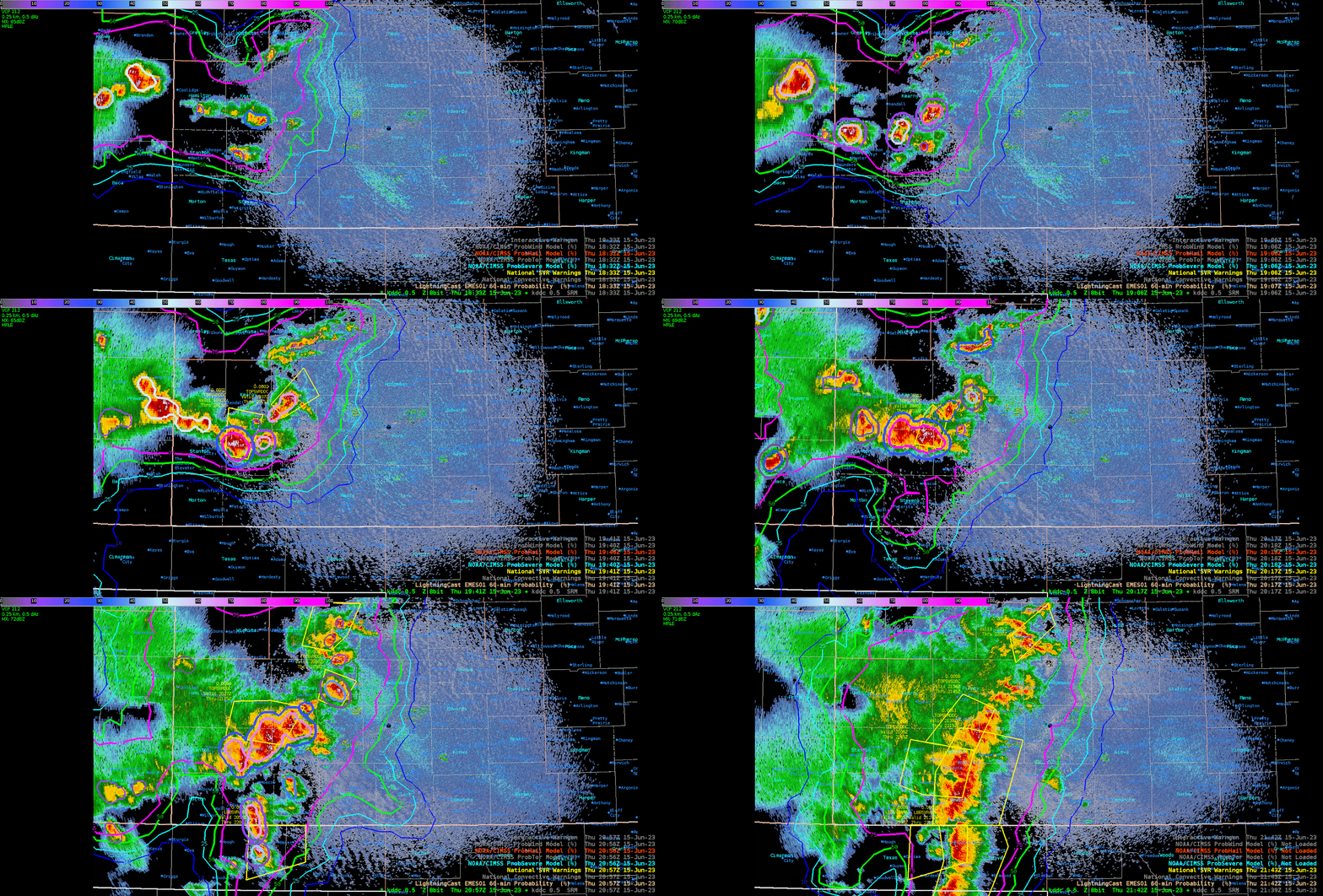
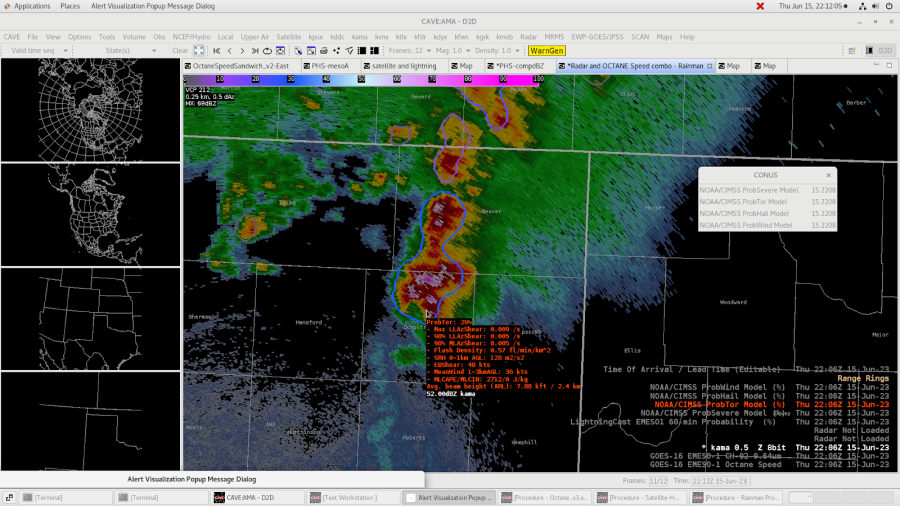
Today we focused on the Pueblo, Colorado  CWA for afternoon High Plains convection. Scattered convection developed across the CWA leading to large hail and damaging winds. The first Severe Thunderstorm formed on our CWA border with Albuquerque and drifting south into their CWA. A second Severe storm developed and tracked north towards our DSS Event in Pueblo, bringing the potential for large damaging hail and strong winds.

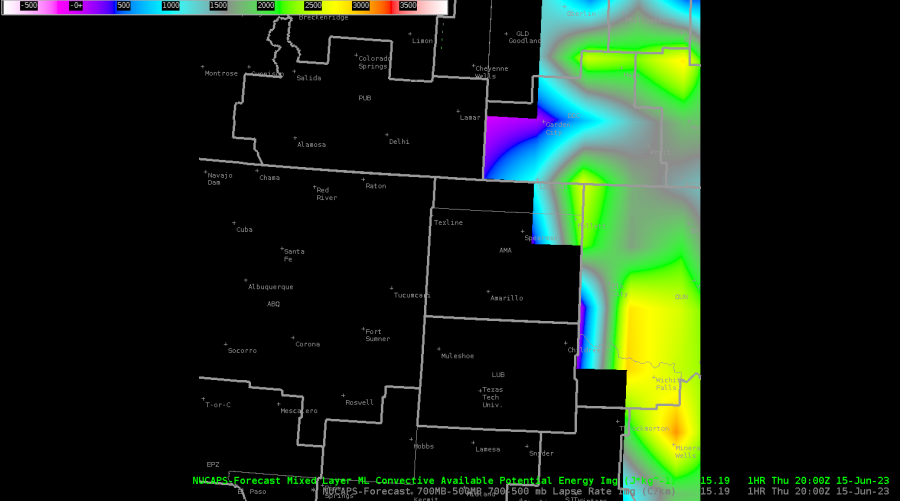
15Z PHS MUCAPE valid at 18Z showed around 2000  to 2500 J/kg for green areas while areas in blue had roughly 1000 to 2000 J/kg.
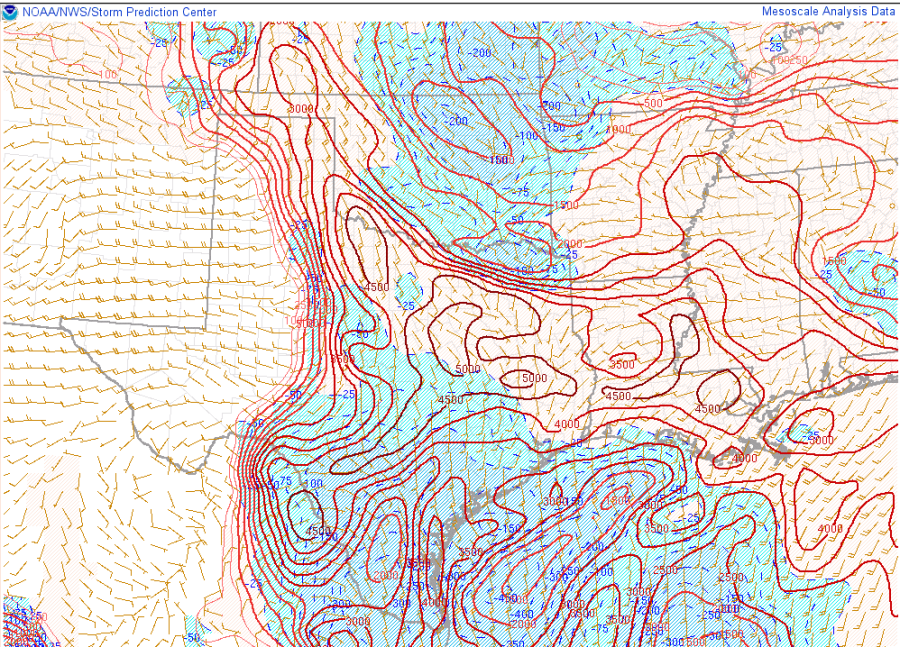
SPC MUCAPE Mesoanalysis valid at 18Z shows similar trends to the 15Z PHS MUCAPE values.

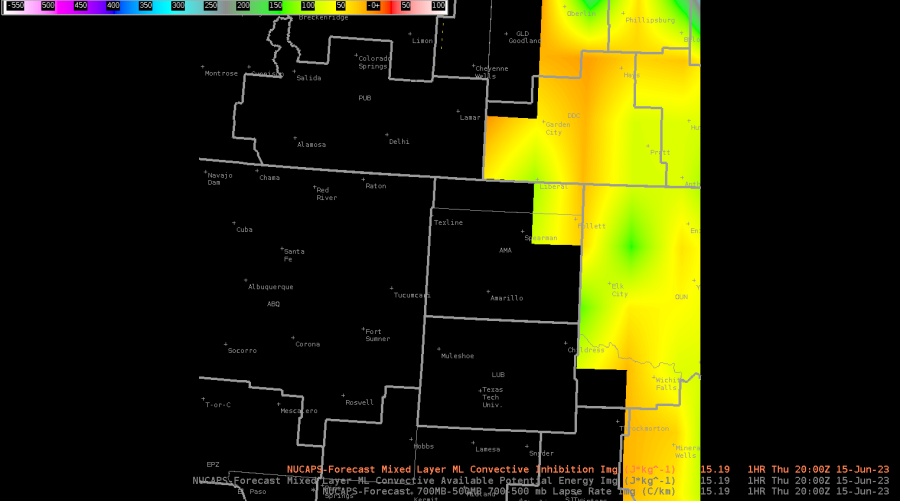
16Z PHS valid at 21Z showed a slight upward trend of MUCAPE in the eastern half of the CWA. 

21Z SPC Mesoanalysis showed increasing values of MUCAPE developing just south-southeast of the CWA, similar to the 16Z run of the PHS shown above. 


15Z PHS STP valid at 18Z showing little overall threat for tornado concerns through early afternoon, for the most part values were less than 0.25. 

SPC Mesoanalysis page showing 18Z STP values similar to the 15Z PHS forecast. 


The image below shows the Octane Speed product on the left and the Octane Direction product on the right, focusing on a cluster of activity near the Jefferson/Douglas County line in Colorado. Picked this screen capture as it showed a wide range in values, mainly for the Direction product. The Octane Speed product shows some speed shear present with the lighter speeds (darker blue, ~5 kts) transitioning to brighter green/a bit of yellow (~30 kts). The magnitude of directional shear was higher, showing direction of motion/divergence ranging from ~170 degrees (core of red area) to ~295 degrees (core of green area).
Below is a animated graphic showing the transition in both products. 

———————————————————————————————-

Chose to grab this Octane Direction product screen capture as it shows an elongated area of storm top divergence through central Colorado.  The red/magenta colors show direction generally from the 170-190 degree range, while the green/yellow colors show values from the 275-285 degree range. The black areas are spots of data dropout, which can occur when the speed shear product drops below 5kts.

———————————————————————————————-

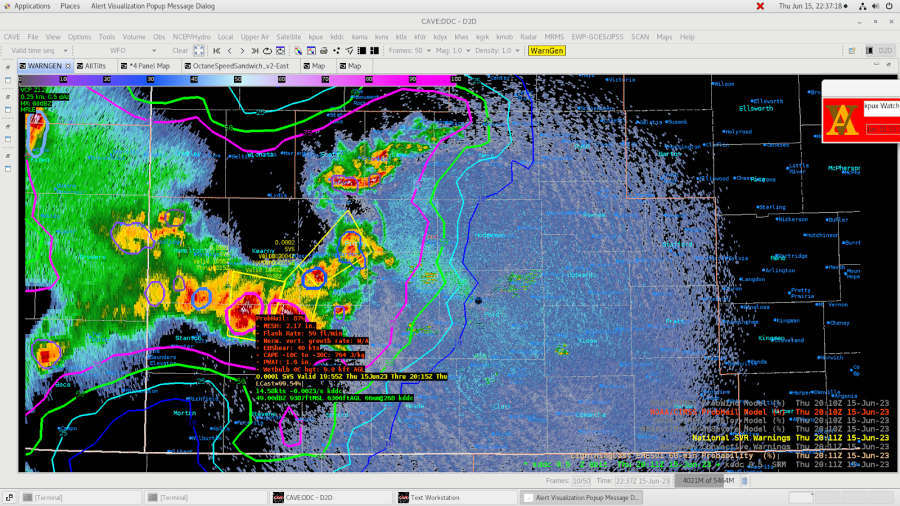
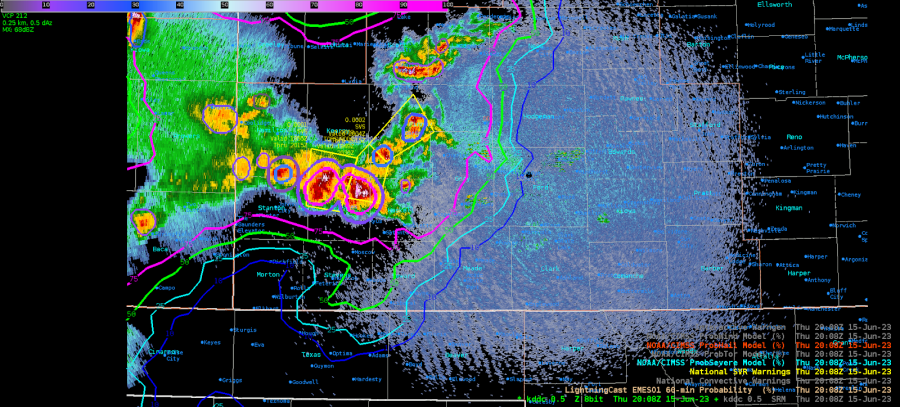
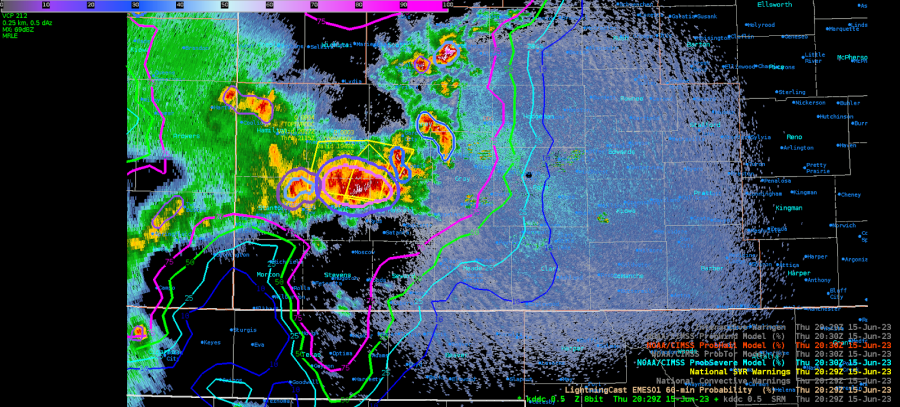
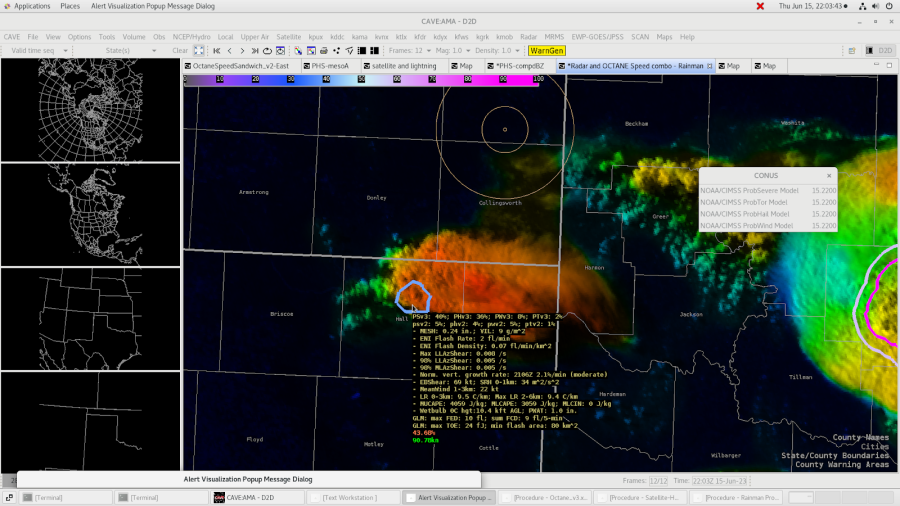
First Severe Thunderstorm Warning issued for this area today came right after 20Z, based on ProbSevere values/time series as well as the Octane Speed Sandwich product.  Probabilities ramped up quickly for both ProbSevere and ProbHail on this storm at the edge of the PUB/ABQ CWA boundary. Octane around “peak” of the storm.Low Level SRM and ProbSvr (0.5 deg slice is about 10.8k ft AGL)Mesh showing 3 inch hail on the border of the Pueblo CWA.

ProbSevere and ProbHail maxed out at roughly 90% while the storm remained severe. This storm eventually moved into ABQ’s CWA.———————————————————-

2nd Severe Thunderstorm Warning – Huerfano County

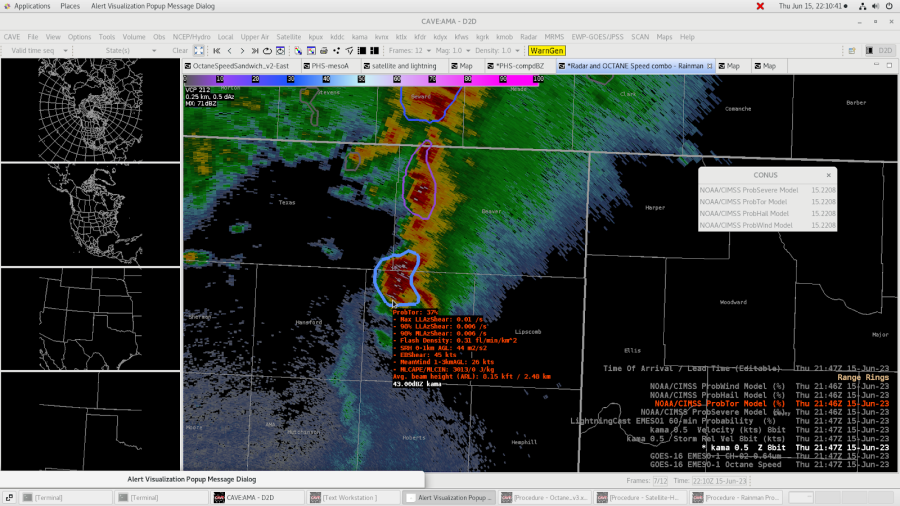
ProbSevere values and time series for 2nd Severe Thunderstorm Warning of the day, readout is at its “peak”…around 2045Z.
Octane Speed/Direction at “Peak” of the storm,  around 2045Z. Directional shear varied from ~205 degrees (reds) to ~285 degrees (greens).
ProbSevere showing the weakening trend of the storm gave us confidence that the storm was in fact weakening.  Octane speed/direction further confirming the weakening trend as colors become more diffuse in nature.

ProbSevere showing continued weakening trend. We decided not to issue another severe thunderstorm warning on this storm based on the trend.

Though this storm showed a weakening trend, it was a short-lived trend, as it still had ~2000 j/kg of MUCAPE and effective shear around 30kts to work with as it tracked farther north.

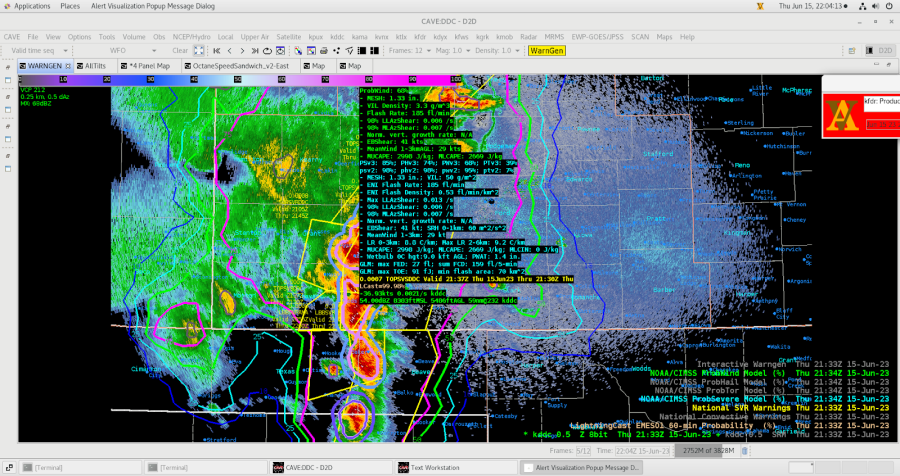
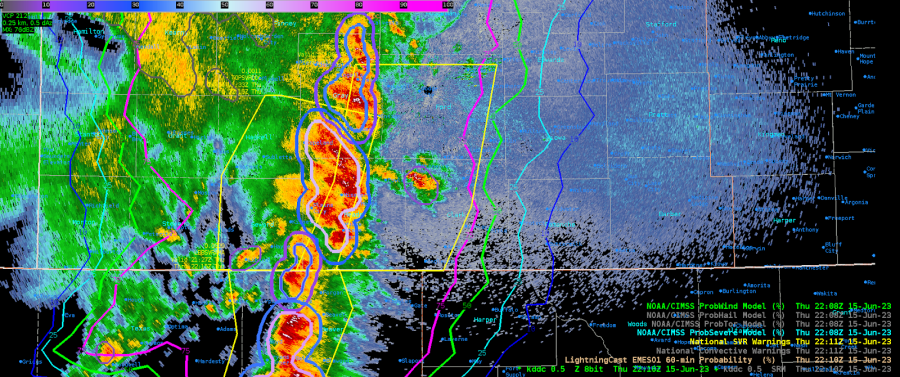
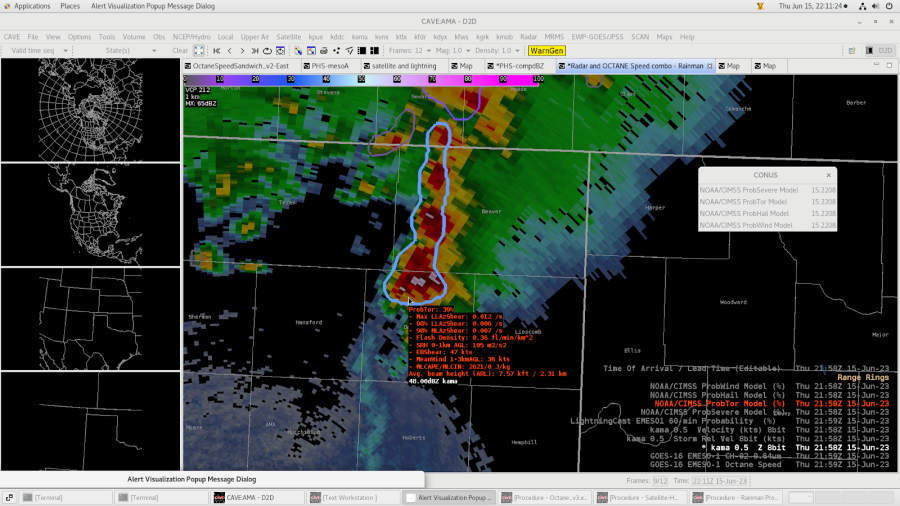
The storm ended up re-intensifying, as shown by the ProbSevere output/time series below. We went ahead and issued another Severe Thunderstorm Warning for very large hail.  An increase in both storm top speed/directional shear was also shown by the Octane product.The level reflectivity images show an impressive core peaking in the 36-40k ft range, shown in the 12.5 deg. slice. MESH showing nearly 4 inch hail south of our DSS event in Pueblo. The event was notified about the potential for large damaging hail.


-Dwight Schrute/Bubbles

Tags: None

LightningCast Over Eastern MT

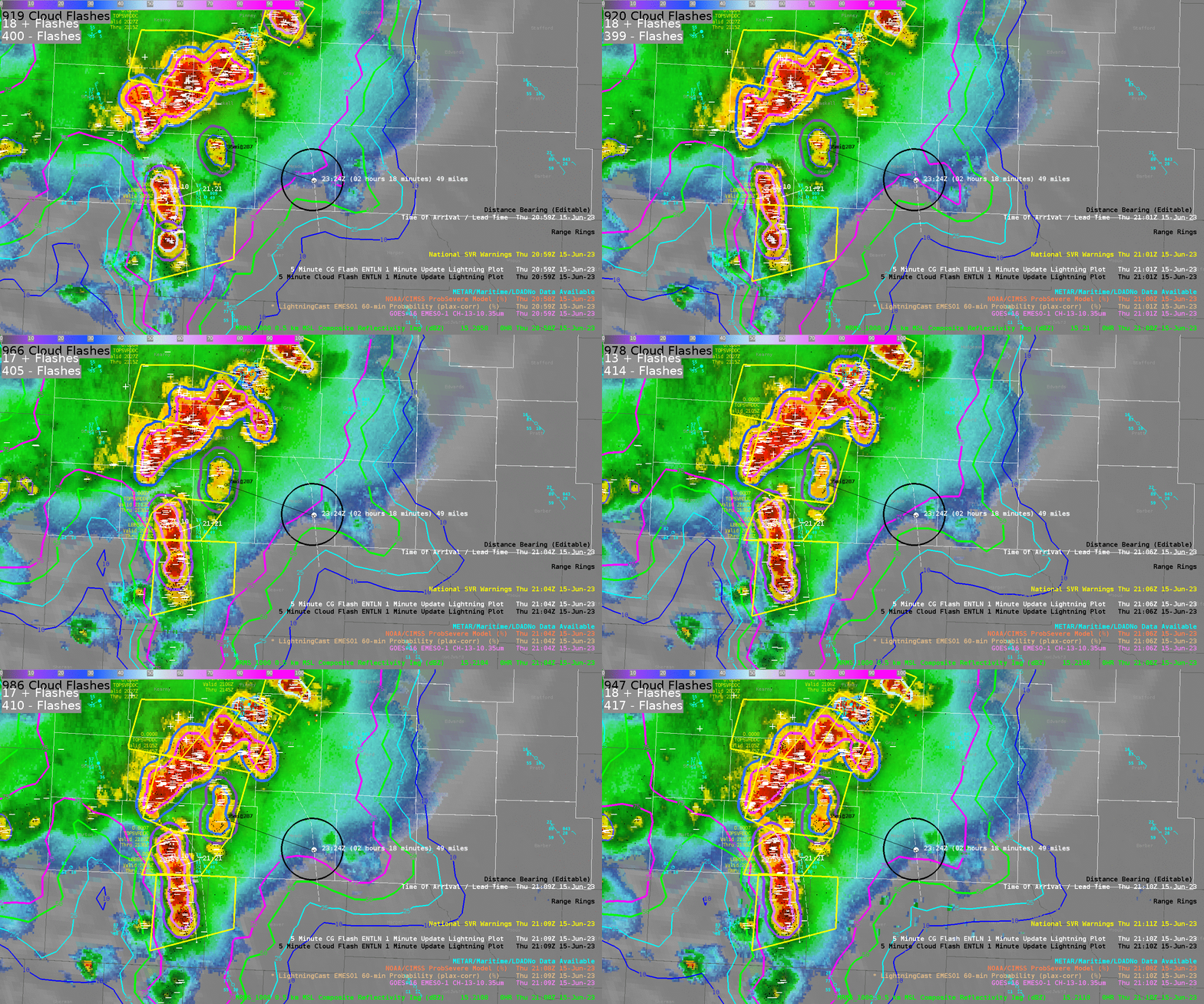
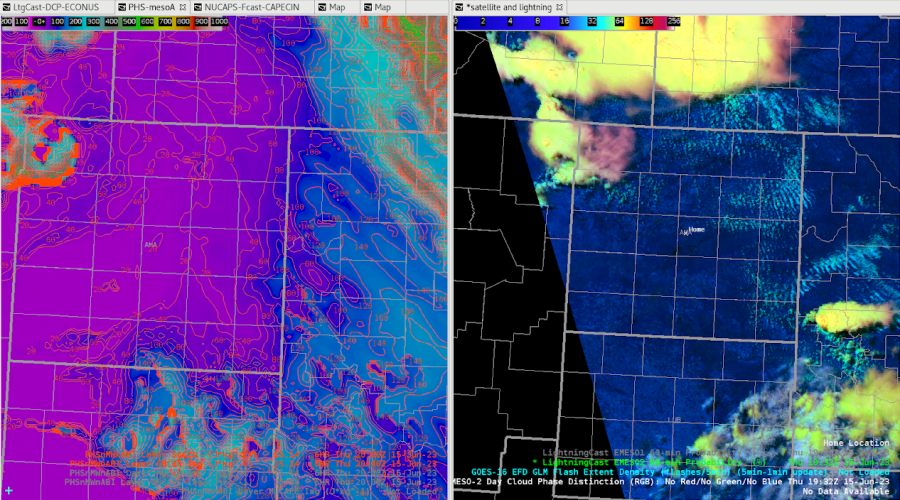
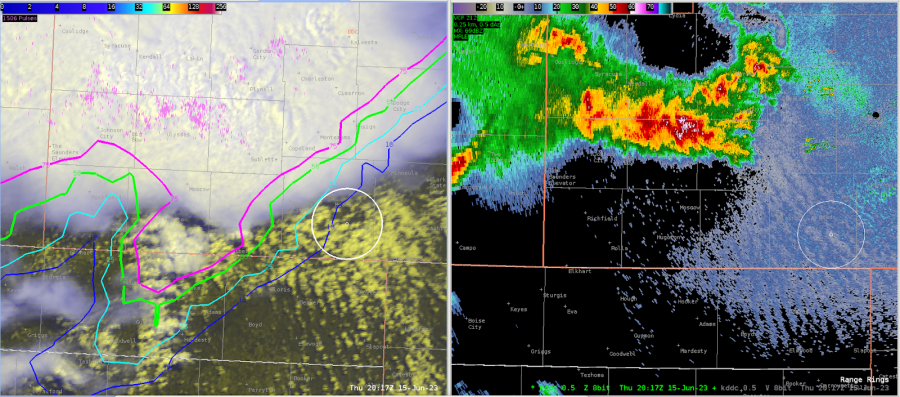
This image shows Day Cloud Phase Distinction, LightningCast, and 5 Minute CG Flash Lightning Plots for NLDN and ENTLN across Eastern MT.  While LightningCast provides a lot of information, it’s easy for it to overwhelm forecasters in situations like what’s shown, especially if other colorful imagery is included.  A suggestion is to give forecasters the option to load LightningCast in 10% increments from 10-90% (10, 20, 30, etc).  Then, forecasters can turn the individual increments on or off depending on the situation (i.e. lots of severe weather can prompt the lower values to be turned off, or partners concerned with the initial start of lightning can prompt lower values to be turned on).  Having the ability to change the color, line style, and line width for each increment would also be nice.

-Champion

Tags: None

PHS Highlights Instability Axis – Elko, NV

PHS Highlights Instability Axis – Elko, NV

High resolution thermodynamic parameters from PHS appeared to be in line with meso-analyzed products from the RAP (SPC Mesoanalysis). The benefit with PHS is the 2km resolution output, highlighting terrain features in the CWA. Composite reflectivity product performed well with expected convection through the afternoon, and helped with the creation of a mock DSS graphic that included up to 3 hours of lead time for an airshow in Wells, NV.


PHS SB CAPE at 19Z prior to CI

PHS Comp Refl at 18Z

PHS Comp Refl at 20Z

Tags: None

Octane Speed and GLM Act as Nudgers for west central Elko County Severe Warning

Octane Speed and GLM Act as Nudgers for west central Elko County Severe Warning

The Octane speed sandwich product highlighted a minimum in velocity in a rapidly developing thunderstorm across west central Elko County, NV, an indicator of strong outflow in the anvil on upwind side of the developing cell. An analysis of 1-minute GLM data also indicated a rapid increase in flashes for the same storm. These indicators acted as strong nudgers for the severe thunderstorm warning decision making process.

Octane Speed Sandwich indicates explosive convective development in west central Elko County. 2027Z to 2054Z

Visible satellite imagery coupled with 1-minute GLM depict rapid increase in lightning in west central Elko County. 2012Z to 2054ZTest

– Rain-Free Bass Guitar

Tags: None

Octane and ProbSvr Highlight Elko County Supercell

Octane and Prob Severe Highlight Elko County Supercell

As thunderstorms continued to mature through the afternoon, the Octane speed sandwich continued to highlight an increase in downwind velocities from an isolated supercell across central Elko County. In tandem with the increased downwind velocities, a minimum in velocities occurred on the opposing upwind side of the strengthening supercell.

ProbSevere v3 highlighted the increasing trend in severe probabilities and in tandem with the Octane speed sandwich product, and solidified the decision to keep a severe thunderstorm warning in effect for the central Elko County supercell. Prob severe values were quite a bit higher with v3 compared to v2 (see details below). The decision to not issue a tornado warning was due to the high LCL values in the region (>1,800 m AGL), despite increased ProbTor values maxing out around 17% for this supercell.


Octane speed sandwich for severe-warned storm across central Elko County Prob Severe v3 at 2028Z for severe-warned supercell across central Elko County

V-SRM-HC-SW at 2110Z for central Elko County severe-warned supercell

ProbSvr v3 at 2116Z for central Elko County severe-warned supercell – 82% v3 vs 37% v2 Probhail 73% v3 vs 30% v2; Probwind 14% v3 vs 42% v2; Probtor 17% v3 vs 2% v2

Tags: None

PHS PreStorm Environment

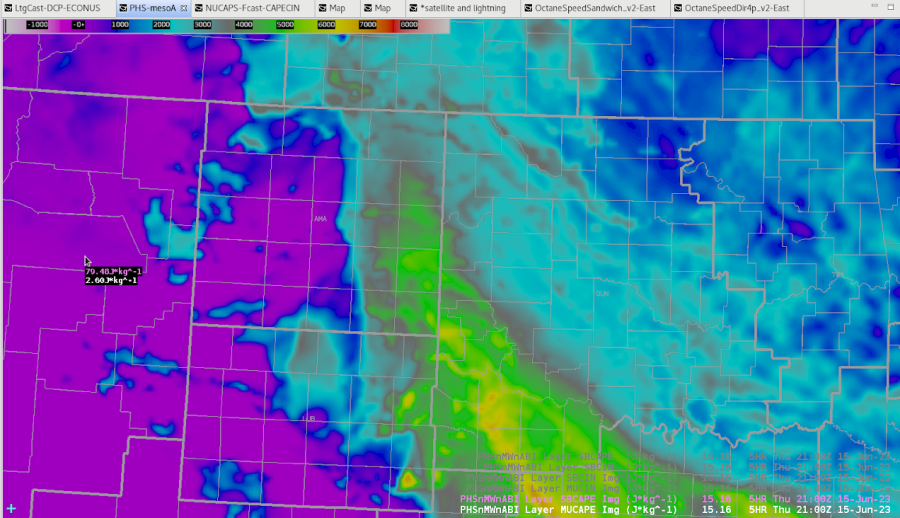
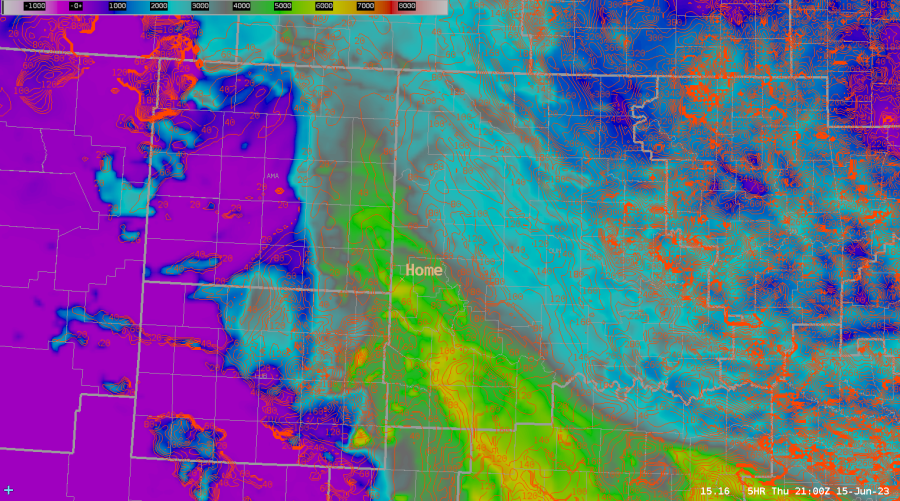
Looking at the pre-storm environment using PSH we can see higher MUCAPE in the eastern most portion of ABQ CWA. We also looked at the SHIPS model on the PHS website and saw high number also in the eastern region of the CWA. That indicated to use the best chance of storms would be in the eastern most half of New Mexico and the biggest threat would be hail. PHS did excellent in this event. We have been seeing a few good hail cores in the area of the highest CAPE while areas to the west of of higher CAPE has see a storm or two but nothing close to severe.   .-Thunderstruck

Tags: None

Octane Captures Intense Updraft Over NV

Here is a 1 hour loop (1-minute increments) of strong convection over NV.  The top image is Octane Speed with DMW overlayed.  The bottom image is MRMS 0.5 km MSL Composite Refl.  Notice an intense updraft develop in the center of the screen.  The blue indicates lower winds while green/yellow are higher.  Winds get as low as 2 kt in the anvil, while just downstream of it they are 30-40 kt!!!  The DMW confirm this as they are generally within 5 kt of the Octane speed.  Shortly after this happens, reflectivities rapidly increase.

-Champion

Tags: None

Differences in low level moisture between NUCAPS and guidance

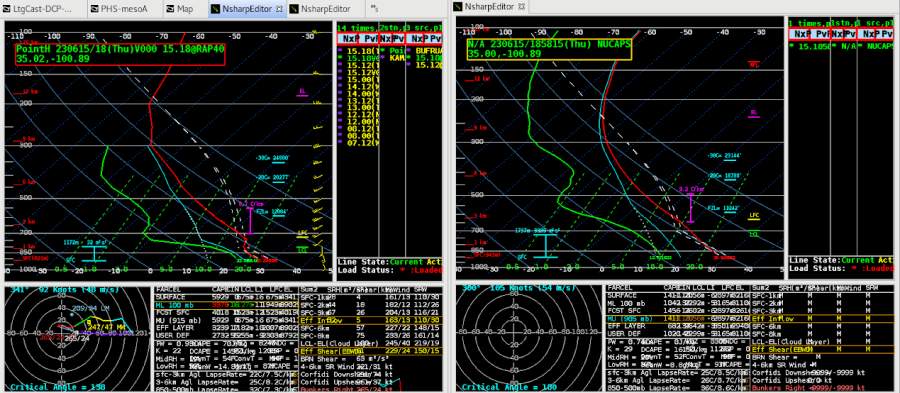
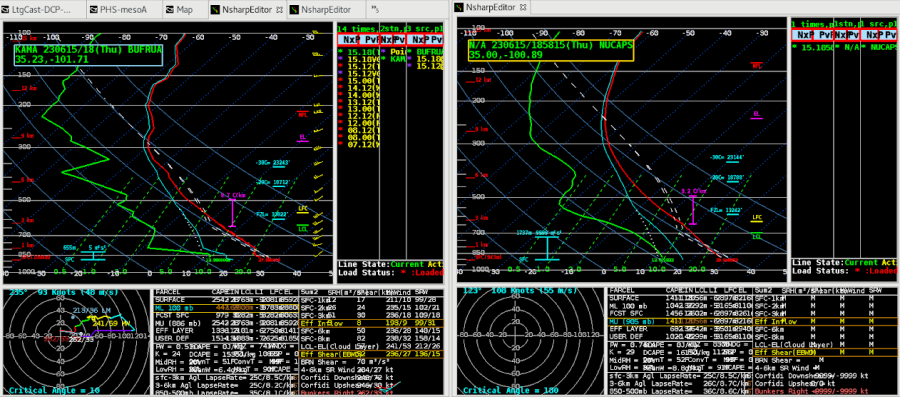
The NUCAPS sounding pass showed greater MLCAPE than the RAP sounding shown as well as the RAP output on the SPC Mesoscale analysis. A difference may be how the RAP is mixing out low level moisture, as it has a lower mean mixing ratio (8.4 g/kg) than both the NUCAPS pass and the NAM forecast sounding at the same point (10.1 g/kg and 10.4 g/kg respectively). The NAM is known to have an undermixing bias but may be closer to reality in situations like this where the surface isn’t quite so hot and dry, giving more confidence to the NUCAPS instability.  Convection this afternoon is building into this area of instability, which makes the analysis important as it could play an impact on the magnitude of severe hazards.

-Joaq 

Tags: None

Storm Top Divergence Progression in a Severe Storm With Octane Products

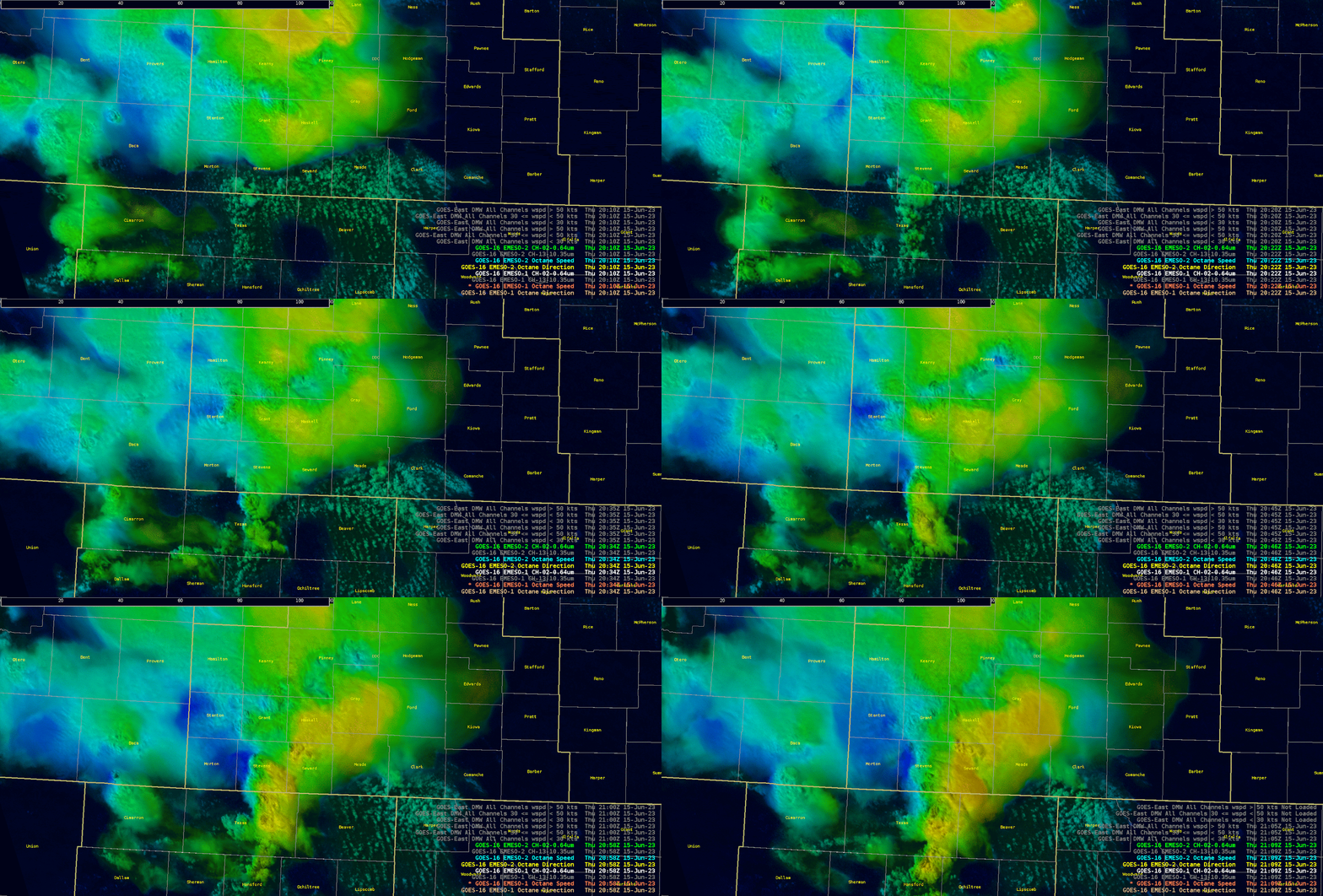
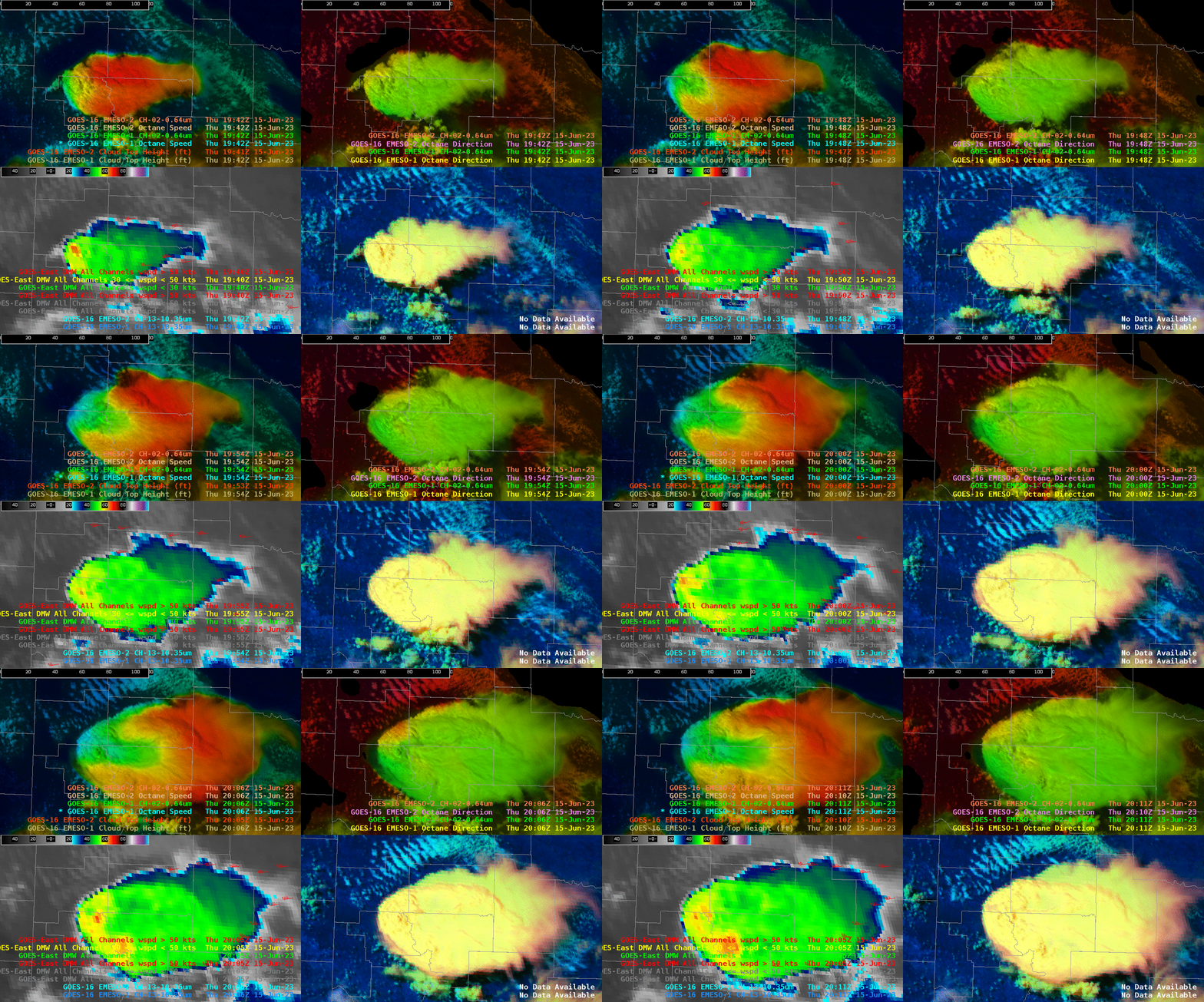
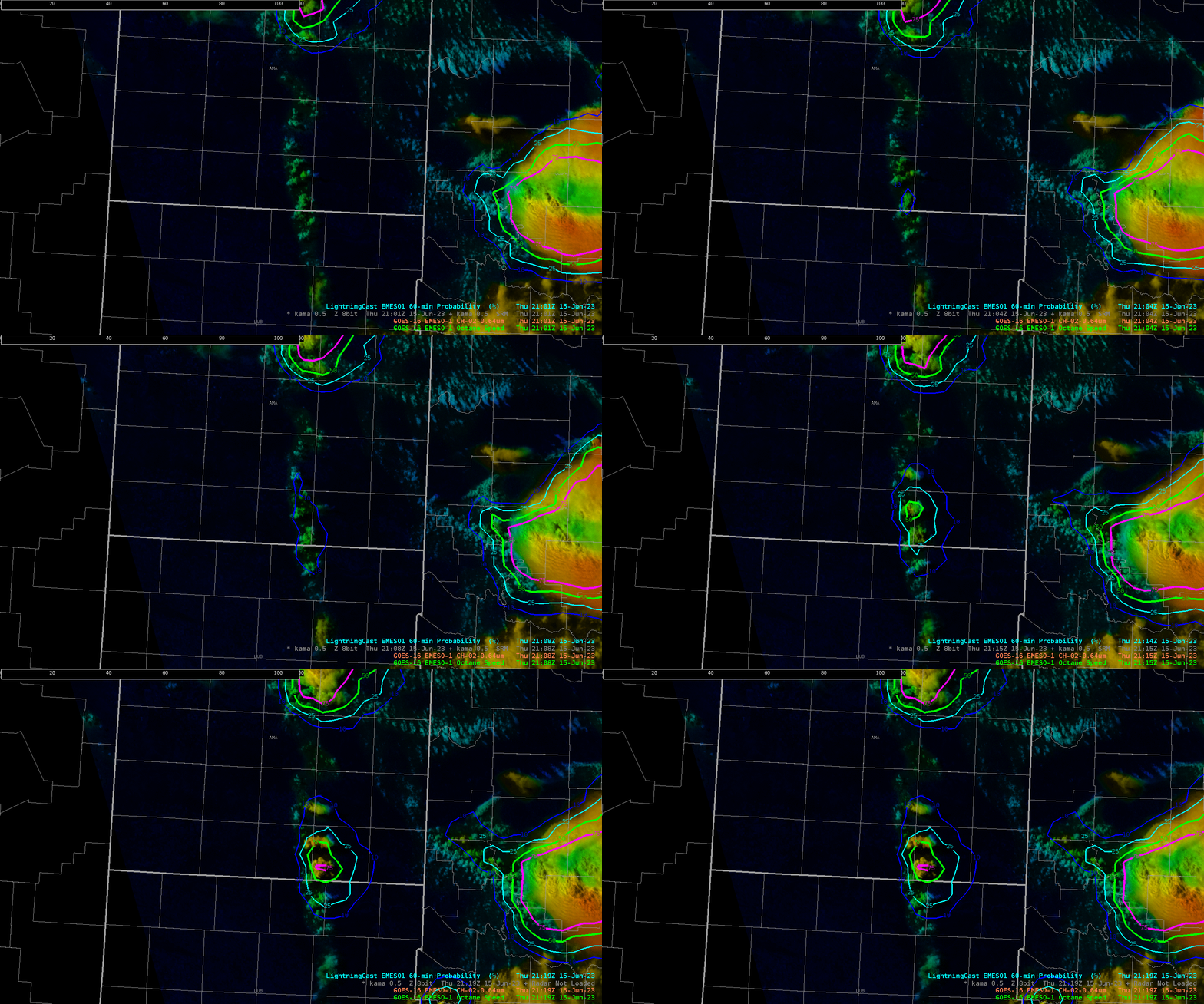
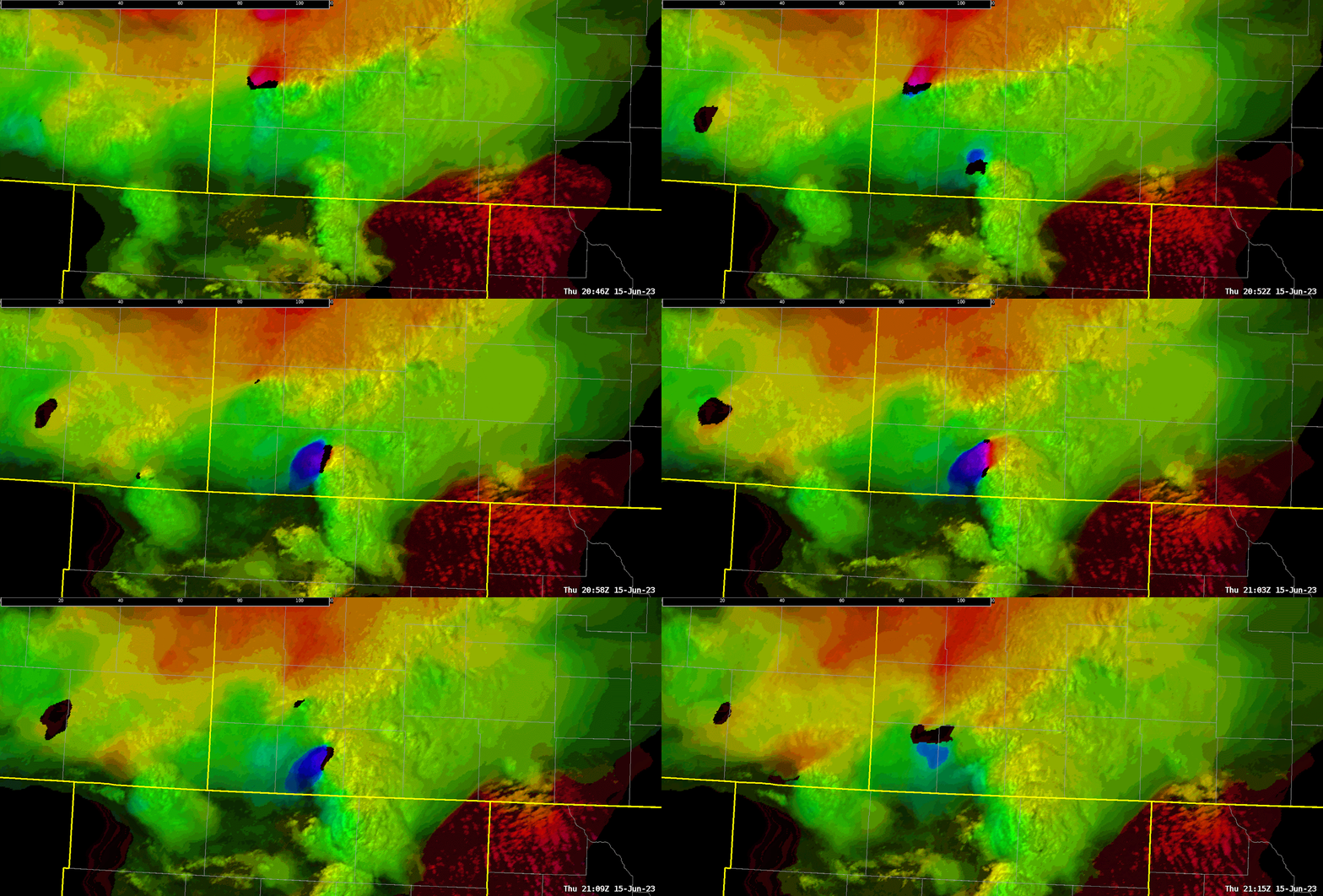
Shown is the progression of developing tower to severe storm with strong storm top divergence on the thunderstorm over the Colorado/New Mexico border. From around 1940Z to 1955Z  the Octane Speed showed the development of storm top divergence while both versions of ProbSevere increased in severe probabilities. The Octane Speed product then showed the upshear side of the storm become “stationary” as the storm top divergence strengthened even further after 20Z, lining up with ProbSevere V3’s signal that the storm had become severe.

-Joaq

Tags: None

Finding The Low Level Moisture Axis From The Octane Direction Product


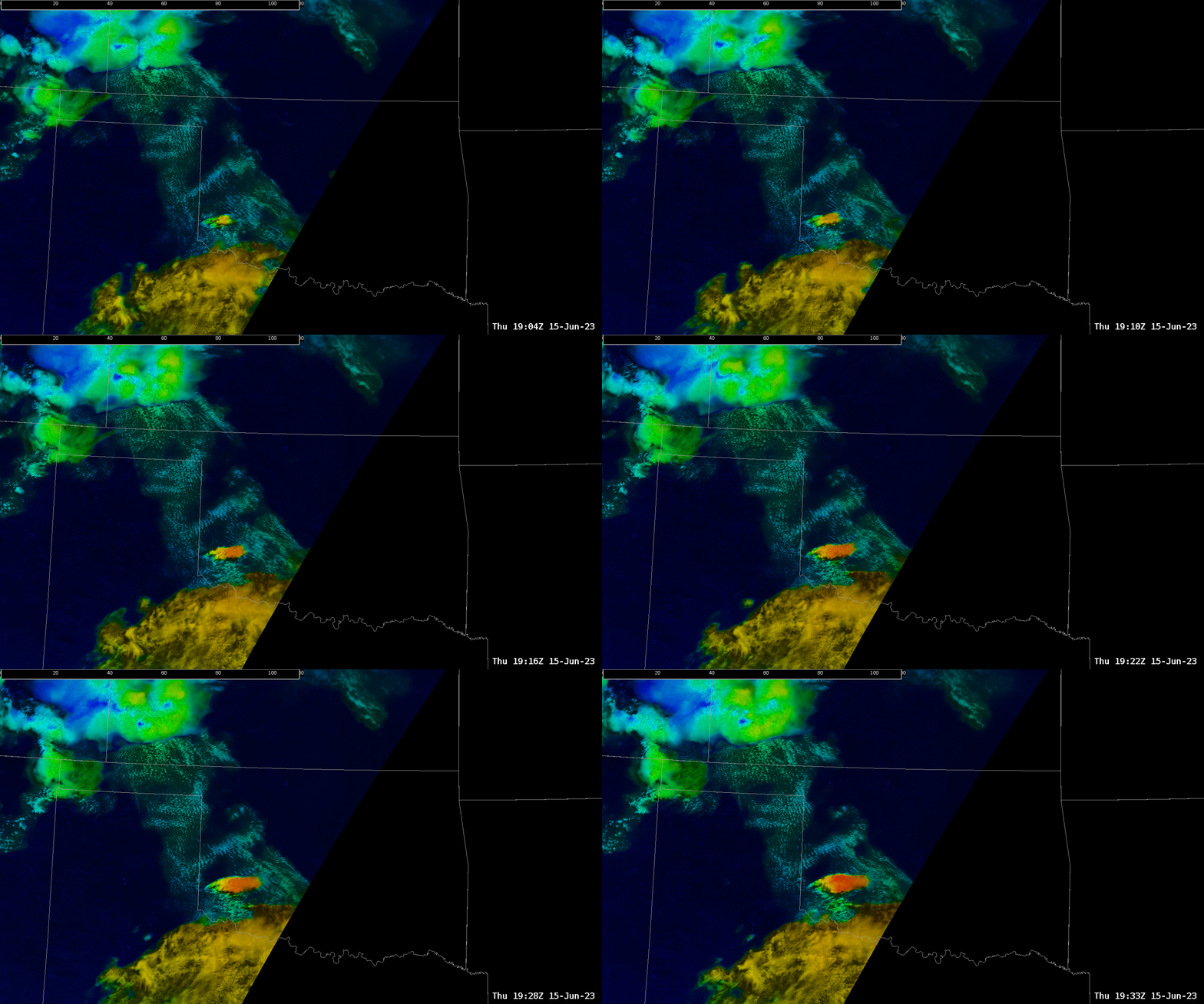
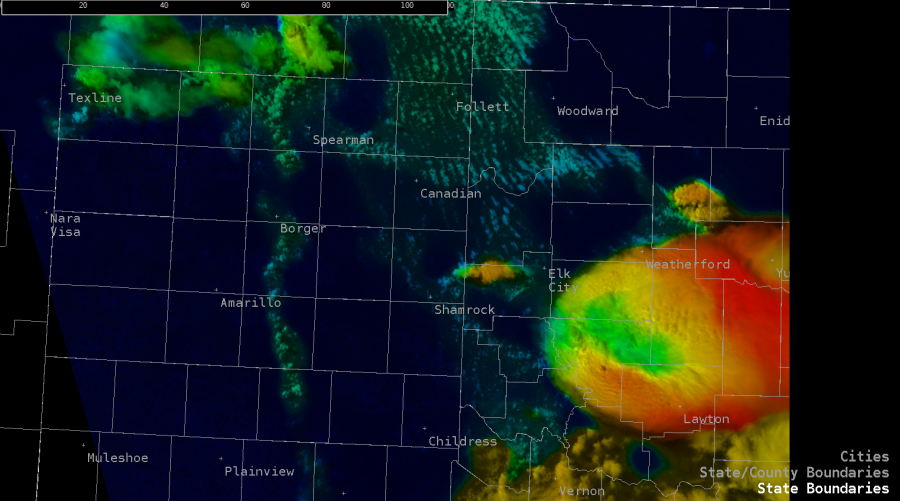
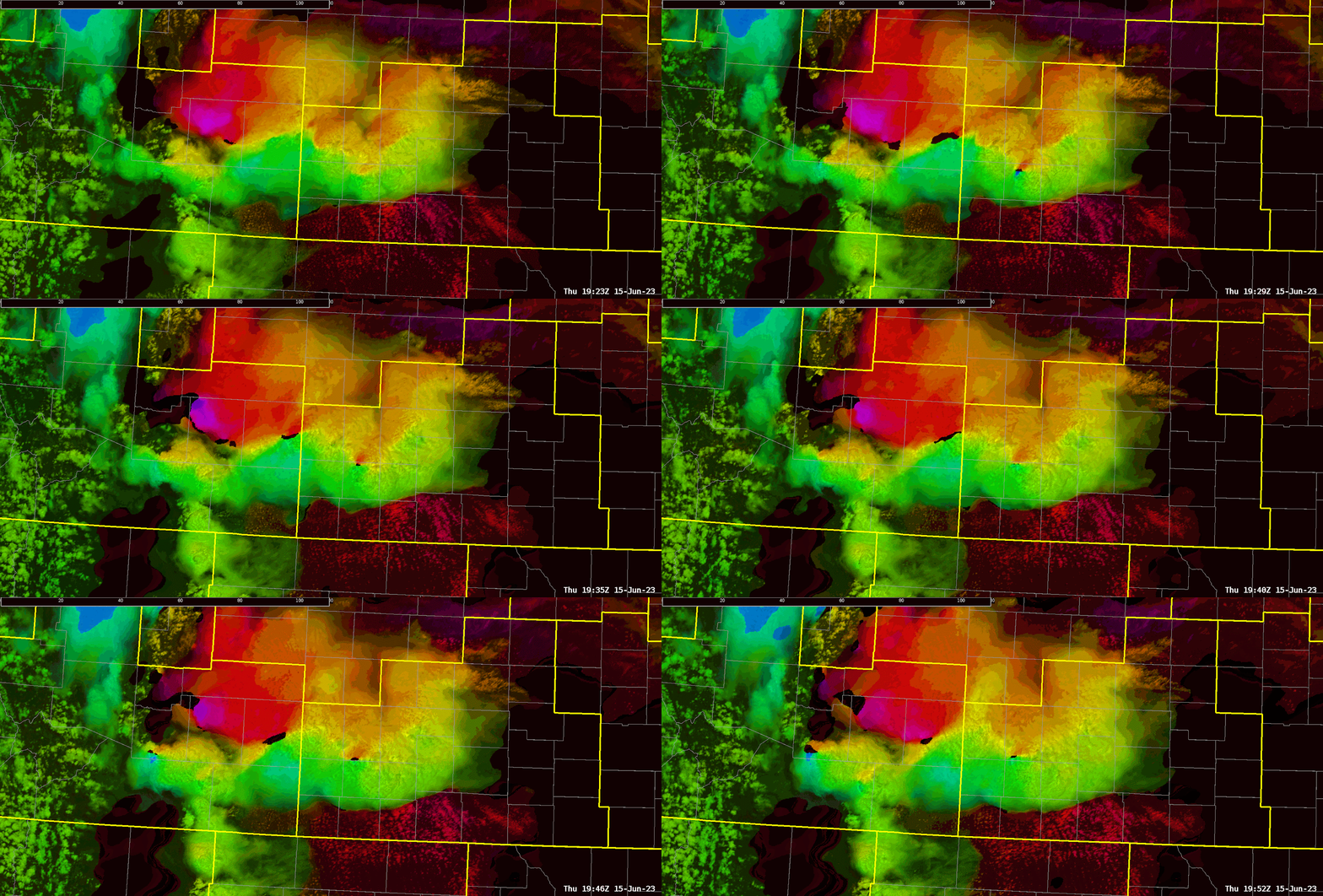
The 19Z Octane Direction product depicts the low level southerly-flow  moisture axis well with the  the red/purple hues of the shallow cumulus from northeast New Mexico through the AMA and LUB CWAs. This clashes well with the westerly greens shown from the maturing convective towers and anvil clouds coming off the ABQ terrain, lining up with the westerly flow aloft. It’s difficult to see the separation from where convection is rooted currently in north central New Mexico compared to where the southerly moist axis is to the east. That said, it’s fair to expect a more favorable convective environment within that moist axis for thunderstorms to move into and strengthen later this afternoon or evening.

-Joaq

Tags: None