Can PHS Improve Mesoanalysis and Near Term Convective Forecasts?
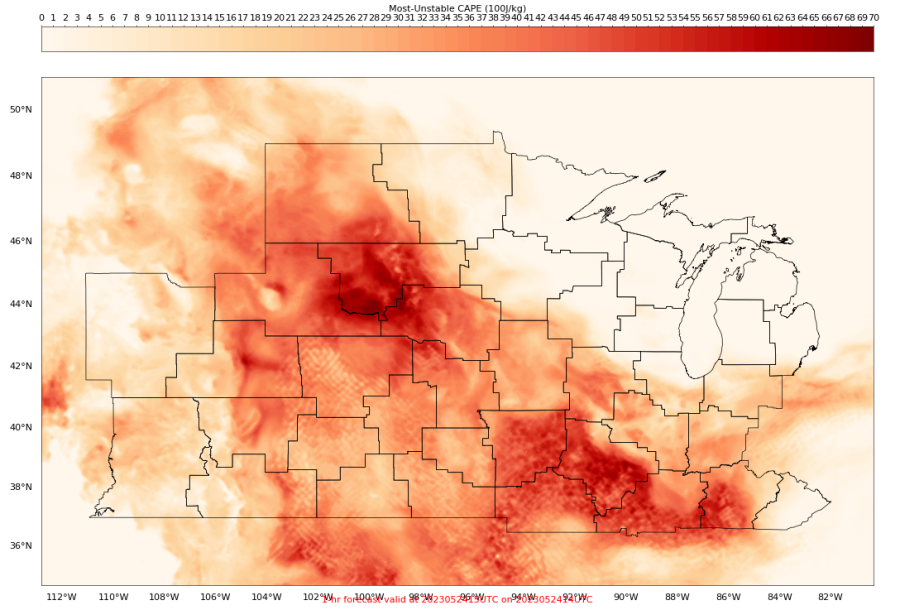
A large portion of the MKX CWA was included in a MDT severe risk, so by the start of the operational period, we had to assess the evolving severe threat spreading in from the west. Meanwhile, our DSS event was the Madison Jazz Festival, which entailed a focus specifically on south central Wisconsin. The PHS CAPE forecast appeared to be a noteworthy improvement from the CAPE fields on the SPC Mesoanalysis, along with the short-term forecast on that page.
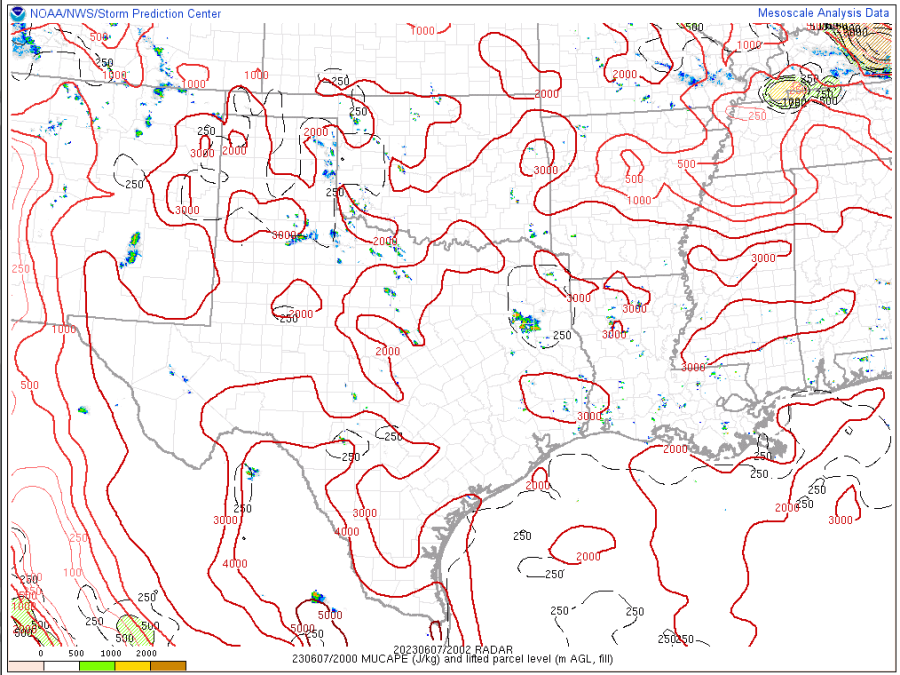
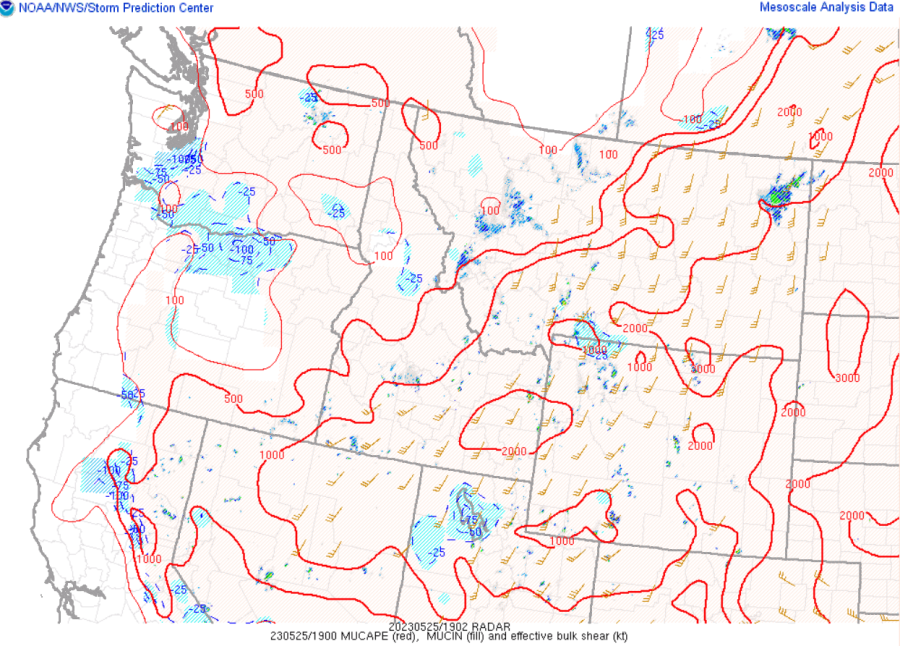
Below are the 18z through 20z plots of MUCAPE, MUCIN and effective bulk shear from the SPC Mesoanalysis page.
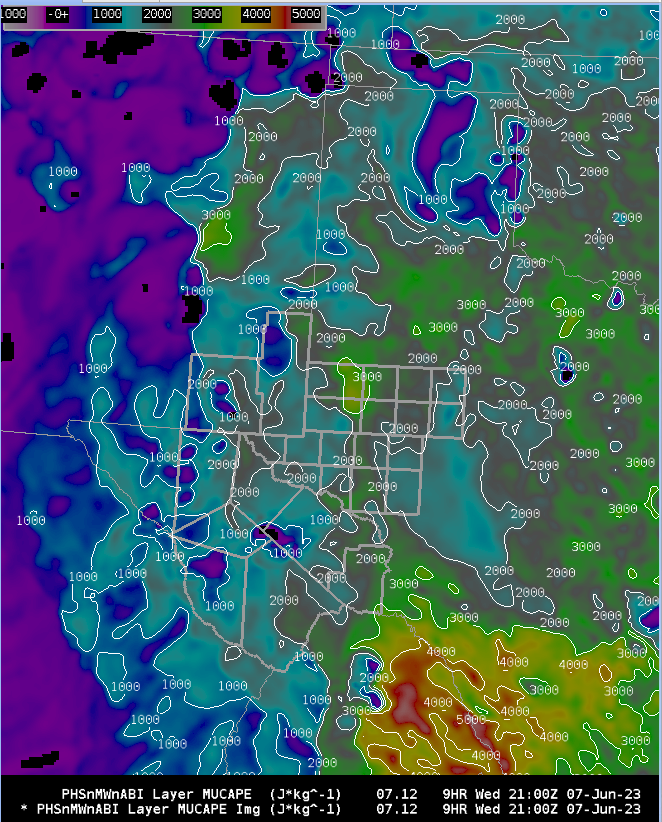
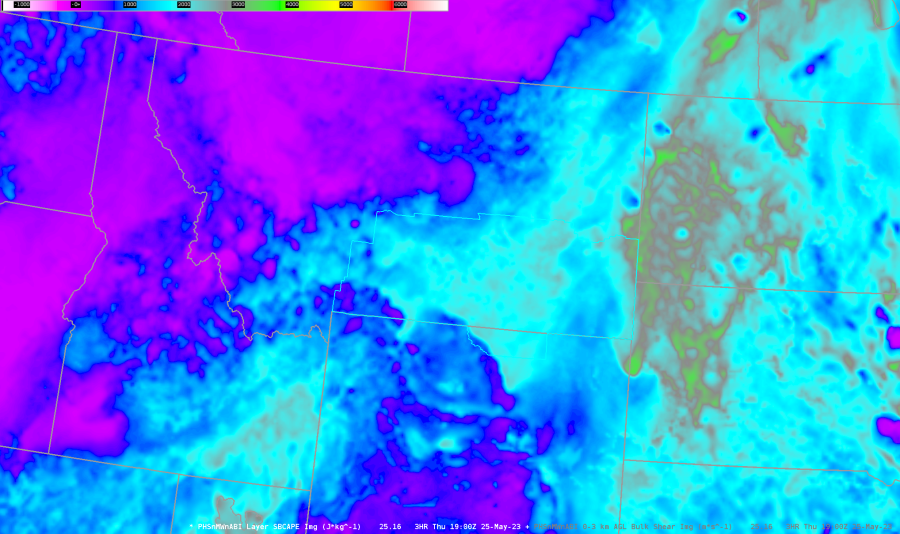
Compare the above images with 4000 J/kg of uncapped MUCAPE to the PHS MUCAPE initialization at 18z and 2-hour forecasts (19z and 20z) below.
As you can see, while the SPC mesoanalysis was indicating 4,000 J/kg of uncapped MUCAPE, the PHS forecast showed CAPE decreasing across central and south central Wisconsin. This was an important and helpful piece of information for our DSS content for the Madison Jazz Festival.

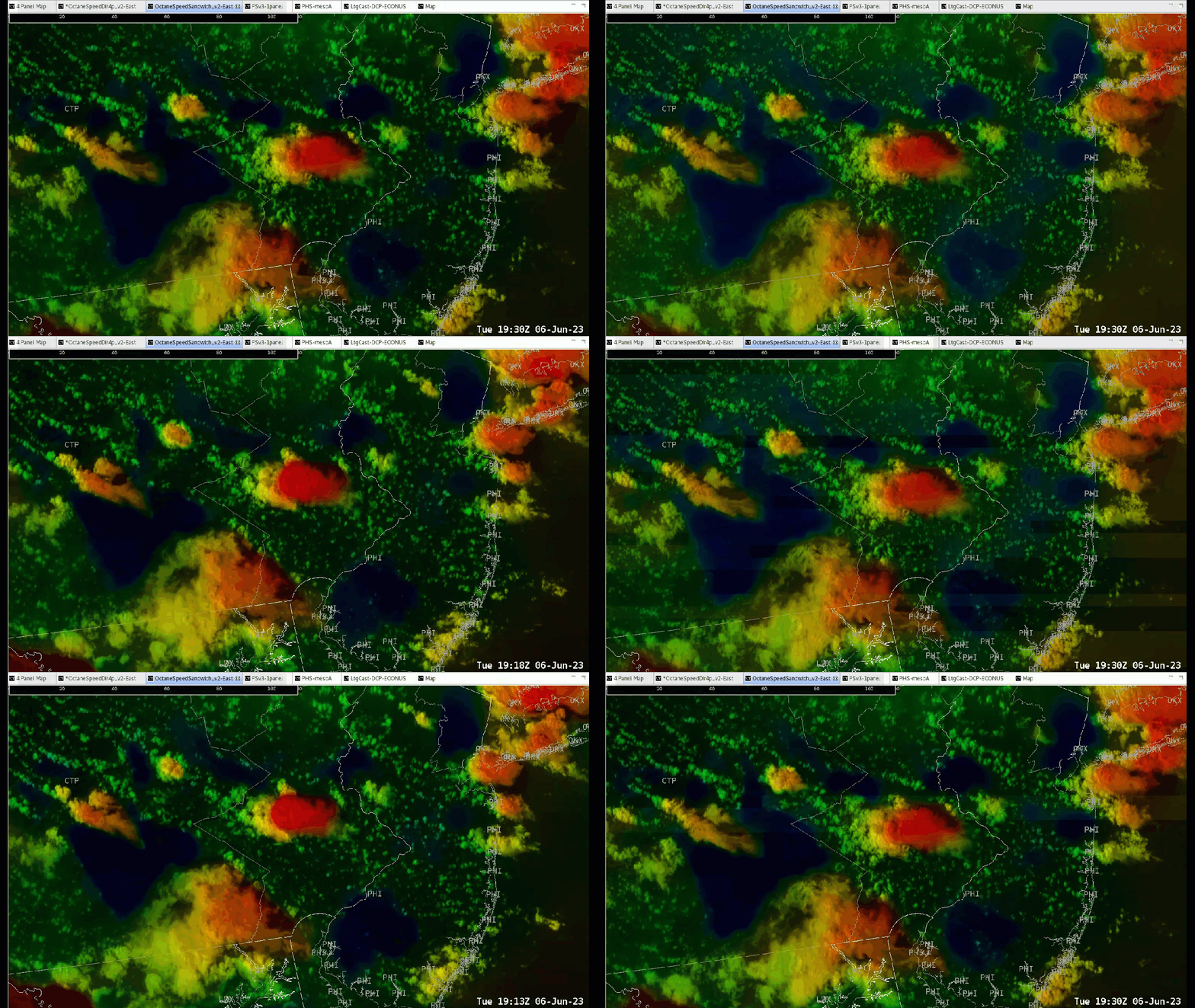
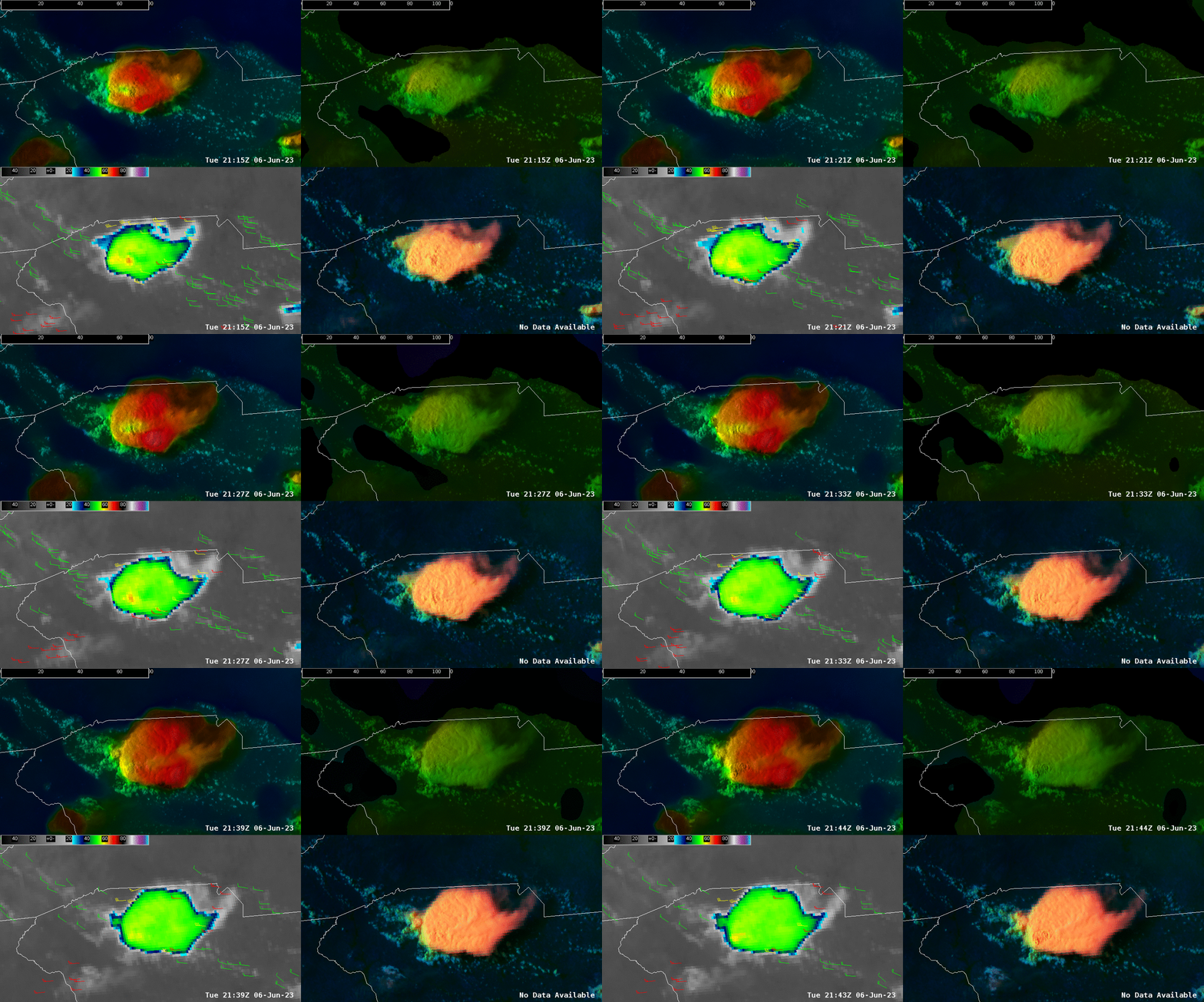
The Day Cloud Phase RGB images below back up the PHS forecast vs the SPC mesoanalysis, as relatively flat Cu field over our area of interest actually dissipated between 20z and 22z.

Based on the PHS forecast combined with satellite analysis, we were able to focus the convective threat for the Madison area toward 6PM and onward, tied to the stronger forcing and better moisture arriving from the west where the ongoing convection resided closer to the cold front. It appears that the PHS sampling of moisture in the column applied to the near-term forecast strongly outperformed the SPC/RAP Mesoanalysis model background and OA algorithm.

Differences between the LightningCast (LC) CONUS and LC Mesos

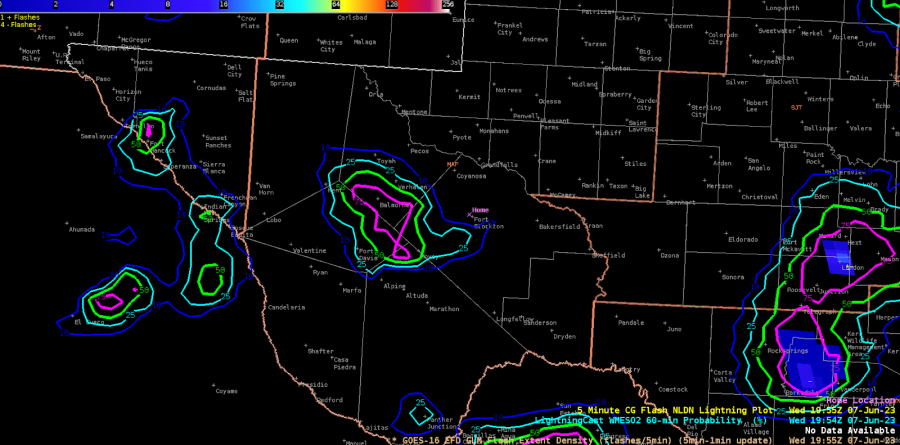
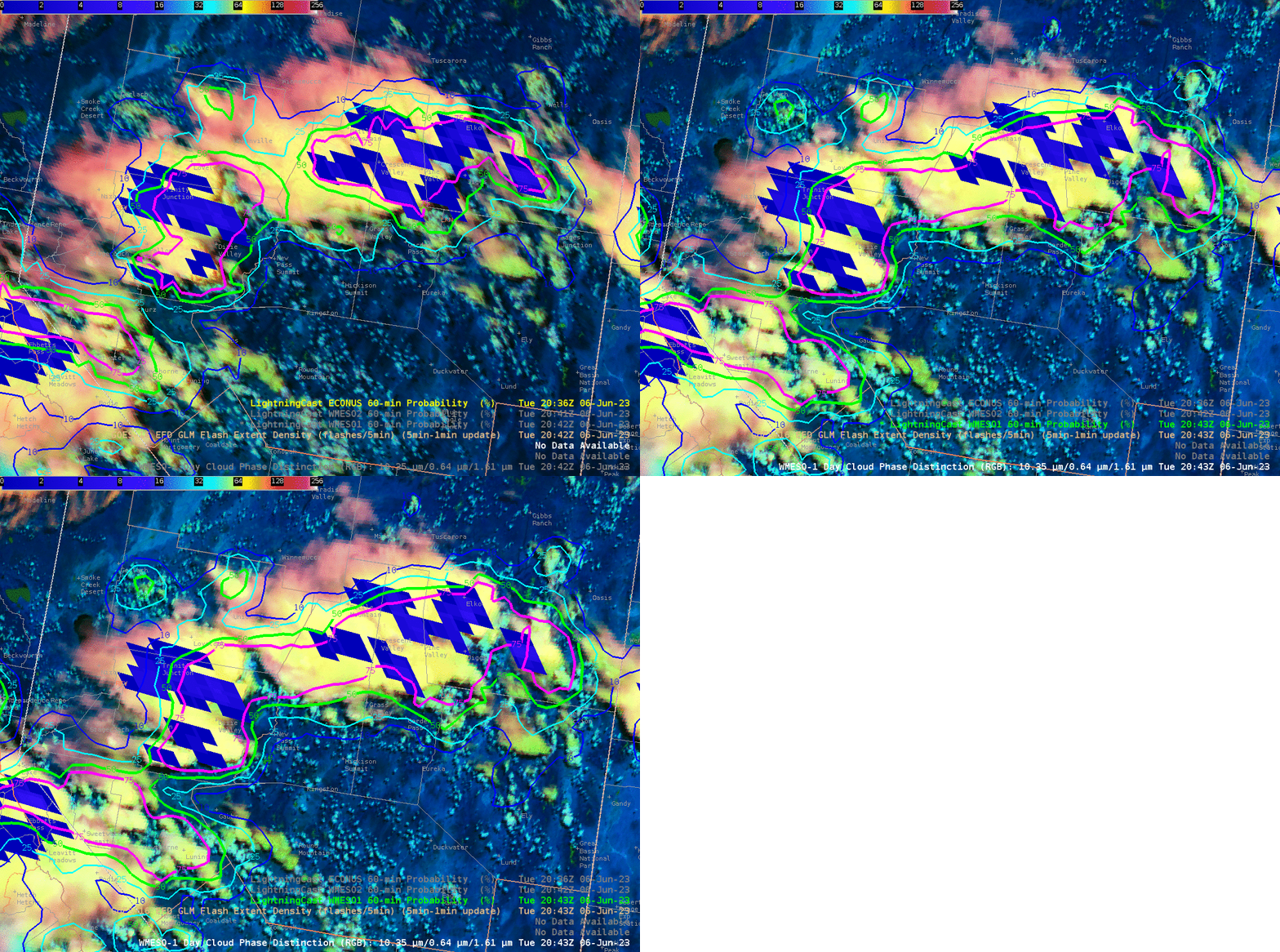
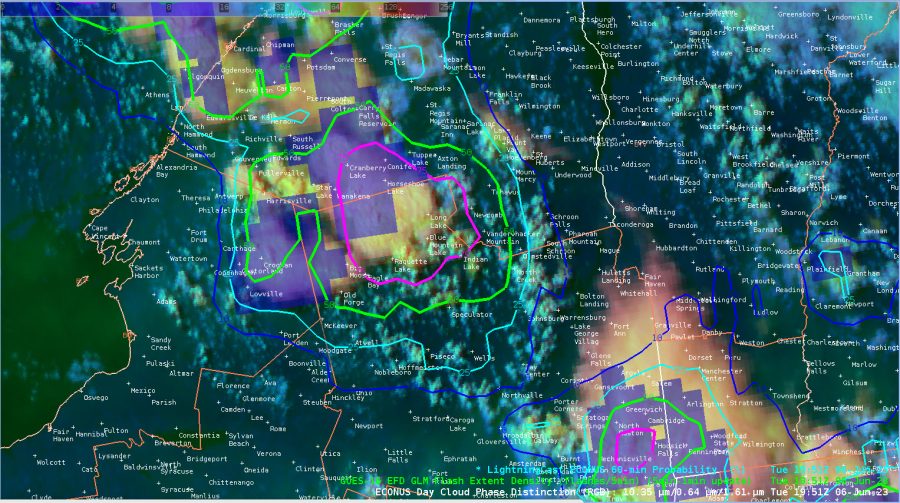
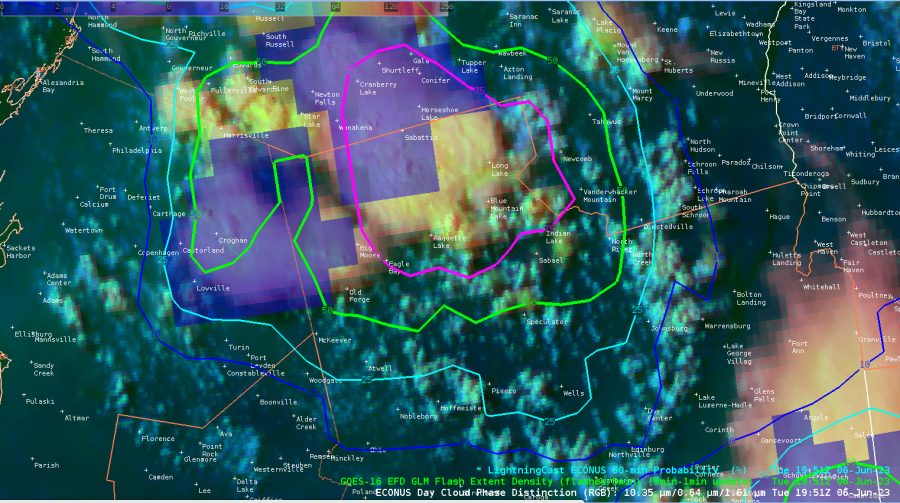
Note below the CONUS scale (1st image) and Mesos (Meso Sector 2 on 6/15) had a different depiction of the lightning probability over northeast Iowa at 1911z 22Jun15. This was due to the time for a CONUS GOES-East scan to complete, vs. the much shorter time for a Meso sector, which in turn affects the LightningCast model. This is something to keep in mind when using the product.

ProbSevereV3 Trends for Severe Convection in Western/Southwestern Wisconsin

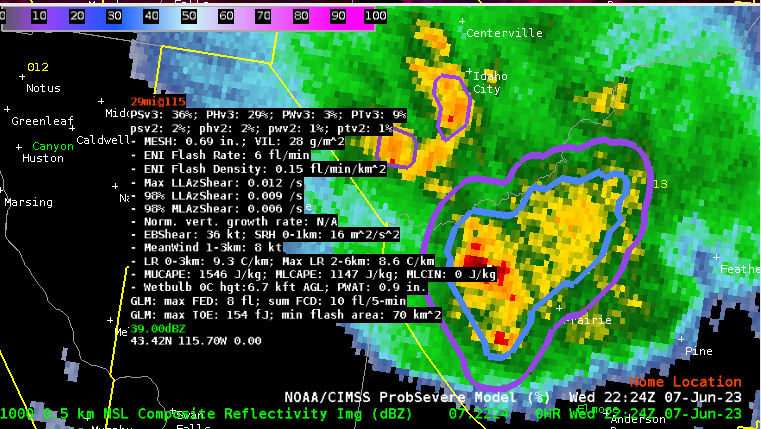
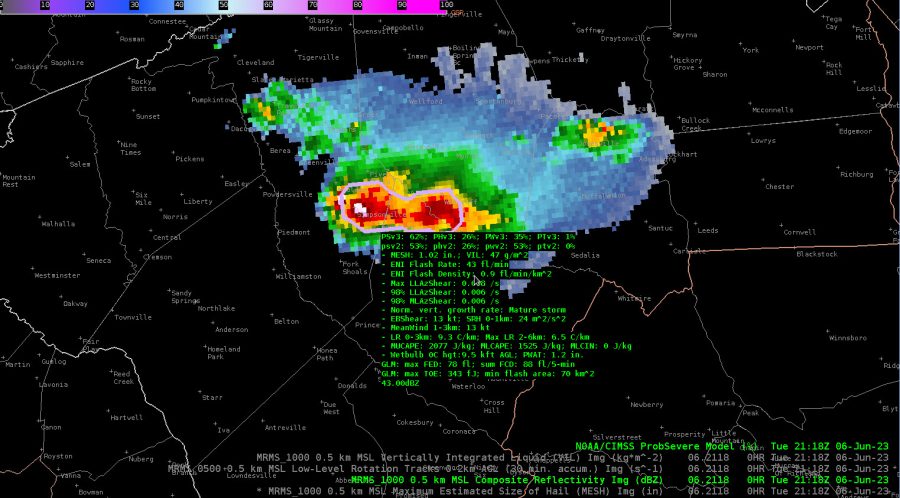
At 2106z, the ARX office had recently issued a Tornado Warning (2102z) for the northern cell with a high % on PSV3 and PTV3, per the noted superior calibration of the updated model vs. the V2. Could the PSV3 and PTV3 trend on this storm have assisted the radar operator in an increased lead time? As you can see below, starting at 2045z, there was a sharp upward trend in the ProbTor, to near 40% prior to 21z. At the least, this tool appears to be an excellent situational awareness tool, and may even be able to help lead time in some cases. It helped us in the MKX CWA regarding downstream warning issuances. In the event of an unexpected radar outage in a sparse radar coverage area, environmental analysis plus satellite interrogation with the utility of PSv3 could support successful radar warning ops in a less than ideal scenario.

– Hurricane84

Situational Awareness and Lead Time with LightningCast and ProbSevere/Tor

Today’s experience landed us in MKX monitoring convective development potential across the western portion of the CWA, with a line of storms ultimately moving in from the west, and some risk of discrete cells persisting even after we ceased the experiment.

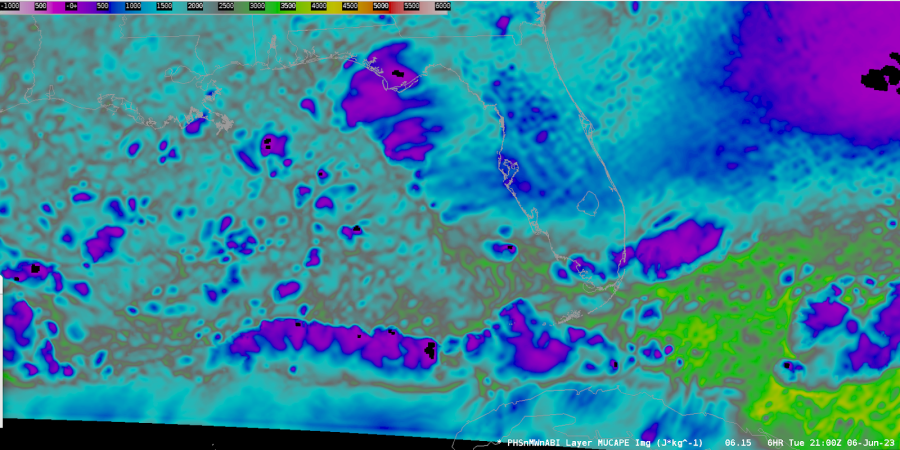
I took the opportunity today to set up procedures overlaying PHSnABI indices (CAPE) with satellite imagery (e.g. Day/Cloud Phase or Viz), to see how well it corresponded with convective development. Unfortunately I didn’t grab a screenshot, but it was a nifty display that I hope to use again. PHSnABI suggested that CAPE in some areas of the CWA was not as high as the SPC mesoanalysis or RAP suggested. We tried to investigate this using a combination of NUCAPS and model soundings and RAOB, but couldn’t figure out a reason for the CAPE depression before incoming storms grabbed our attention. Notably, the indices derived only from GOES agreed with PHSnABI about this depression, though we couldn’t figure out if it was correct. It seems likely the GOES ABI was driving the PHSnABI result.

My main takeaway the rest of today is how useful ProbSever, ProbTor, and LightningCast can be with approaching/developing convection.

LightningCast, combined with GLM data, was useful for IDSS imagery to depict position and potential of lightning (example DSS slide using these graphics provided below).  Storms never made it to our decision point prior to leaving the experiment, but lightning threat was usefully communicated to the simulated JazzFest event.

As convection developed, we also practiced relying on probSevere and probTor for lead time in anticipating warnings. The following shows an example where the probTor trends corresponded well with ARX’s actual decision to issue a tornado warning.

SImilarly, intensification of the convective line appeared to be well detected. In fact, depending on what threshold of the probSevere parameters is relied on (probably depends on environment and other factors), the escalating value could have given useful lead time for a severe issuance decision.

Although the main mode appeared to be a line of convection, there were positions along the line where tornado risk seemed to increase (evidenced by radar velocity). It was reassuring to see probTor pick up on the gradually increasing risk of tornadoes as well.

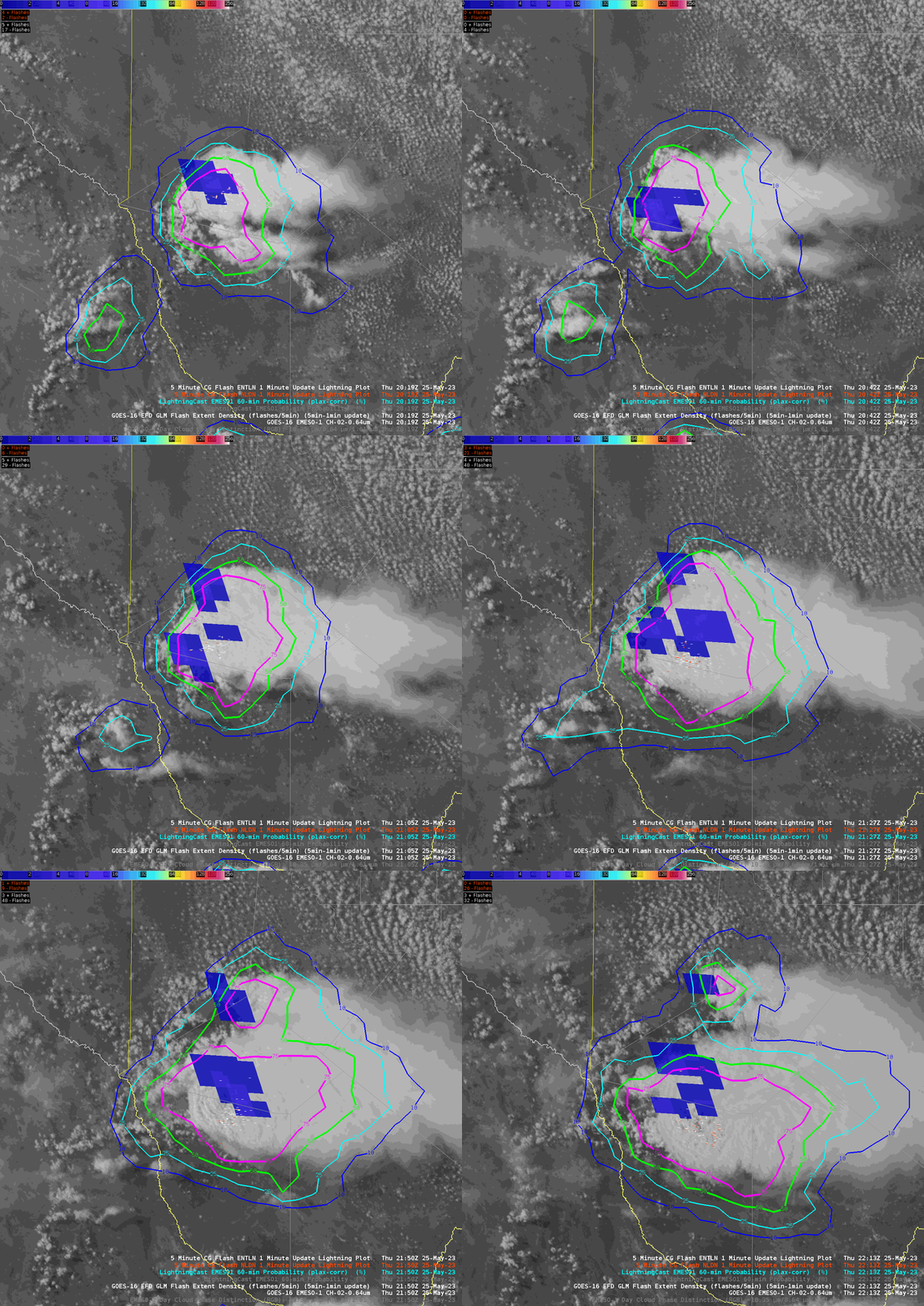
And one final note… lightningCast is fairly impressive in how it produces calibrated estimates of lightning occurrence using only a single time step of satellite imagery (though it uses several bands of the ABI). Naturally lightningCast has difficulty where a developing tower is obscured by an anvil overhead, as we saw in this example. But it was neat to see lightningCast immediately respond with a broader swath of high lightning probabilities the very first time that a tower poked above the anvil that previously obscured it.  The fact that it was hidden probably means lightning could have been occurring below the anvil with lower than ideal lightningCast probabilities (though non-zero, to its credit), but it was neat to see the immediate adjustment to the probability contours with new imagery.

– Buzz Lightyear

A Close Look at LightningCast for the Application of DSS or TAF Support

On June 15th 2022, a dynamic setup was unfolding across Iowa, Minnesota, and Wisconsin with multiple hazards that NWS forecasters would have had to message and warn. For this case, we were on watch for a DSS event representing the Cranberry Blossom Festival in Wisconsin Rapids in the GRB CWA. The main concerns with the event were lightning and any severe storms, both of which seemed certain for this case and the name of the game was timing the oncoming convection.

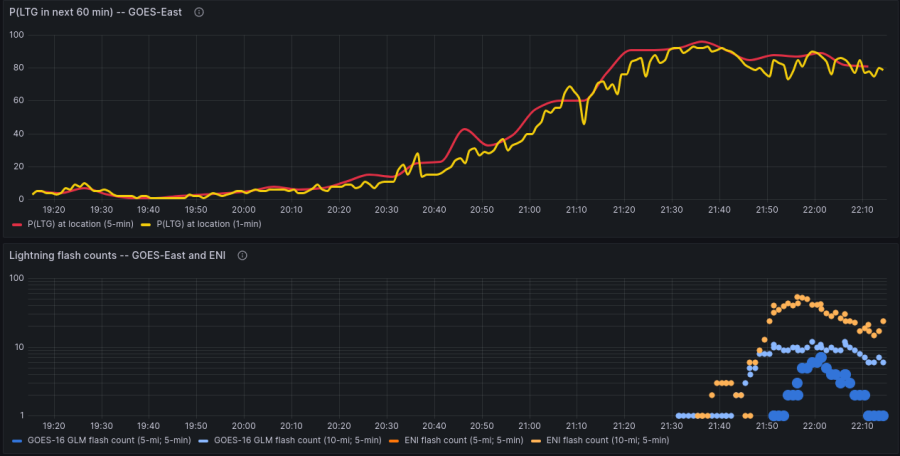
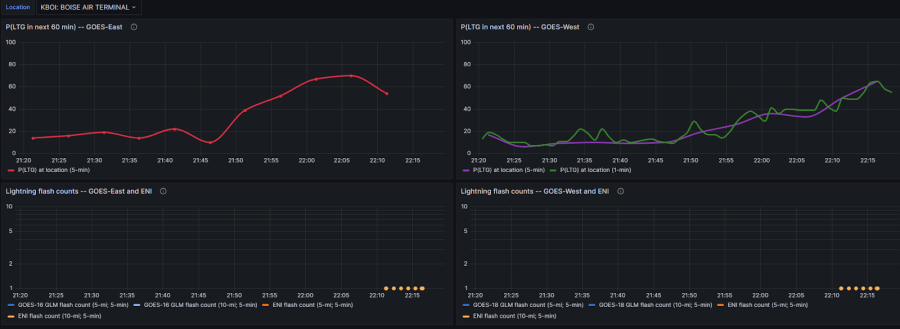
LightningCast uses machine learning with numerous satellite inputs that yields the probability of lightning occurring at a location within the next hour. This product immediately jumps to the front of a forecaster’s mind to apply for decision support services (DSS) or assessing lightning probability for airport forecasting. Below is a table showing the probabilities from LightningCast versus the “time of arrival” tool that estimated storm timing based on the movement of storms:

First vicinity lightning strikes (within 10 mi of event): 4:21 PM
Arrival of storms (within 10 mi of event): 4:30 PM
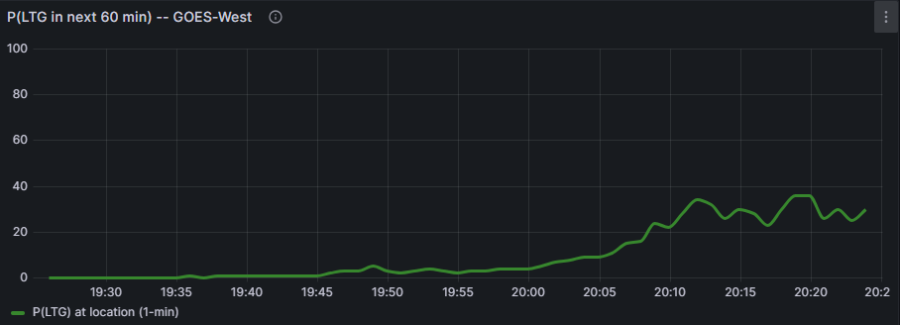
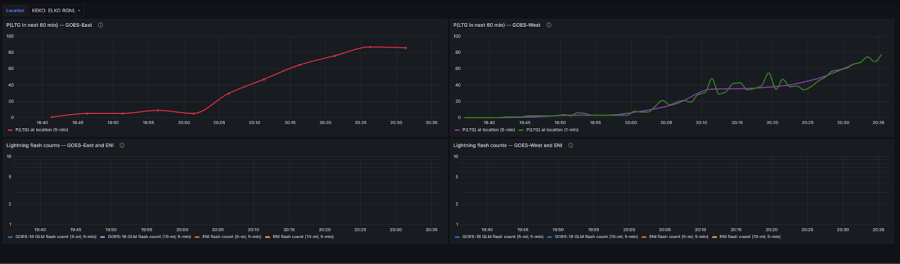
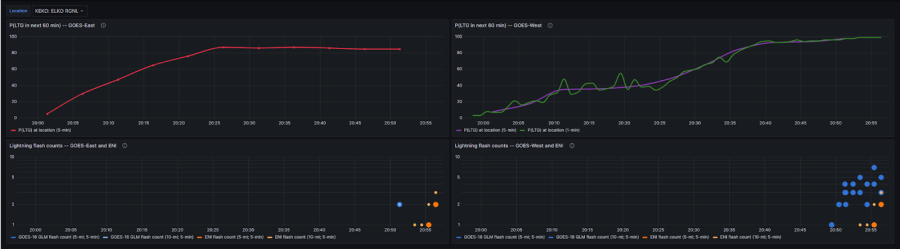
Immediately the usability of this product is fantastic. It shows the probabilities of lightning occurring in a contour format, making it a great pairing with satellite imagery, lightning data, and radar. WIth this case being a very well forced event the main evaluation was the percentages and how they did with the advection of the storms. The LightningCast seemed to ebb and flow with the eastward acceleration and deceleration of the storms between 3 and 3:30 PM, while the next 15 minutes showed accelerating storms, giving a 61% chance of lightning within the next hour at 3:45 PM. With the acceleration of the storms, it was good to see the model adjust, with the 50% threshold being crossed before 3:45 PM. The 50% threshold is very important for forecasters, as values above that are typically  used in several products and gauges of confidence. The LightningCast model giving upwards of 40 minutes of lead time for advecting storms gives me a lot of confidence in the product, leaving me wishing it was already available within our datasets for immediate use.
– aerobeaver

Storm Movement and Severity at TAE

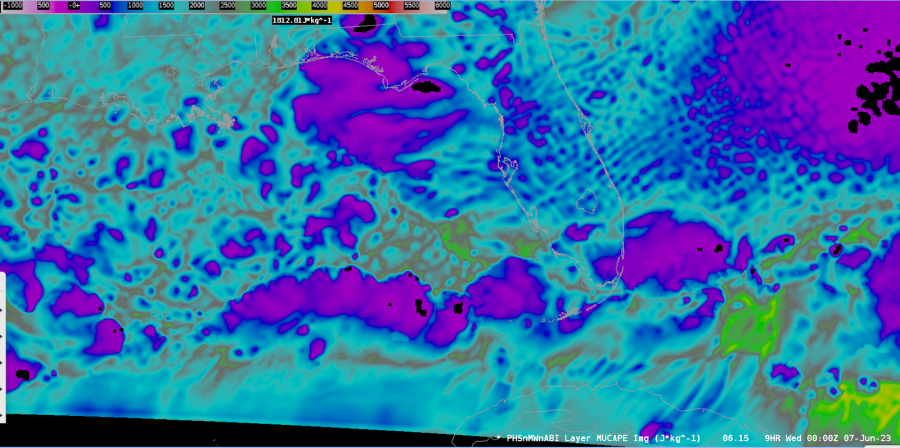
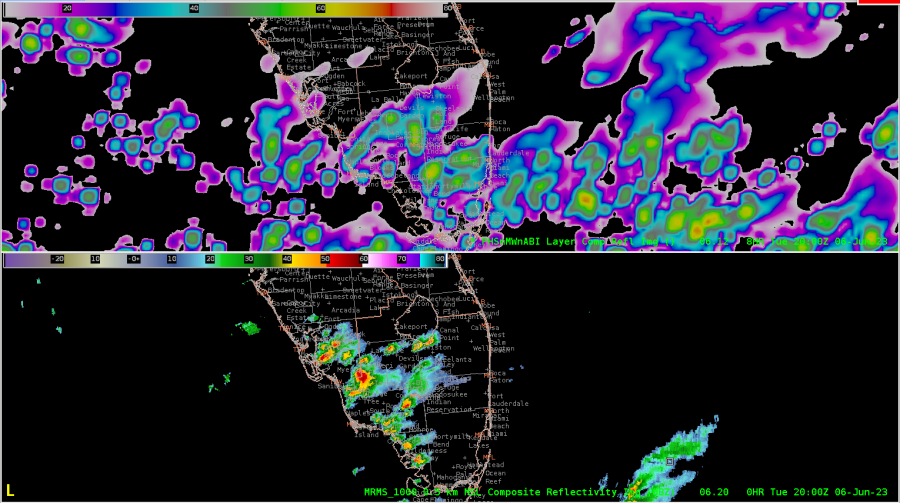
Down in Tallahassee, there are two boundary layers where storms are initiating or ongoing.  There is a lingering MCS that moved down from the Midwest overnight and a Sea Breeze. You can see the CAPE gradients along the both boundaries and how that progresses forward in time with both the boundaries interacting with one another.

17Z

18Z

19Z

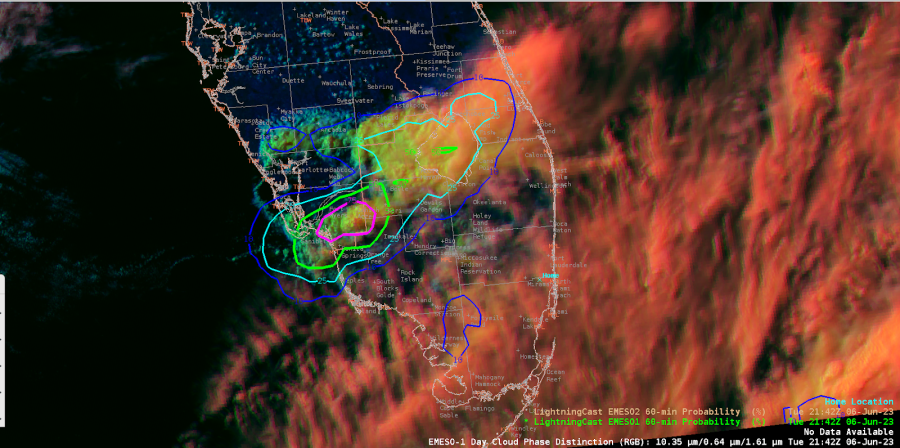
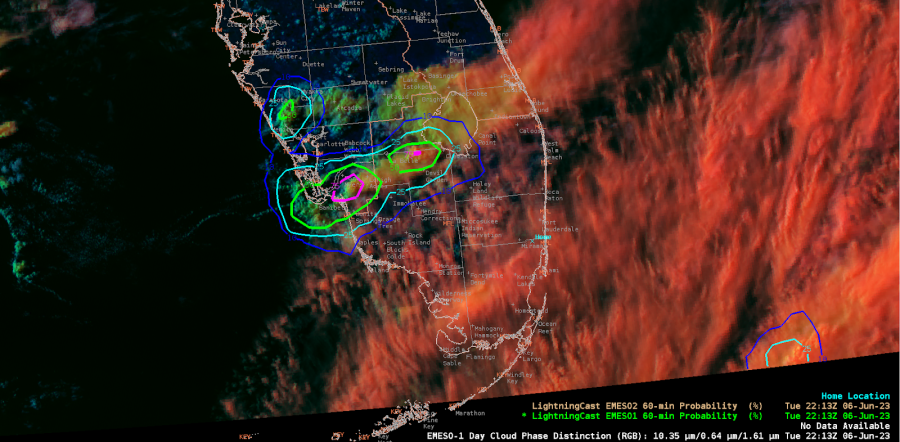
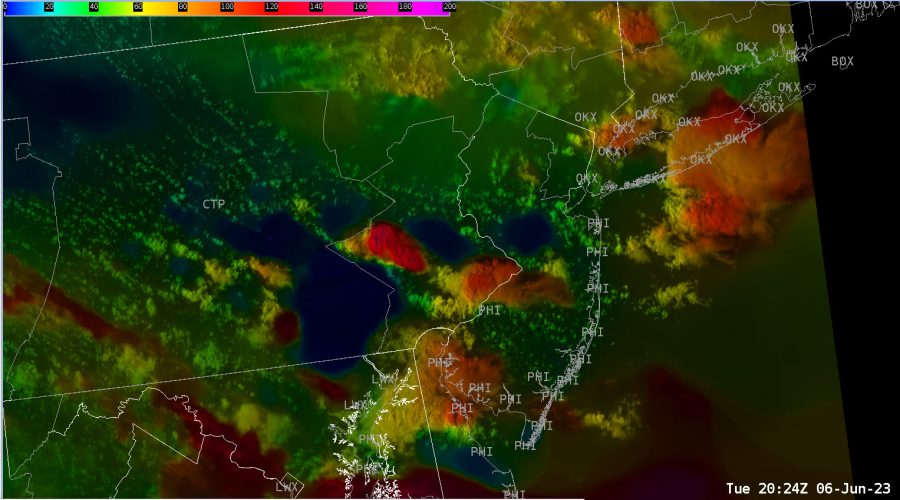
This tracks very well when you overlay the visible satellite imagery with the PHS images as you can see the cumulus field along the CAPE gradient. This gives a good visualization of where storms are initiating along the Sea Breeze and the strongest storm movement along the MCS.
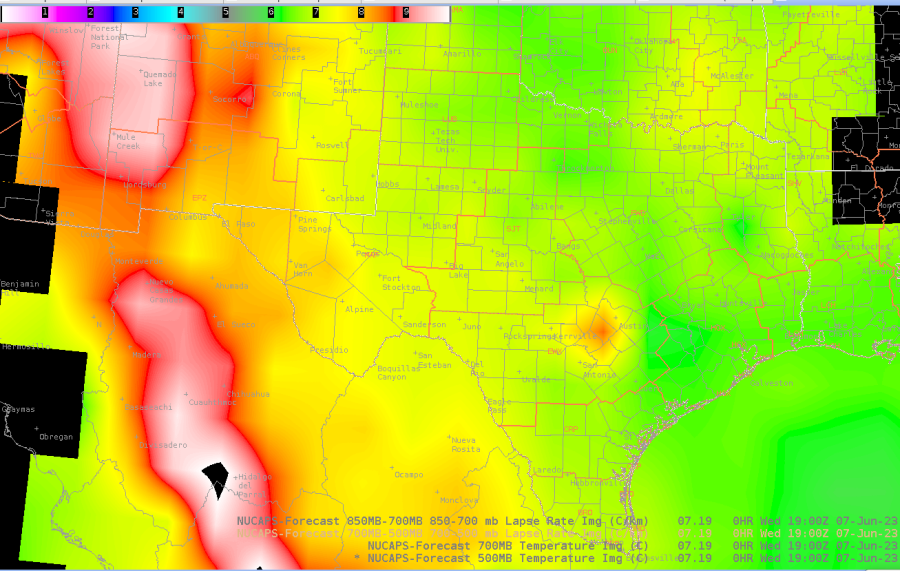
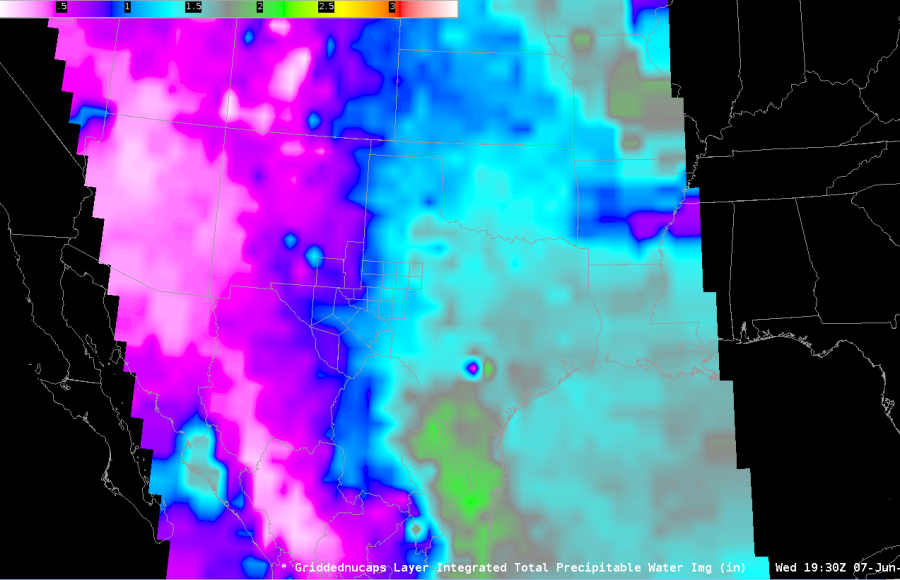
As these two boundaries move closer together they will be moving into a more favorable low level environment. It would be nice to have the Polar Orbiting Satellite NUCAPS sounding data available. This way we could verify lapse rates and what Prob Severe is giving us. While an upper level ridge is in place over the southern CONUS what sounding information we did have early on in the forecast period was very helpful as outside of the storm environment skies were clear. I was able to grab some gridded NUCAPS data that shows the diurnal destabilization of the low levels from 18Z. Now that it is 21Z, that data isn’t as helpful in either a warning or pre convective event because things could have changed drastically in the 3 hrs since the last Polar Orbiter moved through.
After overlaying Prob Severe with the PHS CAPE and Visible Satellite imagery, you can see your strongest storms along the CAPE gradient which tracks well. However, there are differences between Prob Severe Version 2 and Version 3.
A great example of the differences between PSv3 and PSv2 is with one of the strongest storms of the day for the Tallahassee CWA. Version 2 seems to try to highlight a hail threat at 48% while Version 3 has prob severe hail at 6%.  It seems that Version 2 is overestimating the Hail threat for this area. Especially given the subpar mid level lapse rates at 5 C/km or less, storm motion of around 5 kts or less and the upper level subsidence. The storm environment just is not conducive to produce quarter sized or larger hail.
– Cirrus Fields

LightningCast/NUCAPS and Isolated to Scattered Convection in FGF

Convection developed rapidly to the south of the main area of convection in an area of high instability. This was first picked up by higher probabilities in the LightningCast data. There was some rapid cumulus development that was picked up well by the algorithm. Probabilities went well above 75% around 5 minutes or so from the first GLM detection. NUCAPs data indicated MLCAPEs of around 2000 J/Kg in this area supporting the quick upscale growth.

Convection developed rapidly to the south of the main area of convection in an area of high instability. This was first picked up by higher probabilities in the LightningCast data. There was some rapid cumulus development that was picked up well by the algorithm. Probabilities went well above 75% around 5 minutes or so from the first GLM detection. NUCAPs data indicated MLCAPEs of around 2000 J/Kg in this area supporting the quick upscale growth.

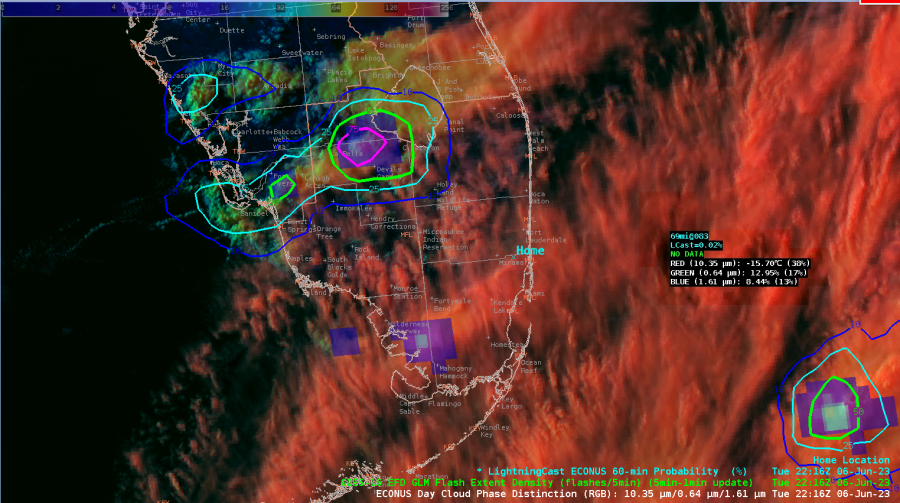
LightningCast and GLM at 2131 UTC

DCP RGB and LightningCast  2131 UTC

MRMS -10 Reflectivity and LightningCast first GLM detection at 2135 UTC

So let’s take a look at some NUCAPS soundings as we had three overpasses right before the convection initiated in the above examples.  Here is the first overpass with the sounding point selected with the red arrow:

NUCAPS Sounding at 1823 Z

Not too shabby with a MLCAPE value of 2094 J/kg.  (And why mixed-layer? Hank likes ML because very few times do parcels start at the surface for SB, and MUCAPE is just fun to look at).

The next overpass was 2003 UTC (about an hour and a half after the previous overpass) to see if the environment has changed much:

MLCAPE of 1235.  Hmmmm…that’s quite a drop in MLCAPE compared to previous overpass.  Two things to remember; this is on the edge of the field-of-view (matter of fact, the eastern edge).  Luckily we have a Modified NUCAPS for the same profile point which adjusts the boundary layer:

Yeah, that looks much more reasonable based on observational trends (few clouds to change the mid-atmospheric profile, increasing surface T/Td conditions) with 2185 J/kg MLCAPE.  But wait, there’s more!  We also have a:

NUCAPS AQUA Overpass

This was almost directly under NADIR so we should have much better profile retrieval.  Sure enough, MLCAPE value is almost 3000 J/kg in between the 1823 and 2003 UTC NOAA-20 sounding retrievals.

How does this all tie into the weather for FGF today?  This is what the SPC Mesoanalysis graphics had for 2100 UTC MLCAPE values:

They all combine to increase confidence on what conditions COULD be in areas where the models are saying one thing and an observational system is indicating potential reality (remember, it’s still a remote sensing platform with their own set of issues). In our case, the bulls-eye of 3000 J/kg in east central Minnesota is likely real and needs to be an area to watch…and that is where the Lightning Cast product at the start of our post indicated the potential for new activity to develop.  Pretty cool stuff…

– Marty McFly/Hank Pym

Where is the new convection going up?

The GLM can be used to help find where new convection is developing under a cirrus canopy.  Here’s an example of this!

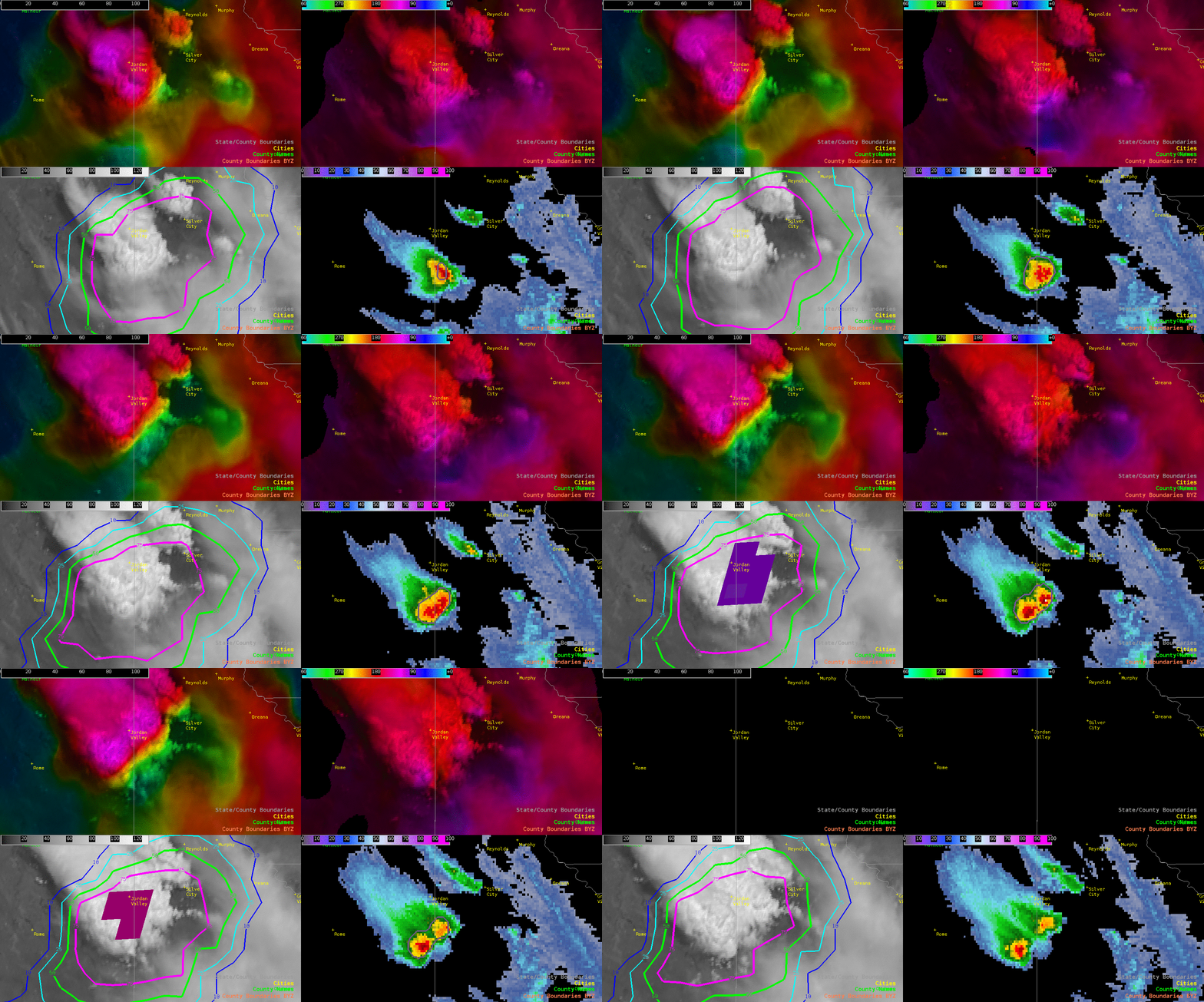
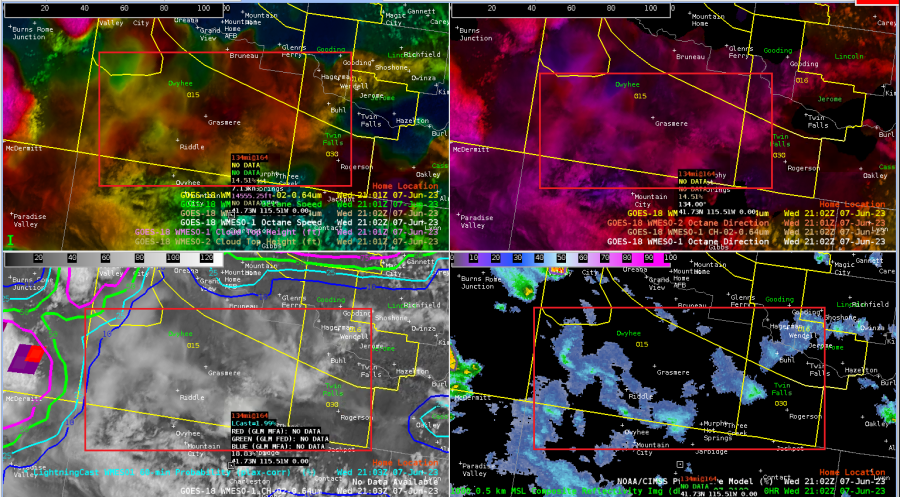
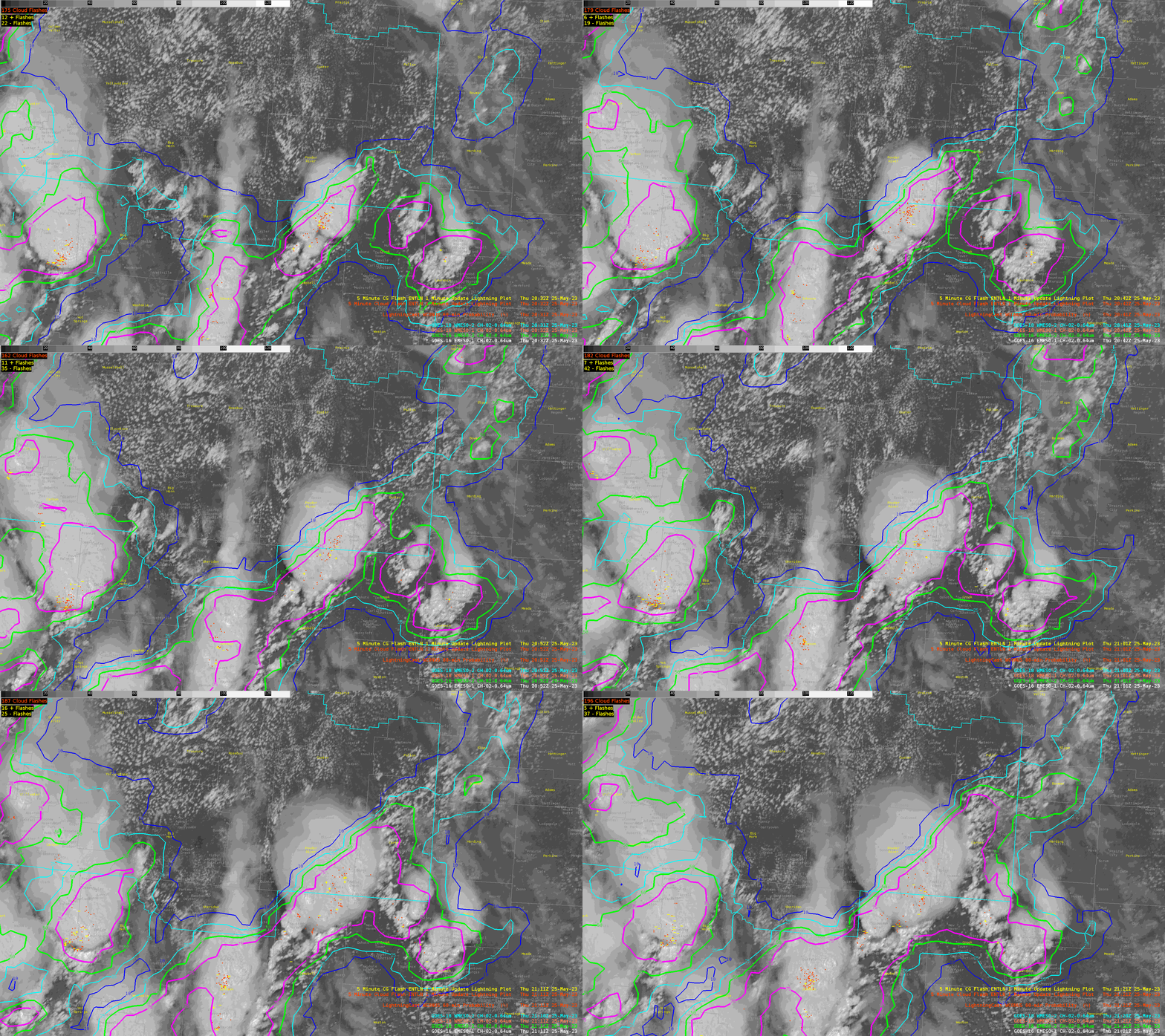
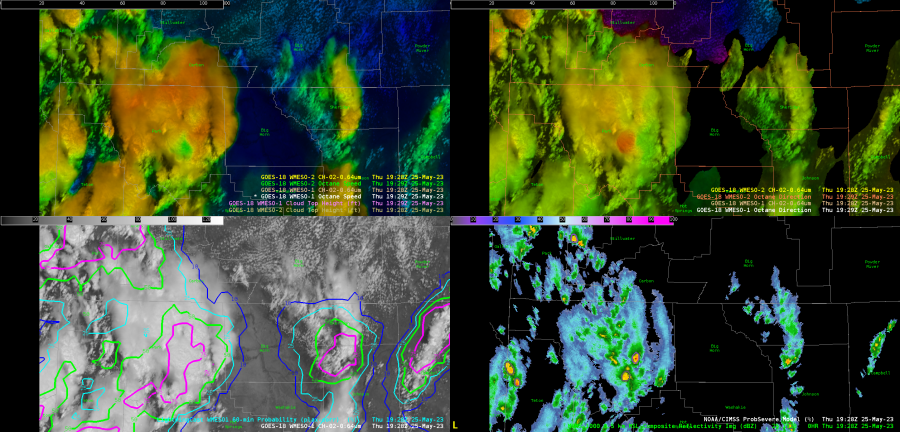
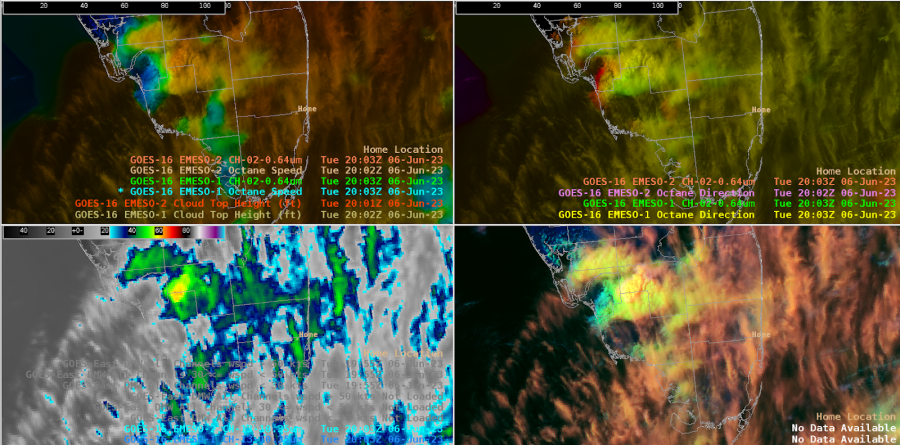
Top left – LightningCast with Day Land Cloud Convection and Flash Extent Density (FED).  Top Right is Minimum Flash Area (MFA). Bottom left is MRMS 1km Reflectivity.

We can see that there are some returns developing in the center of the field of view on the MRMS reflectivity but it is hard to tell whether this is real or not.  Five minutes later, we have this image:

Hmm, that could be new convection developing on the Top Left panel because it looks like there is a tower coming through the cirrus shield.

And then the next frame we have:

And there we go!  Flashes starting to show up so it looks like this area of convection will need to be watched.  (Should also note that it would also be helpful to time match to the GLM 1-minute FED instead of the 5-minute RGB!)

-Hank Pym

Metwatch for Wilmington DSS event

Metwatch for Wilmington NC started with modified NUCAPS soundings and a comparison with NAM BUFKIT profiles:

Looking at 700mb temperatures, BUFKIT has about 8C for that layer, and here is the gridded NUCAPS 700mb temperature layer. Note: not a lot of advection noted at 700mb, with low level dry advection (not shown)

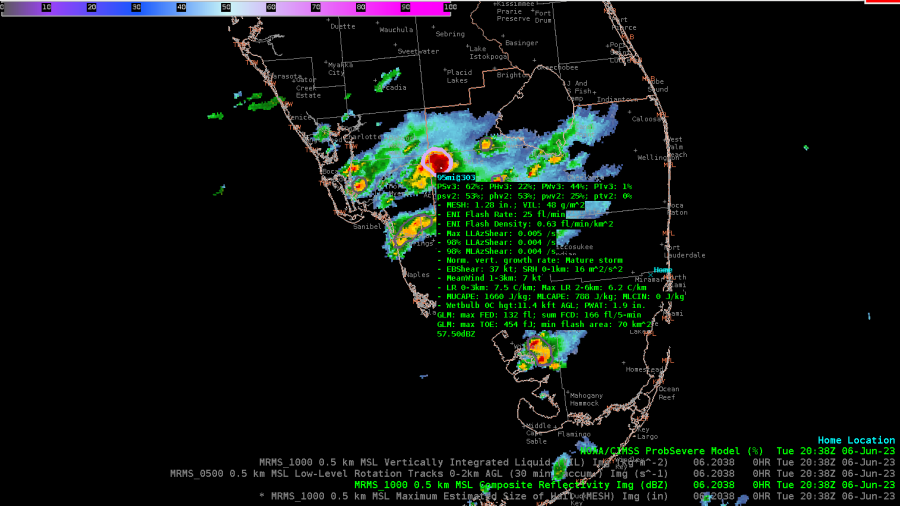
Watching this cell just outside the CWA pulse and then fall apart…PWV3 never exceeds 4% with this pulse. LightingCast also showed a rapid drop in probabilities.

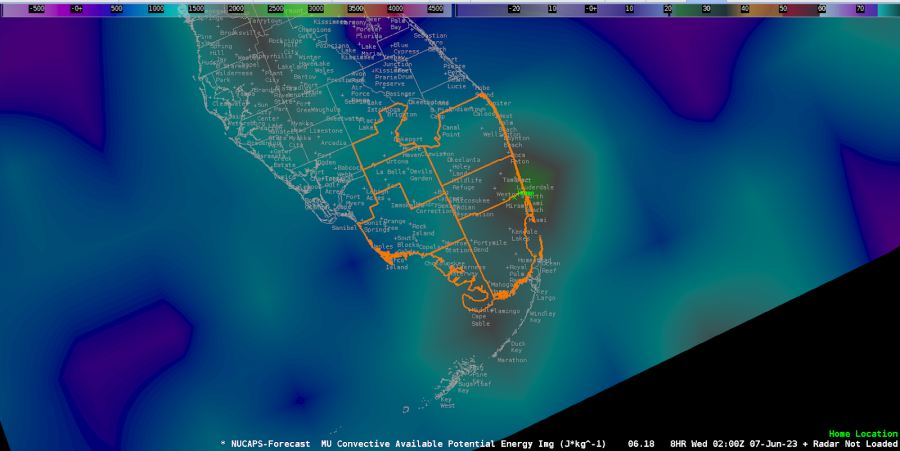
Not much happened today, but just along the coast was this little area of enhanced CAPE (3000j/kg)…so you’re saying there’s a chance…

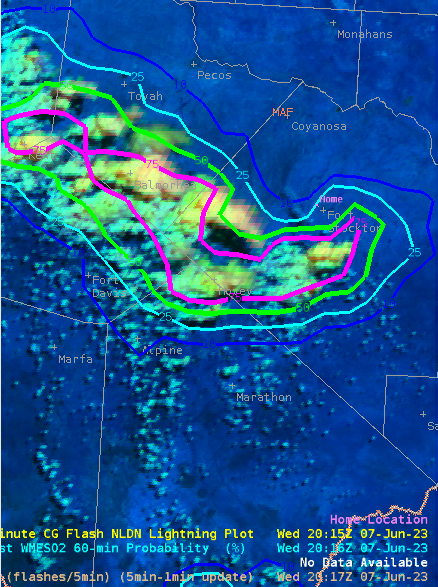
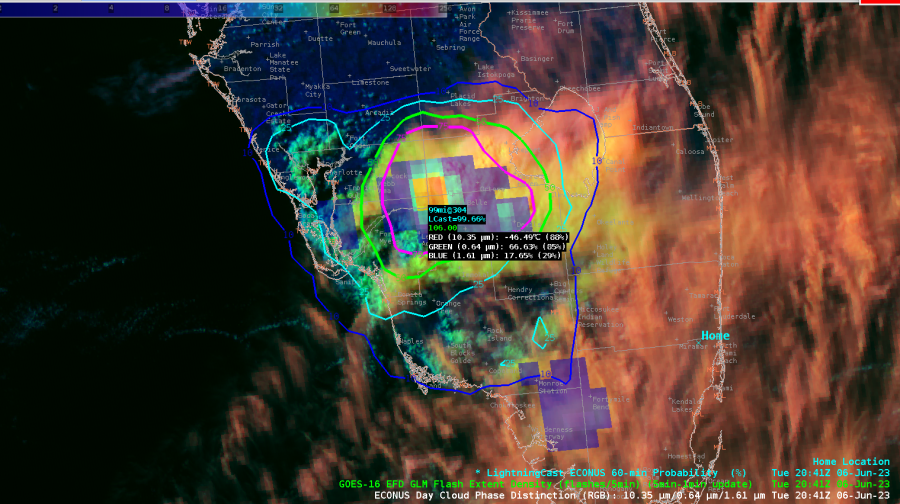
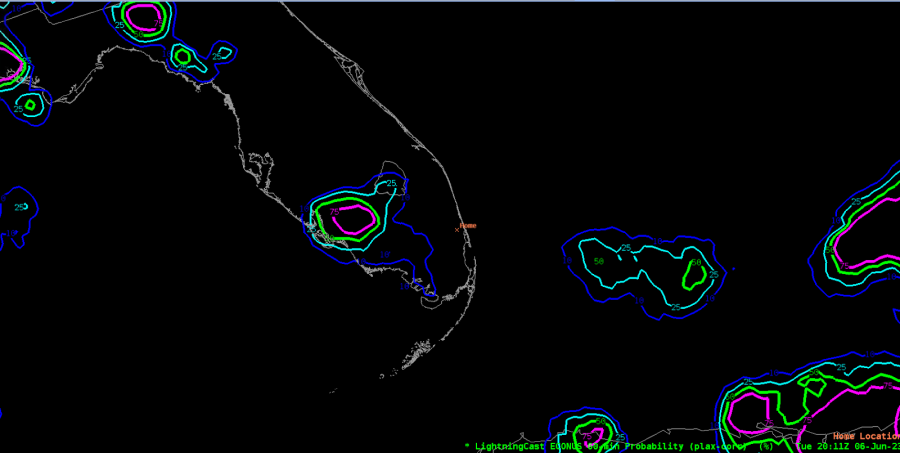
Comparison between parallax corrected and uncorrected lightning cast. You can see the image above and to the right (corrected) has some higher percentages getting into the 20 mi range ring compared to the non corrected data which just has the 25% grazing the 20 mi range ring. Having the corrected data could be more beneficial to providing DSS support.

– Mr. Bean

– Noctilucent

LBF HWT Blog Day 4

We didn’t have too many storms occur during operations today, but that allowed us to be able to focus more on CI.

LightningCast for CI

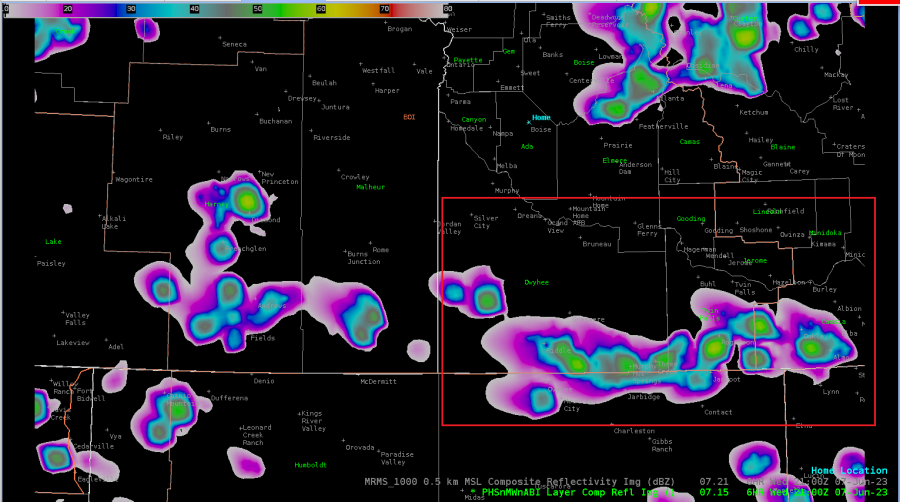
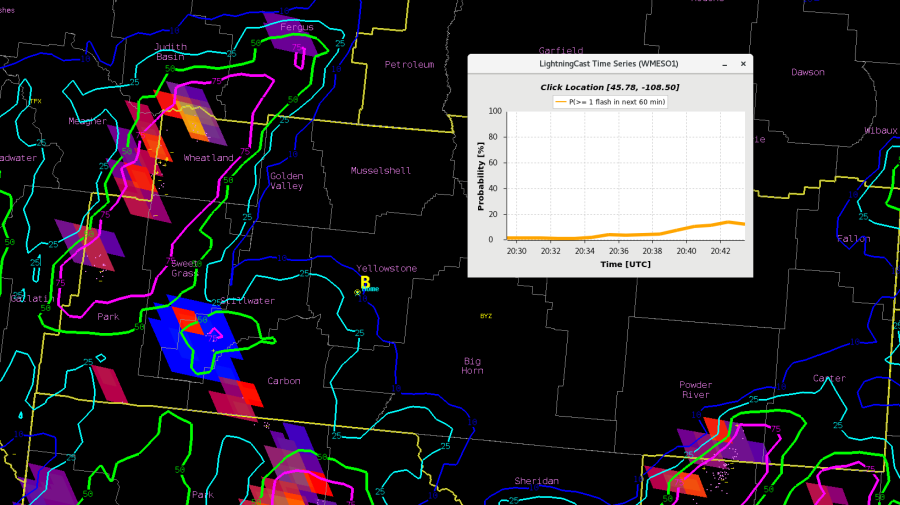
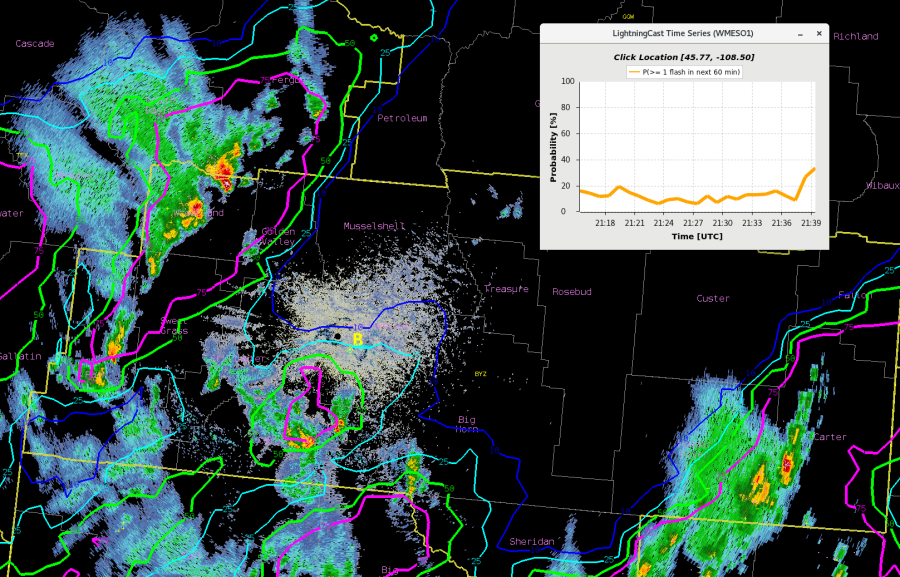
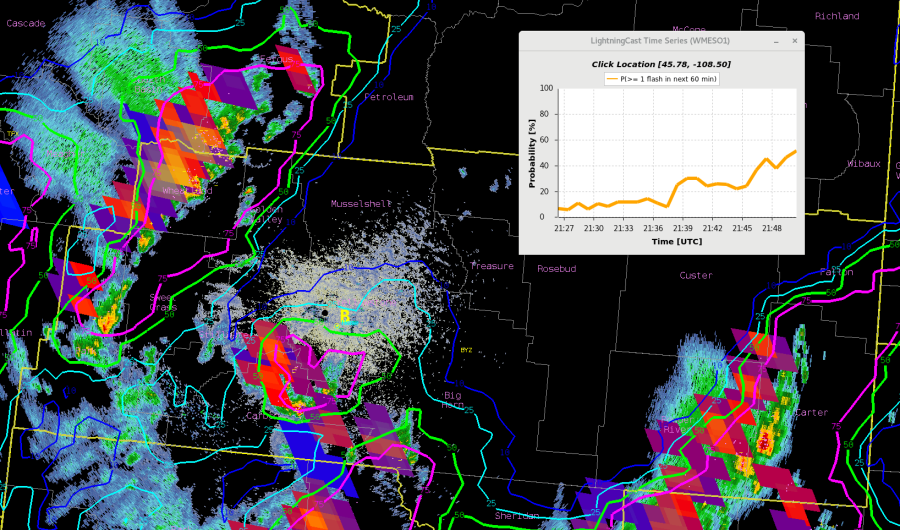
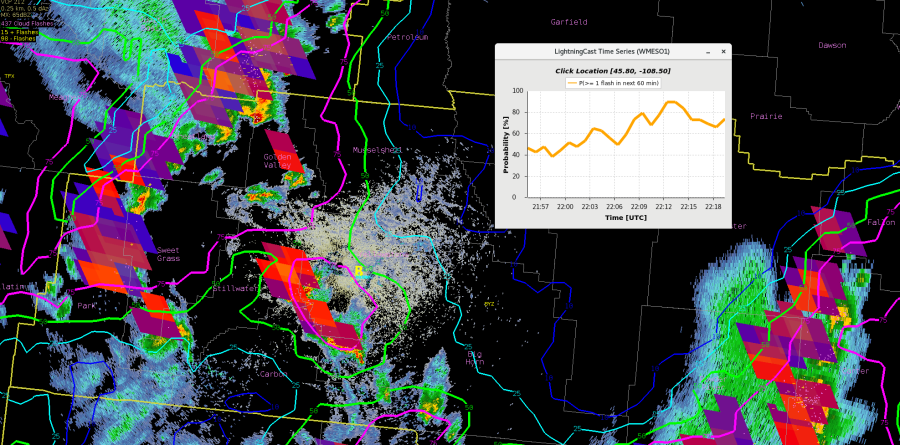
Was able to use LightningCast for convective initiation today as LBF was waiting for storms to fire back up for the afternoon and evening. Initially we were thinking storms would form first over the southern portion of the CWA based off of modeled convective parameters but at 2101Z, a 25% chance of lightning popped up via LC for the north-central portion of the forecast area. This 25% contour appeared a few minutes before radar reflectivity started showing up for the same area. Seeing even the 10% contour show up earlier on, clued me into the fact that we needed to shift our focus further north than we originally thought. These storms seemed to be forming along a shear gradient and weak boundary.
Of note, I am using the parallax corrected LC.
LC, GLM FED, and DCPD at 2100Z
LBF radar at 2109Z
By 2116Z, both GLM and ENTLN showed the first flash of lightning, allowing for around 15 minutes of lead time off of the 25% contour.
For comparison, these storms were forming ahead of the highest PHS CAPE and ahead of any of its stronger gradients.
21Z:
22Z:
As our day was winding down, LC continued to indicate areas to watch before it showed up on radar, but I did not grab additional images.

NUCAPS:

Tried to compare NUCAPS soundings today as we did have an overlap, but unfortunately ran into technical issues within my CAVE so was not able to do much with it. Another limiting factor was that the only “green” soundings from Aqua within our CWA fell within the far western scans which we were told by one of the developers they would next expect good data from, being on the limb. But for comparison, here are Aqua (1911Z) and NOAA-20 (1953Z) sounding from points NW of North Platte.
Points selected were both NW of the town of North Platte, circled below. The NE point of the two is Aqua and SW point is NOAA-20
– Matador

ILN HWT Blog Day 3

NUCAPS

Did finally get a chance to check out NUCAPS for today’s case as the timing and location of the data was more compatible. It was good info ahead of the storms as it showed the low LCL values (mainly noticed in the modified soundings), below 1000 ft which is what you want to see for potential tornadoes. Overall, liked getting to dig into the NUCAP soundings, but given the finicky timing and data quality, it’s not something I could use on a regular basis for warning operations. Would be better suited for short term forecasting or possibly as the mesoanalyst.

GLM & LightningCast

For GLM, I set the max value at 130. I originally set it to 65 as I had been using in the high plains the past few days, but for these midwest storms it seemed too sensitive. 130 was a good value for today, likely because of the larger and more numerous storms than I dealt with today versus the previous days.
Also tried out the parallax corrected LightningCast today. Liked that it gave a more accurate location when using it for a specific location such as today’s DSS event. While it was made to pair with radar, it was still useful when using it with satellite products – just had to take a few seconds to make the mental adjustments at the beginning.

PHS

Prior to entering the ILN CWA, the PHS STP showed an area of high STP values in and near Rush County, Indiana. The actual IND office did issue a tor warning for this area at 4 PM ET.
Over time, I did notice that for STP, really just the current hour and the next couple of hours were useful. Jumping to 3 or 4 hours ahead it seemed that the data was missing for areas I expected to see higher values. Once the next run came in and I went back and looked, the data was much better. For an example below, there was a vast difference for 21Z between the 18Z run and the 20Z run where the 18Z run for that time did not seem realistic but the 20Z run was more what I expected to see.
08.18 run for 21Z

ProbSevere

After talking with one of the ProbSevere people, was able to learn that the threshold for ProbTor is lower than that for Wind or Hail. For training purposes, it would be good to include this information to give a mental threshold for forecasters, such as an ongoing tornado would likely see a max of around 60% for ProbTor. It makes sense that the probs would be lower for tors just as they are for SPC outlooks where the tor percentages are also lower than that for wind or hail.
– Matador

Northeast Colorado Supercells

Nowcasting Supercell storm entering CWA: The loop of instability and SigTor highlight the southeast/south central CWA east of Colorado Spring, ahead of an already ongoing storm. North of this storm an environment of favorable instability exists up to about the latitude of Denver, with a significant drop off to the north.

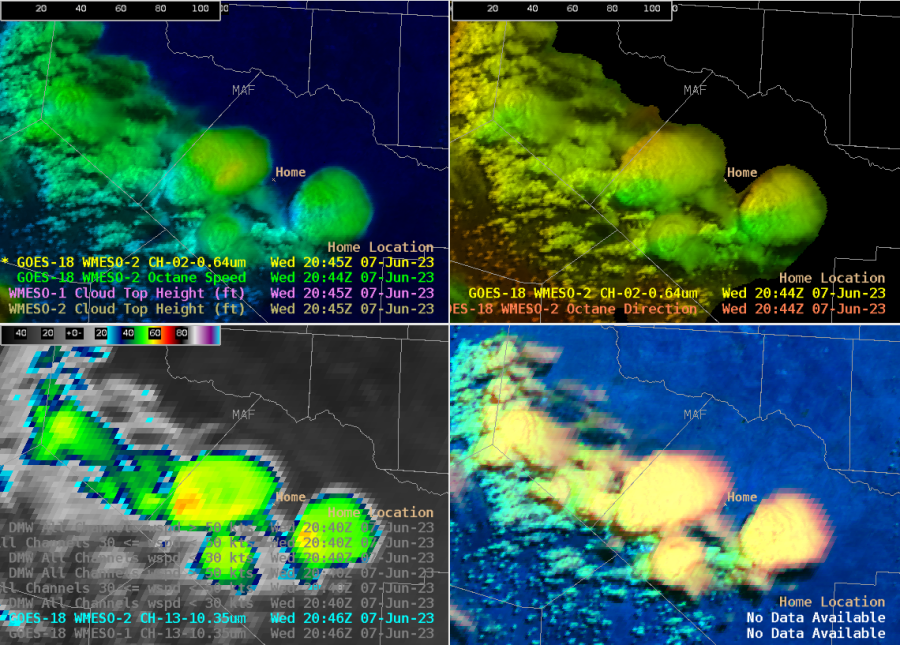
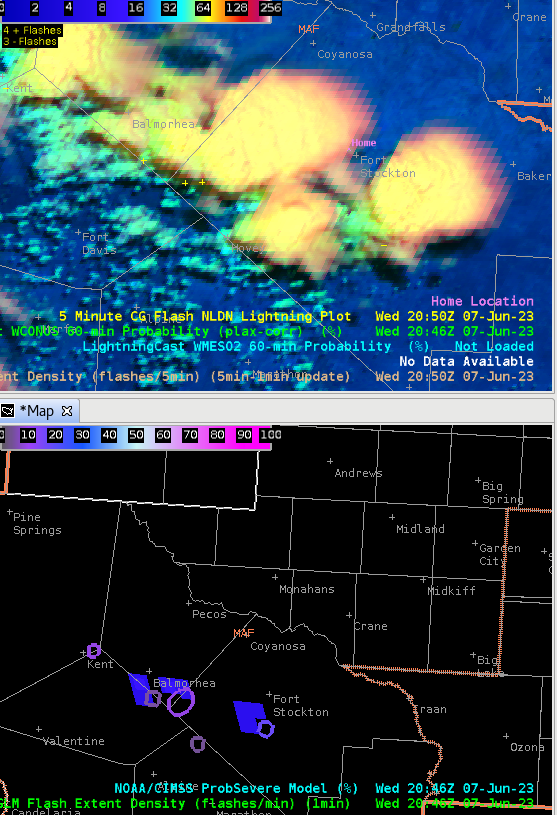
When it comes to high and northern plains – parallax becomes an issue. In this case lighting was occurring just on the other side of the border with the CWA, so here are the two LightningCasts (with/without parallax correction) for comparison:

ProbSevere v3 increases correlating to entering a favorable environment

PHI localized CAPE corridor

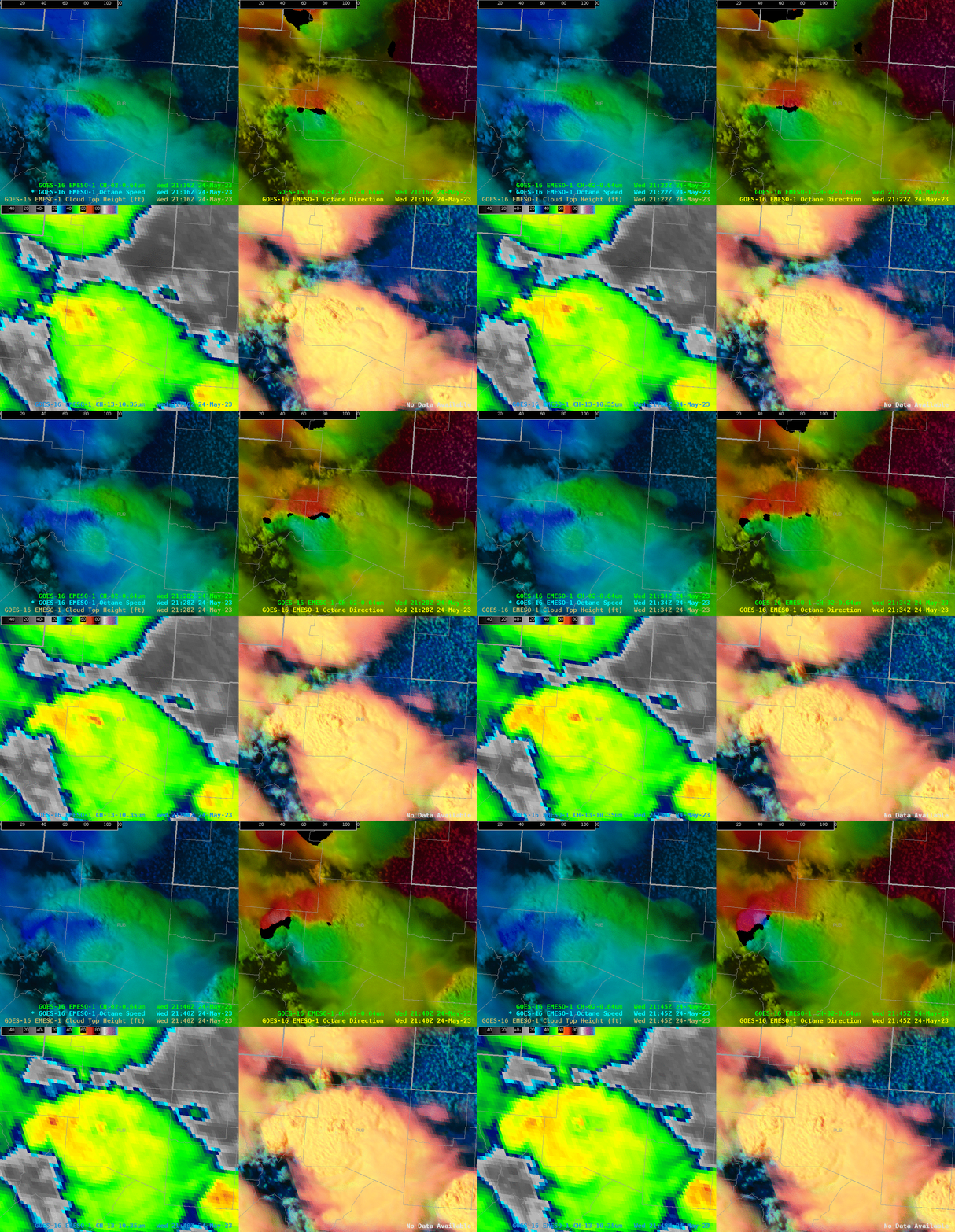
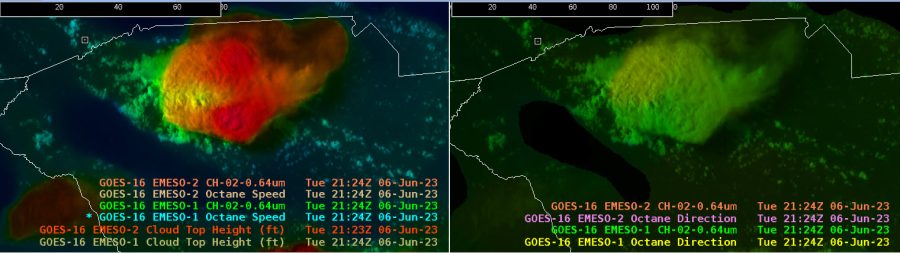
New area of MFA suggesting spitting storm with new updraft core of the established cell. (1950 UTC)

Storm cell split denoted by MFA with two distinct areas of MFA in upper right panel. (2000 UTC)

Focused on the cell east of Denver – this cell and subsequent others that developed are in the favorable area of instability. Just to the north of Boulder we spotted a few cells that attempted to develop, however in the lower instability environment movement off the higher terrain resulted in these cells falling apart. Through the rest of the afternoon this area remained convection free.

Sig Tor blip. A SRVE like feature was observed but at this time convergence associated with this feature wasn’t favorably located under the updraft.

Cell developing east of Denver, noted by the MFA  in the upper right panel. (2020 UTC)

Cell rapidly develops in an area of localized higher instability denoted by the PHS values discussed earlier on.(2034 UTC)

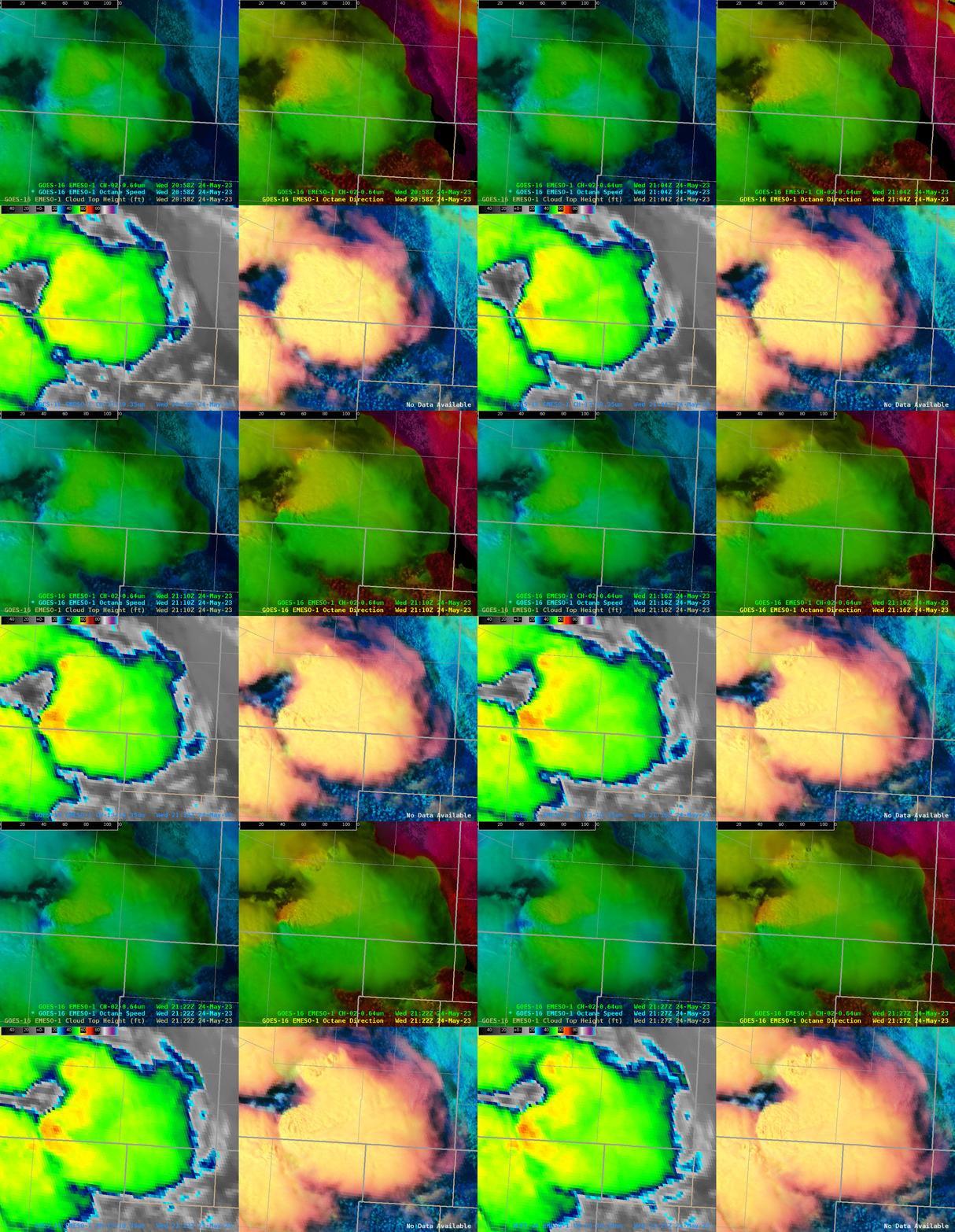
The LightningCast has identified the left turning nature of the storm(s) east of Denver

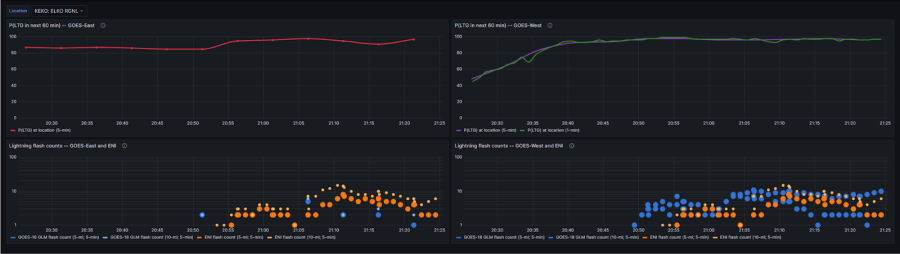
An interesting note was comparing the differences between GOES East (left panel) and GOES West (right panel). These subtle differences can  be effective in analyzing the strengthening of a thunderstorm.

In the middle of METWATCH – NUCAPS became available (about 1 hour latency). The sounding below is a modified NUCAPS profile, depicting the environment in which our storms developed. Storm mode was supercellular with frequent spitting of cells.

-Mr. Bean

-2%hatched