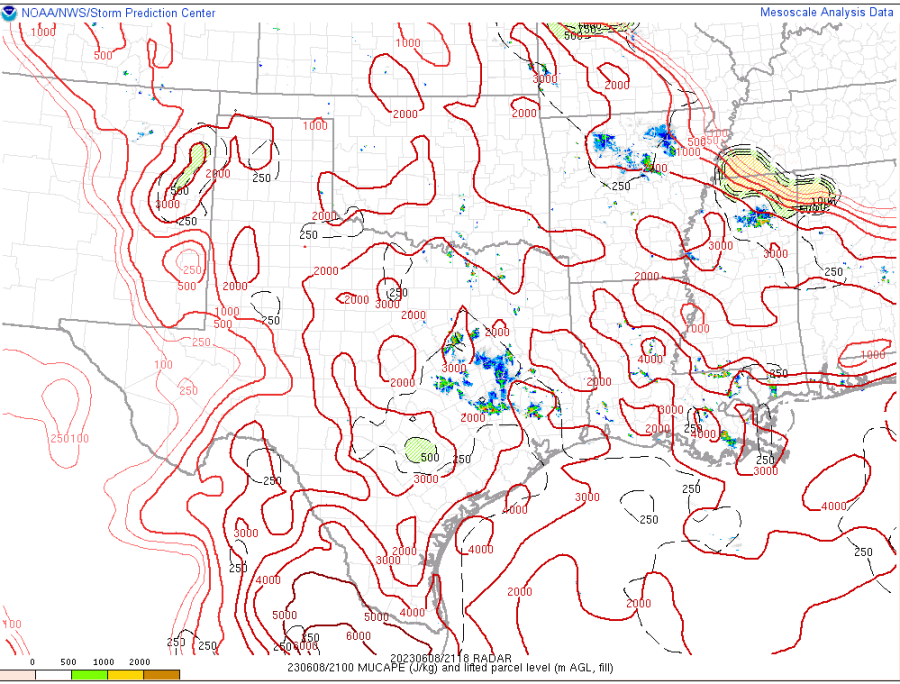
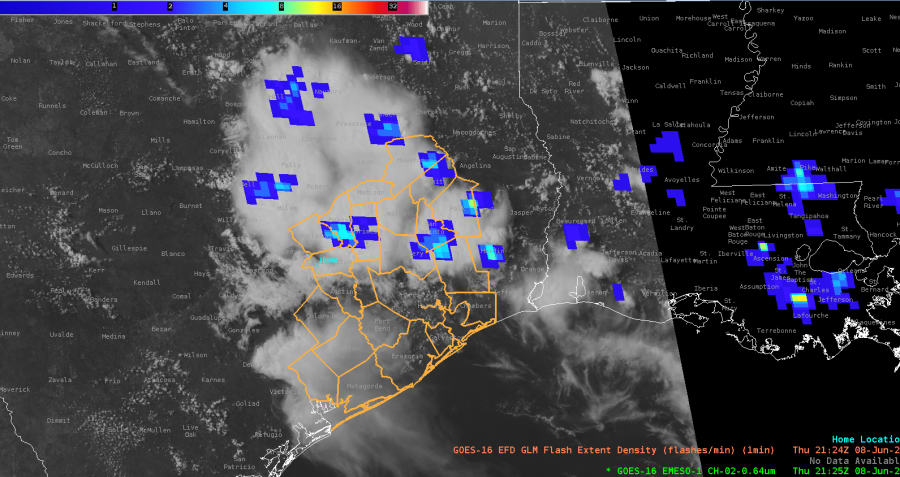
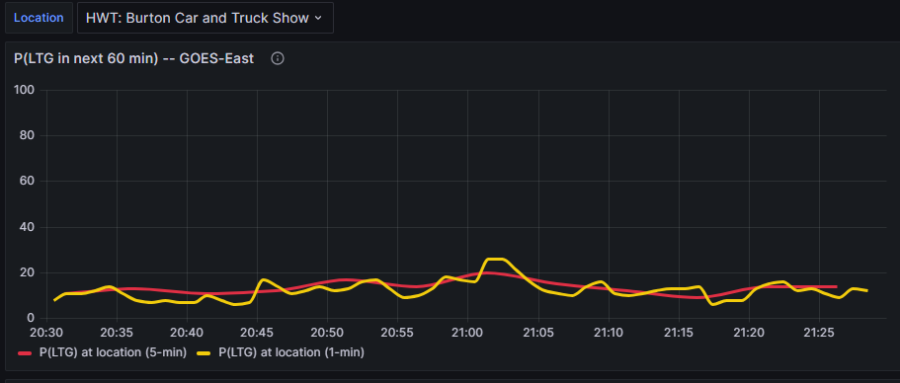
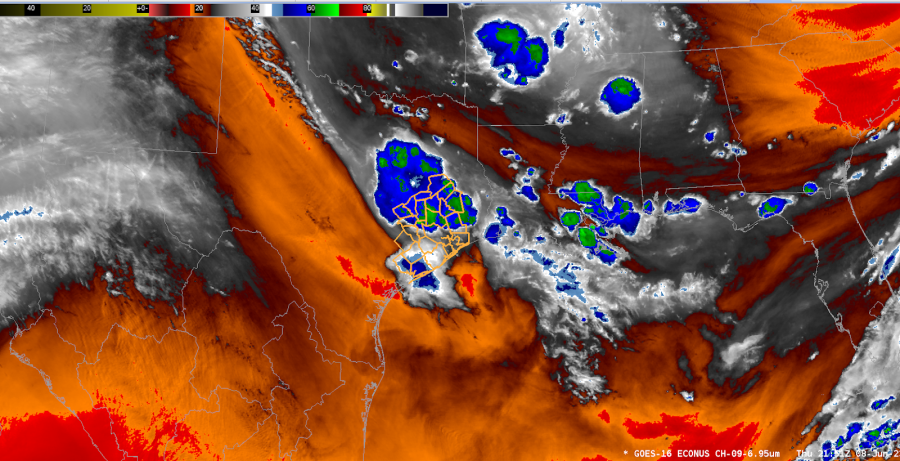
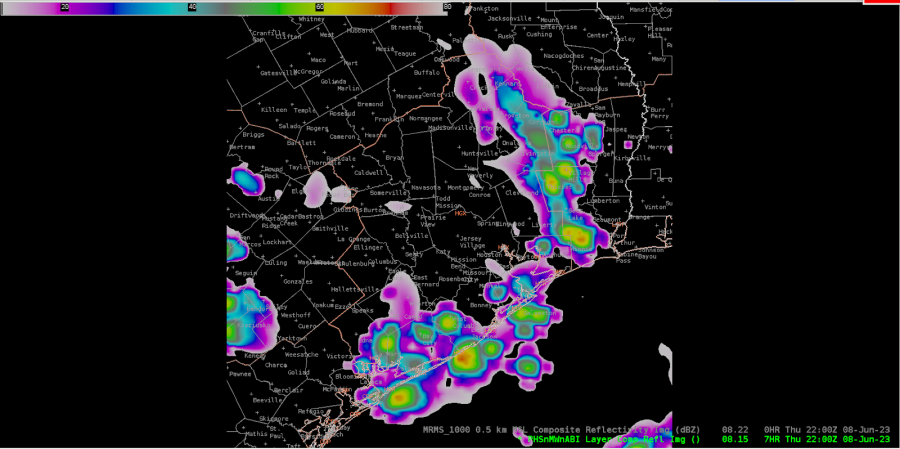
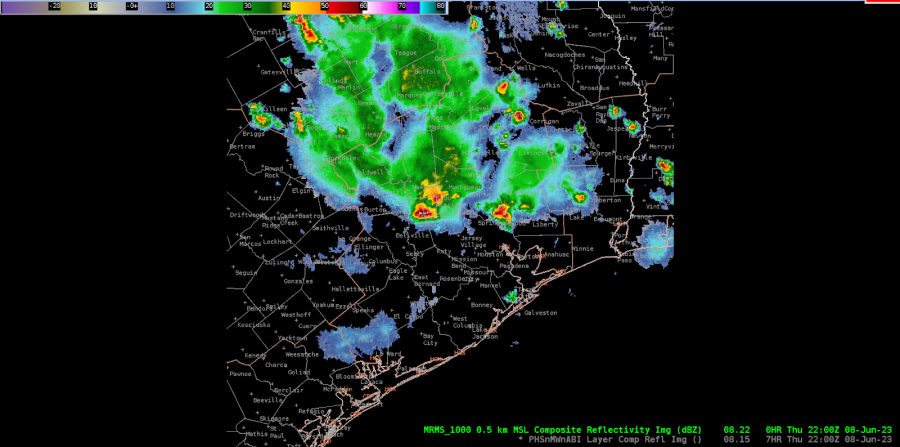
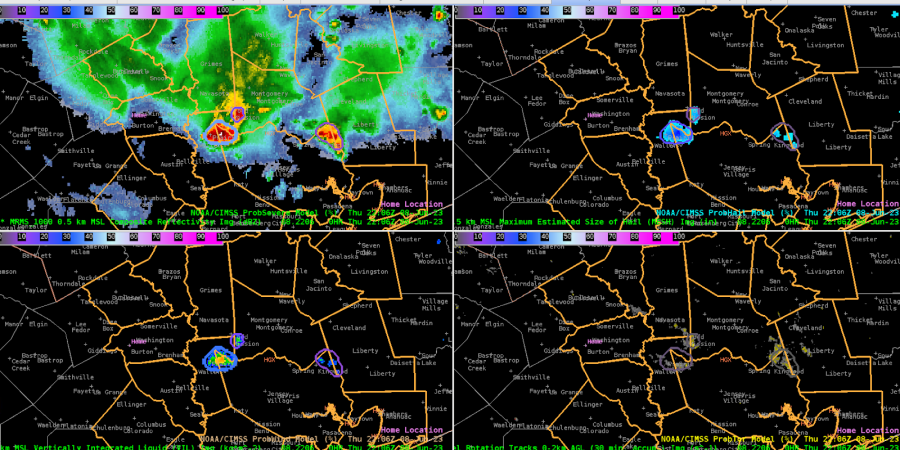
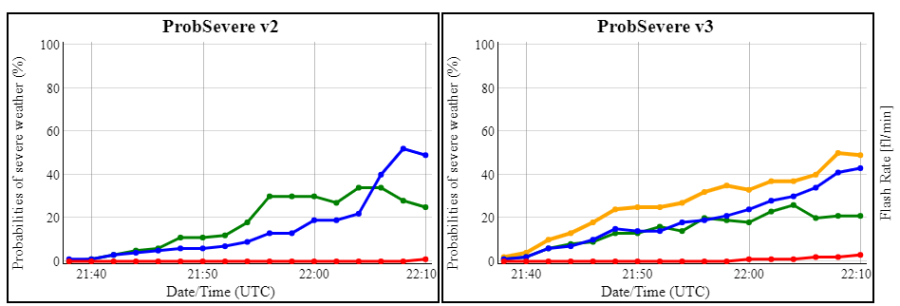
Satellite HWT Day 3 Carl

Wednesday Satellite HWT Thoughts

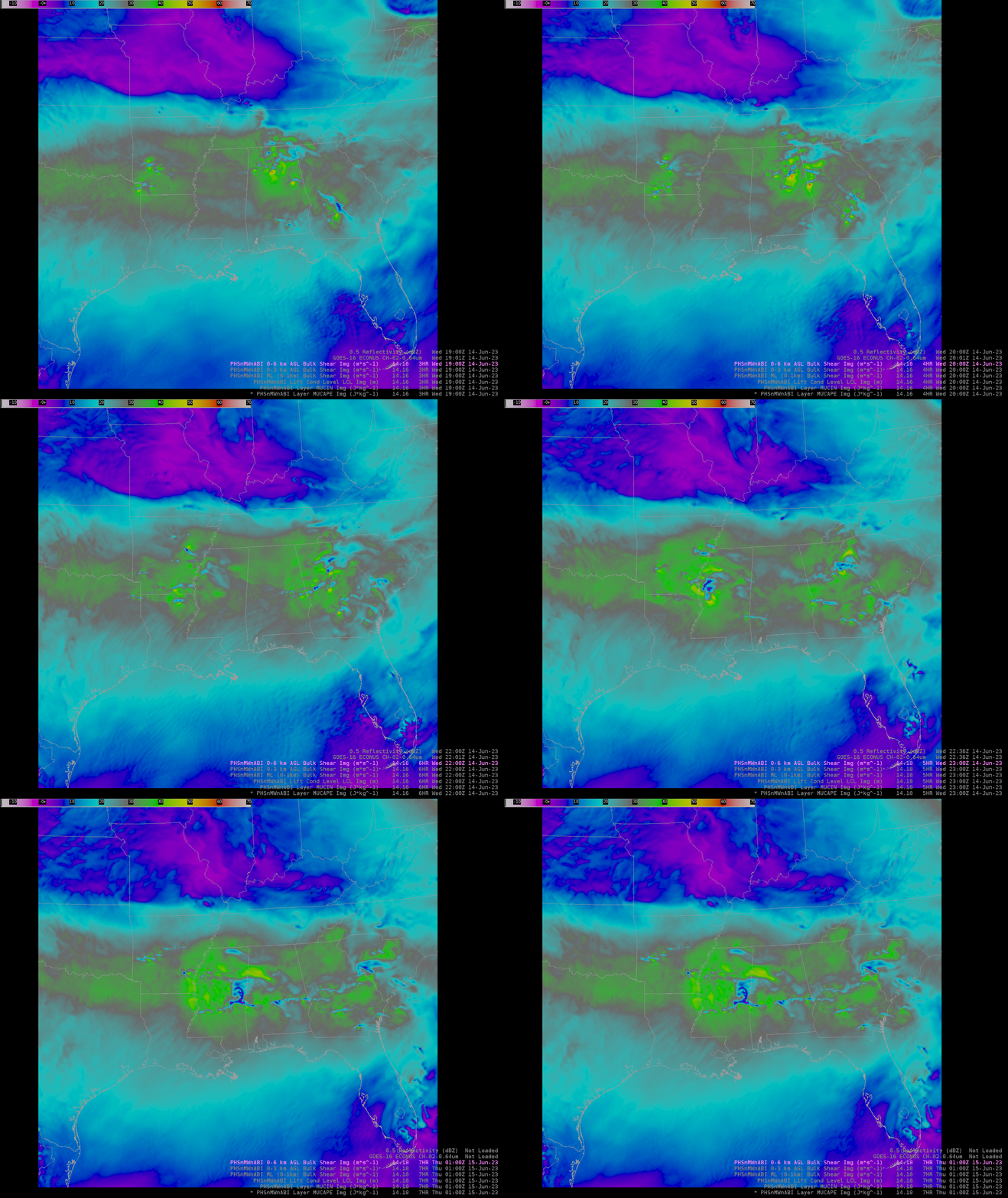
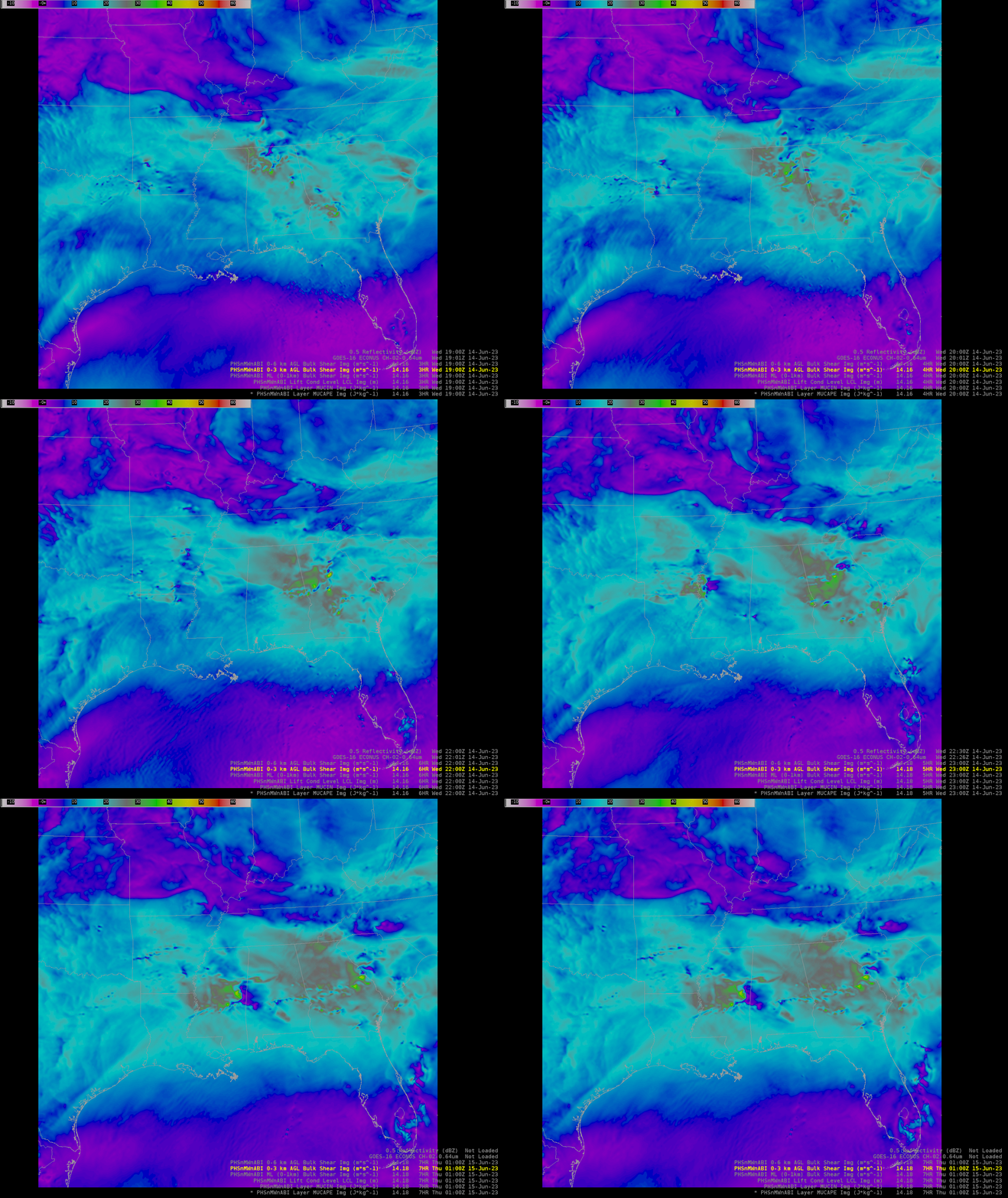
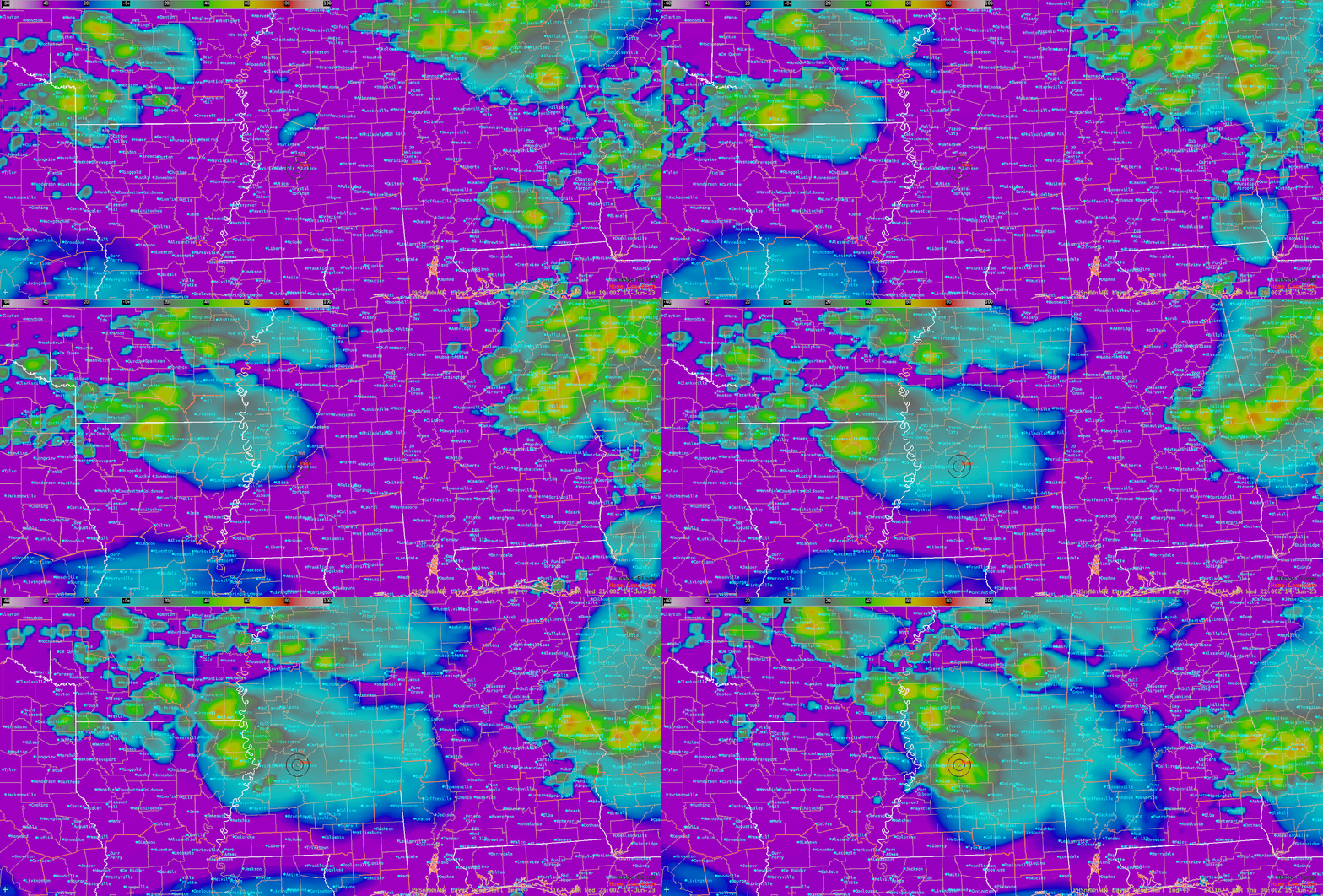
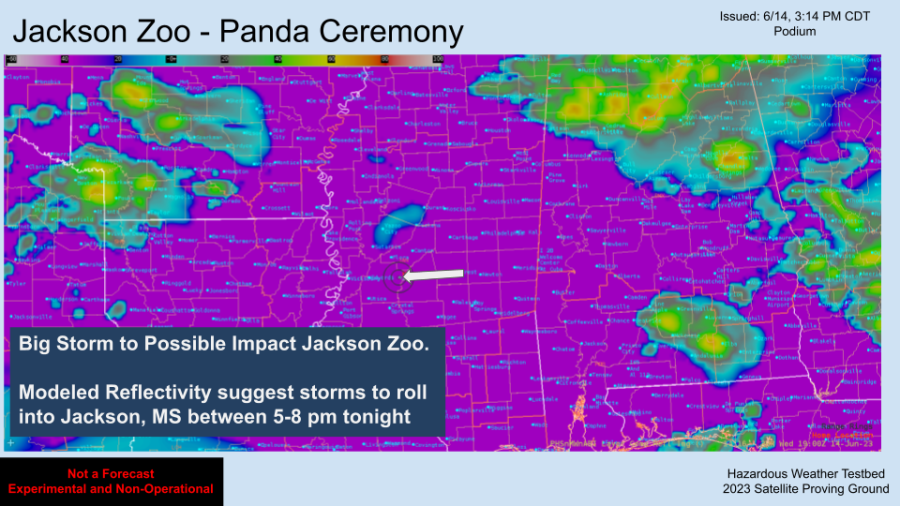
PHS Model Comparisons and Thoughts

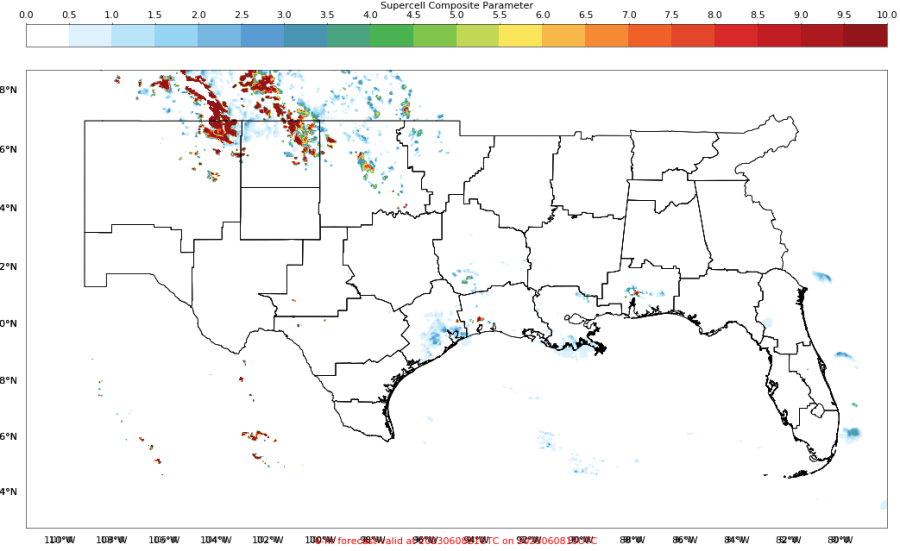
Above: Top is HRRR SHIP parameter, bottom is PHS SHIP parameter.

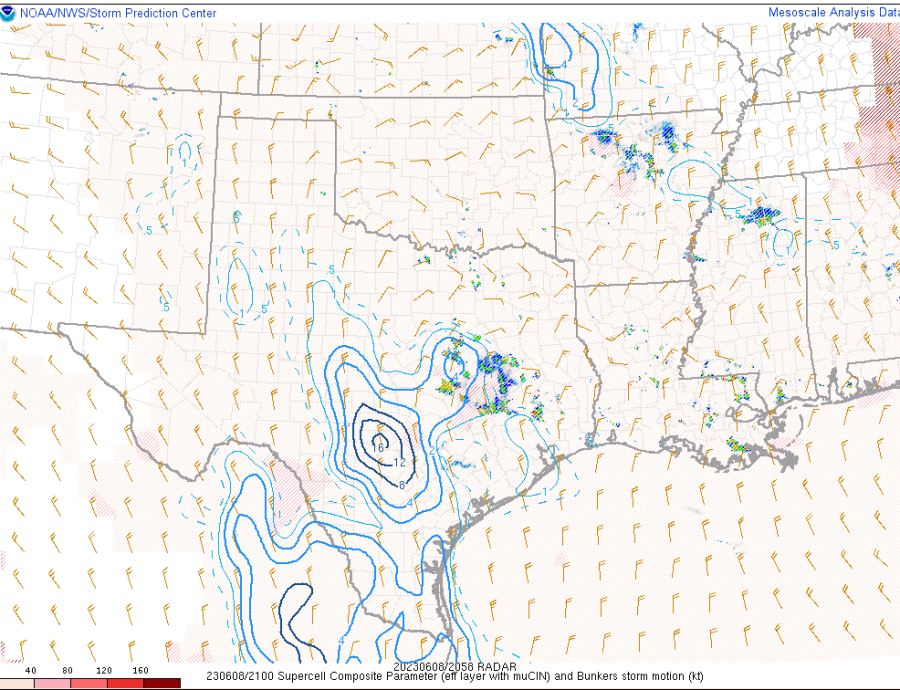
Looking at some of the convective parameters and indices around the CWA I was working with today (PUB), one thing that really stood out to me was how “splotchy” many of the parameters were when compared with the HRRR model. It’s very hard to believe that the model, especially at a 3 km resolution, is able to obtain that level of accuracy with regards to these parameters, or at the very least having gradients this sharp in many of these parameters doesn’t make much sense. Wondering if some of it is being driven by the extreme CAPE gradients that do show up later on, which are certainly going to be drivers in many of the severe indices.

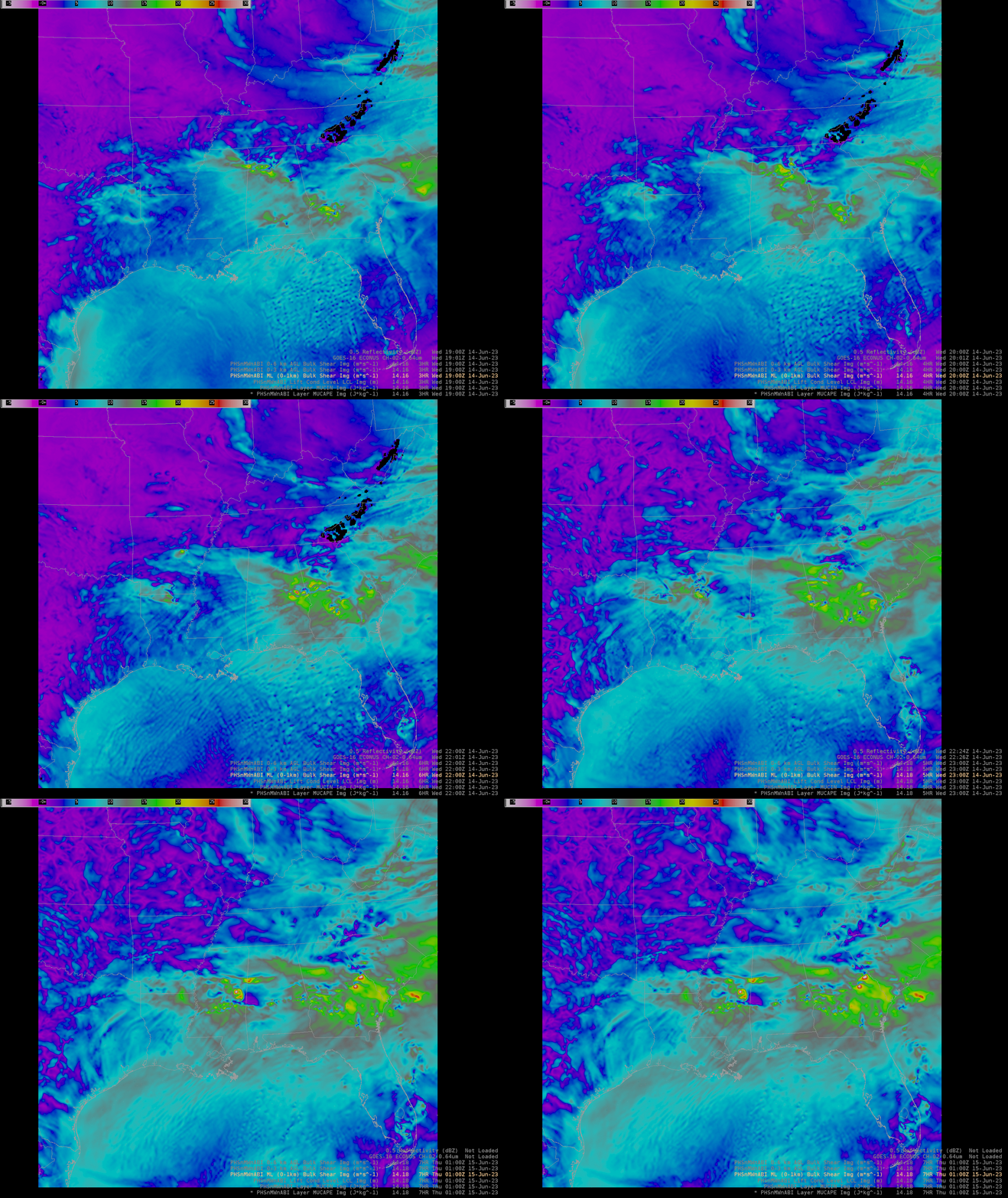
Another thing I noticed is what looks to be a wave-like numerical instability within the first hour of the model – this could be having some big impacts on the model forecast, as you can see these reflected in the base fields (T, u, v, etc) and then having impacts on many of the other derived parameters that last through the forecast period, as shown in the image below:

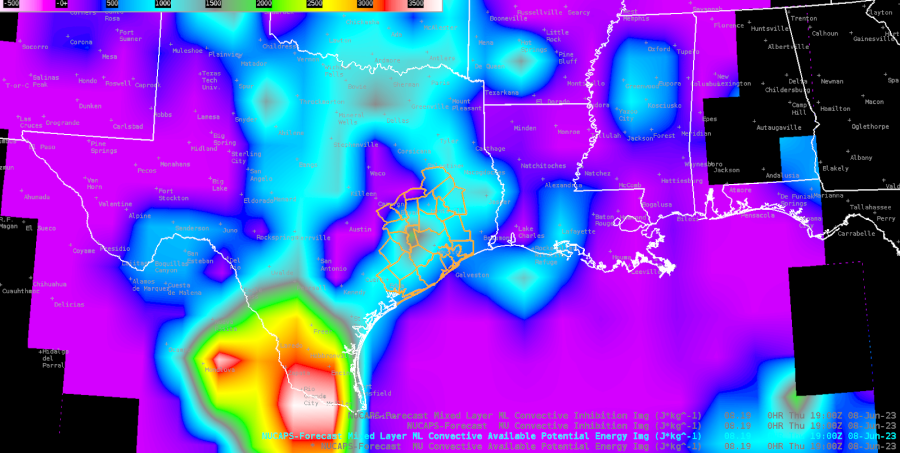
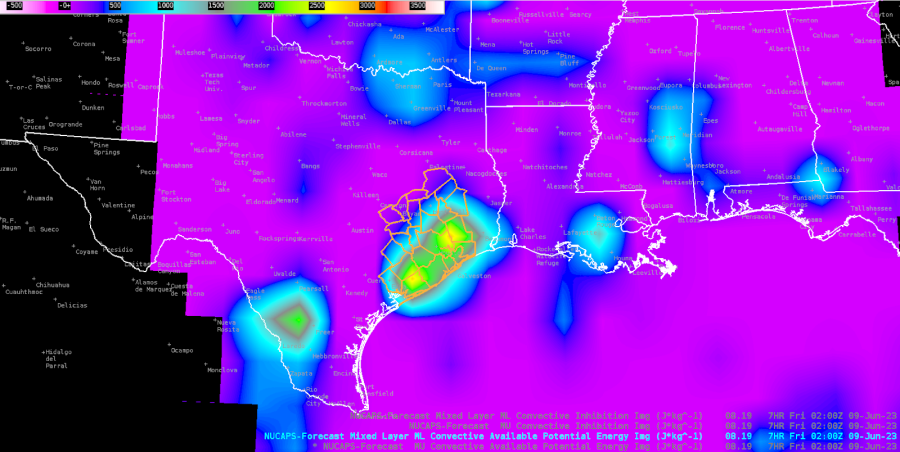
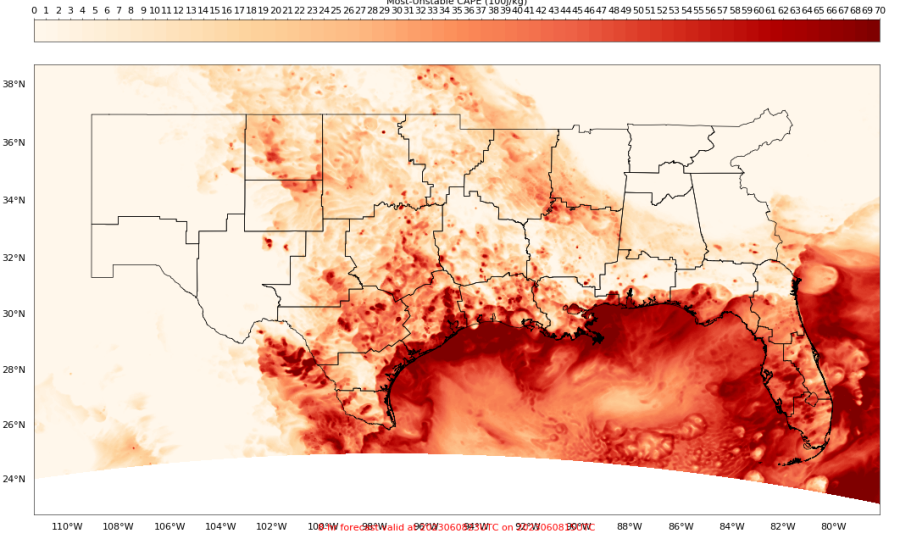
CAPE also seems to initialize really high, then “jump” down to a lower value at the first hour. This is quite a large “adjustment” from the initial conditions that the model seems to start with. Shown below are hour 0 of the 14Z run and hour 1 of the 14Z run from Wednesday 5/24.

You can also see the numerical instability within this field that is in place across a large portion of the domain.

OCTANE

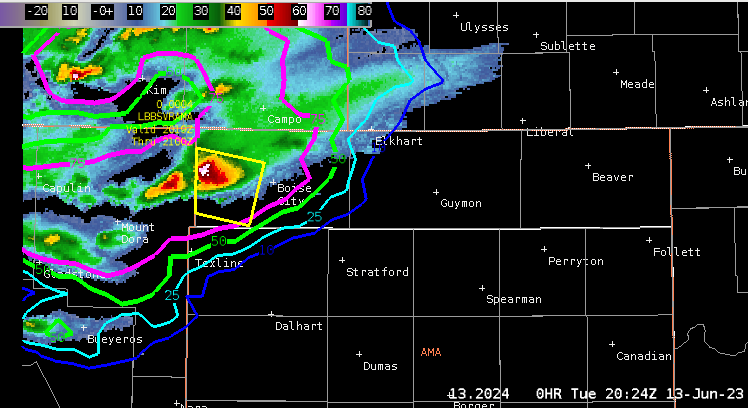
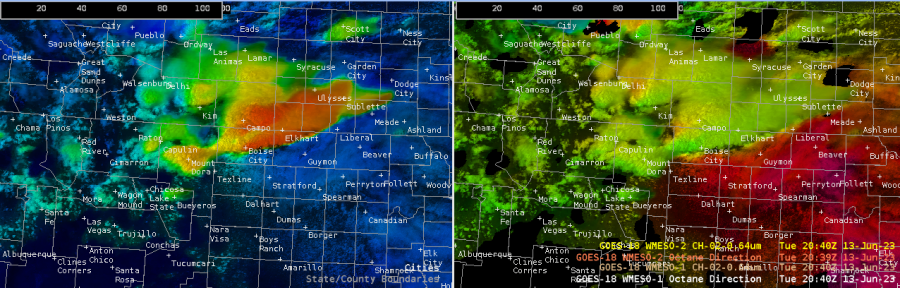
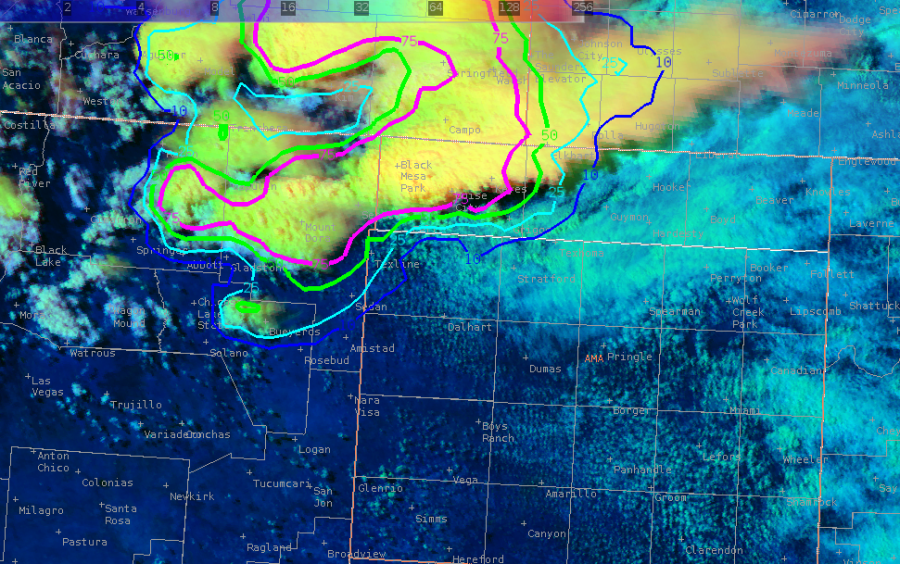
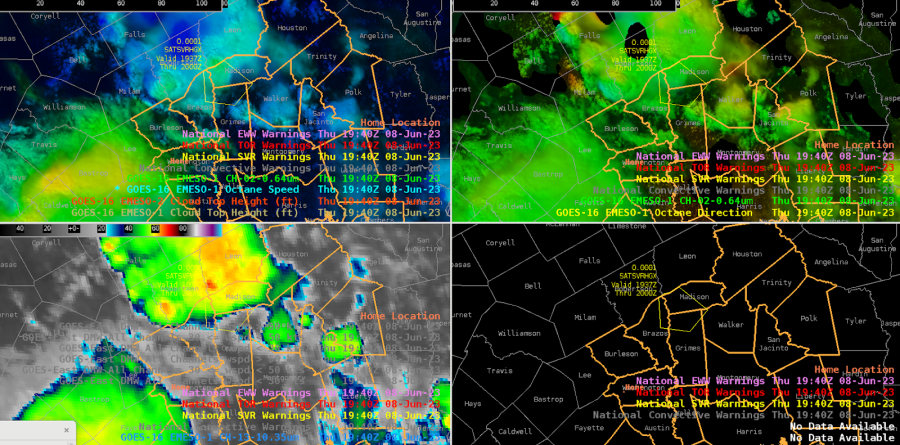
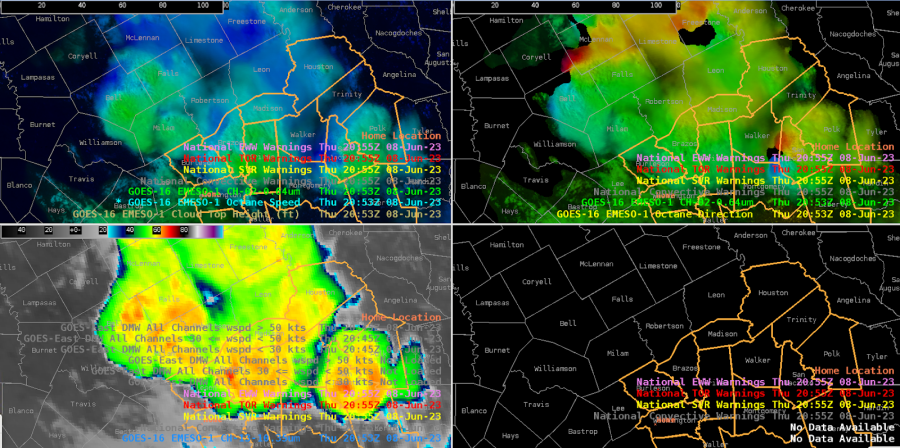
Octane was able to capture an interesting view of the Above Anvil Cirrus Plume on a very powerful storm along the New Mexico/Colorado border during the afternoon hours. The cirrus is a bit slower than the surrounding clouds within the sheared environment, providing that “V” type shape that we’ve come to associate with some of the strongest updrafts:

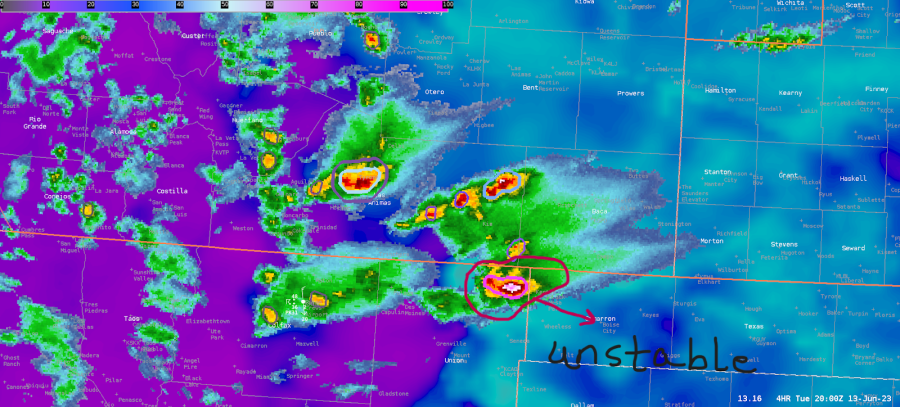
Another good example of using Octane for surveillance of storms – the direction product really highlighted another storm that quickly grew on the flank of another severe warned storm. Big value especially in areas where radar coverage might be limited by mountains, such as in the CWA I was working in today (PUB):

LightningCast

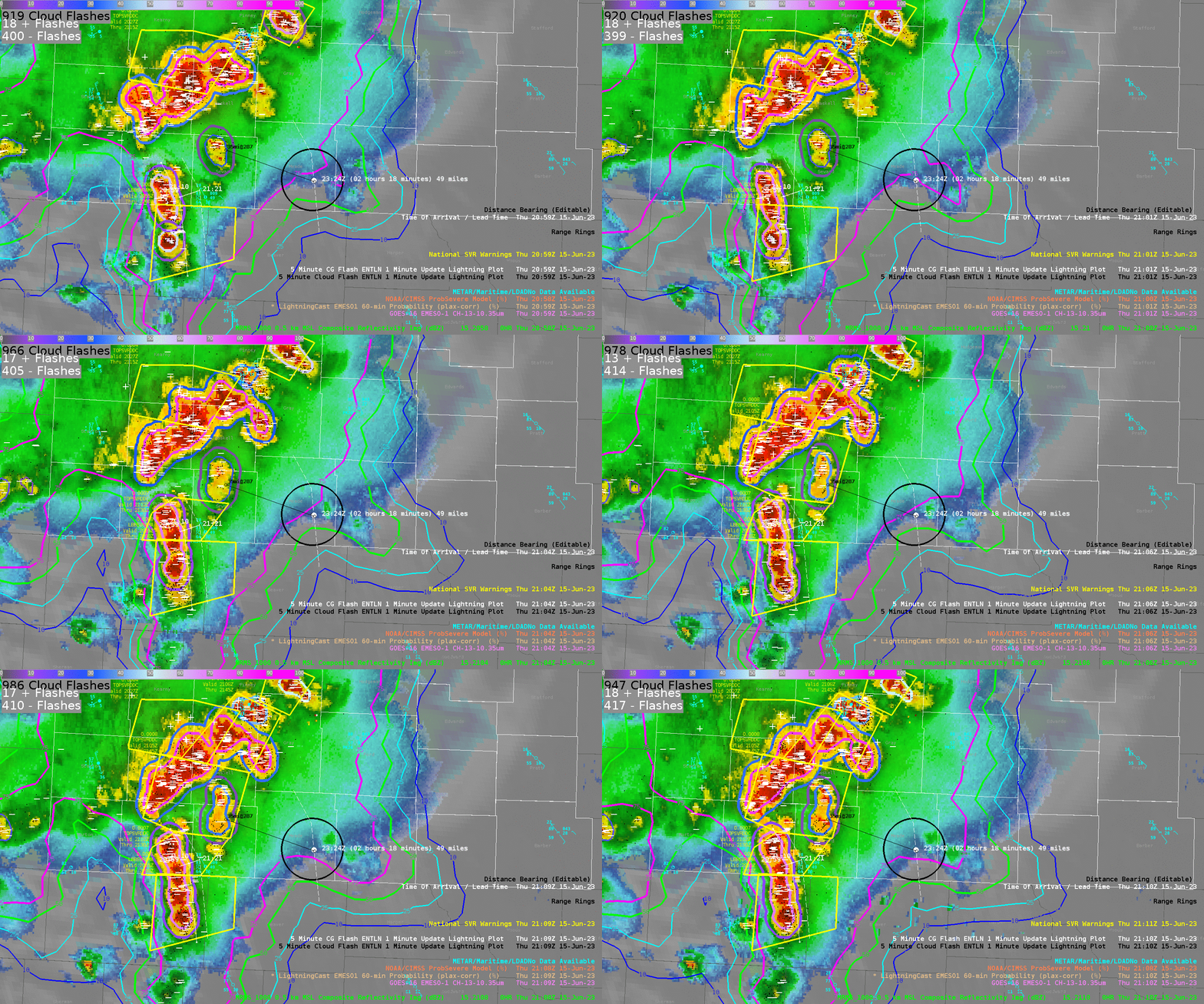
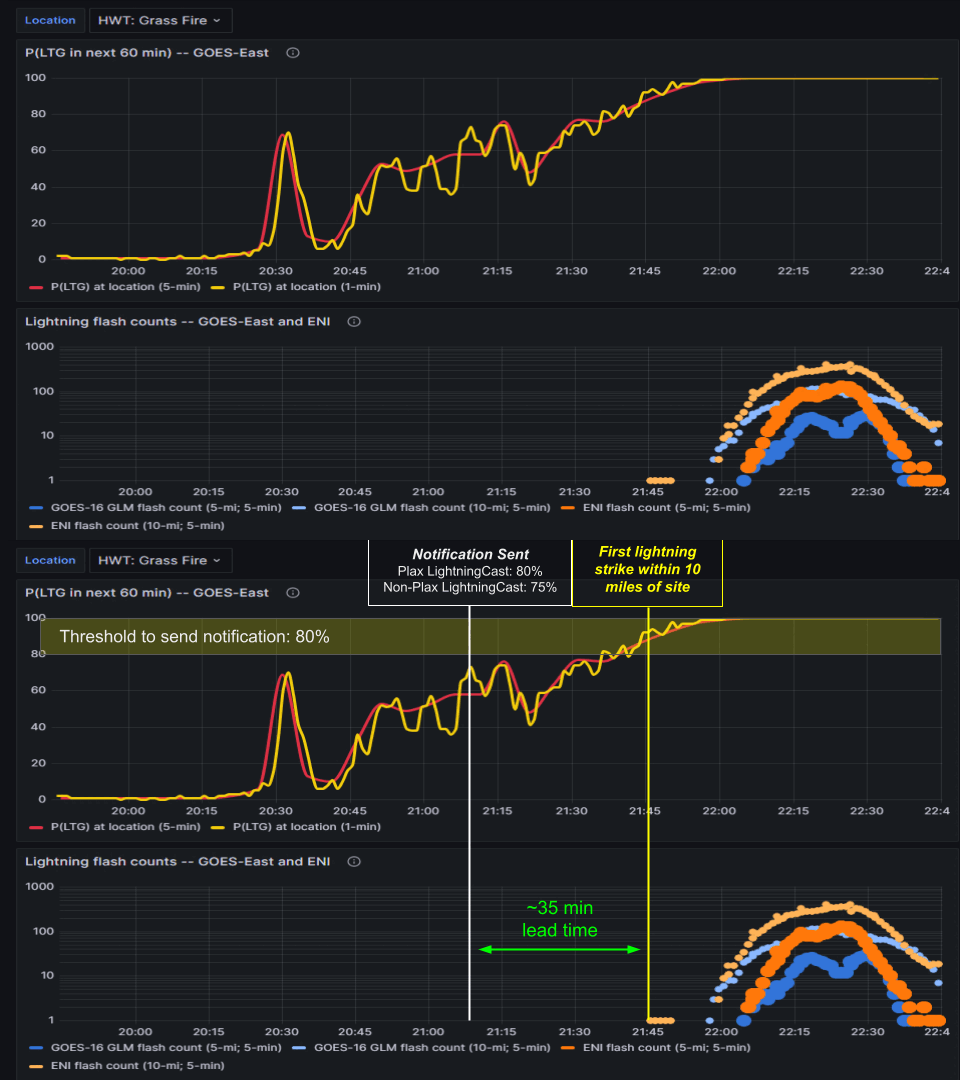
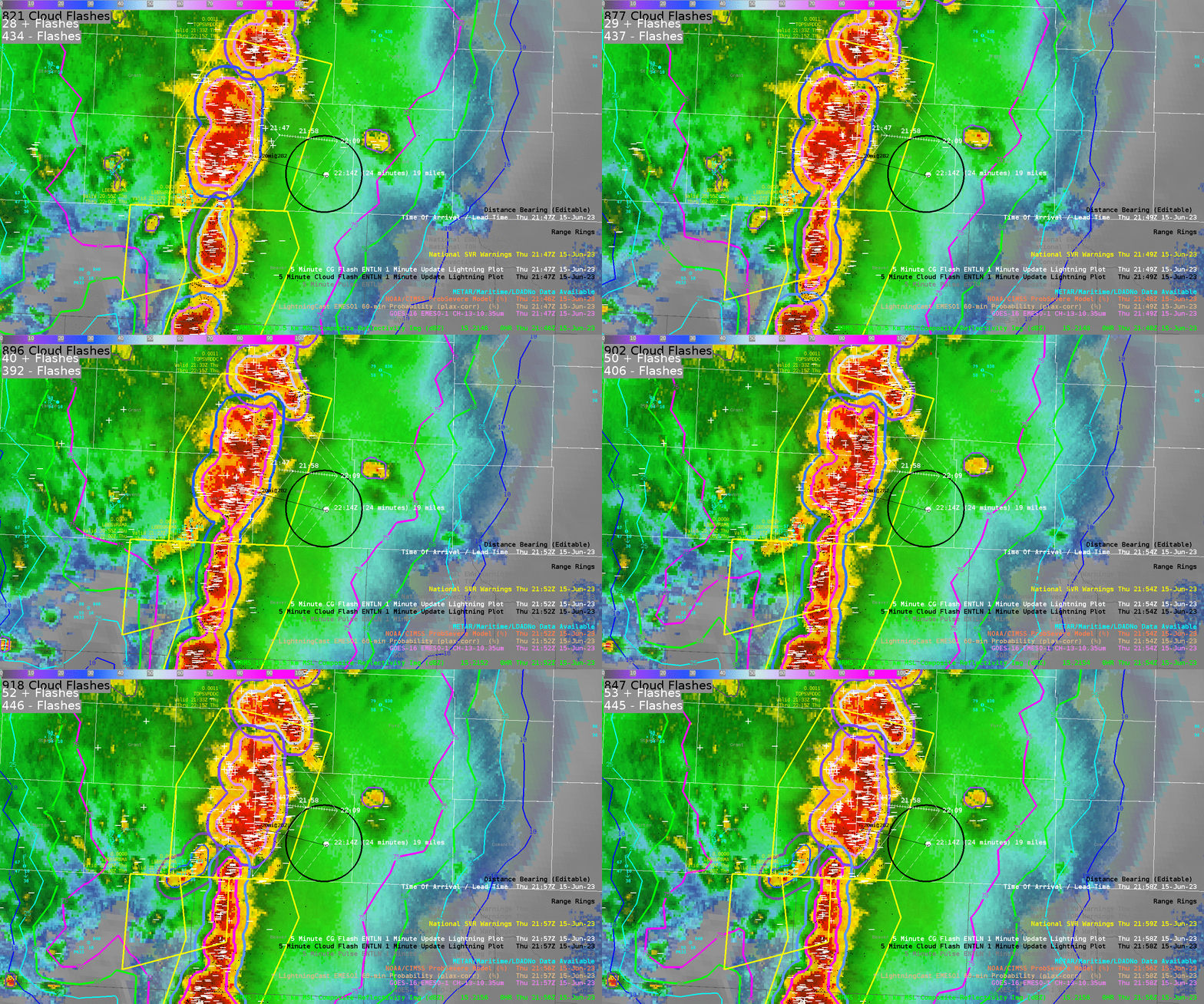
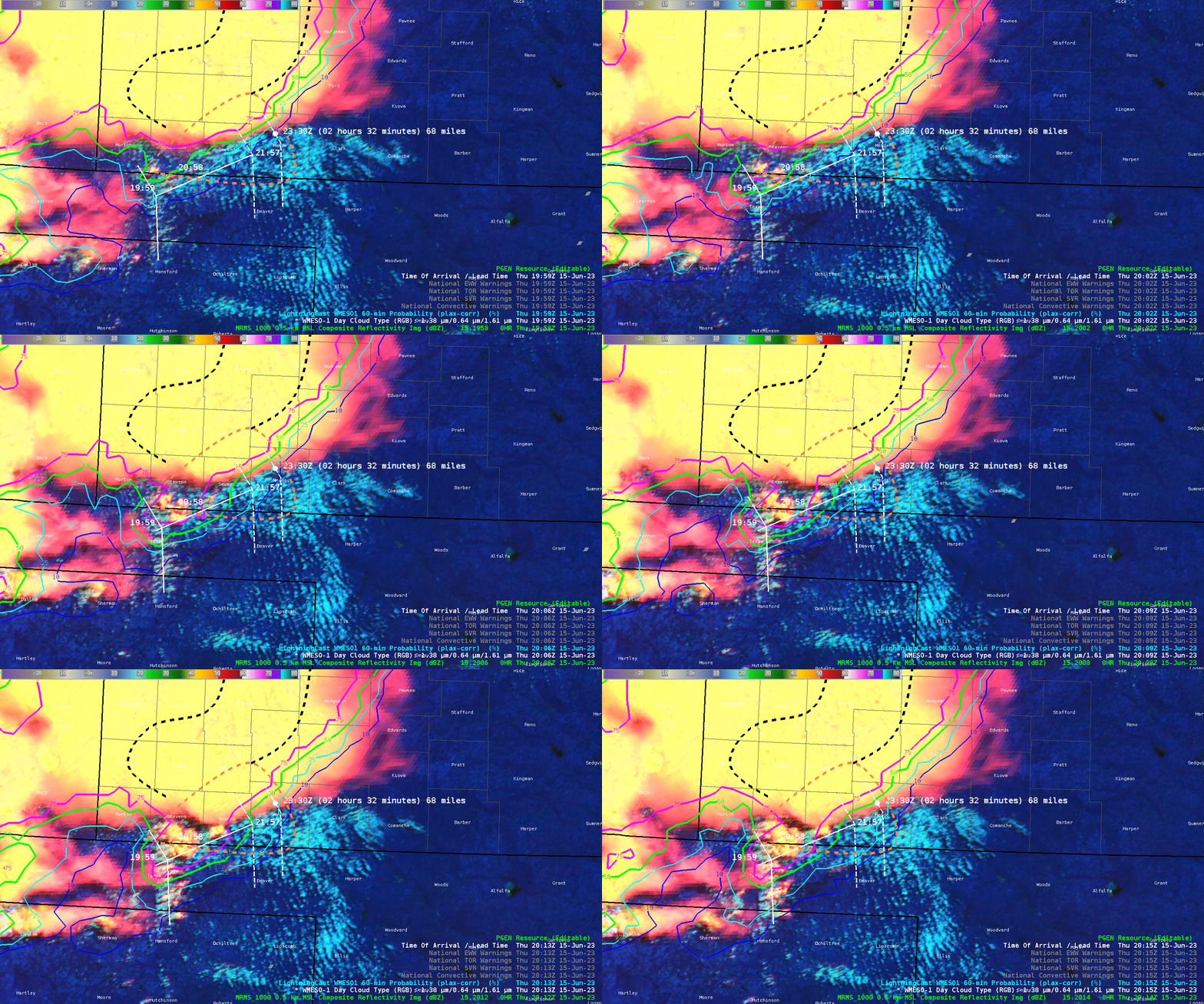
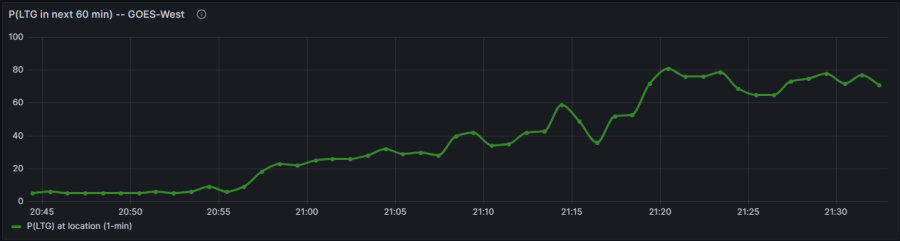
Used the LightningCast product extensively for DSS purposes today. We had a pretend outdoor event located in Pueblo, Colorado. A very strong thunderstorm (MESH estimated nearly 3″ or larger hail at one point) which passed within a few miles to the south and east of the city. I used the LightningCast probabilities in AWIPS overlaid with satellite data to provide multiple updates to Emergency Management, using it to confidently state that probabilities of lightning were increasing as storms approached from the south. Lead time for action would have been within the 45 min to 1 hour range. Was able to confidently say they would see lightning within the 10 mile range a good 15-30 minutes before the first strike occurred within the range per the ENTLN network data. Below is the LightningCast time series as output on the webpage for the KPUB airport, which is very close to where the DSS event was taking place:
There is definitely some very actionable lead time here. As a forecaster, having this type of data available to me outside of AWIPS is a game changer. I know it may be challenging, but being able to click on a point like this and get this type of information would be huge for briefings and emails with decision makers. Right now we are limited to airports. Even a relatively coarse mesh that would allow me to pick a close point would be extremely useful if these images can’t be generated on the fly. Other possible ideas include only generating points within a certain LightningCast threshold (say 10%), or generating them on the fly based on a click query. That all said, even in its current form I will be using it going forward, and making a point to share it with my office and WCM for DSS.

I also made a social media type graphic using the LightningCast product for hikers, given the large number of mountains within the CWA. Perhaps would have been a bit more meaningful to have sent this as storms were beginning to form, but they were already cooking once we got spun up and started. Highest probabilities were hugging the mountains where storms were forming. If I were formally posting to social media, I may have added some lightning safety graphics or something to that effect as part of the post (twitter thread, multiple images in Facebook post).

GLM RGB

This product does a great job in my opinion combining information from the FED and MFA. I found it useful for detecting lightning jumps within storms while still maintaining information about the overall coverage of lighting. Would happily use this as my primary GLM viewing option in AWIPS.

-Carl Coriolis


Tags: None

LightningCast Over Eastern MT

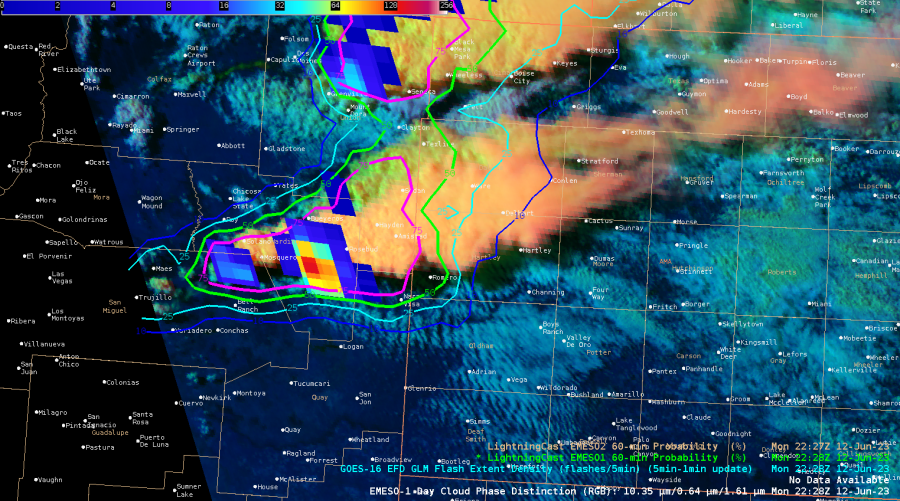
This image shows Day Cloud Phase Distinction, LightningCast, and 5 Minute CG Flash Lightning Plots for NLDN and ENTLN across Eastern MT.  While LightningCast provides a lot of information, it’s easy for it to overwhelm forecasters in situations like what’s shown, especially if other colorful imagery is included.  A suggestion is to give forecasters the option to load LightningCast in 10% increments from 10-90% (10, 20, 30, etc).  Then, forecasters can turn the individual increments on or off depending on the situation (i.e. lots of severe weather can prompt the lower values to be turned off, or partners concerned with the initial start of lightning can prompt lower values to be turned on).  Having the ability to change the color, line style, and line width for each increment would also be nice.

-Champion

Tags: None

LightningCast Graph For Lubbock Airport

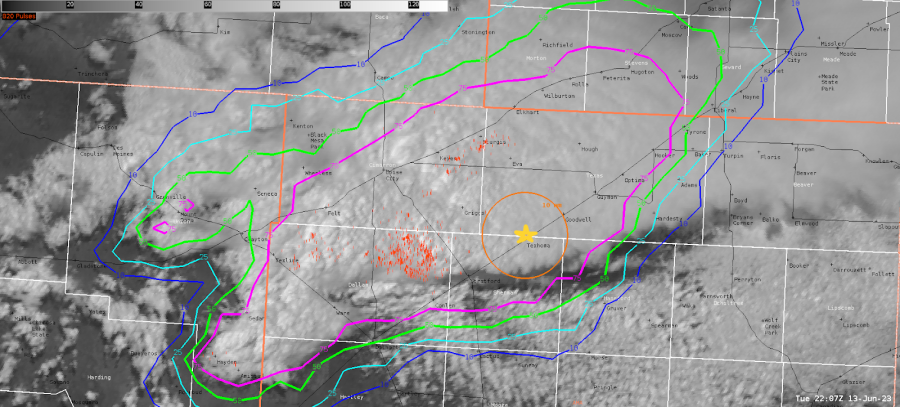
This is a great example of LightningCast application that could be used for TAF forecasts or DSS. As the image above shows you can see the chance of lightning slowly going up for the airport getting to around 20 to 30% before the first lightning strike within 10 miles and above 60% before the first strike before it hit within 5 miles. More localized research would have to be done to see the threshold for DSS and TAFS. But in this example if we used 30% threshold we would have a 15 to 20 minutes lead time before lightning got within 10 miles of the airport.

-Thunderstruck

Tags: None

LightningCast Gives Advance Notice for DSS Event

Lightning Cast (parallax corrected) had a 75% contour for lightning within the next hour (screenshot taken at 21:51Z) for our railroad DSS event. Notified the DSS event about the high lightning potential within the next hour. Went back to look at radar and lightning data for 22:50 to 22:54Z and there were CG and CC strikes just north of the Railroad DSS event in Levelland, TX. This allowed us to give them an hour to make any ground preparations regarding personnel.

-Dwight Schrute

Tags: None

LightningCast Gives Advance Notice

Thunderstorms were expected to develop in northern TX on May 23rd. Using Day Cloud Phase Distinction, a specific cell seemed to be quickly forming. Minutes after this trend was noticed on satellite, Lightningcast started tracking it. A 10% area was forecasted at 1927Z, followed by 25% at 1930Z, 50% at 1933Z, and finally 75% at 1942Z. While the 75% forecast dropped off for a brief time, it still was predicting lightning over the next hour. What happened? NLDN and ENTLN detected a CG strike at 1959Z (extreme northeast Roosevelt County). The storm went on to continue producing lightning.

– Champion

Tags: None

Challenge With A DSS Event With Scattered Thunderstorm Development…focus on LightningCast.

Sea Breeze and outflow boundaries in place over the Florida Peninsula made for a tricky forecast during the afternoon hours, as thunderstorms could and would quickly develop just about anywhere along that boundary. Lightning up to this point by far was the main threat from these storms…as most storms were not strong long enough to cause notable hail to be a concern, but with storms having the potential to “die off” quickly as well, wind was more of a concern.

With the initial onset of early afternoon activity, providing DSS support and giving the local contact more detailed information was on the ‘easier’ side. LightningCast around 19Z was showing increasing probability contours of lightning within 60 mins at the DSS site (image below was at 1901Z. The DSS event is noted by the yellow “C”.

By around 2035Z, activity had increased in coverage and drifted northeast, closer to the DSS event, shown below by the increased coverage of ENTLN lightning plots and the 75% probability contour in the area.

The challenge since then is that more scattered/widespread activity has developed (and died off), in what seems at times to be in fairly random areas…but are for the most part tied to the moving outflow boundaries from previous storms (seen in radar image below at 2203Z).

Not surprisingly, as a result of all of this activity, LightningCast over this entire area has been remaining mostly around-above 50%, with many spots at/above 75%.

The challenge is what is the best way to convey this information to the DSS point of contact? Below is an image showing the LightningCast probability contours at 2212Z, along with the LightningCast Time Series for the DSS site (noted with the yellow “C”).

There is an overall lull roughly between 2110Z-2150Z (probability is closer to/lower to 50%)…but it never drops below 20%.  

Personally, looking at this time series and given the environment/set up and evolution of storms so far, I would have a difficult time calling the DSS point of contact and saying the threat of lightning is low…as another storm could develop as soon as I hang up. You don’t want to totally shut an event down, or be constantly calling the point of contact with updates (unless you know the contact likes that much communication). I don’t claim to have the answers, just thinking out loud, but it’s something to think about if using this product to communicate with DDS contacts.

-Bubbles

Tags: None

Taking a look at LightningCast in West-Central Florida.

Thunderstorms have been gradually increasing this afternoon along the west coast of Florida, and wanted to take a look at the evolution of the LightningCast product vs when flashes were first reported. Want to note upfront, there was an issue with GLM data, so used the 5-min (1-min update) CG/Cloud/Pulse ENTLN1 lightning plots to see when activity developed.

Below are images showing when the 25, 50, and 75% probability contours of lightning occurring in the next 60 minutes appeared, focused on Sarasota and Lee counties. For both counties, the 25% probability contour first appeared at 1838Z, 50% contour at 1851Z and the 75% contour at 1854Z. The first lightning strikes appeared in Lee County at 1858Z (a 20-min lead time from the 25% contour). The first strikes appeared in Sarasota County at 1906Z (a 28-min lead time from the 25% contour).

The image below shows the 25% probability contours showing up in the Sarasota and Lee Counties at 1838Z.

The image below shows the 50% probability contours showing up in the Sarasota and Lee Counties at 1851Z.

The image below shows the 75% probability contours showing up in the Sarasota and Lee Counties at 1854Z.

The image below shows the first lightning strikes showing up in Lee County at 1858Z.

The image below shows the first lightning strikes then showing up in Sarasota County at 1906Z.

– Bubbles

Tags: None

GLM and Lightning Cast

The GLM parallax showed up again Thursday, June 16th, over the PBZ area. This was even more evident than yesterday’s event in WI that was written about in a blog post.  Figure 1 has ProbSevere, LightningCast, GLM Flash Extent Density, and ENTLN data overlaid in a 4-panel.  This case was fairly simple to “self correct” the parallax as the GLM was clearly displaced to the north of ProbSevere (as well as the base reflectivity).  Really once you get a few cases under your belt recognizing the parallax, it’s not too challenging to keep that “self correct” in the back of your mind.  One interesting thing to note about Figure 1 is the storm just outside the PBZ CWA just south of Mount Veron, Ohio (See bottom left in Figure 1).  The ProbSevere and GLM FED are lined up perfectly and this is a great example of utilizing the lower threshold in the colormap. The bullseye shows up much nicer than the larger thresholds in the top two images.

Figure 1: GLM with ProbSevere and LightningCast

– Podium

Observations from BUF on Thursday June 16th

Optical Flow Wind Storm Top Divergence Can Aid in Warning Operations

The storm of the day produced a 2.5” hail stone near Cato, NY.
Strong storm top divergence signals an intense or intensifying thunderstorm. Matched with upper level radar scans, satellite interrogation (clean IR), and ProbSevere, optical flow wind products may be another tool to aid the warning forecaster and/or storm scale mesoanalysis,  Below are the corresponding optical flow wind storm top divergence images approaching 4 PM EDT (3 PM CDT) when the sig severe hail was reported. The thunderstorm of interest is centered just south of eastern Lake Ontario.

LightningCast as Graphical Messaging/IDSS Tool

As the DSS and graphics person for BUF, I took the opportunity to highlight the utility of LightningCast for Graphical NowCasts and DSS graphics. The fairly broad brushed nature of the lightning probability contours at the timesteps utilized for graphics I think is a positive for a few reasons: they show actionable probabilities (10+, 25+, 50+, 75+) that users can understand; the contours are akin to annotations on a radar graphic, so would be a time saver; and finally, broad brushed is a way to prompt users and partners to seek out more information, like real time zoomed in radar data, perhaps calling or sending us a chat on NWSChat, or even simply keeping an eye on the sky and listening for thunder. The parallax corrected product in the images below I feel would be more useful for graphics of the nature shown below. Ultimately, for operational use, there would probably need to be some work done to ensure they are not confusing to the user and aesthetically pleasing.
Graphical NowCasts for our websites and social media
Graphic for IDSS Event

A Case for the Sharpened GLM FED Color Scale Used this Week

Over the course of satellite product interrogation this week, the GLM FED stood out as one of the most useful products.  Below are examples from in/near the BUF CWA at 2043z and 2047z. Note that the top of the color scale was set to 128 flashes/5 min over the grid point vs. the default 256 flashes/5 min in AWIPS. The FED also paired well with the MFA and TOE on this 4-pane procedure.
The color curve used this week really popped and correlated well with frequent ENTLN detections. Another example below from shortly after 6 PM EDT (2202 and 2207z)  shows that there will be instances where perhaps an even small color bar range would be useful.
While the strongest storm at this time still showed up well on the AWIPS default color bar range, the 128 flashes/5 min top end of the range (top right) helped it pop even more and corresponded well conceptually with the ENTLN cloud flash detections. Furthermore, the thunderstorms to the north of the strongest thunderstorm showed up better from an SA perspective, if you have been focusing on the strongest storm for warning ops. The smallest color bar range on the bottom left further enhances the above described effect.

Addendum: GLM Flashes and a more smoothed FED

The excellent COD NexLab Satellite and Radar page added within the past year the GLM flash centroids to their GOES derived overlays. From an apples to apples perspective with respect to the ground based lightning detection network displays, this may be a useful product to add into AWIPS.
\

Addendum 2: Would a more smoothed FED be preferable?

Below are a few web based examples of FED displays.
A case can be made that these smoothed FED examples would be somewhat less obtrusive than the default AWIPS FED display, especially for storm scale interrogation by the warning operator or storm scale mesoanalyst.
– Hurricane84

GLM Parallax and Lightning Cast Fun

The GLM data, specifically the FED data, was used to provide DSS to the Riverfest in La Crosse, WI.  After my first contact with the event POC, I noticed that the FED data was off by roughly a county from the ground-based lightning data.  This was my first time witnessing the parallax issue from the GLM and why ground-based lightning networks are a key component in confirming that the GLM location is accurate. In Figure 1, notice the intense concentration of the lightning just southwest of the event (20 mile and 5 mile radius rings) depicted by the GLM while the ENTLN/NLDN say that concentration is about a county south.   The parallax is evident in other lightning concentrations in and around the event circle.  I know it’s something being worked on to have the GLM data corrected to avoid this parallax issue, but it would be nice to have a map of the locations where the parallax is more evident in case you may not need the corrected version. Obviously, the further north, the larger the parallax, but not quite sure at what latitudes it really starts to show its hand. On a side note, for aviation purposes, the parallax could become problematic if the GLM lightning data is off by a factor of a county or two, especially if re-routing aircraft is occurring.

Figure 1: GLM Flash Extent Density compared with ENTLN data on June 15, 2022.

Figure 2: FED and ENTLN animation showing the GLM parallax.

I utilized the Lightning Cast to provide a probable end time of the lightning threat for the Riverfest event in La Crosse, WI.  This was a valuable tool as it provided some added confidence when the storms would exit the event area.  I did my best to line up the TOA tool with the 25 percentile contour. Once I got my estimated time that the end of the lightning threat would reach the event, then I added about 30 minutes to ensure it was well east of the event circle.

– PODIUM