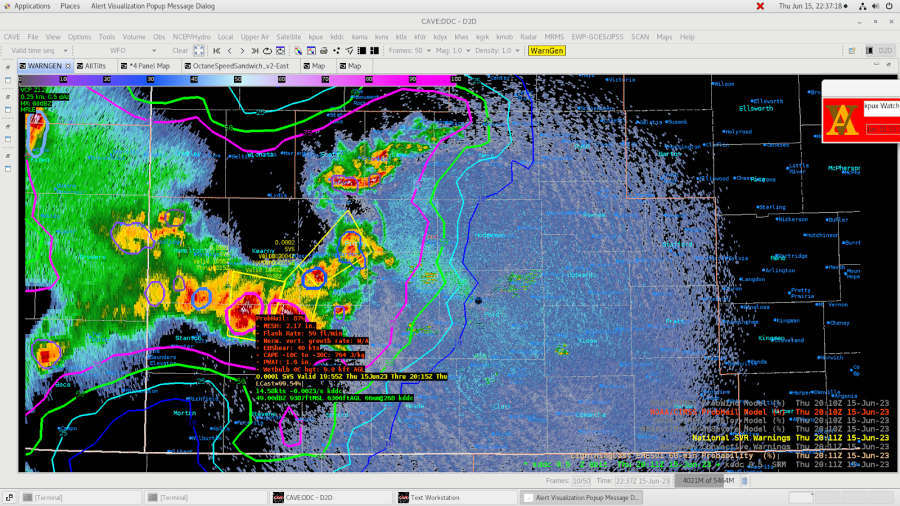
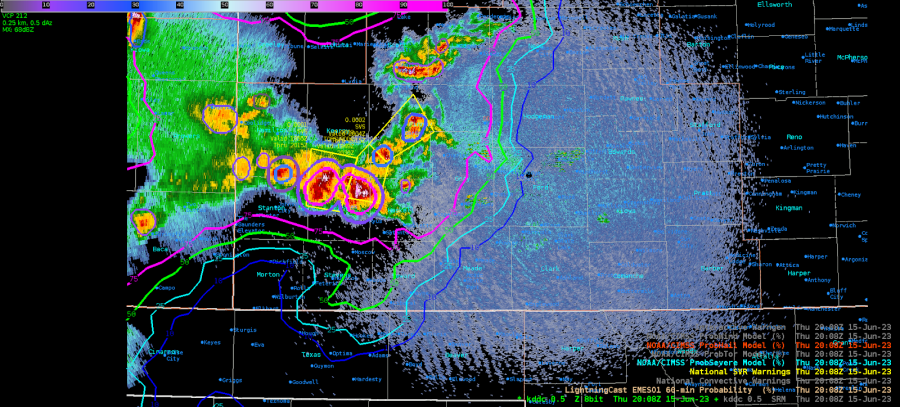
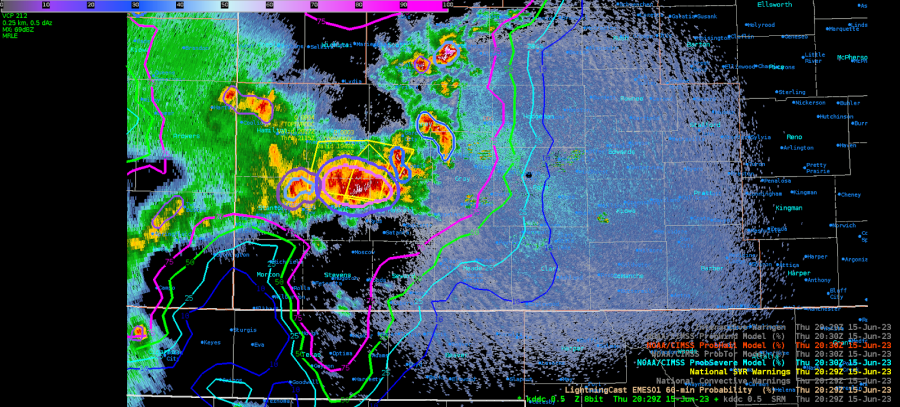
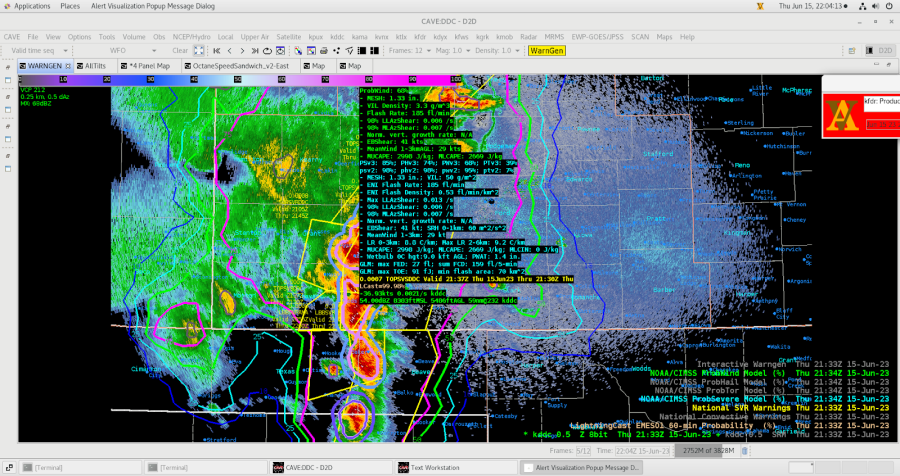
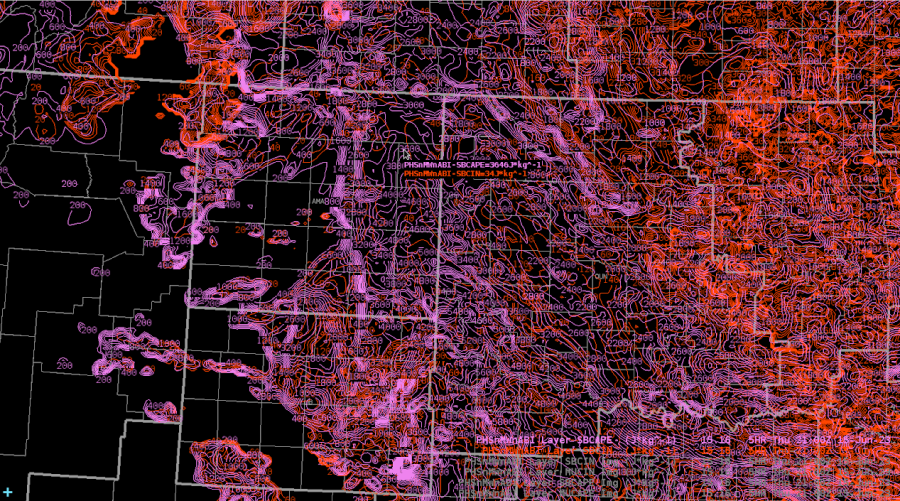
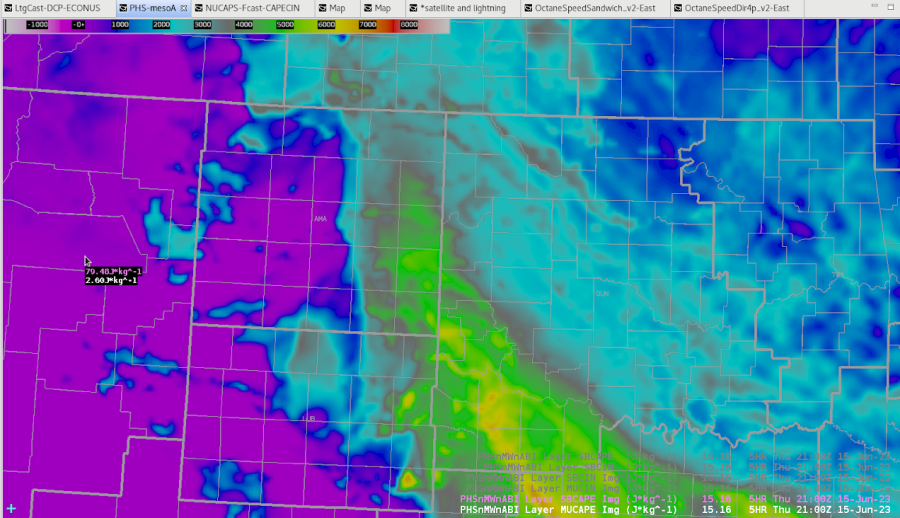
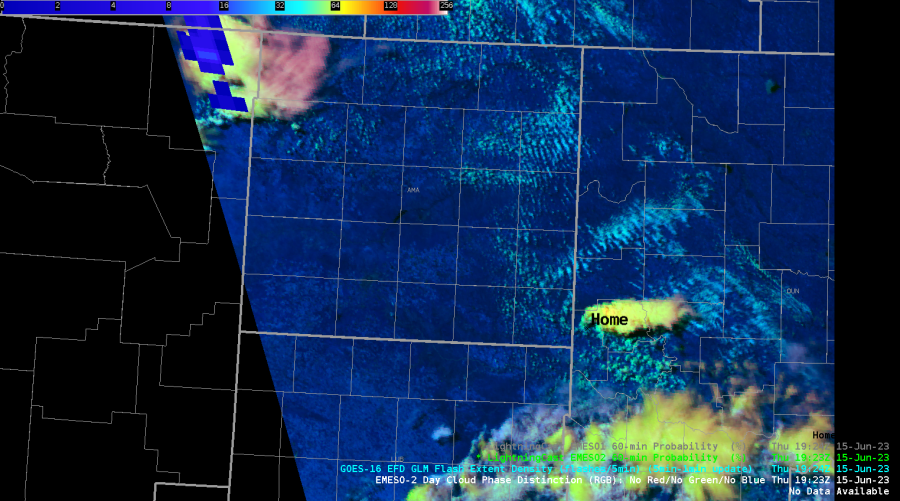
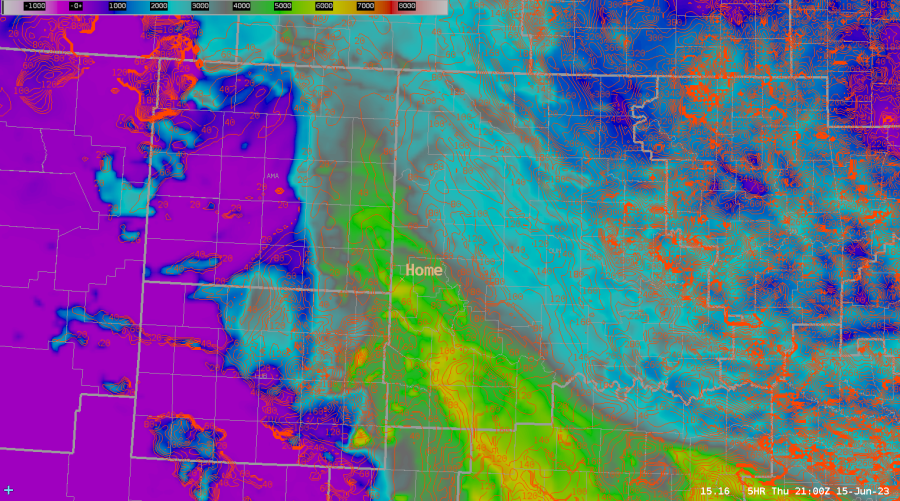
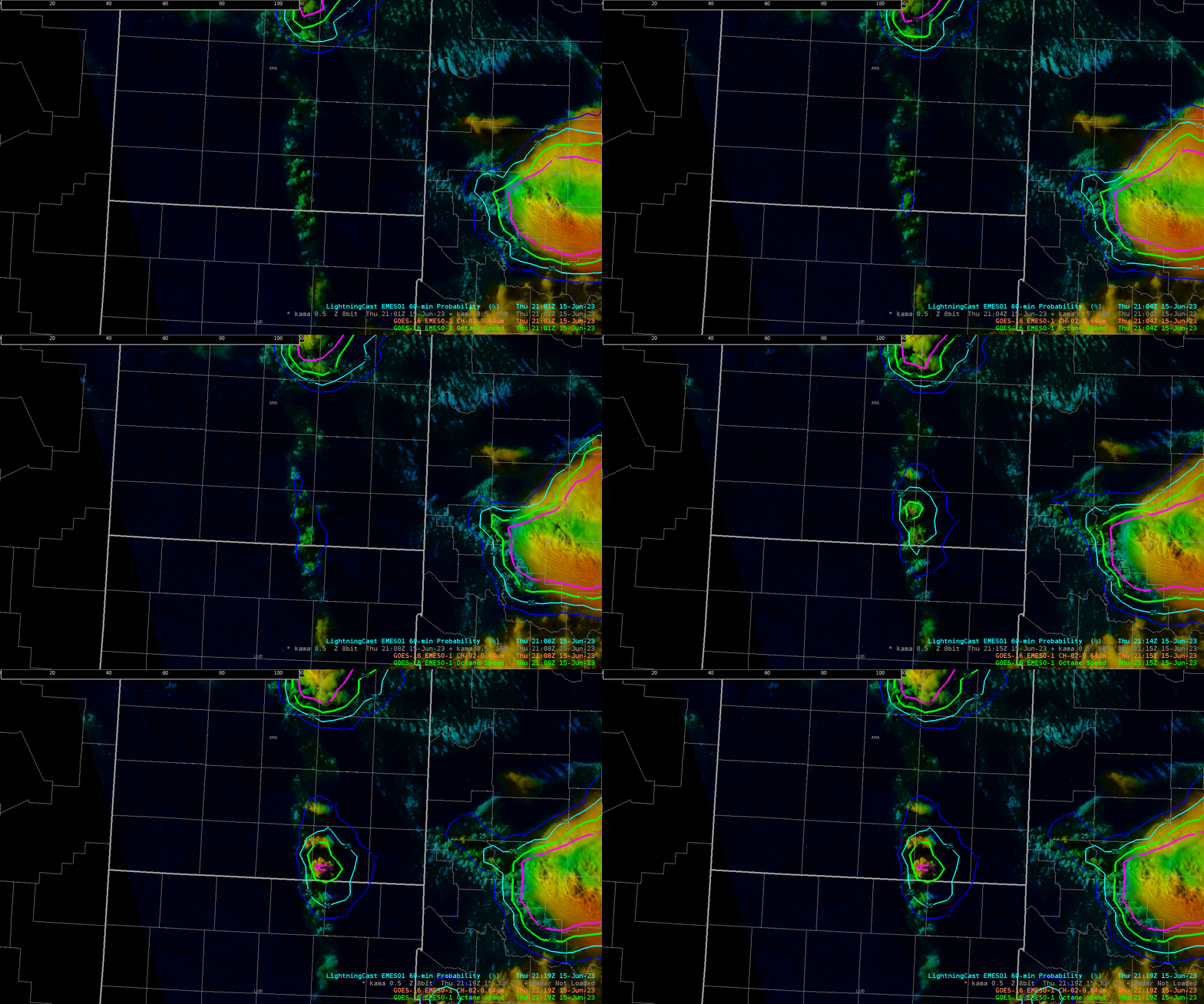
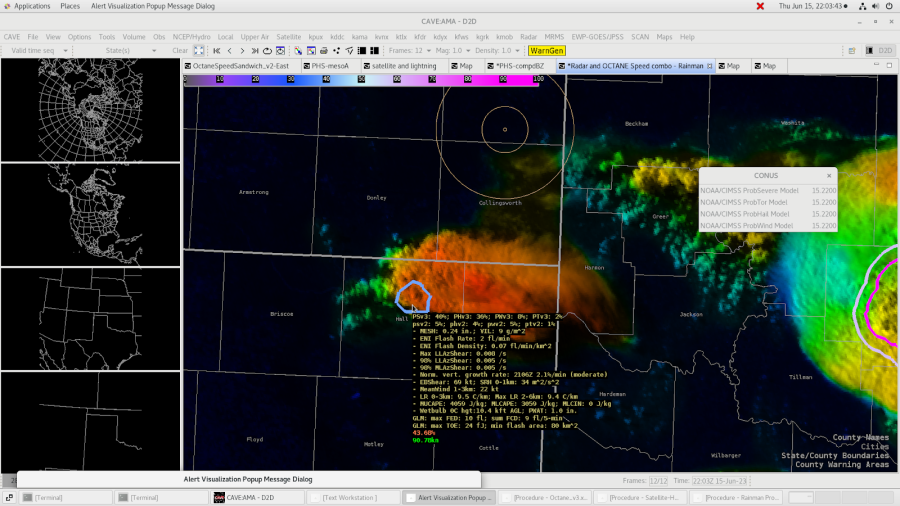
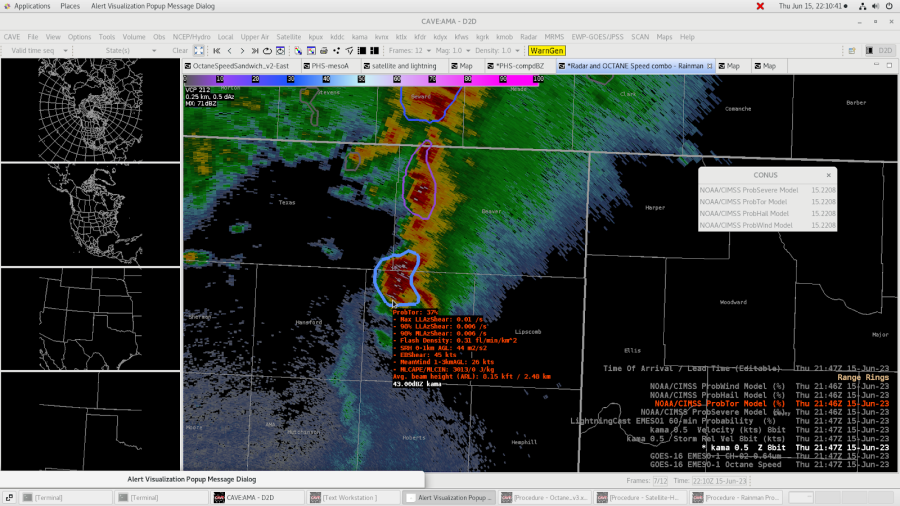
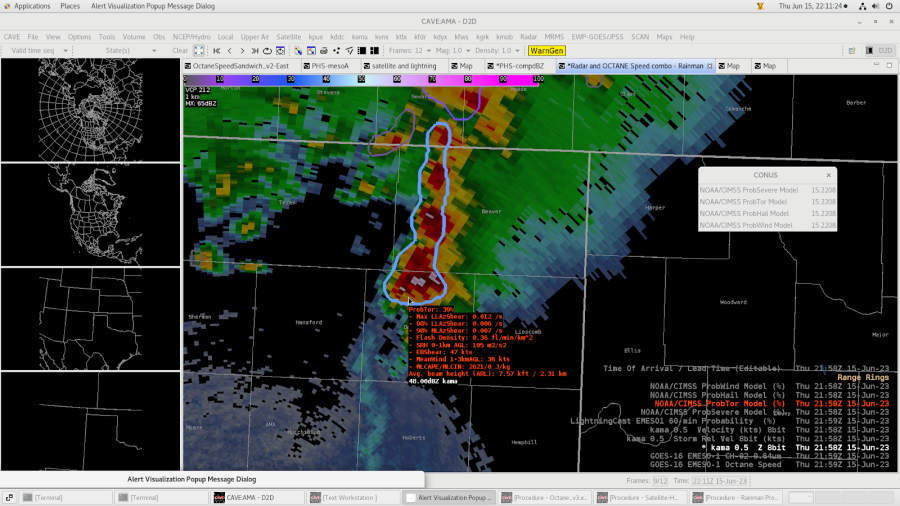
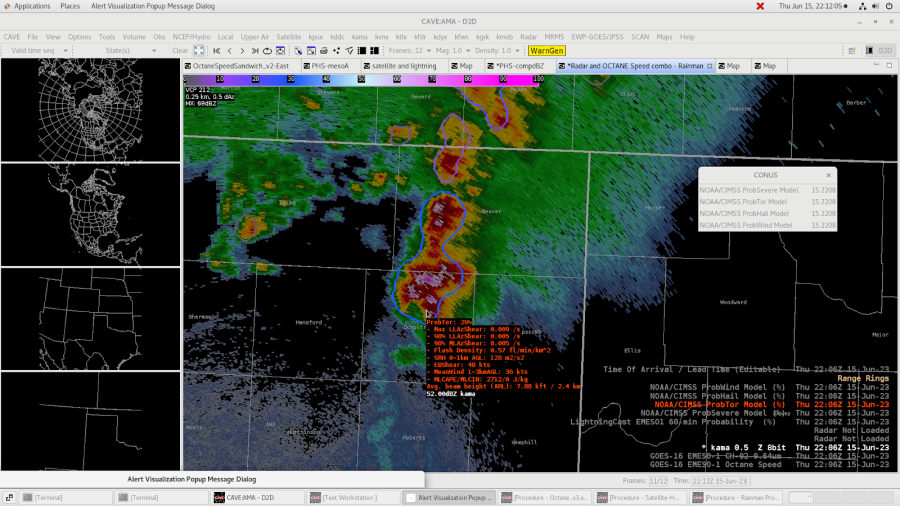
HGX Convection impacting the Car and Truck Show in Burton, TX

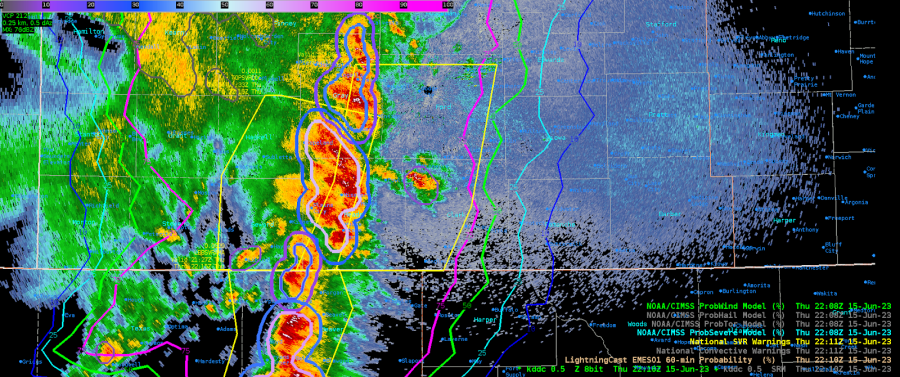
Initial setup for the HGX vicinity showed several cells to the north and east of the DSS site, propagating southeastward. The strongest cell, pictured below, had a PSv3 of 73%, while PSv2 remained as 56%.

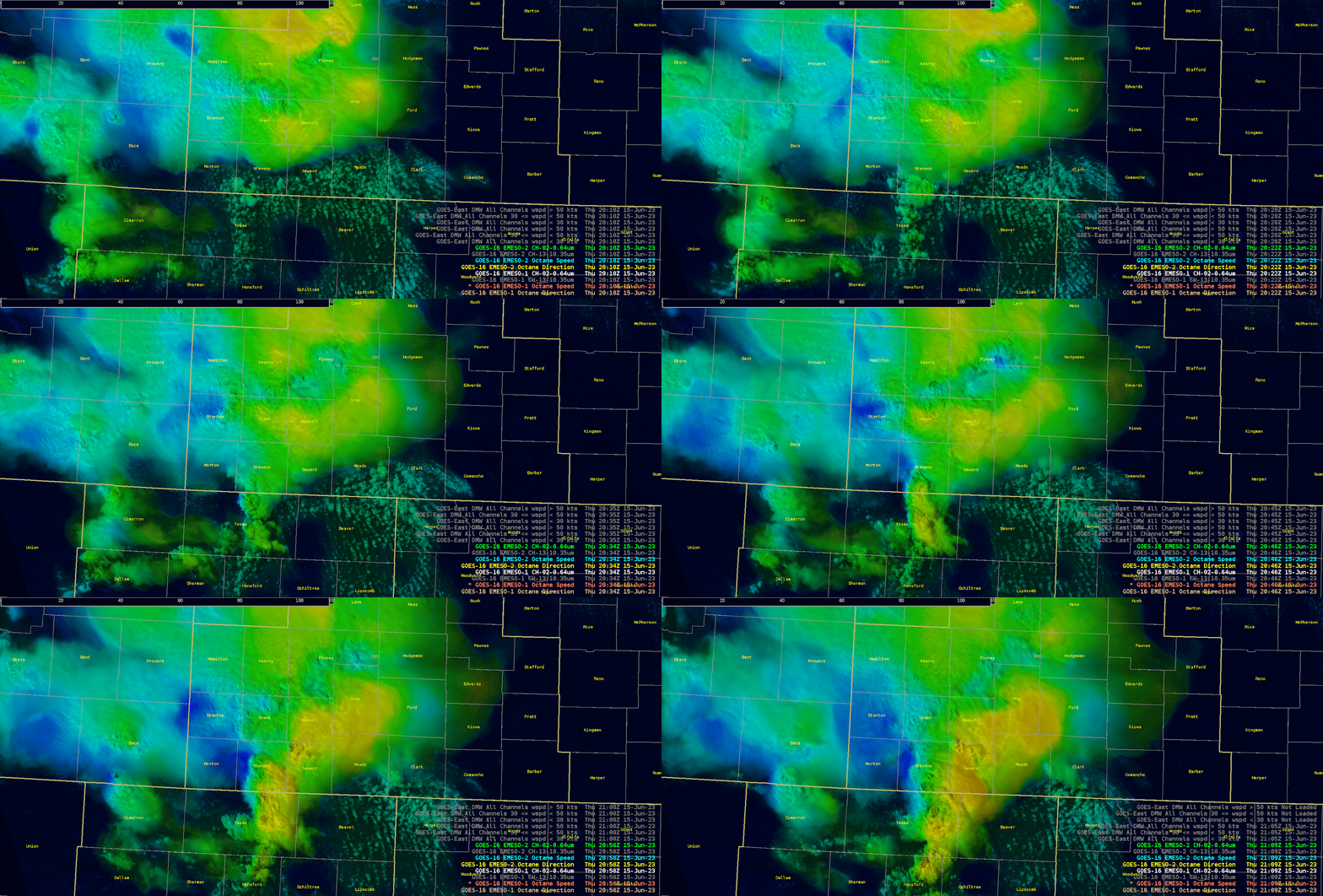
We issued a warning for a northern cell moving into the CWA into Madison county, based on a -70C cloud top brightness temp and PSv3 total prob over 70% (had been climbing from the 50s fairly steadily). But the cloud top shear noted by Octane was not strong (~20-25 kts), so the warning was very borderline. Just a couple scans later, it lost most of its texture on the vis imagery and lost its shear in the Octane direction product. Cloud tops warmed a bit as well.

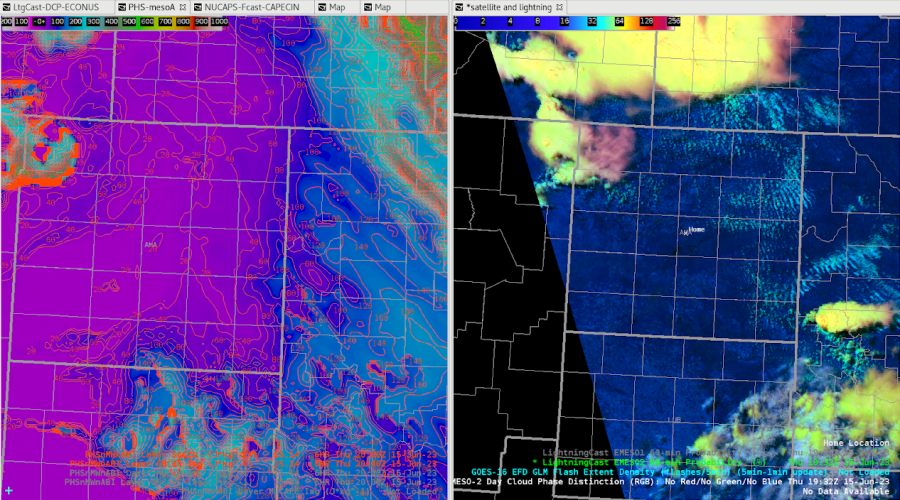
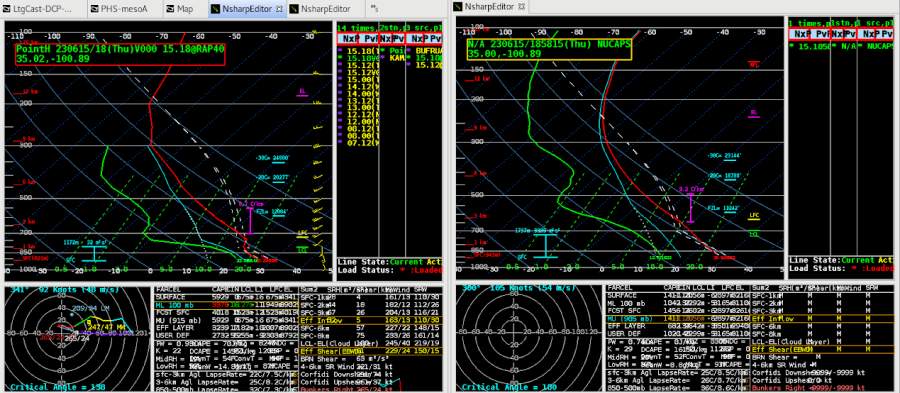
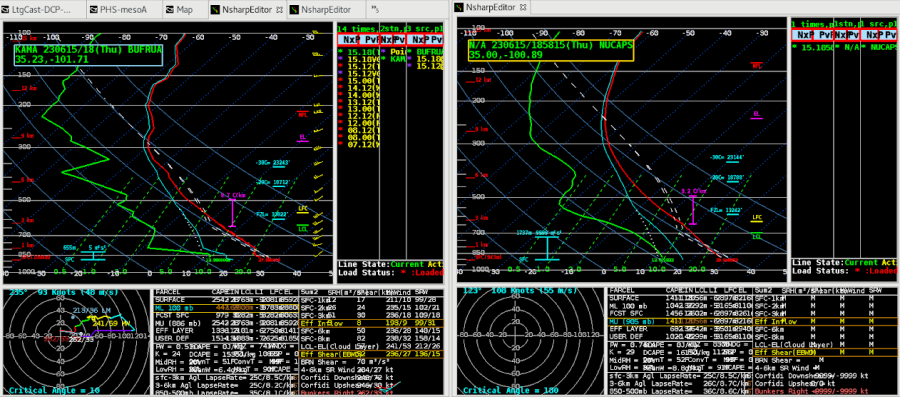
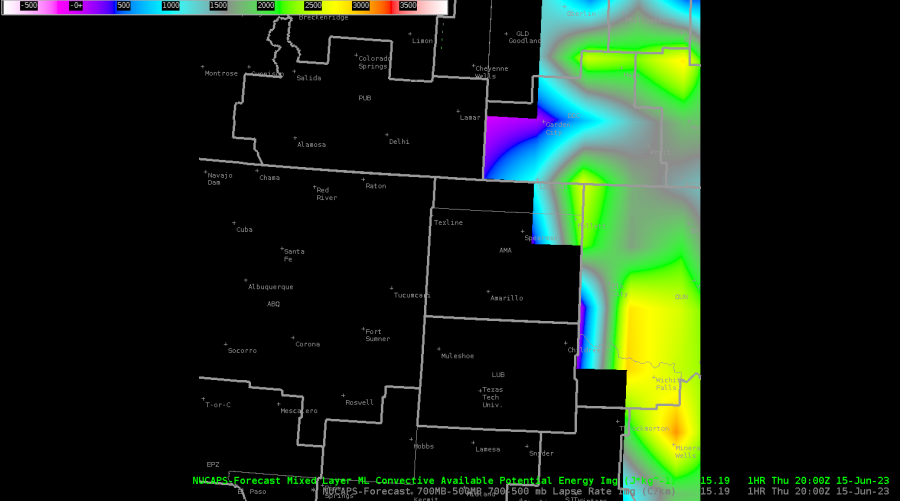
00H NUCAPS-Forecast (NF) is showing moderate CAPE now (1st image below), which may help explain the messy sub-severe multicell clusters, but the forecast valid at 02z this evening shows a resurgence in the CWA (2nd image below).

Looking to our NW, one of the stronger cells is outside our CWA, but the Octane direction is showing good cloud top diffluence.

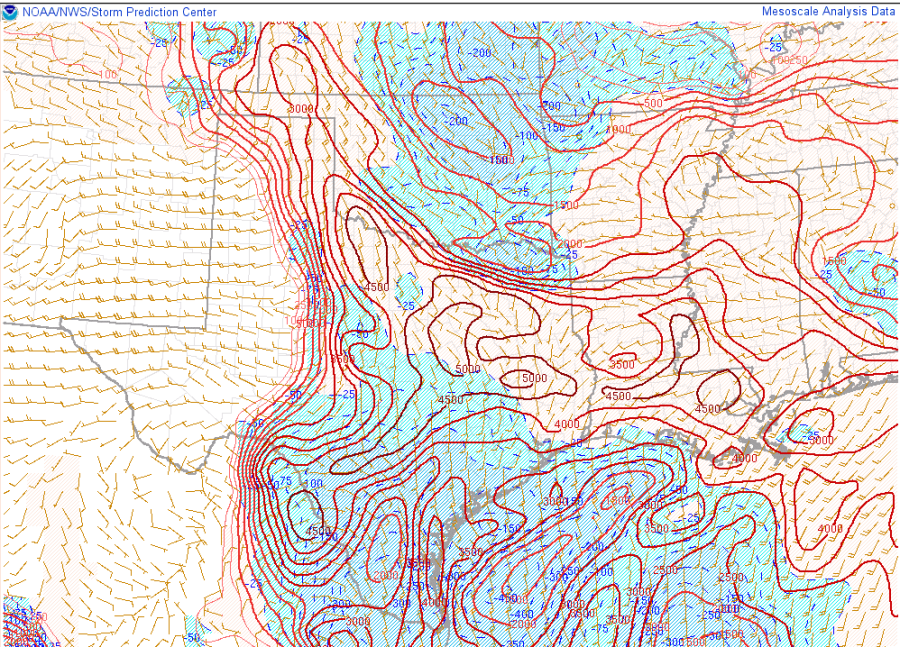
The PHS SCP forecast valid at 20z looks to be around 2-4 over our area, although this doesn’t match well with the SPC meso page SCP, which focuses high values W of our CWA.

The 21z PHS MUCAPE (15z run) looks like it has insane values of 6000-7000 J/kg near the coast and just offshore. This is much higher than the SPC meso page, showing 3000-4000 J/kg at most.

Looking at the optimal application of LightningCast, it seems that the point-based meteogram would work best for CI and in situ developing convection, versus storms propagating into the area. In our case here, at the DSS site, the point-based LC probs are low, suggesting little concern. But we can see from the GLM FED data that there are mature cells with lightning just to the NE that will probably move near the site in the next hour, which certainly poses a safety concern.

The NUCAPS sounding near Victoria (far SW CWA) showed a lot of CAPE and DCAPE, but a rather dry profile. This is confirmed by WV imagery over much of far S TX.

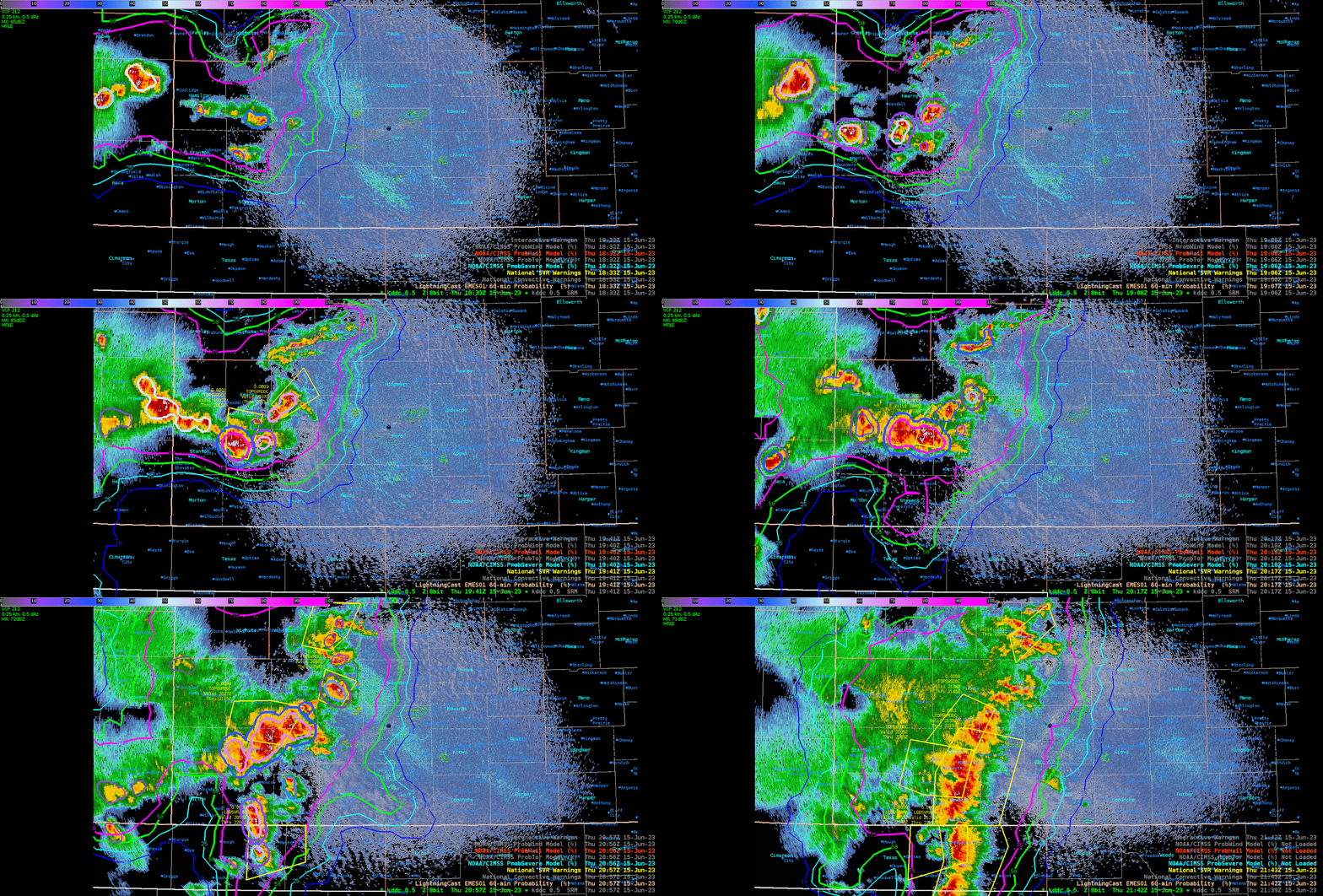
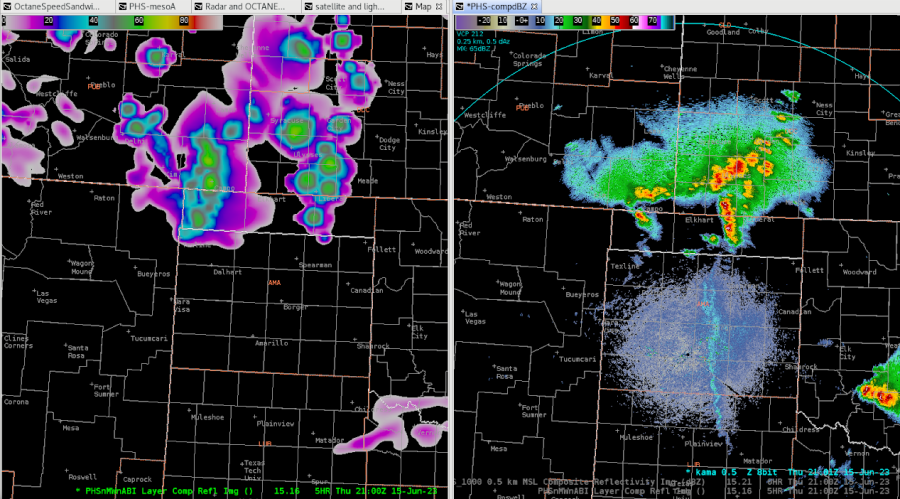
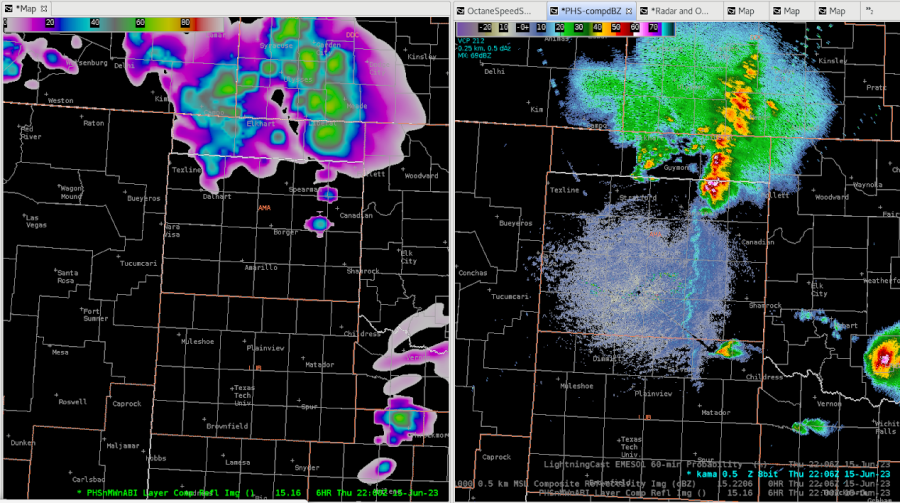
22z PHS Composite Reflectivity (above image) compared to 22z MRMS Composite Reflectivity (below image ) depicting PHS struggling on timing as the cluster of thunderstorms propagate from northwest to southeast.

Late in the event, this cell is showing slow strengthening on PS — currently both v3 and v2 have 40% total.

– Edgar and Harvey Specter

Tags: None

MAF Convection

Convection has been slow to initiate in W TX, but we’re finally seeing some vertical extension and greater texture in the CU field on the NE side of the mountains. LightningCast is now showing higher probabilities in this area, after several scans of sub-50% contours.

We are seeing good destabilization. The PHS MUCAPE compares quite well to the SPC mesoanalysis.

LightningCast probabilities continue to climb, and we’re finally seeing a few flashes on GLM imagery.

Our LightningCast meteograms are finally showing some higher probs in the next hour near our DSS site in Fort Stockton.

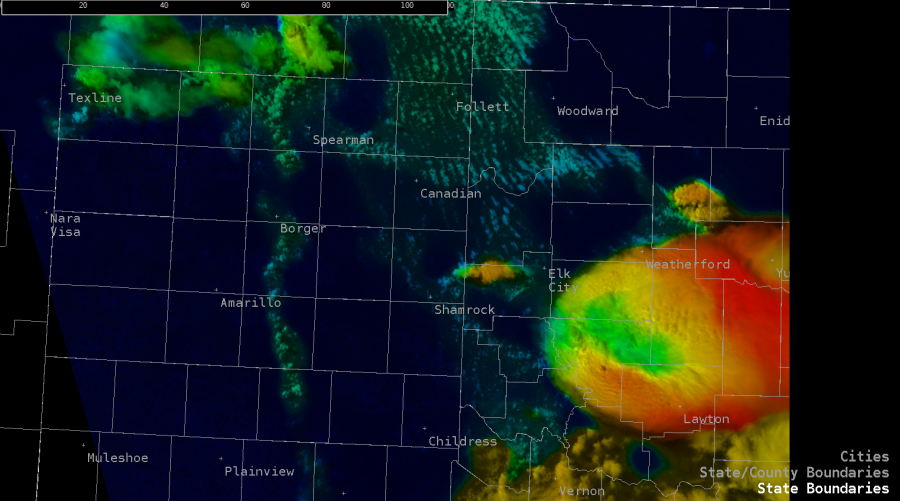
We’re now seeing more defined features in the Octane imagery, including cloud top divergence signals and cooler brightness temps, down to -63C. But our ProbSevere markers remain low.

Looking at the NUCAPS-Forecast initialization at 19z, the mid level lapse rates are lower in areas NE of the higher terrain, where convection has been a bit slower to strengthen, as compared to the storms to our SW over Mexico, where MLLRs are higher.

The new TPW imagery from NUCAPS shows well the delineation of the moist air to the E and drier air to the W.

The PHS SHiP pattern looks good, but its magnitudes appear way off, compared to the SPC meso page and how SHiP is calculated.

Hail probs are exceeding 80% now on ProbSevere, although our GLM lightning is rather low! Interesting how assumed large hail presence doesn’t necessarily equate to classic charge separation that would prompt high electrification.

21z 700-500mb comparison of SPC Meso (top) vs 21z NUCAPS-Forecast (bottom)
    – Some differences in lapse rates between the two, with NUCAPS about .5-1°C/km  lower than SPC Meso page. 

ProbSevere, Octane, and IR imagery supports warning issuances for Reeves and Pecos counties.

With the warning now out for Reeves and Jeff Davis counties, this storm continues to exhibit high hail probabilities on PSv3.

Up to 120 kts of ST divergence with the warned cell (at about 50 kft).

Interesting how ProbSevere identifies objects. There appears to be 3 separate updrafts in Pecos county, however PS is seeing one object.

– Edgar and StormofCentury

Tags: None

Examination of LightningCast and OCTANE in Idaho and Oregon

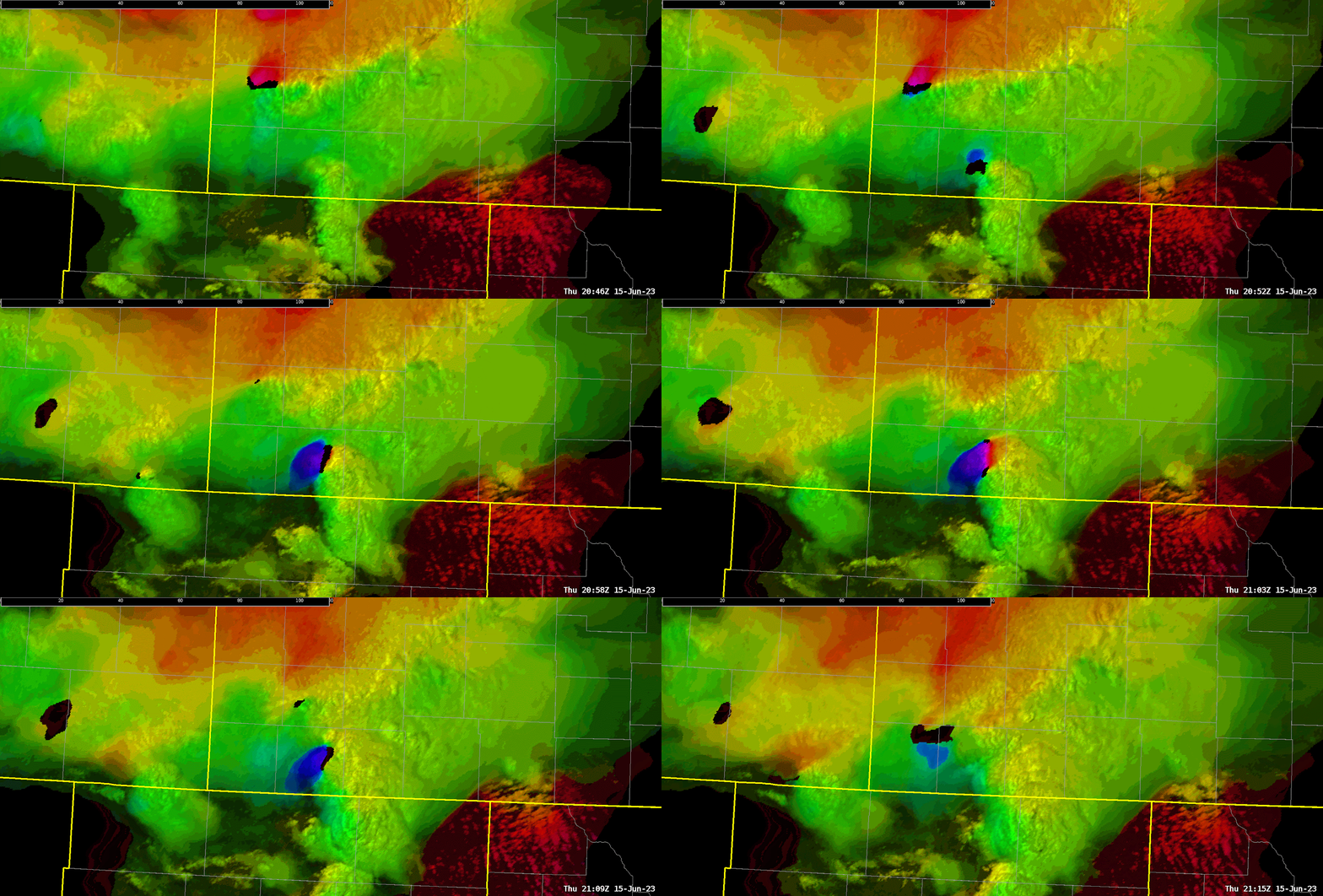
Near the Idaho/Oregon border, we observed splitting cells on the afternoon of Wednesday, June 7. We believe we were able to see the first hints of this process get underway with the help of the OCTANE product. Subtle gradients were observed on the left side of the main storm prior to the ultimate cell merger. 

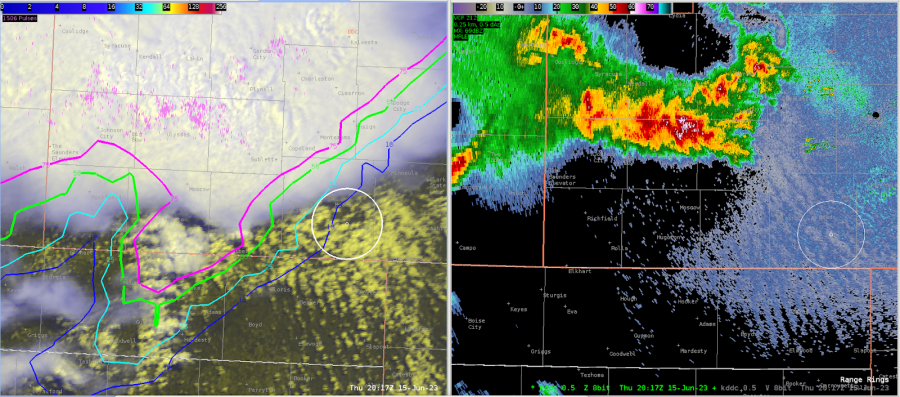
In the image on page 2, we see a nice comparison using LightningCast between an environment characterized by cirrus contamination vs an environment that was not contaminated. On the eastern side of the CWA that was characterized by cirrus contamination, LightningCast probabilities peaked at 50% on a storm that ultimately produced lightning. In contrast, two thunderstorms to the west (developing in a clear, cloud-free environment) both saw LightningCast values exceed 80% on two storms that ultimately produced lightning.

Above, we see perhaps the first instances of a splitting cell in progress, and OCTANE helped give us a first indication of the split (upper left in particular)

Above: LightningCast Meteogram as of 2053z, depicting a small trend upwards, albeit extremely minimal, within the next 60 minutes for some lightning impacting the American Aquarium at Hayden Beverage in Boise (DSS location).

Above: 21z PHS shows development of convection in Owyhee and Twin Falls counties (southern BOI CWA) depicted by a red box; however, the 4 Panel Situational Awareness is indicating that doesn’t seem to be the case, with mere cirrus cloud development. Perhaps the timing is off?

Above: On the other hand, PHS is doing a fairly good job depicting the convection just east of the DSS site. Currently (almost 22z), a few decent cells depicted by ProbSeverev3 (right around 15-18% probability, where MESH values are just over 0.50”)

Above: 2123z: LightningCast indicating just above 50% probability of lightning within the next hour yet the Meteogram is well below 20% for the GOES East reading. It is suspected that this is because the AWIPS readout is Plax-Corrected, whereas the Grafana Meteogram may not be?

Just after 22z, Grafana Meteogram (above) shows GOES East  ProbSevere Lightning to be 67%. This latency further aids in the belief that the Meteogram is not Plax-Corrected.

As of 2220z, downward trend displayed with regards to the Grafana Meteogram (topped at 70%, now showing 54%). This is indicative of the cells east of Boise (DSS area) initially showing signs of weakening…HOWEVER…

Things are starting to get juicy at 2224z with ProbSevere v3 showing the cell south of Idaho City has increased to 36% probability (below).

– Bolt and Harvey Specter

Tags: None

Monitoring South FL Convection for the Miami Open

We’re closely monitoring for CI near the Miami Open Tennis Tournament (location noted by the Home marker). Thus far this afternoon, the deepest convection has been in the west, NE of Naples, where the Band 13 imagery shows high cloud tops with cool brightness temps (-66C), and Octane imagery shows a good divergent signal.

So far, LightningCast has focused on the convection in the western peninsula, with the maximum slowly translating inland and to the N along the inland-tracking sea breeze.

This is further confirmed by the lightning meteogram for the DSS site. Looks like they can keep playing tennis for a little bit longer!

Looking at the storm clusters back west, a NUCAPS sounding near that cell shows plenty of CAPE.

The NUCAPS-Forecast MUCAPE confirms the high CAPE invof the storms.

Let’s see what the forecast shows for our DSS event. By 02z this evening, it shows increasing CAPE invof the DSS event. They are not out of the woods yet!

However, ProbSvr3 and LightningCast continue to provide a general idea that the strongest cell remains north and west of the Miami Open, limiting any impacts during the event.

Looking at the PHS imagery, it shows continued moderate CAPE extending into SW FL invof the ongoing convection, with much lower CAPE near our DSS event.

And the projections for 00z this evening show CAPE lowering further.

20z PHS Composite Reflectivity compared to MRMS Composite Reflectivity persistently highlights a lot of noise. Understanding from a forecaster’s perspective, this can be mentally filtered out, but at the same time, remains to be a distraction from the overall product’s use.

The warned cell over Glades county weakened and merged with other convection, and accordingly, the LightningCast probs declined. But we’re seeing new vigorous convection to the WSW just north of Bonita Springs.

One interesting note. There are new cells developing in far SW FL with lightning noted on GLM, however the cirrus canopy there is too thick to allow LightningCast to detect this convection.

– Edgar and Harvey Specter

Tags: None

LKN LightningCast DSS Event Evaluation

Several pop-up storms developed in the Elko forecast area Tuesday afternoon. To provide DSS for the Elko Airshow, we looked at lightning products, such as GLM and LightningCast (shown here). There were noticeable differences in northern Nevada between the GOES East CONUS and GOES West Meso Sector satellites. This provided a bit of a conundrum of which satellite would be best to use for our DSS event. However, we noticed the trends in lightning probabilities (time series shown below) were increasing for the Elko Airport area for both satellites, so we hedged on that and blended both to arrive at probabilities. In this case, Lightningcast proved to be a useful DSS tool, as lightning was observed within 5 miles of the DSS event by 2056Z.

GIF showing the difference between GOES East CONUS and GOES Meso West products over northern Nevada.

LightningCast time series trends for Elko Airport.

– Bolt and Burton Guster

Tags: None

Albany and Columbia WFO for the HWT Testbed

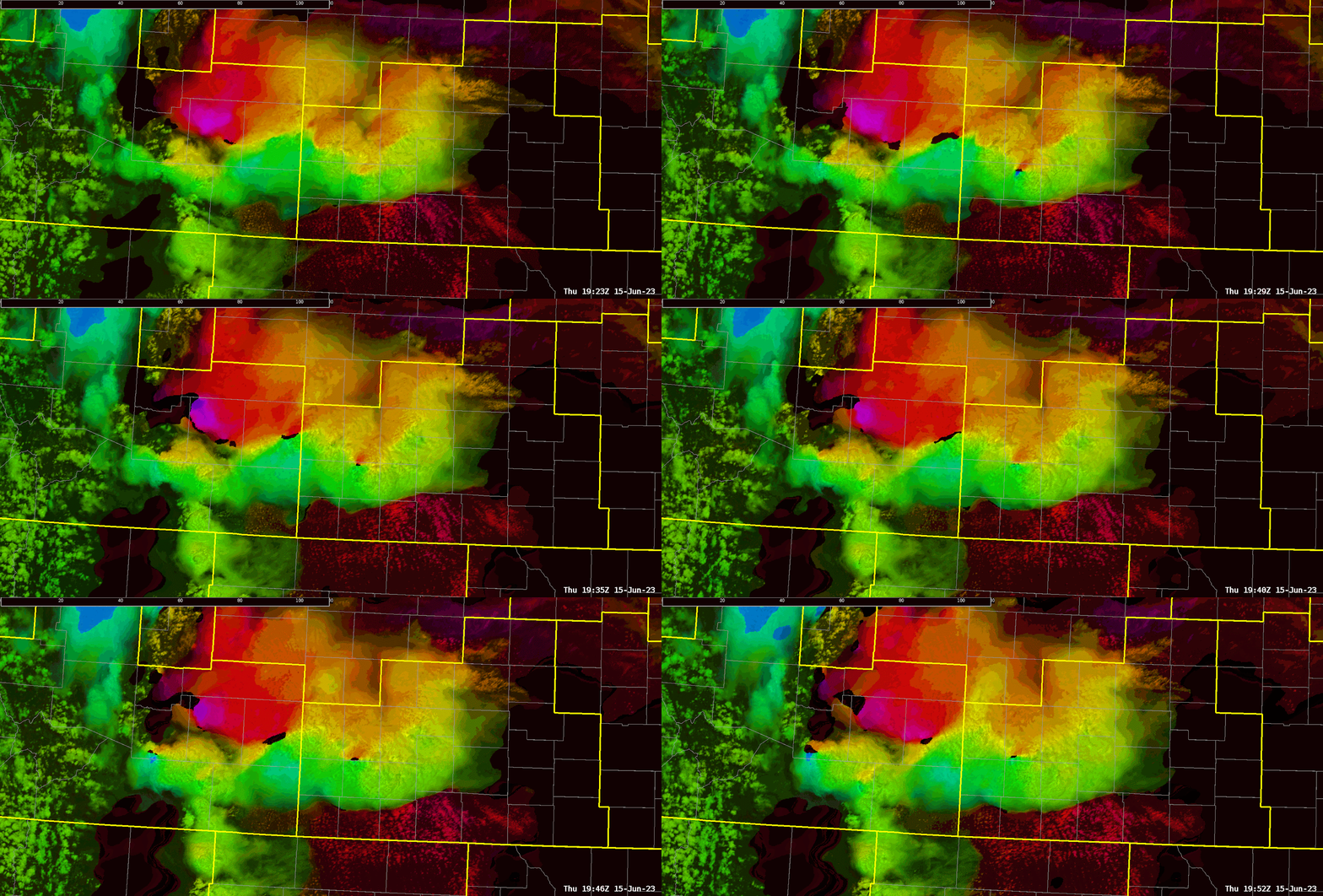
The environment is mostly within northwest flow, so some decently sheared storm tops are noted on the OCTANE speed product, ranging from about 25 kts to 60 kts at anvil/storm top level.

The OCTANE Speed Product over eastern PA.

DSS for Twigs Craft Fair – Speculator, NY.

Increased lightning chances developing and going up over 50% now at our DSS site. This is a concern as people at the festival will likely need to take shelter soon as storms approach from the north. Lightning is possible ahead of the storm given the environment it is in and favorable synoptic setup.

GOES 16 GLM and LightningCAST near our DSS site at Speculator, NY.

Additional imagery with a zoomed-in view.

The overall storm top speeds line up fairly well with SPC Mesoanalysis between the 300mb and 500mb layer where speeds of 40-80 kts are noted over eastern PA and western Long Island, NY. Our storms have between 50-70 kts of speed at storm top, so it lines up fairly well with what the RAP mesoanalysis has. Very interesting. See the images below.

3:35pm CT: 1-min LtgCast has increased to ~90% at DSS point, with GLM showing ~1-2 flashes/5min.

Interesting feature on a storm over upstate South Carolina to the west of Columbia. Some weaker winds aloft behind the overshooting top of the storm. Additionally, cooler cloud top temperatures are noted in the overshooting top. Increase in PSv3 values are notable as well with a ramp up in severe threat. The storm was severe warned at this time.

Additionally, you can note the fairly decent divergence aloft at anvil level with the OCTANE direction product.

-Satellite Steve & Displar


Tags: None

Growing Lightning Threat in Carter County, MT

Growing Lightning Threat in Carter County, MT

LightningCast probabilities steadily increase across Carter County, MT (Far SE MT) through the late afternoon. Perhaps the user could opt to select a more detailed range of probs by using the density radio button option in the product menu. At the moment only the 10/25/50/75% probs are available.

Probailities for lightning are steadily increasing over Carter County as convection forms along the cumulus field observed running SSW to NNE across the county. 

Surface-based CAPE from the PHS product indicate values increasing to 2,000+ J/KG across far SE MT.

– Rain-Free Bass Guitar

Tags: None

Evolution of LightningCast Over Southern Montana/DSS Event In Billings

Upper level flow shows continued SSW flow aloft over the region, thanks to deep troughing remaining over the West Coast. Overall forcing through the afternoon is on the weaker side of things, but models show an upper level jet streak nosing into the area. Scattered thunderstorm activity has already developed (below) to the south of Billings in northern WY, and is expected to expand in coverage through the afternoon. The DSS event is noted by the large yellow “B” over Billings.

The 14Z PHS forecast output (below) showed 19Z MUCAPE values across the area ranging roughly from 1000-2500 j/kg (with highest values in the eastern areas). Looking further into the mid-afternoon hours, outside of MUCAPE values creeping closer to 3000 j/kg in far NE portions of the CWA, the PHS overall didn’t show any notable changes in values. PHS values of 0-6km shear also matched up fairly well with SPC Mesoanalysis at 19Z, and had values increasing to around 35-40 kts through the afternoon.

Below is the 19Z MUCAPE via the SPC Mesoanalysis page.

LightningCast right around 19Z showed the 10% probability contour still about 40 miles SSW of Billings at its closest point (below).

LightningCast right around 20Z showed the 10% probability contour still about 30-35 miles W-SW of Billings at its closest point (below).

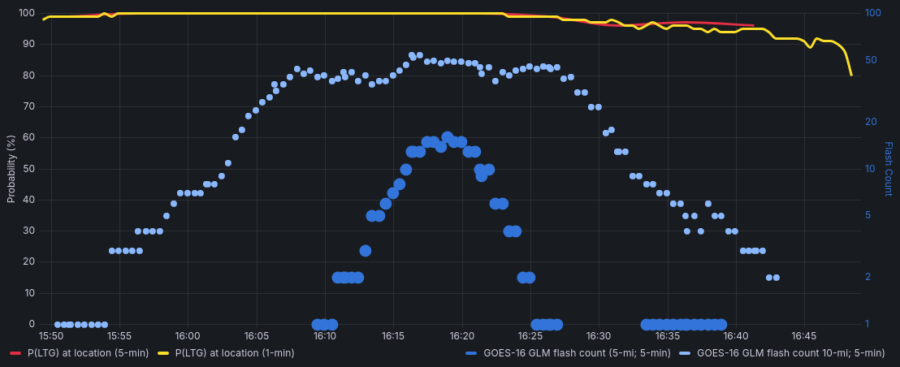
Around 2045Z, the 10% prob. contour reached the DSS event(below), but overall activity continues to be slow to push NNE. The LightningCast Time Series is included to show the trend up to this point.

Fast forward to roughly an hour later (~2140Z), there’s been a bit of a jump in the LightningCast Probability/TimeSeries (below), with the DSS event now sitting with a roughly 35% probability of lightning in the next hour.

A few minutes later, another jump up in probability – up to around 50%. Below is an image that has the GLM FED (colored pixels) included with the radar, LightningCast, and ENI Total Lighting Plot.

You likely have already been talking with the DSS contact point, but this jump up in the last ~10 mins may warrant another update, conveying that there is an increasing probability of lightning occurring in the next 60 mins.

Not surprisingly, the LightningCast probabilities have continued to increase, also shown in the time series. Image is from 2220Z.

What’s the best way to pass along this information to the DSS contact point?

With this type of event, where it’s slow to move in (driven more by the upper forcing vs the somewhat random quicker-developing activity that can occur in high CAPE/low shear  and other types of environments) and no significant changes in the overall environment across the area, perhaps you could wait until it’s closer to 50% or more  before expressing greater concern for the threat of lightning.  In those instances where activity may be quicker to develop/strengthen, it’s not out of the question that values closer to the 25% contour would warrant greater concern. No matter the overall environment, I do believe the addition of a shorter-term probability (lightning within 30 mins)  would be beneficial.

– Bubbles


Tags: None

New Four Panel

After a few days at the HWT I have decided to make a four panel of my own with the new products which has been working great! On the top left we have Octane Speed with Octane direction on the top left. We have Vis with lightningcast and GLM 1 min lightning on bottom left. On bottom right I have MRMS data and ProbSevere V3.  I was very happy with this display for situational awareness.

Also in the image below we can easily spot a stronger storm in a cluster of cells in Park County looking at directional and speed shear with Octane. Then we can quickly look down at ProbSevere and see its on the one storm being highlighted. That tells me this is the storm that I need to watch over the next 10-15 minutes for development.

-Thunderstruck

Tags: None