Update: 2011-05-17 11:30z

I ave Todd and Stephen the opportunity to exit MLB and try out a case since convection was appearing to remain weak in their area. They went for it and the case is being set up.

Brian and Julia are still in warning mode in JAX with a southward moving multicell riding an outflow boundary.

Tags: None

CI & CTC May Provide Lead Time on JAX-area Storm

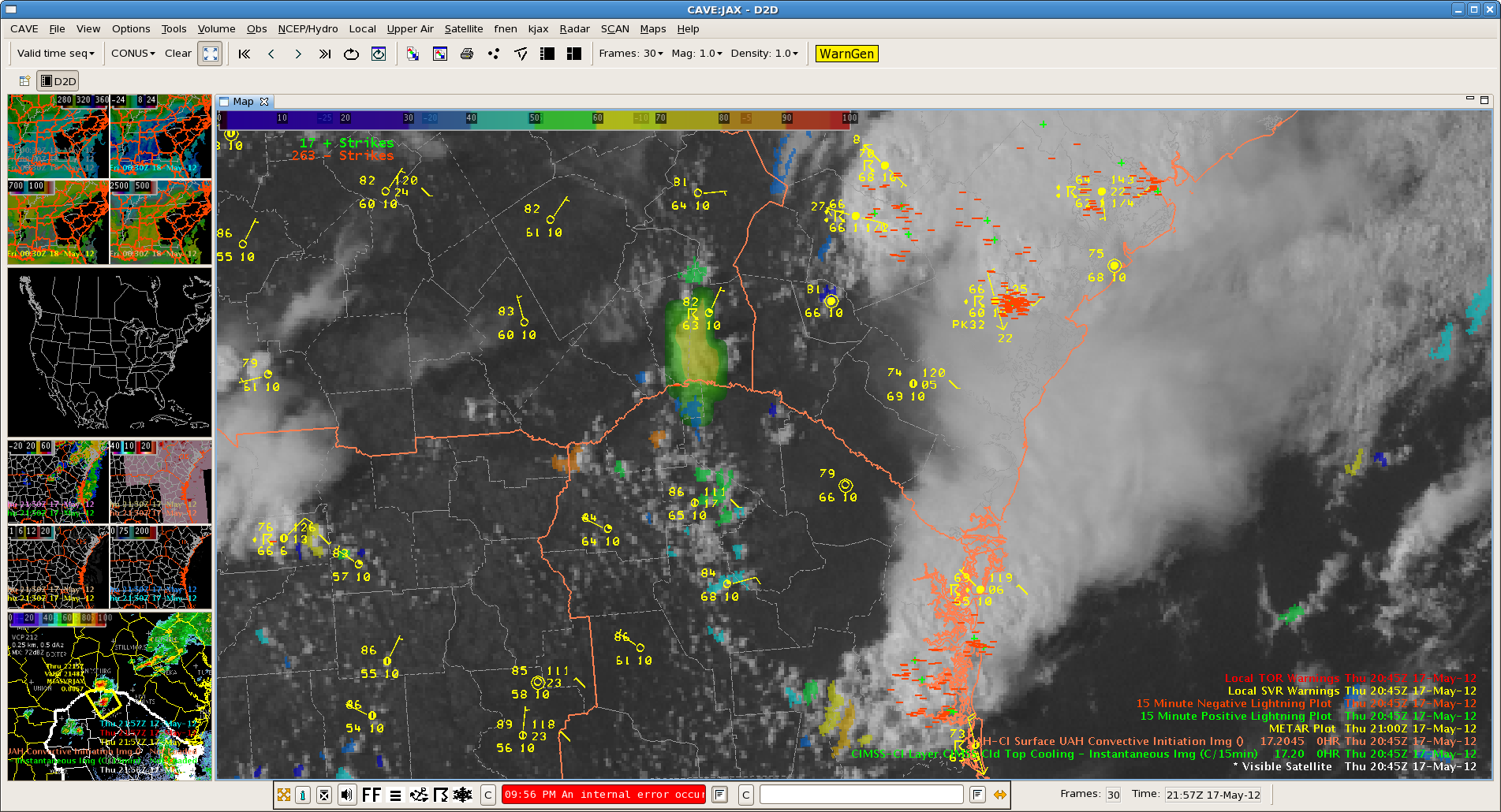
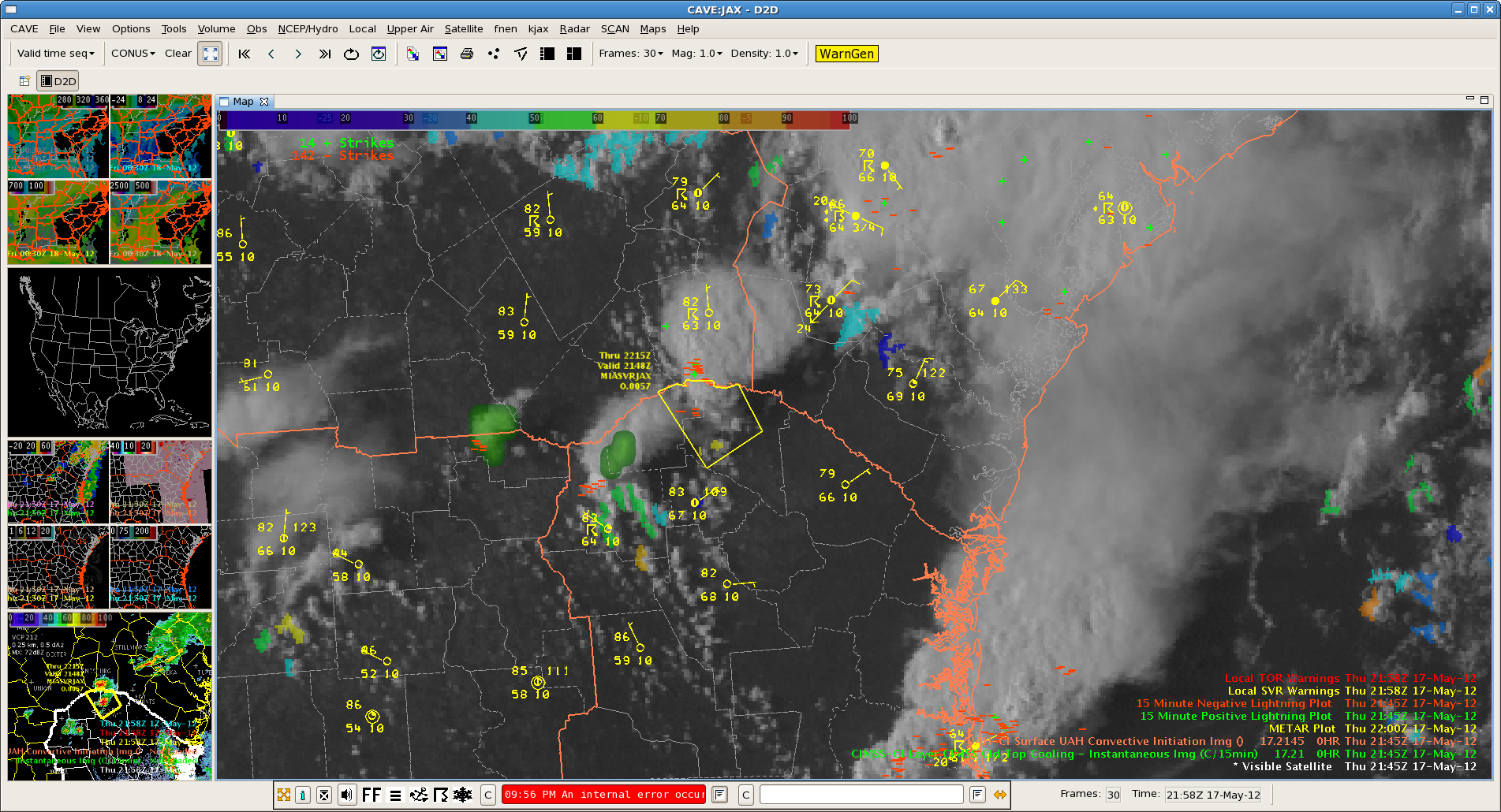
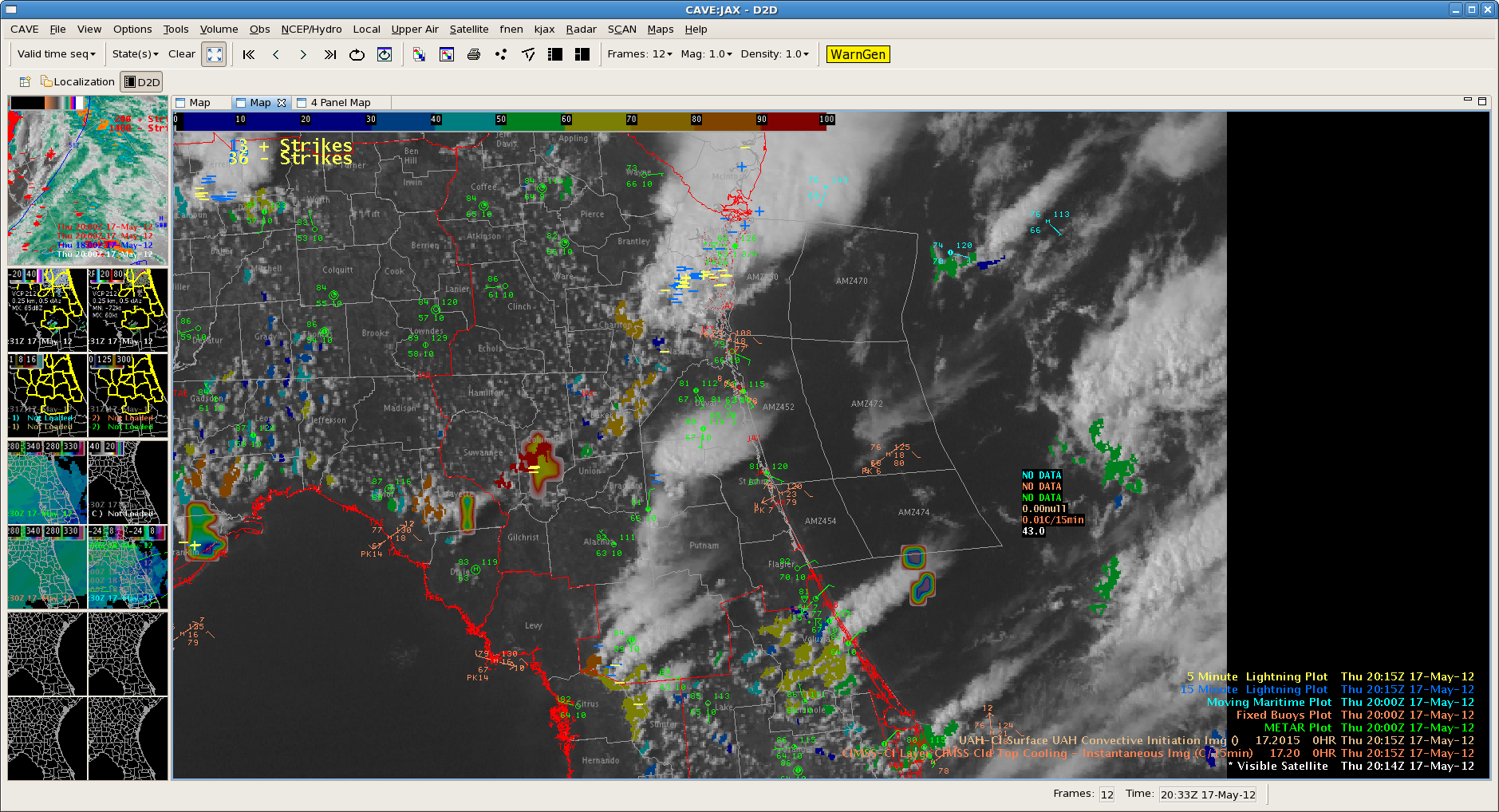
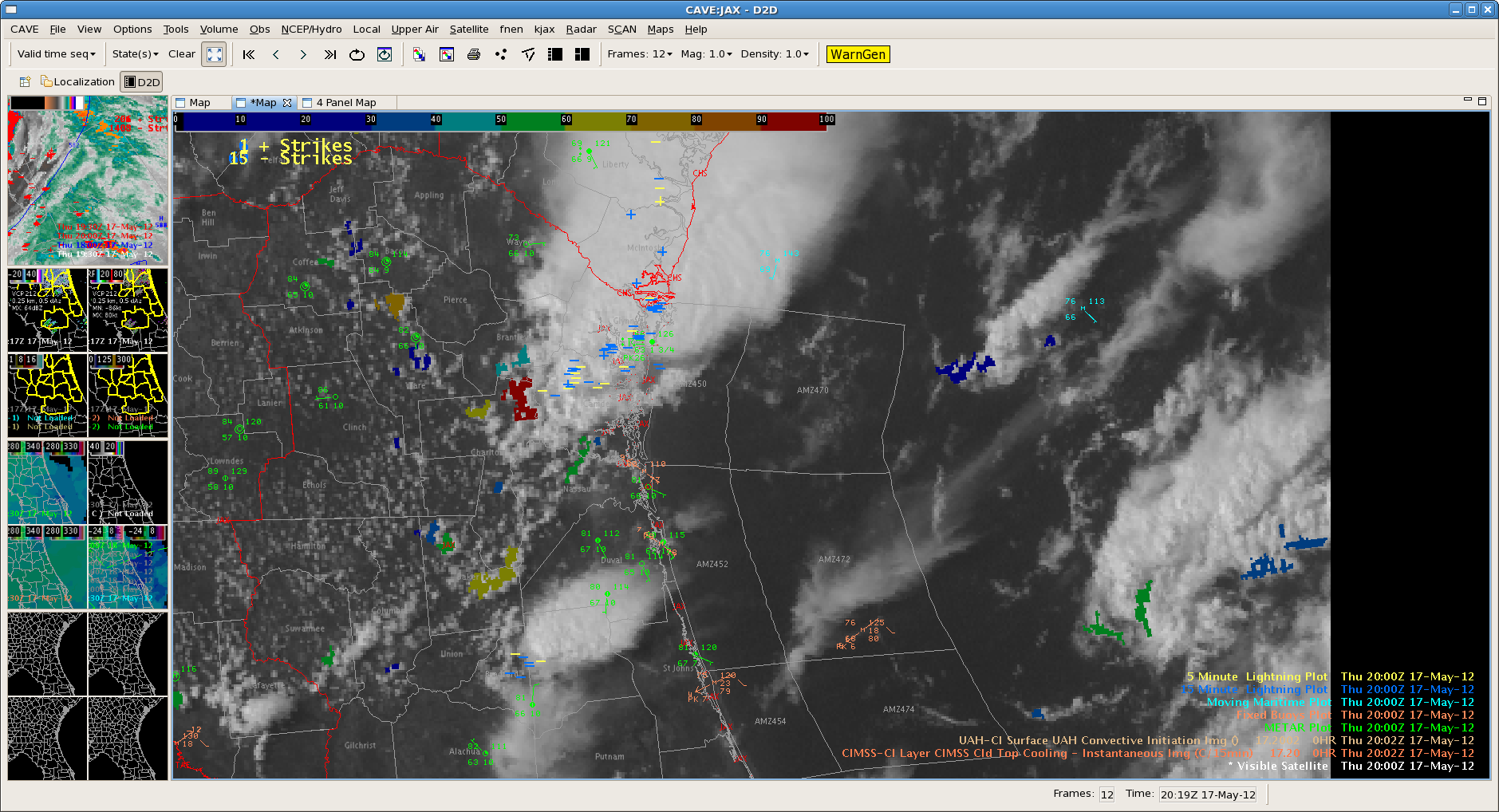
Another severe thunderstorm warning was recently issued (2148 UTC) for a portion of southeastern Georgia (Appling and Jeff Davis Counties), west of Vidalia.  It’s worth noting that both the UAH CI and the UW CTC products flagged this storm quite some time ago.

The first indication on this cell occurred with a 59 strength-of-signal indication from the UAH CI product.

UAH CI and Visible Satellite valid 2012-05-17 1945 UTC

The SOS increased to 68 on the next satellite scan, then 71 on the subsequent scan (2015 UTC).  The UW CTC flagged the storm for the first time at 2045 UTC with CTC rates of -13 to -14 C/15min, and that decreased to -16 C/15 min on the next image.

UW CTC and Visible Satellite valid 2012-05-17 2045 UTC

The visible imagery becomes quite impressive with overshooting tops by 2130 UTC.  The SVR was issued at 2148 UTC, based mostly on distant radars.  The 3DVAR analysis domain was just recently expanded to include this area, and MRMS POSH and MEHS were not particularly impressive.

Visible Satellite valid 2012-05-17 2145 UTC

3DVAR Captures JAX-area Outflow

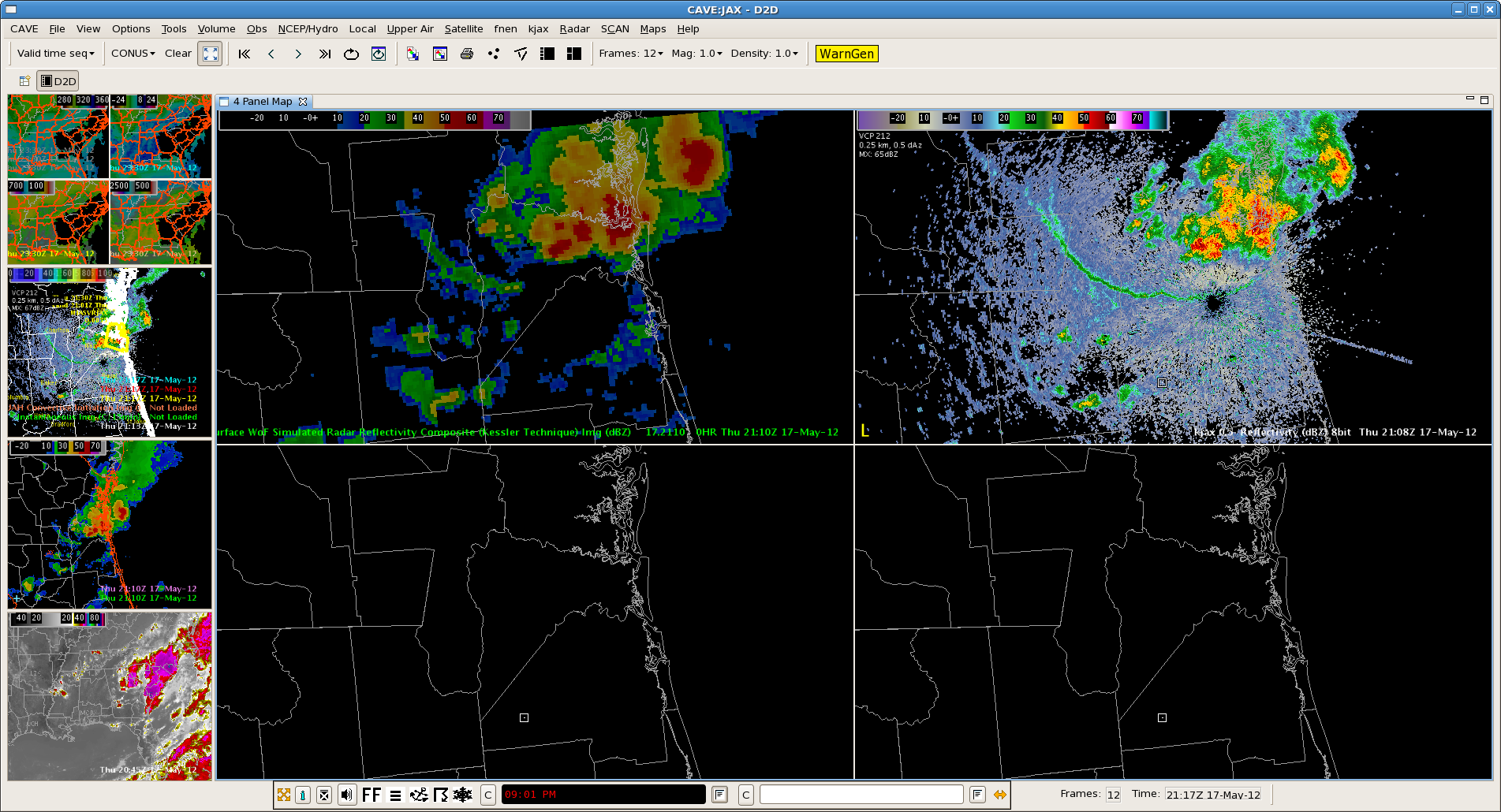
Another severe thunderstorm warning was issued near the Florida-Georgia border based on strong dual-pol radar and MRMS signatures.  3DVAR hasn’t been as interesting (perhaps the storms are too close to the KJAX radar), but the simulated reflectivity product is picking up on an impressive outflow boundary crossing the state line.

3DVAR Simulated Reflectivity valid 2012-05-17 2110 UTC and KJAX 0.5-Degree Reflectivity valid 2012-05-17 2108 UTC

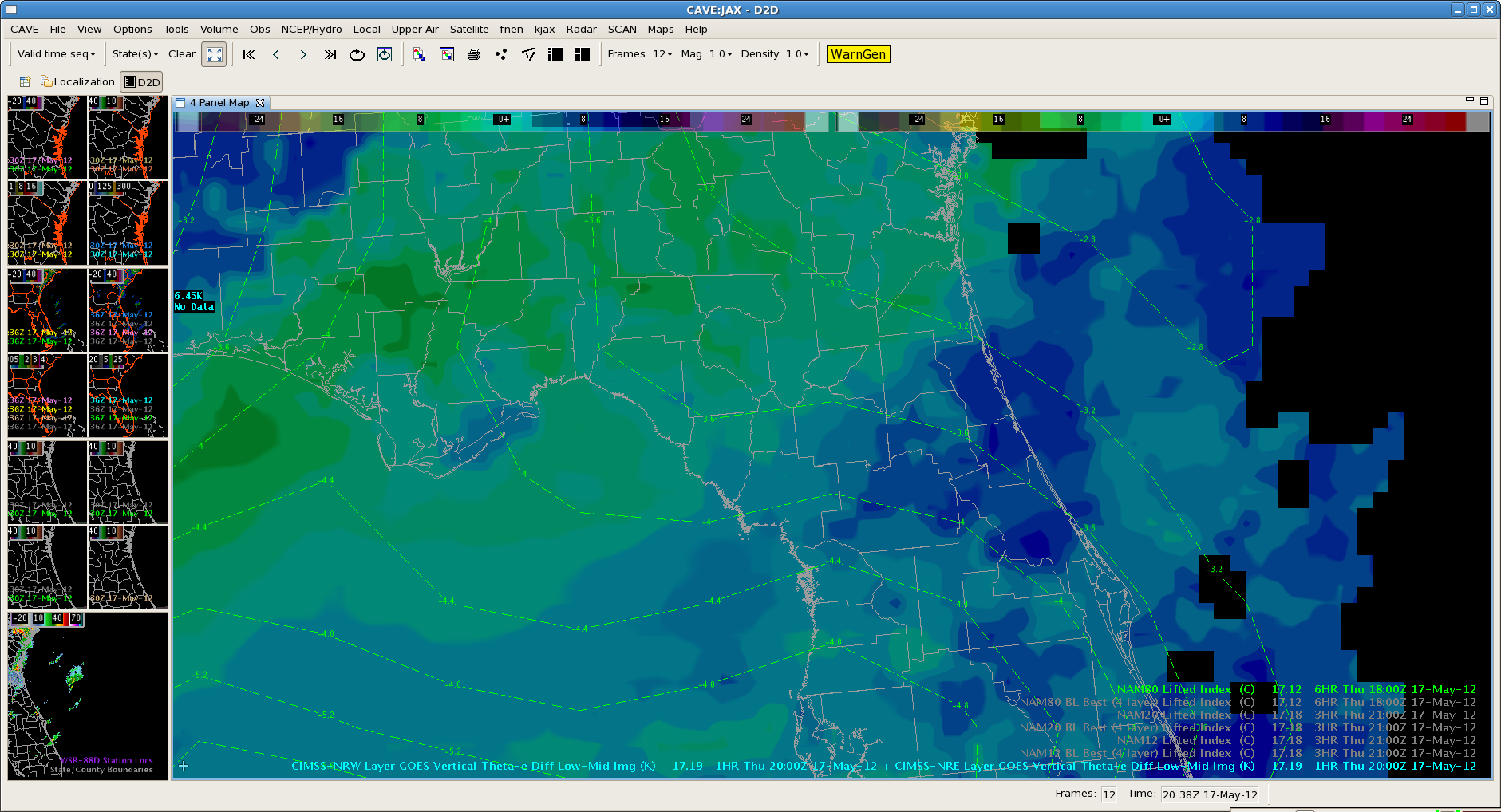
JAX – ThetaE Gradient

Noticed an interesting diagonal differential heating sort of boundary in across northern Florida where the next round of convection appears to be initiating.  It show up well on the nearcast as s thetaE gradient and is now showing up on Vis and CI products…if this end up being the focus of more critical convection later in the afternoon this could be a really good application the nearcast product.  There was a similar looking (though not sure if it was the same cause) feature when we were MLB two days ago that was where the bigger stuff triggered.  Waiting to see….

JAX – 3D Var vs Dual Pol

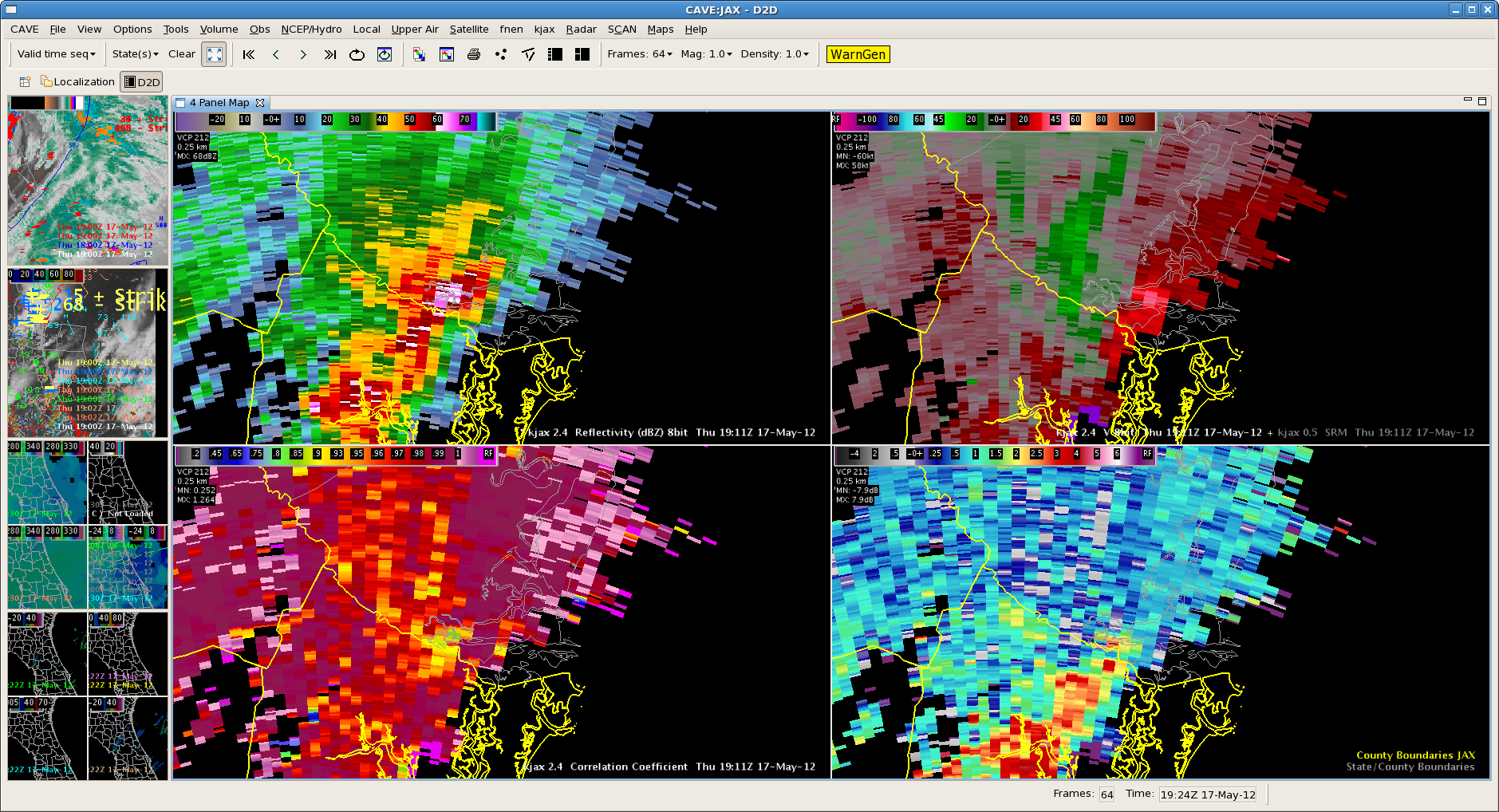
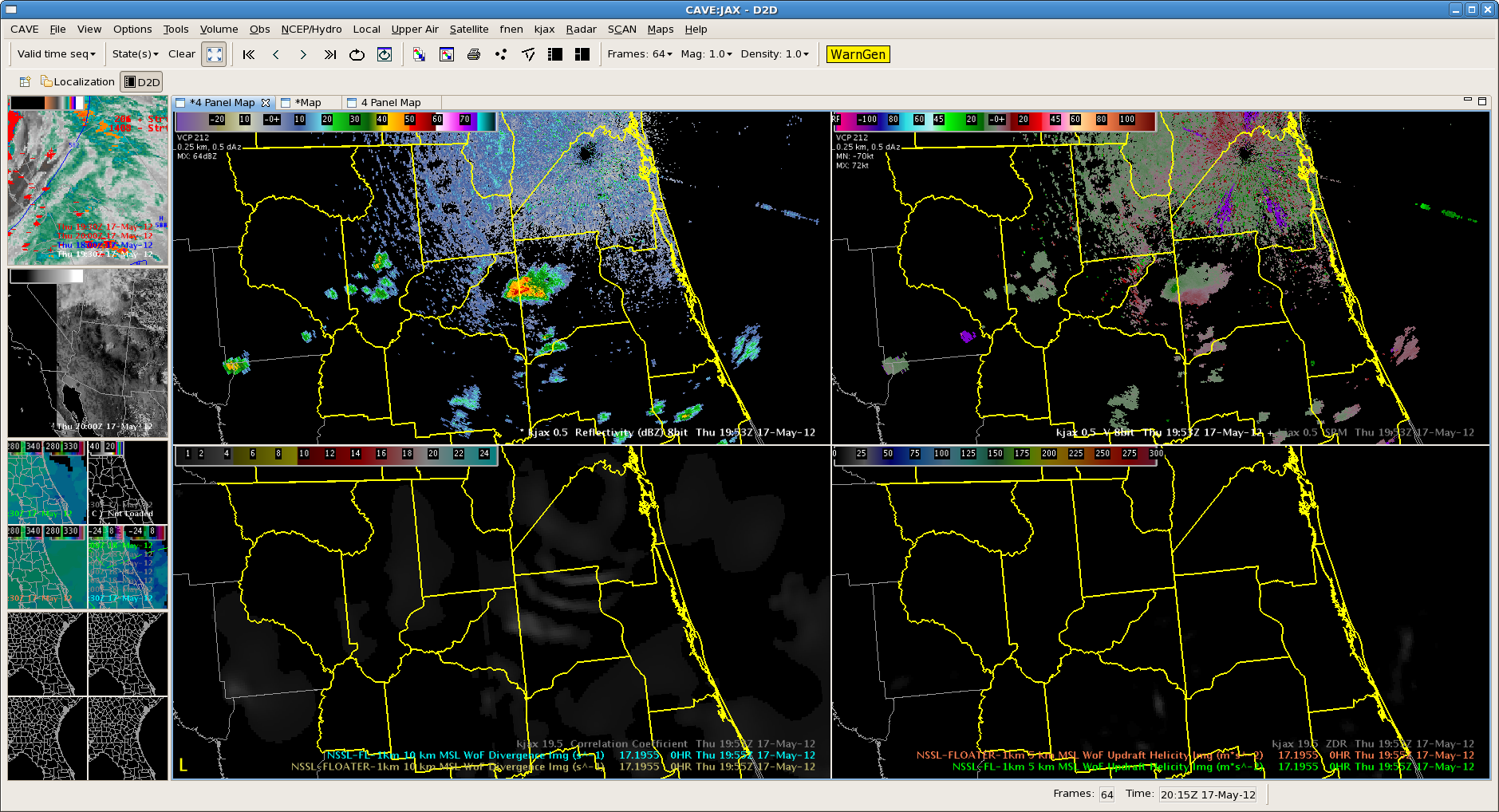
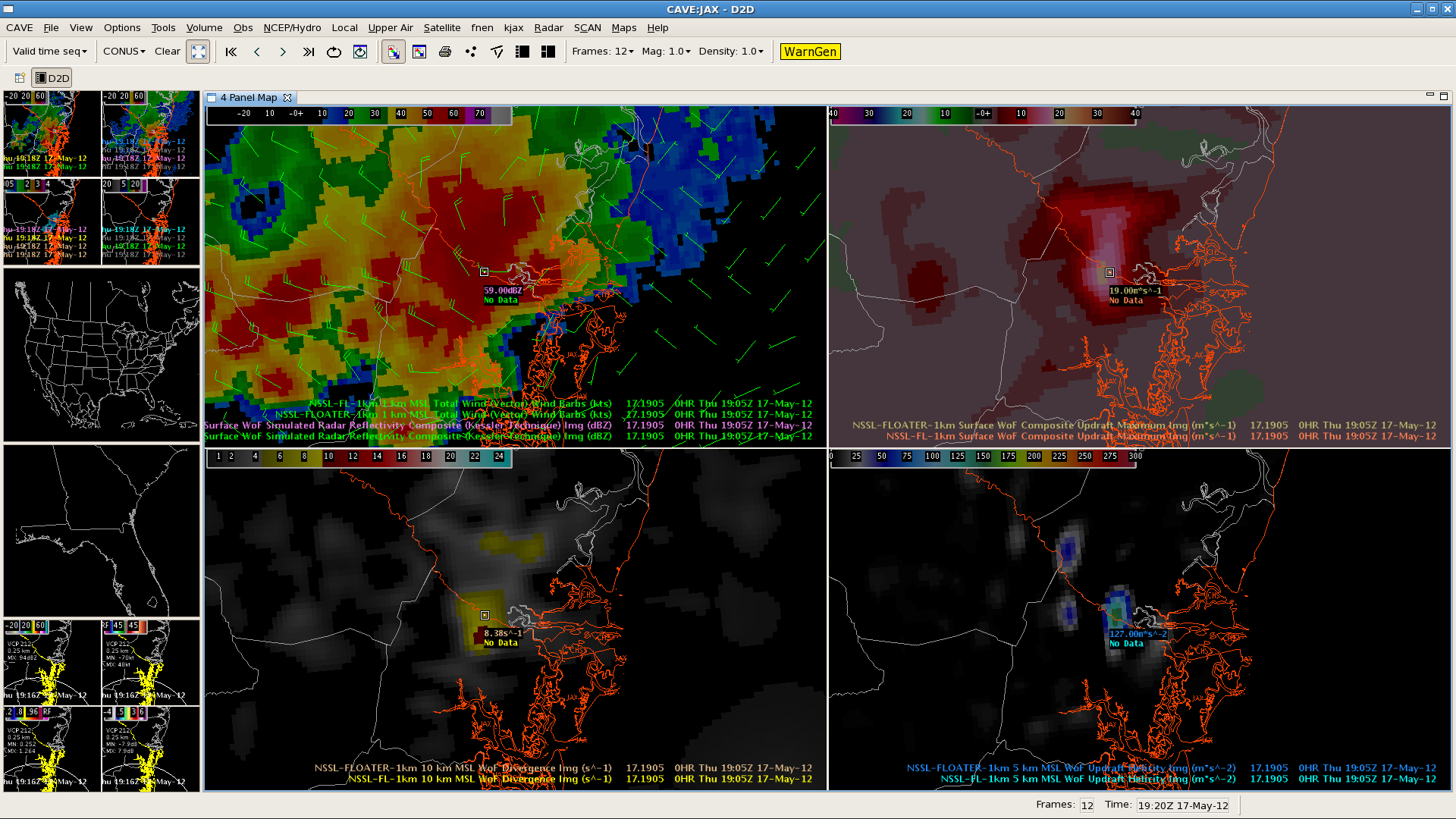
Here is an good example of 3d Var picking up on a strengthening storm and some mid level rotation.  The top 4 panel 3 d var from 1905 and the second is radar from 6 minutes later.  The updraft strength, updraft helicity and updraft velocity products show a strong signal while the mid level storm relative velocity images (3 and 4 degree scans especially) have good rotation developing.  Not much at low levels (images not shown) but nice example of 3-d Var pick up and highlighting mid level rotation.  One additional feature that would be very good to have in the 3d var data is something that shows the height of max updraft helicity.  Built a 4 panel to compare all tilts radar (top two panels) to 3-d var updraft helicity and storm top (10 km) divergence as they seem to be good parameters to for finding rapidly intensifying/severe storms and will have to see how it works for the next storm.  Below is an example of the procedure with interesting gravity wave like features from the previously dissipating storm but nothing much firing yet to see how it works.


Interestingly there is a red (94%) and a few other CI detections in the vicinity of the ‘gravity wave’ looking things.  Curious to see how they build…

GOES sounder nearcasting CAPE

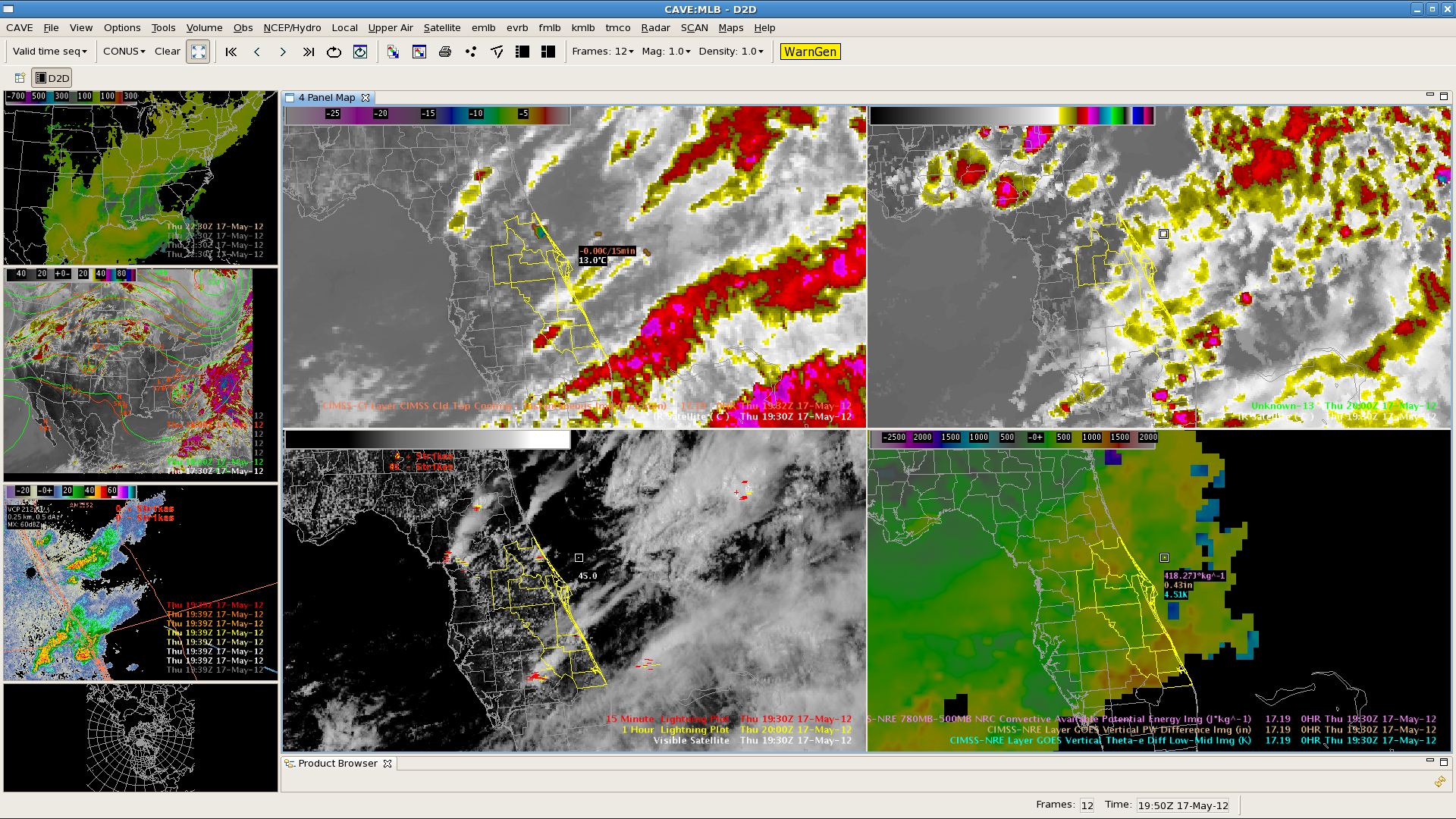
We’ve been keeping an eye on the relationship between the GOES nearcasting CAPE field and the coverage of the developing convection over Florida today.  The synthetic satellite imagery has also done a good job on delineating the areal coverage of developing convection.  The four-panel image has actual Infrared imagery on the upper left, synthetic satellite imagery on the upper right, visible satellite and lightning data on the lower left and a layered CAPE field derived from GOES-13 sounder nearcasting data.  The highest CAPE values, around 1200 joules/kg, are located just to the northwest of Lake Okeechobee, with an axis of lower CAPEs further to the north.  There is also a subtle increase in CAPE values over northern Florida, where additional convection is developing.  The region with the lower CAPEs has weaker convection at this point.  The synthetic satellite imagery is a 12 hour forecast using the 06z run of the WRF model, valid at 18z.  It also does a nice job depicting less convection in the region of lesser instability.

Dankers/Kearney

First Warning of the Day for JAX

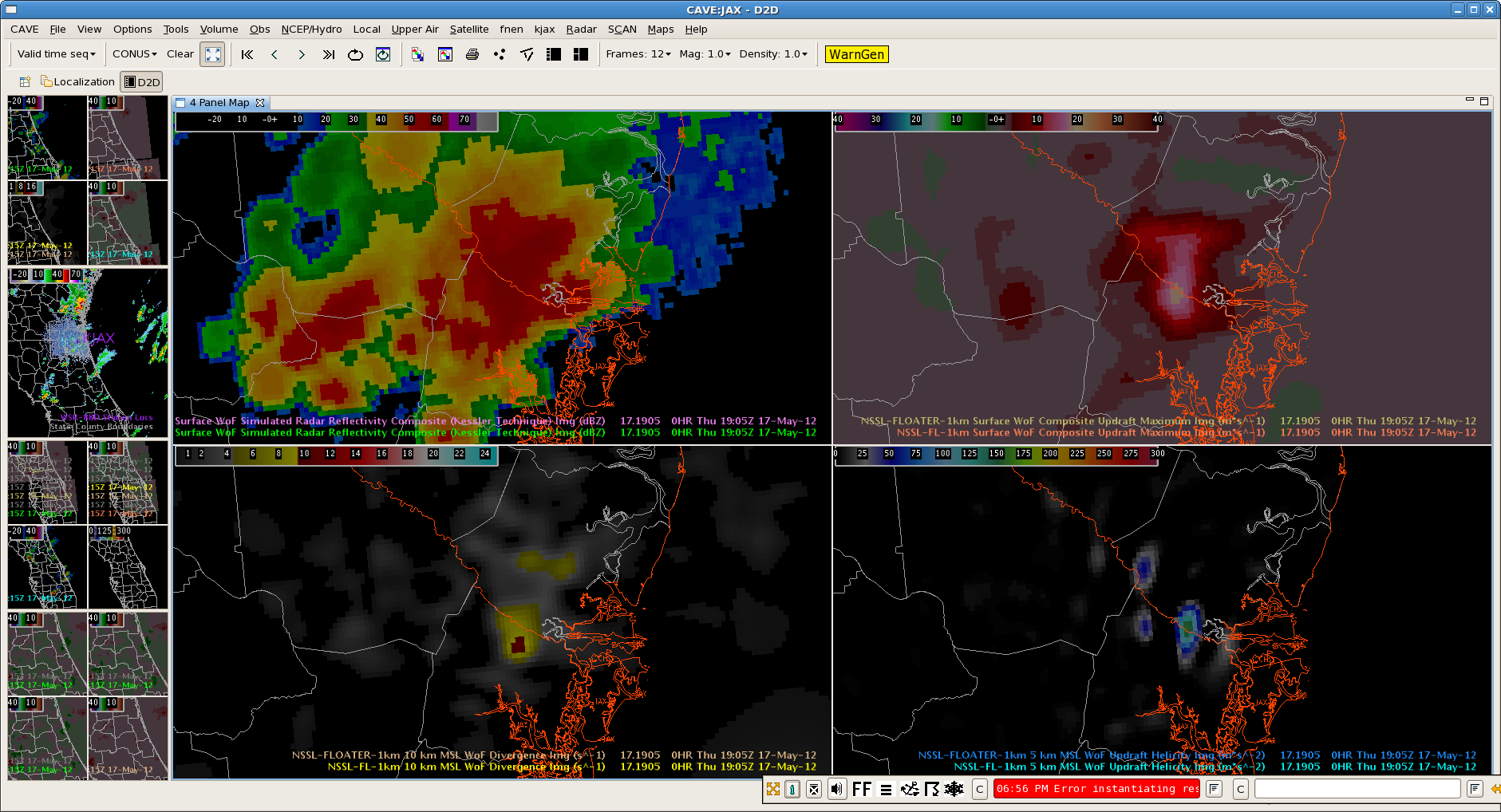
The first severe thunderstorm warning for the day for WFO JAX comes along the JAX-CHS CWA line in Glynn County, GA.  The 3DVAR analysis indicates some of the strongest indicators seen this week.

3DVAR Analysis of Simulated Reflectivity and 1km U/V Wind, Updraft Composite, Updraft Helicity, and 10km Divergence valid 2012-05-17 1905 UTC

The 1-km U/V winds indicate 30-40 knot winds (perhaps a rear-inflow jet) nearing the coast, 19 m/s composite updraft strength, 159 m/s^2, and 10km divergence of 10.72 s^1.  These values (particularly the updraft) are among the stronger storms we’ve seen this week.  After some AWIPS 2 problems, a severe thunderstorm warning was issued after confirming these data with the KJAX radar.

NearCasting for JAX

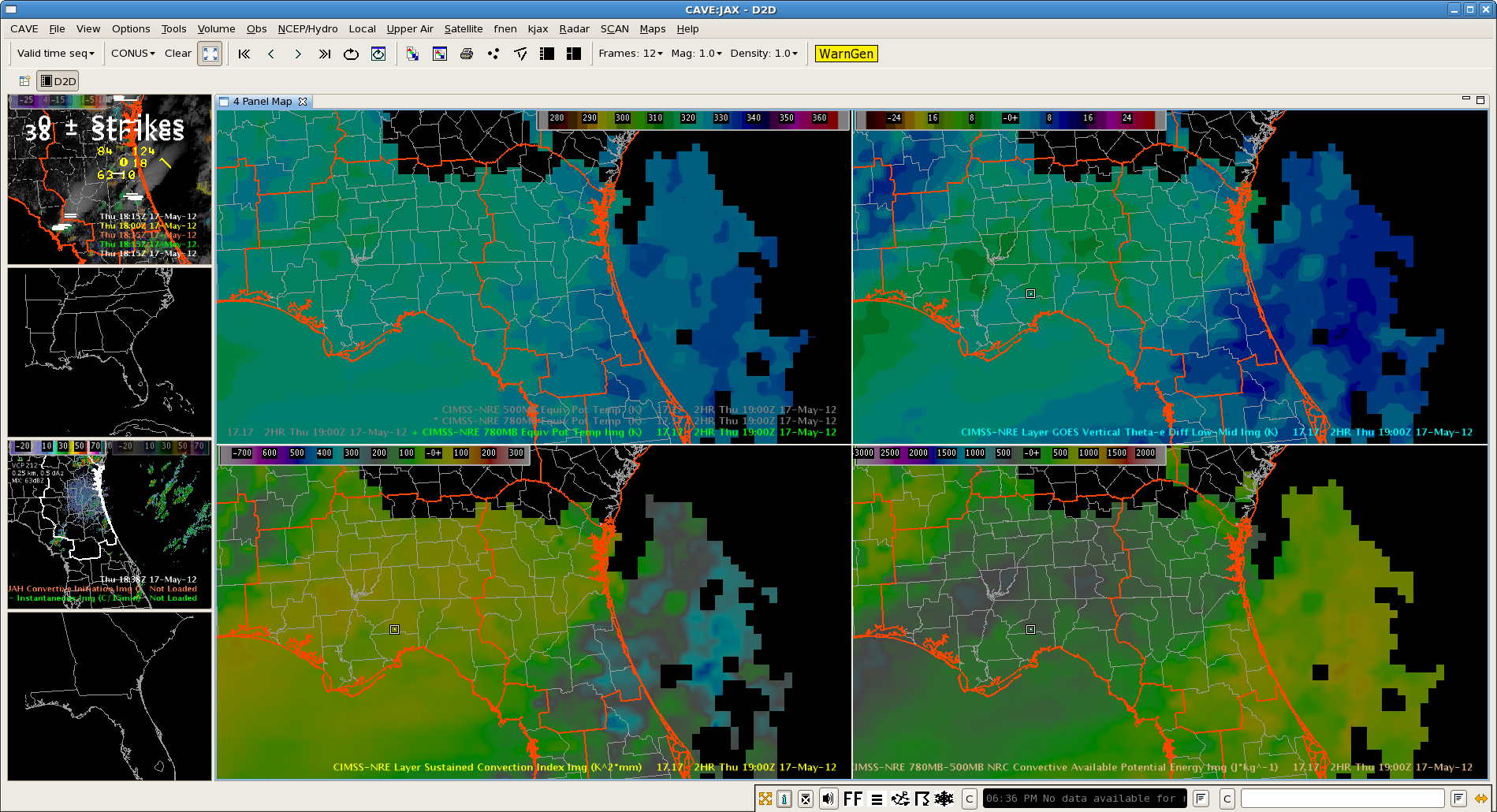
We are focused on the JAX CWA today.  While there is convection ongoing in the extreme northern portion of the area (bordering FFC and CHS), the GOES-R NearCast CAPE (new this week) and vertical theta-e difference suggest that the southern half of the JAX CWA is more conducive for new convection.

GOES-R NearCast 780mb Theta-E, Vertical Theta-E Difference, CAPE, and Sustained Convection Index valid 2012-05-17 1830 UTC

The NearCast has been challenging to interpret this week due to interpretation confusion (are negative versus positive theta-e differences indicative of instability) and then a mid-week visualization change in AWIPS 2.  The NearCast shows promise for helping with the tremendously-difficult 1-6 hour timeframe, but the product stability has presented a problem.

Max Updraft preceding Max Reflecitity

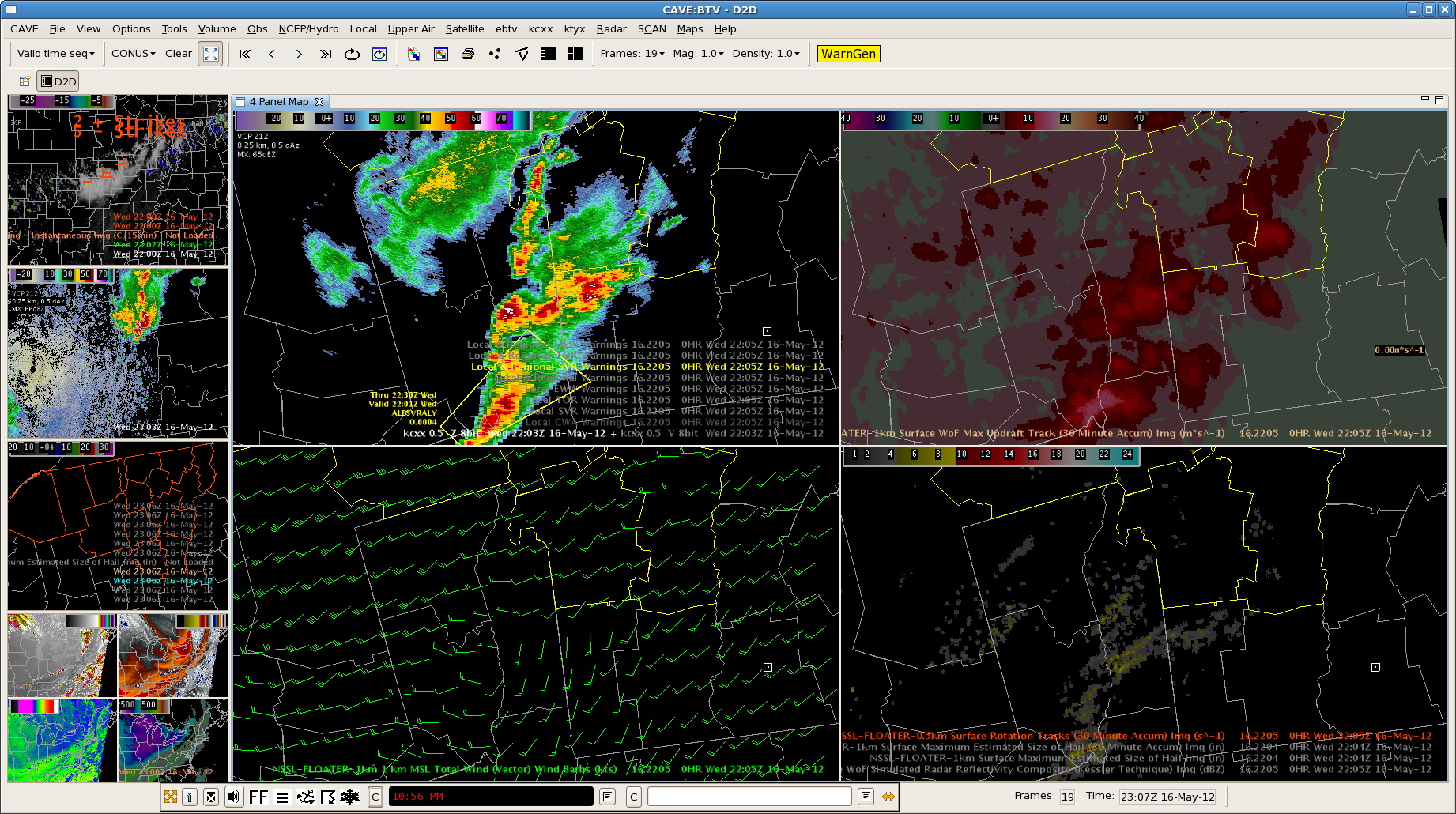
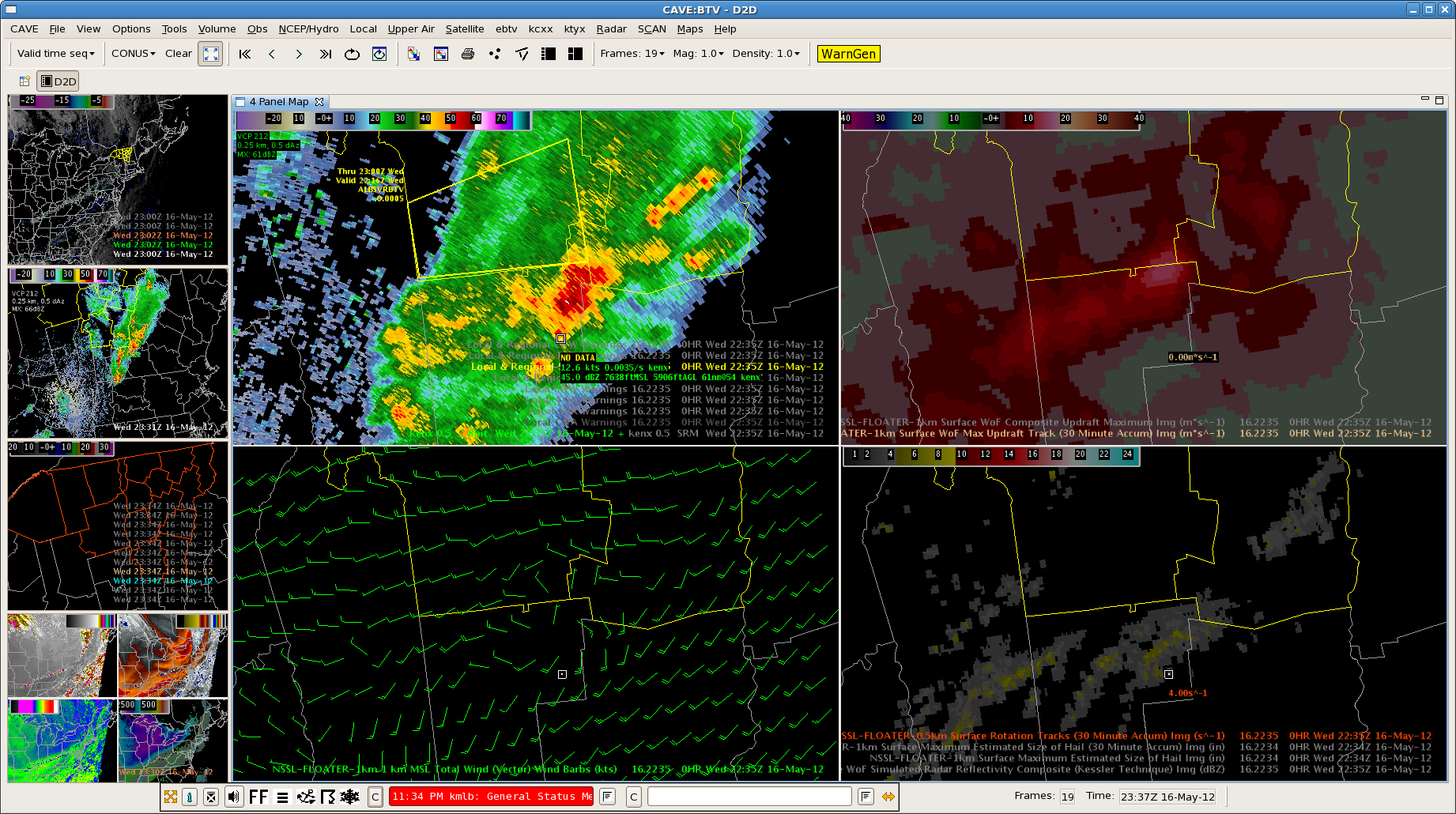
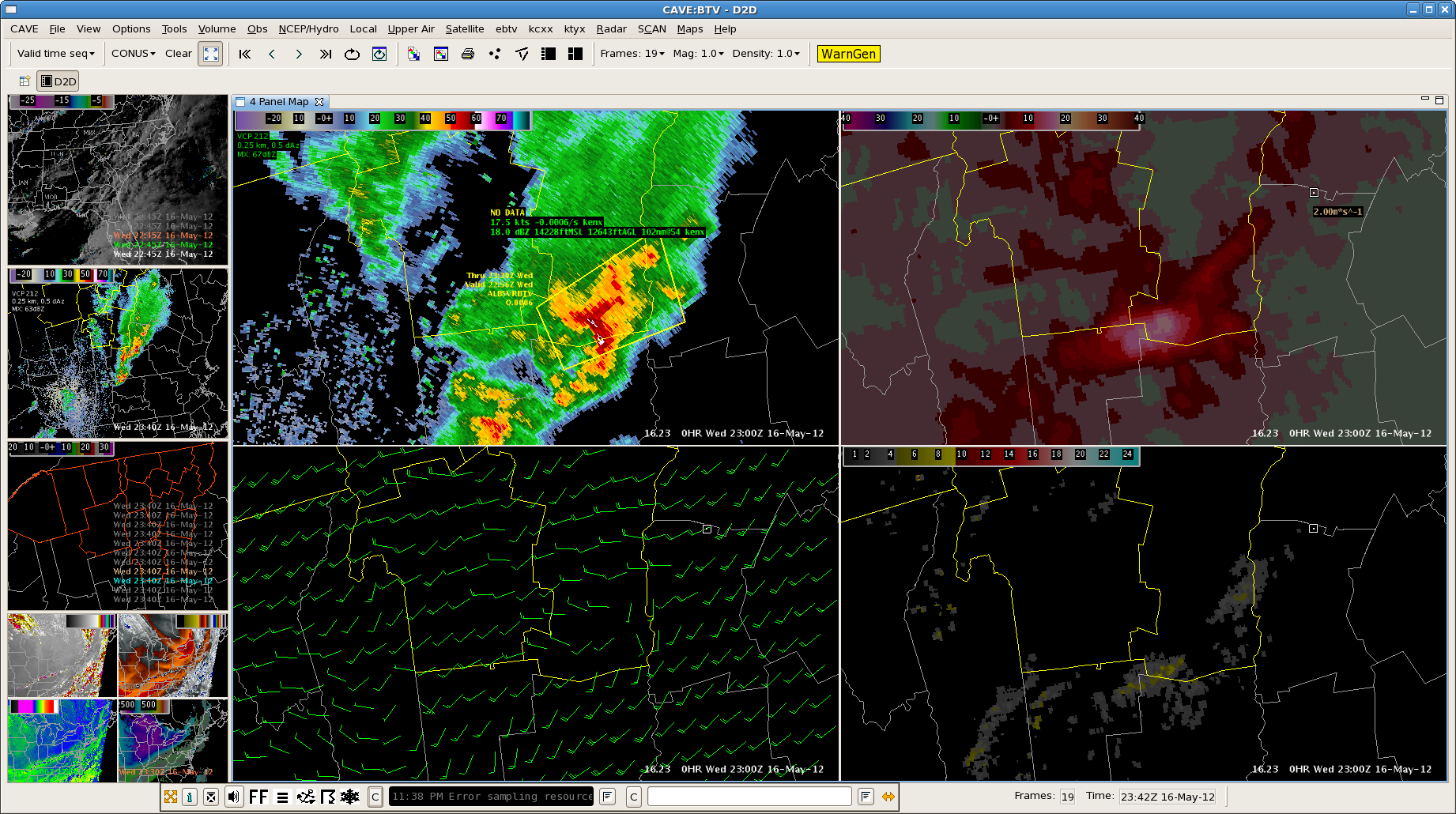
Late in the afternoon, as convection continued along the southern fringe of BTV’s county warning area, a storm cell began pulsing up and down.  This series of images shows how the max reflectivity on radar and the maximum updraft output from 3D-VAR began oscillating.  Maximum updraft strength from 3D-VAR would precede a peak in radar reflectivity by about 20 minutes.  We issued a warning for a southern BTV county, based on the Max Updraft data.  The storm produced 3/4 inch hail.

2205z.  Reflectivity is maximizing from a previous pulse, and current Max updraft values are less than 10 m/s.

2235z. Maximum Updraft values around 14 m/s. Max Reflectivity around 56 dbz.

2300z. Max Reflectivity back up to 60 dbz, while Max Updraft Strength continues around 18 m/s.

Dankers/Kearney

Miscellaneous musings from ALY

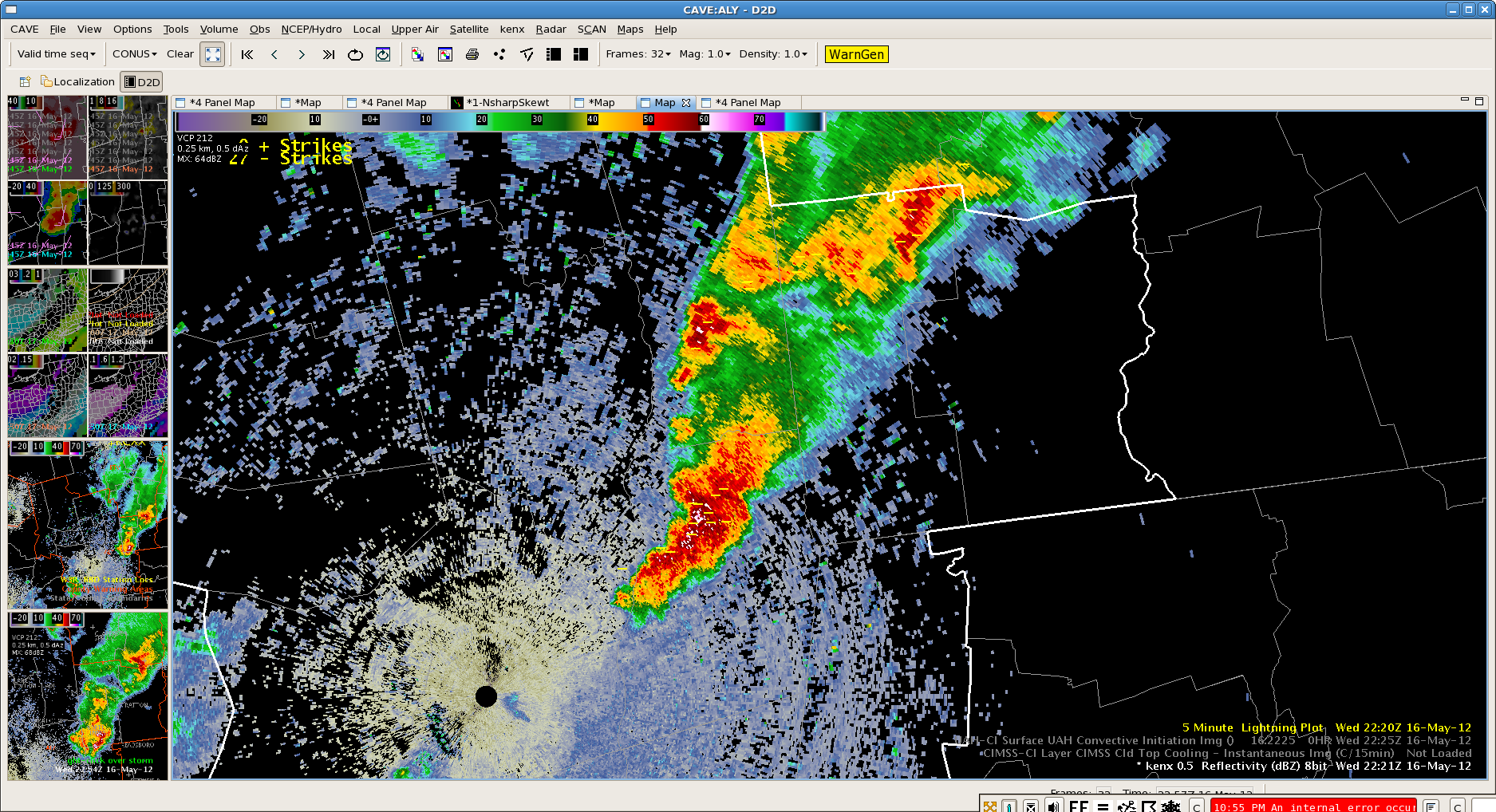
Had an interesting day working with convection in Albany’s CWA today.  Several storms grew big enough to make severe hail, strong winds and show nice organized rotation..also a bow echo looking storm.  In general the 3D Var and MRMS products proved useful for detecting hail concerns and also evaluating whether or not updrafts were strengthening or weakening…how high they were and whether or not there was good updraft helicity/vorticity.  Also the azimuthal shear product from MRMS was useful/interesting.  The nearcast thetha e product had its scale and units reversed since yesterday which caused some initial confusion but did seem to depict the more unstable regions well…though instability was fairly marginal.

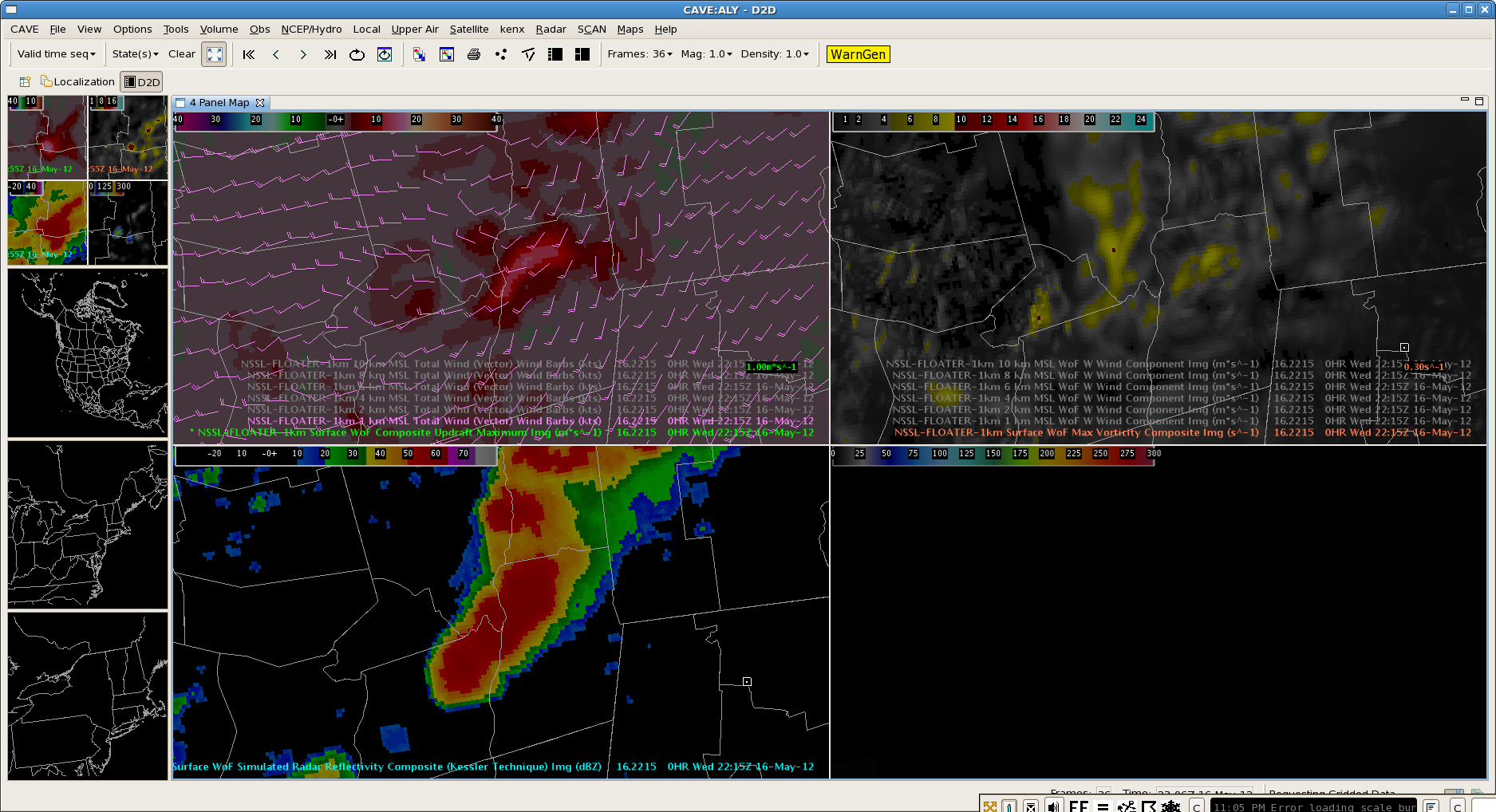
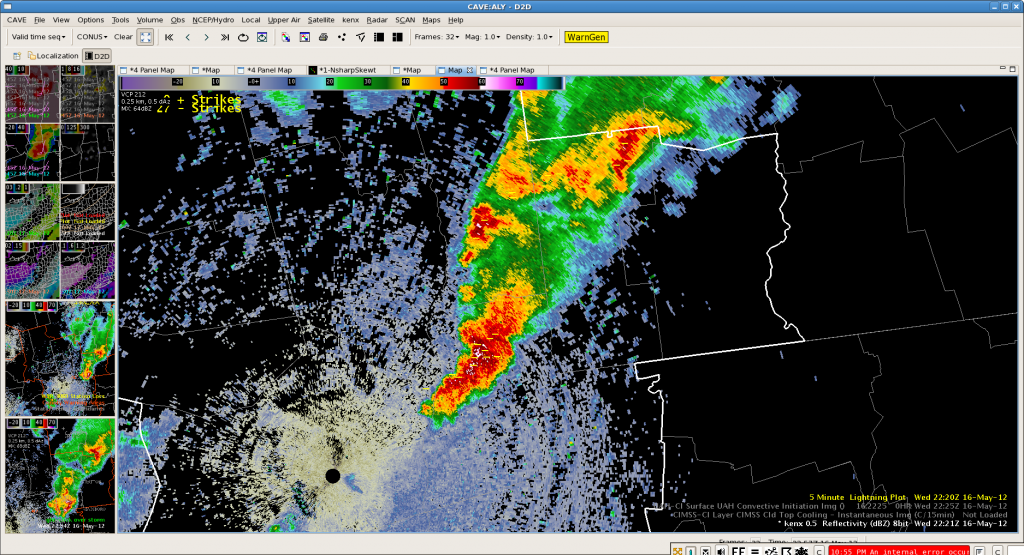
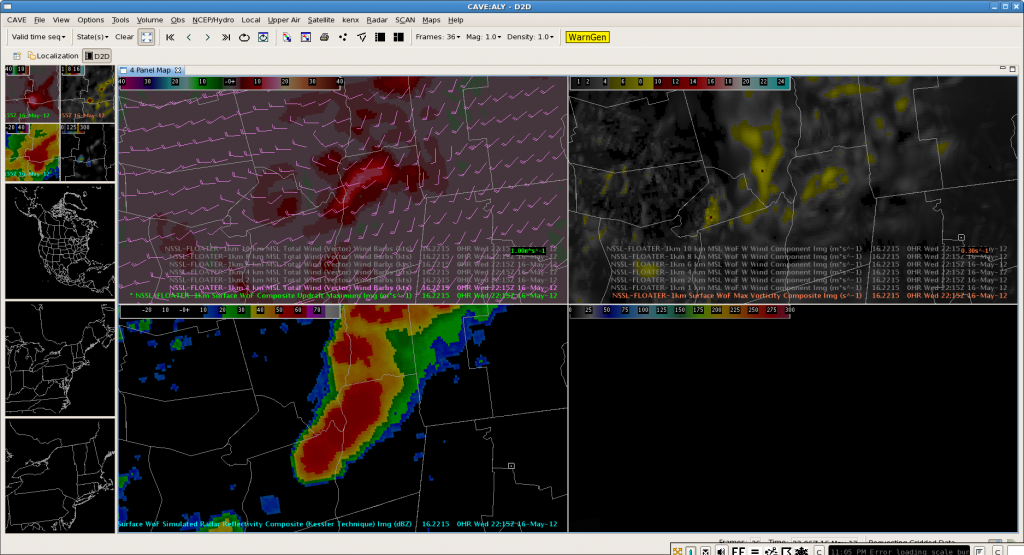
Some product limitations we ran into:  With all the new fancy products we had, there really wasn’t anything to aid with max wind gusts.  With the bow echo storm the 3d var fields were barely perturbed and did not at all seem representative of the probable wind speeds (images below show reflectivity and 3d var quad at same time with 1km (lowest available) winds…higher levels didn’t show much either)…old school use of radar velocities worked much better.
Some other products that would really be nice to have would be a 3-d or cross section way to look at updraft and downdraft strength, the horizontal plots of this could be overlayed at 1 km spacing in 3 d-var and was useful to watch through the life cycle of the storms but was very clunky to step through and hard to mentally visualize. In a 3d view this could be a very powerful way for forecasters to monitor and diagnose storm structure.  Another thing we ran into today were training storms and flash flood concerns…dual pol was handy for this among other things but wonder about what applications of the fancy new products there might be to hydro concerns.

AWIPS 2/Warngen/CAVE issues continued again today with warnings that wouldn’t go out, multiple Cave crashes, lots of random error messages and slow downs.  This system is not at all ready for operational use as they slowed/prevented warning issuances and having Cave crash mid warning ops when all the work station is running are 2 Caves not at all confidence inspiring when you think about everything else AWIPS in WFOs runs and does in addition.  Also found an interesting bug with the map background in the quad panels where they don’t always stay linked and you can unpredictably end up with map scales and alignments in different sections of the quads.