GREMLIN and Lightning Cast – Observational Notes and Feedback

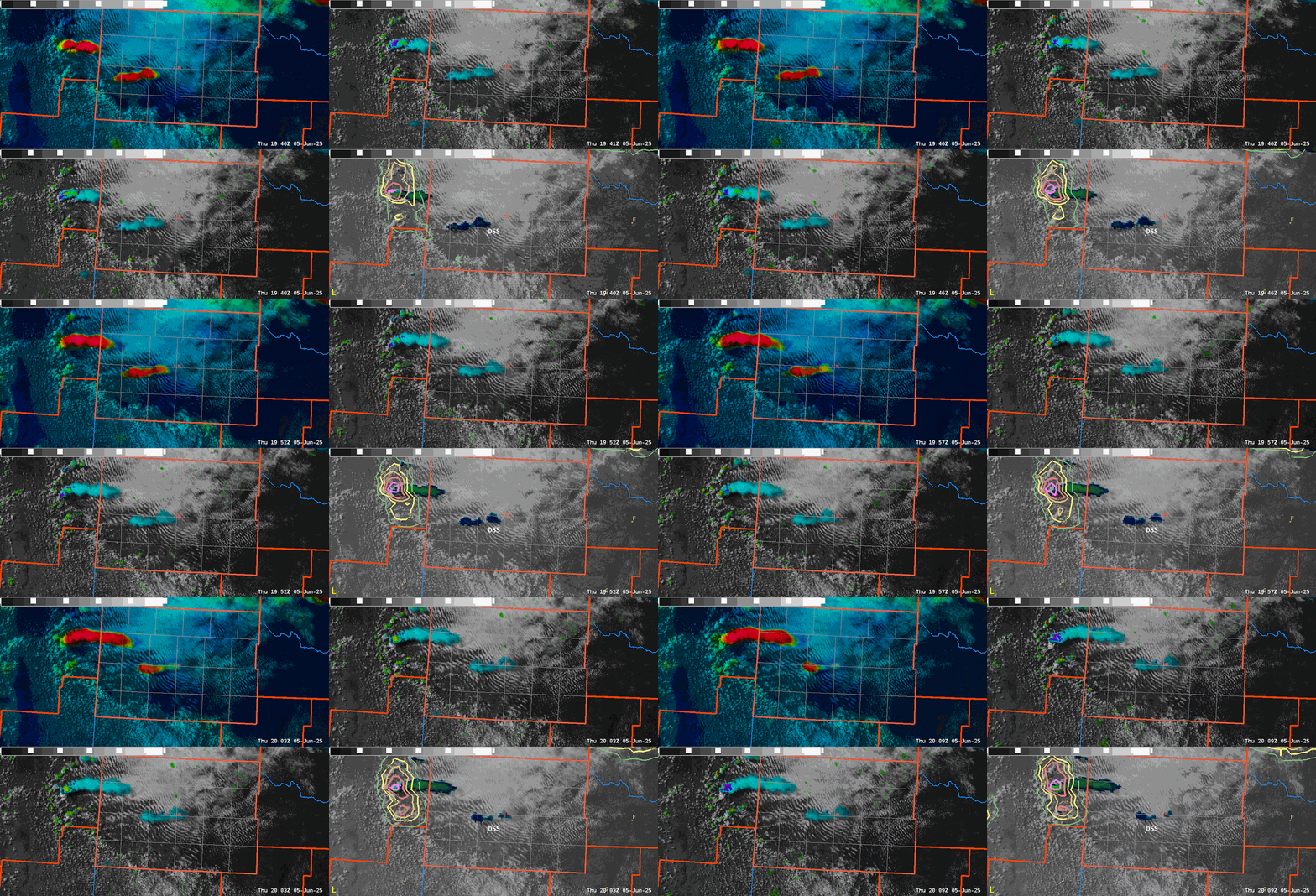
SYNOPSIS – A broken line of thunderstorms lifted north through SE Colorado in a weakly sheared, high LCL environment with modest instability (1000-2000j/kg MUCAPE) and high DCAPE (1000+ j/kg). This environment appears to favor pulse severe potential, with primarily a gusty/damaging wind risk.

OPERATIONAL NOTES AND FEEDBACK – Using GREMLIN and Lightning Cast Together

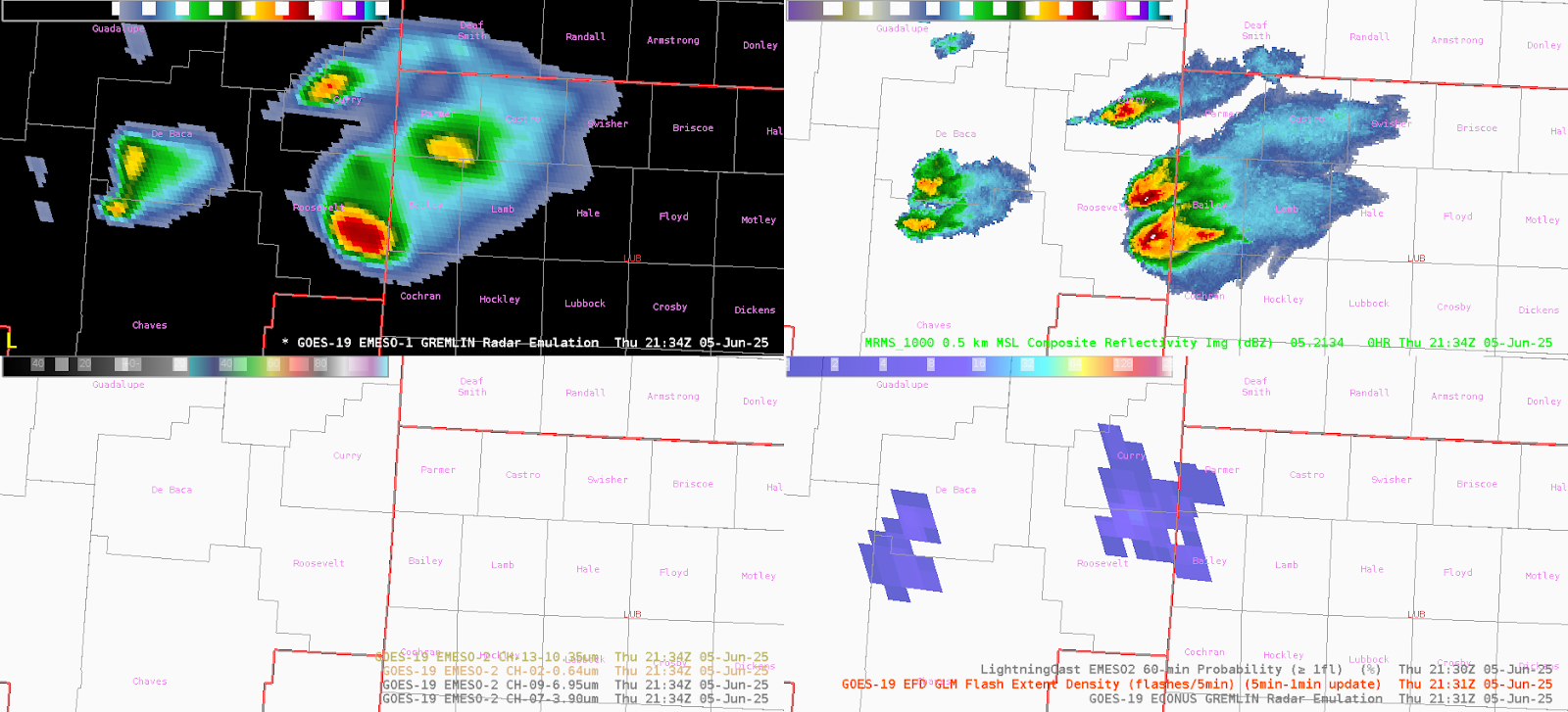
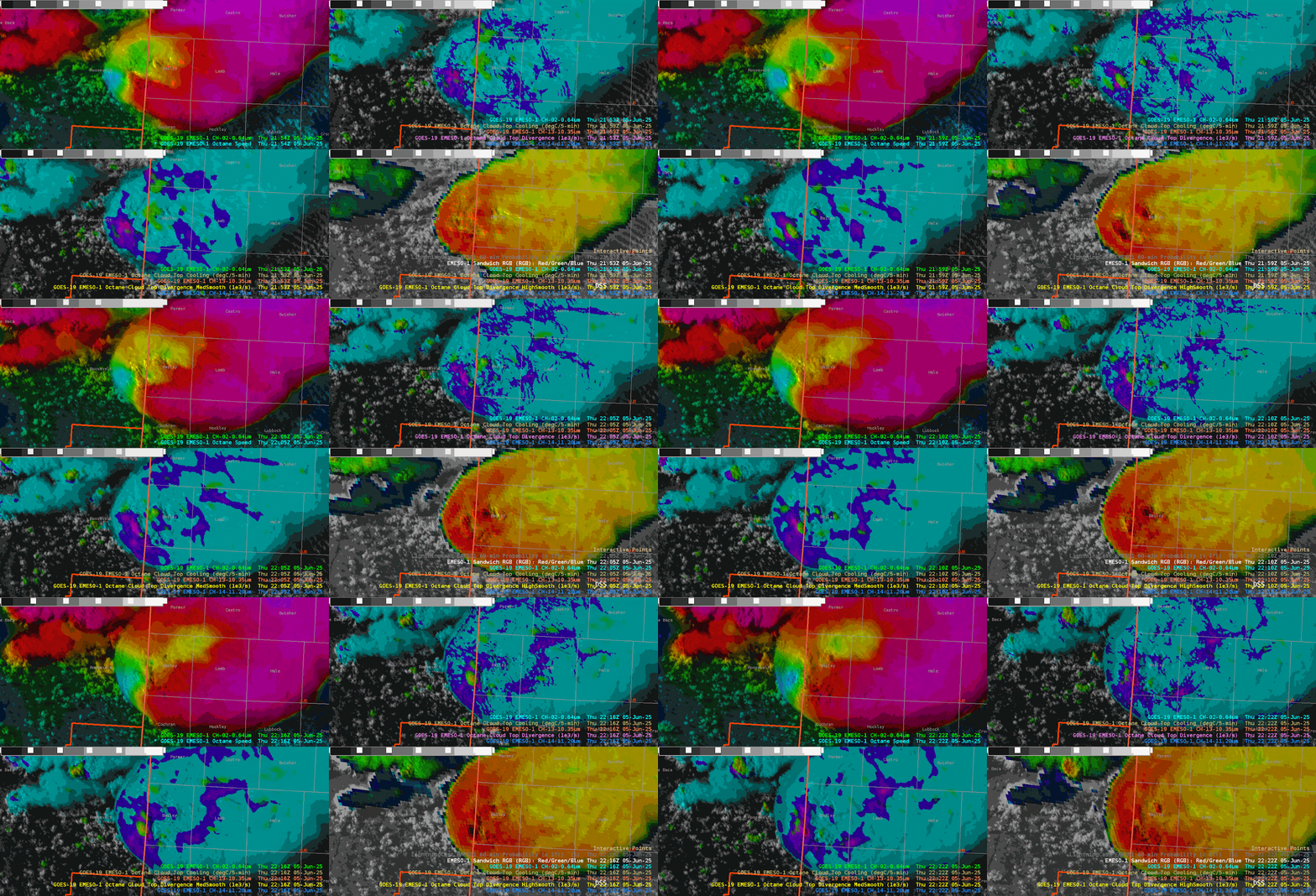
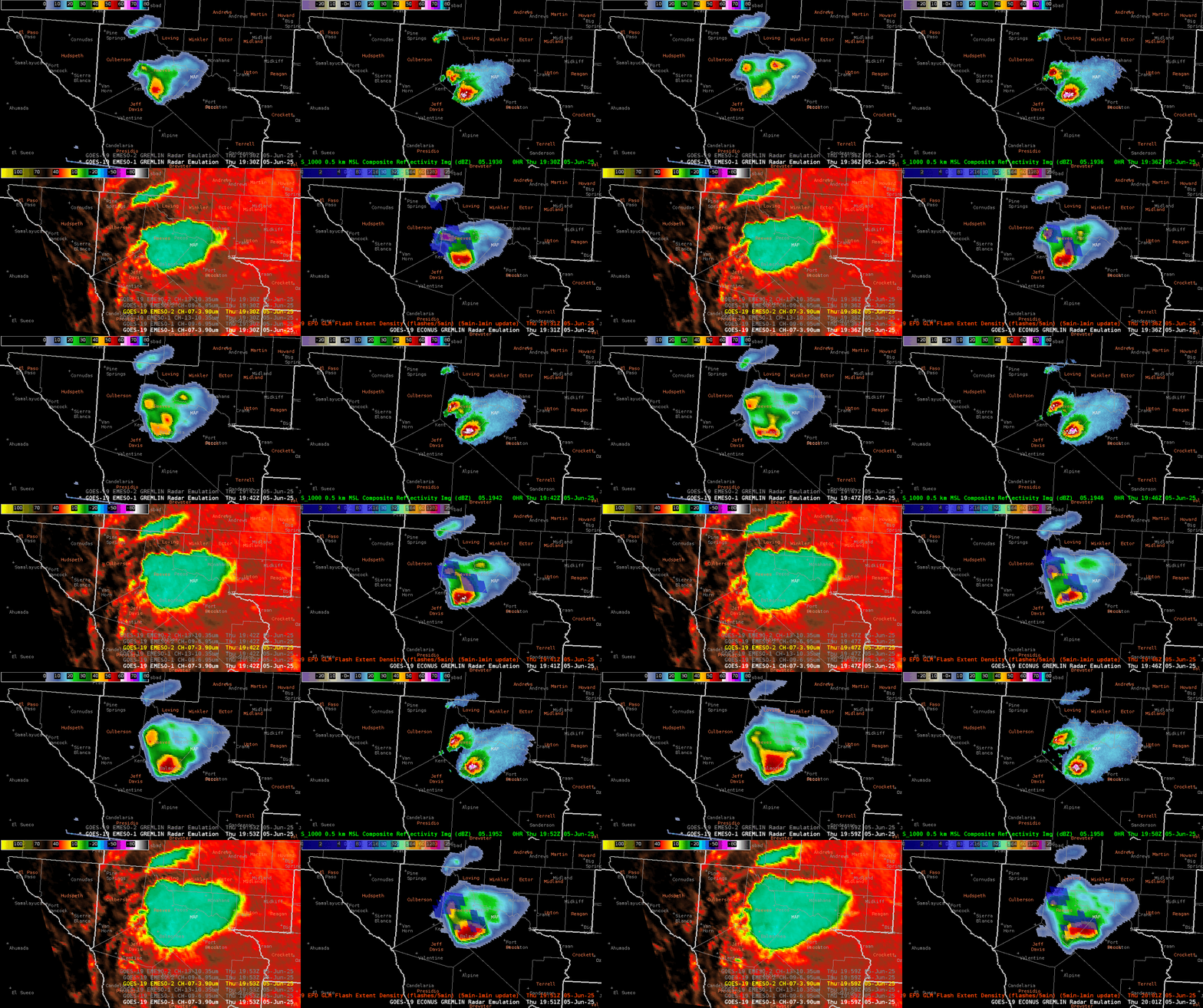
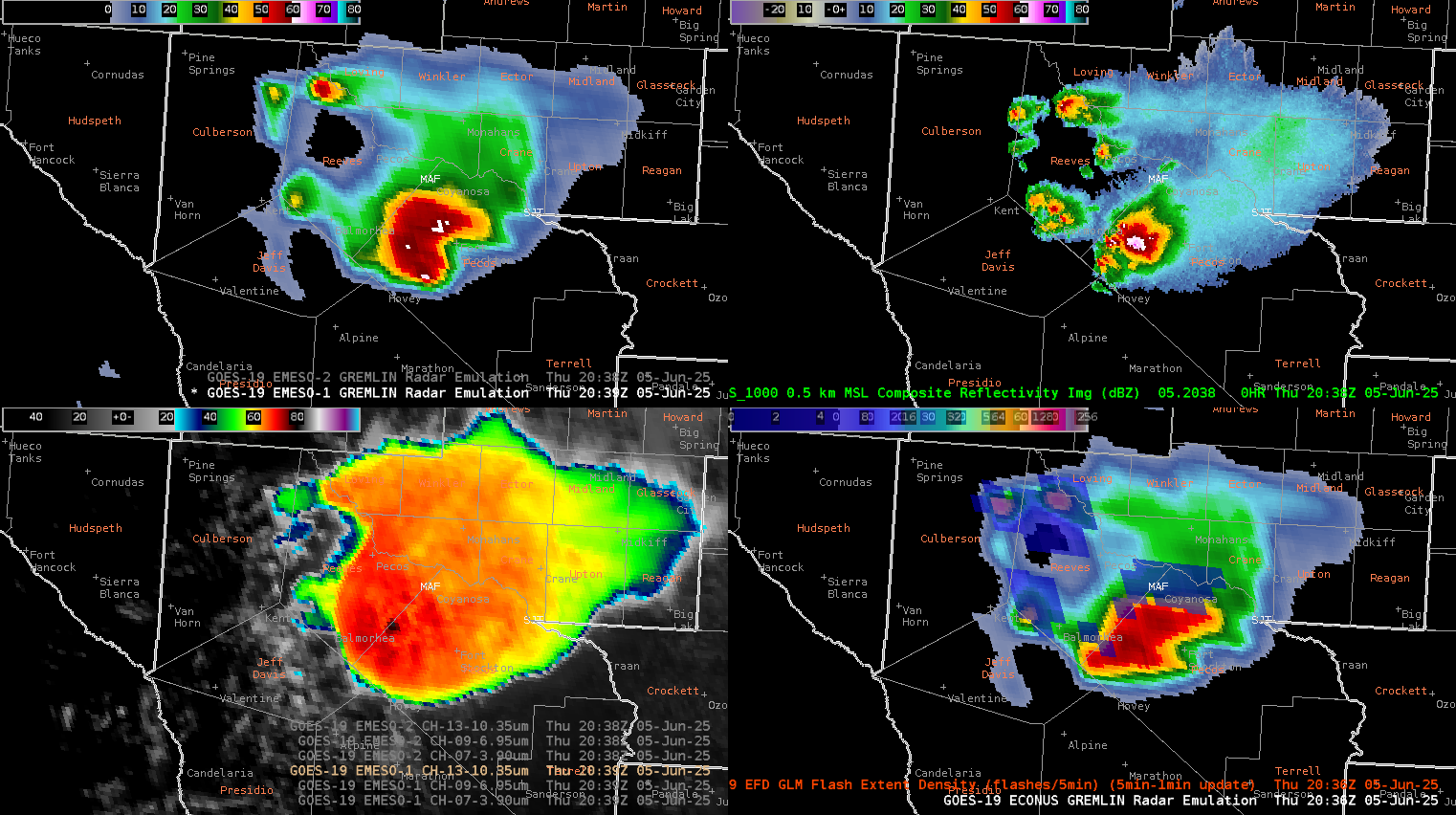
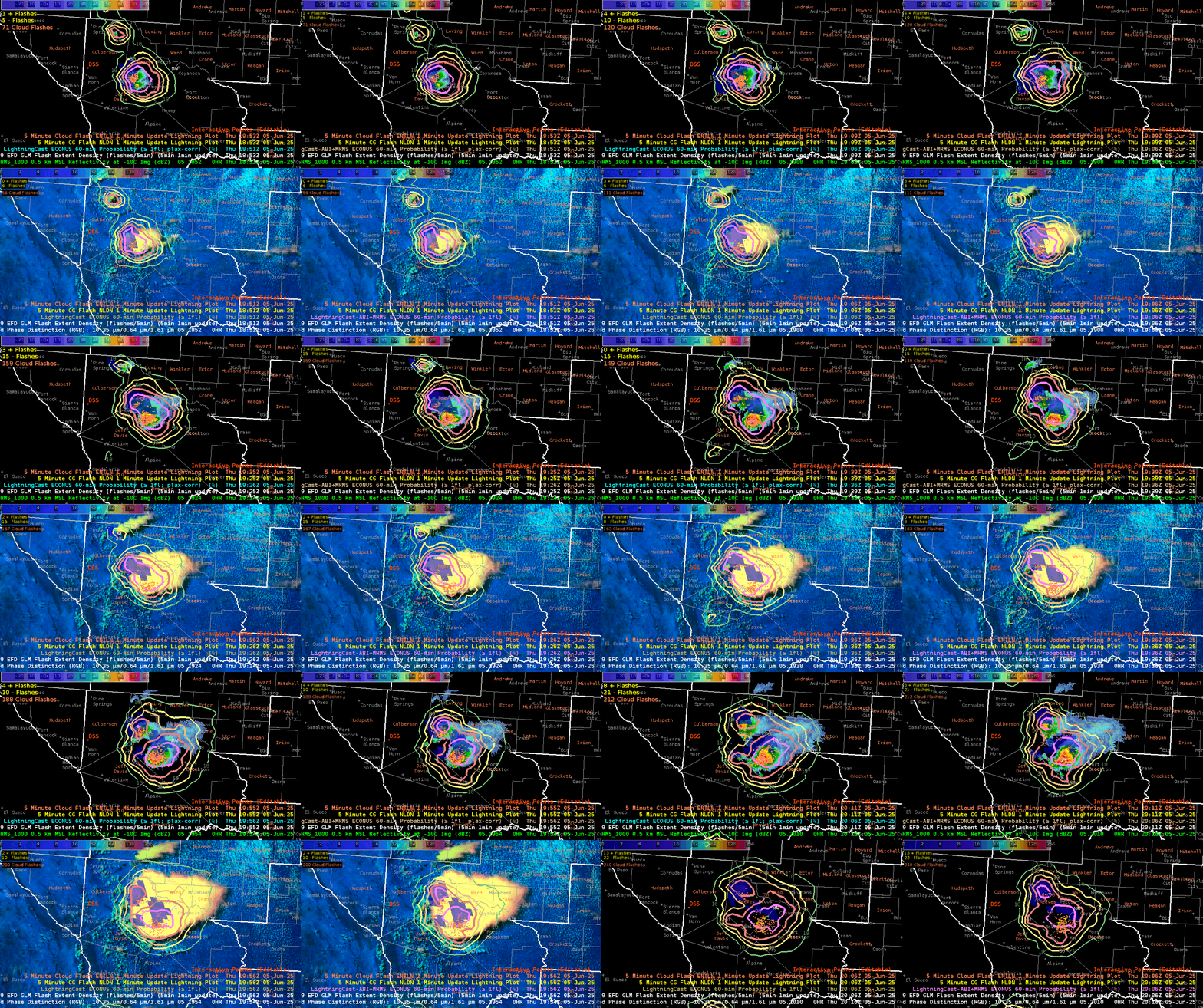
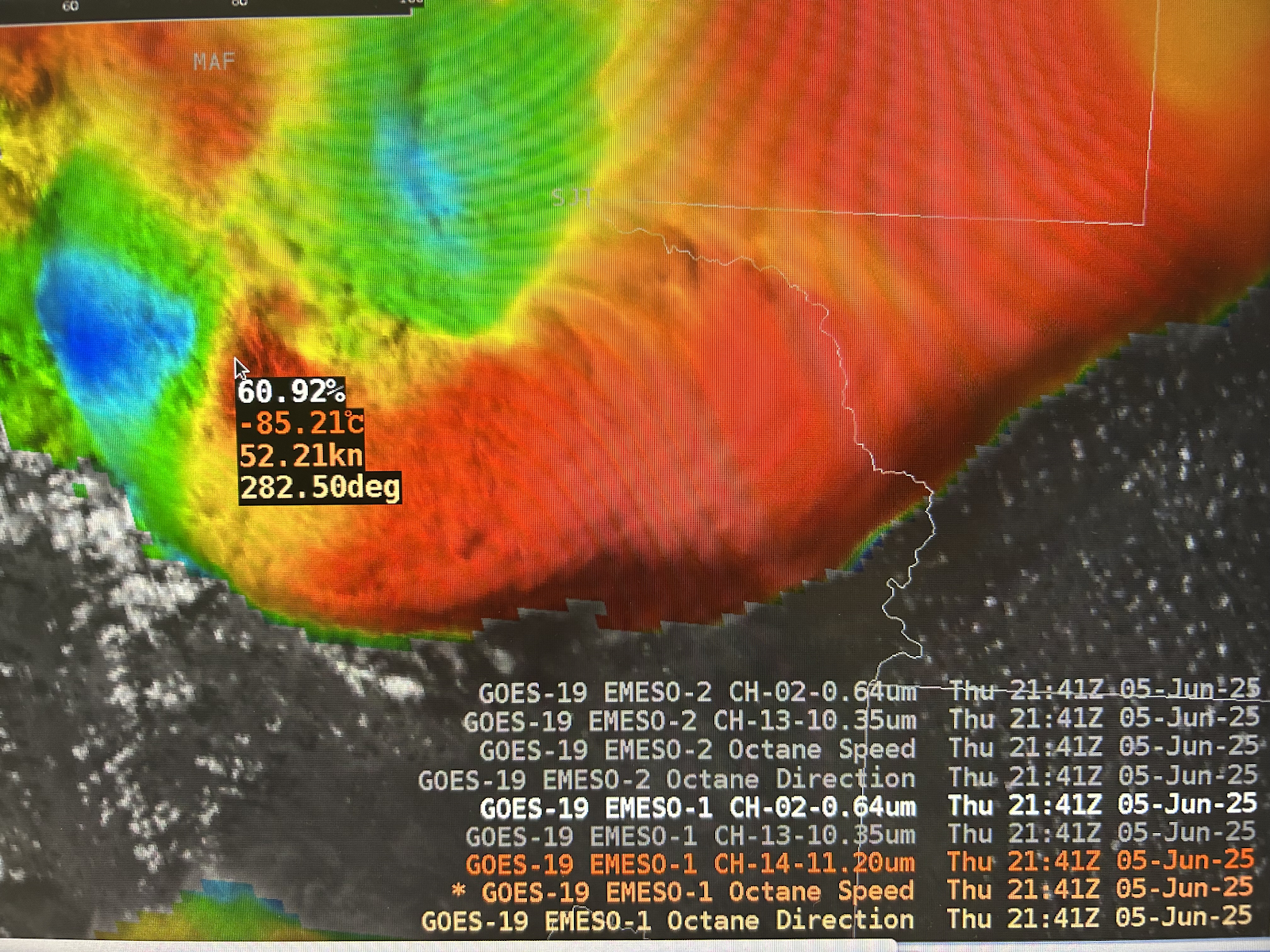
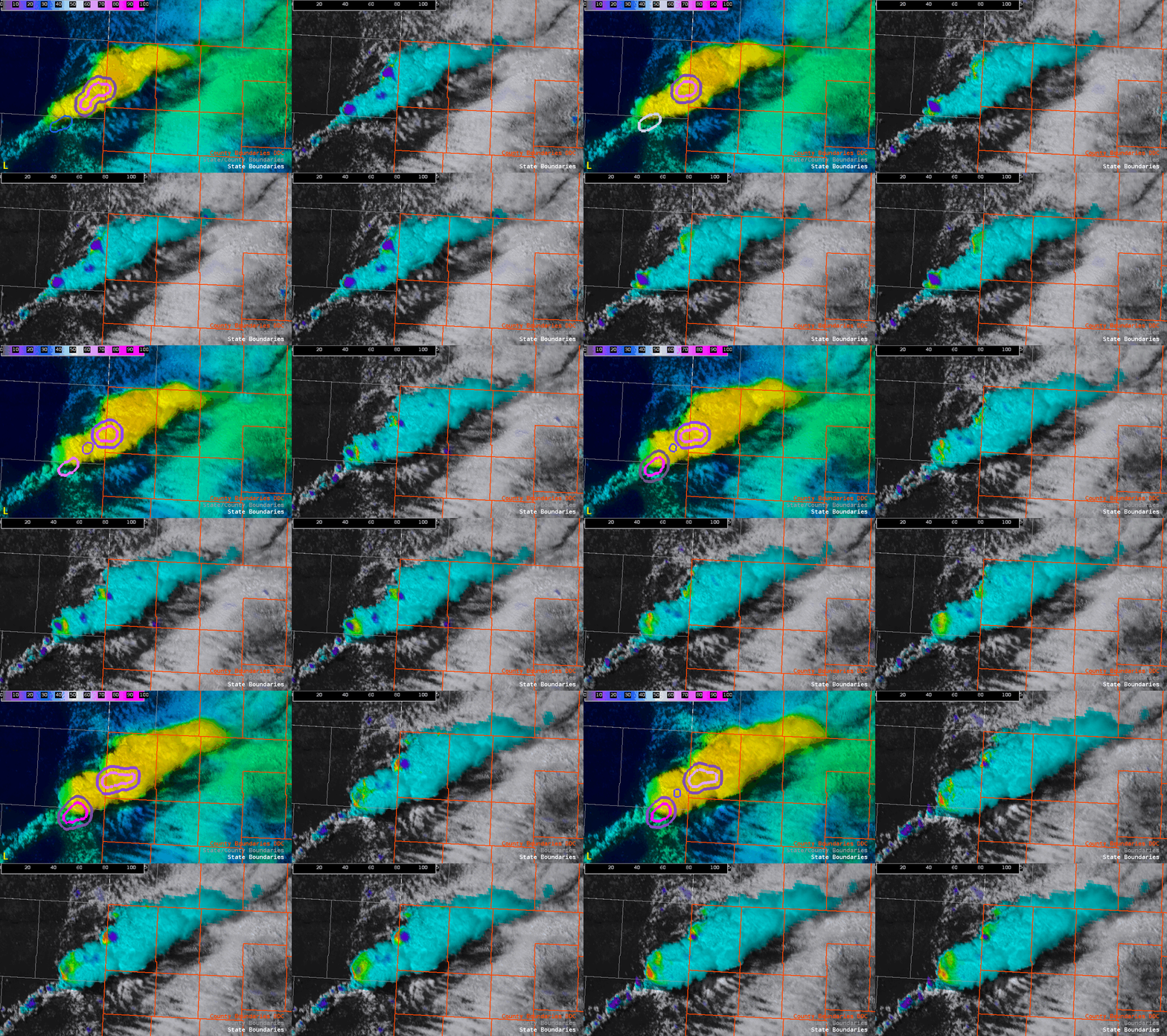
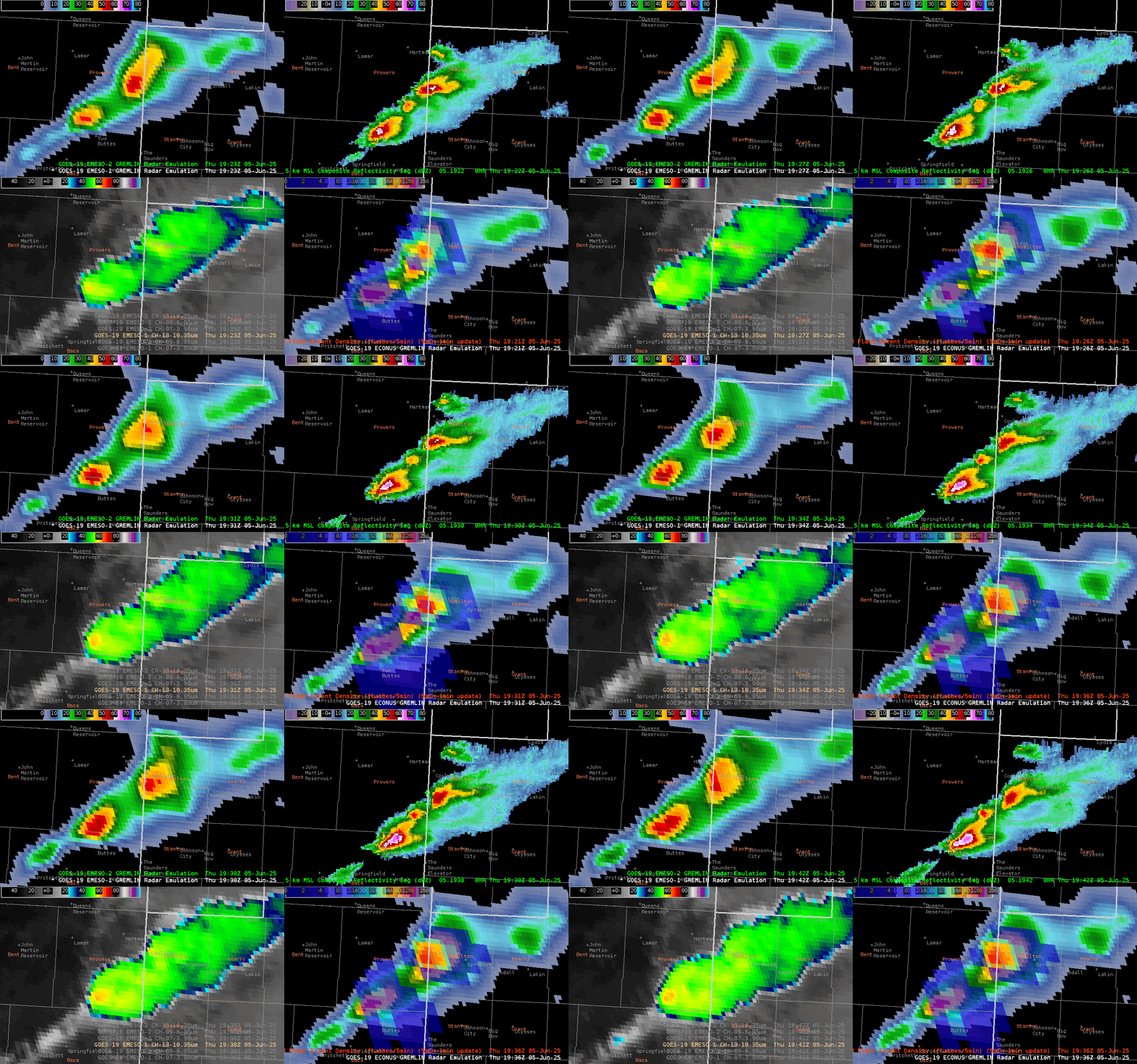
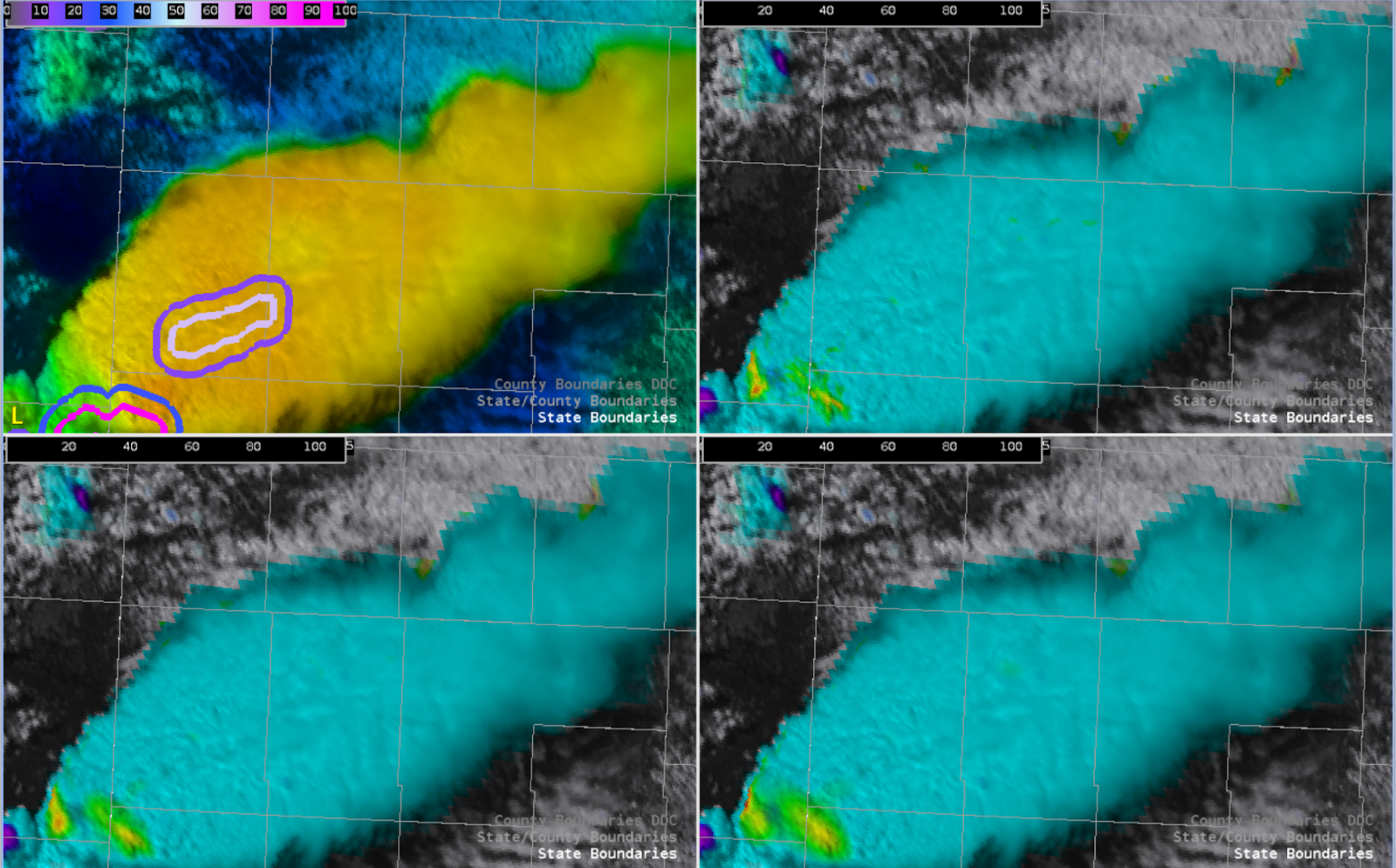
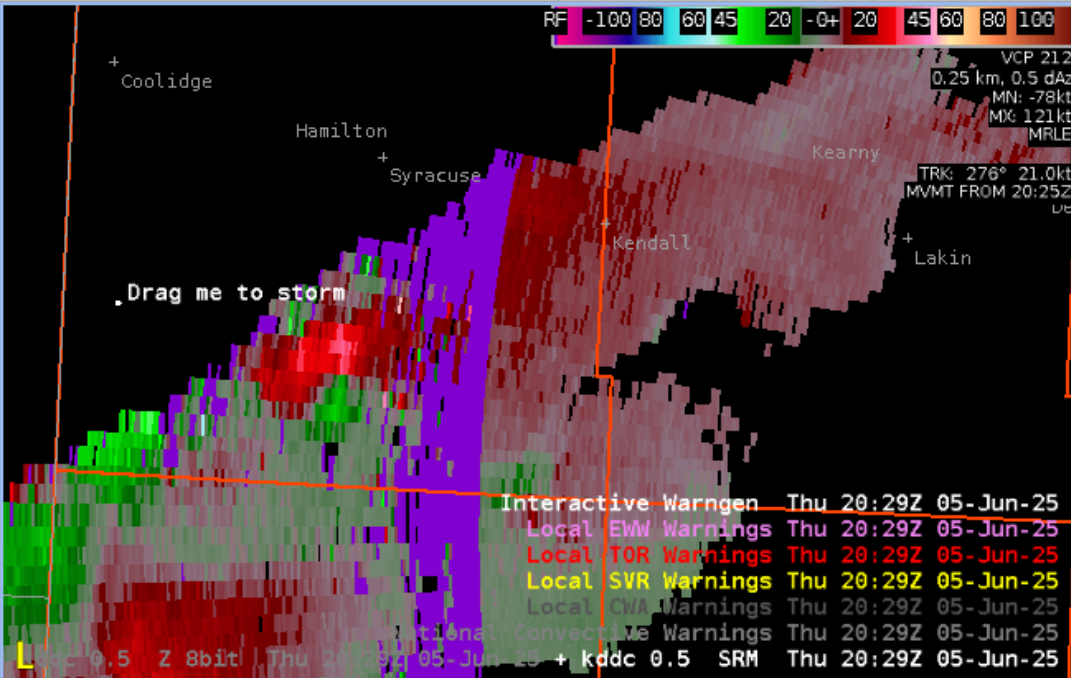
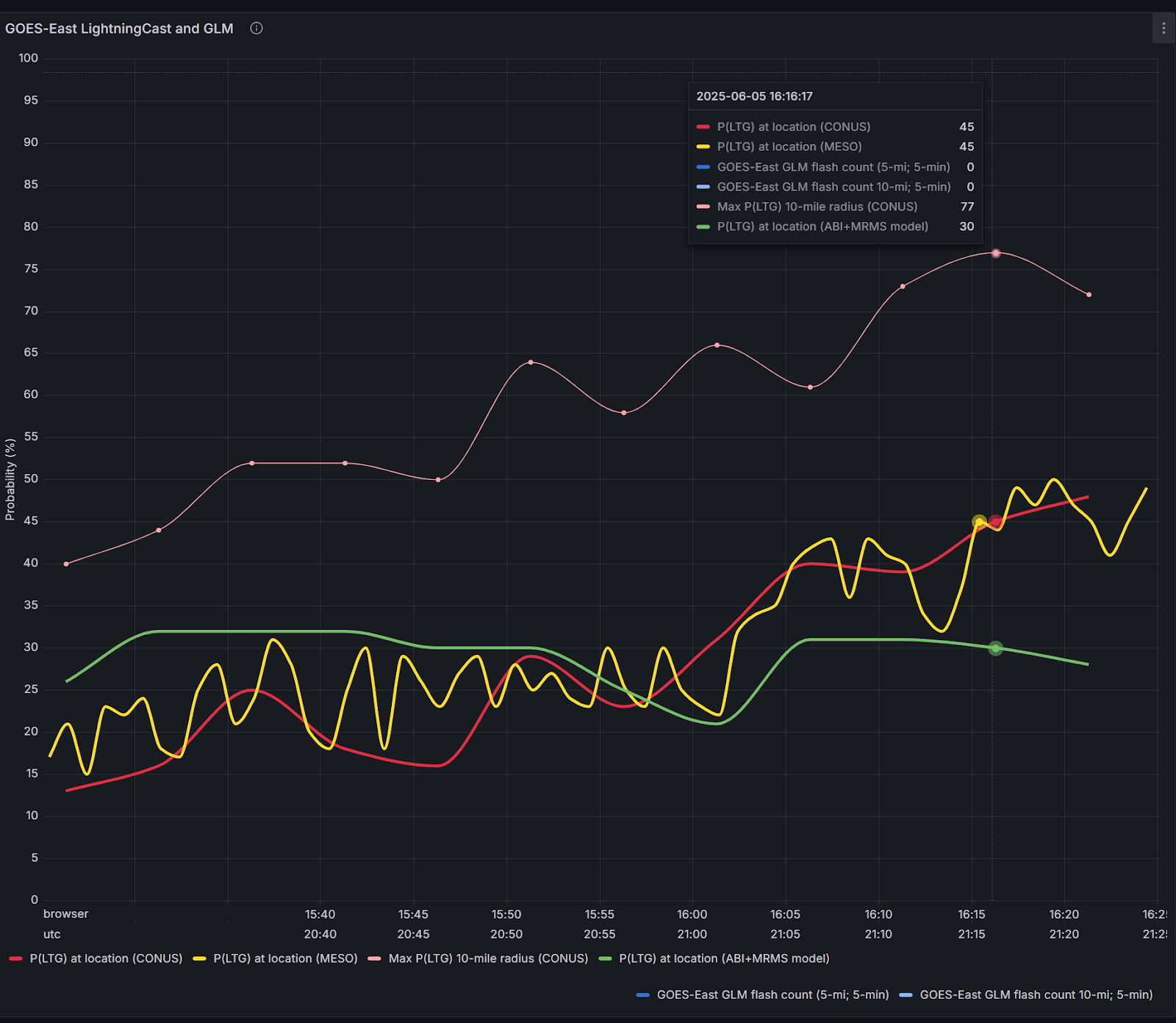
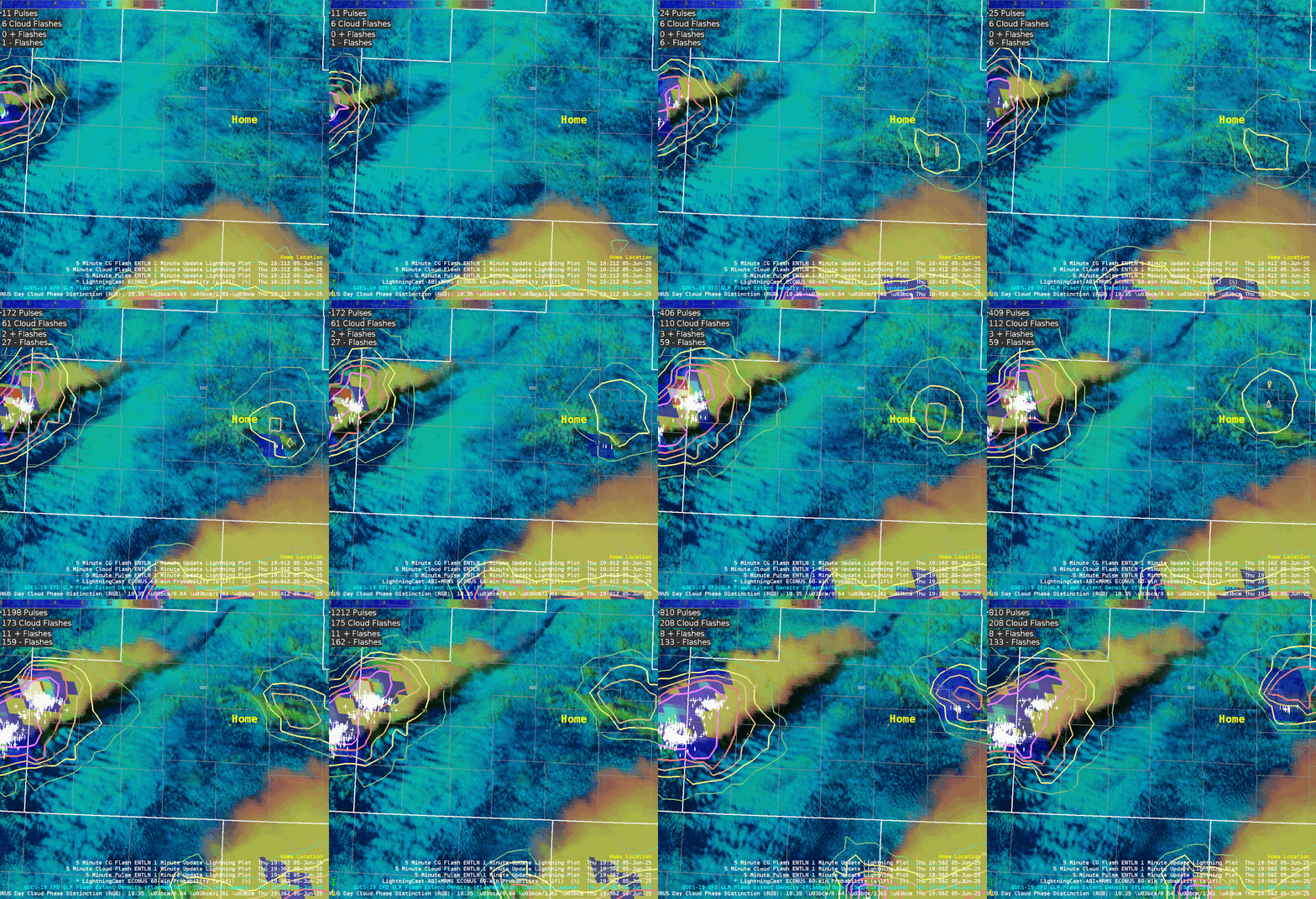
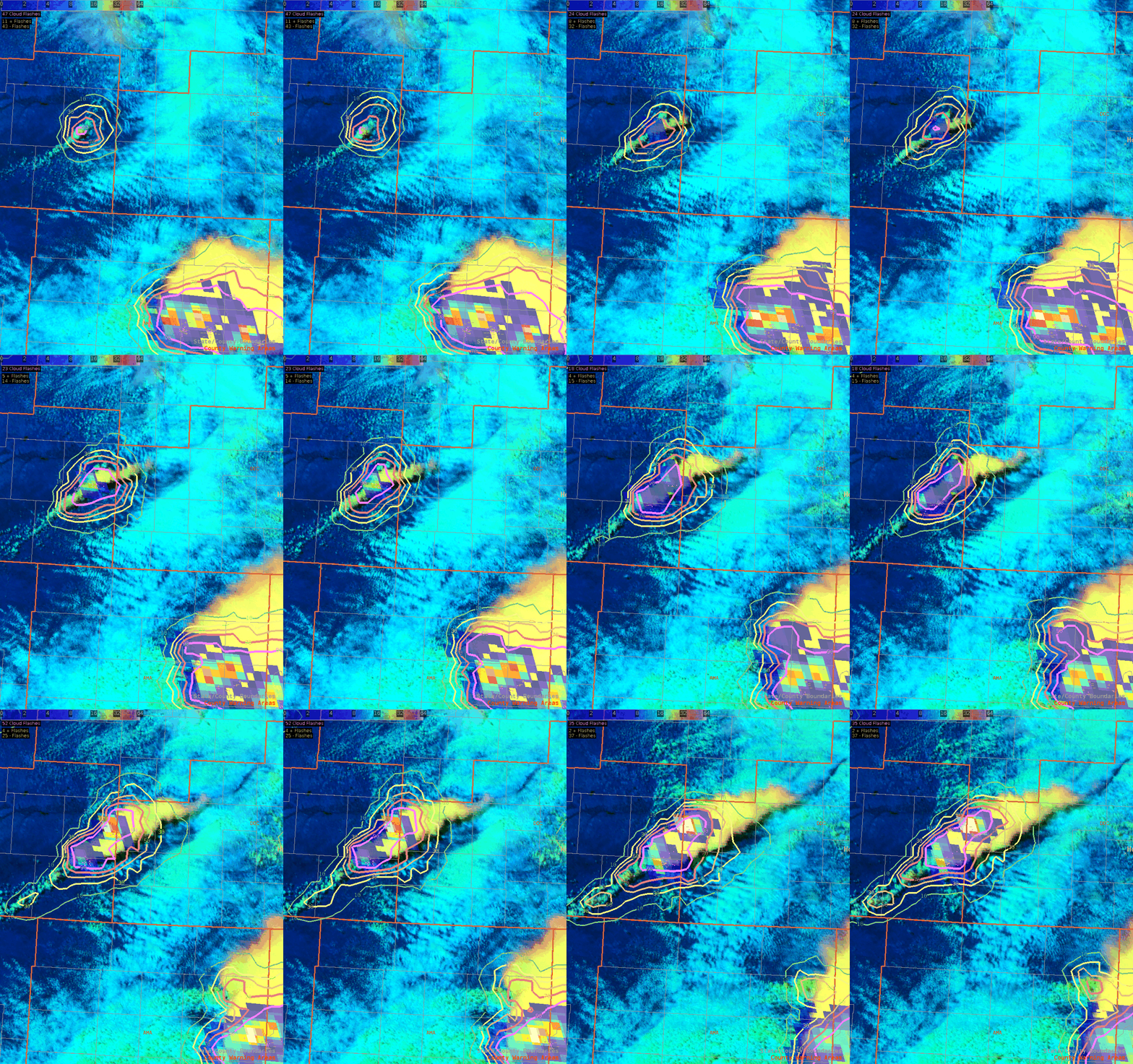
I used a 4-panel to compare GREMLIN, satellite, radar, MRMS, and LTG Cast data. I’ve not typically used LTG Cast to nowcast the severity of convection, but when combined with GREMLIN, it kind of reminds me of looking for signals in model data. For the most sustained convection, for example, GREMLIN had a fairly consistent signal of 40-50dBZ echoes in tandem with consistently high LTG probabilities. In the past, I’ve typically just focused on GLM lightning data on its own separate from LTG probs. Overlaying LTG Cast probs with GLM data seems to provide a more uniform / smoothed view of the evolution of lightning within convection as opposed to using GLM on its own. GLM can be jumpy at times, which can give the impression that a thunderstorm is weakening. However, if LTG cast probabilities remain high, it may give the forecaster more confidence that a thunderstorm is not weakening. This seemed to be the case with multiple different thunderstorms in SE CO today.

OPERATIONAL NOTES AND FEEDBACK – GREMLIN

It was interesting to note how closely the increase and decrease in GREMLIN reflectivity was tied to the increase and decrease in lightning. The developers noted that this is to be expected. Since GLM data can sometimes be jumpy, and isn’t always reflective of the severity of a storm at a given moment in time, it might be interesting to see if there is a way to offset this. Perhaps there is some way to mesh GLM data with Lightning Cast data (reference the notes in the observation section about nowcasting convective strengths) or through some other means (longer averaging time, etc.). When GLM data isn’t jumpy, GREMLIN seemed to compare very nicely with MRMS. But, when GLM data was jumpy, GREMLIN seemed to struggle some, showing more rapid increases and decreases in reflectivity that what MRMS showed. As an alternative, I could see where simply overlaying LightningCast data on top of GREMLIN data could provide a more “smoothed” and uniform trend in convection over time, in a way that could still provide useful information for warning decisions.

From an operations standpoint, GREMLIN seemed to provide a great overview of convective evolution, especially when overlaid with LightningCast data. It’s possible this could translate to warning decisions, but this initial runthrough with the product suggests its biggest advantage may be nowcasting the general evolution of convection as opposed to making specific warning decisions. Admittedly this is my first use of the product, and I’m looking forward to trying it in future days of the HWT to see if anything different stands out.

– NW Flow
Tags: None

DSS LightningCast Dashboard

GOES-East LightningCast for DSS event in CYS CWA


GOES-West LightningCast for same DSS event in CYS CWA over same time period

When using the DSS event/stadium GLM dashboard on the web, with an event that is located in the CYS CWA in the mid-CONUS, there was a significant difference in the probability of lightning from GOES-West compared to GOES-East. The GOES-West data was ultimately better and more reflective of actual lightning trends in that area, despite GOES-East  having two mesosectors located over the point in question.

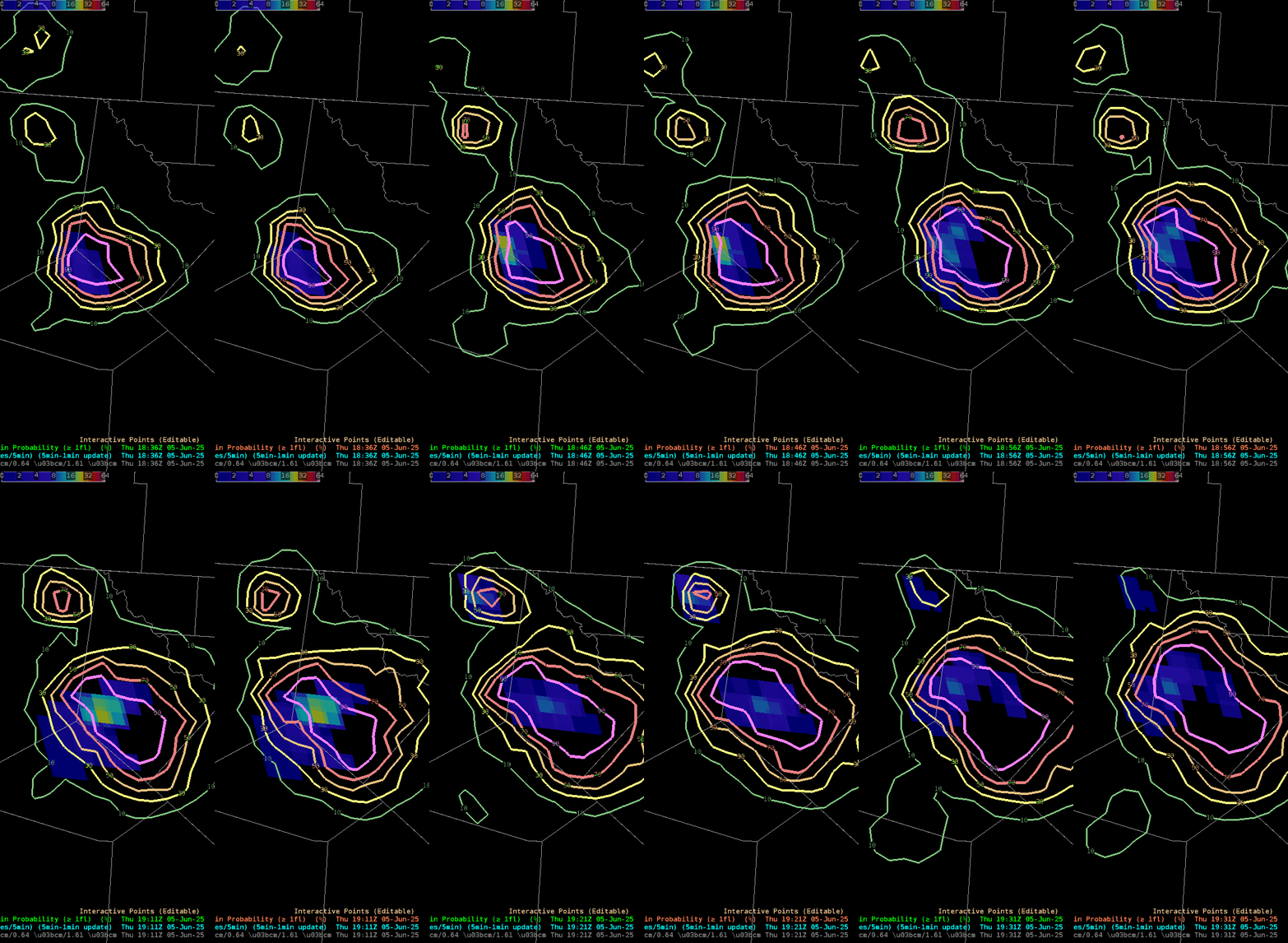
Top panel, LightningCast version 1. Bottom panel, LightningCast version 2.

Meanwhile, in a different area (BOU), comparing LightningCast v1 to v2, it appears that v1 does better in areas with poor radar coverage, while v2 does better in areas with better radar coverage.  In the image above, version 1 has a better handle on the isolated first GLM pixel (50%) than version 2 (10%). Meanwhile, the more robust lightning area is more accurately represented on version 2 (which happens to have better radar coverage) compared to version 1.

– prob30

Tags: None

Filling in LightningCast Contours in AWIPS

TFX was focused on DSS messaging since it became evident fairly early on in the day that we were not expecting severe convection. The event we had was a State Track Meet with a range ring of 10 miles. Since there were a lot of contours to look at, our group decided to load them as an image and play around with the fill value of the LightningCast probabilities for easier visualization of imminent lightning threat for our partners. To do this, we loaded LightningCast as an image, went into the Change Colors option of the Img LightningCast and set the 10/30/50/70/90 thresholds to match with the colors, including setting 0-10% as transparent. Then we overlaid MRMS on top of it and set everything below 20 dbZ to transparent so we didn’t get any noise from the light showers since we were more focused on the thunderstorms with higher dBZs.

Initial attempt at filling in the LightningCast contours.

Later on in the day, we settled on a less opaque version of the colorbars and we were able to save them such that others in the TFX group could use them on the AWIPS user account as “LightningCastFilled”. This allowed the reflectivity above 20dBZ to stand out more so partners knew where the heaviest rain was without it blending into the bright filled LightningCast.

Final decision on the colormap filling in the LightningCast contours overlaid with MRMS composite reflectivity above 20 dBZ.

Our group members also noticed the default Max and Min for both versions of LightningCast (when loaded as an image) were originally set in AWIPS to random numbers like -20 and 113. Version 1’s default range was different than Version 2’s which added to the visual discrepancy. Before we figured this out, the contours and images did not match up in space (i.e. the image went outside the contour for the same value), but turning on samples revealed they were the same value. In theory, these should be set to 0 and 100 given that LightningCast is a probability. Once we changed these values on the LightningCast Img product in AWIPS to be set to a range of 0 to 100 and reset the colorbar levels according to this scale, they matched up perfectly with the contours. Our suggestion for developers was to ensure the default for these is 0 to 100 in AWIPS if they were ever to be loaded as an image.

Tags: None

LightningCast Dashboard

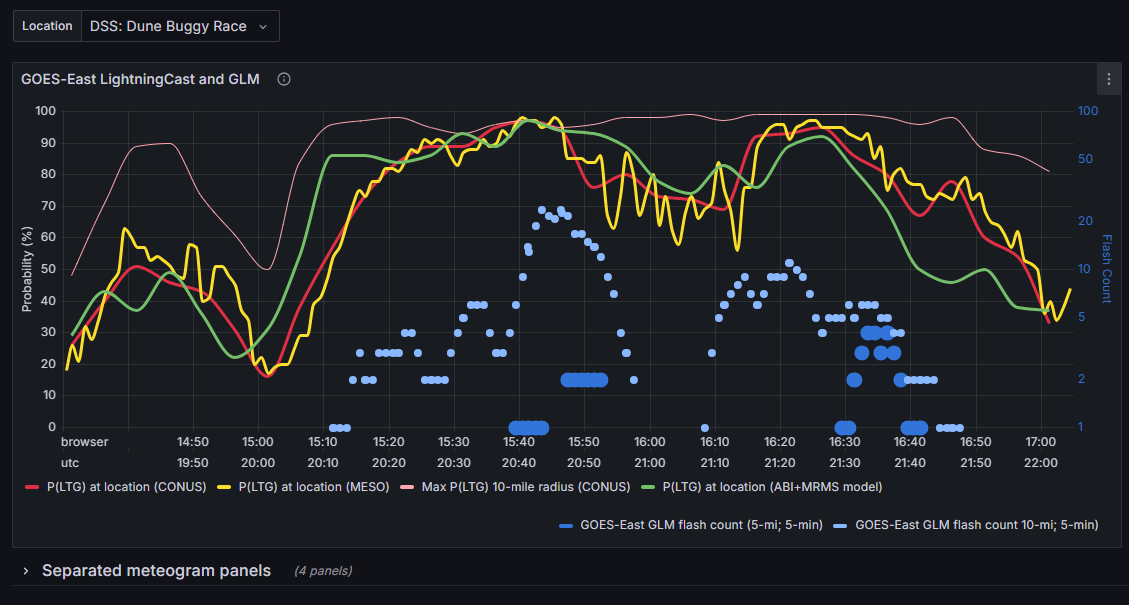
One of the more useful features for DSS messaging today was the Dashboard Request Form for values at our State Track Meet. Since we were operating under the assumption that the go or no-go threshold for this event was lightning within 10 miles, I liked using the dashboard but isolating the Max P 10-mile radius line in pink.

One note of feedback I had was to add some context for what we’re looking in each line at by noting where the data comes from in the legend. I was able to verbally ask a visiting scientist exactly what each line meant and where the data comes from, but this may not always be an option. The suggestion we came up with was adding (5-min, CONUS) and (1-min, MESO) to the legends circled in red so that it’s clear that the 5 minute data came from the CONUS satellite and the 1 minute data comes from one of the mesosectors.

– millibar

Tags: None

Lightning Cast Differences With Pulsing Convection

A weak line of thunderstorms developed and moved into the southern portion of Great Falls, Montana CWA (WFO TFX). Based on MRMS, the storms appeared to be weakening with MRMS and lightningcast V2 began to lower probabilities of lightning quicker than V1. However, slightly after the lightning decreased in V2, both versions increased probabilities of lightning within the next hour to above 90%. Maybe V1 does better with pulsing storms or maybe it was just a single case scenario where V2 dropped in probabilities during what it believed was decaying convection, when in reality it was pulse-like convection.

– Aurora Borealis

Tags: None

Lightning Cast: Real-Time Monitoring for DSS

The LightningCast Dashboard is an excellent tool to monitor and predict the probability of lightning at a point, which allows us to easily provide decision support services (DSS) for outdoor events.

Here’s an example from today for the Clown Rodeo on the south side of Lubbock, TX:

Notice the LightningCast probabilities for both the ABI and ABI + MRMS generally remained between 0 to 20% during the duration of the event.

These probabilities were associated with developing cumulus clouds in the area, which can be seen in the Day Cloud Phase Distinction RGB:

Typically, if a meteorologist sees developing cumulus similar to shown above in the Day Cloud Phase Distinction RGB, this would result in an increasing concern for lightning at that location. However, it is challenging to quantify this concern and message it probabilistically to our partners. LightningCast gave us confidence to message our partners there is a low probability (10 to 20%) of any lightning strikes within the next hour.

-Vrot

Tags: None

CONUS GREMLIN Handling Convection Worse than MESO for a Change Over Western Montana

Figure 1: CONUS GREMLIN. There is a lot of stratiform in TFX and MSO’s area, though it is not being reflected nearly as much as MRMS indicates in Figure 2.

Figure 2: WMESO GREMLIN. Although the Meso Sector doesn’t extend all the way north, it does a better job representing the arcing line of showers. Perhaps it has a tendency to do this on the edge of the domain?

Not a whole lot is happening across MT right now so I will shift my eyes to TX for a bit. OCTANE seems to be doing great with initiation across a puffy CU field across west TX in Figure 3.

Figure 3: Note the cooling tops across all the CU in the unstable environment. A few have already developed into robust storms.

Back to MT…

Cloud tops have cooled somewhat on the storm entering the southwest corner of the CWA with LightningCast increasing accordingly, Figure 4.

Figure 4: LightningCast V2 seems to be handling this better according to lightning obs.

Figure 5: Associated Radar

ECONUS GREMLIN also appears to have picked up on this well (Figure 6).

Figure 6: ECONUS GREMLIN

Figure 7: ECONUS GREMLIN continues to intensify accordingly with what radar and MRMS have.

Additionally, the parallaxing appears to be quite evident once again as shown in Figure 8 and 9. I’d imagine that it’s due to the ECONUS sector, but I am not totally sure. This would be a major issue in my CWA with flooding ops as the warnings tend to be very specific over slot canyon locations, and this could lead to a false alarm or a missed event entirely if we are solely relying on GREMLIN.

Figure 8: Notable parallax issues compared to where my SPS was issued.

Figure 9: Location of the storm according to the KTFX radar.

Tags: None

LightningCast: Version 1 vs Version 2

Throughout the day, there were a few instances of latency issues between version 1 and version 2. It was usually no more than a 30 second delay, but the right panel with version 2 of LightningCast often failed to load in AWIPS for a few moments despite there being no differences in the temporal resolution of each field. Example below of version 1 coming in faster than version 2. This delay was about 20 seconds.

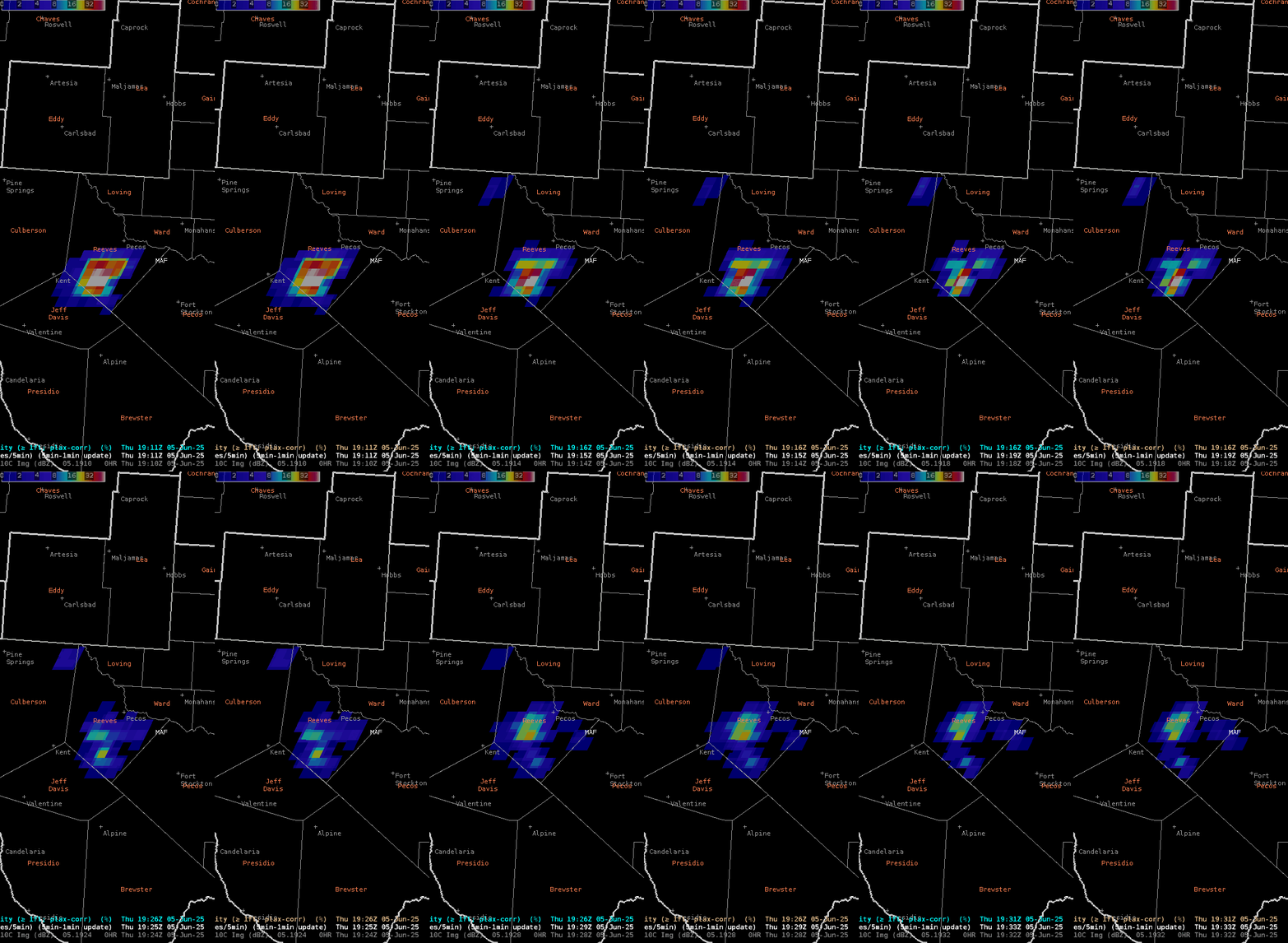
Though versions 1 and 2 of LightningCast perform generally similarly, I did notice a few times where version 2 captured the initiation of new convection better than version 1, such as the offshore cells popping up in these screenshots from 19:21 and 19:31Z.

19:21Z

19:31Z

– millibar

Tags: None

Using LightningCast and MesoAnywhere for Alligator Wrestling

Since we are relatively limited with the products we can use today as the meso sector doesn’t fully extend down into JAX’s area, I will be mainly using LightningCast and MesoAnywhere today. We are able to use the CONUS sector for GREMLIN, though I’m not too sure how useful it will be today with good radar coverage via KJAX. However, there are some more storms moving in from TAE’s area and with KVAX out for the day, it could prove useful.

There is already some discrepancies with the event so far with LightningCast V2 being slightly more bullish with the threat at the Alligator Wrestling event this afternoon as shown below in Figure 1.

Figure 1: LightningCast V1 (left panel) compared to V2 (right panel).

The LightningCast dashboard also shows this discrepancy (Figure 2) with a notable spike in probabilities from V1 followed by a significant decrease and a pretty gradual increase for V2.

Figure 2: LightningCast dashboard comparing V1 (warmer colored lines) and V2 (green line) over time at the event.

Additionally, MesoAnywhere has proven useful since we do not have a meso sector today. I found that it has been pretty good identifying more dominant storms in decaying clusters with pretty good lead time compared to using 5min imagery. Pretty obvious that this would be useful, but I see it as a pretty great tool as a former Florida WFO meteorologist. A lot can happen in 5 minutes and I see this being quite useful for summertime pulse convection.

As of 4:10PM ET, Lightningcast V2 continues to remain more bullish than V1. Figure 3 shows the contours in AWIPS and Figure 4 shows the dashboard. Both versions appear to be on a steady incline, though V2 is noticeably higher.

Figure 3: AWIPS LightningCast with V1 on the left and V2 on the right. The 30% contour is noticeably further south toward the Gator Wrestling Match and also has higher probabilities off the coast of St. Johns county.

Figure 4: LightningCast dashboard showing the probabilities across each version. As of typing this, both have begun to even out.

However, it does appear that V1 did a better job at picking up on the lightning threat for a storm over in TAE’s area covering Berrien and Lanier counties in GA. In Figure 5 below, both versions had a 90% contour over the developing storm with lightning following not too long after.

Figure 5: LightningCast V1 and V2 indicating the threat of lightning for a storm over Lanier and Berrien counties in GA.

In Figure 6, LightningCast shows the threat decreasing accordingly with time as the storm begins to ingest some cooler air, likely outflow from the southern storms. This product appears to be quite good with initiation and I hope we get more cases like this over the next couple days.

Figure 6: The storm over Berrien/Lanier counties in GA showing less of a signal for lightning over the next 60 minutes as it weakens.

Regarding the Gator Wrestling, chances have decreased to zero over time. Both V1 and V2 remained on the lower end for probabilities and verified well with only one GLM strike within 10mi (Figure 7).

Figure 7: Not a whole lot going on at the Alligator Wrestling Match.

Tags: None

Convective Decay Using LightningCast

We found LightningCast to be very useful for the decay of pulse-severe type convection. While the probs jumping up were great for CI, the opposite is true for cessation. The loop below demonstrates LightningCast signifying the cluster of cells decaying as they move across the JAX CWA, while remaining in a generally low-end GLM FED and a near constant ice phase. In other words, the LightningCast was a little quicker to jump on weakening trends than satellite data. This would also be very useful for DSS where we can brief a partner with an outdoor event with a quantitative probability that lightning will be over at their point within 60 minutes.

-millibar

Tags: None