GLM maxFED Comparisons


NUCAPS Sounding (IND 06/08/2022 2019 UTC)

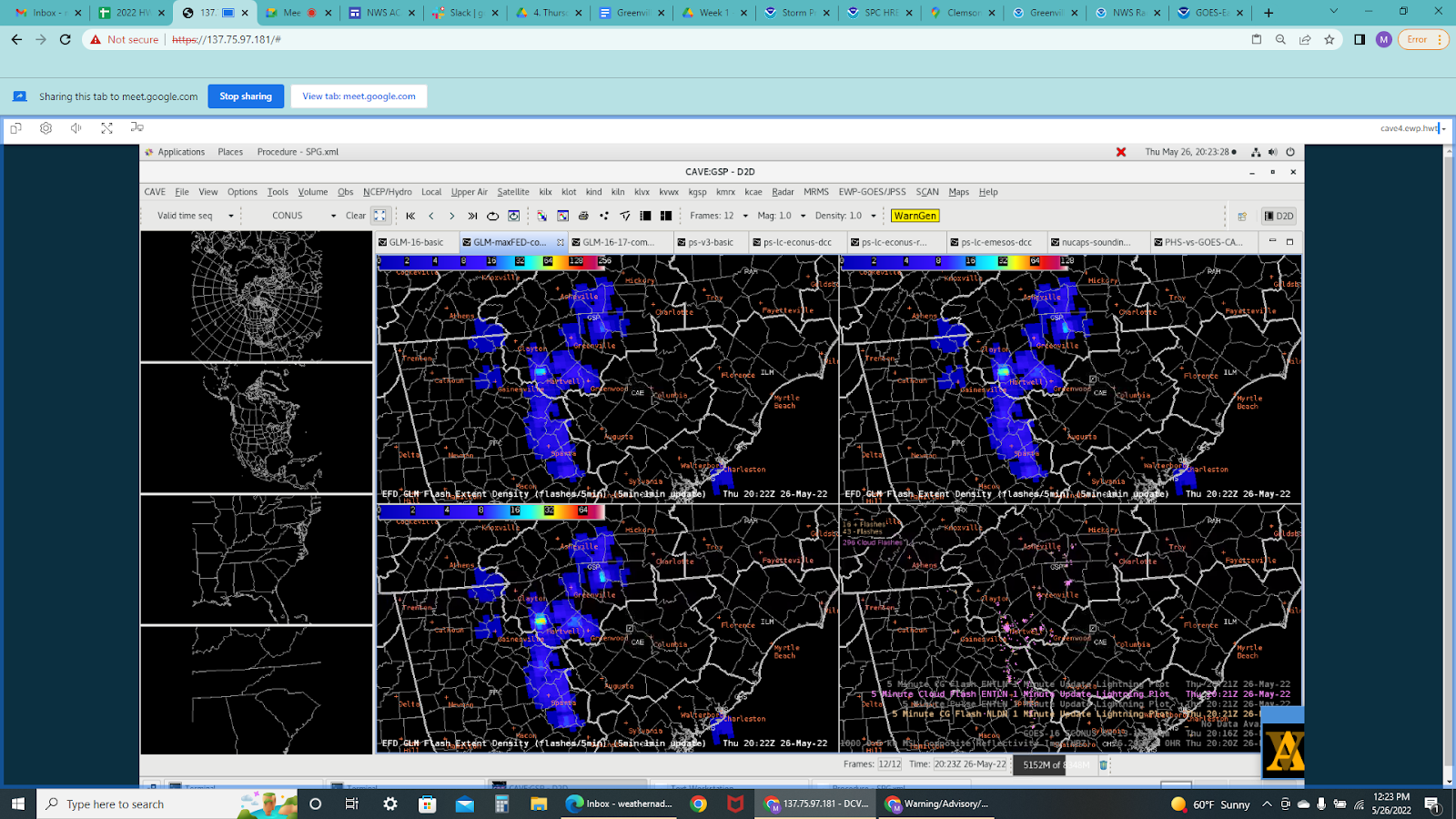
Lowering maxFED values effectively highlights the area of strongest thunderstorm activity as seen in this example. This makes the strongest two thunderstorms (circled) more distinguishable from other thunderstorms, especially on the northern circled thunderstorm. It should be noted that this may be even more effective during the initiation to nearing maturity stages. Once a storm reaches full maturity, FED signal may be much higher.

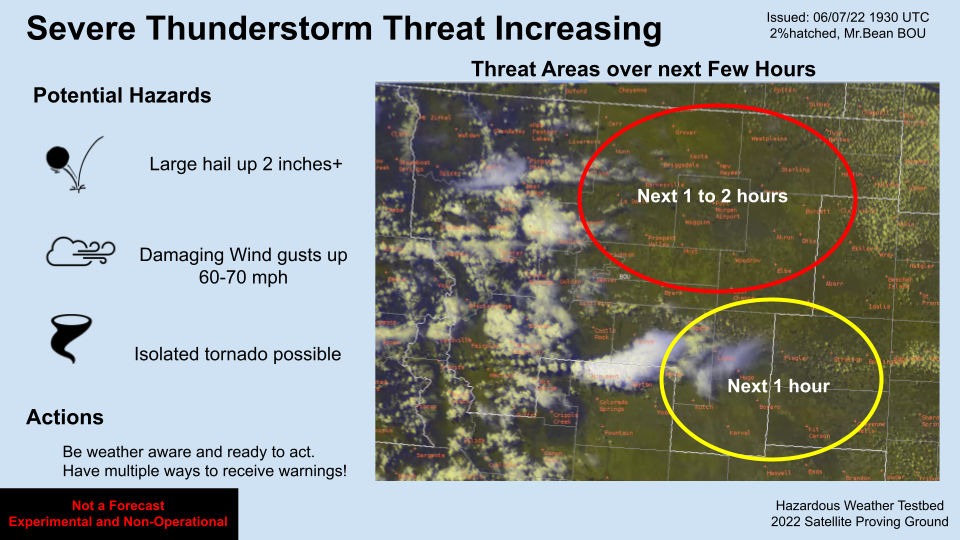
– 2%hatched

Two Storms GOES 16 v 17

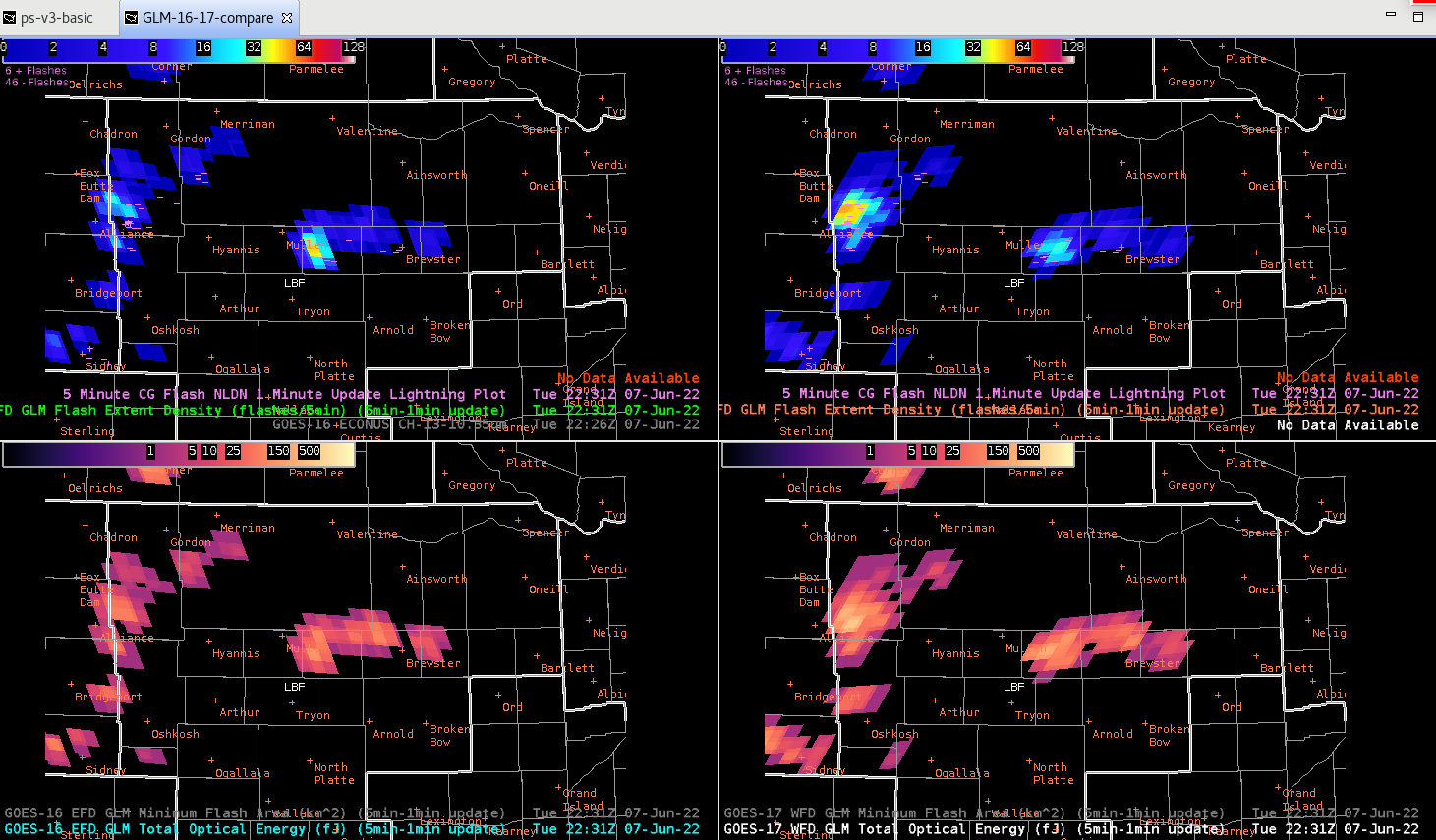
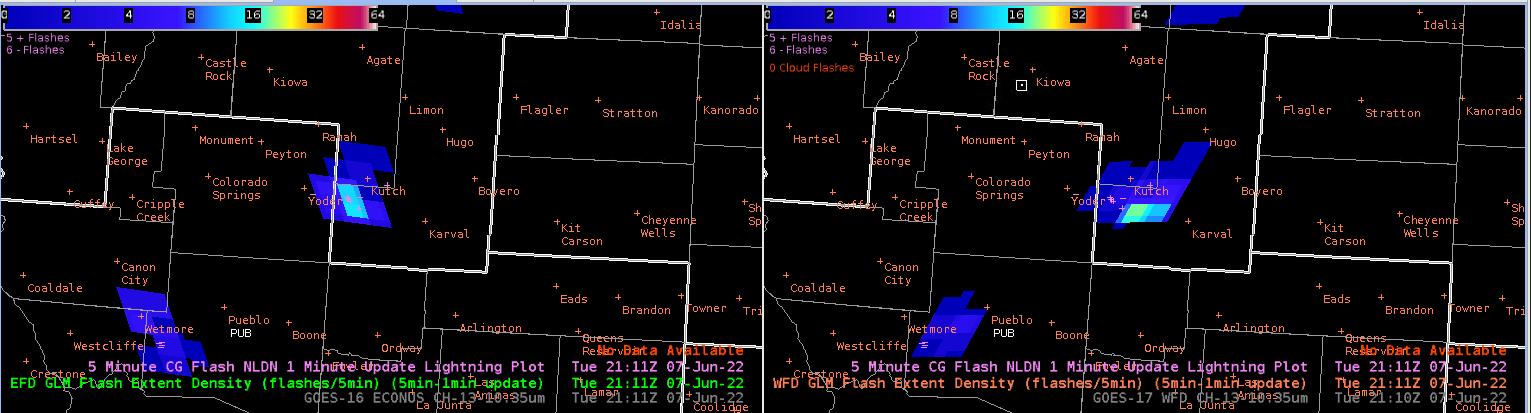
Being on the western edge in the North Platte County Warning area we did a comparison versus GOES 16 and 17 with the GLM Flash Extent Density. At first there wasn’t much of a difference, but when storms started to ramp up more and we had a decent eastern and western storm there was a difference.

As you can see our eastern storm shows up better on GOES 16 and not as good on GOES 17. Meanwhile the western storm there is a much greater difference in the Flash Extent Density (and Total Optical Energy) on GOES 17. This matches with what was stated at the initial discussion this morning that GOES 17 may work better with western storms.

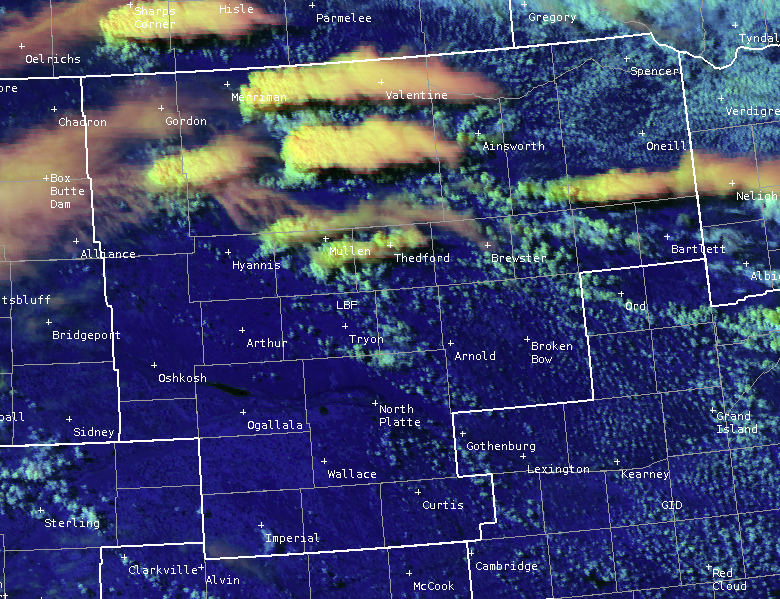
-Noctilucent

Northeast Colorado Supercells

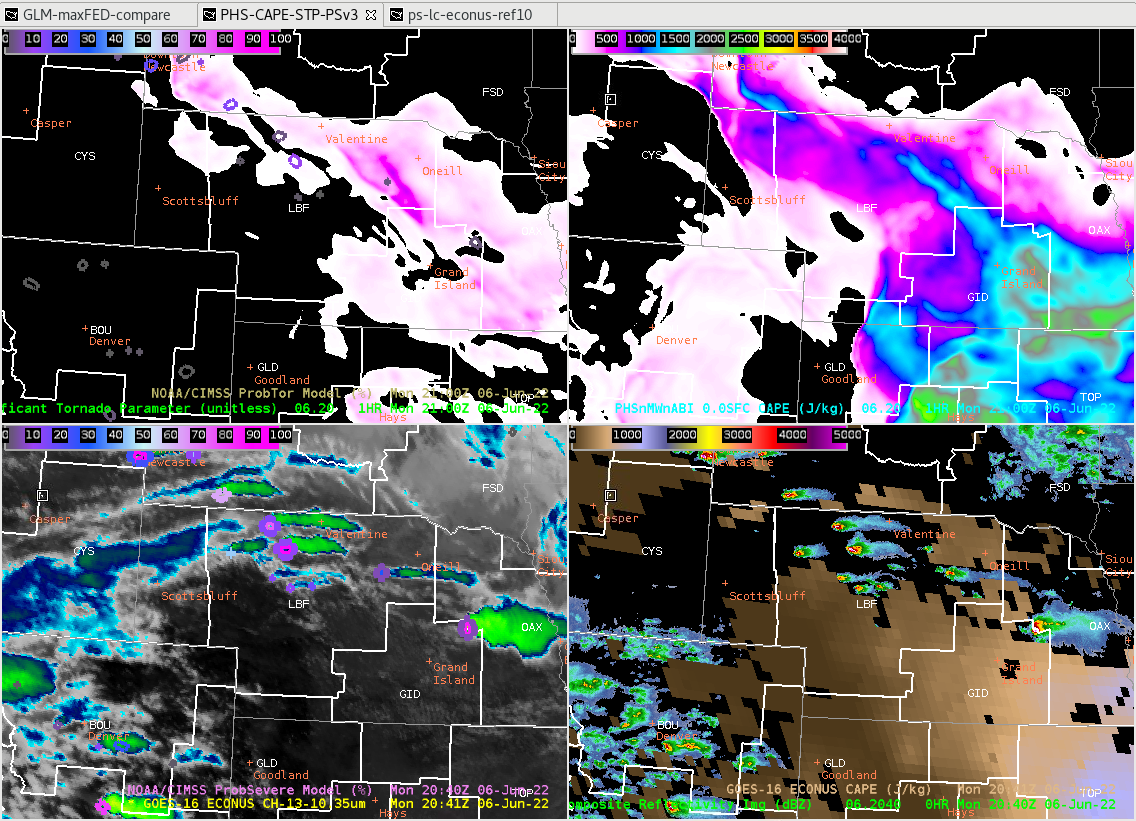
Nowcasting Supercell storm entering CWA: The loop of instability and SigTor highlight the southeast/south central CWA east of Colorado Spring, ahead of an already ongoing storm. North of this storm an environment of favorable instability exists up to about the latitude of Denver, with a significant drop off to the north.

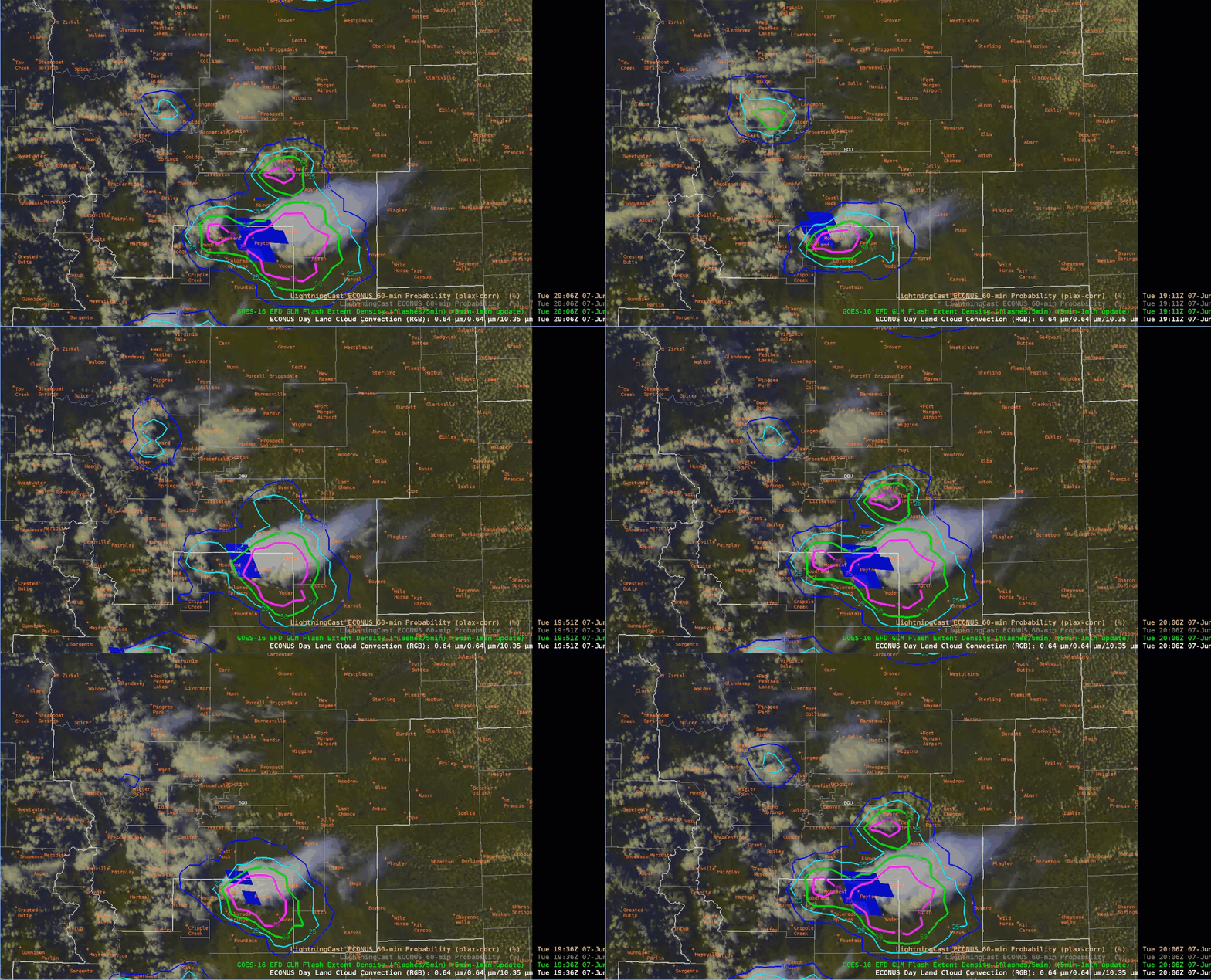
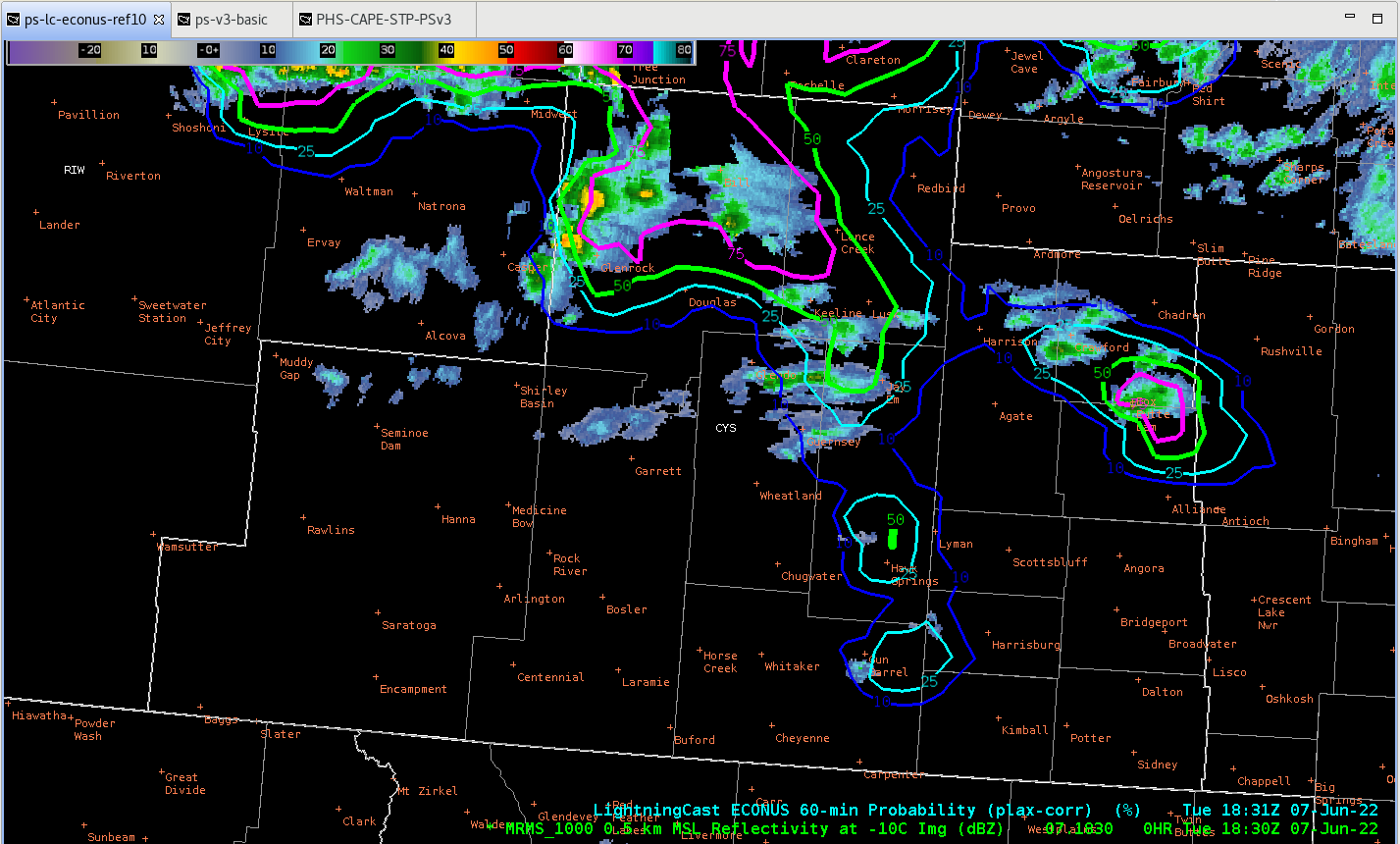
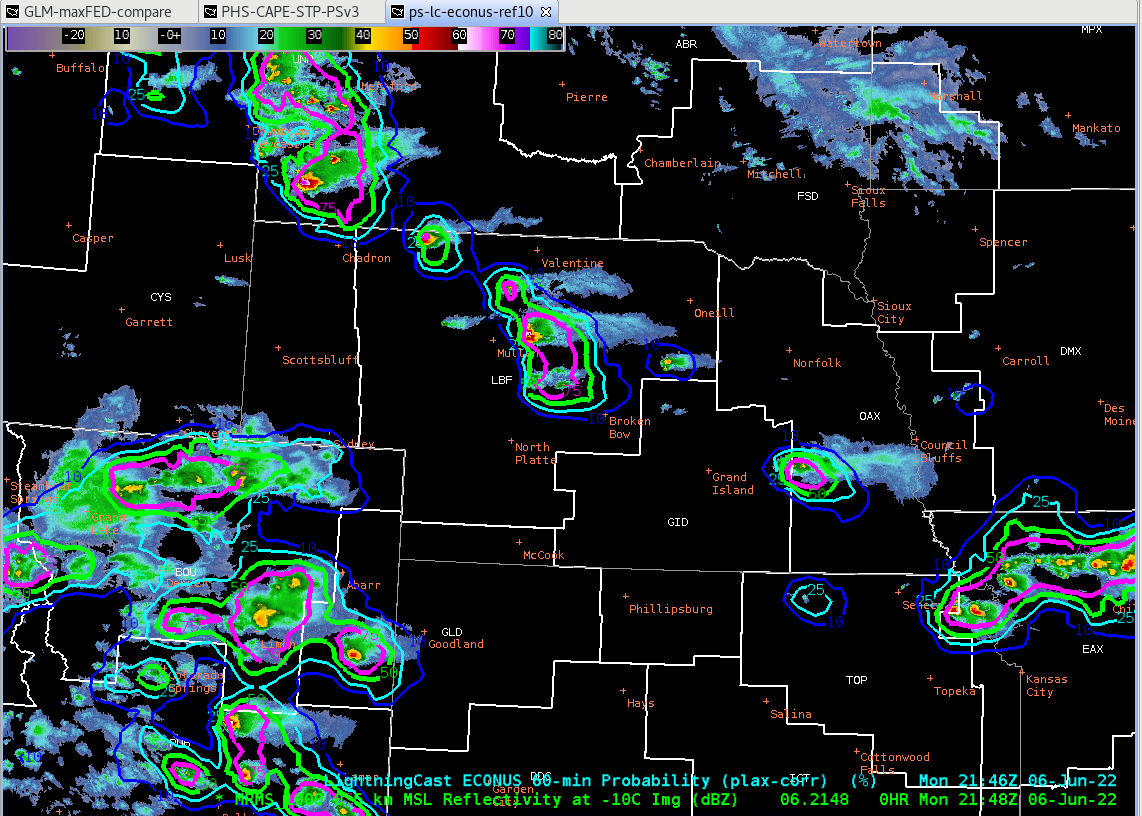
When it comes to high and northern plains – parallax becomes an issue. In this case lighting was occurring just on the other side of the border with the CWA, so here are the two LightningCasts (with/without parallax correction) for comparison:

ProbSevere v3 increases correlating to entering a favorable environment

PHI localized CAPE corridor

New area of MFA suggesting spitting storm with new updraft core of the established cell. (1950 UTC)

Storm cell split denoted by MFA with two distinct areas of MFA in upper right panel. (2000 UTC)

Focused on the cell east of Denver – this cell and subsequent others that developed are in the favorable area of instability. Just to the north of Boulder we spotted a few cells that attempted to develop, however in the lower instability environment movement off the higher terrain resulted in these cells falling apart. Through the rest of the afternoon this area remained convection free.

Sig Tor blip. A SRVE like feature was observed but at this time convergence associated with this feature wasn’t favorably located under the updraft.

Cell developing east of Denver, noted by the MFA  in the upper right panel. (2020 UTC)

Cell rapidly develops in an area of localized higher instability denoted by the PHS values discussed earlier on.(2034 UTC)

The LightningCast has identified the left turning nature of the storm(s) east of Denver

An interesting note was comparing the differences between GOES East (left panel) and GOES West (right panel). These subtle differences can  be effective in analyzing the strengthening of a thunderstorm.

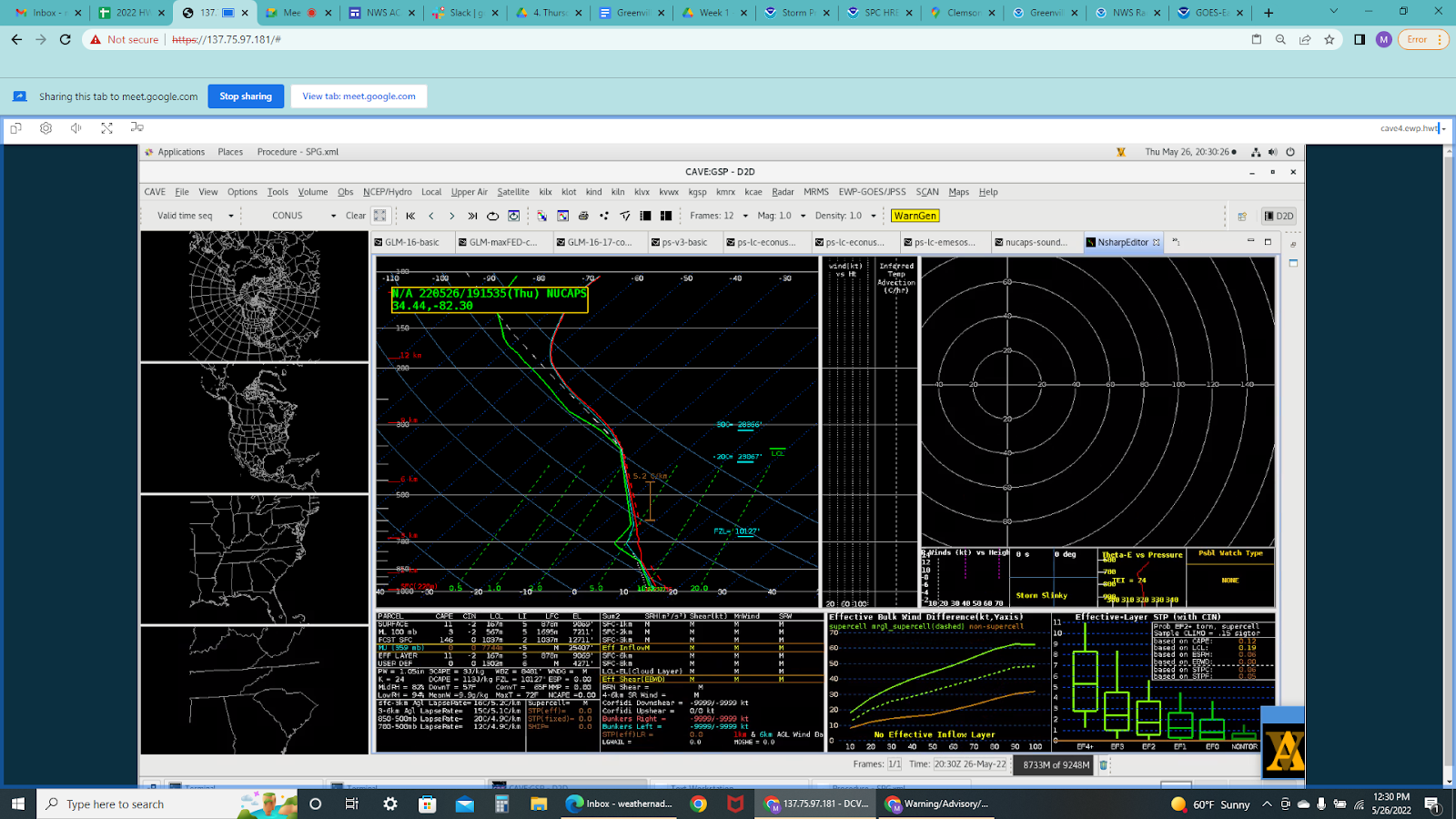
In the middle of METWATCH – NUCAPS became available (about 1 hour latency). The sounding below is a modified NUCAPS profile, depicting the environment in which our storms developed. Storm mode was supercellular with frequent spitting of cells.

-Mr. Bean

-2%hatched

CYS HWT BLOG Day 2

LightningCast for storm approaching Scottsbluff

First instance of 50% contour 1831 Z
The lightning cast did build before backing off for a few frames, dropping below 50%, but jumps back up above at 1851 Z. From then until the first flashes of lightning, the probabilities continued to increase.
First instance of 75% contour 1906 Z
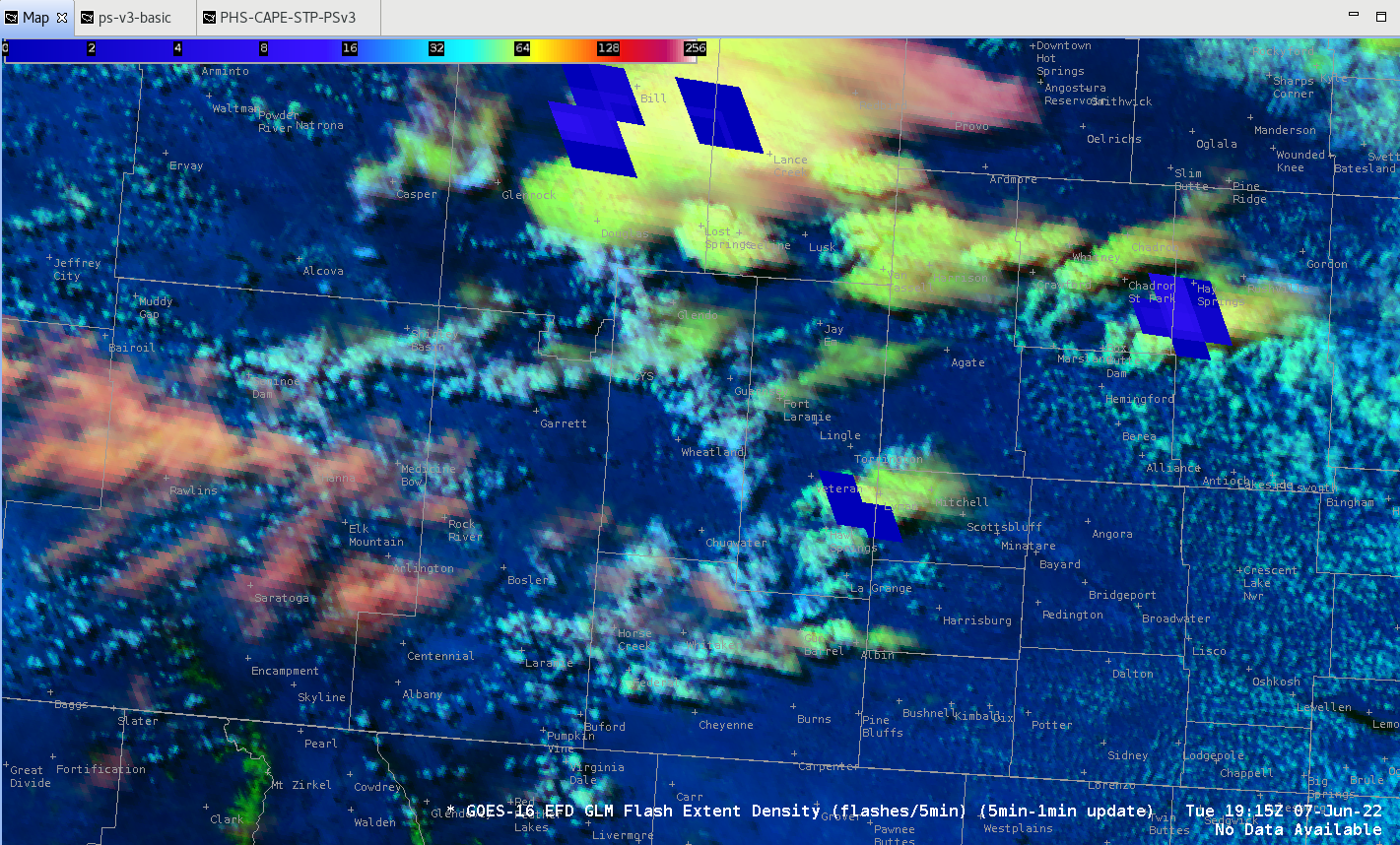
GLM denotes flash 1915 Z
So, lightningcast was able to indicate well ahead of time that we needed to keep an eye on that storm for lightning production as it approached the city.

GraphiCasts with ProbSevere and PHS

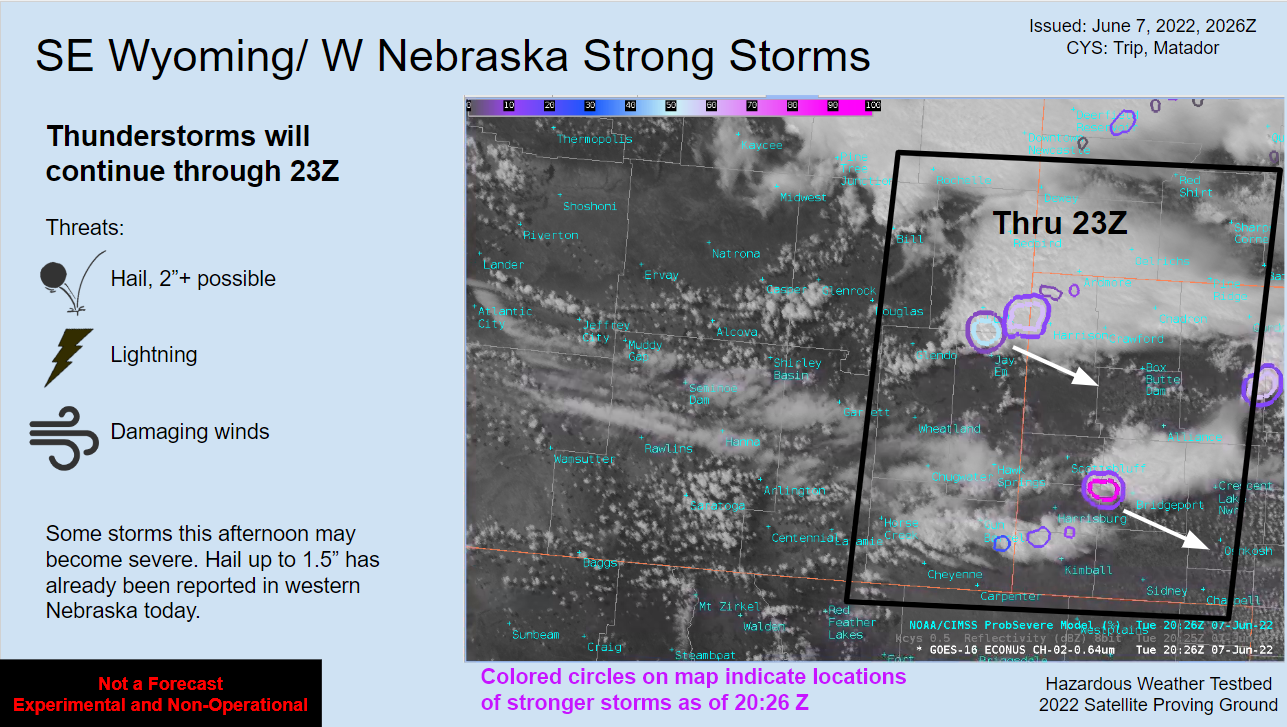
For today’s GraphiCast, decided to overlay ProbSevere V3 over visible satellite data to indicate the location of the stronger storms amongst all the clouds. The concern with using it for public graphics is whether the public will understand it. Went with a brief description that it indicates stronger storms for today, but would be curious to see how others message what probsevere means and then how the public may respond to it. I do like how it clearly shows the cells to watch out for.
To determine the time that storms would continue through, I only used the hourly PHS data which dropped off at 23Z. The images below show 20Z PHS vs 23Z. This timing for storms ending for the CYS CWA worked out well as the strong to severe storms exited the CWA by 2256Z with only a few isolated showers remaining for a short time afterwards.
20Z:
23Z: 
– Matador

GLM – GOES-16 vs GOES-17

Differences between the GLM Flash Extent Density products from GOES-16 and GOES-17 were quite stark for convection occurring over the Cheyenne, WY CWA on June 7th.

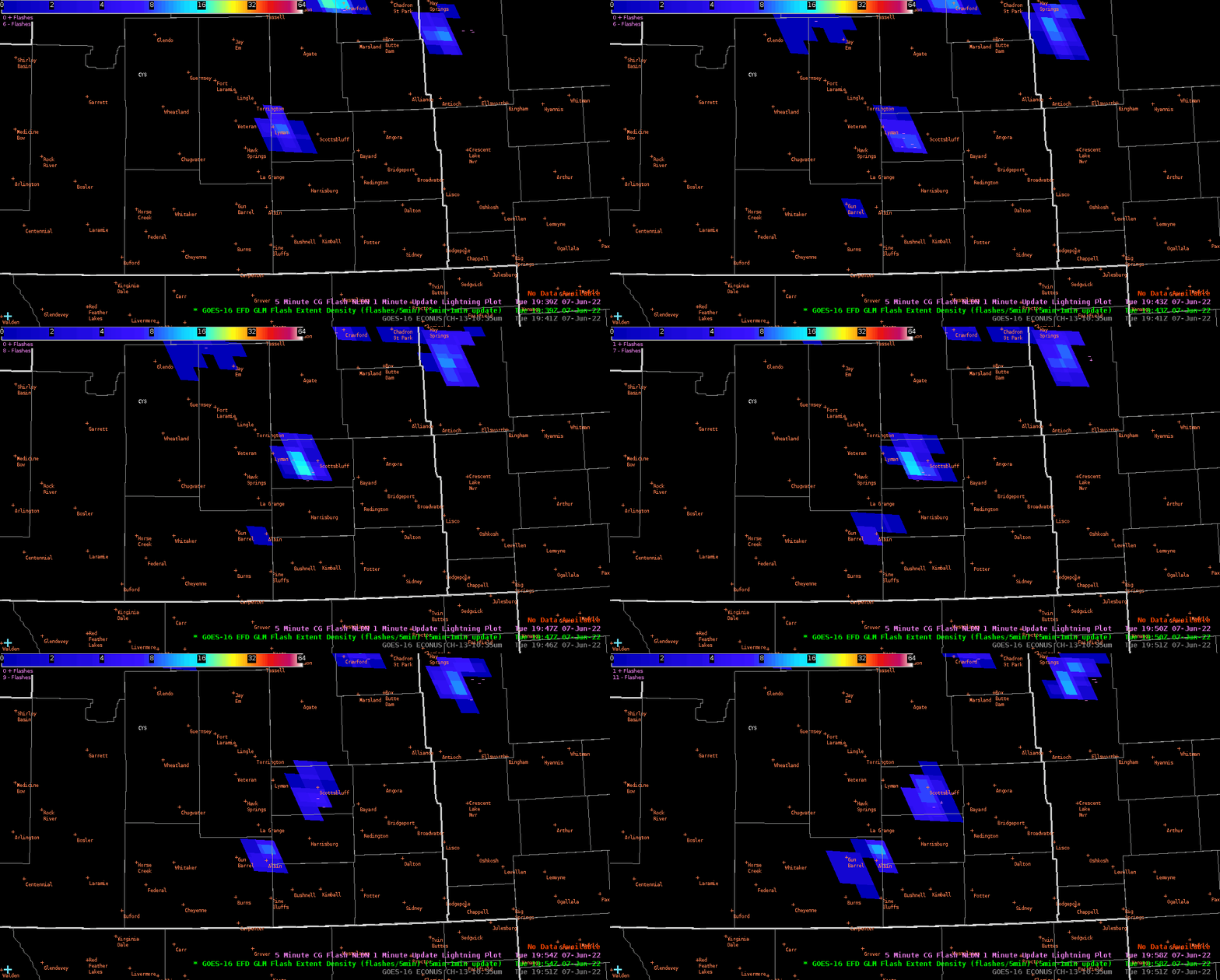
The two animated gifs below highlight the difference in lead times for an observed uptick in lightning activity within a cell near Scottsbluff, NE. The first animation is of GOES-17 showing the uptick in lightning activity beginning at 1939Z. The second animation from GOES-16 shows the same uptick in lightning activity, except beginning ~5mins later at 1945Z. Interestingly enough, both satellite perspectives show the downtrend in lightning activity occurring at 1950Z.

GOES-17 GLM FED Scottsbluff 5-min improved lead time.

GOES-16 GLM FED Scottsbluff

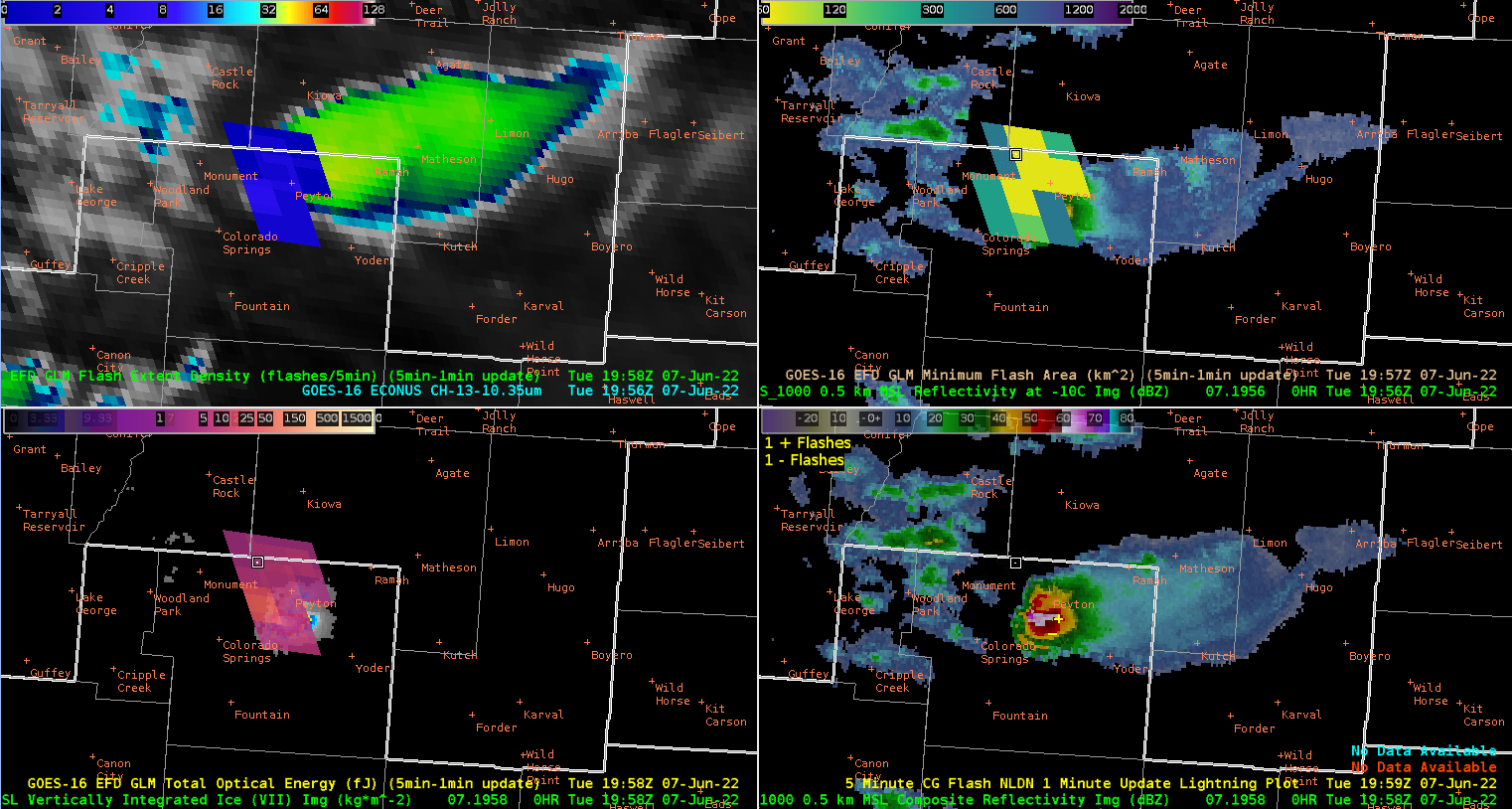
The next three examples show sharp contrasting GLM FED intensities between GOES-17 and GOES-16 through the afternoon of June 7th. This first example focuses on a warned supercell just southeast of Scottsbluff, NE at 2022Z. The first image shows FED from GOES-17 showing much higher FED numbers, while the second image shows FED from GOES-16 not indicating any increased lightning activity. The third image shows a 4-panel layout of MRMS, MESH, VIL, and ProbSevere version 3 all supporting a supercell occurring. A subsequent report of 1.5” hail was observed from this warned storm.

The cause of this was shared from the investigators running the HWT this week, that GOES-17 had the better angle to see lightning activity in these supercells developing over the high plains of WY and NE. Whereas GOES-16’s perspective from further east had to punch through spreading anvils downstream of the main updraft that likely obscured the light emanating from the lightning, GOES-17 had a more side-on view of the updraft with less to no obscurations of light emanating from lightning occurring in the updraft. Unfortunately, GOES-17 CONUS view and the day’s mesosector from GOES-17 did not reach this far east and there are no satellite images displaying the different parallax views from GOES-16 and GOES-17.

GOES 17 GLM FED @ 2022Z “Scottsbluff Cell”

GOES 16 GLM FED @ 2022Z

MRMS – MESH – VIL – PROBSEVEREv3 @ 2022Z

1.5” hail report from this storm. Max MESH reached 2”.

The next two examples below each showcase three images each, a GOES-17 FED showing higher intensity lightning activity, a GOES-16 FED missing the higher intensity lightning activity, and a 4-panel layout showing MRMS, MESH, VIL, and ProbSevere version 3 highlighting the severe nature of the supercell.

An interesting follow-up to this in the future is to see how these two satellite GLM FED products compare in a low-storm motion environment where the spreading anvils at storm top flow in all directions. This could cause both satellites to have an obscured view of the convective updraft beneath, causing both to miss out on any increased lightning activity.

GOES-17 GLM FED @ 2016Z “Lance Creek Cell”

GOES-16 GLM FED @ 2016Z “Lance Creek Cell”

MRMS – MESH – VIL – PROBSEVEREv3 @ 2016Z

GOES-17 GLM FED @ 2026Z “Scottsbluff Cell”

GOES-16 GLM FED @ 2026Z “Scottsbluff Cell”

MRMS – MESH – VIL – PROBSEVEREv3 @ 2026Z “Scottsbluff Cell”

– Trip

ProbSevere v3 and NUCAPS

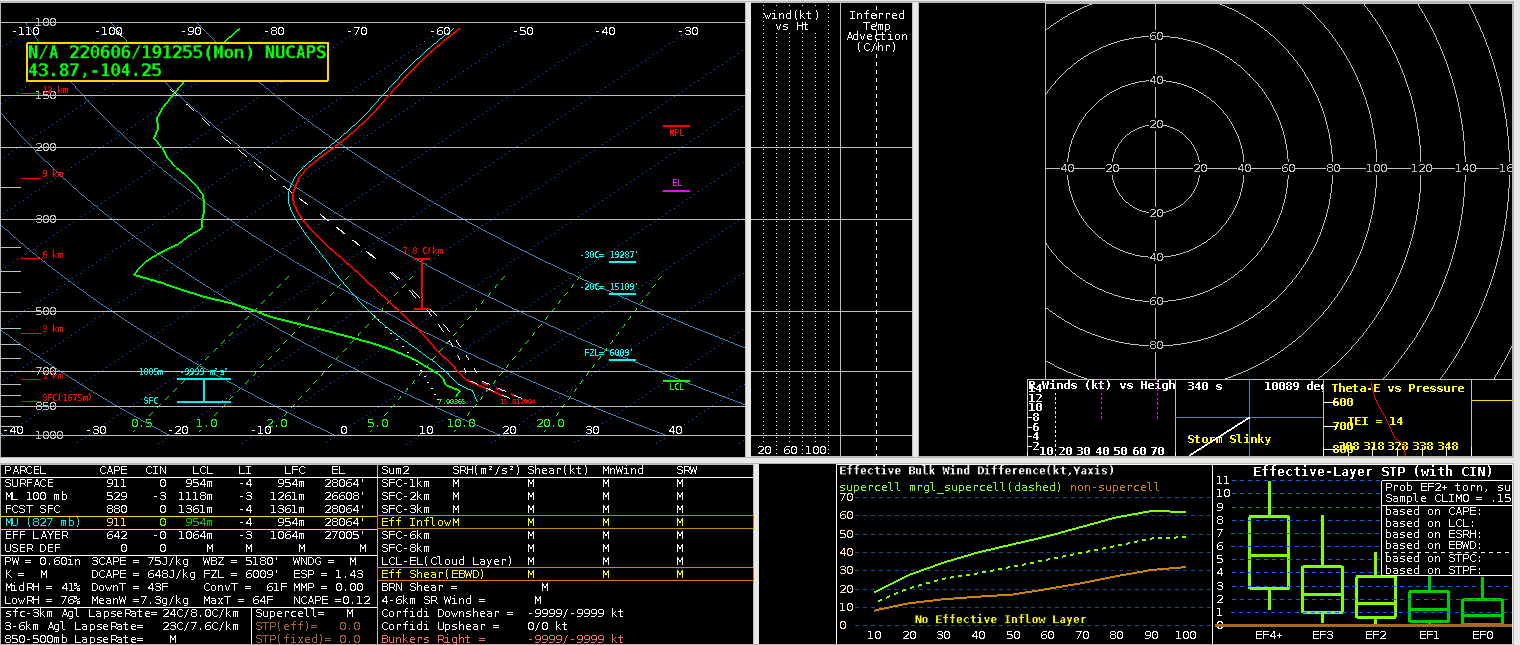
When analyzing a thunderstorm developing over western South Dakota, a noticeable jump occurs near 20:25 – 20:30 UTC as seen on the ProbSevere Time Series. At this same time, there was a distinct uptick in lightning activity seen in the GLM 4 panel. This would correlate with a strengthening of the thunderstorm at this time. A modified NUCAPS sounding from around this time captured an environment favorable for further strengthening encompassed by steep mid level lapse rates and adequate instability. This thunderstorm was beginning to exhibit severe hail potential.

ProbSevere Time Series

GLM-16 4 panel

Modified NUCAPs sounding ~20 UTC

-2%hatched

LBF Day 1 HWT Blog

Day 1

Acting as LBF
This image was used in a graphicast to which we then added areas of concern over the next several hours and storm direction.

PHS, ProbSevere

Enjoyed using PHS, especially getting the heads up at the beginning of today’s session to watch along the value gradients for stronger storms. That tip fit the bill for what we were seeing today and higher prob severe seemed to follow the gradient as well. I have not had much practice with version 2 of probsevere, so I cannot not really compare it to version 3. However, I did find version 3 useful today, especially with all the readout information breaking down the threat level for each type of severe hazard as well as mesh values.
2041 UTC
2141 UTC

LightningCast

From an IDSS standpoint, the Lightningcast is nice to use to give a heads up and see trends in lightning.
For GLM, I really liked decreasing the max value. Seems to work well in these smaller cells to highlight which cells to watch for.
– Matador

GLM and Minimum Flash Area

Lightning energy during the HWT was introduced in several different ways. Three of these were:


  1. Flash Extent Density
  2. Minimum Flash Area
  3. Total Optical Energy


For monitoring severe thunderstorms, Flash Extent Density seemed to be the most useful of the three.

However, all of the GLM products were what we focused on.

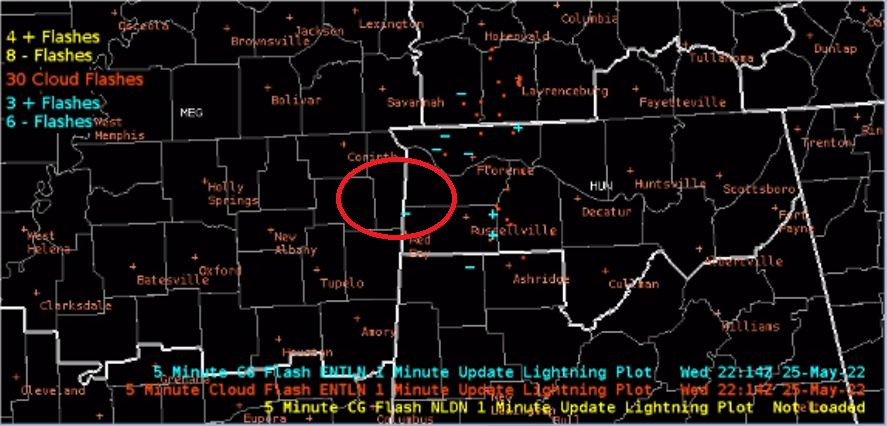
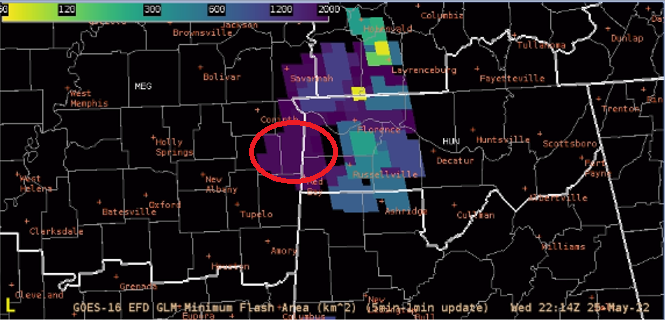
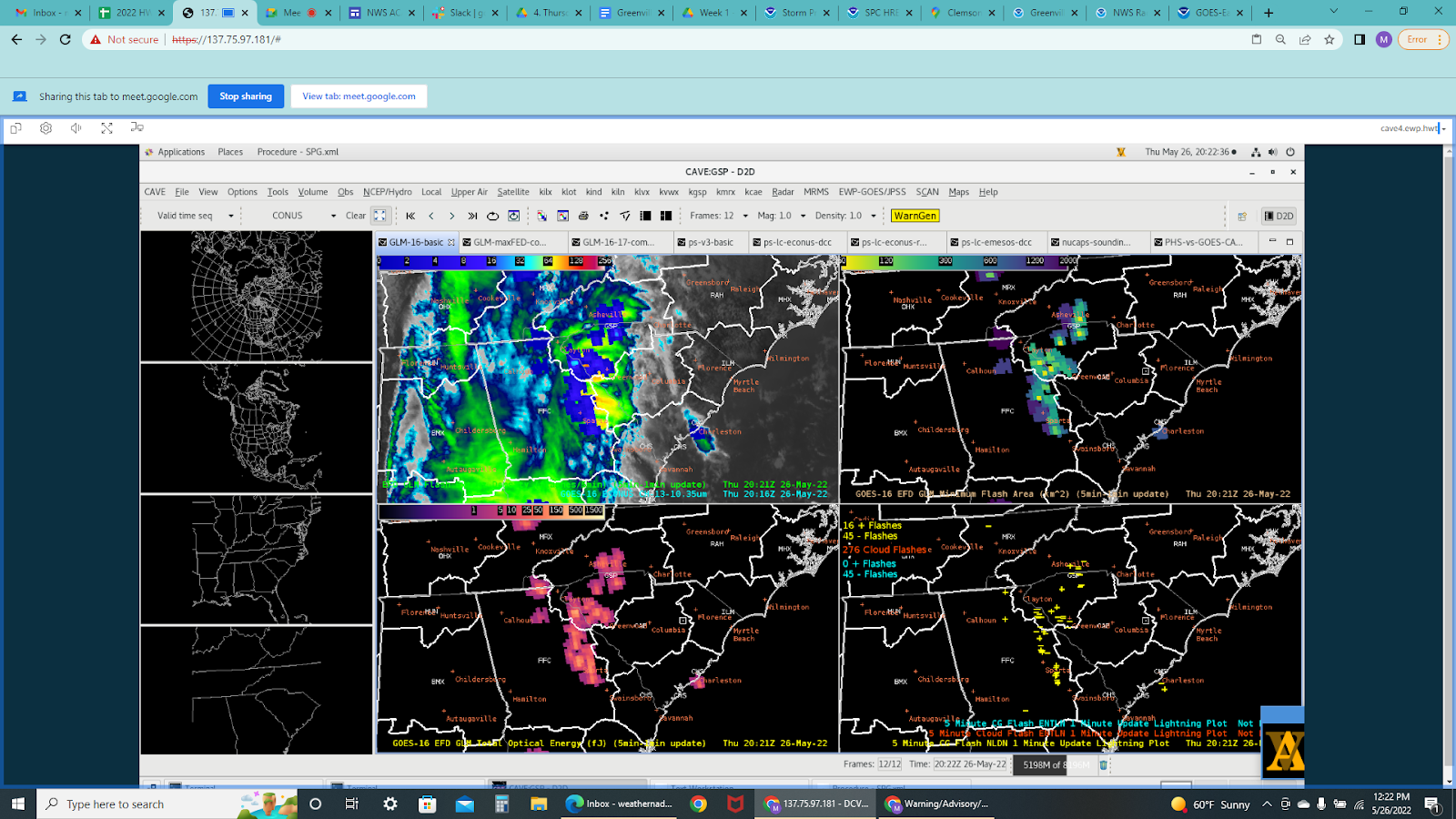
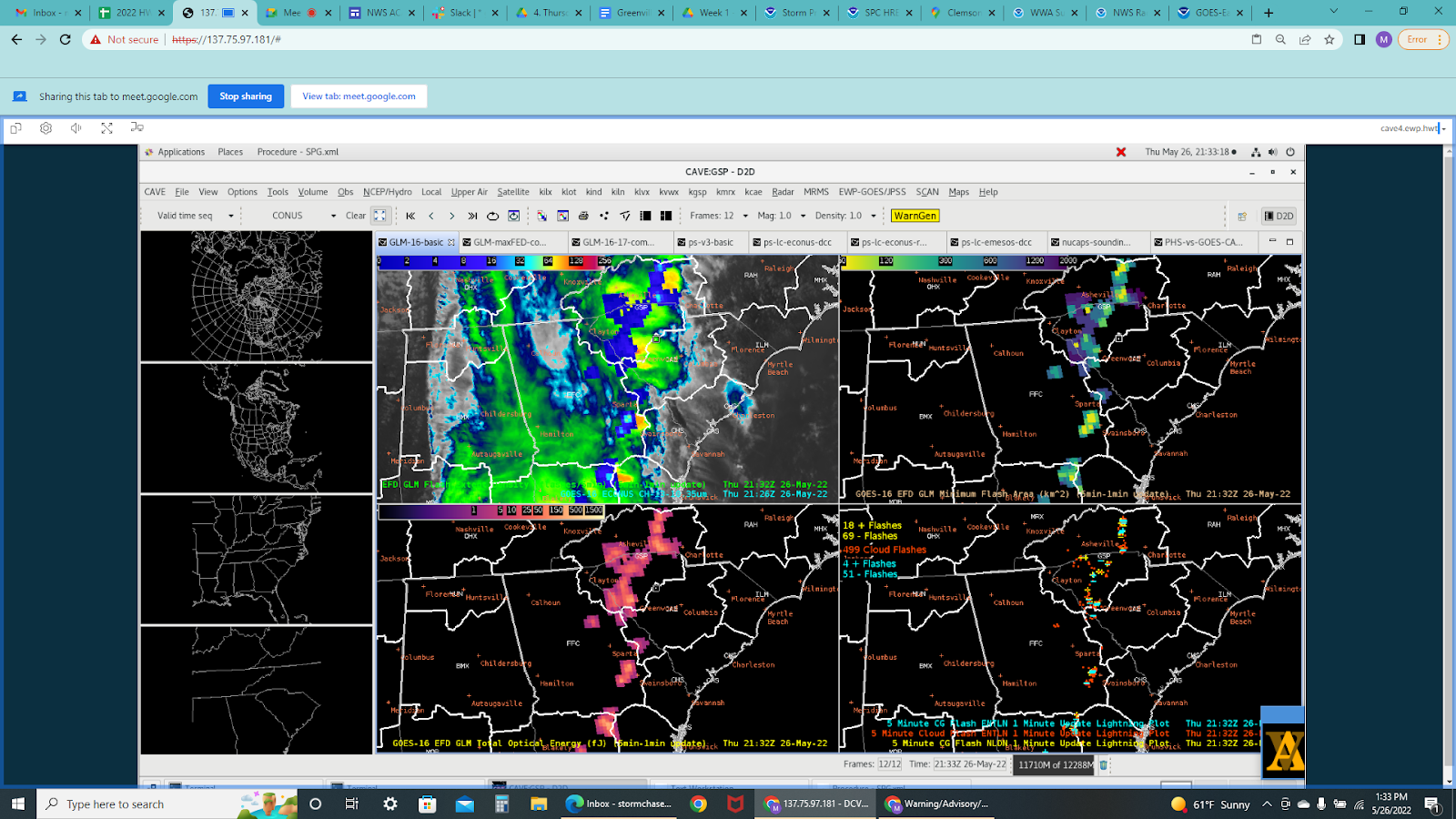
In order to obtain GLM lightning data on the grid or map, you had to obtain a Minimum Flash Area. It was interesting in the stratiform type storms that a wide area was displayed compared to the small area where the flash took place. In this case it was one cloud-to-ground lightning strike (CG).

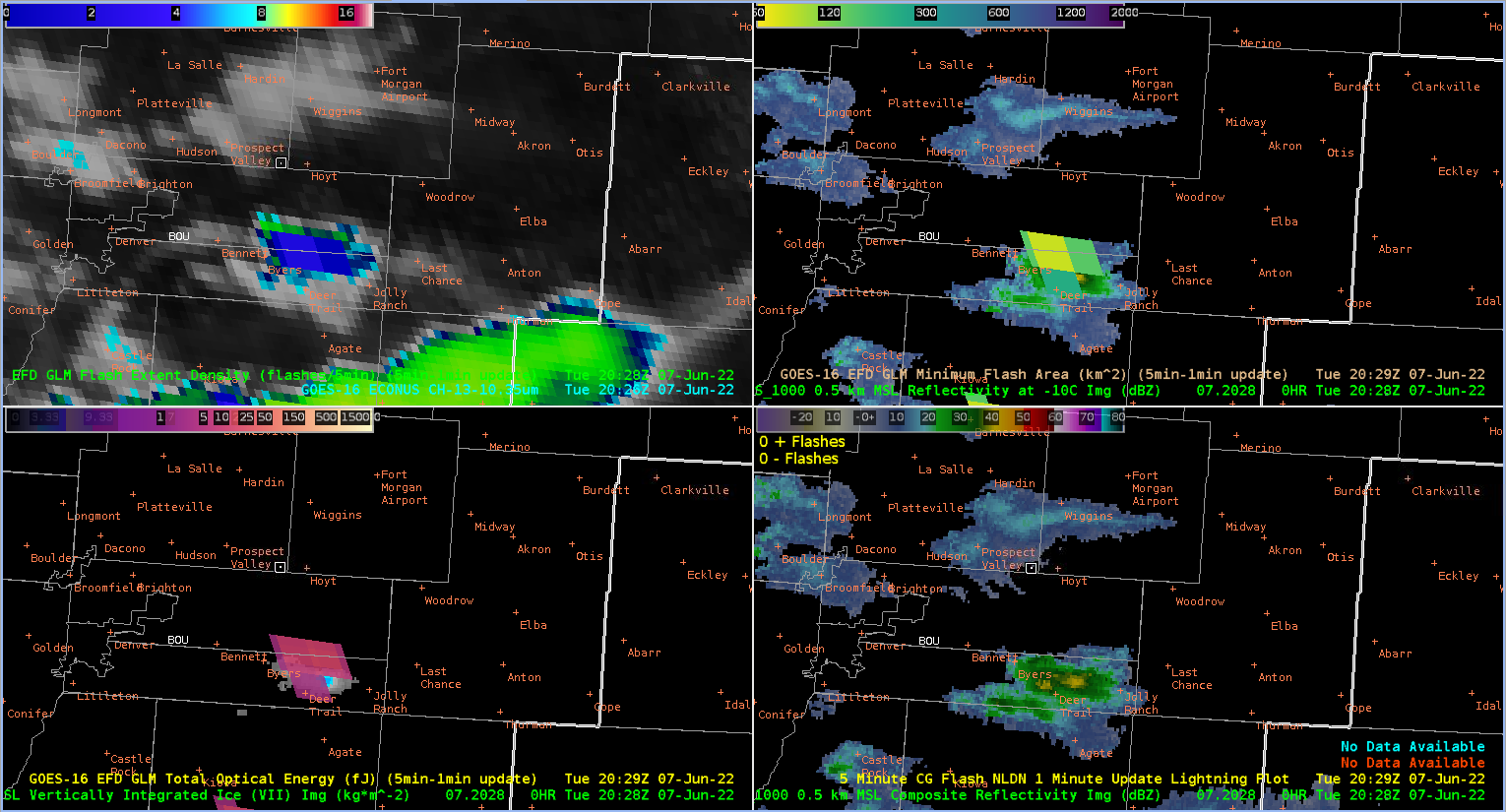
This image is from the Bottom-Right panel (CG and Cloud Flashes):

This is the top-right panel (Minimum Flash Area):

This shows that one CG Flash can plot a large area on the Minimum Flash Area product. It seemed that this was necessary for other products to plot, such as the Flash Extent Density, but it may be a little bit of a distraction for the operational forecaster as it would seem to flash a bit (on and off if looping it) and for a much larger area than what was shown compared to the cloud Flash and CG plots.

– WeatherTed

Greenville SC Observations

Synopsis: A deep upper low tracked slowly northeastward across Missouri today. The main cold front associated with this low moved across the Greenville, SC region. Along and ahead of the front, widespread showers and thunderstorms continued over western South Carolina for most of the afternoon and evening hours.

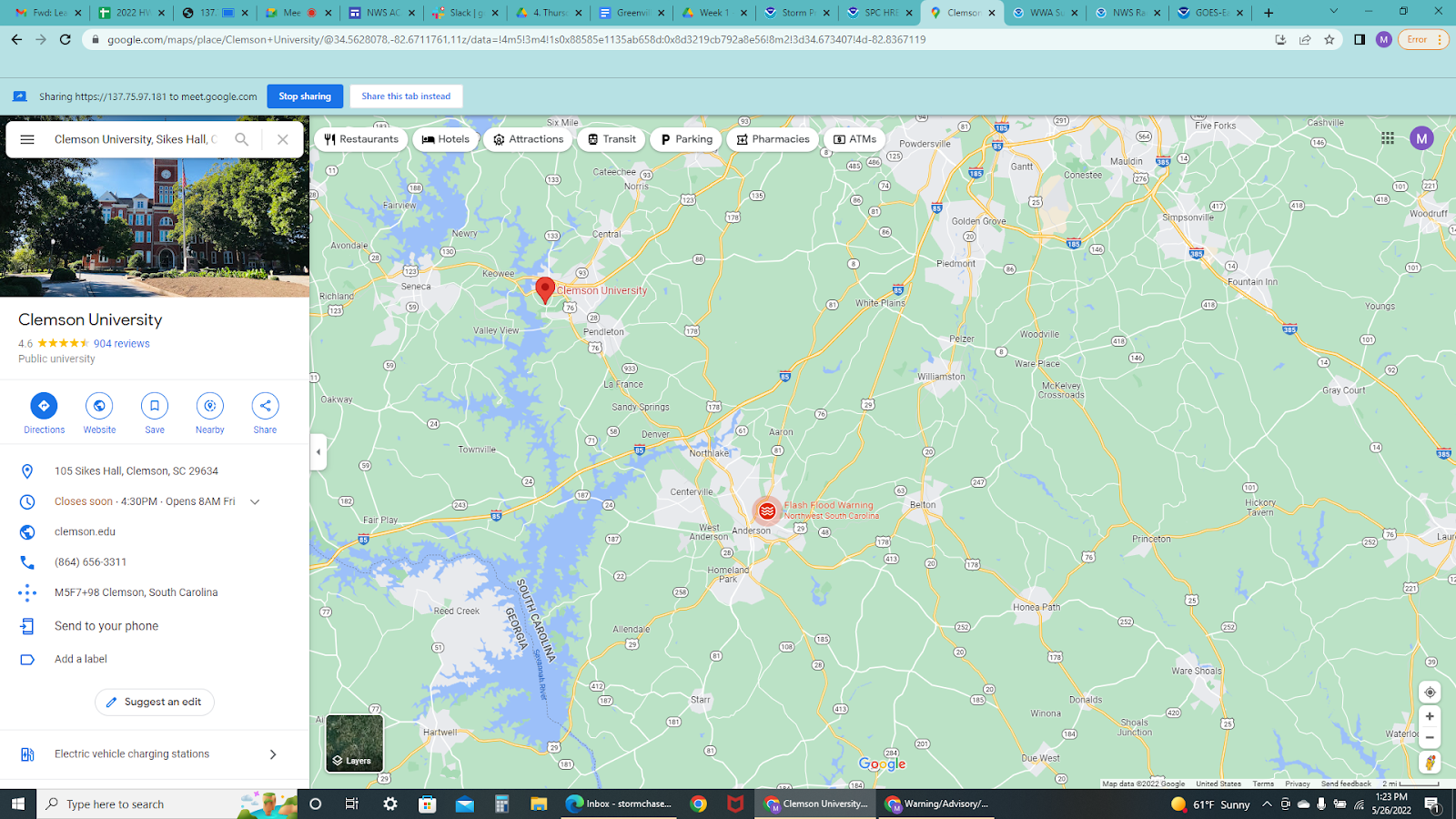
Our DSS messaging was for Softball Tournament Games located at Clemson University.

SPC Convective Outlook: Slight risk of thunderstorms over extreme northwestern SC, with marginal risk elsewhere.

Primary threat was wind flash flooding and wind with a chance of hail and a possible tornado.

Scattered showers and thunderstorms tracking northward across the forecast area.

IR imagery overlaid with lightning data.

Greenville ACARS sounding taken in 1910Z.

NUCAPS Sounding nearby Greenville.

Another NUCAPS Sounding nearby Greenville.

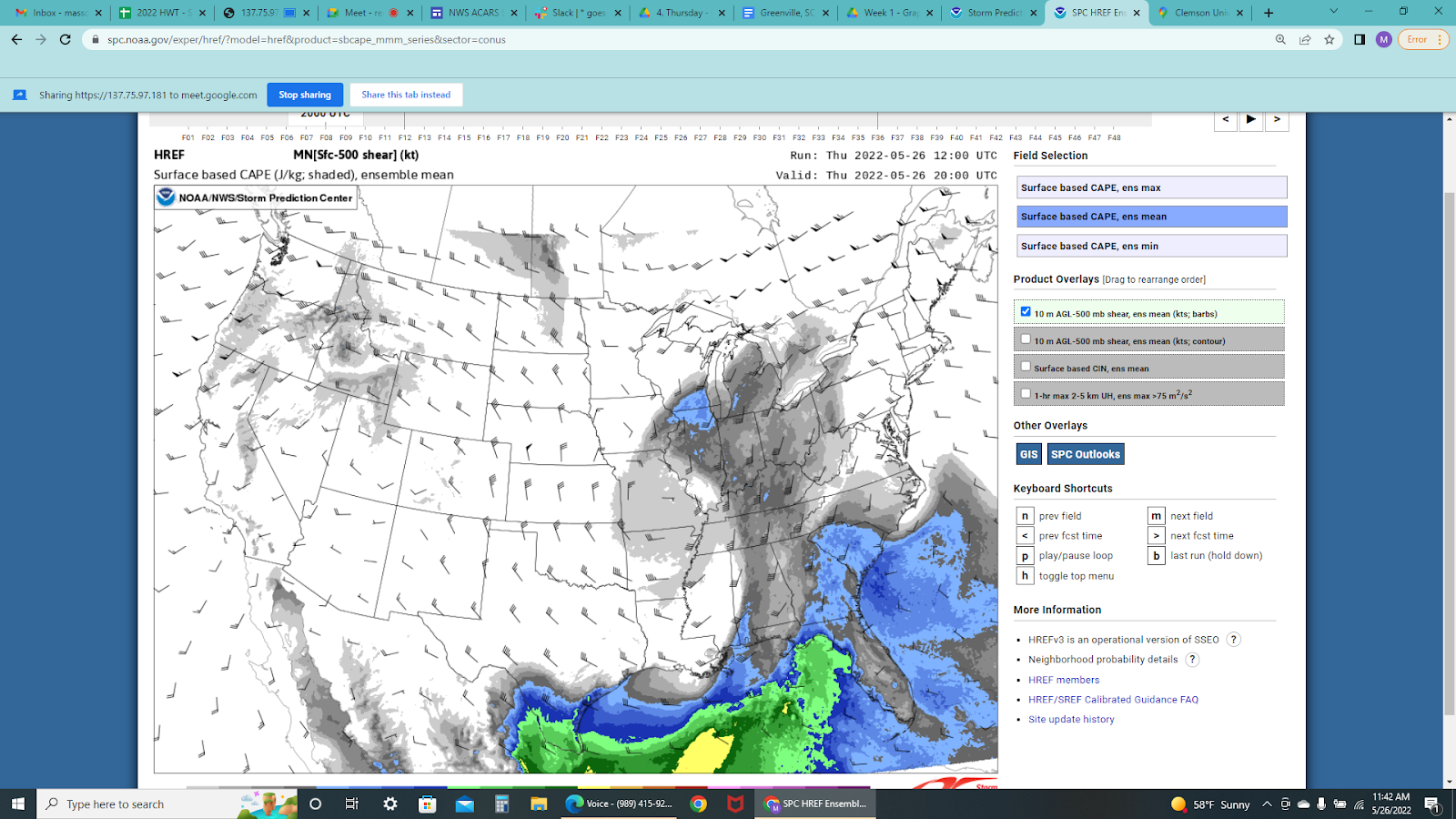
Mesoanalysis – Surface CAPE values ranging from 500 to 1,000 J/kg.

PHS showing similar instability parameters.

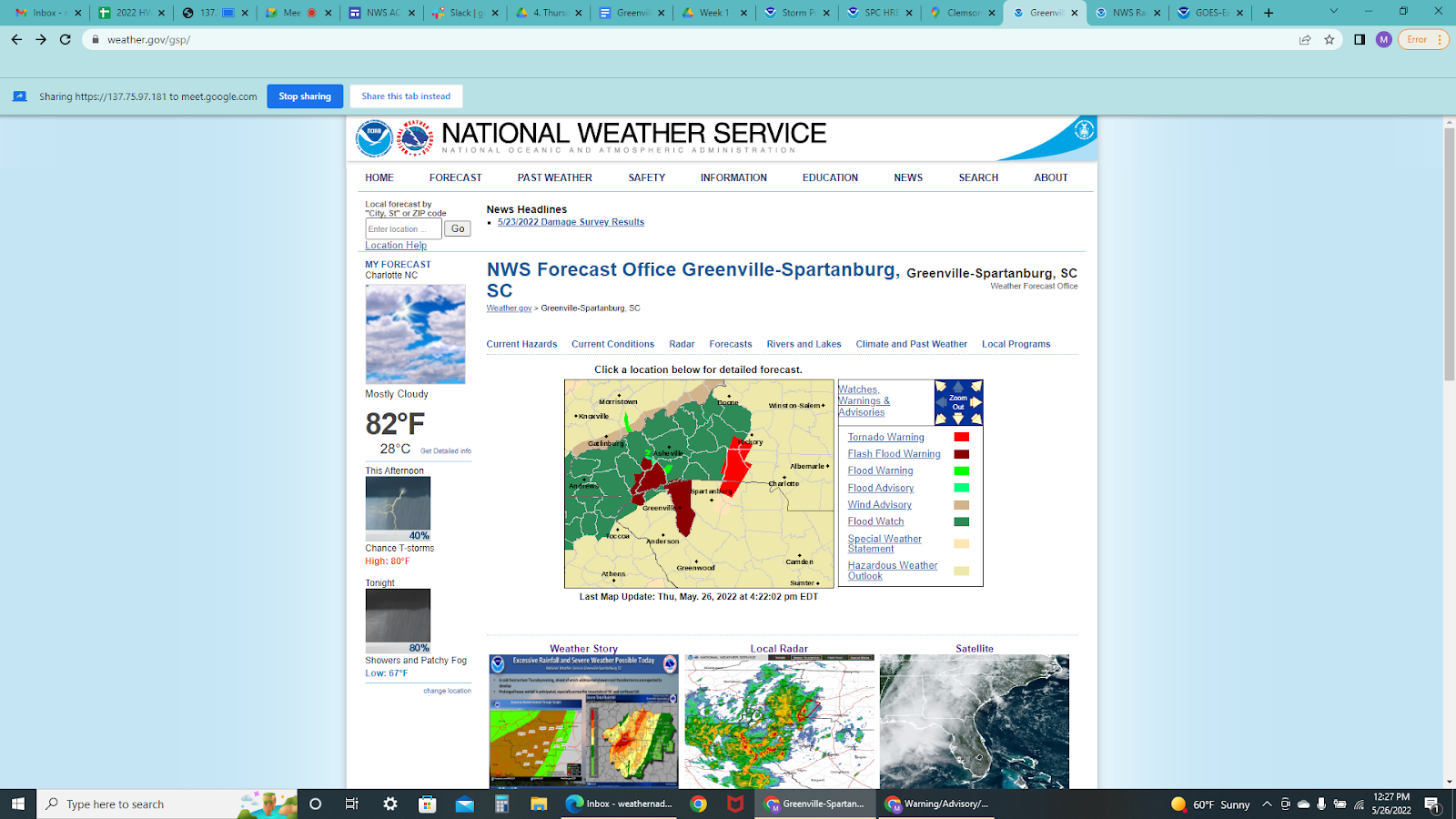
Watches/Warnings products issued throughout the day by WFO Greenville.

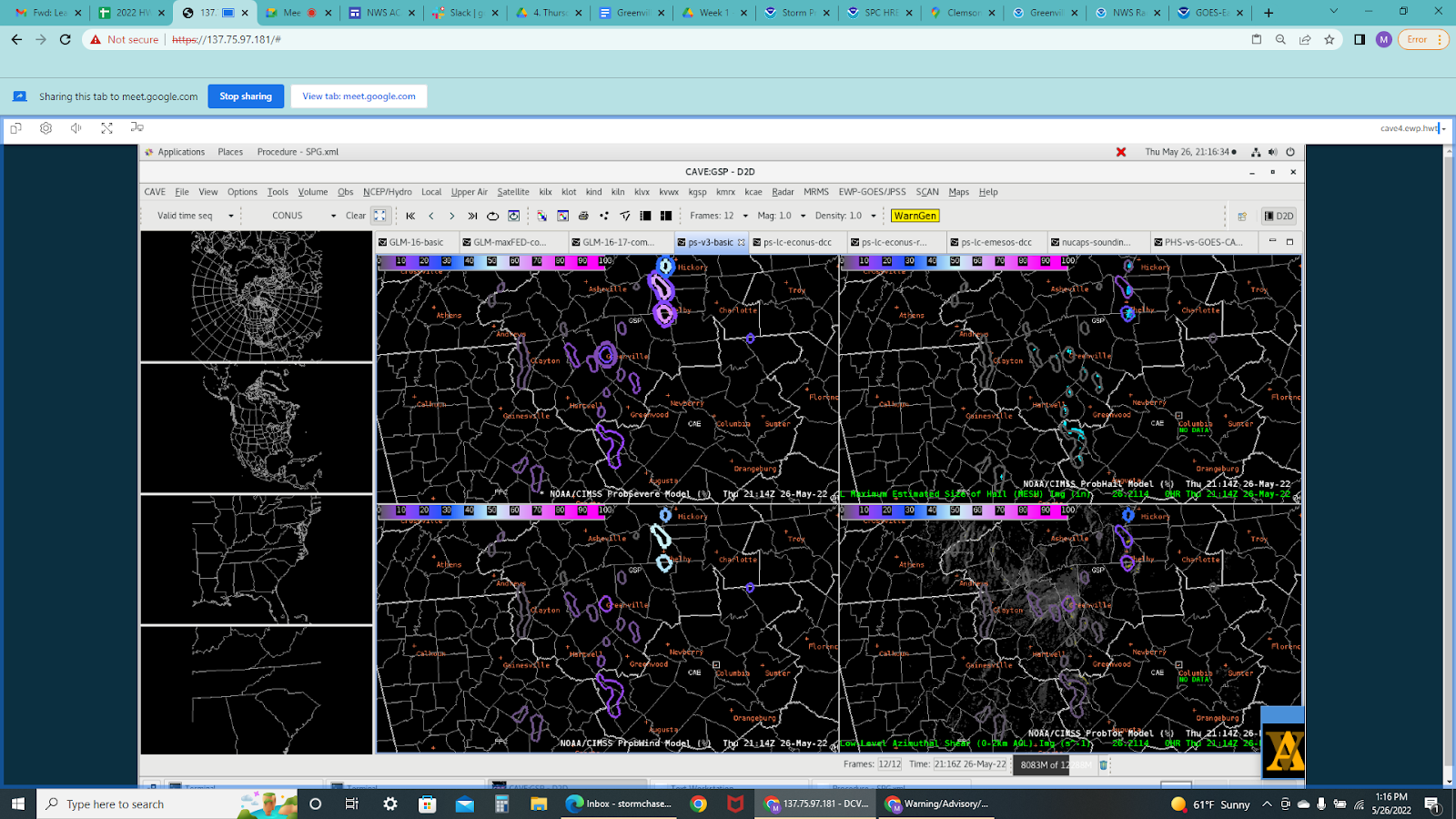
ProbSevere3: Low probability of severe weather, but sufficient enough for storm warning operations and convective maintenance situational awareness.

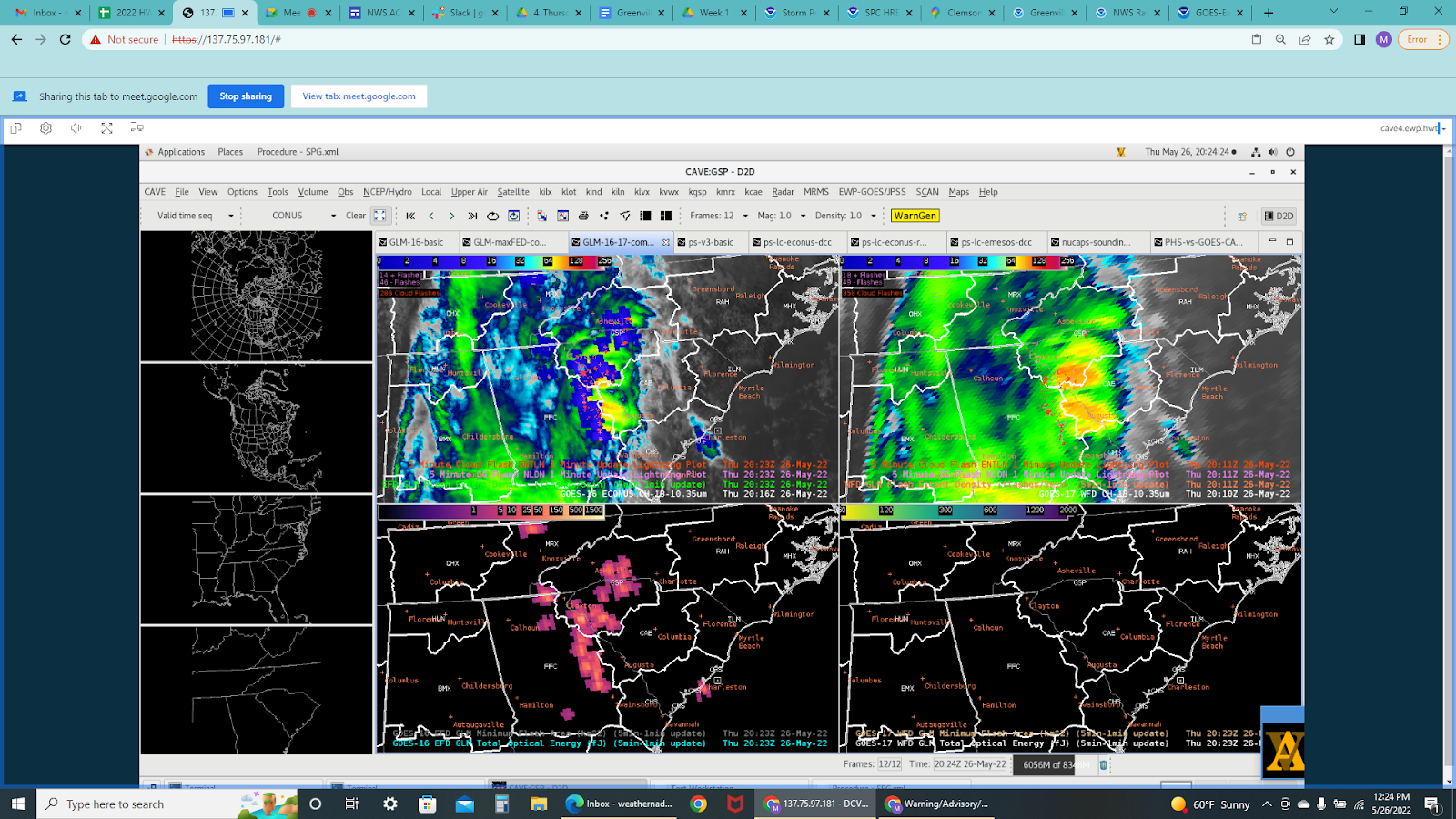
GLM Basic – Helped with operations as well as DSS.

GLM

GLM

Lightning Cast overlaid with satellite was helpful for enough lead time and confidence.

Lightning Cast overlaid with radar.

Lightning Cast overlaid with satellite.

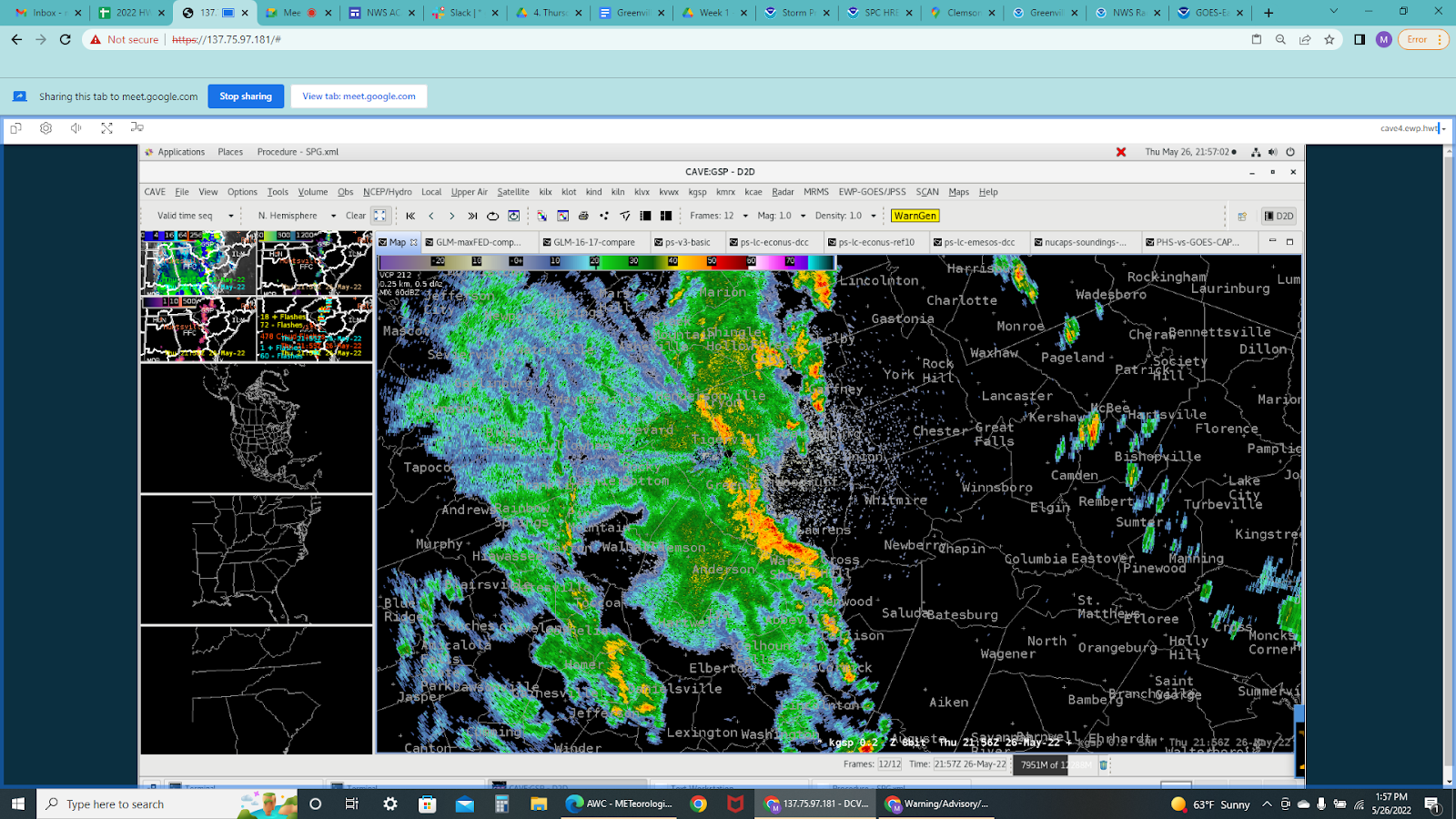
Radar overlaid with Polygon Warnings issued throughout the day.

DSS update: A Flash Flood Warning was issued for Northwest South Carolina near Anderson county and remained in effect until 9:00 PM EDT.

Latest update on ProbSevere3 and tracking any nearby storms.

Latest update on GLM.

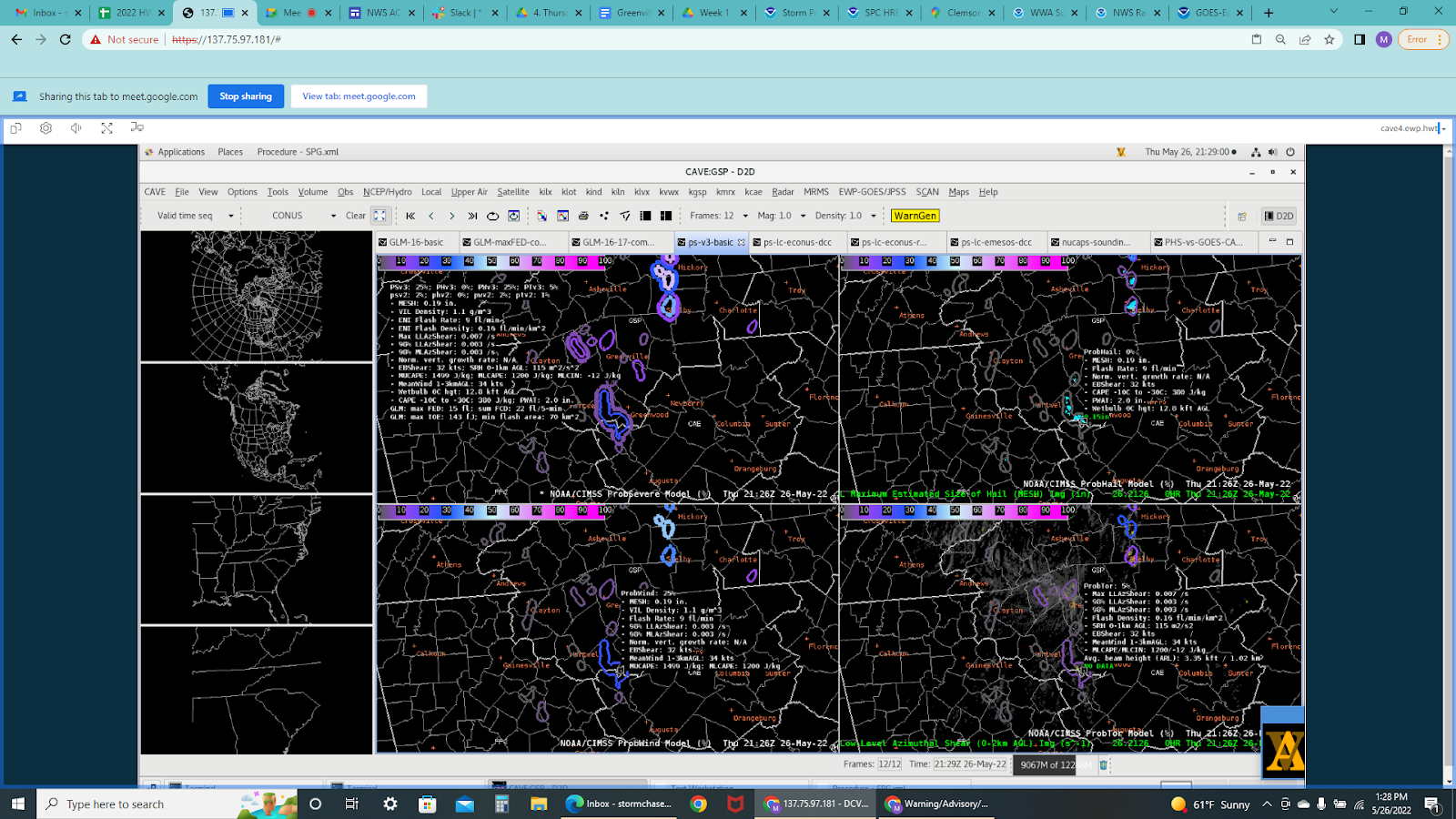
SPC Mesoscale Discussion. Thunderstorms intensified across northeast GA into upstate SC, near and south of a warm front that slowly lifted northward toward western NC.

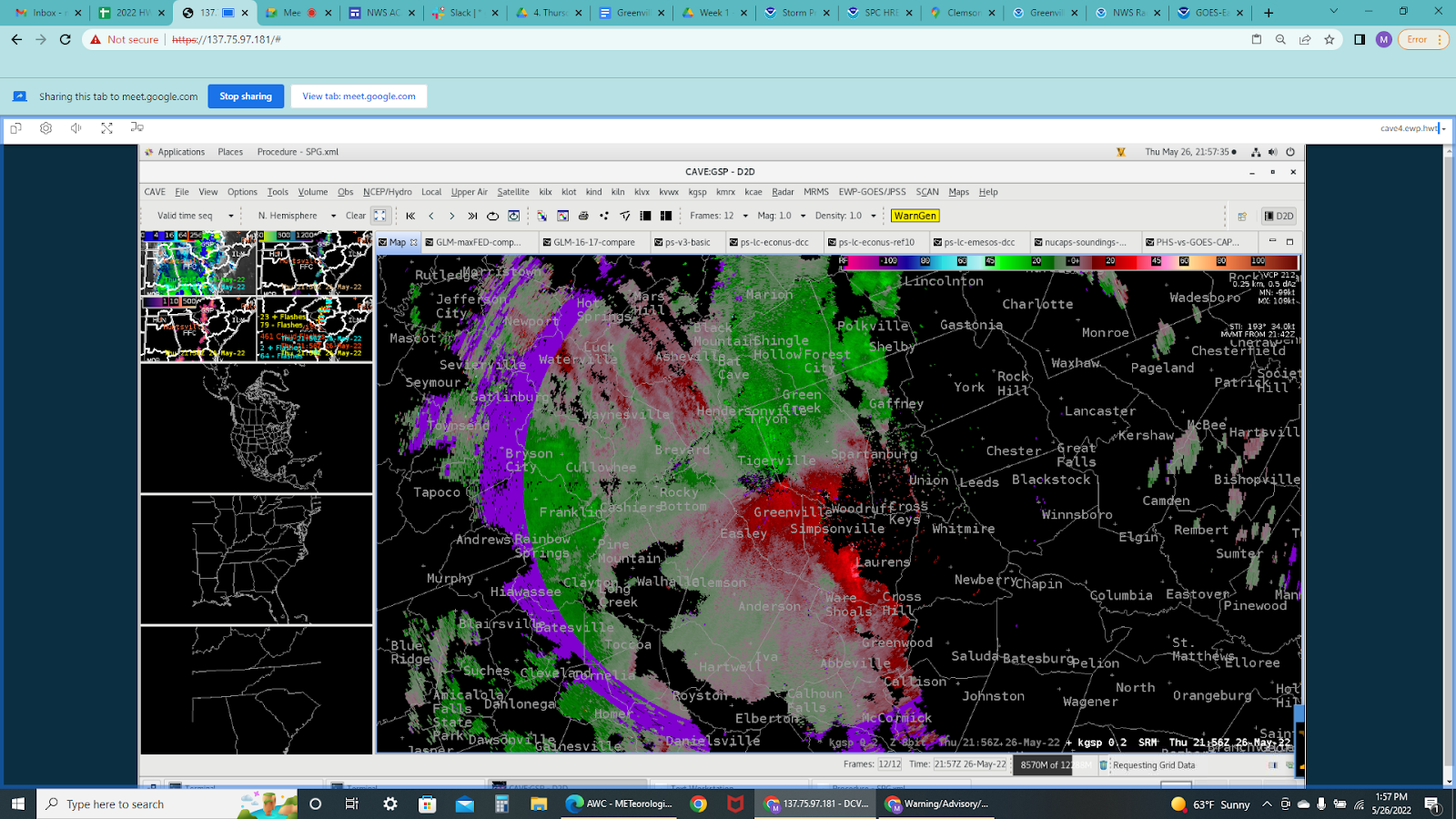
Storm velocity showing gate-to-gate or small rotational couplets near Ware Shoals and Spartanburg.

Vortex Power

Monitoring convection in Louisville, KY CWA

After an initial batch of rain and embedded storms that are continuing to move across the easernt half of the LMK forecast area, there is a narrow corridor of partial clearing, behind which another band of convection is forming. It is somewhat apparent in the PHS fields (both CAPE and  STP) that there is better destabilization across western portions of the CWA under partial clearing.
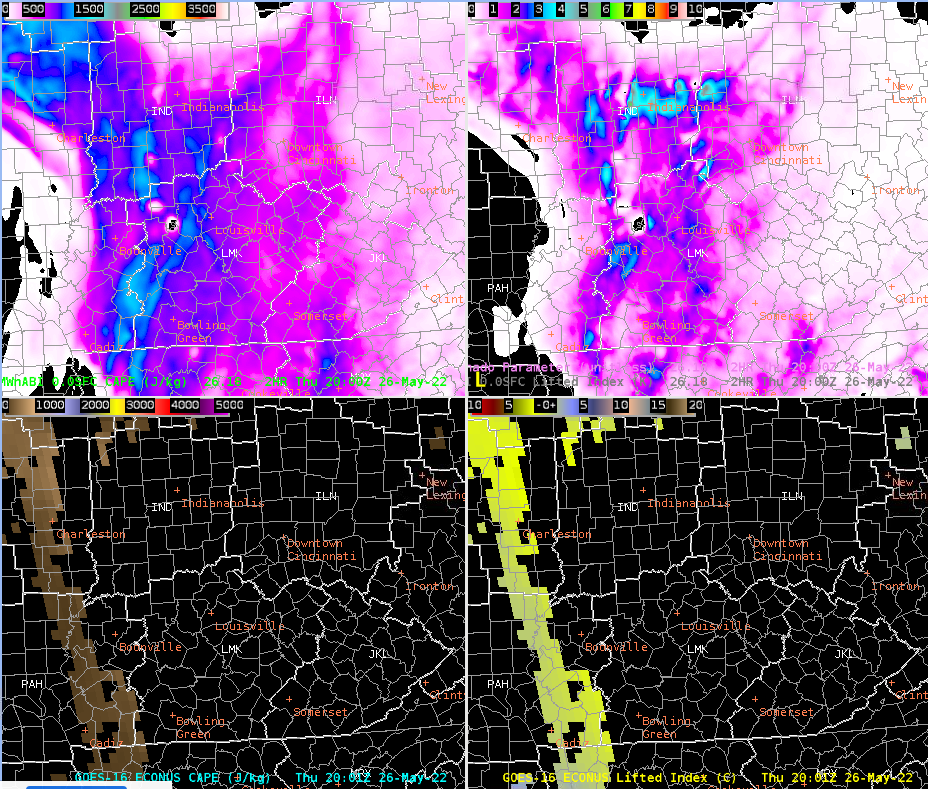
Top left: PHS modeled CAPE at 20z. Top right: PHS moceled STP. Bottom left: GOES CAPE 20Z. Bottom right: GOES LI 20Z.

By 20Z, had issued a significant weather advisory for a cell in the northwestern and portion of the forecast area. ProbSevere began spiking, and GLM FED picked up while MFW decreased, indicating strengthening updrafts. Within the next 20 minutes, cells in the southeastern forecast area began exhibiting similar behavior, and I issued another advisory for those.

0.5 degree base reflectivity at 20Z overlaid with probSevere
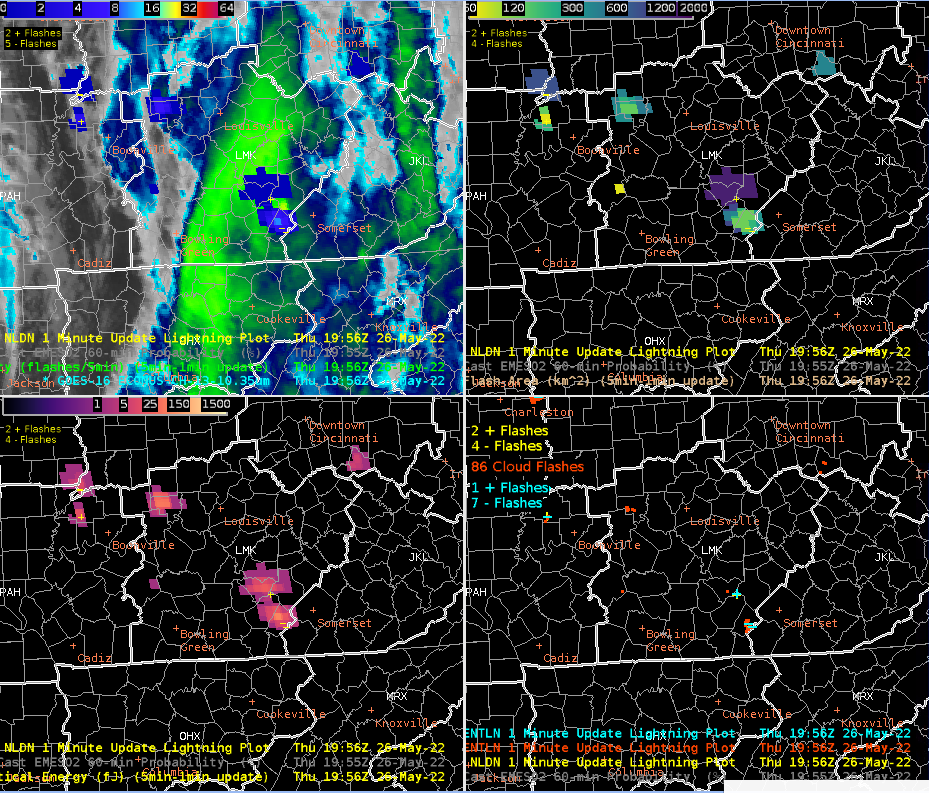
4 panel GLM over IR at 20Z

ProbSevere was indicating more of a wind threat, and a secondary threat from hail with MESH up to a half an inch. Why did I not go severe? Base velocity was decent, up to 30kts on the 0.5deg tilt. Base reflectivity up to 50dbz was only apparent up through around 18kft. NUCAPS soundings from earlier in the day, courtesy of metop C, indicated a freezing level around 11kft, so I would believe small hail.
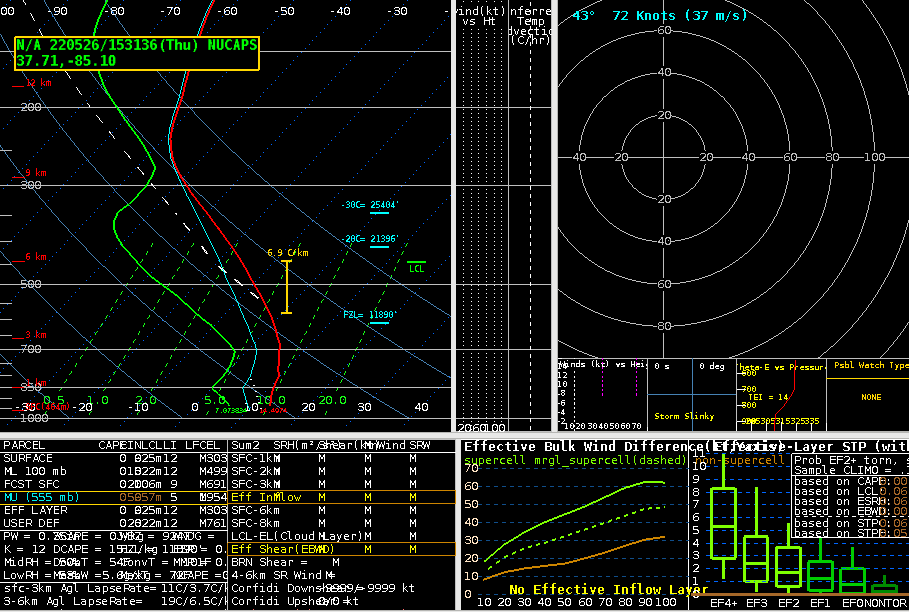
Mid morning NUCAPS sounding over central

By 2130Z, lingering activity is pretty much stratiform with just some embedded storms. Examining Day Cloud Phase Distinction (DCPD), and instability fields courtesy of PHS, we might figure out why. DCPD is indicating thick cloud cover over much of the eastern two thirds of the CWA. Meanwhile, CAPE and STP remain maximized closer to the western CWA boundary, under the area of clearing skies.

21Z DCPD
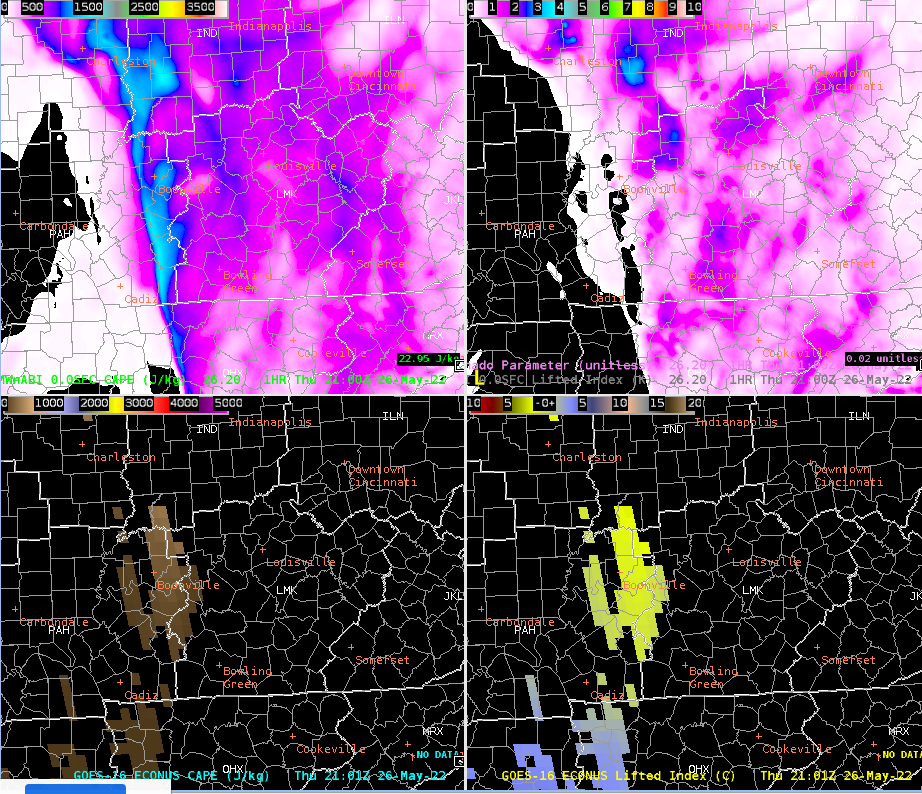
PHS 21Z modeled CAPE, STP (top) and GOES CAPE, LI (bottom)

19Z NUCAPS soundings (from the NOAA20 overpass) were largely unavailable over the CWA due to cloud cover.

A  Modified NUCAPS sounding out of SW KY indicates quite a bit of dry air at the midlevels, but also decent lapse rates and as much as 1500 to 2000j/kg of CAPE

For comparison, the regular, non-modified NUCAP profile at the same location was far less bullish with the instability.

A look at base reflectivity at 2130 indicates that trend towards mainly stratiform rain with embedded storms. In the eastern CWA, ProbSevere is still pretty enthusiastic about an exiting line of convection with probability ranging as high as 20 to 30%  for wind and even up to 20% for tornadoes. An examination of base velocity did indicate some inflow notches ahead of the line.

Base reflectivity with probSevere around 2130Z

However, with GLM FED remaining steady, and MFA on the larger side, the confidence in any real severe weather is waning.

– PoppyTheSmooch