Difference in Instability in NUCAPS and PHS

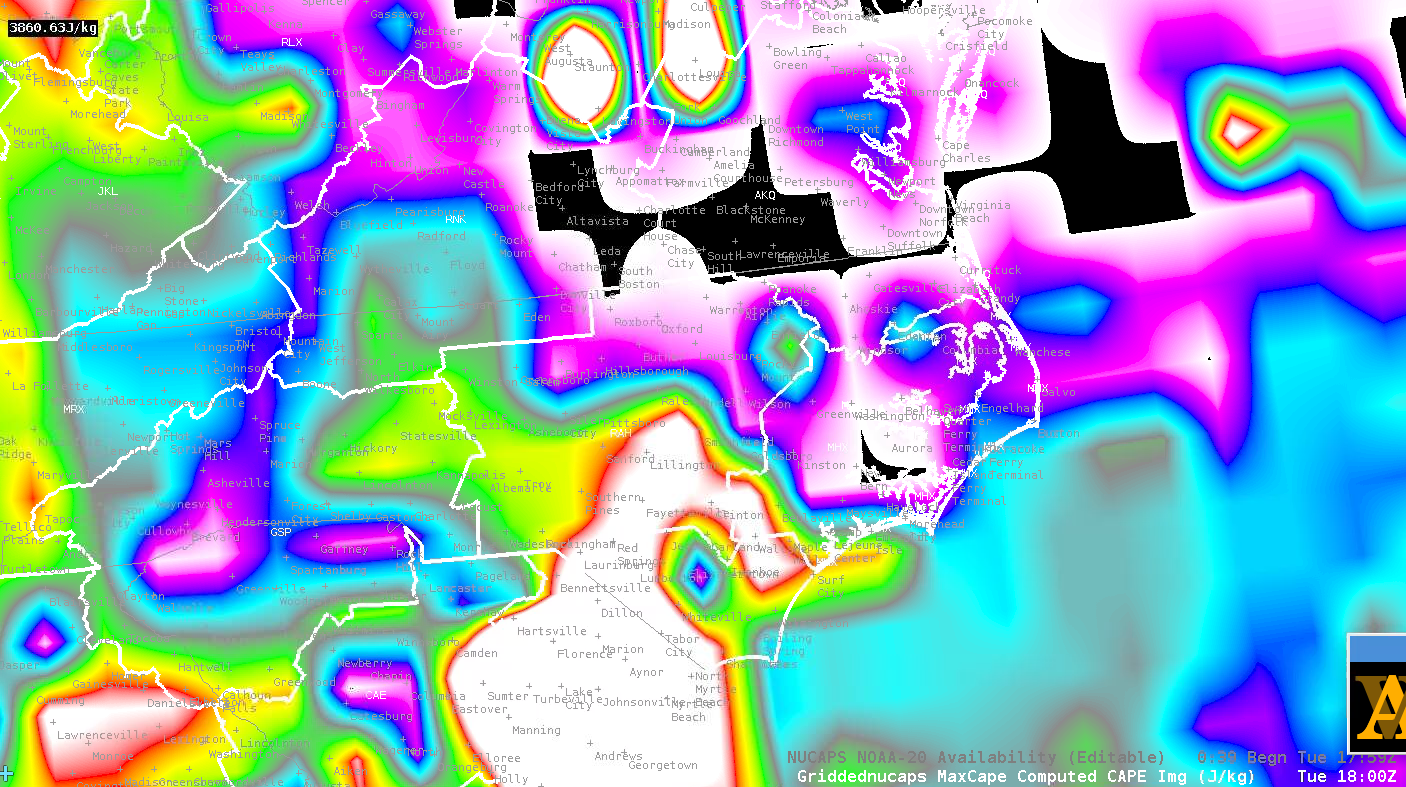
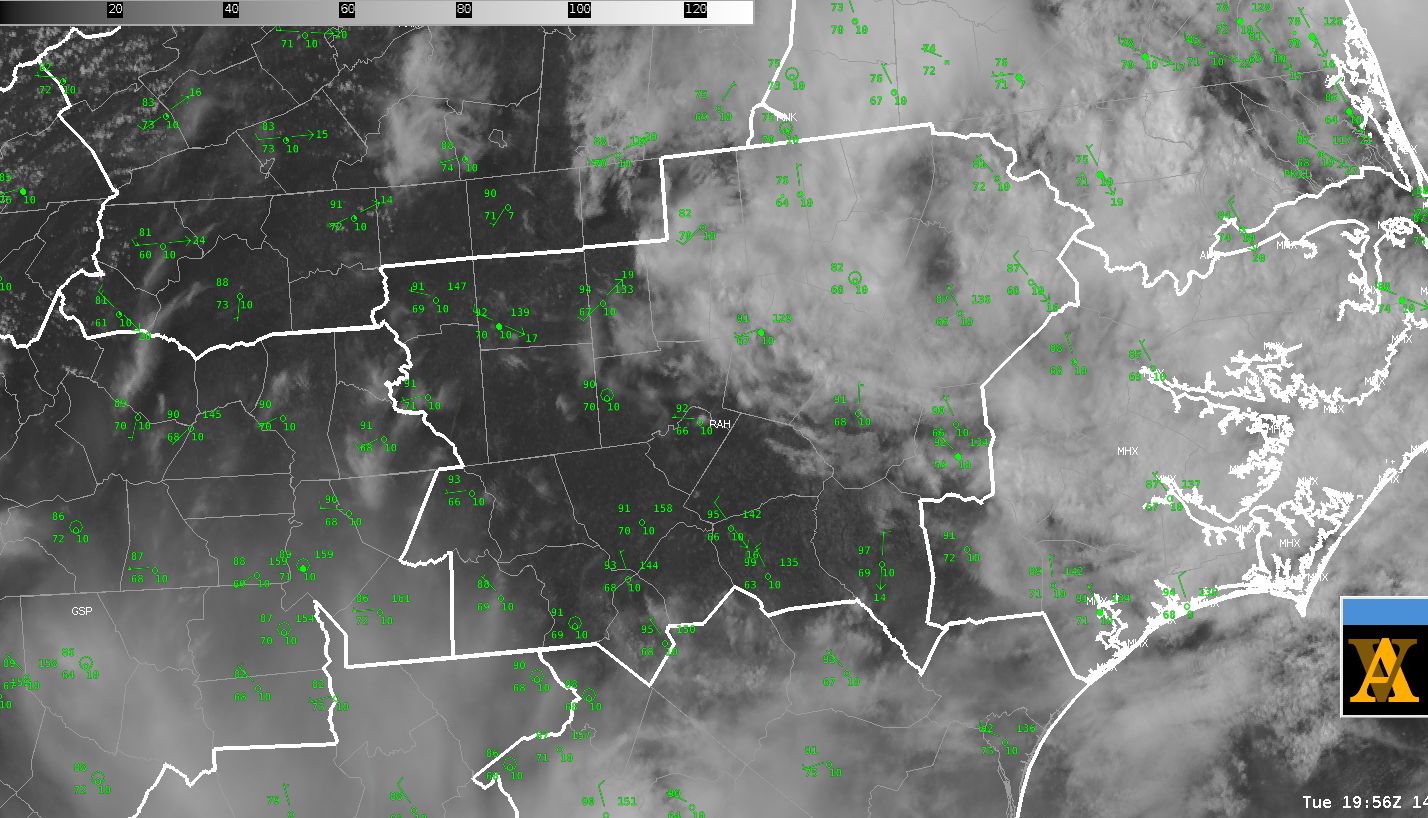
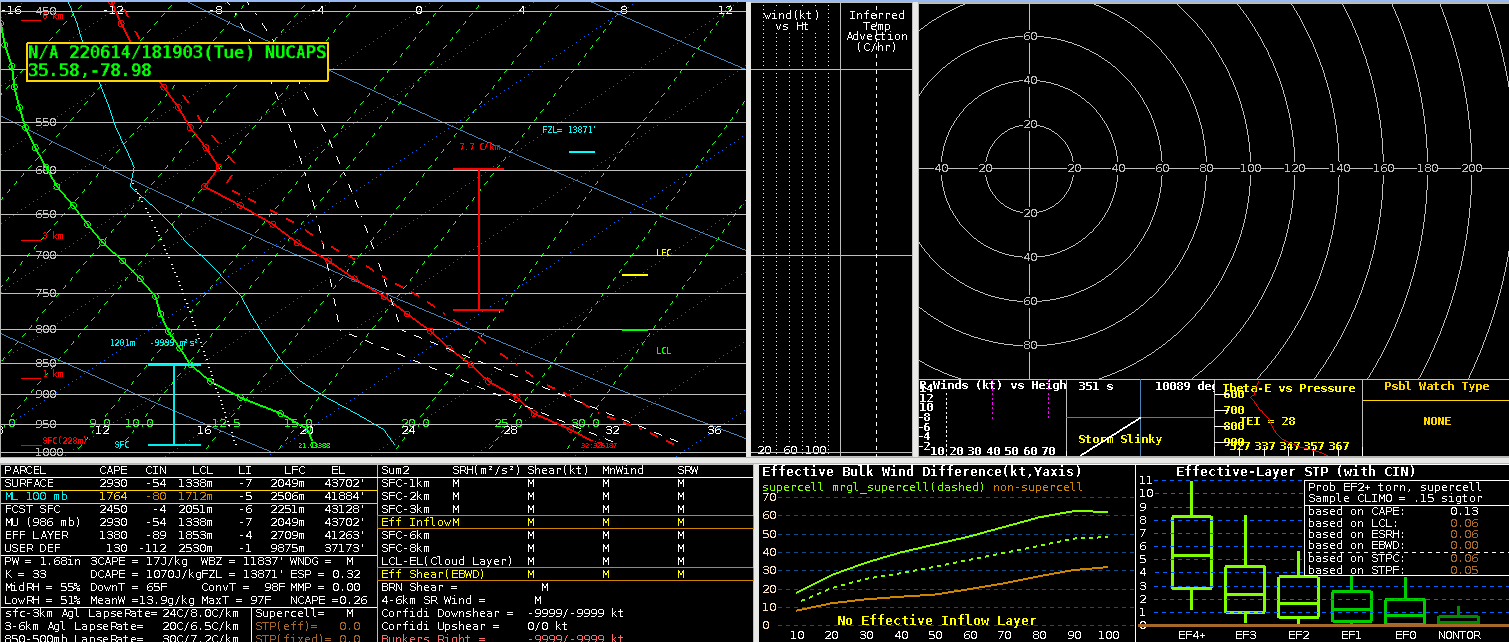
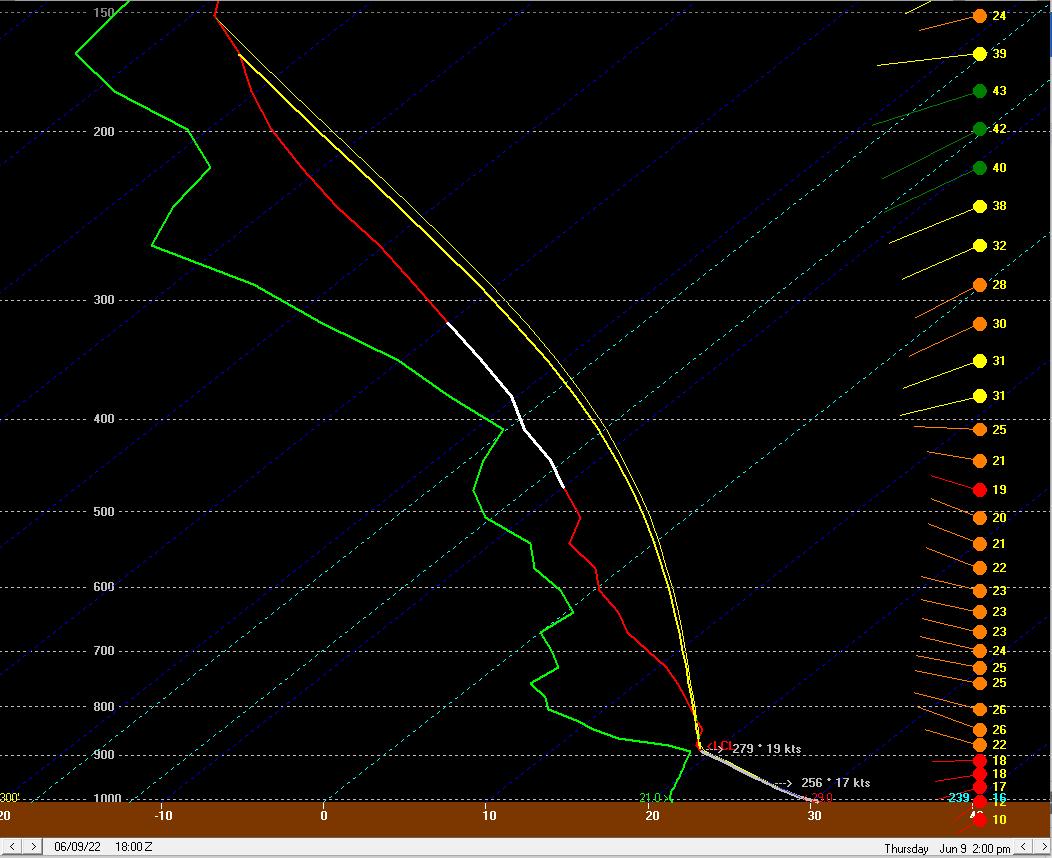
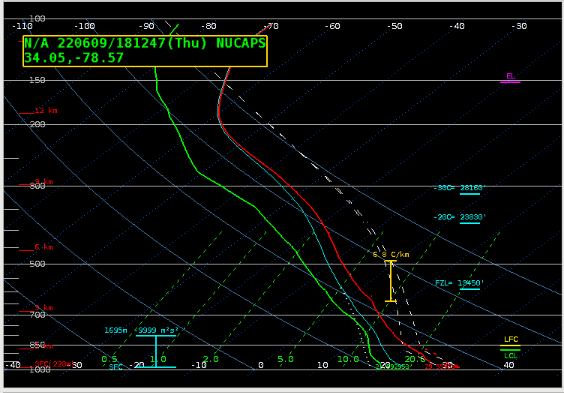
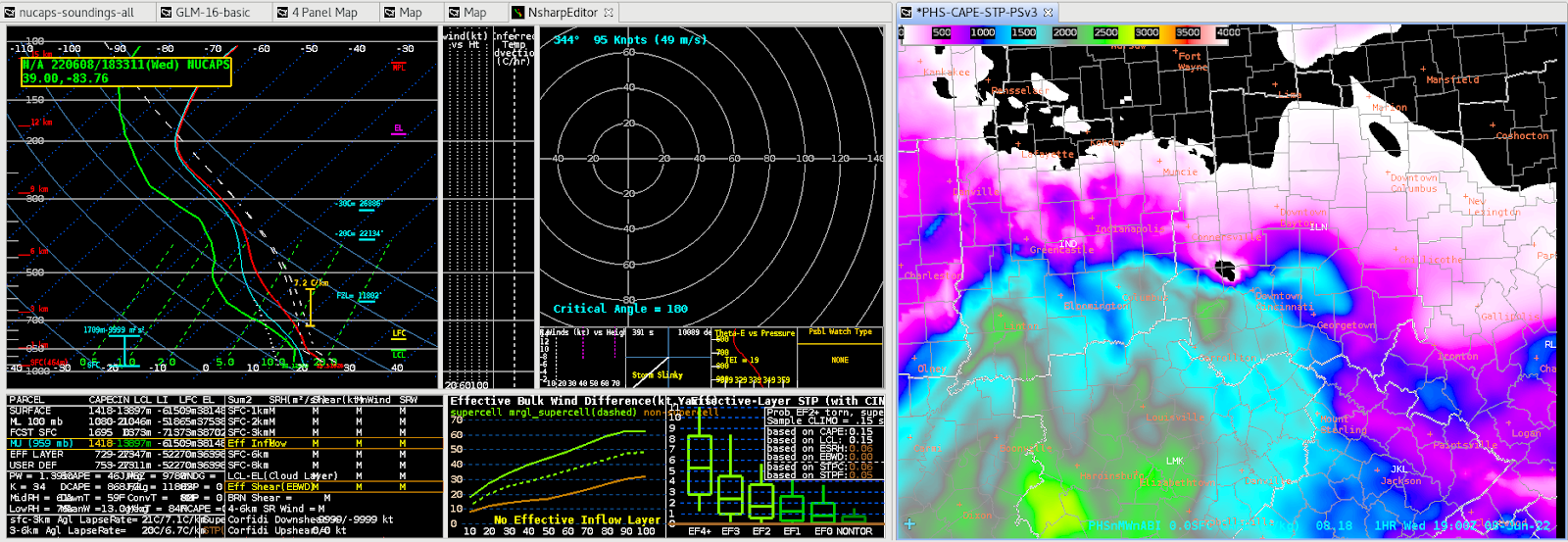
We noticed some large differences in SBCAPE values between the NUCAPS data and the PSH over the Raleigh CWA. NUCAPS had values of over 4000 J/Kg over a large area just to the south of Raleigh with PHS indicating values of less than 1000 J/Kg over the entire domain. Looking at surface observations, the surface dewpoints from NUCAPS may be slightly higher and did modify the boundary layer in the soundings below. This modification yielded values closer to 1500-2000 J/Kg. The modified soundings also introduced some capping to the sounding as well. Included the visible satellite imagery to show the lack of cumulus development in the area to the south of Raleigh.

Gridded NUCAPS CAPE 18z

PHS CAPE at 20z.

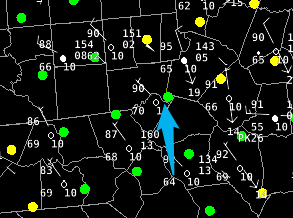
The point selected with the nearest ob used for images below:

Original NUCAPS Sounding

Original Modified NUCAPS

Modified NUCAPS Modified Sounding for nearest observation point (90°F/70°F)

-MartyMcFly

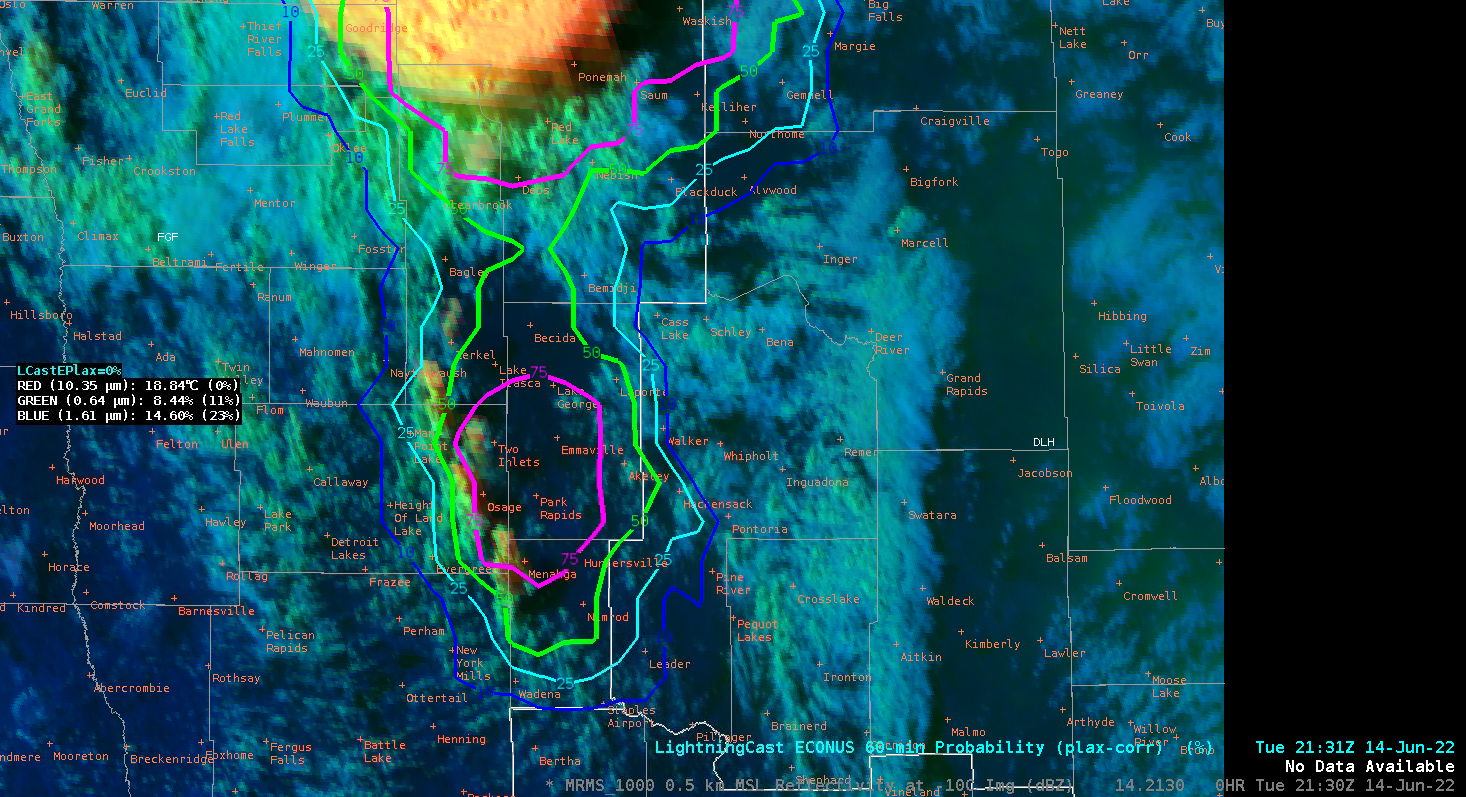
LightningCast/NUCAPS and Isolated to Scattered Convection in FGF

Convection developed rapidly to the south of the main area of convection in an area of high instability. This was first picked up by higher probabilities in the LightningCast data. There was some rapid cumulus development that was picked up well by the algorithm. Probabilities went well above 75% around 5 minutes or so from the first GLM detection. NUCAPs data indicated MLCAPEs of around 2000 J/Kg in this area supporting the quick upscale growth.

Convection developed rapidly to the south of the main area of convection in an area of high instability. This was first picked up by higher probabilities in the LightningCast data. There was some rapid cumulus development that was picked up well by the algorithm. Probabilities went well above 75% around 5 minutes or so from the first GLM detection. NUCAPs data indicated MLCAPEs of around 2000 J/Kg in this area supporting the quick upscale growth.

LightningCast and GLM at 2131 UTC

DCP RGB and LightningCast  2131 UTC

MRMS -10 Reflectivity and LightningCast first GLM detection at 2135 UTC

So let’s take a look at some NUCAPS soundings as we had three overpasses right before the convection initiated in the above examples.  Here is the first overpass with the sounding point selected with the red arrow:

NUCAPS Sounding at 1823 Z

Not too shabby with a MLCAPE value of 2094 J/kg.  (And why mixed-layer? Hank likes ML because very few times do parcels start at the surface for SB, and MUCAPE is just fun to look at).

The next overpass was 2003 UTC (about an hour and a half after the previous overpass) to see if the environment has changed much:

MLCAPE of 1235.  Hmmmm…that’s quite a drop in MLCAPE compared to previous overpass.  Two things to remember; this is on the edge of the field-of-view (matter of fact, the eastern edge).  Luckily we have a Modified NUCAPS for the same profile point which adjusts the boundary layer:

Yeah, that looks much more reasonable based on observational trends (few clouds to change the mid-atmospheric profile, increasing surface T/Td conditions) with 2185 J/kg MLCAPE.  But wait, there’s more!  We also have a:

NUCAPS AQUA Overpass

This was almost directly under NADIR so we should have much better profile retrieval.  Sure enough, MLCAPE value is almost 3000 J/kg in between the 1823 and 2003 UTC NOAA-20 sounding retrievals.

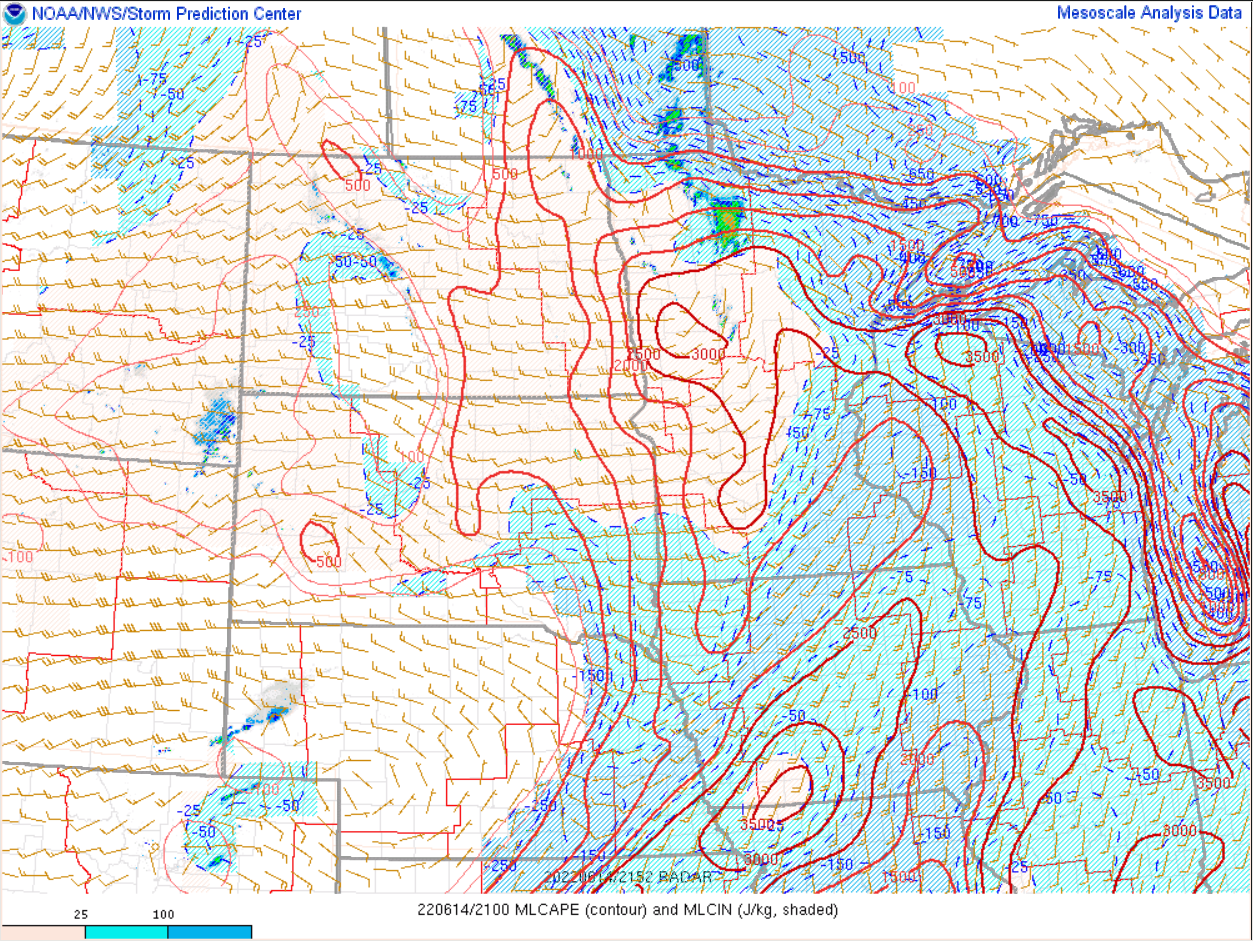
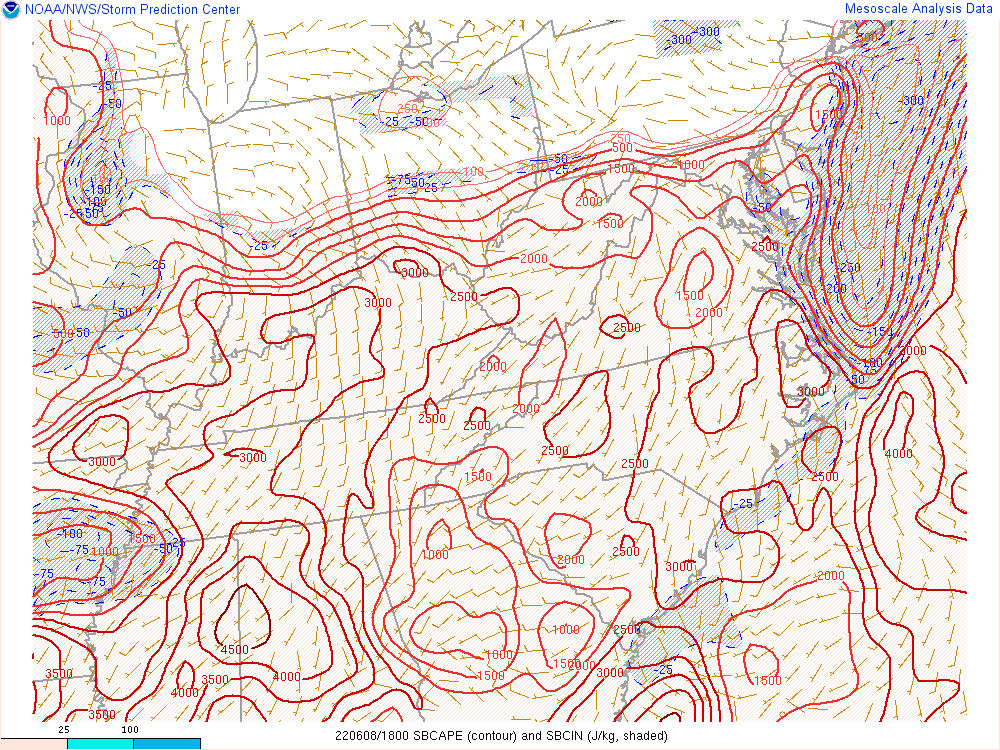
How does this all tie into the weather for FGF today?  This is what the SPC Mesoanalysis graphics had for 2100 UTC MLCAPE values:

They all combine to increase confidence on what conditions COULD be in areas where the models are saying one thing and an observational system is indicating potential reality (remember, it’s still a remote sensing platform with their own set of issues). In our case, the bulls-eye of 3000 J/kg in east central Minnesota is likely real and needs to be an area to watch…and that is where the Lightning Cast product at the start of our post indicated the potential for new activity to develop.  Pretty cool stuff…

– Marty McFly/Hank Pym

A Comparison of the Optical Flow Winds “Divergence” Product and KMVX Radar Storm-Top Divergence

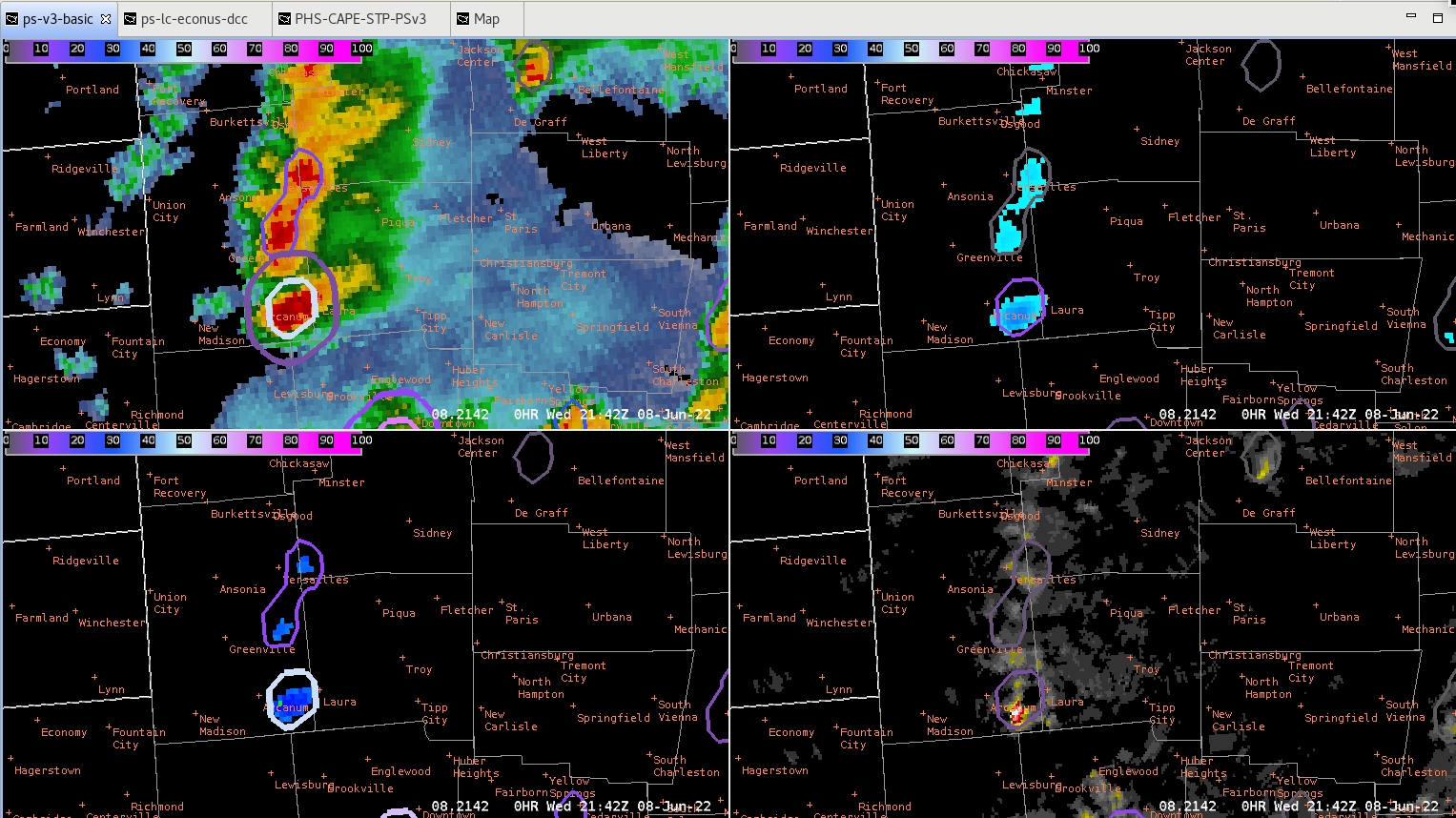
By 2200z, a strong cluster of storms was ongoing in northwestern Minnesota ENE of the KMVX RDA while moving northeast. Below are a set of 4 figures showing the divergence at the cloud top of the ongoing cell, with a cyan circle outlining the updraft area.

Here is a comparison of the Optical Flow Winds divergence versus storm top divergence provided by traditional means:

OFW – STD

>100 – ~115 kt

~80 – ~105 kt

>100 – ~150 kt

> 100 – ~130kt

While the divergence output wasn’t as high, it seemed to behave consistently below the traditional storm top divergence which means it could be adjusted up in the forecaster’s head. I’d love to see a little more discerning from the color curve for divergence, as it shows little difference, and when it goes over 100, it is all red. Also, it would be nice to see the exact unit that it uses, as it seems assumed that it’s kts.


aerobeaver

Where is the new convection going up?

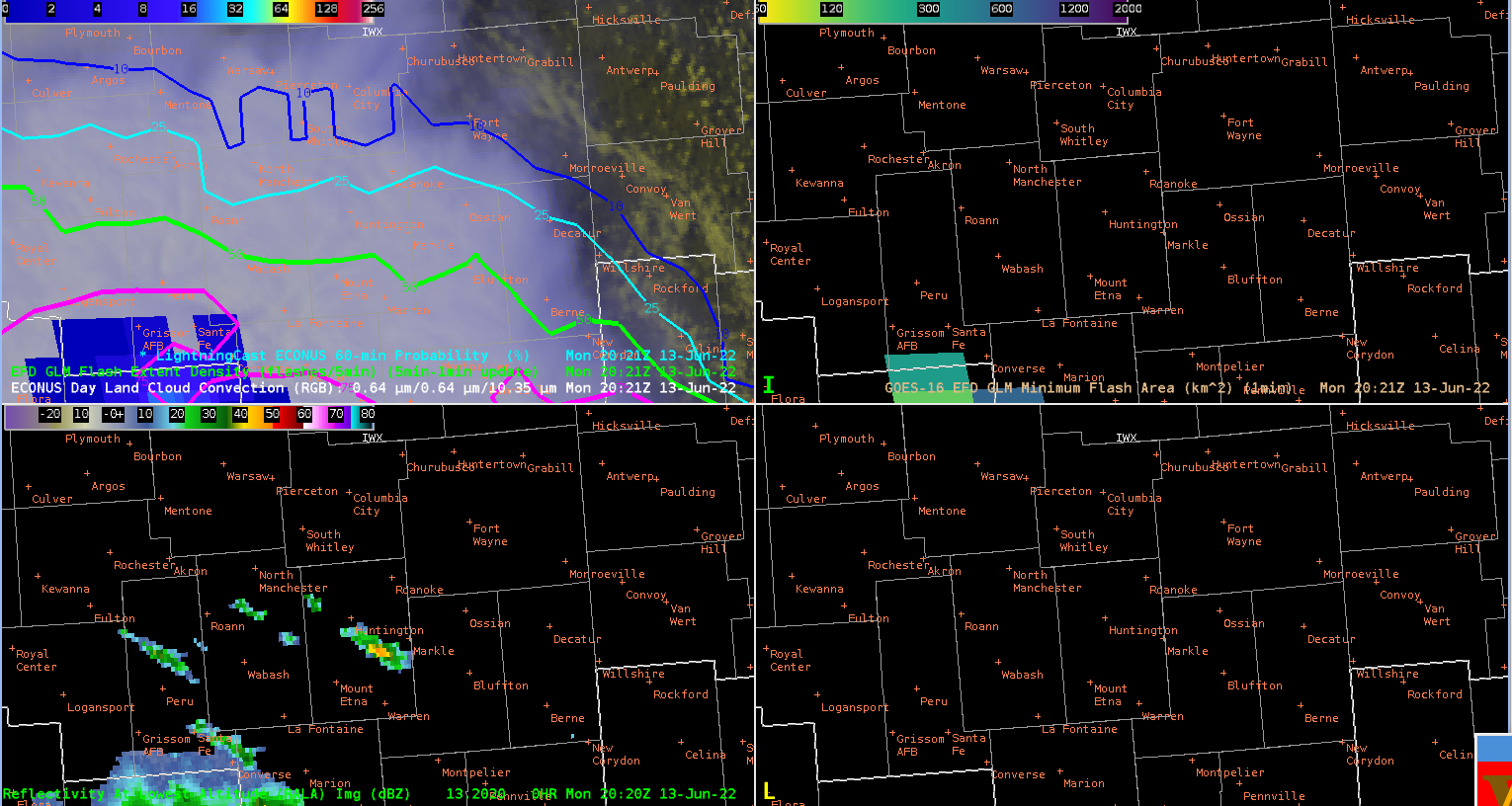
The GLM can be used to help find where new convection is developing under a cirrus canopy.  Here’s an example of this!

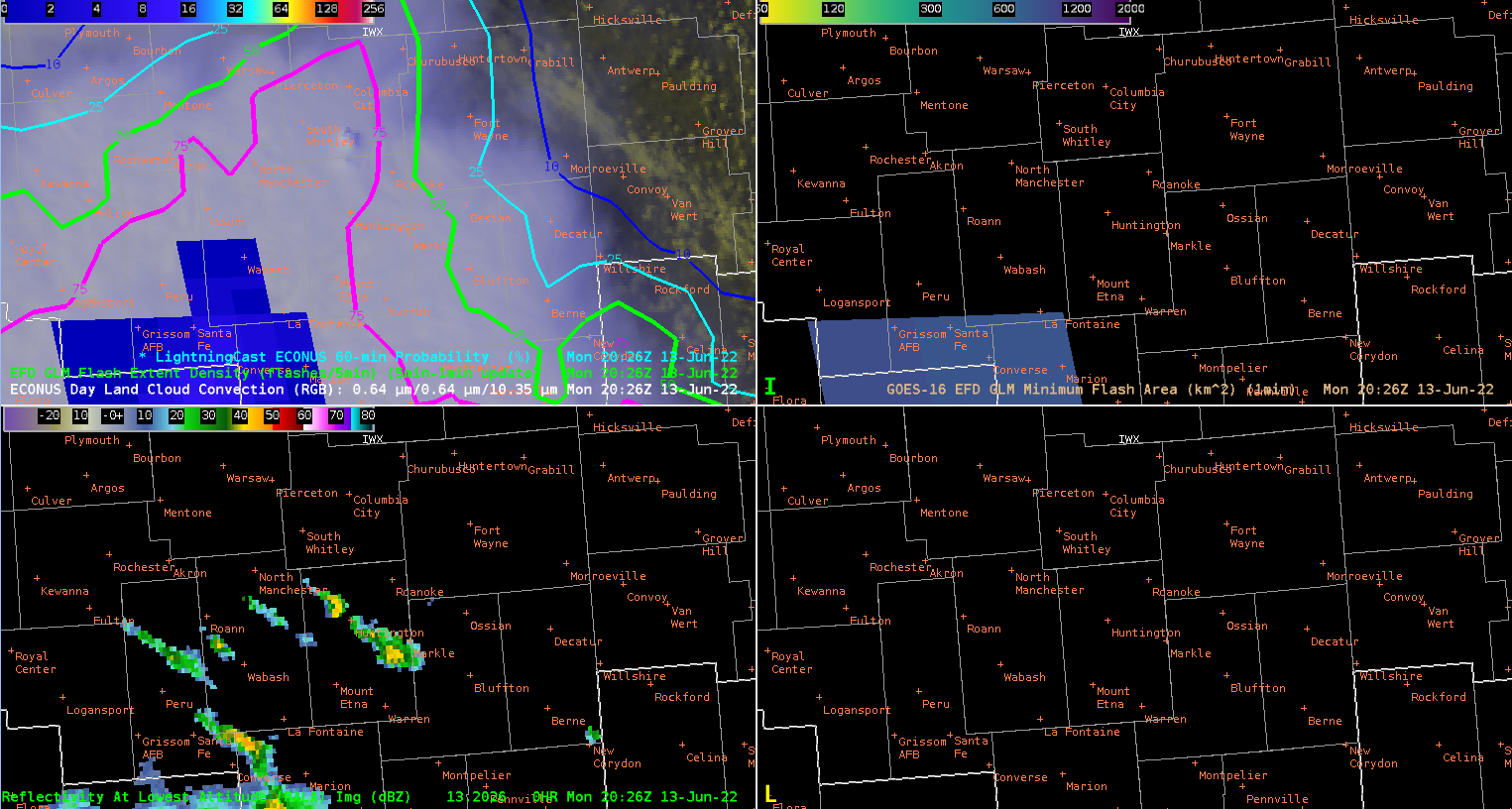
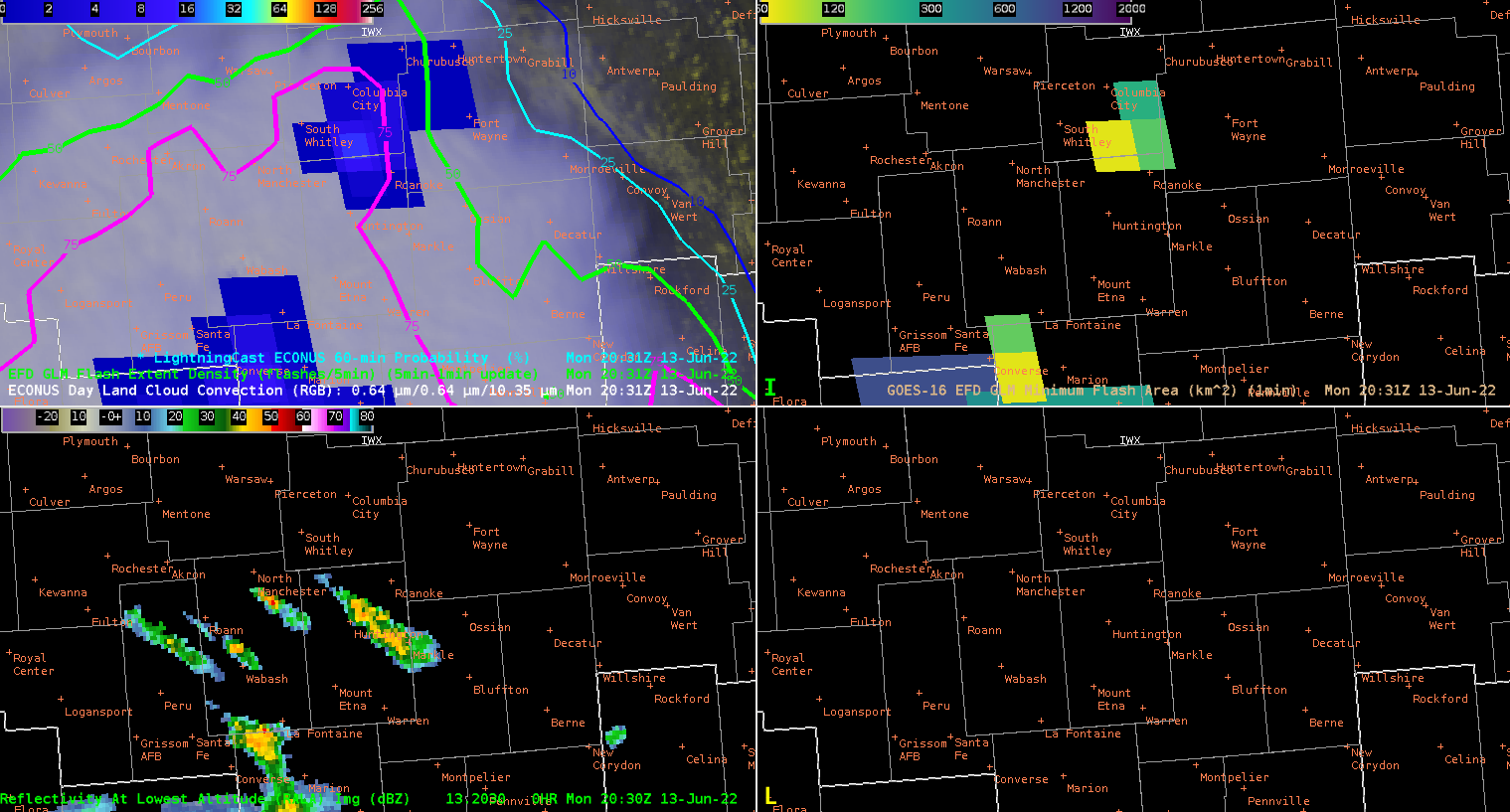
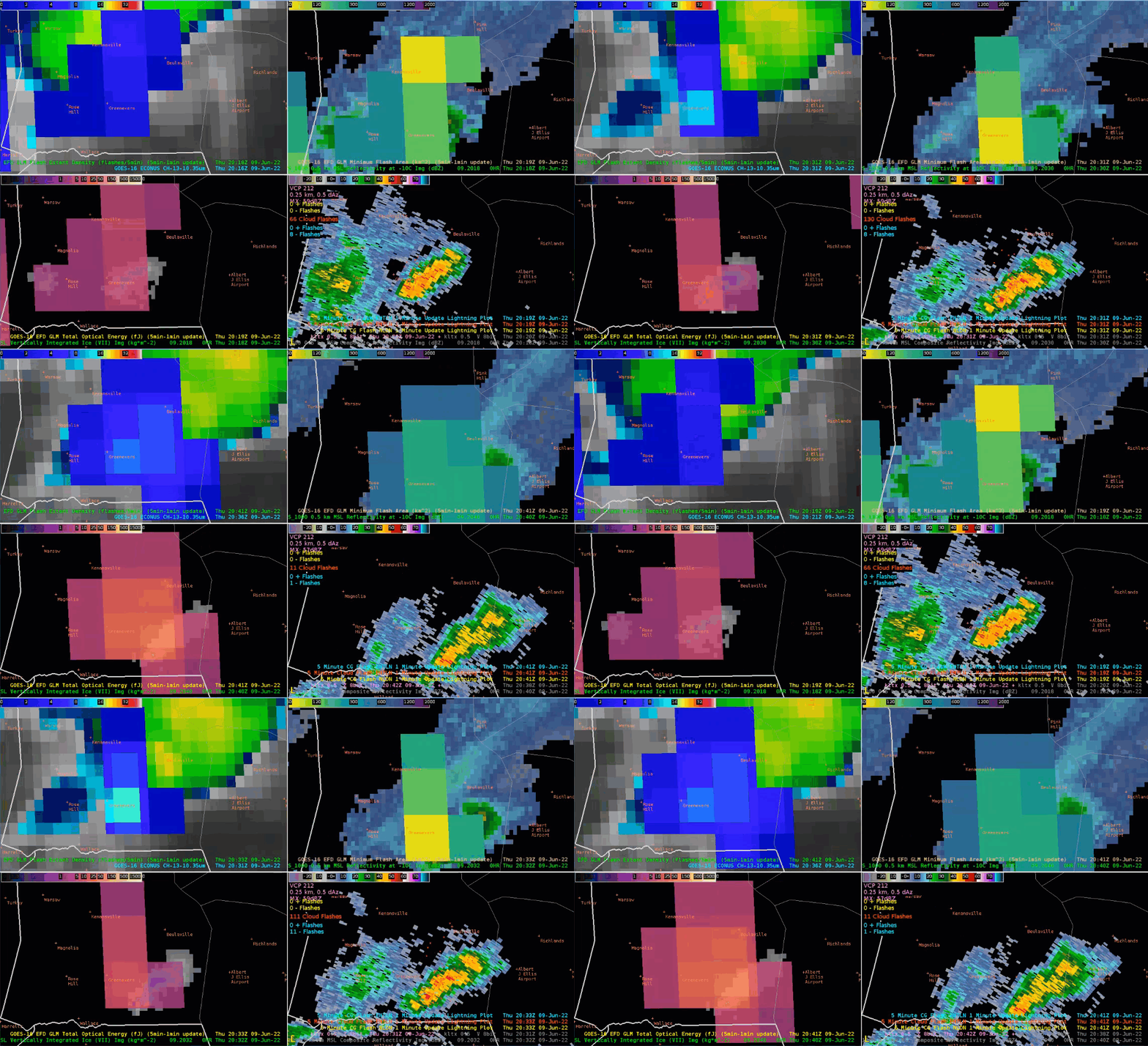
Top left – LightningCast with Day Land Cloud Convection and Flash Extent Density (FED).  Top Right is Minimum Flash Area (MFA). Bottom left is MRMS 1km Reflectivity.

We can see that there are some returns developing in the center of the field of view on the MRMS reflectivity but it is hard to tell whether this is real or not.  Five minutes later, we have this image:

Hmm, that could be new convection developing on the Top Left panel because it looks like there is a tower coming through the cirrus shield.

And then the next frame we have:

And there we go!  Flashes starting to show up so it looks like this area of convection will need to be watched.  (Should also note that it would also be helpful to time match to the GLM 1-minute FED instead of the 5-minute RGB!)

-Hank Pym

Metwatch for Wilmington DSS event

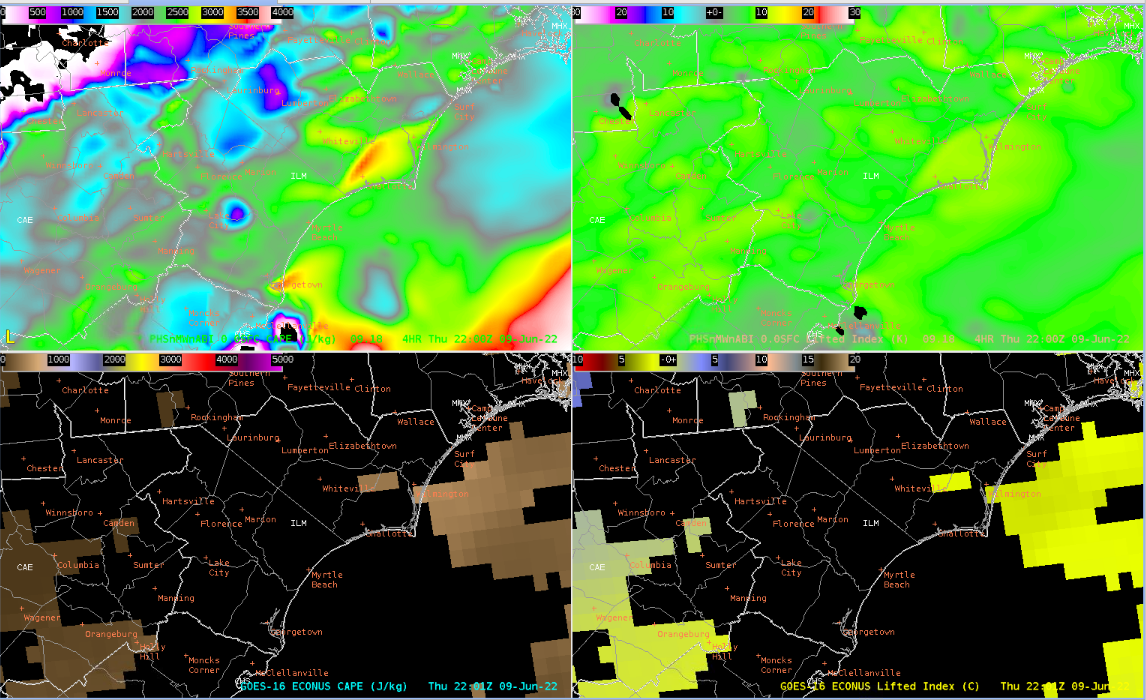
Metwatch for Wilmington NC started with modified NUCAPS soundings and a comparison with NAM BUFKIT profiles:

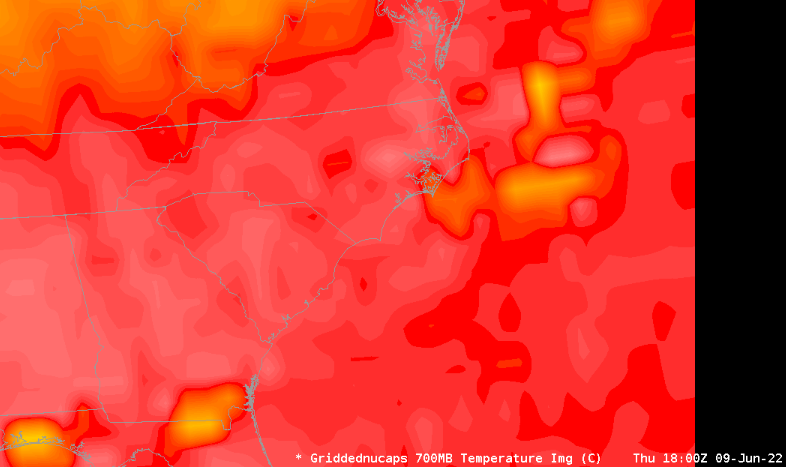
Looking at 700mb temperatures, BUFKIT has about 8C for that layer, and here is the gridded NUCAPS 700mb temperature layer. Note: not a lot of advection noted at 700mb, with low level dry advection (not shown)

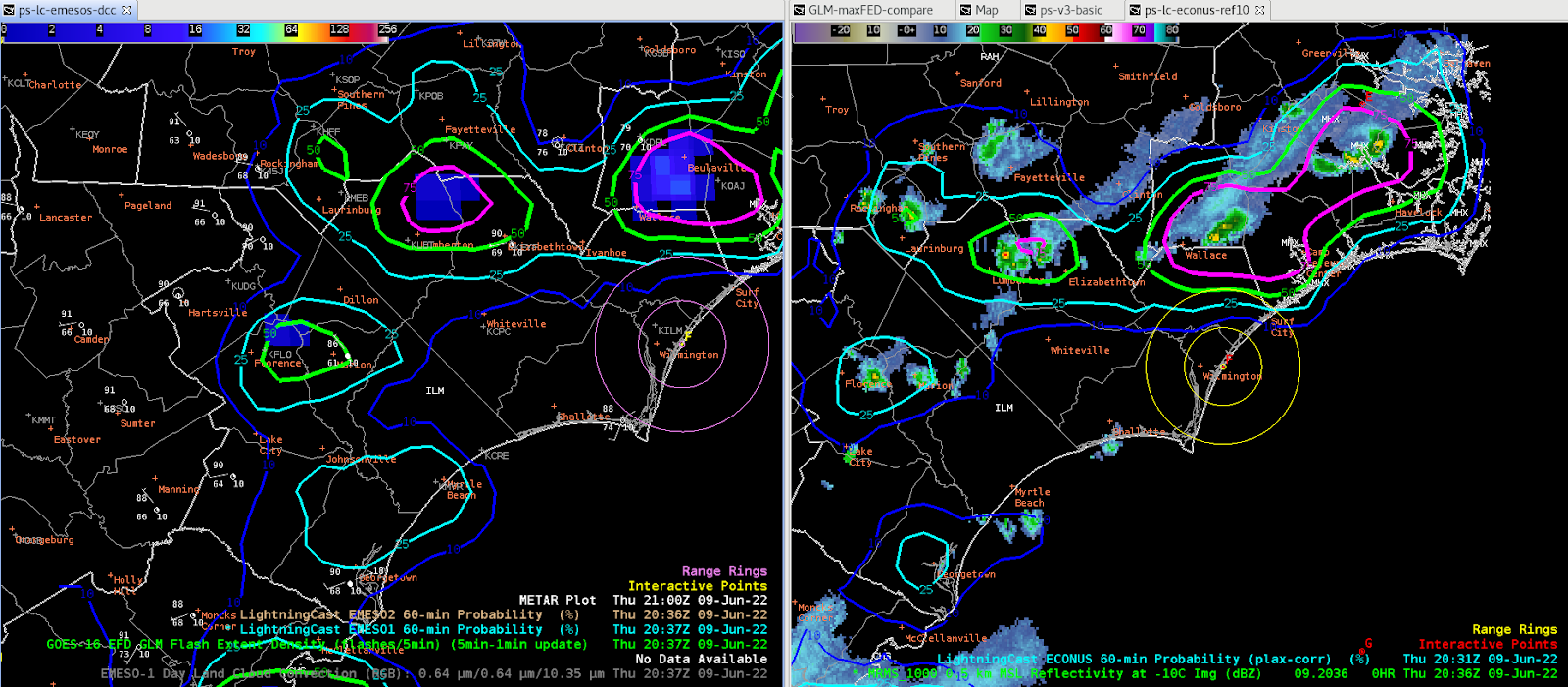
Watching this cell just outside the CWA pulse and then fall apart…PWV3 never exceeds 4% with this pulse. LightingCast also showed a rapid drop in probabilities.

Not much happened today, but just along the coast was this little area of enhanced CAPE (3000j/kg)…so you’re saying there’s a chance…

Comparison between parallax corrected and uncorrected lightning cast. You can see the image above and to the right (corrected) has some higher percentages getting into the 20 mi range ring compared to the non corrected data which just has the 25% grazing the 20 mi range ring. Having the corrected data could be more beneficial to providing DSS support.

– Mr. Bean

– Noctilucent

LBF HWT Blog Day 4

We didn’t have too many storms occur during operations today, but that allowed us to be able to focus more on CI.

LightningCast for CI

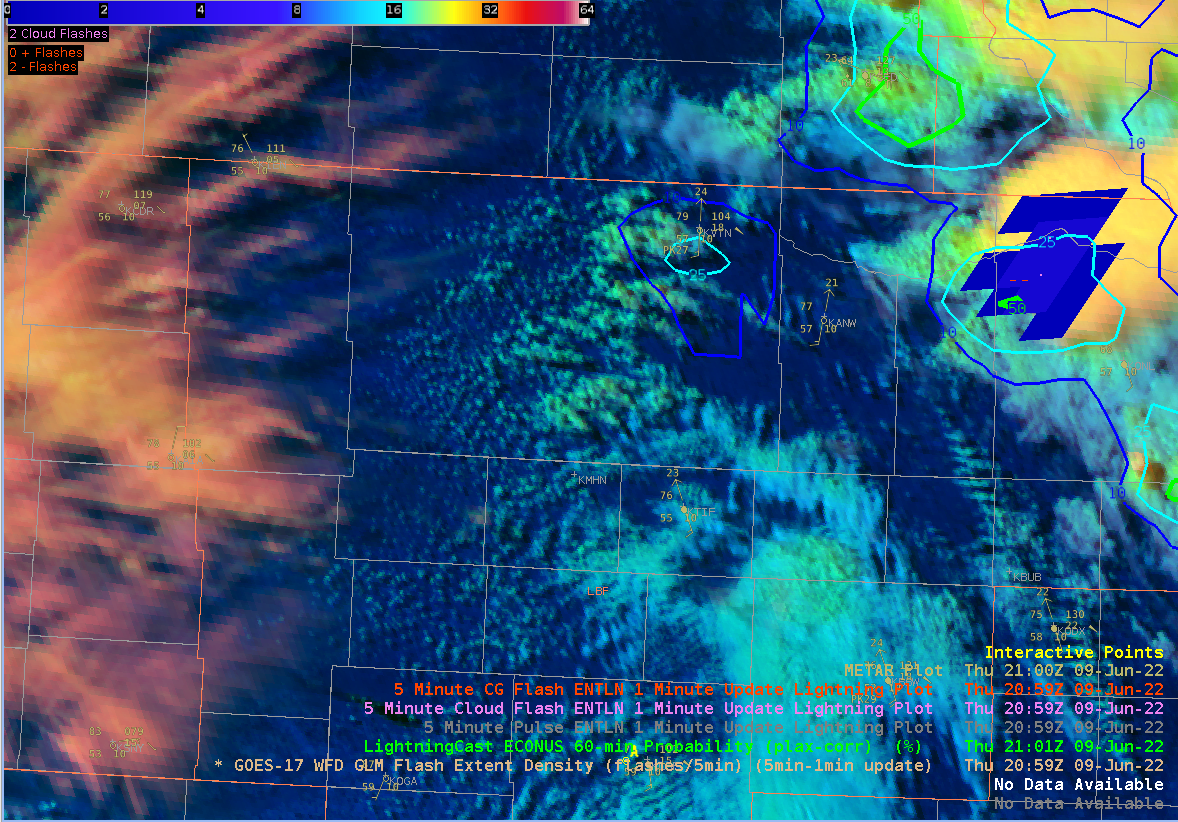
Was able to use LightningCast for convective initiation today as LBF was waiting for storms to fire back up for the afternoon and evening. Initially we were thinking storms would form first over the southern portion of the CWA based off of modeled convective parameters but at 2101Z, a 25% chance of lightning popped up via LC for the north-central portion of the forecast area. This 25% contour appeared a few minutes before radar reflectivity started showing up for the same area. Seeing even the 10% contour show up earlier on, clued me into the fact that we needed to shift our focus further north than we originally thought. These storms seemed to be forming along a shear gradient and weak boundary.
Of note, I am using the parallax corrected LC.
LC, GLM FED, and DCPD at 2100Z
LBF radar at 2109Z
By 2116Z, both GLM and ENTLN showed the first flash of lightning, allowing for around 15 minutes of lead time off of the 25% contour.
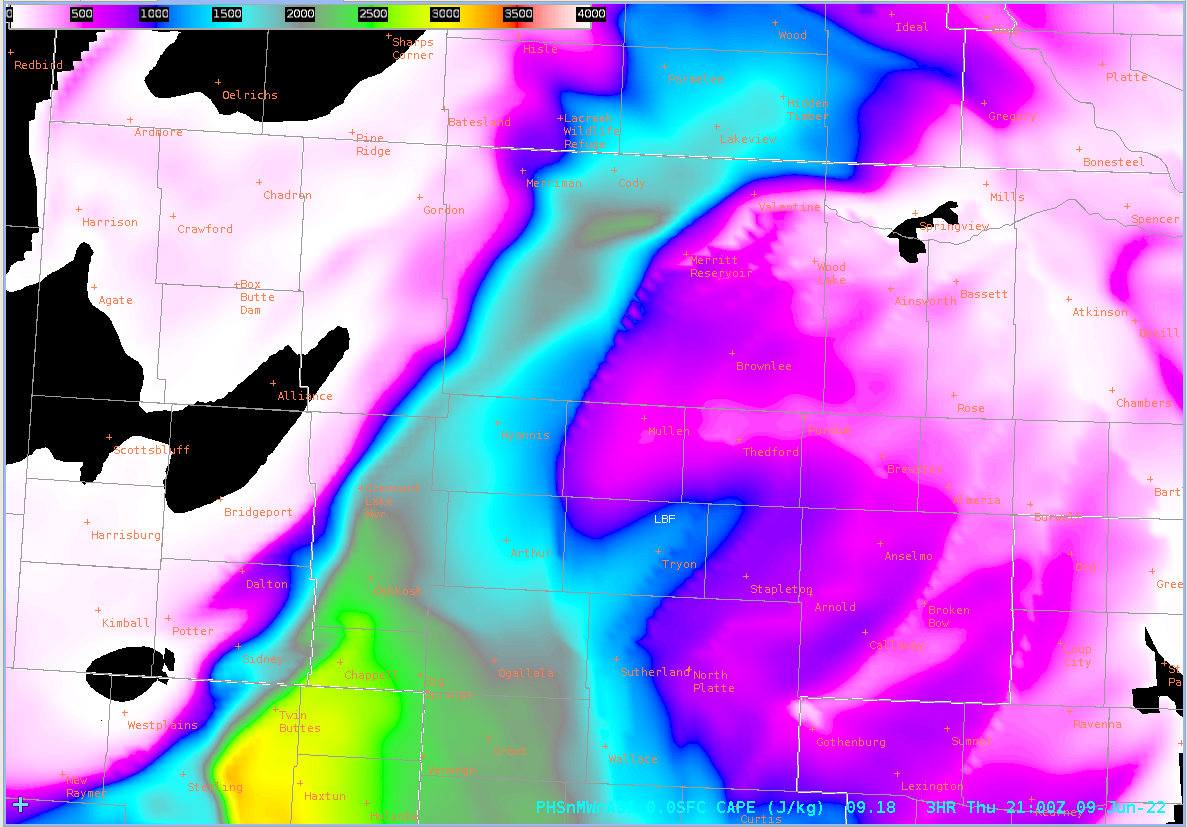
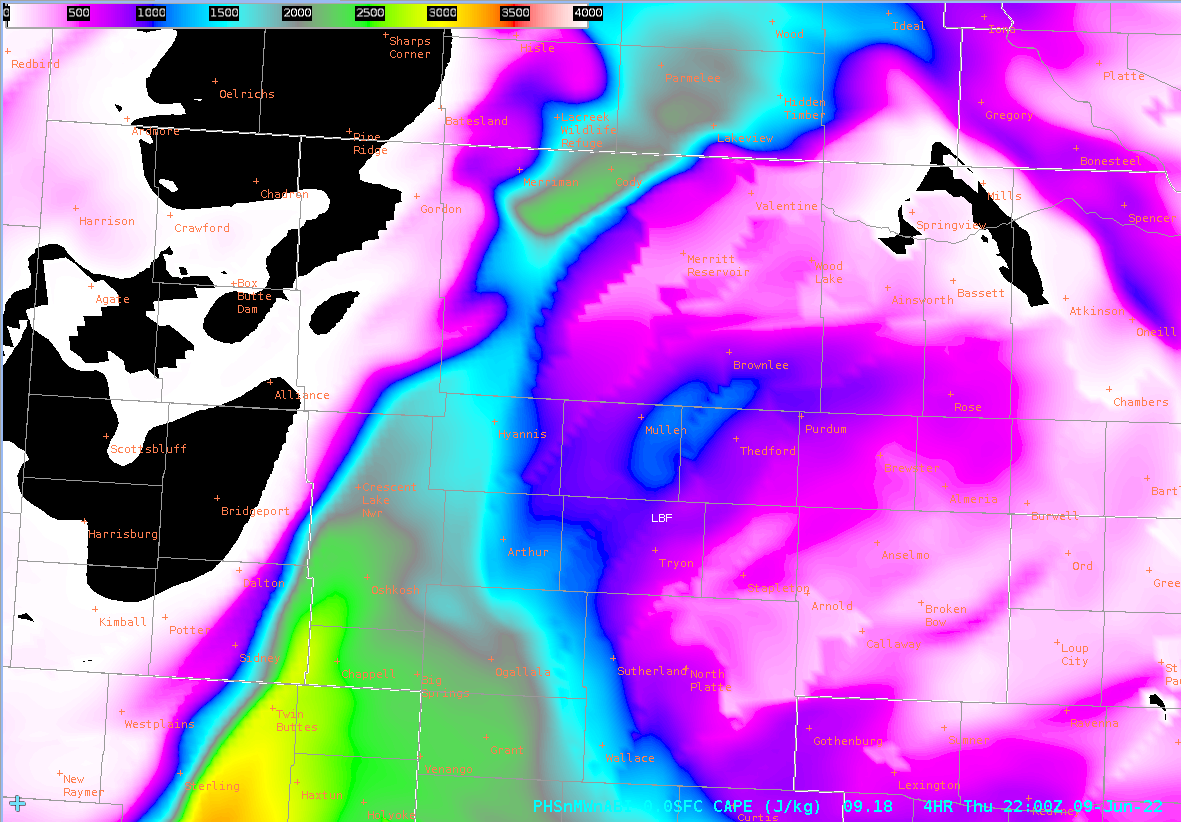
For comparison, these storms were forming ahead of the highest PHS CAPE and ahead of any of its stronger gradients.
21Z:
22Z:
As our day was winding down, LC continued to indicate areas to watch before it showed up on radar, but I did not grab additional images.

NUCAPS:

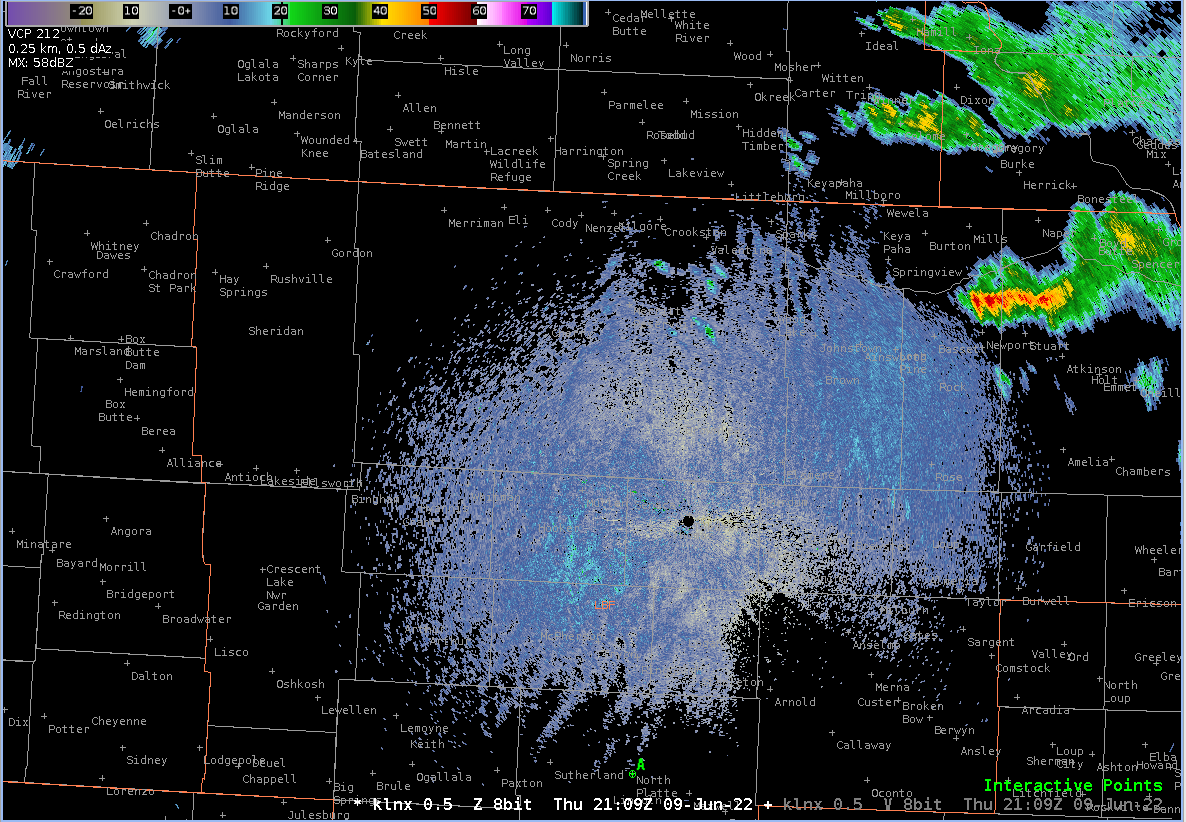
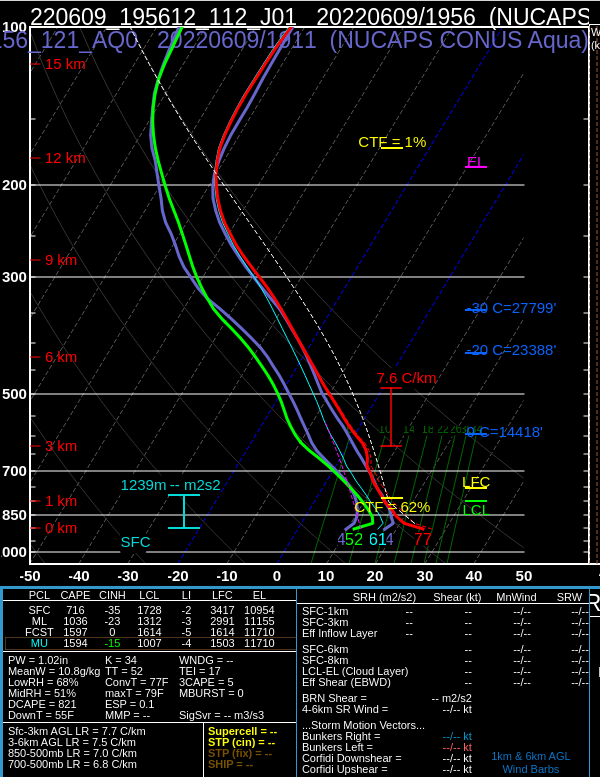
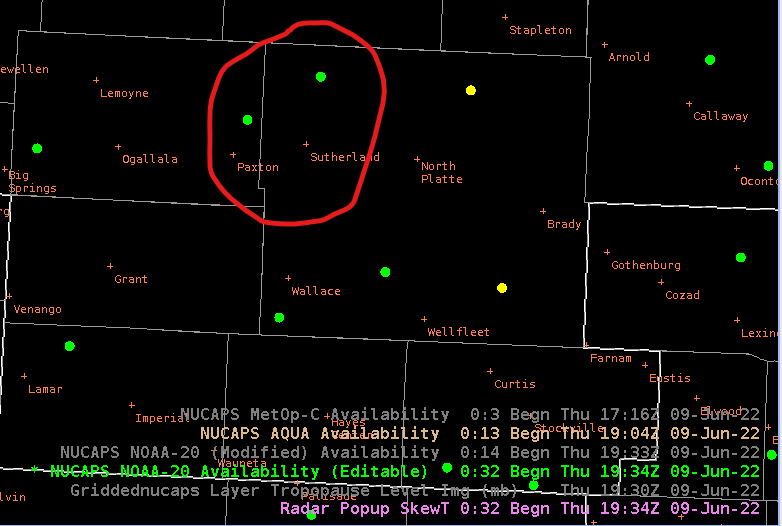
Tried to compare NUCAPS soundings today as we did have an overlap, but unfortunately ran into technical issues within my CAVE so was not able to do much with it. Another limiting factor was that the only “green” soundings from Aqua within our CWA fell within the far western scans which we were told by one of the developers they would next expect good data from, being on the limb. But for comparison, here are Aqua (1911Z) and NOAA-20 (1953Z) sounding from points NW of North Platte.
Points selected were both NW of the town of North Platte, circled below. The NE point of the two is Aqua and SW point is NOAA-20
– Matador

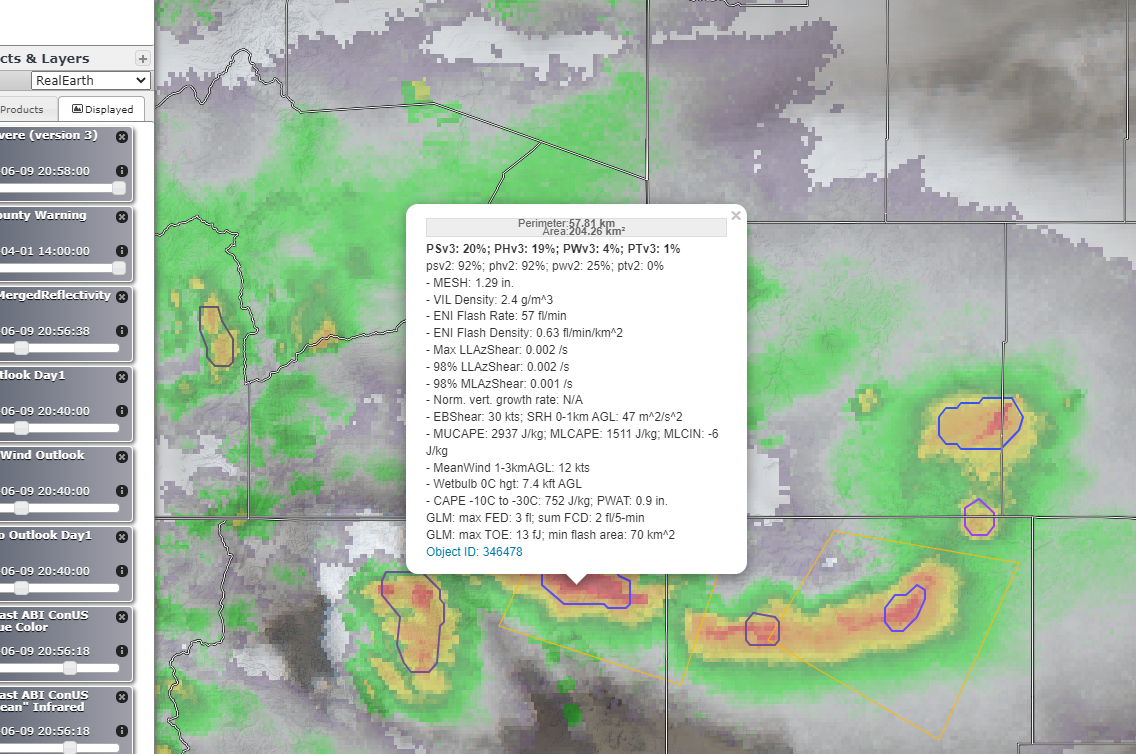
Differences in Prob Severe v2 vs v3

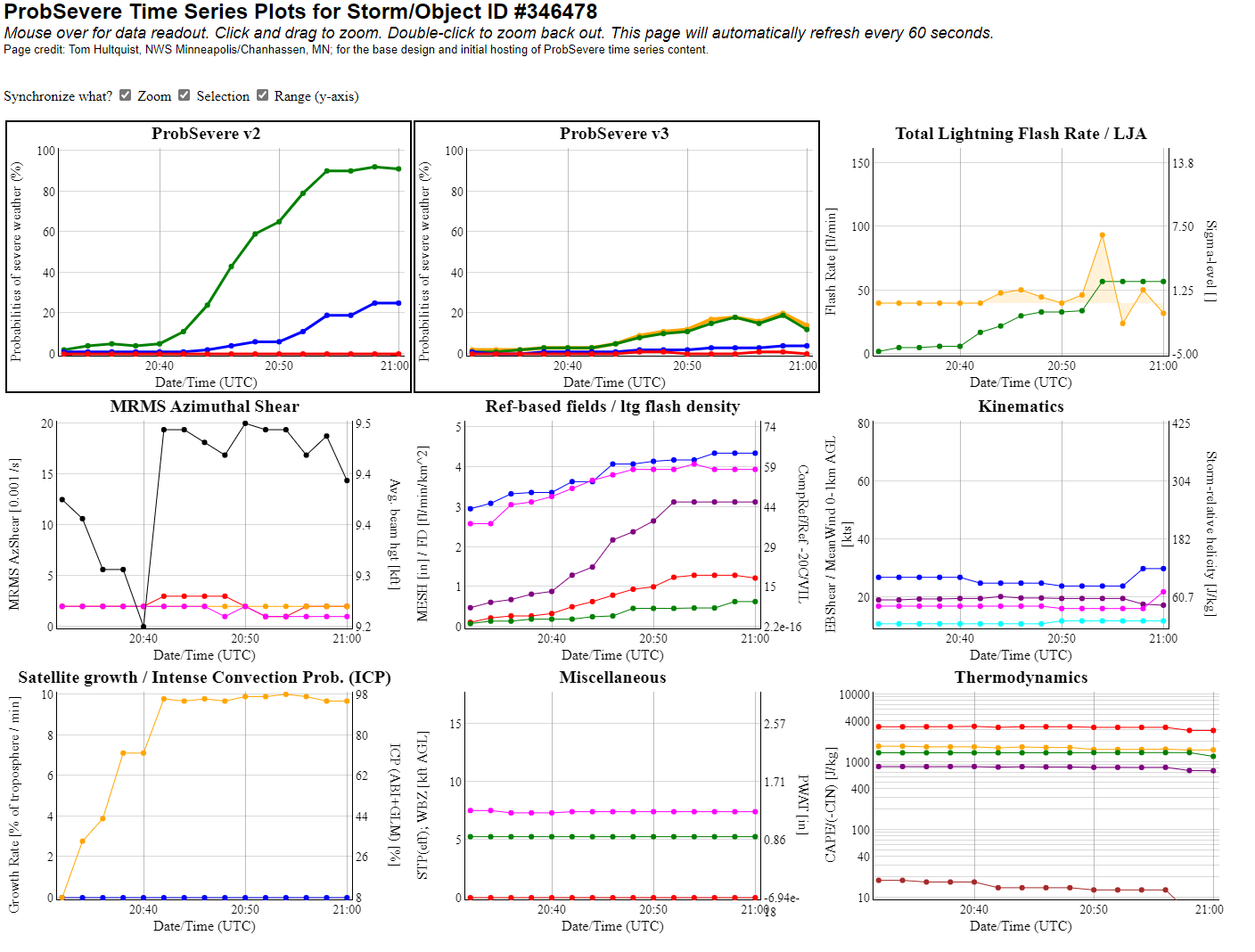
Some significant differences in probabilities for v2 vs v3. Noted on this storm in northern New Mexico. Not quite sure the reasoning for this large discrepancy.

Storm ID: 346478 in Northern New Mexico June 9, 2022.

Notable Differences in ProbSevere in the time series.

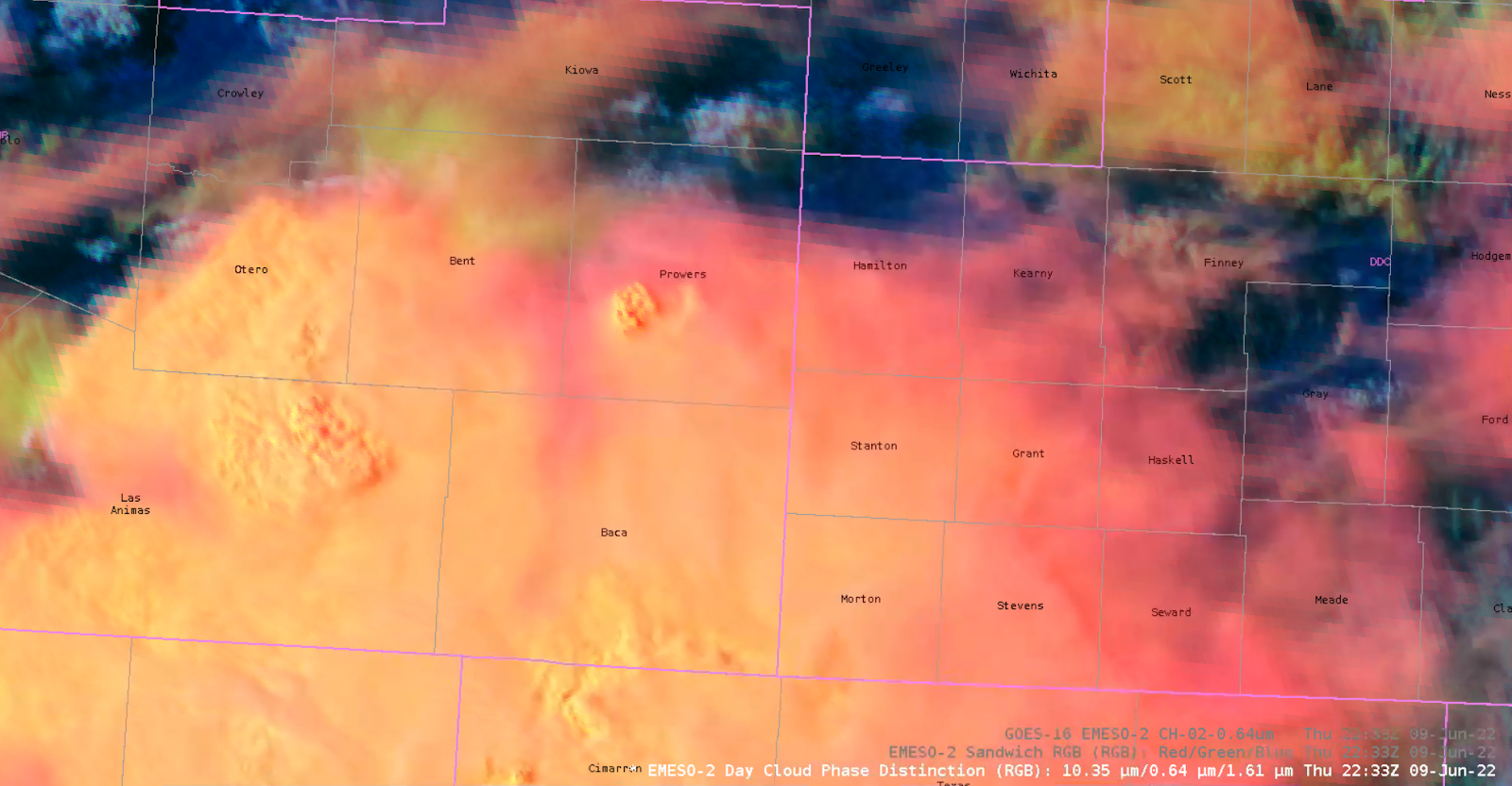
Storms going up right along forecasted boundary from PHS CAPE

Storms developing in Prowers County in southeastern Colorado.

– David Spritz

ProbWind and ProbTor Performance

ProbSevere May Have Caught a Missed Severe Wind Event

The ProbSevere v3 drew attention to a cell near Bloomington, IN on the afternoon of June 8th. Specifically it was drawing attention to the wind threat with a high ProbWind percentage reaching 50% to 60%. However, radar interrogation was only initially yielding velocity of 30-40kts on the inbound side of the cell, sub-severe but certainly SPS worthy. There were a few scans yielding up to 45kts as well. So initially there was a little wondering why there was higher ProbWind percentages. Quick realization of the storm track being perpendicular to the radar beam could explain the lower velocity signatures here. Knowing this, ProbSevere and its ProbWind portion was drawing attention to a scenario that otherwise may have been missed if only looking at velocity data and not realizing the storm track relative to the radar beam.
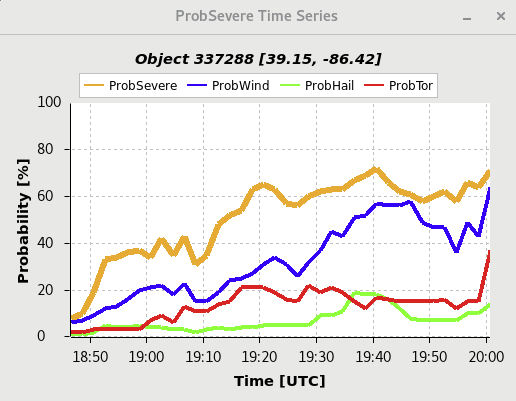
ProbSevere v3 of “Bloomington Cell”

STP went up at 20Z coincident with new SPC mesoanalysis.

ProbSevere v3 readouts of “Bloomington Cell” at 1940Z

KIND Velocity signature of the “Bloomington Cell” @ 1941Z

ProbTOR Missed a Likely Tornado Event – First Example

At 2005Z the KIND radar showed a solid and persistent tornado signature on a cell near Shelbyville, IN. To go along with this in the overall outlook for the day was an MD highlighting the tornado risk and a Tornado Watch that included the southern half of IN. However, the ProbTor parameter did not tick up in response to the tornado signature on radar. The observed uptick at 2000Z, coincided with the intake of the new SPC mesoanalysis data that ProbSevere v3 ingests as described by the product’s providers. Even still, this uptick was small only amounting to a ~5% increase.
ProbTor only peaking at ~15%
 
The second image below may explain some of this away, showing that two individual cells were coalesced into a single storm identified by ProbSevere v3. These two cells were relatively close to each other, so much so that they did appear as one on MRMS data. However, the third image of SRM and V show the tornado signature associated with the northern cell. This combination, with the southern cell having a much lower tornado potential and being ingested by the northern cell may have played a role in lowering the overall ProbTor percentage.
ProbSevere v3 showing that cell being grouped with another to its south, could this have inhibited the increase in ProbTor?
 
SRM (left) and V (right) showing the TOR signature with this cell.
 
Multiple LSRs for wind damage were observed from this event, with a “tornado possible” added to the remarks.

The PHS SigTOR parameter also further supported the tornado risk during the 2000Z hour. The image below shows the PHS SigTOR parameter at 2000Z with ProbTOR percentages overlaid on top. The cell which produced the likely tornado east of Shelbyville, IN is sampled in the image with the ProbTOR only at 9%.

PHS SigTOR parameter pegging the area that produced a TOR. The cell highlighted with ProbTor readout produced the Tornado Warning referenced earlier.

ProbTOR Missed a Likely Tornado Event – Second Example

From roughly 2130Z to 2200Z, a supercell passing west to east through west-central OH showed a persistent meso signature as seen from the KILN radar in Wilmington, OH. This signature eventually depicted gate-to-gate shear and tornado warnings were issued for this cell. The same ongoing Tornado Watch from the prior example also covered this same region. Image three also shows the PHS SigTOR Parameter showing higher tornado potential in the region, although not directly overlaid with where the Tipp City cell was. However, the ProbTor parameter of ProbSevere v3 did not show a corresponding jump in tornado potential. Unlike the prior example which showed the ProbSevere v3 grabbing a second much weaker cell with the tornado producing cell, this was a discrete cell with no merger occurring.

Highlighted in the Tornado Warning issued by the Wilmington, OH office, was a tornado debris signature. The KDAY metar located just south of Tipp City also included “tornado” in the remarks signature, shown in image four.

KILN SRM and V showing tornado signature near Tipp City.

Time series of ProbSevere with persistently low ProbTor for tornado warned storm west of Tipp City.

PHS SigTOR Parameter highlighting higher tornado potential in the region with overlaid ProbSevere – ProbTor percentage for tornado warned cell by Tipp City.

The KDAY metar showed “tornado” in the remarks section for the cell passing through Tipp City.

– Trip

PHS, NUCAPS, Optical Flow, Prob Severe Fun

PHS and NUCAPS

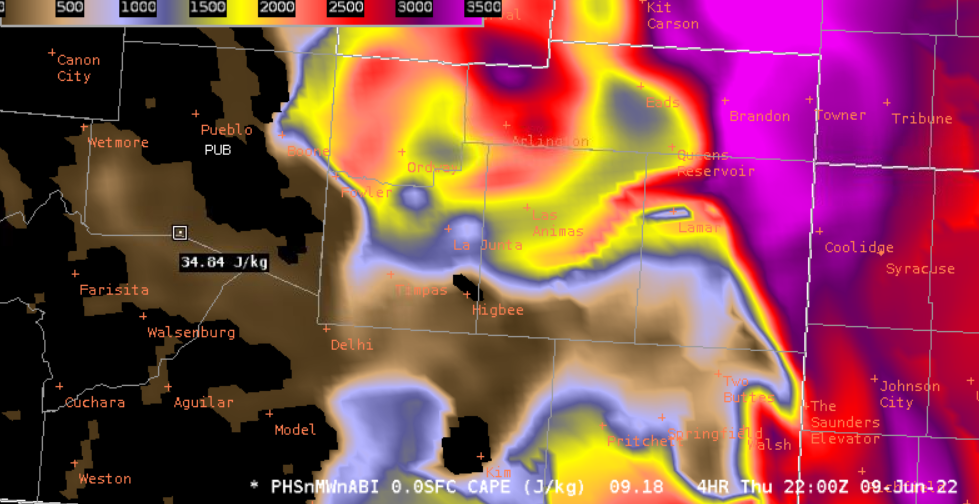
Today worked out well with PHS and NUCAPS. NUCAPS data came in shortly after opening up our work stations. We decided to compare the output between PHS, NUCAPS, and SPC mesoscale analysis. The variable that we chose was surface CAPE.
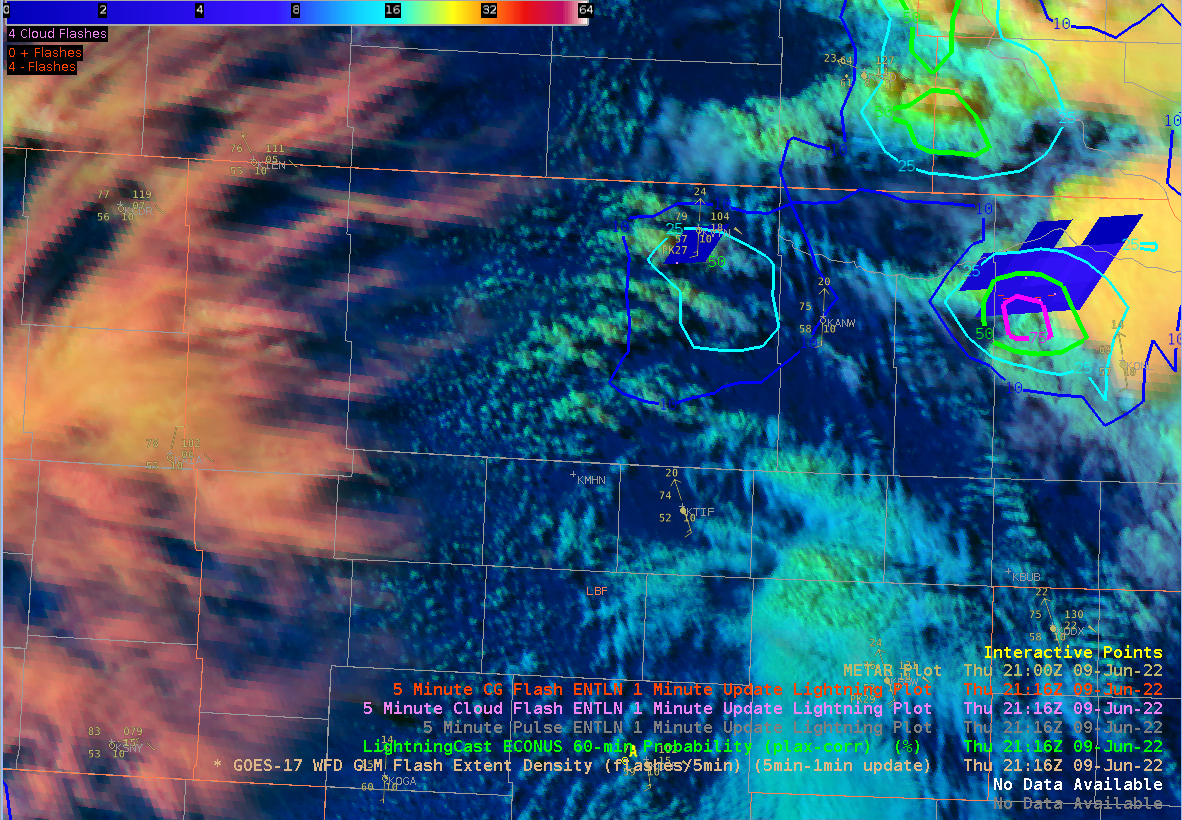
They all seemed to match up well highlighting the higher instability to the south that would gradually  push north this afternoon. It was definitely a confidence builder in each product to see the agreement between them.

Optical Flow

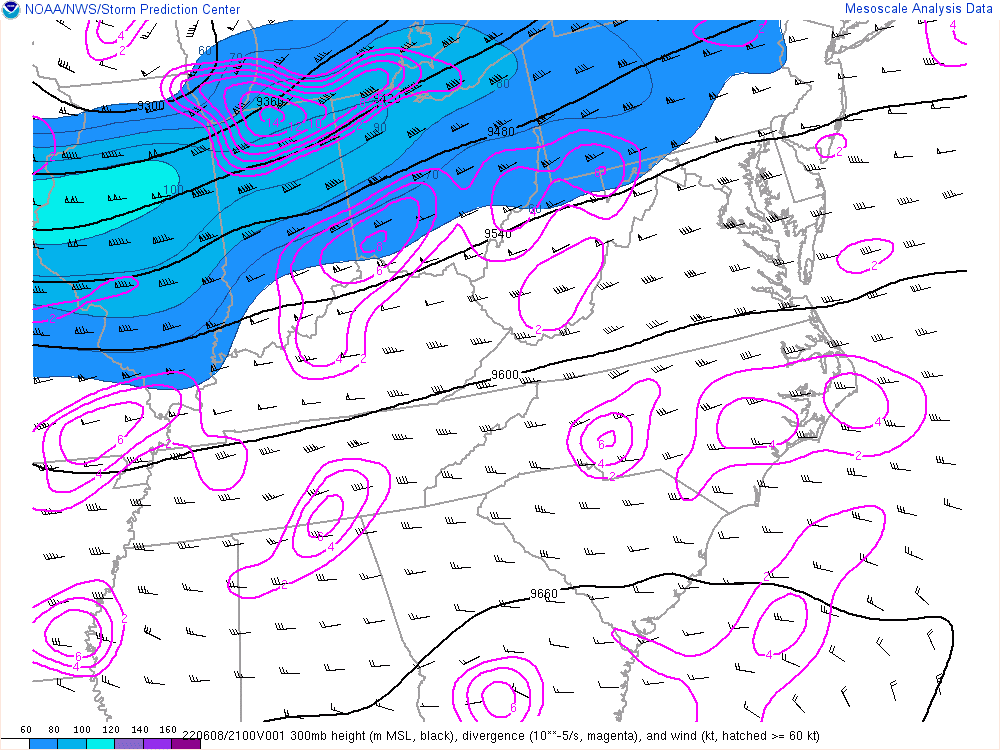
We also decided to compare the Optical Flow winds to SPC mesoscale analysis. Once storms developed a bit more, you can pick out a slight directional divergence signal in the flow. Looking at SPC mesoscale analysis there is also directional divergence is present in the mesoscale analysis.
Overall looking at these two examples, using these tools together can be a way to verify information and give the meteorologist more confidence (or less) in a specific product to help them with forecasts, DSS, and warning operations.

Prob Severe

We were able to compare Prob Severe V3 to the time when there was an observed report and when the new tornado warning came with a radar observed tag due to a CC drop. The first image is when there was a twitter report of a tornado around 2142Z in SE Darke county.

At 2144Z the Prob Severe V2 tornado jumped to 21% while V3 only went to 6%.

The next image below is when the radar confirmed tornado was reported.
– Noctilucent & Matador

PHS CAPE localized maximum compared with storms developing in the area

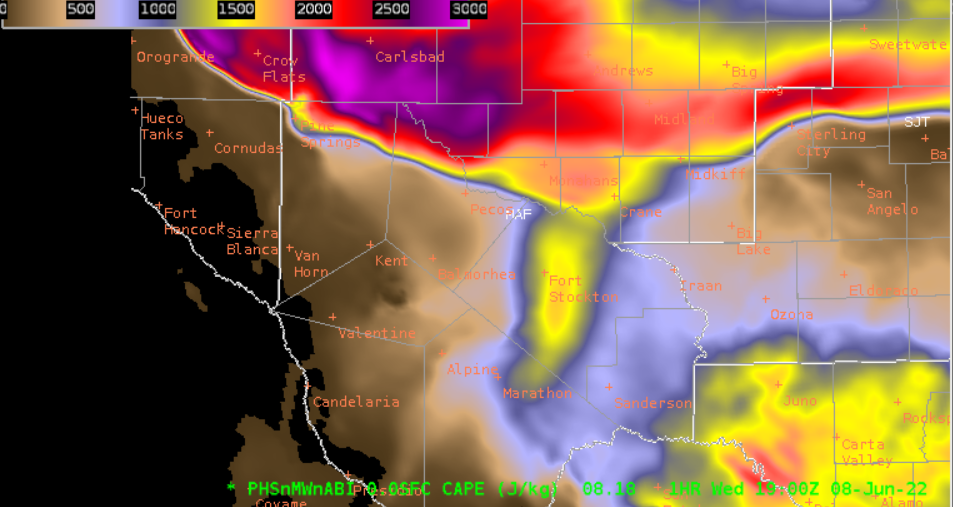
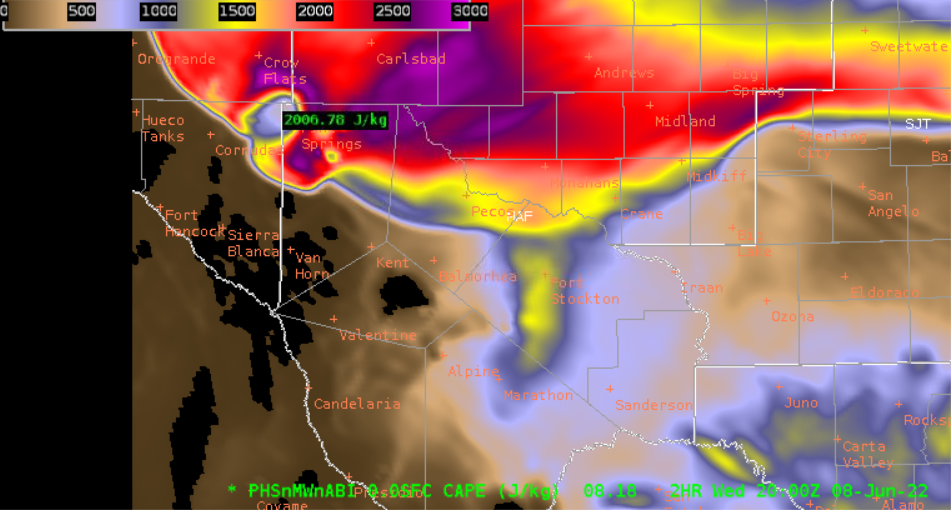
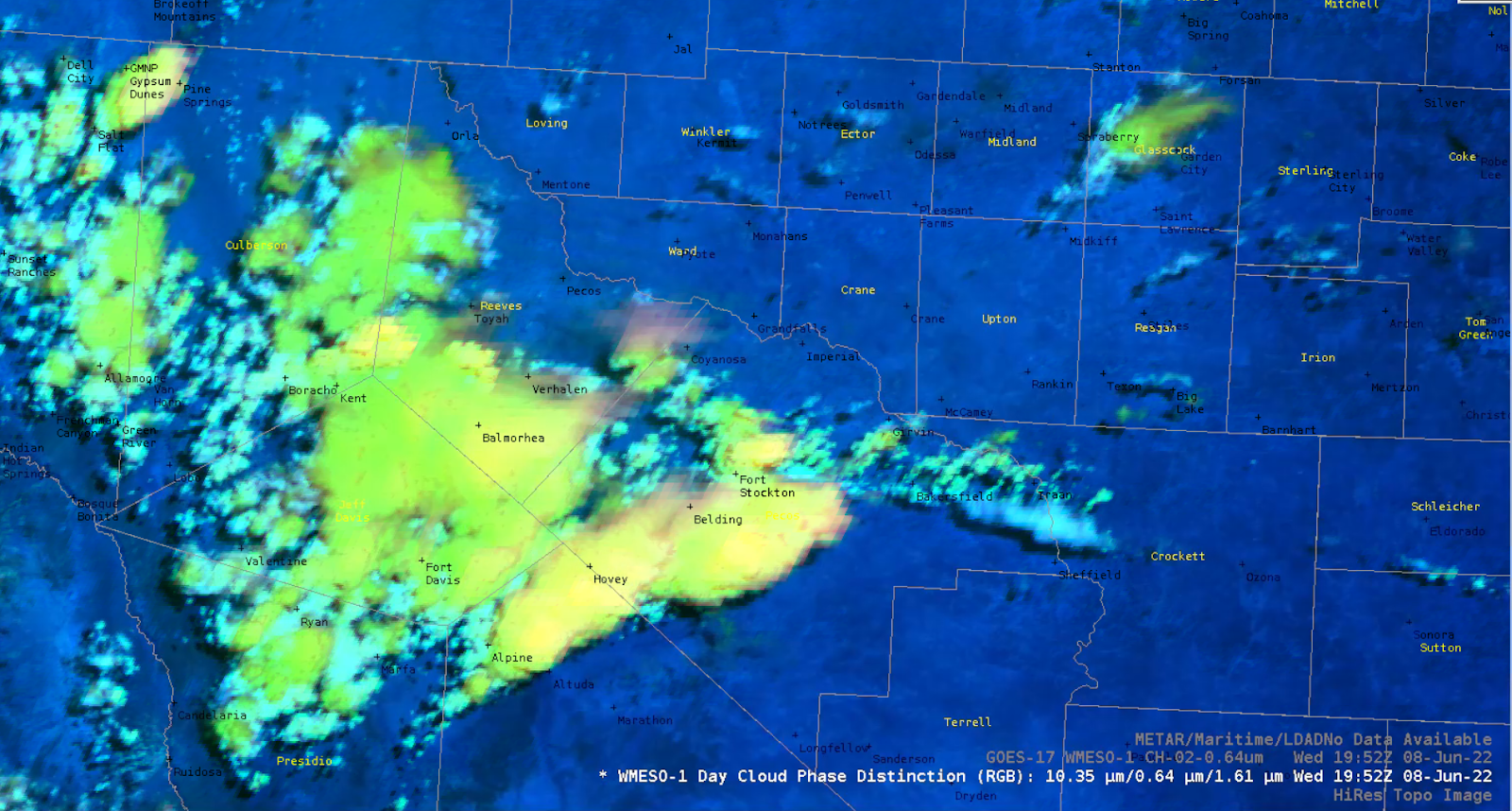
PHS CAPE values increase from north to south over Fort Stockton. This correlated well with RAP mesoanalyzed SB CAPE on SPC webpage. Storms actively going up along this gradient as an outflow boundary pushed south during the early afternoon from overnight convection over Oklahoma.

PHS CAPE 18Z 1 hour forecast for 19Z

PHS CAPE 18Z 2 hour forecast for 20Z.

Storms developing over Fort Stockton via Day Cloud Phase Distinction on GOES 17 Mesosector

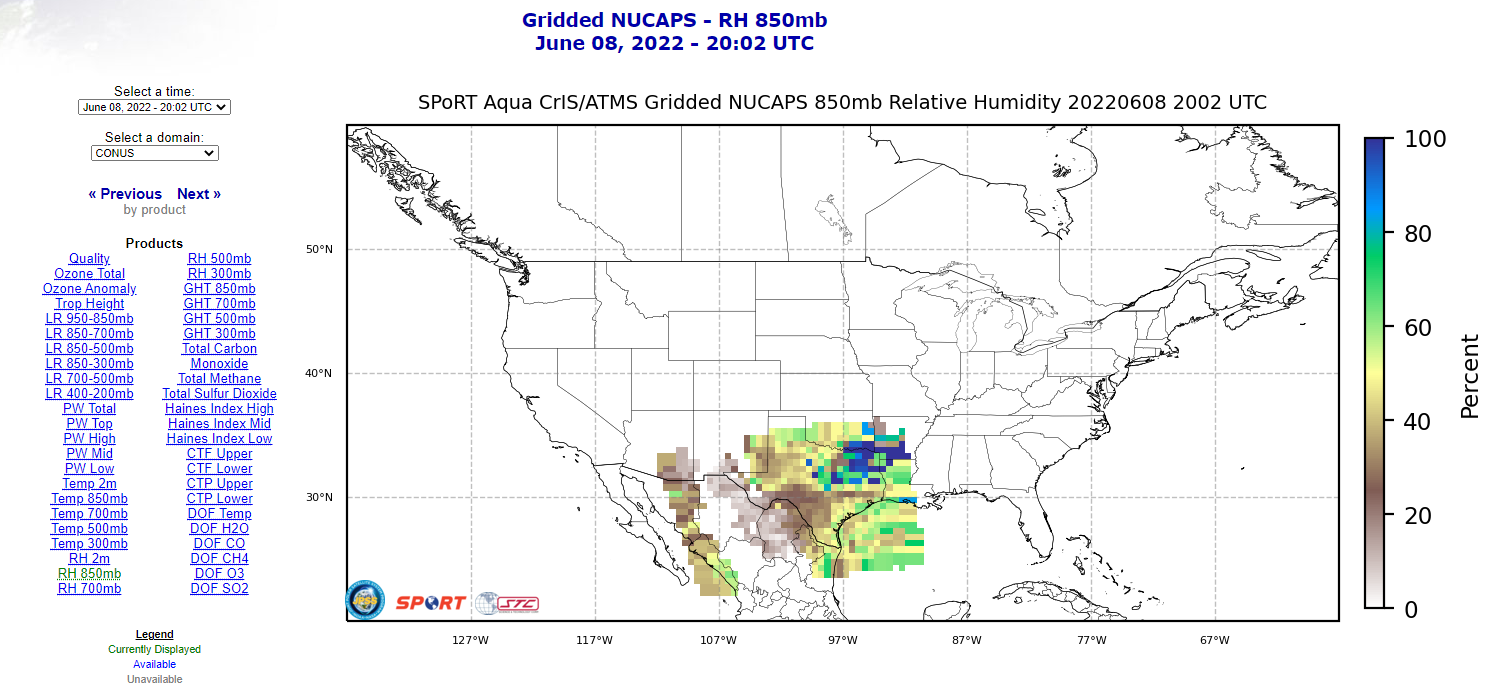
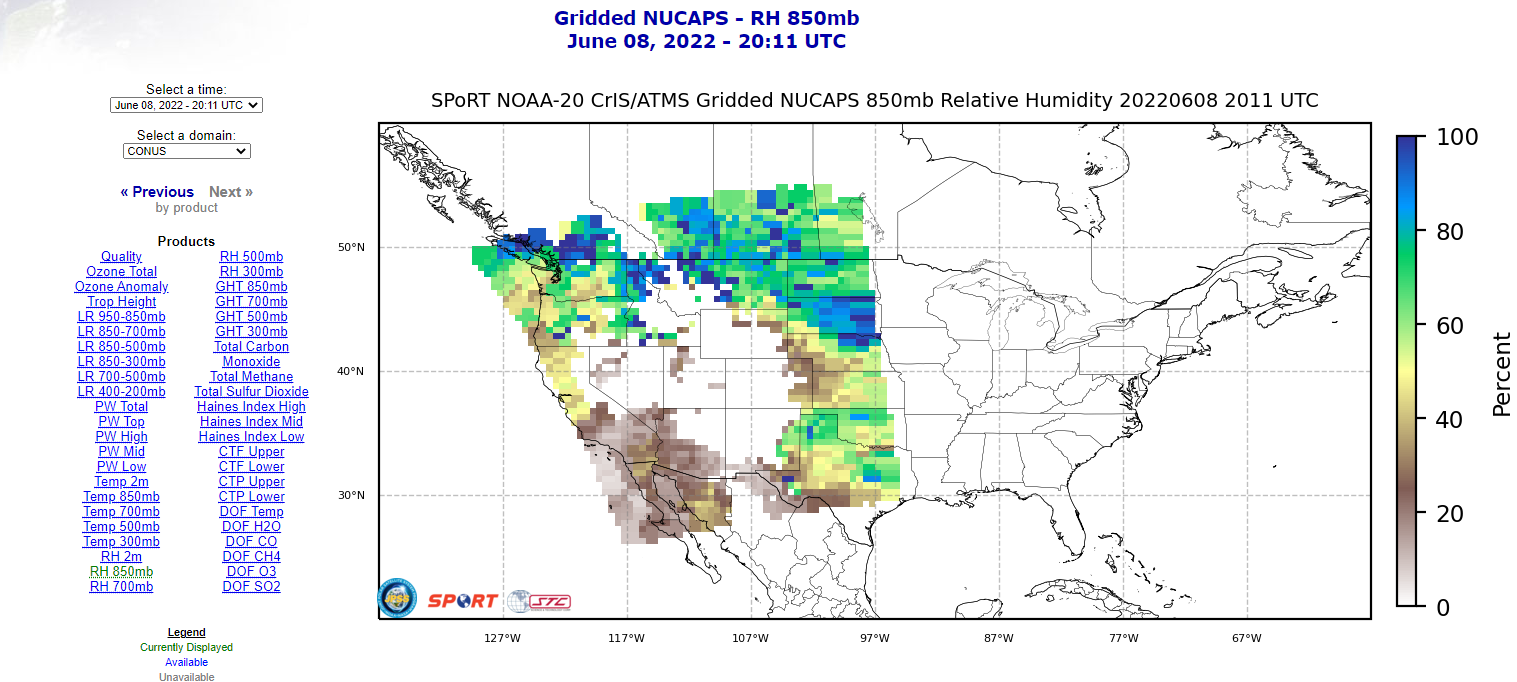
We showed above that the north side of the outflow would contain more instability – which is directly related to the moisture from the morning MCS outflow. The Gridded NUCAPS provides additional insight using the 850mb moisture fields from both AQUA and NOAA20 respectively – validating our hypothesis.

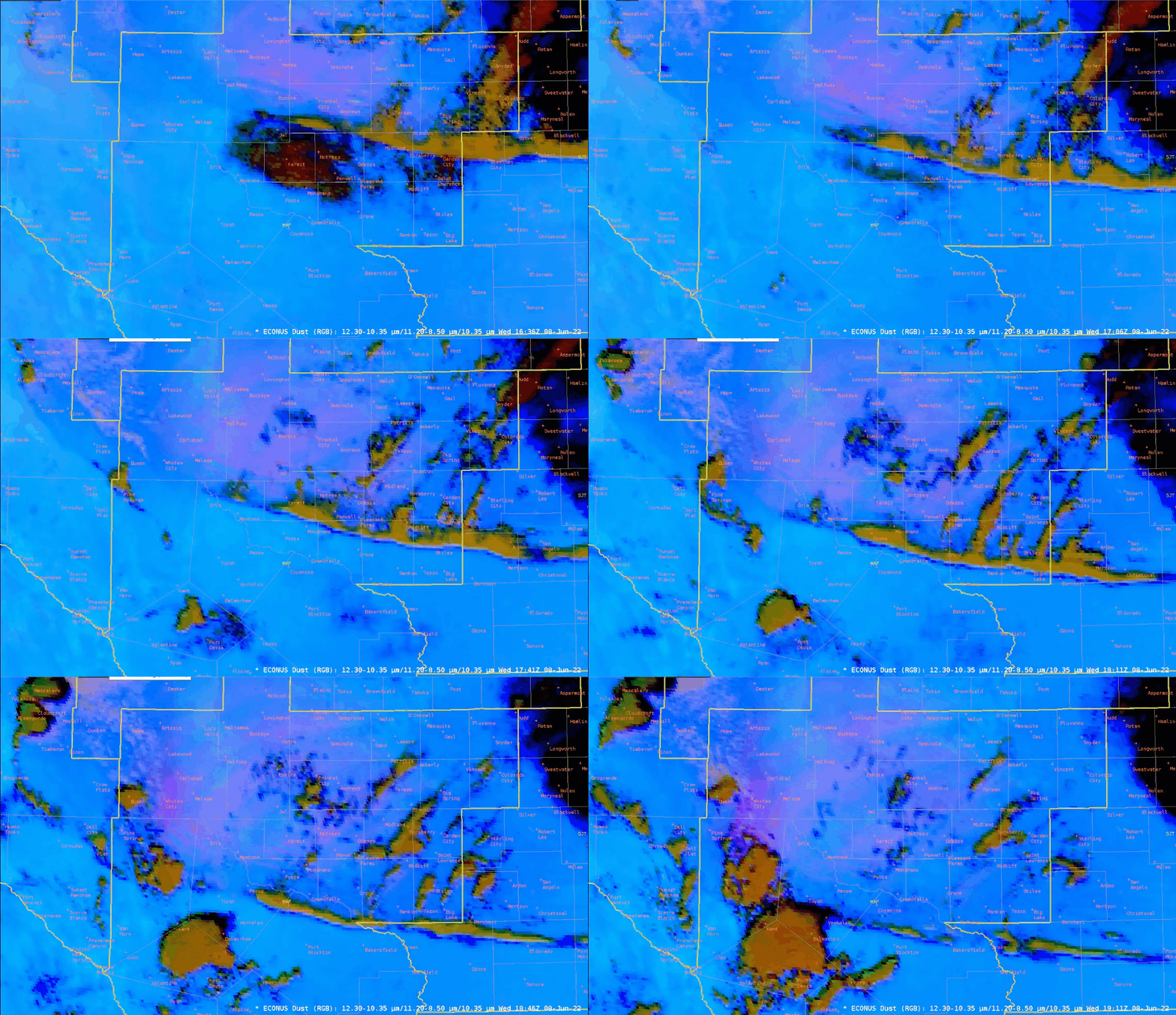
We double checked since there was a dust advisory/dust in the forecast and yes – Dust

Don’t warn if pop = 0

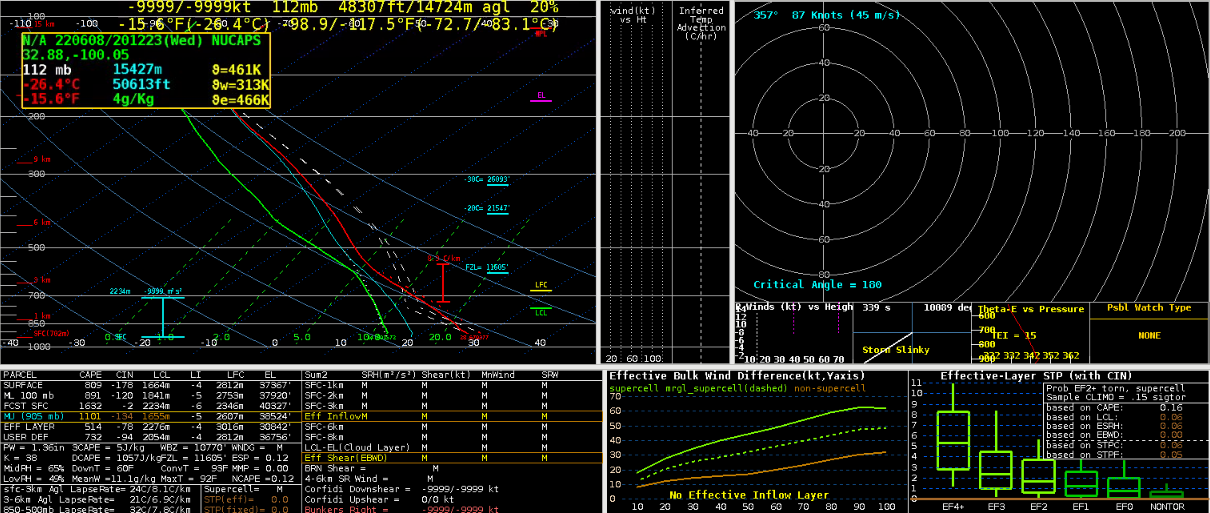
Convection was skirting the northeast portion of the CWA so we’ll use the recent pass of NOAA-20 to view the potential for convection redevelopment to the west and affecting the forecast in our CWA. Here are the Modified NUCAPS soundings:

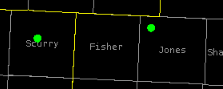
The top image is for the sounding in Jones county, below is Scurry – which shows a capping inversion still in place.

Storm Motion

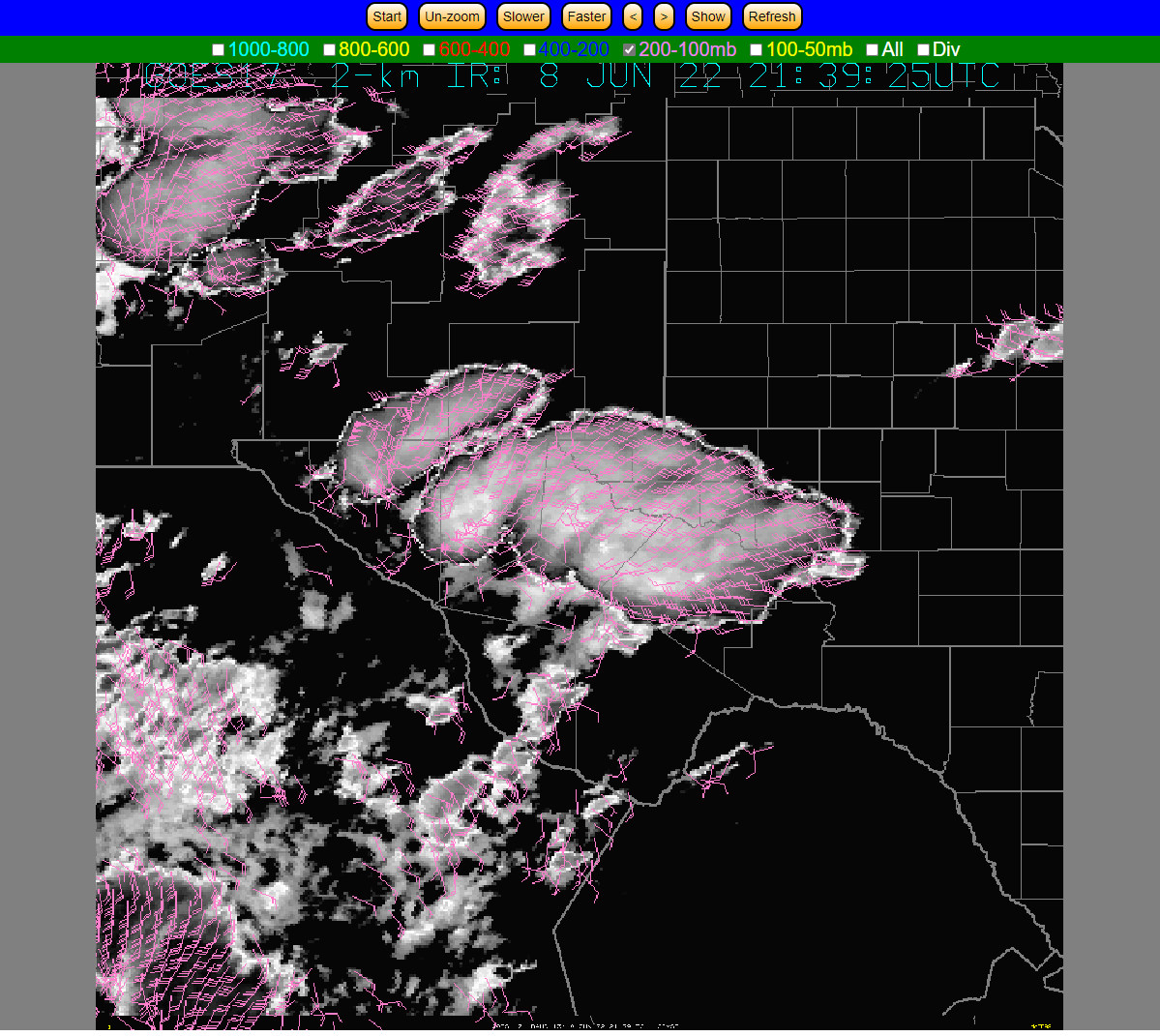
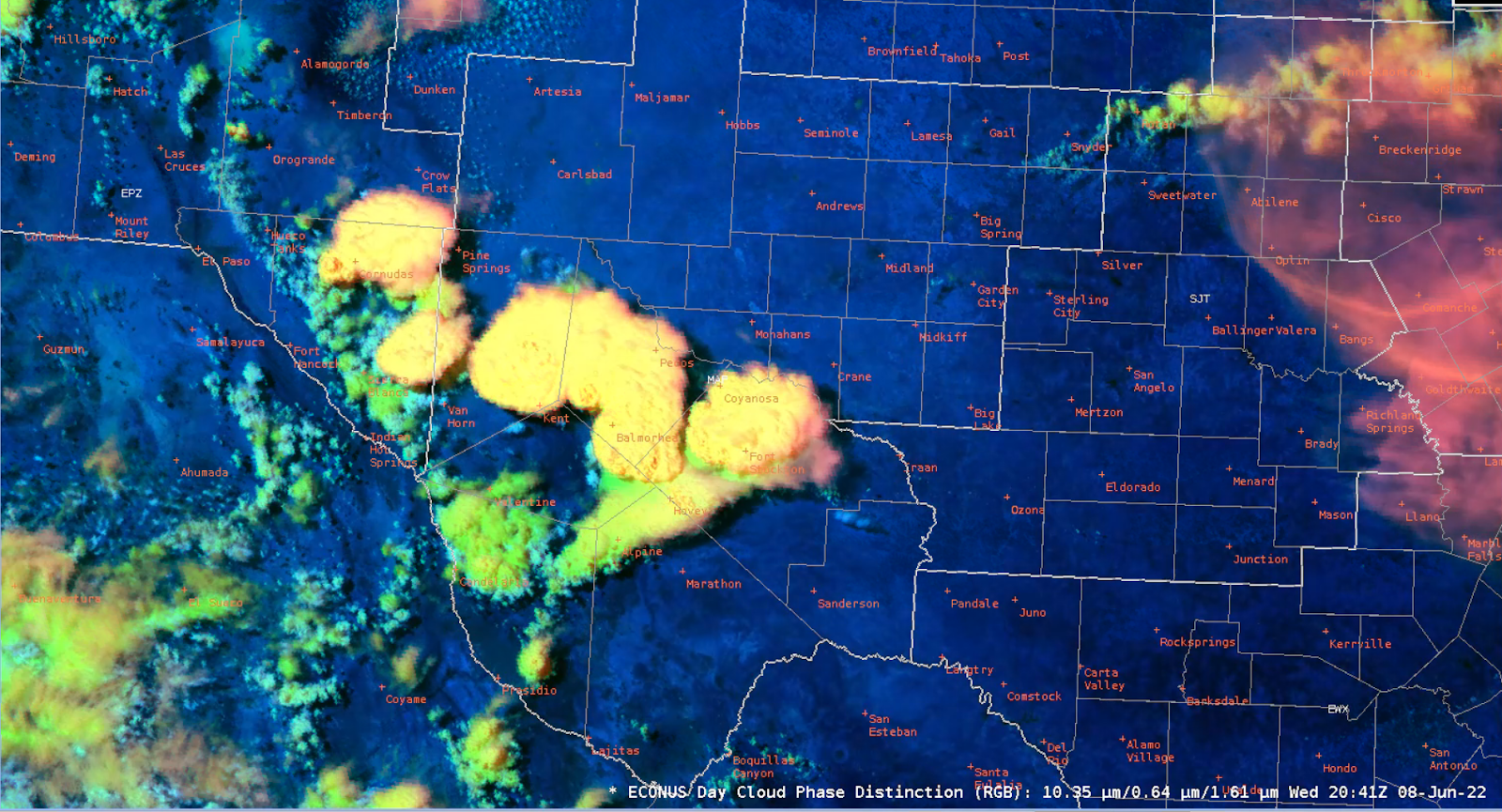
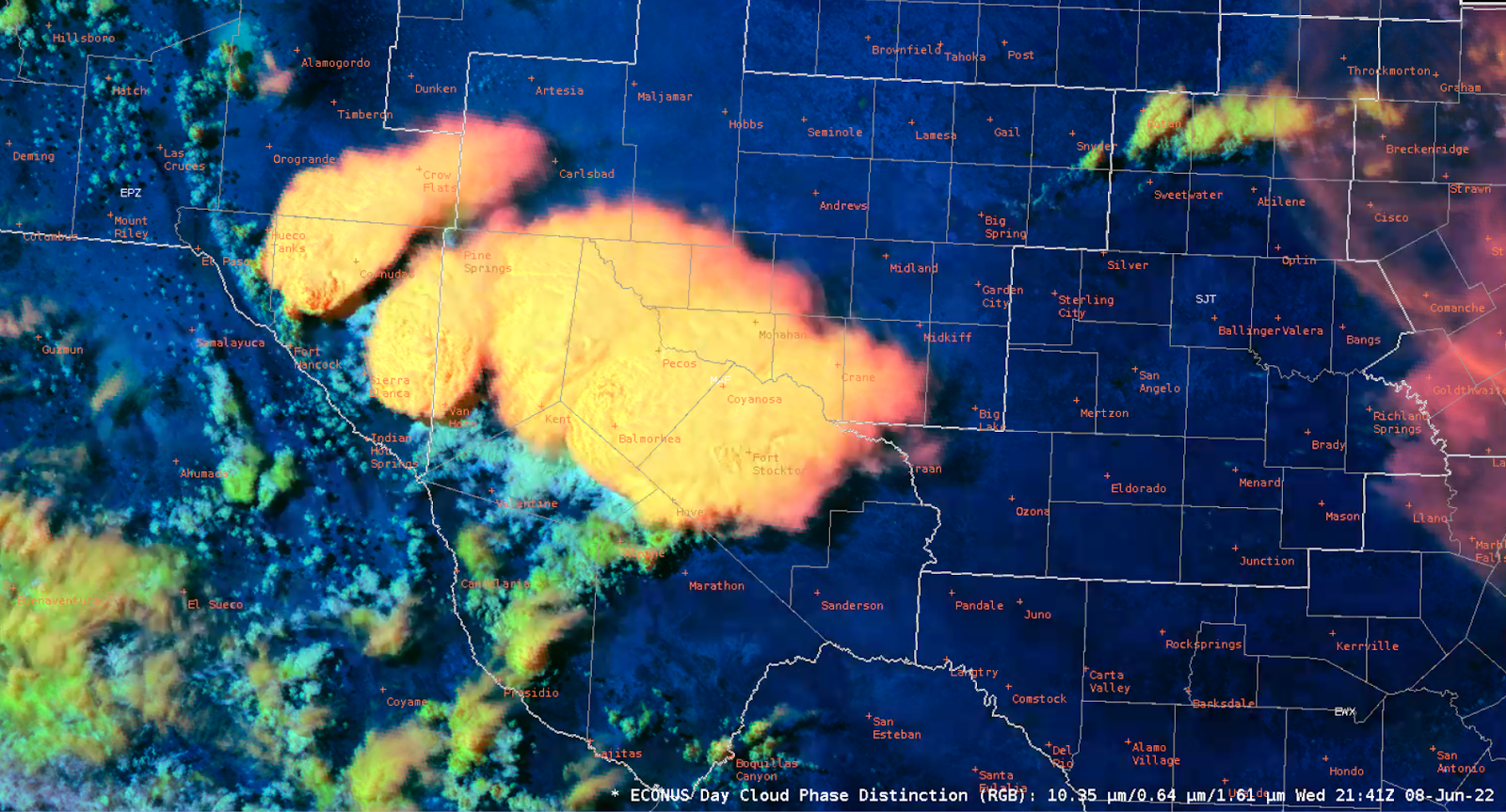
Weak winds aloft and throughout the atmosphere have contributed to very little in the way of storm motion. Hence, locally heavy rainfall may begin to evolve, even over an area that has received very little rainfall in the last 6 months.

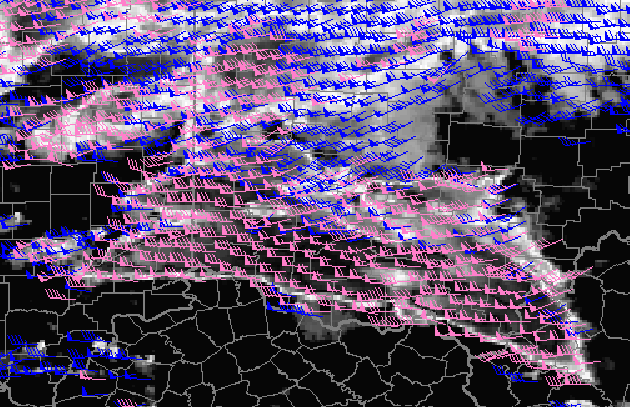
Optical Flow Winds in the 200-100 mb level.

Day Cloud Phase valid 2041Z.

Day Cloud Phase valid 2141Z.

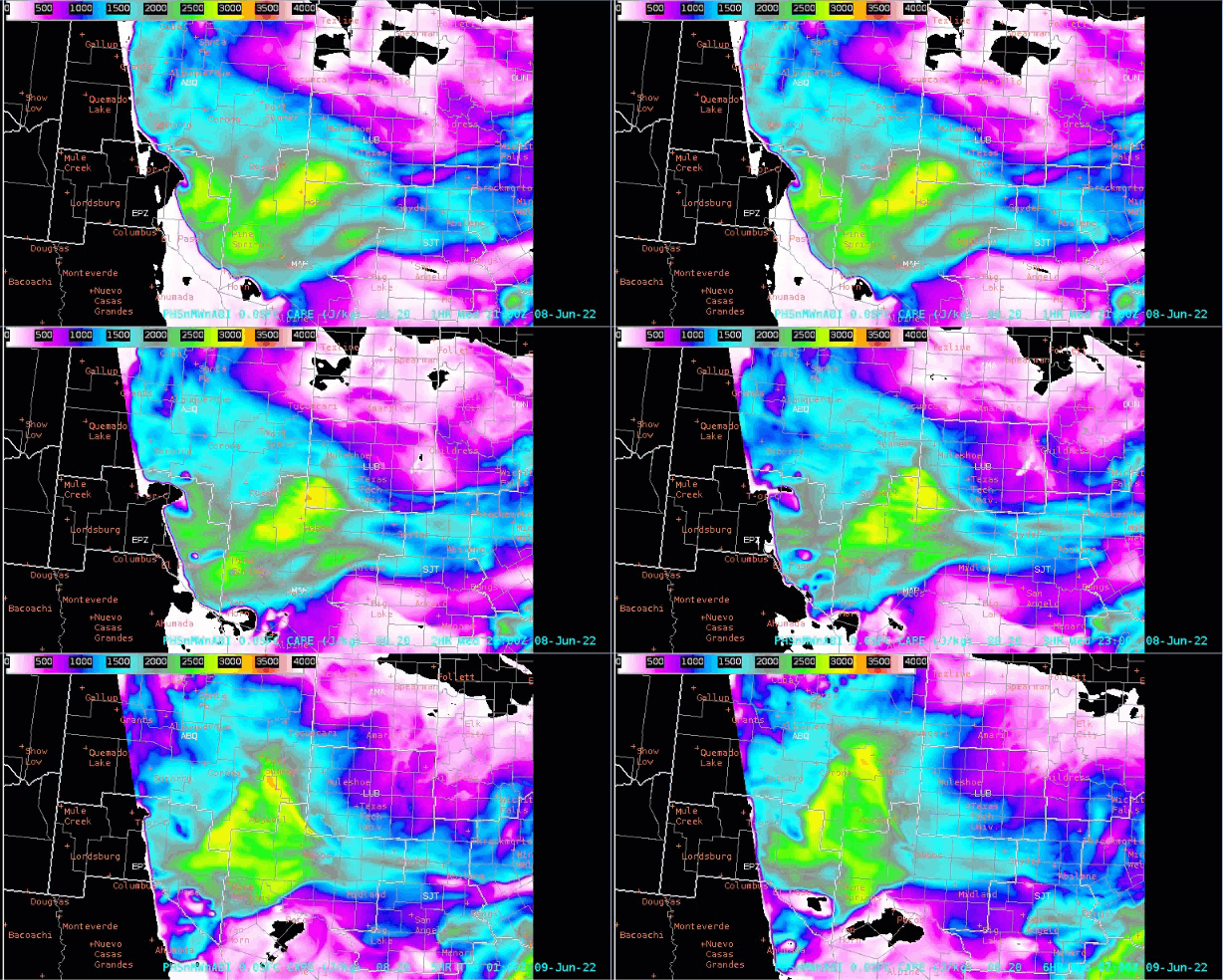
PHS depicts this plume of moisture and associated instability will back into New Mexico this evening. Could it play a part in tomorrow’s severe weather risk?

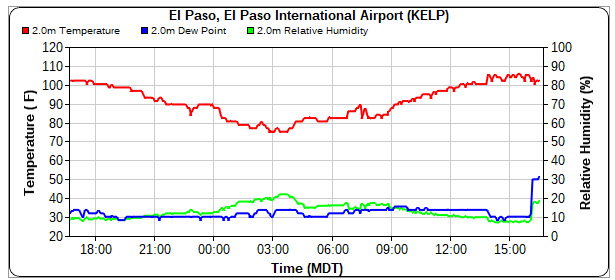
Here is what happened at El Paso when the front backed into the area – Dewpoint jumped from 30F to 50F

– David Spritz

– Mr. Bean