ILN HWT Blog Day 3

NUCAPS

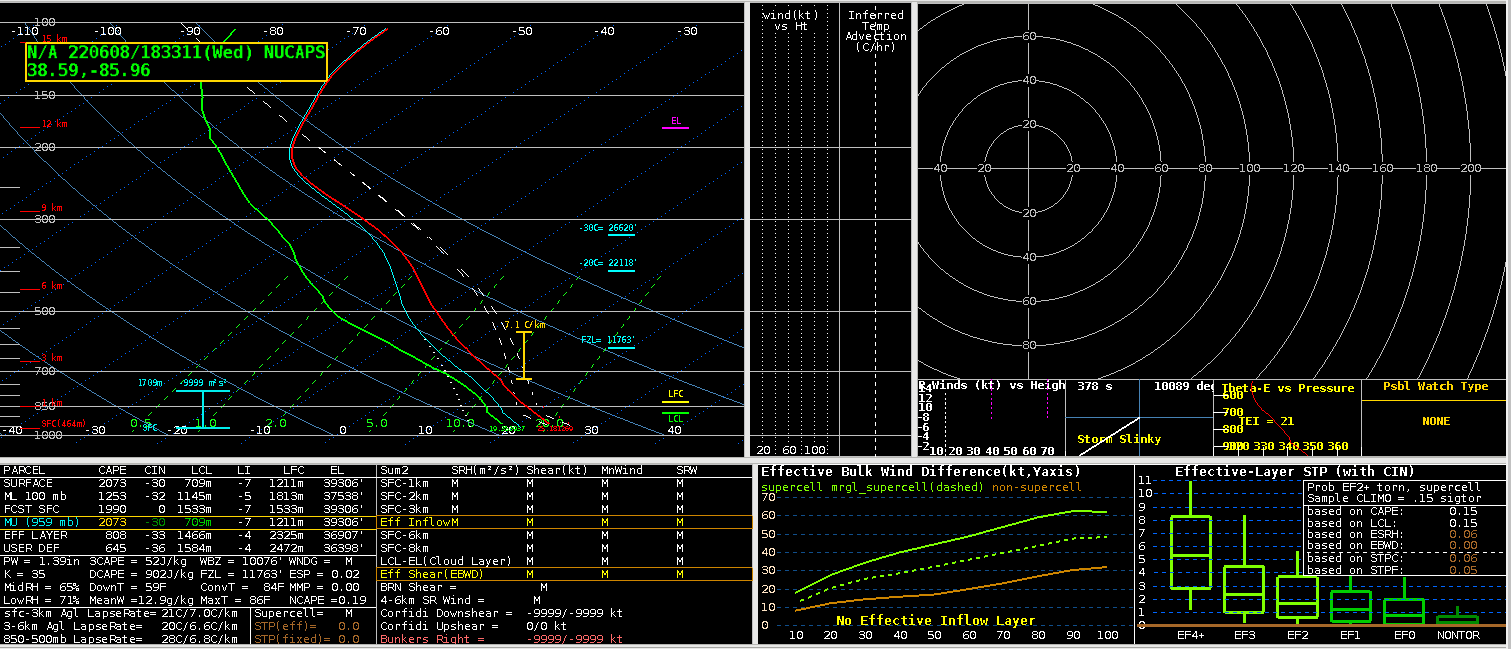
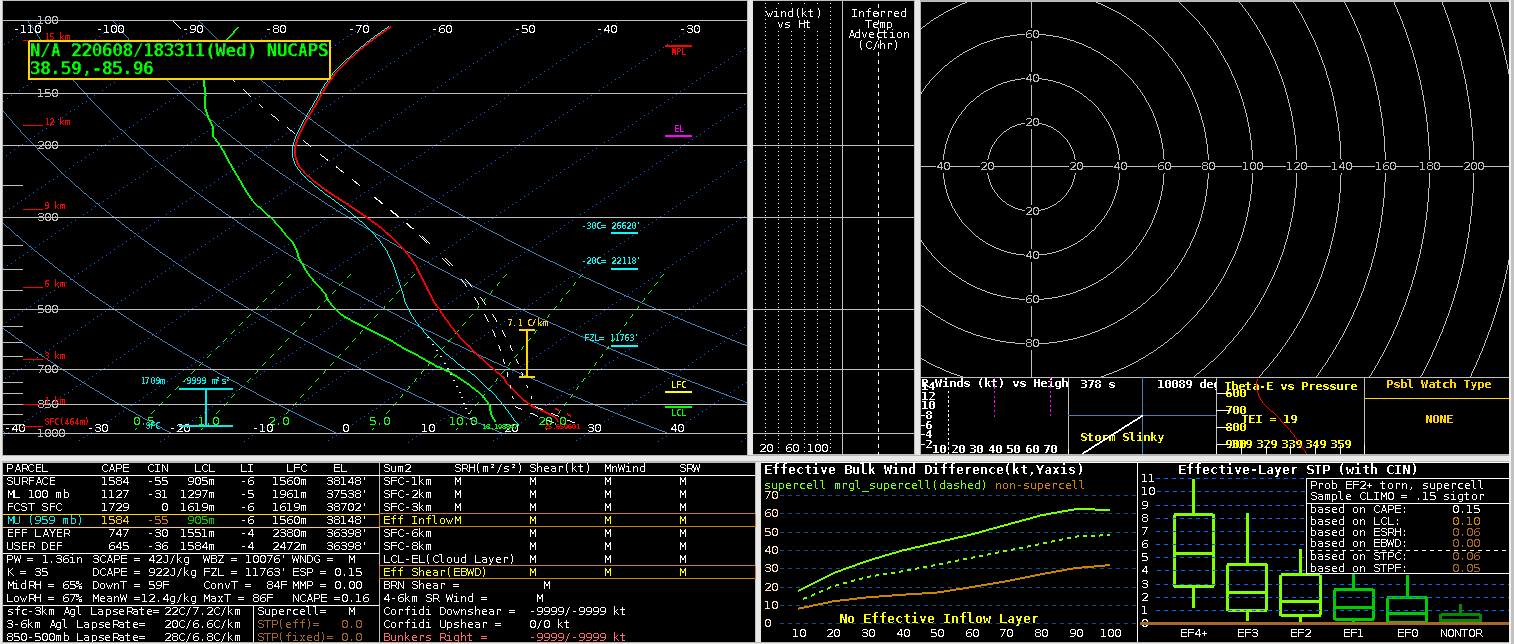
Did finally get a chance to check out NUCAPS for today’s case as the timing and location of the data was more compatible. It was good info ahead of the storms as it showed the low LCL values (mainly noticed in the modified soundings), below 1000 ft which is what you want to see for potential tornadoes. Overall, liked getting to dig into the NUCAP soundings, but given the finicky timing and data quality, it’s not something I could use on a regular basis for warning operations. Would be better suited for short term forecasting or possibly as the mesoanalyst.

GLM & LightningCast

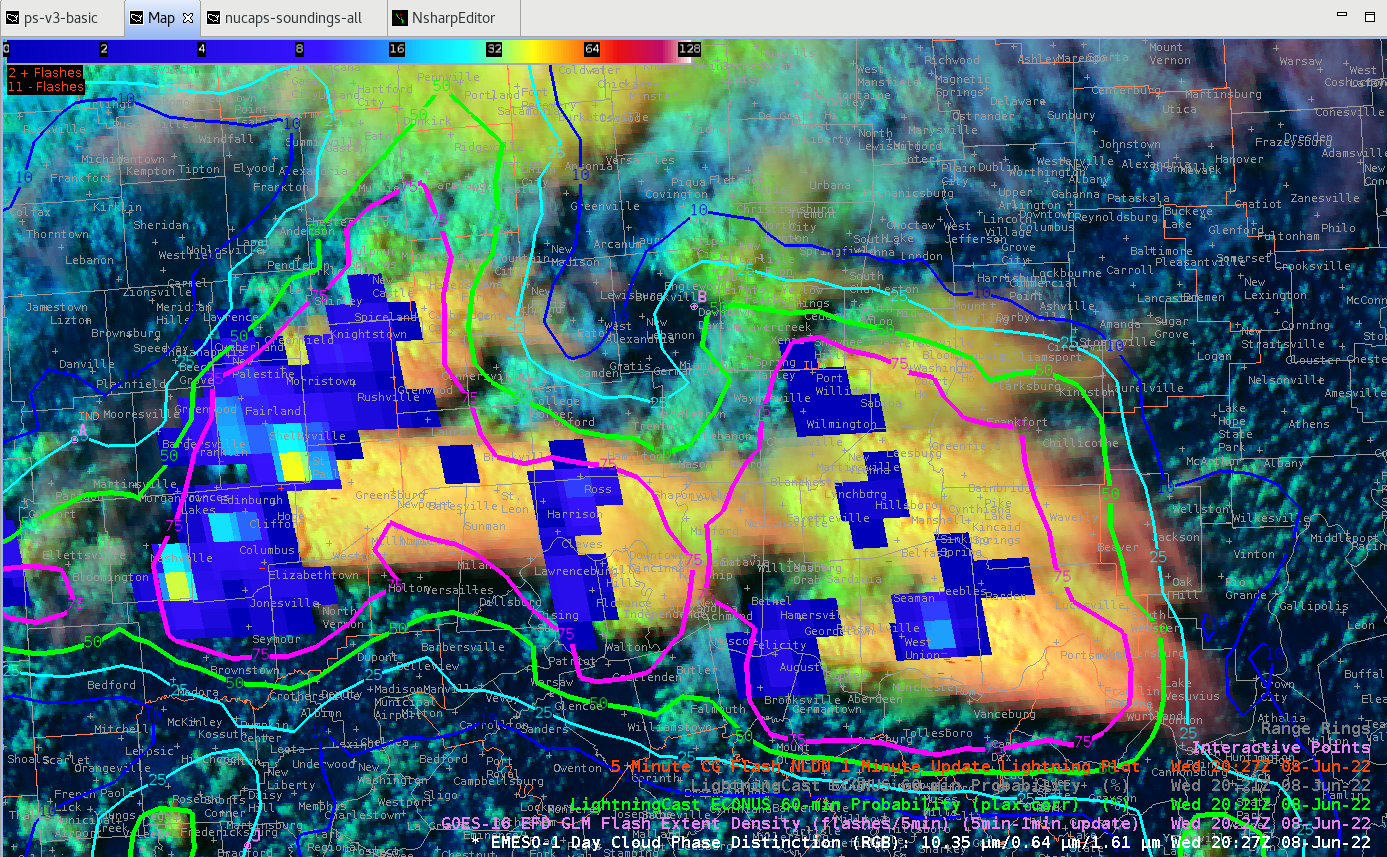
For GLM, I set the max value at 130. I originally set it to 65 as I had been using in the high plains the past few days, but for these midwest storms it seemed too sensitive. 130 was a good value for today, likely because of the larger and more numerous storms than I dealt with today versus the previous days.
Also tried out the parallax corrected LightningCast today. Liked that it gave a more accurate location when using it for a specific location such as today’s DSS event. While it was made to pair with radar, it was still useful when using it with satellite products – just had to take a few seconds to make the mental adjustments at the beginning.
PHS

Prior to entering the ILN CWA, the PHS STP showed an area of high STP values in and near Rush County, Indiana. The actual IND office did issue a tor warning for this area at 4 PM ET.
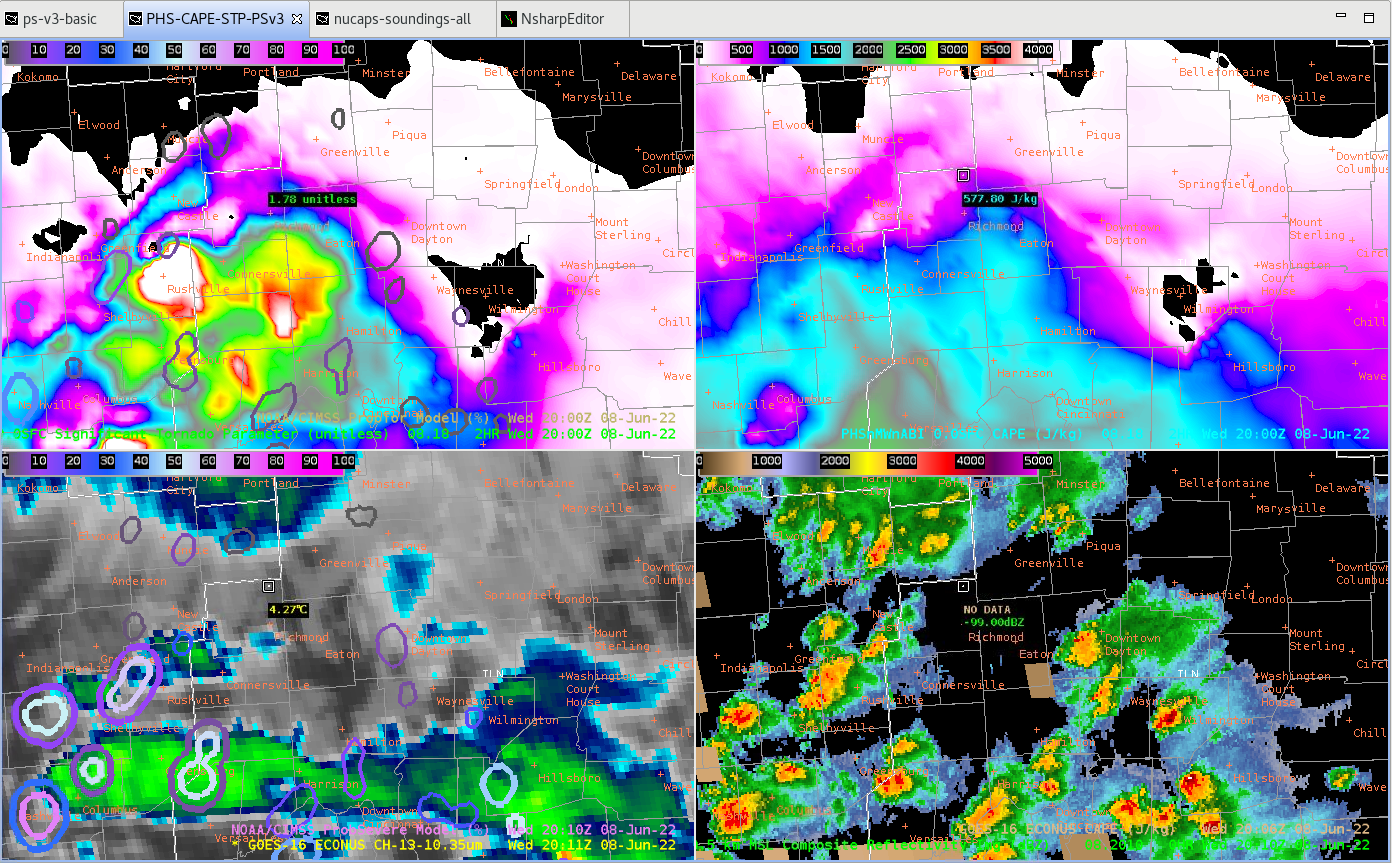
Over time, I did notice that for STP, really just the current hour and the next couple of hours were useful. Jumping to 3 or 4 hours ahead it seemed that the data was missing for areas I expected to see higher values. Once the next run came in and I went back and looked, the data was much better. For an example below, there was a vast difference for 21Z between the 18Z run and the 20Z run where the 18Z run for that time did not seem realistic but the 20Z run was more what I expected to see.
08.18 run for 21Z

ProbSevere

After talking with one of the ProbSevere people, was able to learn that the threshold for ProbTor is lower than that for Wind or Hail. For training purposes, it would be good to include this information to give a mental threshold for forecasters, such as an ongoing tornado would likely see a max of around 60% for ProbTor. It makes sense that the probs would be lower for tors just as they are for SPC outlooks where the tor percentages are also lower than that for wind or hail.
– Matador

GLM maxFED Comparisons


NUCAPS Sounding (IND 06/08/2022 2019 UTC)

Lowering maxFED values effectively highlights the area of strongest thunderstorm activity as seen in this example. This makes the strongest two thunderstorms (circled) more distinguishable from other thunderstorms, especially on the northern circled thunderstorm. It should be noted that this may be even more effective during the initiation to nearing maturity stages. Once a storm reaches full maturity, FED signal may be much higher.

– 2%hatched

Comparing NUCAPS Soundings along Warm Front Passage

NUCAPS Sounding (1832 UTC)

NUCAPS Modified Sounding (1832 UTC)

NUCAPS and NUCAPS Modified soundings displayed were along a warm frontal passage lifting south to north across southern Indiana. The modified NUCAPS sounding provided a more realistic depiction of the environment with higher levels of instability (CAPE and DCAPE). Furthermore, the LCL values represented in the modified sounding were lower; depicting an environment more favorable for tornadoes along the warm front.

– 2%hatched

Two Storms GOES 16 v 17

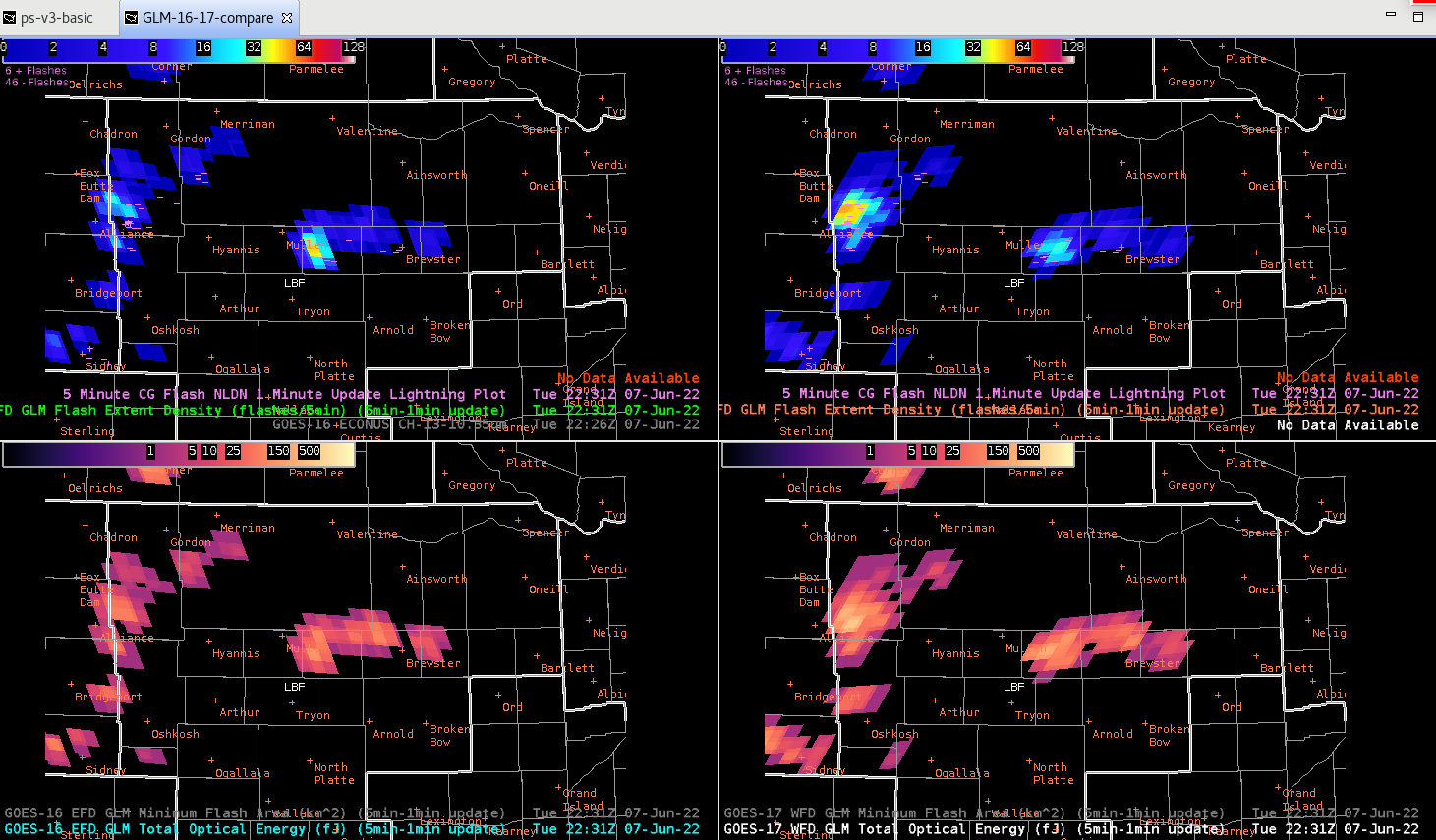
Being on the western edge in the North Platte County Warning area we did a comparison versus GOES 16 and 17 with the GLM Flash Extent Density. At first there wasn’t much of a difference, but when storms started to ramp up more and we had a decent eastern and western storm there was a difference.

As you can see our eastern storm shows up better on GOES 16 and not as good on GOES 17. Meanwhile the western storm there is a much greater difference in the Flash Extent Density (and Total Optical Energy) on GOES 17. This matches with what was stated at the initial discussion this morning that GOES 17 may work better with western storms.

-Noctilucent

Northeast Colorado Supercells

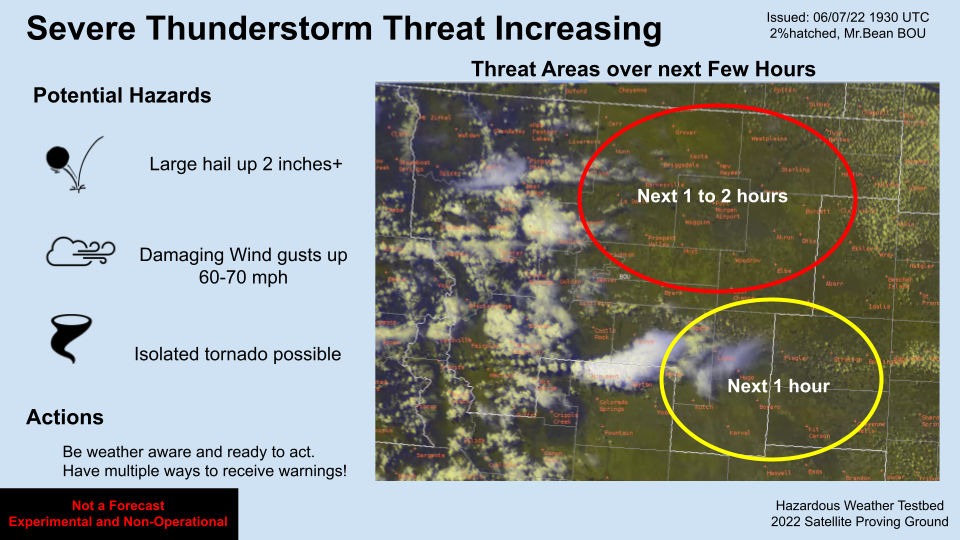
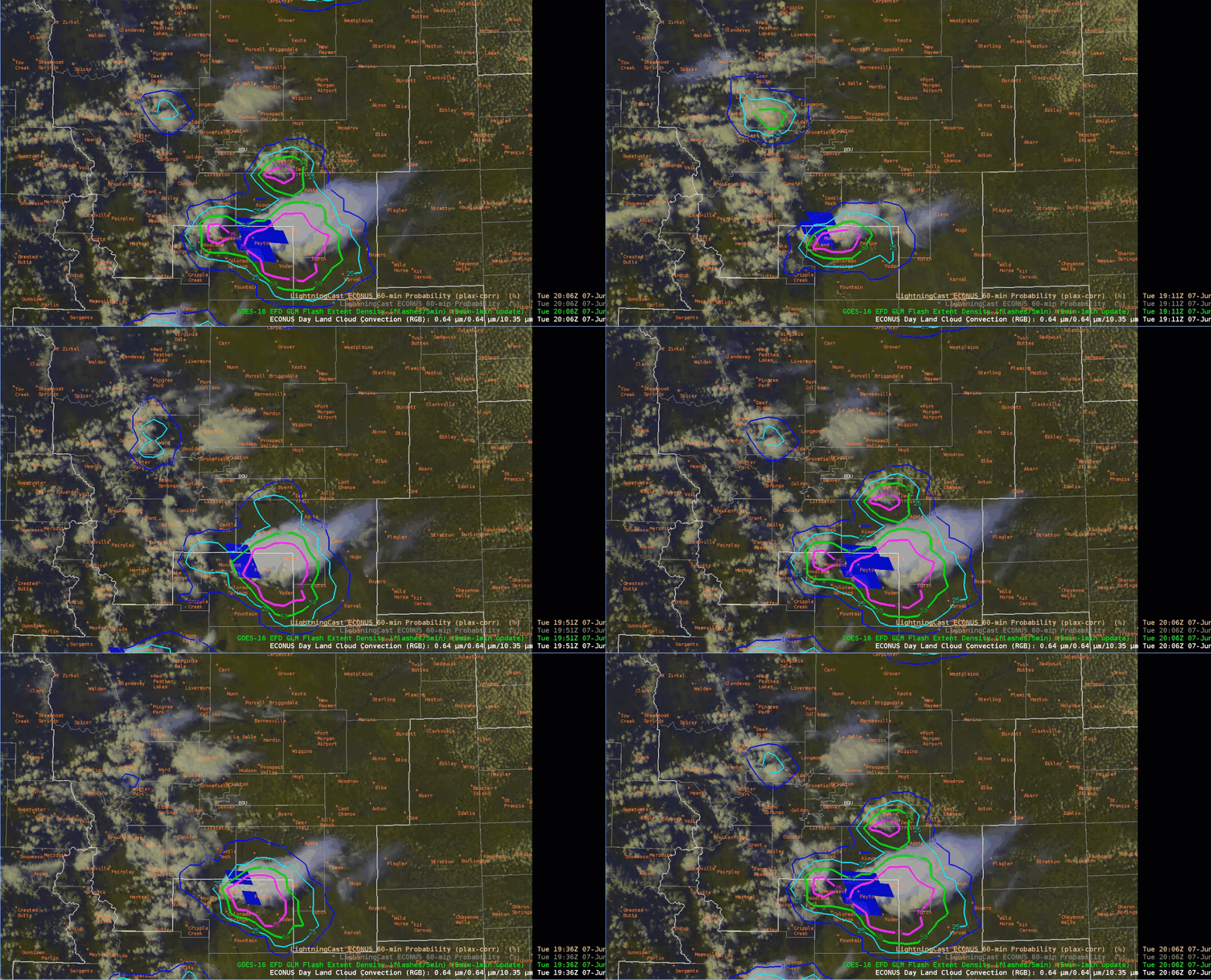
Nowcasting Supercell storm entering CWA: The loop of instability and SigTor highlight the southeast/south central CWA east of Colorado Spring, ahead of an already ongoing storm. North of this storm an environment of favorable instability exists up to about the latitude of Denver, with a significant drop off to the north.

When it comes to high and northern plains – parallax becomes an issue. In this case lighting was occurring just on the other side of the border with the CWA, so here are the two LightningCasts (with/without parallax correction) for comparison:

ProbSevere v3 increases correlating to entering a favorable environment

PHI localized CAPE corridor

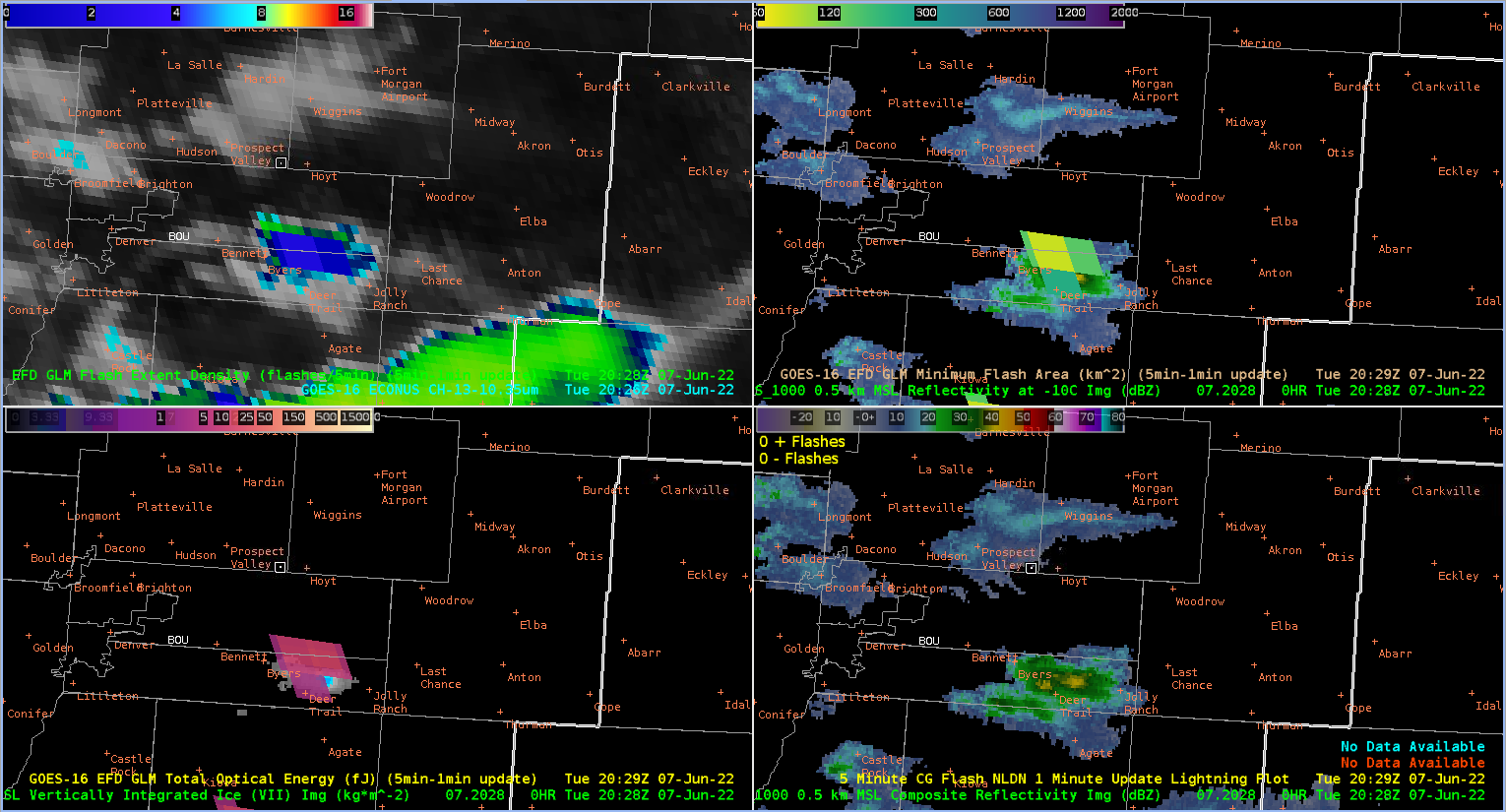
New area of MFA suggesting spitting storm with new updraft core of the established cell. (1950 UTC)

Storm cell split denoted by MFA with two distinct areas of MFA in upper right panel. (2000 UTC)

Focused on the cell east of Denver – this cell and subsequent others that developed are in the favorable area of instability. Just to the north of Boulder we spotted a few cells that attempted to develop, however in the lower instability environment movement off the higher terrain resulted in these cells falling apart. Through the rest of the afternoon this area remained convection free.

Sig Tor blip. A SRVE like feature was observed but at this time convergence associated with this feature wasn’t favorably located under the updraft.

Cell developing east of Denver, noted by the MFA  in the upper right panel. (2020 UTC)

Cell rapidly develops in an area of localized higher instability denoted by the PHS values discussed earlier on.(2034 UTC)

The LightningCast has identified the left turning nature of the storm(s) east of Denver

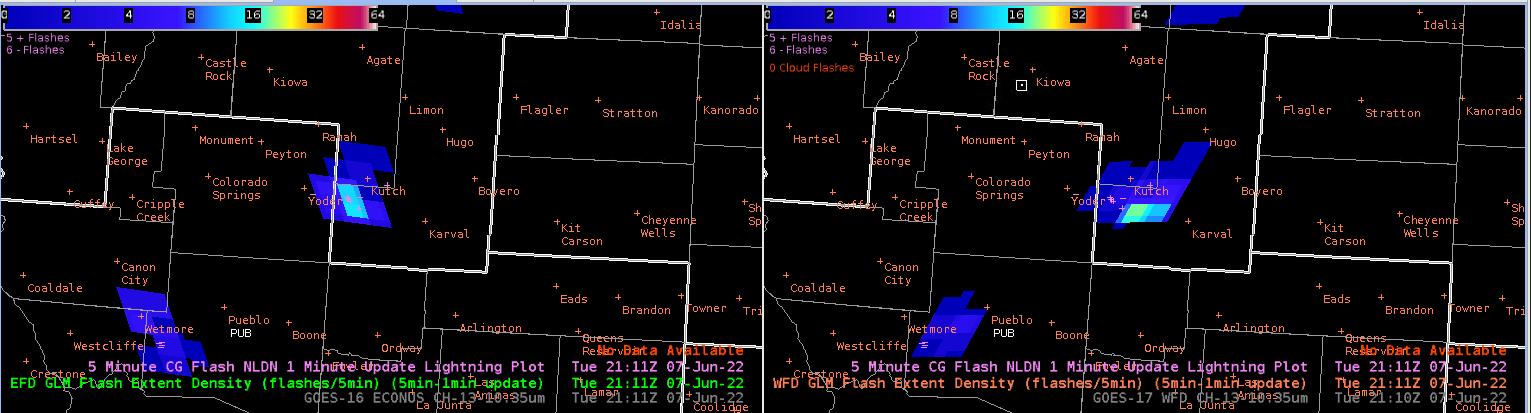
An interesting note was comparing the differences between GOES East (left panel) and GOES West (right panel). These subtle differences can  be effective in analyzing the strengthening of a thunderstorm.

In the middle of METWATCH – NUCAPS became available (about 1 hour latency). The sounding below is a modified NUCAPS profile, depicting the environment in which our storms developed. Storm mode was supercellular with frequent spitting of cells.

-Mr. Bean

-2%hatched

CYS HWT BLOG Day 2

LightningCast for storm approaching Scottsbluff

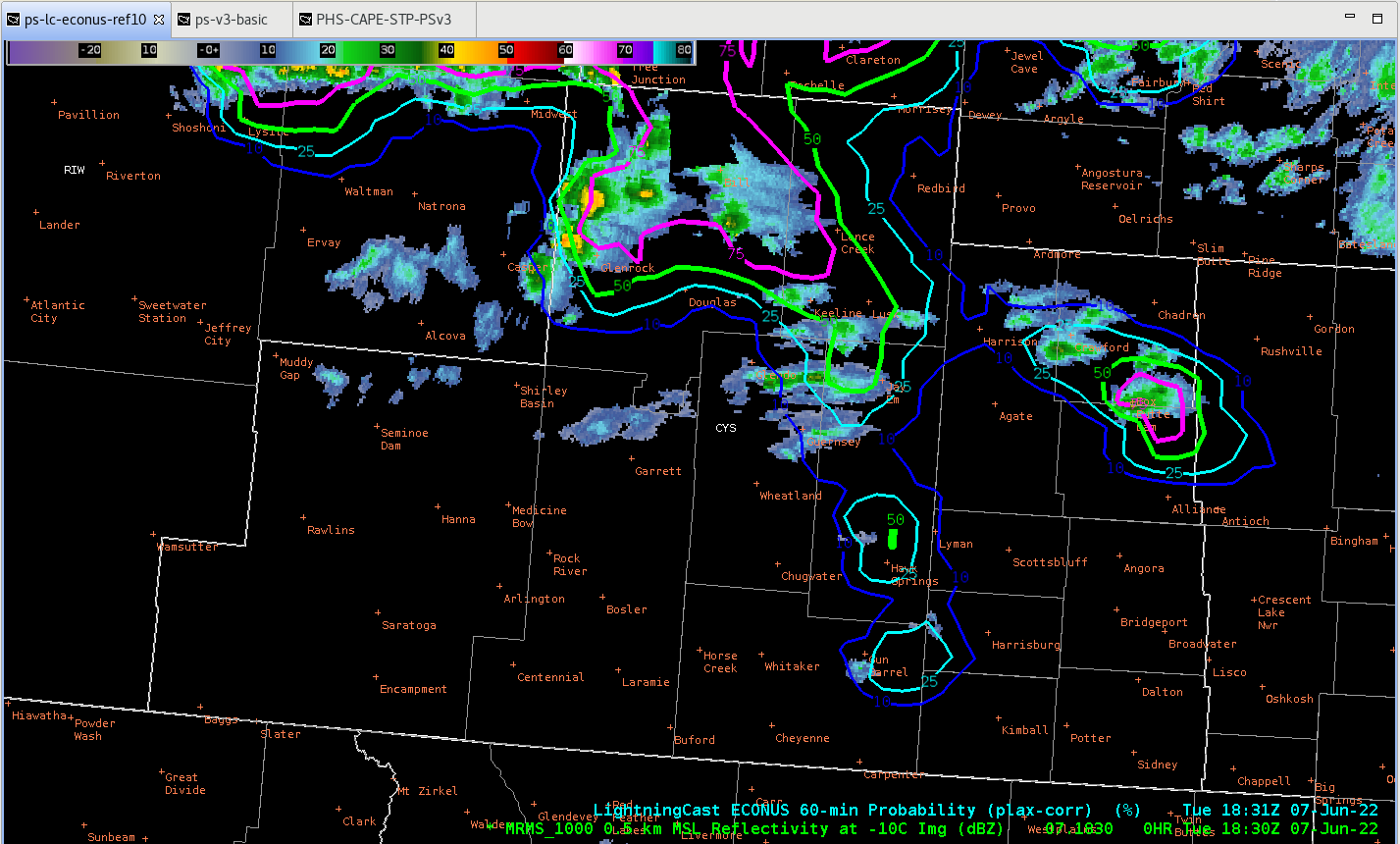
First instance of 50% contour 1831 Z
The lightning cast did build before backing off for a few frames, dropping below 50%, but jumps back up above at 1851 Z. From then until the first flashes of lightning, the probabilities continued to increase.
First instance of 75% contour 1906 Z
GLM denotes flash 1915 Z
So, lightningcast was able to indicate well ahead of time that we needed to keep an eye on that storm for lightning production as it approached the city.

GraphiCasts with ProbSevere and PHS

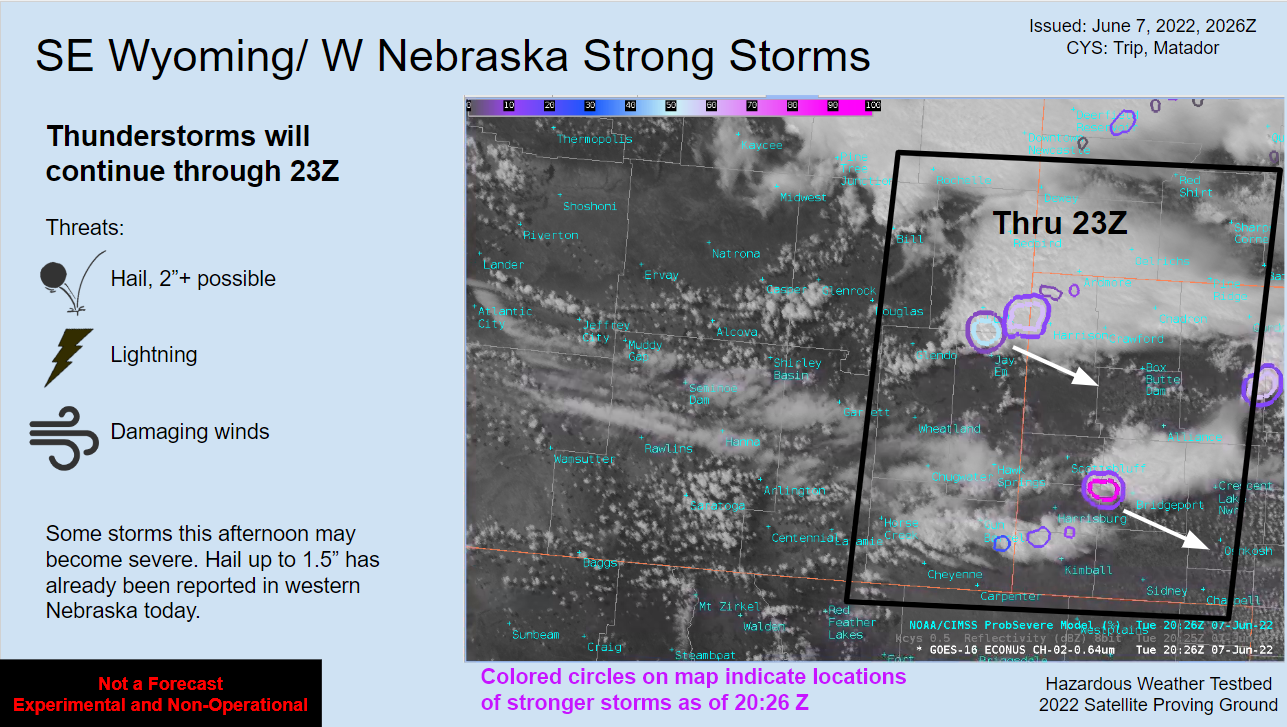
For today’s GraphiCast, decided to overlay ProbSevere V3 over visible satellite data to indicate the location of the stronger storms amongst all the clouds. The concern with using it for public graphics is whether the public will understand it. Went with a brief description that it indicates stronger storms for today, but would be curious to see how others message what probsevere means and then how the public may respond to it. I do like how it clearly shows the cells to watch out for.
To determine the time that storms would continue through, I only used the hourly PHS data which dropped off at 23Z. The images below show 20Z PHS vs 23Z. This timing for storms ending for the CYS CWA worked out well as the strong to severe storms exited the CWA by 2256Z with only a few isolated showers remaining for a short time afterwards.
20Z:
23Z: 
– Matador

GLM – GOES-16 vs GOES-17

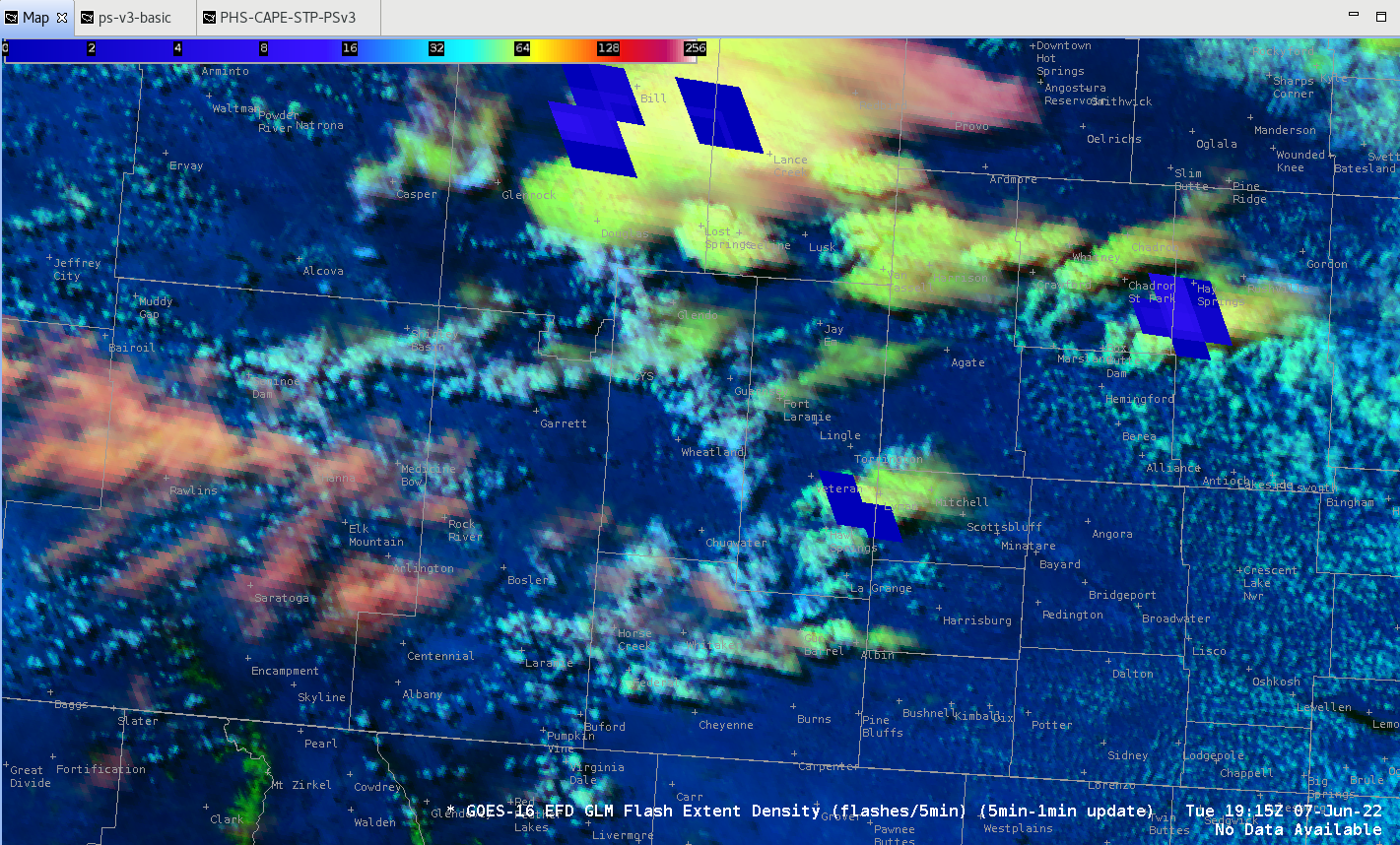
Differences between the GLM Flash Extent Density products from GOES-16 and GOES-17 were quite stark for convection occurring over the Cheyenne, WY CWA on June 7th.
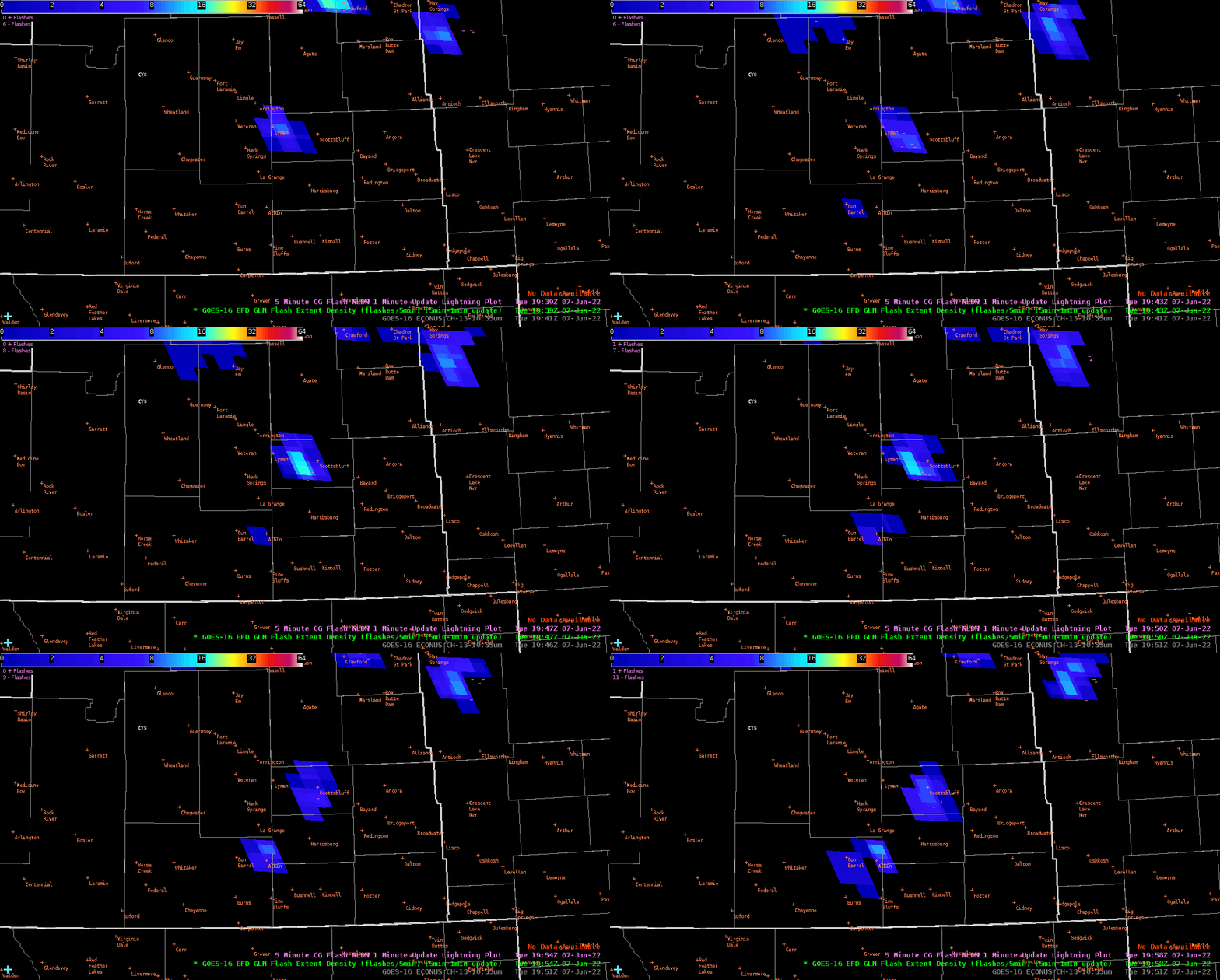
The two animated gifs below highlight the difference in lead times for an observed uptick in lightning activity within a cell near Scottsbluff, NE. The first animation is of GOES-17 showing the uptick in lightning activity beginning at 1939Z. The second animation from GOES-16 shows the same uptick in lightning activity, except beginning ~5mins later at 1945Z. Interestingly enough, both satellite perspectives show the downtrend in lightning activity occurring at 1950Z.

GOES-17 GLM FED Scottsbluff 5-min improved lead time.

GOES-16 GLM FED Scottsbluff

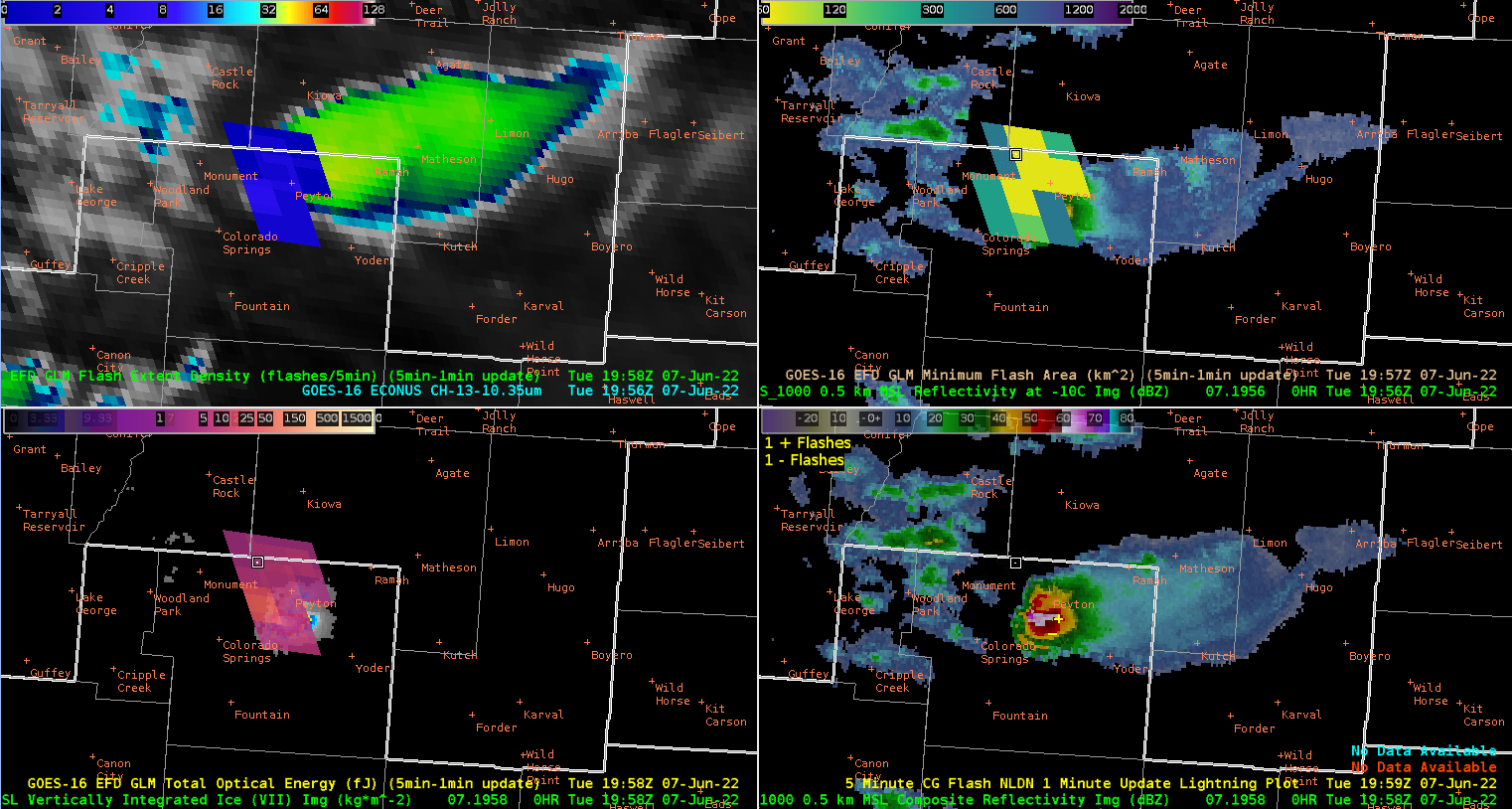
The next three examples show sharp contrasting GLM FED intensities between GOES-17 and GOES-16 through the afternoon of June 7th. This first example focuses on a warned supercell just southeast of Scottsbluff, NE at 2022Z. The first image shows FED from GOES-17 showing much higher FED numbers, while the second image shows FED from GOES-16 not indicating any increased lightning activity. The third image shows a 4-panel layout of MRMS, MESH, VIL, and ProbSevere version 3 all supporting a supercell occurring. A subsequent report of 1.5” hail was observed from this warned storm.

The cause of this was shared from the investigators running the HWT this week, that GOES-17 had the better angle to see lightning activity in these supercells developing over the high plains of WY and NE. Whereas GOES-16’s perspective from further east had to punch through spreading anvils downstream of the main updraft that likely obscured the light emanating from the lightning, GOES-17 had a more side-on view of the updraft with less to no obscurations of light emanating from lightning occurring in the updraft. Unfortunately, GOES-17 CONUS view and the day’s mesosector from GOES-17 did not reach this far east and there are no satellite images displaying the different parallax views from GOES-16 and GOES-17.

GOES 17 GLM FED @ 2022Z “Scottsbluff Cell”

GOES 16 GLM FED @ 2022Z

MRMS – MESH – VIL – PROBSEVEREv3 @ 2022Z

1.5” hail report from this storm. Max MESH reached 2”.

The next two examples below each showcase three images each, a GOES-17 FED showing higher intensity lightning activity, a GOES-16 FED missing the higher intensity lightning activity, and a 4-panel layout showing MRMS, MESH, VIL, and ProbSevere version 3 highlighting the severe nature of the supercell.

An interesting follow-up to this in the future is to see how these two satellite GLM FED products compare in a low-storm motion environment where the spreading anvils at storm top flow in all directions. This could cause both satellites to have an obscured view of the convective updraft beneath, causing both to miss out on any increased lightning activity.

GOES-17 GLM FED @ 2016Z “Lance Creek Cell”

GOES-16 GLM FED @ 2016Z “Lance Creek Cell”

MRMS – MESH – VIL – PROBSEVEREv3 @ 2016Z

GOES-17 GLM FED @ 2026Z “Scottsbluff Cell”

GOES-16 GLM FED @ 2026Z “Scottsbluff Cell”

MRMS – MESH – VIL – PROBSEVEREv3 @ 2026Z “Scottsbluff Cell”

– Trip

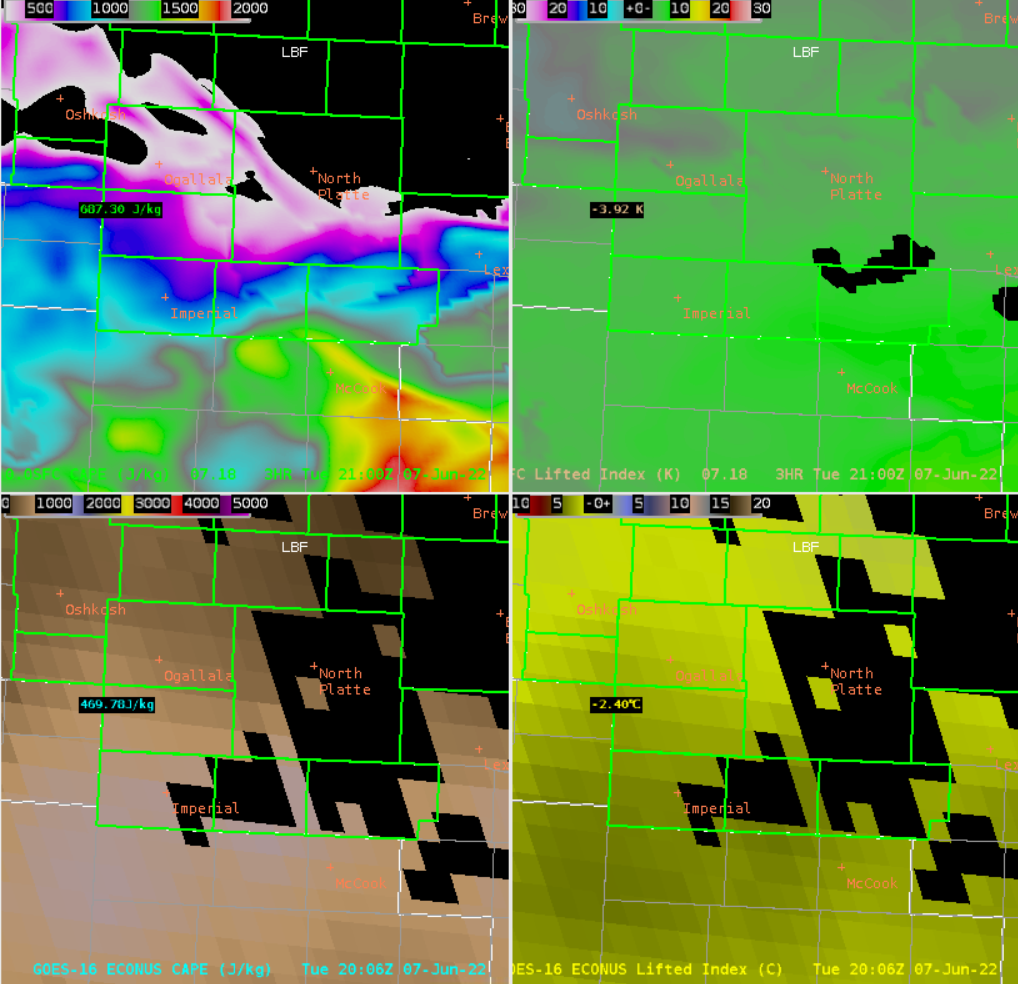
Day Cloud Phase Boundary noted on PHS CAPE forecast

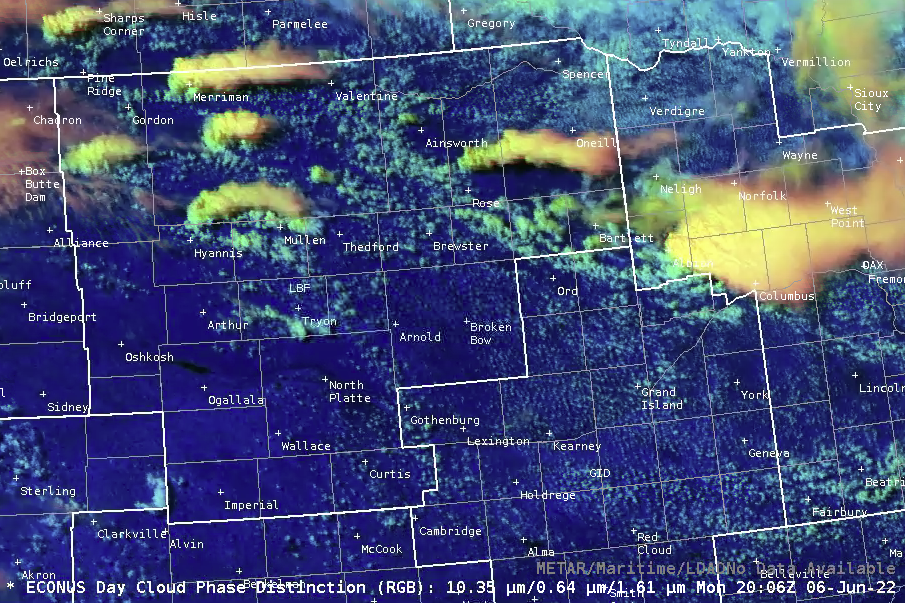
A notable boundary seen over the southern CWA of LBF on GOES 16 Day Cloud Phase Distinction is also evident in the PHS CAPE forecast for 19-21Z over the same area. The evolution of this boundary could be key in determining future convective development later this afternoon/evening.

Day Cloud Phase Distinction 20Z

SFC CAPE PHS for 21Z forecast, top left panel.

Meteorologist David Spritz

PHS CAPE Gradient Use in Mesoanalysis

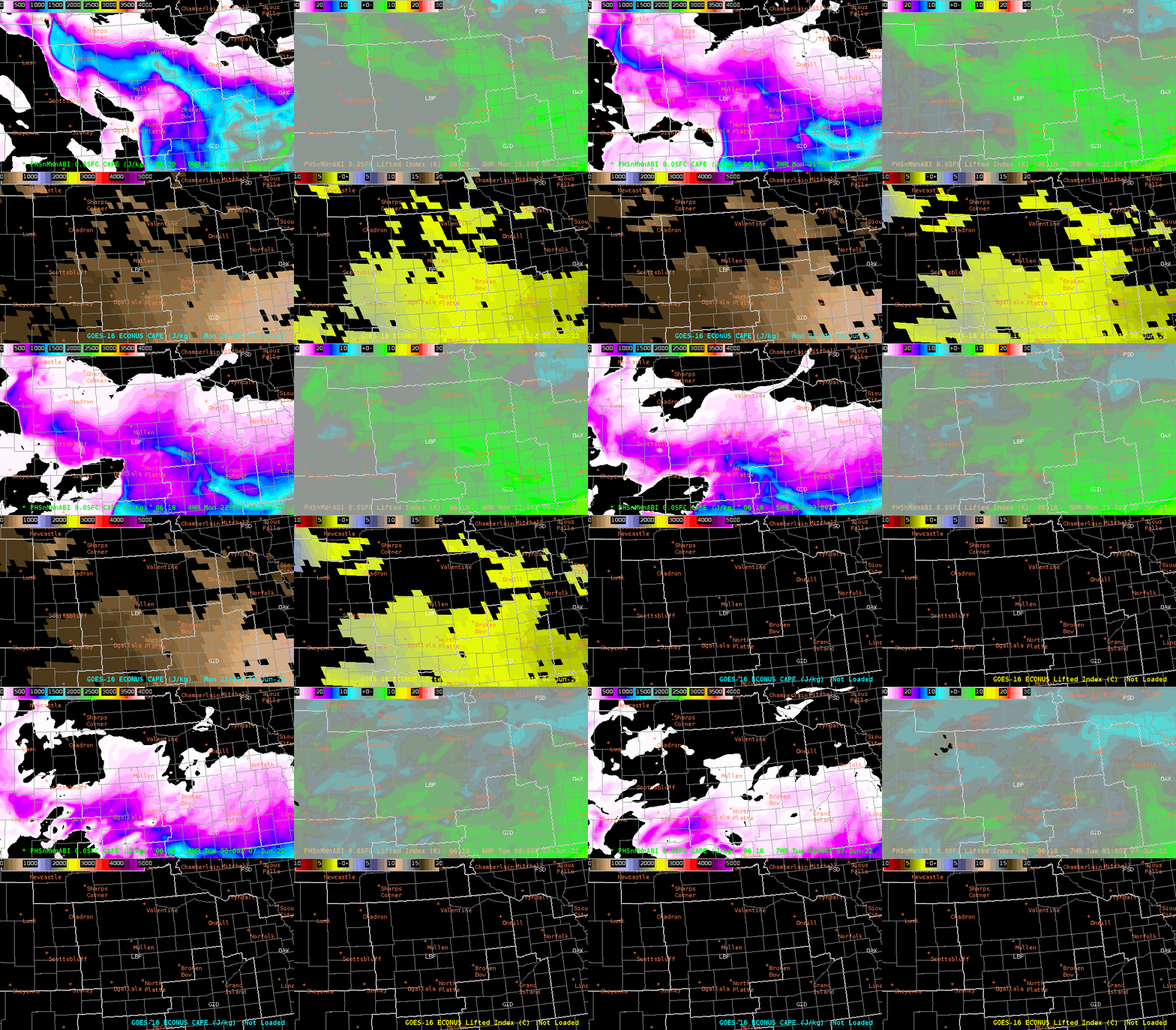
The PHS Sfc CAPE procedure was helpful in diagnosing the mesoscale environment. In particular, the depiction of CAPE gradients matched well with where the Day-Cloud-Phase Distinction showed where these boundaries lay as could be construed from the cumulus field.

The PHS Sfc CAPE depicted this surface boundary migrating southward through the central NE through the 21Z-00Z time frame. Observed cells moving left (east) off the boundary into a more stable environment as resolved by the PHS Sfc CAPE field all decreased in intensity and saw their convective updrafts weaken.

Seeing this after the first hour raised forecast confidence in the forecast thinking of today’s severe weather potential and was shared in a graphicast for this test case scenario.

PHS-CAPE-STP-PSv3 Procedure from 6/6 @ 20Z to 6/7 @ 01Z
Day-Cloud-Phase Distinction RGB at 20:06Z
– Trip

NUCAPS uses in comparison between separate satellite passes

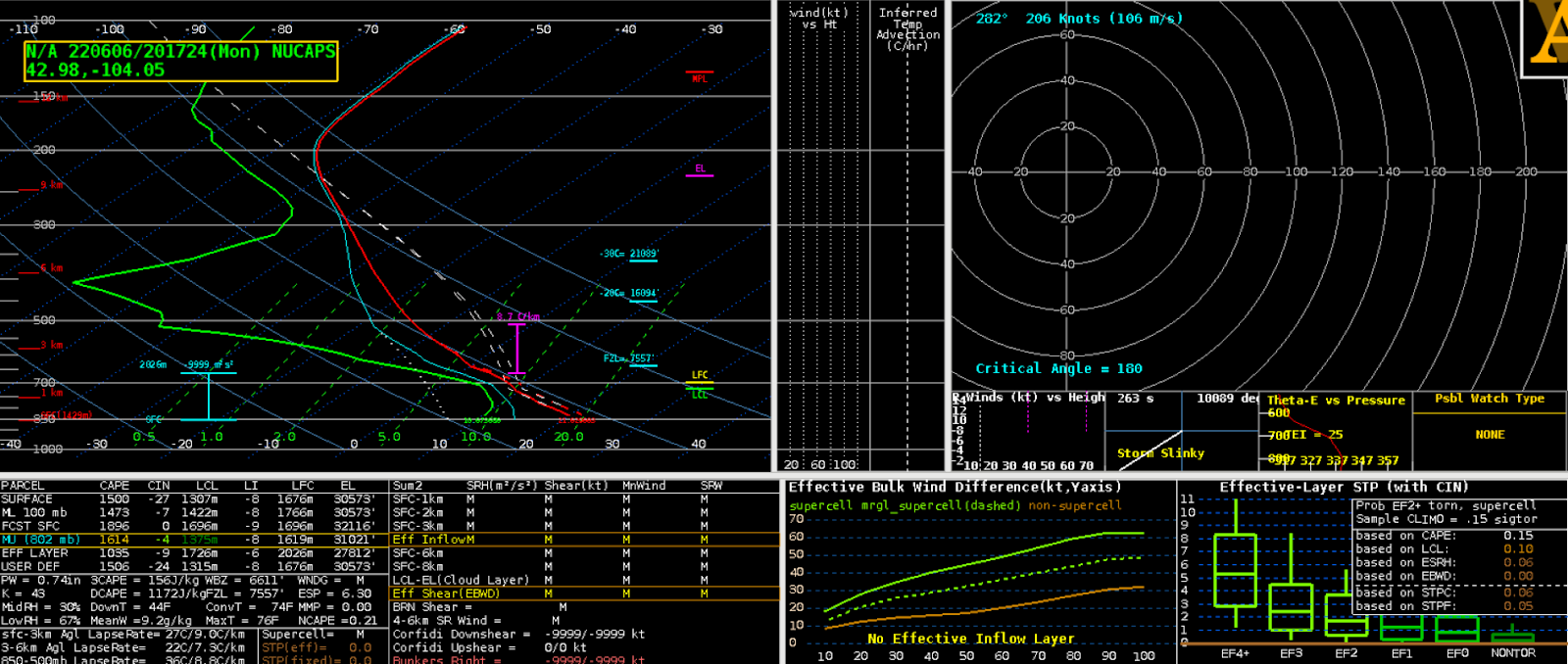
NUCAPS has been quite useful in comparison between previous passes. (Comparing the NOAA-20 modified and the Aqua), shows how an environment is changing to the south and southeast of the storm cell moving through Custer. We noticed a rapidly changing environment when compared to early afternoon convection. Sfc temperatures and mid level instability increased quite a bit as this storm moved off the higher terrain and into a more favorable mesoscale environment.

NOAA-20 Pass from approximately 19Z. On western SD/NE border.

Aqua Pass from approximately 2030Z. Same location. (On western SD/NE border.)

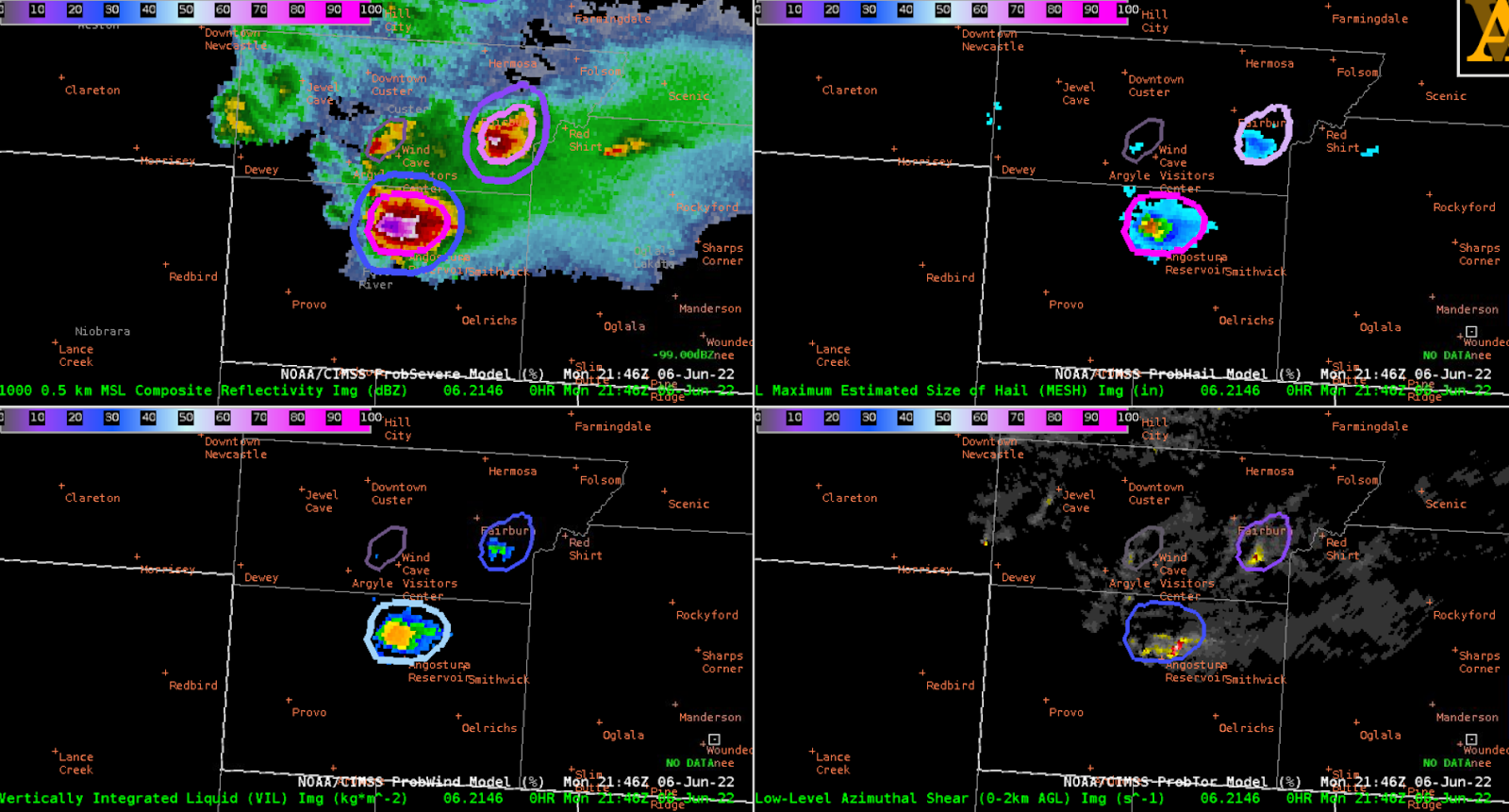
This increase in surface temperatures as the storm moves into a more favorable environment. Notable spike and jump in Hail core and probabilities.

A notable spike after 2130 for prob hail and prob severe.

-David Spritz