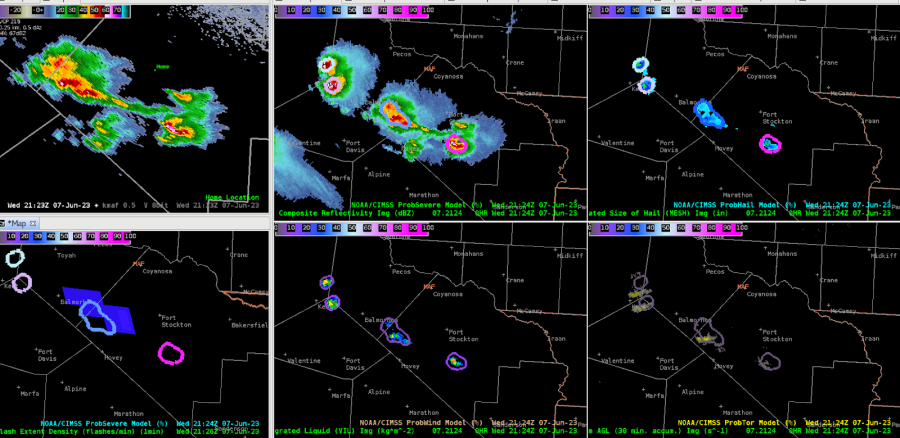
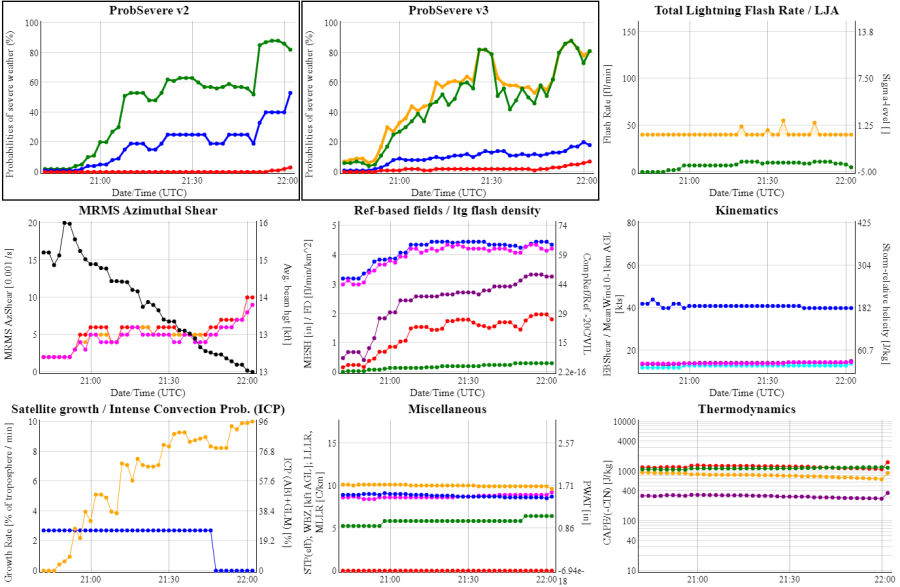
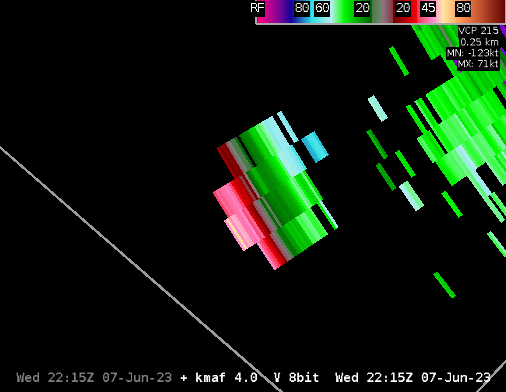
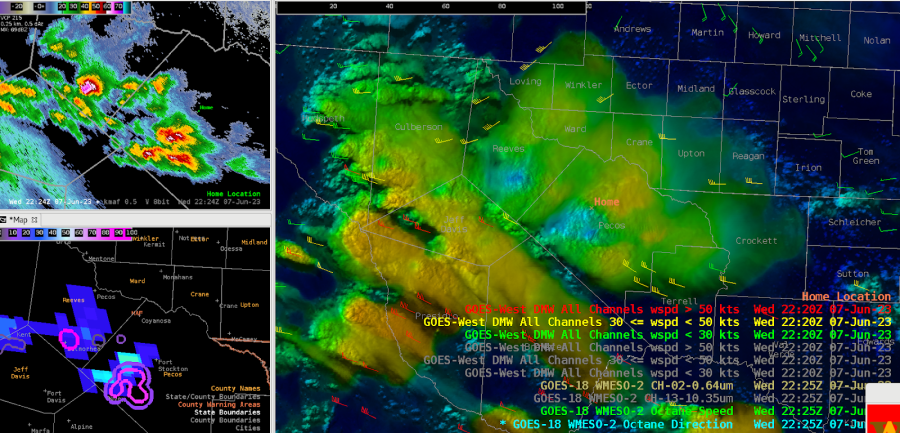
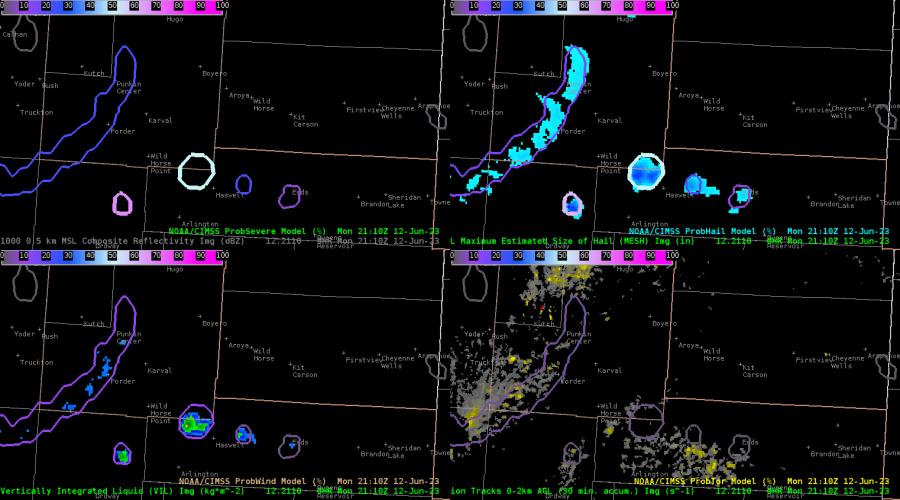
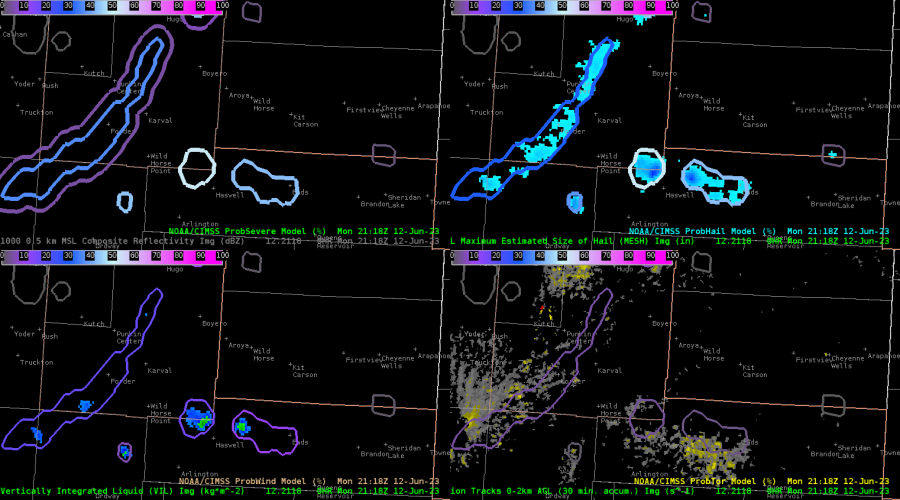
ProbSevere_V3 Captures Hail

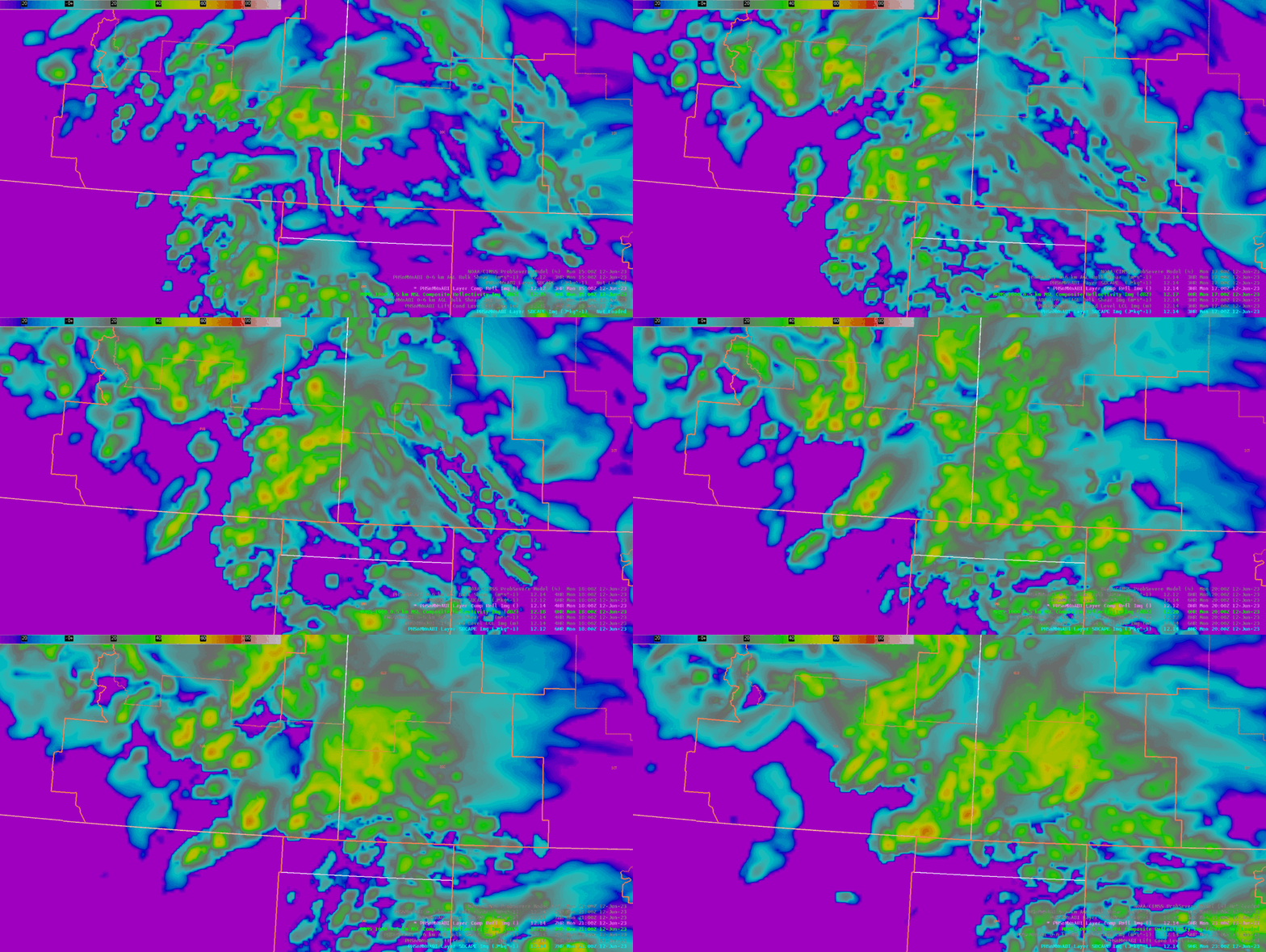
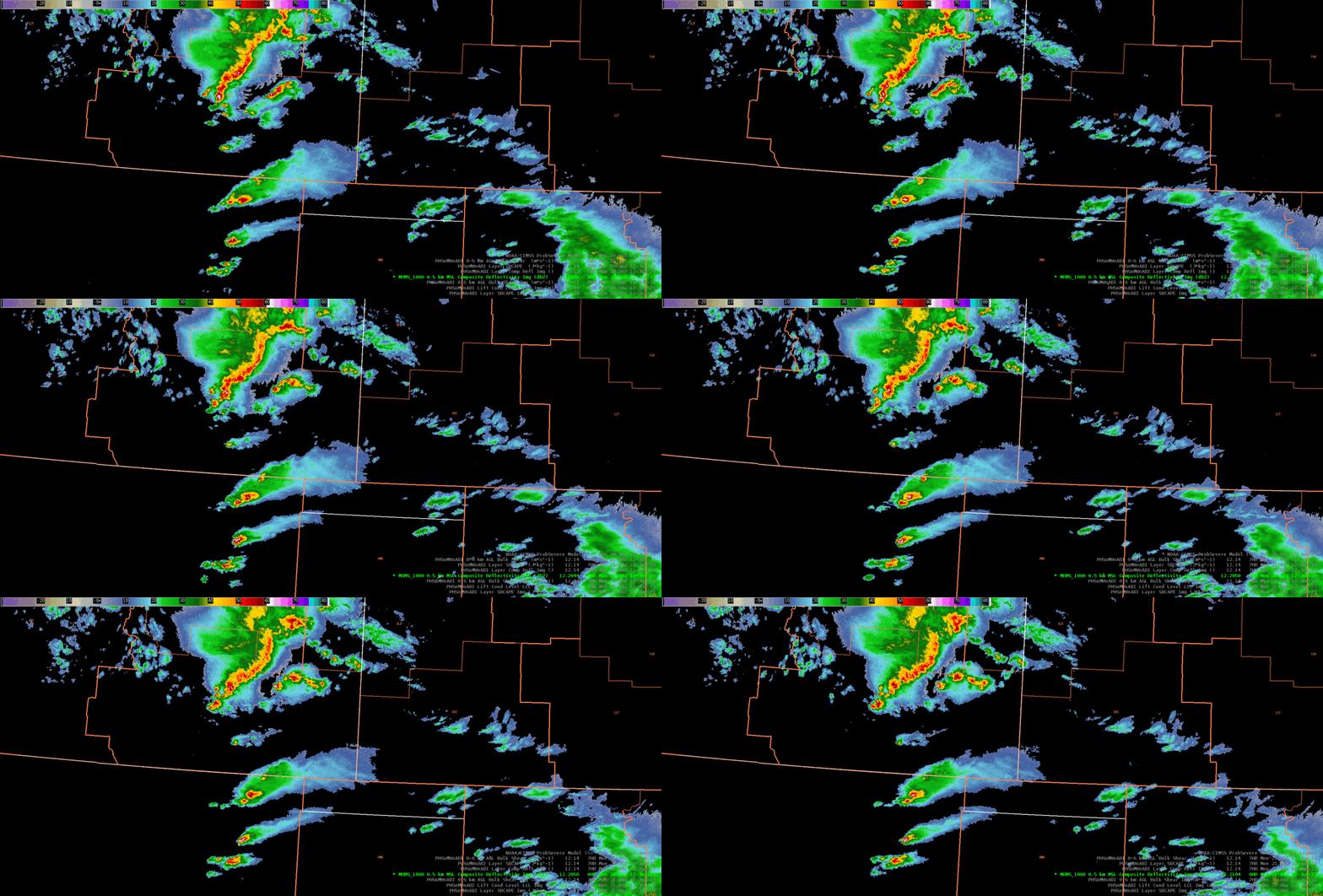
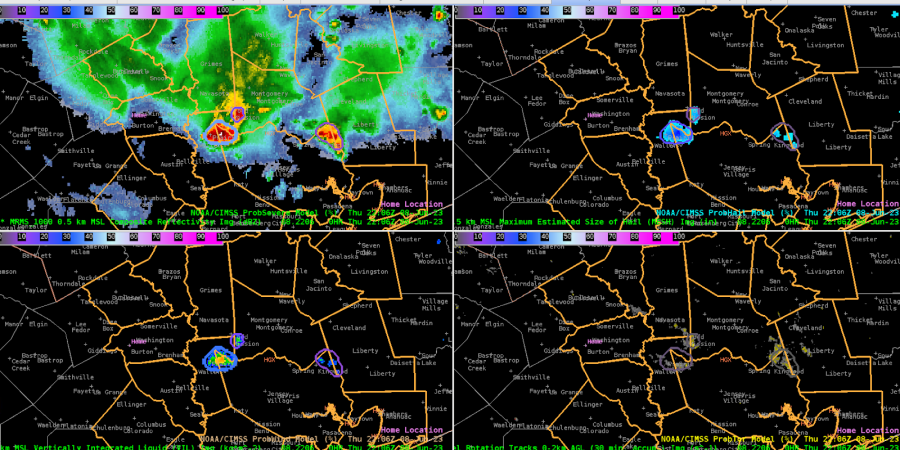
Severe storms developed over Hale County, TX on the afternoon of 5/22.  KLBB 0.5 Z reflectivity at 2109Z (top left image) indicated intense convection, especially just southeast of Hale Center.  ProbSevere V3 (the 4-Panel) did well at 2108Z.  The upper left has the ProbSevere Model at 84% with the MRMS 0.5 Comp Reflectivity peak value of 66 dBZ.  The upper right has ProbHail at 85% and MRMS Maximum Estimated Hail Size (MESH) peaking at 1.85″.  The lower right has ProbTor at 12% and MRMS Low-Level Rotation Tracks.  The lower left has ProbWind at 35% and MRMS Vertically Integrated Liquid (VIL) at 55.  Notice how the ProbSevere Time Series ProbHail was at 60% at 2020Z, nearly an hour before this.  What happened?  Here is the LSR…

SSW PLAINVIEW Hail Report
County, State: HALE, TX
(marker location is approximate)
Lat.: 34.12, Lon.: -101.76
Time: 2023-05-22 21:09 UTC
Hail Size: 1.75 IN. DIA.

HAIL FELL ALONG I-27 BETWEEN HALE CENTER AND PLANVIEW (LUB)

Since forecasters should consider warning with lower ProbSevere values for V3 compared to V2, these high values supported a warning.

-Champion


Tags: None

Monitoring Storm Evolution Via ProbSevere & Octane Speed/Direction

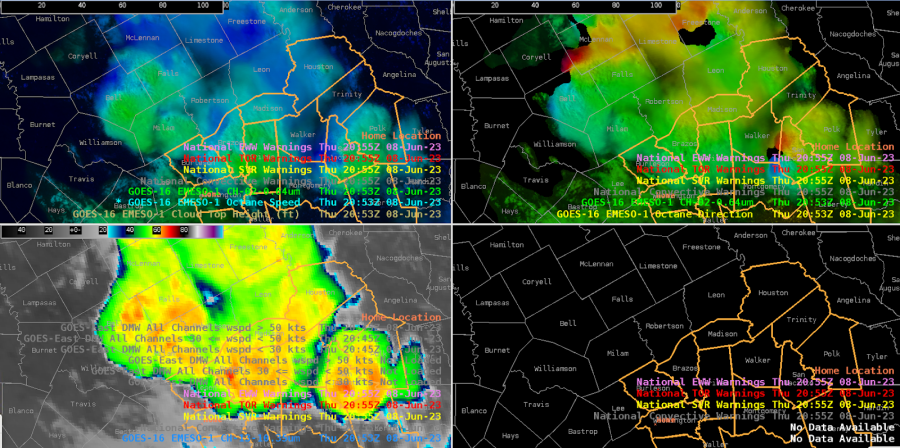
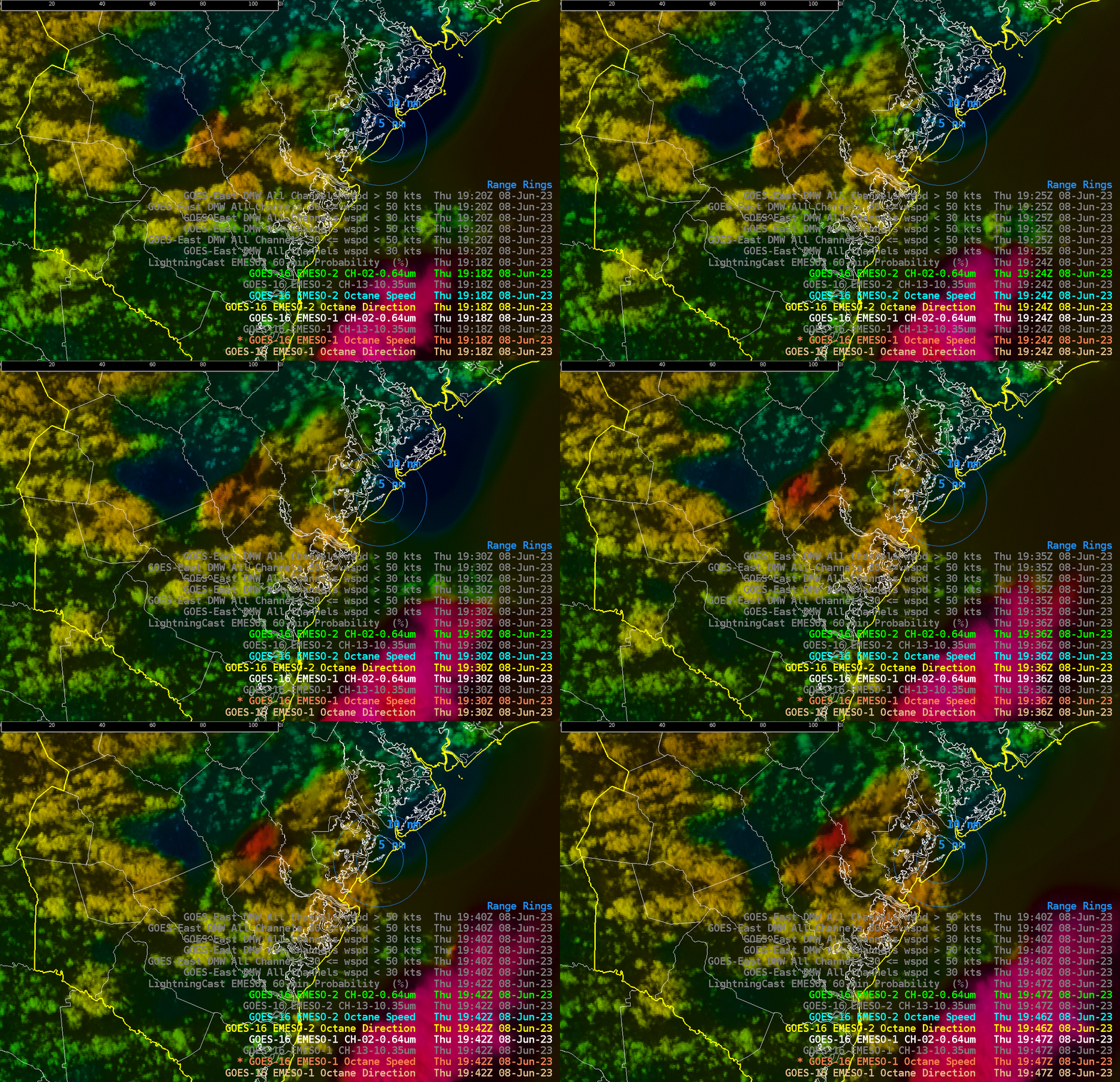
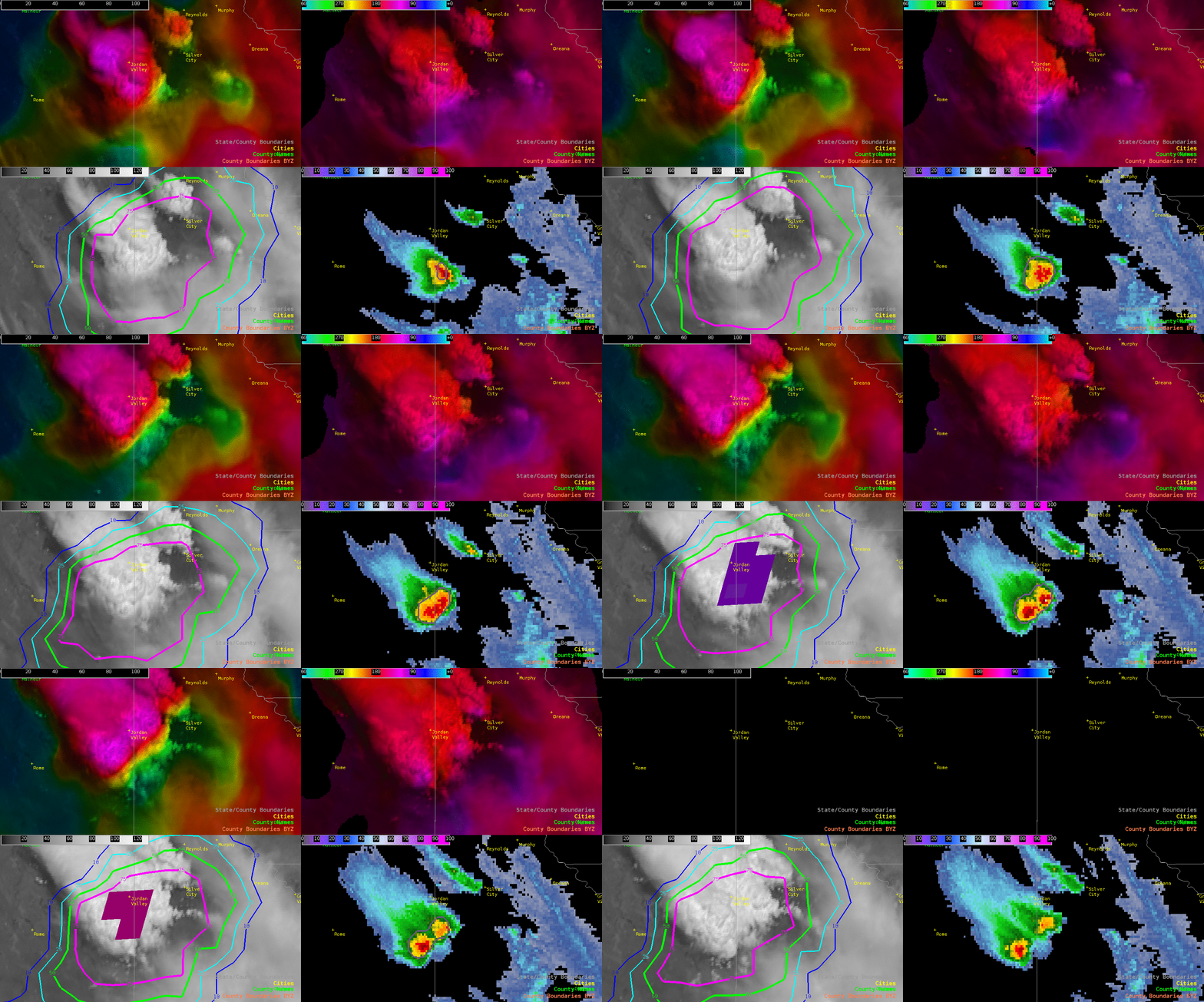
This video shows a storm’s evolution as it moves into far SW Lamb County just before 21Z. The upper left hand shows the Octane Speed product…the upper right shows the Octane Direction product…the lower left is the GOES-16 Ch. 13 Clean Window IR Band…the lower right is the Day Cloud Phase Distinction RGB product.

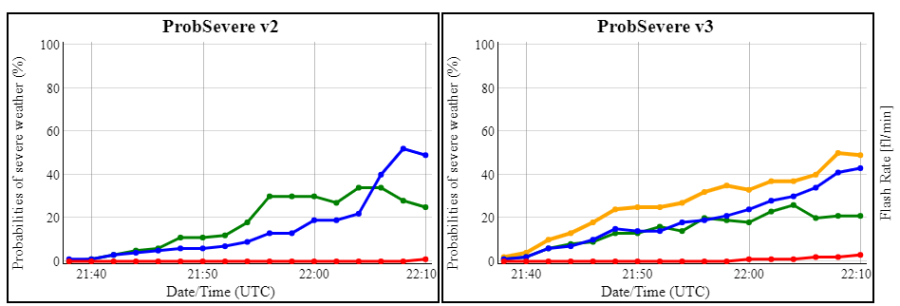
Looking at the Octane Speed product, as this storm is initially growing,  the cloud top features moderate cloud top divergence with the variation in Octane Speed (as the greens and yellows nearby). The storm evolution then plateaus and eventually diminishes in intensity, shown as the cloud top speed becomes more consistent (with the loss of the yellow colors). The Octane Direction product shows a southerly component to the direction across the north of the storm with a westerly component along the southern side of the cloud top. At the end of the loop you can see the yellow (the southerly component) begin to disappear as the loss of cloud top divergence causes the direction to change from the motion of the divergence to the environmental westerly component. Below is an image showing the storm’s trends via the ProbSevere Time Series (storm location now just NNW of Anton). Though the ProbSevere values will lag behind the satellite imagery, one can note the storm’s gradual increase in ProbSevere values with the “warming” colors of the Octane Speed product. The values then also level off, before dropping off as the cloud tops become more consistent.

Joaq & Bubbles

Tags: None

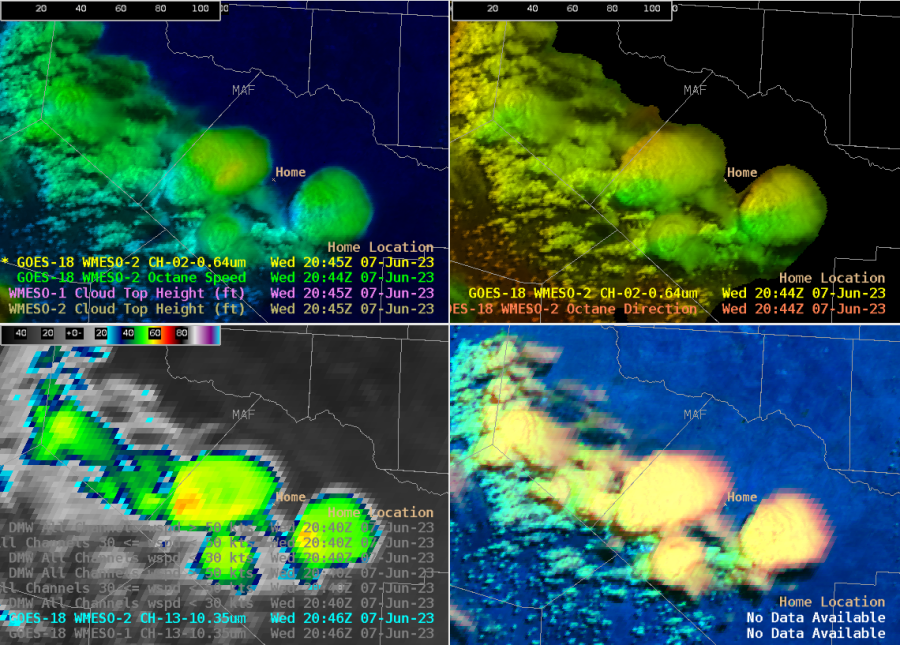
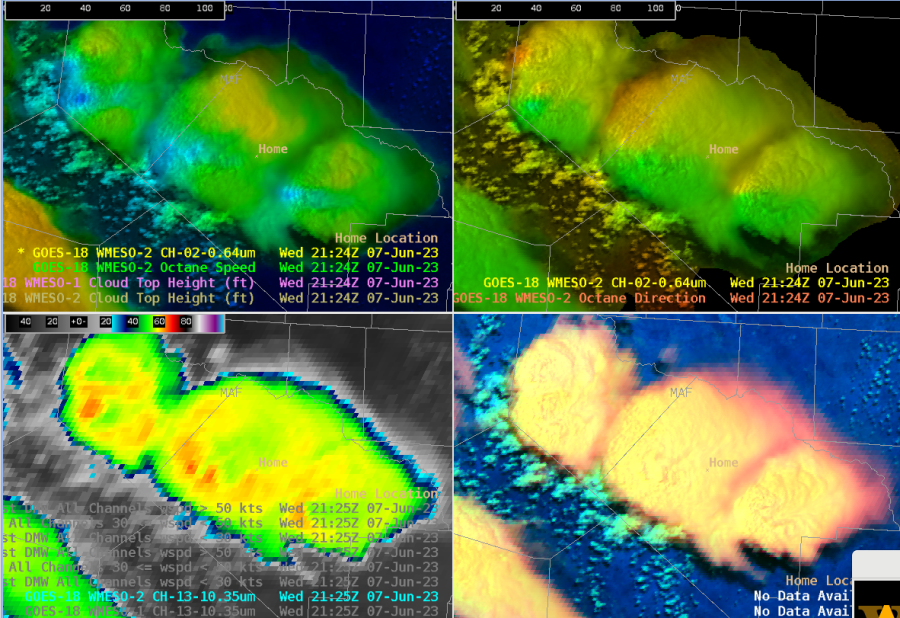
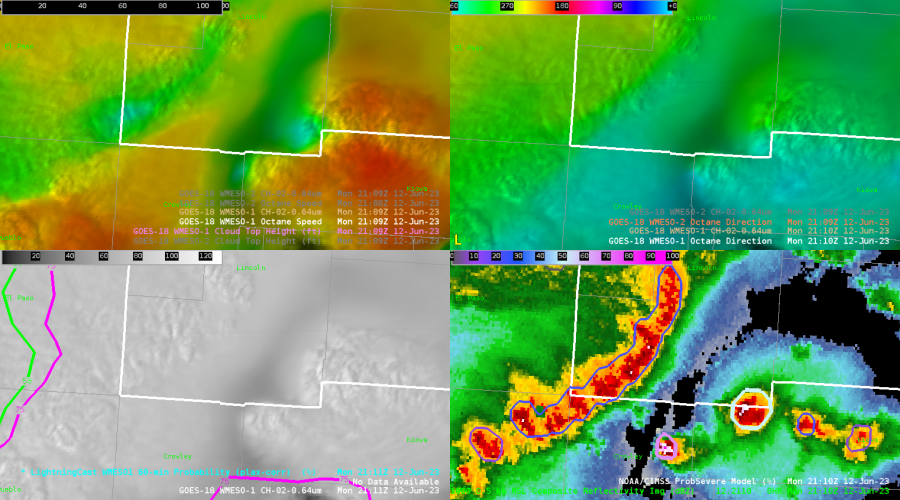
Octane Speed/Direction Severe vs Normal Thunderstorm

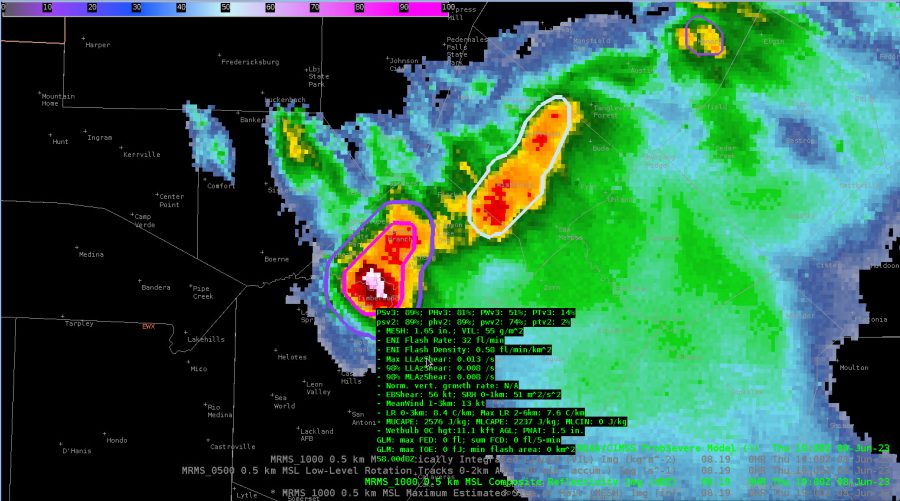
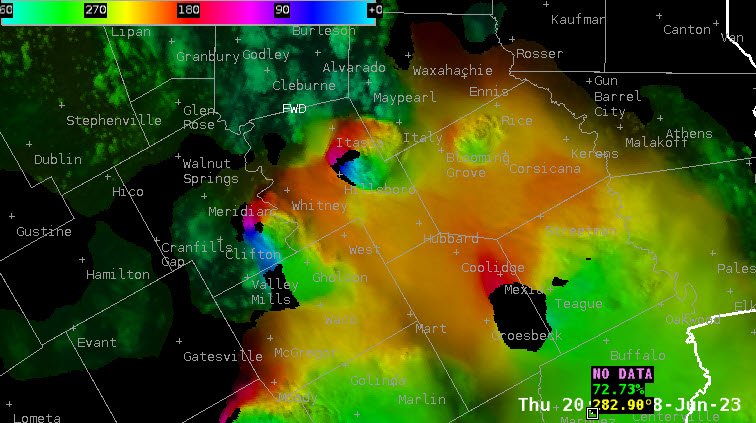
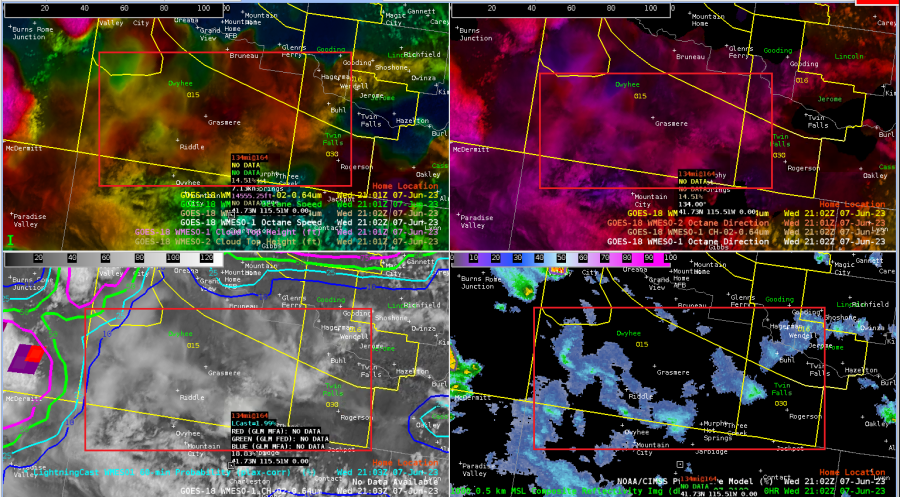
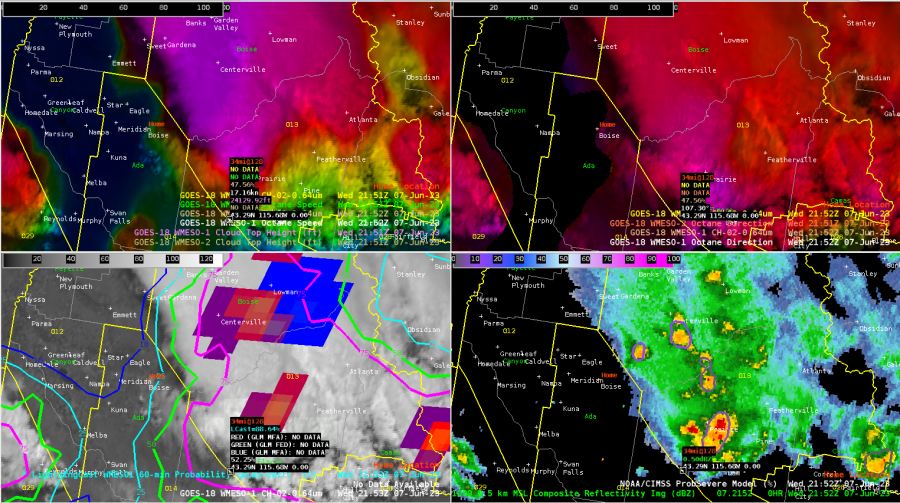
If we look at the top two panels you will see a line of storms. The northern storms have small differences in wind and speed difference (green/light blue for speed and yellow and green for direction). However one of the thunderstorms to the south stick out. It has must stronger difference in wind speed (3m/s vs 16m/s) and direction (180 degrees vs 280 degrees). At the time of this image only the southern storm was severe while the northern storms were below severe.  I feel this is a great example to see how you can use OCTANE flow to spot the strongest storm in a line of developing storms. 


-Thunderstruck

Tags: None

GLM and Lightning Cast

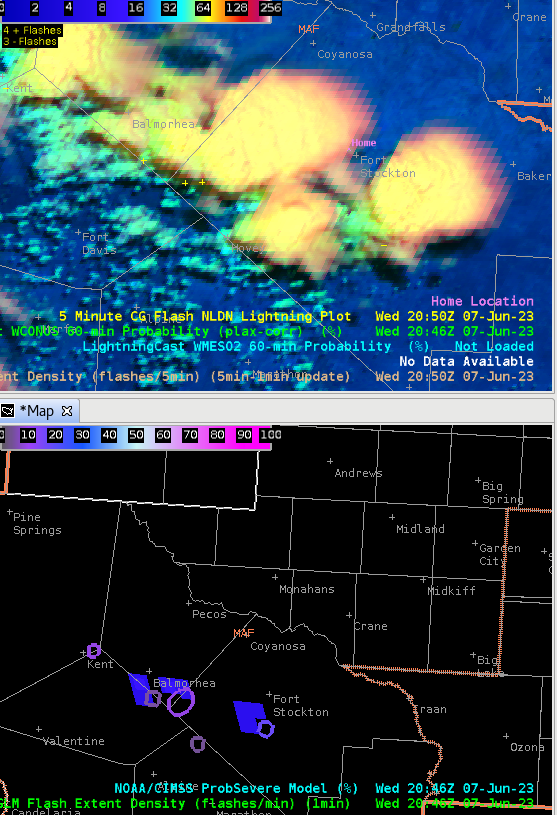
The GLM parallax showed up again Thursday, June 16th, over the PBZ area. This was even more evident than yesterday’s event in WI that was written about in a blog post.  Figure 1 has ProbSevere, LightningCast, GLM Flash Extent Density, and ENTLN data overlaid in a 4-panel.  This case was fairly simple to “self correct” the parallax as the GLM was clearly displaced to the north of ProbSevere (as well as the base reflectivity).  Really once you get a few cases under your belt recognizing the parallax, it’s not too challenging to keep that “self correct” in the back of your mind.  One interesting thing to note about Figure 1 is the storm just outside the PBZ CWA just south of Mount Veron, Ohio (See bottom left in Figure 1).  The ProbSevere and GLM FED are lined up perfectly and this is a great example of utilizing the lower threshold in the colormap. The bullseye shows up much nicer than the larger thresholds in the top two images.

Figure 1: GLM with ProbSevere and LightningCast

– Podium

What’s the best way to look at NUCAPS?

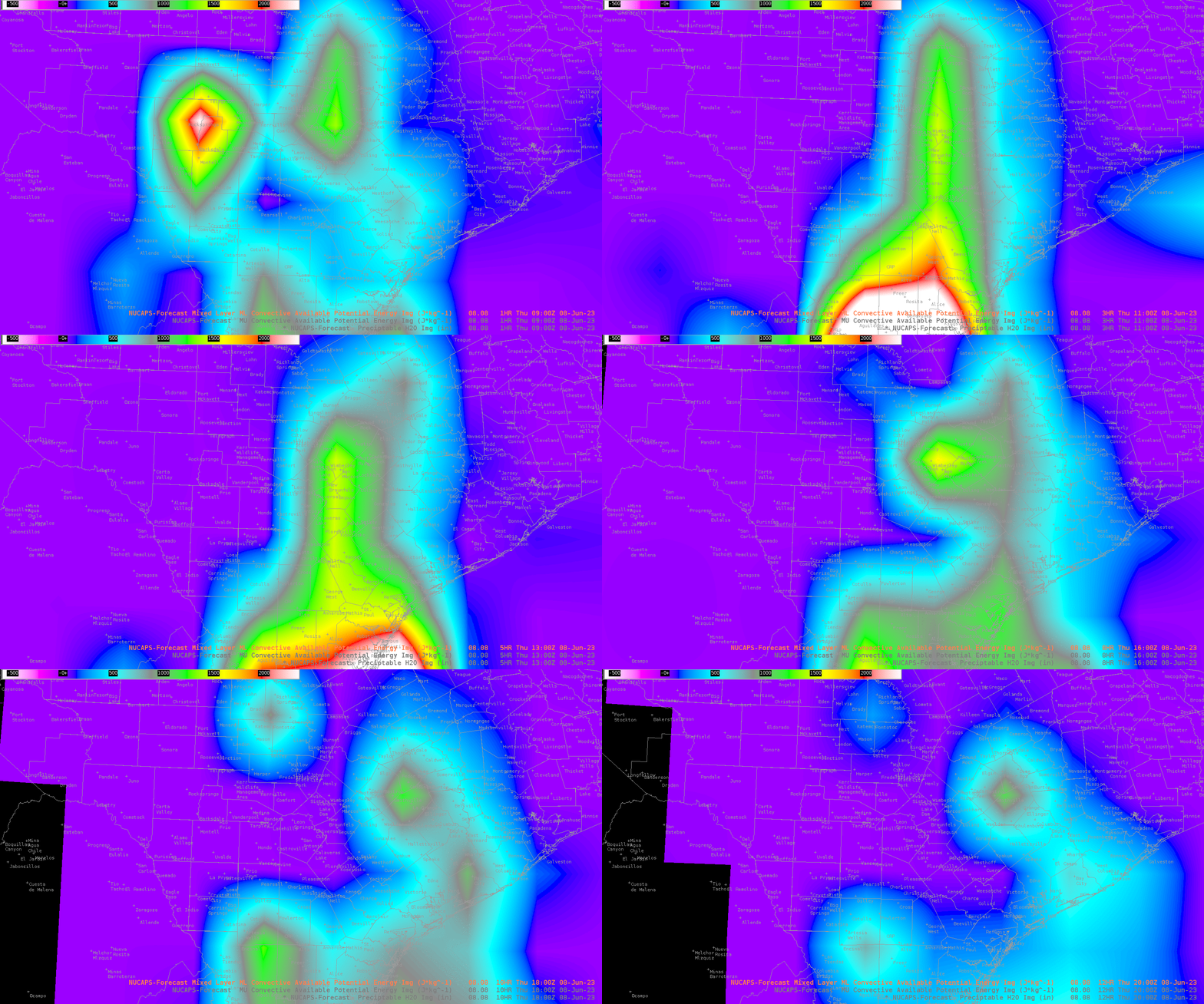
So far this week, I’ve been impressed with the performance of NUCAPS and for the most part Modified NUCAPS with providing thermodynamic profile information in areas that there are overpasses.  However, what would be the best setup to figure out how well NUCAPS is doing.  Let’s dive in:

Today we’re located in Binghamton, NY (BGM) office with a Enhanced risk over the region.  We’ve also got a NUCAPS sounding directly over the region which can help us with evaluating how well things like the SPC Mesoanalysis graphics or other models are doing:

But, visible satellite shows that there are some clouds that could be interfering with the retrievals:

After playing around a bit, it may be a good idea to load the Day Cloud Phase RGB, NUCAPS points, and surface observations into one pane:

This is useful for three reasons:


  1. We can see that the red in the Day Cloud Phase are mainly high clouds that are pretty thin and has enough gaps to allow for good retrievals underneath the cirrus.
  2. The low clouds are pretty thin except over the southern part of the CWA where some of the retrievals are yellow indicating that caution should be taken when looking at the profiles
  3. The surface observations can be used to give an idea of how well the surface T/Td are in the soundings which will impact all of the convective parameter calculations (especially CAPE/CIN)


So what about the soundings?  Looking at the NUCAPS and Modified NUCAPS here:

We can see how things are handled by the soundings.

Here is the original NUCAPS sounding at this point:

Of note, the surface conditions in the NUCAPS sounding is too warm (85 vs 80 at the nearest ob) while the Td were fairly close 69 vs 70.  How did the modified NUCAPS do?

80/70 in the sounding which is a much more likely scenario based on surface observations closest to the time of the overpass/sounding.

Why is this important?  Well, all your convective parameters are based on these two conditions.  MLCAPE drops by around 400 J/kg (~3900 J/kg vs ~3500 J/kg) AND CIN increases from -19 J/kg in the unmodified to -49 J/kg in the modified NUCAPS.  This too lines up with what the visible satellite shows; a lack of boundary layer CU potentially meaning the CAP is holding strong.

-Pym

ProbSevere V3 Adjusting During New Cell Formation

ProbSevere V3 has been showing much improvement over version two, with this particular day featuring somewhat pusley mixed-mode storms across upstate New York. This particular group of cells had habitual new updraft development, with storms nearing or briefly becoming severe as high dBZ cores develop aloof then make their way downward. These particular cells were able to form 1.00” hail. The ProbSevere V3 time series reflected the marginally severe nature of these storms very well, with values peaking at 60 to 65%. The very encouraging sign was the peaks and valleys in the ProbSevere V3 time series that showed this group of cells peaking at over 50% severe probabilities, dipping below 50% as the new updraft takes over, and then once again peaking above 50% once the new updraft strengthened. I’d definitely recommend forecasters to take a look at the timeseries to build confidence in cell trends during warning applications.

Shown above is the group of cells, with the initial one showing a core of 60+ dBZ that begins to drift off to the northwest while a newer updraft takes over and moves more east-northeast.

– aerobeaver

ProbSevere Time Series

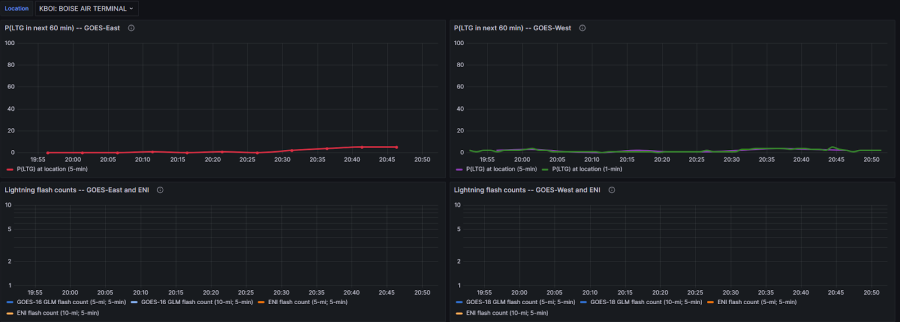
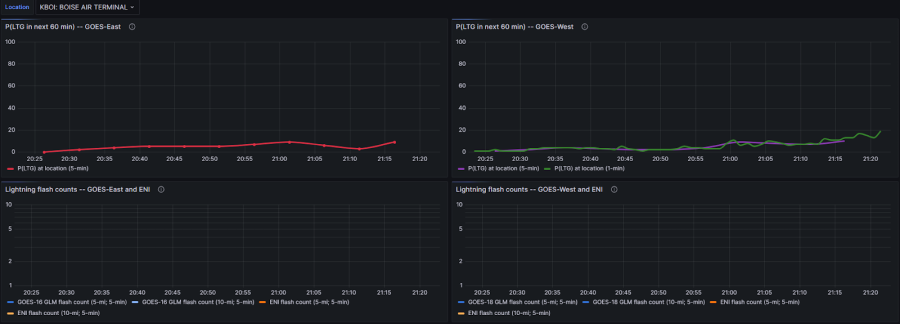
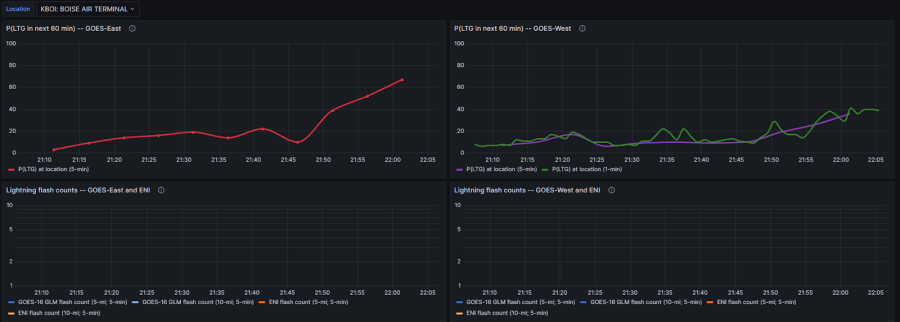
I utilized the ProbSevere Time Series in warning operations today (June 16, 2022) within the Pittsburgh, PA CWA.  With only using basic radar products and no other products  (that I’d normally use during warning operations), it was extremely helpful in warning decision making.  After issuing several warnings already and monitoring a storm quickly developing in the western portions of the CWA that was getting close to severe, I issued a warning based on an uptick in the ProbSevere Time Series (See Figure 1 vs Figure 2).  The uptick in ProbHail occurred within about 5-6 minutes or roughly 2 radar scans of the PBZ WSR-88D prompted a warning.  The storm continued for several minutes and regenerated about 30 minutes later that prompted another warning downstream (See Figure 3).
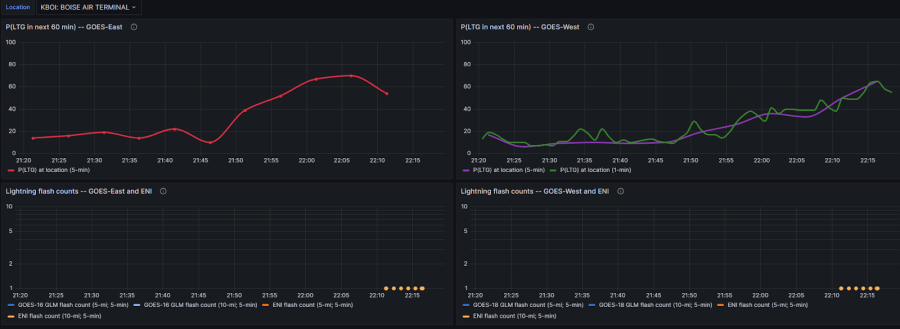
Figure 1: ProbSevere Time Series at 2056z

Figure 2: ProbSevere Time Series at 2100z

Figure 3: ProbSevere Time Series Plots.

– Podium

NUCAPS sounding comparison vs observed 19z PIT sounding.

With the threat for severe weather today, WFO Pittsburg launched a 19z special sounding to access the atmosphere. The atmosphere featured a moist boundary layer with dewpoints the lower 70s and decent lapse rates throughout much of the atmosphere of around 7 C/km. The low-level wind profile in the observed sounding indicates veering winds with height and low level winds generally from the west southwest to west. The wind profile was helpful in determining the severe weather threat. Based on this low-level wind profile, one can conclude that the tornado threat appears to be fairly low.

There was also a NUCAPS pass across the region around 1741 UTC. I selected a point just to the west of the Pittsburgh office based on the general atmosphere advection to the west based on the observed sounding. Due to this, it would seem that the point just to the west of Pittsburgh at 1741 UTC would be a good approximation of the atmosphere near the Pittsburgh area at the time of the 19 UTC sounding.

The Observed sounding indicates major fluctuations in the dewpoint temperature throughout the atmosphere but the NUCAPs sounding indicates a much smoother moisture profile. Overall, these different methods indicate rather similar PW values to the observed around 1.31 inches and NUCAPS PW of 1.27 inches. Overall, a fairly consistent moisture profile. There are some noticeable differences in the boundary layer moisture profile. The modified NUCAPS is included as the last image. It seems that the modified NUCAPS introduces a bit too much moisture with PW values of 1.43 inches. These higher PW values also lead to higher values of instability as well.

Overall, the NUCAPS sounding was helpful in diagnosing the thermodynamic profile of the atmosphere. It also arrived over an hour earlier than the observed sounding. The sounding indicates a moderately unstable atmosphere across the region capable of leading to severe weather. The moisture profile is smoother in the NUCAPs but it doesn’t seem to affect the overall moisture with PW values being the same. It would be nice to add a model wind profile to the NUCAPs sounding. This way it would be possible to access the tornado threat as well because there is not much available in the thermodynamic profile alone to make this assessment. However, I’m very impressed by the similarity between the NUCAPs and observed sounding.

Observed 19 UTC PIT sounding and NUCAPS from 1741 UTC.

19 UTC PIT Observed Sounding

Location of Observed 19z PIT sounding.

1741 UTC NUCAPS Sounding.

1741 UTC NUCAPS soundings point, brighter green dot.

1741 UTC Modified NUCAPS.

– Marty McFly

Observations from BUF on Thursday June 16th

Optical Flow Wind Storm Top Divergence Can Aid in Warning Operations

The storm of the day produced a 2.5” hail stone near Cato, NY.
Strong storm top divergence signals an intense or intensifying thunderstorm. Matched with upper level radar scans, satellite interrogation (clean IR), and ProbSevere, optical flow wind products may be another tool to aid the warning forecaster and/or storm scale mesoanalysis,  Below are the corresponding optical flow wind storm top divergence images approaching 4 PM EDT (3 PM CDT) when the sig severe hail was reported. The thunderstorm of interest is centered just south of eastern Lake Ontario.

LightningCast as Graphical Messaging/IDSS Tool

As the DSS and graphics person for BUF, I took the opportunity to highlight the utility of LightningCast for Graphical NowCasts and DSS graphics. The fairly broad brushed nature of the lightning probability contours at the timesteps utilized for graphics I think is a positive for a few reasons: they show actionable probabilities (10+, 25+, 50+, 75+) that users can understand; the contours are akin to annotations on a radar graphic, so would be a time saver; and finally, broad brushed is a way to prompt users and partners to seek out more information, like real time zoomed in radar data, perhaps calling or sending us a chat on NWSChat, or even simply keeping an eye on the sky and listening for thunder. The parallax corrected product in the images below I feel would be more useful for graphics of the nature shown below. Ultimately, for operational use, there would probably need to be some work done to ensure they are not confusing to the user and aesthetically pleasing.
Graphical NowCasts for our websites and social media
Graphic for IDSS Event

A Case for the Sharpened GLM FED Color Scale Used this Week

Over the course of satellite product interrogation this week, the GLM FED stood out as one of the most useful products.  Below are examples from in/near the BUF CWA at 2043z and 2047z. Note that the top of the color scale was set to 128 flashes/5 min over the grid point vs. the default 256 flashes/5 min in AWIPS. The FED also paired well with the MFA and TOE on this 4-pane procedure.
The color curve used this week really popped and correlated well with frequent ENTLN detections. Another example below from shortly after 6 PM EDT (2202 and 2207z)  shows that there will be instances where perhaps an even small color bar range would be useful.
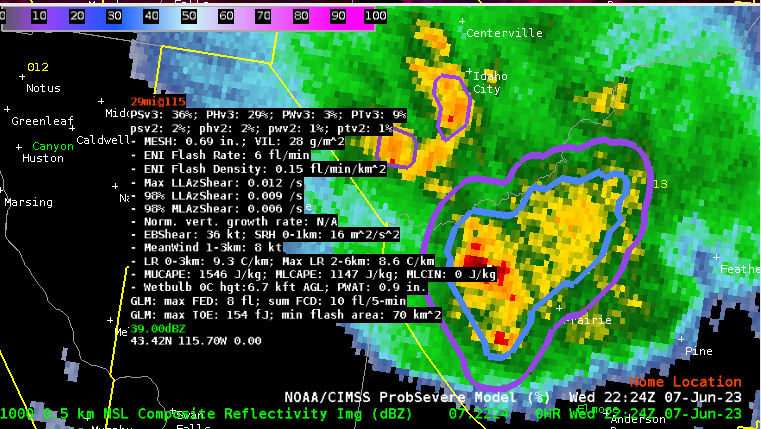
While the strongest storm at this time still showed up well on the AWIPS default color bar range, the 128 flashes/5 min top end of the range (top right) helped it pop even more and corresponded well conceptually with the ENTLN cloud flash detections. Furthermore, the thunderstorms to the north of the strongest thunderstorm showed up better from an SA perspective, if you have been focusing on the strongest storm for warning ops. The smallest color bar range on the bottom left further enhances the above described effect.

Addendum: GLM Flashes and a more smoothed FED

The excellent COD NexLab Satellite and Radar page added within the past year the GLM flash centroids to their GOES derived overlays. From an apples to apples perspective with respect to the ground based lightning detection network displays, this may be a useful product to add into AWIPS.
\

Addendum 2: Would a more smoothed FED be preferable?

Below are a few web based examples of FED displays.
A case can be made that these smoothed FED examples would be somewhat less obtrusive than the default AWIPS FED display, especially for storm scale interrogation by the warning operator or storm scale mesoanalyst.
– Hurricane84