20120515 – 2125z update 1st warning of the week

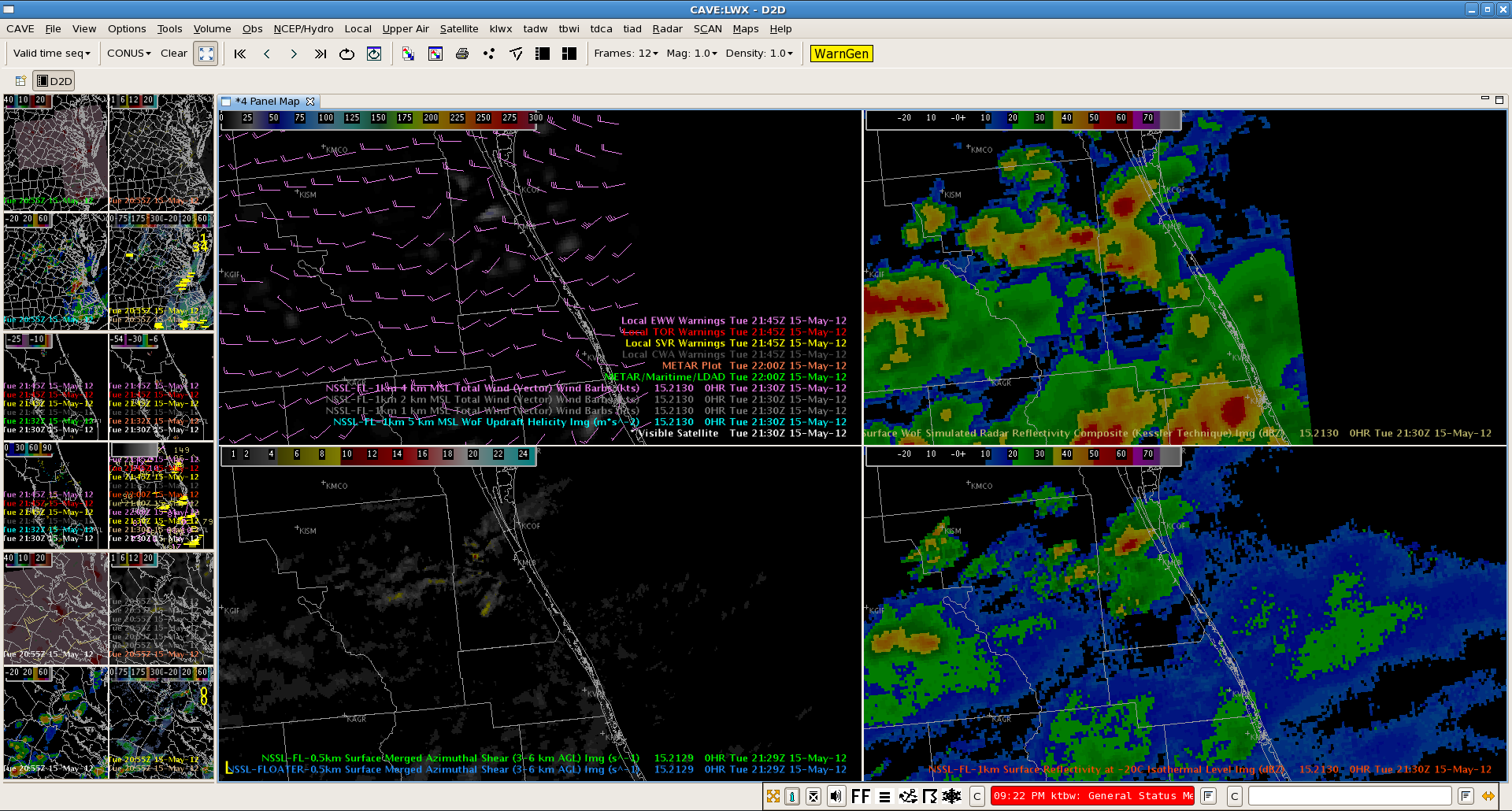
The first warning of the week was issued by the MLB team for a storm just northwest of MLB.  The MRMS and 3dVAR shows some indication of rotation with that storm between 3 and 6 km.

Updraft helicity and merged azimuthal shear layers and units are different.  How does one compare between the two?

Jim LaDue: EWP week 2 coordinator

Monitoring & Forecasting DVN Convection

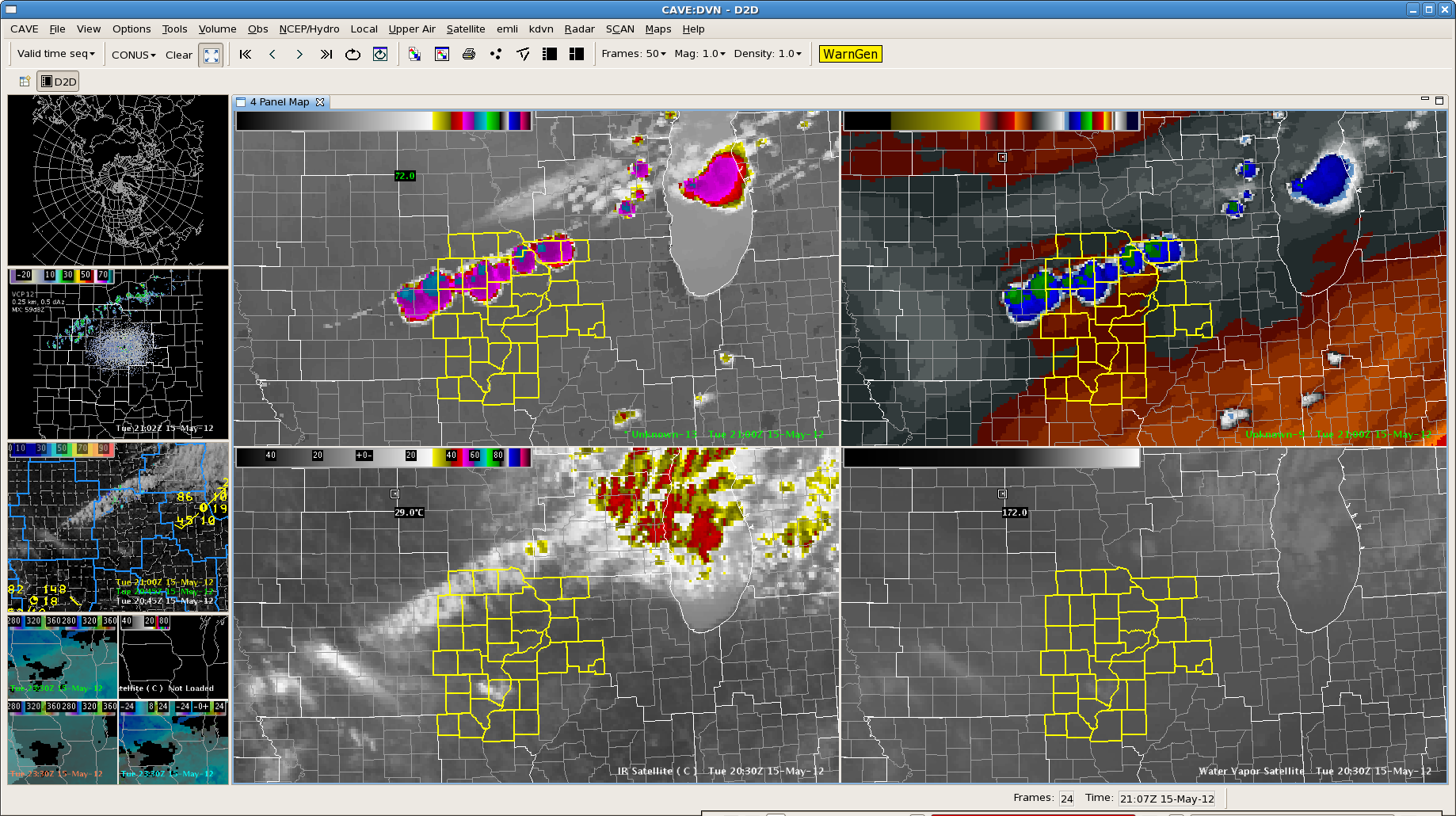
Despite strong indications from the NSSL-WRF SimuSat imagery, convection in the DVN CWA has stayed rather benign.  The NSSL-WRF appears to have overestimated the low-level prefrontal moisture.

SimuSat Imagery at Top, IR Imagery at Bottom, valid 2100 UTC 2012-05-15

The GOES-R NearCast Theta-E Low vs. Mid-Level Theta-E image indicates very little destabilization ahead of the front (in fact, it actually indicates increased stability).  This is consistent with surface dewpoints in the 30s and 40s reported ahead of the front.

GOES-R NearCast valid 2030 UTC 2012-05-15
GOES-R NearCast Theta-E Difference valid 2030 UTC 2012-05-15

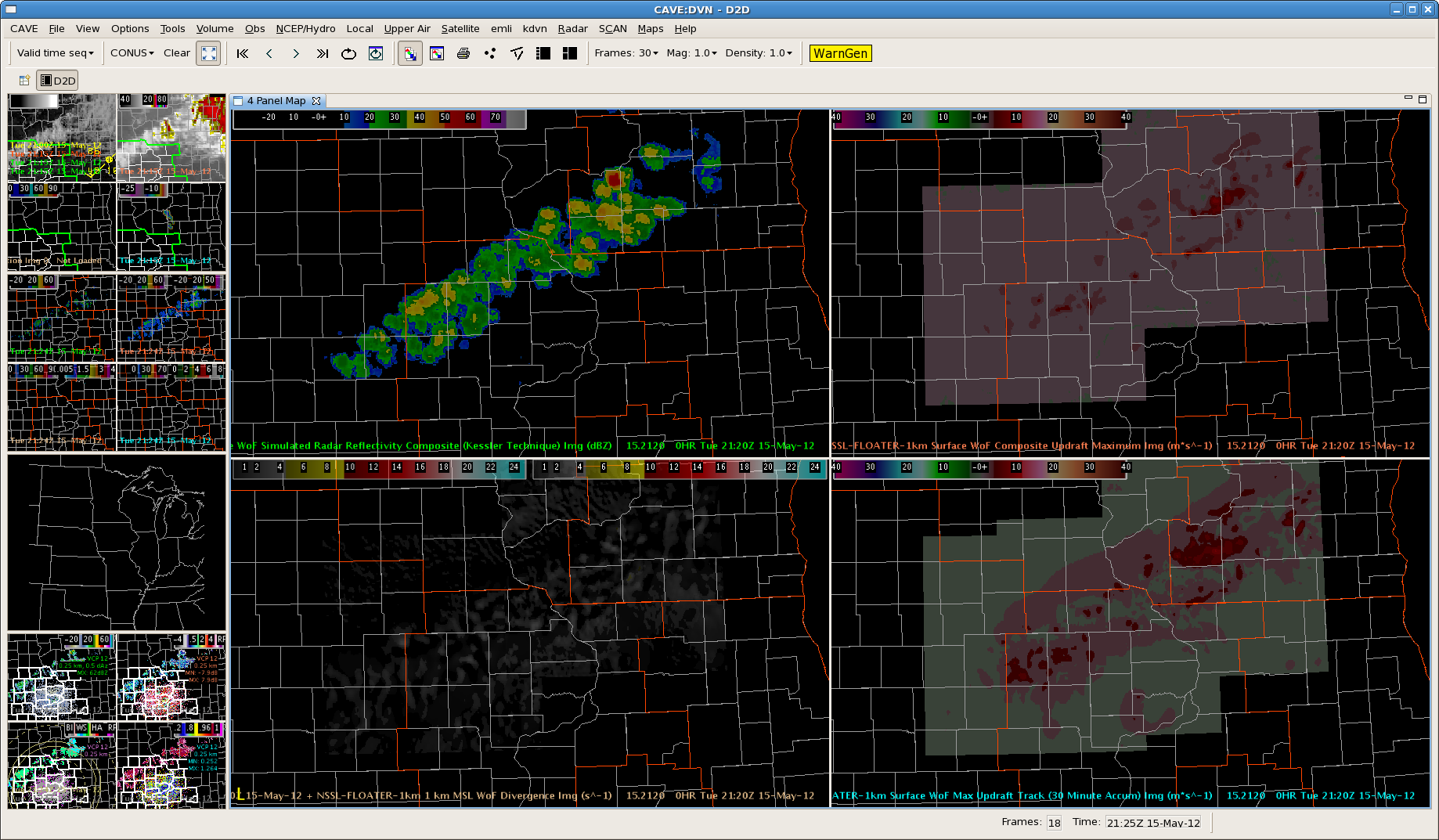
There have been a few cloud-to-ground lightning strikes just to the northeast, and the 3DVAR and MRMS data have helped to monitor the convection across multiple CWAs and on the edges of multiple radars.

3DVAR Analysis valid 2120 UTC 2012-05-15
3DVAR Analysis of Reflectivity, Updraft composite, 30 Minute Updraft Accumulation, and 1km/10km Divergence, valid 2120 UTC 2012-05-15
MRMS Surface Merged Reflectivity, -20C Reflectivity, VIL, and MESH valid 2114 UTC 2012-0515

LWX 20Z

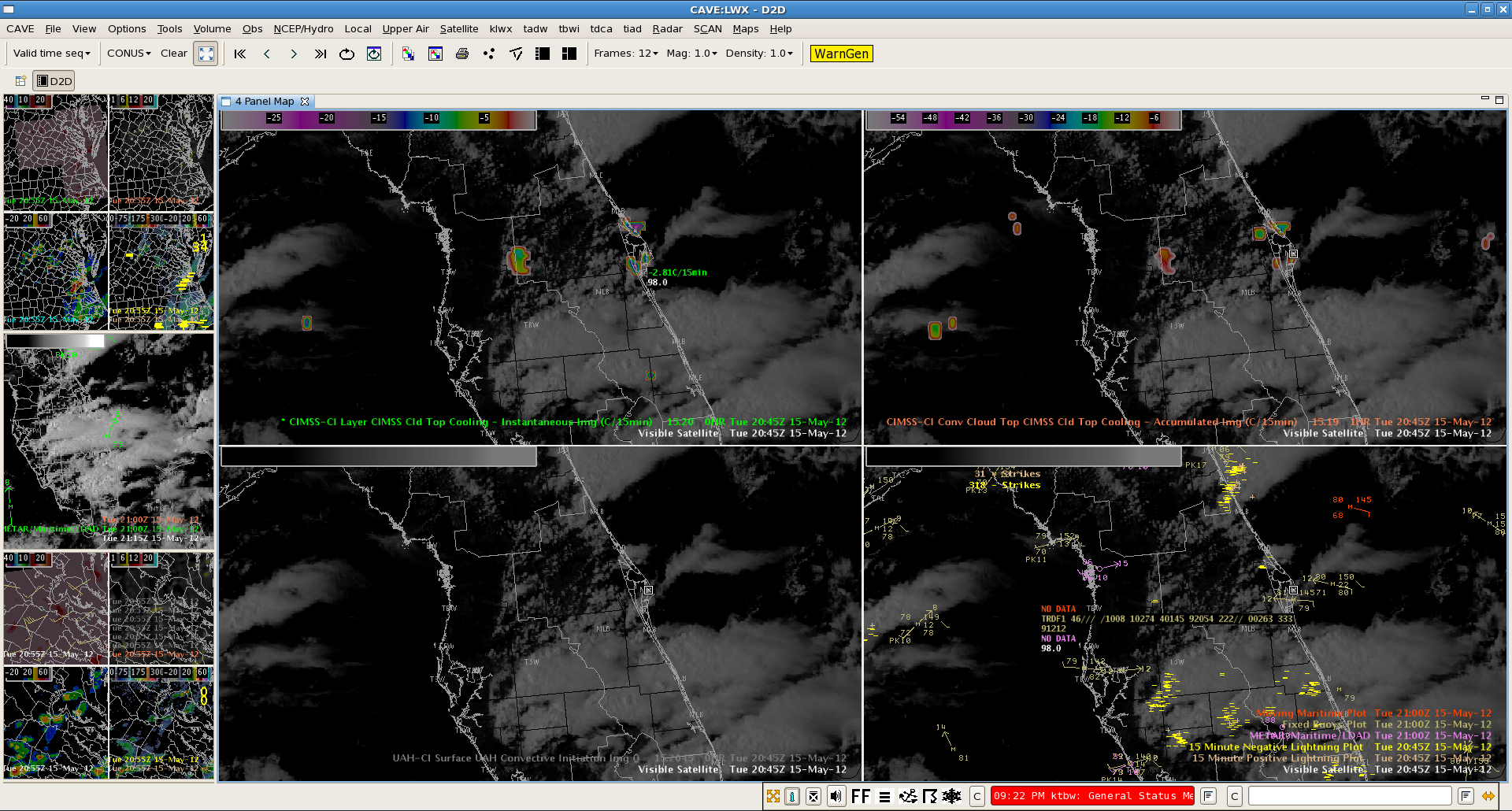
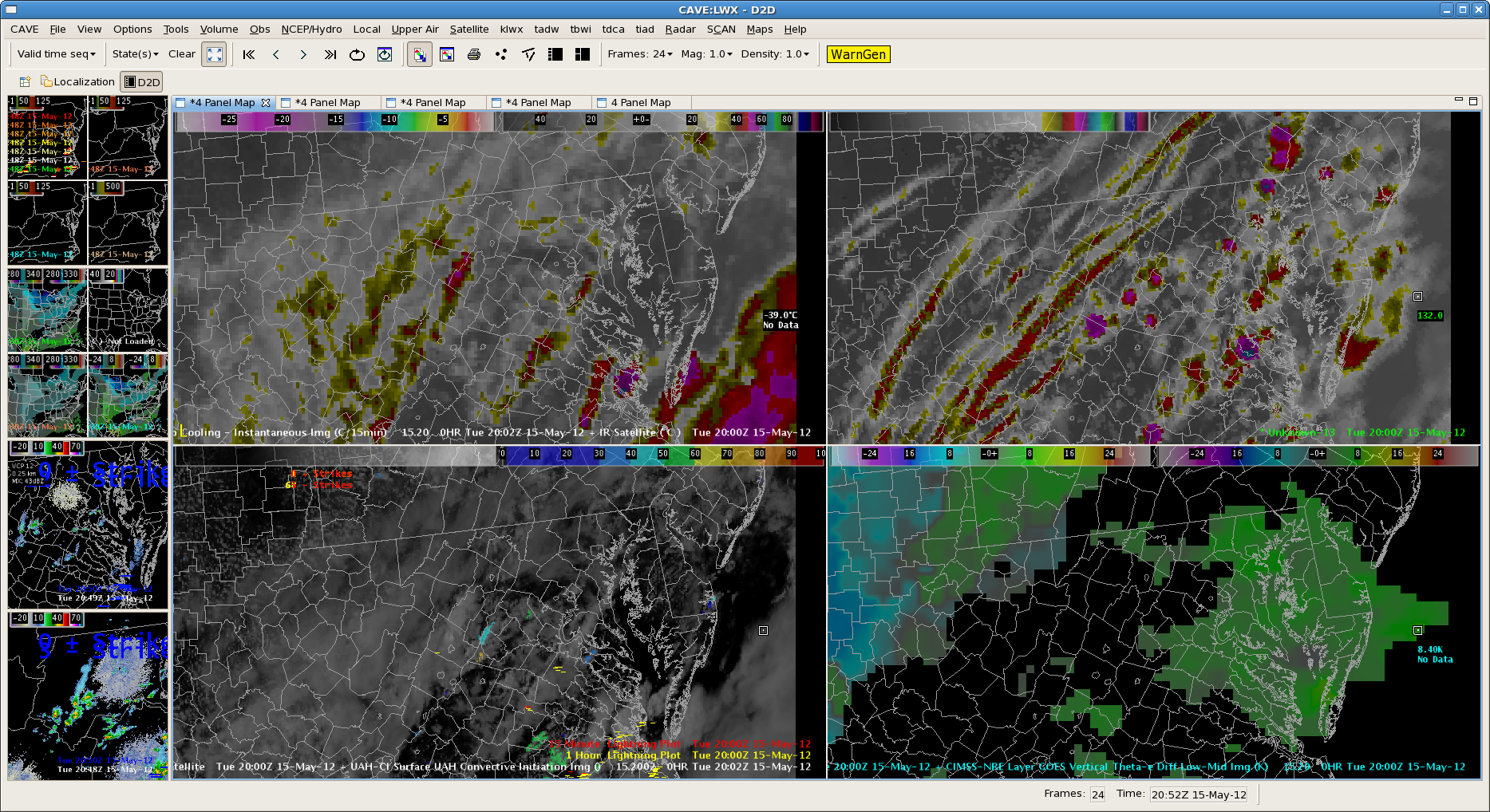
Being LWX today for another rather quiet day. Nearcast products and simulated satellite (and HRRR and 3dVAR) both showed marginal instability and a few air mass sort of thunderstorms and that is what has been happening.  It has let us see a few flashes on the pGLM products but not really enough to evaluate usefulness in warning situation. Image below shows nearcast theta e product in lower right (showing not much) and simulated IR in upper right showing spotty but unimpressive convection.  Left two panels are real IR & Vis sat showing that the simulated stuff not bad.  The CI products seem to be hitting areas that do end up as the small thunderstorms but not sure they are showing more than can be diagnosed by looking at the satellite imagery so not sure if I would warn on this product any more often than the satellite and radar alone but good quick check to make sure I am not missing anywhere I should be watching.

NSSL-WRF SimuSat Prompts Move to DVN

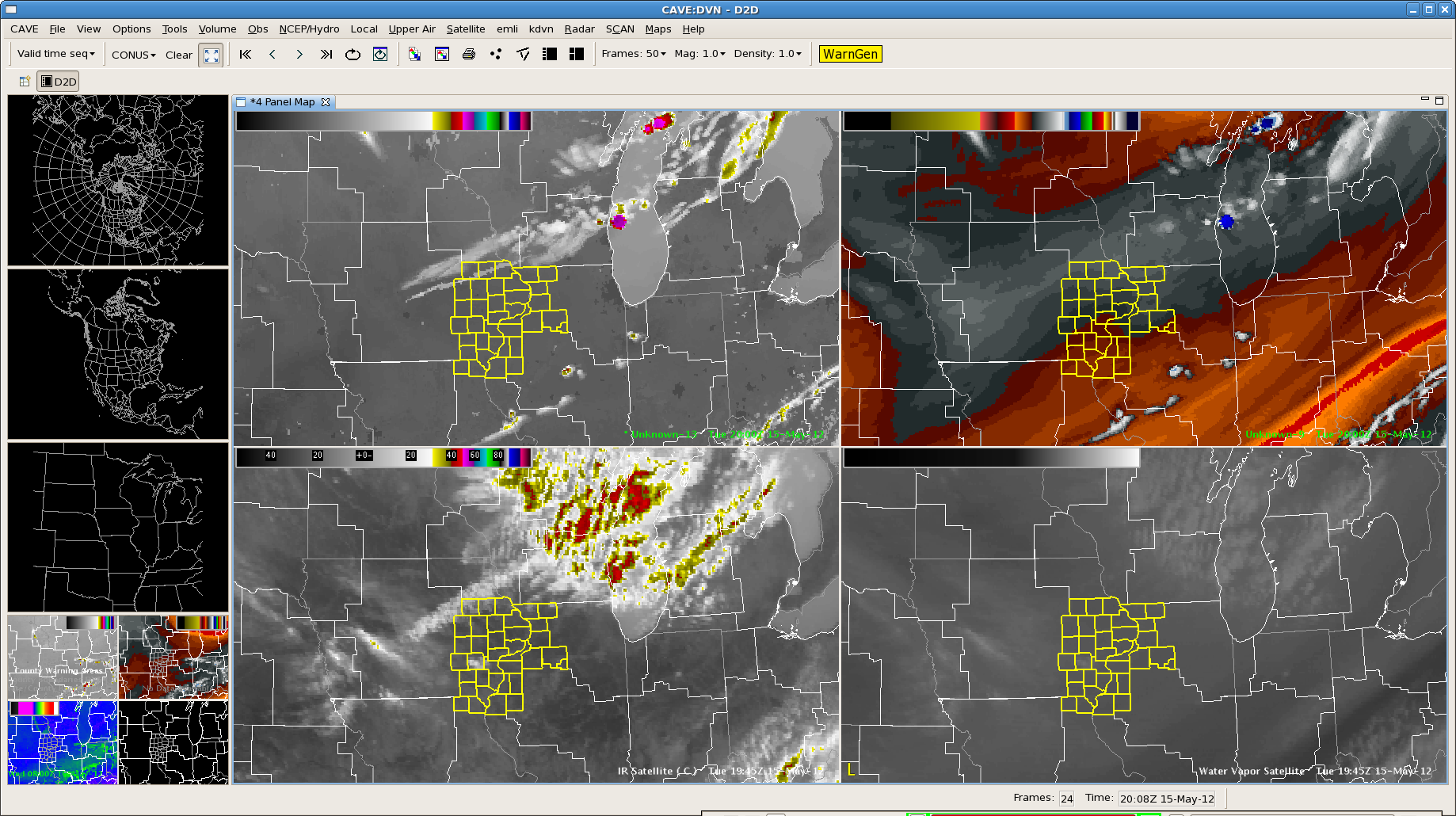
The simulated satellite imagery based off the NSSL WRF is handling a cold frontal passage in the Midwest quite well this afternoon.  The 2000 UTC comparison between the WRF “SimuSat” and observed IR image:

NSSL-WRF Simulated GOES-R IR Satellite (top) vs. Observed IR Satellite (bottom) at 2000 UTC 2012-05-15

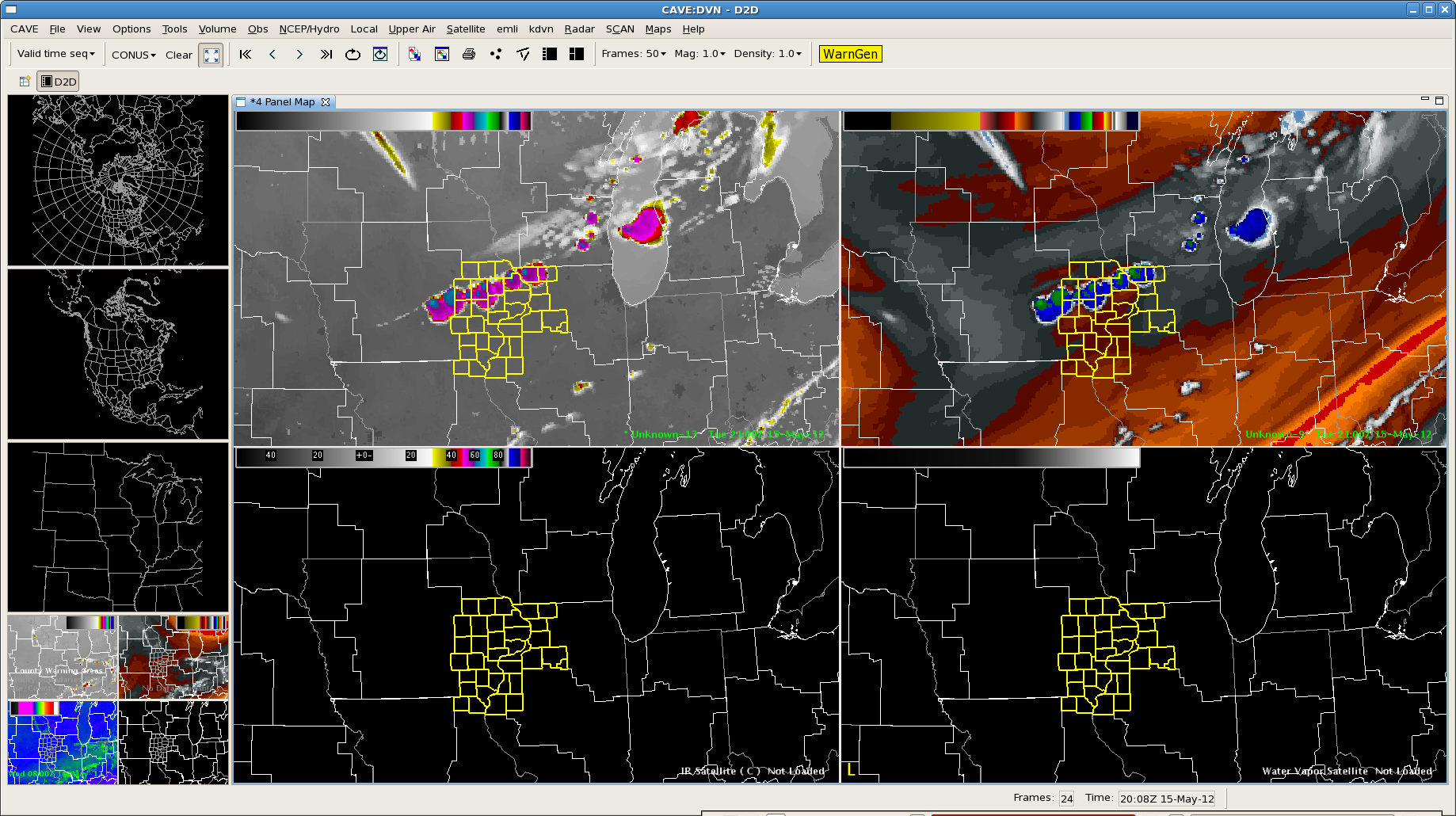
The NSSL-WRF simulated satellite imagery suggests that storms will erupt over the next hour:

NSSL-WRF Simulated GOES-R IR Satellite (top) vs. Observed IR Satellite (bottom) at 2100 UTC 2012-05-15

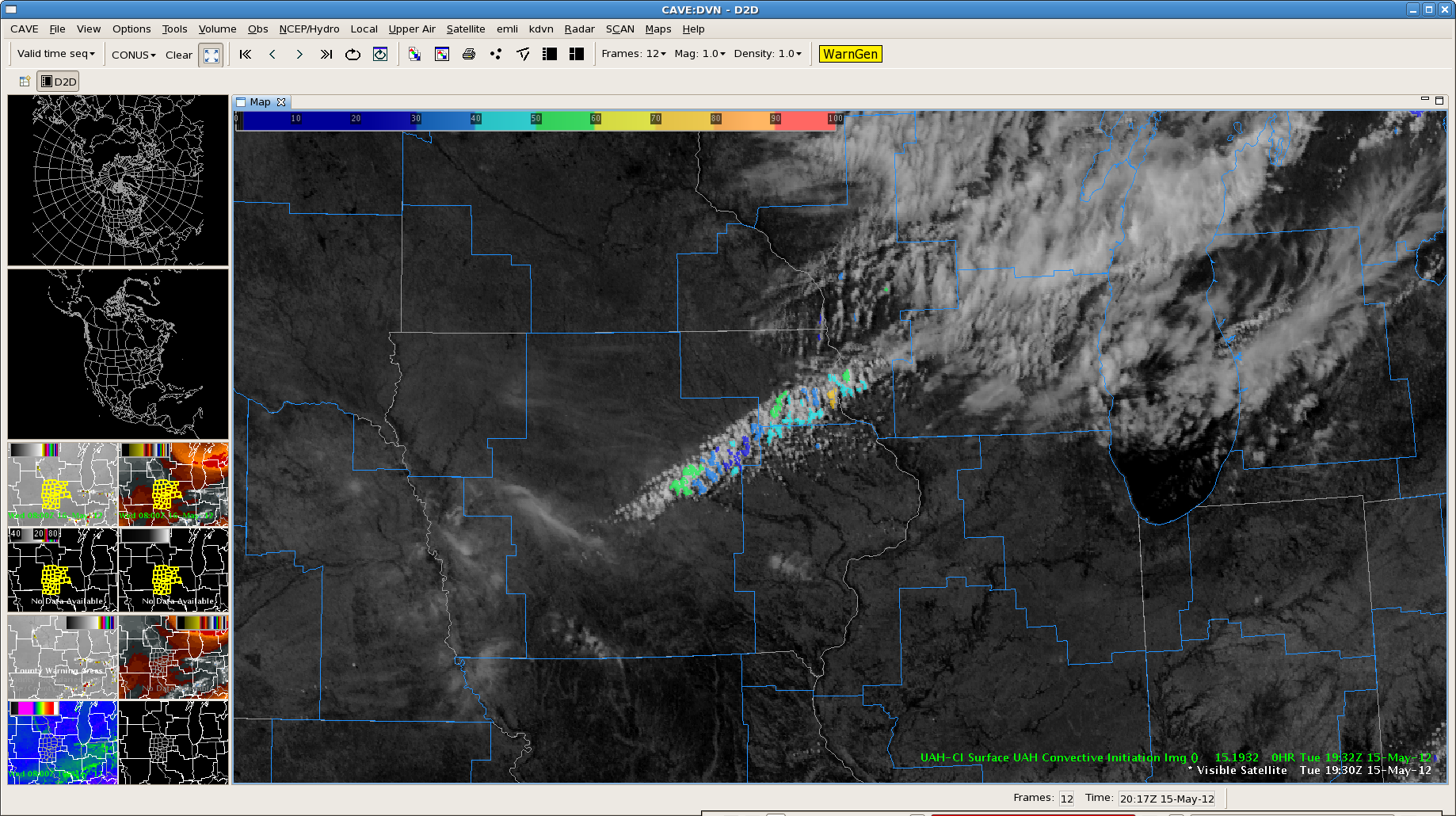
This model output, combined with hits from the UAH Convective Initiation product in the Cu field along the front, has prompted the RNK group to shift domains to DVN for the rest of the afternoon.

Visible Satellite and UAH CI Product, 1932/1930 UTC 2012-05-15

Update: 2012 May 15 1954z

The western target is now growing enough cumulus to have one of the teams move west.  Brian and Stephen will be localizing to Davenport, IA CWA to take the best advantage of evaluating CI along the cold front.  CAPE is weak but lapse rates are high.

Tags: None

RNK 19:15UTC

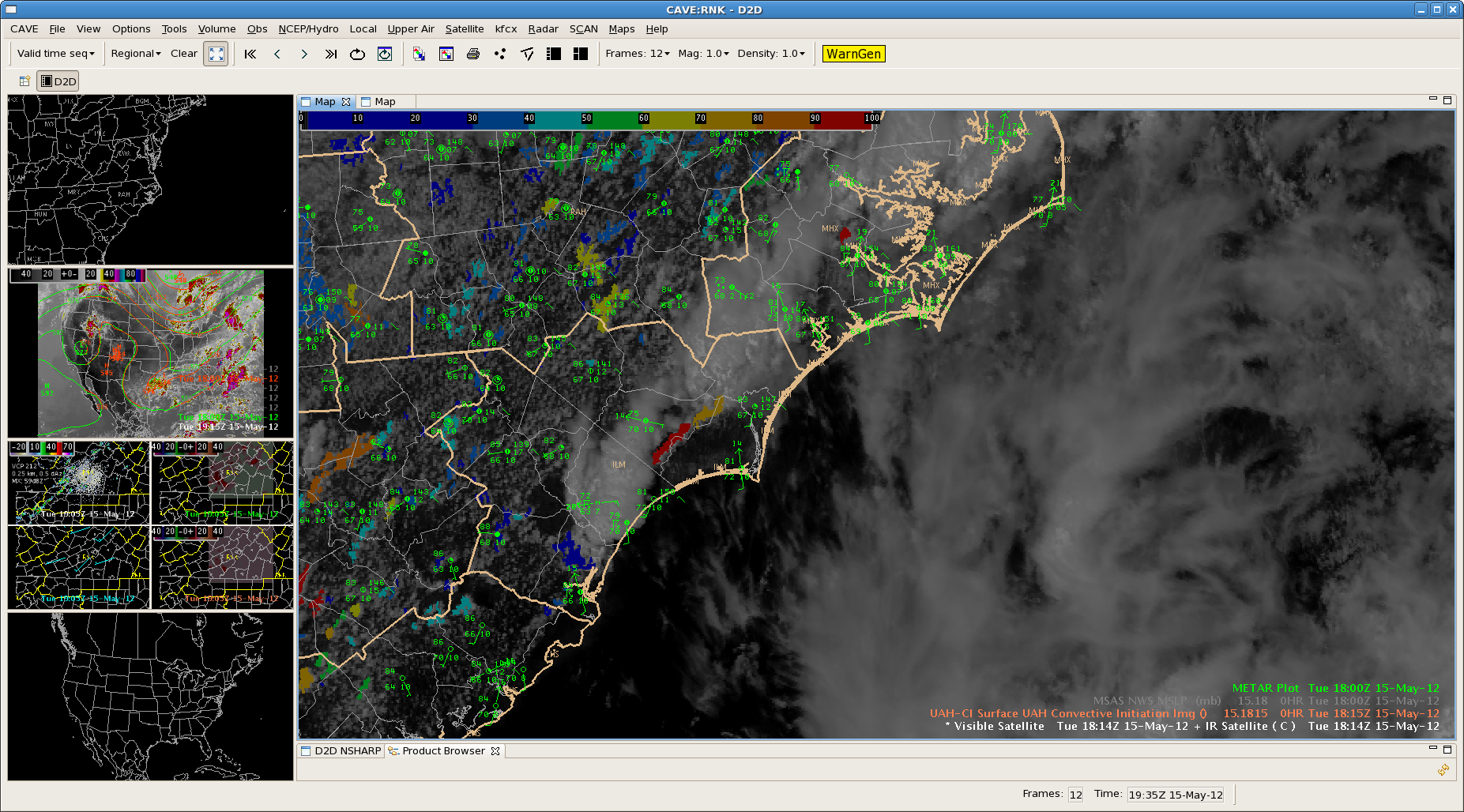
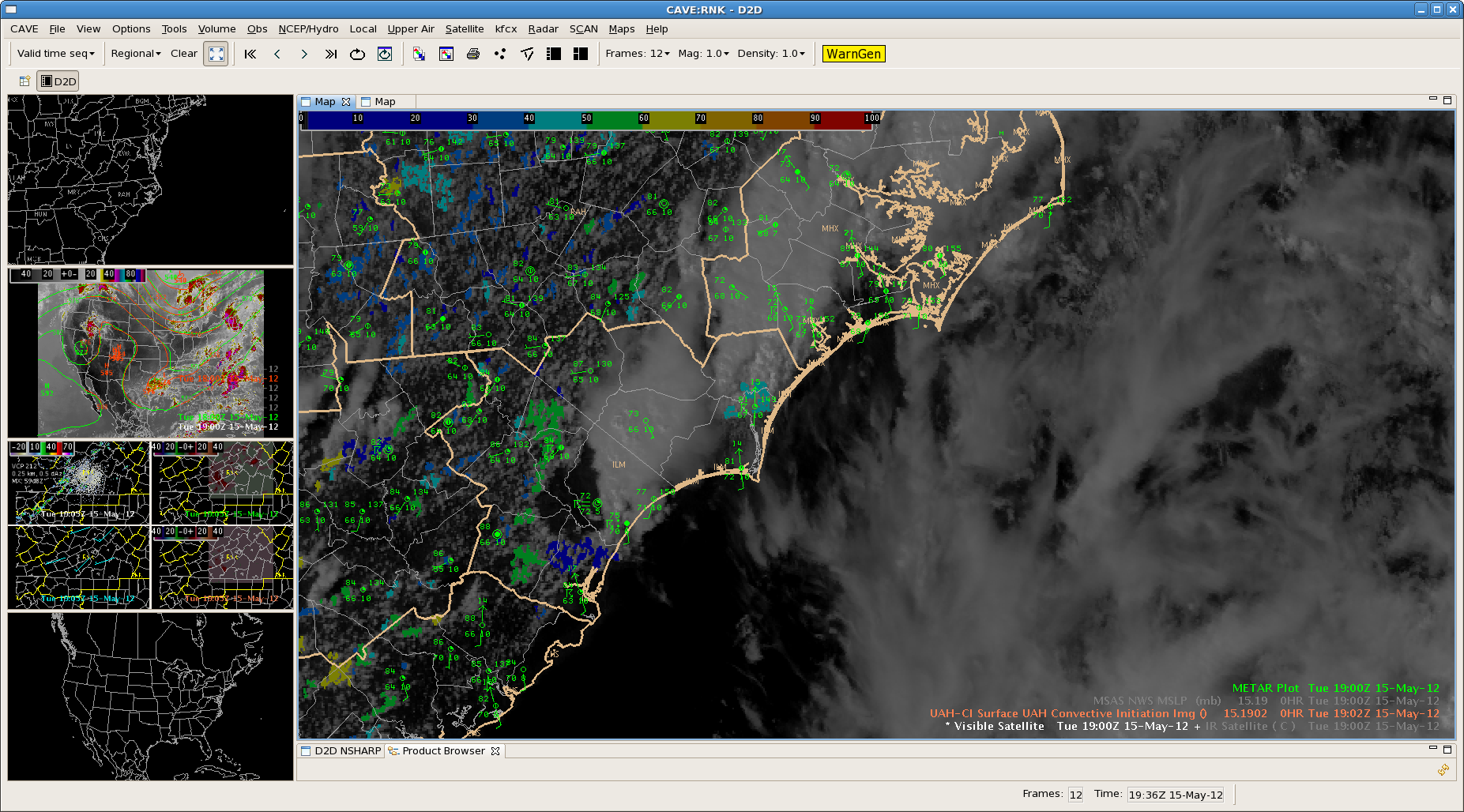
Although this was outside of our CWA, the CI product did a nice job of detecting a developing storm along the sea breeze front on the Carolina coast.  At 18:15UTC, CI indicated a 90% (red) area.

45 minutes later, at 19:00, the visible image showed a full-blown storm with a wide anvil.

Weak Convection in the RNK CWA

We are monitoring convection in the RNK (Blacksburg, VA) CWA this afternoon, but so far the development has been rather weak.

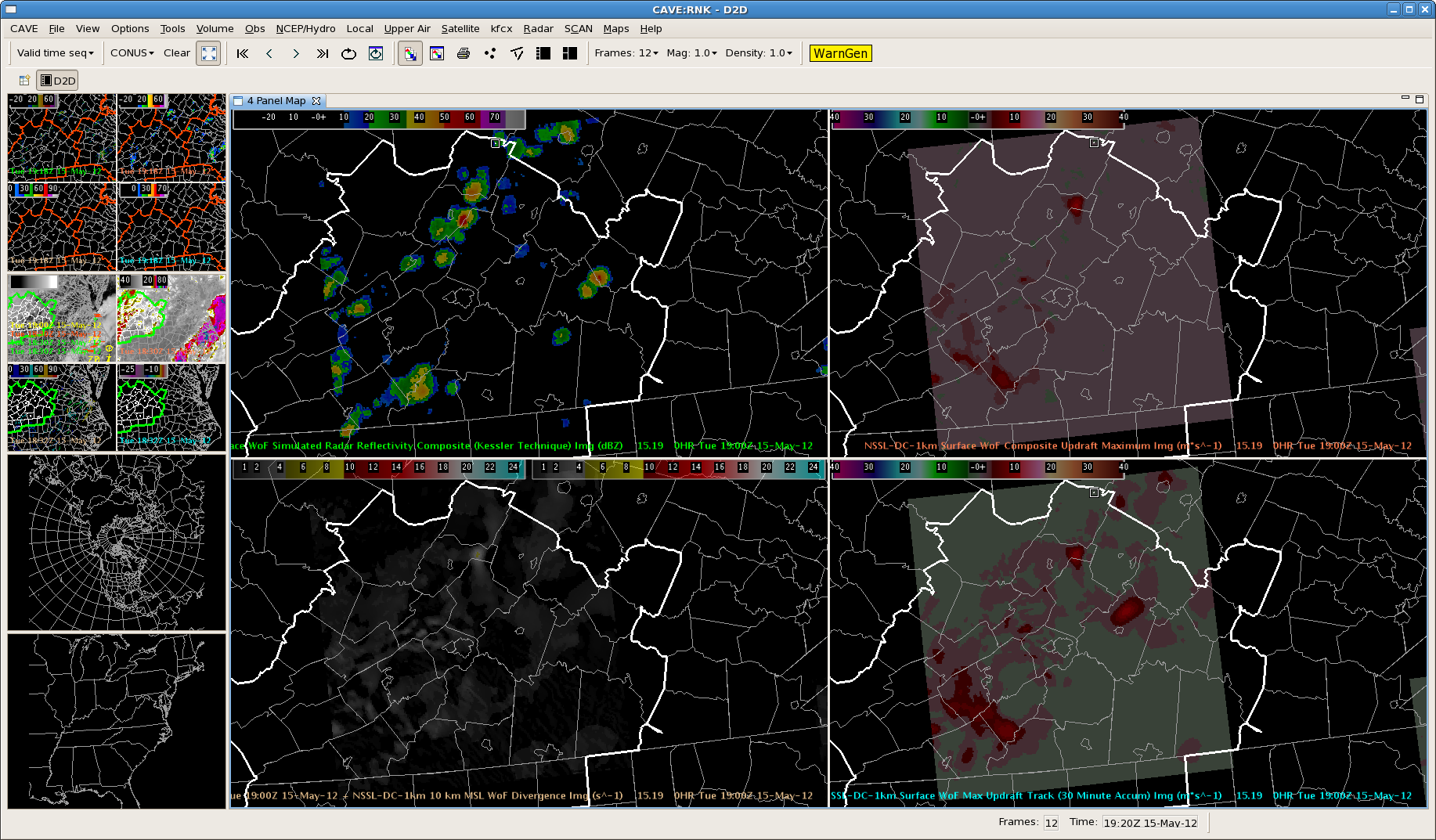
The 3D-VAR analysis has been useful for monitoring updraft intensity and anticipating possible stronger updrafts (top-right indicates instantaneous updrafts, bottom-right indicates 30-minute updraft history).  However, none of the strong updrafts have maintained themselves beyond one “scan”.

RNK 3D-VAR valid 1900 UTC 2012-05-15

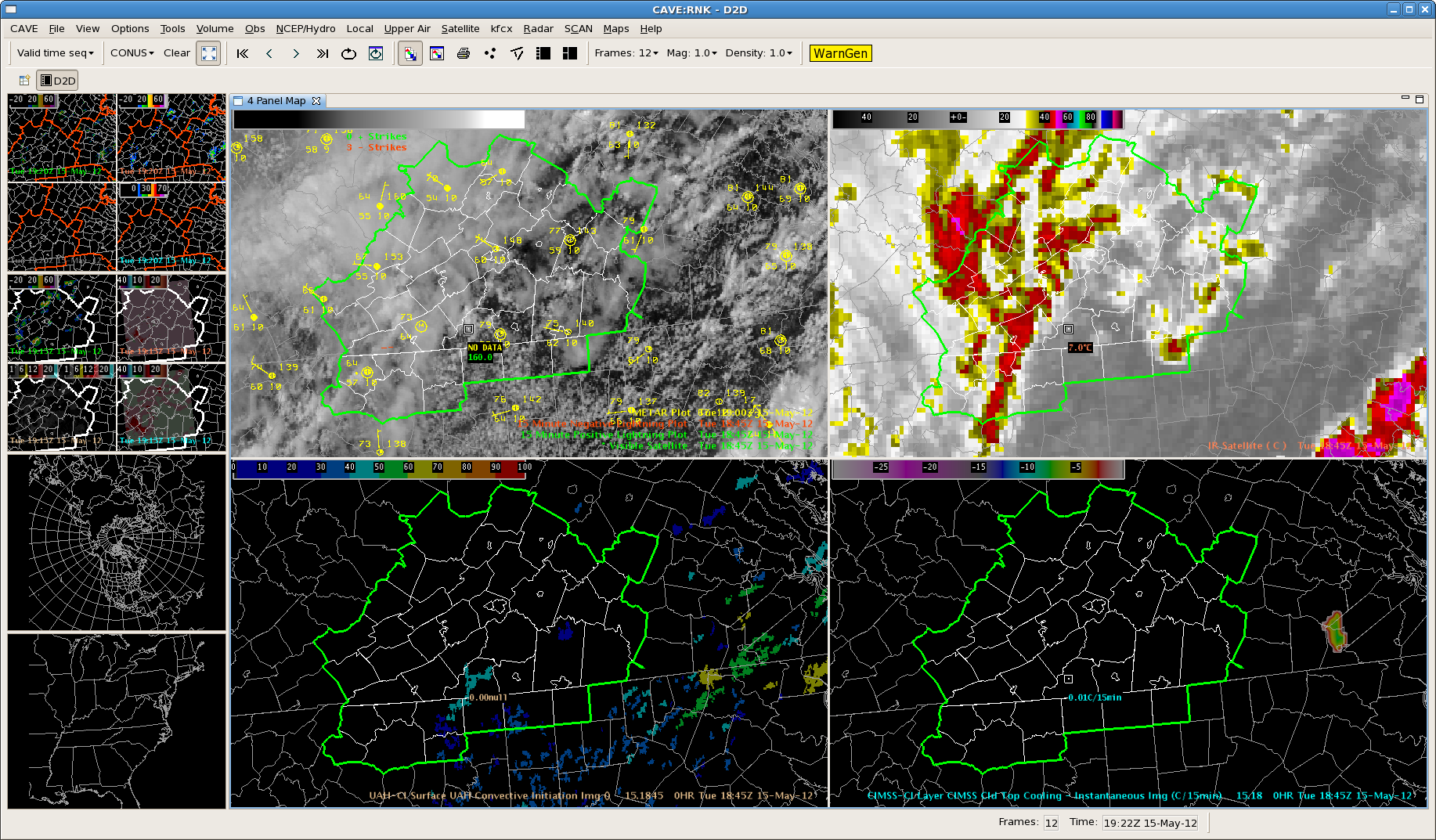
The convective initiation algorithms have struggled due to all of the cirrus blanketing the northwestern half of the RNK CWA, but some clearing in the southeast has produced some CI from the UAH algorithm.  Using the new Strength of Signal output, nothing has gotten above ~50 (the included sample is just 46 in the south-central portion of the CWA), and indeed there has been little significant development in those areas.  Nothing has triggered the UW Cloud Top Cooling algorithm yet in our area as of 1902 UTC.

Convective Initiation Algorithms valid 1845 UTC 2012-05-15

Outlook: 2012 May 15

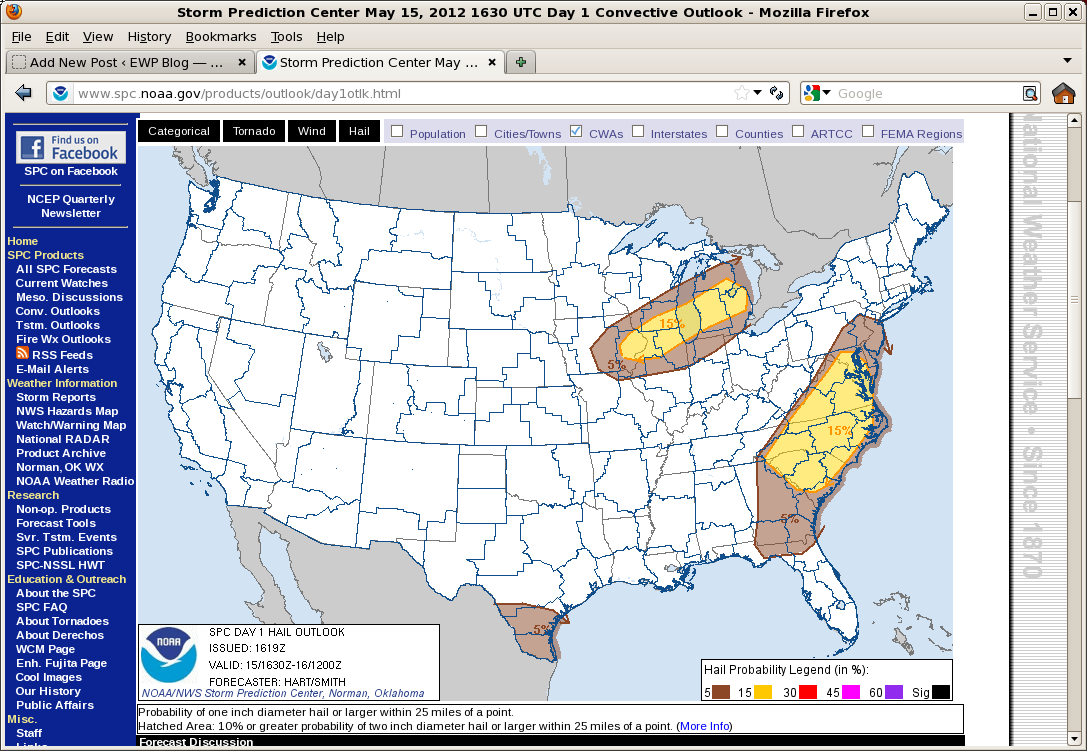
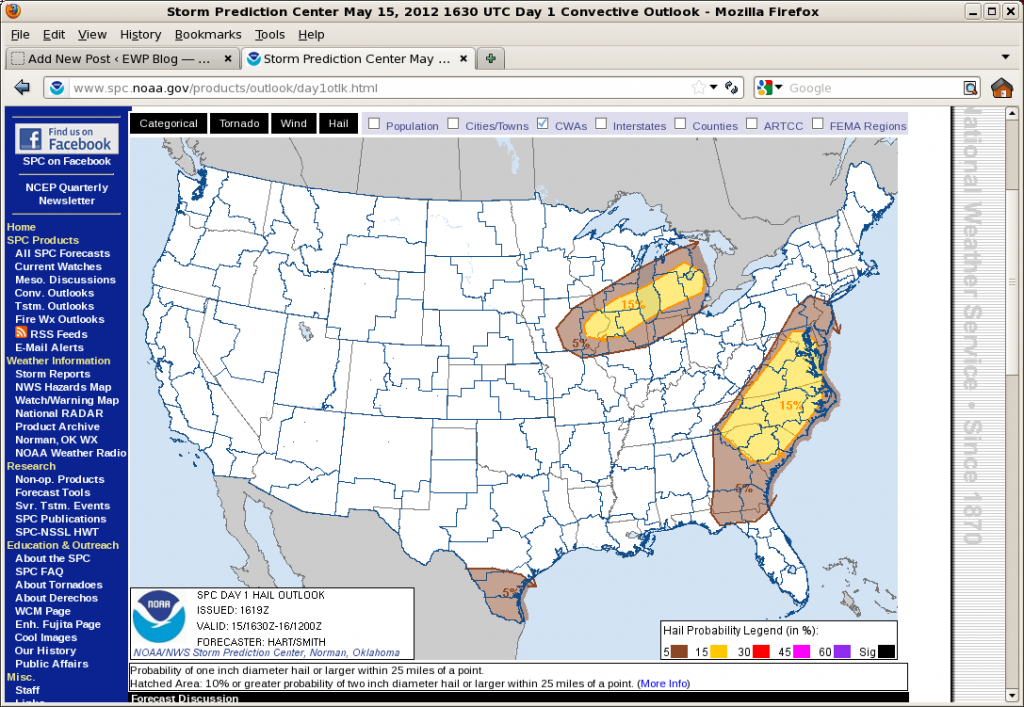
The eastern mid-level trough and near surface cold front moved extremely slowly overnight allowing the east coast another day of good surface-based instability.  Morning soundings in DC, Wallops Island and Blacksburg show near saturation over at least 300 mb above the surface and little cap. Surface moisture values are in excess of 12 g/kg. However lapse rates are relatively poor and deep layer shear is only 25 kts.  The result is expected to be areas of scattered to numerous small multicells forming relatively early in the day off of high terrain to the west and subtle axis of enhanced moisture extending just east of DC.  Steeper lapse rates and similar saturation along coastal North Carolina have allowed the morning sea breeze to more quickly initiate vigorous convection.  Any of these areas will be susceptible to moist downbursts and marginally severe hail.

Further west, a northern stream midlevel short-wave trough is dropping into the western Great Lakes.  A trailing cold front is expected to initiate convection from southeastern MN eastward to central MI.  Here, moisture is sparse with surface values only around 8 g/kg.  But we expect this limited moisture will be able to sustain convection owing to very steep lapse rates in the lowest 400 mb of the atmosphere.  Shear is also expected to remain weak (<30 kts/6km) and thus small multicells are expected.  Due to the limited moisture, we don’t expect any upscale growth here.

The plan is to work the DC LMA area and the Roanoke CWA for the early convection and then shift our focus to WI and MI for the later afternoon.
Jim LaDue, EWP2012 Week#2 Weekly Coordinator

Tags: None