A neat way to visualize OUNWRF parameters on one display

Gabe, the OUNWRF PI, showed us an interesting way to monitor a few model output fields simultaneously.  The display here includes the model derived radar reflectivity as a background image, with the green contours showing updraft helicity and the salmon contours the maximum hourly column hail.  The display here is consistent with the expected mode of convection over the next few hours…namely, pulse storms or multicell clusters.  With marginal bulk shear values, we aren’t expected a lot of deeply rotating storms, but there will be a large hail and/or damaging wind threat with some of the stronger cores.  I will continue to watch this display through the evening to see how it all pans out.

CL

OUNWRF_display_01413_1927

Tags: None

Convection Comparison Between OUNWRF/Actual Reflectivity across Beautiful W TX/SE NM

This is a image of the OUNWRF 16 UTC run 05/14/13 for 1845 UTC 1 km AGL Derived Radar Reflectivity compared to 0.5 Degree Reflectivity from KMAF at 1845 UTC.  They compared well with the OUNWRF doing a fine job with the location and storm mode (isolated cells/multicell clusters) near and just southwest of Midland.  The OUNWRF underestimated unorganized convection across SE NM.  Michael Scotten
Tags: None

Possible location shift for 14 May 2013:

Models have been trending upward for severe chances in southwest Texas for today and the most recent day 1 outlook from SPC has moved from a “see text” to an actual “slight risk” for the region.  The combination of a dryline circulation, forced lifting and an upper-level jet streak will increase the probability of severe weather compared to the western great lakes region we had previously targeted which is still dealing with a lack of moisture and a strong cap.

Possible CWAs:  San Angelo, Austin/San Antonio, Midland

K. Calhoun, Week 2 Coordinator

Tags: None

LAPS Surface Analysis Near Terrain and Convection

The 2.5 km variational LAPS did a relatively good job at resolving various boundaries that became apparent through the afternoon. Looking at the LAPS surface dew point and wind fields across the northern Rockies around 22Z…higher terrain locations had lower dew points in the 20s and 30s…with the lower terrain locations in the valleys and plains of northern Montana showing dew points in the 40s and 50s. In addition…locations in the wake of convective activity across northeast Oregon and points to the northeast both showed higher dew points and outflow boundary-like signatures in the wind field. These both matched reasonably well with the METAR observations. The model also did well with identifying the convergence boundary in the wind fields stretching from eastern Oregon through central Montana. LAPS_boundaryMazur

Tags: None

EWP Status for 14 May 2013: 1-9 pm Shift

EWP STATUS FOR 14 MAY 2013: 1 – 9 PM SHIFT

Another conditional / marginally severe day is on tap for Tues. We will likely be operating over Minnesota, Wisconsin, Michigan as a strong frontal system moves across the region.  Warm air advection will be the story over the region tomorrow with surface temperatures reaching the mid-to-upper 80s behind the warm front by the mid afternoon. Showers and storms are likely along the warm front, though at the moment, these look unlikely to become severe.  Further west ahead of the cold front, instability seems slightly better, but a strong cap and low moisture will possibly inhibit storm growth.  Models have been a bit mixed in terms of the amount of low-level moisture that will be available.

Possible CWAs of operation tomorrow:  Duluth, Marquette, and Twin Cities (MSP)

K. Calhoun, Week 2 Coordinator 

Tags: None

Monday, May 13th Montana Storms, downburst/hail potential

Location: Montana. Threat: severe hail/high winds. Soundings suggest potential for thermodynamically-driven downbursts over mountainous terrain. Question: will cloudtop cooling (CTC) rate be applicable to hail cores that could generate wet/dry microbursts?

CTC rates have been noted to have problems in mountainous regions such as the Rockies and even Appalachians. The rates were at or below 10C/15 minutes on the first few updrafts and only one storm briefly (one volume scan) reached 50 dbz through 20UTC. A storm entering Idaho County showed cooling rates of 12.6C/15 minutes at 2015 UTC, but this storm did not intensify until after 2130 UTC. This storm was not assigned a CTC rate after 2015 UTC because of masking by cirrus blowoff. Another storm that formed on the forward flank of this storm became marginally severe but was also never identified due to cirrus.

Possible sampling issues were noted in the MRMS sfc height of 60 dbz above -20C. The levels showed big scan to scan variability which may have been a function of distance from KMSO and sparse coverage of surrounding radars. As this storm got closer to the RDA, the scan to scan variability decreased.

SPC issued a severe thunderstorm watch at 21UTC with the main threats being large hail and high winds, with a secondary threat of a tornado.

– Ostuno

Tags: None

14May2013 01Z Mesoscale Discussion Update

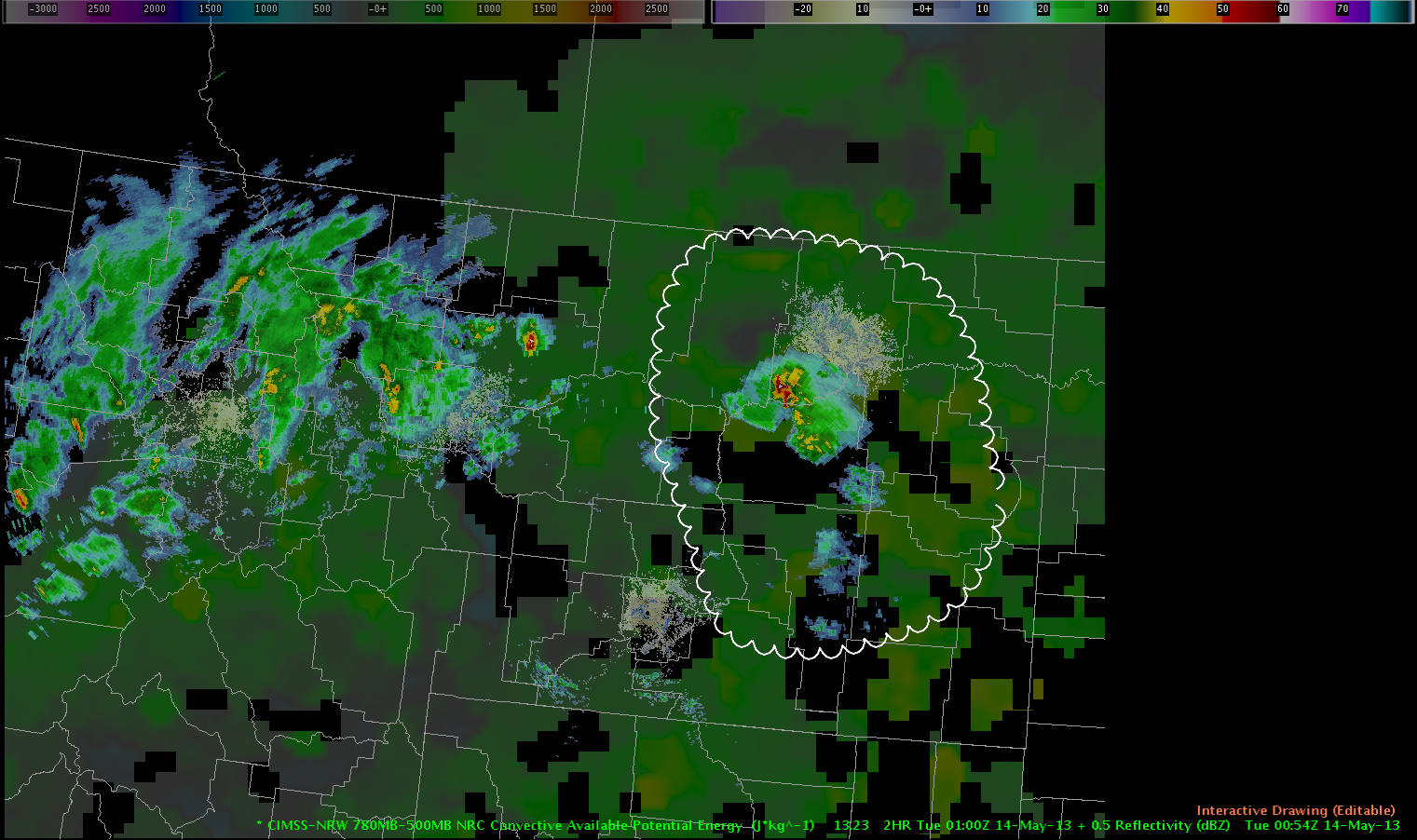
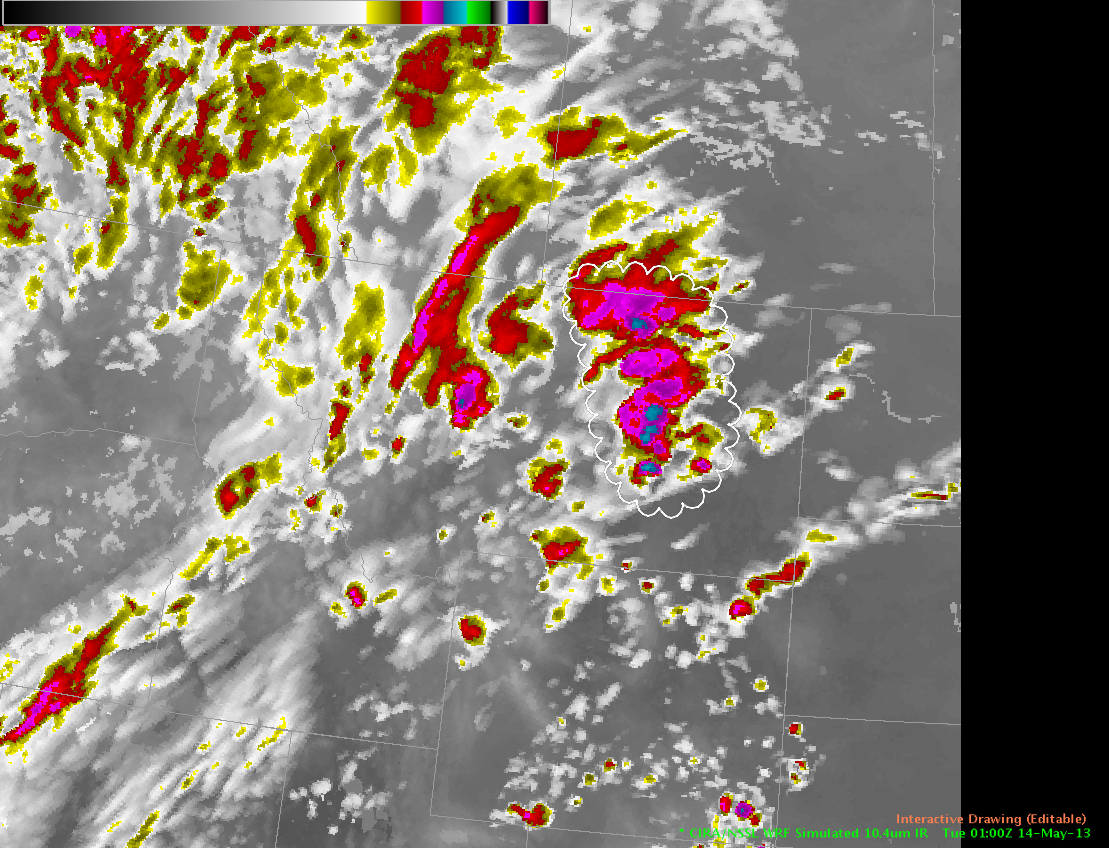
Best possibility for near-severe wind gusts and marginally severe hail appears to exist across the E half of Montana over next couple of hours. WRF simulated IR images and CIMSS 780-500mb difference products continue to point at this region having the best thermodynamic environment (approx 700-900 J/kg of CAPE) to maintain convective development during this time period. Regardless, severe threat still appears to be low-end.

0100zsimIR nrwcape_radar

Picca

Tags: None

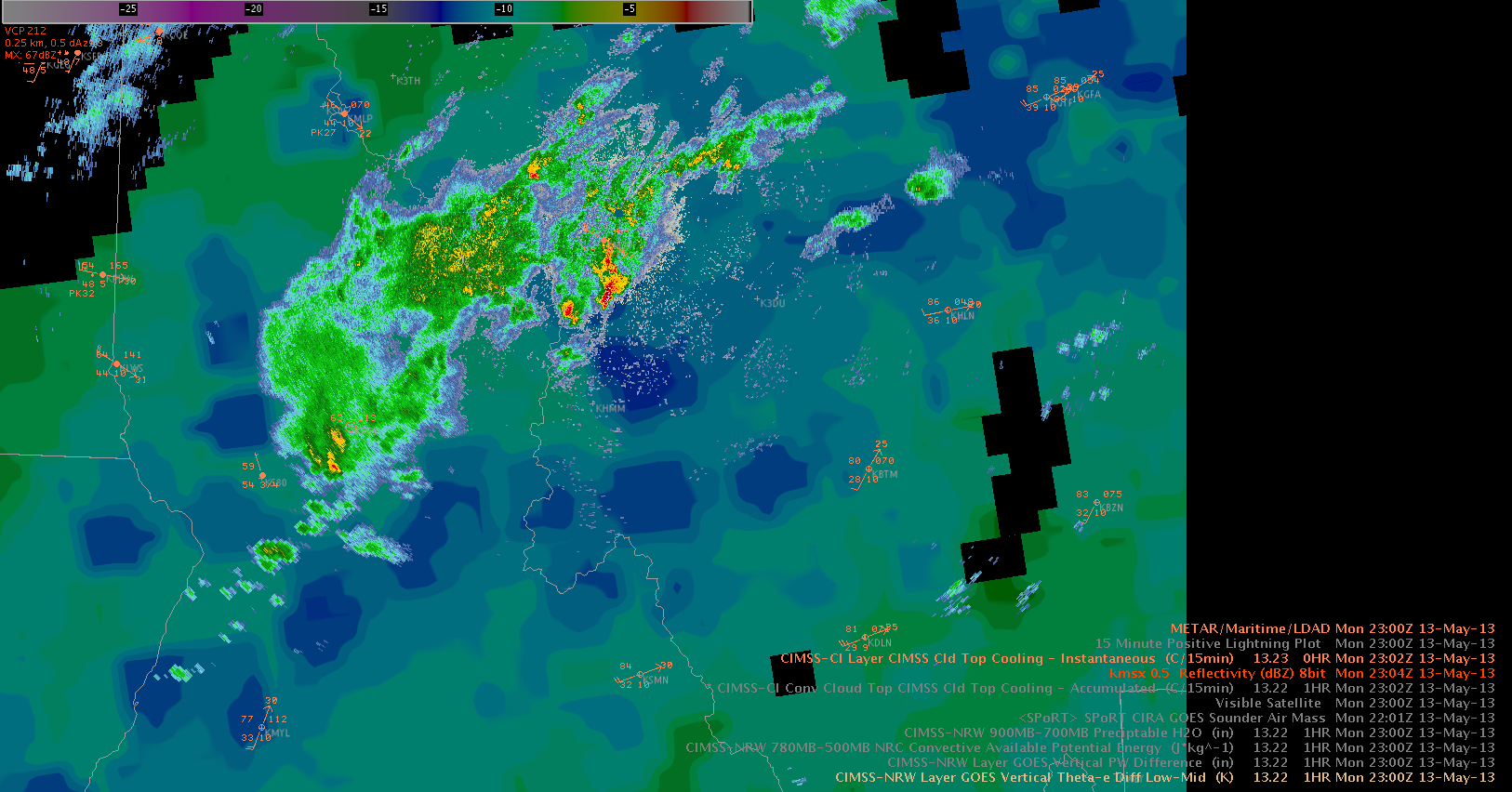
CIMSS vertical theta-e difference product with ongoing strong to severe storms

refl_theta-e_diff_13_05_2330Z

Despite moving atop an increasingly dry boundary layer (ref. to dewpoint readings in the mid to upper thirties), the strong to severe thunderstorms keep their strength. The GOES vertical theta-e difference (low-mid) product highlights the moist and unstable air mass nicely with 500-1000 J/kg (another product) present. In fact the thunderstorms really increased in strength when approaching and eventually crossing that plume of unstable air. For this event, the product by CIMMS helped a lot to get a feeling about how supportive the air mass stratification would be ahead of the thunderstorm despite decreasing boundary layer moisture. In the near future we should see a potential increase of a downburst risk with inverted-V profiles to the E/SE of the storm. A marginal hail risk continues with that storm.   Helge

Tags: None

Simulated IR Satellite Comparison Across NW US

IRCIMASSimulatedIR051313Comparing the simulated satellite from NSSL-WRF/GOESR/CIRA on the right to the actual IR on the left at 23 UTC on May 12 depicts general good agreement.  The simulated satellite imagery overdeveloped isolated convection over southern Idaho, Montana, and Wyoming, and was a bit to quick/far to the east with the cooler/deeper moisture plume from far northern California to Alberta.  The simulated IR verified very well with post-frontal cold air cumulus depiction over western Washington and northwest Oregon. Michael Scotten

Tags: None