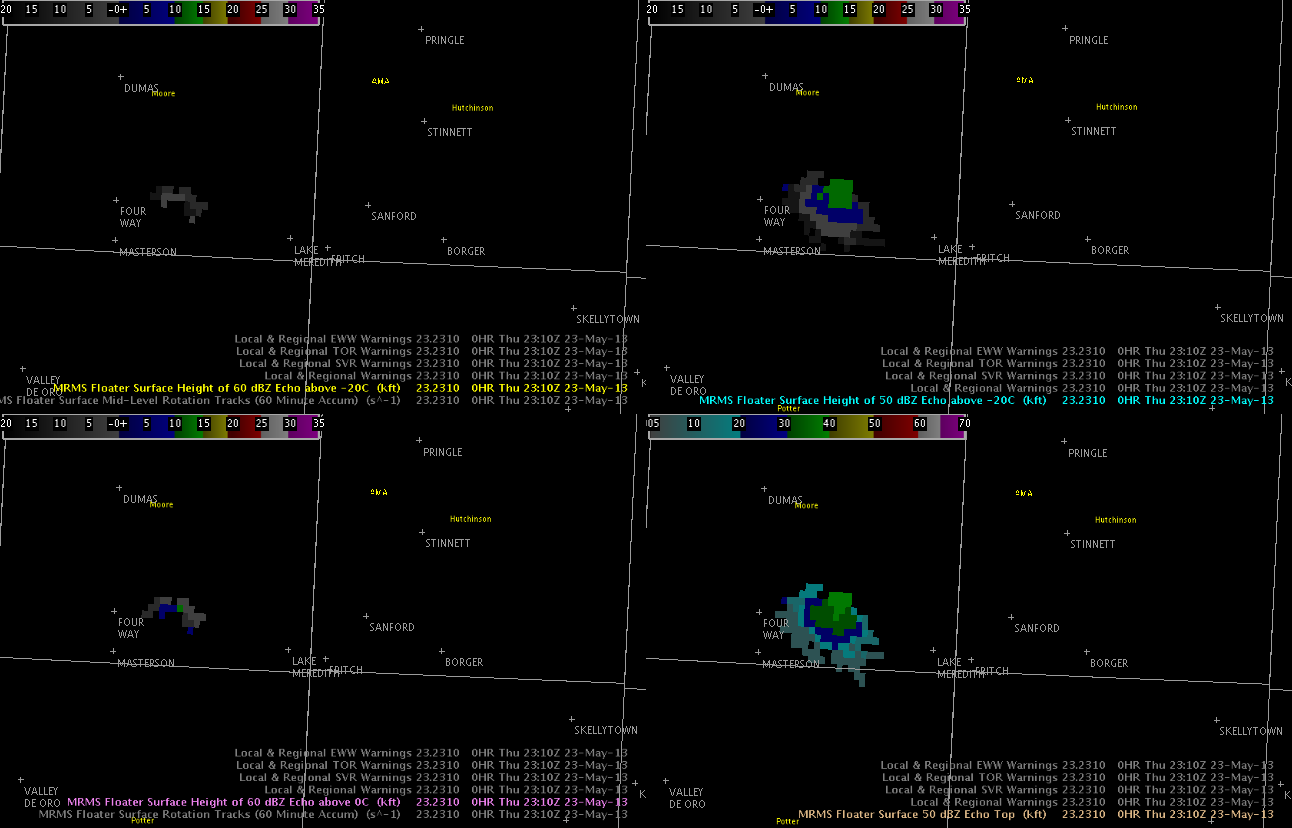
50dbz Echo Top_MESH_HSDA North Texas

The 50 dbz echo top continues to be one of my favorite parameters for quick and easy interrogation should things get busy. It’s a nice way to see the approximate height of the 50dbz core. Height of the 50dbz core above -20C is also a nice touch to analyze those really big storms that may need more significant hail wording.50_60dbz_2310z
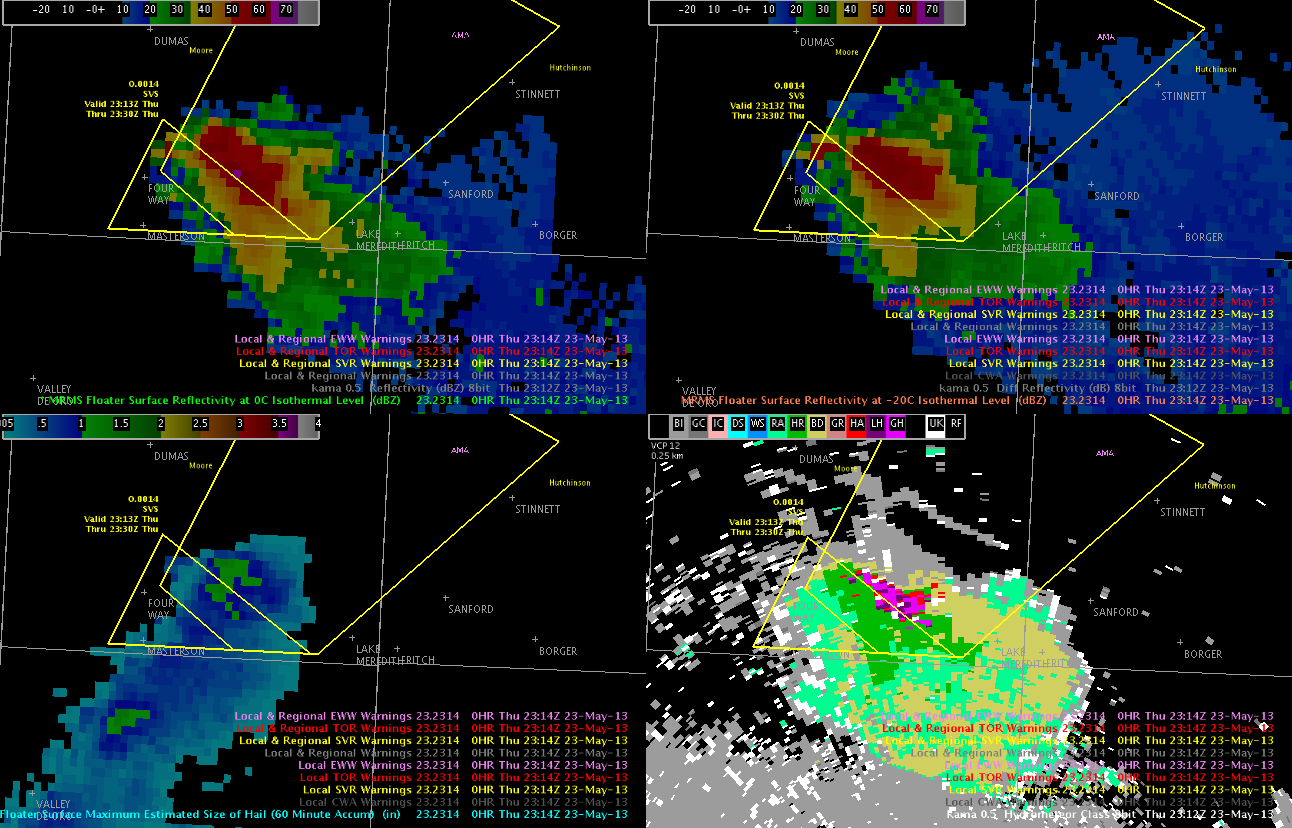
The MESH and HSDA were both doing a good job with this storm. We did not get any hail reports, but that is likely due to the rural locations where the storm was tracking. Seeing the MESH indication of 1 inch hail and the HSDA forecast of large hail added confidence in the warning decision making process and it only took a few seconds to glance at these products. Therefore, there was still time to go through a complete review of base reflectivity and SRM data in all_tilts. The algorithm hail trends reflected what one would expect based on all_tilts base data.MESH_HSDA_2313Z
The mid level rotation track was a nice way to view the life of this storm. Initially there was good mid level rotation, but this rotation begins to weaken with time and the warning was allowed to expire early. The decision to expire the warning early was based primarily on trends within MESH, HSDA, and 50dbz echo tops. But the loss of rotation was icing on the cake for letting the warning expire.  (Jeremy Wesely)
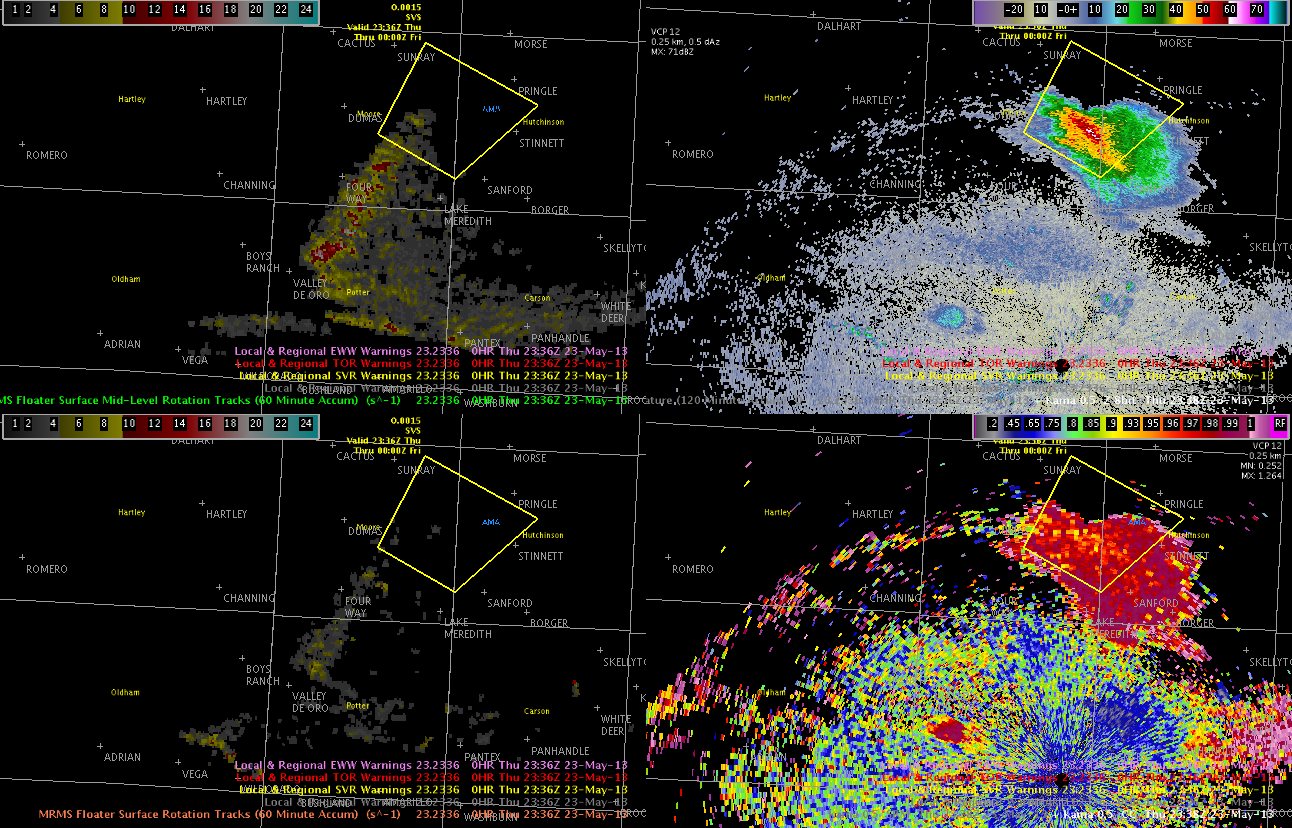
Rotation_Storm_Decay

Jeremy Wesely

Tags: None

Storms Along the SJT/MAF Border

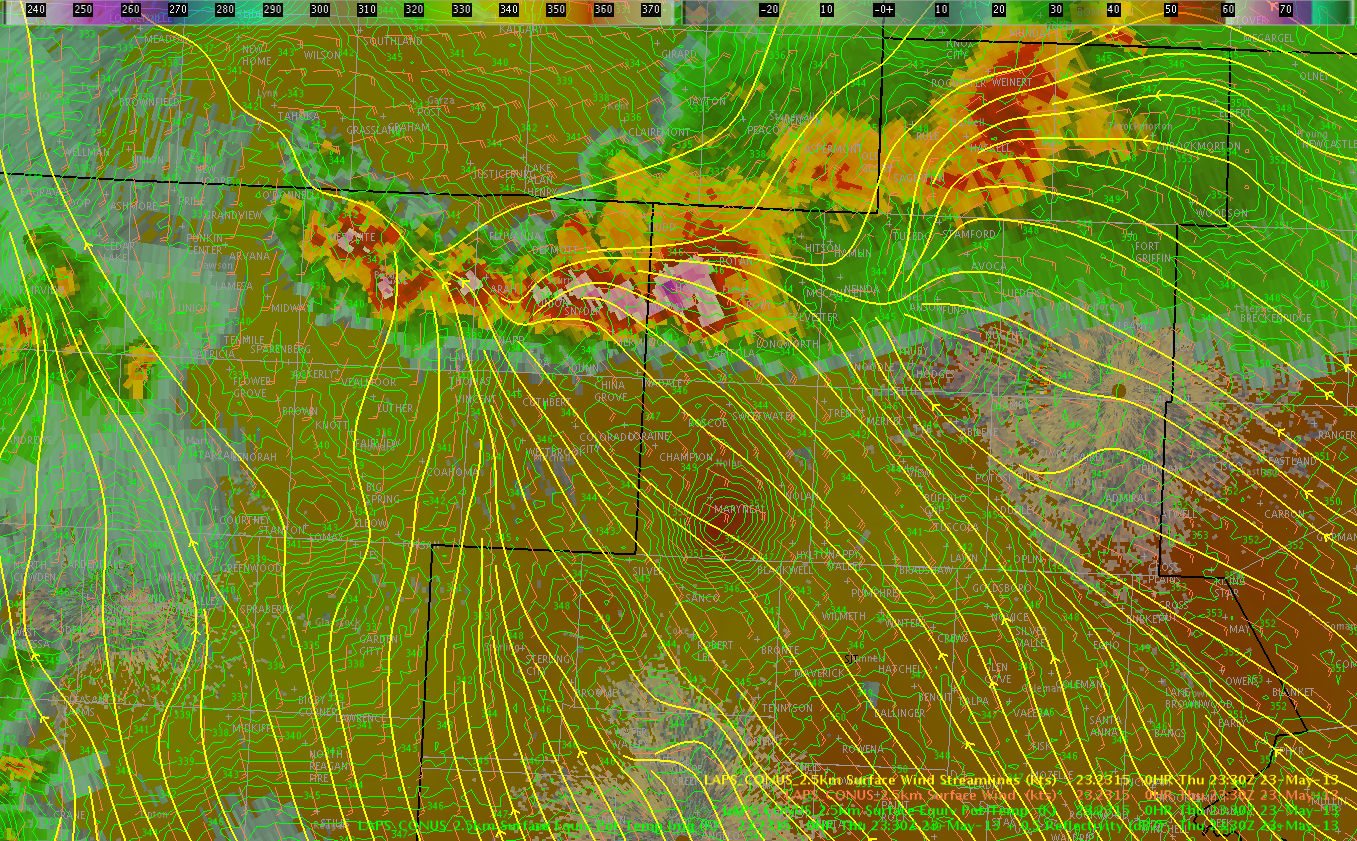
An earlier cell merger helped enhance low-level rotation and produced a reported tornado near Rotan in Fisher County TX in SJTs area.  The mid-level meso would eventually track SW toward Scurry and Mitchell Counties in the MAF forecast area.  The LAPS streamline analysis at 2330 UTC indicated convergence over the northeast portion of the MAF CWA, which appeared to be concentrating higher theta-e values in the location likely allowing the stronger convection to translate west of south.

2330LAPSradar

Tags: None

Damaging Convective Wind Event To Affect Areas From Abilene to Throckmorton

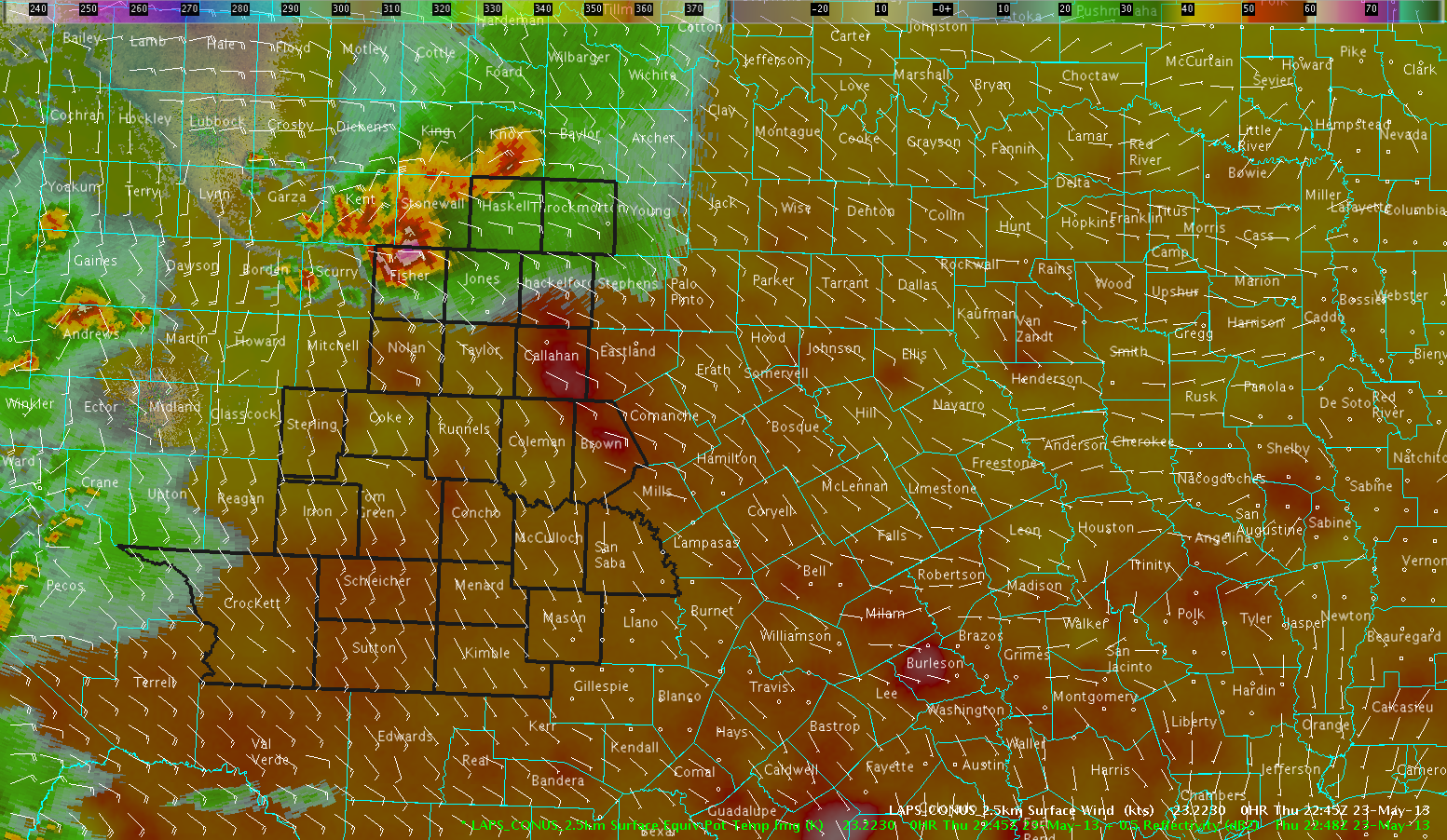
Our first clue was the 2.5KM LAPS Theta-E image with LAPS wind and regional radar overlaid on it at 2245 UTC.2245ZLAPS_Theta-E_Wind*The tornadic Fisher Co storm was propagating southward toward the bullseye of Theta-E over Nolan Co, while the rest of the more linear convection with damaging to destructive winds was moving southeast toward an area of high Theta-E extending from Jones/Shackleford countis into Callahan/Brown counties.

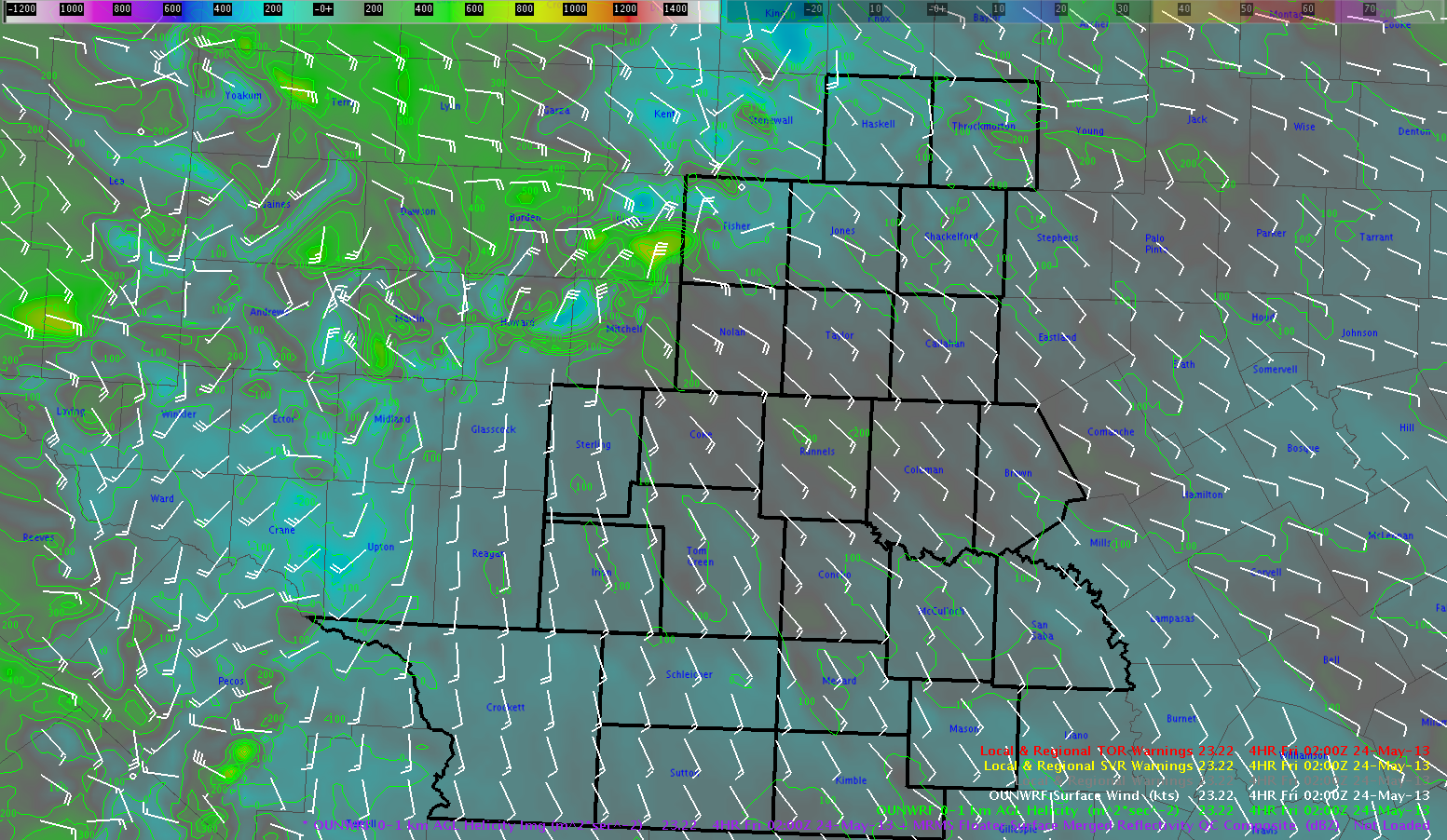
There’s a chance this linear complex splits with the better tornadic part moving southward across western San Angelo’s CWA from Fisher south through Nolan and Coke counties where the OUN-WRF 0-1KM SRH forecasts values by 0200 UTC to increase over 200 m2/s2. Meanwhile, the linear activity moving toward Abilene/Throckmorton is moving into an area of 0-1KM SRH less than a 100 m2/s2 for the most part with likely more of a damaging wind/marginal hail threat.

0200UN_WRFSRH

Here is latest MESH and 60 min MESH swatch from the severe activity.

SJT_MESH*

Tags: None

Some further warnings in the Midland CWA prompted by MRMS and HSDA data…

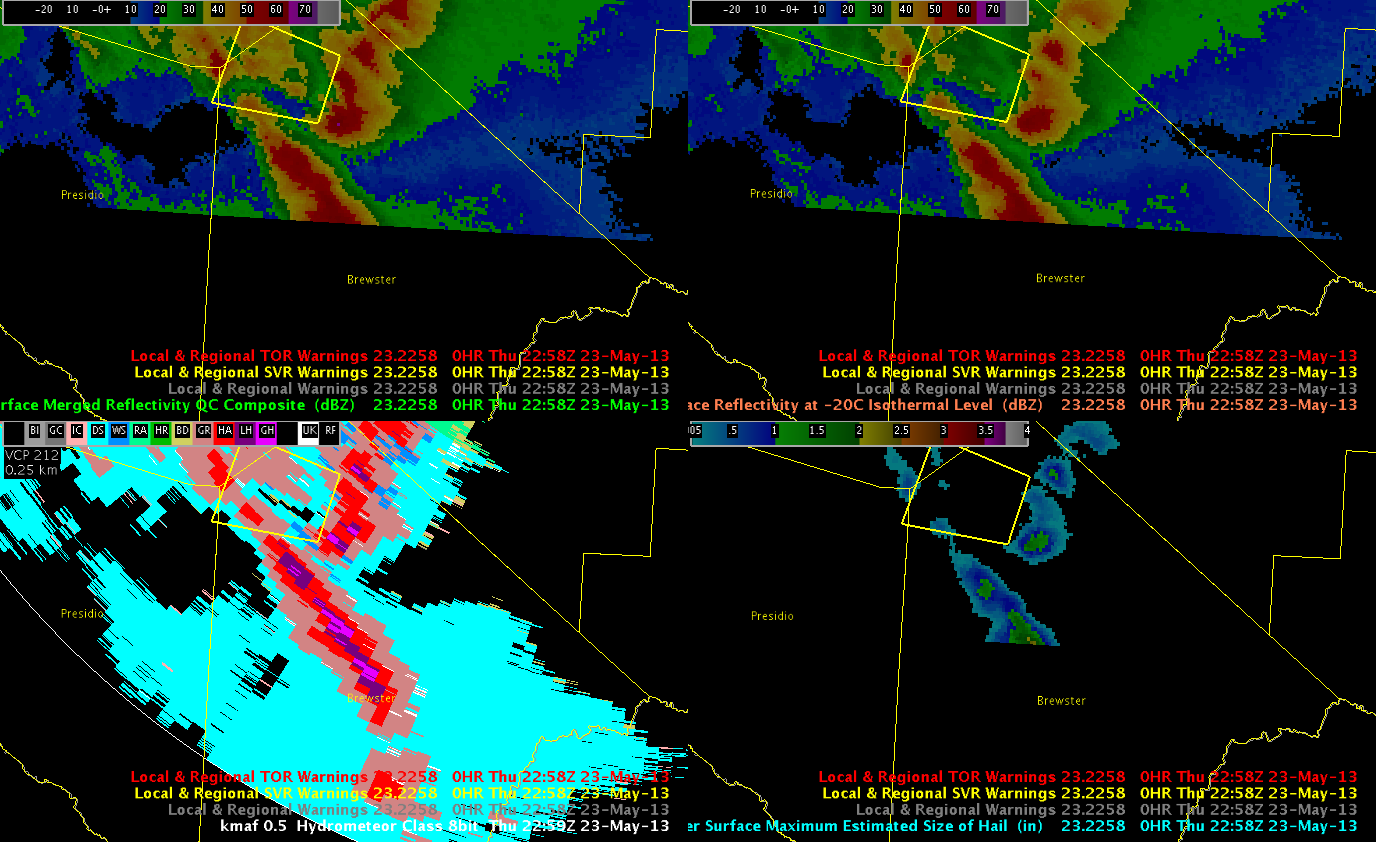
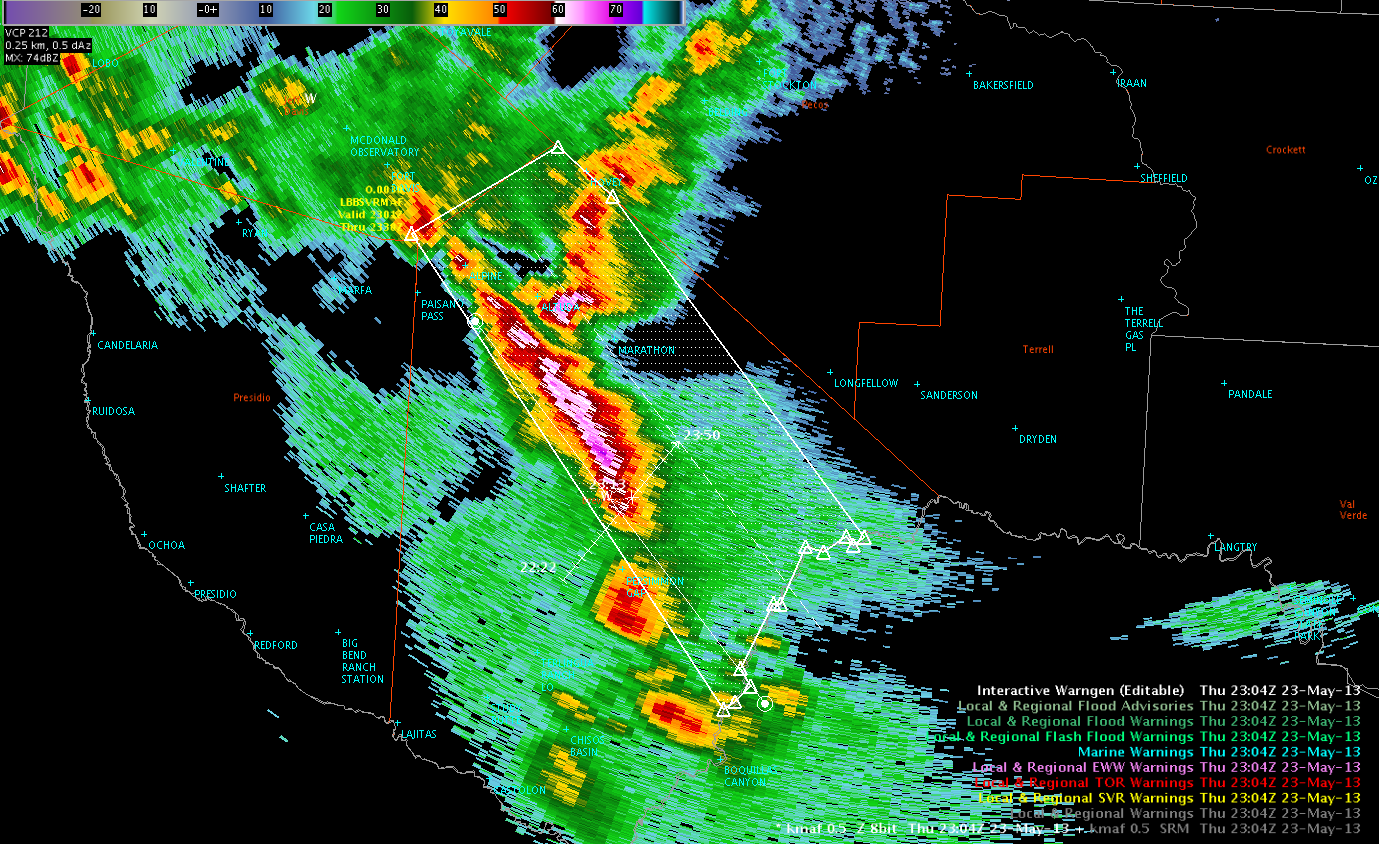
A few more warnings have resulted in the Midland CWA since I switched over.  I’ll blog about the most recent.  By 2300 UTC I noticed a line of deep convection moving northward through Brewster County, TX.  Unfortunately, this area was on the far southern end of our domain today, so I didn’t get HWT specific products until some of the potentially severe portions of these cells may have already been ongoing.  Anyway, as you’ll notice, MRMS MESH and HSDA data were indicating potentially severe hail with this line of storms between 2250-2258 UTC.  I had to use the KMAF reflectivity data to produce the warning (to see the extent of the line of convection).  Nevertheless, you’ll notice that the MESH was as high as about 2 inches in the extreme southern portion of the image.  HSDA data at the time was showing a line of categorical giant and large hail.

Image 1.  2258 UTC MRMS and HSDA data, overlaid with SVR warnings.  Upper left - MRMS Merged reflectivity QC Composite, MRMS upper right - reflectivity at -20C, lower right - MRMS MESH, lower left - KMAF 0.5 degree HC.
Image 1. 2258 UTC MRMS and HSDA data, overlaid with SVR warnings. Upper left – MRMS Merged reflectivity QC Composite, MRMS upper right – reflectivity at -20C, lower right – MRMS MESH, lower left – KMAF 0.5 degree HC.

These data prompted me to issue a warning, which went out at 2304 UTC.  The following image shows the resulting polygon.

Image 2.  2259 UTC KMAF 0.5 reflectivity and resulting warning polygon.
Image 2. 2259 UTC KMAF 0.5 reflectivity and resulting warning polygon.

Any reports so far?  No…I’m not real sure to expect any either, but we’ll see.

Kris

Tags: None

LAPS CAPE Field for Outflow

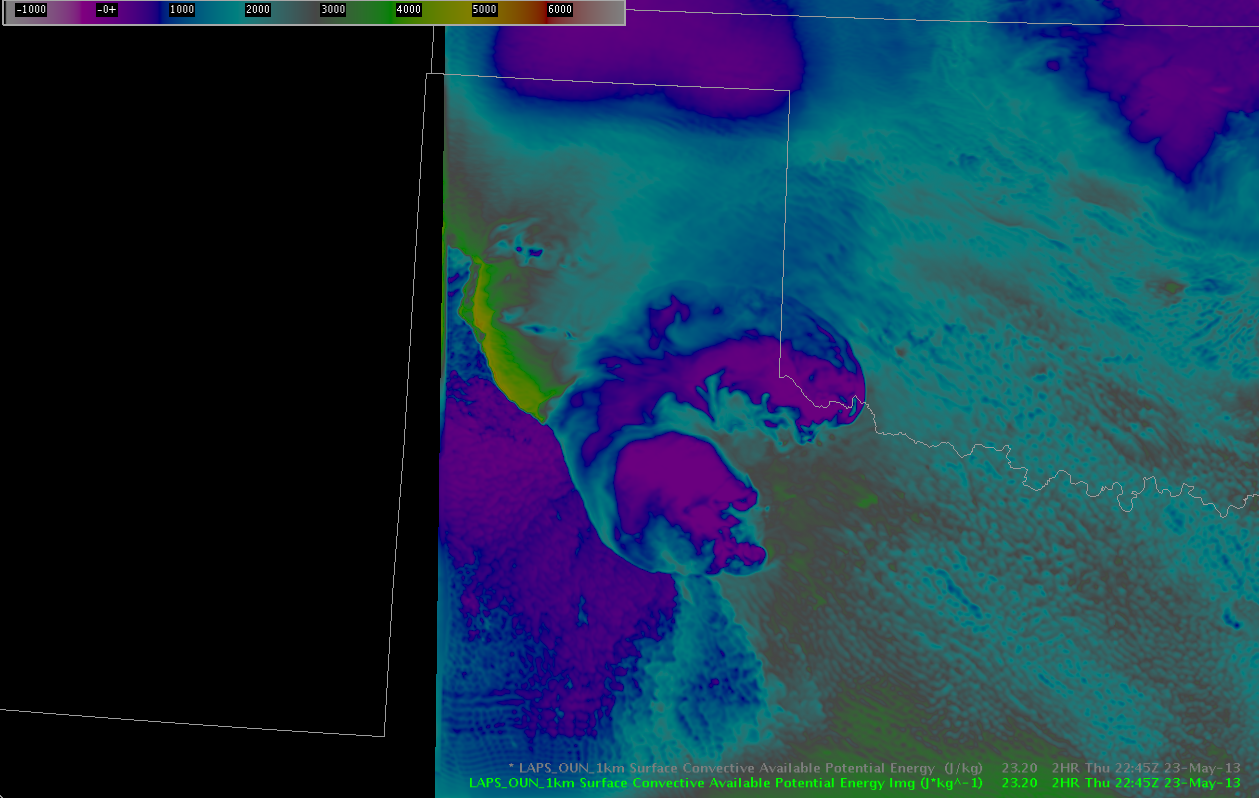
LAPS CAPE fields rather quickly caught onto the idea that the northern LBB/southern AMA area would be dominated by cooler, more stable surface air as a result of outflow from the earlier supercells southeast of Lubbock.  The most instability is limited to the far western portions of the CWAs.

2245LAPSCAPE

Tags: None

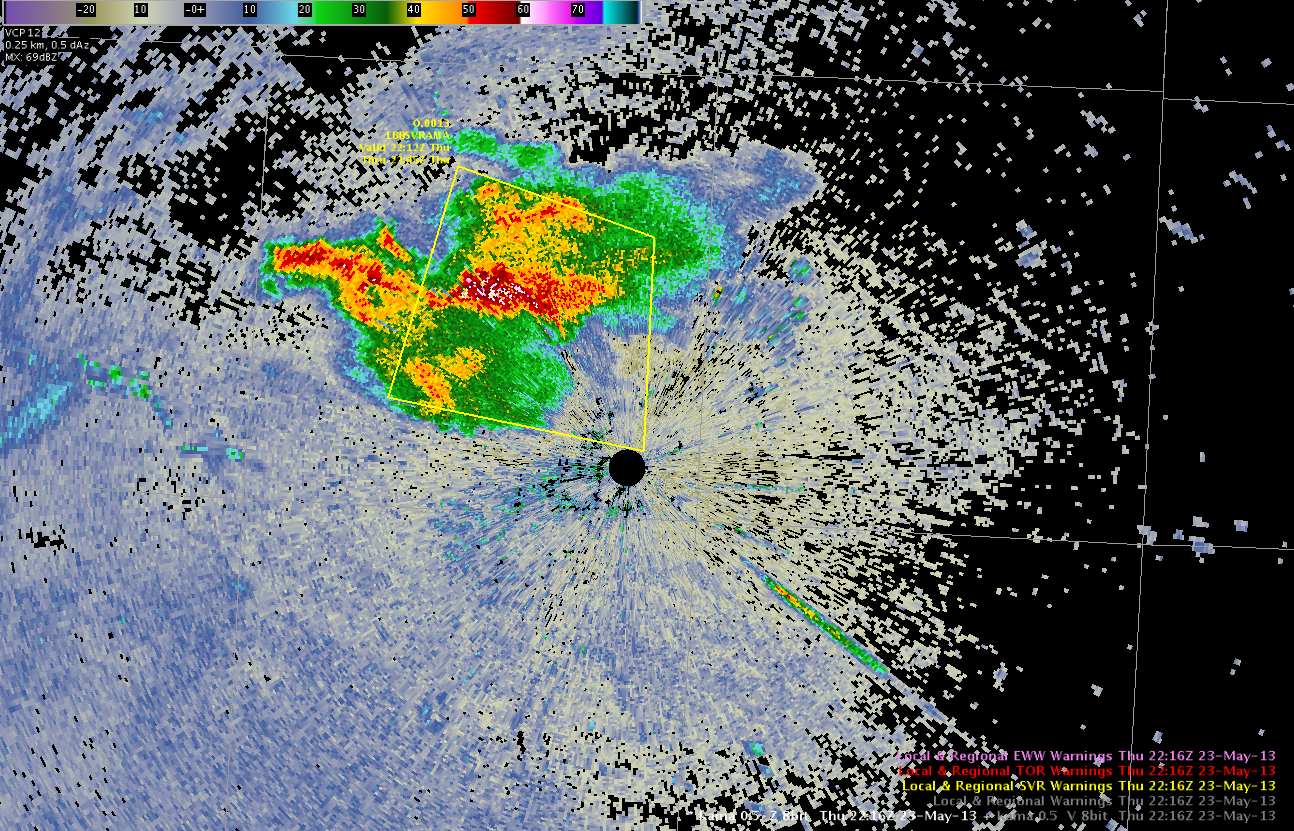
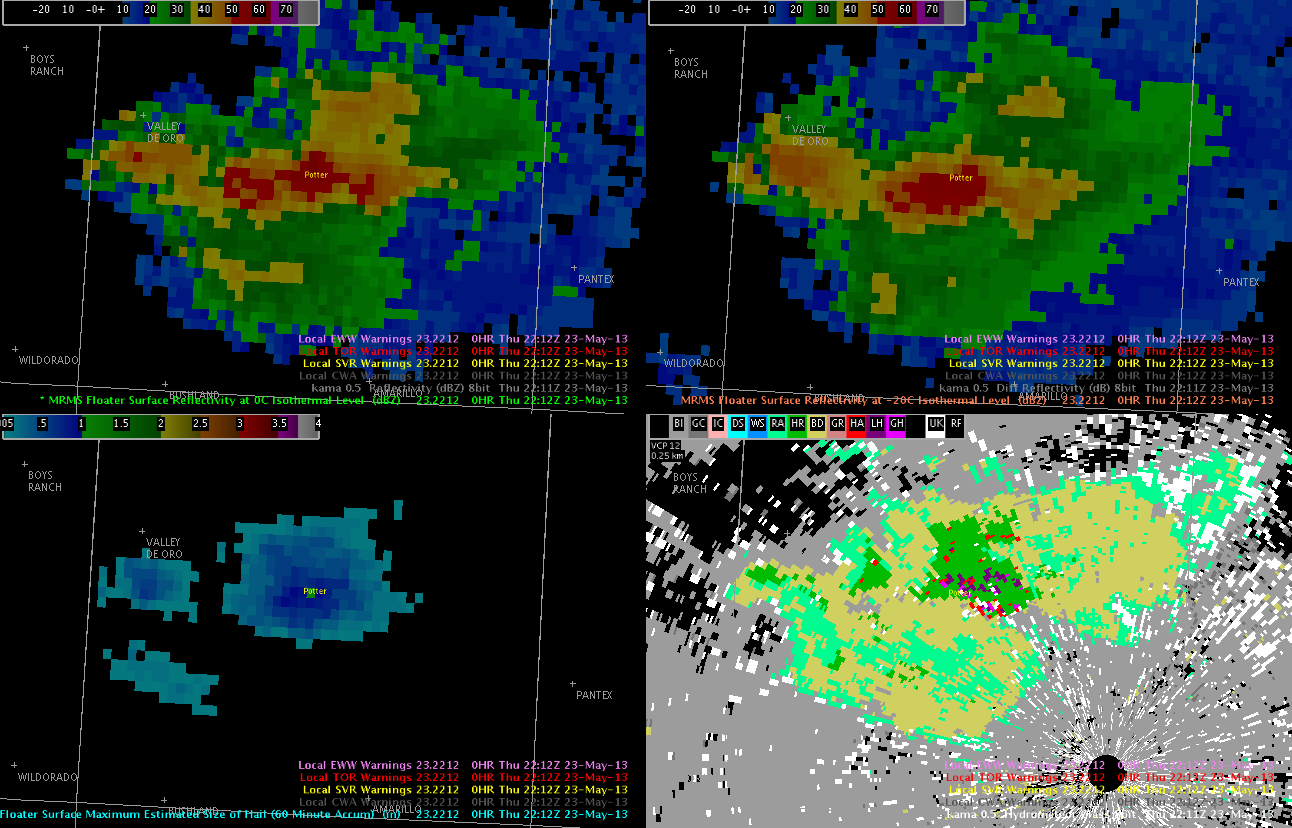
Storm close to radar_CTC_Storm Initiation_50dbz echo top_MESH_HSDA

The MRMS products were a big help in this case being able to look at multiple radars since my storm was right near the radar as depicted in the image below.  (Wesely)

BASE_REFLECTIVITY

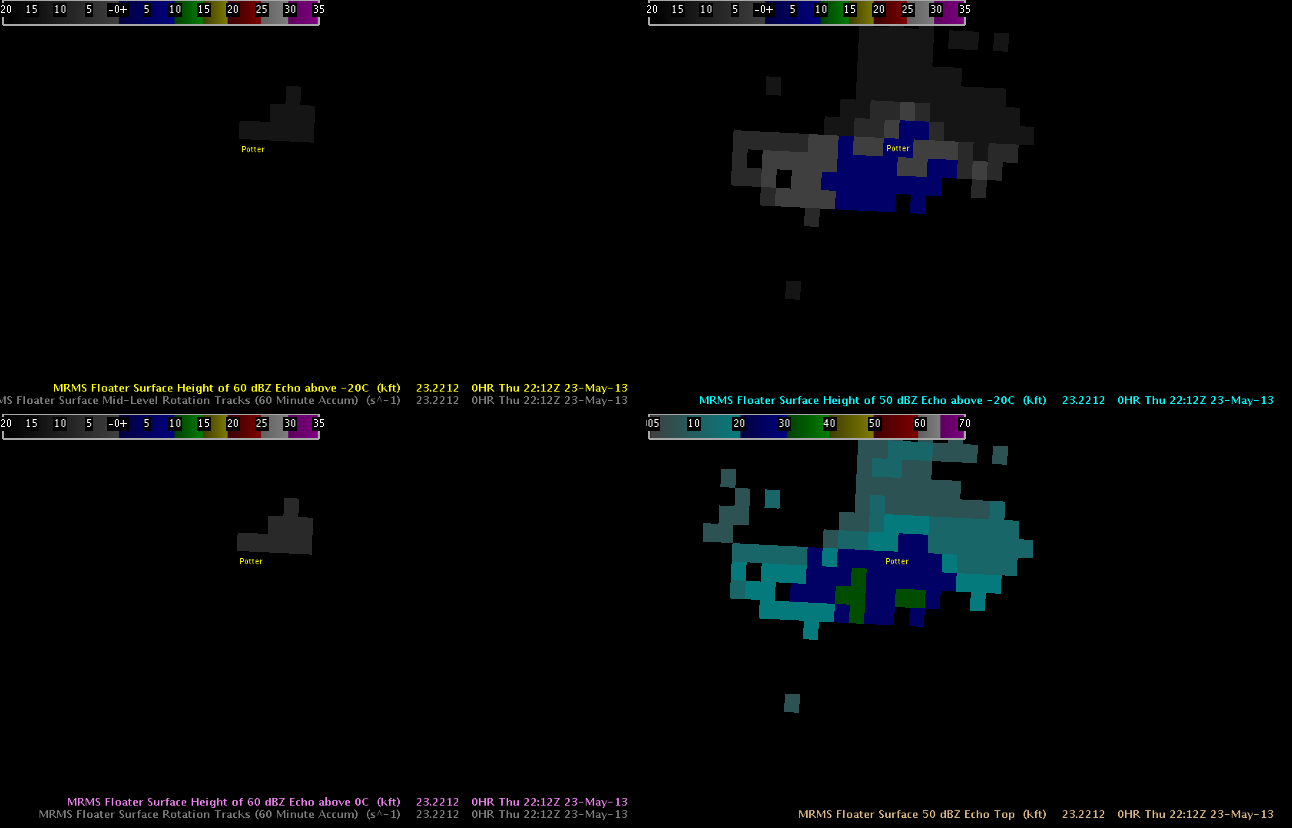
The Height of the 50dbz core went above 30,000ft agl, which was a trigger for issuing the warning. The 4 panel product below made the process easier in two ways. First the storm was near the radar and so having a 50 dbz echo core height product that took into account multiple radars was extremely helpful as the local office radar was unable to see the top of the storm. In addition, you could just look at the one screen and see the 50 and 60 dbz core height quickly without having to look through multiple slices of an adjacent offices radar to find the height of these cores.

50_60dbz_2012z

The MESH and HSDA algorithms below both provided lead time for the quarter size hail that fell 11 miles north of Amarillo at 2236Z. The multi radar aspect of the MESH algorithm also made it easier to use than having to look at an adjacent radar to see the top of the storm. The HSDA is not multi radar and thus there were some limitations with this algorithm for the storm near Amarillo due to the close proximity of the storm to the radar.mesh_2212ZHSDA

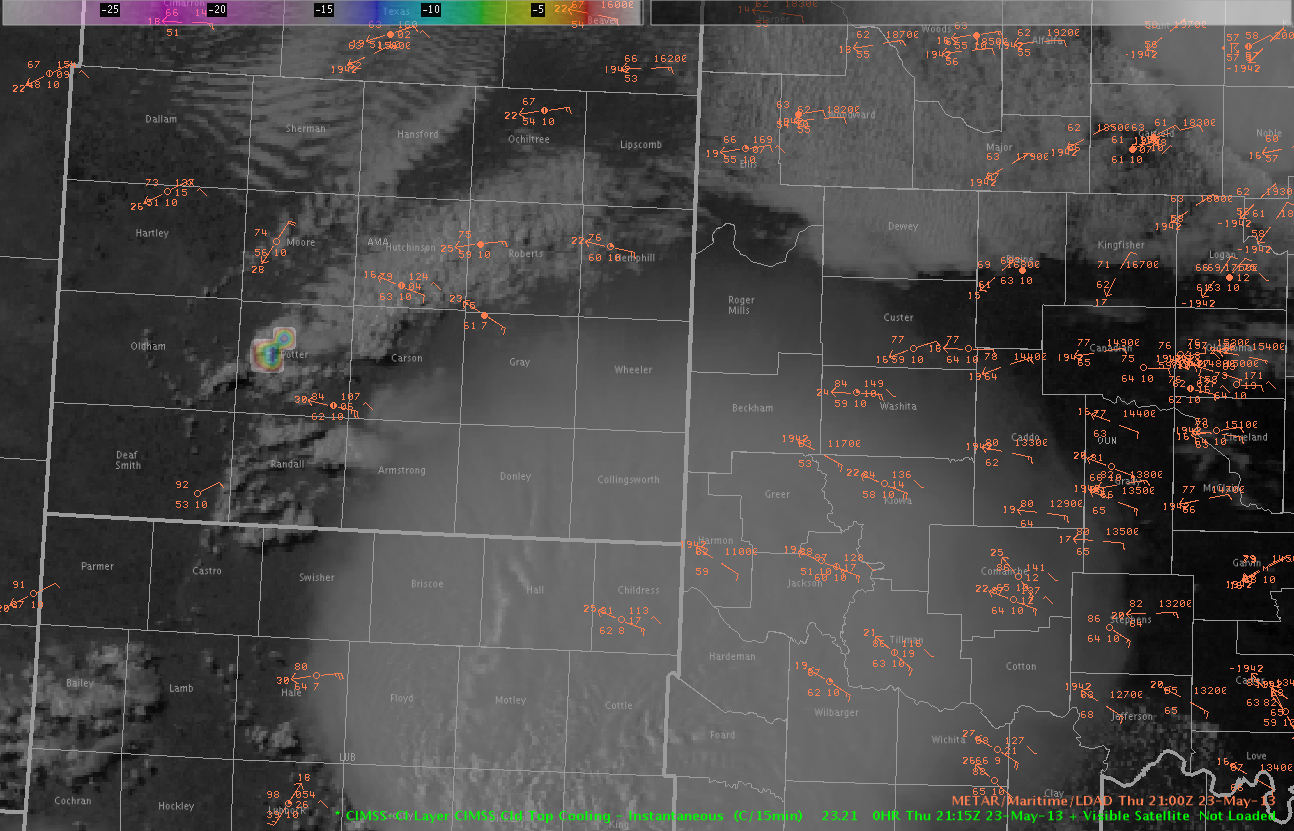
Cloud Top Cooling (CTC) did a nice job of showing that convection was really trying to break out in Amarillo’s County Warning Area (CWA). There were numerous cloud top cooling signatures beginning at 20z. The first 50dbz echo reached the ground at 2146z. So it took awhile but eventually the storms overcame the cap and became severe (See image of CTC below).

CTC2115z

Jeremy Wesely


Tags: None

HSDA Detections within non-uniform beam filling

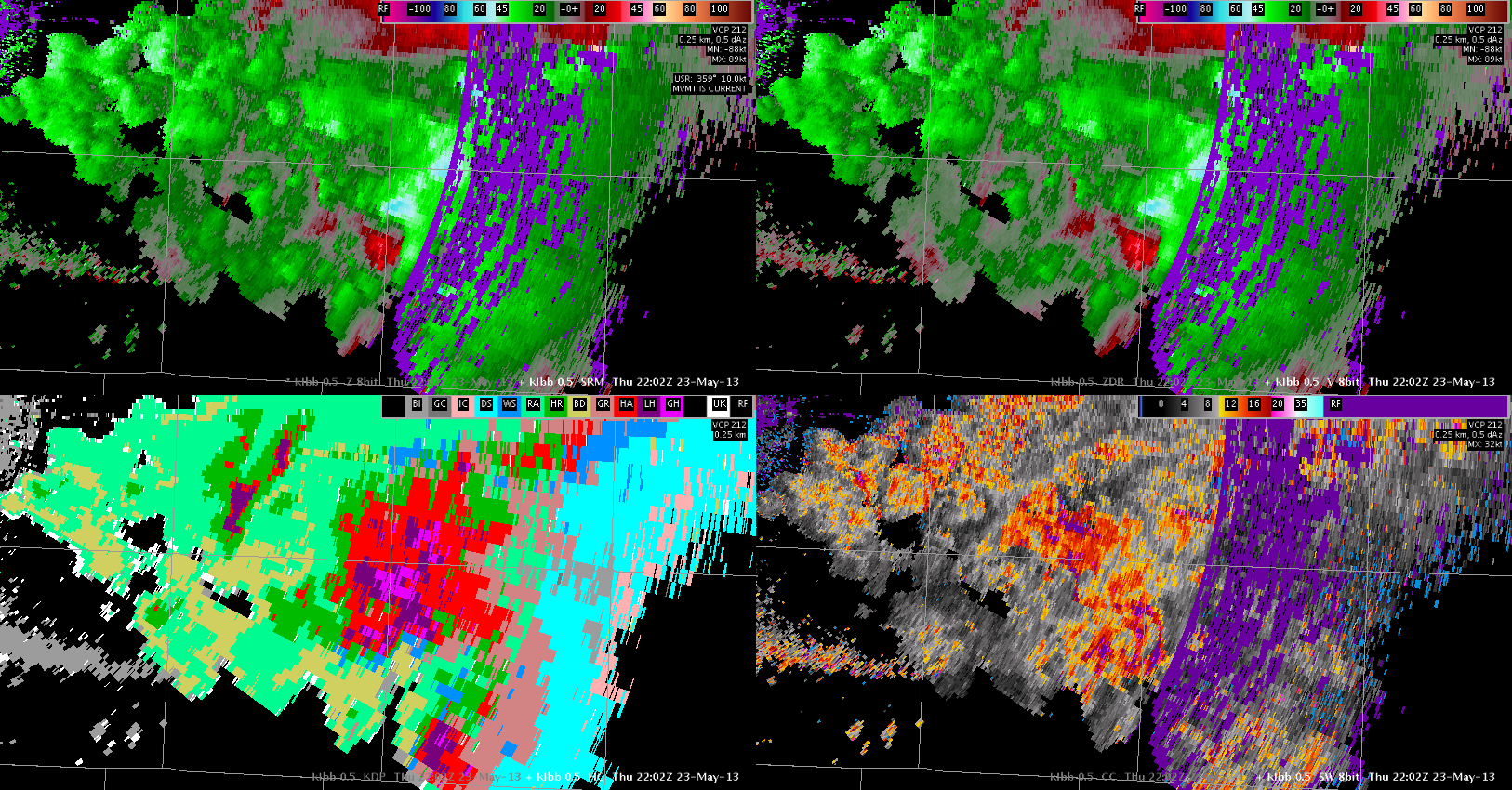
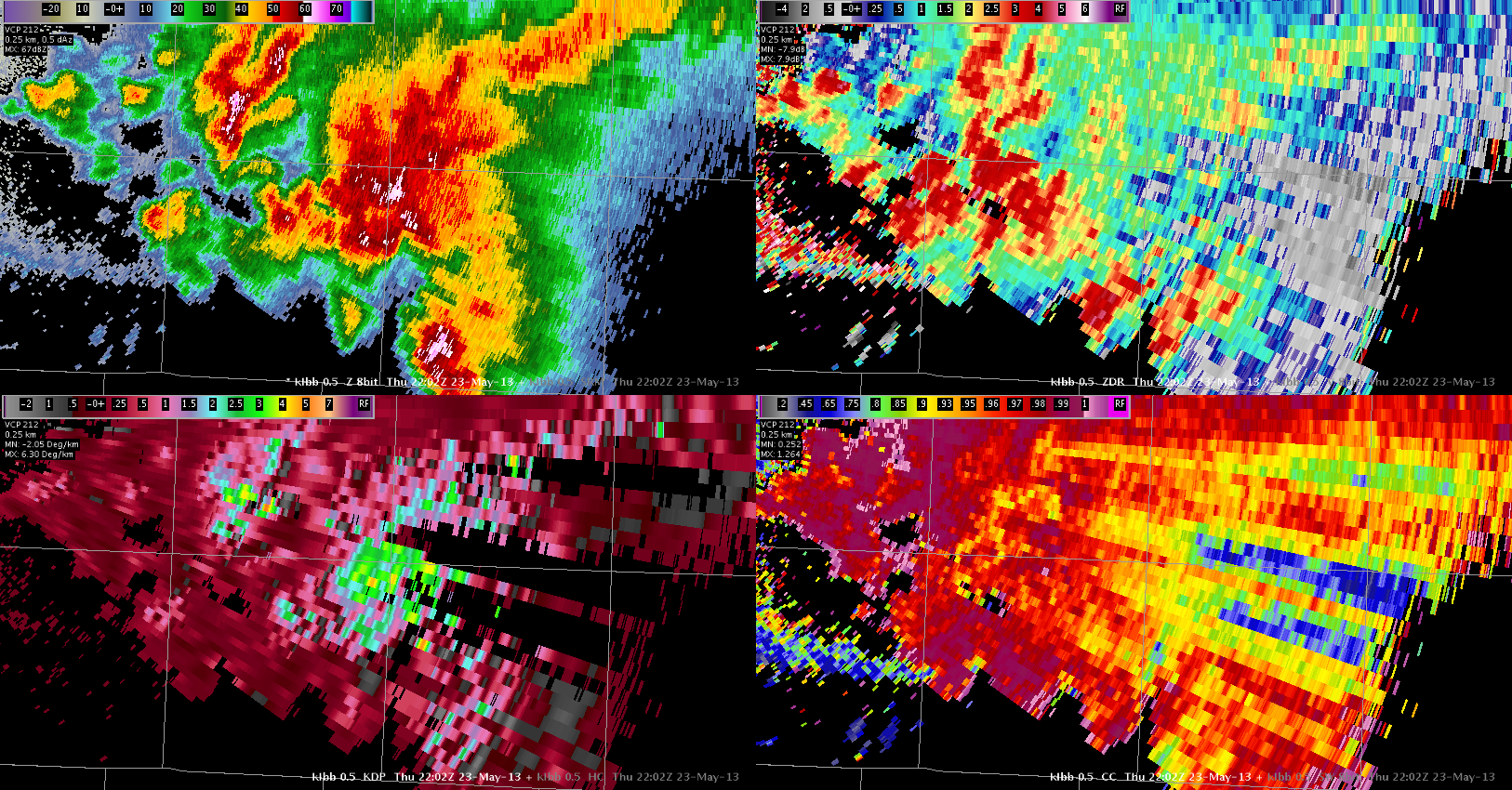
Some HCA detections in the east (right most storm) are occurring within areas of non-uniform beam filling from the first storm (and most likely the second storm).  Forecasters should be wary of identifications within these regions and shows the need for investigation of the base variables in addition to using the algorithms for diagnosis of storm severity.

nubf_hca nubf_base


–KO

Tags: None

EWP Mesoscale Discussion May 23 2220 UTC

A complicated convective scenario continues to evolve over western Texas in an area of weak mid level flow where mesoscale features have been the primary driver for storm motion, storm type, and severe weather type.

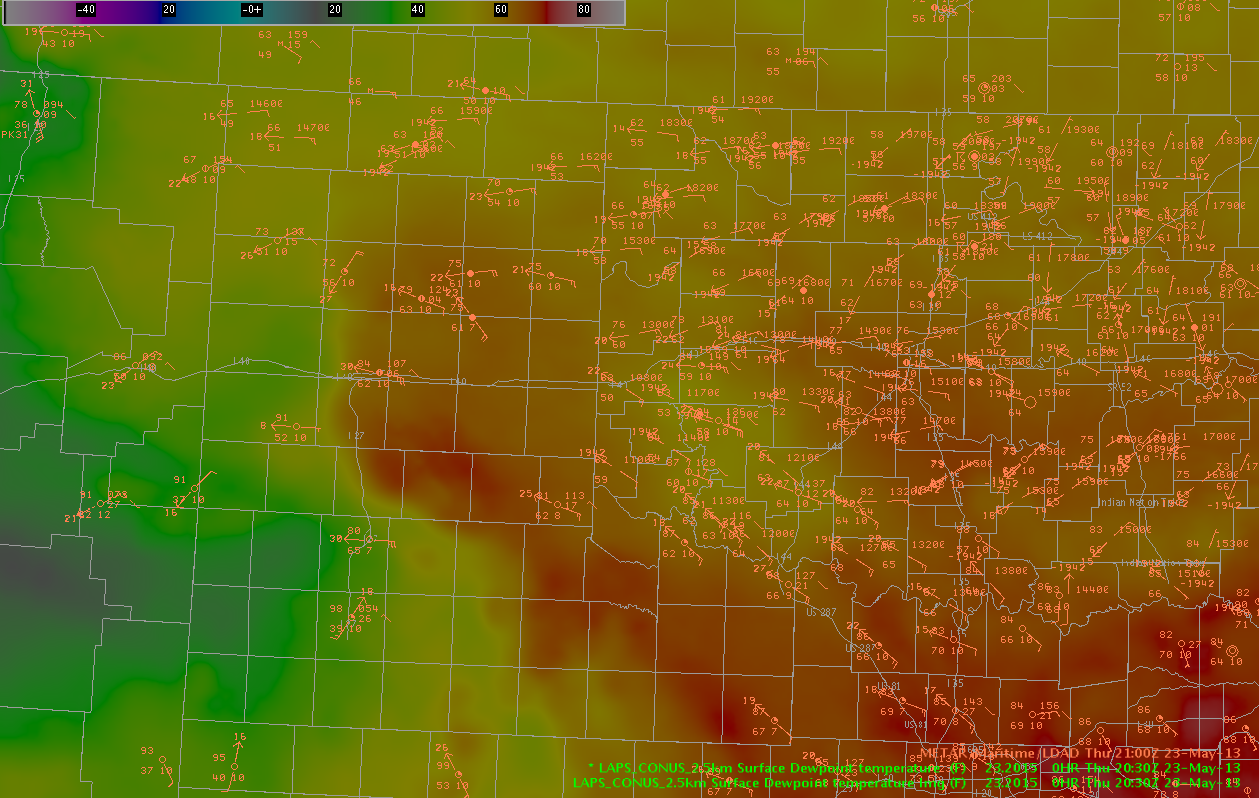
Severe supercell storms with all severe weather threats continue to move south southeastward across King and Dickens Counties into Kent and Stonewall Counties.  These storms have a history of tornadoes, golfball sized hail, and 80 MPH winds.  This severe threat is expect to persist as these storms move slowly along a region of high theta-E air with dew points in the low to mid 60s.

2030ZDewPointTempsLAPS

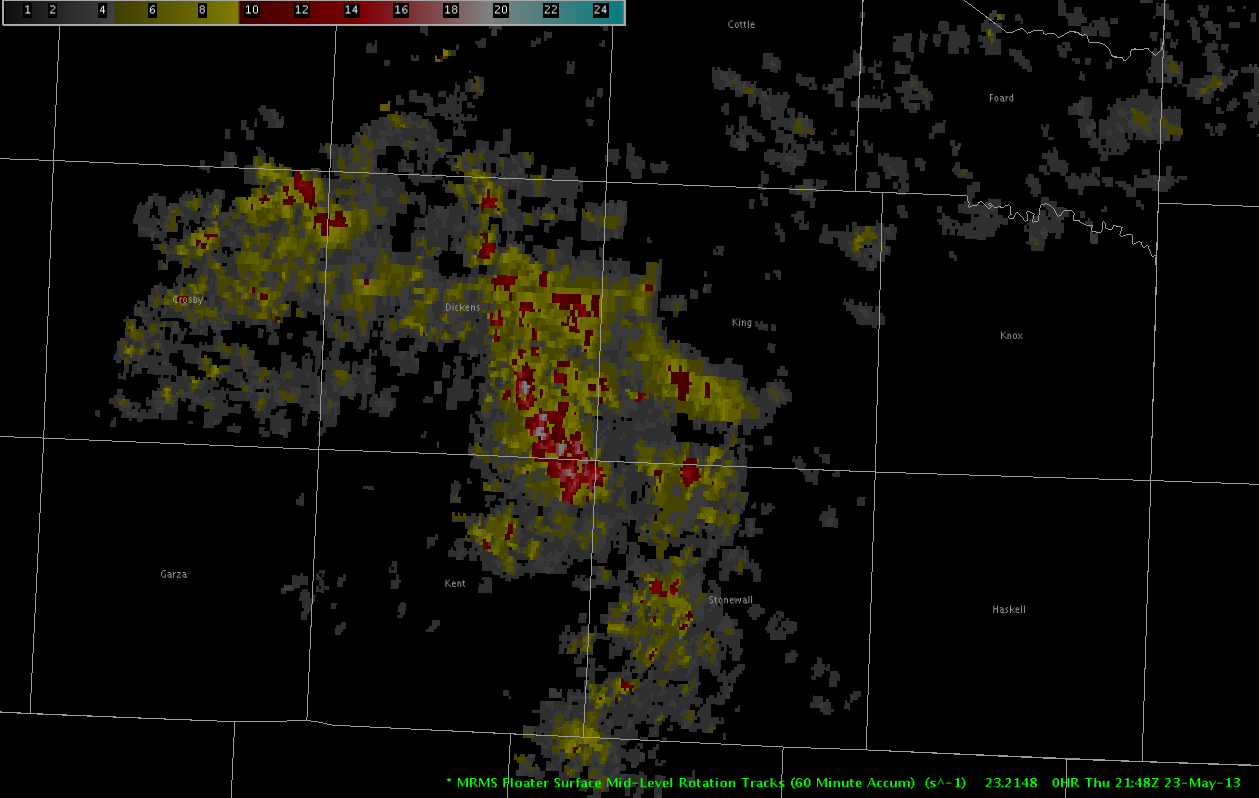
Recent radar trends show strong mid level rotation continuing in King County…and there is no current reason to believe that this storm will weaken at any point soon.

2148ZThursMidLevelRotationTrack

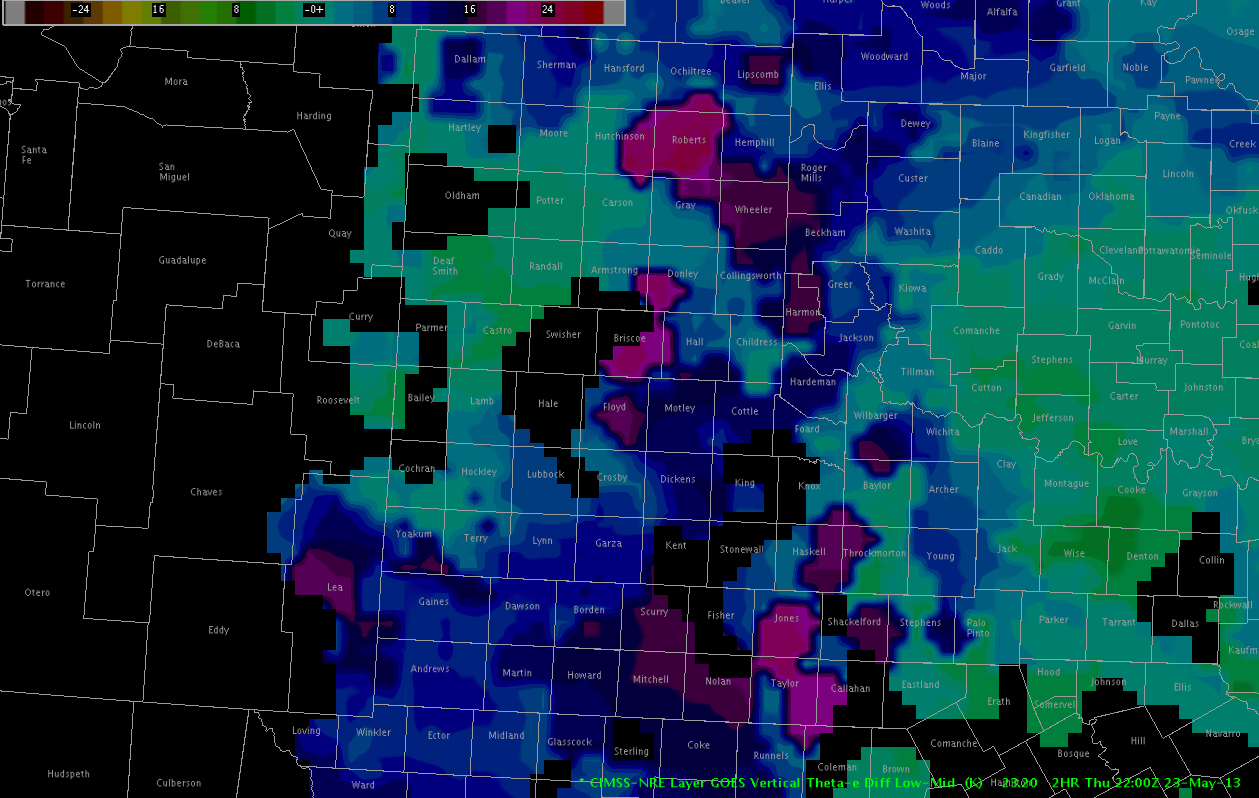
Because storm mode is expected to be supercellular for at least the next couple of hours and possibly longer…significant severe threats of all modes should be expected in the path of this storm.  In addition to continuing to travel along this boundary of rich theta-E air…NEARCAST products indicate a region of substantial destabilization in the path of this storm.

Thurs22ZVerticalThetaEDifference

To the north, in the AMA area, potential for convection continues to be monitored to the north where considerable destabilization is forecast by GOES-Nearcast vertical theta-E difference.  A strong outflow boundary has pushed to the north and west of the LBB area storms… which continues to complicate the convective scenario.  Originally…  deeper convection was noted on the Cloud Top Cooling product…  and though the echo has struggled to develop…  lightning and a severe MESH indicator are now noted within an echo in Potter County.  Convection may continue to increase along the outflow boundary in the next couple of hours…  with hail and wind being the main threats.

To the south, in the Midland CWA, convection developed in areas of higher terrain and drifted slowly to the north-northeast.  The strongest storm at this time is moving into Andrews County.  These storms have been moving slowly to the north over an atmosphere characterized by dry air…and though the MESH product continues to indicate a threat of hail in the strongest storms…a threat of damaging wind will likely be the primary threat until the storms reach higher moisture.

– Sears/McCormick

Tags: None

Supercells over LUBs CWA (MRMS and HSDA analysis)

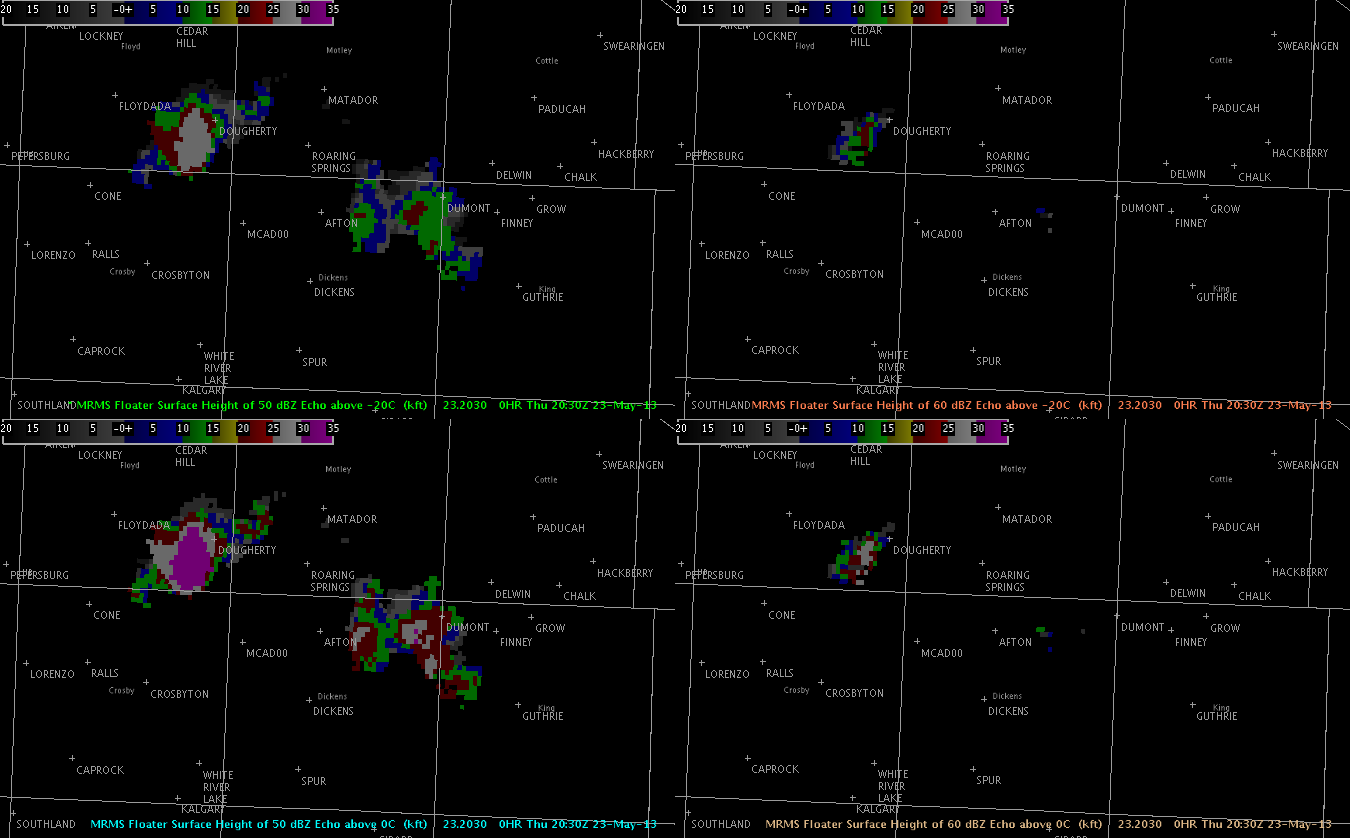
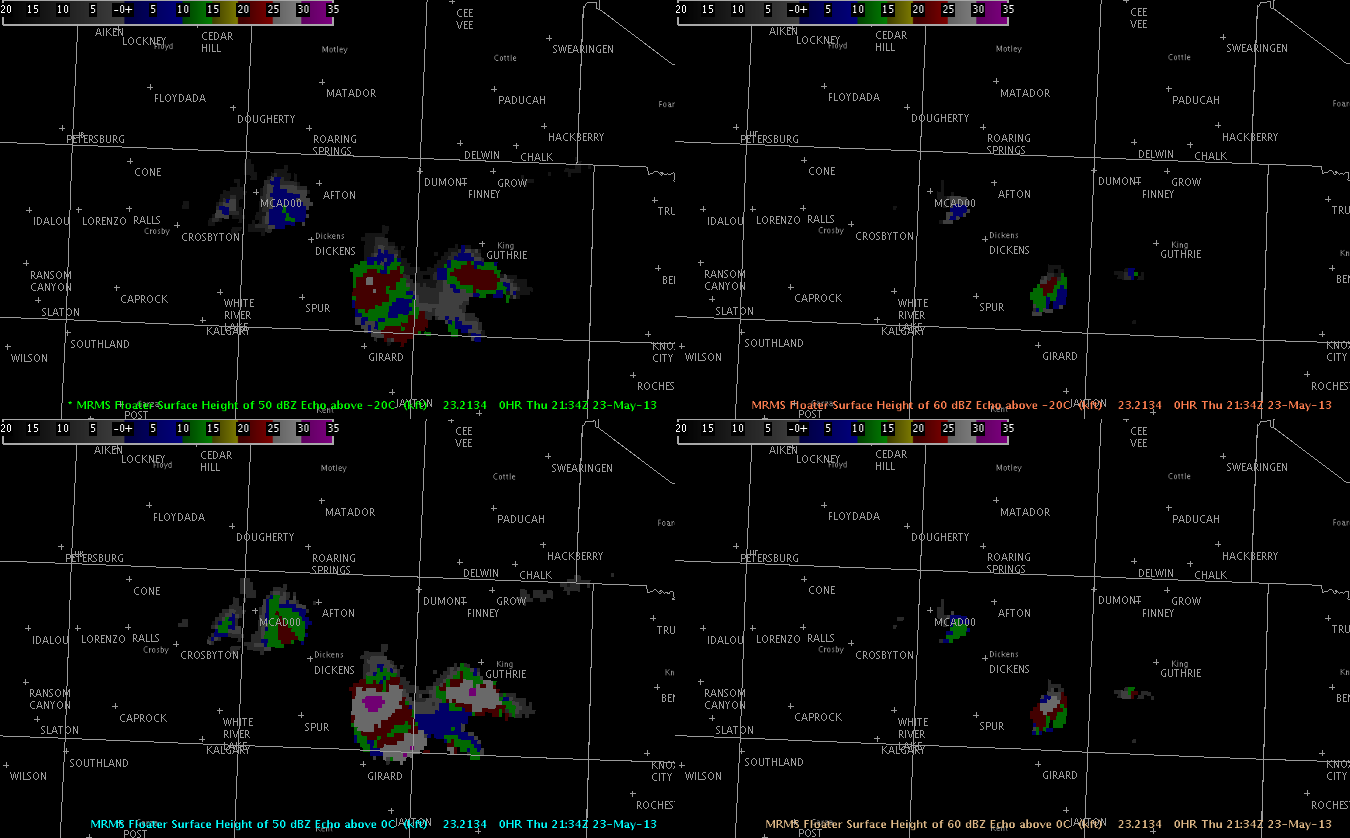
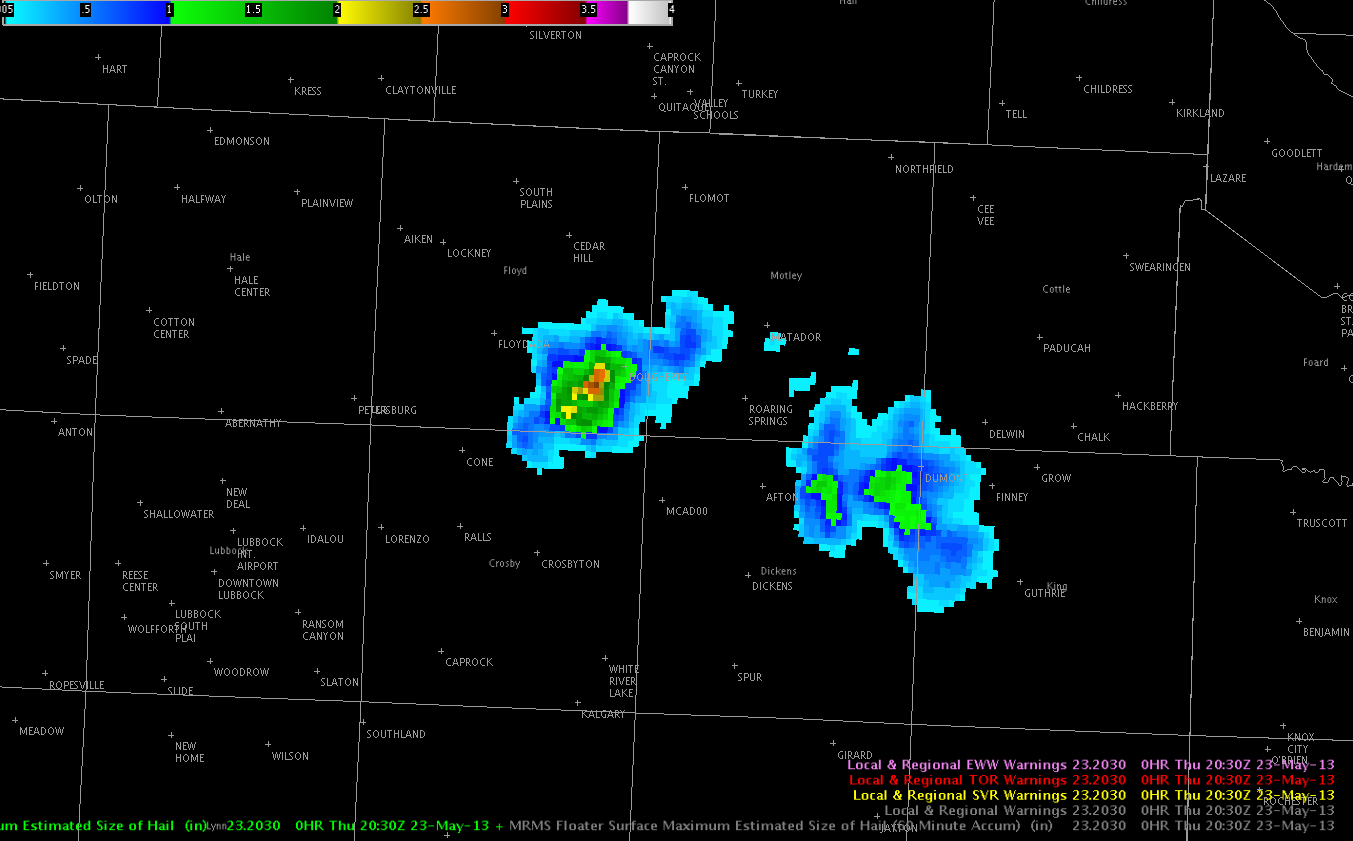
The images below show a 4-panel display of the height of the 50dBZ echo above -20C (top left) and above 0C (bottom) right, and the height of the 60dBZ echo above -20C (top right) and above 0C (bottom right).  This time represents the time of the highest MESH values (~3.0in) and indicates the 50dBZ core was over 26k ft above the -20C isotherm and the 60dBZ core was nearly 20k ft above the -20C isotherm.  About an hour later this storm began to collapse with the eastern storm becoming dominant.

2030z_heightabove_4panel2131z_heightabove_4panel

This is the corresponding MESH image corresponding to the top image.

MESH_2030z

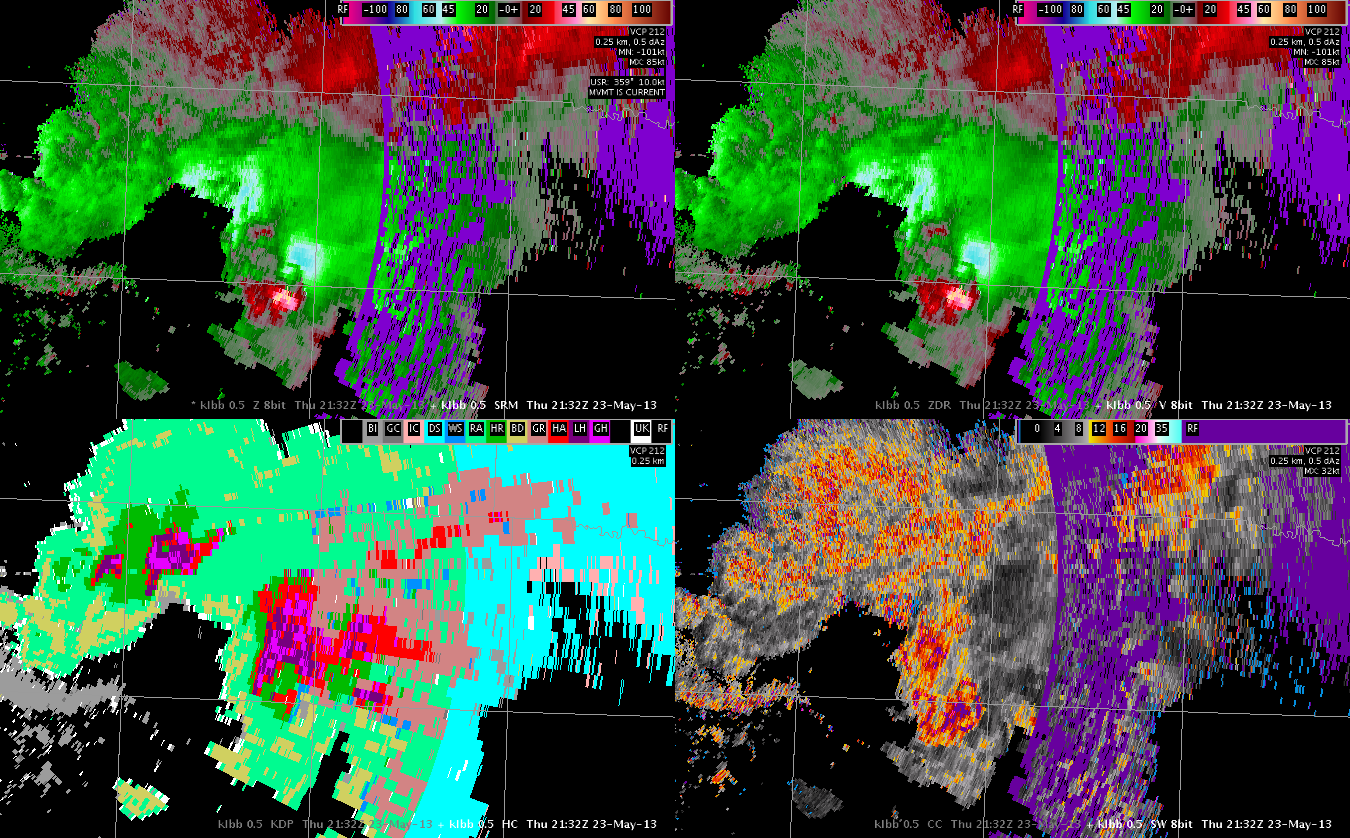
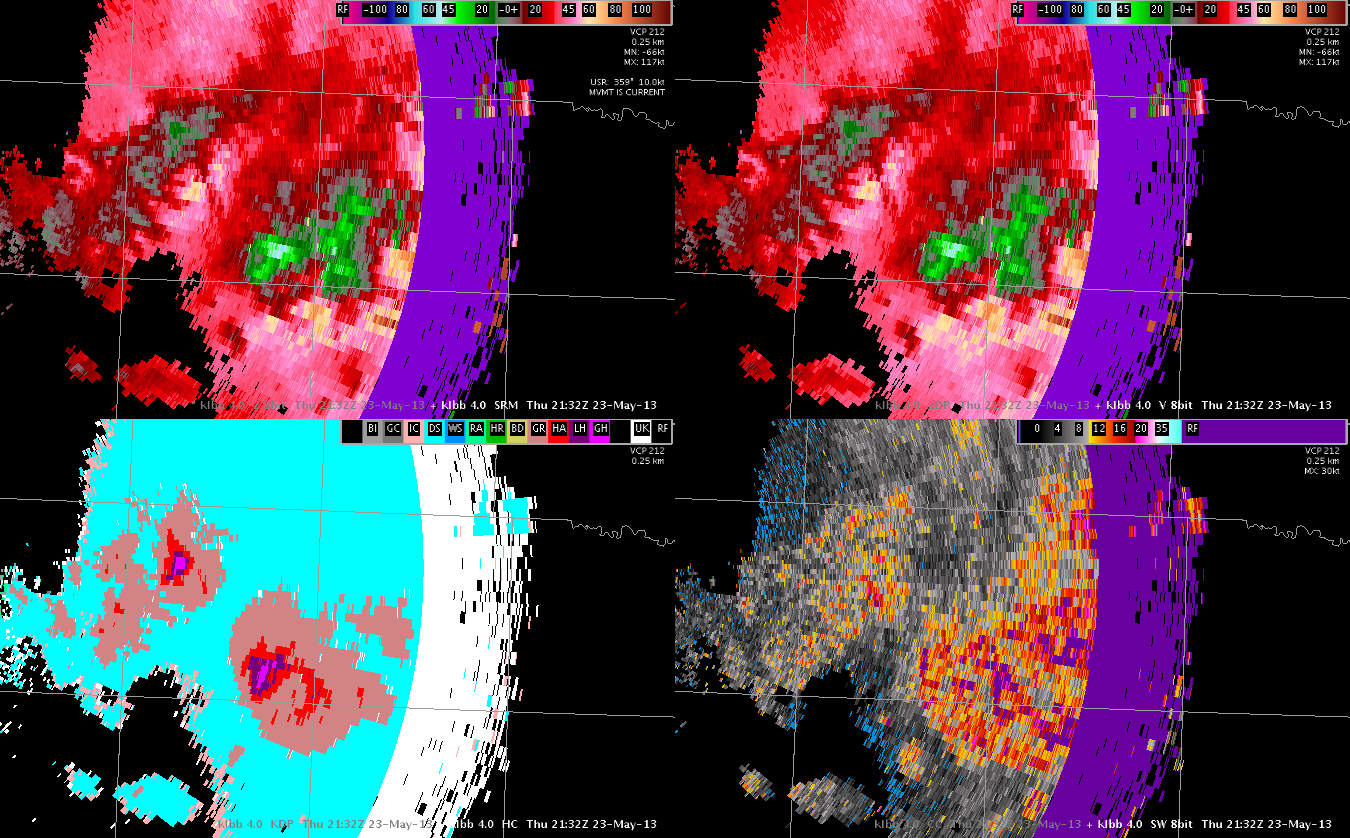
At 2132 UTC the HSDA on the eastern storm showed a hail core (indicating giant hail) from the 0.5 degree slice up through the 4.0 degree slice (~30k ft).  This corresponded well with the rotating updraft.  The MESH at this time (not shown) showed 2.83in.

HSDA_05_2132z HSDA_40_2132z

Tags: None

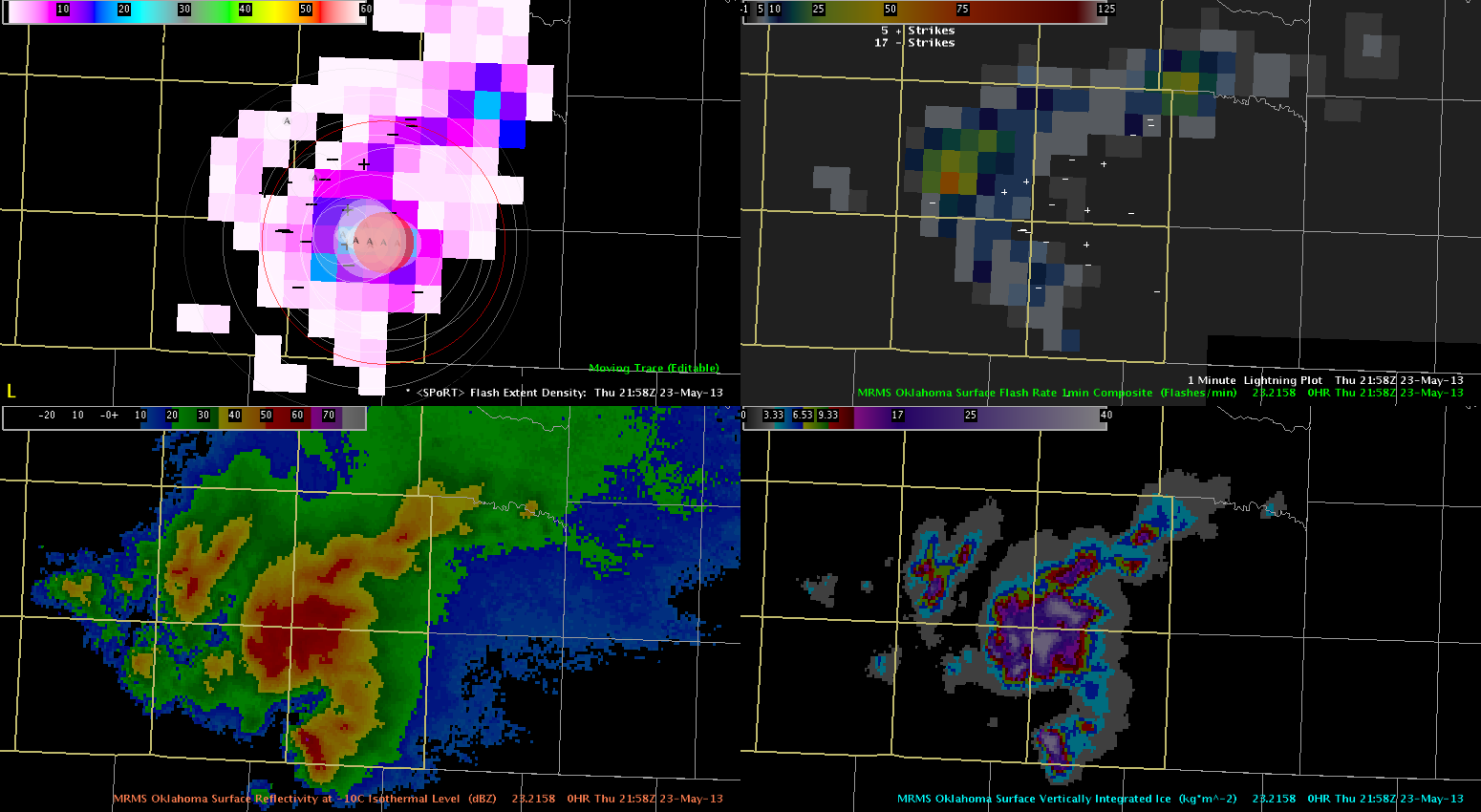
SPORT Flash and Trace Tool Kent Co Texas

Just for you, Kristin! See? I was paying attention. 🙂

On a 4-panel with MRMS Sfc Z, Sfc Vil, and others.

Trace tool was used on upper-left panel and indicated how the flashes increased quickly with severe storm over Dickens, Kent, and Stonewall counties in SE LUB’s CWA.

SPORT_FlashTraceTool

Admittingly, the latter 5 min occurred while I was creating the image, etc, so didn’t redo my centroid there, just the zig-zag bad data.

Martello

Tags: None