NearCasting for JAX

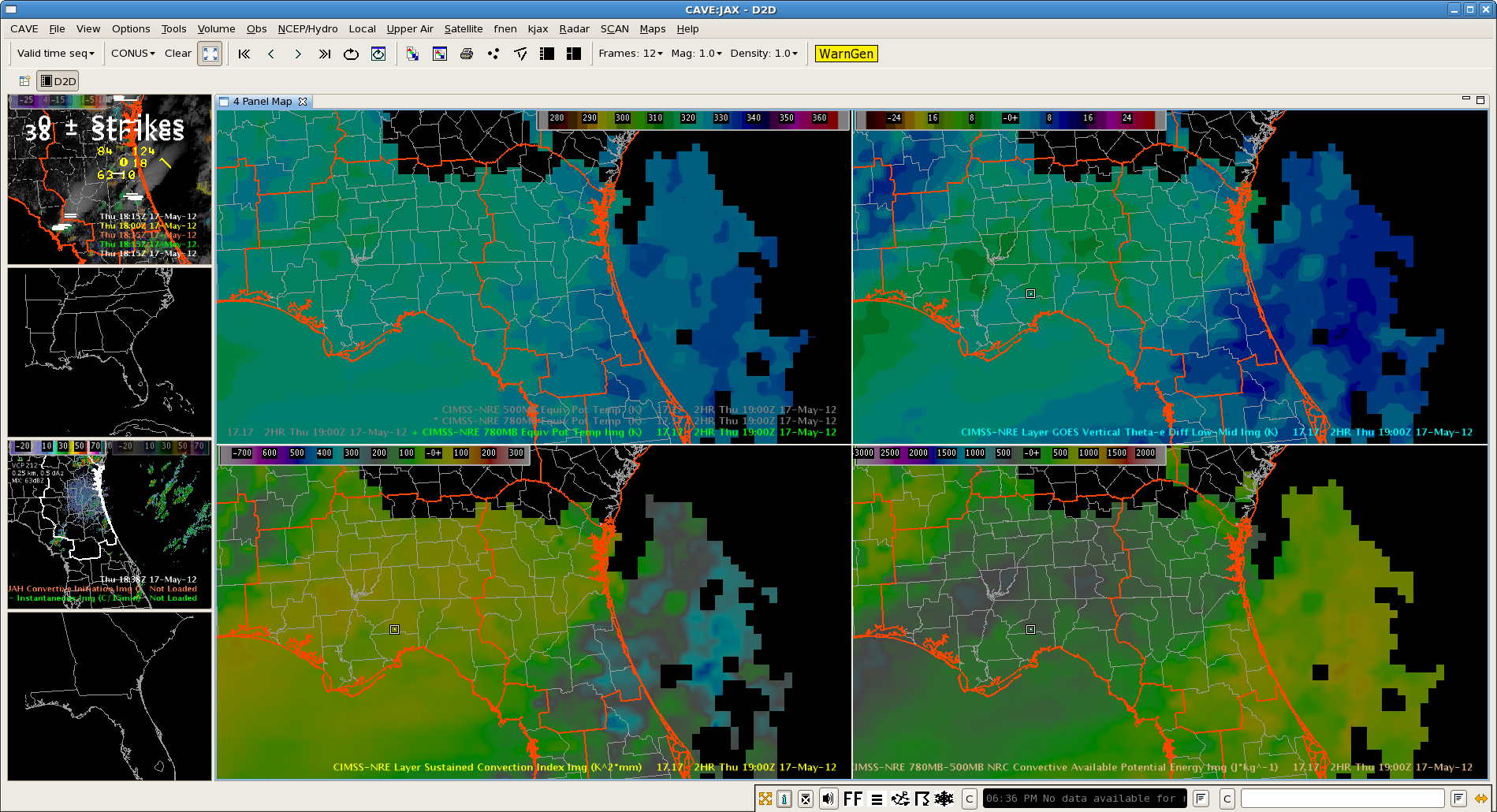
We are focused on the JAX CWA today.  While there is convection ongoing in the extreme northern portion of the area (bordering FFC and CHS), the GOES-R NearCast CAPE (new this week) and vertical theta-e difference suggest that the southern half of the JAX CWA is more conducive for new convection.

GOES-R NearCast 780mb Theta-E, Vertical Theta-E Difference, CAPE, and Sustained Convection Index valid 2012-05-17 1830 UTC

The NearCast has been challenging to interpret this week due to interpretation confusion (are negative versus positive theta-e differences indicative of instability) and then a mid-week visualization change in AWIPS 2.  The NearCast shows promise for helping with the tremendously-difficult 1-6 hour timeframe, but the product stability has presented a problem.

EWP Daily summary: 2012 May 16

We focused operations in both the Burlington, VT and Albany, NY CWAs ahead of a strong upper-level storm and cold front.  Stephen and Todd started issuing warnings with the help of MRMS MEHS product in northern Lake Champlain at 1820z.  Shortly afterwards (1915 Z) Brian and Julia issued a SVR warning in Herkimer county, NY following indications of a three-body scatter spike and dual-pol hail signatures.  Neither the MRMS or 3DVAR showed strong storm indications.  But Brian noticed storm top divergence > 9.5 s^-1 in the storm top.  Both storms produced hail ~1″ in diameter but no wind reports.  Ten minutes later, the UW CTC showed large negative values in eastern Hamilton County, NY as the storm continued east.

Both teams kept issuing severe tstm warnings as the storms continued east and new ones developed west of Albany.  The BTV team noticed that CI was useful for areas where outflow initiated new storms far enough away from old thunderstorm anvils.  They also liked using the 3DVAR vertical velocity.  One severe storm with a MEHS of 2″ showed updraft strength of 14 m/s at 2018 UTC over Essex County (BTV’s area).  They also noticed max updraft preceding max reflectivity by up to 20 minutes.  Meanwhile Todd and Julia focused on peak storm top divergence in 3DVAR.  Todd believed that product actually helped with lead time before reports arrived. The Albany team thought the MRMS azimuthal shear, and the 3DVAR updraft vorticity was useful in identifying intensifying storms.  They also found the nearcast theta-e differences successfully flagged the ridge of instability going up the Hudson Valley.

As the action wound down in BTV, Todd and Stephen worked with the CI team on flagging new convective initiation along the tail end of the front in northeast Arkansas.

Some limitations came out too.  Julia found that the 3DVAR barely perturbed the flow around a bow echo east of Saratoga, NY.  So she used traditional radar interpretation to assess the storm.  The Albany team would also have liked a quick cross-section ability.  Julia issued a flash flood warning but didn’t use the new products in the decision-making namely because she had no familiarity with how they may be used for that kind of product.

The Albany team also had issues with CAVE and Warngen with occasional crashes and slowdowns.
Tags: None

The beat GOES on

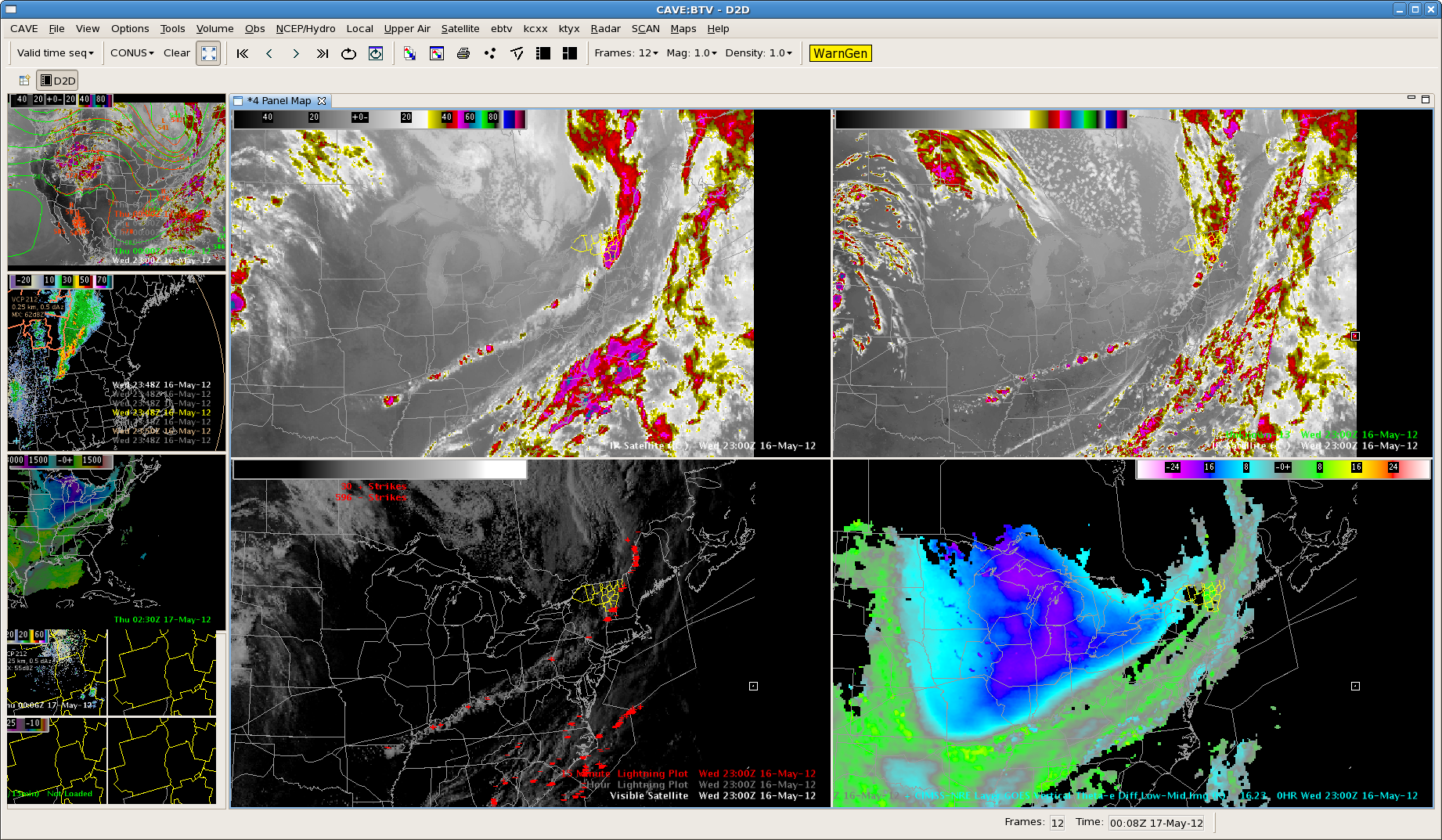
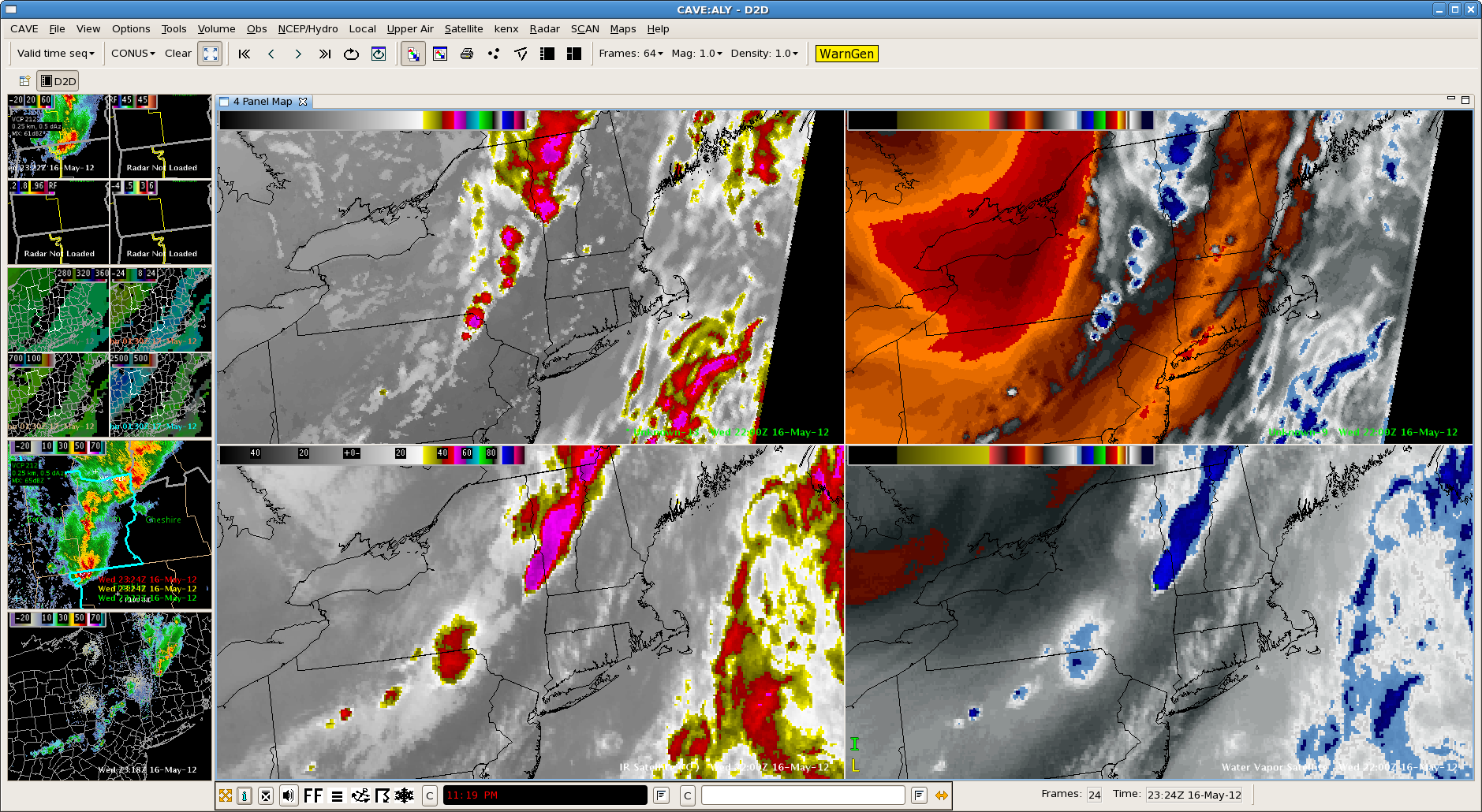
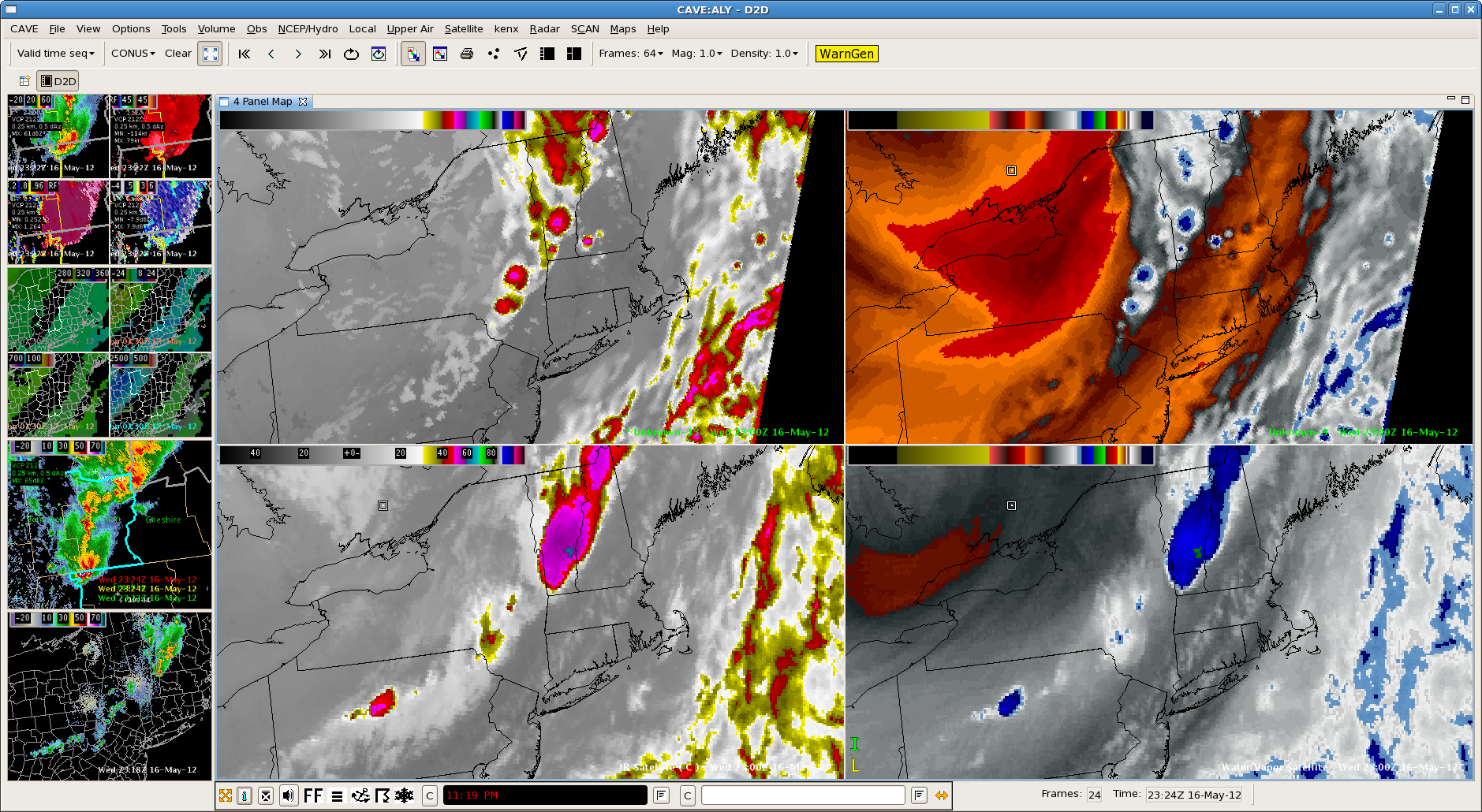
The synthetic imagery did a nice job of placing convection southward along the cold front through the Ohio and Lower Mississippi Valleys.  Here’s a screen capture from 2300UTC, with the actual IR on the upper left and the model forecast on the upper right.  Visible imagery with lightning is shown in the lower left pane, with the theta-e Nearcast product on the lower right.  All in all, the GOES products did well today depicting where convection would be in relation to the cold front.  This would be an excellent application to the CWSU environment for air traffic planning purposes.

EWP STATUS FOR 17 MAY 2012: 12-8pm SHIFT

EWP STATUS FOR 17 MAY 2012:  12-8pm SHIFT

Prospects for active real-time operations appear to be diminishing a bit.  However, there are two possibilities for operations.

The first would be in FL as the southern stream flow and continuing small short-wave troughs move across the peninsula.  Little cap and high moisture will initiate convection quite early should the diurnal heating be allowed.  Today, thick cloud cover restricted heating.  It’s more likely that there will be less deep cloud cover and solar insolation will be stronger. The southern stream flow may be strong enough to organize any convection into sustained multicells or perhaps a short duration supercell.  In fact the SREF guidance suggests a good possibility of supercells, especially in southern FL including the Keys.

The second area would be along the coastal Carolinas just like in the past few days.  The odds for organized convection would strangely enough be less than in FL owing to lower mid-level winds.

Most likely we may focus the two teams on FL if two CWAs are active with convection.  Given the lack of convective inhibition and plenty of local forcing mechanisms, we’ll start again with an early shift.  Should the area be on the subsident portion of an upper-level wave, we should be ready to activate a case in DRT mode.

Shift time will be 12 – 8 pm.

Tags: None

Max Updraft preceding Max Reflecitity

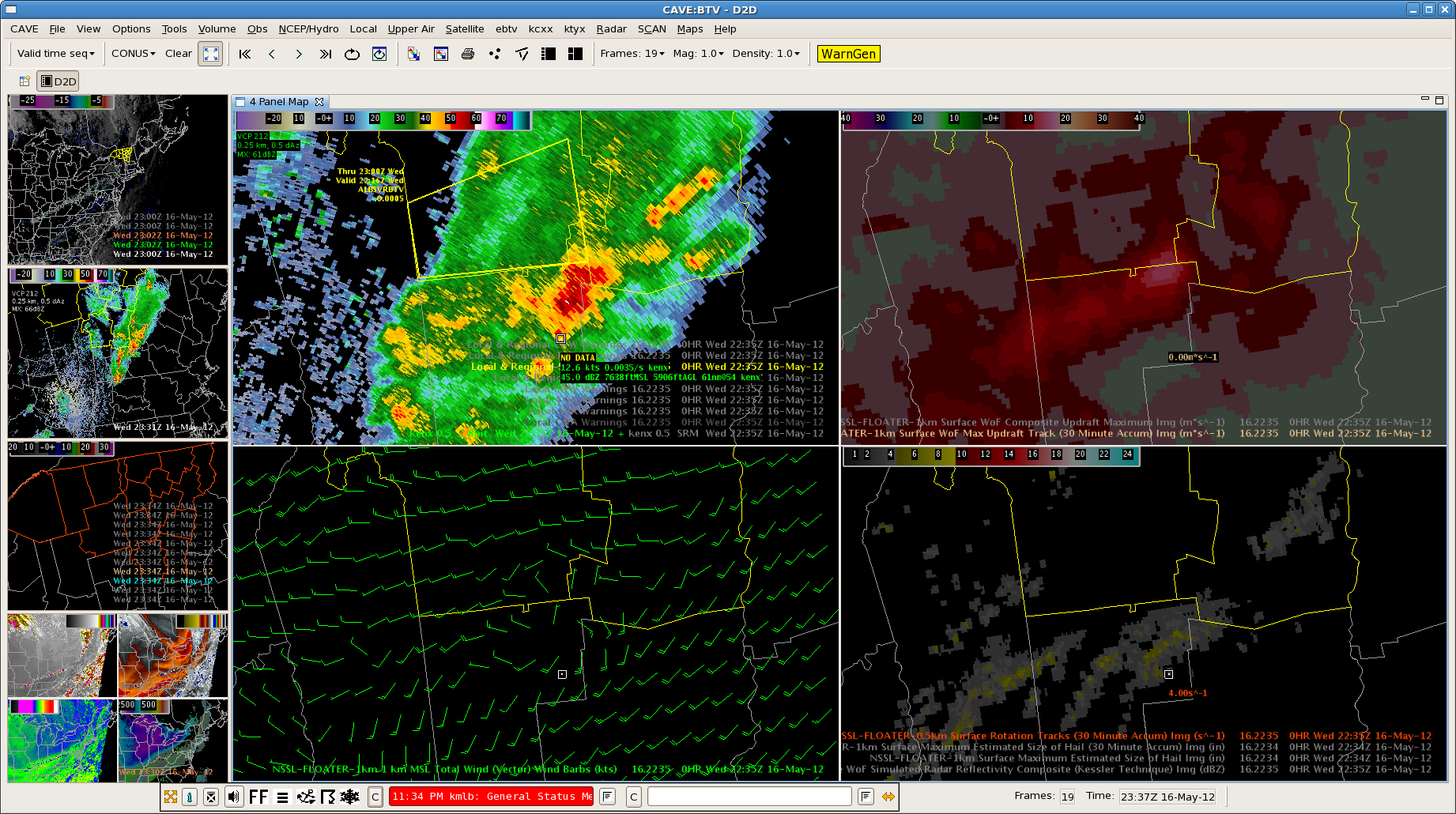
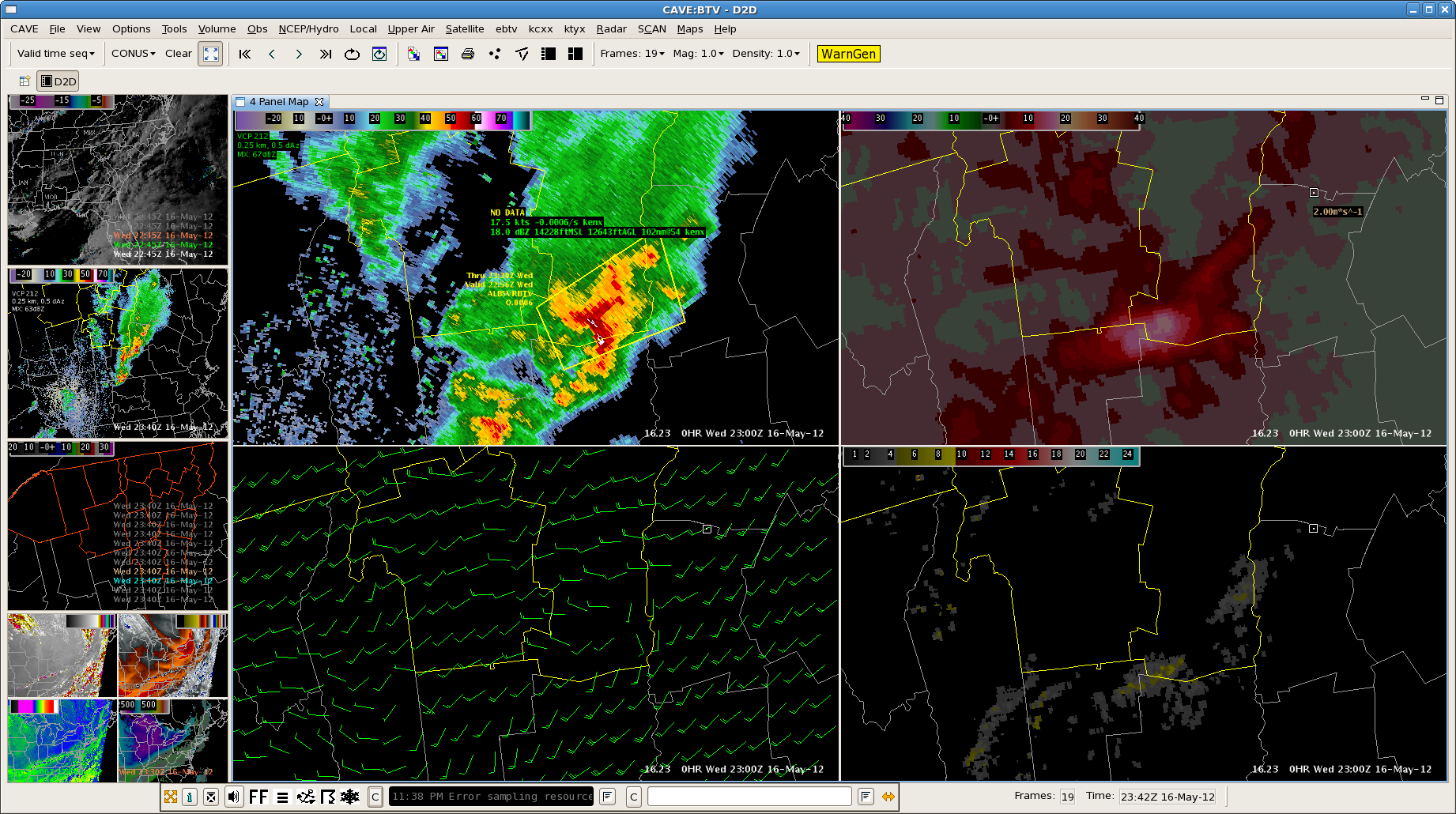
Late in the afternoon, as convection continued along the southern fringe of BTV’s county warning area, a storm cell began pulsing up and down.  This series of images shows how the max reflectivity on radar and the maximum updraft output from 3D-VAR began oscillating.  Maximum updraft strength from 3D-VAR would precede a peak in radar reflectivity by about 20 minutes.  We issued a warning for a southern BTV county, based on the Max Updraft data.  The storm produced 3/4 inch hail.

2205z.  Reflectivity is maximizing from a previous pulse, and current Max updraft values are less than 10 m/s.

2235z. Maximum Updraft values around 14 m/s. Max Reflectivity around 56 dbz.

2300z. Max Reflectivity back up to 60 dbz, while Max Updraft Strength continues around 18 m/s.

Dankers/Kearney

Miscellaneous musings from ALY

Had an interesting day working with convection in Albany’s CWA today.  Several storms grew big enough to make severe hail, strong winds and show nice organized rotation..also a bow echo looking storm.  In general the 3D Var and MRMS products proved useful for detecting hail concerns and also evaluating whether or not updrafts were strengthening or weakening…how high they were and whether or not there was good updraft helicity/vorticity.  Also the azimuthal shear product from MRMS was useful/interesting.  The nearcast thetha e product had its scale and units reversed since yesterday which caused some initial confusion but did seem to depict the more unstable regions well…though instability was fairly marginal.

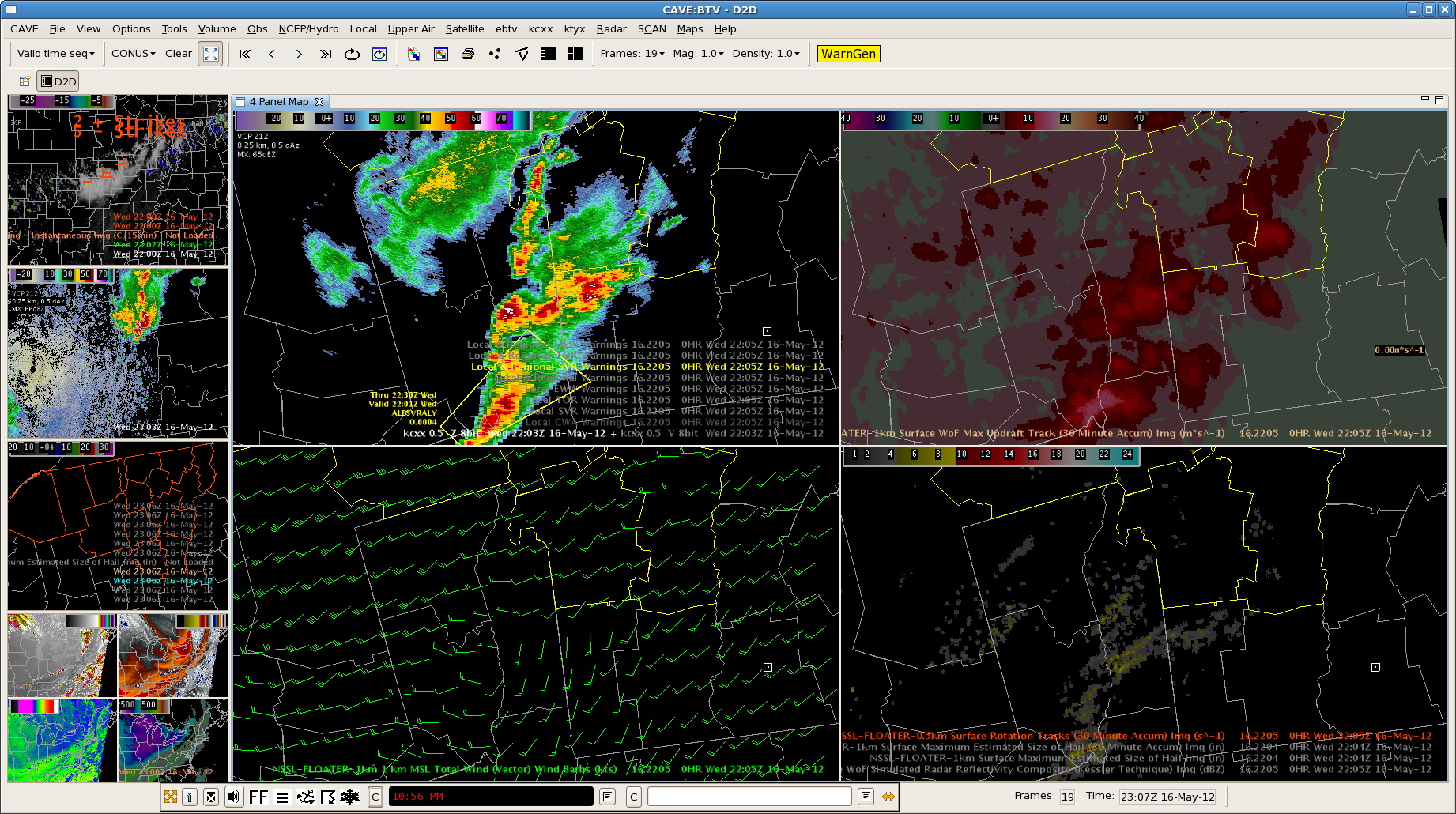
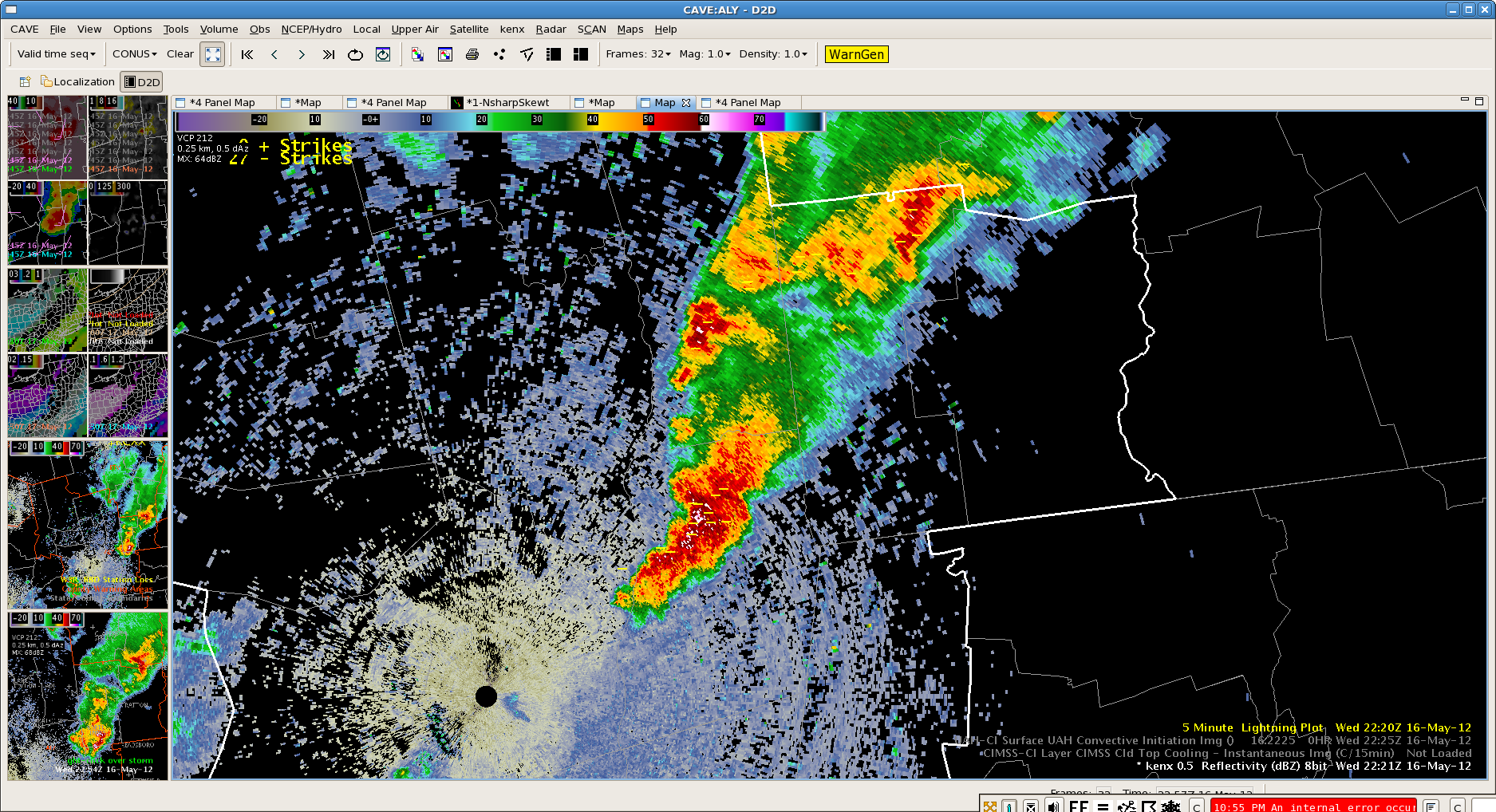
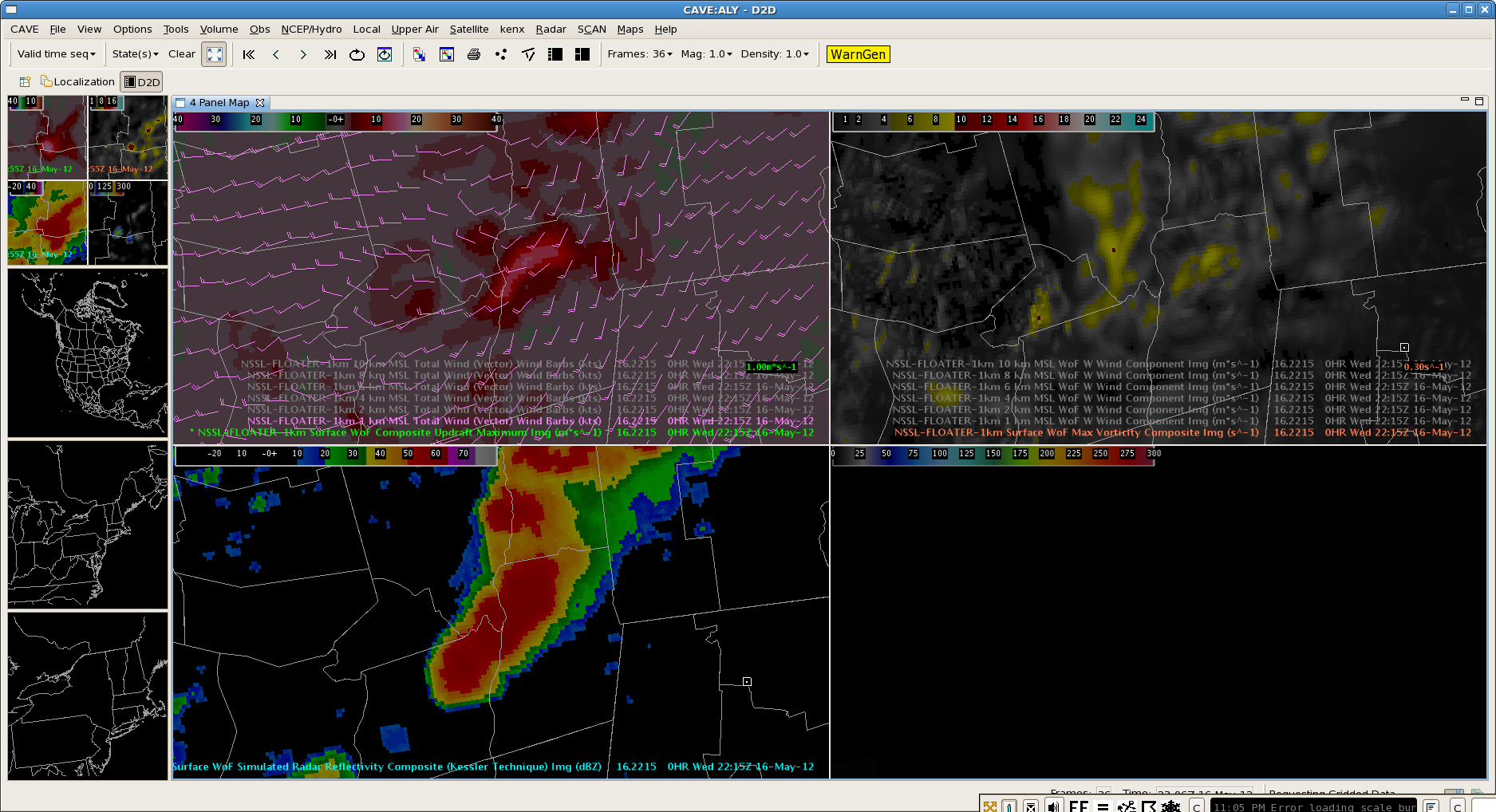
Some product limitations we ran into:  With all the new fancy products we had, there really wasn’t anything to aid with max wind gusts.  With the bow echo storm the 3d var fields were barely perturbed and did not at all seem representative of the probable wind speeds (images below show reflectivity and 3d var quad at same time with 1km (lowest available) winds…higher levels didn’t show much either)…old school use of radar velocities worked much better.

Some other products that would really be nice to have would be a 3-d or cross section way to look at updraft and downdraft strength, the horizontal plots of this could be overlayed at 1 km spacing in 3 d-var and was useful to watch through the life cycle of the storms but was very clunky to step through and hard to mentally visualize. In a 3d view this could be a very powerful way for forecasters to monitor and diagnose storm structure.  Another thing we ran into today were training storms and flash flood concerns…dual pol was handy for this among other things but wonder about what applications of the fancy new products there might be to hydro concerns.

AWIPS 2/Warngen/CAVE issues continued again today with warnings that wouldn’t go out, multiple Cave crashes, lots of random error messages and slow downs.  This system is not at all ready for operational use as they slowed/prevented warning issuances and having Cave crash mid warning ops when all the work station is running are 2 Caves not at all confidence inspiring when you think about everything else AWIPS in WFOs runs and does in addition.  Also found an interesting bug with the map background in the quad panels where they don’t always stay linked and you can unpredictably end up with map scales and alignments in different sections of the quads.

Quick Glance at SimuSat for Today’s Convection

Severe thunderstorms kept the WFO ALY team busy today!  With storms in our area diminishing (and moving out), I wanted to check out the CIRA/CIMSS Simulated Satellite Imagery from the NSSL-WRF to see how it compared to the last few hours.  Overall, I’d say quite well, aside from some placement issues, and the extent of the coldest cloud tops (which was to be anticipated).

CIRA/CIMSS Simulated WRF Satellite Imagery (IR Left/WV Right) - Valid 2012-05-16 2000 UTC
CIRA/CIMSS Simulated WRF Satellite Imagery (IR Left/WV Right) - Valid 2012-05-16 2200 UTC
CIRA/CIMSS Simulated WRF Satellite Imagery (IR Left/WV Right) - Valid 2012-05-16 2300 UTC

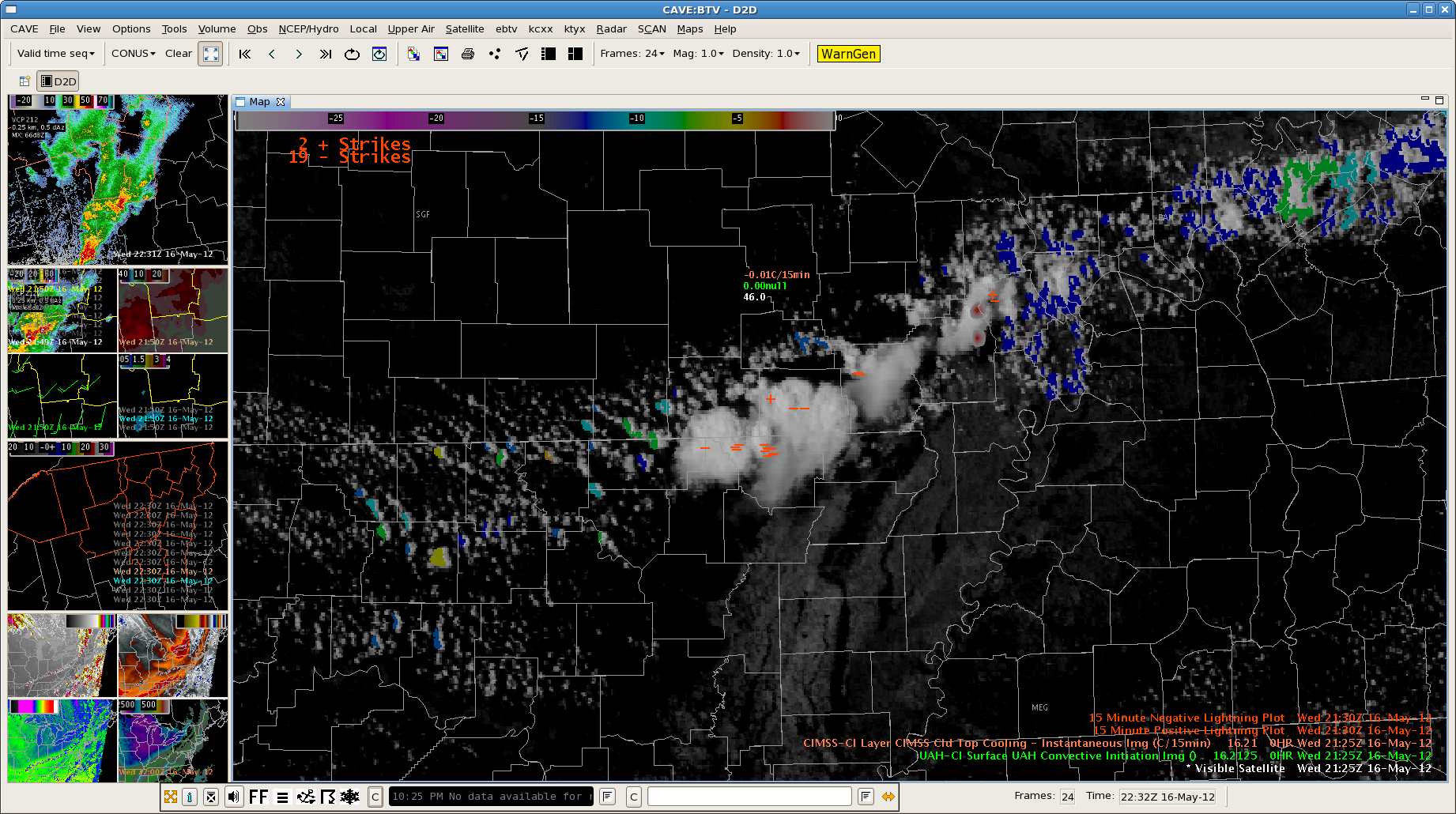
Convective Initiation – Verified!

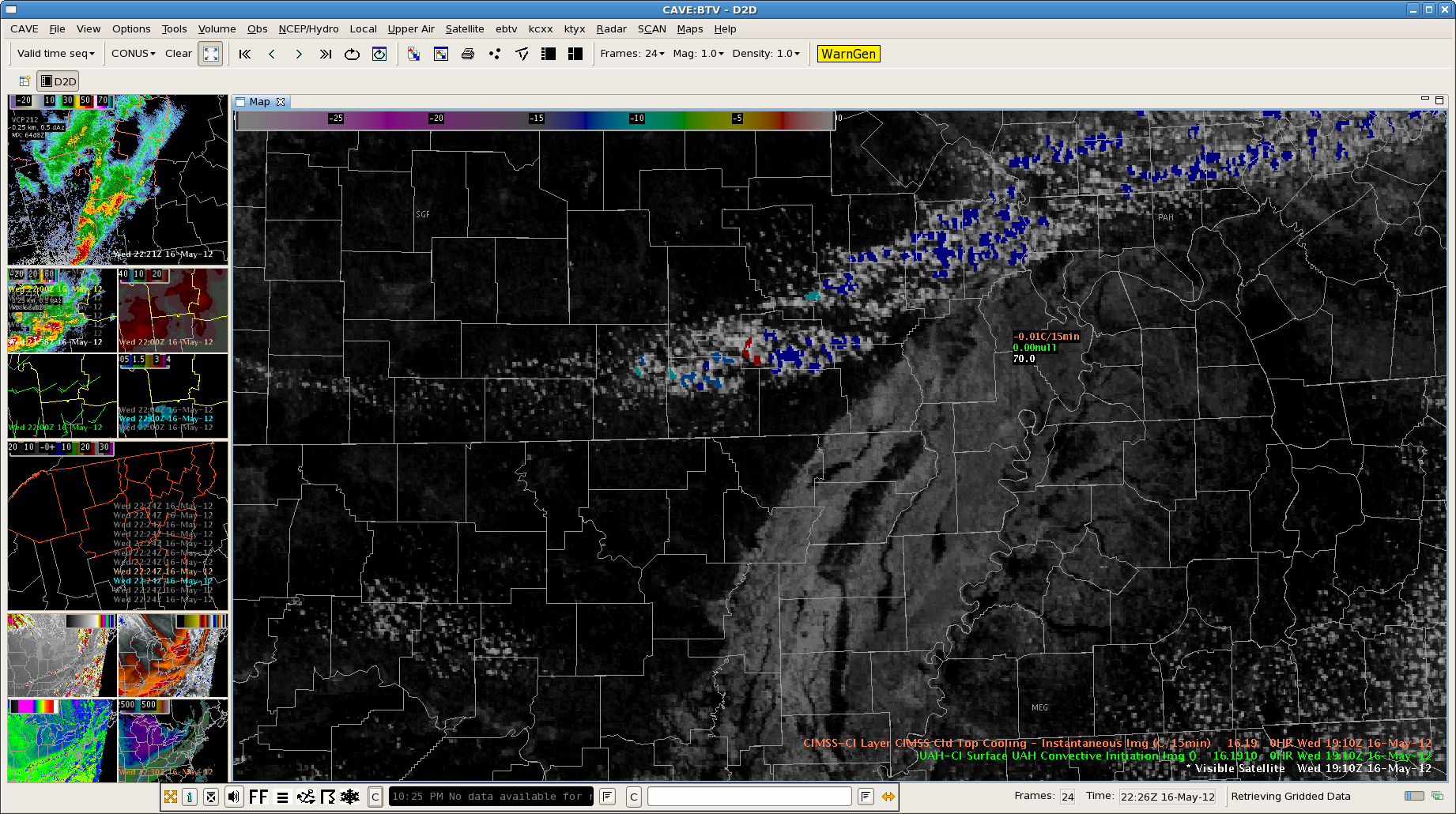
This series of images shows an ideal case of the CI product detecting a rapid development of storms along a cold front in northeast Arkansas.  The first image shows a strong CI signal (red) at 19:10.

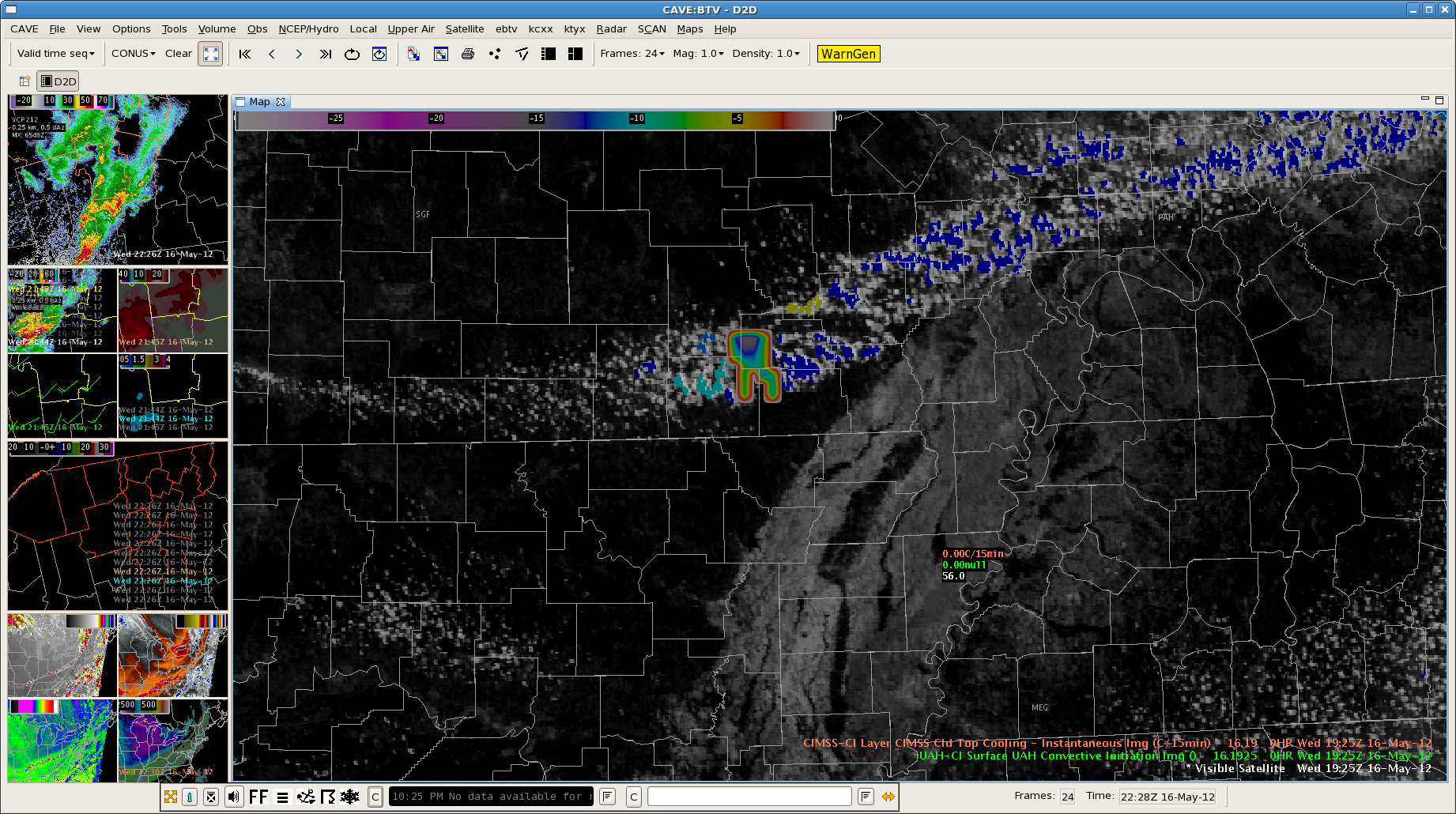
The second image shows the same area about 10 minutes later at 19:25.  The weird tooth-shaped object is the Cloud Top Cooling rate and this indicated -16 deg/15 min.

Finally, at 21:25, about two hours later, the visible imagery showed a developing storm with an overshooting top.

Update: 2012 May 16 22z

Convection continues to be active in the Albany CWA keeping Brian and Julia active.  It appears that the moisture axis in the Hudson valley is contributing to storm intensification.  Things have quieted down substantially in Burlington’s CWA and no warnings have been issued by Todd and Stephen for over an hour.  They could move east to Gray Maine’s CWA, however there is no indication that storms will reintensify upon crossing CWA boundaries.  Or perhaps they could move to Taunton, MA’s CWA but storms are unlikely to reach there for another two hours.  Thus Stephen and Todd will continue their focus to looking at CI and Nearcast products on CONUS scale as they have done for the past hour.

Jim LaDue:  EWP week 2 coordinator

Tags: None

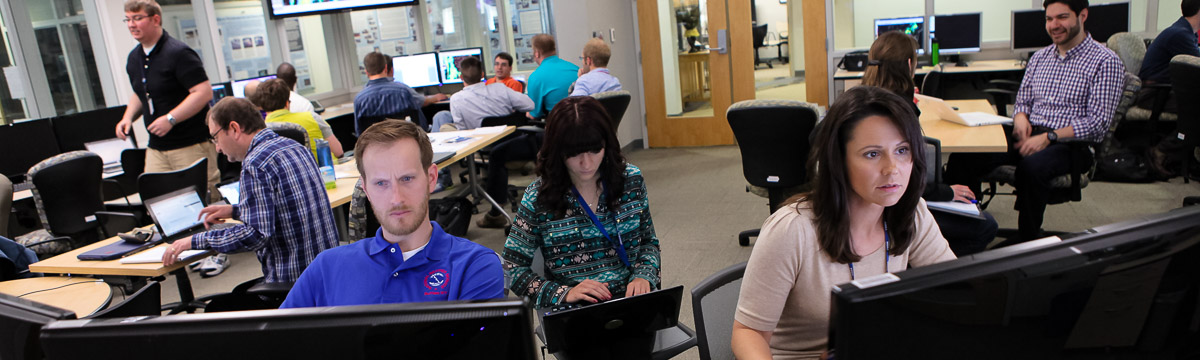
Photos from the Testbed

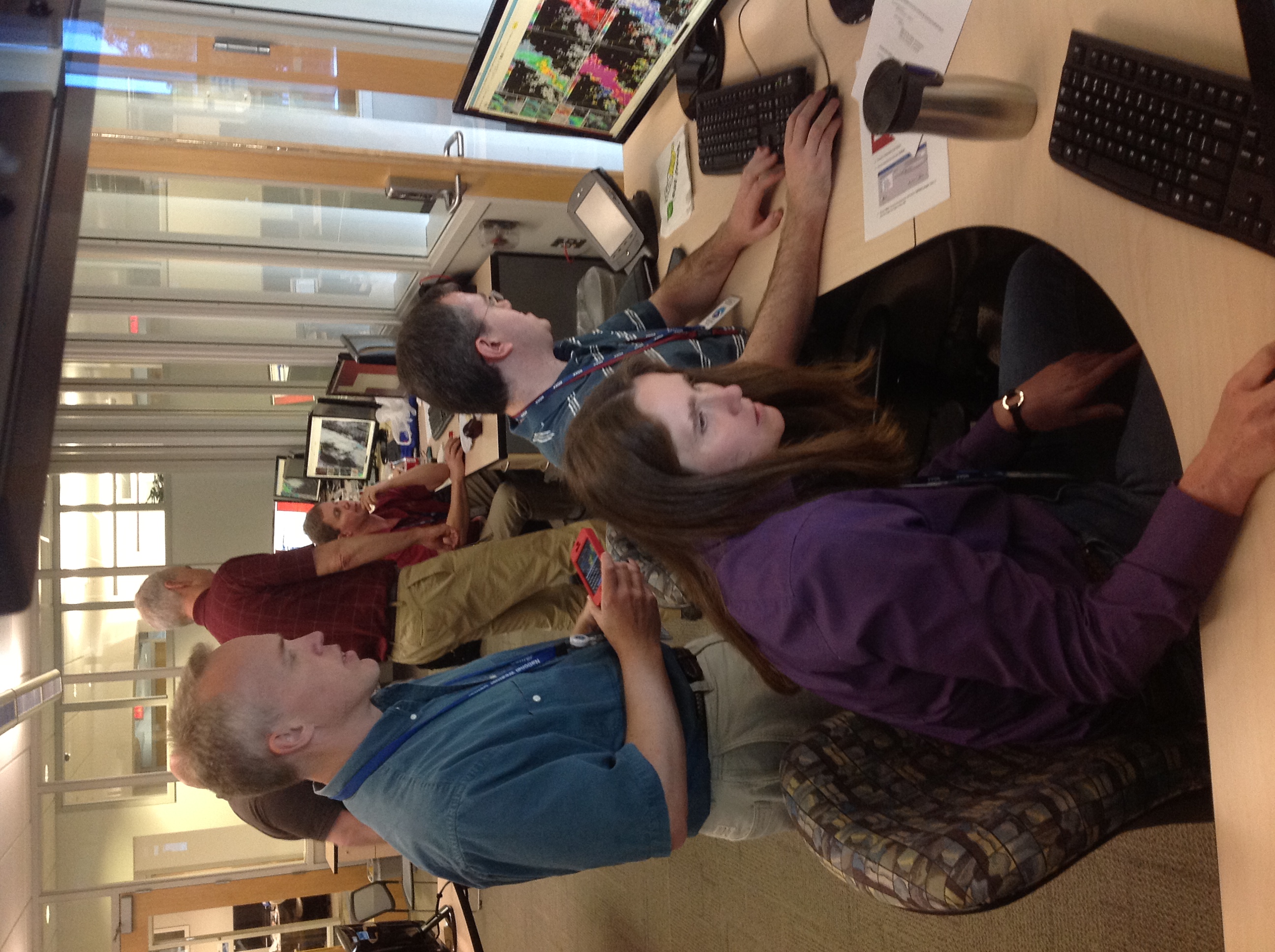
Photo 1:  Our Albany, NY, WFO team.  Julia Ruthford and Brian Carcione.  Jim LaDue observes.


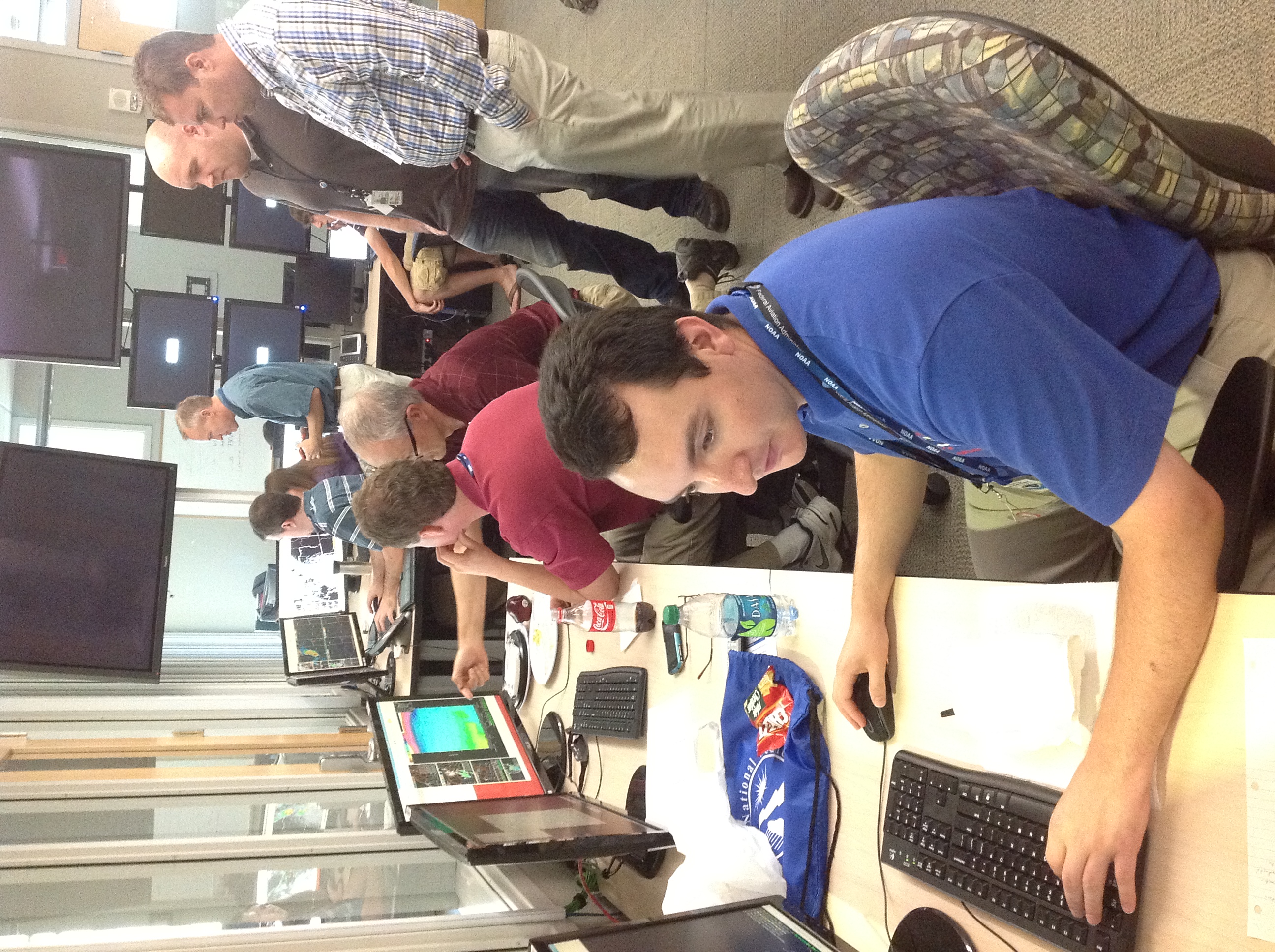
Photo 2:  Our Burlington, VT, WFO team.  Stephen Kearney and Todd Dankers.  Chris Siewert, Bob Aune, and Chad Gravelle observe.

Greg Stumpf, EWP2012 Operations Coordinator

Tags: None