Web based LightningCast for a DSS event

My office’s internet went down hard for the entire day, so I had to utilize a mobile hot spot. AWIPS in the cloud was very sluggish and unusable on the mobile hotspot so I opted to only utilize the web based tools for today.

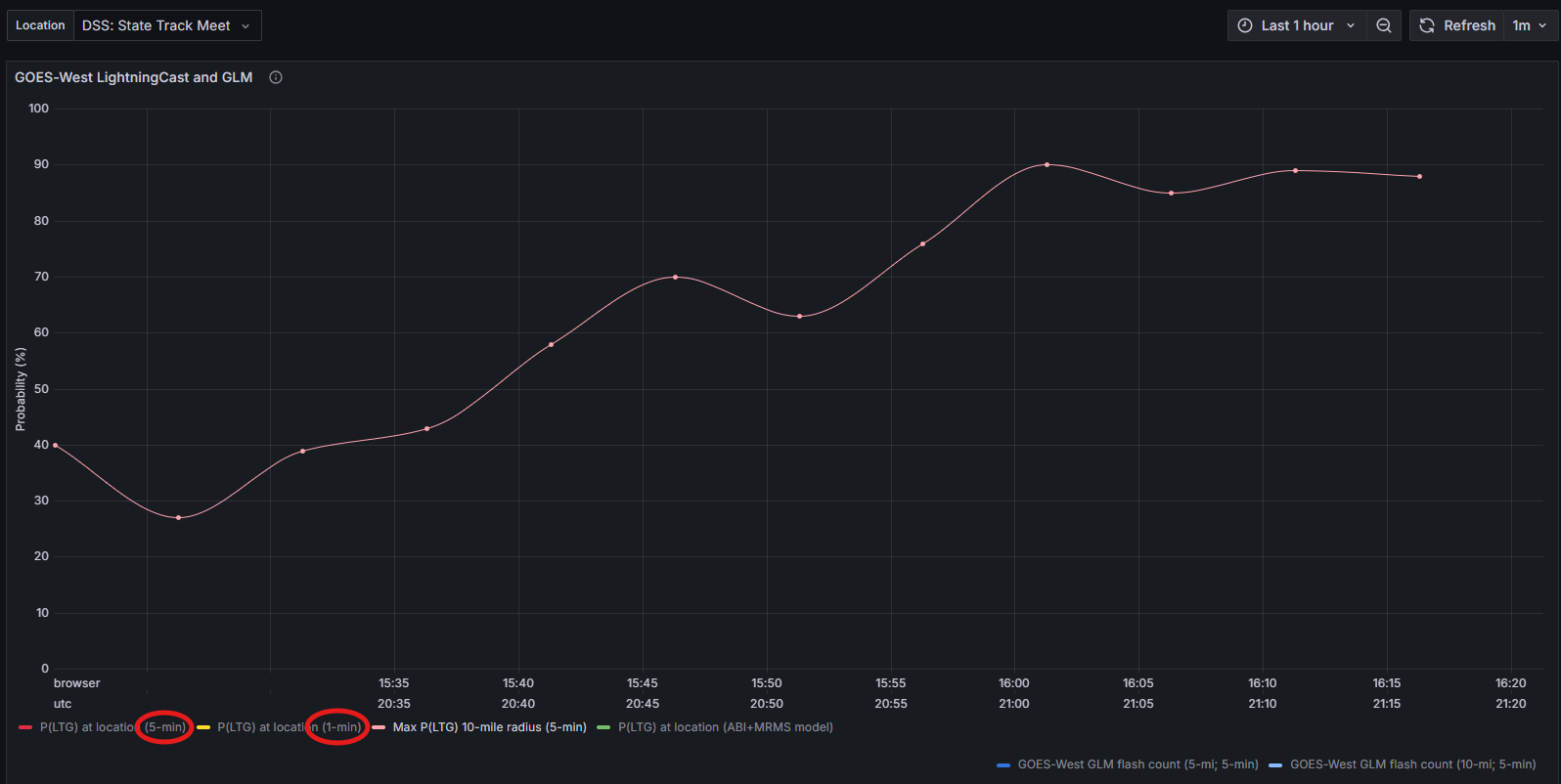
With a focus on the Brisket Appreciation Society Annual Bash in Beaumont, TX, storms started to emerge to the west and southwest of the event around 2 PM. I found the DSS dashboard useful when monitoring the specific location, but I wanted to use the LightningCast map as well for overall situational awareness. It was a little difficult for me to find exactly where the location was, so it would be useful for the map to have a dynamic layer for the DSS events.

I created a public graphic around the time lightning started near the to move closer to the DSS event. I generally utilized radar and LightningCast dashboard for the DSS event for the messaging. I did not include an image of the LightningCast for the graphic because it was already above 80% when I created the image. Because of this, there was very high confidence that lightning would occur, with the goal of the graphic to inform people of the approaching storms and the associated hazards.

LightningCast (both v1 and v2) stayed very high during the entirety of the event. When looking at the DSS dashboard, the probabilities within for the event increased to >80% 30 minutes before lightning was within a 10 mile radius of the event. There was an issue with the 1 minute data that caused that dip to 0. However, the 1 minute data is very noisy, and in this case, is not an improvement when compared to the 5 minute data.

– Golden Retriever Lover

Tags: None

GREMLIN and The Orphan Anvil

I experimented with GREMLIN for convective initiation on May 7, 2025. One feature that stood out and was briefly discussed amongst the developers and participants was an orphan anvil. The first animation below is the GREMLIN CONUS (bottom right), MRMS Composite Reflectivity (top right), and GOES-19 Channel 7 (bottom left) and the second animation is Day Cloud Convection overlaid with LightningCast.  As you follow the anvil passing south of the Home (or the Hot Pepper Festival), GREMLIN continues to project it as a storm or at least a shower further east. LightningCast did well and held steady and kept the lightning potential with a set of updrafts to the west.  Unfortunately, a meso-sector was not available at this time and thus could not compare the 1-minute data to the 5-minute data.  On a side note, the MesoAnwhere did fairly well depicting the orphan anvil progressing eastward.

Images above show the orphan anvil being projected eastward and suggested by GREMLIN as a storm/shower but MRMS has no reflectivity. The lack of lightning probably hurt GREMLIN in this scenario and it was suggested by a developer that anvil temperatures can resemble cloud tops and most likely confused GREMLIN in this scenario.

MesoAnywhere showing the orphan anvil.

– Podium

Tags: None

LightningCast Comparison for Cabbage, Potato, and Bacon Festival near Hastings, FL (JAX CWA) on Wednesday May 7th

LC V2 did better with lightning cessation showing lightning probabilities dropping quicker as convection moved east of the DSS event which it title “HOME”. This allowed for more timely DSS updates to partners mentioning the lightning threat was diminishing, at least over the next hour or so. LC V2 also did better with storms to the south which we will talk about more below.

LC V2 showed higher probabilities for lightning quicker for developing storms near southern portions of the county warning area. V2 also lowered probabilities quicker once the storms temporarily pulsed down. I do believe one or both of these storms eventually pulsed up again after this though so it is possible V1 performed slightly better in this scenario by keeping slightly higher lightning probabilities.

LC V2 had tighter areal extent of lightning probabilities overall which was more helpful and accurate. May just need to be a little more weary of sensitivity to decreasing lightning probs too quickly for pulse thunderstorms in the summer.

– Ricky Bobby

Tags: None

Tulsa Severe Weather Event

An upper low across central Oklahoma allowing for an unstable environment across the Tulsa CWA. At 19:38Z,  clearing noted across the western  half of the CWA allowing for cu development across this region. At this time, limited to only CONUS level satellite imagery as mesoscale sectors are elsewhere.

21:00, towers with anvils noted and are beginning to shear off of the updraft.

I felt that lightningcast overperformed in pinging on lightning that never transpired in real time.

-Jolly Rogers

Tags: None

Day 3 observations

LightningCast/MesoAnywhere for DSS Event

We were operating as NWS JAX on 5/7/25. There was not a huge severe threat, but there were cells that produced a lot of lightning. Our DSS event was the Cabbage, Potato, and Bacon Festival in Hastings, FL (labeled as “home” in AWIPS). As soon as the   day started, there were cells within the range of the festival, with our primary focus on lightning cessation. One of the first things I noticed was that for the cells to the north of the cells, LightningCast v1 had a wider spatial extent of the probabilities than v2 for areas of decaying convection. I assumed this was because of the MRMS data as there were lower MRMS -10C reflectivities in the northern edges of the convection where the lower v2 probabilities were.  I was curious how that would impact the probabilities for the event as the convection began to decay there and how it related to notifying the event of an “all clear”.

Image 1: LightningCast data v1 vs v2 from 19:50Z to 20:11Z.

With respect to the event itself, using the lightning dashboard (image 2) was helpful. Probabilities both in v1 and v2 were high for the beginning of the day in the middle of all the convection. Probabilities started to decline around 20:15Z. Initially, v1 was declining faster, but by 20:30Z, v2 was declining at a faster rate than v1. There was still lightning within the 10 mile radius during these declines, but v2 it seems that v2 caught on to the decay a bit faster. This is also shown in the LightningCast loop from AWIPS (image 3) where v1 had a larger spatial extent to the higher probabilities for longer. I used LightningCast probabilities in my DSS messaging. When the probabilities were going down, I used a number in between each version for the probability I used in the message. I also utilized MesoAnywhere 1 minute Channel 13 data once it became available for us to monitor the potential for new convection behind the main cluster of cells. There was not much being shown, which made me more comfortable noting the event of an all clear.  Probabilities eventually did start to go back up after 21:15Z because there was a lot of convection to the north and south of the event.

Image 2: LightningCast Dashboard for the Cabbage, Potato, and Bacon Festival in Hastings, FL.

Image 3: Lightning Cast comparison loop from 20:43Z to 21:32Z.

Octane and Gremlin

Today was the first day that I used Octane. After getting some training on it from Jason, my first impression of it is that it would be a valuable resource for situational awareness for developing convection and alerting you to where stronger thunderstorms are. This could alert a forecaster to a cell that they may need to interrogate a little more. During warning operations, if radar data is available, I do not think that a warning operator would have enough time to use this in their data analysis, but the warning coordinator or mesoanalysis person would probably find this tool helpful. We went through a thought exercise about how we would use this tool when radar data is unavailable. During times like that, the radar operator would probably find this tool helpful because the storm top divergence and the speed sandwich offers information that radar operators look in radar when assessing thunderstorm strength. With respect to the individual options, I found myself using the speed sandwich more initially because I was able to infer the storm top divergence in a unit that I am used to. However, the more I get comfortable with the actual CTD units and colors, having it paired with the storm top cooling would provide me more information overall than the speed sandwich during warning operations. If I only had satellite data, I would probably be pretty liberal with my warning issuance. There was a cell near Juniper Springs around 22Z, where the speed sandwich and CTD tools were showing relatively “stronger” signals (stronger is relative since there were not many strong signals today). Looking at radar data (MRMS MESH, VII, dual-pol data) and knowing the environment, I did not think the cell was producing severe weather. I am not very comfortable just yet with the thresholds in these Octane products, but given the environment was supportive of marginal severe weather, I may have issued a warning in this instance. Both the SpeedSandwich and the CTD displays were indicating the storm was weakening though, so I also might not have either. As others have noted the last couple of days, the MedSmooth CTD was the one I preferred.
Image 4: Octane Speed Sandwich and Cloud Top Divergence and Cooling from 21:54-22:21Z=
Looking at GREMLIN for the same storm, it seemed to have picked up on the stronger signals of the specific cell and would be useful for pinpointing the storm with the highest “potential” in this instance since it was the one with the higher reflectivity values. I don’t know if I would make a warning decision specifically off of this product, but if I had it available in addition to other satellite data, I may be more inclined to issue a warning or an SPS if the environment is supportive of it.
Image 4: GREMLIN 20:31Z to 22:21Z
Unrelated to the previous storm, this was another snapshot I took of GREMLIN. There was an outflow boundary (not visible in this image) that was traveling southward and sparking new convection as it interacted with the sea breeze. A small cell that was relatively strong quickly developed to the southeast of the Jacksonville Airport. While reflectivities were picking up on MRMS, satellite didn’t pick up on it as quickly. GREMLIN did not catch this initiation.
Image 5: GREMLIN at 20:01Z.
There was a cell that developed along a outflow boundary very close to the radar. Satellite data was not really picking up on it with little cooling cloud tops so GERMLIN completely missed it.
-goldenretreiverlover
Tags: None

Lake Charles May 6th event

GREMLIN was helpful early in the event to quickly identify most intense thunderstorms developing across SE Texas, but as more convection developed it became less useful. A severe thunderstorm warning was issued for the cell highlighted in blue on the top right panel of Figure 2 which shows MRMS. GREMLIN data hardly shows much lower reflectivities for the severe cell as more frequent lightning producers to the northwest are likely causing it to struggle.

88D radar data showed a tall and strong Z core. Strong STD and lower ZDR/CC values were also noted aloft though were not shown here.

This was right at the end of the day so didn’t have time to issue more warnings, but storm to the NW is likely severe by this point just given supercell characteristics.

OCTANE STD showed the severe cell with cooling cloud tops and then showing a STD signal as the storm quickly grew taller than an anvil from an upstream thunderstorm. The STD signal was rather weak though and was even weaker than some sub-severe storms which developed across East Texas. This could have been due to disrupted flow from upstream convection. The product did still help me quickly realize there was new convection developing over SW LA and led to me eventually issuing a warning after doing further analysis on 88D radar data.

Didn’t see too many significant differences between LC V1 and V2 overall. I did find this image interesting as convection developed across SW Louisiana LC V1 had higher probs over a larger area before V2. Further north across central Louisiana, there was additional convection developing under thicker cirrus where V2 did a better job showing higher probabilities of lightning. LC V1 only had low or moderate probs at most while there were a few lightning strikes already occurring. I forgot to save an image from that example.

– Ricky Bobby

Tags: None

LightningCast v1 vs LightningCast v2 5/5/25 21:26Z-22:21Z

 The cell I was observing was producing infrequent lightning for much of the period in the loop with probabilities in v2 staying consistently higher than v1 before and after the lightning strikes. v1 decreased to near 0% at 21:41Z right before a strike occurred at 21:56Z although the probability in v1 increased to 10% at 21:46Z. v2 probabilities remained relatively consistent during that time frame. It seemed that with the MRMS data, it had enough reason to continue the probabilities even though the lightning was infrequent. From a forecaster’s perspective, this would give me more confidence that the storm was persisting and was continuously capable of producing lightning whereas v1, I might think that (if only relying on the LightningCast), the threat was diminishing.

4 panel comparing LightningCast v1 and Lightning Cast v2

-Golden Retriever Lover

Tags: None

Subtle LightningCast Differences

After the first day of using the new LightningCast, I was able to notice some subtle differences between the old version (LC1) and new version (LC2).  However, I don’t have enough information to say it will impact my operations one way or the other with the new version.  It does seem the new version is a bit more detailed and possibly slightly faster with convective initiation. For instance in Figure 1,  there was an isolated storm in west-central NM where the new LC has the 75% outlining the storm by the end of the loop and the older version does not. Also, the cluster across the northern portions of NM (or ABQ CWA), the older version seems to be too quick to end the lightning as it just has a small 75% line near the border of Colorado. The new version keeps that higher probability going much further south.  In this case, LC2 might provide slightly more lead time in IDSS as well as a bit more detail in the cessation of convection.

For the last figure, I wanted to provide a snapshot of the convection and compare the two LC versions. Northern NM again was a noticeable difference between the probabilities. For the farthest northern cell, LC2 has a much larger 75% prob area while the 25/50 probs are fairly similar to LC1. LC2 suggests there might be lightning between the two areas of storms in northern NM as it has the 10% prob contour completely connected while the LC1 does not.  

LC1 suggests there might be a storm developing further east with a small 25% area near the CO border, while LC2 does not have anything and verifying with radar, appears there were only a few showers in that location. It is interesting to note the two 50% areas on the two separate storms in the southeast suggested by LC1 while LC2 keeps the contours together. And judging by the FED data, LC1 is probably more correct in this snapshot.   There are a couple other differences within that snapshot, but not entirely sure these differences would make much of an impact on a warning/IDSS scenario.

Figure 1: LightningCast and Flash Extent Density at the beginning of convection on May 5, 2025.

Figure 2: Captured a few hours in the southeast section of ABQ county warning area. A few subtle differences, but nothing notable that would change operational thinking.

Figure 3: At 20:26z, the most notable difference between the two versions is with the storm across northern NM and a minor difference with the storms in the southeast portion of ABQ county warning area.

– Podium

Tags: None

Comparing GREMLIN and LightningCast to actual Reflectivity and ENTLN Lightning Plots

Radar is an essential tool used across all CWA’s daily. What would you do if your CWA had the potential for severe weather but you did not have radar or MRMS? Well that is something I was able to experience today across KOUN’s CWA. Satellite convective products such as GREMLIN and LightningCast were crucial in being able to determine storm location and intensity. GREMLIN was helpful in being able to get an idea of the location of storms along with their intensity even though the range of reflectivity with GREMLIN is limited. The general idea was to see if there were any areas with high end reflectivity near 50 dbz as that usually indicated an area of stronger storms. If there were any areas with lesser values this may mean developing storms that could be checked with LightningCast data to see if it believes storm development is likely to occur there. Speaking of LightningCast it was very useful in determining locations of possible future storm development. Using the >1 strikes within the next 60 mins really helps highlight areas of potential storm development and motion. When comparing these products to actual reflectivity there are a few things that stand out. The first being a good ability to get a general idea of potential strong storms and future storm development. Both products highlighted about the same area where the actual reflectivity was located and where lightning clusters developed.

\

These products were then able to do a good job in picking up the intensifying storms and their likely future location. This was shown from data taken at around 23Z.

Overall, both of these products were extremely useful and successful when it came to forecasting severe thunderstorms in a scenario where radar was not available. I can most definitely see these products being applied to everyday convective ops at CWA’s across the CONUS. The last two images show the 00Z comparison between GREMLIN and actual radar reflectivity.

– Sven The Puffin

Tags: None

LightningCast Miscellany over Ohio

The scenario for the Ohio/Indiana area today is pop-up convection ahead of a cold front, with a gap, followed by the front itself. The pop-up convection was already getting going when we began ops for the day, but a few cells were able to be observed in the developing stages. The main convection with the front was just starting to enter our CWA when HWT ops ended for the day.

Troy Strawberry Festival

The festival was in the lull environment between the pre-frontal convection and the convection associated with the front itself for the majority of ops today, though a couple cells did approach the festival area early on in our shift. We were still getting spun up for the day when those cells developed. It was technically a missed DSS event, but I utilized the on-demand LightningCast dashboard to retroactively look at the situation and see how the LC performed and the utility of the dashboard itself. With this event, LightningCast performed fairly well, giving an approximately 10 minute lead time between the peak lightning probability within the following hour and the first GLM flash. A few minutes of additional lead time could be tacked on if you go back to when the probabilities began to spike. I believe this rapid rise in probabilities to be enough time to quickly give the festival a call, alerting them to the likelihood of lightning within the next hour. However, not sure if we’d be able to tell them it would occur in the next 10-15 minutes.

Darke County LightningCast Progression

LightningCast dashboard plot showing the time and probability value of the peak.
LightningCast dashboard plot showing the time of the first GLM lightning flash observation.
– Loki
Tags: None