the California convection that could actually convect

A late season trof moving onto the west coast has everyone east of the Rockies excited for tomorrow and the weekend. It is associated with an unusually late season and significant rain event throughout CA with afternoon storms scattered about in the central valley, deserts, and Sierra Nevada. The GLM was able to detect lightning in several storms in CA and NV. NOAA-20 made an overpass around 21Z and provided several viable soundings in the San Joaquin Valley and near the CA coast.

The NUCAPS sounding centered in Tulare County is shown below. MUCAPE values on the order of 563 J/kg were supportive of low-topped thunderstorms.  Neighboring soundings indicated similar or slightly reduced values of instability. With the focus on severe convection east of the Rockies, it is nice to see NUCAPS perform so well in a completely different region and dynamical regime (namely post-frontal open cellular convection).

Brian Kahn

Velocity Gradient – A product that is even cooler than it sounds

What’s even better than AzShear?

AzShear + DivShear = Velocity Gradient

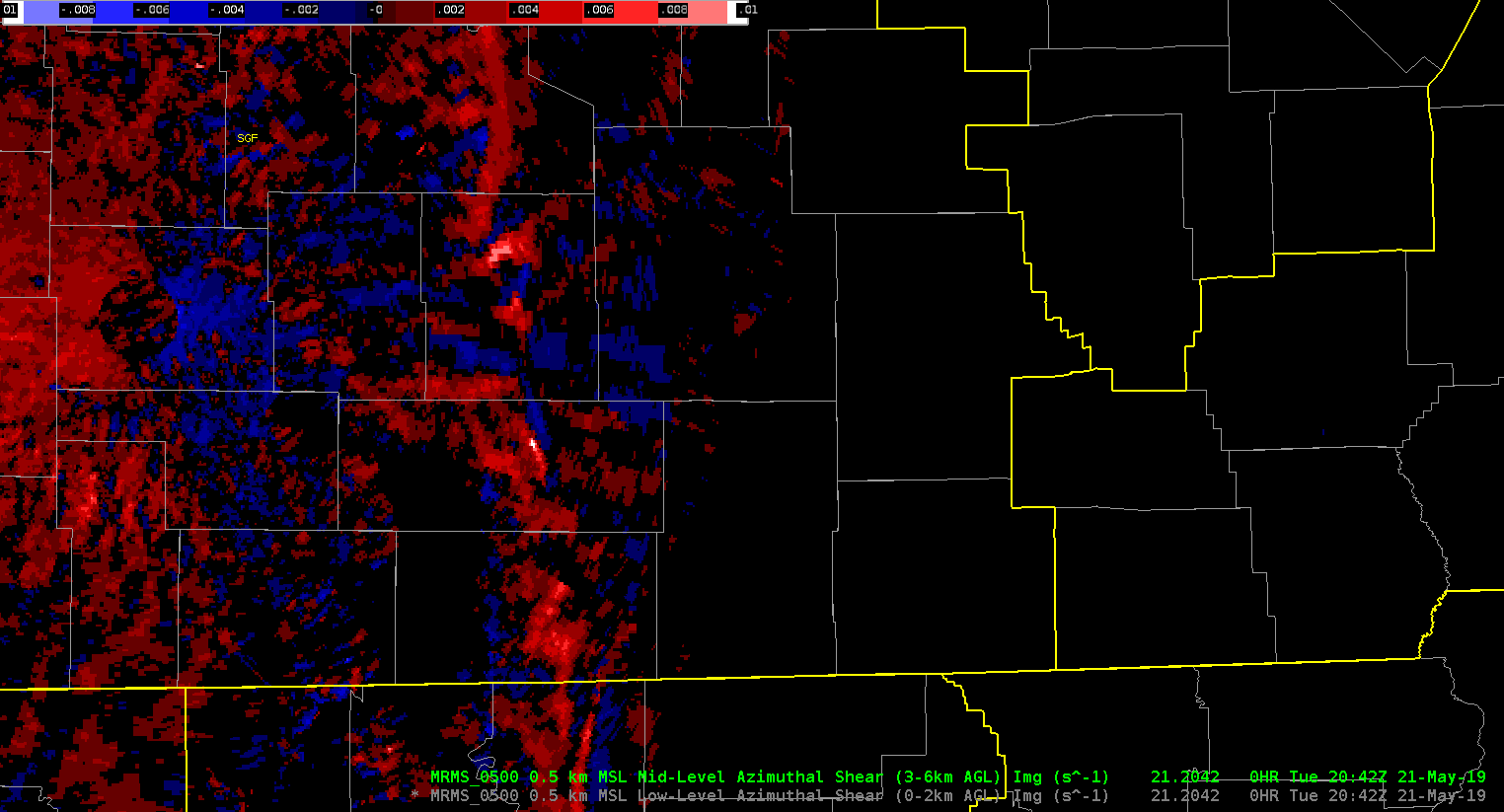
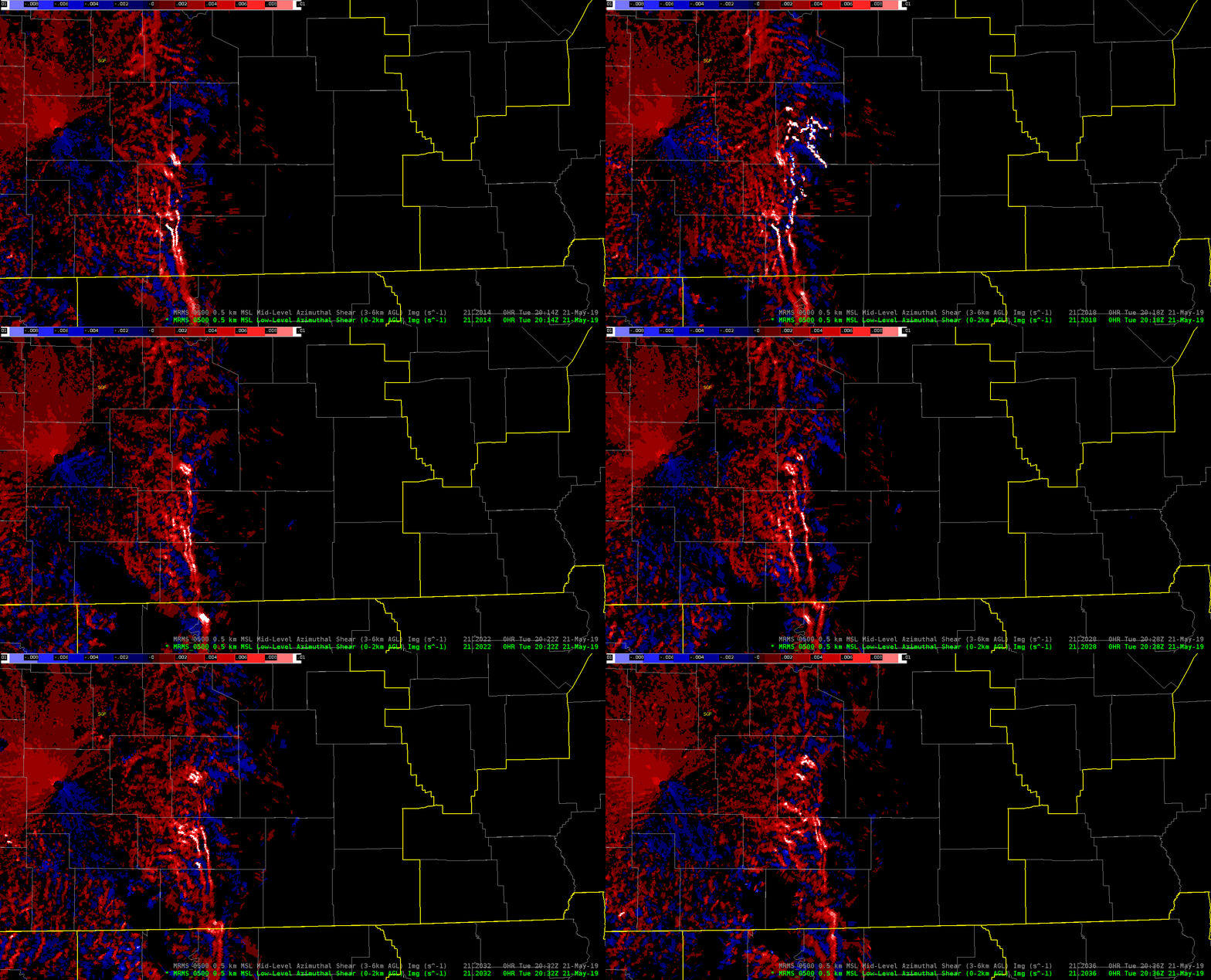
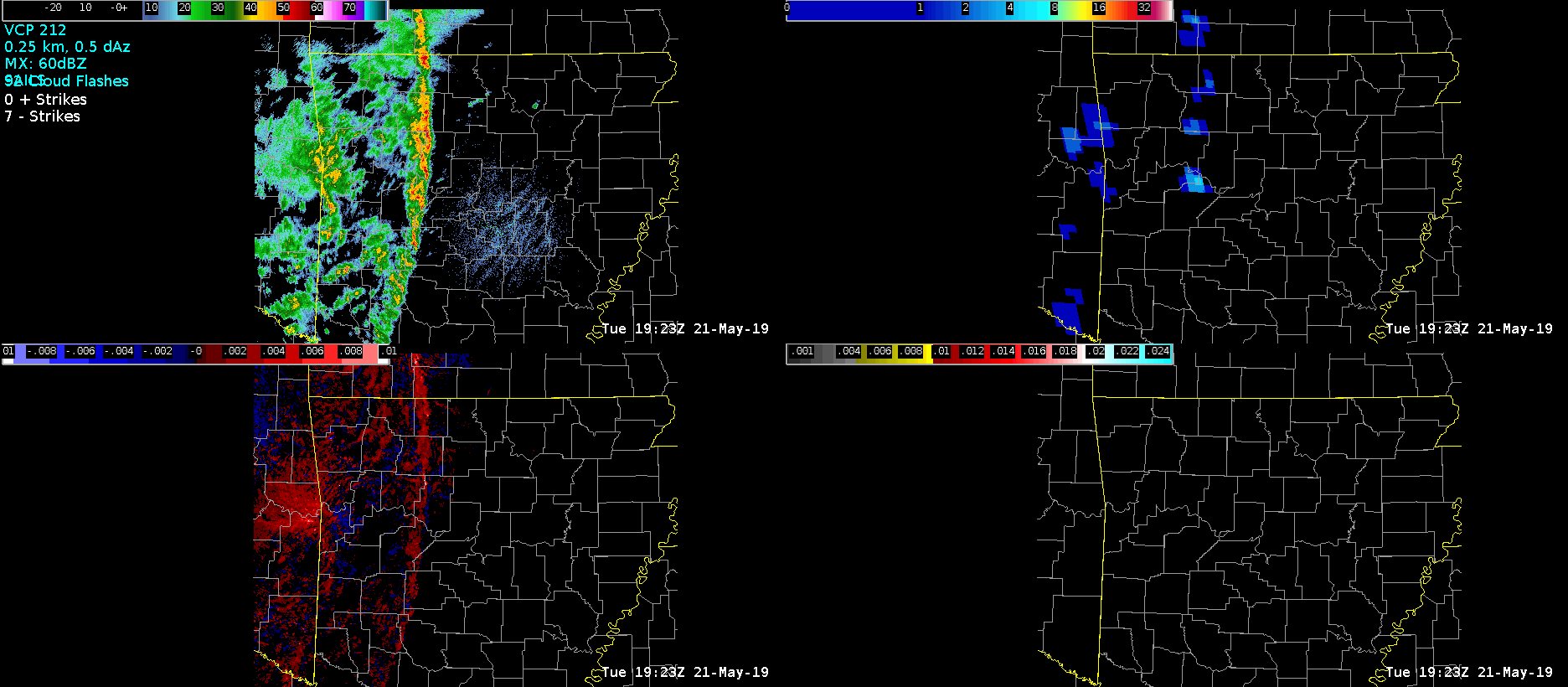
Below is a look at AzShear down low with an approaching QLCS. Fairly noisy right?

Here is another view using DivShear – in other words, divergence along a radial similar to how shear is computed across radials. The convergence (i.e., negative divergence) shows up nicely, eh?

Now combining those fields together with Velocity Gradient, things really start to jump.

Look how well DivShear works with MARCs , too:

Certainly better than AzShear when it comes to mid-level convergence…

And then putting them together for Velocity Gradient…


Now, closer to the QLCS “summit”, we see fairly coherent DivShear…

And this is how Velocity Gradient shows it.

Hoping to show some extremely cool results with these fields involving a QLCS mesovortex later in this case if time permits…

#MarfaFront

IND TVS

15 min prior to 1.75″ hail and 20 min prior to baseball-size hail, a supercell tracked NNW-SSE through Vermillion Co, IL …the Probsvr nailed the values for ProbHail at 96%, VILD 4.3, and a well defined TVS (100kt G-G) and strong MESO on NEXRAD ~ 7k’NUCAPS SVR TS values kinda nailed it in Ern IL :

East Central IL  (green dot) MU and FCST SFC CAPE were > 4000, LIs were > 12, DCAPE > 1000 (~50KT Gusts), SHIP > 1 and LR H8 – H5 ~8SRM showed Storm Top Div > 130kt 12 min prior to the Baseball Sized hailThis storm is not diminishing, with Storm Top DIV remaining well over 100ktEastern end of MCS continues to chug thru central IN (2130-2300z), ProbSVR ~ 23z looking good, more warnings on the way

GLM Flash Event Density vs Centroids

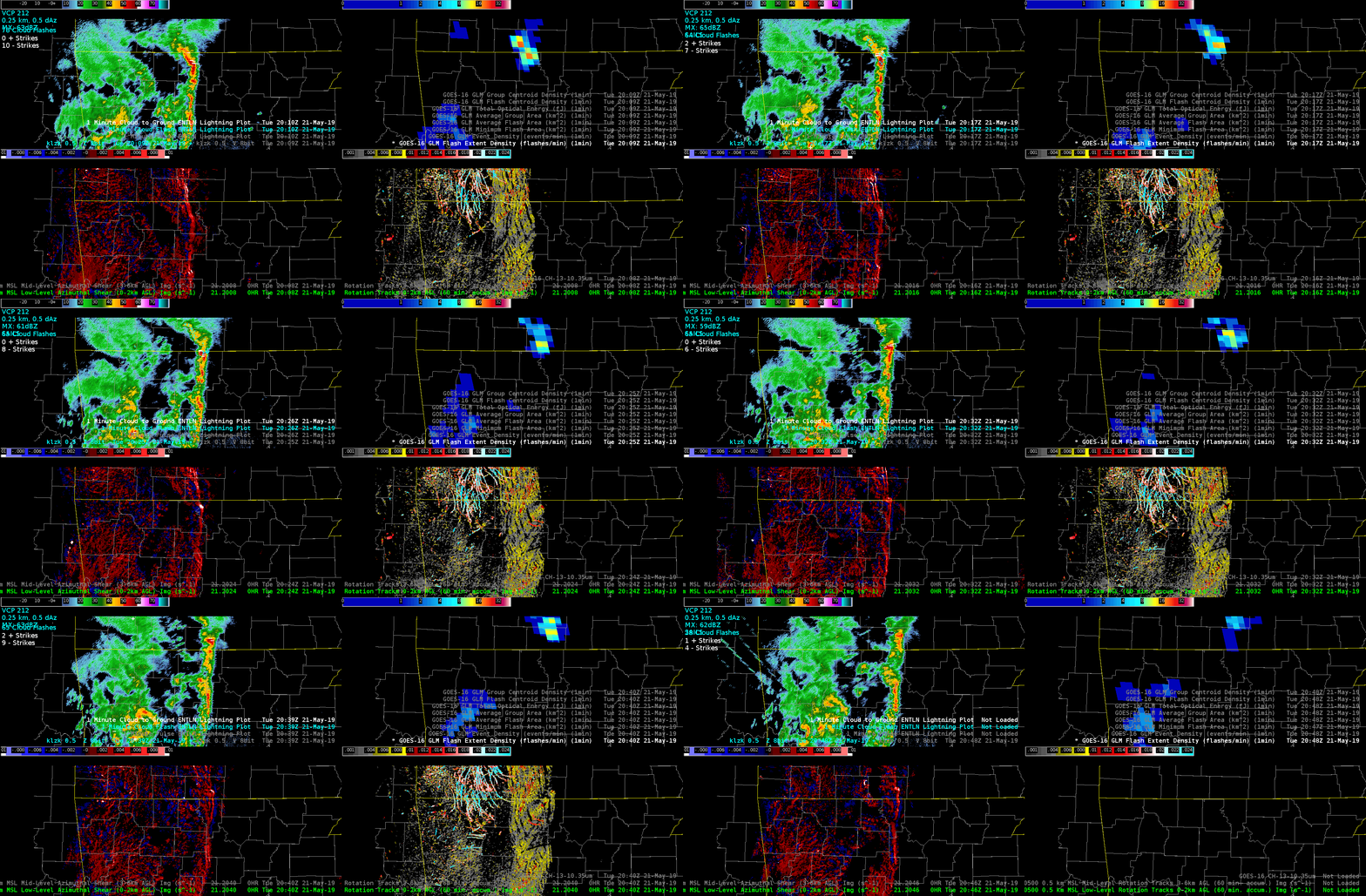
Viewing some marginal severe storms in northern Idaho from GOES 17 in this example. In the first image is the traditional Flash Extent Density product. However, have modified the color curve (User -> Awips -> GLM_FED_DC) to provide some enhancement to the lower values as detection efficiency seems to remain lower over ID/MT as we have found in MT/WY in previous days. While this is overall helpful in picking out some stronger storms, the large 8km grid boxes take up a lot of screen real estate when viewing over background satellite imagery.  Also the strongest storms are somewhat lost in the lightning data of the surrounding storms.

As an experiment, tried loading up the Flash Centroid Density Product. By turning on the interpolation and setting the max value to 10, this really helped to isolate and highlight the strongest cells. Of note is the cell moving toward the north, west of Missoula. Picking out the lightning jump in this storm was easier viewed on this Flash Centroid Density product, and comparing its strength to surrounding storms was also easier. It is also helpful that the product has overall small footprint.

— warmbias —

ProbSevere in MCS

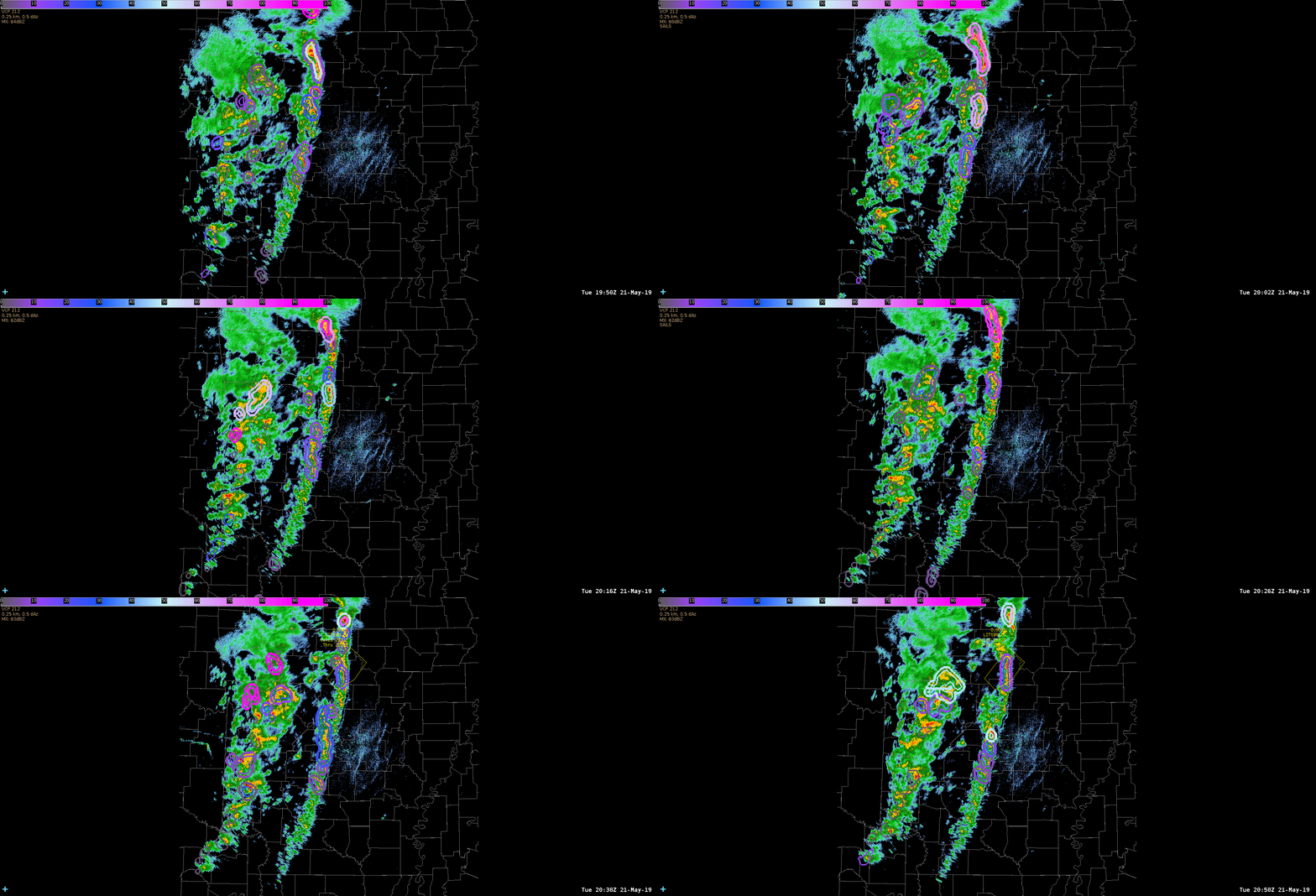
Watching the MCS evolve over Indiana, ProbSevere became increasingly hard to use. The object continued to change in size and in number, so it was hard to trust the probabilistic values. Ideally, I would have liked to see one on the eastern flank where the strongest velocities were, another on the western flank where the reflectivity is higher, and perhaps one or two more in between.  However, since the orientation of the MCS continues to change, I’m not sure if that would continue to be the preferred object count and location.  Bottom line is to use ProbSevere with caution with lines, bows, MCS’s or anything with ill-identifiable cells.

-Tempest Sooner

Vertical Data Smearing – the bane of AzShear’s existence

All right, maybe that’s a bit over-dramatic, but at least I got you still reading. I’ve discussed elsewhere the sensitivity we’ve seen with low level AzShear and Rotation Tracks when it comes to surface features such as outflow boundaries or artifacts such ground clutter. Here we see sensitivity to what’s going on above – i.e., velocity data with a high reflectivity mesocyclone aloft being smeared downward with sidelobe contamination. To illustrate…

KIND 3.1 degree Z
KIND 3.1 degree V
KIND 0.5 degree Z
KIND 0.5 degree V

So, it’s fairly evident that velocity is being contaminated down low. Unfortunately, this also affects the AzShear calculations…

Just something else to be aware of…

#MarfaFront

Were there indications there could be large hail in eastern IL?

Short answer: Yep.

NUCAPS Modified Sounding near Champaign/Urbana, IL from 18Z pass.

Since there were no 18-19Z special soundings from the IL/IN area, I looked to the AllSkyLAP CAPE which was only getting GFS retrievals in the ILX area. Those values were around 2300 J/KG or so.  The NUCAPS modified sounding near Champaign/Urbana, IL (shown above; the closest green dot to the storm that produced the severe hail), suggested more than 3500 J/KG of MLCAPE. Yesterday’s NUCAPS soundings suggested that the NUCAPS CAPE values were a bit high, but the ProbSevere MLCAPE values at the time of the baseball size hail in Westville (2105Z) were near 2773 J/KG.  So, yes, plenty of sources suggested high CAPE and thus there could be large hail in the area.

Also of note: The operational GOES 16 CAPE did not show any values because of clouds across the area.

-Tempest Sooner

A Day to Compare

I initially wanted to compare model data, especially skew-t’s, that I usually use, to the NUCAPS products. My purpose was to  ascertain the feasibility of replacing or supplementing  point based model products with NUCAPS. As I was unable to access the model data I use daily I decided to compare NUCAPS with NAM and GFS.

First the comparisons in the rapidly changing thunderstorm environment in which I interrogated a large MCS over the Illinois/Indiana border.

I compared NUCAPS 18z skew-t (from clear air area) to NAM and GFS skew-t’s, at the same time and location.

NUCAPS presents a much more stable and dry environment than the model skew-t shows, and also much more stable than the actual current environment considering this storm has already produced hail, tornadoes and heavy rain.

Next, I compared an AllSkyLAP CAPE img at 18z (point J on the above picture),  to a NAM CAPE map over the same area/time. AllSkyLAP seems to be about 500J/kg higher than the NAM CAPE map.

Finally, I compared a NUCAPS CAPE img and the NUCAPS Skew-T at 18z over the same area and there was a huge variance. The skew-t was higher than the CAPE img by over 1300J/kg.

Lastly I decided to compare NUCAPS and model data from a stable area, non changing area.

I compared an observed skew-t from the KS/OK boarder to a NUCAPS skew-t. There is a one hour difference in the data but for the sake of this comparison I think this will work. 

The observed skew-t is a relatively dry column with .87pw and a T/D of 31/20C  at the surface and 10/-20C at 700mb. The CAPE is at a ridiculous 3746 J/kg. But with no moisture, lifting mechanism nor shear I wouldn’t expect development. When compared to the NUCAPS skew-t one can see a definitive difference. CAPE on the NUCAPS is at 0 with T/D at 24/11C at the surface and 7.9/-9.3C at 700MB which is a huge departure from what the observed skew-t showed…but how would the observed skew-t hold up to a model skew-t?

NAM 18Z model skew-t compared to the 17Z observed skew-t from the same area shows 28/17C SFC temps, only 3C off from the observed skew-t and at 700MB NAM shows 9.5/-8C only .5C off the temperature and 11 off the DP. Also, CAPE was much closer than when compared to the NUCAPS where SFC CAPE on the NAM is 3246J/kg and 3746J/kg on the observed.

Overall, after this small sample size of data, both severe weather and in clear weather, I believe that I would continue to use NAM/GFS over NUCAPS for my point based forecast needs.


***DESMOND***

VisIR Sandwich of MCS

VisIR sandwich product has been a very useful way to combine the high res visible imagery with the cloud top temperatures. However late in the day as the sun angle gets lower, the image gets darker. One way to remedy this is to adjust the composite options (right click on legend), and equally lowering the Gamma setting. This will brighten up the image and allow better utility into the low sun angle hours before sunset.

Default:

After:

How to adjust settings:


— warmbias —