An official website of the United States government
Here’s how you know
Official websites use .gov A
.gov website belongs to an official government
organization in the United States.
Secure .gov websites use HTTPS A
lock (
) or https:// means you’ve safely connected to
the .gov website. Share sensitive information only on official,
secure websites.
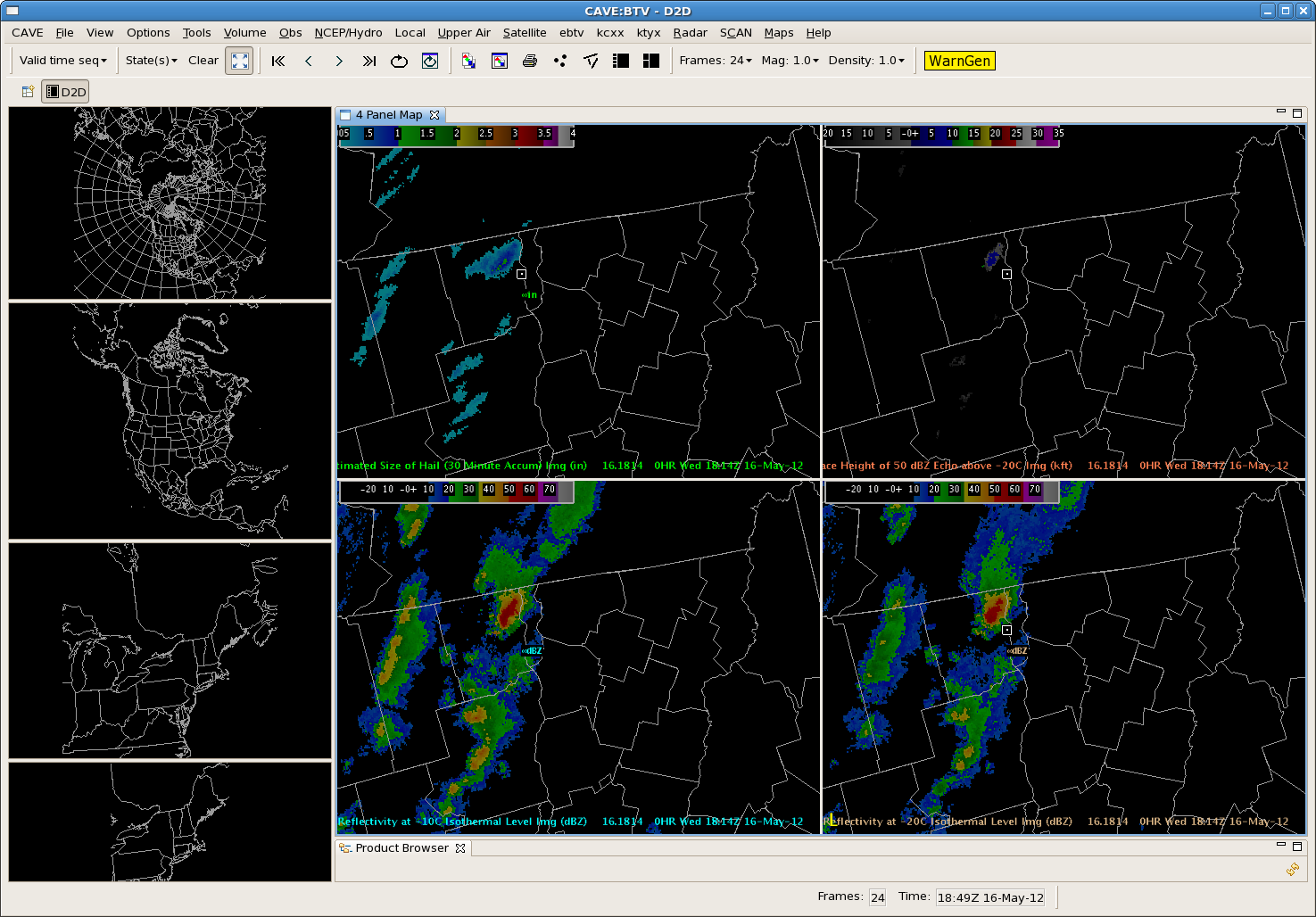
We used MRMS data during storm interrogation and decided to warn for a storm over far northeast New York and far northwest Vermont. As early as 1812z the MESH was indicating hail just over 1 inch while the height of the 50 dbz echo above -20c was over 5000 feet. Warning decision was not made until after 1820z after looking at KCXX radar data. 1 inch hail reports were received from about that time. Attached is a 4 panel showing the Max Expected Size of Hail (MESH), heights of 50 dbz echo above -20C, and reflectivities at the -10C and -20C levels.
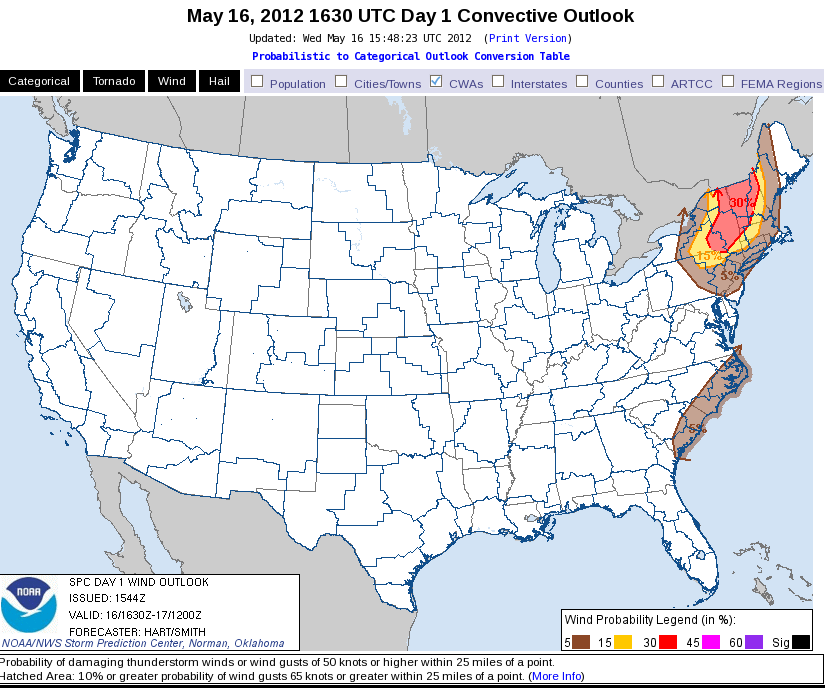
Yesterday’s outlook appears to be still on track. One strong northern stream wave is approaching eastern NY and New England along with a significant cold front. The front still has to interact with the axis of best moisture from the Hudson valley to the east and yet higher based convection is forming in the high terrain in northern PA to the Adirondacks. Convection should consolidate once the front hits the moisture in 2-3 hours. Deep layer shear is strong enough to generate supercells, however the majority of the convection may fall into small multicell forms, perhaps some bow echoes. Low level lapse rates from the Hudson valley to the west are strong but midlevel lapse rates are somewhat marginal (6-7 c/km). Thus I expect that large hail will be a threat though giant hail (>2.5″ diameter) prospects will be very small. Tornadoes are unlikely given somewhat weak low-level shear (10kts). Severe winds are much more likely as strong convective downdrafts are possible with the more intense storms. We have both teams in the northeast; Todd and Stephen are localized to BTV while Brian and Julia are taking on ALY. Convection has already initiated with the most coverage in BTV.
Meanwhile, steep, near saturated, low-level lapse rates have again initiated seabreeze convection along coastal NC. New storms may form further southwest into coastal SC. The Floriday play is somewhat muddied up by fairly dense high cloud cover. However instability is quite sufficient for thunderstorms and the upper-level system is approaching from the west.
Today was one of those days where we ended in somewhat different locations than we intended. Following the morning forecast, we had Stephen and Brian focus on Blacksburg, VA’s CWA while Todd and Julia took on Sterling, VA and the LMA site. We were enthused about the possibility of severe multicells in both areas given the deep, rich moisture, decent CAPE and about 30 kts of deep layer shear. However, the storms that formed remained weak with only a few lightning events per minute. Apparently the weak lapse rates only become worse, likely because the area was on the subsident side of a weak wave lifting into New England.
After a couple hours of failed attempts at vigorous Deep, Moist Convection (DMC). Brian and Stephen moved to the Davenport, IA CWA to sample DMC in a weak CAPE, steep lapse rate layer with 25 kt 3 km winds along a cold front. Initiation was painfully slow as the environment was marginally conducive to DMC. Yet by 6:30 pm storms intensified just enough to produce severe winds just south of Davenport. 3DVAR showed a good example of wind augmentation at 1 km around the south side of one small multicell just before the wind reports. It also showed convergence from what appeared to be a gust front. The base velocity 0.5 deg scan from KDVN showed the downburst in more detail.
Meanwhile we noticed that the Melbourne, FL area had a large pocket of strongly unstable, and unworked air surrounded by active outflow boundaries slowly converging on the CWA. Todd and Julia shifted to Melbourne and set up for a better than expected event. They issued a severe thunderstorm warning for rapid development just northwest of Melbourne. The LMA showed rapid increases in lightning rates up to 20 fl/min I believe. Meanwhile 3dVAR showed some rotation around 5 km MSL. The CI product from UW highlighted some of the initial phases of that thunderstorm. Later on, one of the storms near Titusville began to rotate. Soon KMLB base velocity showed a strong azimuthal shear and a tornado warning was issued. 3dVAR had a gap between two domains that prevented early detection until the 3dVAR northern domain was shifted south. The 3dVAR will need to be redone for a later case review. Meanwhile the UW CTC product didn’t flag the storm as it developed.
The IA case is a great example of a weak CAPE, marginally convective event with severe winds. The MLB case is a good severe GOES-R mini scenario for AWOC.
Based on the available 15 UTC SREF guidance, the east coast again appears to be the best potential for deep, moist convection (DMC).
We have three potential plays of concern. The first area may be New England as the northern stream system affecting IA to WI today moves to the east and begins to impinge on better moisture along the eastern Seaboard. With increasing midlevel winds, the deep layer shear will increase enough for a supercell threat as long as the instability is not prematurely extinguished. The second area will be further south along the coastal regions of the Carolinas. Similar to the past few days, substantial moisture and marginal midlevel flow from the stalled trough may produce enough shear for organized small multicells. Boundary interactions will provide for an interesting session for anticipating severe DMC. The third area will be in FL again as the southern TX upper-tropospheric wave moves eastward. Mid- and upper-level flow will also be marginal to perhaps sufficient for supercells, especially in regions where low-level backed sea breeze flow augments deep layer shear.
All of these potential targets will likely initiate DMC early enough to warrant a 12 – 8 pm shift.
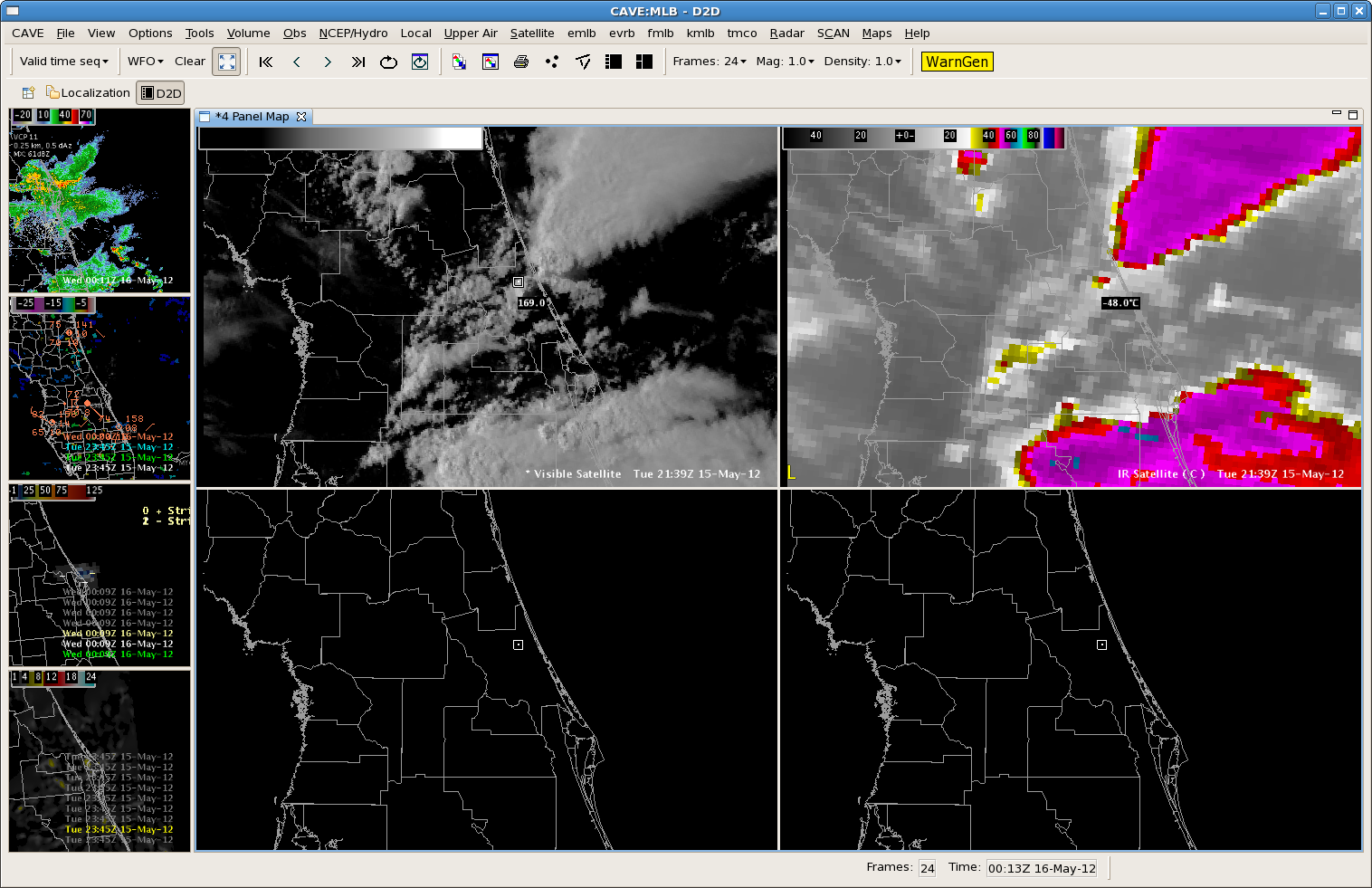
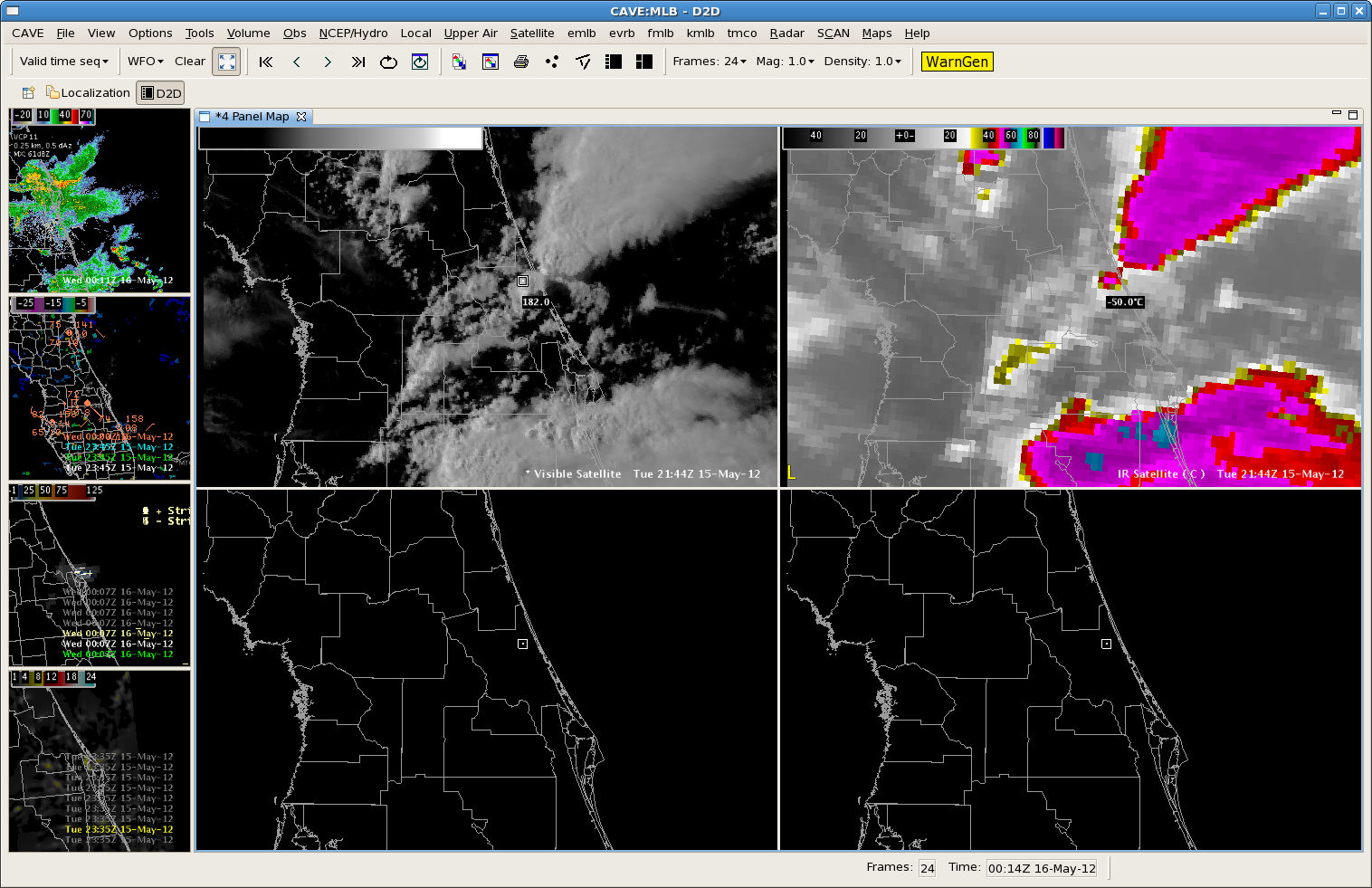
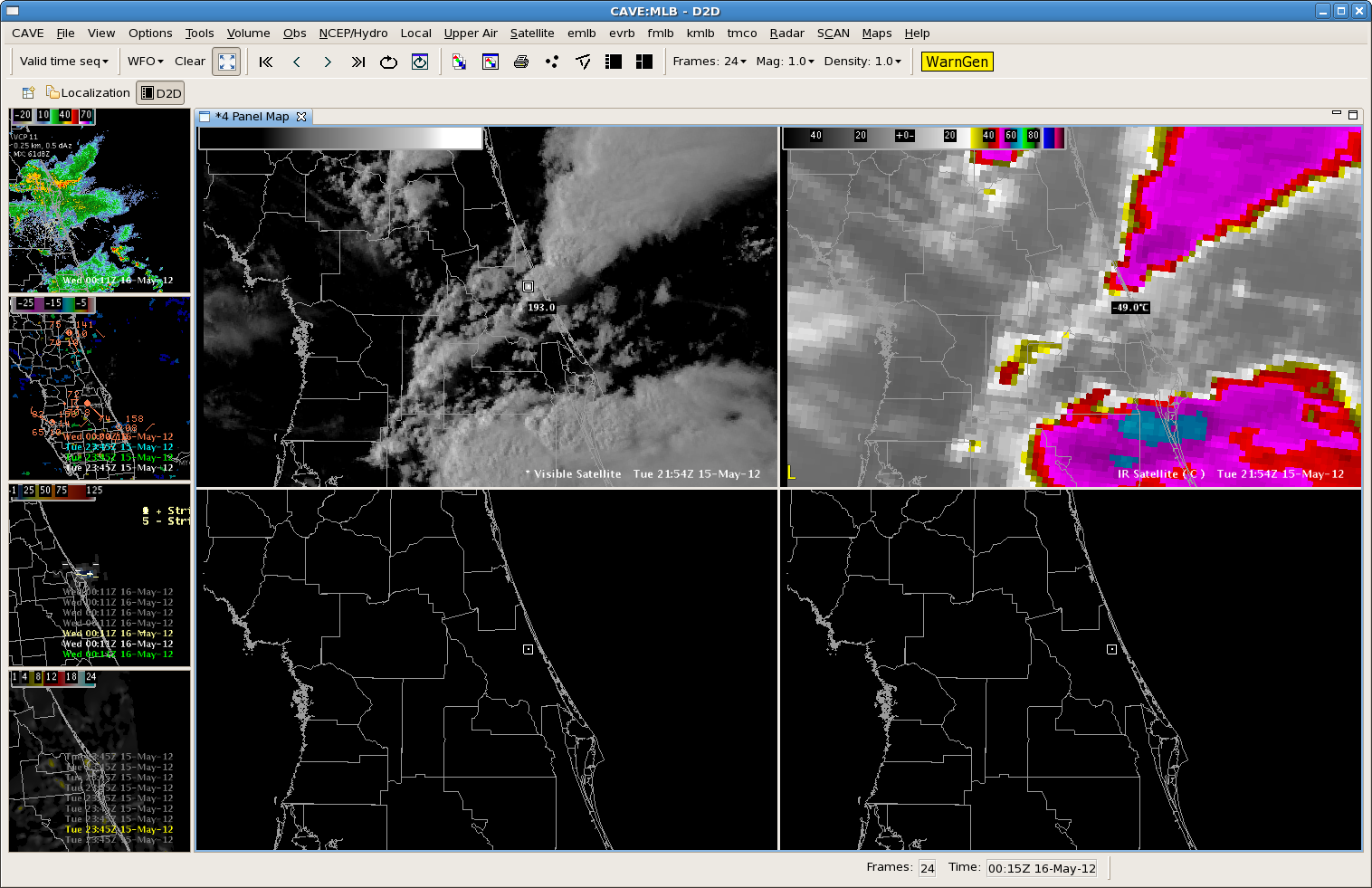
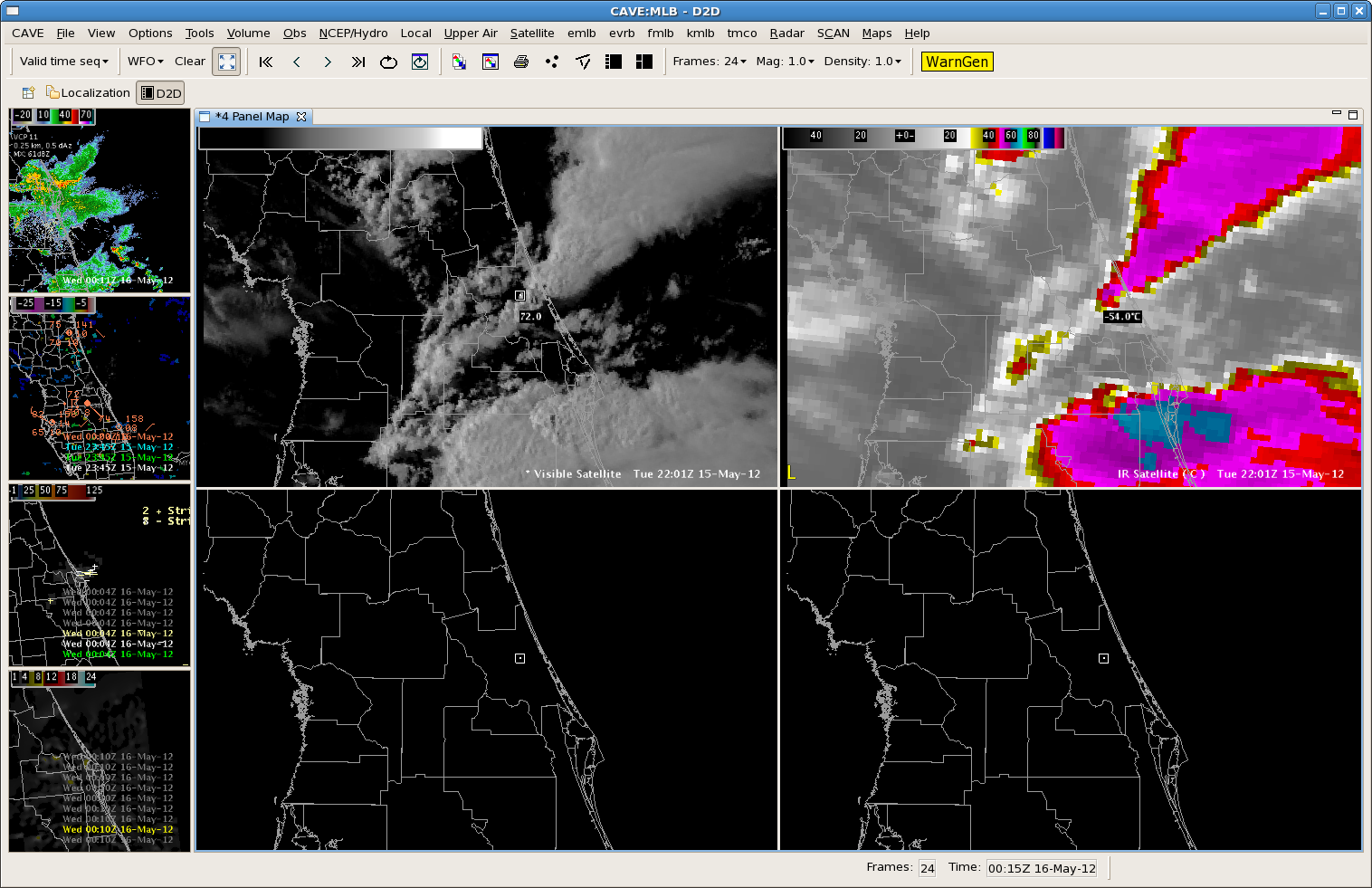
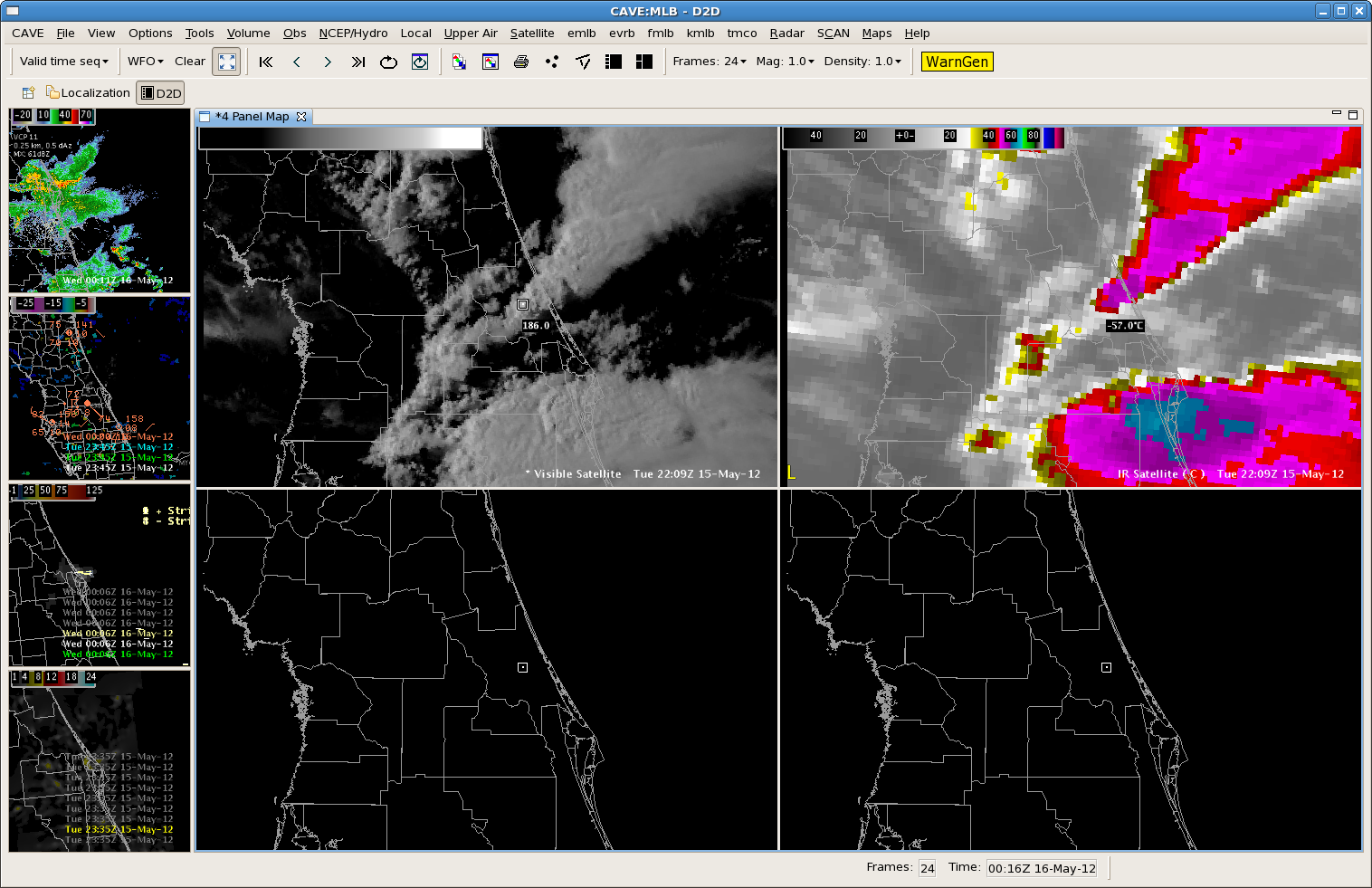
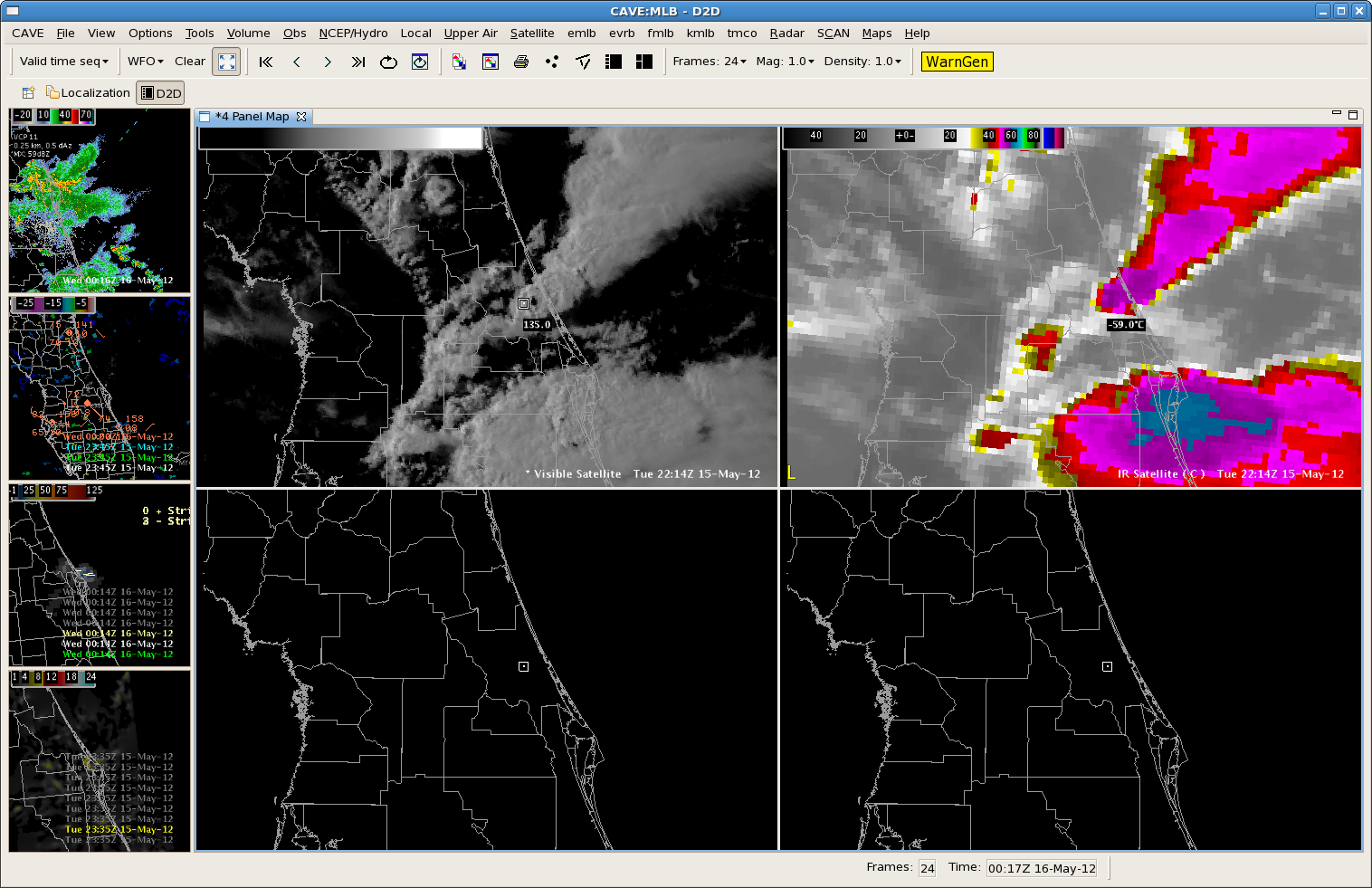
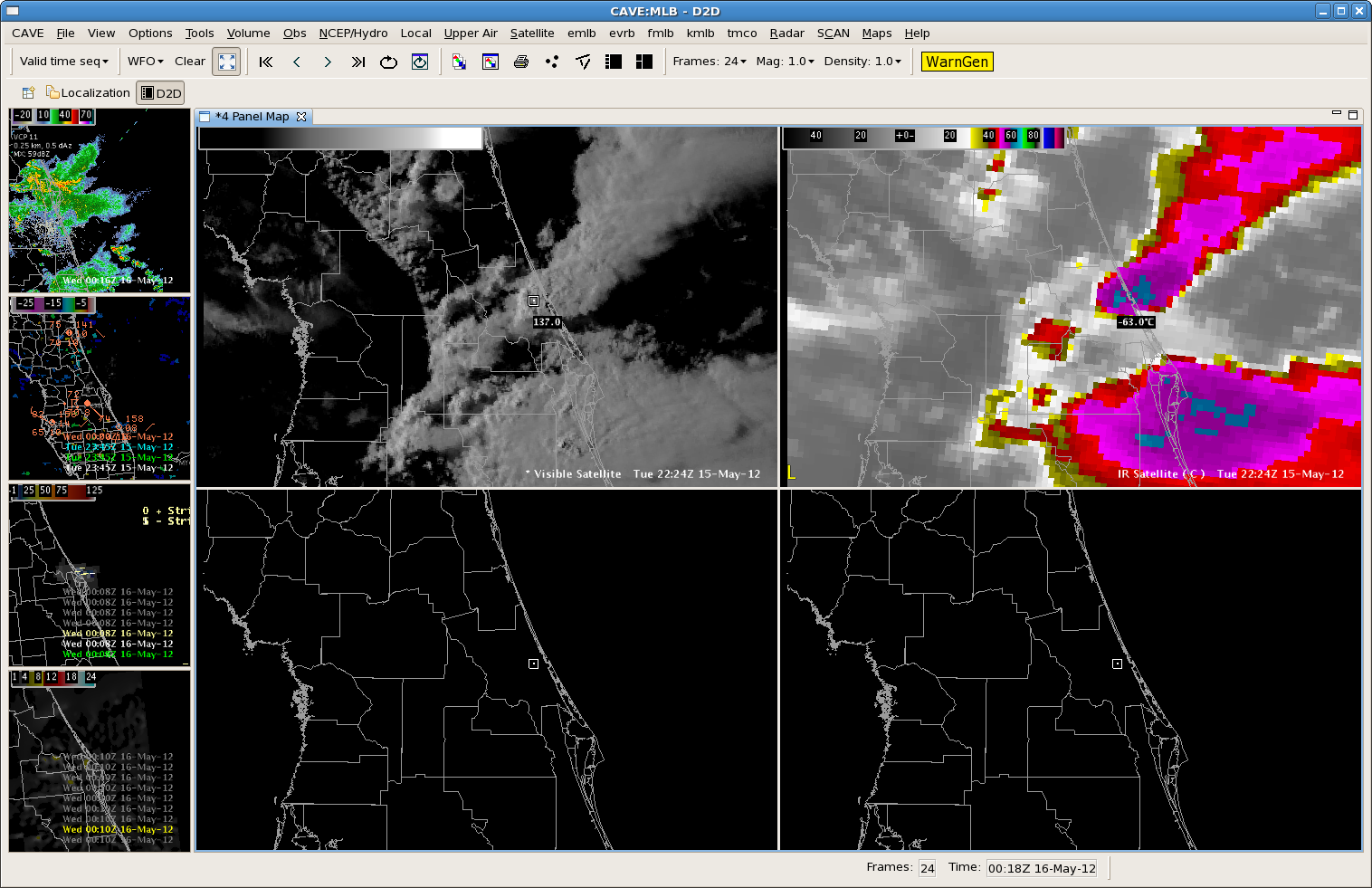
Here is the series of visible and infrared satellite pictures for the storm cell that we issued the tornado warnings. The Convective Initiation product gave a strong signal as this cell began developing, but the Cloud Top Cooling product never identified this storm. The infrared pictures are sampled at the coolest part of the cell at each time step, about 5 to 10 minutes. The storm grew explosively and produced one inch hail along with strong rotation on the radar. It is my hope that a storm developing this rapidly would be identified and highlighted by an algorithm. Apparently this is related to the cloud mask used by the CTC algorithm. I’m just curious why the best storm of the day slipped past the CTC algorithm.
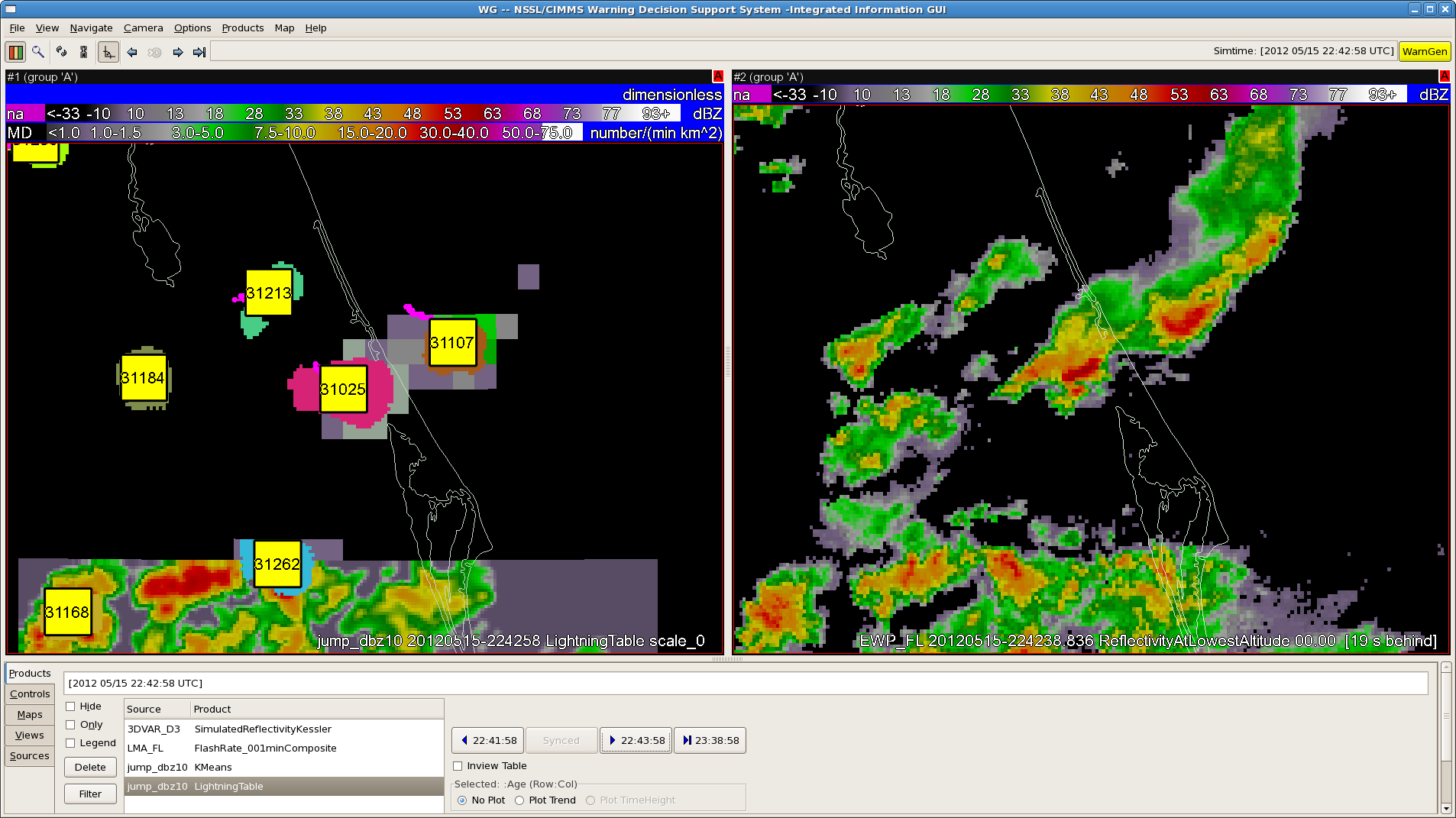
Lightning activity has been prevalent in the FL-LDAR domain today and the ltg jump alg has detected multiple jumps in range of the domain. Scale_0 seems to be the most stable at keeping the storms ID’s unique while scale_1 seems to be dealing with lots of mergers/splits.
In the past half hour (2230-2300 UTC) at least 3 jumps have been detected at scale_0: cell IDs: 31025 @ 2242 UTC, 31107 @ 2245 UTC, and 31184 @ 2248 UTC (additional jumps likely occurred prior to this time).
Storm clusters at scale_0 at 2242 UTC. Cell 31025 was the primary storm of interest in the testbed.
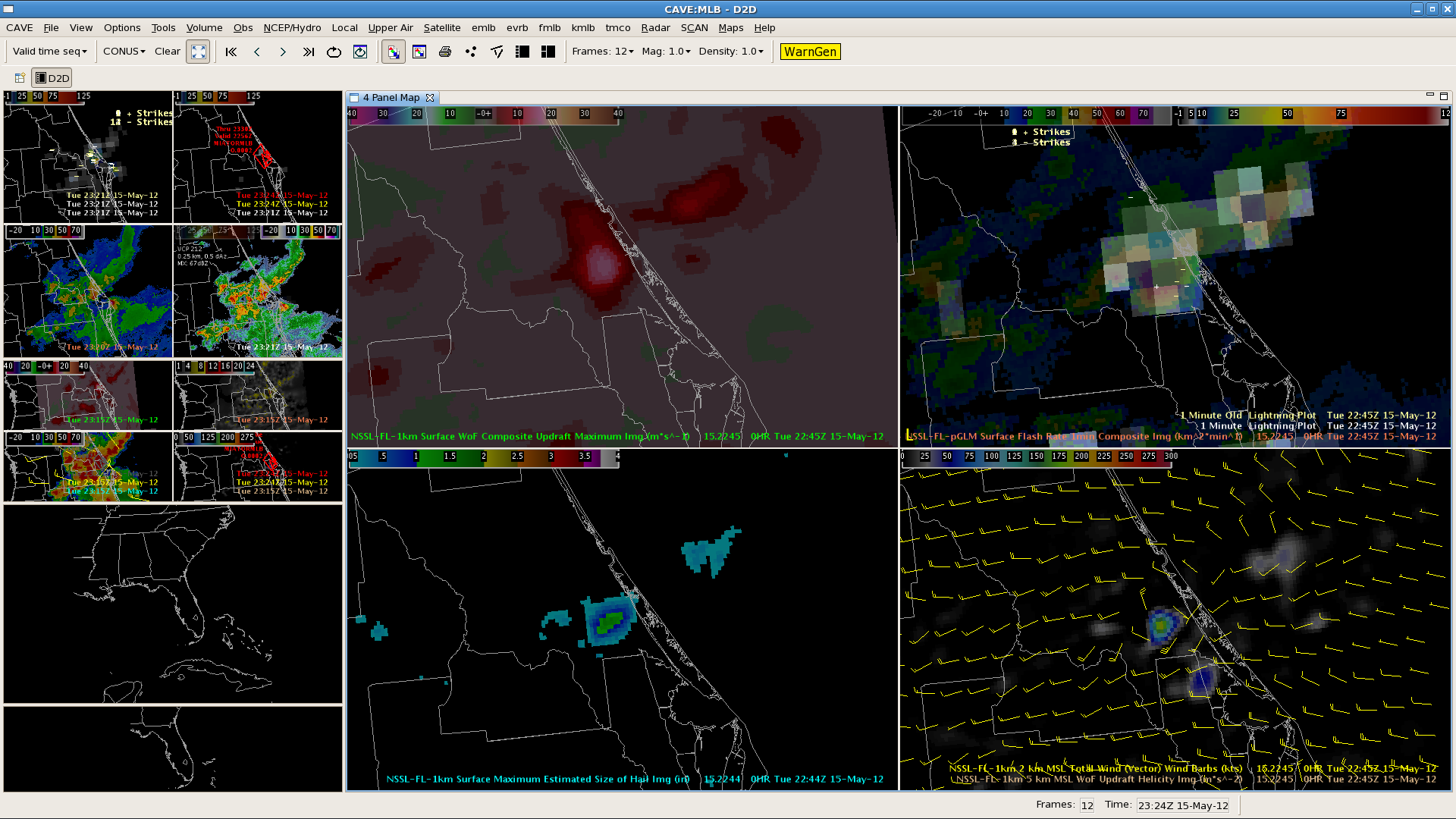
The main cell of interest for forecasters in the HWT operating in the MLB domain has been #31025. 3DVAR products depicted increases in max updraft and vorticity as early as 2230 when the domain was re-centered over the storm. The storm maintained its strength through over the next half hour and the forecaster opted to continue the warning at 2256 UTC (the first TOR warning issued in the HWT was at 2225 UTC, see the forecaster post associated with these warnings for more info). The screenshots below from AWIPS2 include lightning, 3DVAR, MRMS & KMLB radar data for this event:
AWIPS2 screenshot 2245 UTC. Top left: 3DVAR max updraft composite; Top right: MRMS Refl @-10C, pGLM lightning flash extent density, & 1-min NLDN CG data; bottom left: MRMS MESH; bottom right: 3DVAR updraft helicity and 2 km winds
At the time the tor warning was issued in the HWT:
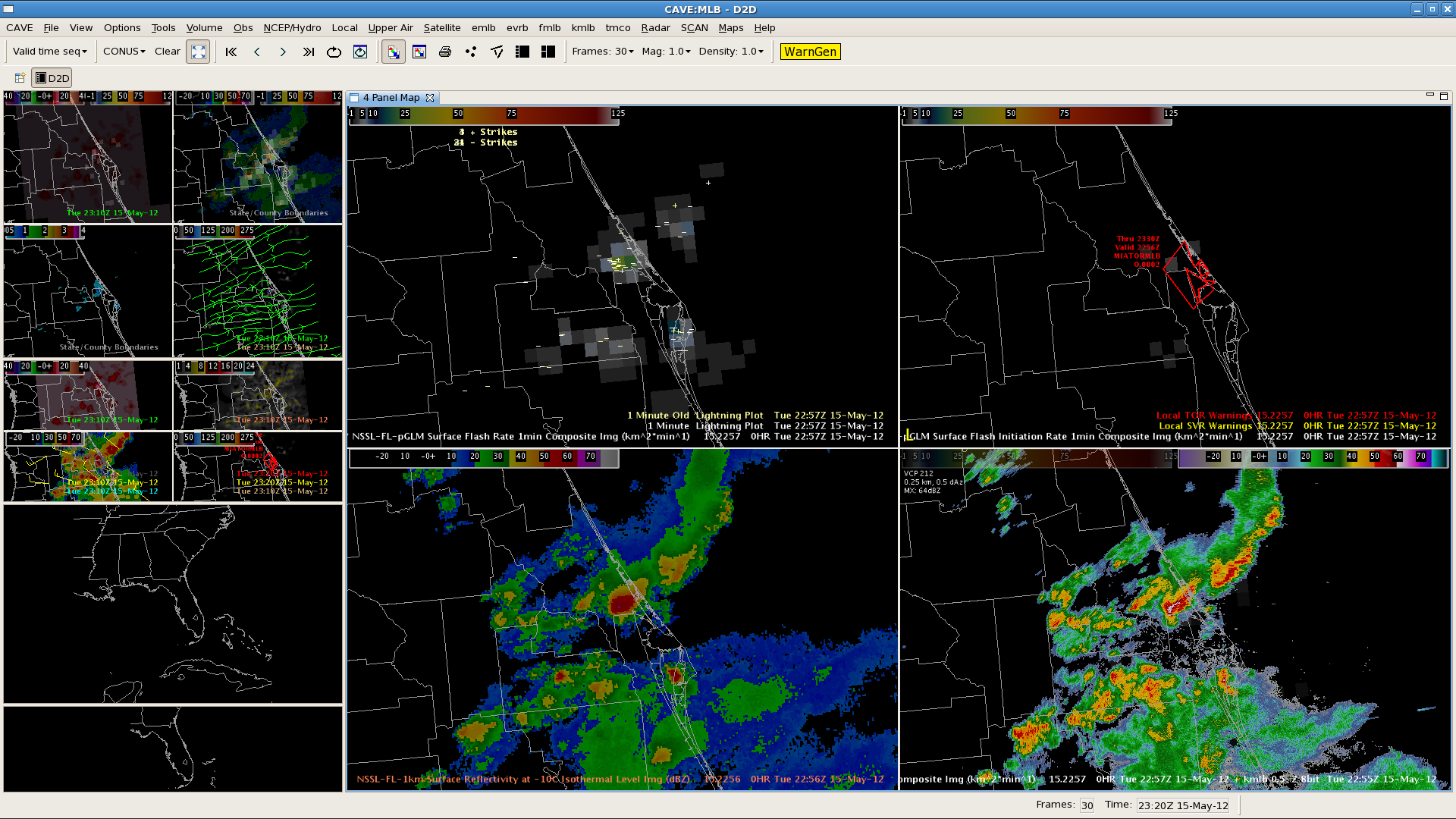
AWIPS2 screenshot @2257 UTC: Top left: pGLM flash extent density and 1-min NLDN CG data; top right: pGLM flash initiations & Tor warning; bottom left: refl @-10C; bottom right: KMLB 0.5 deg refl
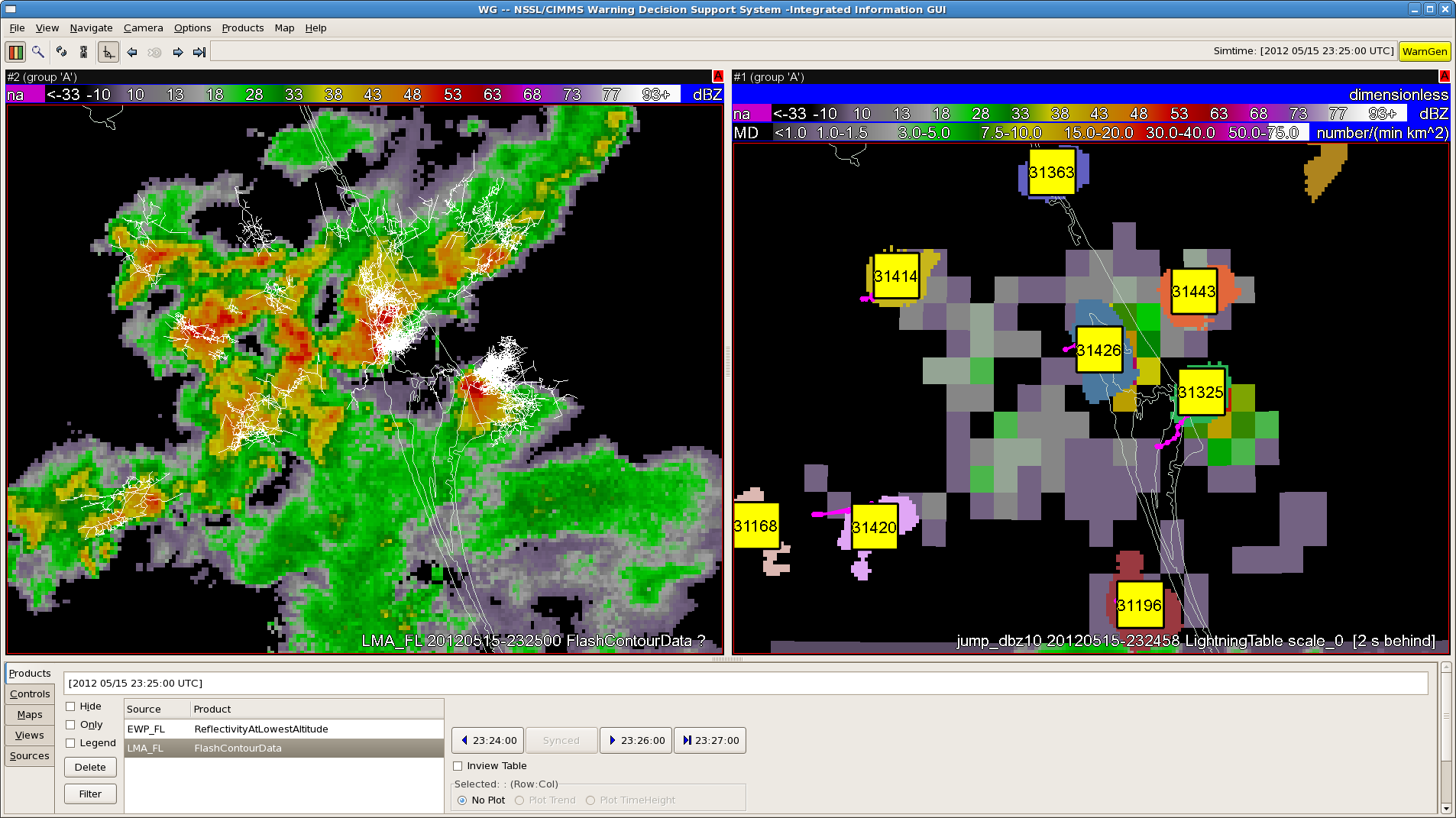
Even as the clusters have become a bit more muddled, the storm tracking algorithm has seemed to maintain a good handle on individual clusters at scale_0, though some of the cell ID’s have changed…
WDSSII image at 2324 UTC: Left: Refl at lowest altitude and lightning flash contours; right: scale_0 storm clusters overlaid on pGLM flash extent density.
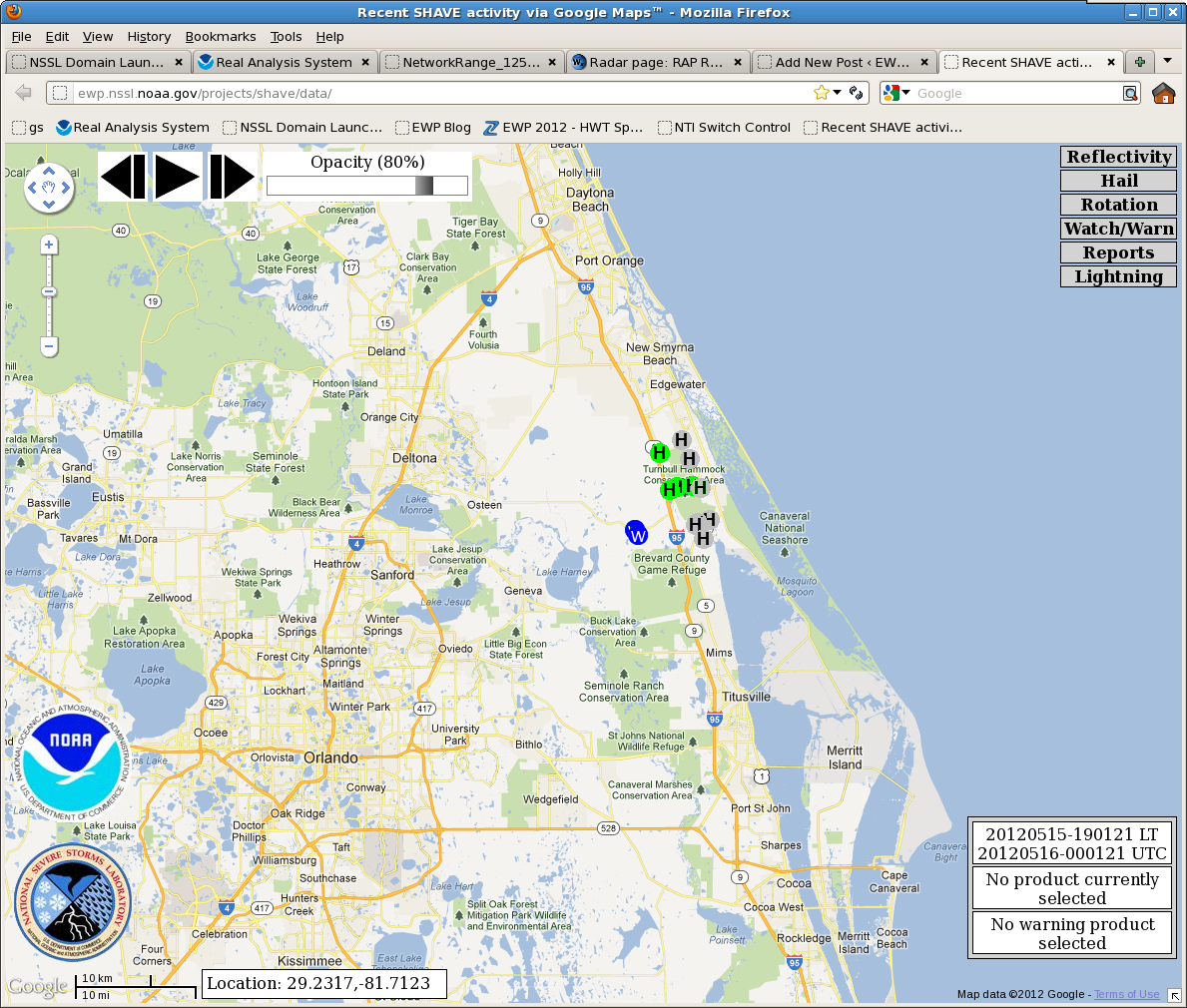
SHAVE is also operational today over this same area… current reports include 1 in hail and high wind:
SHAVE data between 2200 and 0000 UTC in the Kennedy Space Center domain. Gray H circles correspond to no hail, green H circles 1 in hail, and blue W circles severe wind. Reports include 1 in hail piled against side of house & dents to truck.
Technical difficulties of note: the KML images are not currently updating on the webpage, but should be back up in the next day or two; it is also possible that cron job notification of a python script stopped running mid-day on 2 May 2012 and data between 2 May and 14 May, may need to be reprocessed to assure that jumps occurred within the network range.
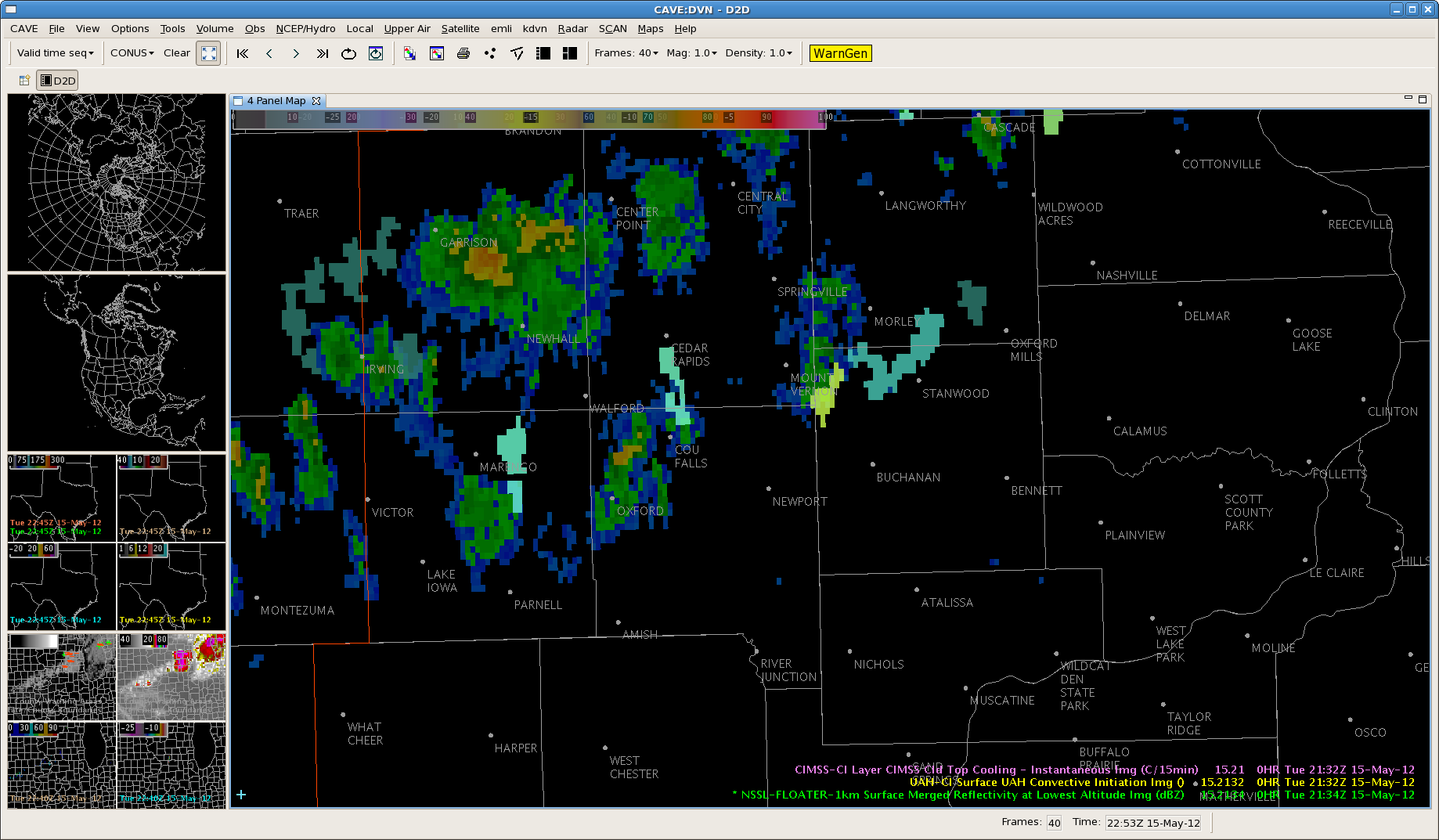
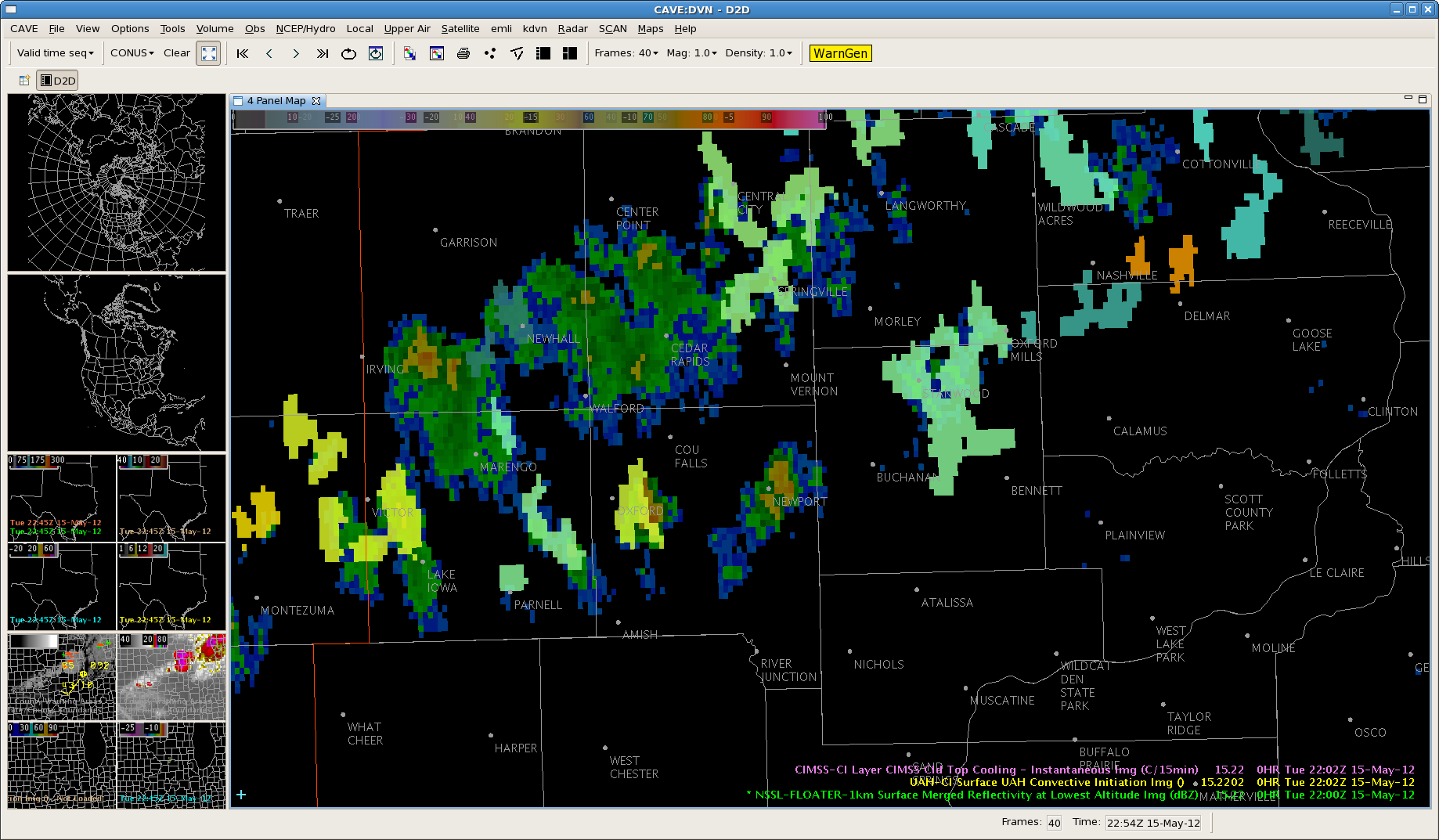
While thunderstorms have not been as impressive over Iowa, Illinois, and Wisconsin, the UAH convective initiation and UW cloud-top cooling algorithms have been increasingly active over the last hour. To track their effectiveness compared to radar, I overlaid the MRMS merged reflectivity at lowest altitude product with the UAH CI and UW CTC all on the same image (something that wasn’t available with AWIPS 1). There was an interesting evolution with the UAH CI starting with the 2132 UTC satellite image, when it flagged an area of CI near West Amana, IA (south of Blairstown) with a 28 on the new Strength of Signal scale.
MRMS Surface Reflectivity, UAH CI, and UW CTC, valid 2134 UTC 2012-05-15
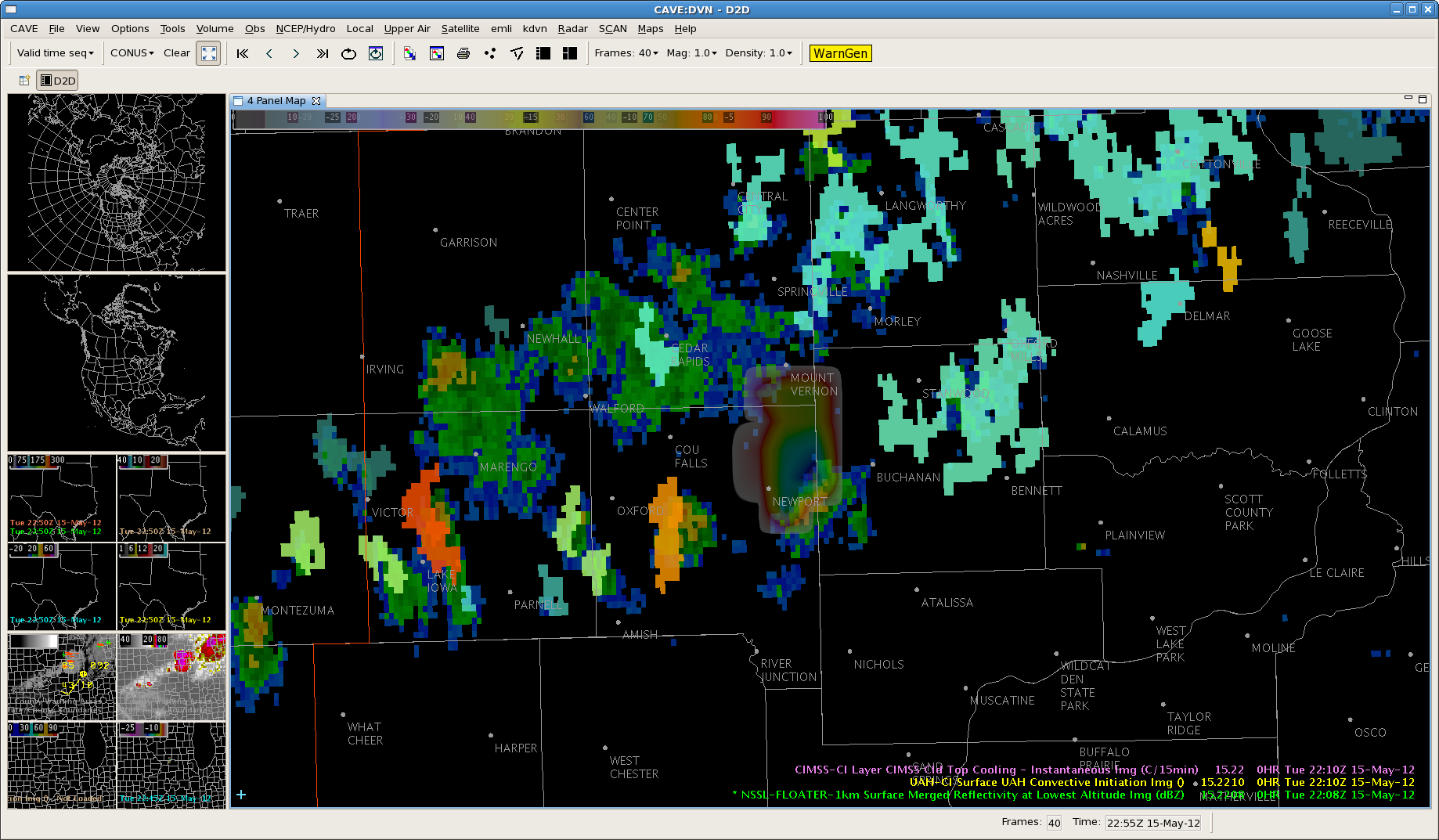
By 2144 UTC, a 20 dBZ shower had developed with that CI object. By 2200 UTC, CI was up to 44, and the radar reflectivity was up to 48 dBZ.
MRMS Surface Reflectivity, UAH CI, and UW CTC, valid 2200 UTC 2012-05-15
Shortly thereafter it maxed out at 63 CI SOS; the cell’s reflectivity maxed out between 2226-2234 UTC at 52 dBZ.
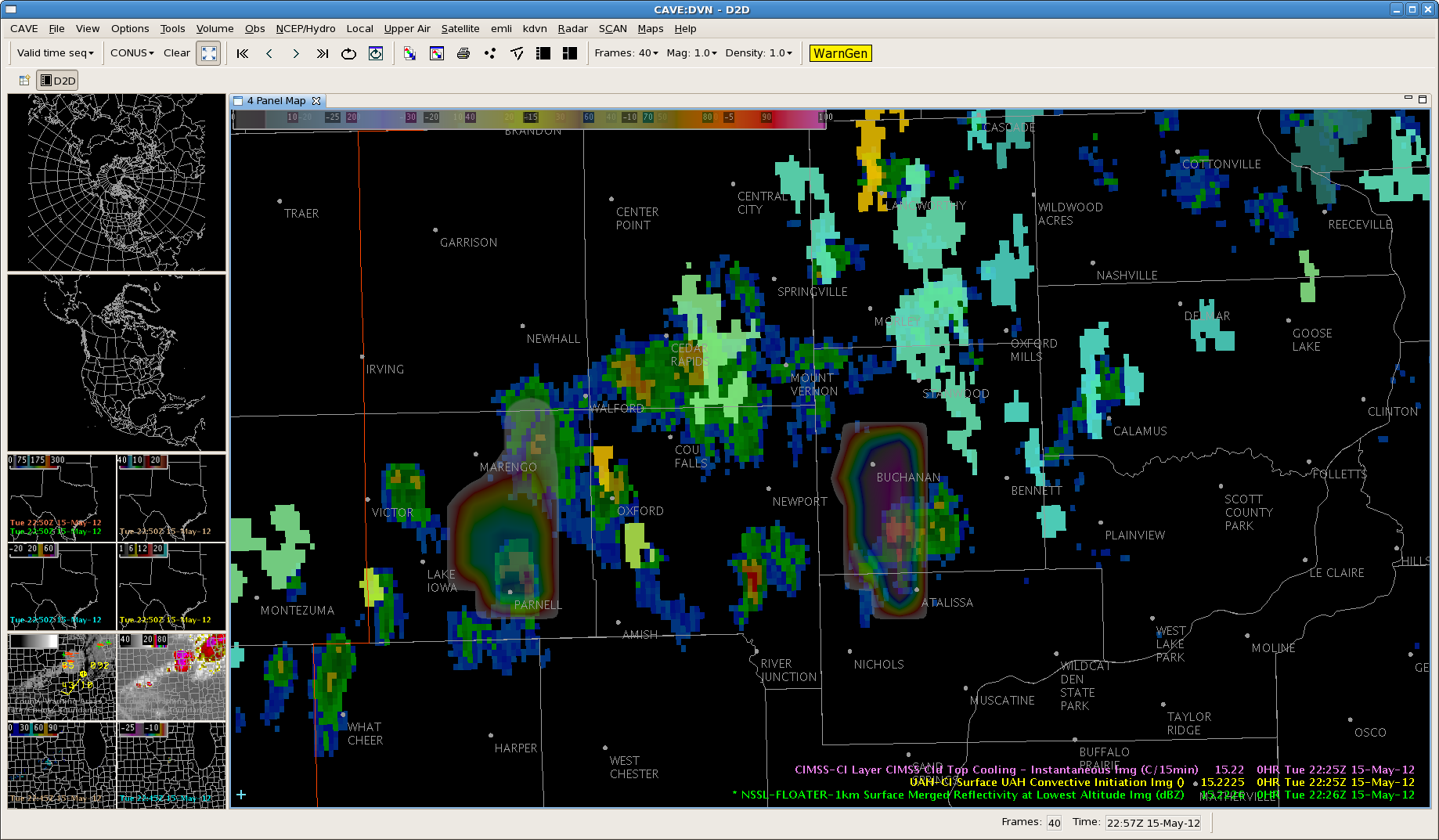
A neighboring storm near Lake Iowa triggered both the UAH (74) and UW (-13 C/15 min) algorithms; it too maxed out around 50 dBZ but was shorter-lived.
MRMS Surface Reflectivity, UAH CI, and UW CTC, valid 2208 UTC 2012-05-15MRMS Surface Reflectivity, UAH CI, and UW CTC, valid 2224 UTC 2012-05-15
Viewing the CI and CTC data simultaneously with radar imagery allows forecasters to make direct comparisons to their most frequently-used warning tool.
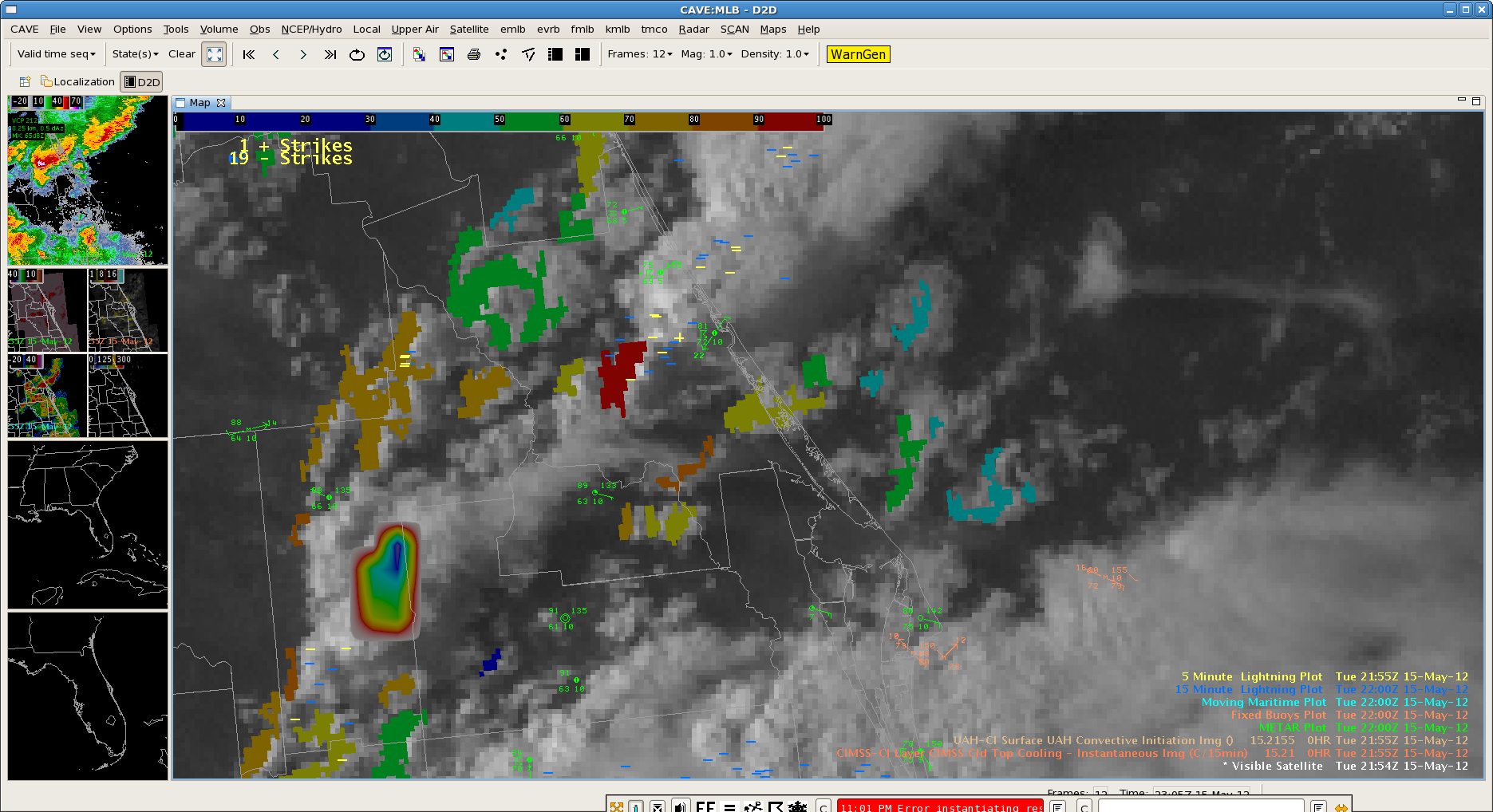
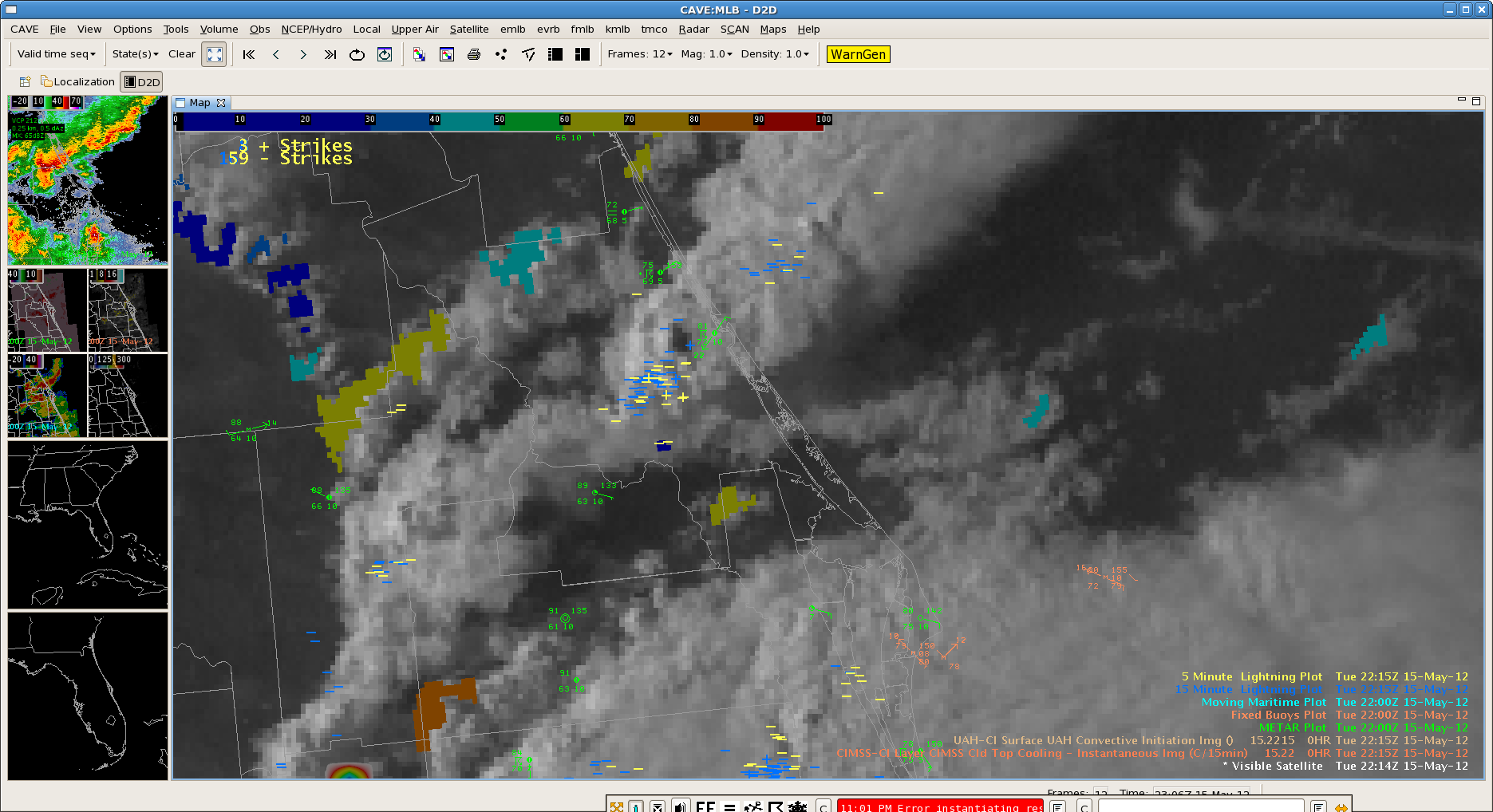
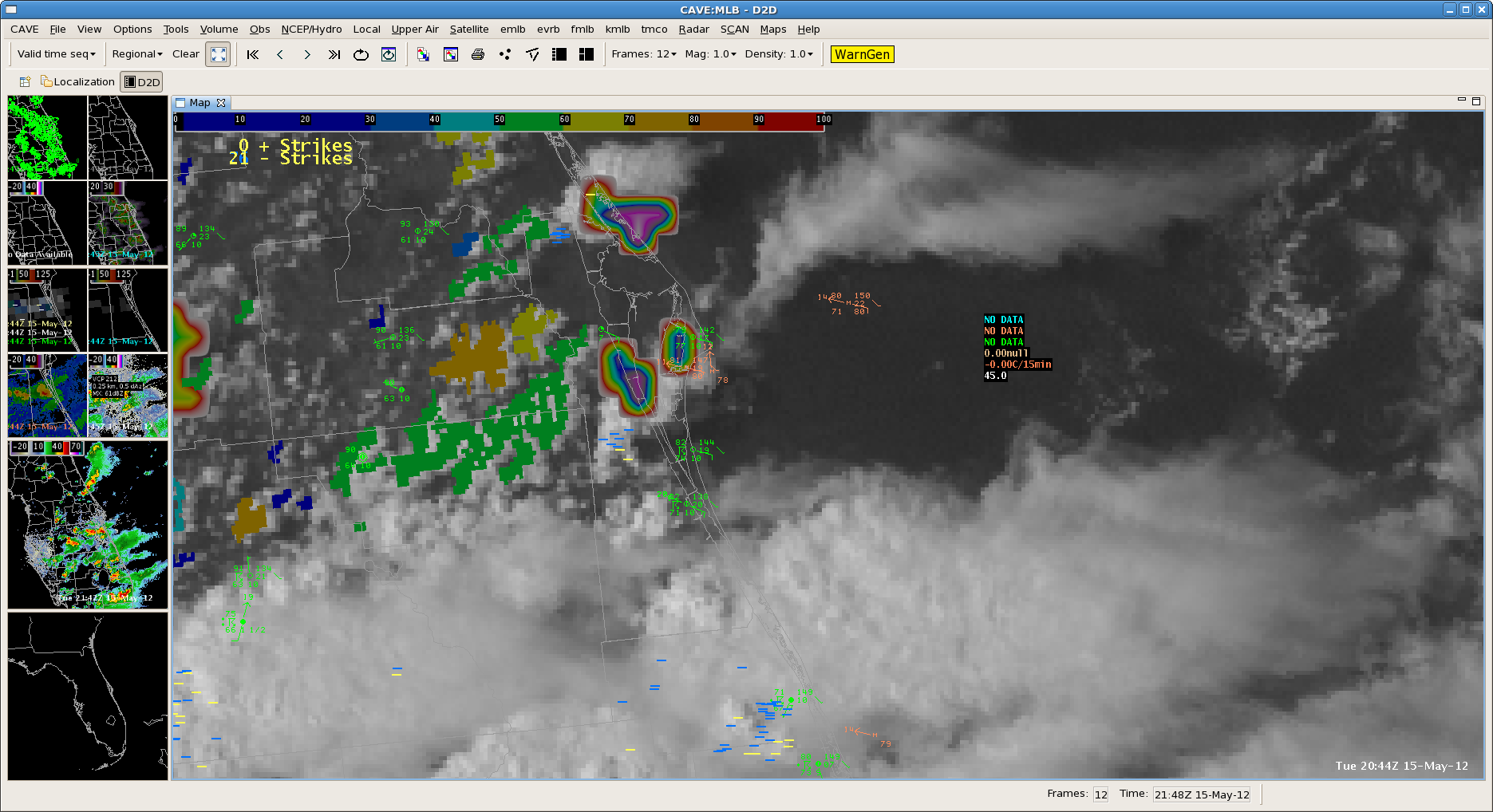
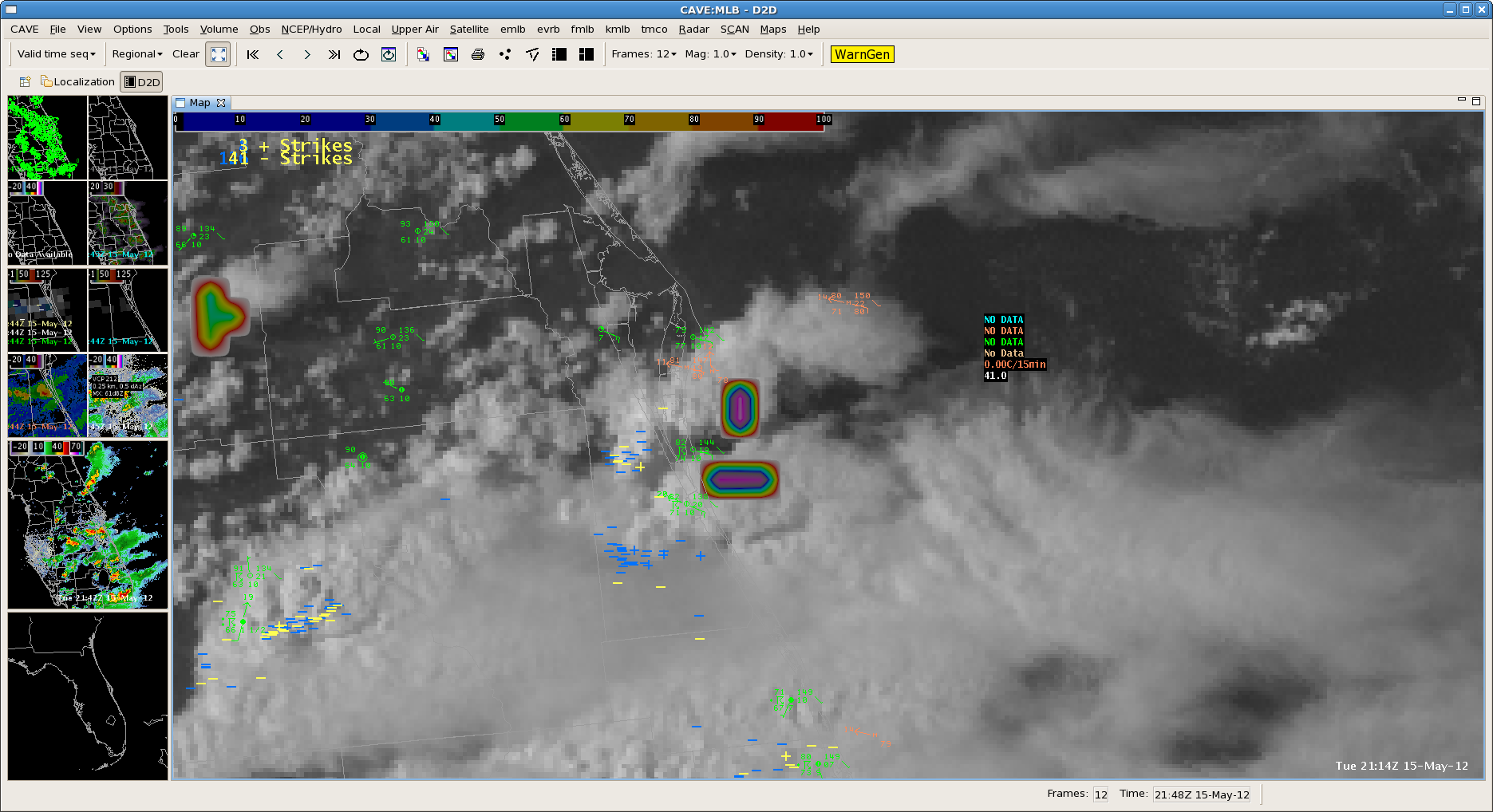
A storm cell over Volusia County, Florida apparently ran over a sea-breeze front and developed a lot of rotation. A hook echo on the reflectivity and strong gate to gate shear was quite evident on Melbourne’s radar. We had been monitoring MRMS data including reflectivities at -10C and -20C. Looking back at Convective Initiation, there was a strong signal at 2154z.
Twenty minutes later the satellite picture and NLDN lightning data looked like this:
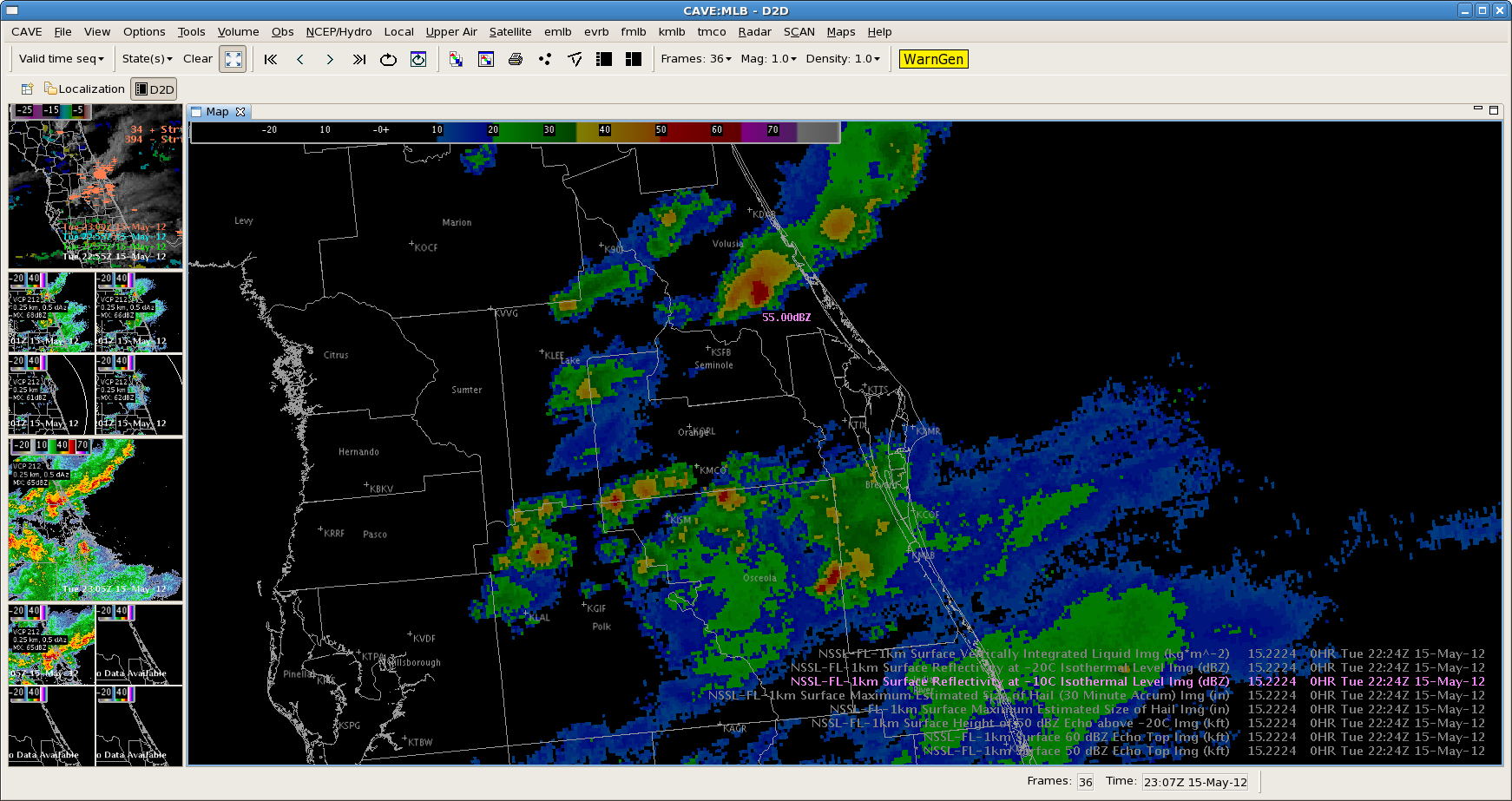
MRMS data at 2224z showed 57 dbz echoes at the -10C level.
By 2225z, velocity data from Melbourne’s radar compelled us to issue a tornado warning. Time from the first Convective Initiation signal to issuing the warning was 30 minutes.
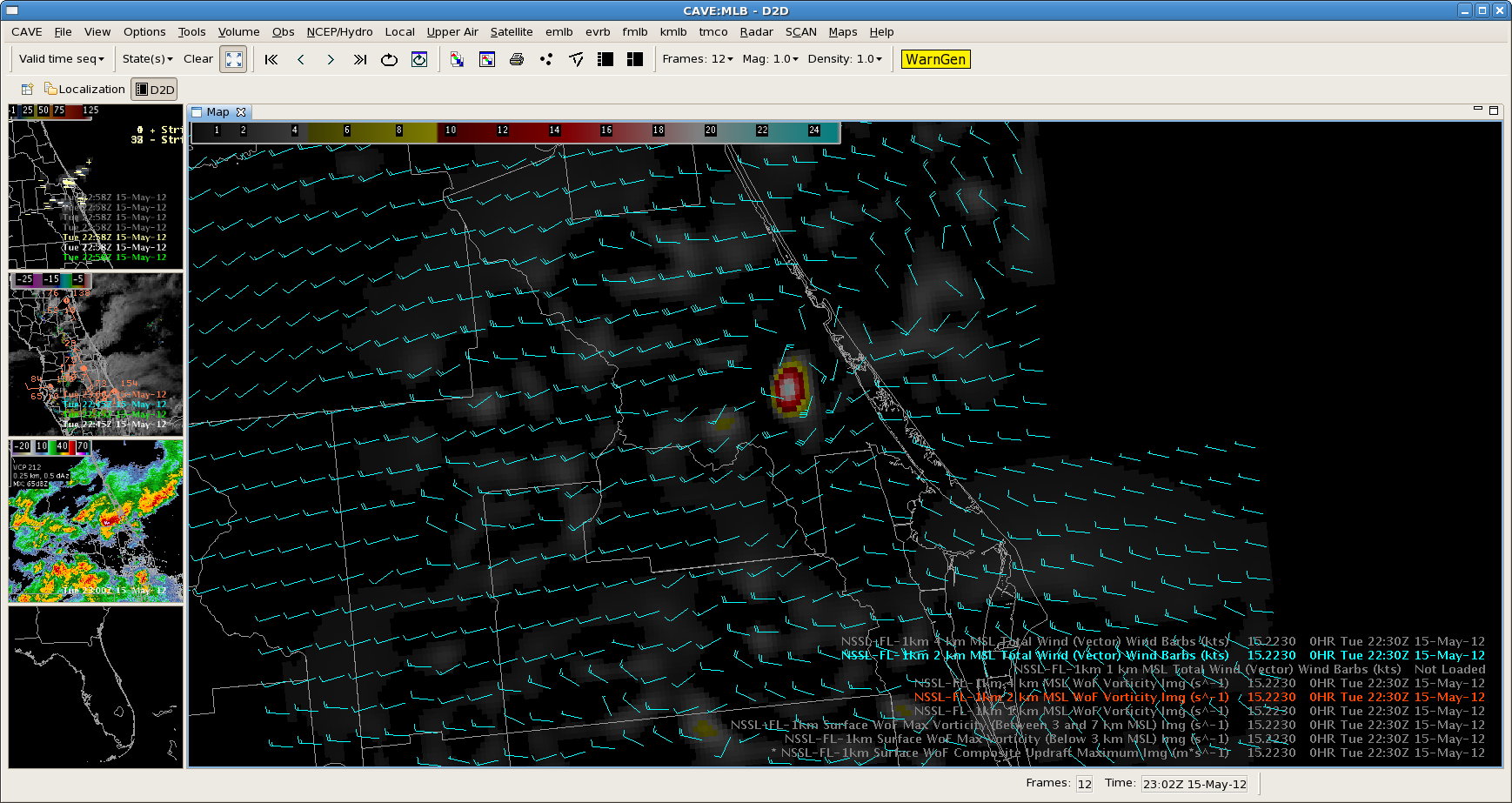
After issuing the warning, we got the 3DVAR domains set up properly and here is a screen capture of the 2km vorticity and winds for the storm of interest.
Here is a four panel of various 3DVAR data for the storm at 2230z.
At the top of the hour, the storm was still quite organized, and a second tornado warning was issued.
Based mainly on radar (Tampa’s and Melborne’s). We had just switched CWAs and were loading up new products so hadn’t had time to load and look at new products. The warning was issued for wind and hail for a storm right next to the Melborne radar. The storm which was tracking SEward then ran into line coming up from the south and fell apart (probably got its updraft source cut off). Had some issues with the AWIPS II set up to get the warning out with warngen. pGLM was showing flash rate of green (around 16 or 17 flashes per min per grid box) at this time.
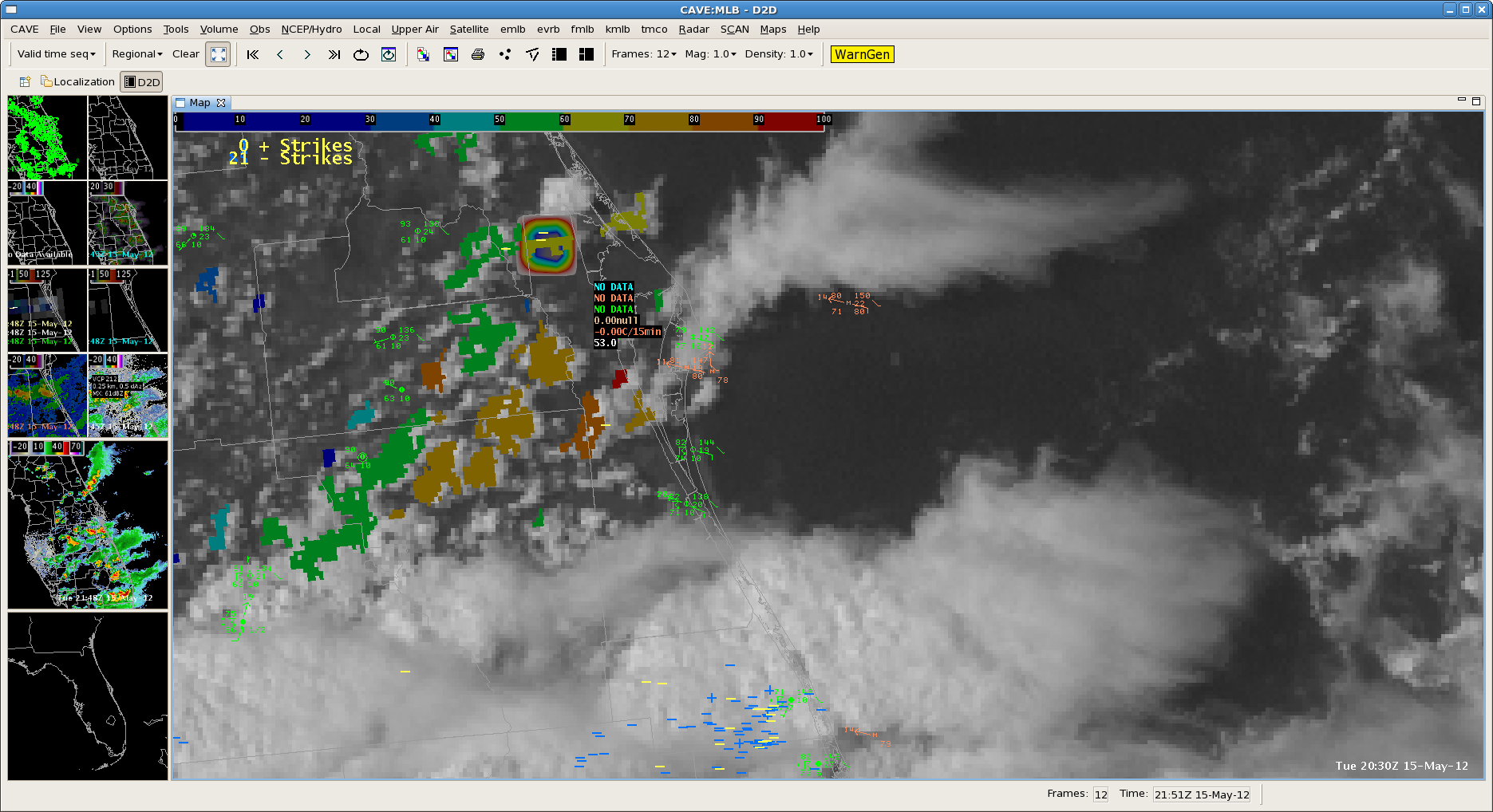
Here is a nice example of the two CI products and a healthy storm that formed in Florida. We had just changed CWAs so it was more a matter of going back and seeing what they said rather than using in real time but they do show indications of a rapidly developing storm. See the red 95% blob (UAH CI product) on first image, the UW cloud top cooling on 2nd and storm getting big on third.