WFO DMX-Storm History via 3DVAR Data

A few interesting storms across WFO DMX this afternoon.  Several were severe, with one storm producing hail and quite a bit of damage in and just S-SE of Waterloo.  In this post, however, we will focus on a storm that was a little closer to the radar that did not as of yet produce any severe reports.  Let’s look at a 4-panel of 3DVAR data:
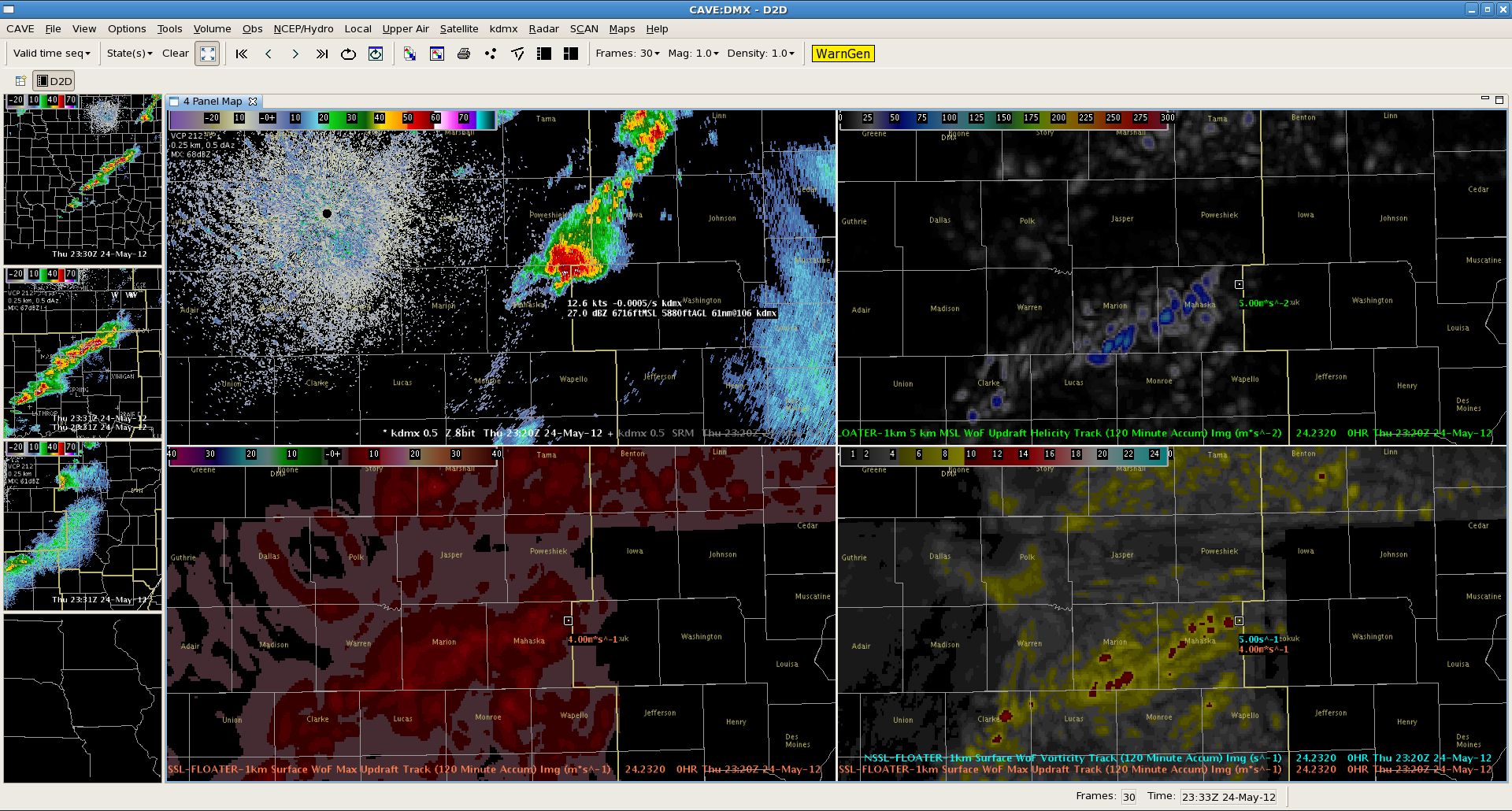
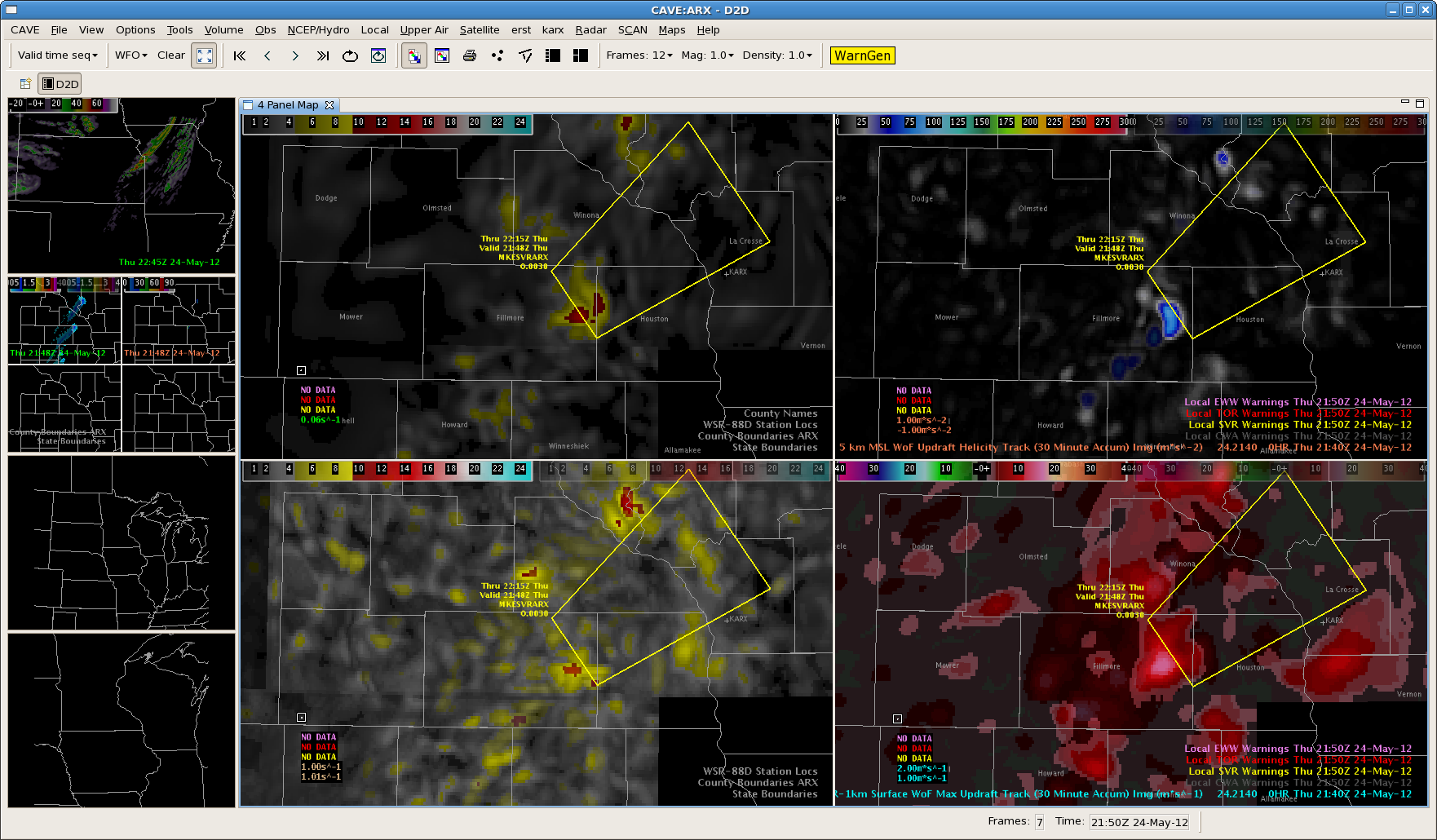
KDMX 4-panel of 0.5degree Base Reflectivity (top left), Updraft Helicity Tracks (top right), Max Updraft Tracks (bottom left), and Vorticity Tracks (lower right).

We are interested in the storm that moved from southern Marion County into and through Mahaska County.  Notice the Max Updraft and Vorticity Tracks (lower panels).  These fields stay fairly constant over time along the path of the storm.  This storm did develop some weak low to mid level rotation.  Not the updraft helicity values in the top right that peaked near 100m2/s2 indicative of this.–Gordon Strassberg for WFO DMX.
Tags: None

3DVAR shows storm characteristics increasing ahead of storm splitting and deviant motion

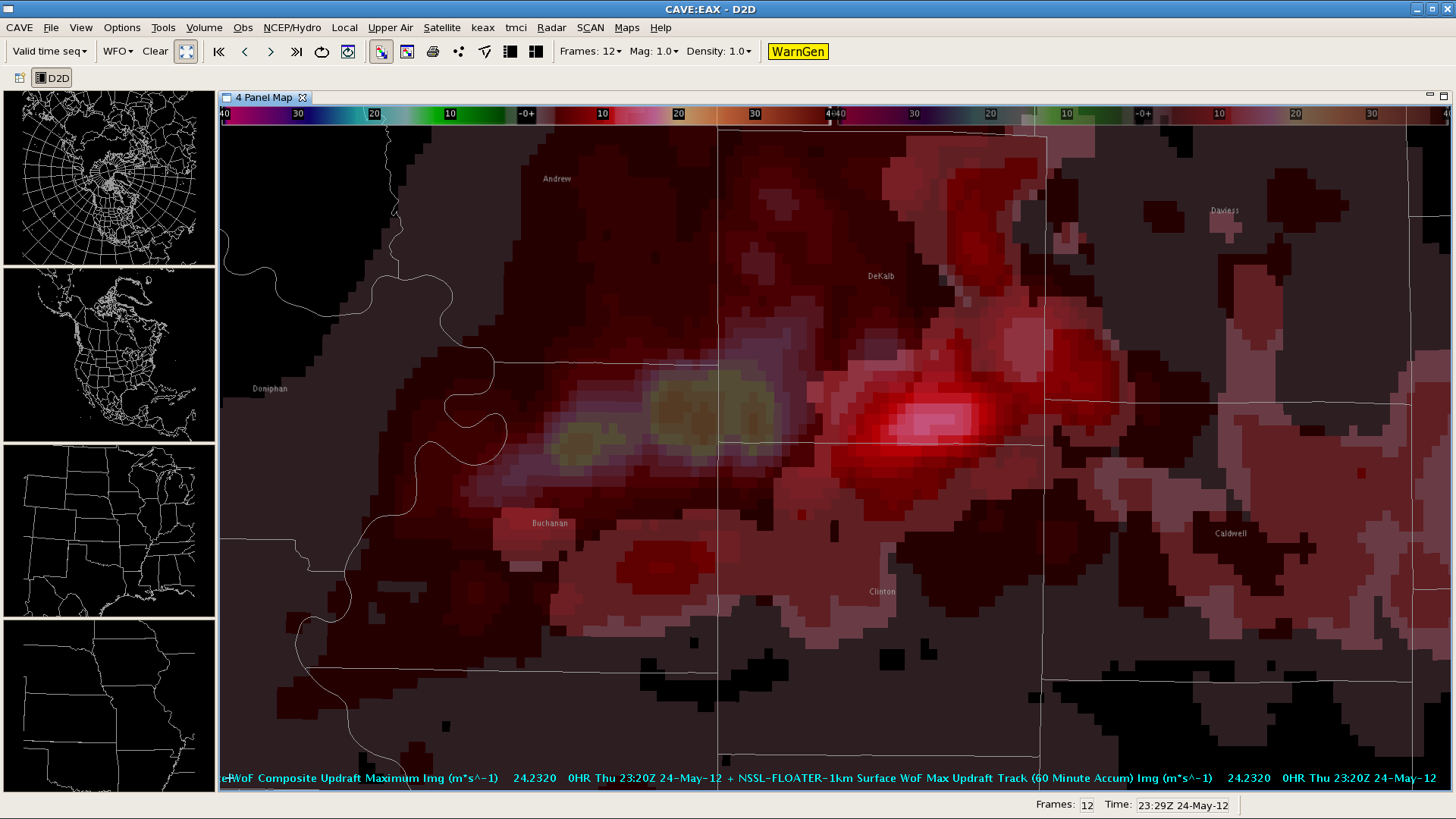
The 3DVAR output showed strong increases in storm top divergence, updraft helicity, and maximum updraft speed in the 2245z image associated with a thunderstorm in Buchanan County in northwest Missouri.  Subsequent to these increases the thunderstorm updraft split (left mover died quickly) and the storm turned to the right over the next several images, as shown in this image of the maximum updraft composite. The brightest image represents the current image while a history of previous images is shown in subdued colors.

3DVAR used over NW Missouri

A line with strong to severe storms continues to push rapidly to the east. The environment is favorable for rapid storm organization, given 60 kt deep layer shear and tongue of 2000 plus J/kg SBCAPE sneaking in from the SW.

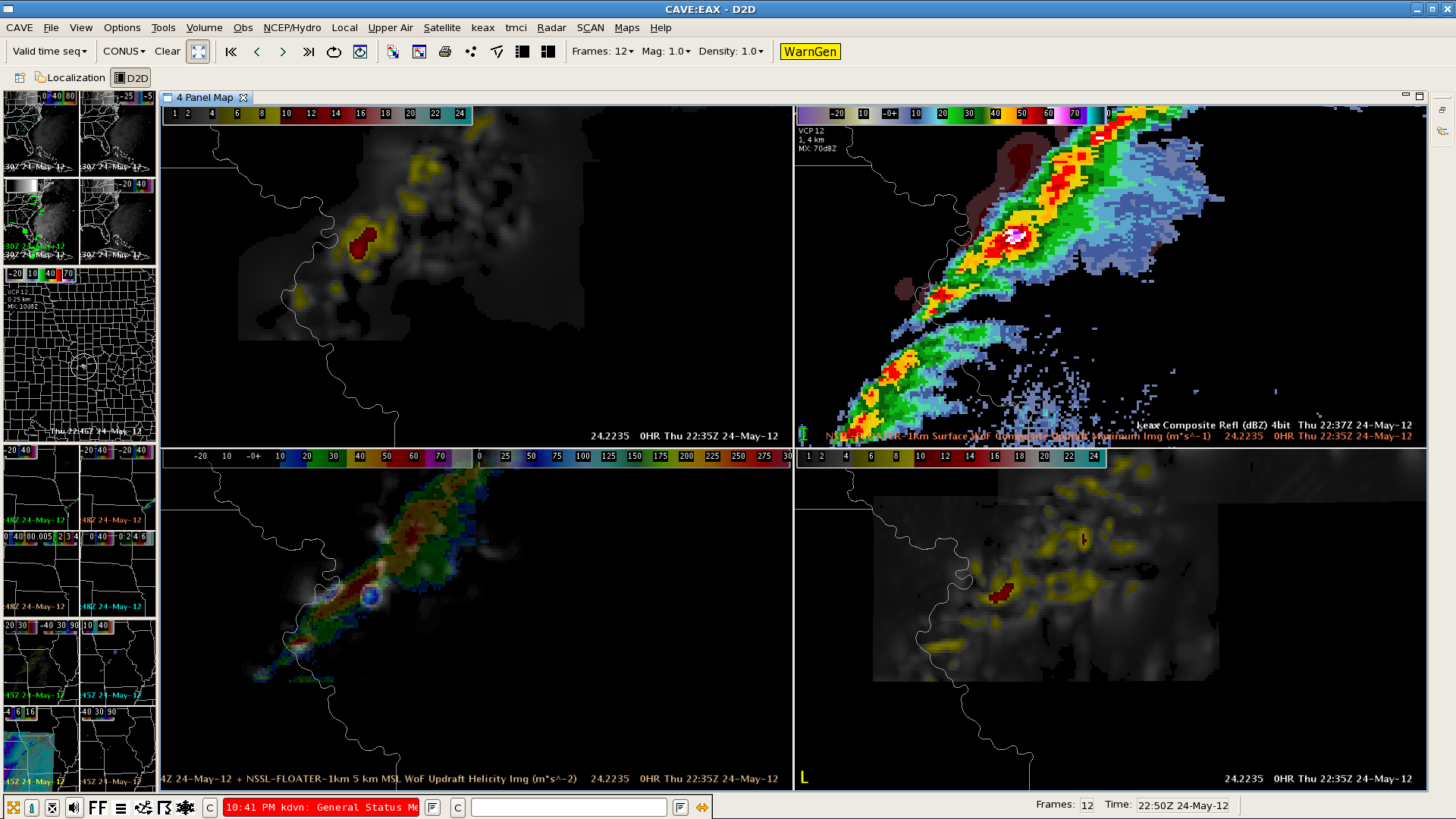
2230Z: Max divergence (upper left), composite updraft max (upper right), updraft helicity (lower left) and max vorticity composite (lower right)
2237Z: Max divergence (upper left), composite updraft max (upper right), updraft helicity (lower left) and max vorticity composite (lower right)

At 2237Z, the composite reflectivity image was added (upper right) with core refl. aoa 70 dBz just where 3DVAR indeed had the most severe cell development along that line over NW Missouri.

Helge

OUN WRF on time with initiation over NE Kansas

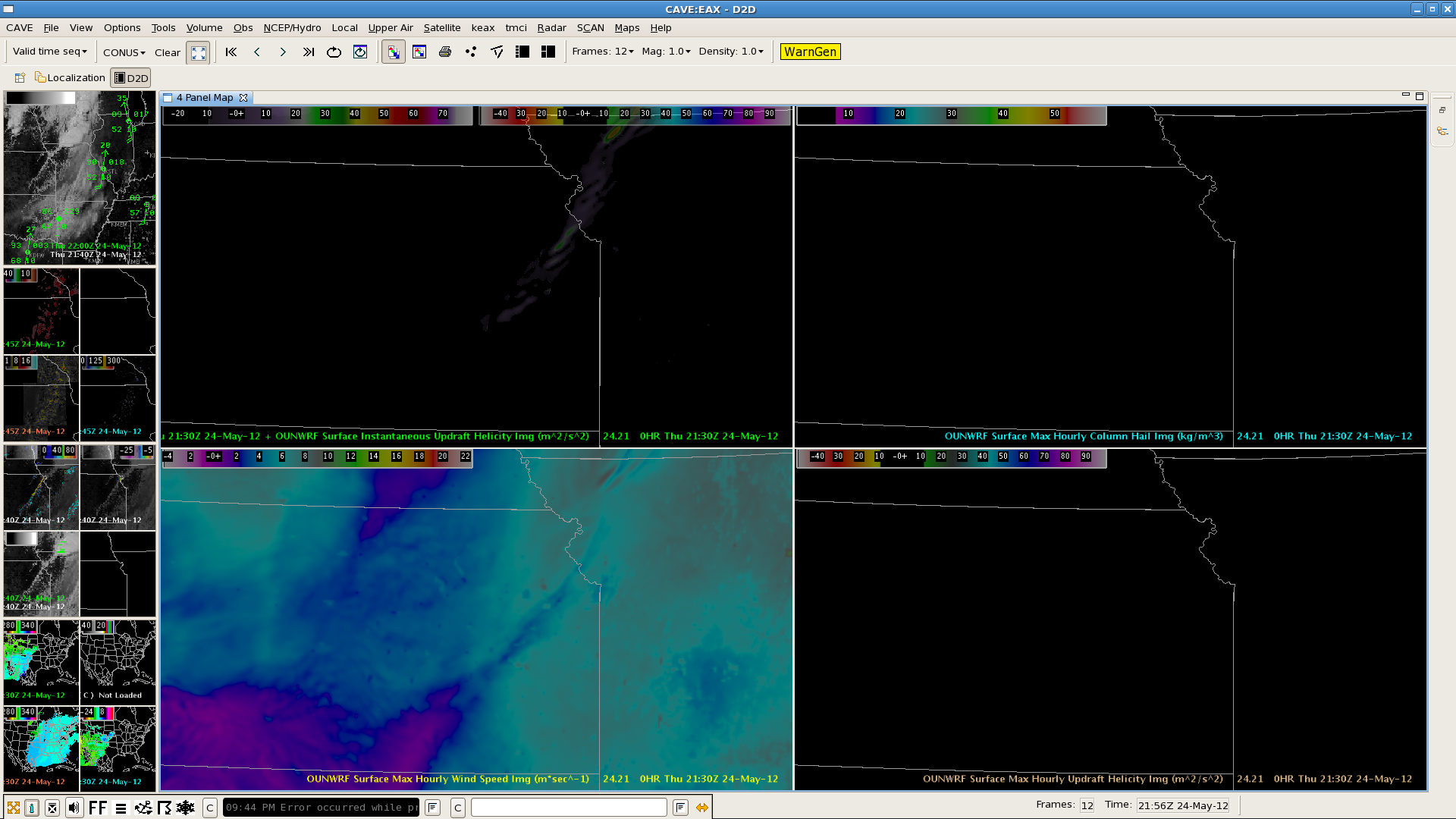
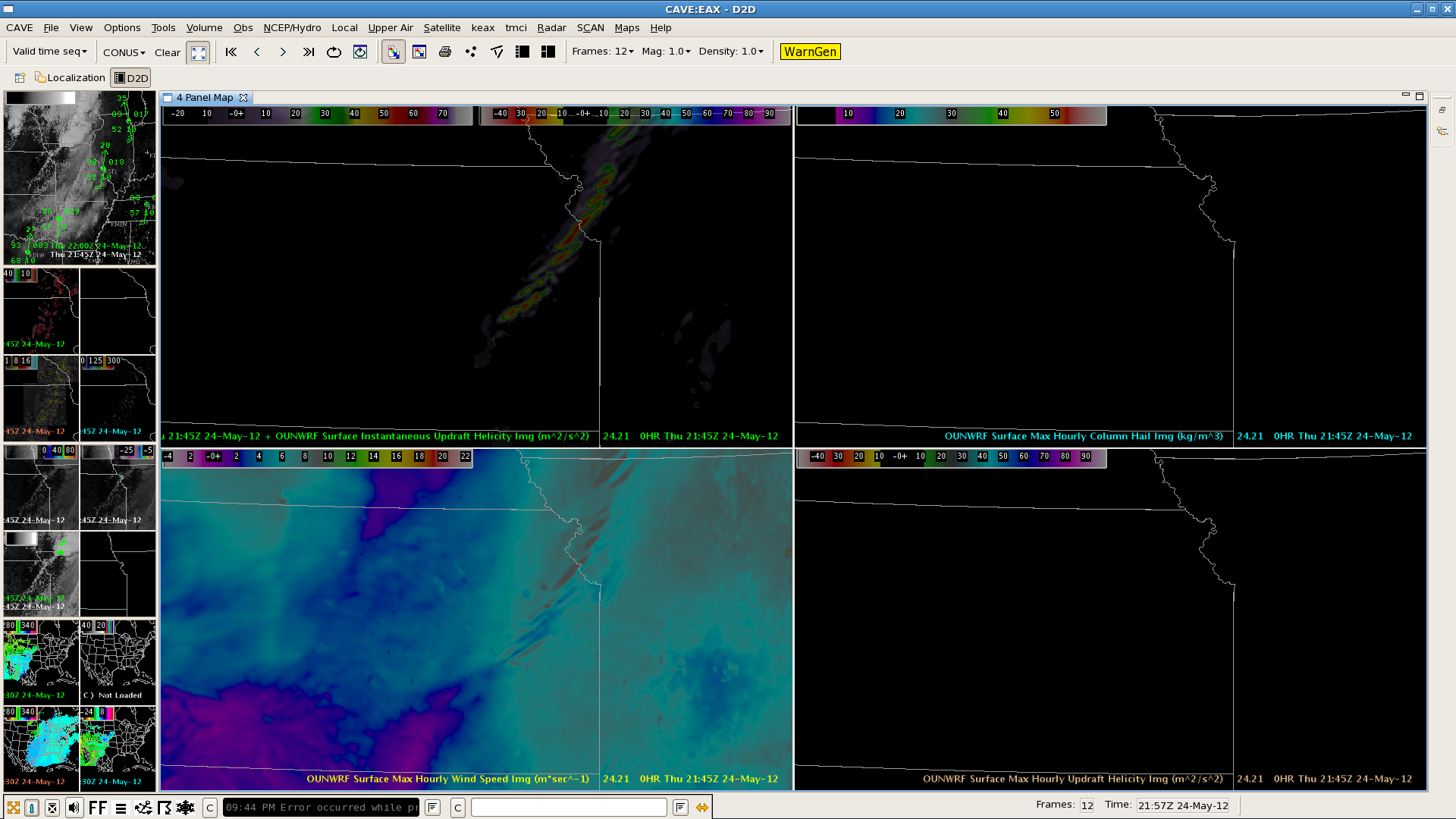
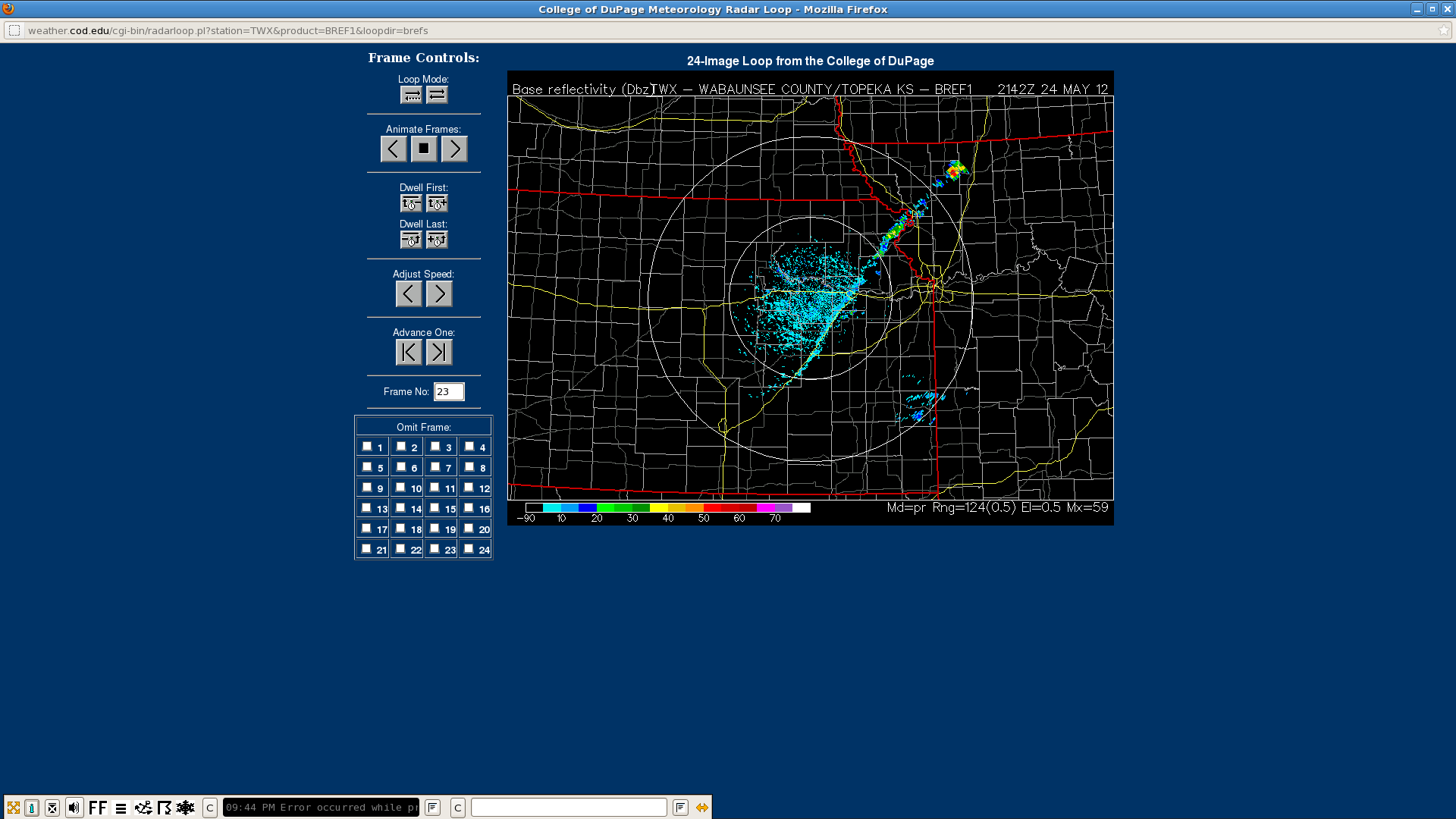
Thunderstorms continue to build rapidly to the SW along the cold front with initiation underway around 2145 Z over NE Kansas. It is amazing how well the OUN WRF captured the initiation:

2130Z OUNWRF precipitation and updraft helicity (upper left)
2145Z OUNWRF precipitation and updraft helicity (upper left)
Radar Topeka at 2142Z @College of DuPage

Timing was excellent with placement just slightly off to the south. This model forecast would have helped forecasters a lot to pinpoint area of initiation well ahead.

Helge

Tags: None

3DVAR indicates thunderstorm strengthening

The 3DVAR products indicated strengthening of this thunderstorm with both the updraft helicity and maximum updraft values spiking on the 2140z image. This thunderstorm had previously caused wind damage (downed power poles) across southern FIllmore county. The values at 2140z were higher than those previously (as shown by underlaid history tracks) so a severe thunderstorm warning was issued for the potential for strong damaging winds.

UPDATE: Emergency managers reported widespread tree damage within the community of Winona, in the northern portion of the warned area, a lead time of 17 minutes. Dime sized hail was also reported within the warned area in southeastern Winona County.

SimSat has problems with tropical low

A weak tropical low moved from Cuba to the NE during the daytime hours and was forecast to affect far SE Florida. Comparing SimSat and real IR/WV data, significant differences can be seen especially regarding the cirrus canopy. The main reason for the differences may be the much stronger development of this depression than expected 21 h ago. NHC also increased probs to 40 %, indicating a consolidating system. This evolution may have resulted in a better defined depression’s center with stronger convective development. Therefore those products may have to be used carefully for tropical lows, which reveal stronger intensification rates compared to what models forecast.

SimSat vs real IR/WV data

Helge

Tags: None

WFO MLB-CI/CTC Example

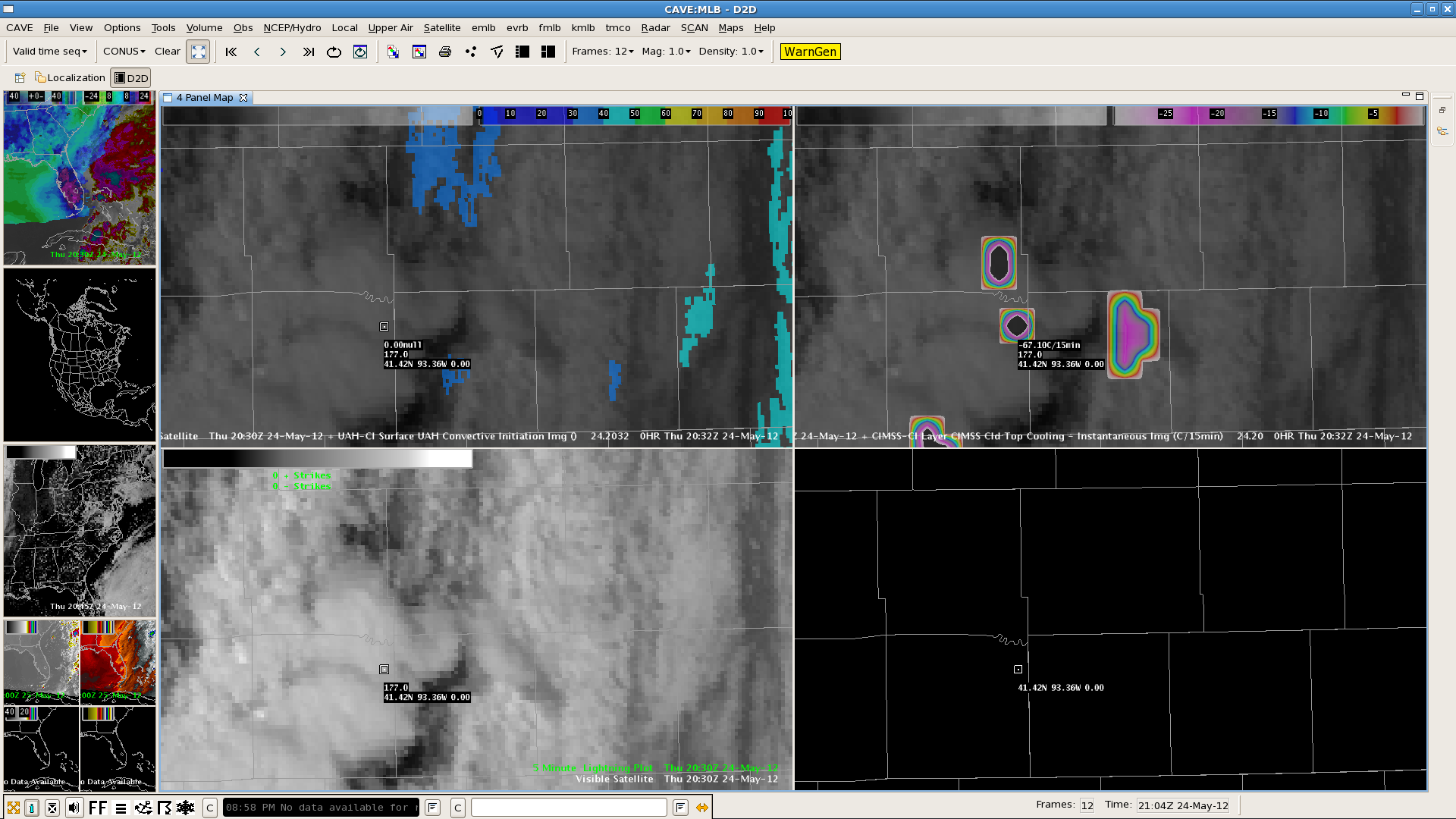
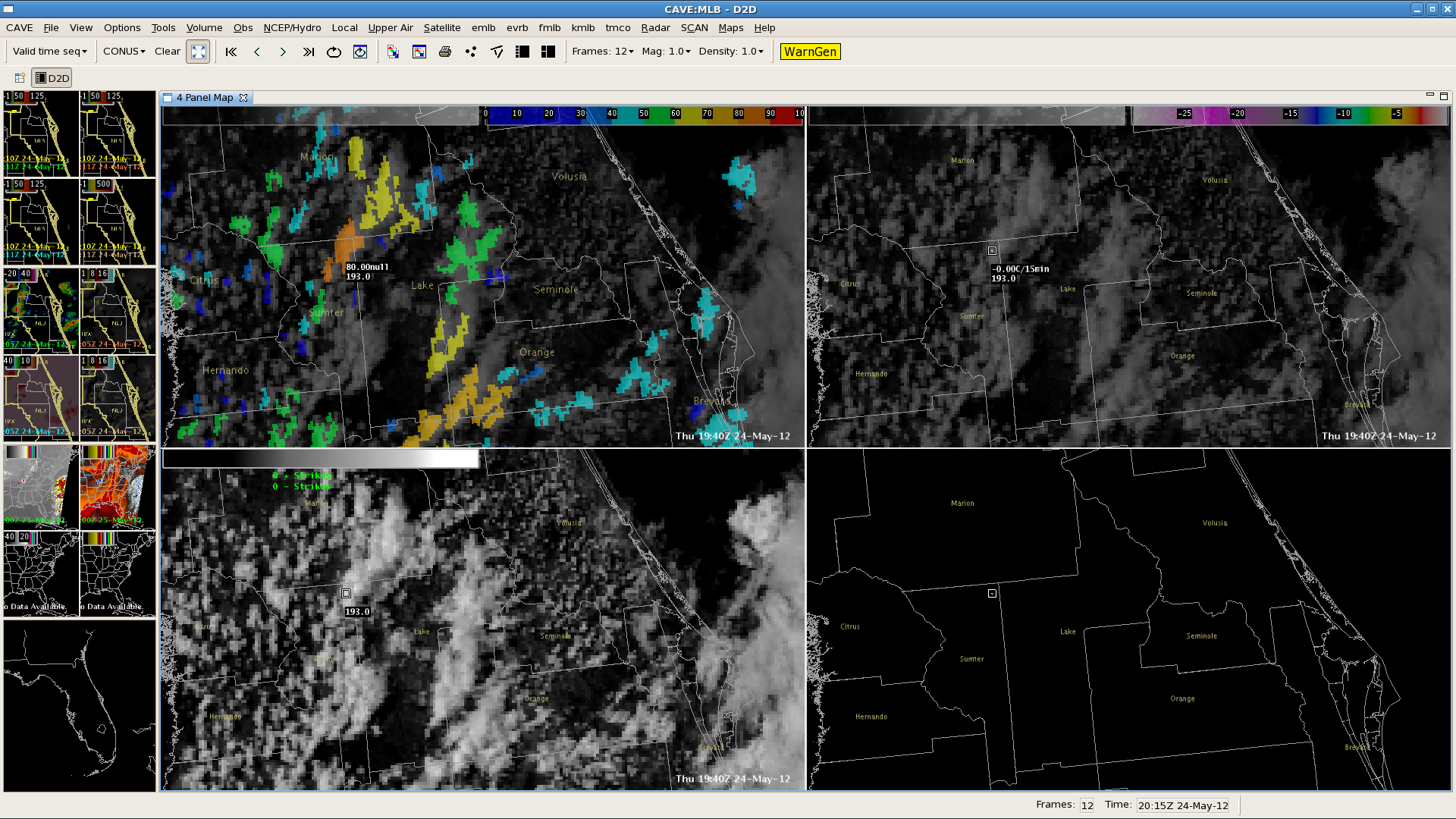
Here is an example of how UAH Convective Initiation (CI) and CIMSS Cloud Top Cooling (CTC) can be used to anticipate convective development.  Here in the first image at 1940Z, let’s look at the CI product in the top left panel:

CI (top left panel) at 1940Z.

Focus on the Lake/Marion/Sumter County line.  There is a maximum in CI there of 80, indicating likely convective development.  If we look at the CTC in the same area on the next image (top right panel), we see a developing max CTC over -20C/15min, which is a strong indicator of a developing severe thunderstorm.

1945Z CTC (top right panel).

Although this did not ultimately become a severe thunderstorm, we did observe a few lightning strikes shortly after this time.  This progression from strong CI signal to strong CTC can be a good indicator of a developing thunderstorm.–Gordon Strassberg for WFO MLB

CI along sea breeze over NE Florida

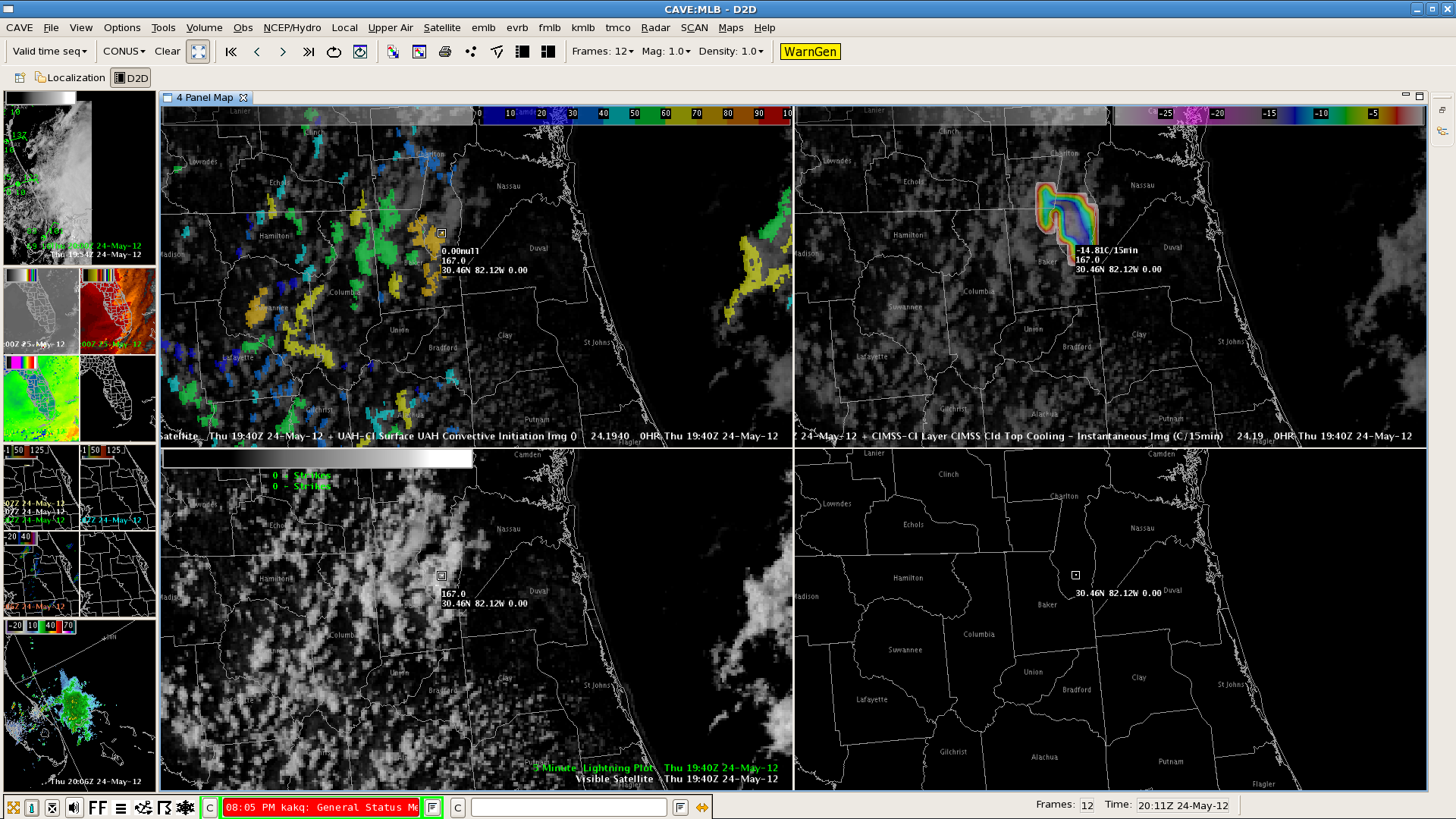
Westward moving sea breeze front helped to spark sporadic showers/thunderstorms during the afternoon hours. We captured the interaction of an already ongoing weak shower, as front moved in from the east.

1932 Z; UAH-CI and Cloud top cooling
1940 Z; UAH-CI and Cloud top cooling

The southern parts of Nassau and Charlton county and Baker county were monitored. At 1932Z an increase in cloud top cooling was noticed and 8 min later, CI product also had probabilities of 70 % plus for this area. At the same time, a cooling rate of roughly -15K/15 min was detected. Rapid development occurred thereafter with 50 dBz and more seen in the JAX radar side at 1947 Z, which gave a good lead time for focusing on the potential hot-spot over NE Florida. The storm was a pulsating one with rapid weakening thereafter.

Helge

Tags: None

Overview of sea breeze fronts in Florida

We’re currently monitoring the rapidly inland moving see breeze front over NE Florida with enhanced TCU present along the convergence zone, whereas the west coast see breeze has trouble to move inland within dominant easterly wind regime. Both convergence zones enter an area over N-C Florida where slightly lower dewpoints (lower to mid 60s) are present. With ongoing diabatic heating, cap continues to weaken or has already vanished with isolated initiation possible over N-C Florida in the following hours but ongoing large-scale weak subsidence seems to delay initiation a bit. HRRR quite aggressive with initiation mainly along the western sea breeze front with RUC also showing sporadic storms over N-C Florida. Overall set-up is not impressive and favors only the development of a few thunderstorms. Moderate CAPE and weak shear environment may result in a few strong and slow moving storms.

Neither CI nor Cld top cooling products showing robust signs for initiation … mainly over C Florida. Both products however show more vivid activity offshore over the Atlantic, where mid-levels remain a bit cooler.

1800Z VIS and station data
1745Z; UAH-CI (upper left) and CIMSS Cld Top Cooling (upper right)

Helge

Tags: None