An official website of the United States government
Here’s how you know
Official websites use .gov A
.gov website belongs to an official government
organization in the United States.
Secure .gov websites use HTTPS A
lock (
) or https:// means you’ve safely connected to
the .gov website. Share sensitive information only on official,
secure websites.
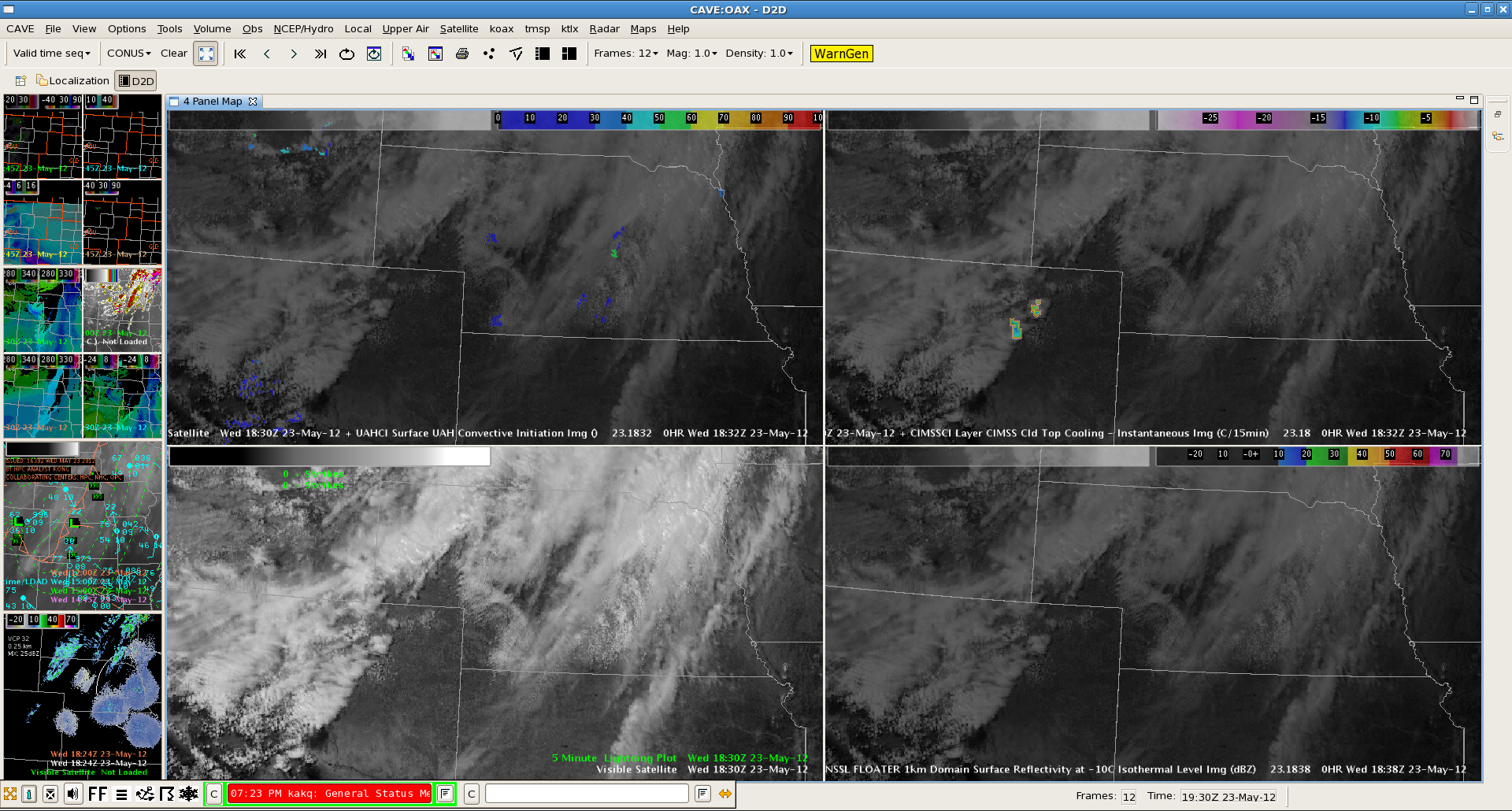
Latest VIS imagery indicates a rapid increase in convection along slowly SE-ward progressing cold front, namely over Hodgeman, Ness and Rush counties. UAH-CI product already showed modest probabilities (50-60 %) for CI with no reflectivity yet present in local radar data.
UAH-CI product placed in the upper left corner at 2130 Z
Latest HRRR is a bit more optimistic with SW-ward zipping convection compared to OUN WRF. Still unsure if storms can initiate in that area with warm mid-level tongue partly covering the cold front/dry line. Strong shear now gradually moving in from the west, so increasing storm organization is likely in case of initiation.
At about 2130 UTC we decided to end operations over the Carolinas and move to the central Plains. McKinney & Hirsh are working the Hastings CWA (GID) while Strassberg & Kleinsasser are covering the Omaha CWA (OAX). Our to observers Helge & McCormick are checking out DDC (though concern over the cap in this region might move them to CO or Iowa).
Meanwhile the SPC issued a watch for the region as well…
SPC Watch for 2100 UTC to 0400 UTC on 23-24 May 2012
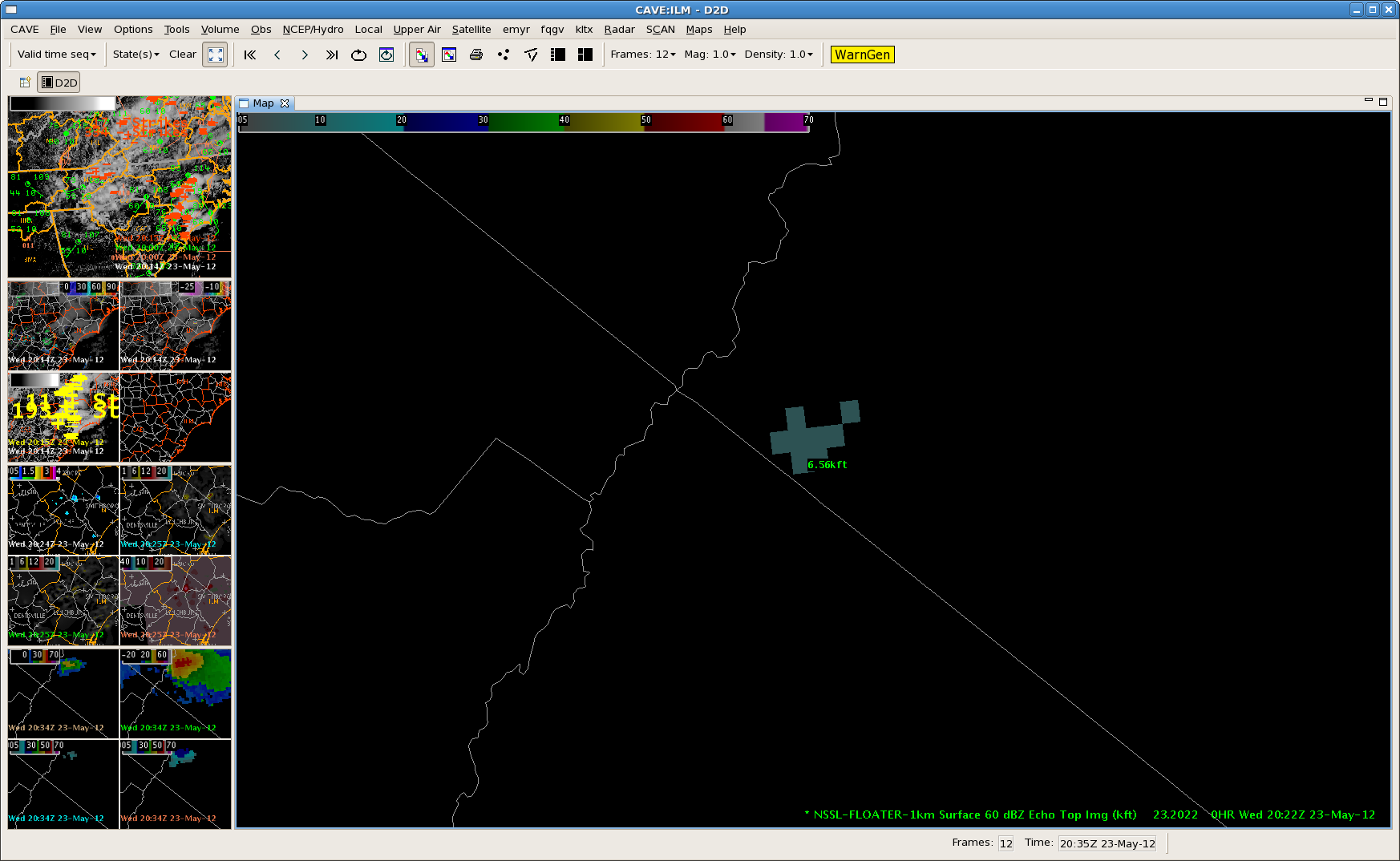
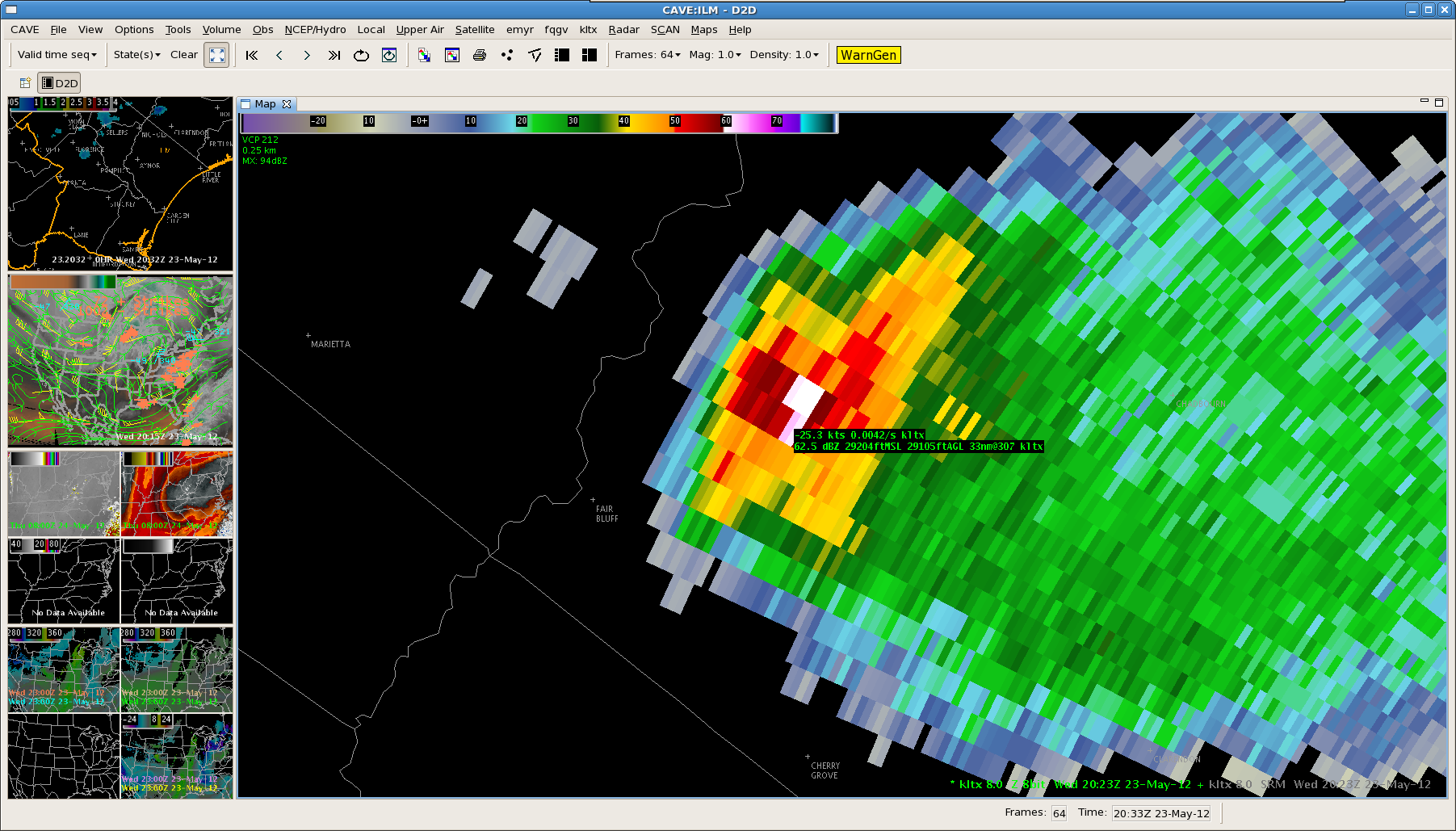
The top image is the MRMS estimate of the 60dbz echo top of a storm over Wilmington NC CWA, estimating the 60dbz echo top around 6500 ft at 2022 UTC on 5/23. However, the bottom image is the corresponding KLTX 8.0 degree slice, indicating 60-62dbz to at least 29,000 ft. At least in this instance, the MRMS 60dbz echo top algorithm did not perform well.
2022 UTC MRMS 60dbz echo top of only 6500 ft.2023 UTC KTLX 8.0 degree slice indicating 60-62 dbz to at least 29,000 ft, proving the MRMS 60dbz echo top algorithm incorrect in this instance.
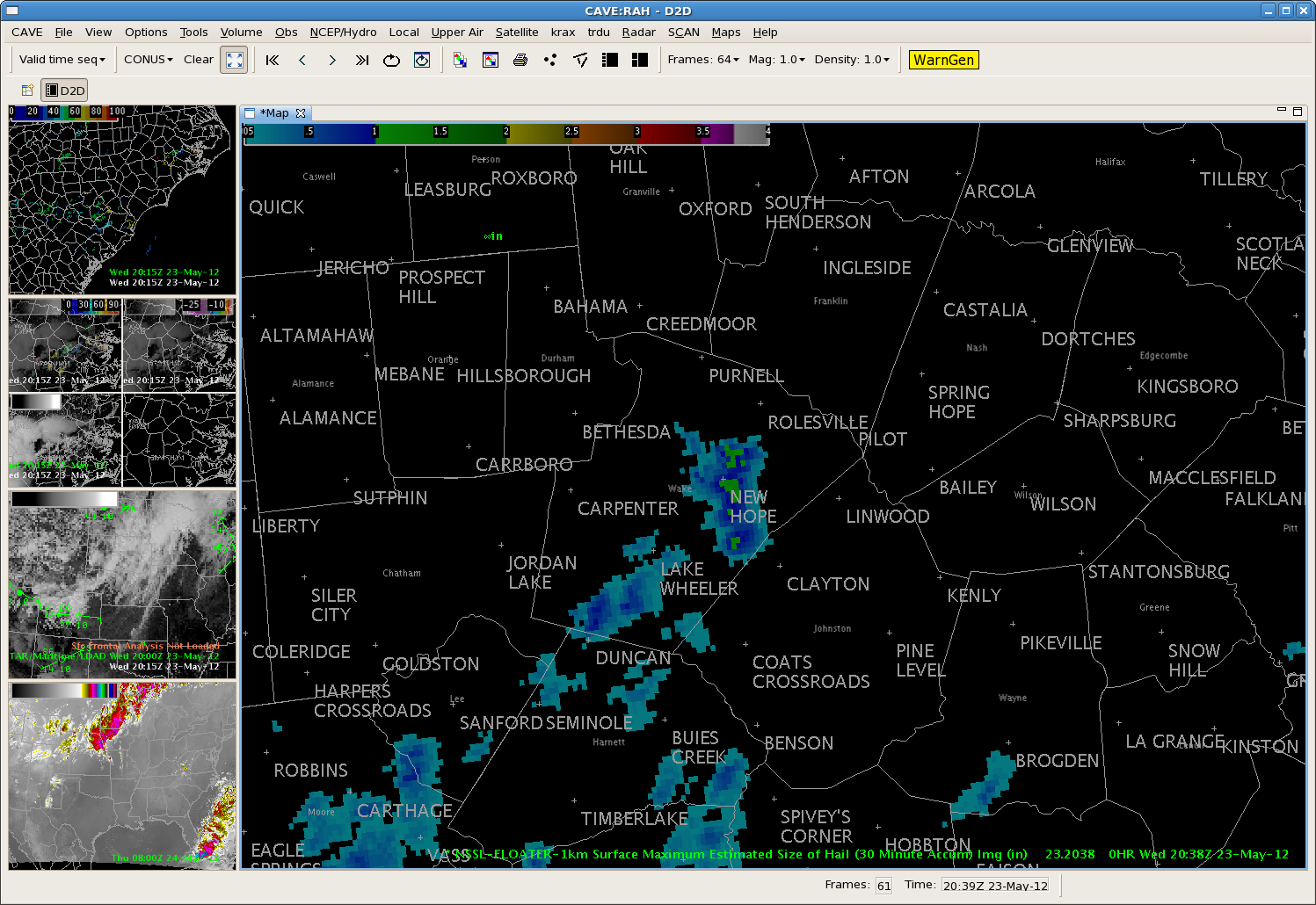
We got some reports of large hail in Raleigh, but I couldn’t seem to find it on the map (top). I needed to zoom in (bottom) quite a bit to see the label for the second largest city in NC. AWIPS II developers…can this be fixed? Zooming out should show the major cities, but it currently shows random small towns.
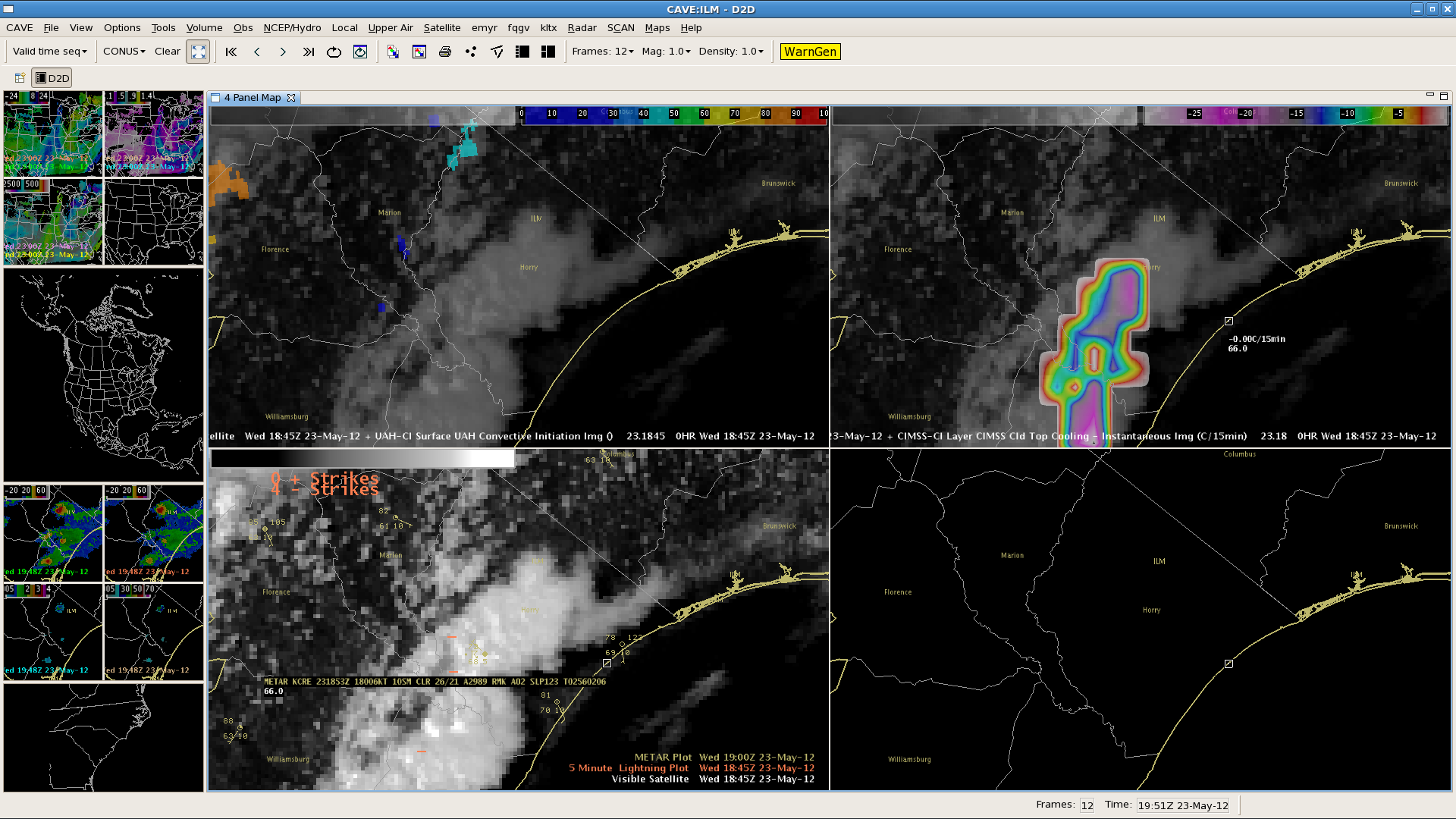
Here in WFO ILM, we have had some great success with the CIMMS Cloud Top Cooling (CTC) product this afternoon (see our previous post). Here is another success story from Horry County, SC. First we will look at the Cloud Top Cooling product at 1845Z (Top Right panel):
1845Z Cloud Top Cooling (CTC) image from WFO ILM (Top Right Panel).
There are two “bull’s eye’s” over SC. Our storm is the northern “bull’s eye”. The CTC showed cooling rates of -21C/15minutes AT 1845Z, which typically correlates to strong convection with significant lead times averaging 45 minutes before Maximum Expected Size of Hail (MESH) exceeds 1″. Now let’s look at some verification. First is the MESH image from 1936Z (lower left panel). This is the first time the MESH exceeded 1″ for a LEAD TIME OF 51 minutes!
1936Z MESH product for WFO ILM (Lower Left panel).
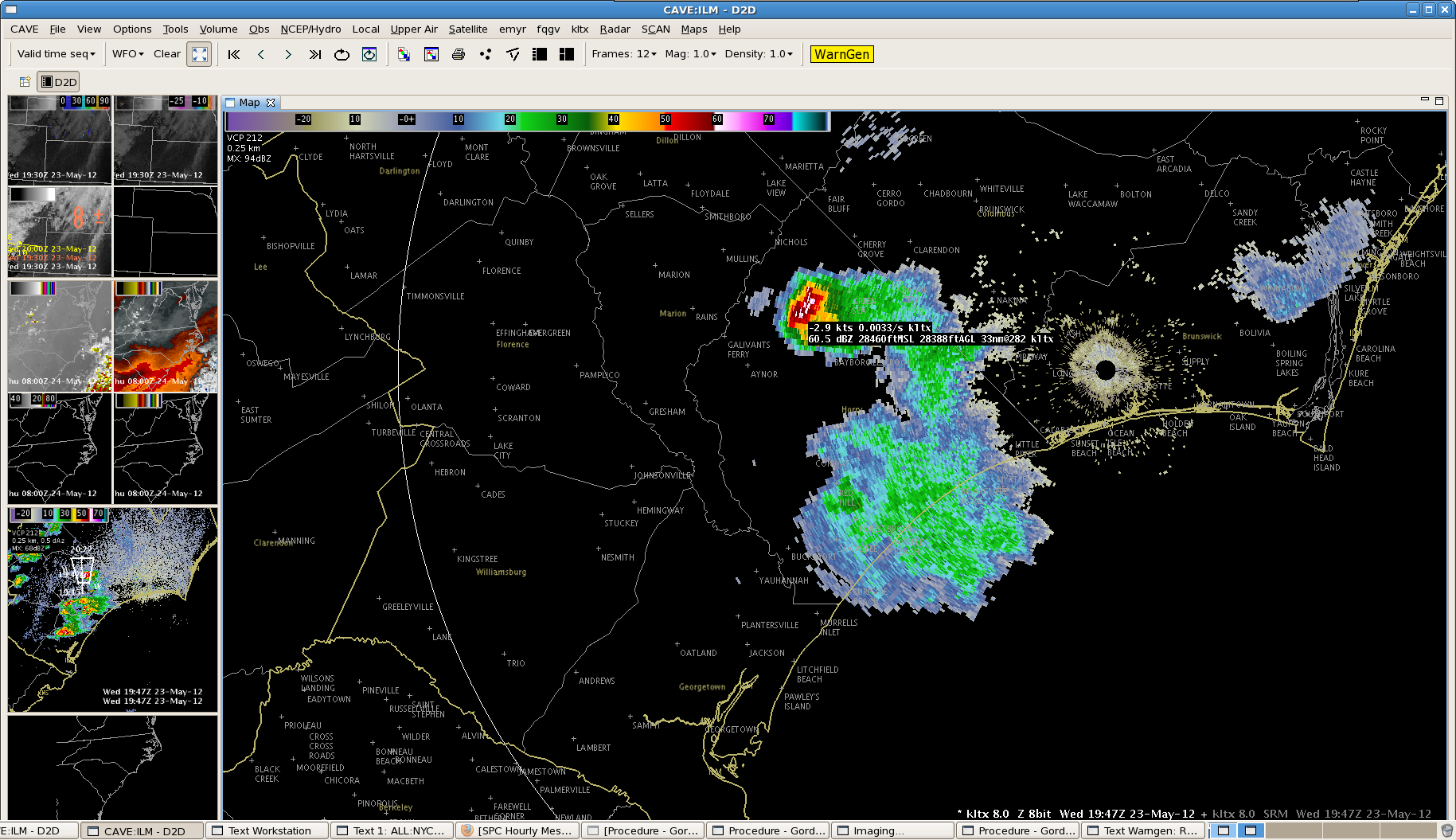
And now for a conventional radar image from 1947Z from the KLTX Radar:
1947Z KTLX Radar image.
The cursor readout shows this storm has 60dbz echos up over 28,000ft…which is above even the -30C level from the 12Z CHS sounding (~25,000ft). We finally got verification of quarter size hail in NW Horry County by around 20Z, though the reports seem to have not come from directly beneath the core of the storm so some larger hail was possibly produced. Now let’s examine some NSSL 3DVAR Imagery:
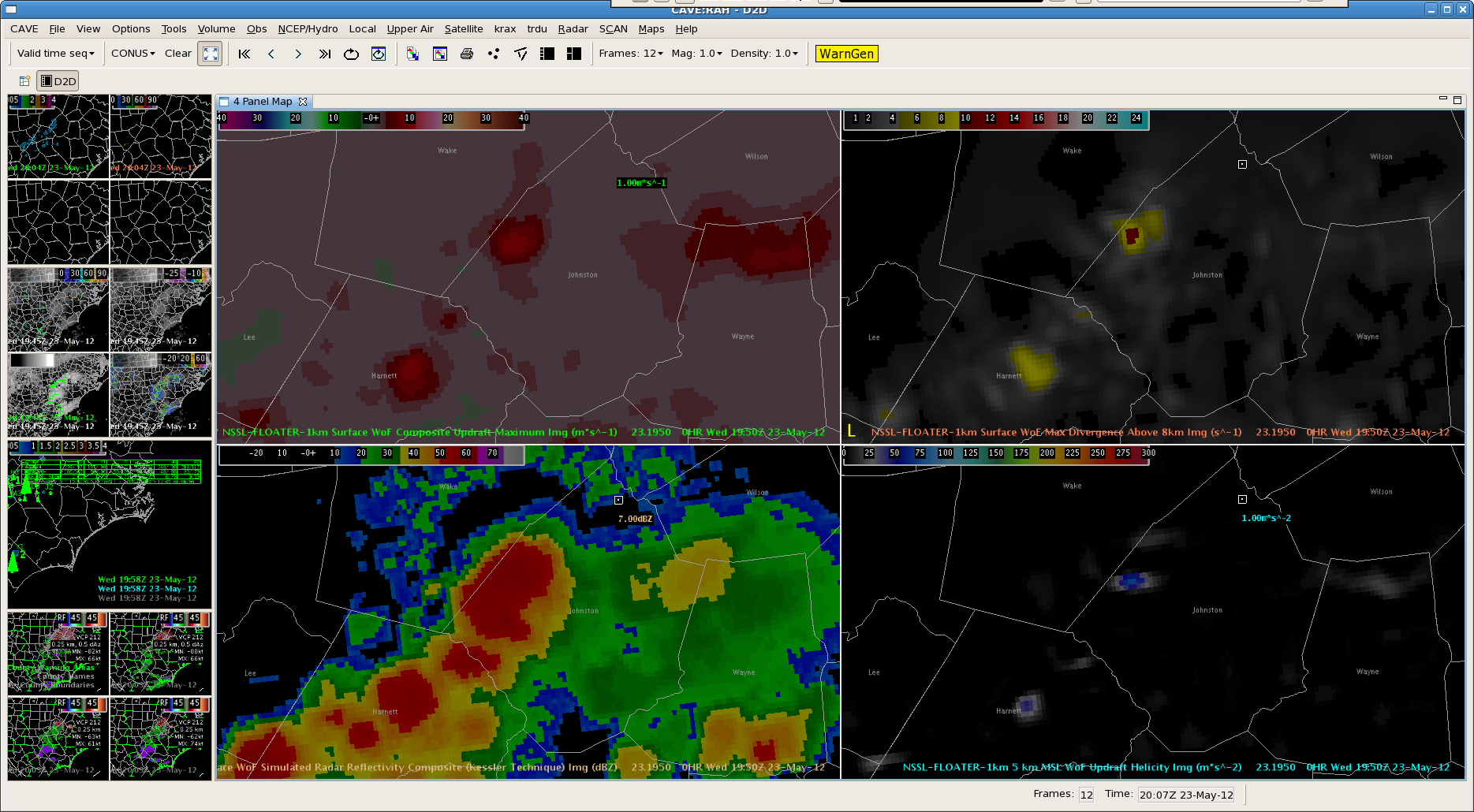
KTLX Base Reflectivity (top left), NSSL 3DVAR Max Divergence (Top Right), NSSL 3DVAR Max Updraft Composite (Lower Left) and NSSL 3DVAR Max Vorticity (Lower Right) at 2005Z.
You can easily identify this storm based on the Max Divergence above 8km, Updraft Composite, and Max Vorticity Images as all show local, significant maxima. Today, the CTC product has shown significant value in lead time for severe hail beneath the Southeastern CONUS upper low.–Gordon Strassberg for WFO ILM.
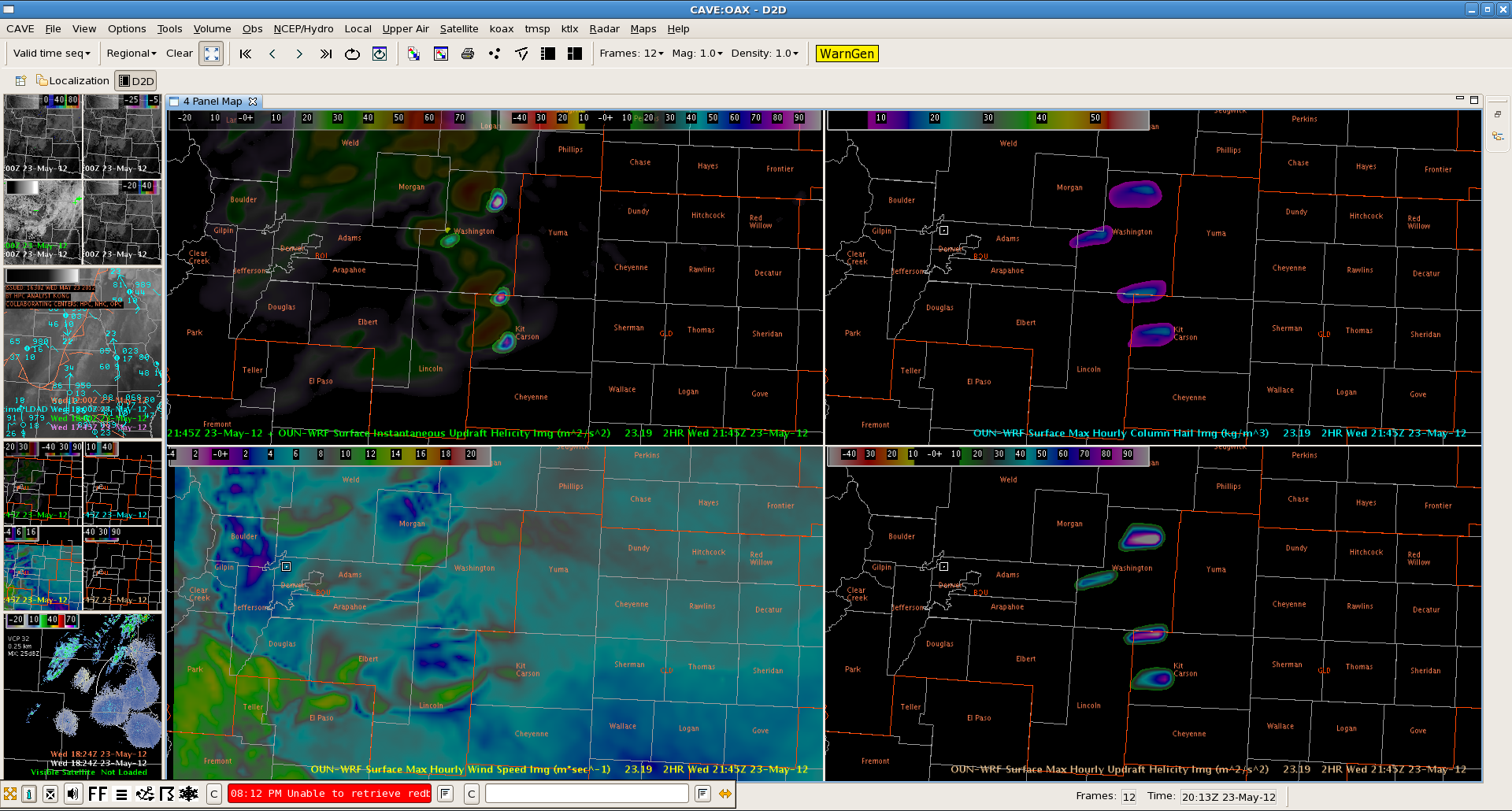
OUNWRF evolves long-lived supercells over Morgan, Washington and Lincoln counties with a rapid eastward progression. This may place highest supercell risk a bit more to the north compared to theta-e difference forecast (mentioned in the blog entry below). Despite LCLs aoa 2.5 km and increasing DCAPE towards C/E Colorado, the WRF keeps max hourly wind speeds on the lower end side. Feeling is that initiation of WRF activity may be too optimistic/early with slow BL moisture recovery still underway.
OUN-WRF updraft helicity (upper left), surface hourly column hail (upper right), surface max hourly wind speed (lower left) and surface max hourly updraft helicity (lower right)
This cell produced coin-sized hail right around the time the 3d-VAR Max Updraft/Divergence peaked. It’s hard to tell if there was lead-time or not. An interesting aspect of this storm is that fact that it passed right over the krax radar and into the cone of silence. This shows the value of having multiple radars looking at the storm.
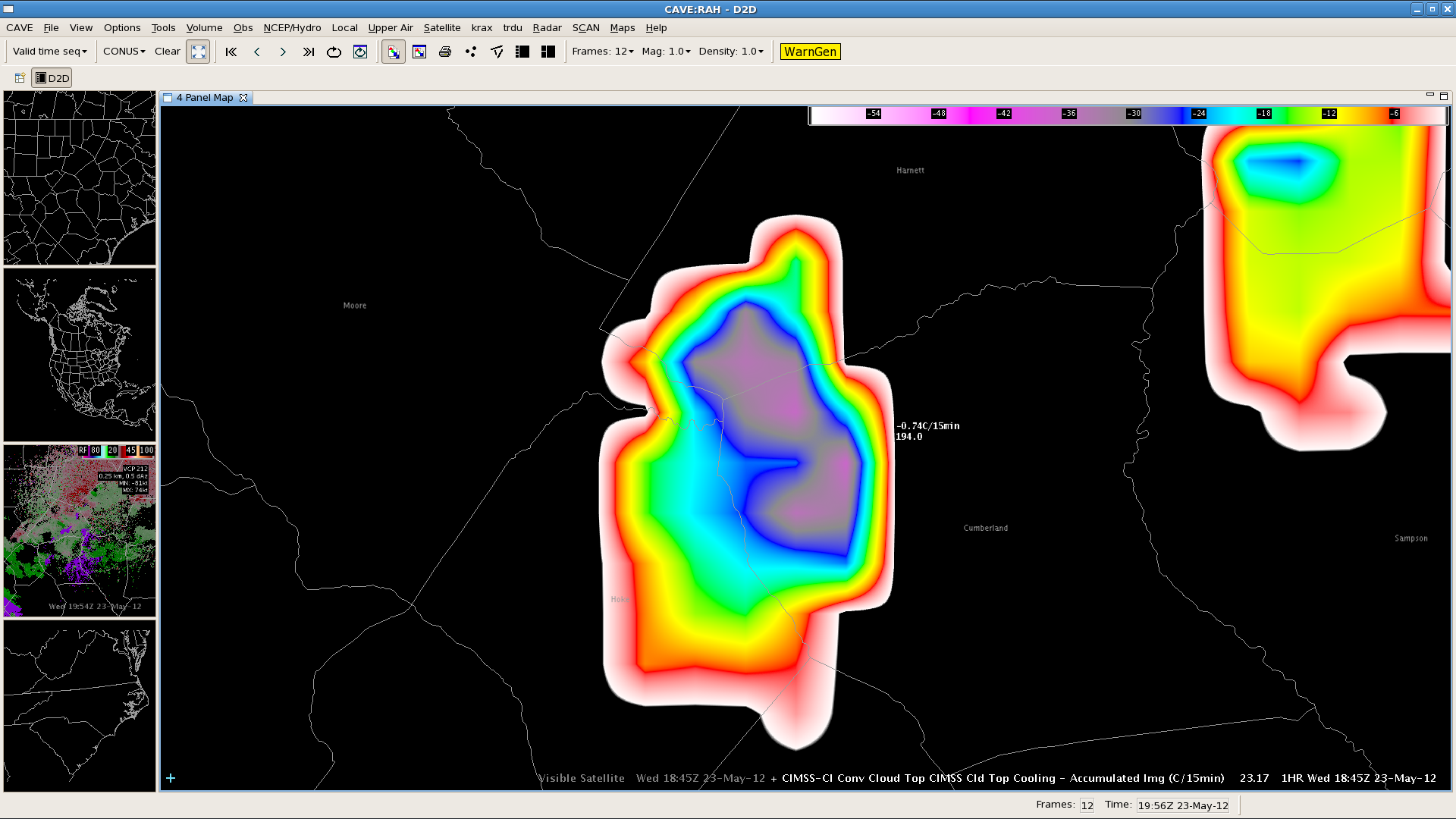
The CIMMS cloud top cooling algorithm first detected cooling rates of approximately -10 C/15 min with a thunderstorm developing across eastern Hoke and western Cumberland counties on the 1815z image. The algorithm continued to show strong cooling rates on the next two images with accumulated CTC values of approximately -30 to -35 C/15 min before the cell was dropped from the display after 1845z. A report of quarter sized hail was received in far southwestern Harnett county with this thunderstorm at 1937z, almost an hour and a half after the algorithm first detected stronger cooling with this storm.
Accumulated CTC values for a cell that produced severe hail.
Conditions gradually improve for thunderstorm development over NE Colorado although initiation may be delayed until the 23-00 Z time frame. Surface boundary pushed through as lee depression slowly consolidated over W-Kansas. 12Z Denver soundings showed steep lapse rates with a deepening and well mixed boundary layer. Numerous weak caps present (roughly at 700, 600 and 500 hPa). CIMMS Cld top cooling product revealed numerous spots with moderately cooling tops in the order of -10 to -15 K/15 min with UAHCI CI product showing low to non existent probabilities. This may be the reason for growing updrafts before reaching one of those aforementioned caps, which suppressed further development. For the forecaster however this is already helpful to pinpoint the area, where enhanced cumulus growth occurs and where initiation may be the most likely.
Question now arises if moisture recovered since 12 Z. Surface dewpoints struggle to exceed mid to upper 30s with lower 40s now entering far NE Colorado as winds backs more to NE-erly directions in response to the consolidating lee cyclogenesis. However, products like the 780mb equiv pot temp and the theta-e diff show robust signals for available potential instability over far NE Colorado with an increasing trend during the following hours. In fact, latest HRRR forecast and the tongue of pot. instability seem to overlap nicely. Hence initiation seems possible around and south of a line Steamboat Springs-Denver-Deer Trail during aforementioned time frame. Incoming mid-level speed max pushes DLS aoa 80 kt, which is more than adequate for well organized storms.
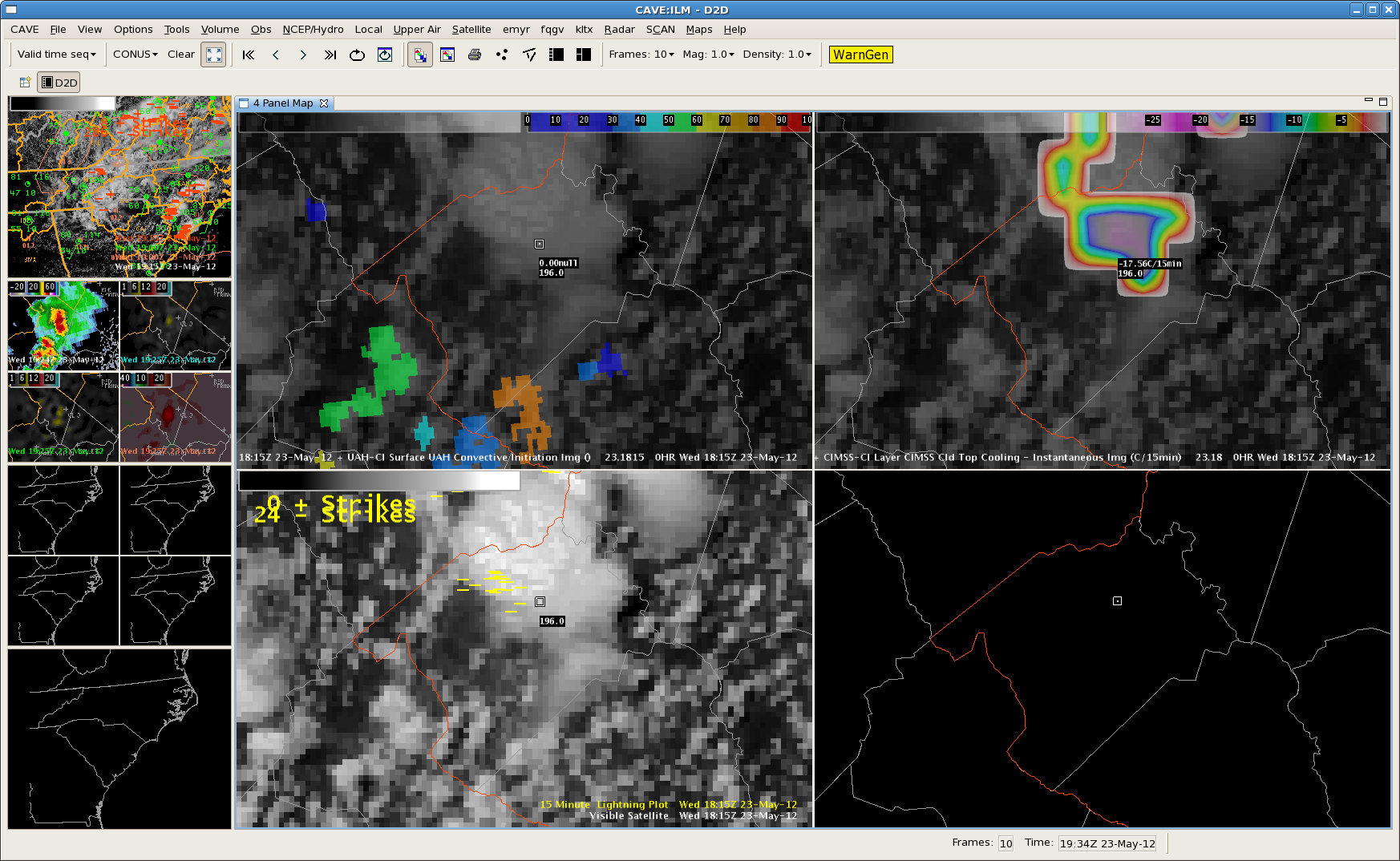
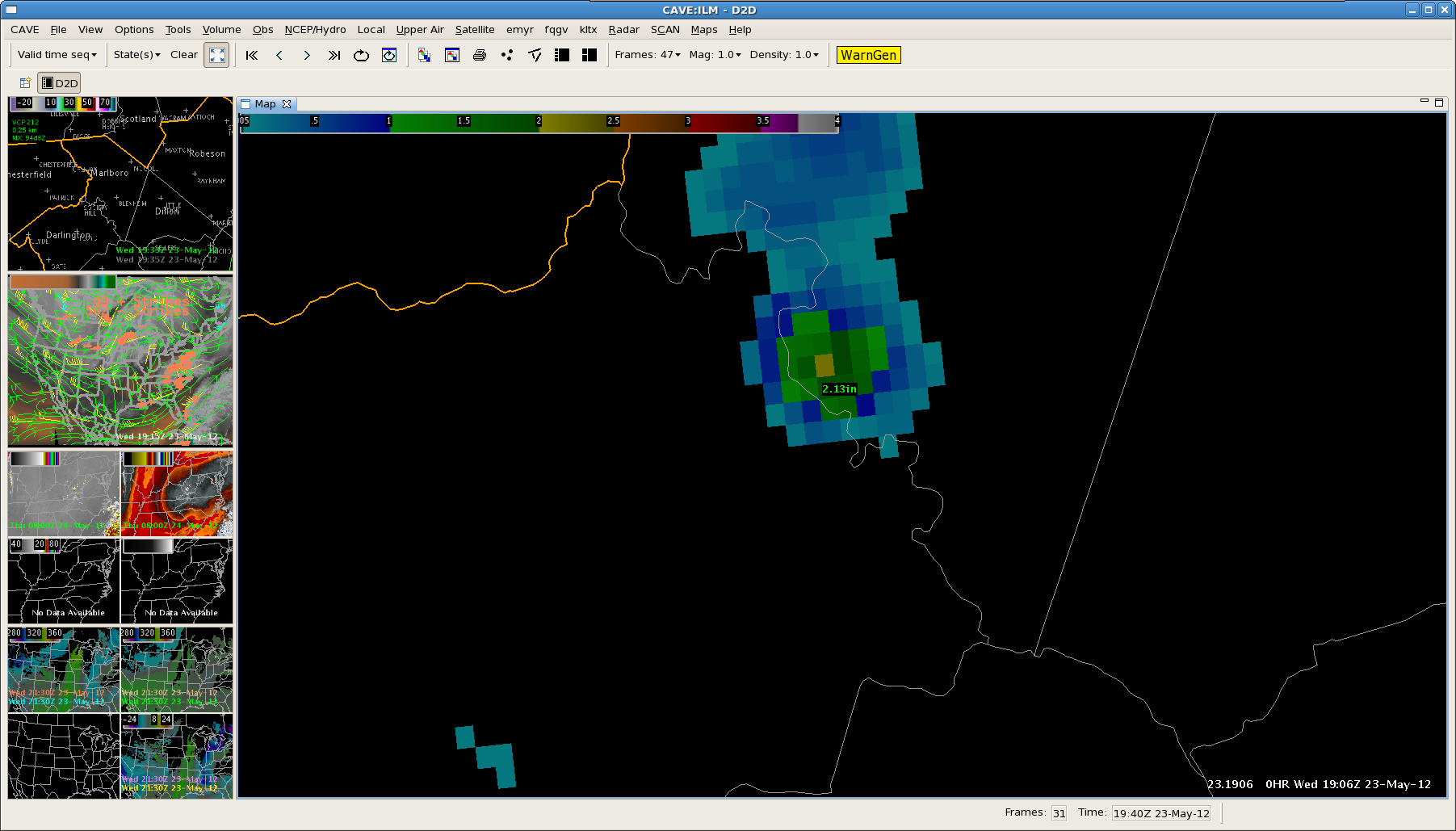
In the 1815 UTC vis satellite image (upper right of top 3-panel), cloud-top cooling was on the order of -17C/15min with a developing thunderstorm. By 1858 UTC, MRMS MESH product reached 1″ hail size (middle image), and just over 2″ hail size by 1906 UTC. The UW-CTC product lead to 45-50 minute lead time for 1-2″ hail (as estimated by MRMS MESH). This is one of many instances we’ve noticed the CTC give decent lead time for 1″ or larger hail.
1815 UTC. Rapid convective development as indicated by -17C/15min cloud-top-cooling rates.1858 UTC. MRMS (multi-radar, multi-sensor) MESH (max estimated hail size) is estimating 1.02" hail, about 45 minutes after rapid CTC. 1906 UTC. MRMS MESH now estimating 2.13" hail, about 50 minutes after initial rapid CTC.