Monitoring South FL Convection for the Miami Open

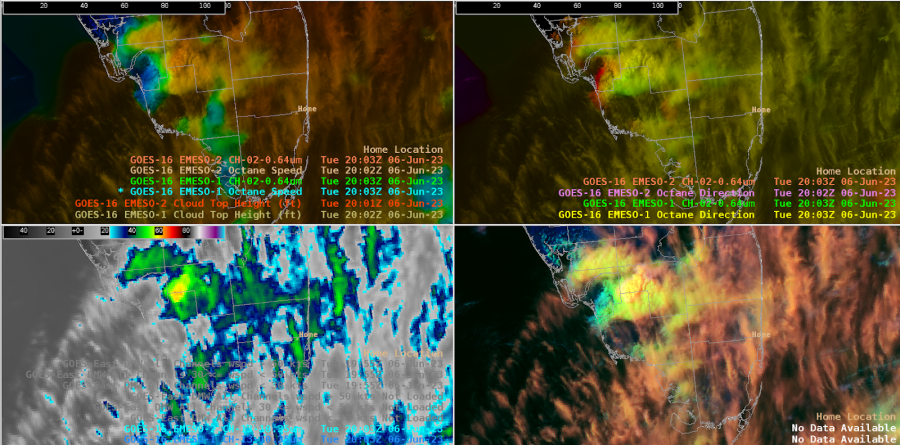
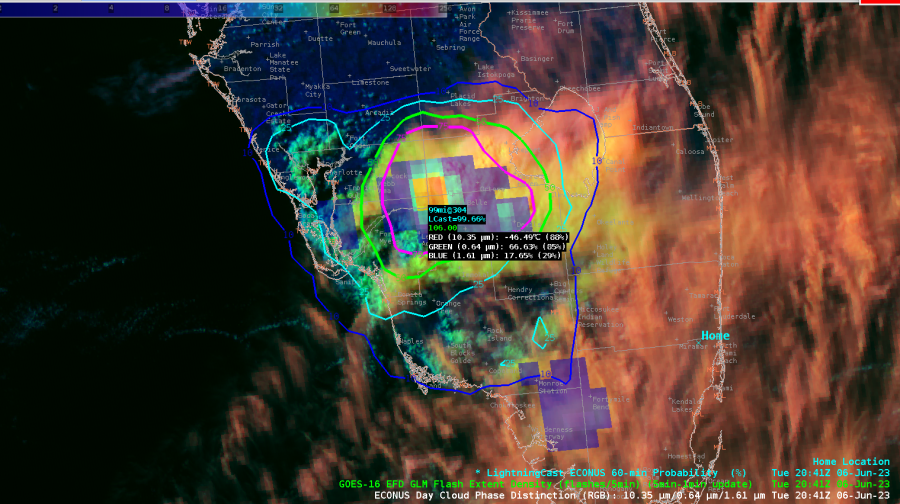
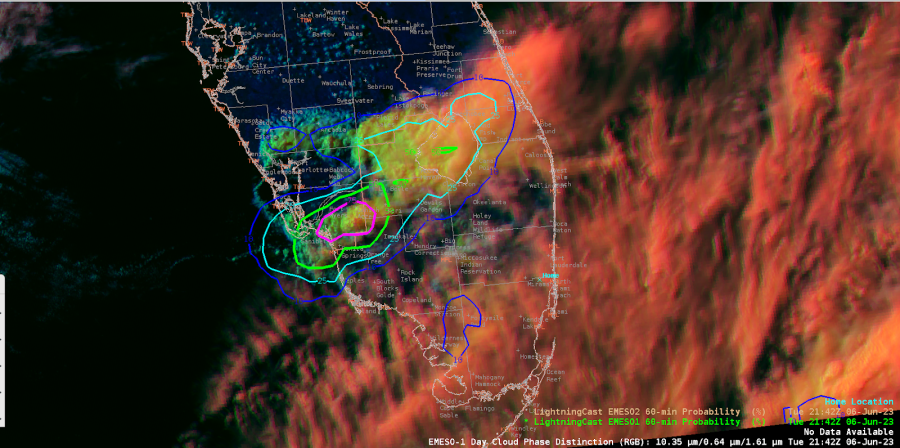
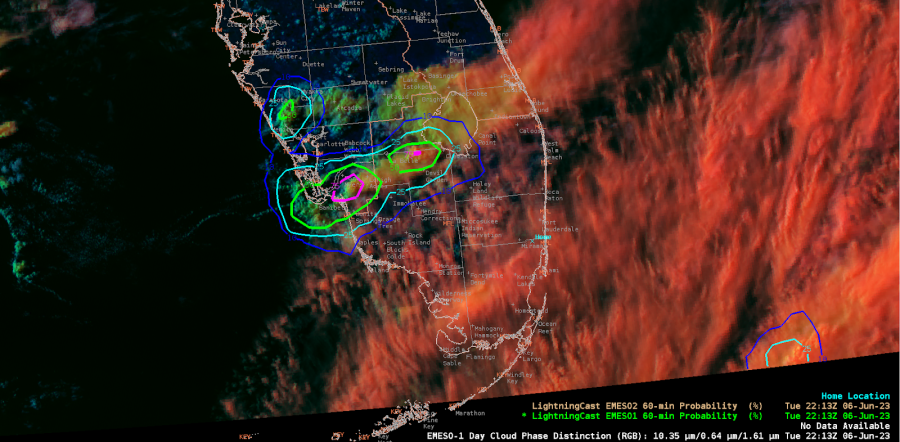
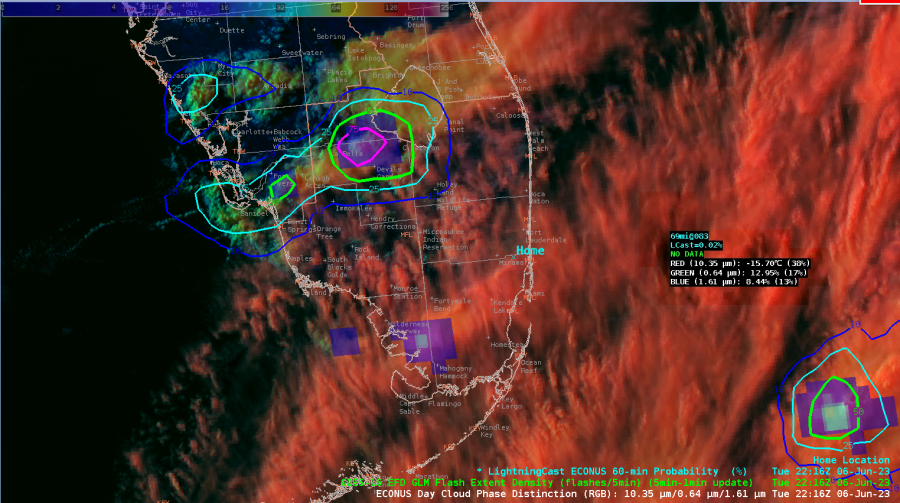
We’re closely monitoring for CI near the Miami Open Tennis Tournament (location noted by the Home marker). Thus far this afternoon, the deepest convection has been in the west, NE of Naples, where the Band 13 imagery shows high cloud tops with cool brightness temps (-66C), and Octane imagery shows a good divergent signal.

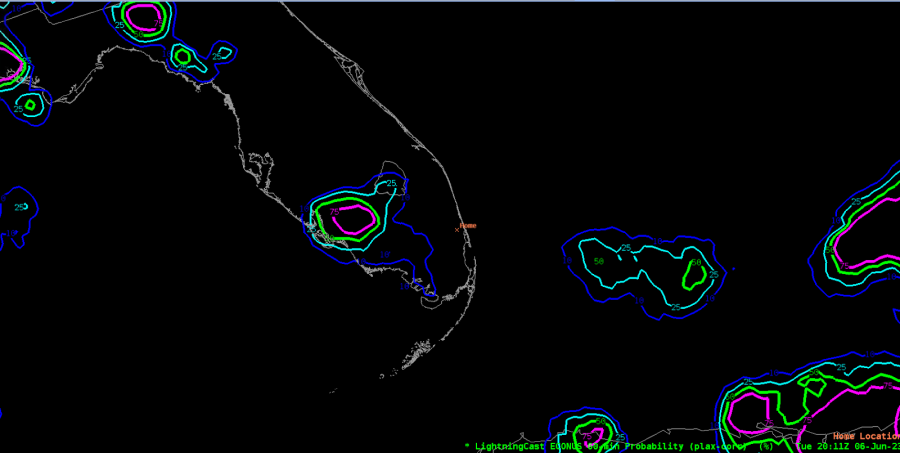
So far, LightningCast has focused on the convection in the western peninsula, with the maximum slowly translating inland and to the N along the inland-tracking sea breeze.

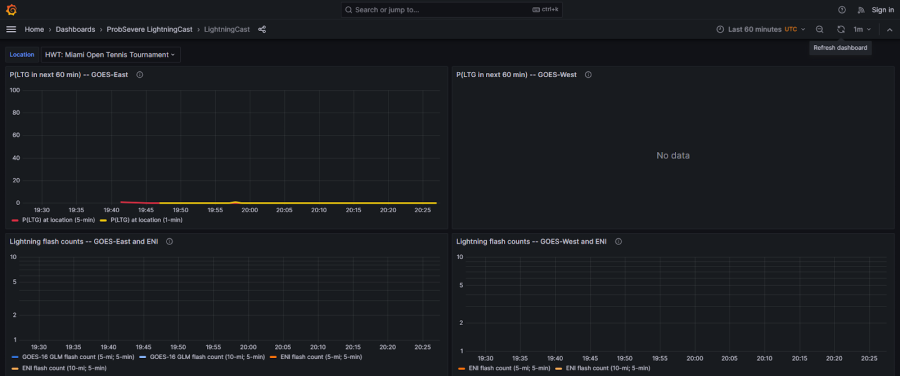
This is further confirmed by the lightning meteogram for the DSS site. Looks like they can keep playing tennis for a little bit longer!

Looking at the storm clusters back west, a NUCAPS sounding near that cell shows plenty of CAPE.

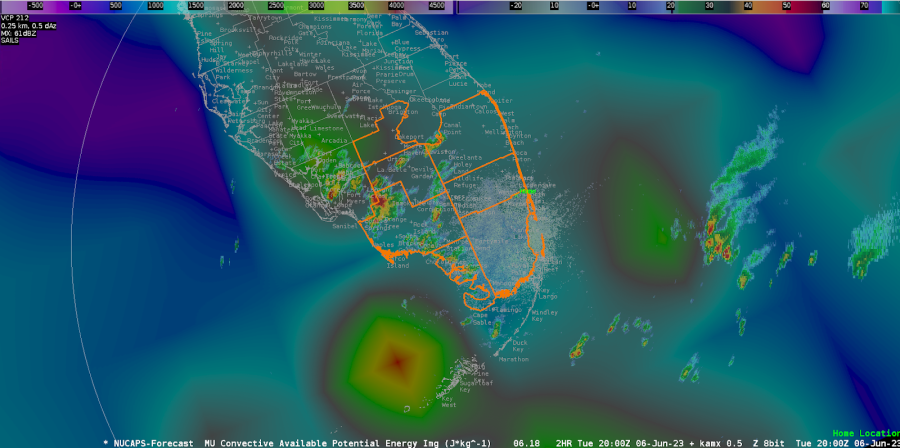
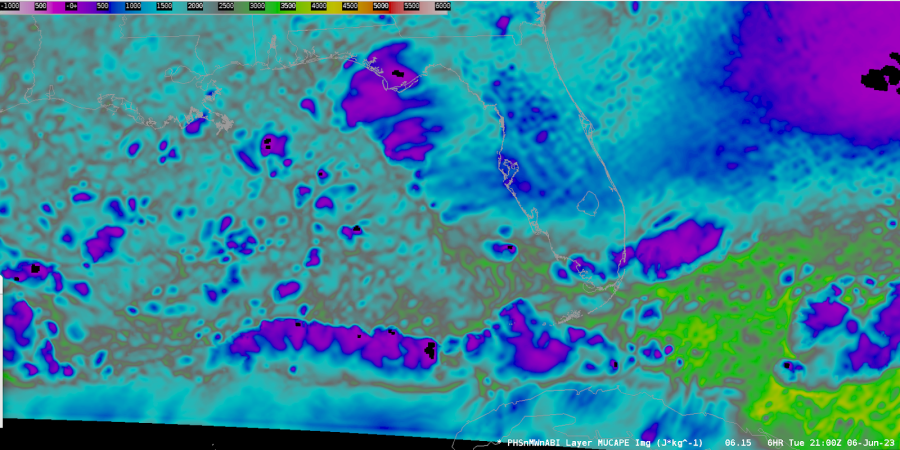
The NUCAPS-Forecast MUCAPE confirms the high CAPE invof the storms.

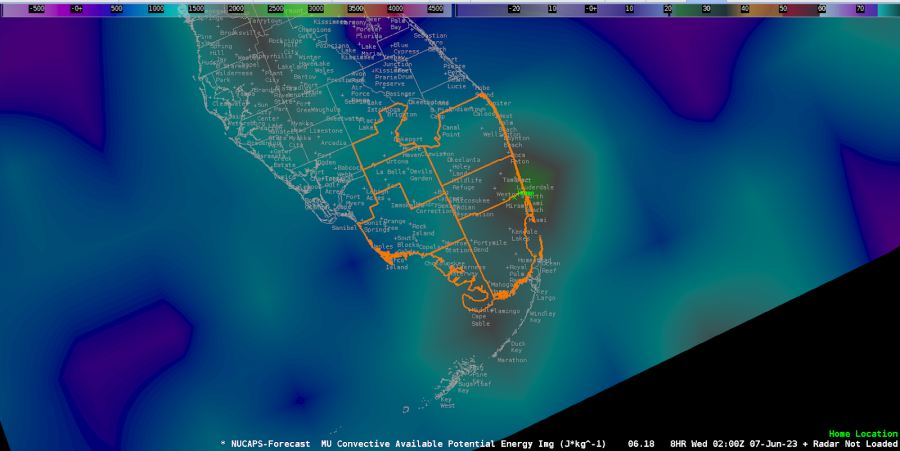
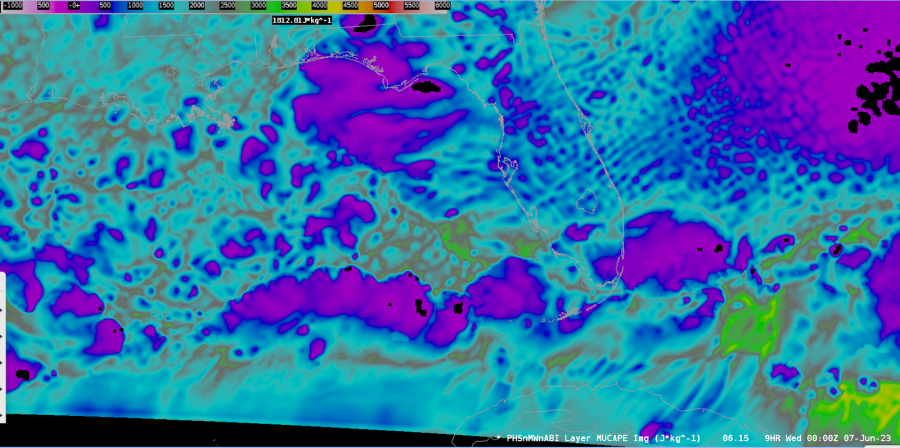
Let’s see what the forecast shows for our DSS event. By 02z this evening, it shows increasing CAPE invof the DSS event. They are not out of the woods yet!

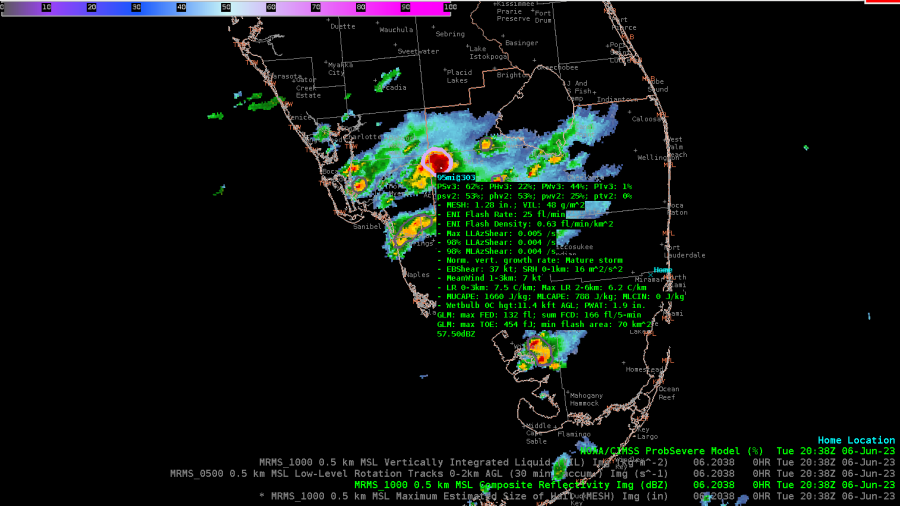
However, ProbSvr3 and LightningCast continue to provide a general idea that the strongest cell remains north and west of the Miami Open, limiting any impacts during the event.

Looking at the PHS imagery, it shows continued moderate CAPE extending into SW FL invof the ongoing convection, with much lower CAPE near our DSS event.

And the projections for 00z this evening show CAPE lowering further.

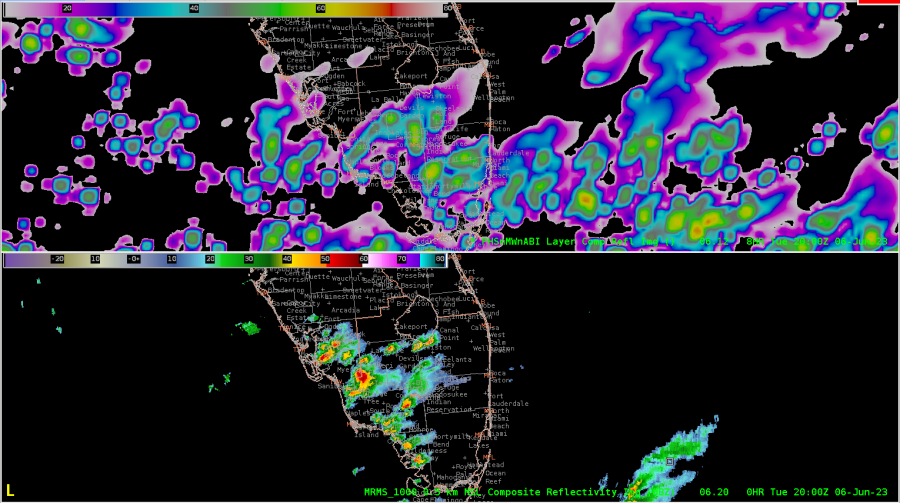
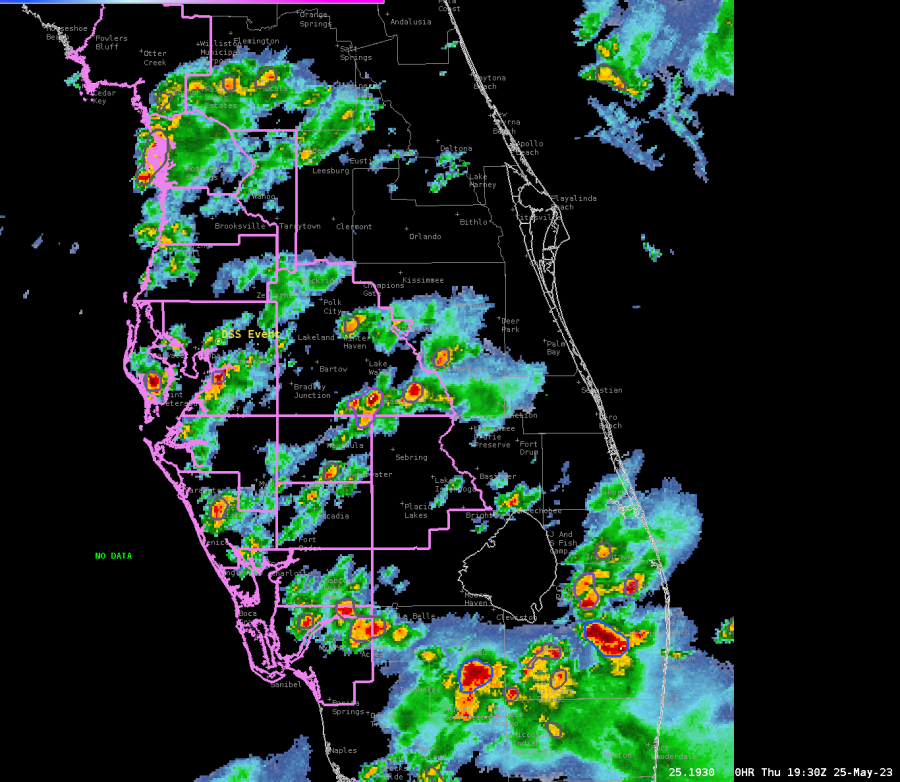
20z PHS Composite Reflectivity compared to MRMS Composite Reflectivity persistently highlights a lot of noise. Understanding from a forecaster’s perspective, this can be mentally filtered out, but at the same time, remains to be a distraction from the overall product’s use.

The warned cell over Glades county weakened and merged with other convection, and accordingly, the LightningCast probs declined. But we’re seeing new vigorous convection to the WSW just north of Bonita Springs.

One interesting note. There are new cells developing in far SW FL with lightning noted on GLM, however the cirrus canopy there is too thick to allow LightningCast to detect this convection.

– Edgar and Harvey Specter

Tags: None

Albany and Columbia WFO for the HWT Testbed

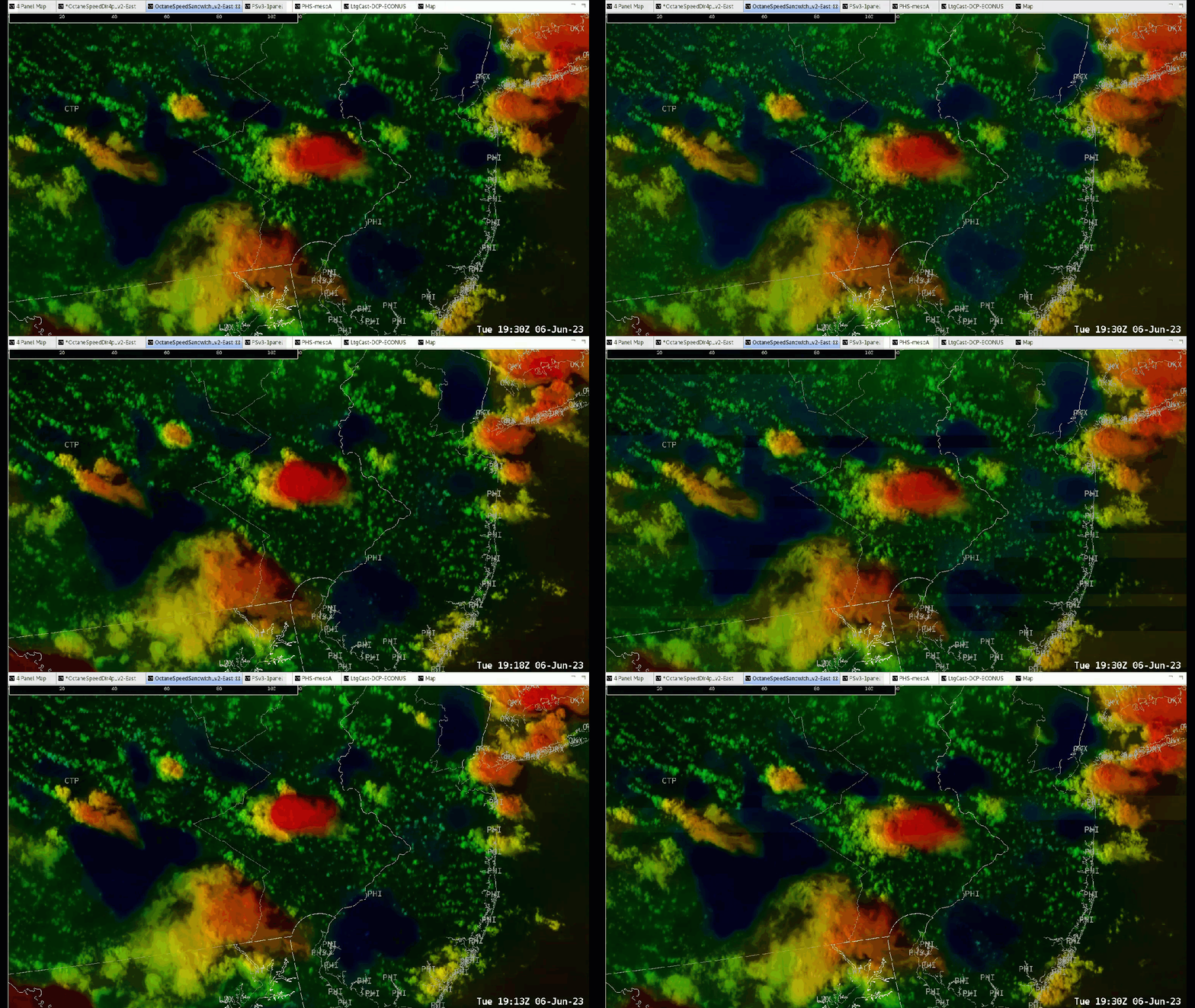
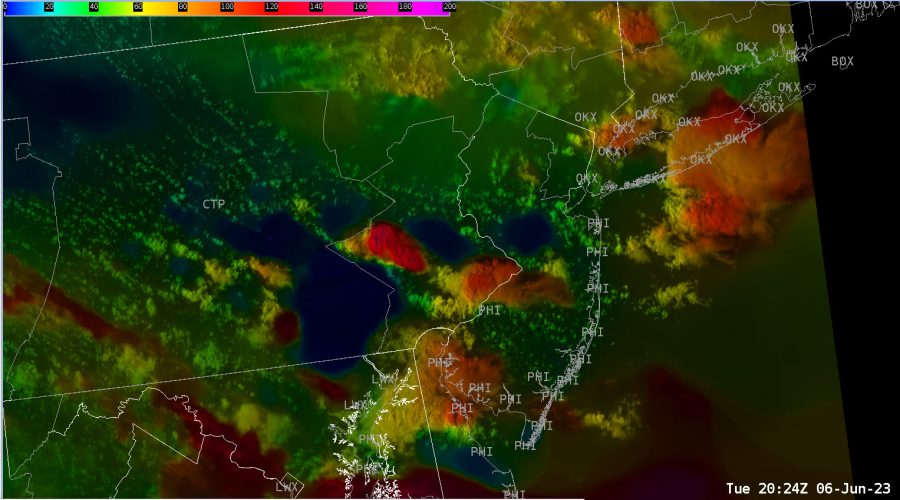
The environment is mostly within northwest flow, so some decently sheared storm tops are noted on the OCTANE speed product, ranging from about 25 kts to 60 kts at anvil/storm top level.

The OCTANE Speed Product over eastern PA.

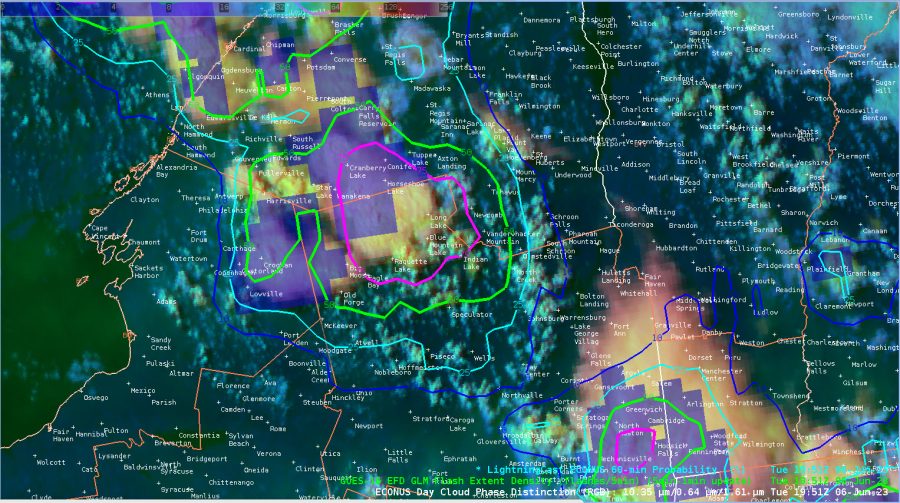
DSS for Twigs Craft Fair – Speculator, NY.

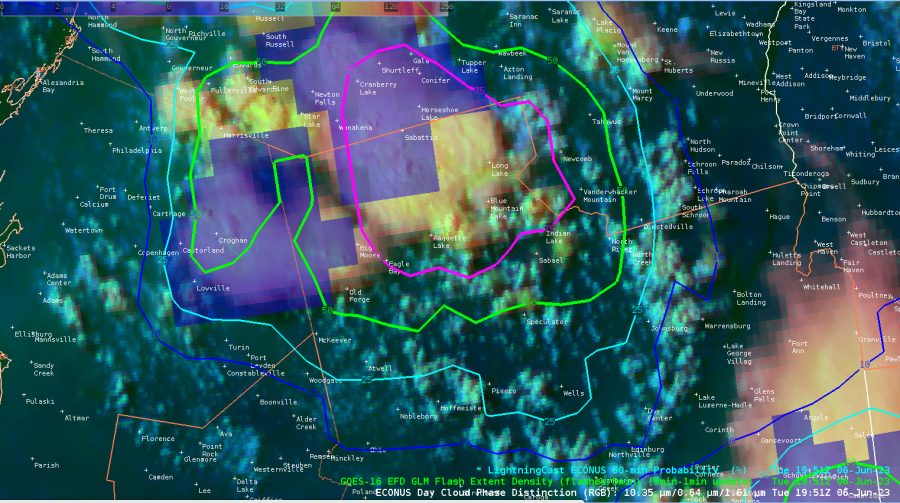
Increased lightning chances developing and going up over 50% now at our DSS site. This is a concern as people at the festival will likely need to take shelter soon as storms approach from the north. Lightning is possible ahead of the storm given the environment it is in and favorable synoptic setup.

GOES 16 GLM and LightningCAST near our DSS site at Speculator, NY.

Additional imagery with a zoomed-in view.

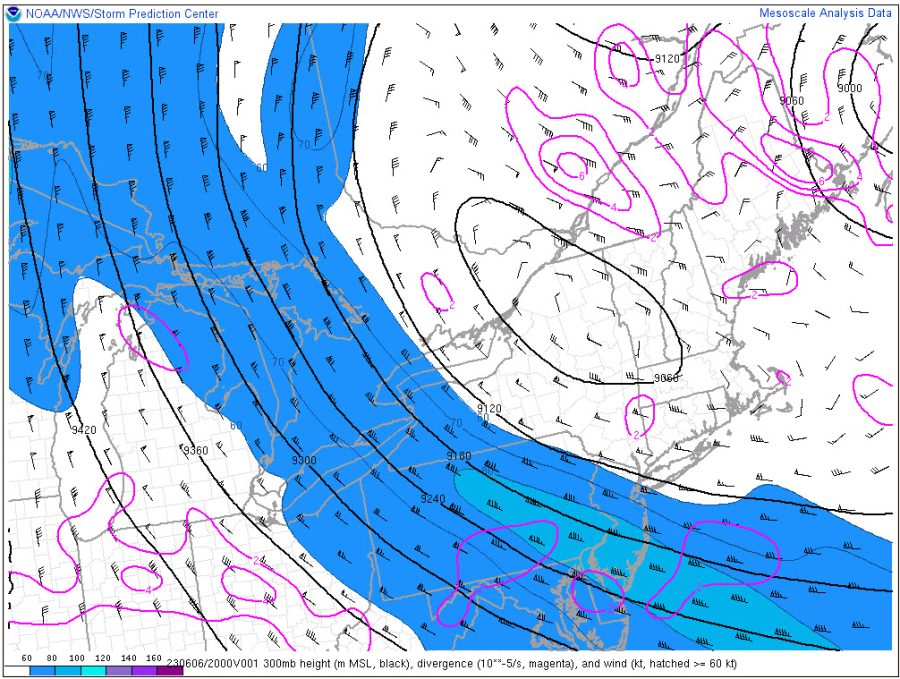
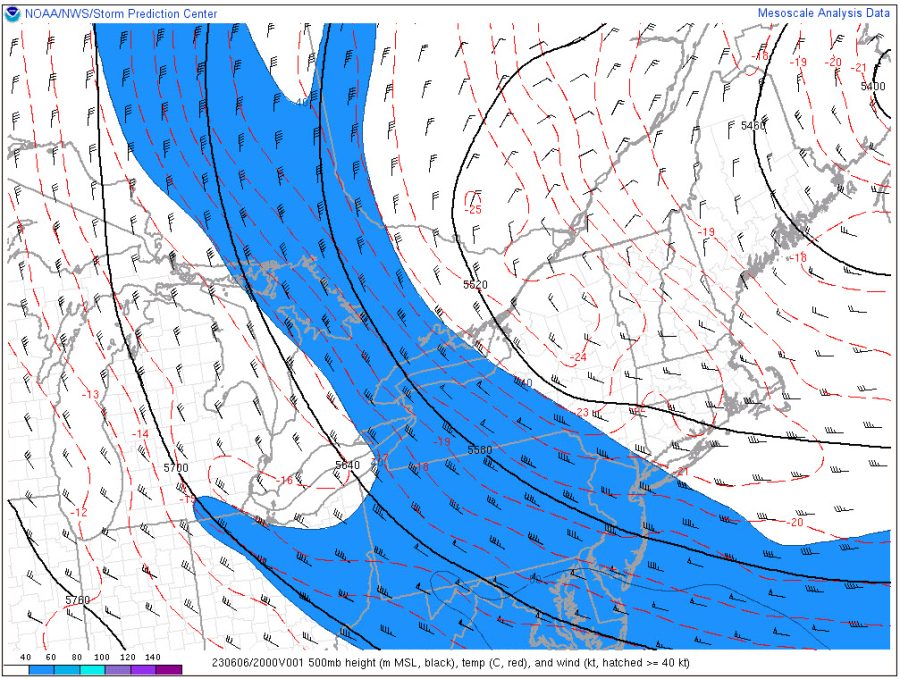
The overall storm top speeds line up fairly well with SPC Mesoanalysis between the 300mb and 500mb layer where speeds of 40-80 kts are noted over eastern PA and western Long Island, NY. Our storms have between 50-70 kts of speed at storm top, so it lines up fairly well with what the RAP mesoanalysis has. Very interesting. See the images below.

3:35pm CT: 1-min LtgCast has increased to ~90% at DSS point, with GLM showing ~1-2 flashes/5min.

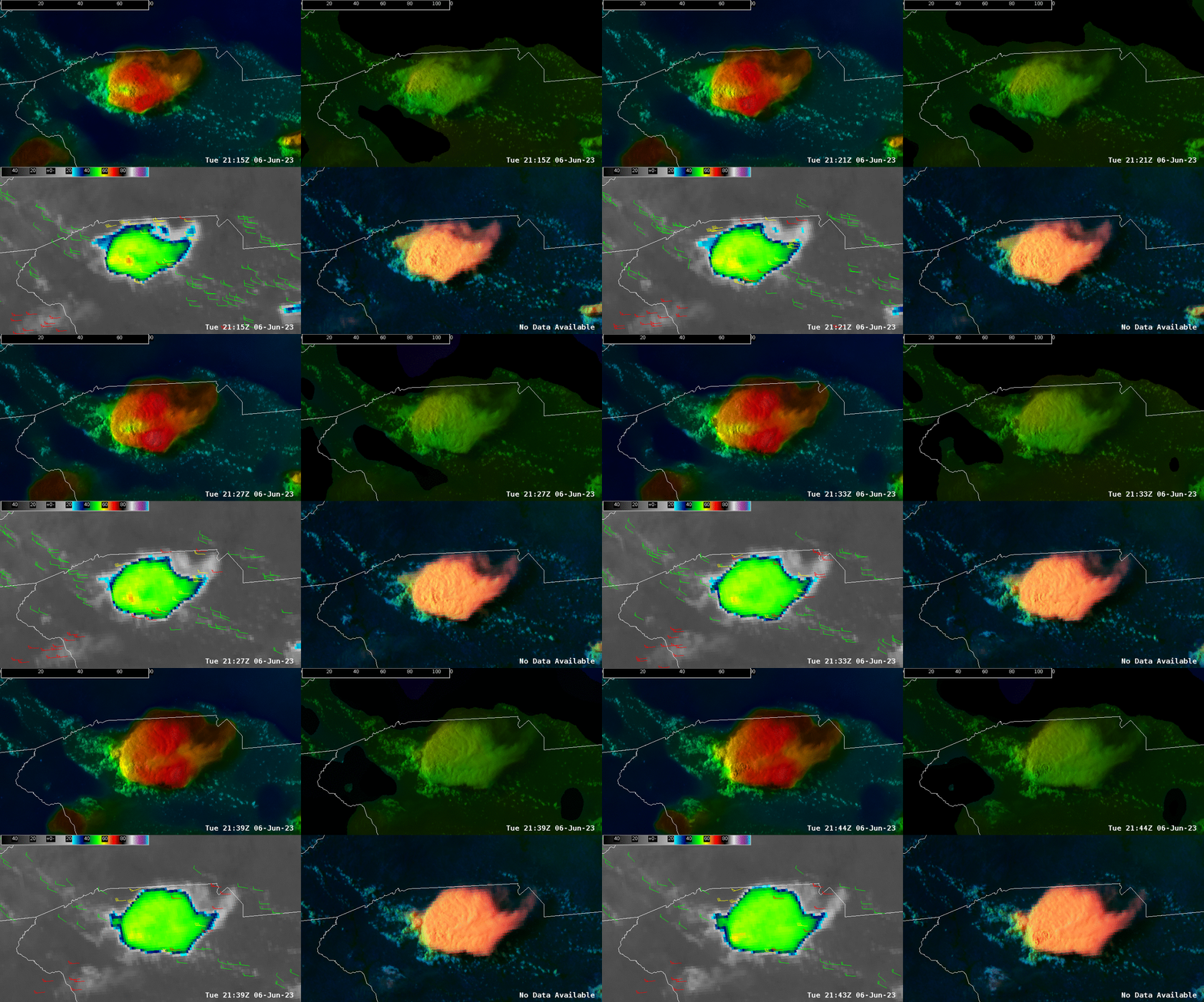
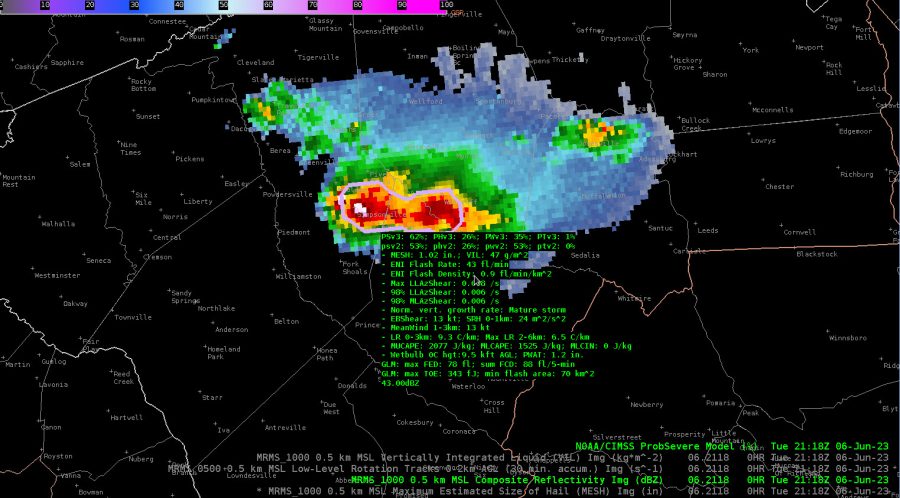
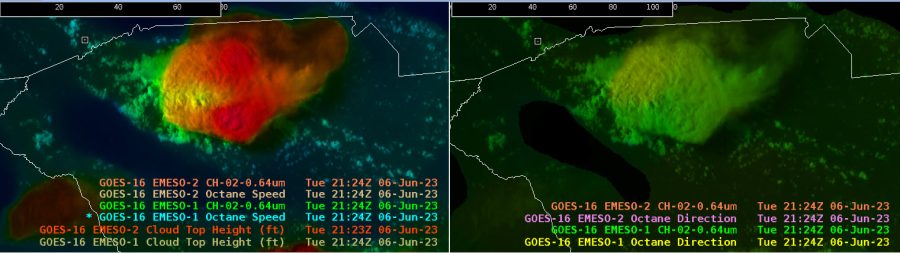
Interesting feature on a storm over upstate South Carolina to the west of Columbia. Some weaker winds aloft behind the overshooting top of the storm. Additionally, cooler cloud top temperatures are noted in the overshooting top. Increase in PSv3 values are notable as well with a ramp up in severe threat. The storm was severe warned at this time.

Additionally, you can note the fairly decent divergence aloft at anvil level with the OCTANE direction product.

-Satellite Steve & Displar


Tags: None

Severe Cell in TFX CWA

At WFO Great Falls (TFX), we made use of the Octane speed and direction imagery, plus the IR brightness and day-cloud phase distinction to evaluate a cell northeast of Iliad. This imagery helped us screen the multiple cells over the CWA so we could home in on this particular cell. Characteristics that stood out included the higher anvil speeds on this cell, the diffluent cloud top signal on the Octane direction imagery; the cooler cloud tops (around -62C), and new/robust convection noted by DCPD.

4 Panel OCTANE depiction of severe warned storm near Iliad, MT.

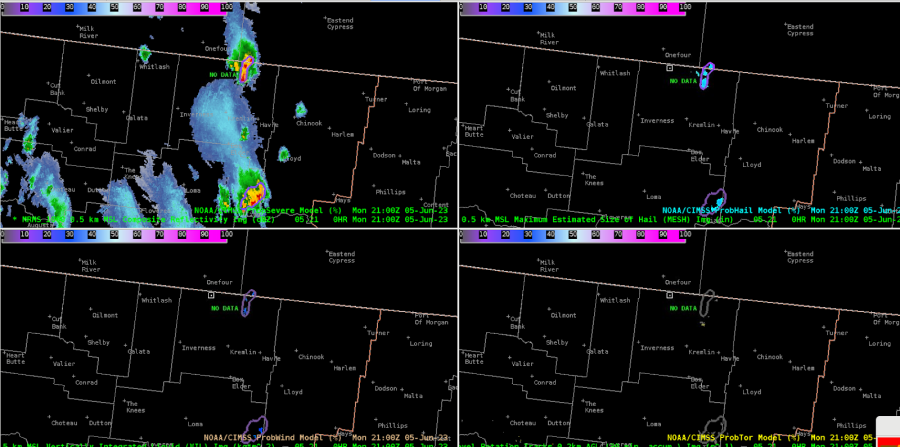
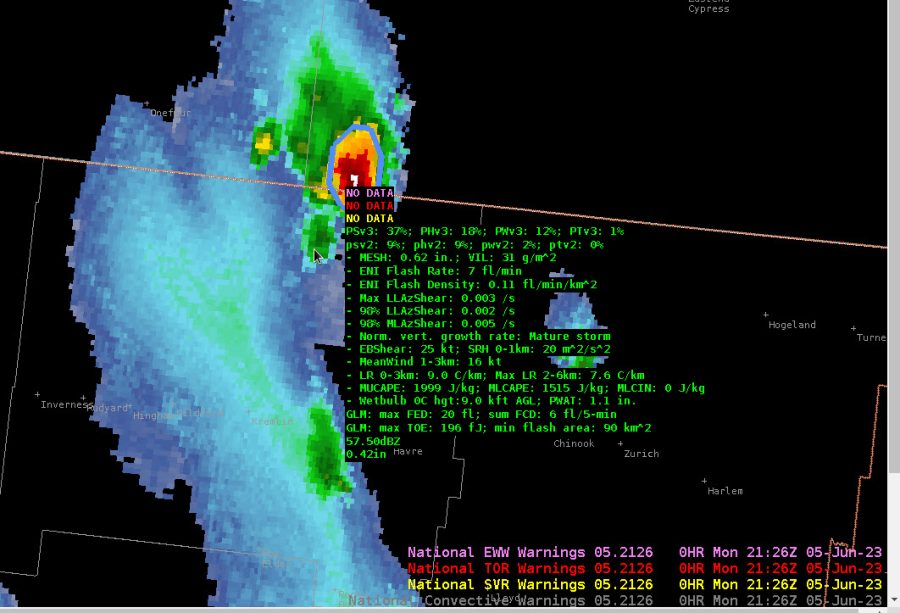
Meanwhile, the cell closer to the Canadian border is becoming stronger. The ProbSevereV3 is trending higher for total severe, up to 19% at 2104Z. The anvil from the storm to the south is beginning to impinge on the cell to the north and somewhat obstruct the view.

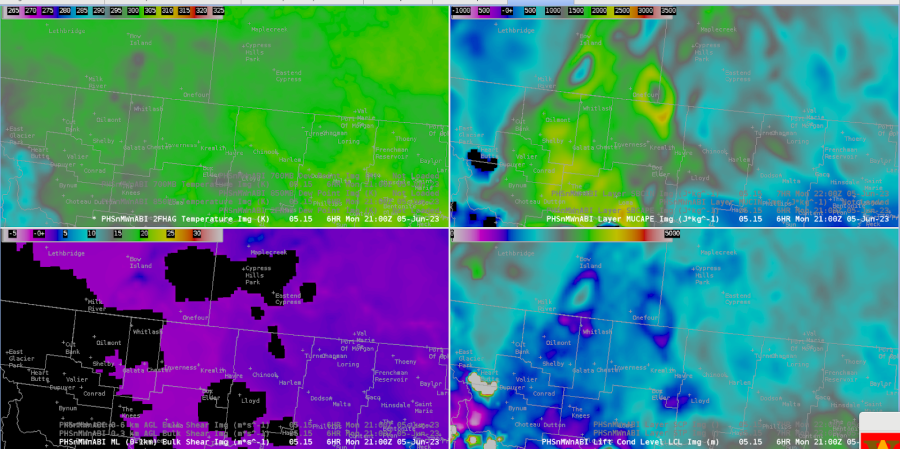
The PHS imagery showed a regional peak in MUCAPE in this area.

Looking a bit later, the total ProbSevere continues to climb. It is well above the individual probabilities, which is curious.

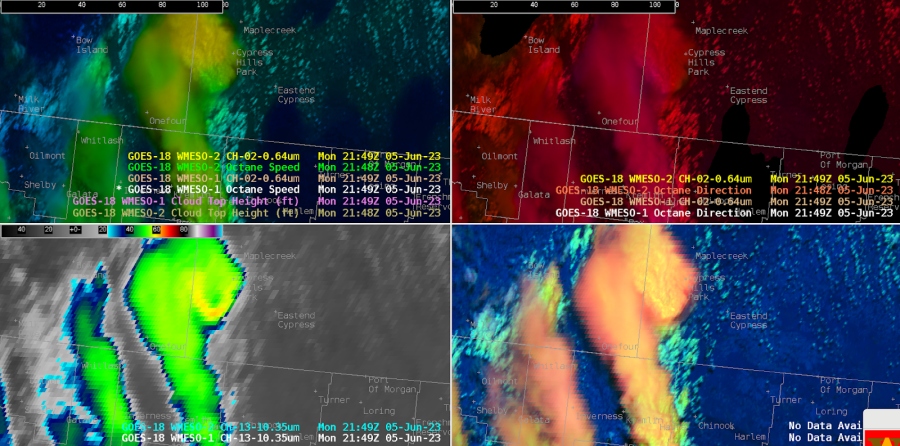
Storms have matured with a notable V notch of cooler cloud tops and warmer tops to the north of the notch. Based on Octane speed, there is a notable difference in speeds from the southern end of the anvil to the northern reaches with 35-40 kts increasing to 65-70 kts. PSv3 does indicate a 50% chance for severe with this storm.

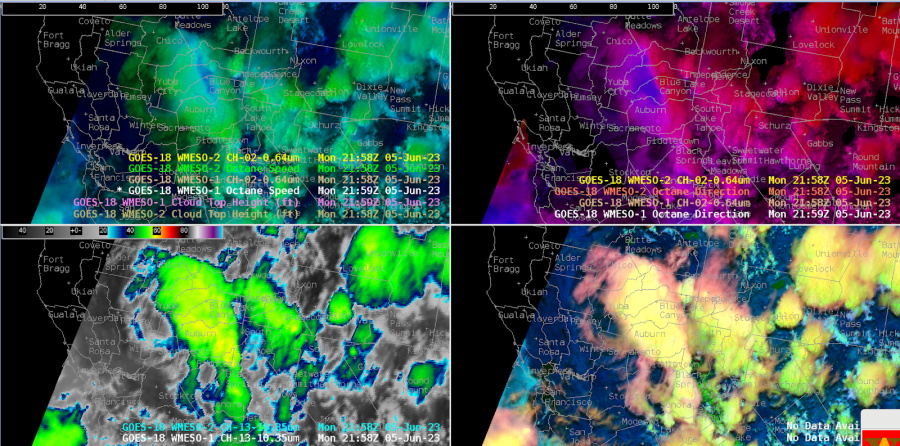
Meanwhile, down in CA, northeast of Sacramento, the Octane direction product is showing an impressive divergence signal!

–  Satellite Steve and Edgar

Tags: None

Satellite HWT Day 4 Carl

Satellite HWT Day 4 Thoughts

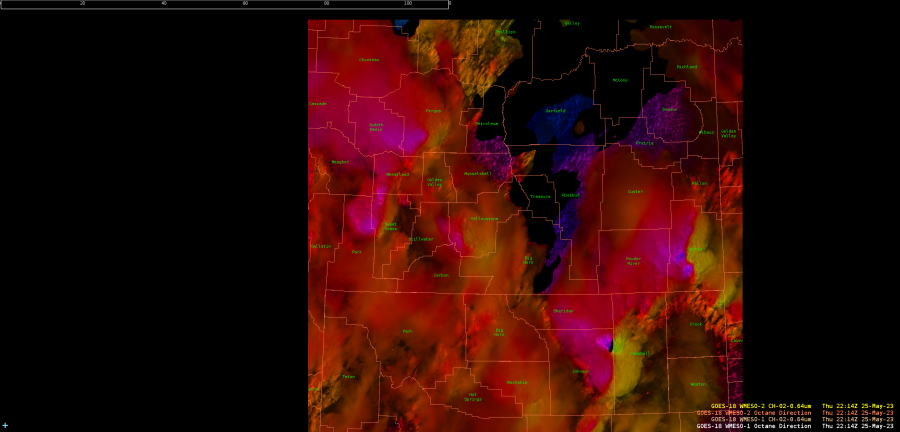
Octane Direction

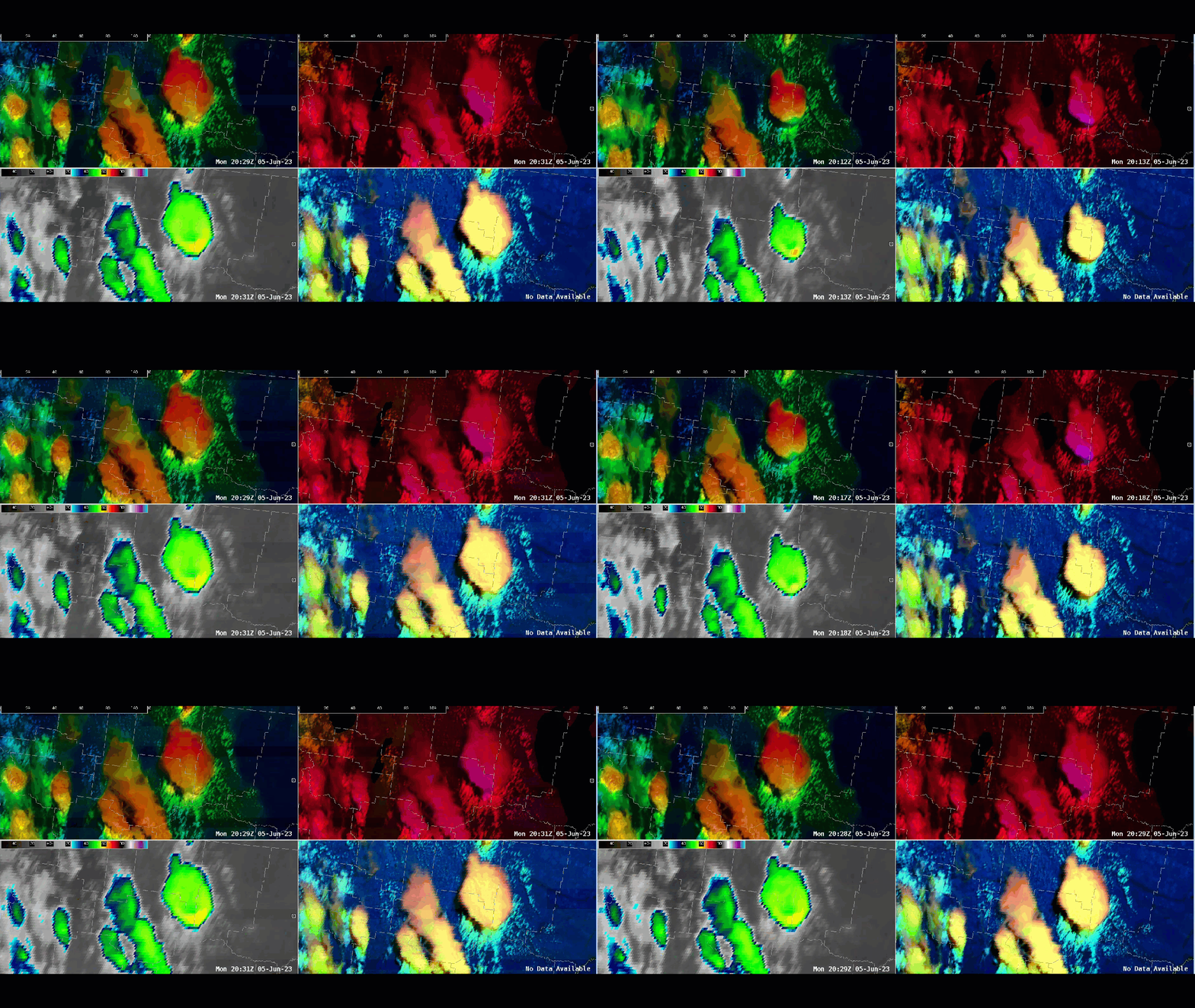
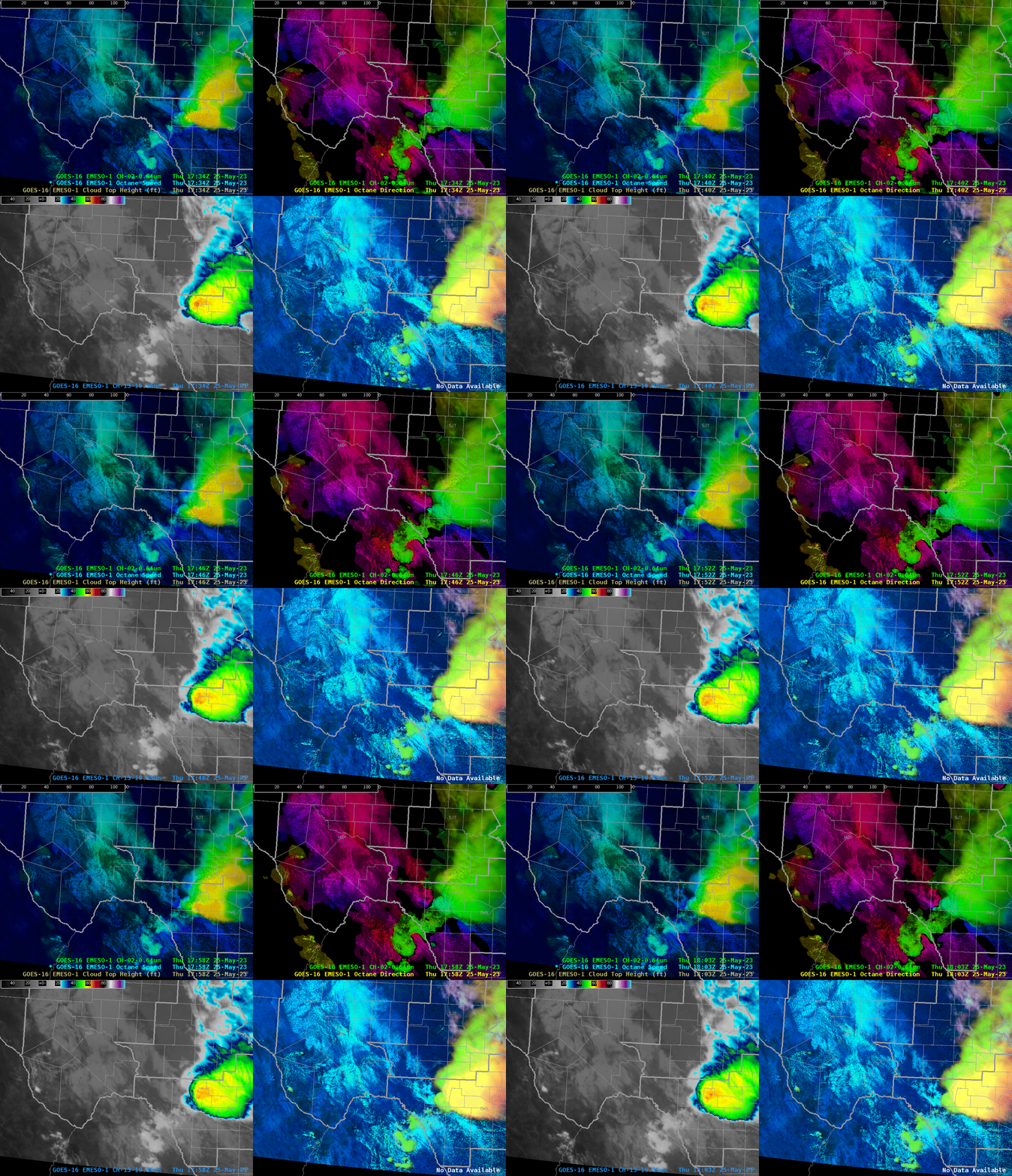
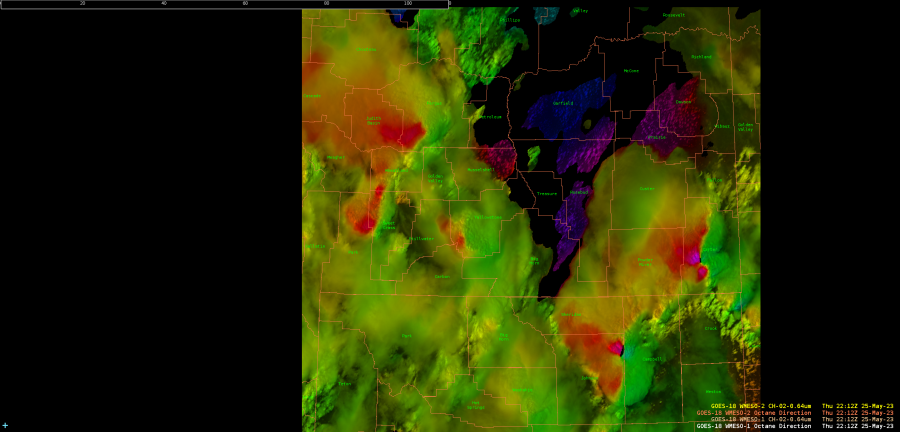
During my initial afternoon analysis I noticed a good use case for the directional product in identifying how different air masses may be coming together over the CWA. In the directional product below, we can see the magenta showing the moist surface air mass that is advecting up from the SE into west Texas and western NM. A drier air mass that is creating a bit of a dry line is pushing from the west in the more yellow colors, with some glaciating cu noted within the Day Cloud Phase RGB. Elevated convection that is still persisting from overnight can be see pushing to the southeast in the lower right, giving the more green colors. This provided a very clear and quick way to pick out these different air masses that will be the main players later in the afternoon for potential convection.

MoistGradConv RGB ECONUS

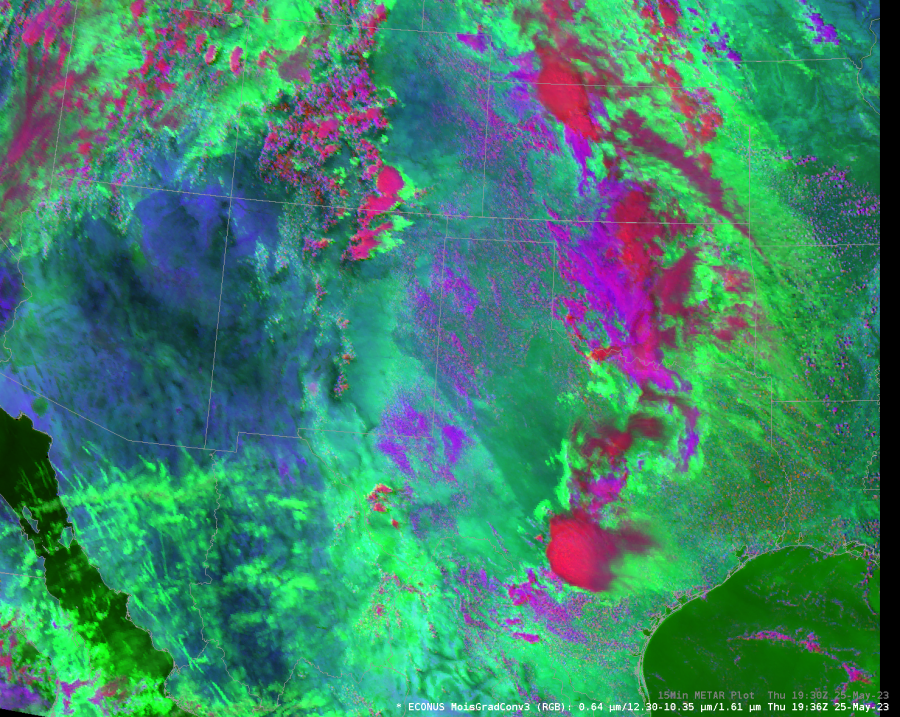
Some really interesting features that stood out when looking at this imagery during the afternoon today. Notice the sharp gradient in the light vs dark greens running across Texas, starting in the southern pandhandle near the NM border and then running SE through central parts of TX. When overlaid with 24 hour MRMS precip, you can see a clear boundary between the areas that received rain last night (the panhandle, darker greens) and the area that did not (lighter green in the Big Bend areas). This clearly stands out in the Snow/Ice NIR band which makes up a portion of the RGB. Moisture can also be seen pooling in west Texas as it moves northwestard along the edge of the Mexican Plateau. Obs later in the day showed that the “brighter” area was mixing out a bit faster given the lack of soil moisture. Some good potential situational awareness being combined within the RGB, given the ability of this to also pick out things like the dry line a little bit easier.

ProbSevere v3

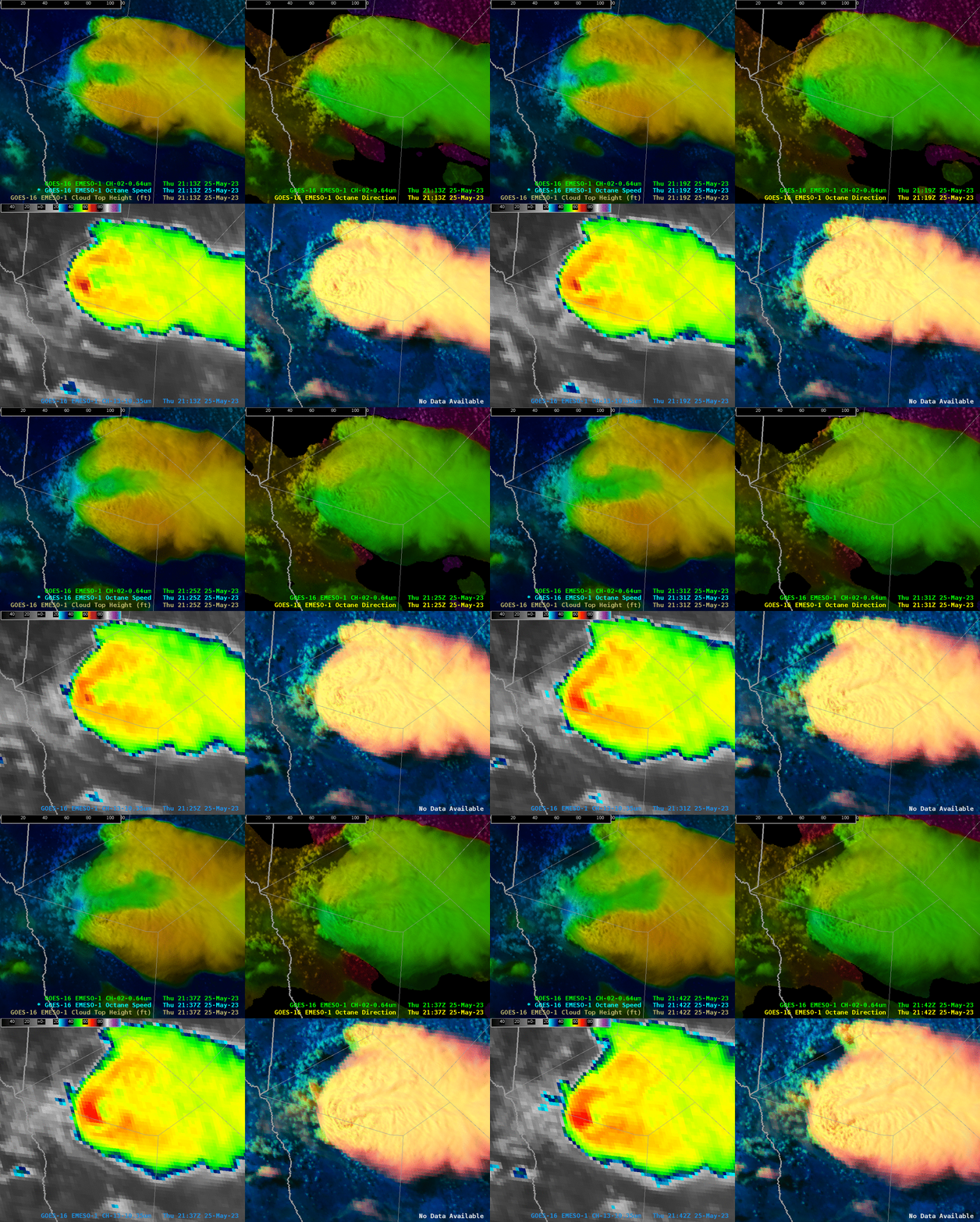
Issued a warning in an area of pretty poor radar coverage (lowest tilt height was around 15kft). MRMS was still capturing a good bit of the freezing level to -20C isothermal levels, so ProbSevere was running pretty strongly with hail probabilities. Additionally, there were some significant bursts of cooler cloud tops, and the Octane product began to show some of the stronger “divergent” signatures that we had seen throughout the week as well as highlighting a clear AACP, all signs of a stronger updraft capable of keeping hail lofted.

Given the environment, these products definitely gave me additional confidence and potential lead time, given these cores really grew tremendously about 15 minutes later, including an eventual split and right mover that likely produced some large hail (hard to verify in this area given lack of population).

More Octane (Speed)!

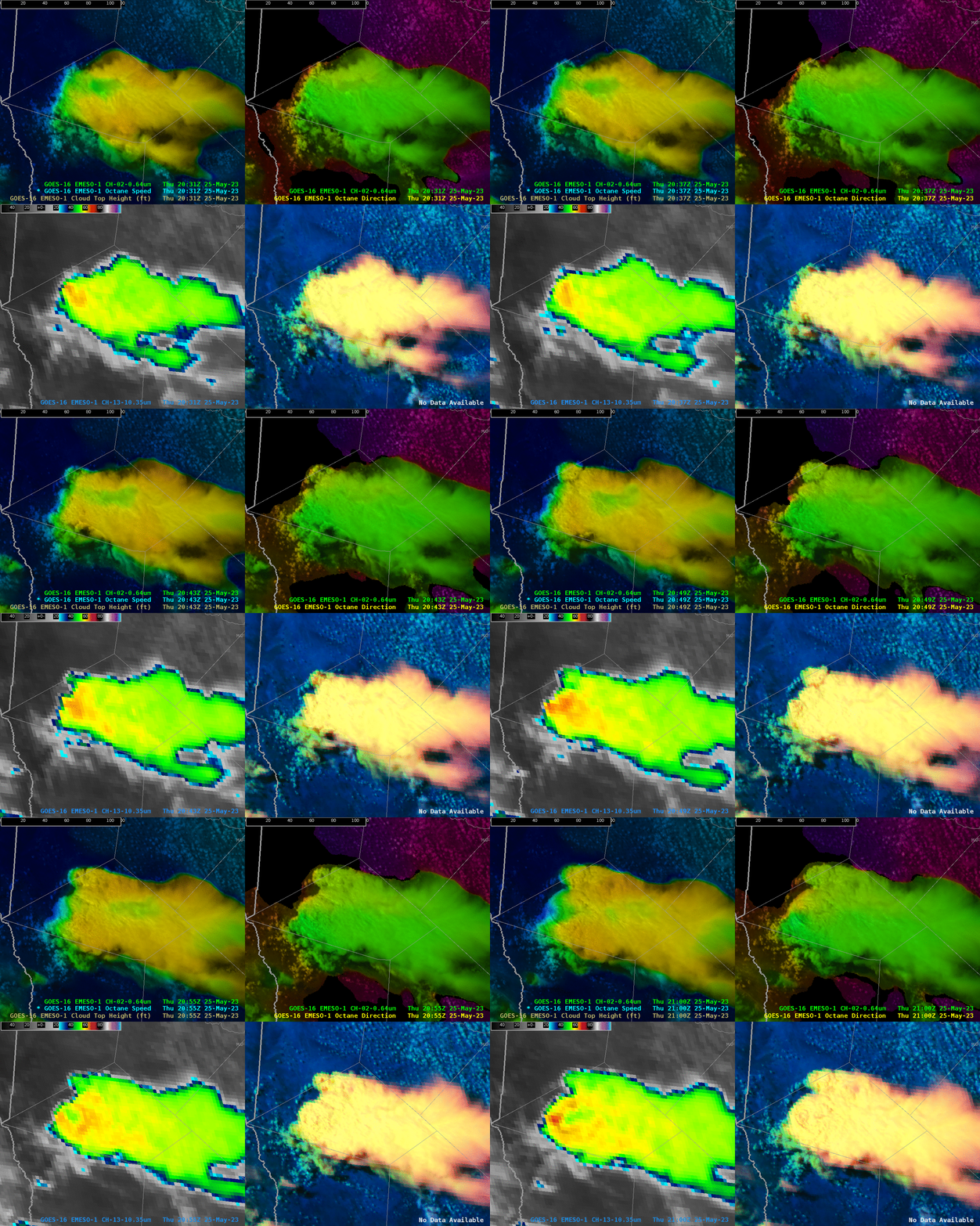
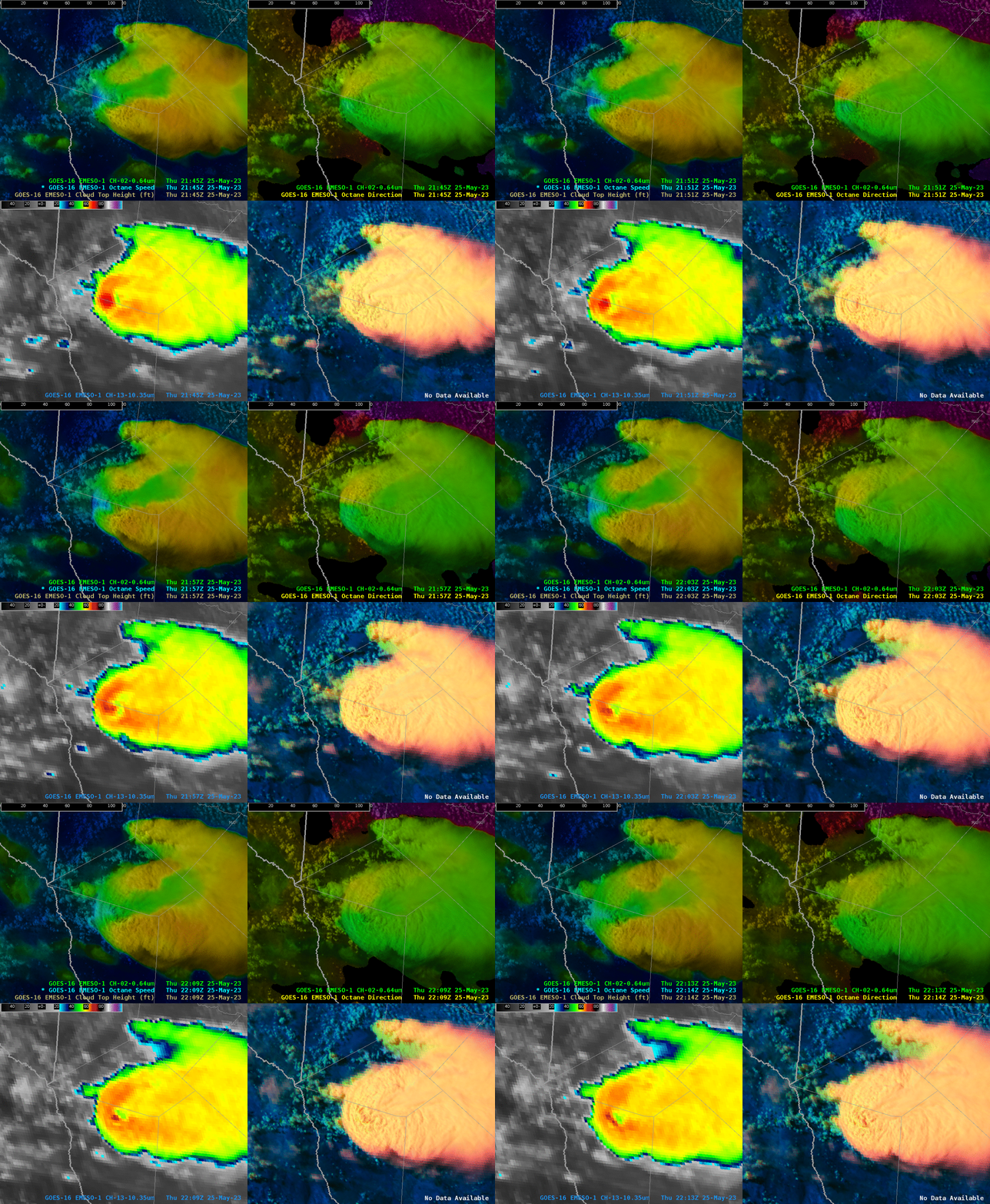
Another picture from later of how this storm grew and exploded. Octane was showing yet another AACP. A very interesting feature of this is that Octane speed algorithm does seem to be “tracking” the AACP in a way. There are a lot of research groups out there that have been looking at ways to track these features for injections of tropospheric moisture into the stratosphere among other things, so this could be a novel way at looking at that problem.

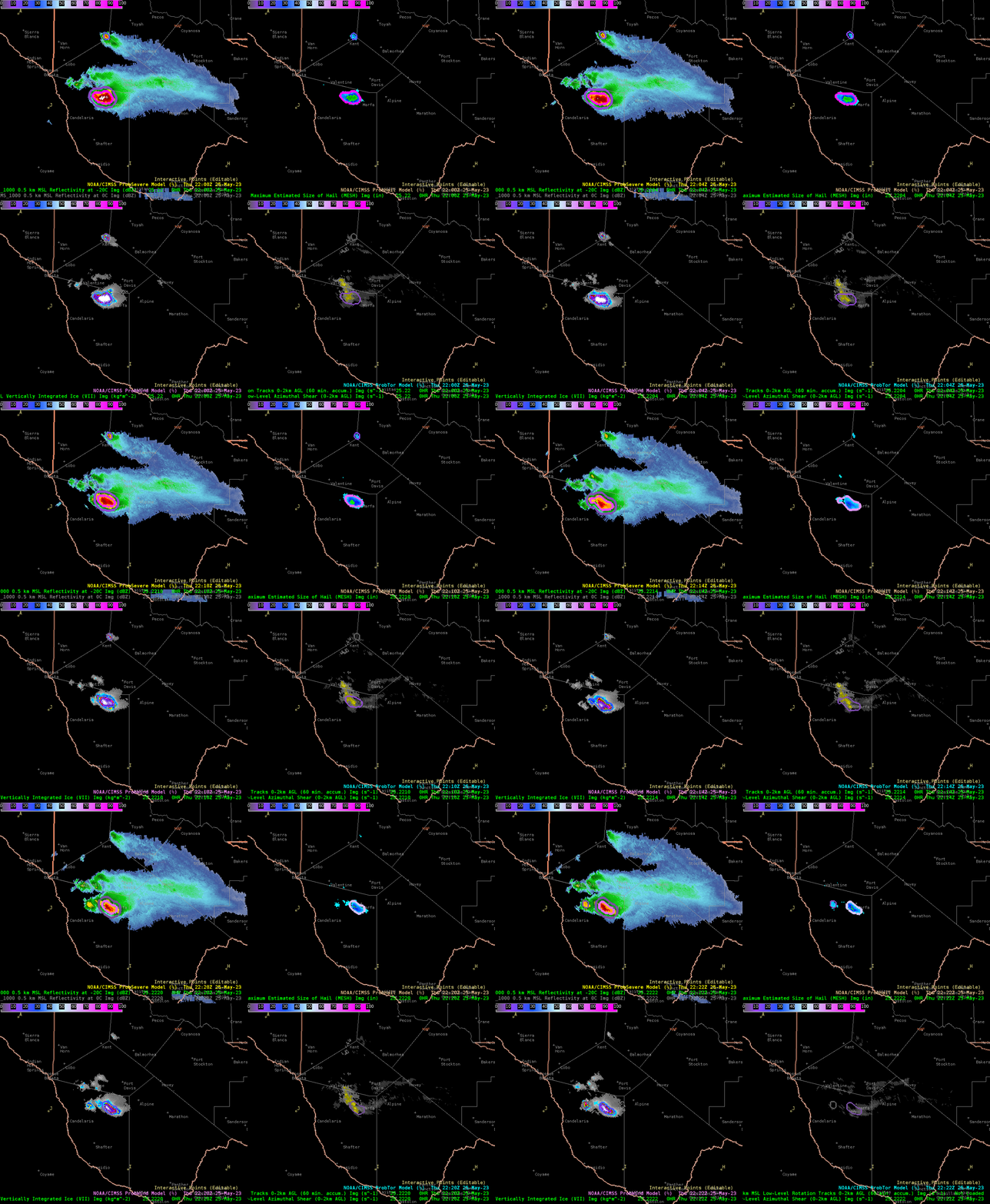
An hour or so later, we can see how the Octane product can be used to see that a storm was weakening. The deep blue divergent signature began to quickly fade, an indication that the updraft wasn’t as strong as it was previously. Given this is data flowing in from the mesoscale sectors on GOES 16, we are getting one minute updates, which will give some lead time over analyzing the core of the storm via the radar or MRMS which needs to get the radar data and then process it. This can be important for SVS or considerations for a downstream severe. I ended up still issuing a downstream severe, but was able to use what I was seeing in the product with the weakening trend to decrease the expected hail size. MRMS and ProbSevere trends closely followed, moving downward in severity.

Above: Weakening trend starts around 22Z for the Octane Speed product in the top left

Below: ProbSevere and MRMS trends begin to come down around 22:05Z or so, lagging the above by a few minutes. Every minute counts in lead time.

-Carl Coriolis

Tags: None

Octane Direction Corrected Wind Speed Color

Octane Direction is a useful tool but changing the color table helps. I think we need get away from the pinks and reds. The top image is the corrected color table while the bottom was the uncorrected. Some of the stronger storms still stick out with divergent but a lot of the weaker but still significant outflows are masked by the pinks and reds. For me to get these results I did need to change the table to only go to direction 270 which made everything from 270-360 the same color, which in the current environment worked well. I am hoping with some more experimenting we could find a color table that goes to 360 that looks more similar to the upper picture.  -Thunderstruck

Tags: None

New Four Panel

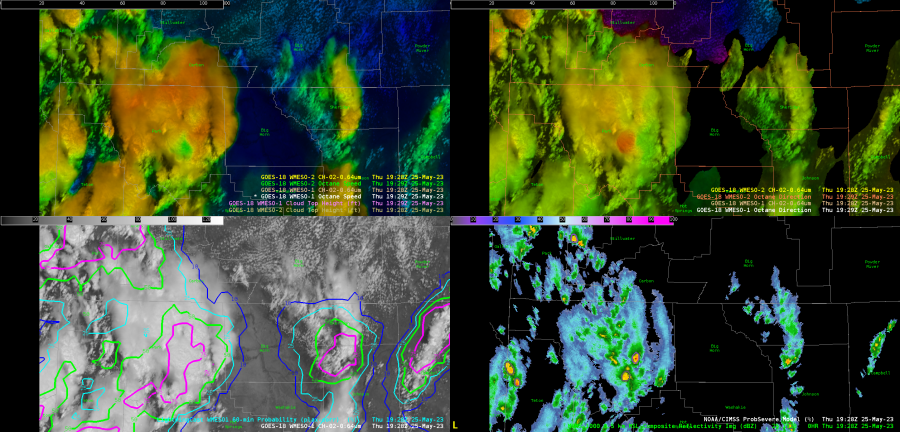
After a few days at the HWT I have decided to make a four panel of my own with the new products which has been working great! On the top left we have Octane Speed with Octane direction on the top left. We have Vis with lightningcast and GLM 1 min lightning on bottom left. On bottom right I have MRMS data and ProbSevere V3.  I was very happy with this display for situational awareness.

Also in the image below we can easily spot a stronger storm in a cluster of cells in Park County looking at directional and speed shear with Octane. Then we can quickly look down at ProbSevere and see its on the one storm being highlighted. That tells me this is the storm that I need to watch over the next 10-15 minutes for development.

-Thunderstruck

Tags: None

PHS and GLM Data for Tampa Florida this Afternoon and Evening

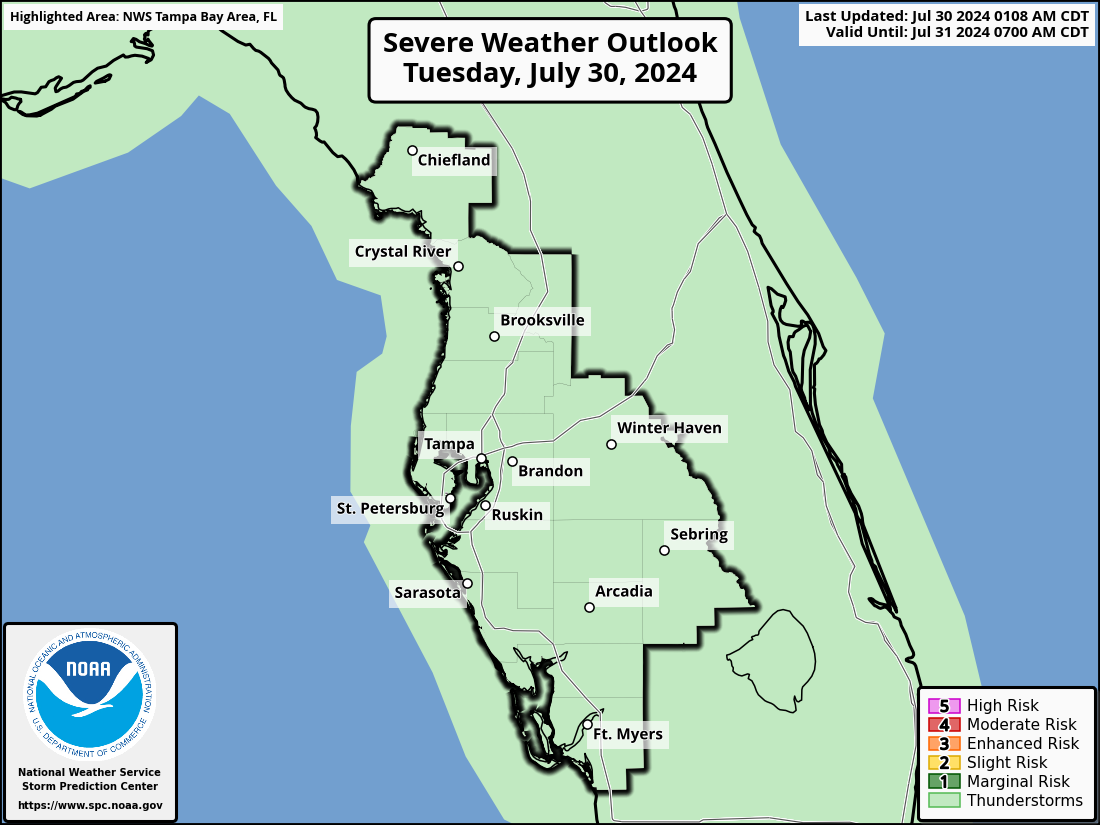
General Risk for Thunderstorms in Florida this Afternoon and Evening

The Tampa CWA is in a general risk for thunderstorms this afternoon and evening per the SPC.

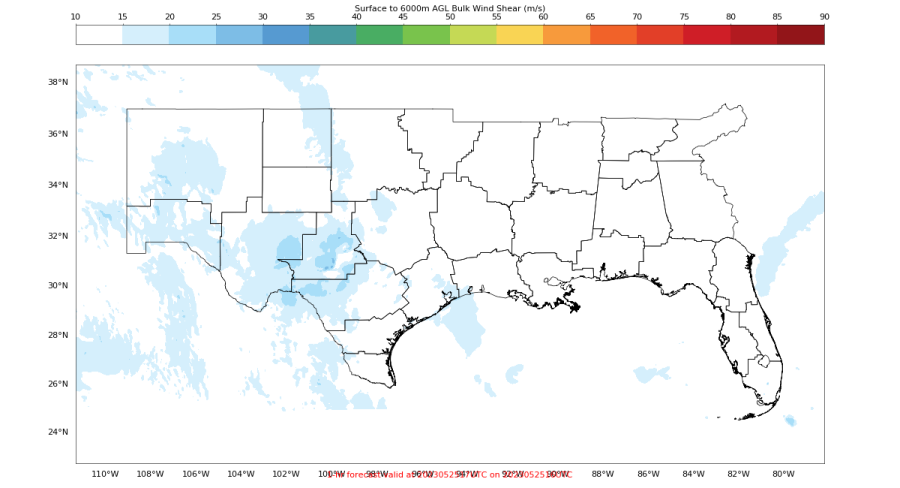
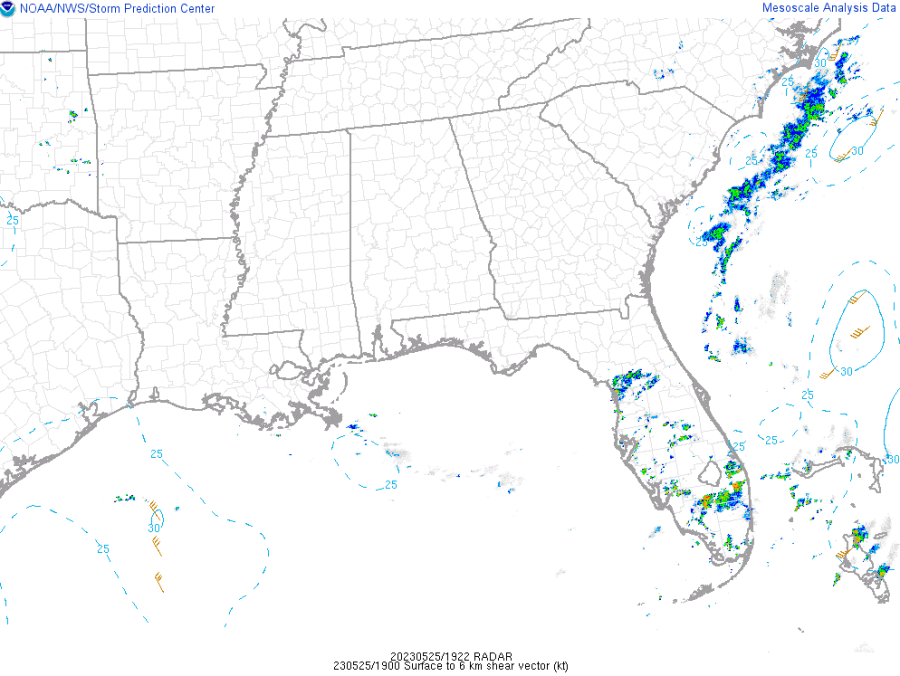
The main potential impacts are frequent lightning, heavy rainfall, and gusty winds thanks to decent amounts of SBCAPE.  Localized flooding  also remains possible, especially in urban areas,  due to slow storm motion as PHS shows no 0-6 km Bulk Shear over Florida. This matches well with the latest SPC Mesoanalysis which also shows no 0-6 km Bulk Shear shear over the region.

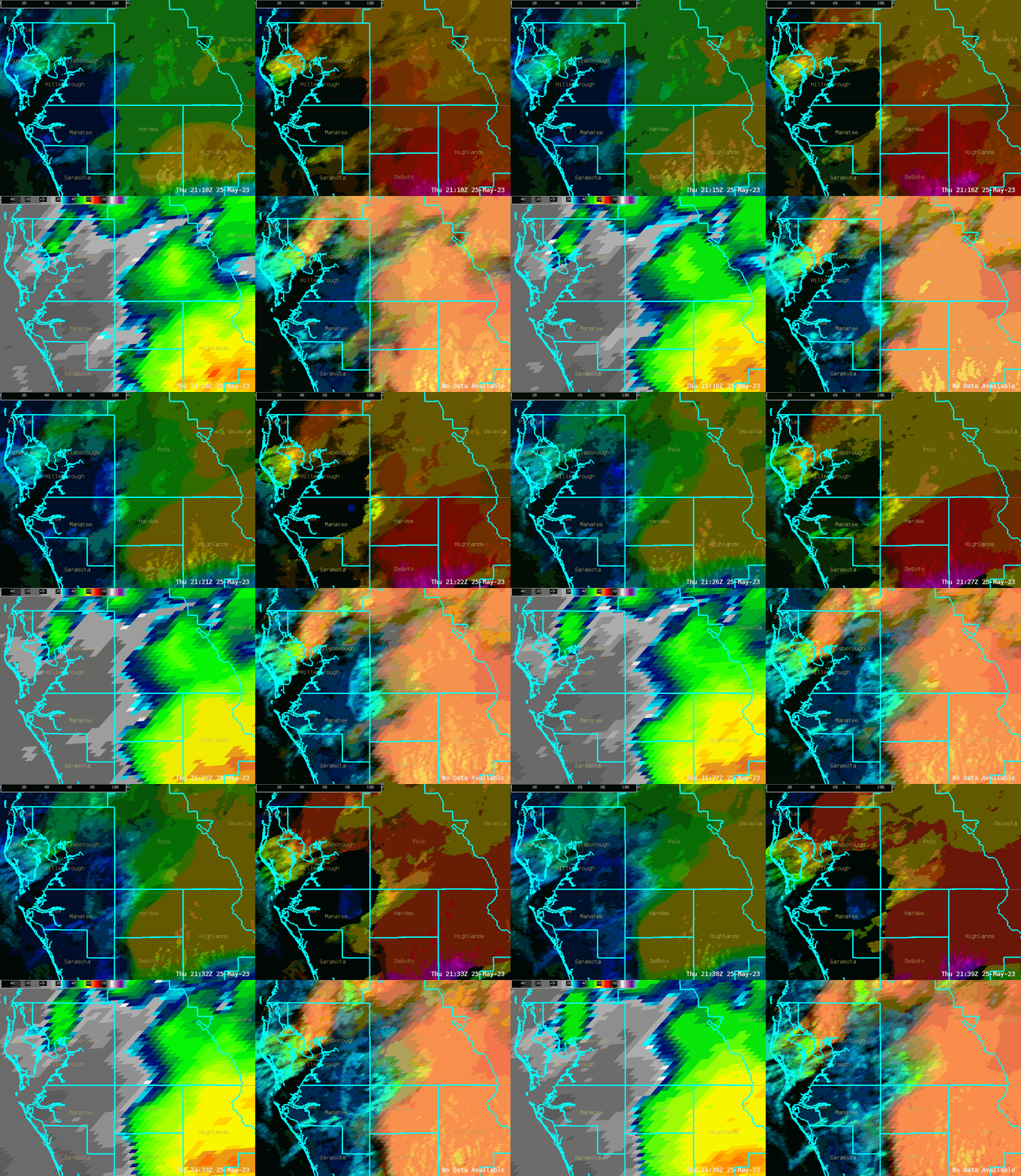
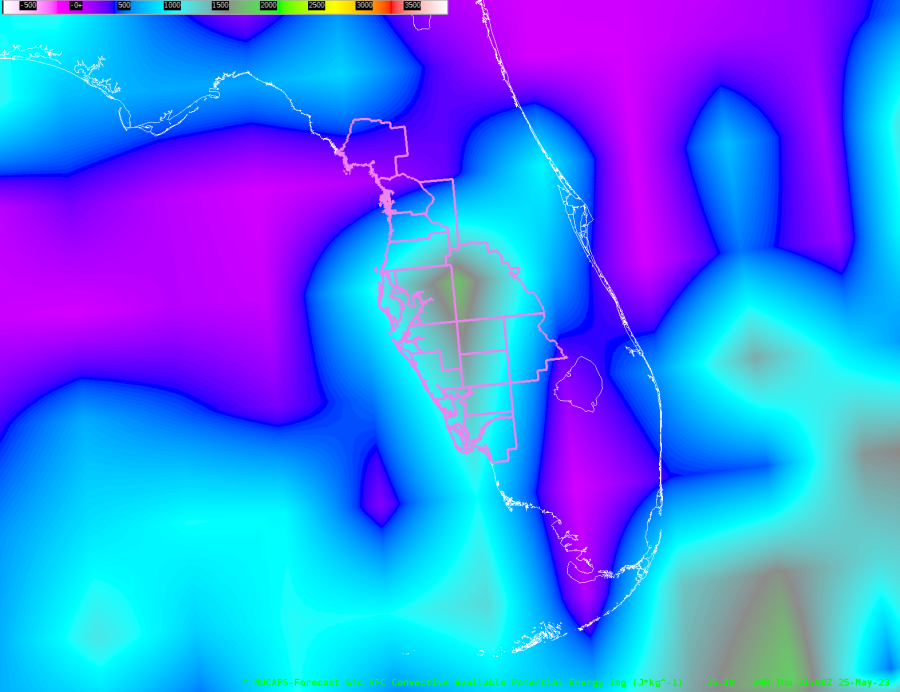
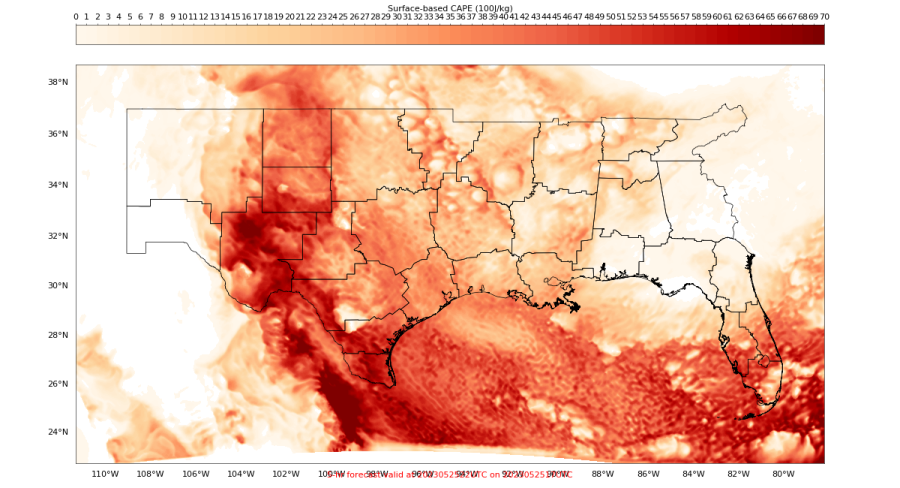
NUCAPS showing SBCAPE values at 21Z. Values are highest across the central and southern portions of the Tampa CWA. Areas in green had values around 1600-1700 J/kg. Areas in teal show values ranging from 800-1400 J/kg. Areas in purple range from 200-300 J/kg.  PHS shows a similar trend to NUCAPs with higher areas of SBCAPE across the central and southern CWA with lower values across the northern half of the CWA. However, the color scale on the online version of PHS is difficult to interpret as the gradient ramps up from light red to dark red. So, you cannot really pinpoint specific values of SBCAPE. However, you are able to see areas of lower SBCAPE and areas of higher SBCAPE at a glance. 

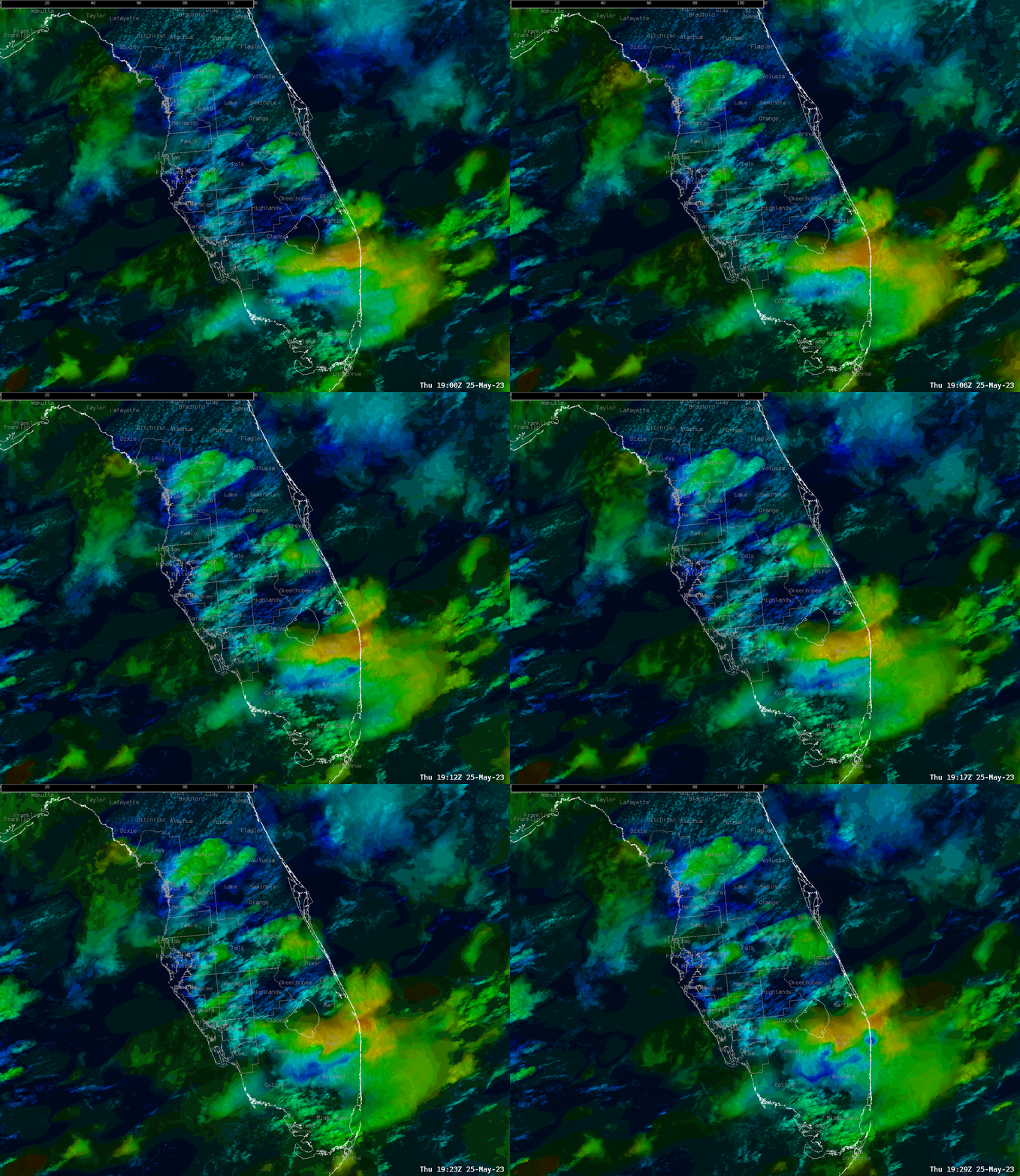
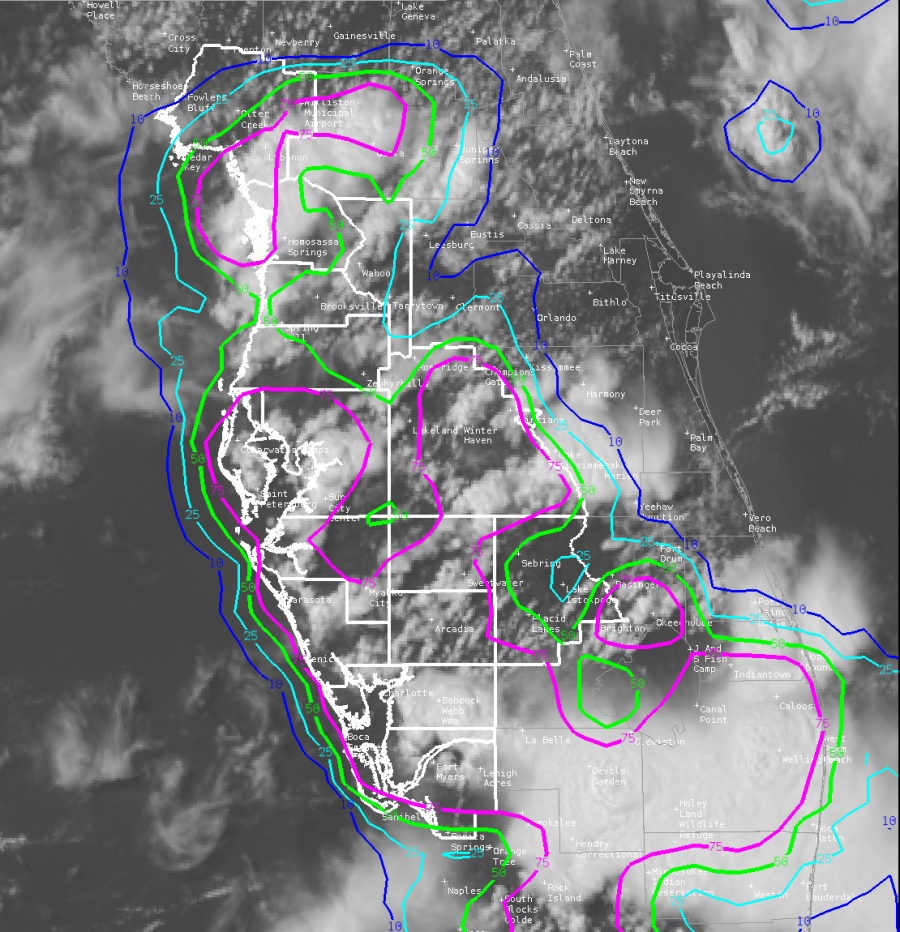
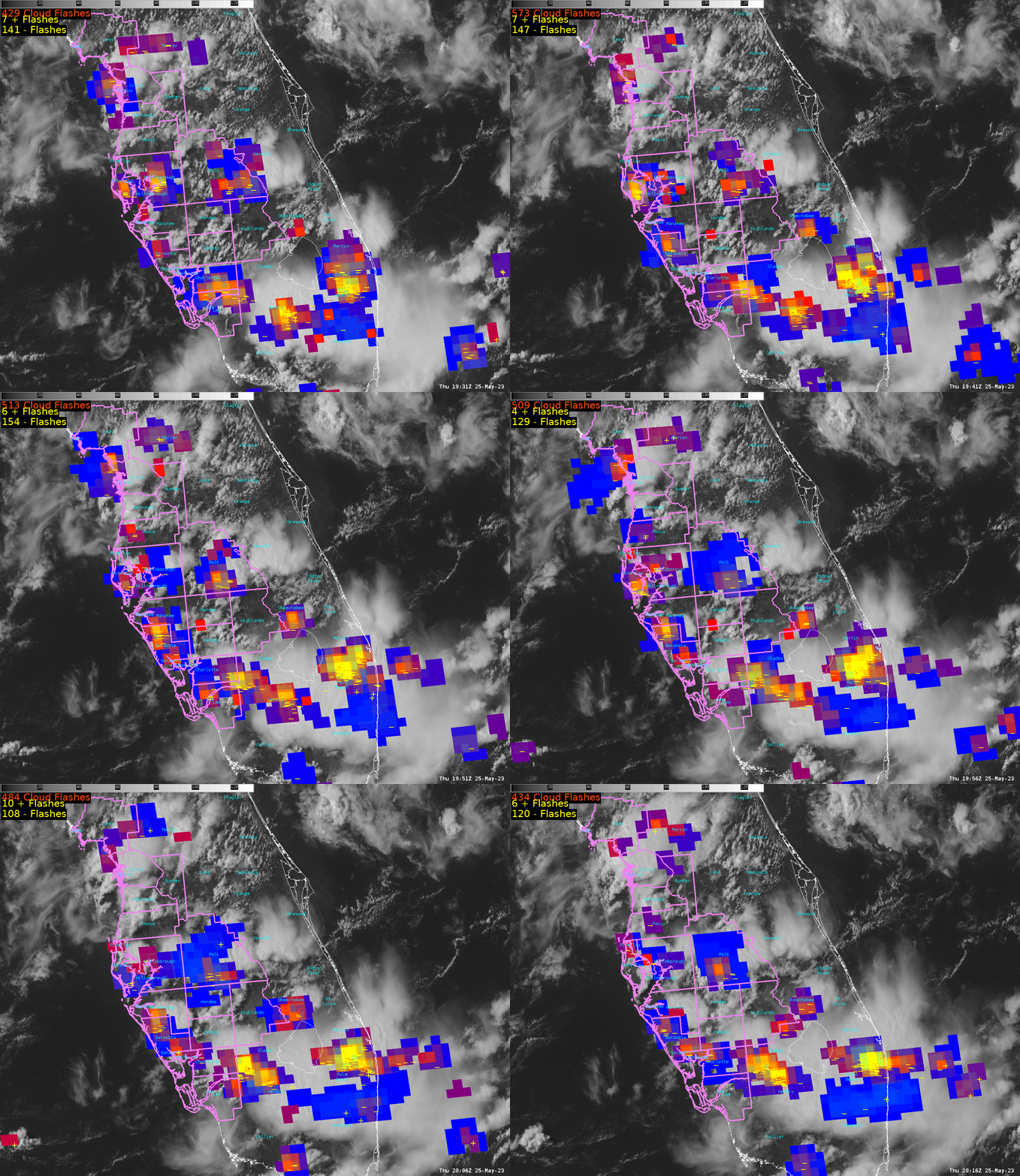
ProbSevere version 3 increases our confidence that storms will remain generally sub-severe as ProbSevere values are below 10% across the Tampa CWA as of 1930Z.The Octane Speed Sandwich product further confirms that storms are remaining below severe limits as the strongest storms are noted over southeastern Florida this afternoon as of 1930Z. Not only do these products help us pinpoint areas of potential severe weather, but they also help us pinpoint areas of sub-severe weather.  GLM shows lightning activity increasing across the Tampa CWA early this afternoon, and activity is expected to gradually increase in coverage as more thunderstorms develop through the late afternoon and early evening hours.  Lightning Cast around 1930Z shows lightning probabilities increasing across the Tampa CWA over the next hour. Pink contours represent a 75% chance of lightning in the next hour. Green represents a 50% chance, teal a 20% chance, and dark blue a10% chance of lightning in the next hour. GLM showing lightning activity increasing across Florida from 1930Z through 2016Z across the Tampa CWA. Areas showing more oranges and yellows have shorter flashes and more lightning density. These areas help us know where stronger updrafts are located. The strongest updrafts at the time of this loop remain outside of the Tampa CWA.  -Dwight Schrute

Tags: None

Using Octane, GLM, and ProbSev for Warning Operations with Very Little Radar

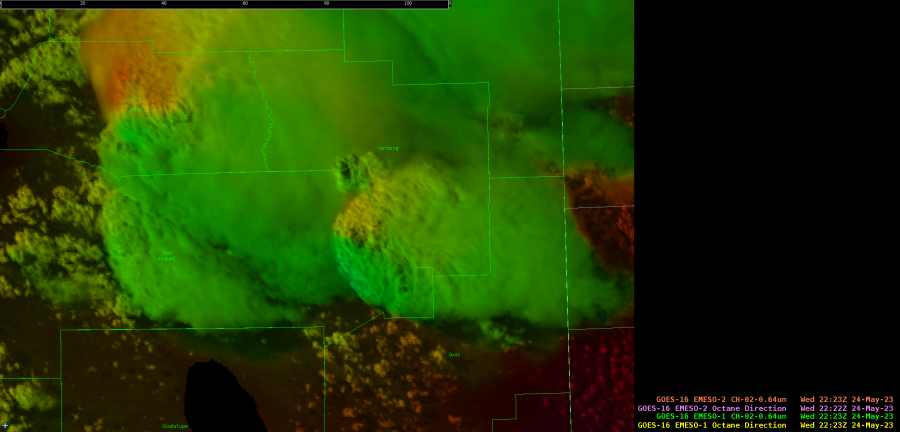
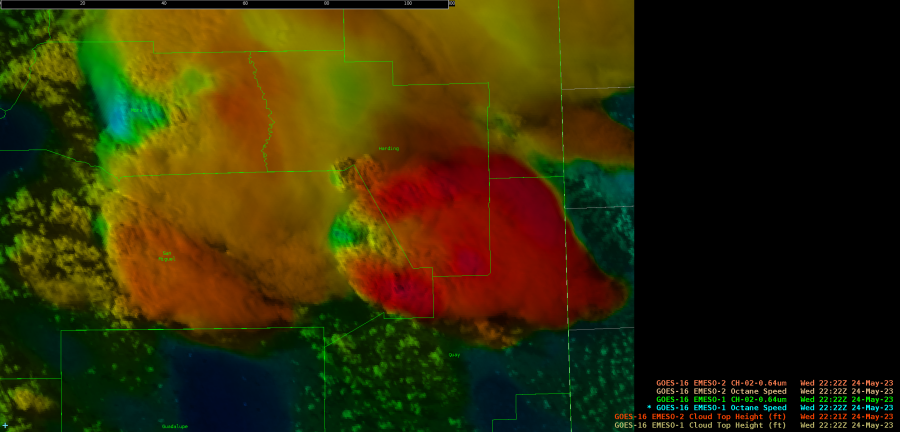
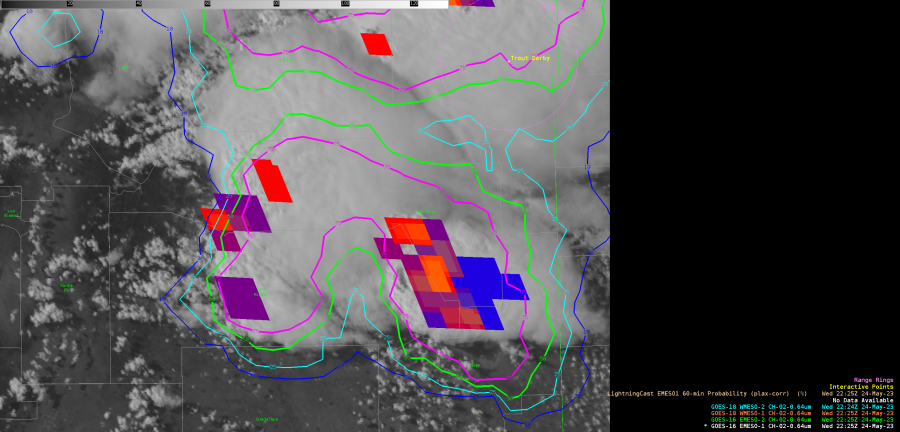
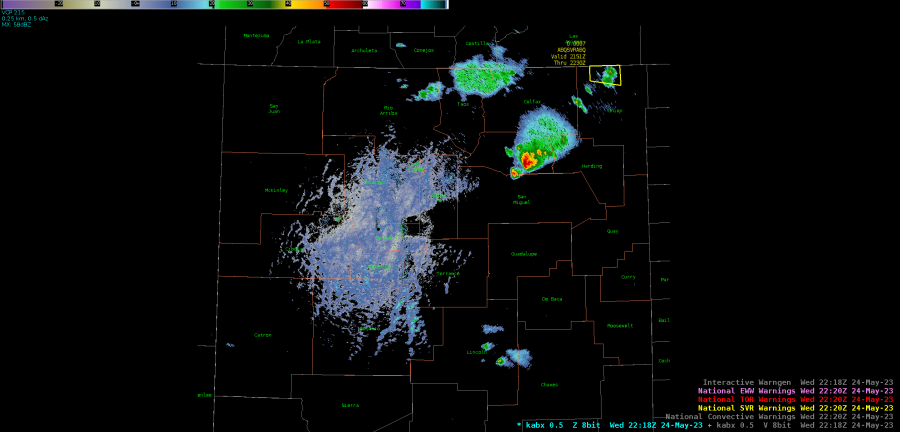
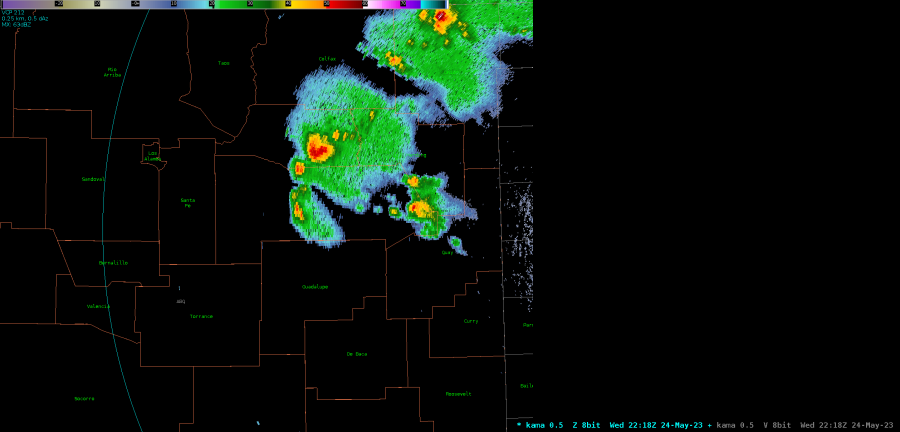
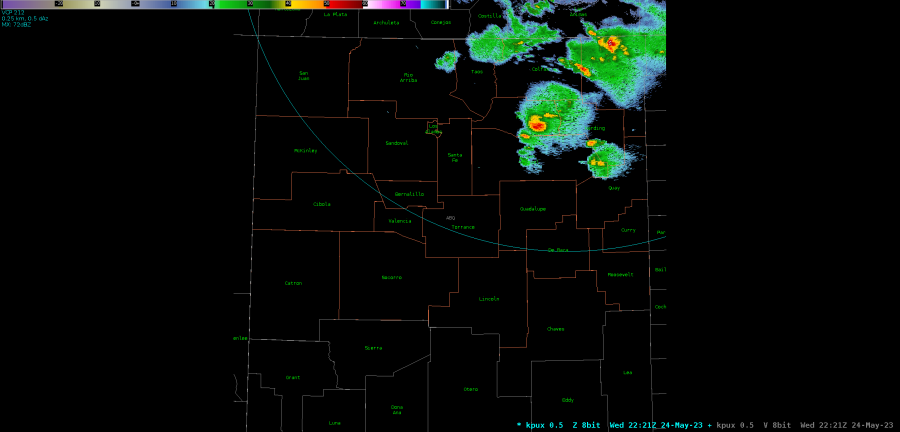
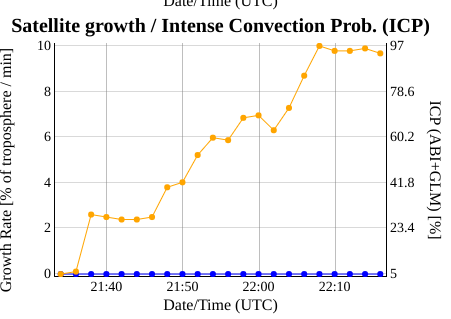
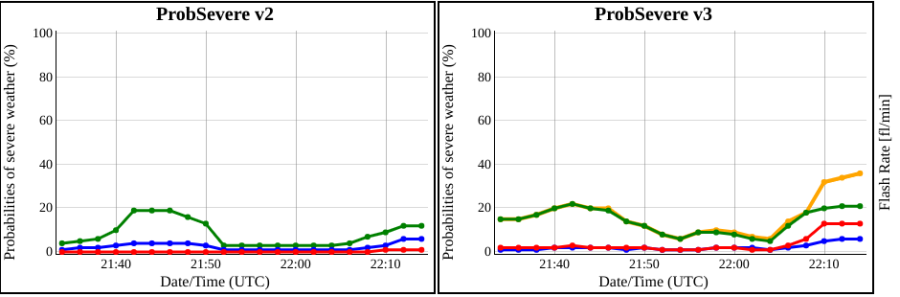
A severe thunderstorm warning decision in eastern New Mexico was a challenge today as it was within a KABX beam blockage and the eastern NM radar, KFDX, was down. The signs of the intensifying storm were found on satellite, GLM, and then slowly ProbSevere as the radar reflectivity heights from KAMA (the nearest valid radar) were very disorganized and slow to respond compared to the trends depicted by satellite and GLM trends. An above anvil cirrus plume, IR thermal couplet, consistent GLM FED/MFE signature, and cloud top divergence depicted by the Octane Speed/Direction product showed signs of strong convection developing. While reflectivity below showed just a minimal 50 dbz core and no 60 dbz core. As ProbSevere V3 gradually increased to around 35%, the ProbSevere ​Satellite Growth/Intense Convection Prob. quickly ​increased. The satellite growth/Intense Convection is not weighted as high in V2 and because of that ProbSevere was much lower at the same time.  While the radar reflectivity core was still missing, we decided to issue a warning for the storm given the other satellite based signatures. ProbSevere V3 began to show strong chances for severe weather approximately 13 minutes after the warning was issued, and a strong 60 dbz core developed on the KAMA radar shortly after with MESH getting as high as 3.5 inches.

GOES-16 Octane Direction.

GOES-16 Octane Speed.

GOES-16 GLM RGB

KABX 0.5 degree reflectivity.

KAMA 0.5 degree reflectivity.

KPUX 0.5 degree reflectivity.


​_

ProbSevere probability charts.


MRMS output showing radar data approximately 20 minutes after warning issuance.


-Thunderstruck

– Joaq

Tags: None

Satellite HWT Day 3 Carl

Wednesday Satellite HWT Thoughts

PHS Model Comparisons and Thoughts
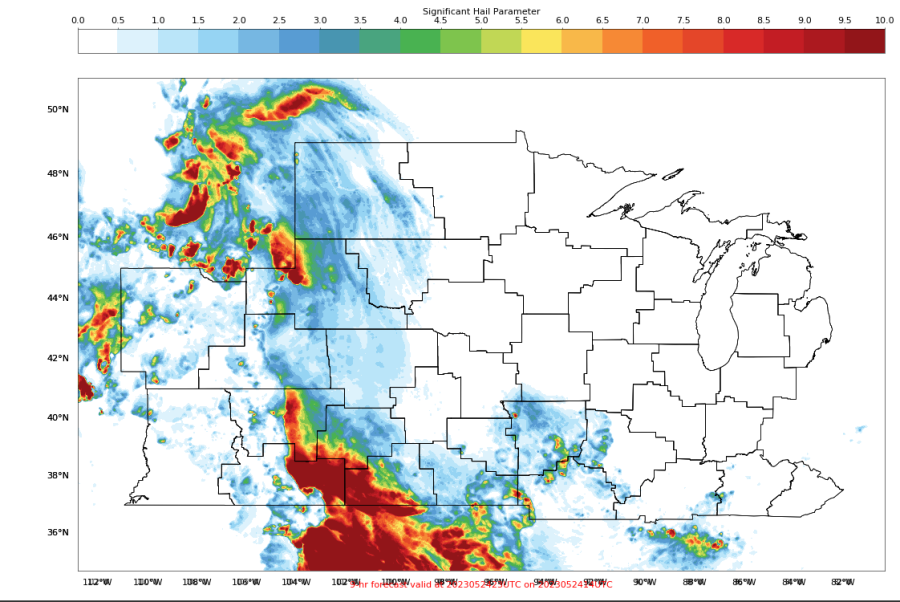
Above: Top is HRRR SHIP parameter, bottom is PHS SHIP parameter.

Looking at some of the convective parameters and indices around the CWA I was working with today (PUB), one thing that really stood out to me was how “splotchy” many of the parameters were when compared with the HRRR model. It’s very hard to believe that the model, especially at a 3 km resolution, is able to obtain that level of accuracy with regards to these parameters, or at the very least having gradients this sharp in many of these parameters doesn’t make much sense. Wondering if some of it is being driven by the extreme CAPE gradients that do show up later on, which are certainly going to be drivers in many of the severe indices.

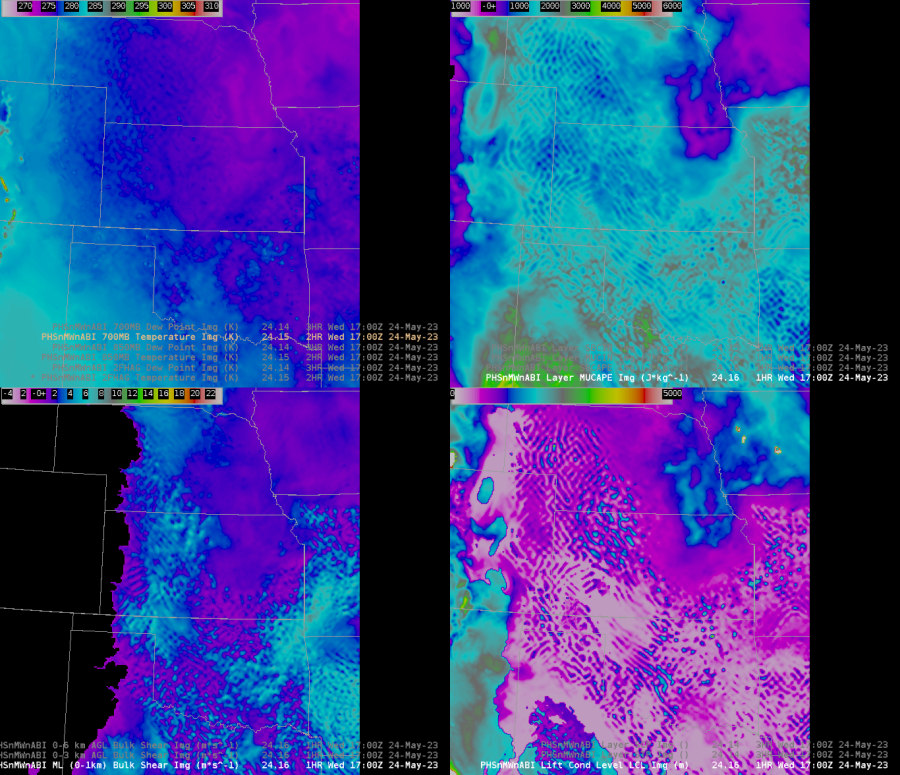
Another thing I noticed is what looks to be a wave-like numerical instability within the first hour of the model – this could be having some big impacts on the model forecast, as you can see these reflected in the base fields (T, u, v, etc) and then having impacts on many of the other derived parameters that last through the forecast period, as shown in the image below:
CAPE also seems to initialize really high, then “jump” down to a lower value at the first hour. This is quite a large “adjustment” from the initial conditions that the model seems to start with. Shown below are hour 0 of the 14Z run and hour 1 of the 14Z run from Wednesday 5/24.
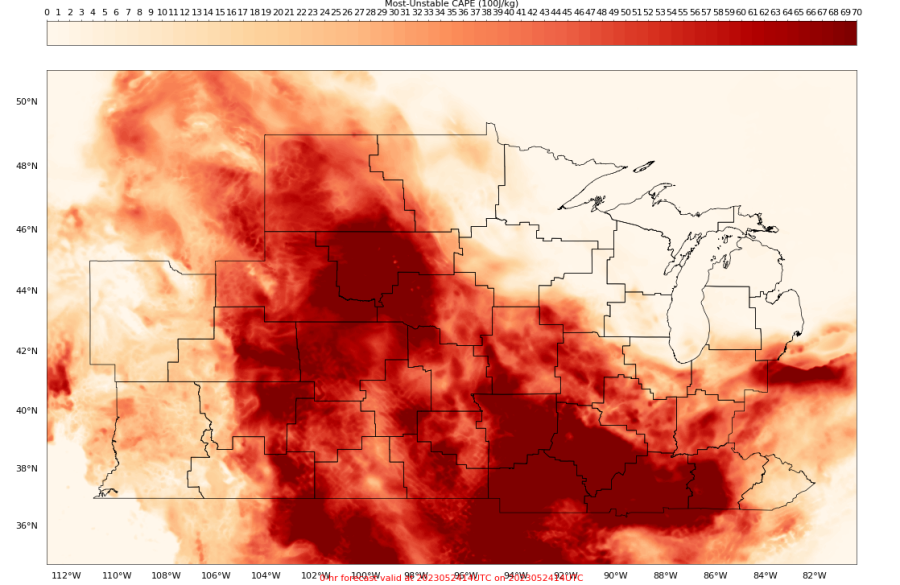
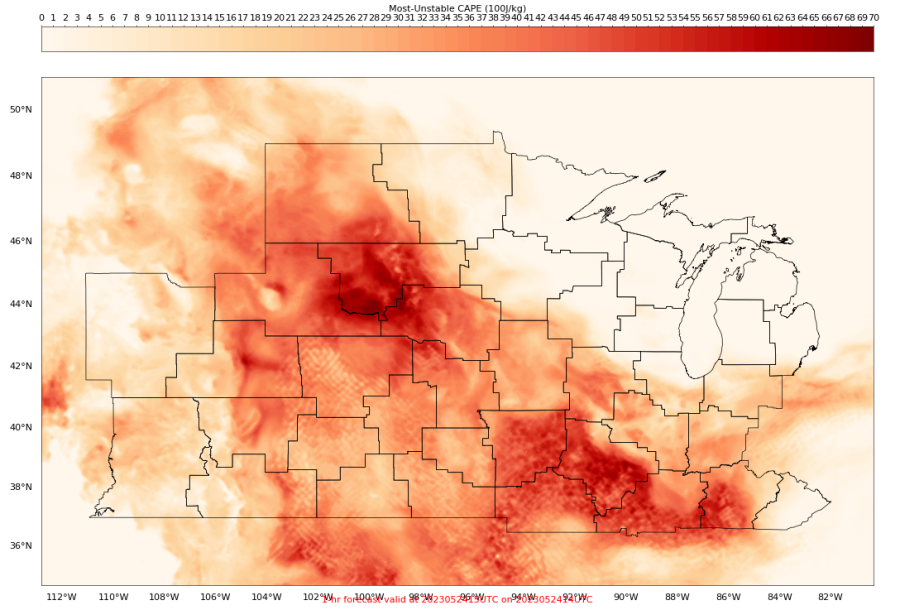
You can also see the numerical instability within this field that is in place across a large portion of the domain.

OCTANE

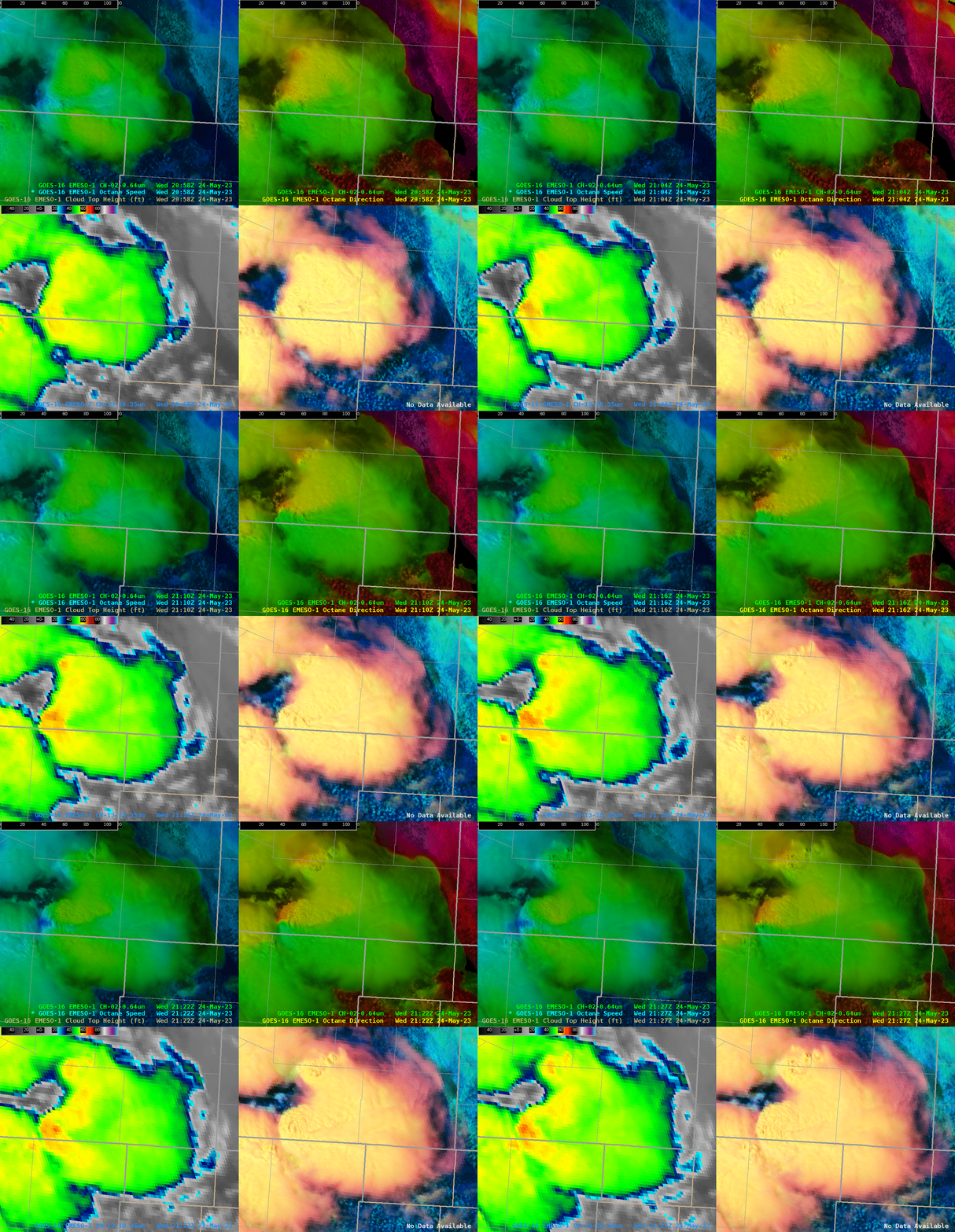
Octane was able to capture an interesting view of the Above Anvil Cirrus Plume on a very powerful storm along the New Mexico/Colorado border during the afternoon hours. The cirrus is a bit slower than the surrounding clouds within the sheared environment, providing that “V” type shape that we’ve come to associate with some of the strongest updrafts:
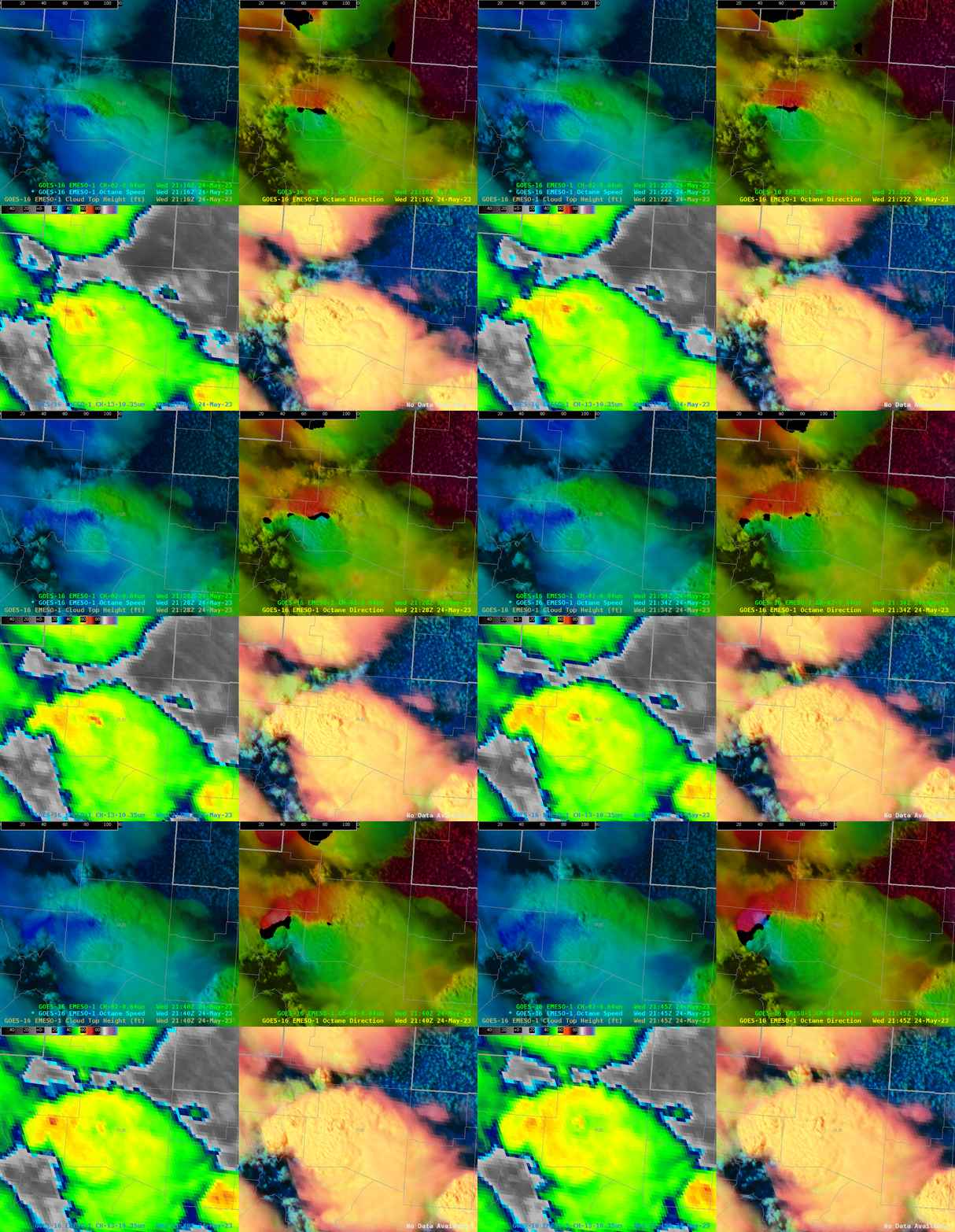
Another good example of using Octane for surveillance of storms – the direction product really highlighted another storm that quickly grew on the flank of another severe warned storm. Big value especially in areas where radar coverage might be limited by mountains, such as in the CWA I was working in today (PUB):
LightningCast

Used the LightningCast product extensively for DSS purposes today. We had a pretend outdoor event located in Pueblo, Colorado. A very strong thunderstorm (MESH estimated nearly 3″ or larger hail at one point) which passed within a few miles to the south and east of the city. I used the LightningCast probabilities in AWIPS overlaid with satellite data to provide multiple updates to Emergency Management, using it to confidently state that probabilities of lightning were increasing as storms approached from the south. Lead time for action would have been within the 45 min to 1 hour range. Was able to confidently say they would see lightning within the 10 mile range a good 15-30 minutes before the first strike occurred within the range per the ENTLN network data. Below is the LightningCast time series as output on the webpage for the KPUB airport, which is very close to where the DSS event was taking place:
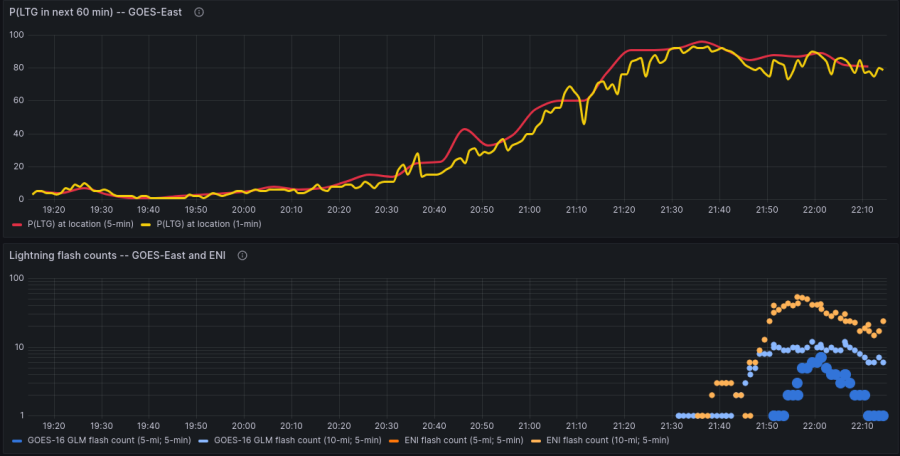
There is definitely some very actionable lead time here. As a forecaster, having this type of data available to me outside of AWIPS is a game changer. I know it may be challenging, but being able to click on a point like this and get this type of information would be huge for briefings and emails with decision makers. Right now we are limited to airports. Even a relatively coarse mesh that would allow me to pick a close point would be extremely useful if these images can’t be generated on the fly. Other possible ideas include only generating points within a certain LightningCast threshold (say 10%), or generating them on the fly based on a click query. That all said, even in its current form I will be using it going forward, and making a point to share it with my office and WCM for DSS.

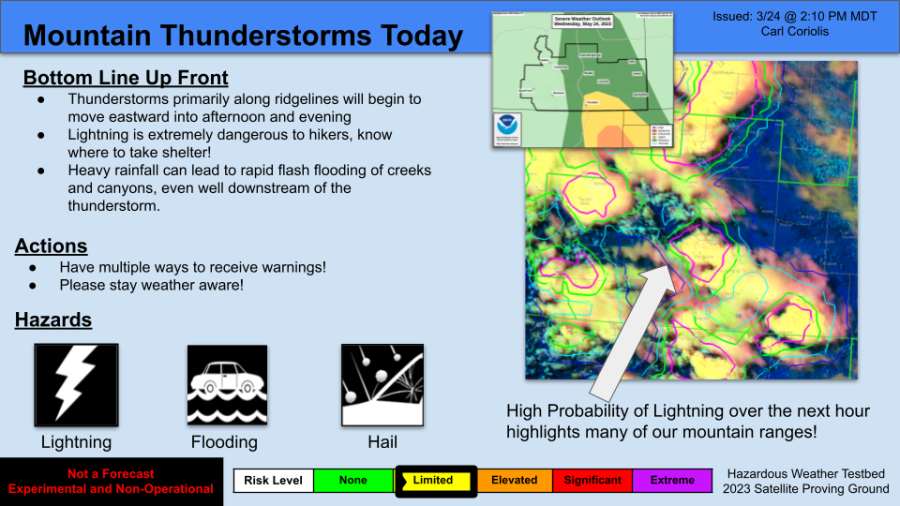
I also made a social media type graphic using the LightningCast product for hikers, given the large number of mountains within the CWA. Perhaps would have been a bit more meaningful to have sent this as storms were beginning to form, but they were already cooking once we got spun up and started. Highest probabilities were hugging the mountains where storms were forming. If I were formally posting to social media, I may have added some lightning safety graphics or something to that effect as part of the post (twitter thread, multiple images in Facebook post).
GLM RGB

This product does a great job in my opinion combining information from the FED and MFA. I found it useful for detecting lightning jumps within storms while still maintaining information about the overall coverage of lighting. Would happily use this as my primary GLM viewing option in AWIPS.
-Carl Coriolis


Tags: None