Waiting in Cloudy SJT

We moved over to SJT where we’re covered in pretty thick stratus. There was a promising looking boundary to the west of the CWA. The GOES CI showed 90% at the northern most part on this line. I was hoping this would be the beginning of a nice storm that would move into our CWA.

SJT CI1
90% CI just to the west of the SJT CWA at 2045Z

Apparently the environment did not agree…

click to animate
click to animate

The tiny little shower never amounted to anything and dissipated quickly. Fail.


-V. Darkbloom

Tags: None

Moved from ABQ to SJT

With scattered thunderstorms and limited severe threat in the ABQ area, we have been moved to SJT to hopefully capture convection moving northeast into the area from the dry line and leftover outflow from last nights convection.

Taking a look back at the visible satellite and convective initiation product, it highlighted the development of convection to the southwest of KBPG very well at 2000Z, with an area of 91% prob of development (and 67% to the south-southwest of that area).

20150505_2000Z_VisSatellite_CI

Moving forward 30 minutes, you can see that area developed experienced development in several locations along that line.

20150505_2030Z_VisSatellite_Radar

-SRF

Tags: None

NUCAPS sounding near strong storm south of LBB

I didn’t get a chance to look at the NUCAPS soundings on Day 1 but as soon as the pass occurred today we looked at a sounding that was about 60 miles east of the storm of interest that we have been following in the northern portion of the MAF CWA.  The NUCAPS availability point was located in a brief area of clearing within the cumulus field but we were a little uncertain whether or not clouds interfered or not.

NUCAPS_location
NUCAPS availability plot. The point we used is in the center of the image.

However, the data did look reasonable as the temp was close to surrounding obs, though the dewpoint appeared to be low compared to surrounding observations.  The SBCAPE in the NUCAPS sounding was about 245 J/kg which was significantly lower than the GOES-R LAP CAPE observation which was around 1000 J/kg.

NUCAPS_sndg
Unedited NUCAPS sounding

We modified the sounding to increase the dewpoint to 59 degrees to be better in line and this resulted in SBCAPE of just under 1000 J/kg and lined up well with the GOES-R CAPE.

NUCAPS_edit
Edited NUCAPS sounding to increase the dewpoint.
GOESR_CAPE
GOES-R CAPE image

Jack Bauer

Tags: None

Prob Severe and Lightning…developing storm in Midland CWA

An area of convection (70% probability in GOES CI) continued to develop around 1900 UTC.  Between 1922 and 1928 UTC, the Prob Severe increased from 18% to 63%, and by 1935 was up to 86%.  The lightning jump increased to 2 sigma during this time.  The 1 minutes lightning density increased over a 2 minute time span from 1 to about 4 flashes/gridbox.   By 1945, the lightning density was up to 9 flashes/gridbox.  All of this evidence points to convection which is increasing in intensity.LightningMLD

Evidence from the NUCAPS sounding as well as the GOES LAP CAPE suggest the storm is in an environment with around 1000 J/kg of CAPE.  By 20:06, the storm is a well-organized supercell with a hook echo and well defined rotational velocity.

MLDreflecMLDvelocityThe combination of lightning data, Severe Prob, NUCAPS and GOES LAPE CAPE were good indicators of strengthening storm worth watching.  The storm produces a tornado.

Tags: None

Trying out Lightning Cell Tracking and Time Series

Since I didn’t have time to test out the Lightning Cell Tracking and Time Series data yesterday, it was nice to have an opportunity to use it today. Overall, I think the lightning time series data can be really useful, especially the multiple color version.

050515_2008Z_LightningTS

One thing that was pointed out to me by one of the trainers was to keep an eye on the cell area (blue dashed line above), as significant drops/rises can indicate cell splits/mergers.  That was definitely the case with the image in the upper left of the four panel above, as the cell tracking was splitting/merging the lightning areas. That can be seen in the two images below, where the the first image shows the combined lightning cell with 39 flashes (2005Z lightning cell). Then the next minute (2006Z lightning cell), the detection split it into several different cells and lowered the total flash rates.

050515_2003Z_LightningTS-Radar

050515_2006Z_LightningTS-Radar

Knowing that information can help eliminate false interpretations of lightning jumps on the time series. -SRF

Tags: None

NUCAPS compared to 18z AMA sounding

Pass came across with NUCAPS available at 20z. Looked at 19z data from a point close to AMA which launched an 18z sounding. First image is NUCAPS, Second image is the 18z AMA soundings. Differences notices were cooler temperatures above 300mb on the NUCAPS sounding. There was a small but more distinct cap near 800 mb on the AMA sounding. The freezing level and -20 level had dropped on both soundings compared to the 12z AMA sounding.

NUCAPS18zMay5AMA18zMay5Lynford

Tags: None

Conflicting Information

The Probability Severe and ENI Thunderstorm Alerts seem to have differing opinions on a couple cells in the ABQ CWA.

ABQ DTA prob svr

At 1932Z, the cell to the north has a Dangerous Thunderstorm box, yet a prob severe of only 17%. Meanwhile, the southernmost cell has a prob severe of 78% but is only considered a “significant” thunderstorm.

At 1940Z, the prob severe of the south cell went up to 82% with no DTA, and the cell the the north went up to 43%. It’s interesting to note these cells are approaching the east/west boundary of the ENI Thunderstorm Alerts. No alerts showed up for the “east” algorithm either.

ABQ DTA prob svr2

The storms are still pulsing down just as quickly as they develop. They really only look impressive for 1-2 volume scans. No hail or wind reports yet, just the funnel cloud near Roswell earlier.

-V. Darkbloom

Tags: None

Convective Initiation temporal resolution concern

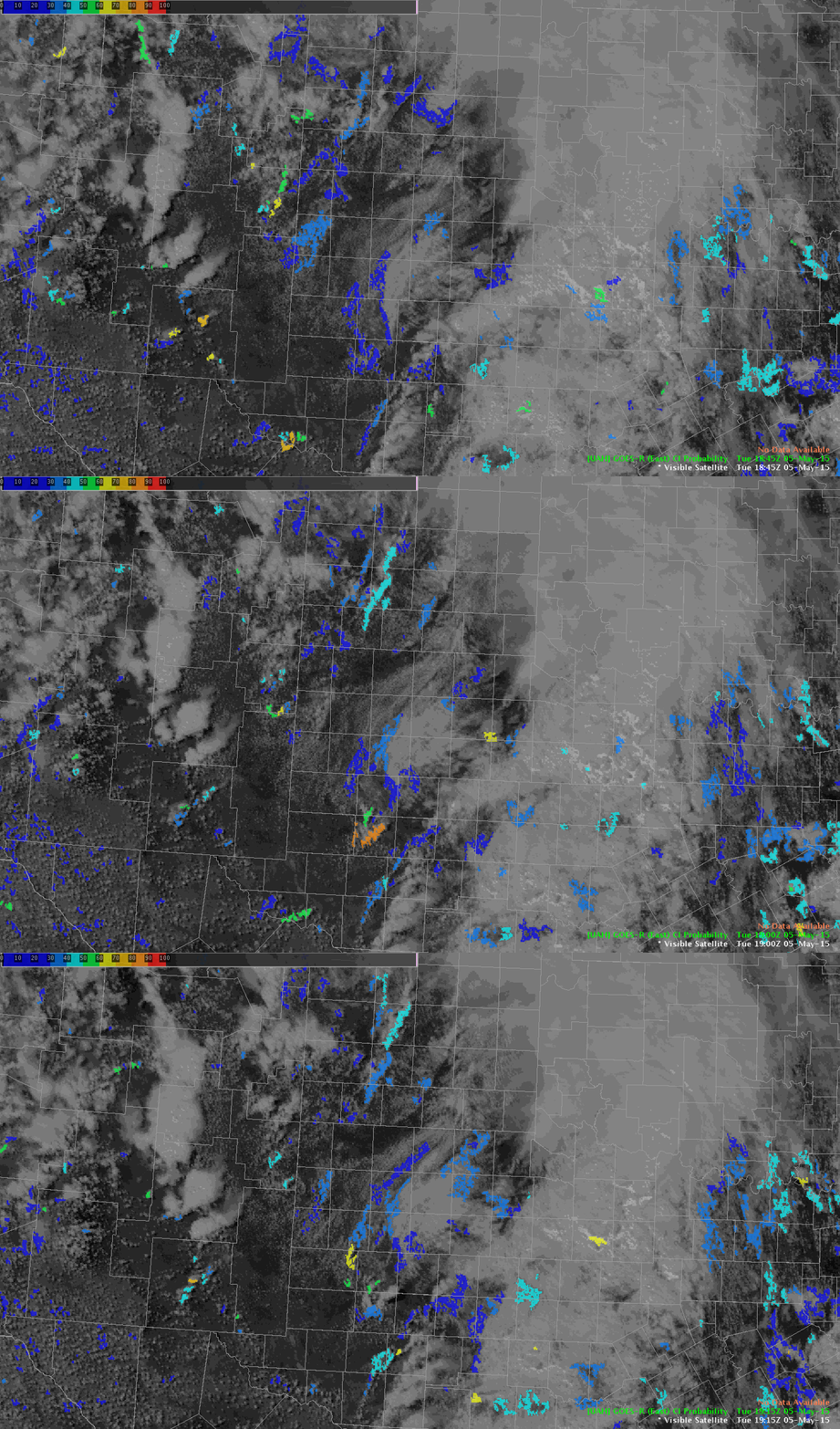
Looking just beyond our LBB CWA to the south I noted a CI change from at 1845 UTC which showed 10% probability of convective initiation to a 70% probability at 1900 UTC.

CI_Loop
Animated loop

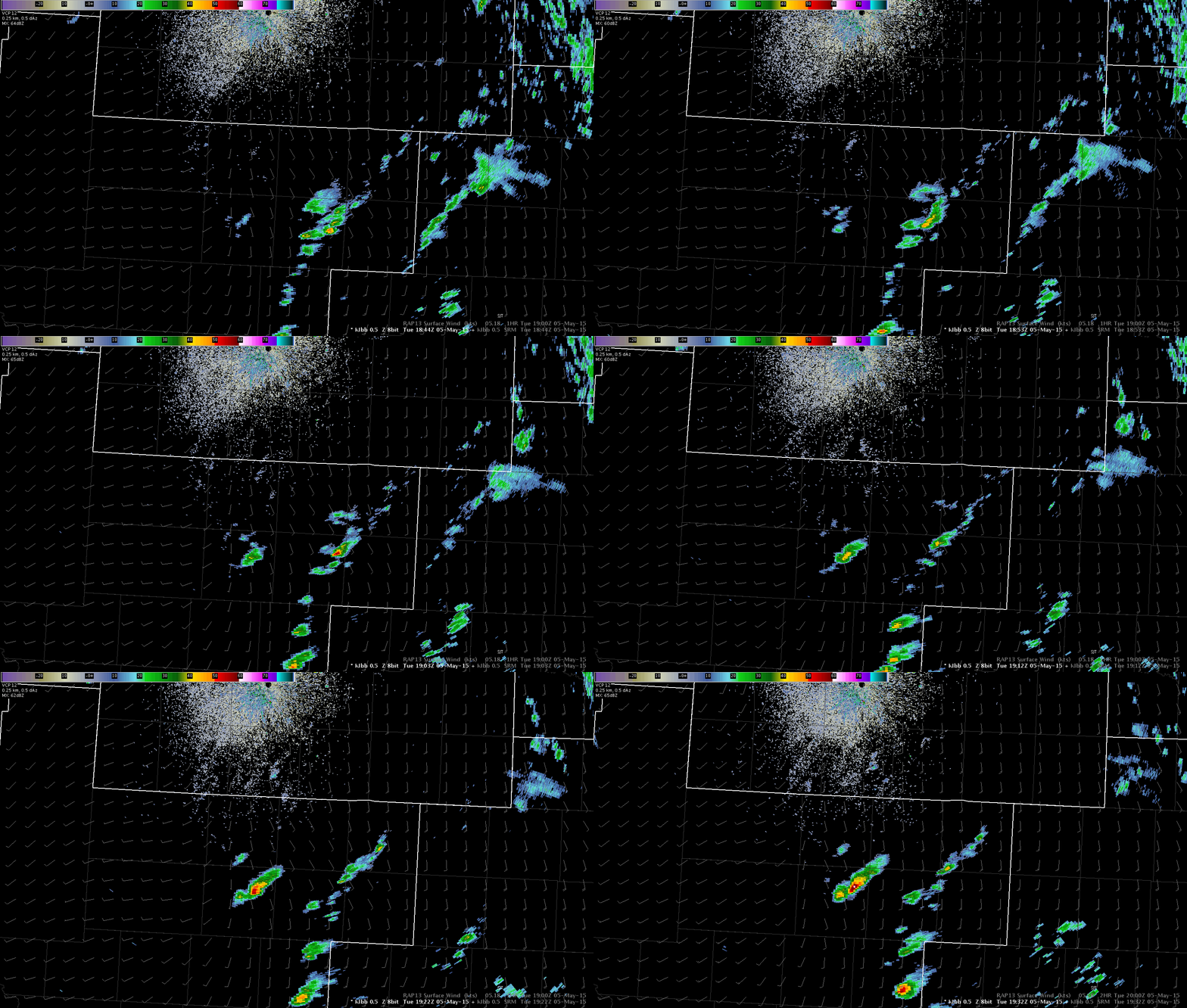
However, when looking back at the radar loop starting at 1845 UTC which matches the first satellite image and continuing past 1900 UTC, we can see the development of an isolated convective cell.

Radar_loop
Animated radar loop

At 1900 UTC a 39 dbz core was noted, so in this case the temporal resolution of the CI product (15 minutes) effectively resulted in a miss as the 35+ dbz was already present at the time the 70% probability was given.  This does not diminish the situational awareness value of the product.

Jack Bauer

Tags: None

Scattered Storms in ABQ CWA

Still monitoring storms across the ABQ area, but thus far they have been pulsing up and down with little maintenance. Here is a broad look at the area with ProbSevere overlayed on the radar.

20150505_1926Z_Radar_ProbSevere

The strongest storm is over the far southeastern part of the CWA, with a ProbSevere value around 77%. But looking at radar data, within the hail growth zone, seeing limited indications of severe hail. That is matched by the MRMS MESH output of right around 1″. Have not issued a warning for that storm at this point. -SRF

Tags: None