ProbTor not showing much “Love” for Tornadic Supercell in Love Co OK


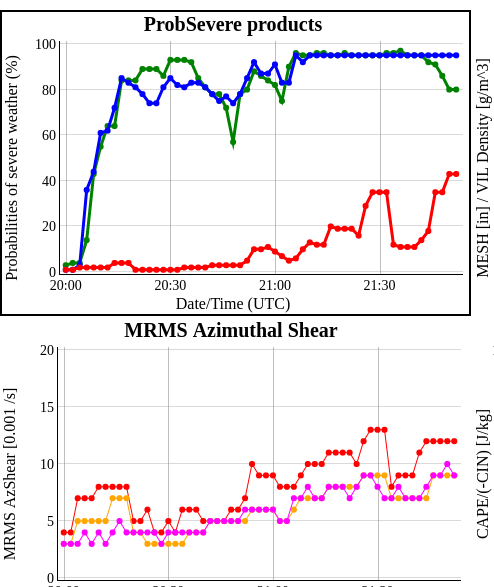
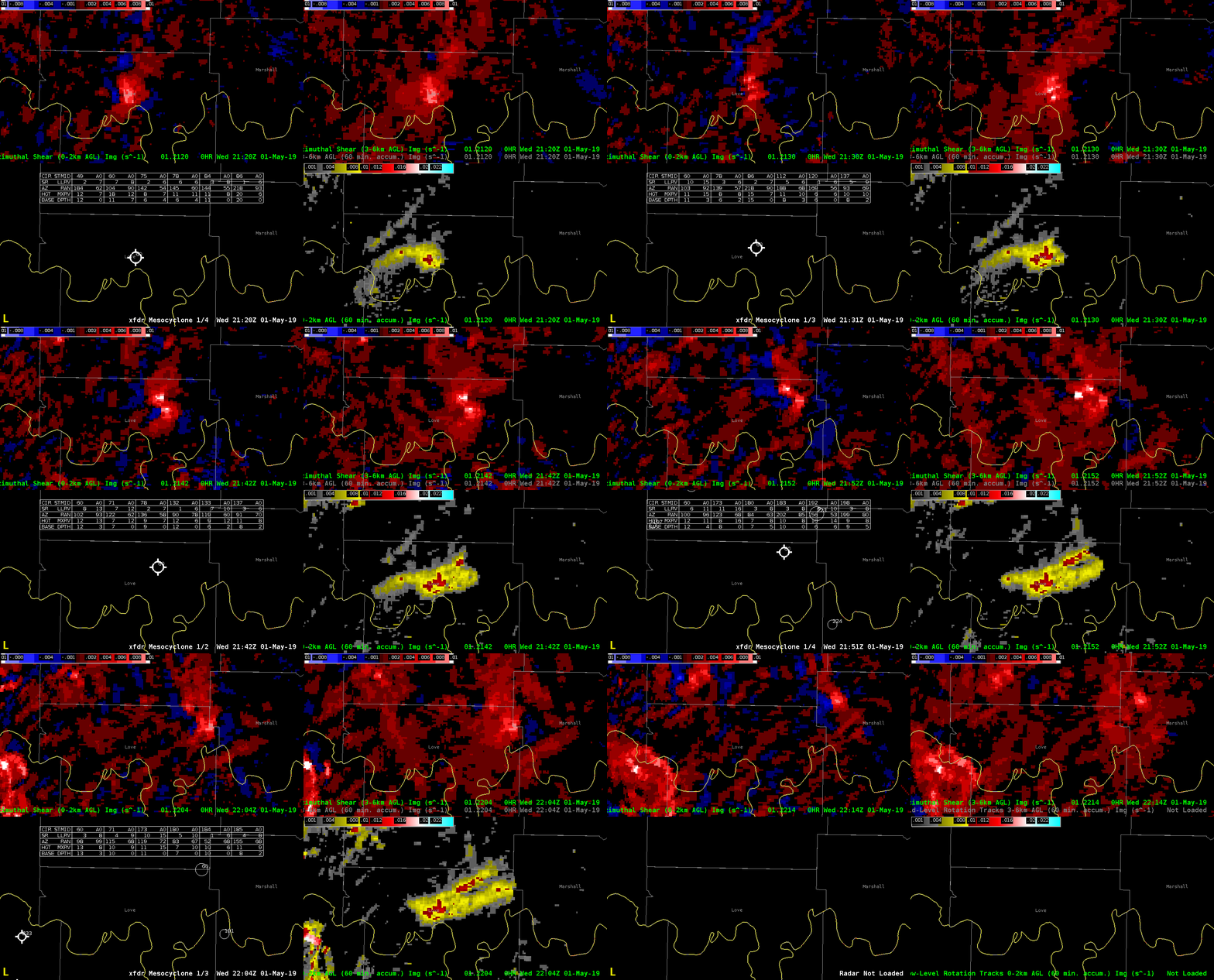
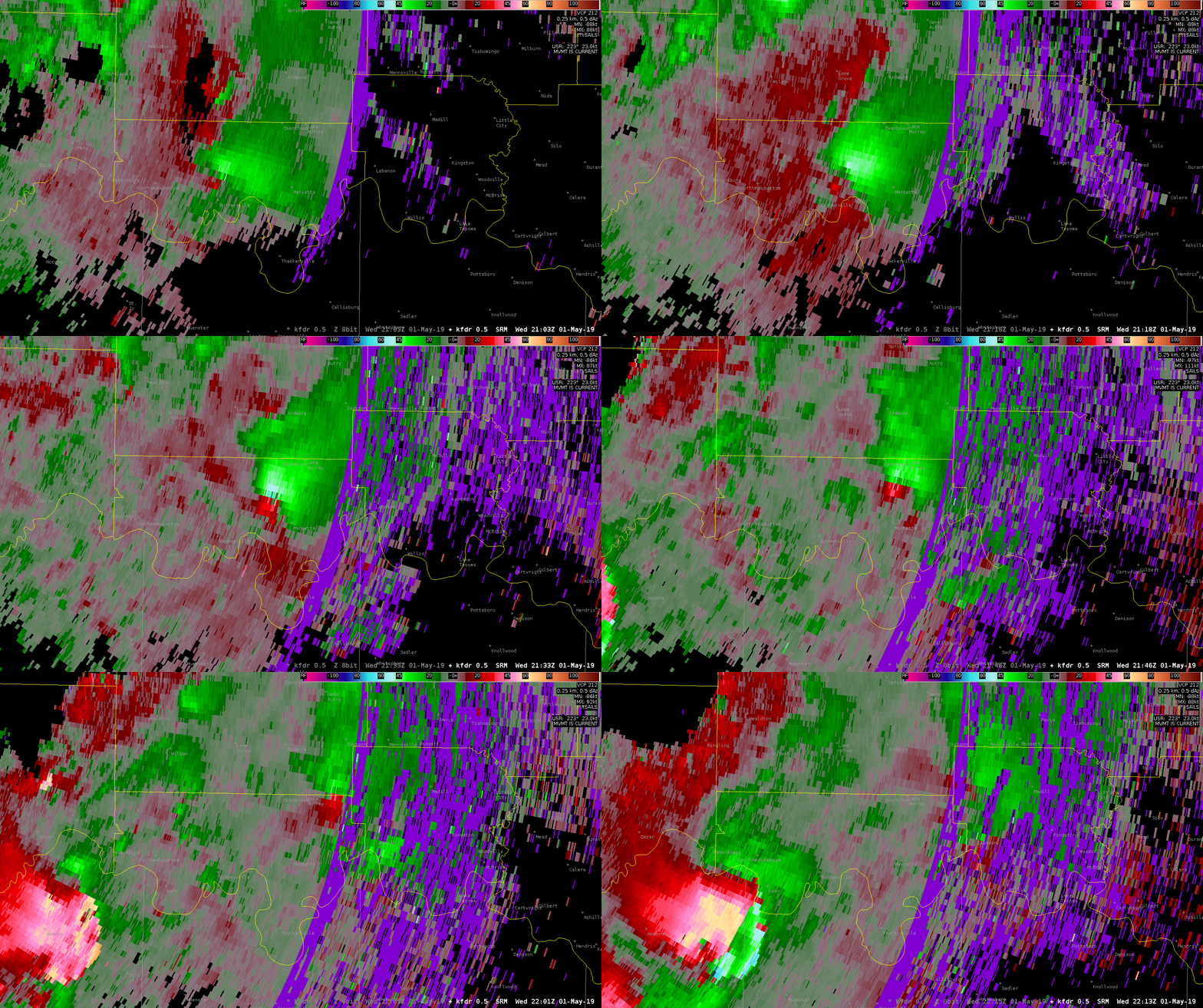
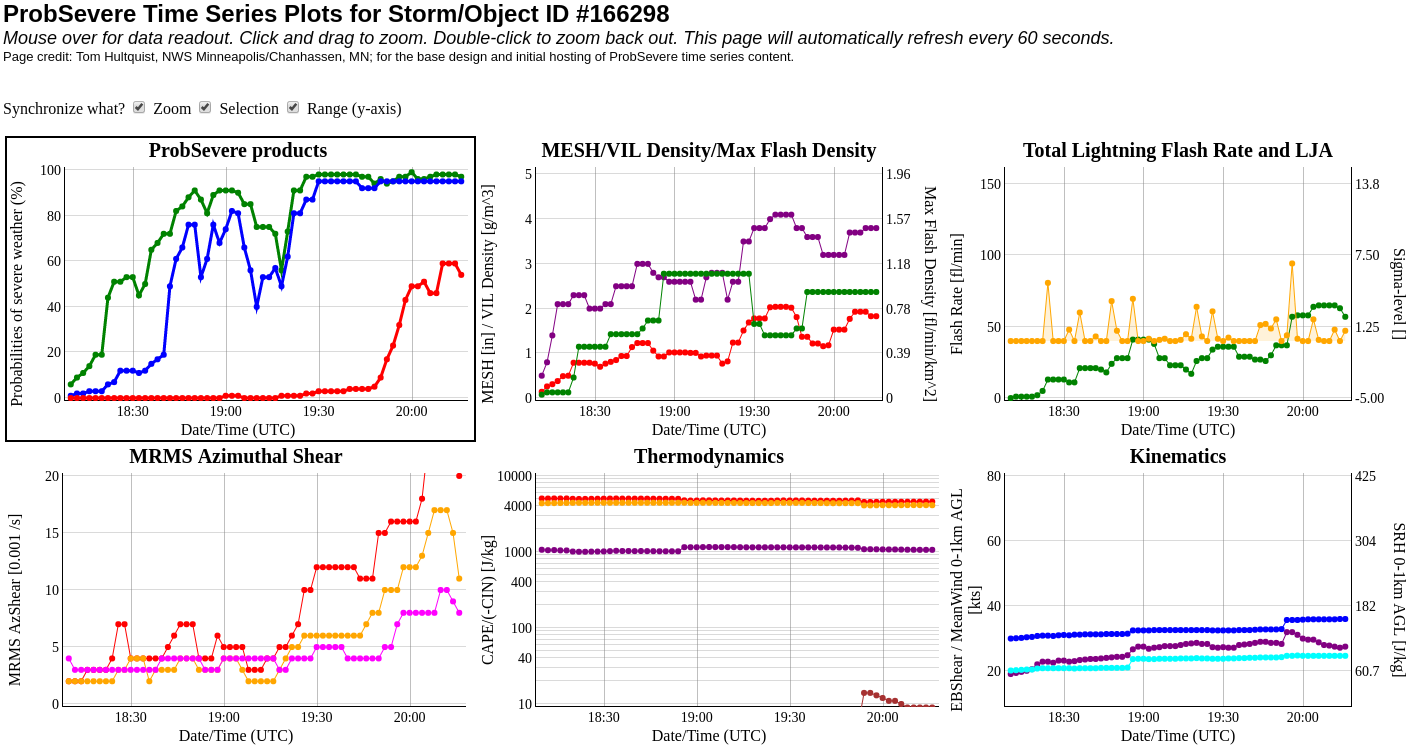
ProbTor showed a noticeable increase in values as the circulation on the Love County storm improved from 21:24-21:28 however there was a significant drop off at 21:34 even though the circulation from KFDR maintained its intensity and actually improved gate-to-gate. Looking at the MRMS AzShear graph you can see the same trends pinpointing the main driver in the ProbTor behavior. By 21:44 the AzShear recovered and ProbTor also returned to its previous value and continued to climb. There was some apparent “funky data” that got into AzShear to cause the unexpected drop. This emphasizes the need to have the proper products paired in AWIPS displays in order to diagnose why some algorithms may “fail” at times.

ProbSevere Time series. (http://cimss.ssec.wisc.edu/severe_conv/plots/PSplots.php?ID=166605)

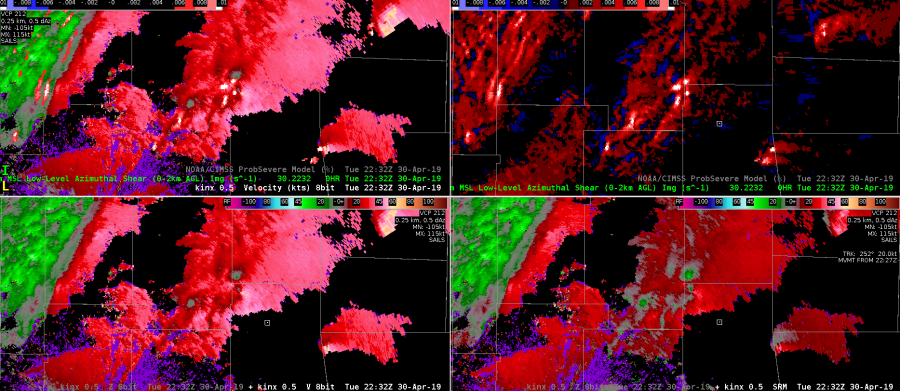
Low Level AzShear (UL), Mid Level AzShear (UR), New Mesocyclone Detection Algorithm (KFDR) (LL), Low Level Rotation Tracks (LR) 21:20-22:14

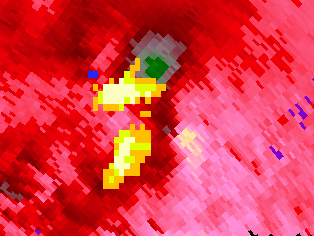
KFDR 0.5 deg SRM 21:03-22:13.

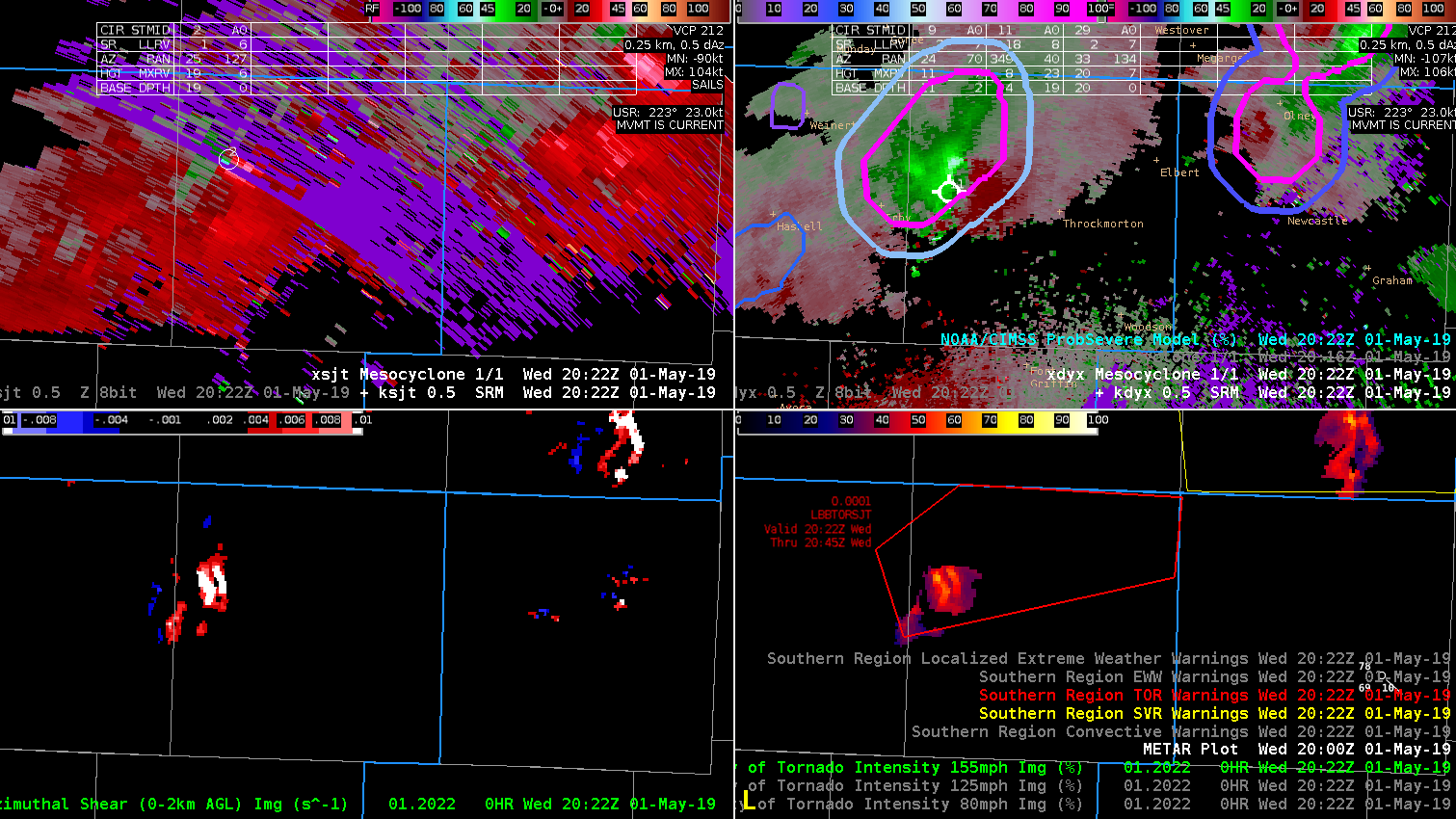
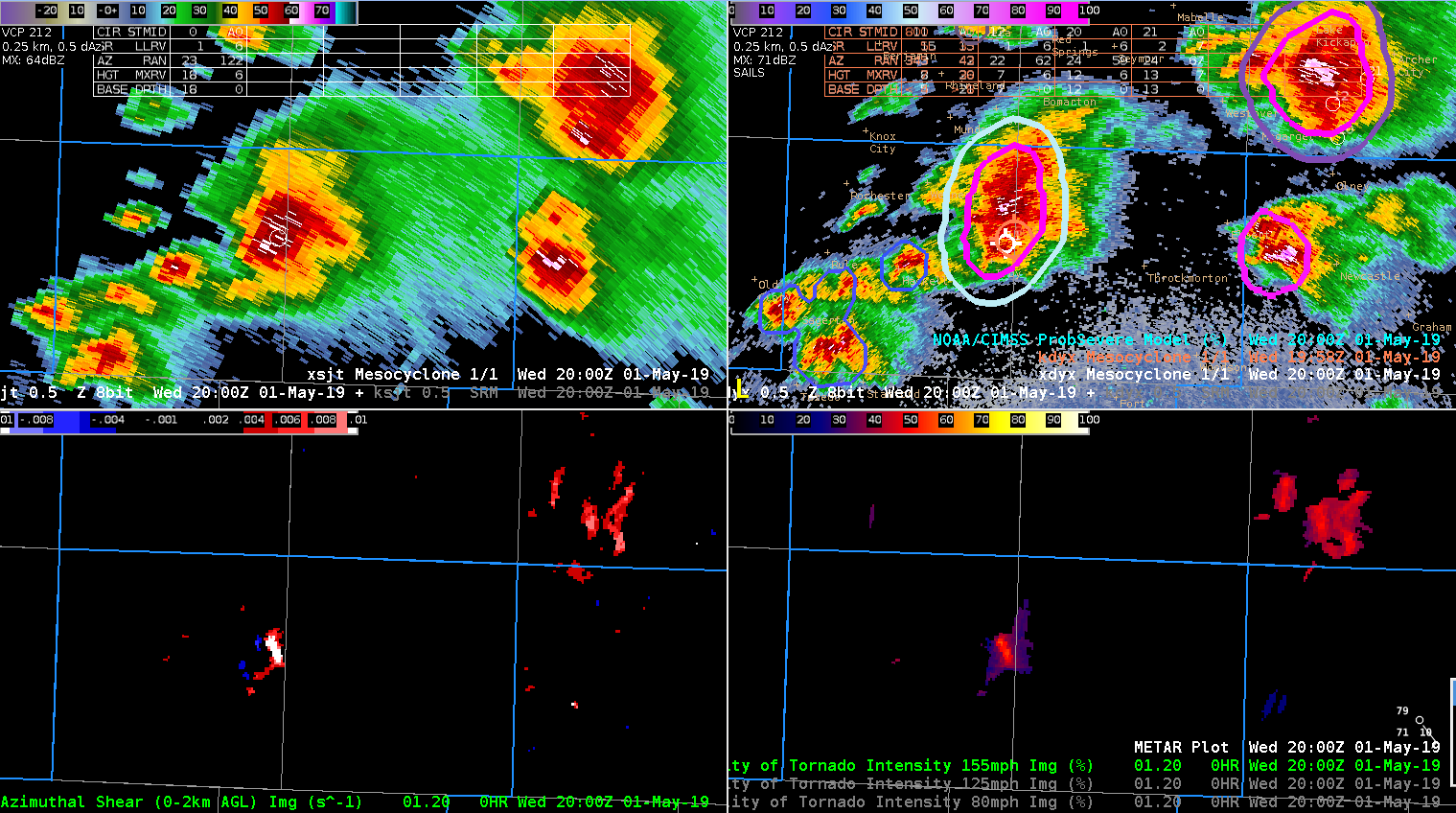
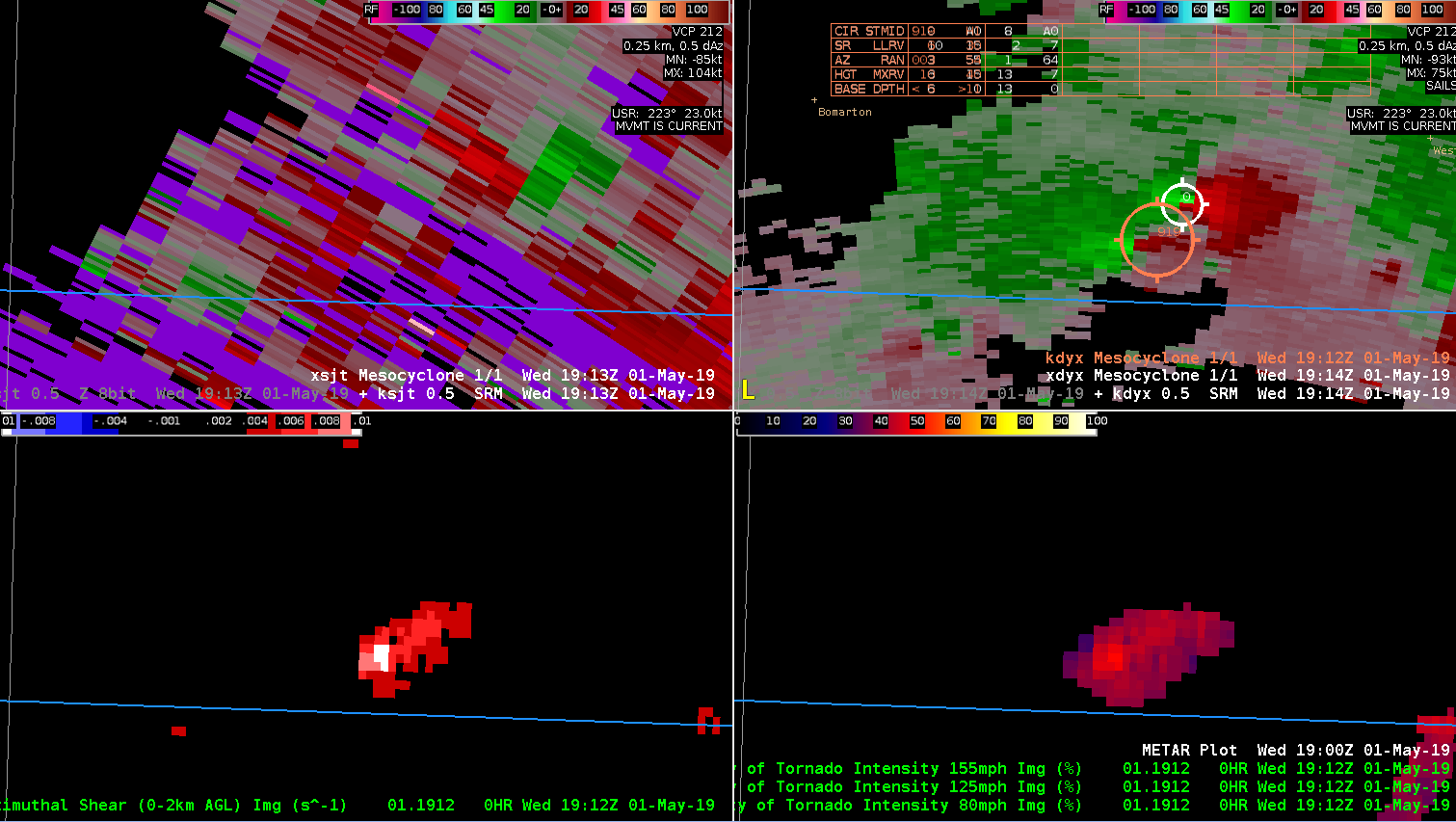
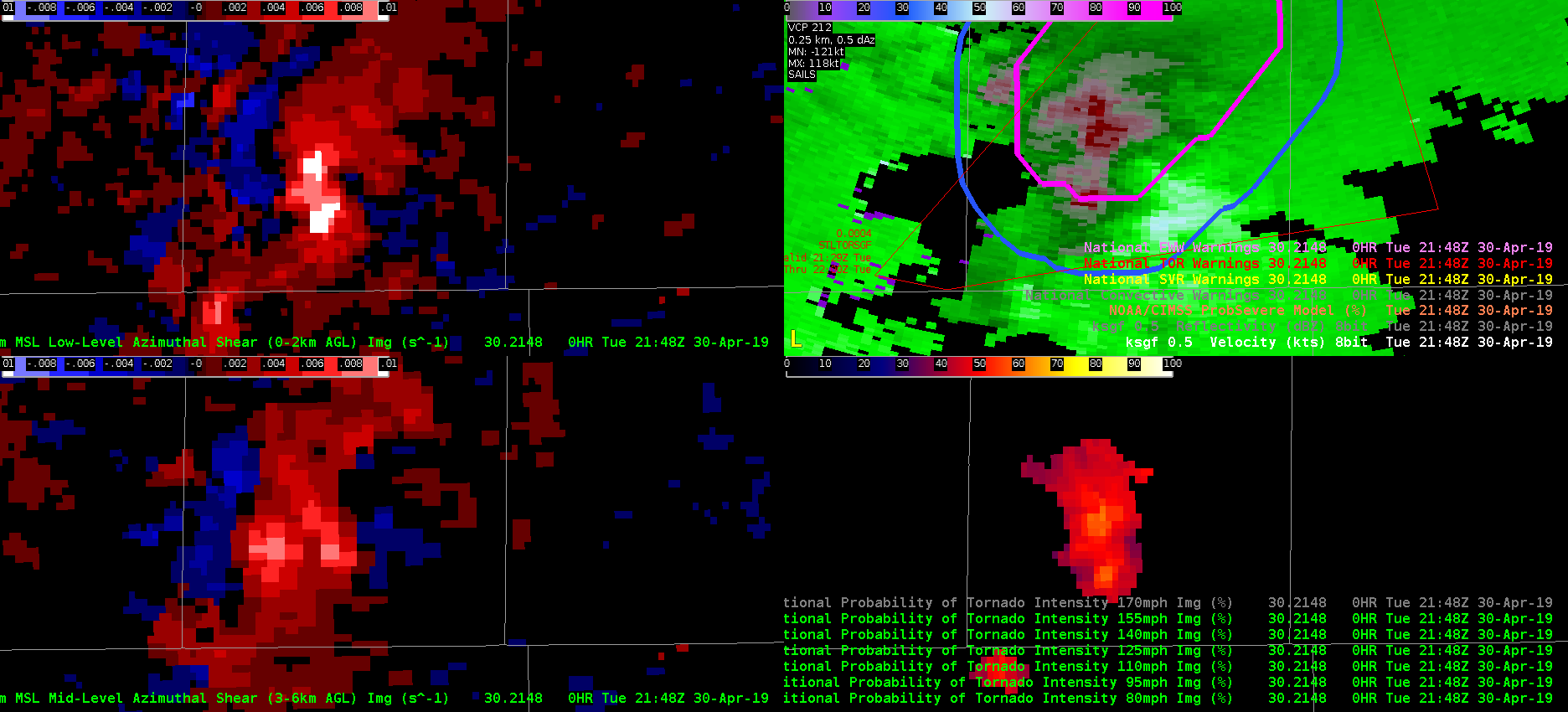
AZ_shear CPTI for possible tornadic storm


AZ_shear was showing double shear signature and also showed in the CPTI product.  Did finally see a bit of an increase on the 155mph for CPTI, however the 125mph and 80mph were similar values.  My conceptual thinking would be that 80mph would be 100%, 125mph 80%, and 155mph 60%, thus would make more sense versus all threshold values being closer to 50-60% range.  -Jake Johnson

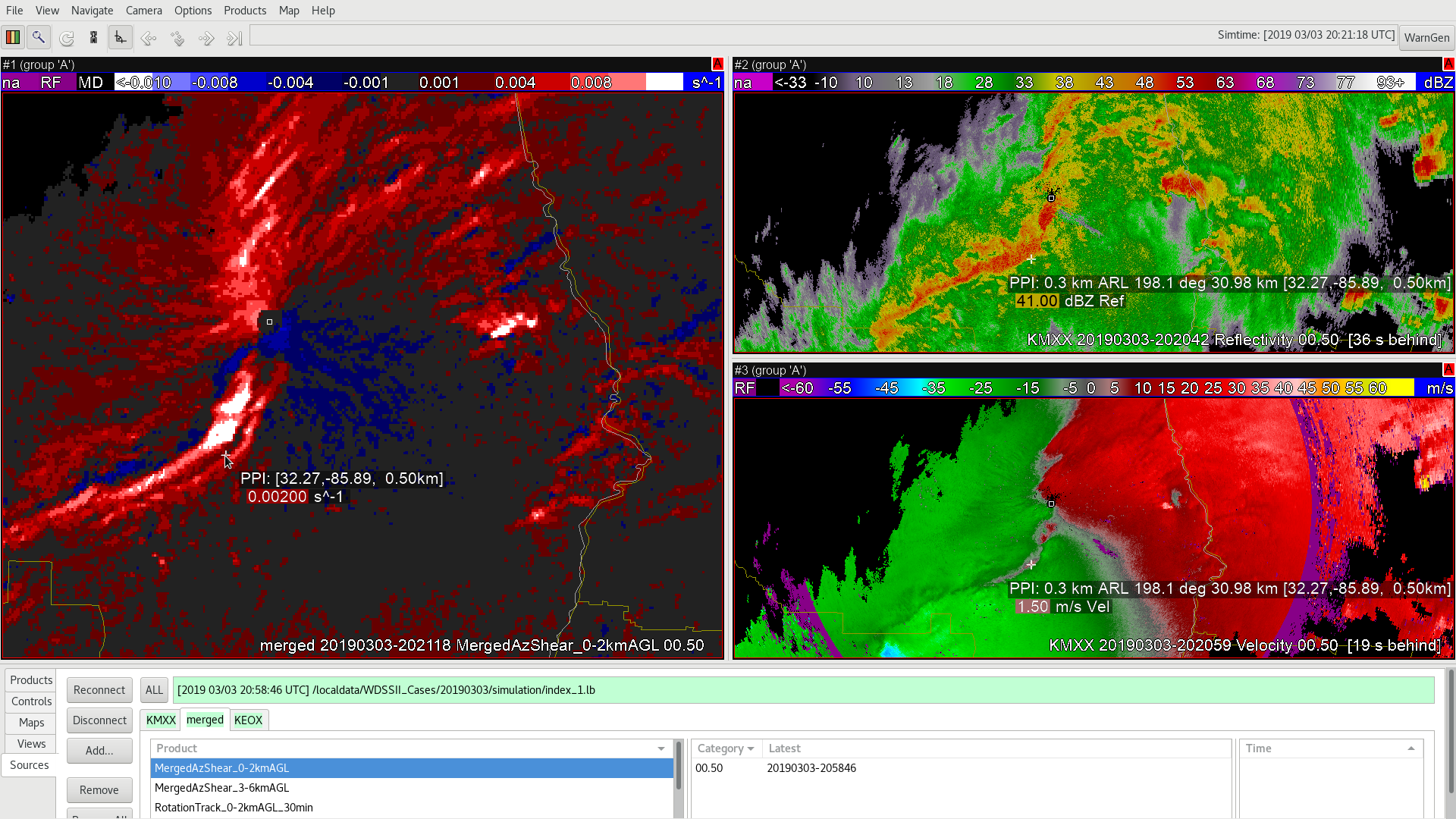
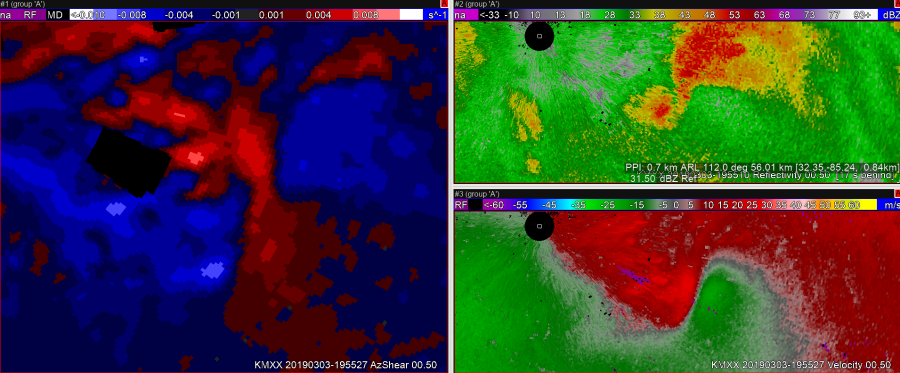
2019 March 03 AzShear

A quick look at the single radar AzShear product vs. the merged 0-2km product for a QLCS event. The single radar AzShear is far more granular and brings my attention to specific points of the line to interrogate further. However, the merged product is washed out…As a result, it’s potential utility to highlight areas of interest is degraded. Perhaps it would be most useful for general trends, but for storm-scale interrogation it leaves me wanting.

I do think the single radar AzShear product has promise with respect to increasing lead times, especially for QLCS circulations. But without other cases to examine, I can’t say for sure. It does show promise (especially when coupled with base velocity and spectrum width) with highlighting the areas of interest a scan or two before velocity couplets develop.

–Stanley Cupp

2021z merged 0-2km AzShear (left): very messy and washes out a lot of the storm-scale features. Also shows a leading area of shear ahead of the main line. This is likely due to SAILS cuts and different scanning modes for the radars used in the creation of the product. Something to watch out for in future events – this is an artifact that needs to be identified when using this product.

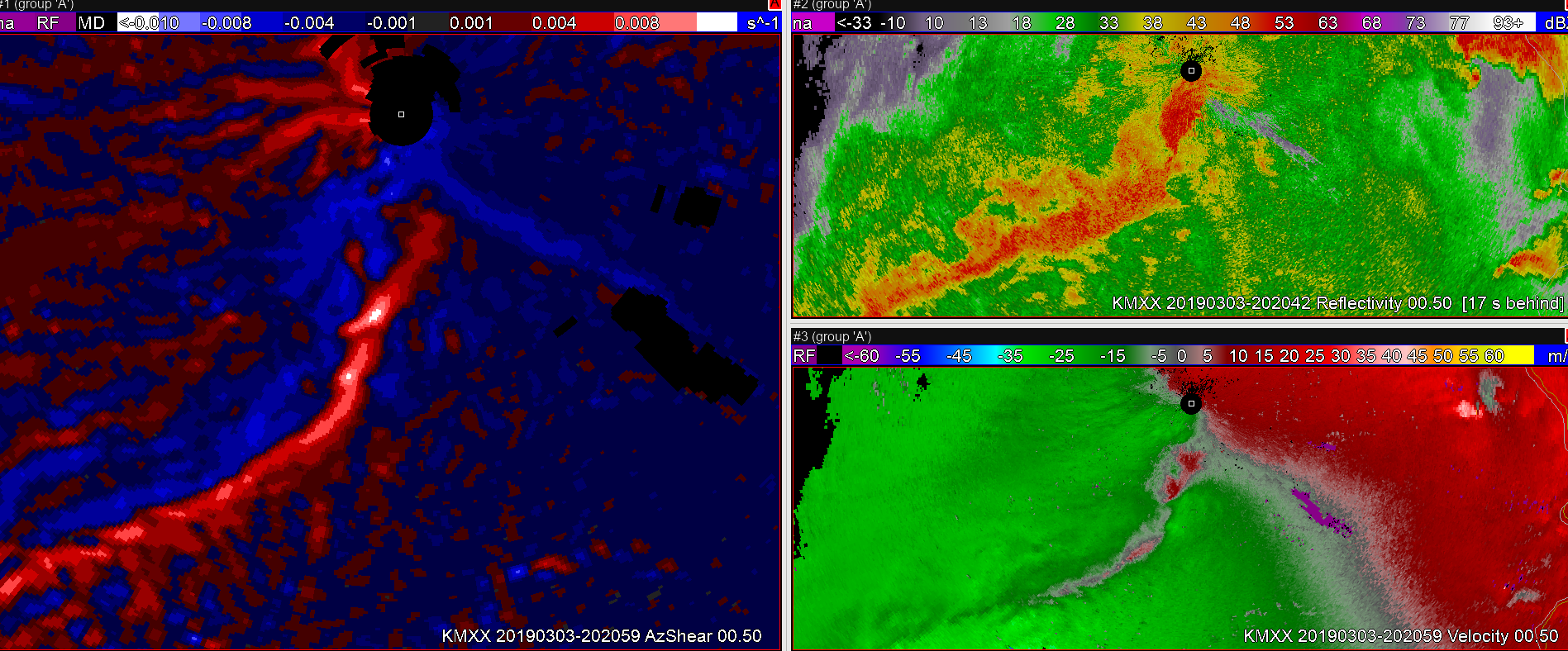
2020 KMXX AzShear highlights 2 main areas of interest along line of convection

2024z: AzShear and velocity begin to show that the southern most of the 2 areas is becoming an increasing concern. Would likely have a tornado warning out at this point, if not the prior scan (especially given the favorable environment). Spectrum Width (top right) also helps diagnose the increased velocity signature on the southern most area compared to the northern one.

And by 2030, a distinct velocity couplet developed 

Az Shear Case – 3/3/19

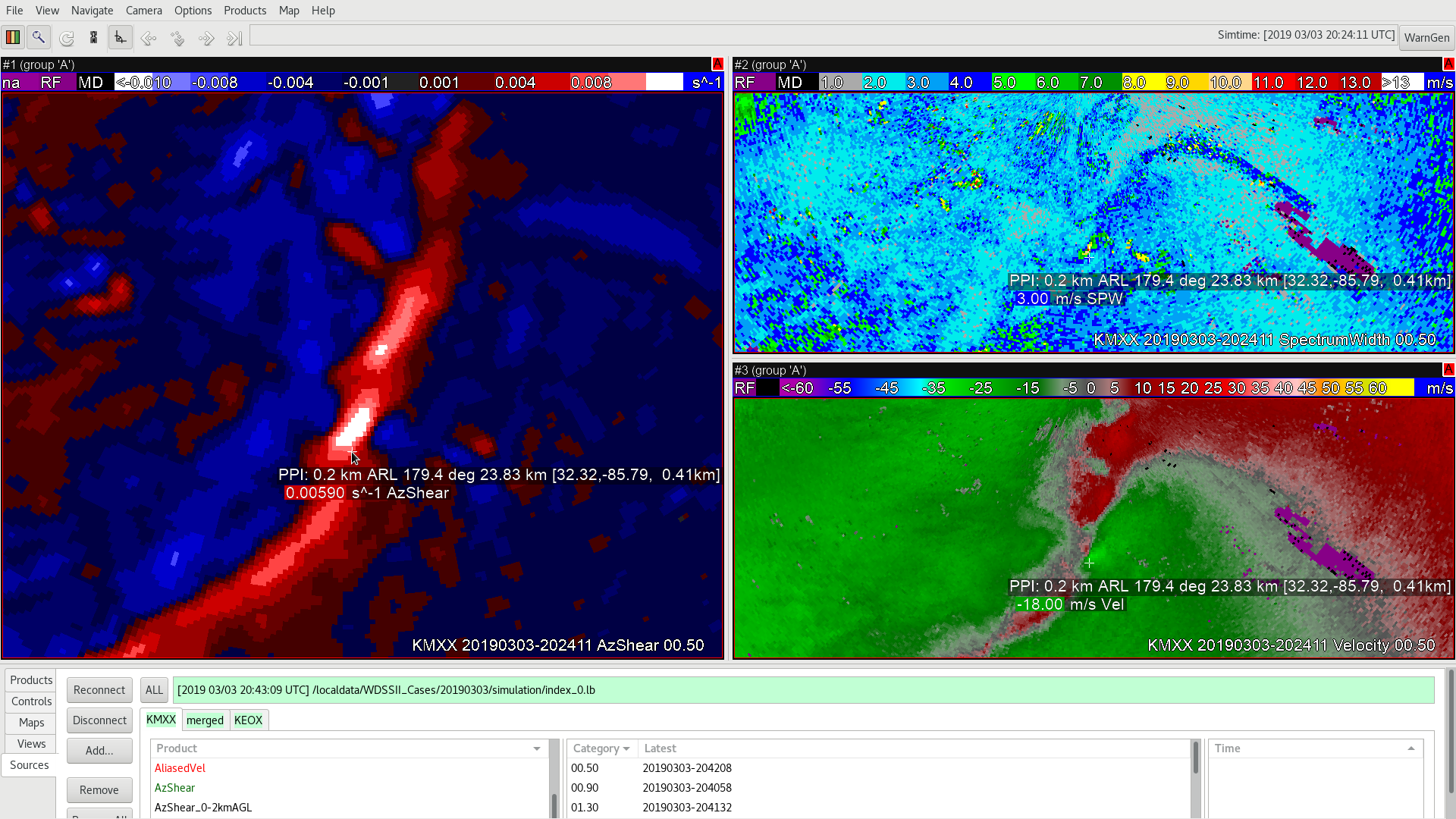
The case above shows a situation where due to the orientation of the zero isodop compared to the radar location, AzShear values are surprisingly low considering the strength of the convergent signature that preceded tornado development.
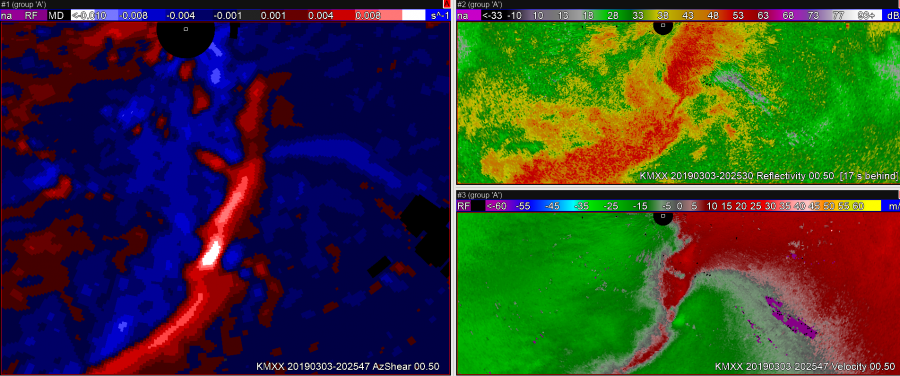
The case above shows  different tornadic circulation developing, but this time to the south of the radar –  a different orientation of the convergent signature relative to the radar. In both of these first two cases, the eventual tornado had not touched down yet, but the AzShear values were quite different. Training on zero isodop and how its orientation relative to the radar affects AzShear should be created for users before this product is used operationally.
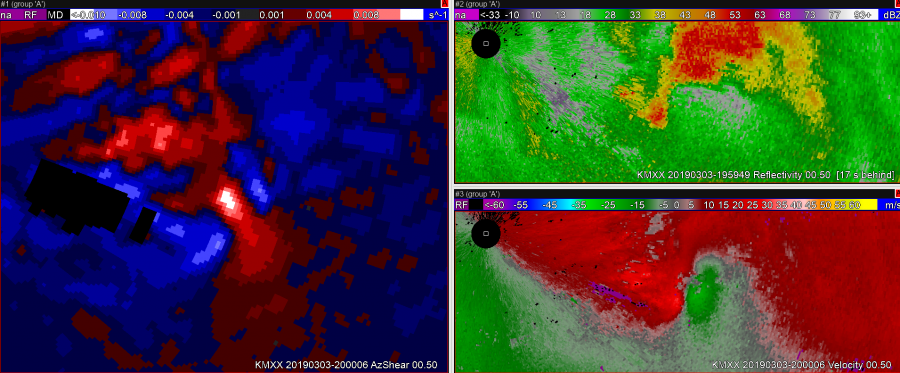
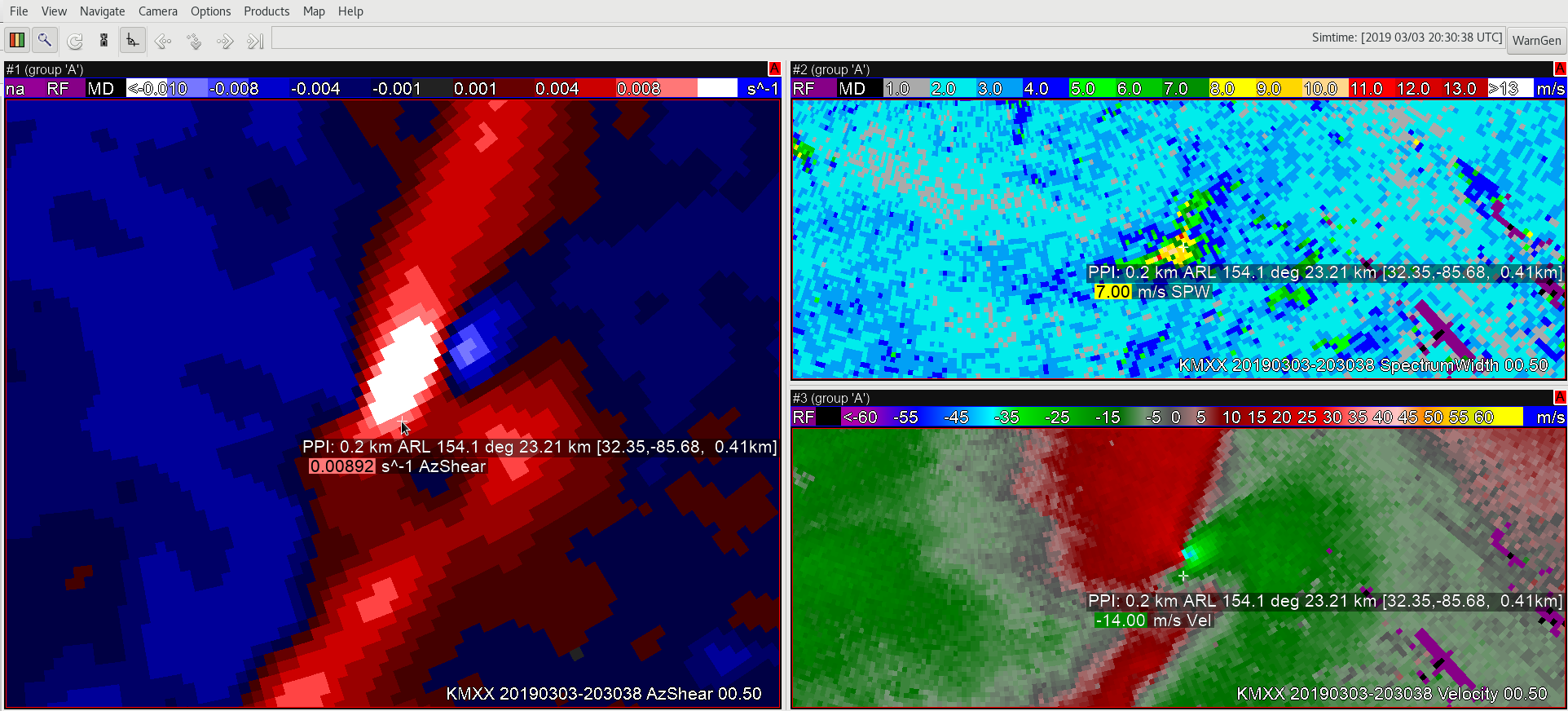
This image shows the first circulation a bit farther in time as the orientation of the convergence changed and AzShear value bins began to max out.
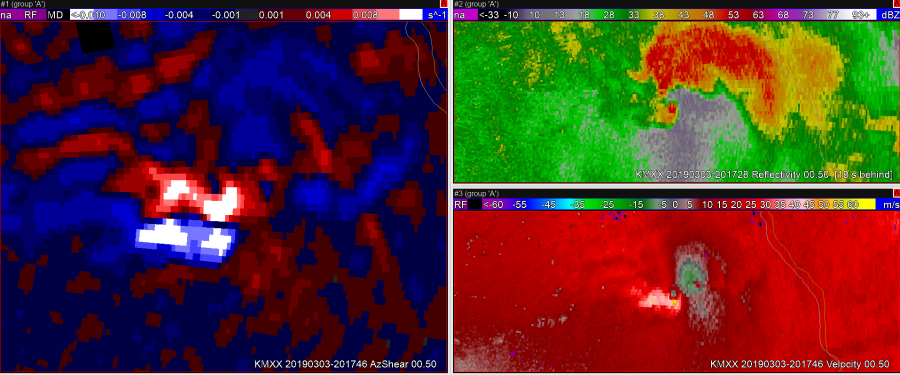
A case where using a color table with bins detracts from the usefulness of AzShear. There are two areas of high AzShear indicated, however very different things are going on in each of these locations. One is a strong tornado on ground the other is flanking line convergence. These two features should not have the same color if this product is to be used in operations. Consider a graduated color ramp with a high range instead of broad bins.
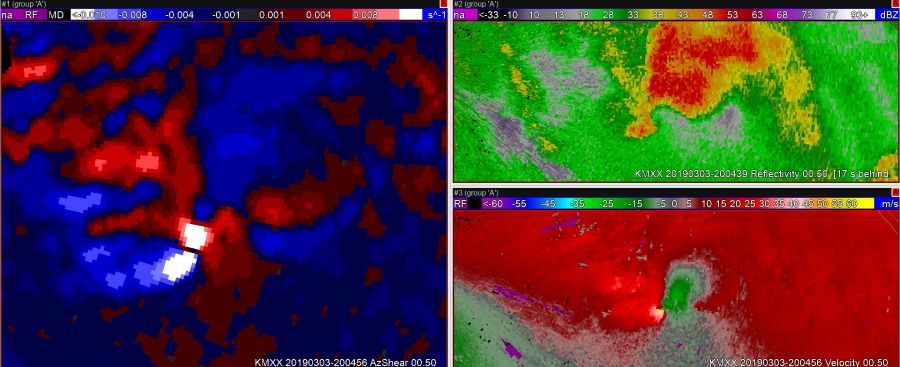
A case where the anticyclonic shear component is extremely prominent in AzShear. Are these regions useful for forecasters focusing on the tornado? Are they more of a distraction? They could be a distraction in some situations.
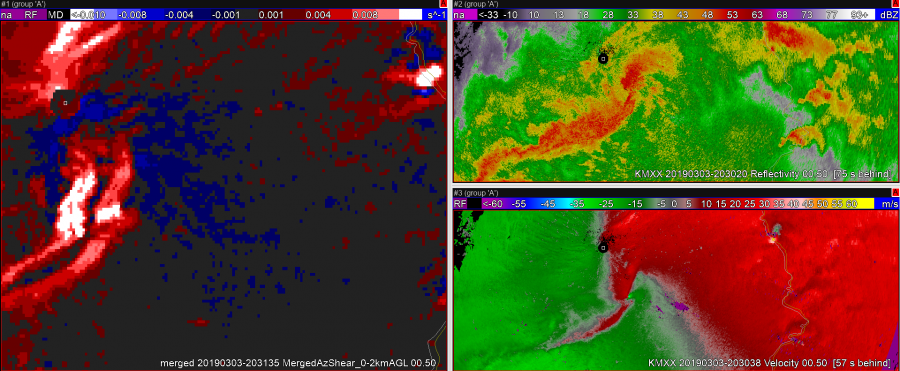
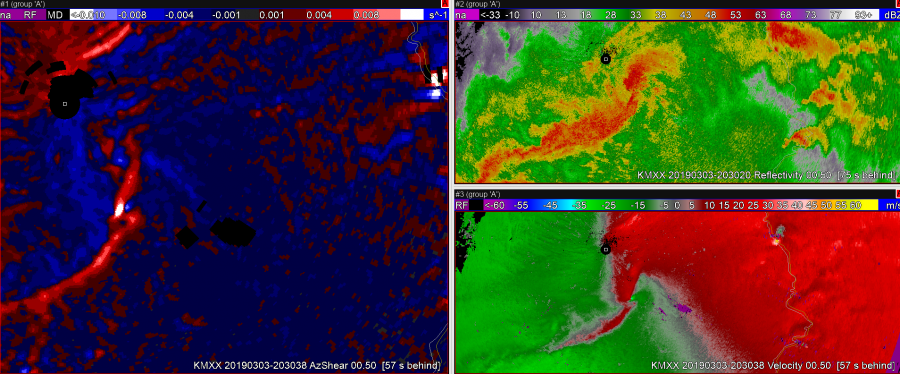
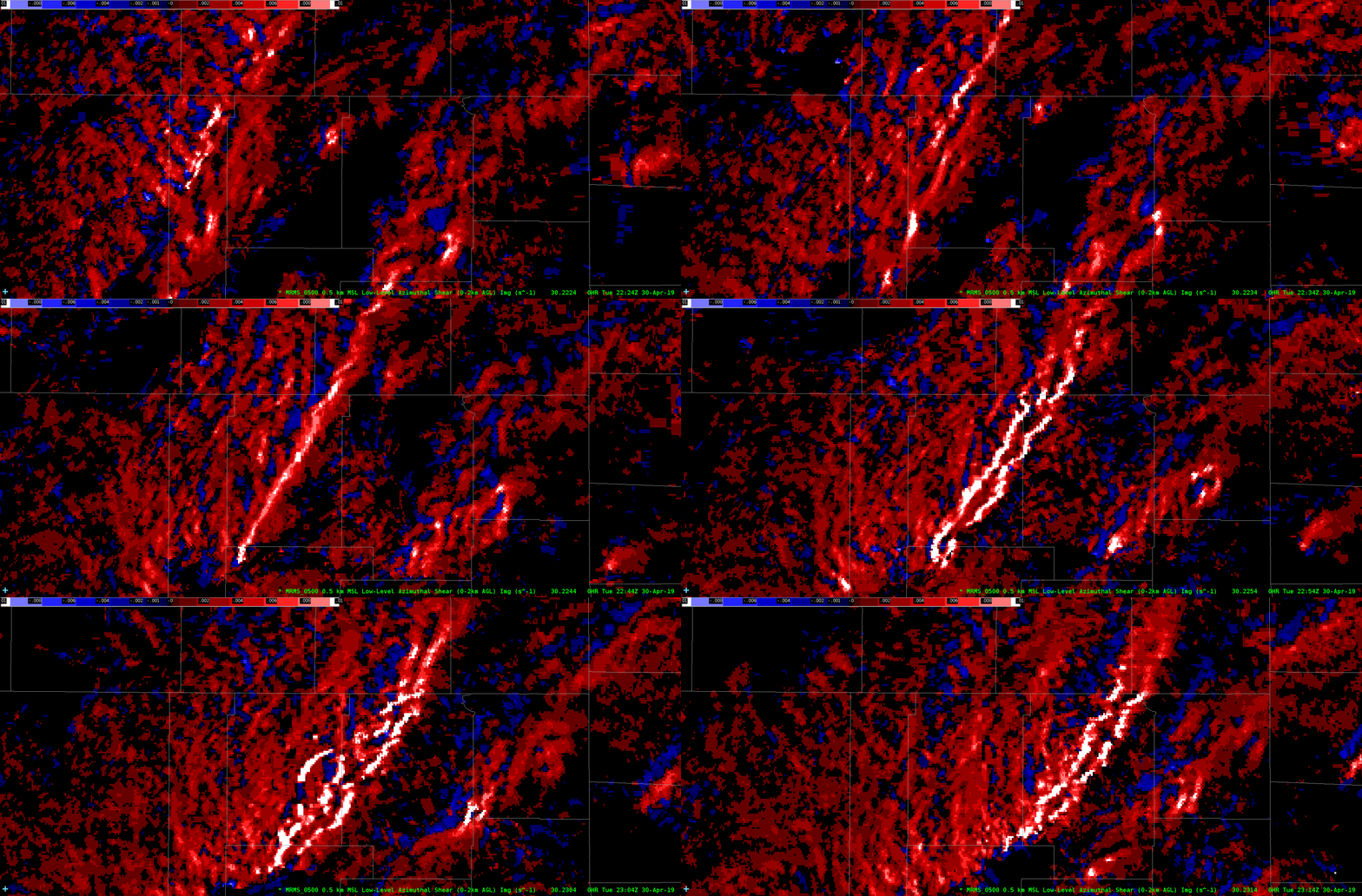
The two above images compare 0-2 AzShear (top) and single scan AzShear (bottom). Due to multiple sampling by multiple radars, it appears as though 4 different iterations of the squall line shear boundary are plotted. This renders the merged 6646data almost useless for interpretation purposes. The single scan data removes this issue. Also from these screen grabs, it appears as though the farthest east scan is coming from the KMX, the single scan site used here.
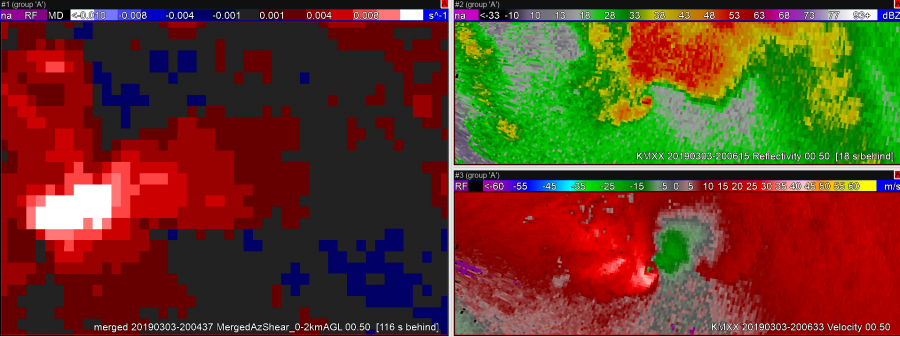
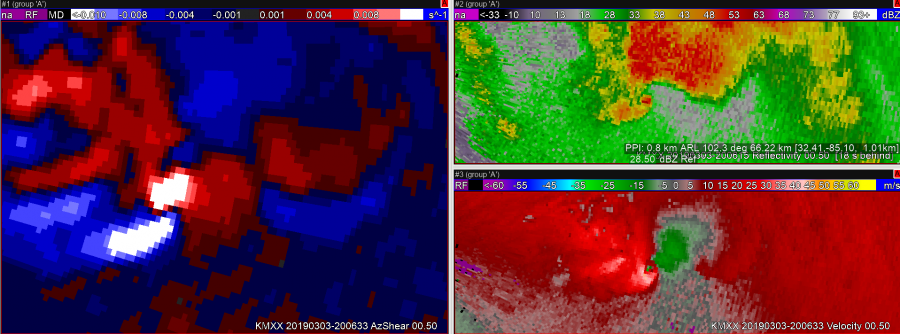
The two examples above show the benefits of single radar versus merged once again. The merged azshear core is several miles behind the circulation center at this time. The single radar data follows the current velocity scan as expected. In a time-sensitive warning operation scenario, knowing this I would likely use the single radar product exclusively.


-Dusty Davis

Az Shear Possibilities

I’ve seen some great promise from the low level az shear this week so far. One thing that I do not like about the default product is that it has a lot of noise/extra info in it that tends to clutter up your screen. An idea that I had was to filter more of the noise by making a large portion of the scale transparent. Take a glance at the velocity field and see how it matches up with the AZ shear extremes.

Shown here is a comparison of the default vs the “enhanced” low level az shear.

Another advantage I could see with only displaying the “extremes” would be the ability to include velocity data underneath the image. This can be especially useful since the MRMS data is feeding the AZ Shear. Why? Well the velocity couplet you are examining is likely to progress a bit “faster” using the baseline radar data rather than MRMS, so they likely will be right next to each other.

Az Shear overlay on Velocity Data

Other thoughts I have had going this route is possibly changing the “red” side of the color scale to something other than red so that it doesn’t match the color scale used by velocity data on radar. I did like a “yellow” scale as it did not largely conflict with the color scales expressed by the velocity data.

An attempt at a “yellow extremes” color table.

As a whole I think this product has some great potential at drawing your attention to portions of the storm very quickly.

South Beach

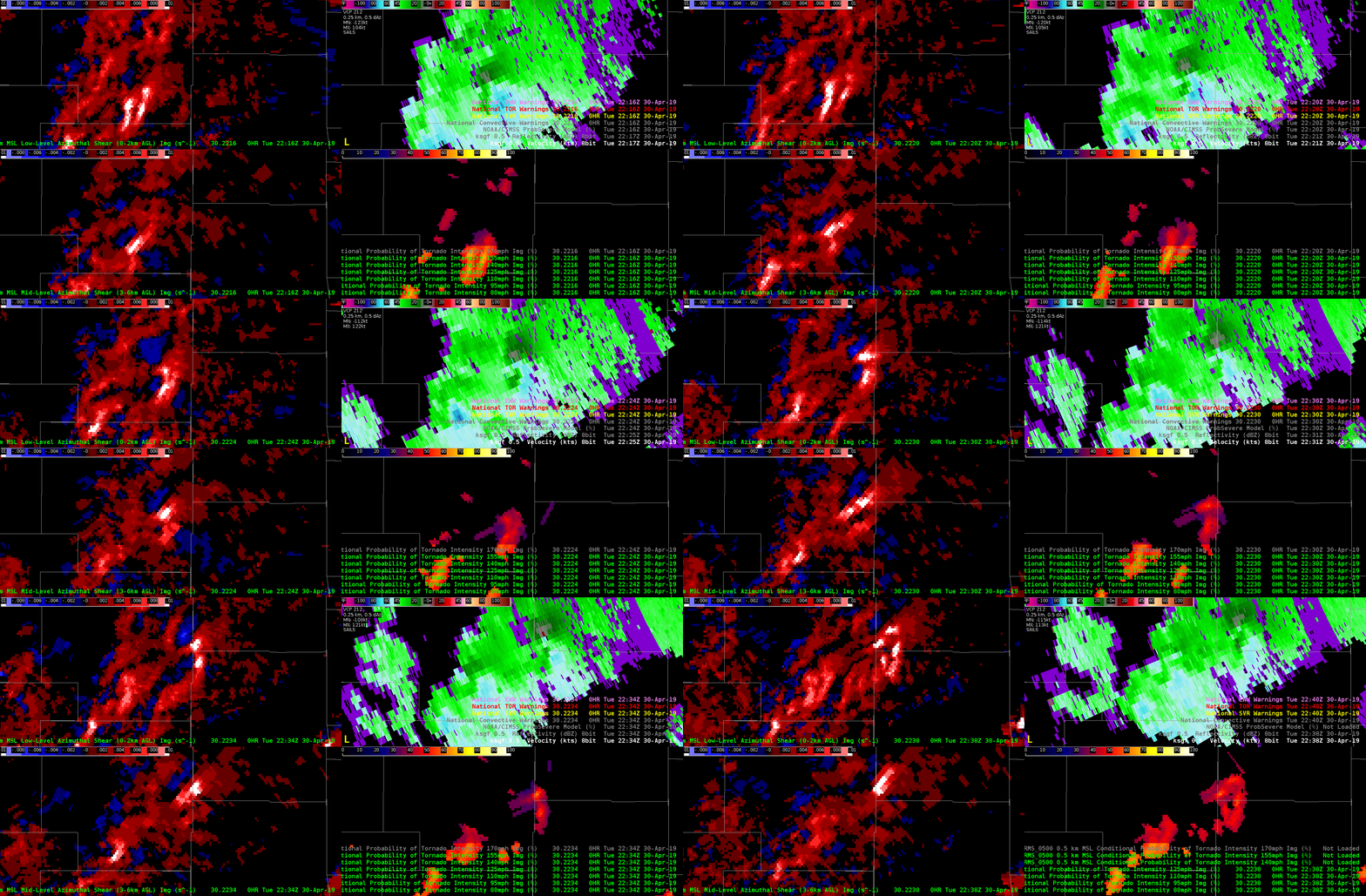
Odd AzShear data: 22:16

Az shear shows a double scan signature on the top left here. This seems like it would result from SGF scanning the shear at one time and Tulsa hitting it at another. Clearly there are not two lines of shear here per radar single scans.

Another example of a double AzShear signal. Likely coming from radar timestamp matching issues.
Tags: None

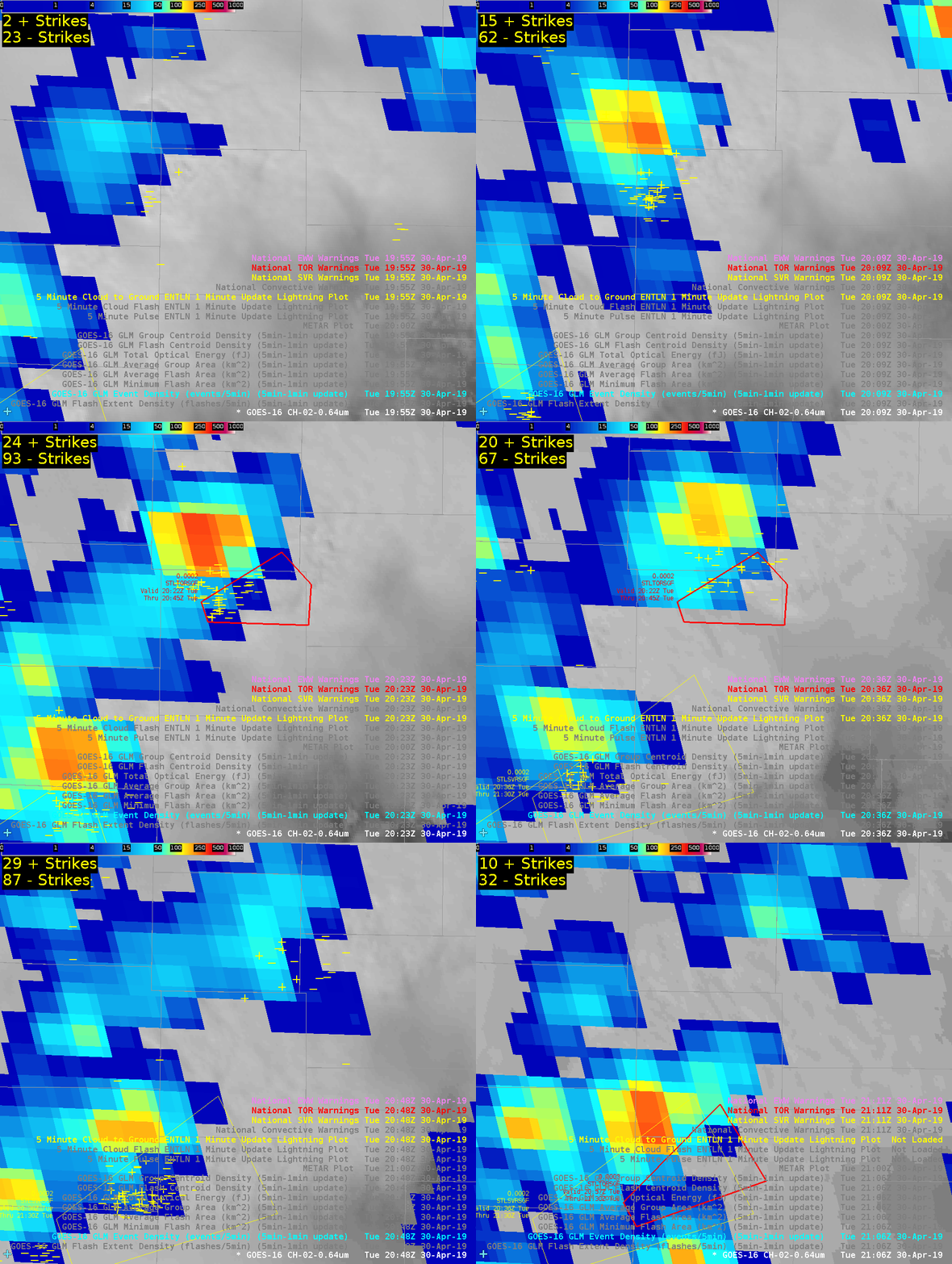
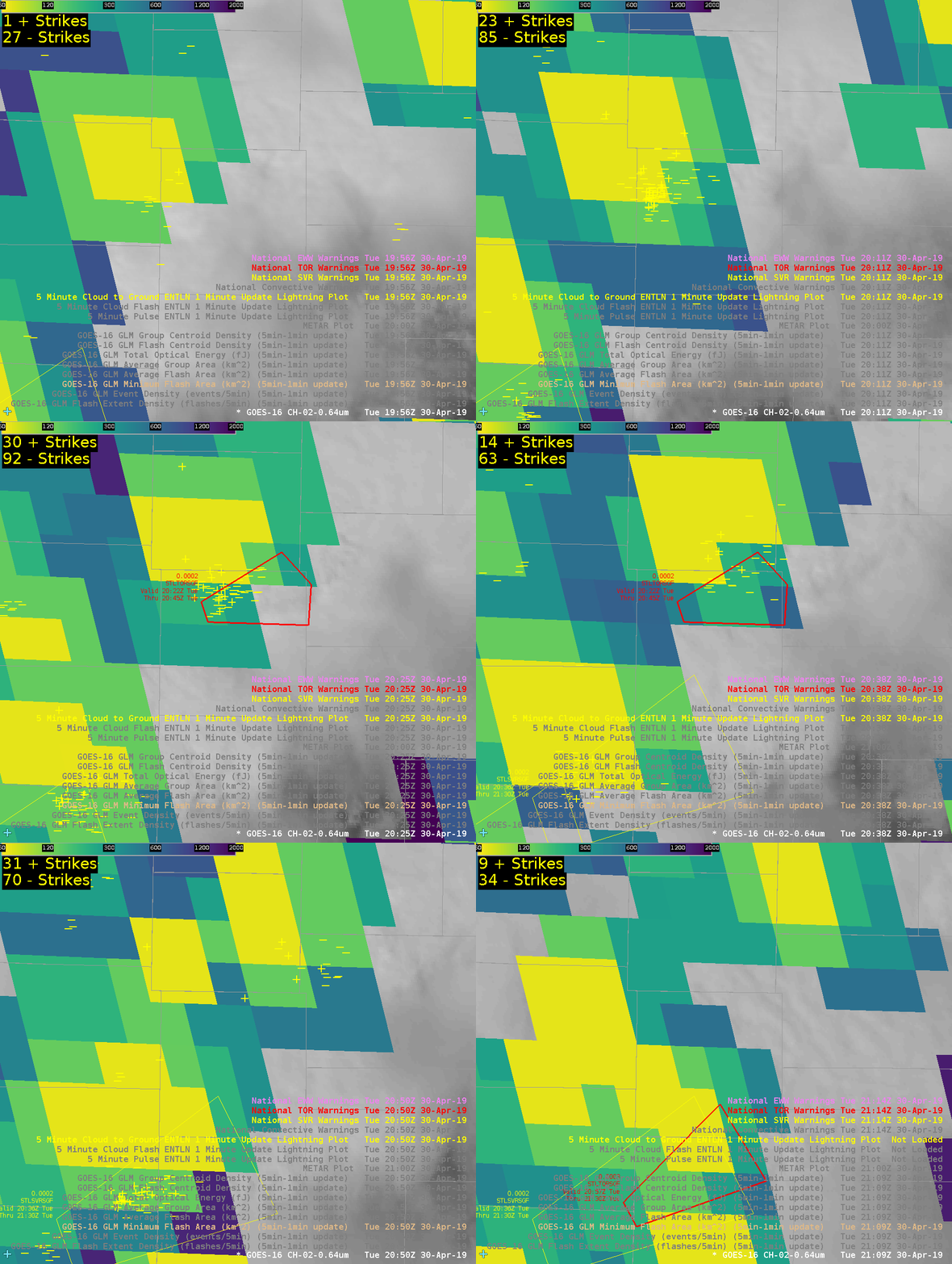
HWT day 2: 19:10 GLM and AzShear observations of Missouri tornadic supercell

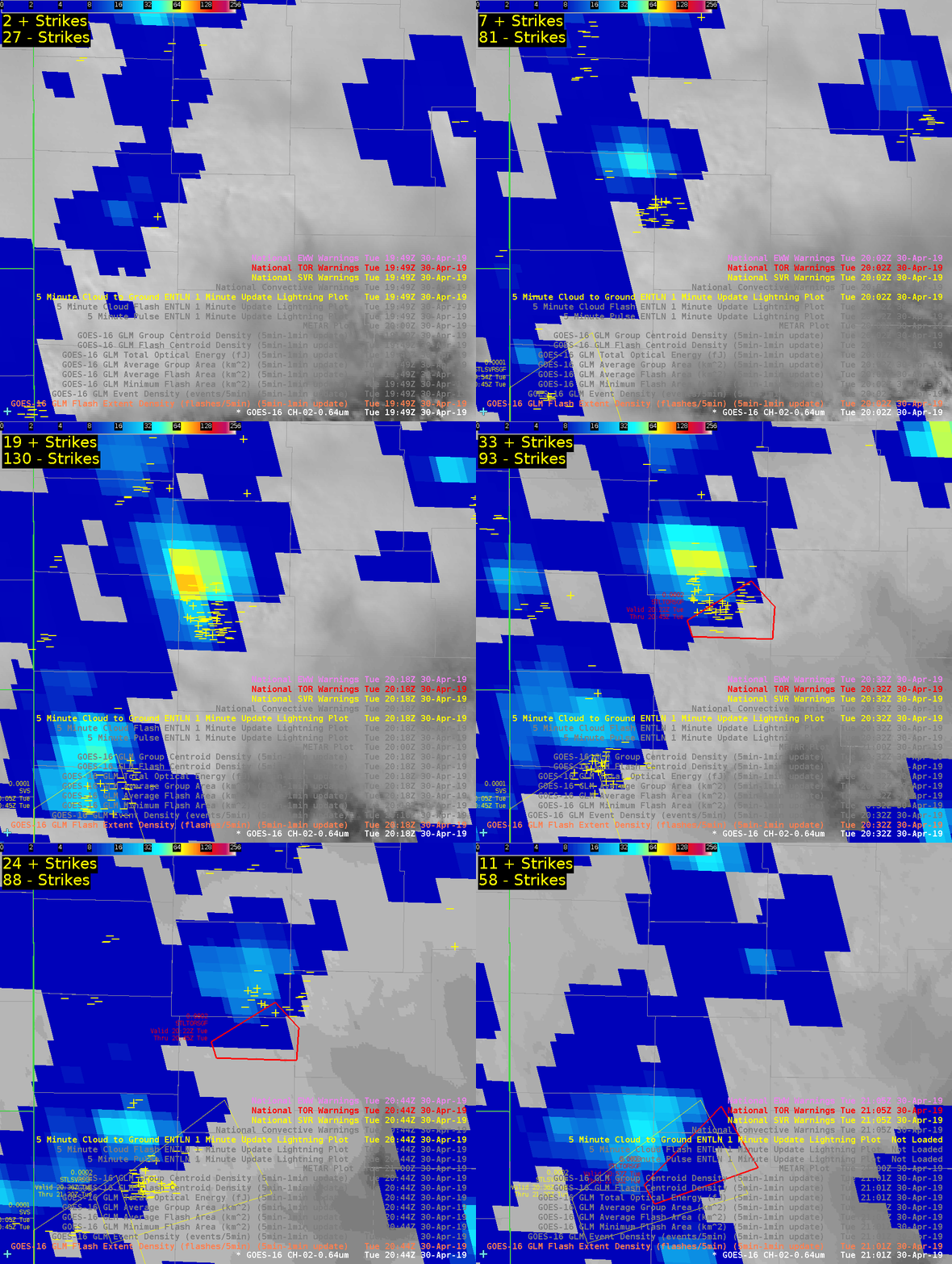
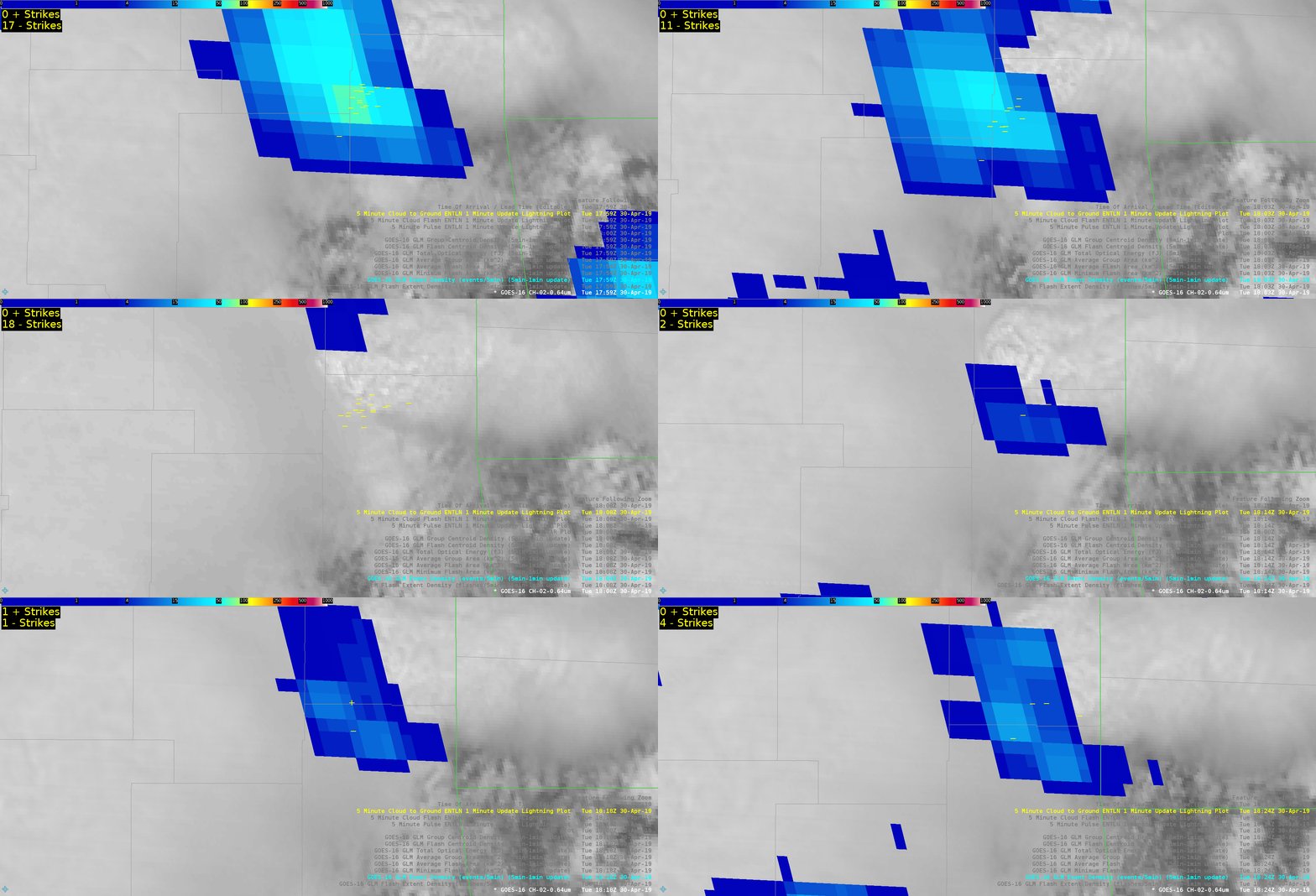
Feature following zoom showing the GLM pulsing phenomena associated with intensification/weakening of a supercell in OK/MO. During the third pulse, a TOR warning was issued.

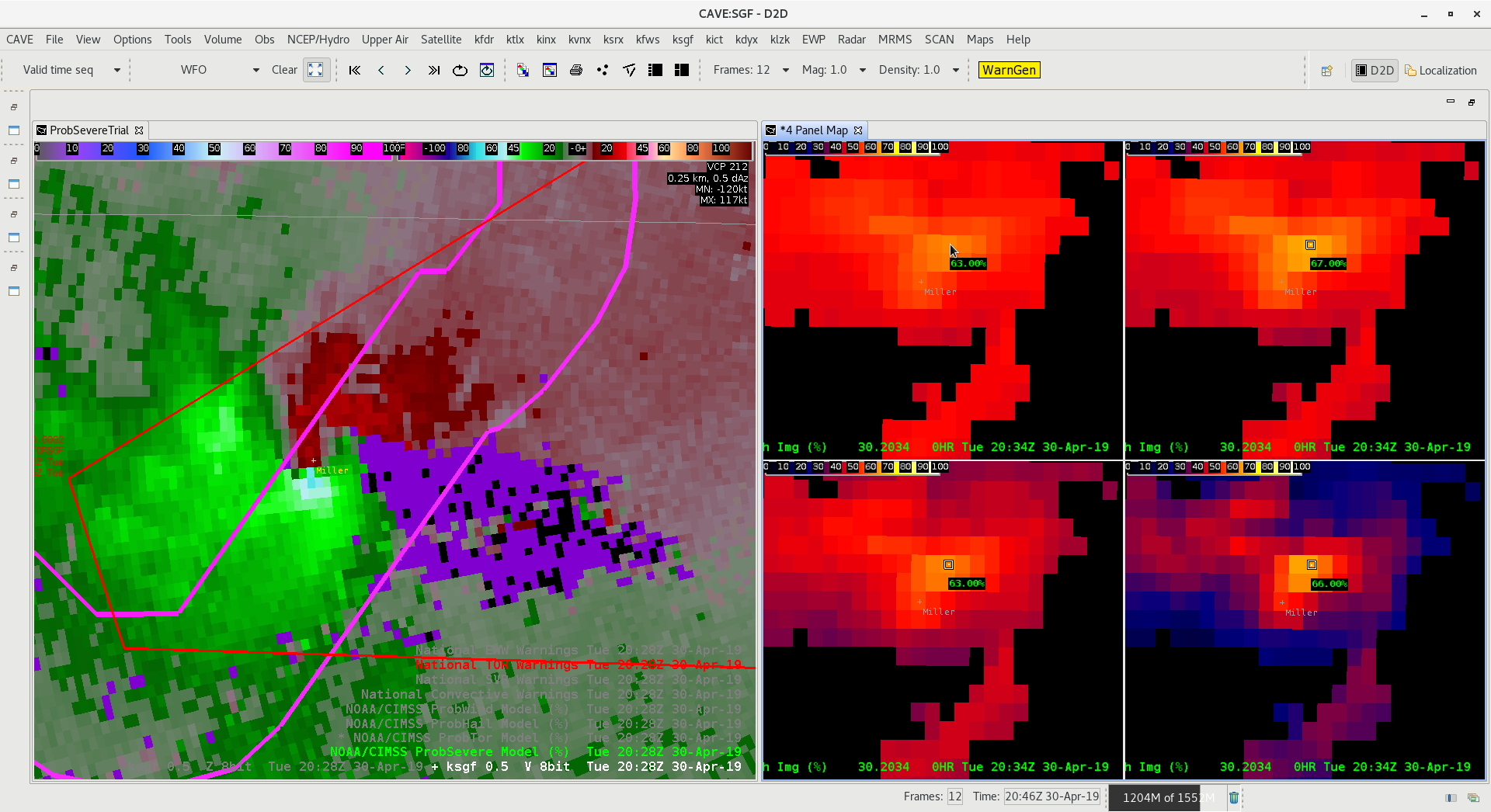
Case of CPTI values on a confirmed tornado near Miller, MO. No confirmed damage estimates yet, but TOR was confirmed at this time visually and with a TDS

Lightning jump preceding a tornado and then confirmed touchdown in MOEvent Density over the same cell

Minimum Flash area showing updraft core
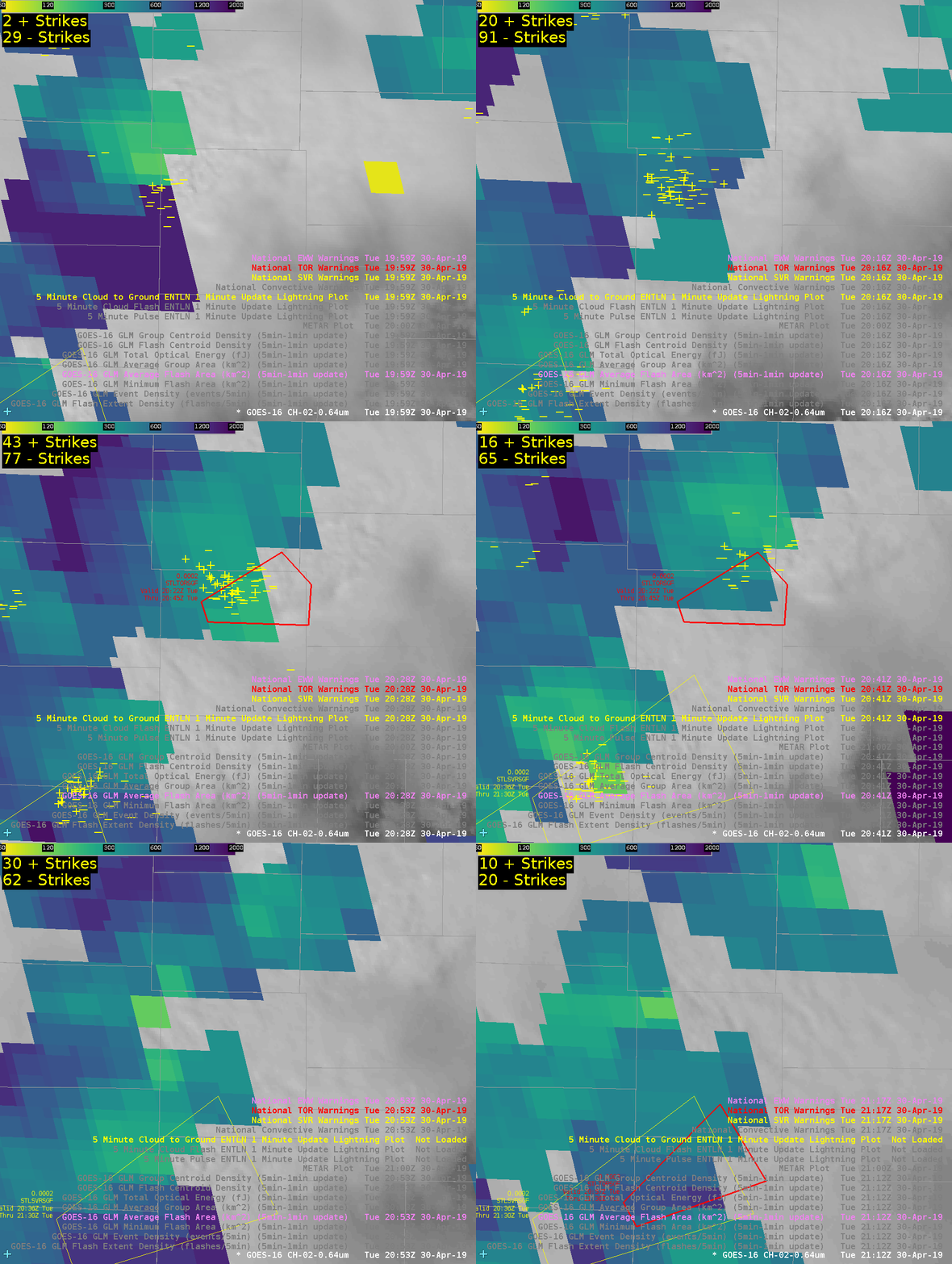
 

Average Flash Area


This is a case where AzShear overdid the tornadic threat This supercell had a circulation that never really tightened up. ProbSevere also vastly overestimated the tornado threat, likely due to nearby storm interactions and mergers. When convection gets messy, can we rely on these products as much?
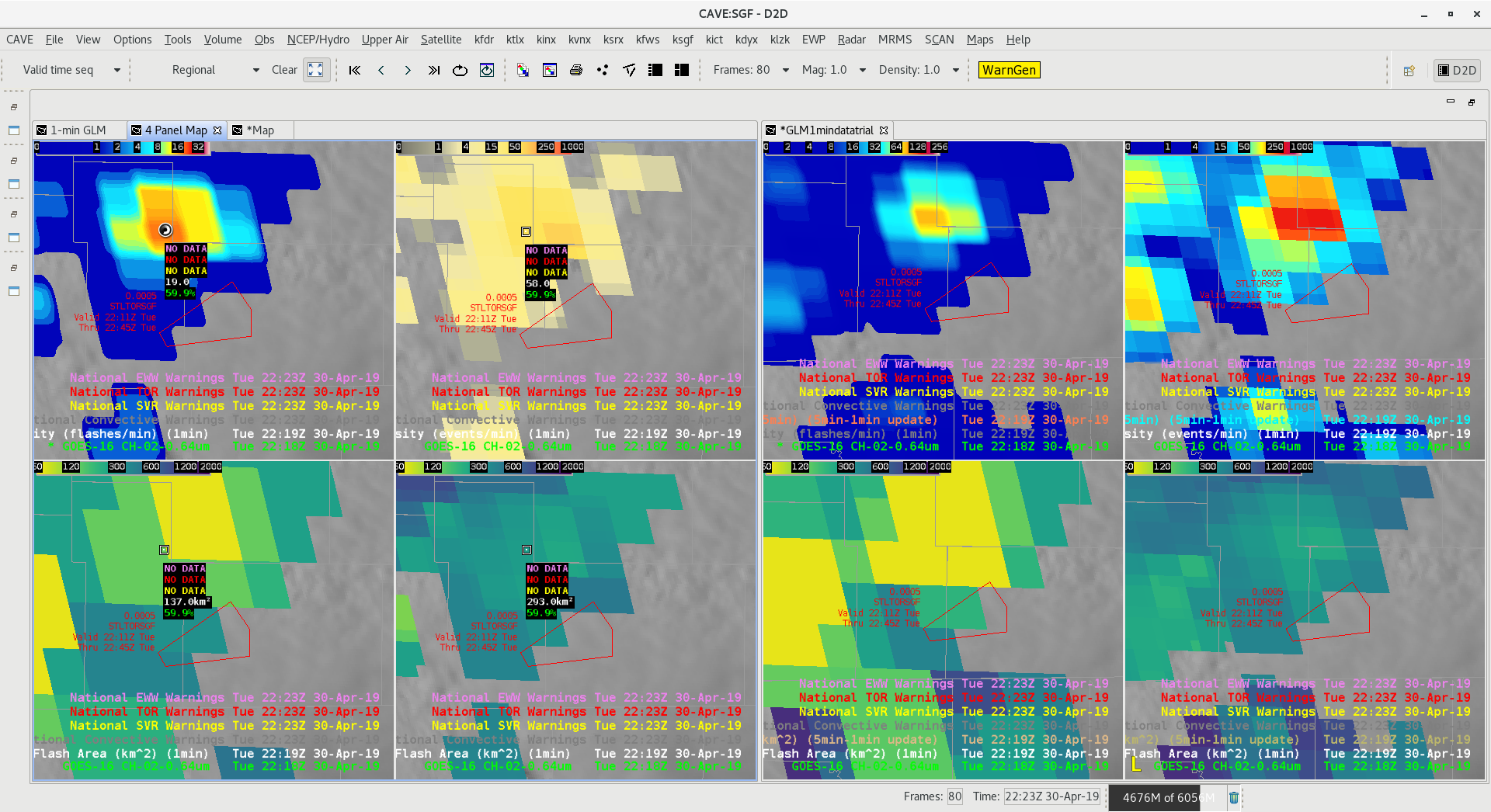
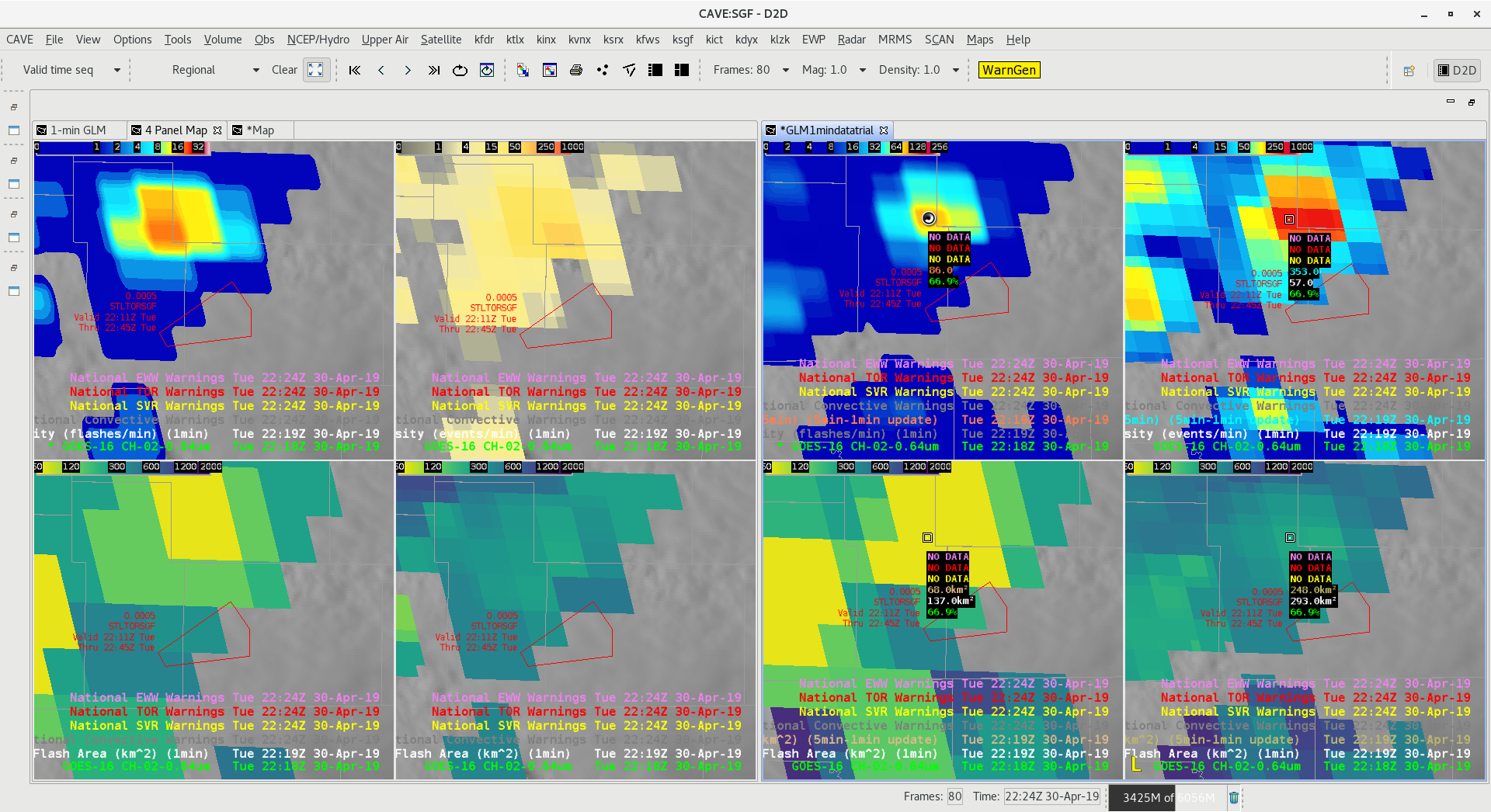
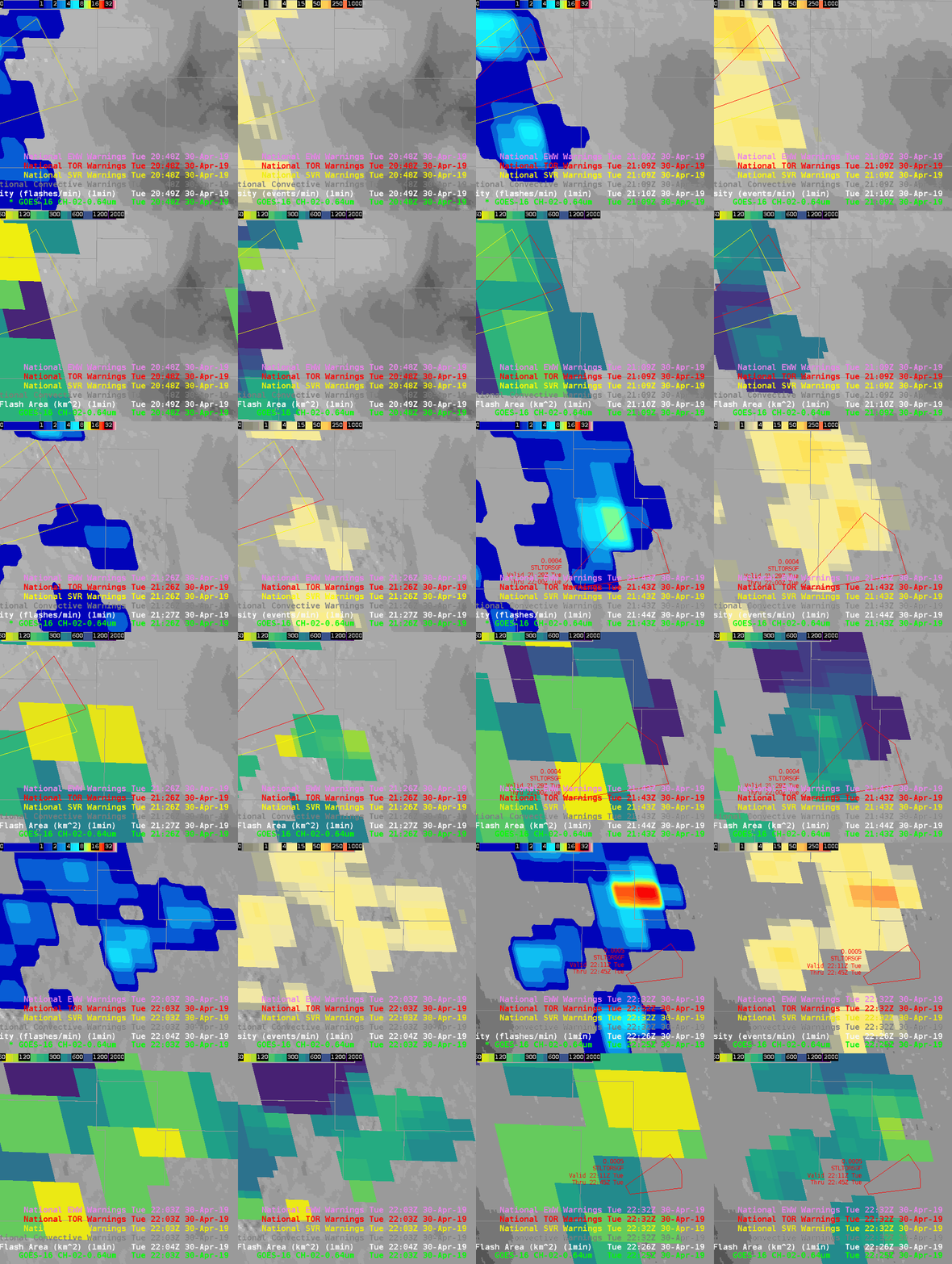
 

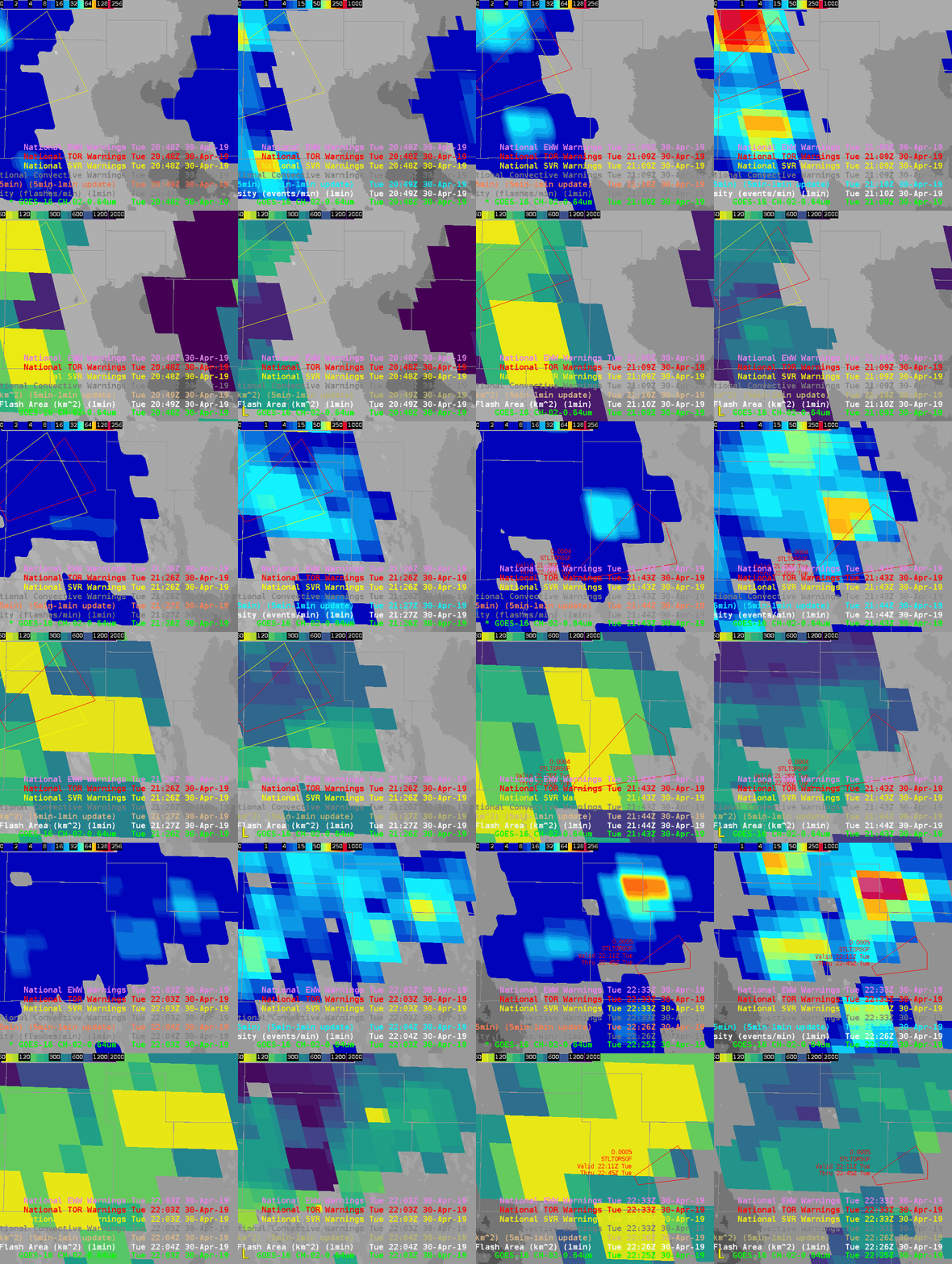
The two images above compare a 4 panel of 1 min GLM data (left four panels) versus 5 min data (right four panels). While the 5 min data was much smoother to view from an animation and trend sense, the 1 min data did provide some fine temporal resolution help during periods of rapid storm intensification preceding this tornado warning.

The above two loops compare 1 min looping (top 4 panel) versus 5 min looping (bottom 4 panels). In a loop the ‘flashy’ nature of 1 min data makes it less desirable in operations, however manual toggling and advancing still make this data useful.


CPTI and Azshear

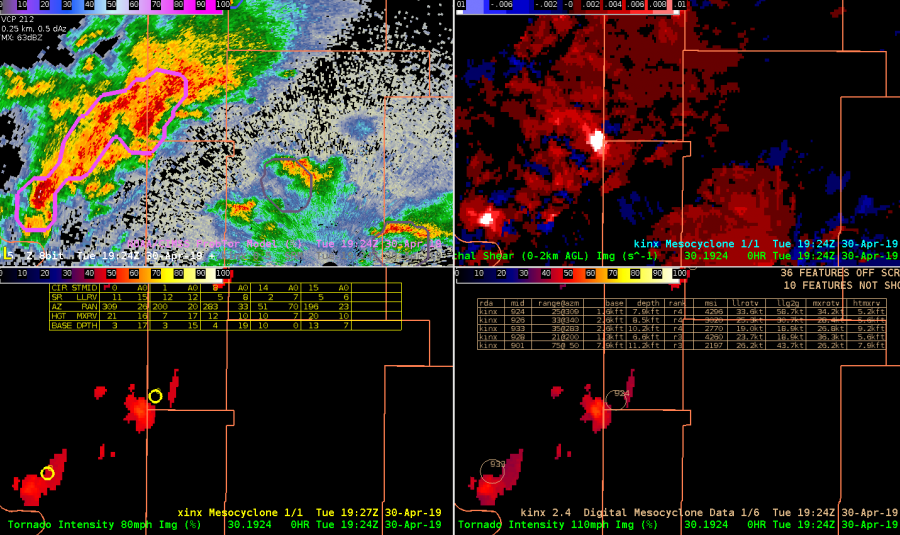
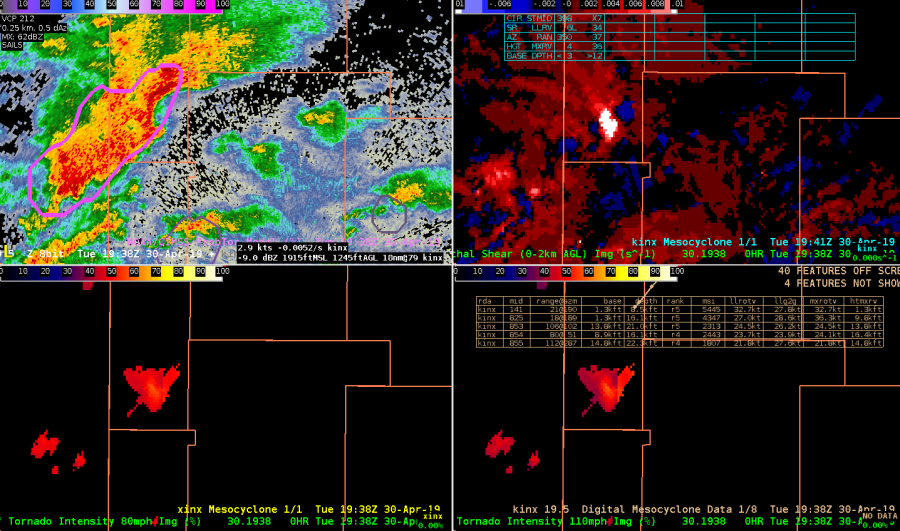
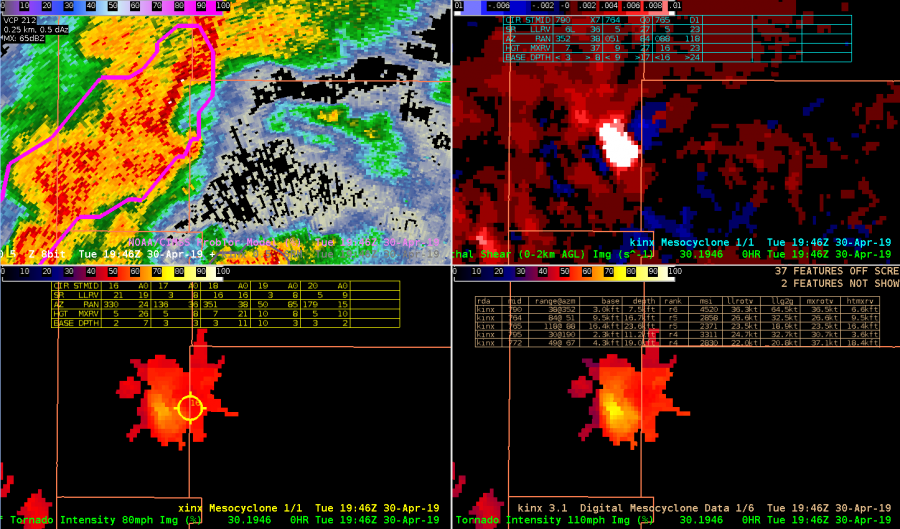
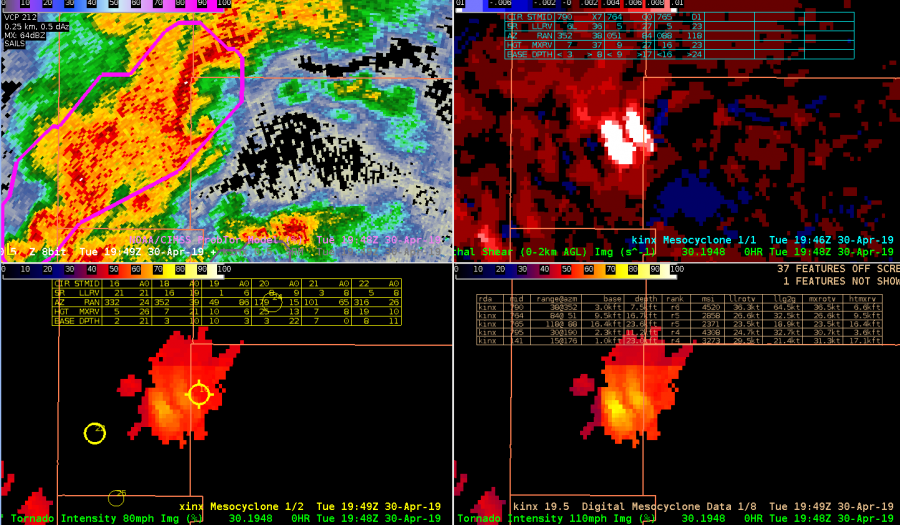
Tracking this northern most SC @ 1926 UTC prior to tornadogenesis.  Azshear 0-2 km product did a nice job highlighting shear with developing storm very early on in storm evolution and was very persistent in highlighting area of shear throughout.  Temporal continuity was very good.  Lower two panels are 80 and 110 mph intensity probabilities.  Used this 4-panel to monitor evolution.  Also displayed is legacy mesocyclone (upper-right), DMD (lower right) and XDMD l(lower left).  This SC also exhibited well-organized ZDR arc and KDP foot (not shown) that whose centroids were normal to storm motion suggesting MC intensification was likely.

1938 utc Azshear still showing strong signal with CPTI gradually increasing to near 60%.  ProbTor increased to 78% as well.  DMD, XDMD and MD not showing much and did not seem to be very helpful.


CPTI was insightful with increasing probabilities of tornado intensity probabilities at higher speeds (110 mph lower right).   Note that XDMD was also indicating MXRV of 26.


1448 UTC – would occasionally see dual maxes in AZShear and CPTI products that was a bit of an issue at times.

CPTI 110 probablities up to ~ 75 % at this time (lower right)

Overall…0-2 km Azshear was quite helpful in quickly grabbing attention to areas of concern.  0-2 km product was temporally very consistent.  Its location relative to developing Mesocyclone was typically off…but still very useful.    XDMD, did seem to perform better than legacy DMD products but not much at least with this storm.   Early in storm evolution, examining ZDR/KDP centroids relative to storm motion was also helpful as a reality check on MC intensification and increasing SRH with this particular storm.  Bottom line was generally pleased wiith  AzShear and CPTI performance for this storm. – Quik TWIP