Live Blog – 18 May 2009 (6:24 pm) – LMA Feedback & Dinner Plans

There has been much discussion of the lightning data.  Forecasters are interested in lightning, but are uncertain how it will help them in warning operations.  They have yet to get in and work with the data.  Matthew suggests that more training on typical LMA data signatures – related to storm morphology, would help get him/others ready to view this data in the HWT operational environment.

The group will break for dinner and then reconvene at 7:30pm CDT.  Groups of 2 will attack archive cases using PAR and CASA data, respectively.

Patrick Burke (EWP Weekly Coordinator, 18-22 May 2009)

Tags: None

Live Blog – 18 May 2009 (5:56 pm) – MRMS-derived products for hail detection

During MRMS training, Les Lemon recommended, based on some published research and his personal experience, that a useful MRMS product would be 60+ dbZ reflectivity mapped to the -20 deg C level.  Les uses this to predict when a storm will begin producing not severe hail, but significant severe hail (2 inch plus diameter).  So we haven’t looked at any data yet, archived or otherwise, but we already have a suggestion for improvement!

Patrick Burke (EWP Weekly Coordinator, 18-22 May 2009)

Tags: None

Live Blog – 18 May 2009 (5:41 pm) – Training Wraps up with LMA

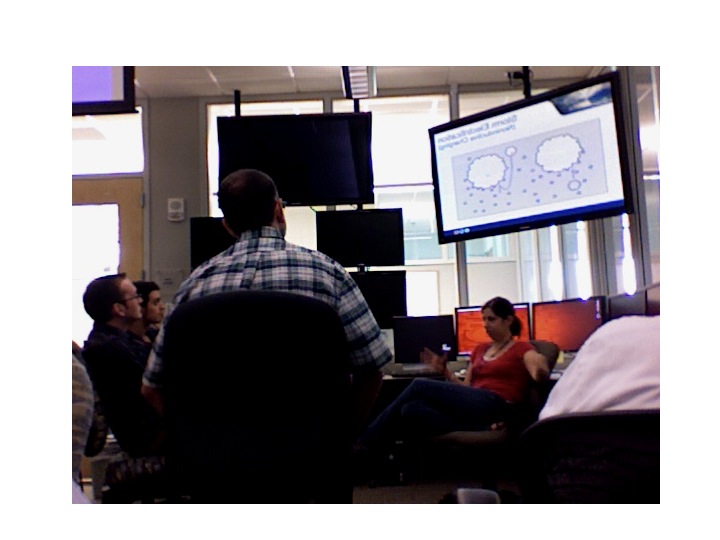
With each training session taking the form of an interactive seminar, the forecasters have absorbed a lot of information covering a wide variety of meteorology and technology.  Greg Stumpf elaborated on the multitude of radar-and-environment-derived products available with the NSSL’s Multi-Radar/Multi-Sensor approach.  Now Dr. Kristin Kuhlman, seen below, is discussing the Lightning Mapping Array, beginning with the physics behind LMA.  Soon the forecasters will take to their workstations and experience LMA data first hand.

Kristin teaches the Week 4 group about the Lightning Mapping Array

Patrick Burke (EWP Weekly Coordinator, 18-22 May 2009)

Tags: None

Live Blog – 18 May 2009 (4:14 pm) – Training Continues

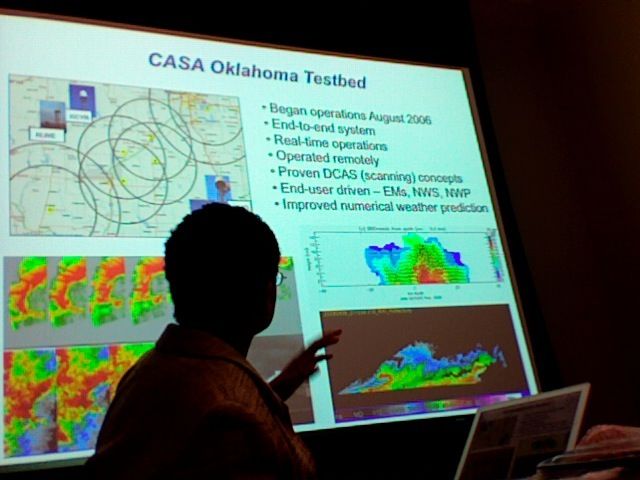
Forecasters are going in depth on the design of the PAR and CASA network.  There have been several questions, especially from Mike and Les, as to where we stand during 2009, with respect to the cycle of Research and Development.  The answer seems to be that both technologies have a strong footing with funding out for the next several years, and both have developed some intriguing datasets, but both are perhaps a decade or more from any eventual implementation in an operational network.  Below, Brenda Phillips of the University of Massachusetts discusses the CASA radars with our forecasters:

Patrick Burke (EWP Weekly Coordinator, 18-22 May 2009)

Tags: None

Live Blog – 18 May 2009 (2:33 pm) – Training Schedule

Forecasters are currently training on the use of the WDSS-II system for interrogation of radar data.  This year in the EWP, WDSS-II is used in tandem with AWIPS D2D.  From 2:30-3:15pm CDT, forecasters will train on interpreting PAR data, followed by training for CASA from 3:30 to at least 4:30pm.  After a short break, forecasters will train on MRMS and LMA, break for dinner, and then perform 2 displaced real-time warning simulations this evening – one using PAR data, and one using CASA.

Patrick Burke (EWP Weekly Coordinator, 18-22 May 2009)

Tags: None

Outlook – 18 May 2009

Our visiting forecasters/scientists arrived at the National Weather Center just before 1 pm.  This week we have Rob Handel from the Peachtree City, Georgia, NWS Forecast Office, Matthew Kramar from the Sterling, Virginia, Office, Mike Vescio from the Pendelton, Oregon, Office, and Les Lemon from the NWS Warning Decision Training Branch.

The group was met today with dry and sunny air, clear blue skies, and little prospect for thunderstorms this week in a 200 mile radius from Norman, OK.  Live operations are unlikely in the CASA and PAR networks, but the group will participate in a variety of warning simulations using archived data from these networks.  The outlook is similar for the LMA testbeds.  An elongated upper ridge will build from Oklahoma toward the Washington D.C. area testbed, keeping the weather dry there.  A broad upper level circulation developing in the eastern Gulf will remain stationary or retrograde slightly, but the chance of significant thunderstorms in the Huntsville, Alabama, LMA testbed is low.  LMA research will likely be based in archived data this week.

Multi-Radar, Multi-Sensor (MRMS) warning operations, however, may be supported in real time from any WSR-88D in the continental U.S.  Currently, the most likely opportunities for real-time MRMS operations appear to be Tuesday evening in Montana, and either Wednesday or Thursday evening in the central High Plains, just east of the Colorado and Wyoming front range.  Below is the probabilistic outlook for severe thunderstorms on Tuesday, forecast by the Storm Prediction Center:

day2probotlk_1730_any.gif

Patrick Burke (EWP Weekly Coordinator, 18-22 May 2009)

Tags: None

Forecaster Thoughts – Kevin Brown (2009 Week 3)

Luckily, we were able see real-time data with the LMA, CASA, and PAR systems, along with the WDSS-II multi-radar algorithms. When compared to the archived cases, real-time operations provided a much better picture of the challenges operational forecasters will have in base data interpretation, primarily due to the more realistic warning environment. Below are some of the main points that I would like to make about each system:

LMA:  With its quick updates, the 1km data aided in locating areas of updraft intensification and deviant motion trends. The ability to see the trend data was also a good indicator of storm strength/trend, especially in radar-sparse areas.  Future research will hopefully lead to additional tools for storm/warning forecasting and warnings.

CASA:  Although rapid updates from multiple radars can be overwhelming at times, the increased temporal and spatial resolution are well worth it.  To alleviate the rapid-fire of new radar scans from 4 separate radars, the multi-radar composite was utilized with success.  Especially in areas with sparse/distant radar coverage, this system should easily increase probabilities of detection and lead-times of severe weather events.  However, due to the detection of features not previously seen on the 88D, an increase in false alarm rate is also expected.  I also found that the sector scanning strategies took away from base data interpretation. Perhaps being able to manually control what sector is scanned would help in these situations.

PAR
:  The rapid scans, along with higher resolutions above the traditional “spit-cuts”, were outstanding.  This helped increase the confidence of meso-cyclone and core strengths.  The ADAPTS strategy appeared to work quite well without compromising the base data moments.  Hopefully in the not-so-distant future, additional panels will be added to alleviate the beam broadening on the edges of our current panel, and allow a greater radar coverage area.

Multi-radar/Multi-sensor algorithms:  In my experience, the use of MESH and reflectivities at 0C and -20C increase warning confidence tremendously.  Other diagnostic products, such as MESH Swath, Rotation Tracks, etc… are also great tools to help with warning confidence and warning polygon construction.  Especially in areas where radar coverage is sparse/distant with respect to your targets, these algorithms are needed.  After using the multi-radar data in this workshop, and also in real-time operations at my office, I feel the products greatly enhance warning and non-warning decisions.

Kevin Brown (NWS Norman OK – 2009 Week 3 Evaluator)

Tags: None

Forecaster Thoughts – Chris Wielki (2009 Week 3)

The EWP was a great experience and I couldn’t really ask for much more. As a meteorologist from outside of the United States I was somewhat uncertain what to expect but what I found impressed me. Technologies that we used throughout the week were useful and the exchange of ideas between researchers and meteorologists is something we too should strive for. The highlight was Wednesday when several tornadic supercells developed over Oklahoma with one passing through the CASA domain. The 3Dvar set the stage for the supercell entering the CASA domain and had us thinking about a tornado potential before appearing on the casa radars.  When the cell moved into the CASA domain the rotation was apparent and we were able to send the warning quickly. The strong winds that followed the tornado were easy to identify in the CASA dataset and warnings could likely be narrowed down as confidence increases with the use of these x-band radars. The WSR-88D data also showed the TVS however it was after the CASA data showing an obvious potential to improve lead times. PAR data and scanning strategies didn’t have any apparent faults and with the improved resolution and frequency I feel features would be singled out earlier in an event and once again lead times would increase. The LMA data has potential but I felt that I would have to get more comfortable with it and develop a conceptual model of what to expect with larger supercells. Picking out a peak in the LMA data would prove to be difficult but the graphical tool on Google earth was useful and could increase confidence in warnings already issued. There may be potential to use the LMA data for storm splitting since it would show the two updrafts however cases showing a split were limited. Last of all were the multi-radar/sensor algorithms. Returning to my office without products such as the MEHS, Reflectivity at -20, MEHS and rotation tracks will prove to be a difficult experience.

Chris Wielki (Prairie and Arctic Storm Prediction Center, Edmonton, AB – 2009 Week 3 Evaluator)

Tags: None

Forecaster Thoughts – John Billet (2009 Week 3)

Being part of the EWP was very worthwhile with the four separate test beds each offering unique opportunities. The phased array radar was extremely useful. The highlight of the week for the phased array was Wednesday night’s live event. I was working with Kevin Brown from the Norman office using the phased array to simulate test warnings for the storms. There are a number of very good features with the phased array, the fast temporal updates of 1 minute per volume scan and the higher resolution brings much better identification to features. The radar has the ability to quickly change where the range folding was occurring from one volume scan to the next which meant at most just one minute of bad data. We were able to view animated cross sections through WDSSII and actually watch the reflectivity cores rise and then come back down to the ground causing downburst signatures. The current phased array radar only has one panel so it had limited viewing as the number of storms increased. We only looked briefly at a tornadic storm in the CASA area but focused on the storm coming south from Oklahoma City to Norman which also had tornadic potential. This storm we could see the original outflow move out ahead of the storm then slow down as the storm caught up and reintensified. This is when the tornado developed which we could clearly track in the velocity and as it got close to the radar we even saw the debris swirl on the radar.

The CASA network with 4 low power Doppler radars each about 40 km apart was surprisingly useful. The fact that a 3DVAR wind analysis is done with the radar scans was very helpful. This analysis clearly showed gust fronts and rear flank downdrafts. It also picked up very well on the tornado. I had some hesitation about the system because it completes a volume scan in 1 minute and if there are numerous echoes in range it only does 1 to 2 elevation scans. I think in hail situations this could be a problem. The software is programmed to look for individual cells then scan up several cuts but we had too many cells in the area so that only 1 or 2 elevations were possible. There is also a numerical forecast of various fields which utilizes the radar data and goes out 1 hour in the future. This helps significantly improve situational awareness.

While the previous two systems are only available at Norman there are two other systems which we at Wakefield hope to access locally. The enhanced lightning detection network which includes in cloud and cloud to ground strokes has one domain centered over Washington DC. The VILMA or lightning density product helped with updraft detection and provides another reality check on storm structure. Being a coastal office and talking with the scientist about the fact that in cloud lightning almost always precedes any ground strokes, we could use this product to give some lead time at the beaches during the summer time about when lightning might occur. The lightning tied to individual cells producing trends helped in predicting intensification or weakening of cells. If the cell numbers could be color coded to indicate increasing or decreasing lightning trends this would help with quick identification of which cells might be increasing.

The final data set was multi sensor multi radar data. For now one domain is centered over Washington DC and covers all of our CWA. Some of the most useful products included real time MESH or hail forecast tracks and instantaneous size estimates. In the cases and two real time events it appeared a good estimator of hail size something always needed. These tracks could also be very useful in the proper shaping for a polygon warning. The circulation tracks are so dense it was hard to use it much but would like to look at it in more detail. There are numerous other products as well which will need to be examined but we ran out of time in Norman. We are working to set this up here for real-time use.

John Billet (NWS Wakefield VA – 2009 Week 3 Evaluator)

Tags: None

Week 3 Summary: 11 – 15 May 2009

LMA:

Kevin – Identify trends and signatures and their meaning could be useful.  Identify what’s useful in developing a storm in initiation.

Chris – Liked the trends in Google Earth.

Steve – VLMA Still needs correlation between its display and other signatures and severe weather events.  Don’t know the benefit of satellite-based sensor in areas of  regular LMA sensor.

Kristen – LMAs are line of sight so they’d need to be smartly located in topography.

John- Would anticipate what it’s coverage would be in poor radar coverage areas and also for coastal areas for advance warning of LTG for mariners and beach-goers.  Concurs more research needed.

What want to see?   Trending, manual area defining intervention to define trending (e.g., distance speed tool or a box),

CASA:

John – anticipates usefulness of 3dvar and multi radars but also big education challenge.  Would like to see vertical cross-section.  Would prefer a 2 min update if they could get some vertical structure.

Steve – Would like cross-section from multi-radar including CASA.  Wed night was a significant stepping stone was like Red Rock was in 1991.  Would like to time-match 88D, CASA, PAR in one 4-panel.

Kevin – CASA saw the circulations 3-5 min ahead of 88D in Gracemont.  Kevin walked into the WFO concerned they were seeing it.  But they had the TOR drafted.  WFO forecasters also walked into the HWT to view the CASA data.

Concerning RFD winds in Anadarko, CASA really showed the winds.  The 3dVAR picked up on the winds as well.  KTLX showed no RFD winds.

Chris – Concurs with the benefits of rapid update.  Drawback is the attenuation.

CASA wishlist:  Can a manual scanning override be accomplished?  This is a workload strategy that could be accomplished by having someone managing scanning while the other interprets storm structure.  The software would need to be made simple.

Would an attenuation product be useful?  Unknown at this time.

PAR:

Kevin:  Liked the mid- upper-level resolution.  Midlevel mesos tightened up more quickly in PAR than 88D.  Did not see any adverse effects of adaptive scanning.  Perhaps would like to see a more frequent full volume scan in explosive initiation environments.  Edge of sector had a bit more velocity problems.

Chris:  Lot of more features visible on PAR.

Steve:  Data quality was better this year’s experiment.

John:  Anticipates much better detection of descending cores in low-shear event.  Worth having superres even with more time.

What tradeoff are the forecasters willing to consider  if one is required to see clear boundaries around the storm?  They are willing to consider a tradeoff depending on how important it is to see the boundaries.

Kevin:  Is CASA network refractivity conceivable?  Feb 10 case refractivity could’ve explained why the following supercells weren’t tornadic.  Could it compensate for sacrificing scanning frequency for sensitivity.

Chris:  Wondered about the impact 2.1 deg beamwidth on edges of sectors?  There was some impact but would be limited in the future with hardware upgrade.

Adam wondered about most what was the most useful scanning stategies.  Not much difference…all were good. 15 elevations was sufficient.

Kevin:  Changing the PRF could be made easier to do but liked the immediate feedback in the PAR.

Multi-radar:

Steve:  What would be the best?  Get it into AWIPS in general

Kevin:  Not a pleasant thought thinking about not using the products.  MESH, 30 and 50dBZ hgt > 0C and -20C,  Reflectivity at 0, -20 C.  Kevin doesn’t look at rotation tracks as much as others in the office.  Though they use it for post-mortem.

The MESH, rotation tracks were used to track motion.  Kevin noticed how big the polygons  are compared to actual tracks.

Chris:  MESH and reports seem to coincide. Rotation tracks showed the strongest tracks were colocated with tornadoes.

John:  MESH and rotation tracks were useful to call in and verify reports.

Merging LMA with multi-radar data?

General comments:

Steve liked the jobsheets for WDSSII.  Should be done on day 1.

Need better AWIPS localization to bring up map products on 4-panels without procedures.

Intro seminars – Good, no death by powerpoint by death.

AWIPS introduction was an added bonus.

Give a chance for forecasters to customize. They could bring their own procedures.  Could use the ‘alter functions’ to change model type or radar ID.

International visitors could benefit from an hour or two of software spinup.

Get SVS capability.

Additional “lost” notes found in an archived draft never published until now:

LMA considerations:  Don’t know what VLMA intensity to consider in warning issuance.  Screen real estate issues.  Would like the source points.  Swears that supercell ID can be done with VLMA and 0.5 deg radar data.  From an Canadian pt of view, if a radar goes out there’s no extra data.  VLMA very useful to see LTG frequency going up just before meso increased north Norman.  MESH would increase after the LTG would peak.  VLMA would indicate splits about to occur.  Might give more confidence about which updraft might be more dominant.  Reflectivity may be more quick to develop but there are lot teaser cores whereas VLMA gives larger view.  One minute update in VLMA really helpful to get the warning out more quickly.

PAR considerations:  So much to see and tremendous detail.  They spent the whole night looking at base data.  Can animate cross section to see the cores going up and then making the plunge.  Were able to change the PRF and see changes almost instantly. Scanning strategies were pumping data so fast that they were not finished with looking at upper tilts by the time new low tilts came in.  Super res in high tilts revealed stuff not seen before.

CASA:  3dvar was very useful showing a meso in all physical dimensions.  Could see the meso forming on the forward flank of the storm.  WFO came in to see the CASA display of the mesocyclone wrap up.  Could see vortex holes and multiple velocity couplets.  Adaptive scanning was easy.  Looked at individual CASA radars but composite CASA was used most often.  3dVAR does have a 10min latency so it was used as confirming evidence.   Long range concern about how many people are needed to monitor a CWA full of CASA radars.  How to display multiple base velocity fields?  3dvar is one way, shear and divergence products are another.  Composite vs. single radar in CASA.  Single radar showed much more pronounced hook but then there’s attenuation issues that composite helps overcome.

No EMs called last night concerning CASA.

Need procedures.  Or better, need to load specific maps even without procedures. Everything was geared to issuing warning earlier.

Jim LaDue (EWP Weekly Coordinator, 11-15 May 2009)

Tags: None