Baylor Co TX Split

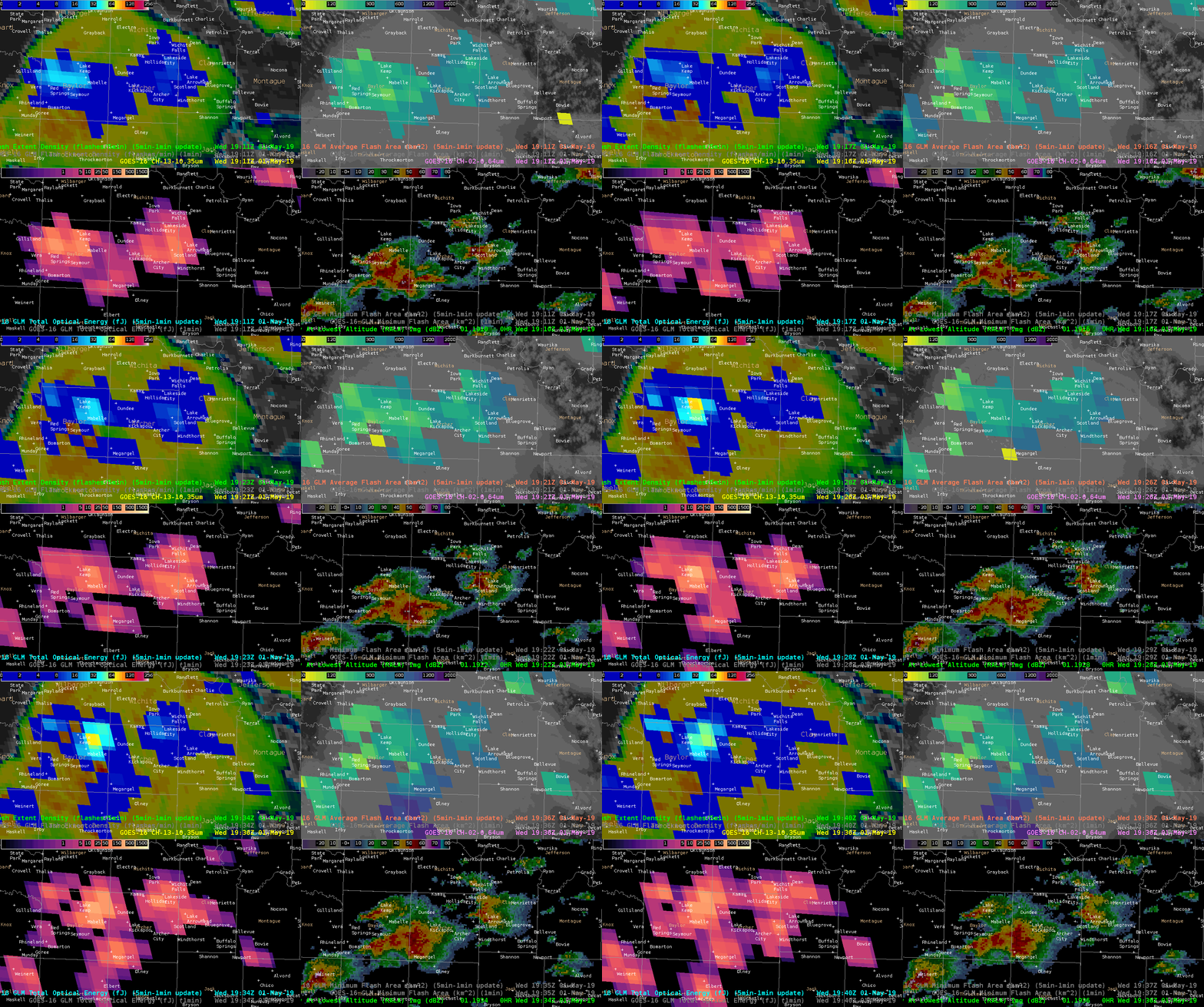
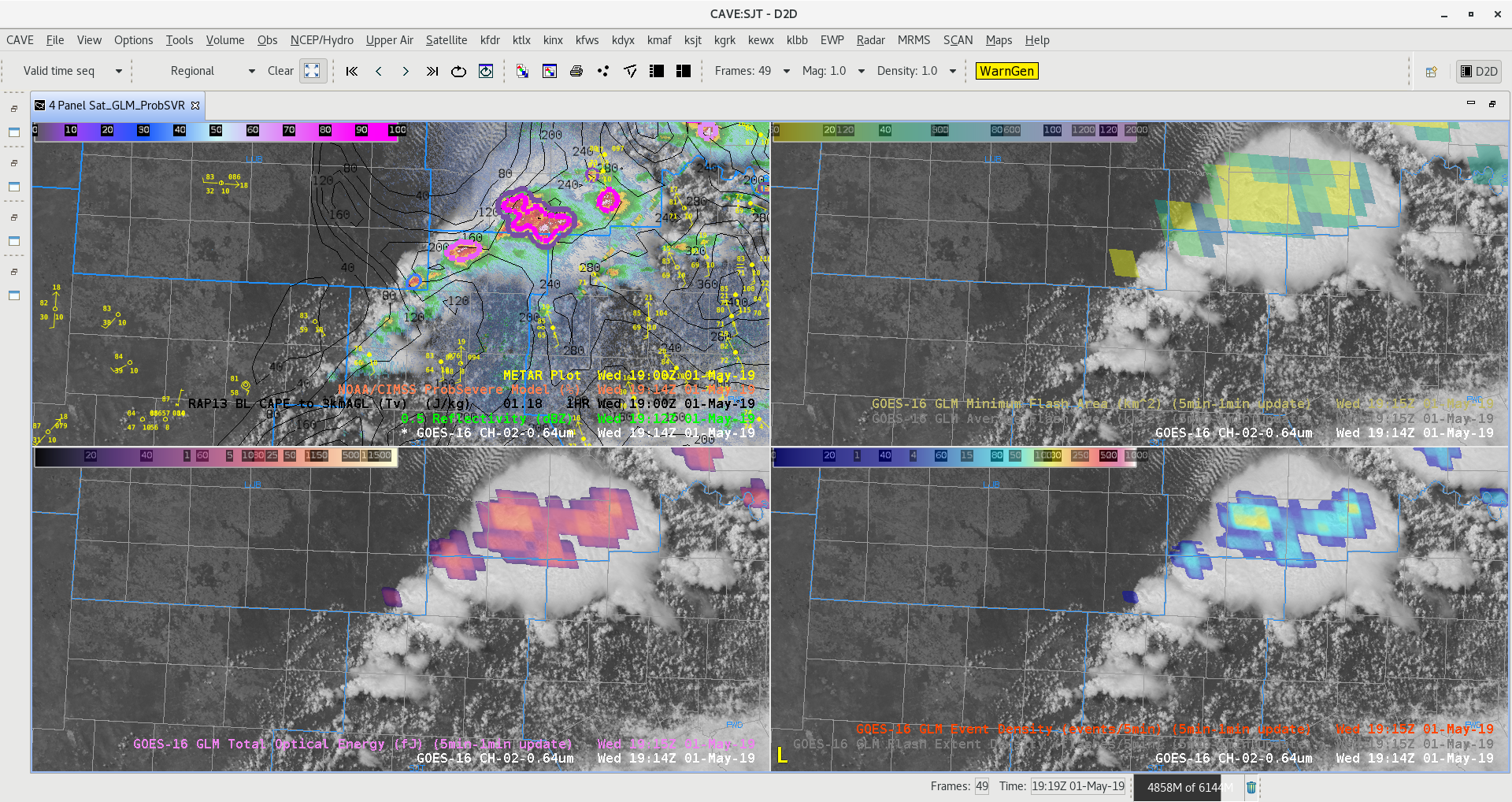
The storm split over Baylor county was seen in GLM. Higher flash rates remained with the right mover. The average flash area remained small through the transition but eventually some larger flashes were observed in the right mover.

There was also a significant lightning increase with the right mover, from 20 fl/5-min to over 80 fl/5-min in 10 minute period.

— SCoulomb

Baylor Co TX – cycling meso

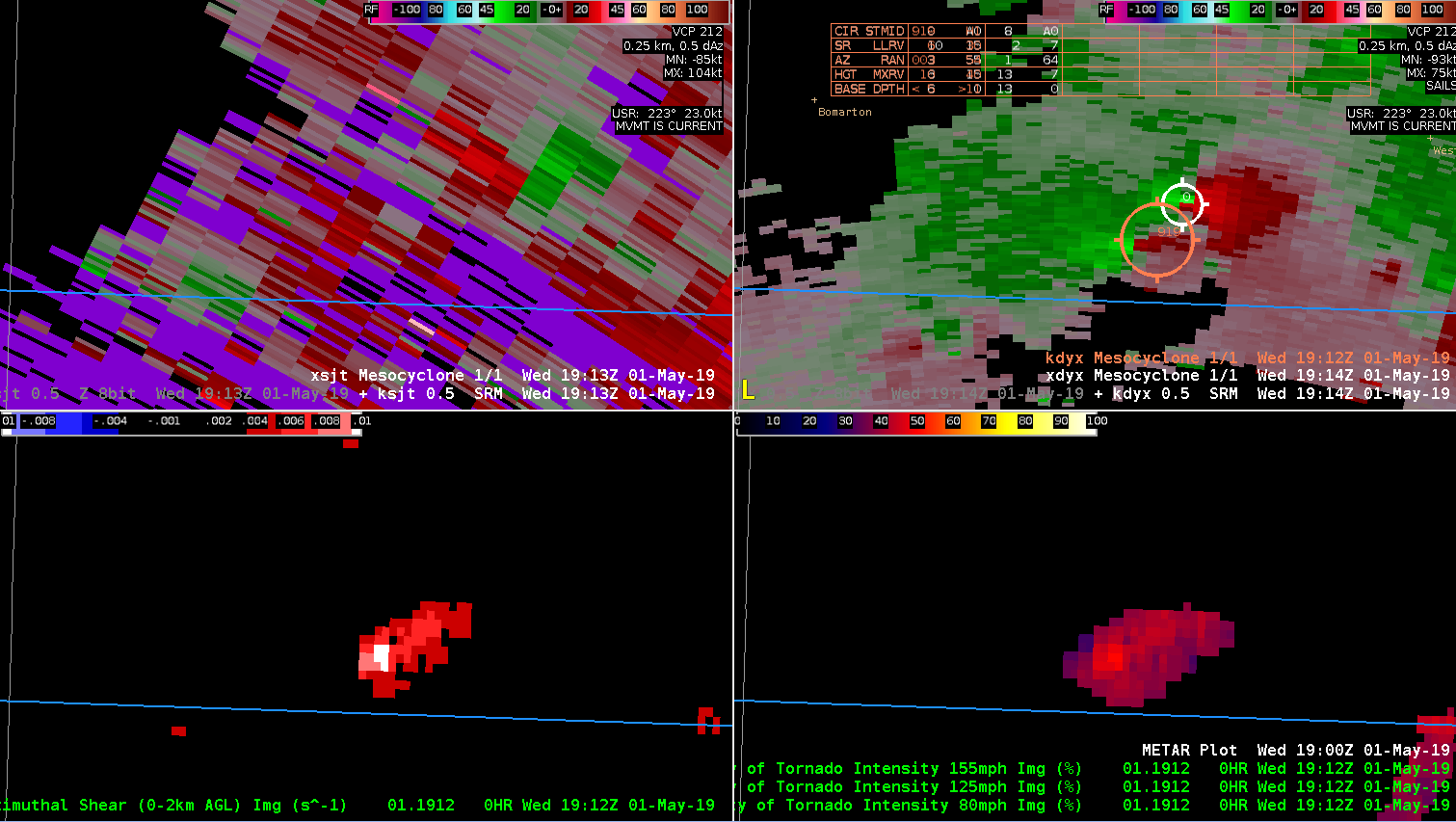
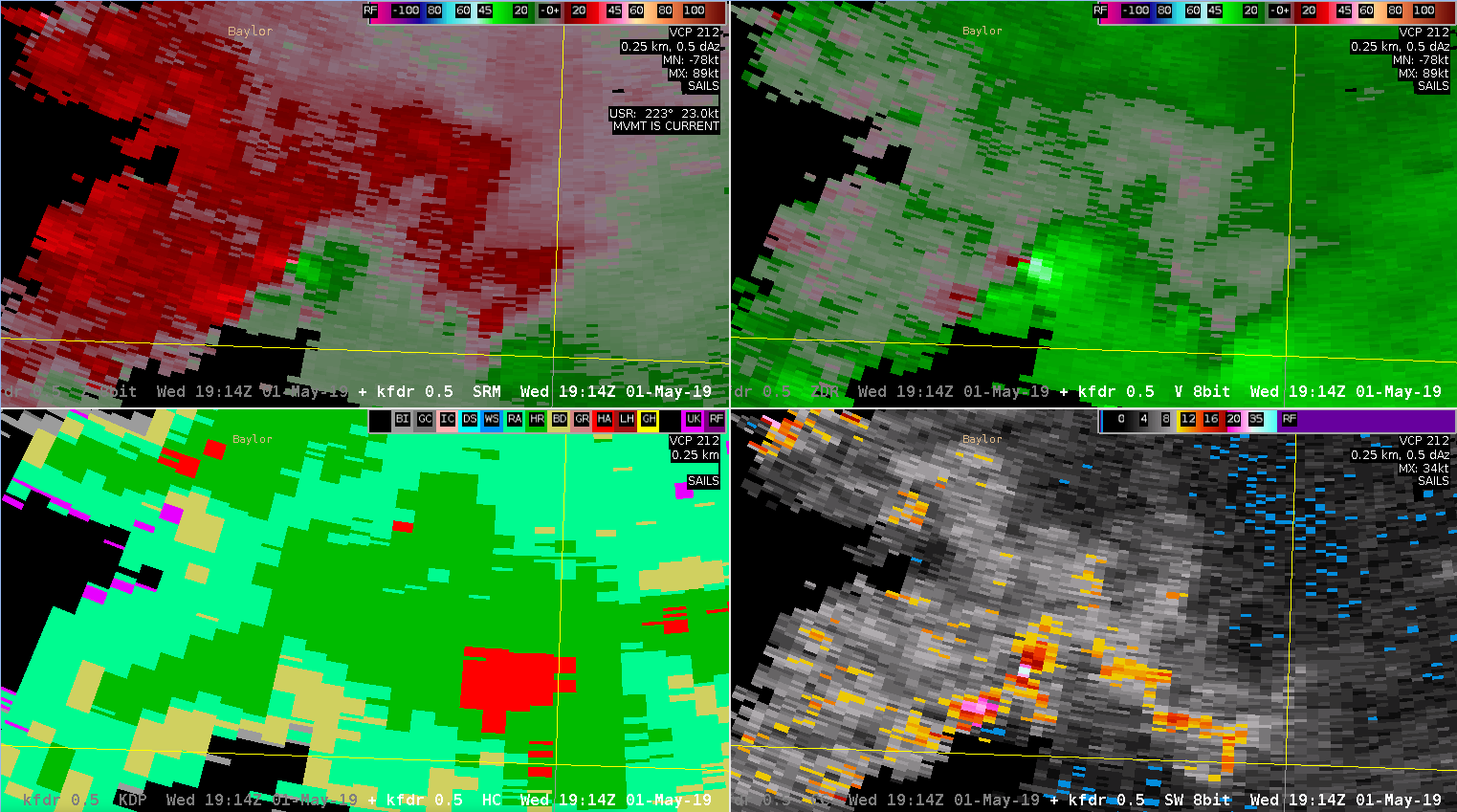
The supercell over NW TX developed a new meso. AzShear also picked up on both circulations. ProbTor values remained relatively low (~3%) throughout this transition. AzShear was weak with SRH only 107 m2/s2, mean wind was also low at 22 kt – all enviro. parameters were near the climatological averages not increasing the ProbTor above average values.

2019 March 03 AzShear

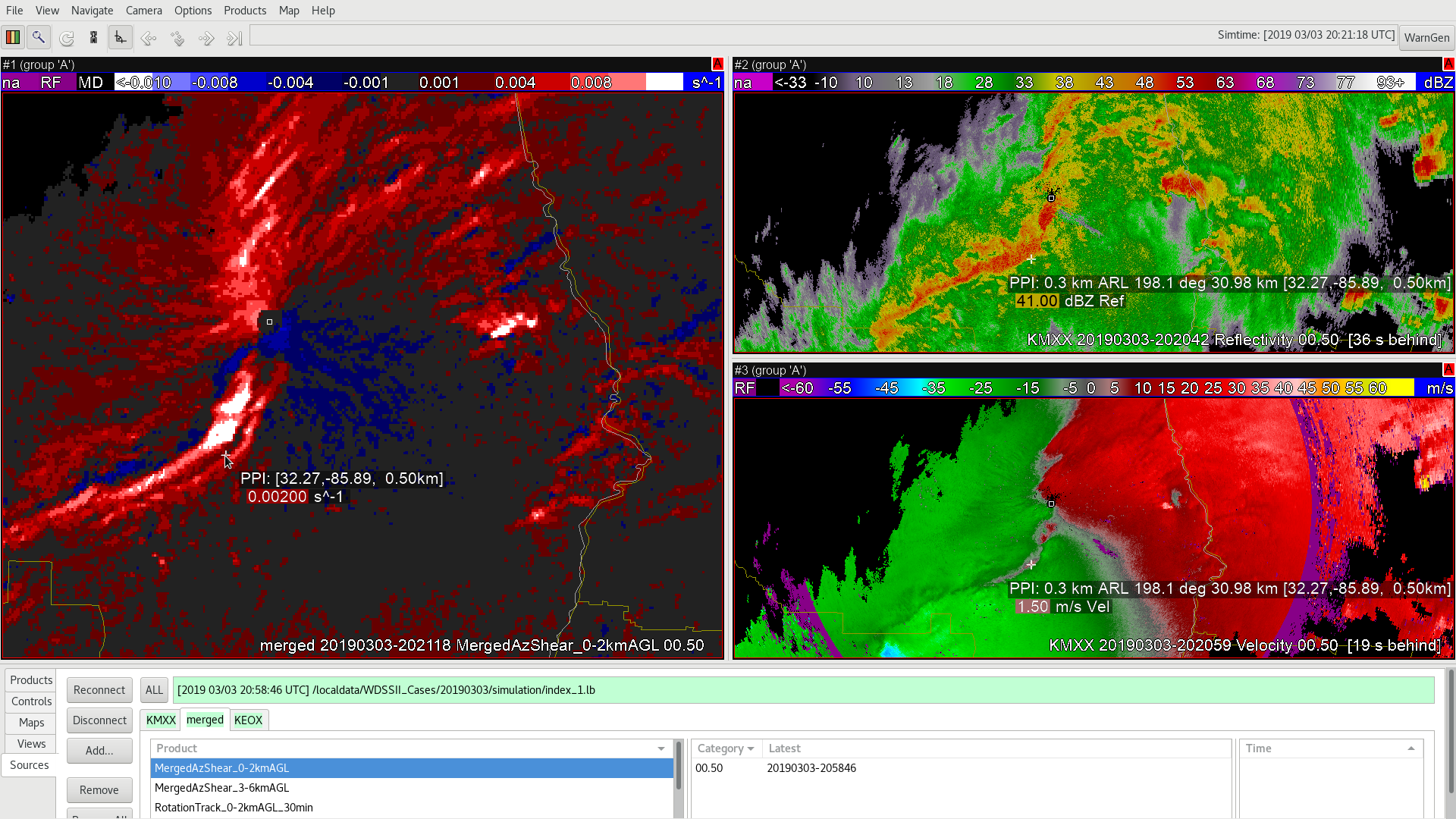
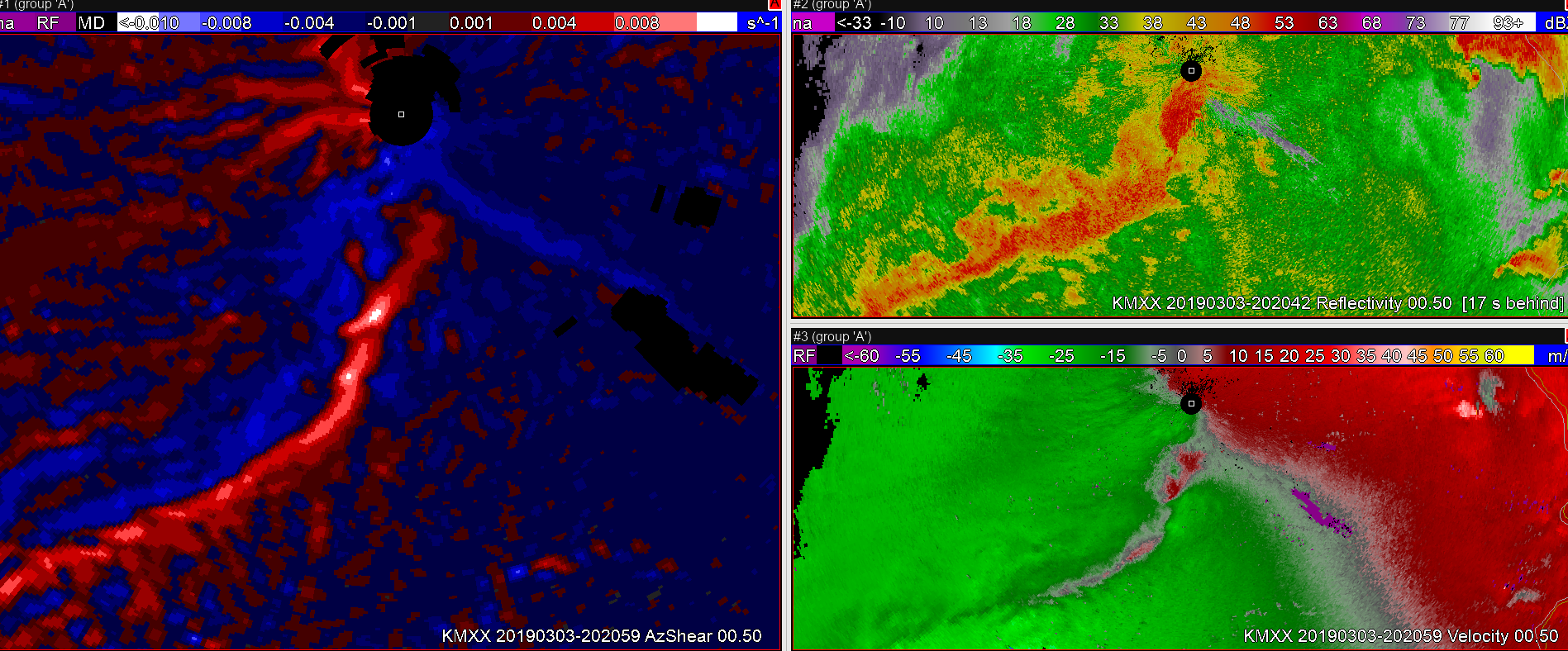
A quick look at the single radar AzShear product vs. the merged 0-2km product for a QLCS event. The single radar AzShear is far more granular and brings my attention to specific points of the line to interrogate further. However, the merged product is washed out…As a result, it’s potential utility to highlight areas of interest is degraded. Perhaps it would be most useful for general trends, but for storm-scale interrogation it leaves me wanting.

I do think the single radar AzShear product has promise with respect to increasing lead times, especially for QLCS circulations. But without other cases to examine, I can’t say for sure. It does show promise (especially when coupled with base velocity and spectrum width) with highlighting the areas of interest a scan or two before velocity couplets develop.

–Stanley Cupp

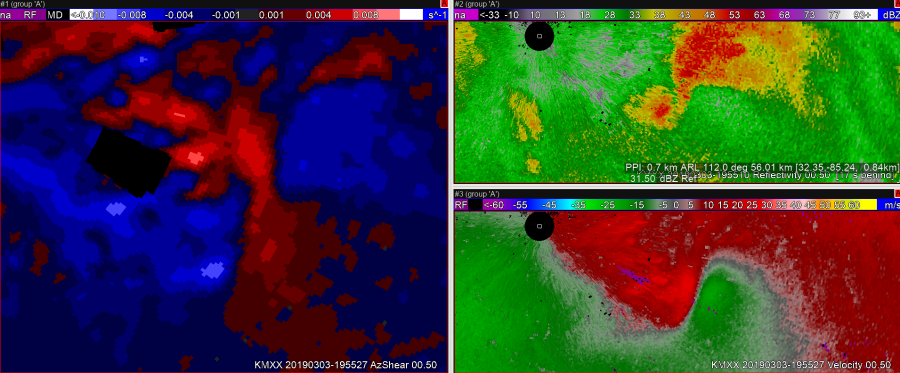
2021z merged 0-2km AzShear (left): very messy and washes out a lot of the storm-scale features. Also shows a leading area of shear ahead of the main line. This is likely due to SAILS cuts and different scanning modes for the radars used in the creation of the product. Something to watch out for in future events – this is an artifact that needs to be identified when using this product.

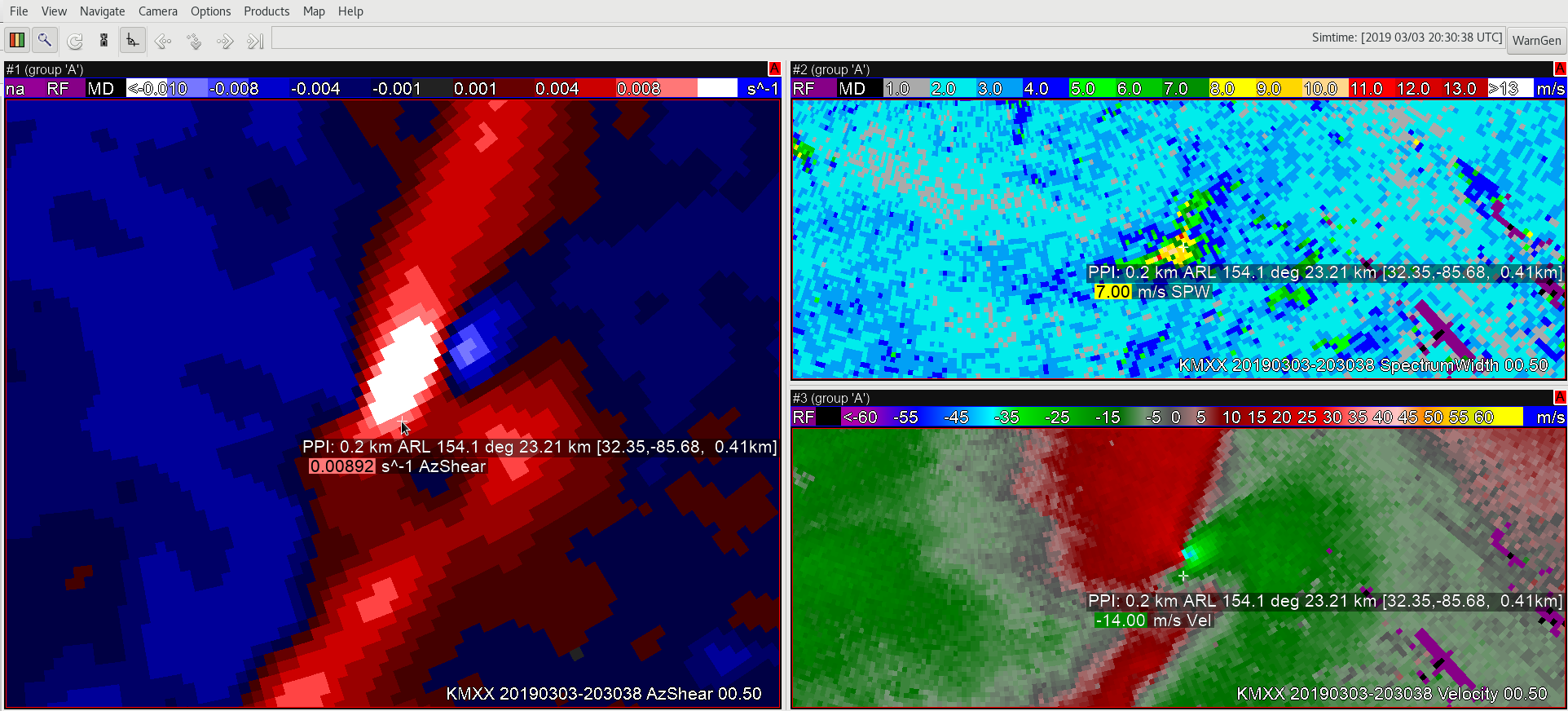
2020 KMXX AzShear highlights 2 main areas of interest along line of convection

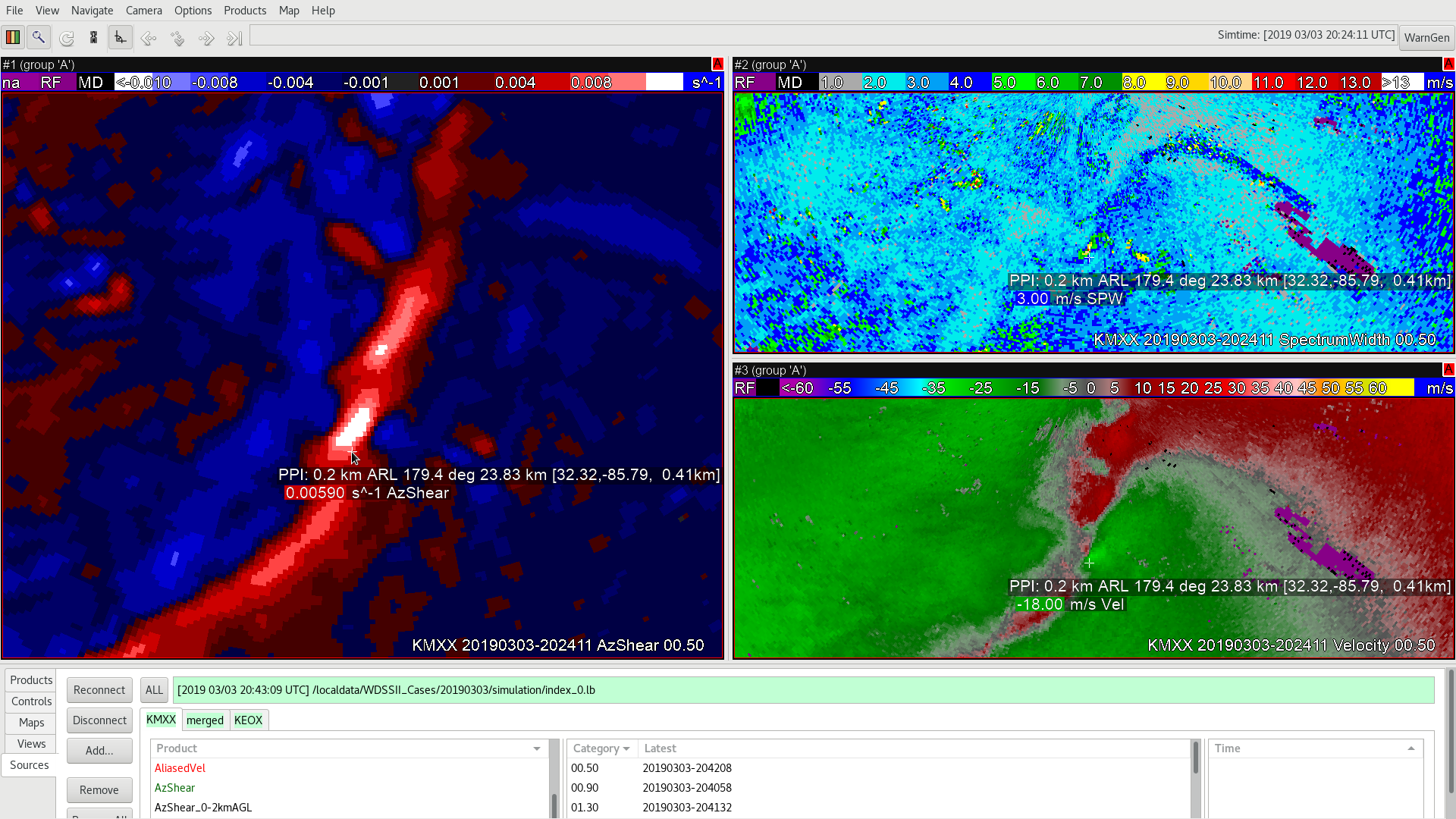
2024z: AzShear and velocity begin to show that the southern most of the 2 areas is becoming an increasing concern. Would likely have a tornado warning out at this point, if not the prior scan (especially given the favorable environment). Spectrum Width (top right) also helps diagnose the increased velocity signature on the southern most area compared to the northern one.

And by 2030, a distinct velocity couplet developed 

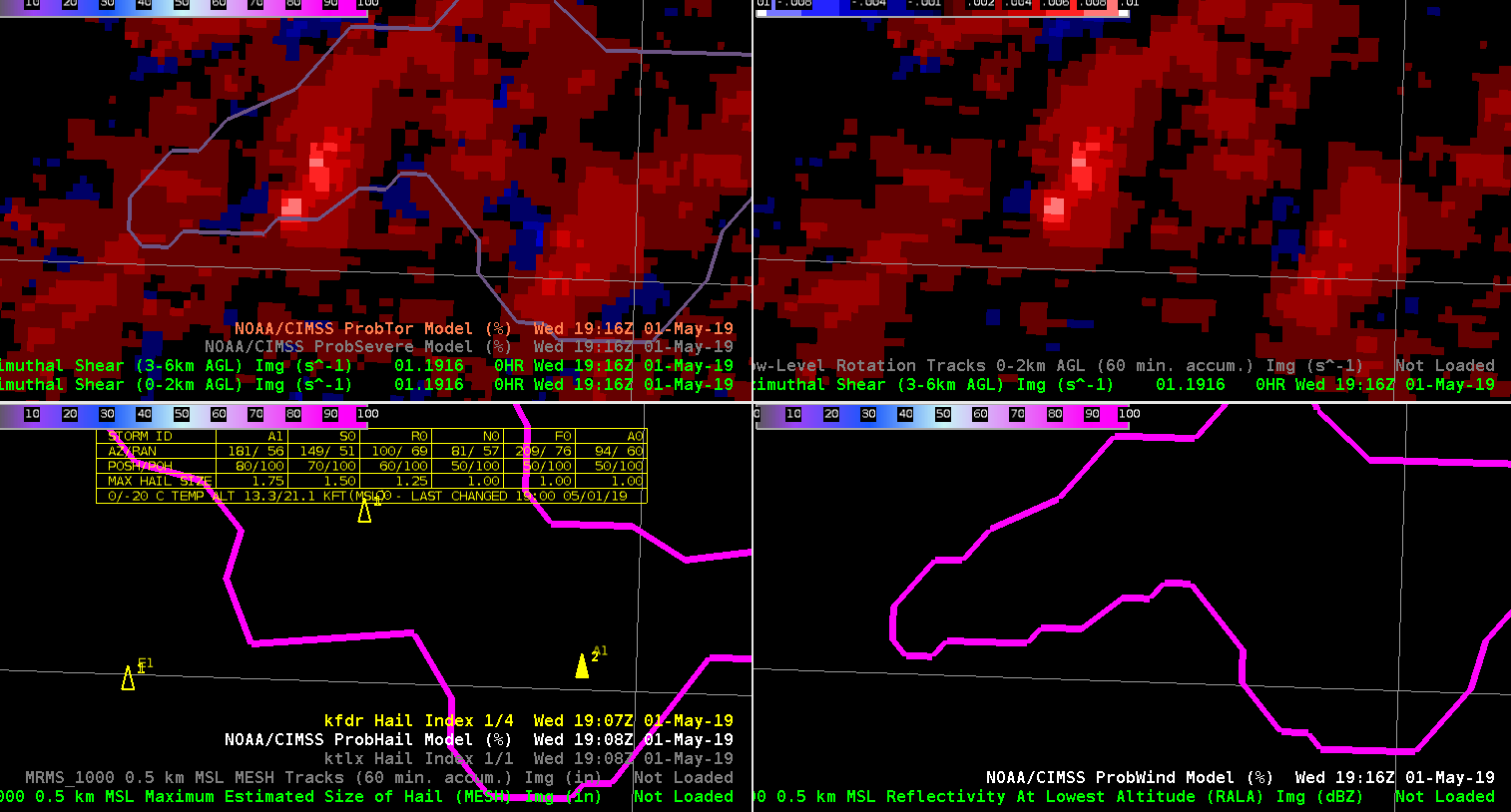
Today’s Experimental Operations – May 1, 2019

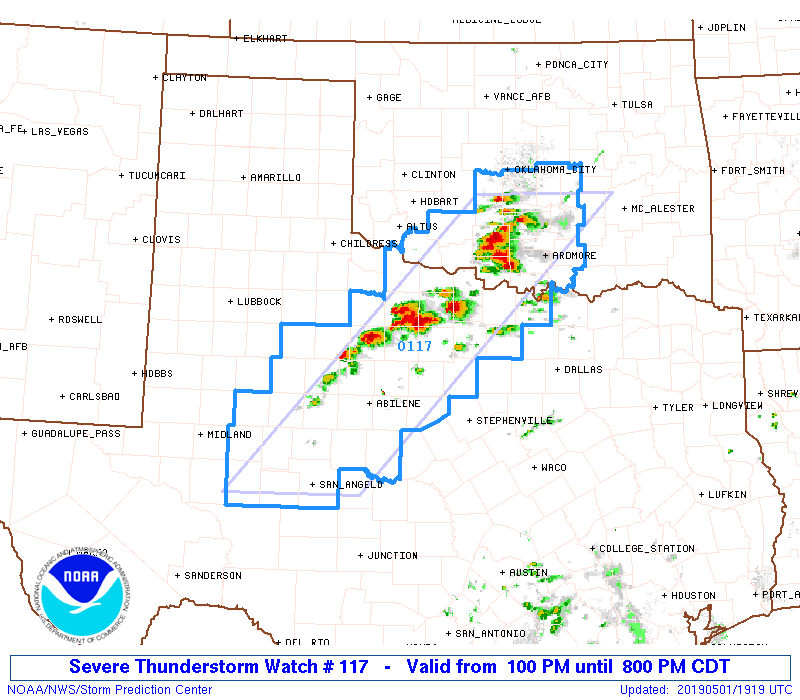
Today’s operations will be focused over the OUN (Norman), SJT (San Angelo), and FWD (Dallas/Fort Worth) county warning areas.  We are highlighting operations south of a remnant outflow boundary that has been left from storms that occurred overnight/early this morning roughly in the area of the Red River Valley.  Storms are currently on-going at the start of operations, with a severe thunderstorm watch over the operations areas that stretches from central OK all the way down to SW Texas.  Supercells will be the primary storm mode to start but might transition to a linear system later in the operations period.  The main threats today are large hail and high winds but tornadoes are still possible (lower probabilities than yesterday though).

Tags: None

Az Shear Case – 3/3/19

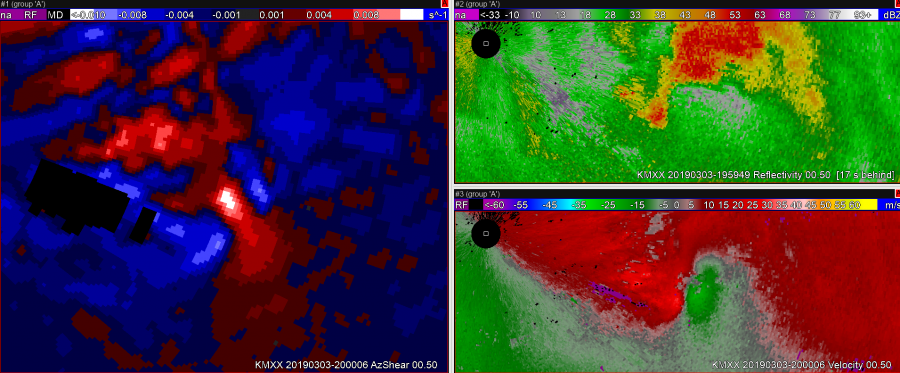
The case above shows a situation where due to the orientation of the zero isodop compared to the radar location, AzShear values are surprisingly low considering the strength of the convergent signature that preceded tornado development.
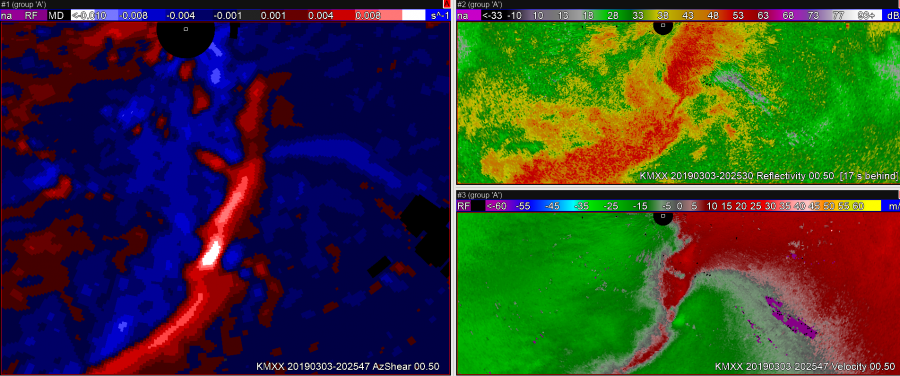
The case above shows  different tornadic circulation developing, but this time to the south of the radar –  a different orientation of the convergent signature relative to the radar. In both of these first two cases, the eventual tornado had not touched down yet, but the AzShear values were quite different. Training on zero isodop and how its orientation relative to the radar affects AzShear should be created for users before this product is used operationally.
This image shows the first circulation a bit farther in time as the orientation of the convergence changed and AzShear value bins began to max out.
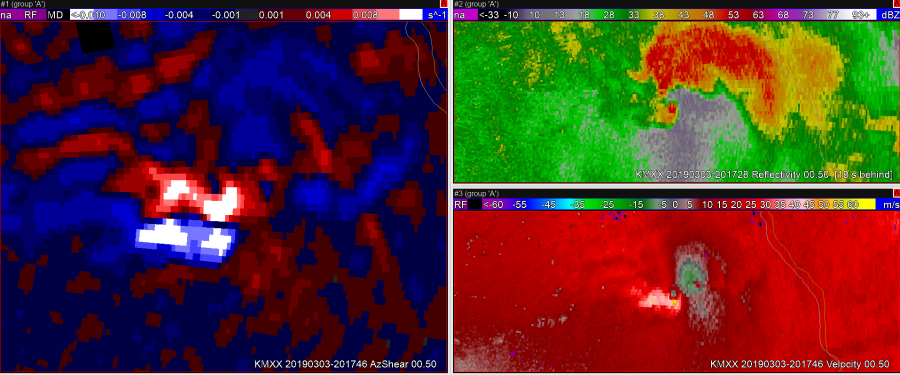
A case where using a color table with bins detracts from the usefulness of AzShear. There are two areas of high AzShear indicated, however very different things are going on in each of these locations. One is a strong tornado on ground the other is flanking line convergence. These two features should not have the same color if this product is to be used in operations. Consider a graduated color ramp with a high range instead of broad bins.
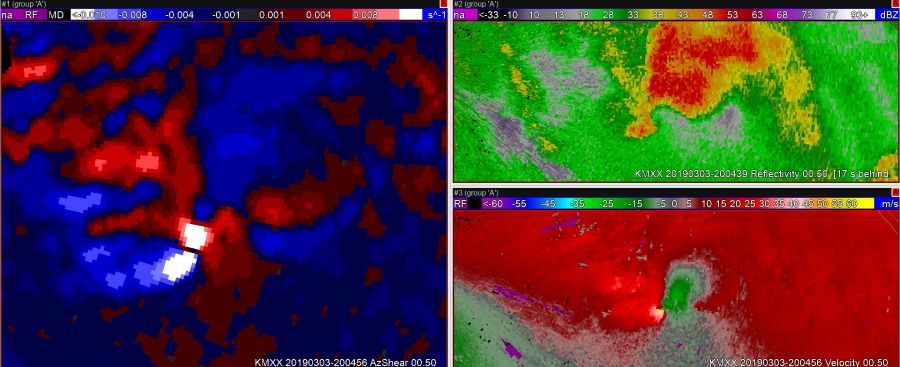
A case where the anticyclonic shear component is extremely prominent in AzShear. Are these regions useful for forecasters focusing on the tornado? Are they more of a distraction? They could be a distraction in some situations.
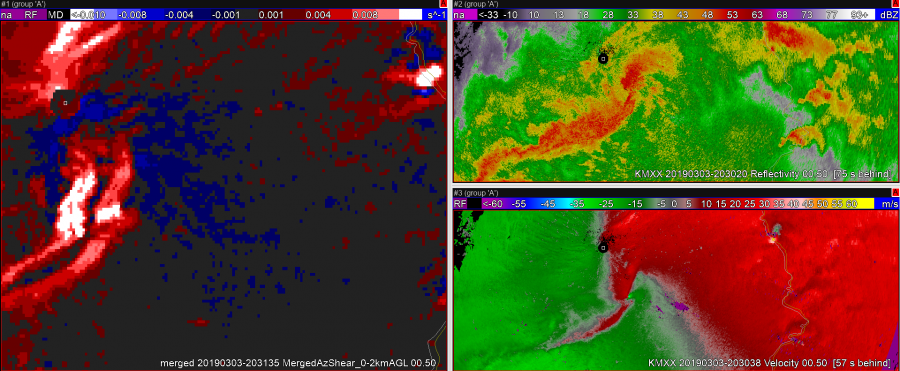
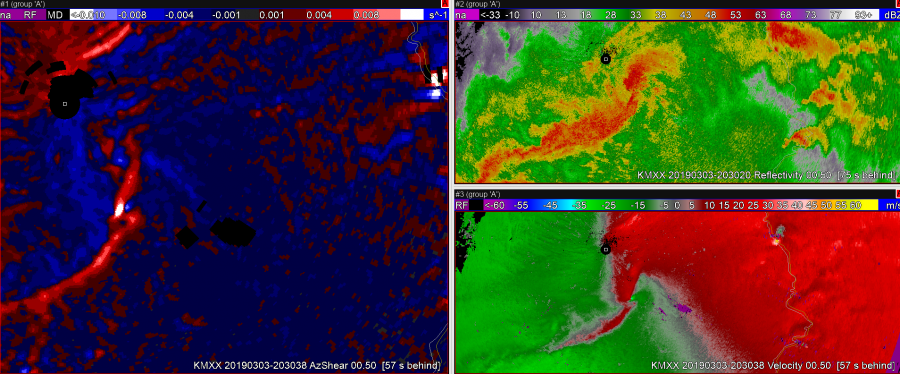
The two above images compare 0-2 AzShear (top) and single scan AzShear (bottom). Due to multiple sampling by multiple radars, it appears as though 4 different iterations of the squall line shear boundary are plotted. This renders the merged 6646data almost useless for interpretation purposes. The single scan data removes this issue. Also from these screen grabs, it appears as though the farthest east scan is coming from the KMX, the single scan site used here.
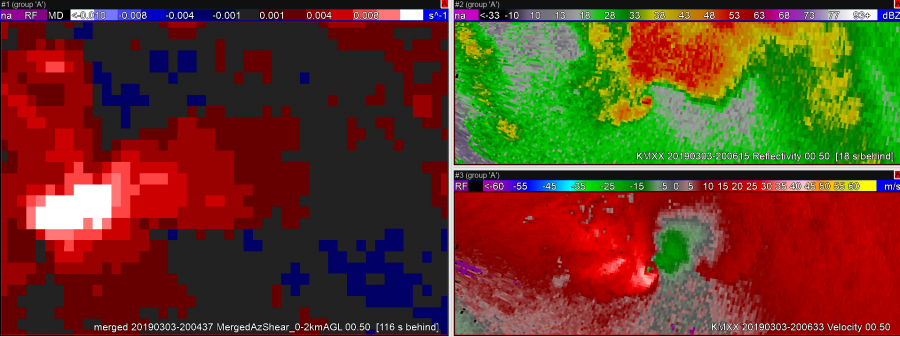
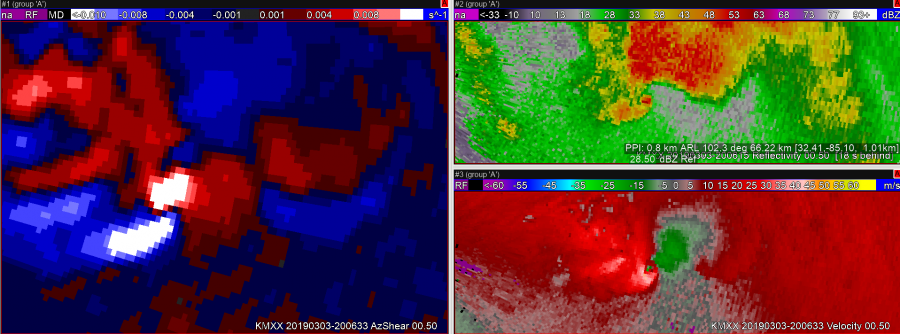
The two examples above show the benefits of single radar versus merged once again. The merged azshear core is several miles behind the circulation center at this time. The single radar data follows the current velocity scan as expected. In a time-sensitive warning operation scenario, knowing this I would likely use the single radar product exclusively.


-Dusty Davis

Mesoanalysis of Storm Development

Figure A

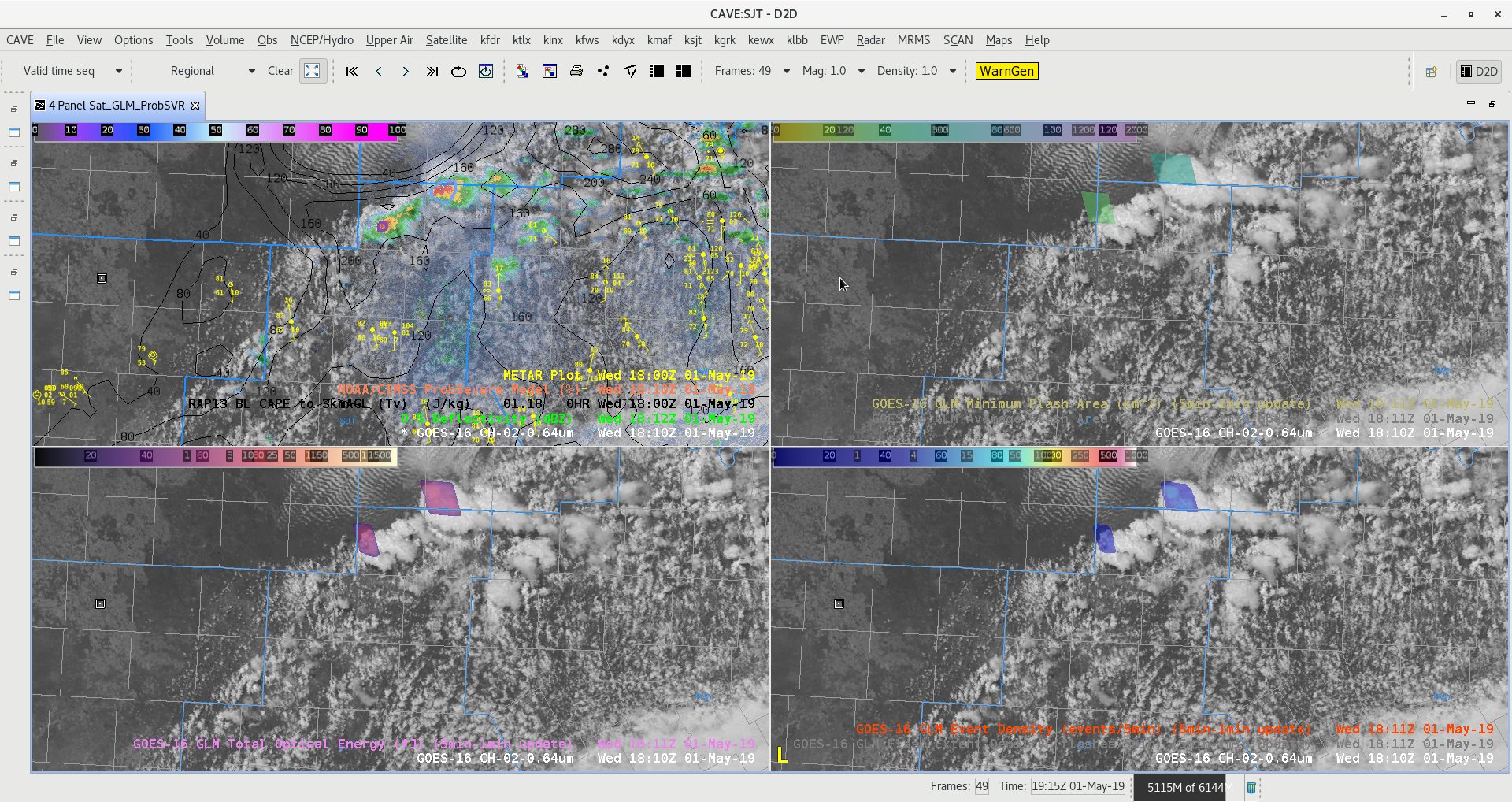
Lightning and ProbSVR detection of first storm develop in west Texas.  GLM products high-lighting two updrafts at 1810Z in Figure A.

Lightning really increased showing lightning jumps and ProSVR Hail/Wind greater than 90% in time series trends.  Notice Tornado trend increased slightly with lowering wall cloud report, however environment is not as favorable for tornadoes today with 0-1km shear on the low end.


Remember to look underneath the hood

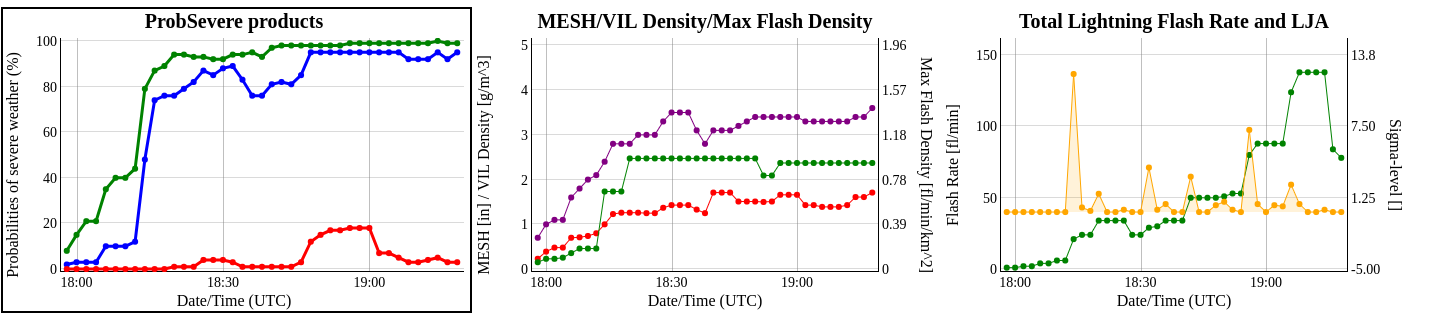
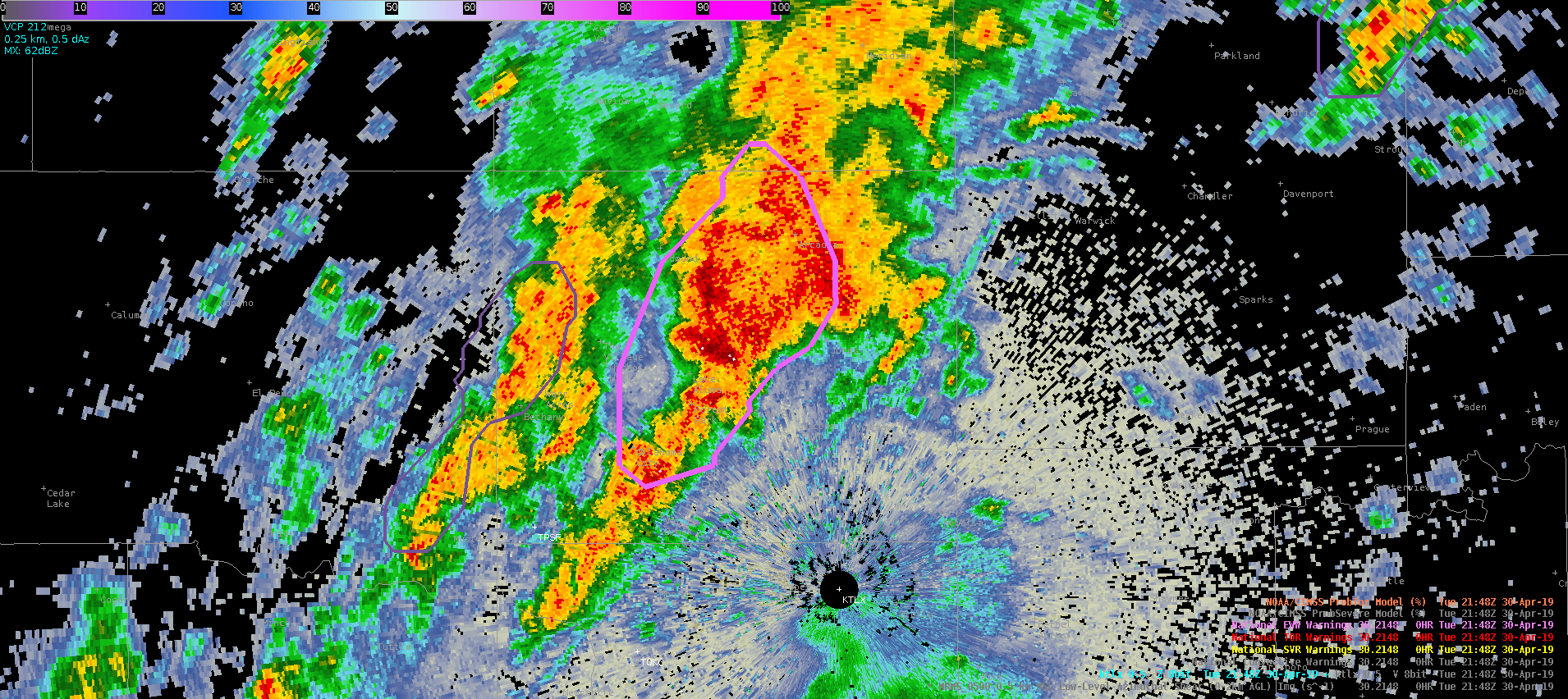
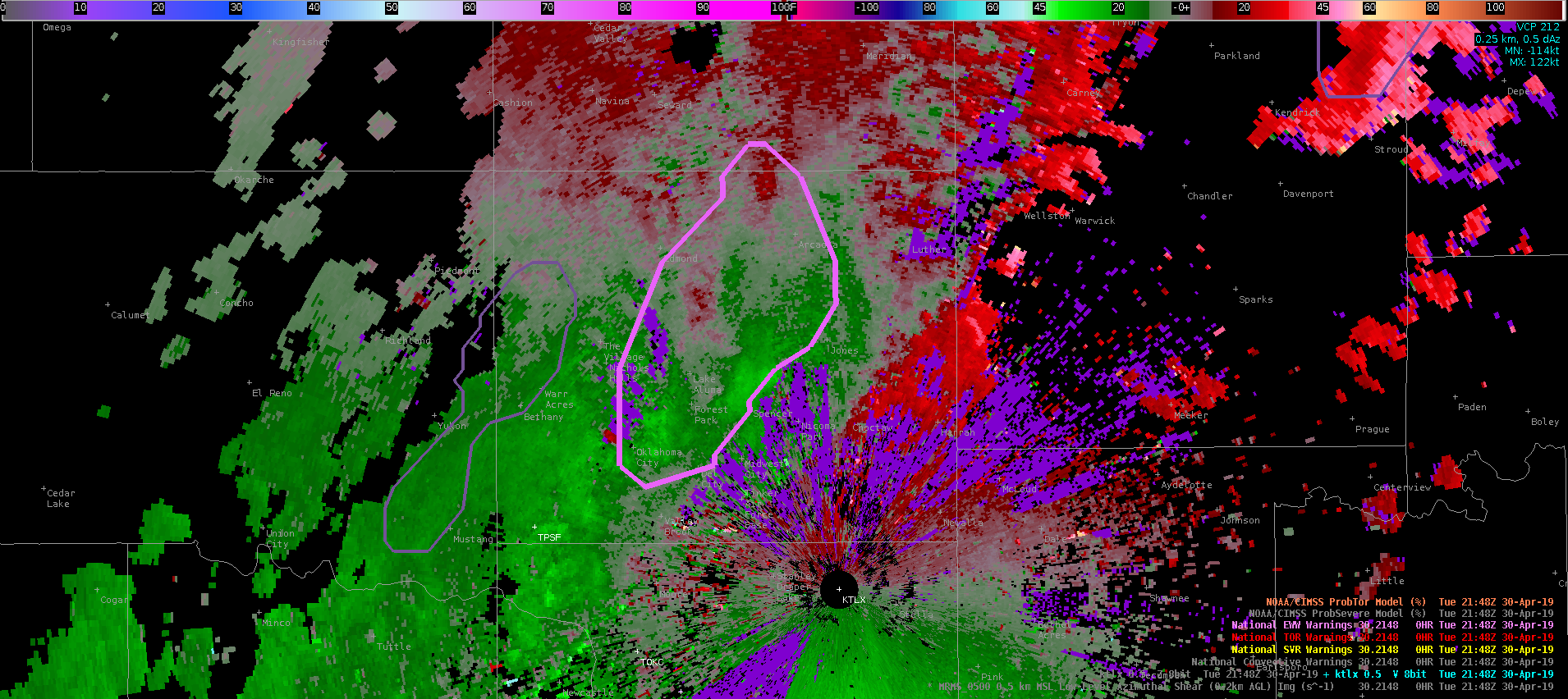
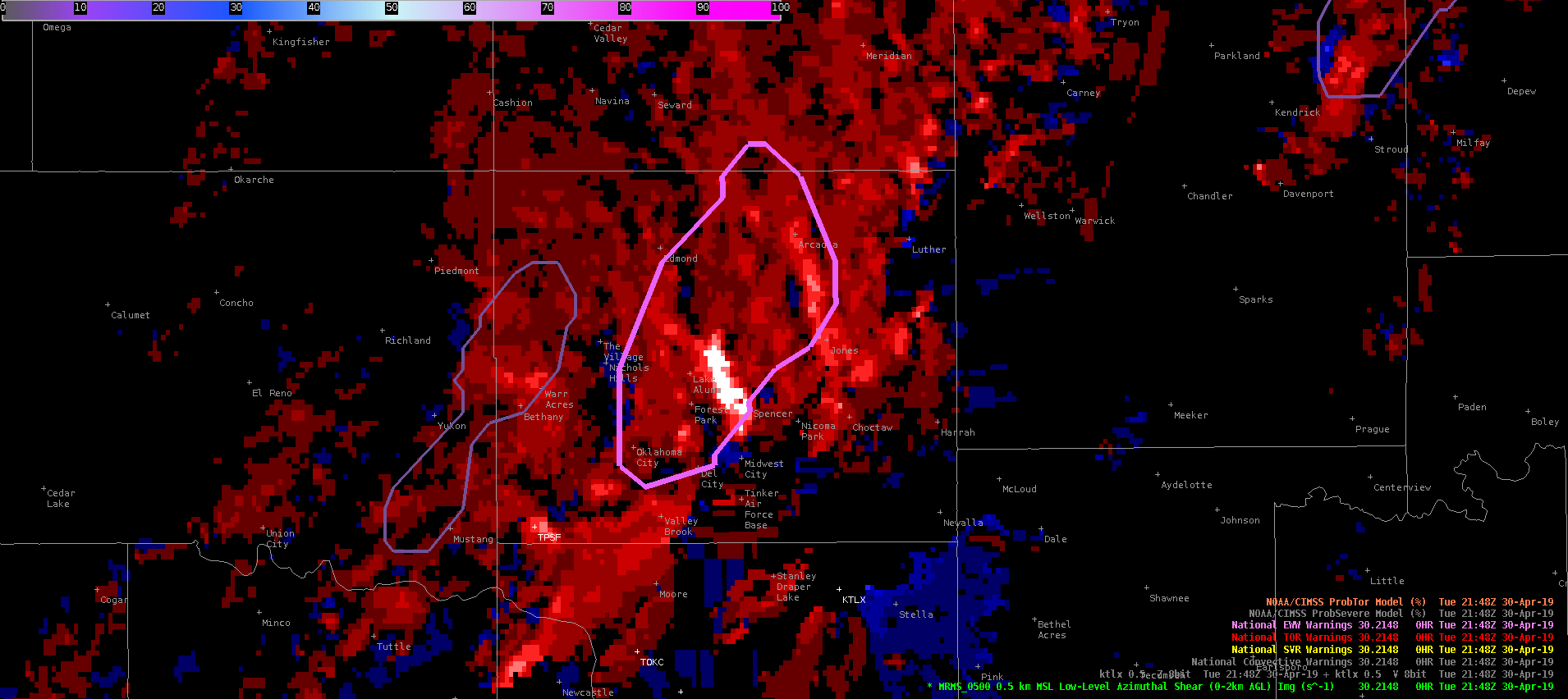
Here’s another example where a casual look at ProbTor might cause some confusion. Flow parallel to the boundary across the OKC metro eventually won out and the semi-discrete cells merged into a messy, slow-moving mess shortly before 22z. At 2148z, ProbTor peaked at 74% for the mass of convection just NE of OKC. However, KTLX velocity showed no immediate areas of concern. The answer to the high ProbTor was found in the 0-2km merged AzShear product. AzShear showed an enhanced area of shear to the NE of OKC near Spencer with generally convergent and broad flow. This is a good example of how ProbTor can be useful in operations: it quickly highlights areas for further investigation that can either be confirmed or thrown out with a very quick interrogation of the base data. In this case, ProbTor worked well, it was just biased by the abnormal/noisy AzShear data.

–Stanley Cupp

2148z KTLX base refl (top), base velocity (middle), and 0-2km AzShear (bottom) with 74% ProbTor contour overlaid on each

Why hello friend – merging supercells into a single ProbTor Object


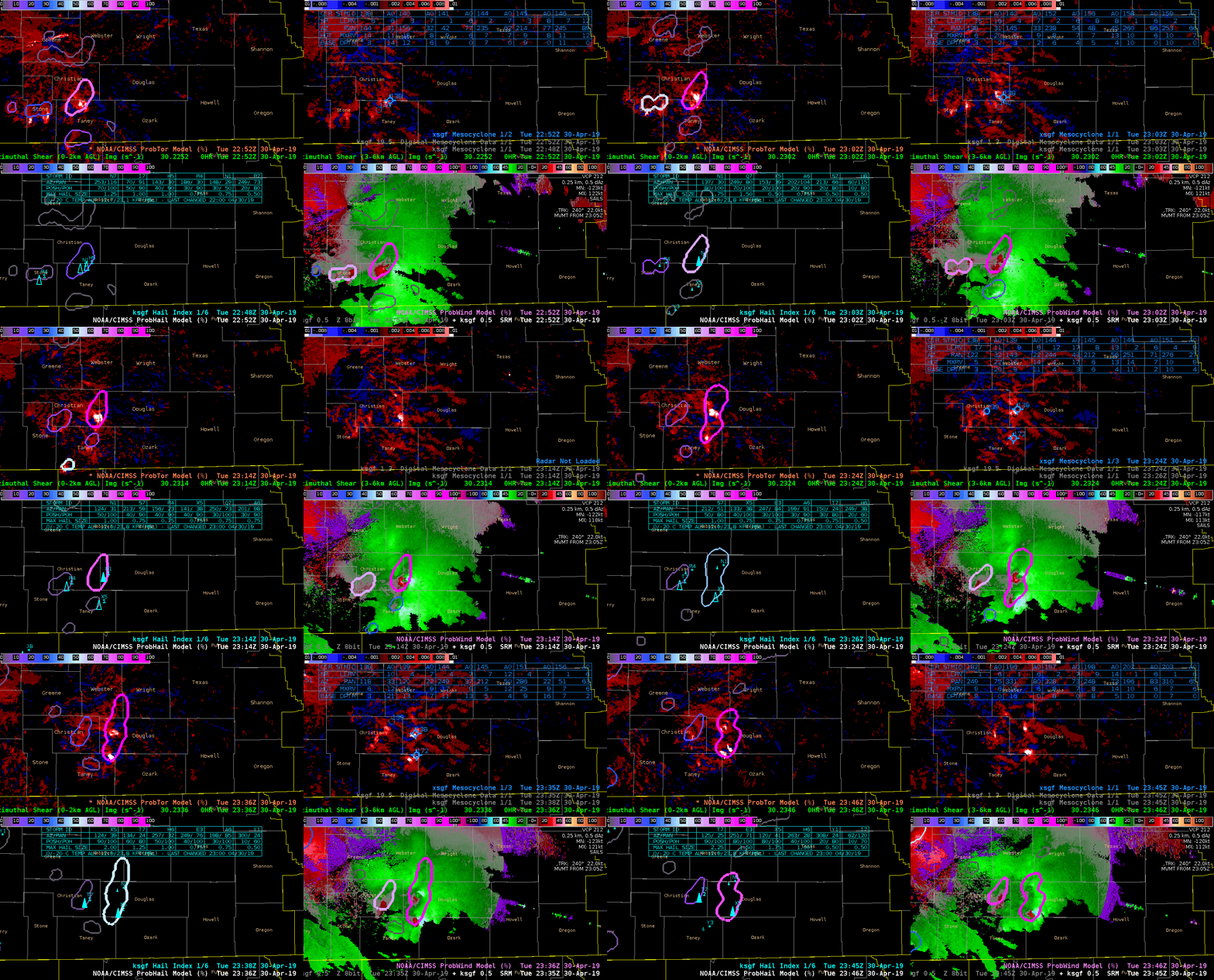
Here a strengthening southern supercell invaded the personal space of its “more aged” northern neighbor. The merger did not change the  ProbTor values of the original, stronger storm (90%) but did eventually show a slightly lower value (87%) despite the southern storm becoming more intense in rotation. There were only subtle differences noted in the ingredients and nothing stood out as to why the Prob values dropped.

As for the new mesocyclone algorithm (xmda) the strength rank jumped to 25 (max value) at 23:32. It is difficult to follow the individual storms in the attribute table since they jump from page to page and are ordered by ID versus strength. Having the cell ID color coded at certain values (e.g. above 10 colored yellow, above 15 colored blue, etc.) would help more quickly discriminate the strongest mesocyclones, especially if you have to move to another page. ProbWind (lower right panel) continues to be very high for these supercells (consistently >90%) although no wind reports were received by SGF.

0-2km AzShear/ProbTor (UL), 3-6km AzShear/xmda (UR), HI/ProbHail (LL), Z/SRM/ProbWind (LR)

CPTI example

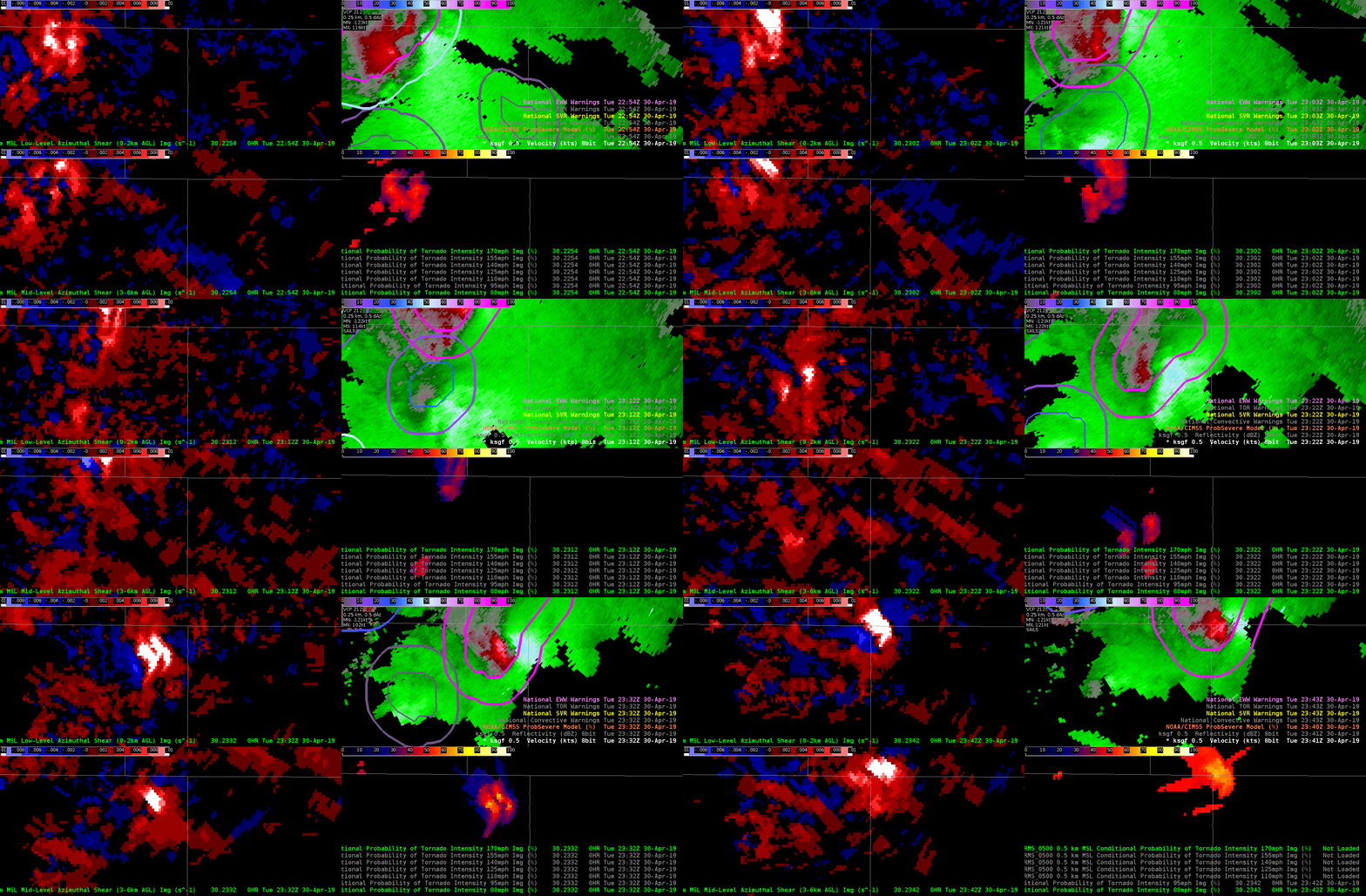
CPTI closely followed the 0-2 Az Shear product in both shape and intensity. This included all velocity time matching errors. These time matching errors decreased the usefulness of the product each time they were seen. CPTI prob of highest winds appeared more useful than the lower thresholds, better enhancing where the threat of strong winds was actually located. Lower thresholds (example at end of loop) appeared to be too broadbrushed for applicable use.