6/15 HWT OUN SuperCell

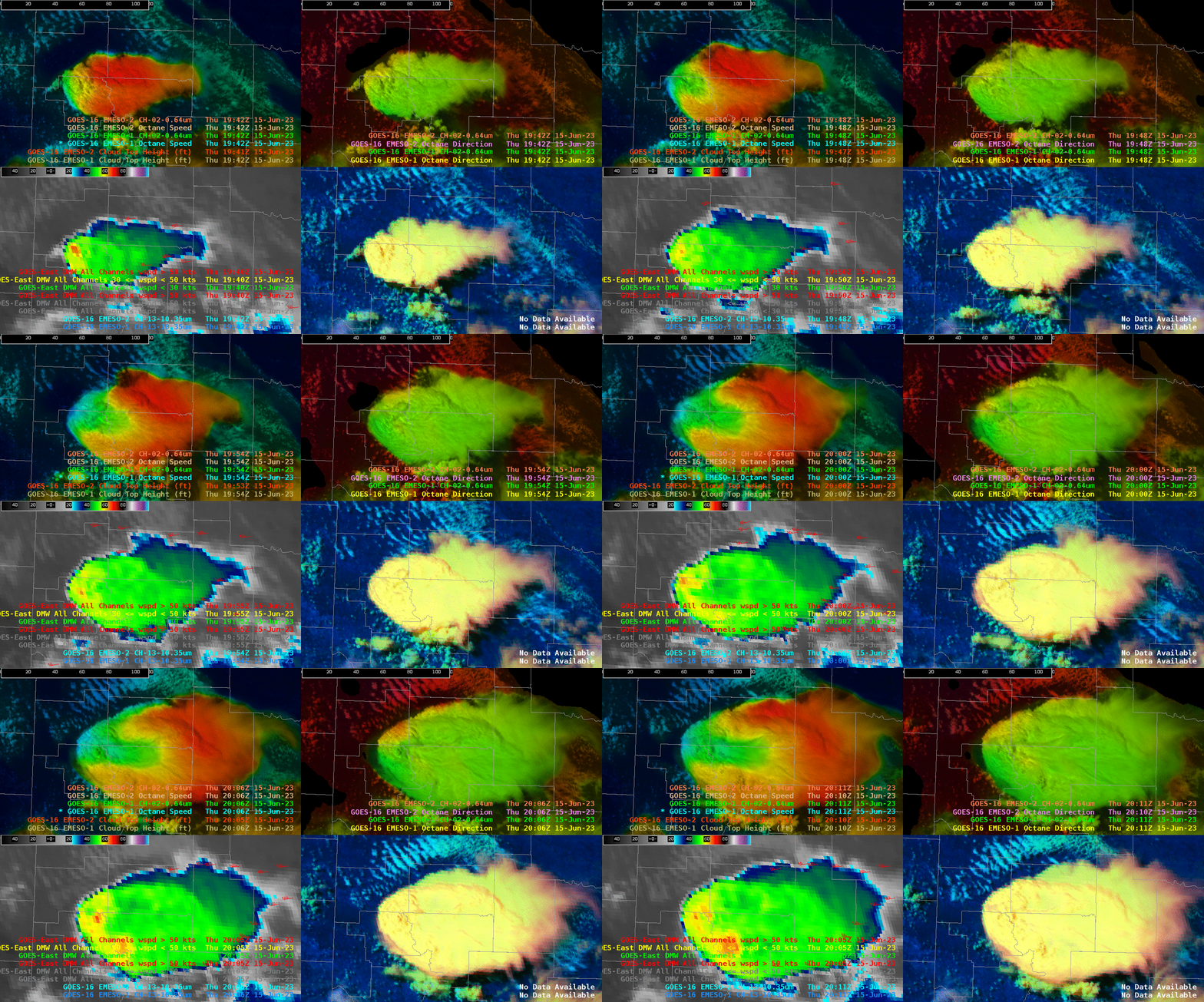
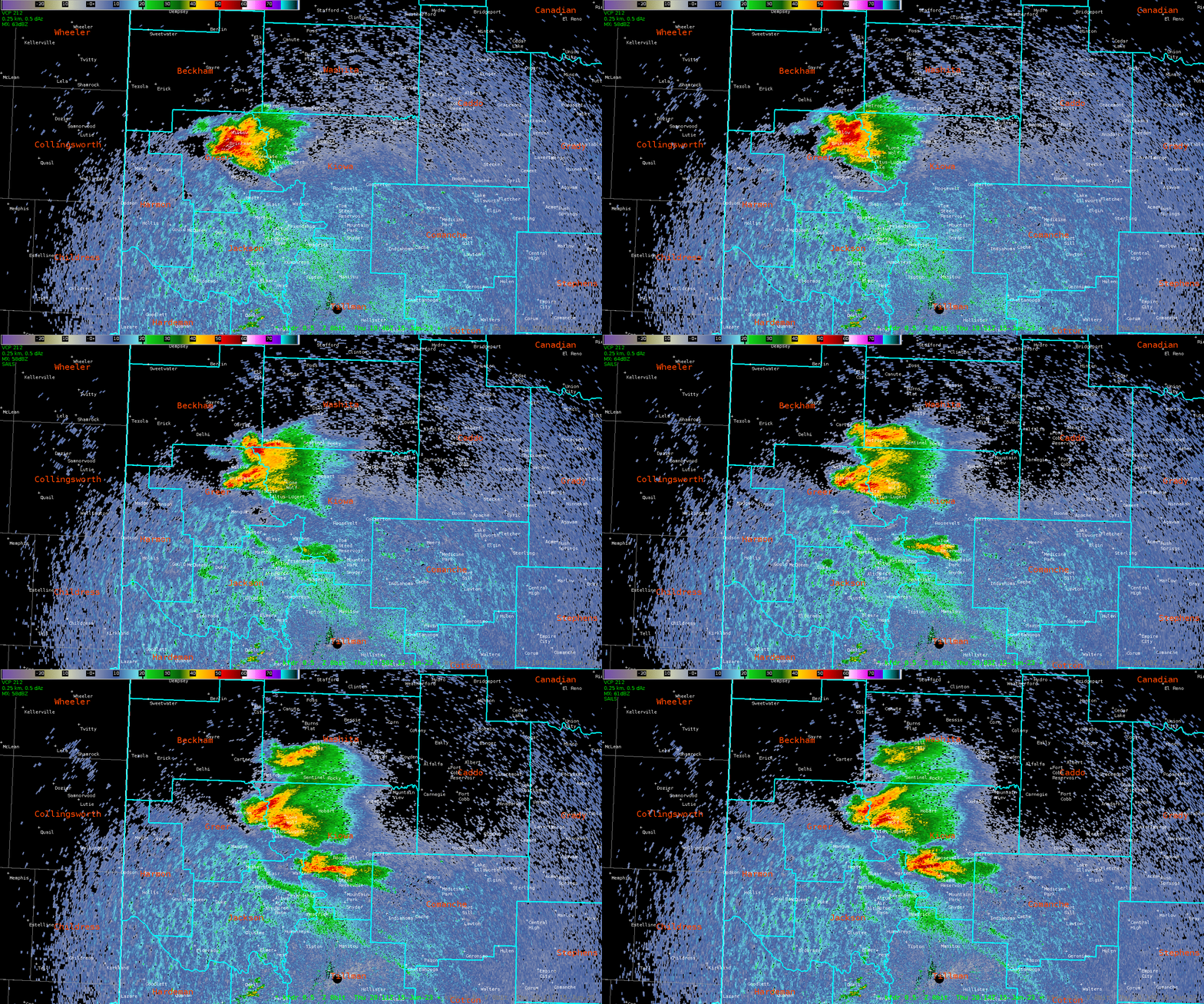
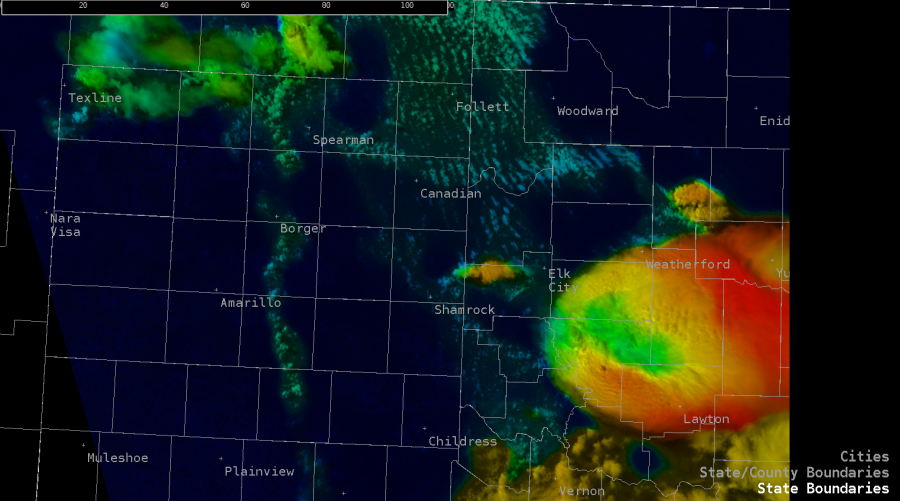
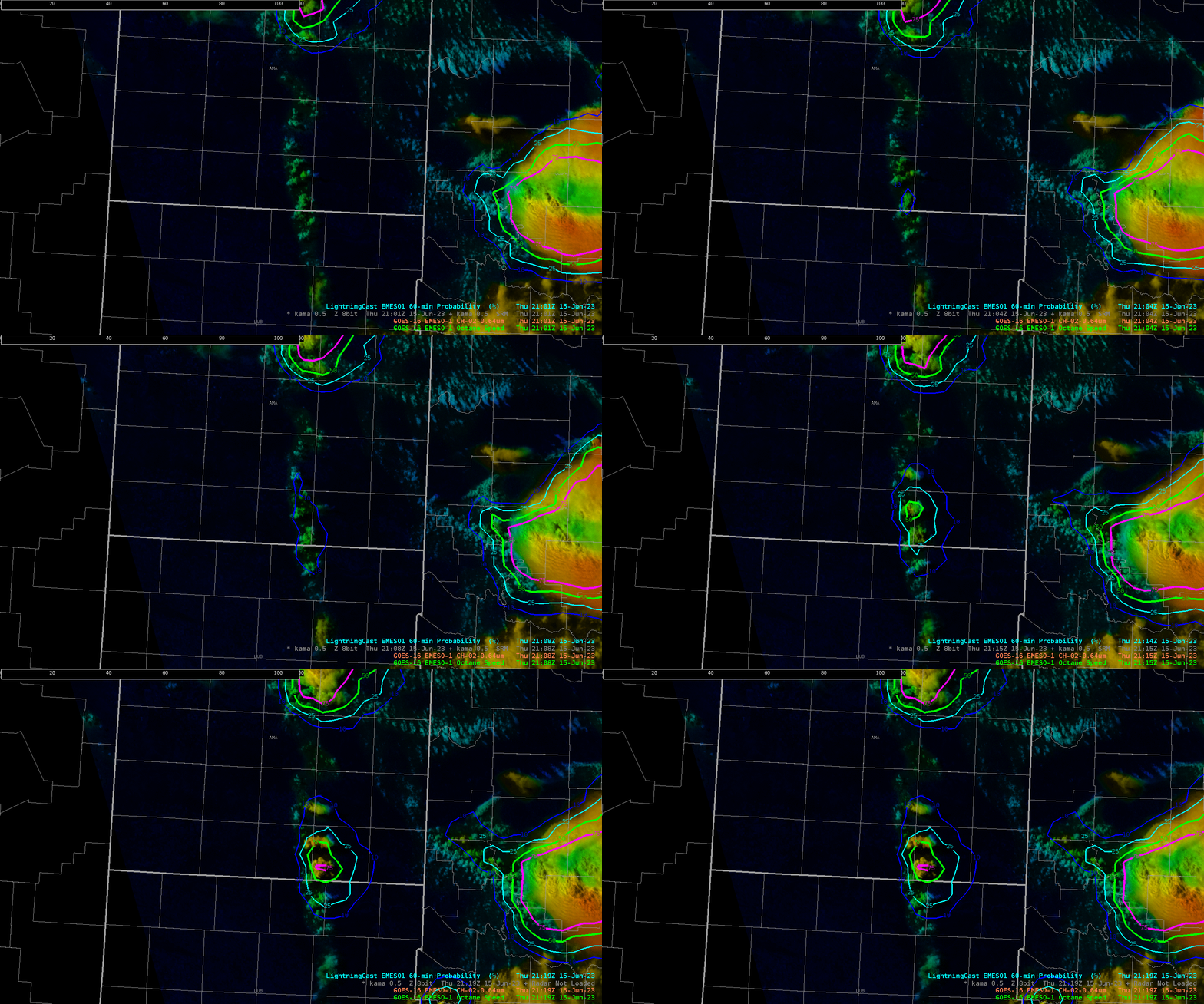
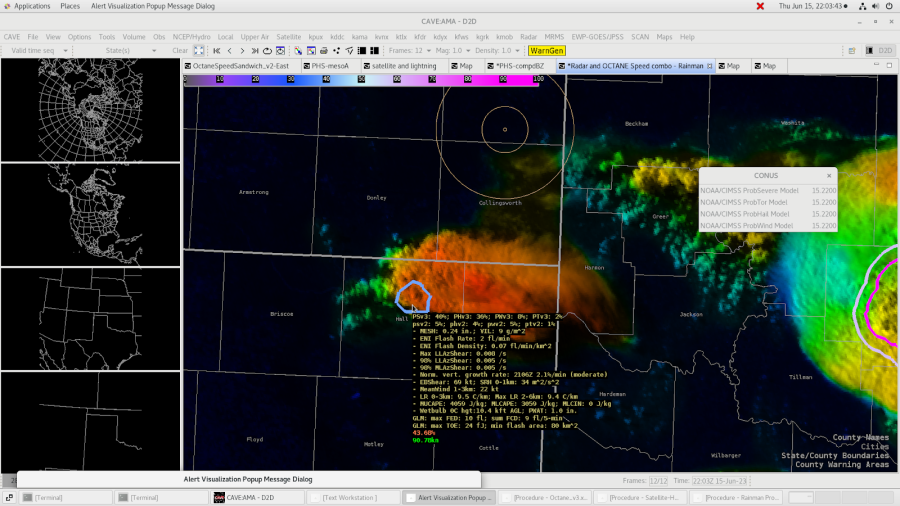
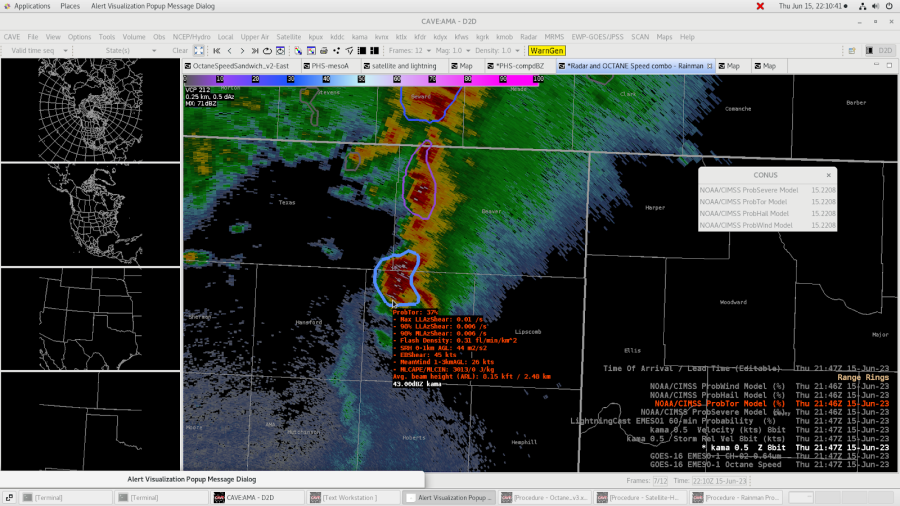
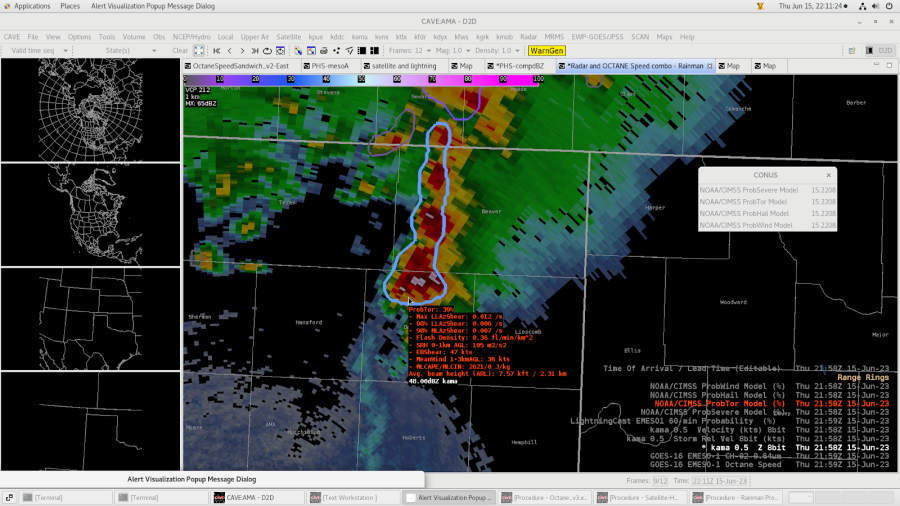
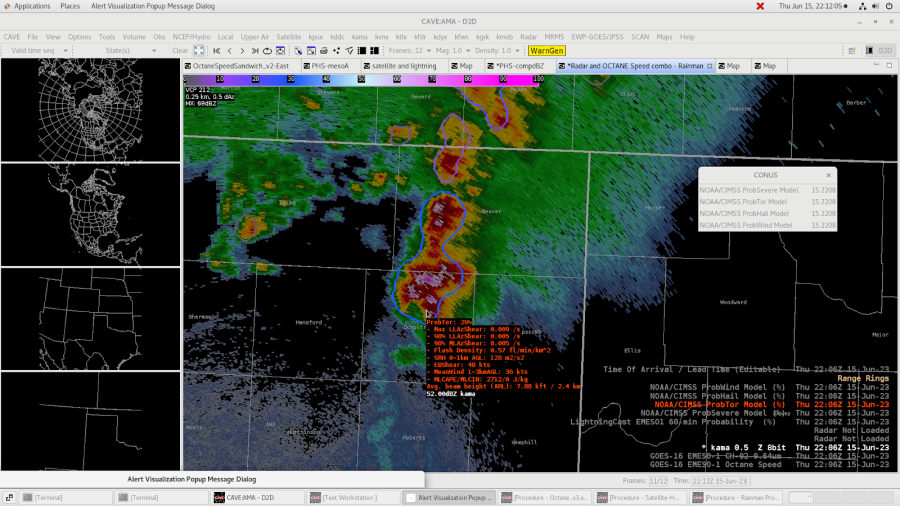
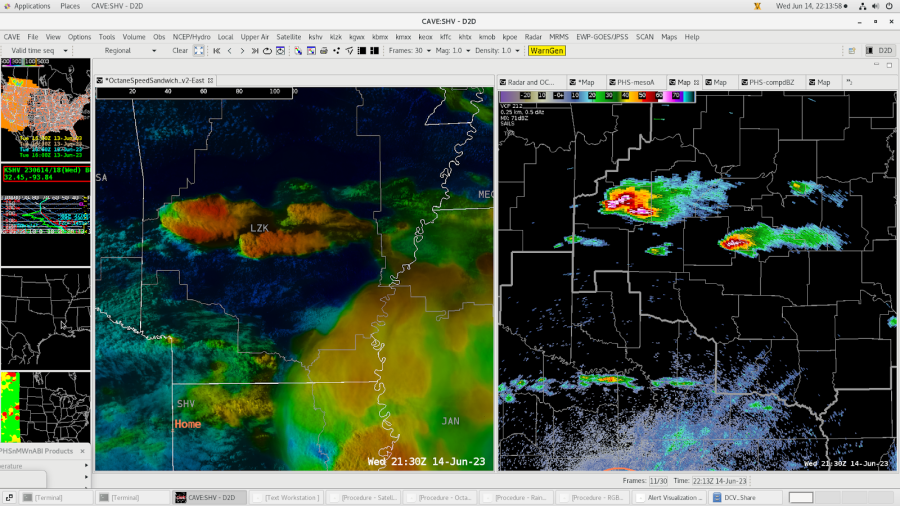
A very intense supercell formed across western portions of OUN CWA. This cell underwent many transformations including splitting and merging at other times. Octane was very interesting to watch as this cell went through the various processes before eventually producing a tornado. Octane was able to show the storm splitting before it occurred on radar.  PHS was also showing corridors of stronger 0-3 and 0-1 SRH; SPC Mesoanalysis was showing this as well but I did like how the PHS was able to highlight exactly where these occurred. Seeing that and a near stationary boundary did increase my confidence that if a storm was able to latch on it would become tornadic. Probsevere/MESH did struggle to catch on to how large the hail actually was initially before finally picking up on the hail size.

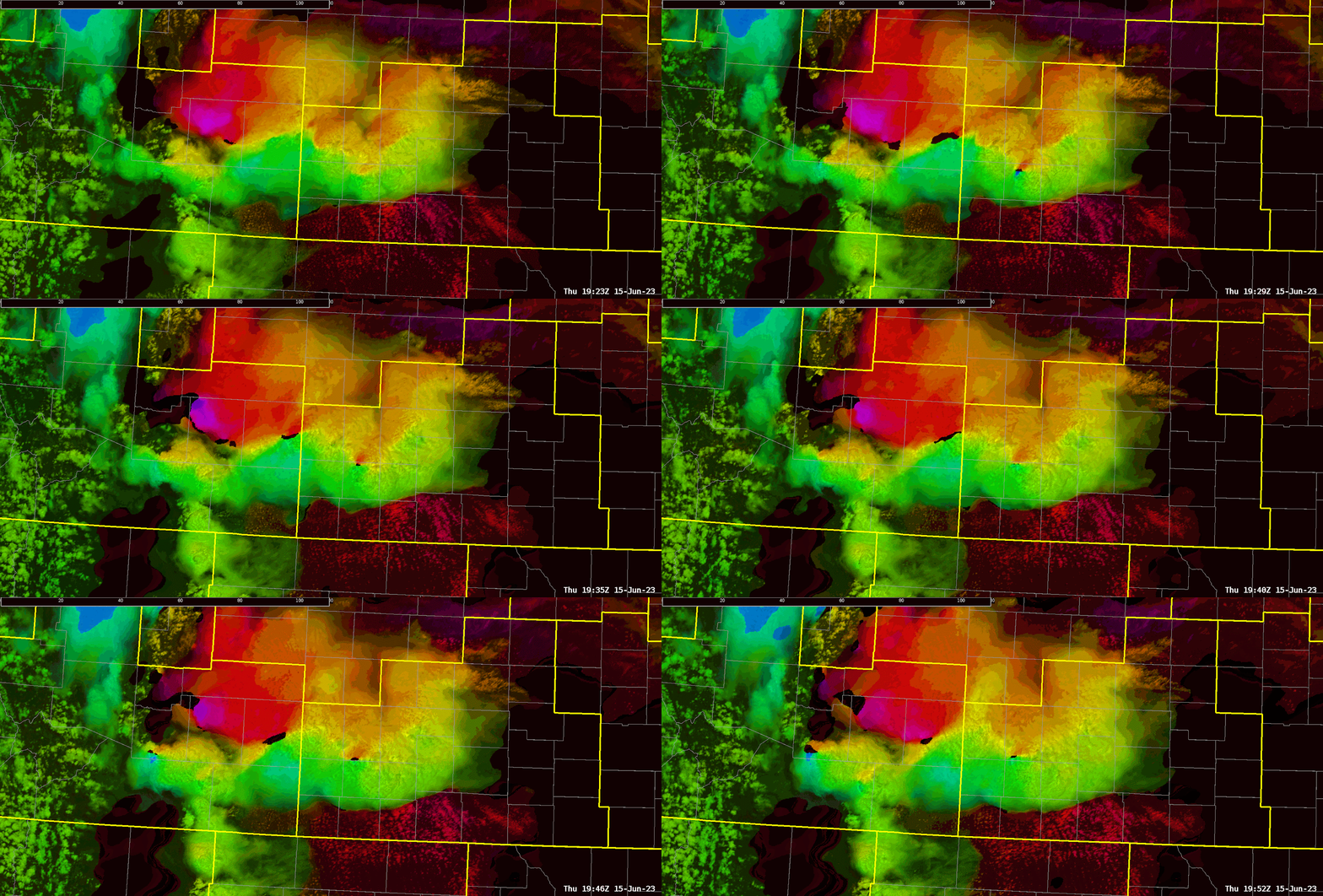
4 Panel with Octane on the top row; appears to be two distinct divergence signatures occurring

Radar Loop of storm splitting shortly after Octane signature…. Notice how the left mover dissipates.

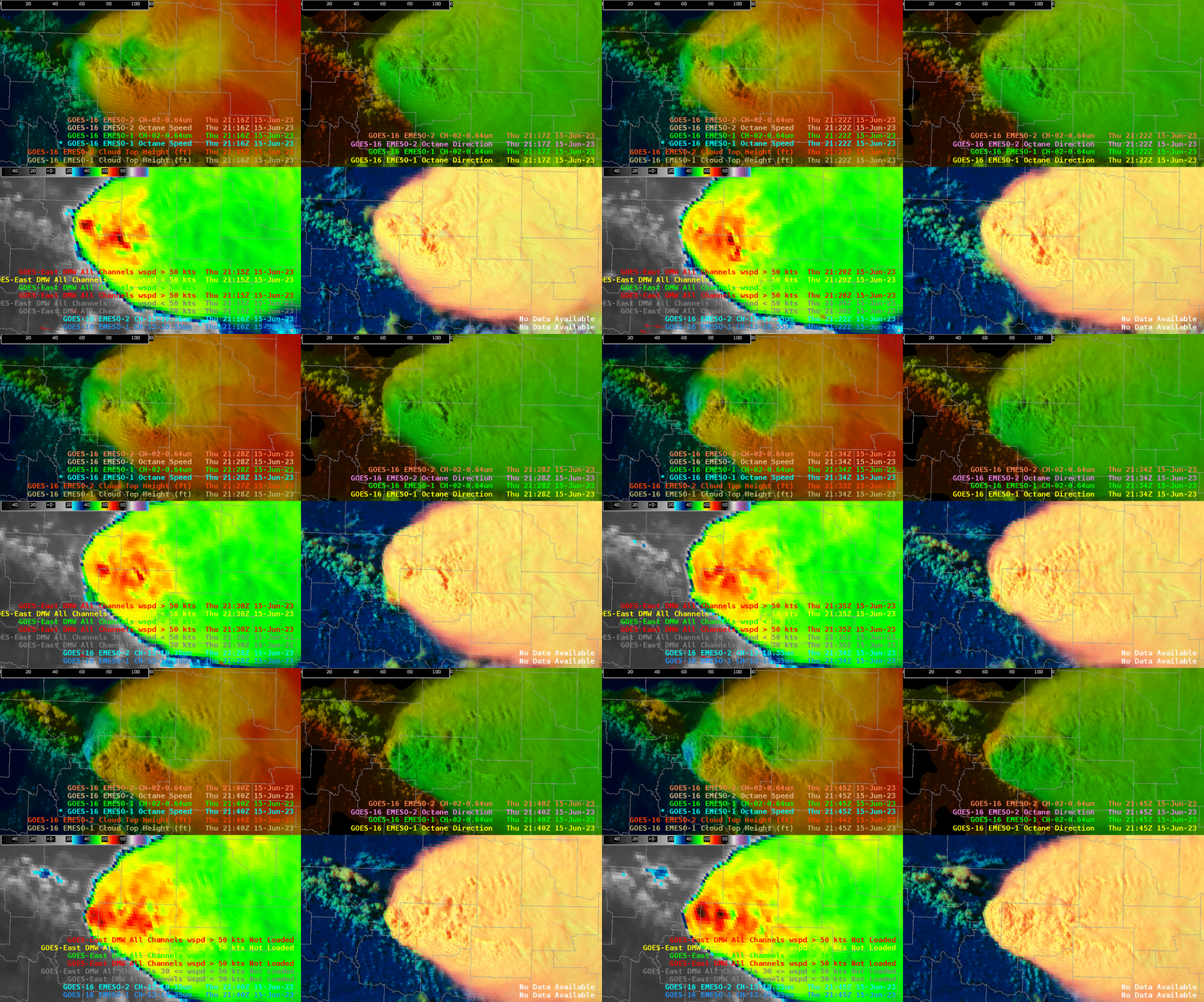
Using the 4 panel with Octane, IR and Day Cloud Phase it was also beneficial to see the upper divergence signature on Octane correlate with the cooling cloud tops of IR and Day Cloud Phase. Although it didn’t seem to create any additional lead time with that aspect; at least that I was able to notice. It was overall a very interesting storm to watch for this experiment.

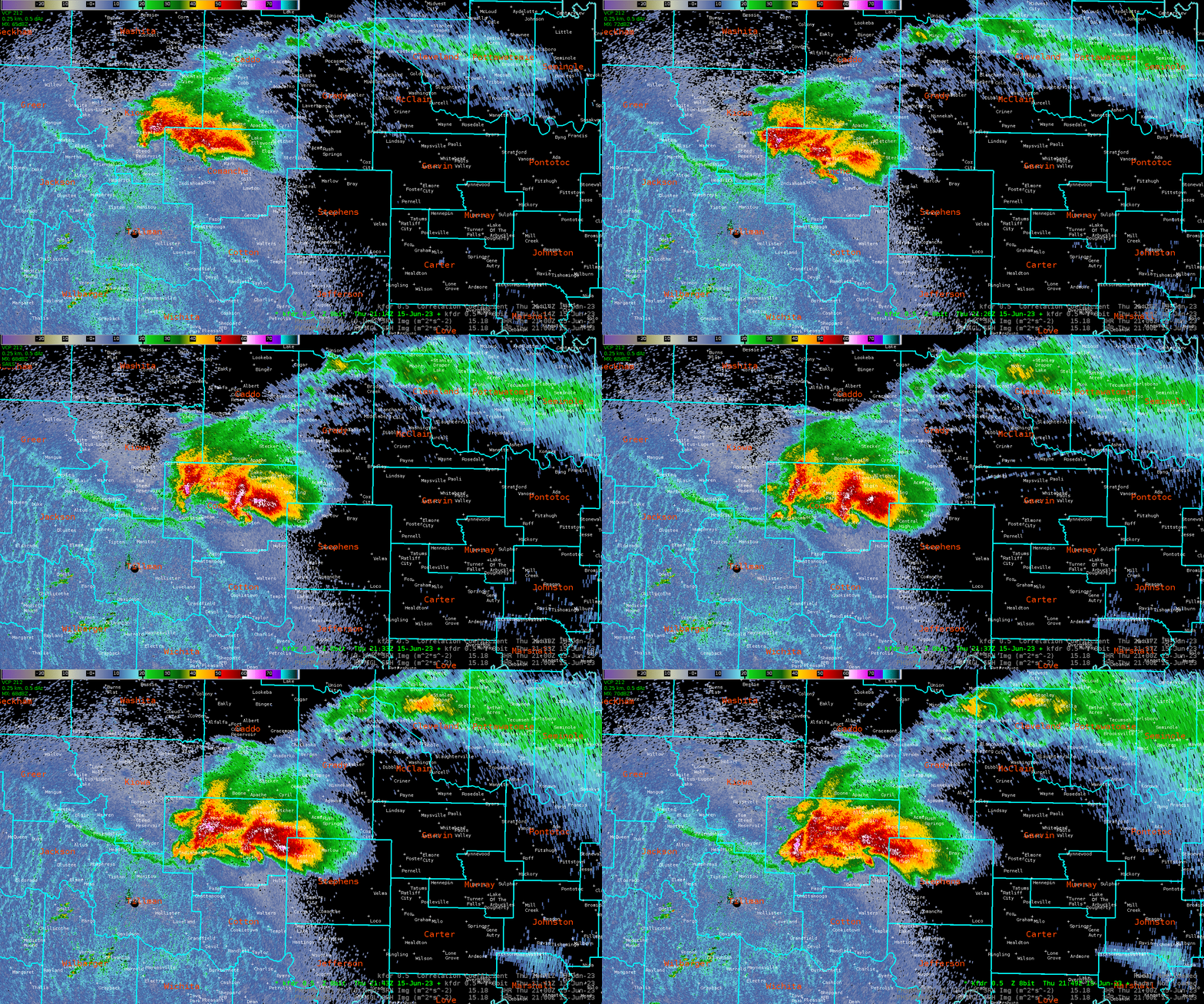
4 Panel Intensification of storm.  Note the rapid color gradient to blue (upper level divergence)on Octane towards the end of the loop.

Radar loop around the same time as the 4 panel above   

– Tor Nader

Tags: None

6/15 Feedback for AMA

PHS

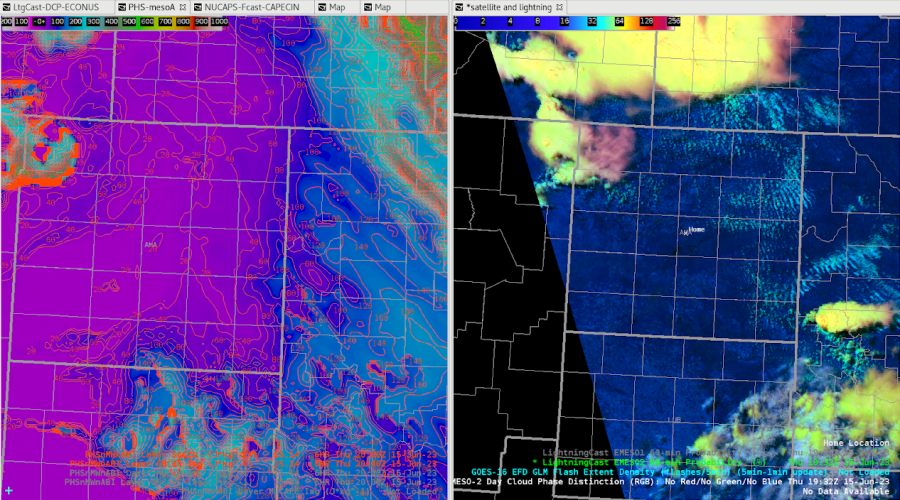
The surface based CINH at 20z lined up rather well with the satellite imagery showing the slightly more stable clouds over the eastern CWA.

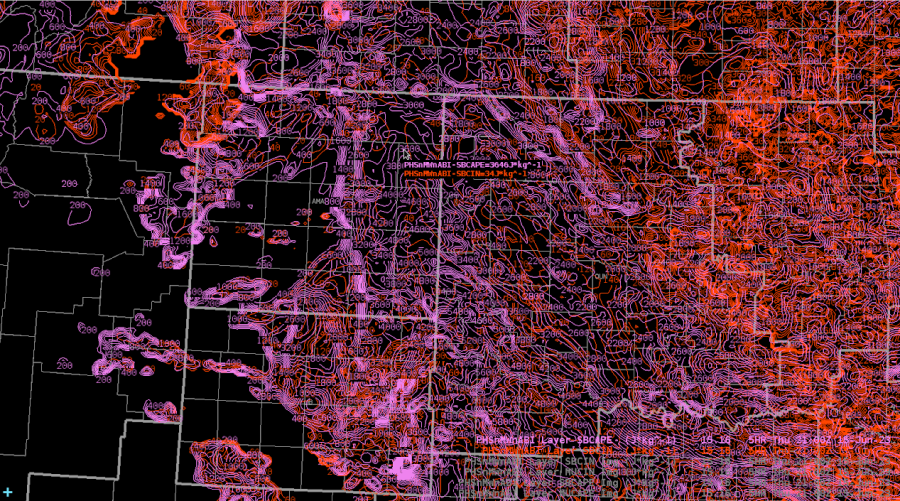
When sampling an image versus contours, the contour sampling has the entire product name in the readout

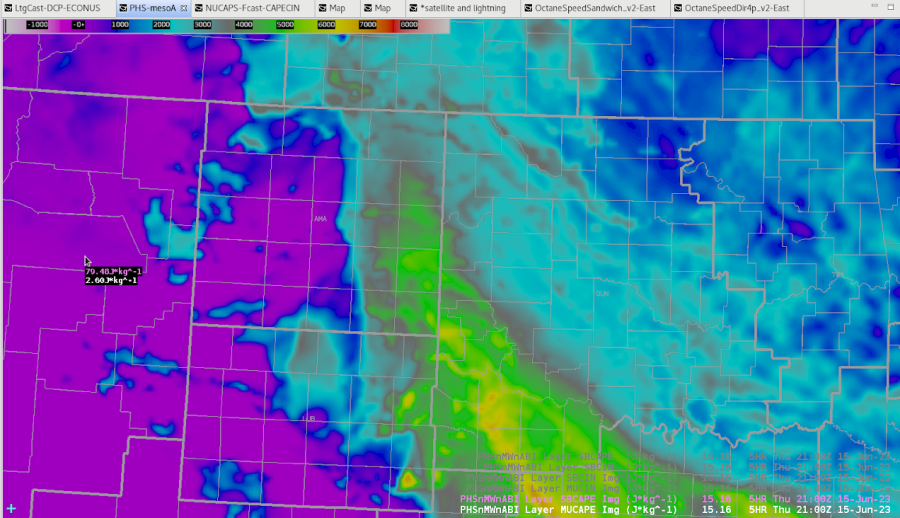
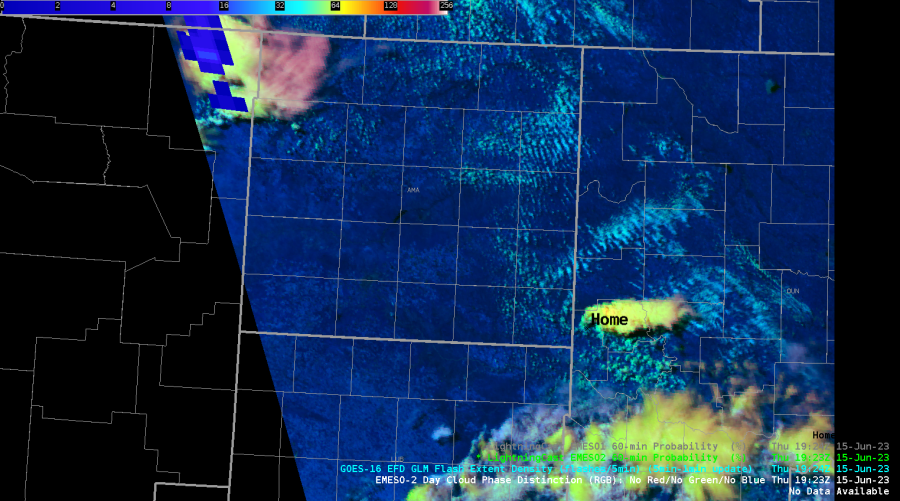
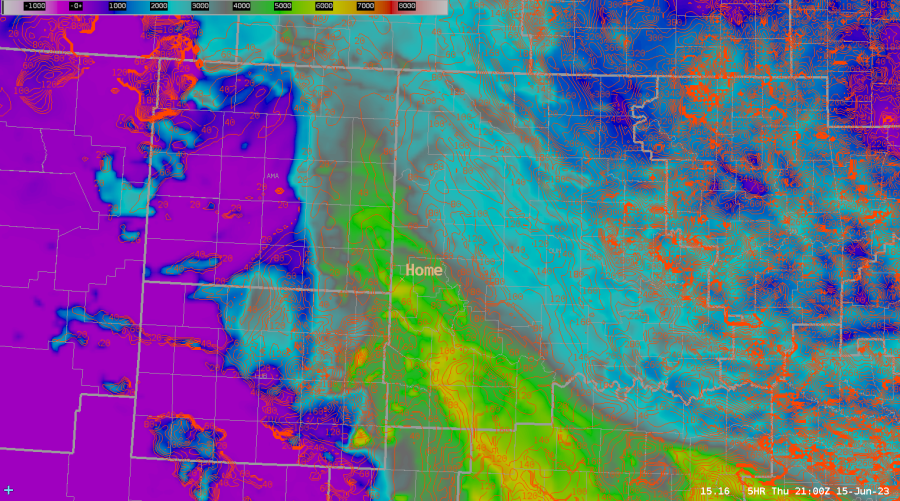
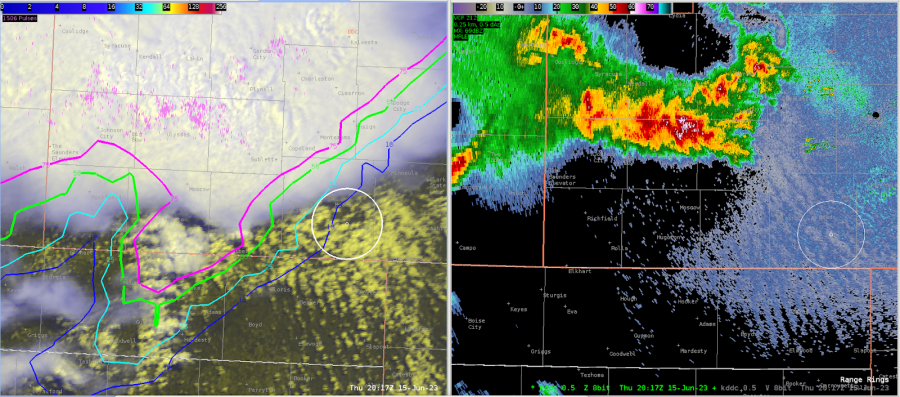
PHS captured the initial convection just east of AMA well, even though the convection started an hour earlier than PHS indicated.  Image on right is PHS SB CAPE and contours are PHS SB CINH.  Home is roughly where the storm is located.  Satellite image is around 1930z and PHS forecast is 21z when CINH dropped from 80j/kg to 40 j/kg.

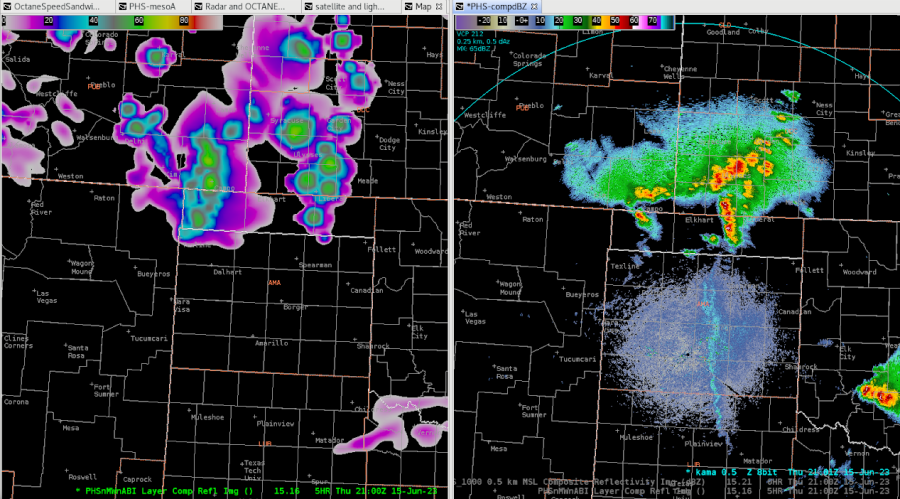
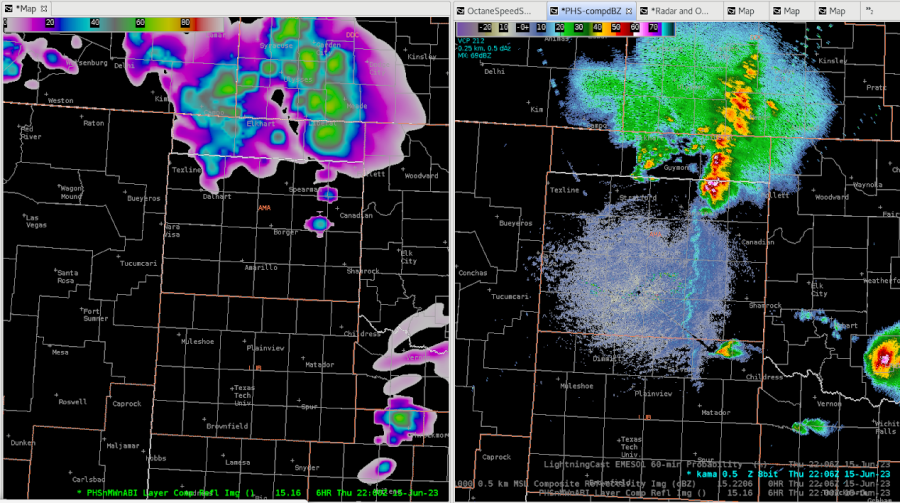
PHS did a reasonable job predicting the general storm coverage by 21z from the 16z run.

Toward the end of the exercise, the storm coverage was well captured by the PHS 16z run.  Should have taken this into account for my public graphics when describing the storm evolution.

NUCAPS

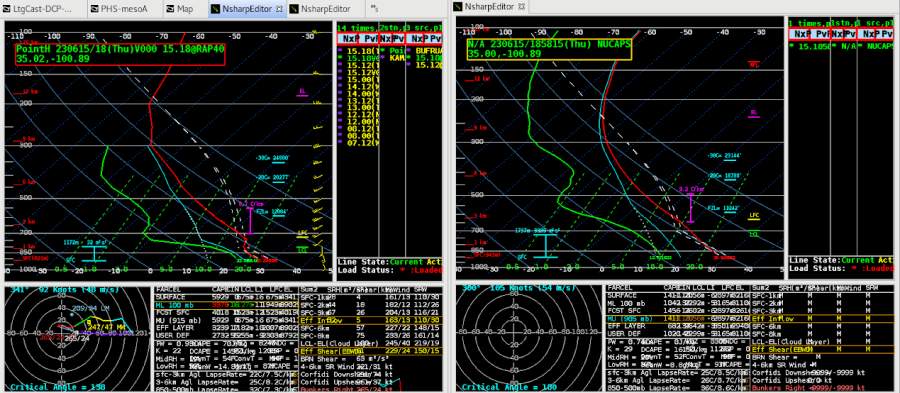
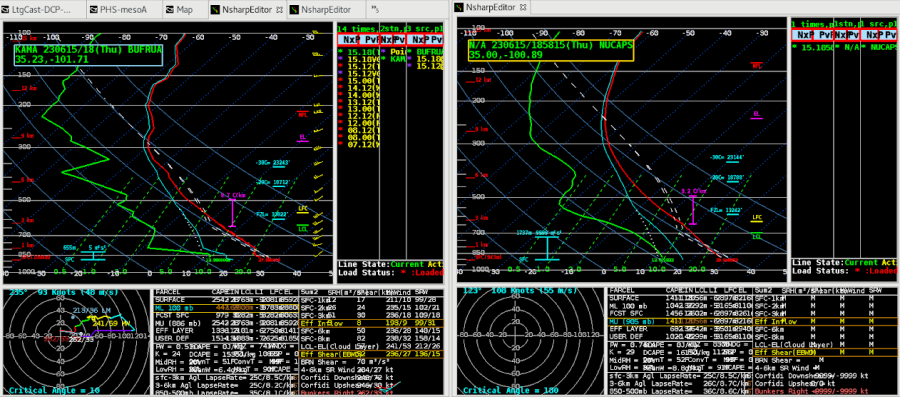
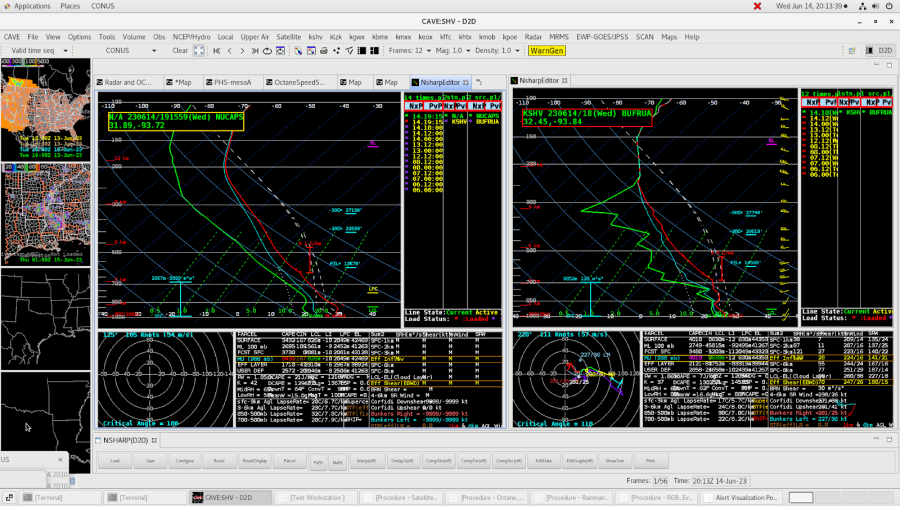
This is a NUCAPS sounding in the TX panhandle near AMA vs. a RAP40 sounding at the same point.  The RAP has the same trend in the dew point profile as NUCAPS, but is lower.

Noticed the NUCAPS sounding didn’t have the lower dew points around 400 mb as shown in the special sounding.  NUCAPS did have a hint of the weak cap near the surface though.

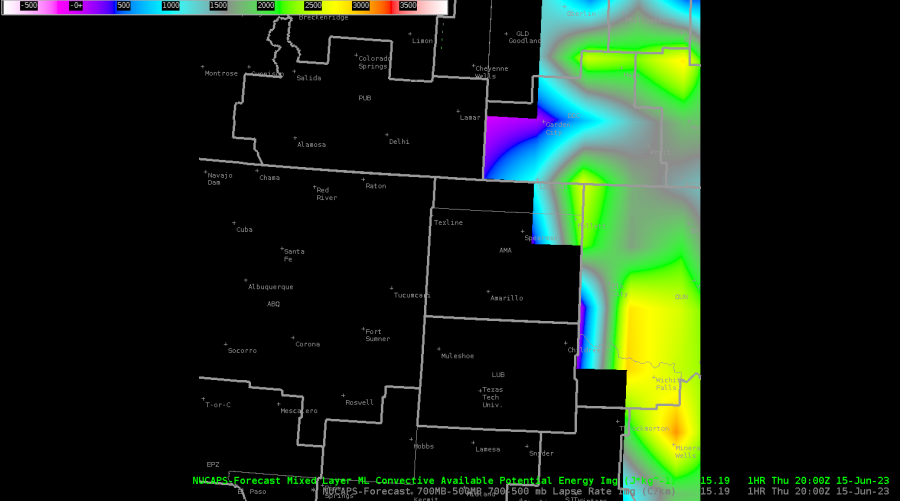
NUCAPS 700-500mb lapse rates from the gridded data was a constant 34.17 C/KM across the map.

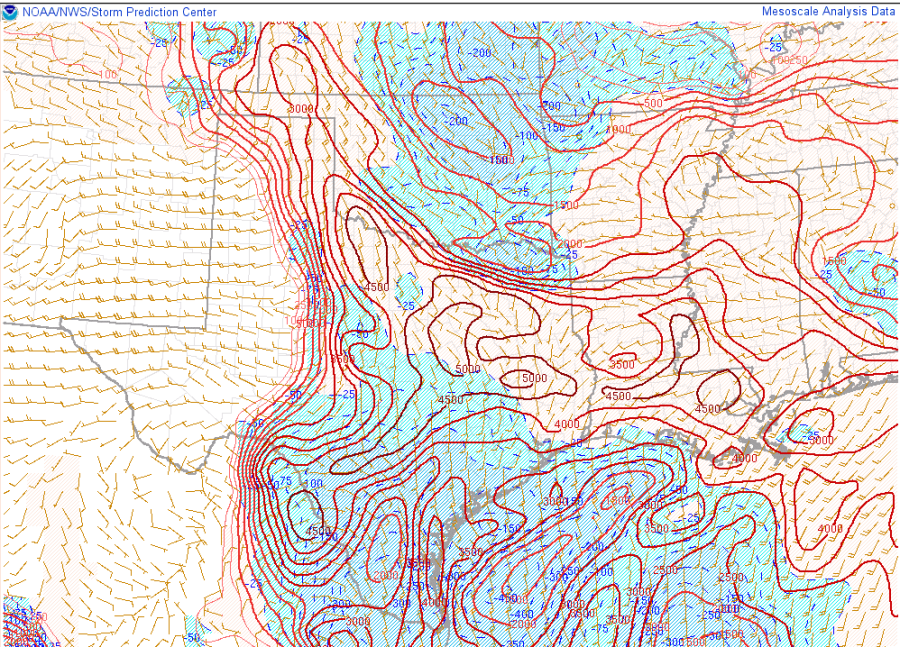
NUCAPS forecast for ML CAPE was slightly less than what SPC mesoanalysis had at the same time of 20z.

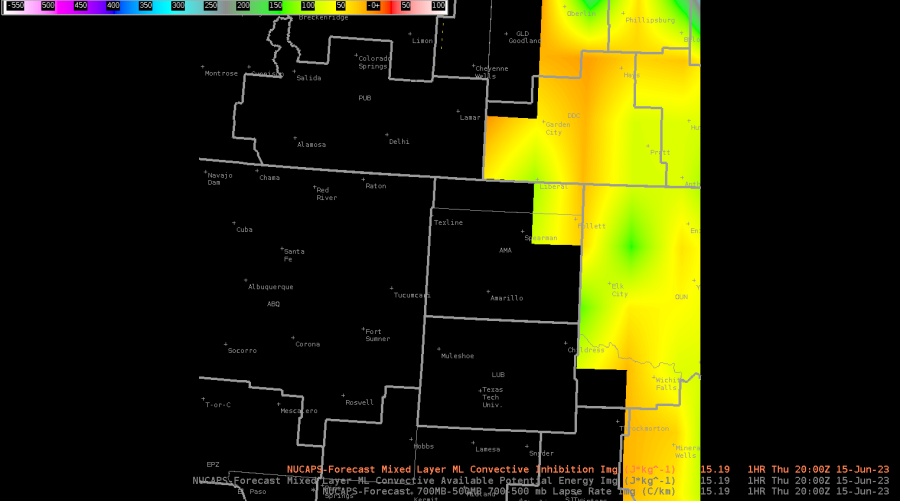
NUCAPS ML CINH was higher than SPC Mesanalysis for 20z, with some parts of the CWA having almost 90j/kg of CINH south of Liberal, KS.

The 700-500mb lapse rates matched well with SPC meosanalysis for 20z.

OCTANE

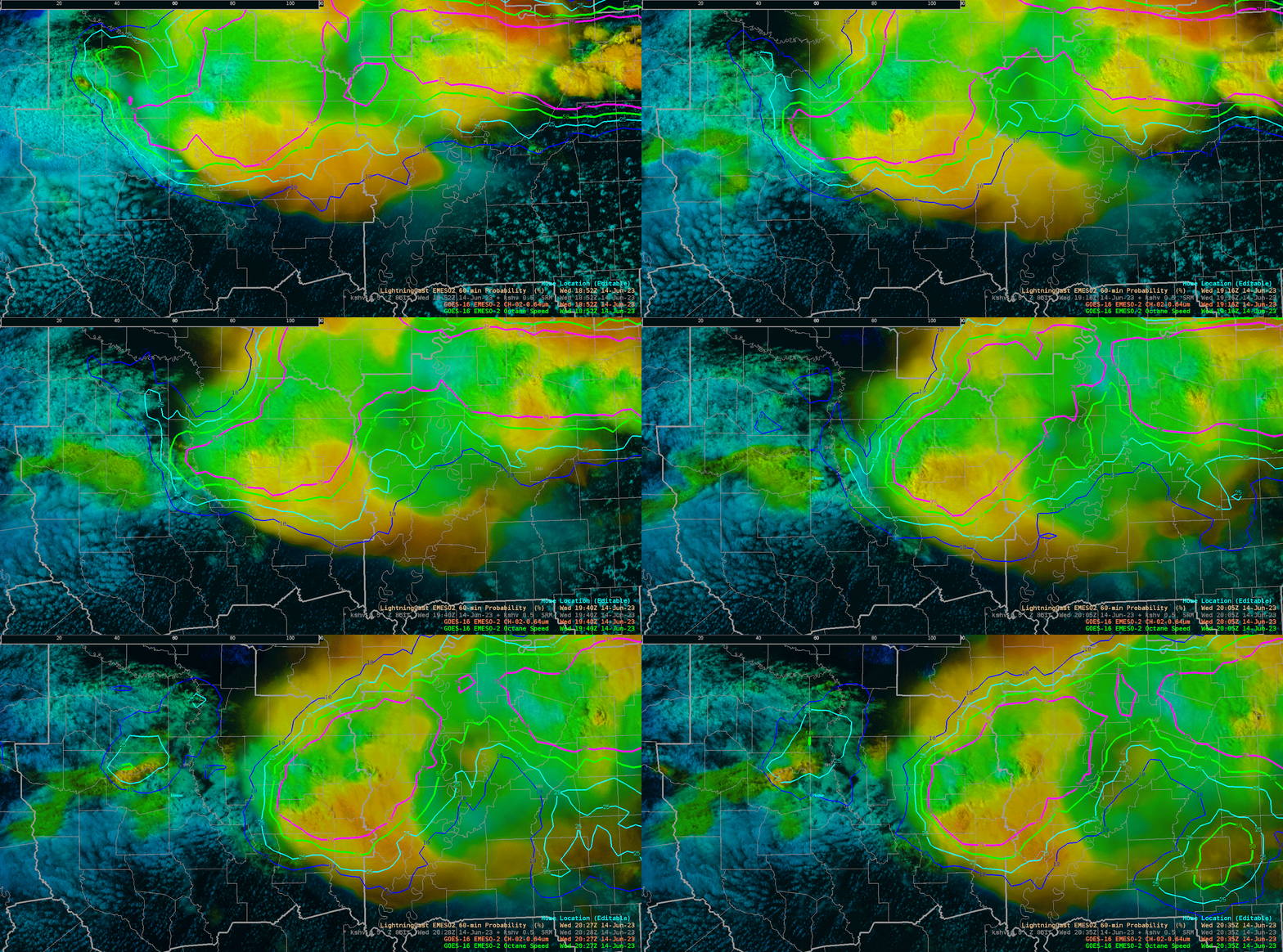
OCTANE showed the cumulus developing along the dry line and warm front well.  Can also distinguish which clouds are becoming taller.

OCTANE highlighted where convection was taller, and Lightning Cast started to show probabilities for those same updrafts.

ProbHail

Noticed what could be an above anvil cirrus plume with the storm in question.  Prob Hail only had a 35% chance for severe hail at the time.

Prob Tor

Noticed the Prob Tor jumped up depending on what cells it was encompassing.  Took three screen shots to denote the trend.  Seemed reasonable for it to increase since the end cell was ingesting the dry line at the time the probabilities increased.

-Rainman

Tags: None

Day 4 Review of Products & Operational Applications

Today, I took on the role of mesoanalyst during operations. I first looked at PHS fields (mainly MUCAPE and bulk shear) and compared them to the SPC mesoanalysis of said fields. The two agreed well, though I do have a suggestion – PHS bulk shear fields are given in m/s, but knots or mph would be better for quick comparison to SPC mesoanalysis and most model output.

I then looked at OCTANE imagery and immediately took note of the divergence signature associated with an especially robust storm over western DDC (Figure 1). This signature was easy to identify as the environmental winds aloft were relatively light.

Figure 1

As the operational period wore on, LightningCast indicated a high likelihood of convection over the southwest portion of DDC well before any radar returns actually appeared (Figure 2). My group used this information to create a DSS graphic that highlighted this area for likely storm development later (which did in fact end up happening).

Figure 2

OCTANE Direction later captured what at first glance appeared to be a couple divergence signatures over southwestern DDC (Figure 3). Upon closer inspection, however, these signatures were co-located with relative minima in OCTANE Speed. The proximity of these signatures to areas of missing pixels (where winds are likely <5 kts) in OCTANE Direction suggests very light winds and/or lower quality data, per the developer.

Figure 3

– Vort Max

Tags: None

Utility of Parallax Corrected LightningCast Versus Non-Corrected within DDC

June 15, 2023 – Role playing as DDC, I was tasked with providing DSS for a (fictitious) grass fire near Meade, KS.

DSS: Grass fire near Meade, KS

For this DSS, requested information included lightning within 10 miles of the site, any significant changes in wind speed and direction, as well as other hazardous weather that would pose a risk to emergency personnel containing the fire.
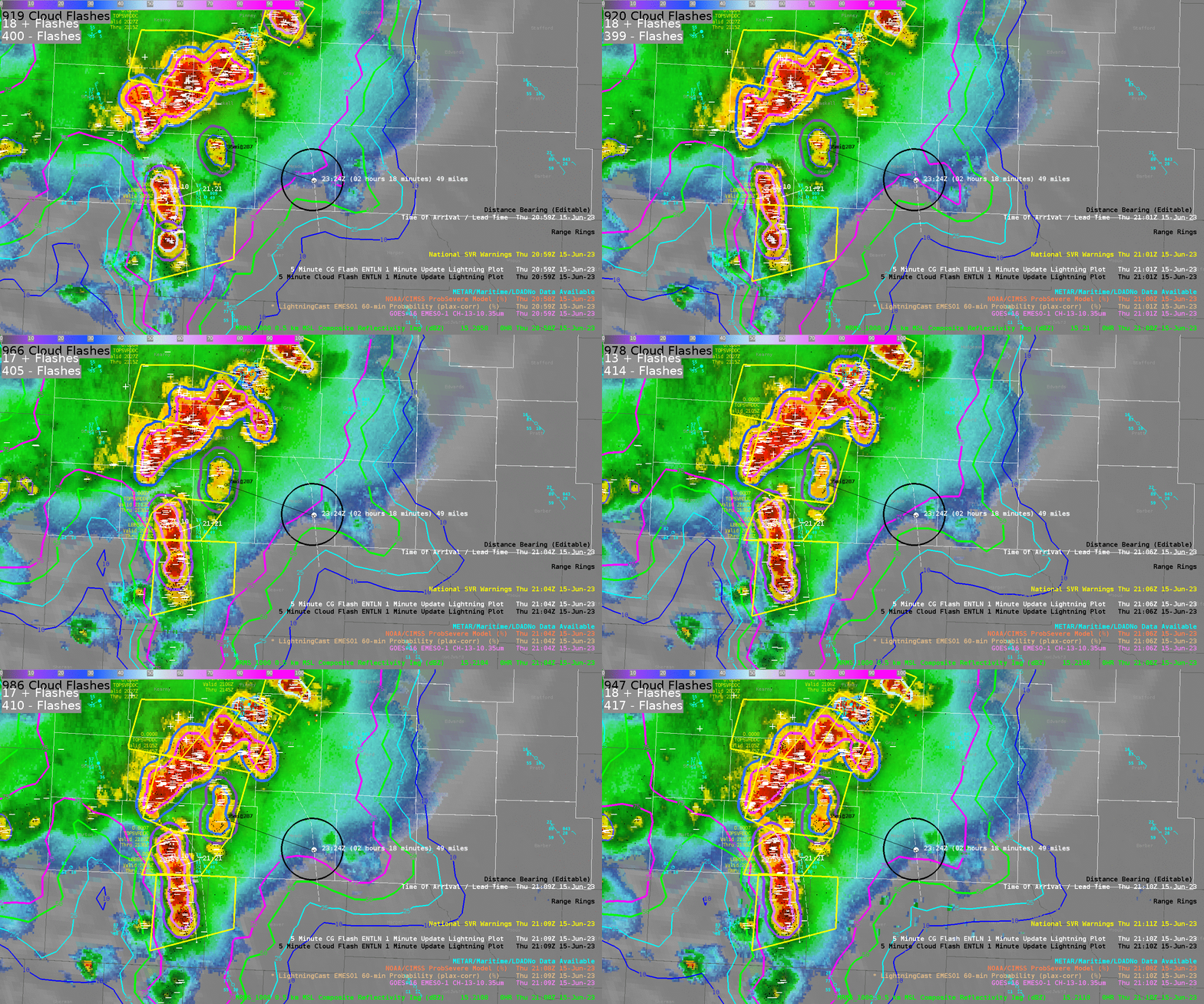
Figure 1.

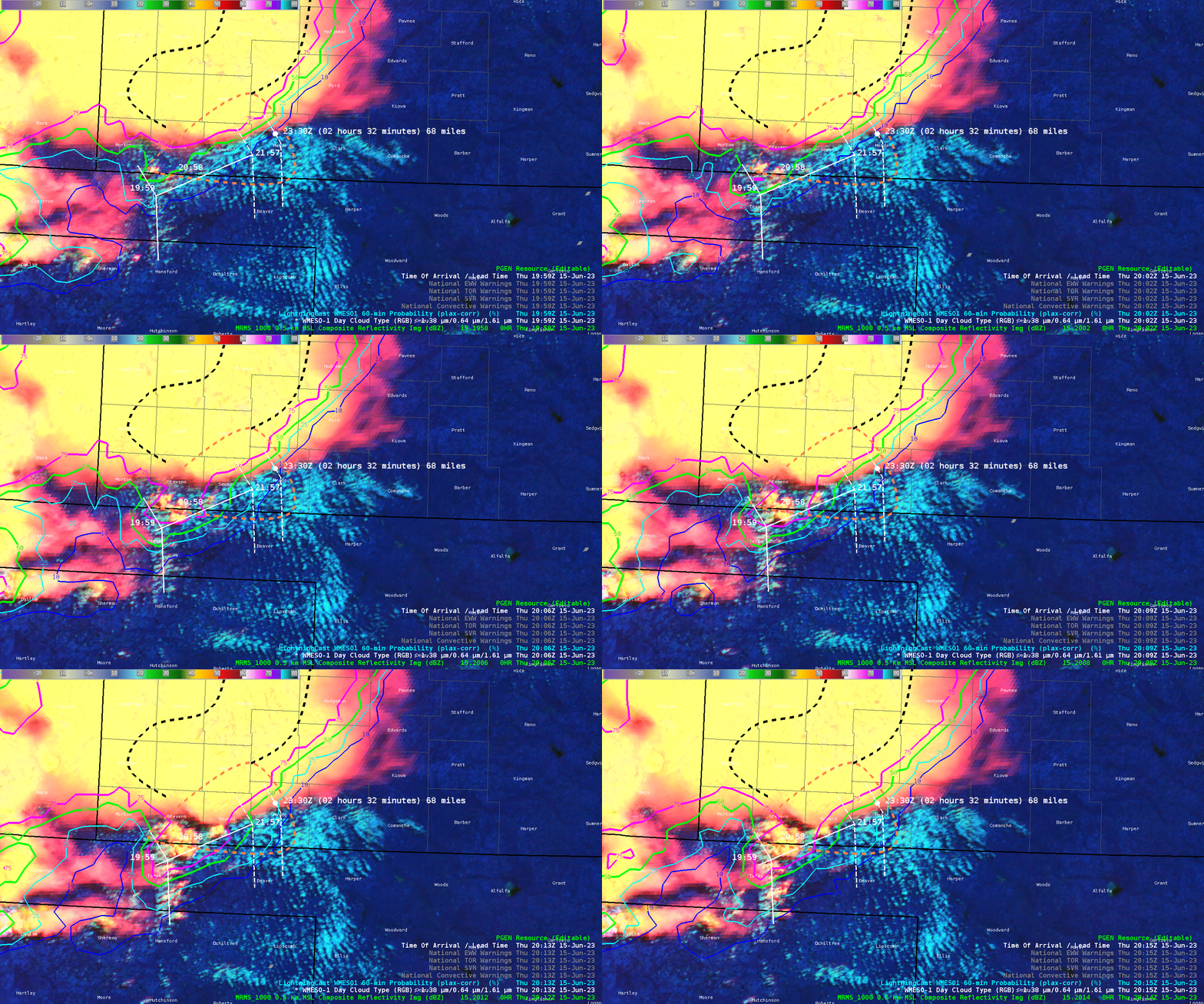
There was ongoing severe convection within the western half of the CWA by the start of my shift, and there was a high likelihood of this convection approaching the DSS site. As shown in Figure 1,  my datasets/tools of choice for tracking severe convection and lightning were as follows: GOES-East Mesosector LightningCast, MRMS Composite Reflectivity, ENTLN intracloud and cloud to ground lightning, surface observations, Time of Arrival Tool, Distance Bearing Tool, and Range Rings Tool.

Ground based lightning observations and LightningCast complimented each other nicely when assessing the potential for lightning at the site. Additionally, LightningCast picked up on additional agitated Cu well ahead of the main line of thunderstorms closer to the DSS Site. Using the Time of Arrival tool to track the main cluster of cloud to ground lightning associated with the severe convection was also very useful in providing information on potential to see most lightning via advection, in the absence of additional convective initiation and/or a rapid change in forward speed in ongoing convection.
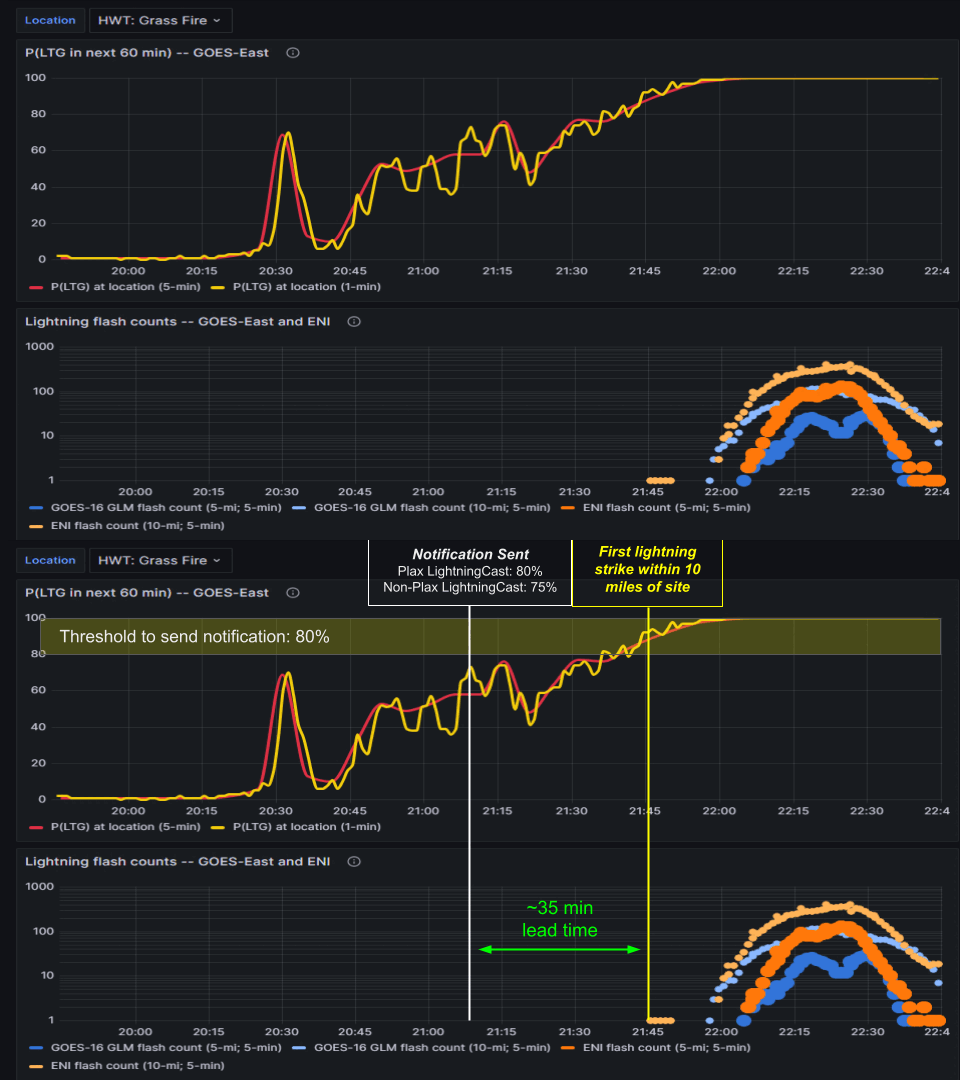
Figure 2.

Some consideration was made to not “overwarn” on lightning potential as the main breadth of lightning would likely come from the severe convection still well off to the west. So with this particular scenario, I set an internal threshold of 80% within LightningCast to send a DSS message. The data readout of the parallax corrected LightningCast offered within AWIPS (not shown) was favored over the non-parallax corrected time series (Figure 2), giving higher confidence in the true probability of occurrence used within the DSS message. This gave around a 35 minute lead time before the first strike was detected within 10 miles of the DSS site. Had we used the non-parallax corrected readout values, lead time would have been much shorter, around 10 minutes using 1-minute imagery and less than 10 minutes using 5-minute imagery. This clearly demonstrates the value of using parallax corrected data compared to non-parallax corrected data when performing DSS.

Here was the DSS message sent at around 21:10 UTC:

Severe thunderstorms have developed around 50 miles to your west, and will likely move over your site between 5:15 pm to 6:30 pm CDT. There is a high chance for storms to remain severe by the time they reach your site, bringing very strong winds over 70 mph out of a direction ranging between northerly to westerly, large hail, heavy rainfall, frequent lightning. We still cannot rule out the potential for a brief tornado, although the chance for a tornado is much lower than previous hazards mentioned. Because of the approaching thunderstorms, the chance for lightning to occur within 10 miles of your site within the next hour (5:15 pm CDT) is over 80%.

– 0SMBLSN

Tags: None

Low Probabilities of LightningCast Despite Observed Cloud to Ground Lightning Within Trailing Anvil / Stratiform Region

While providing (fictitious) DSS for a grass fire near Meade, KS on June 15, 2023, LightningCast was utilized in notifying the onset of lightning within 10 miles of the DSS site as a line of severe thunderstorms approached. Additionally, consideration was given to the potential for lightning cessation over the site in an effort to give information on potential for the “all clear.”

Figure 1.

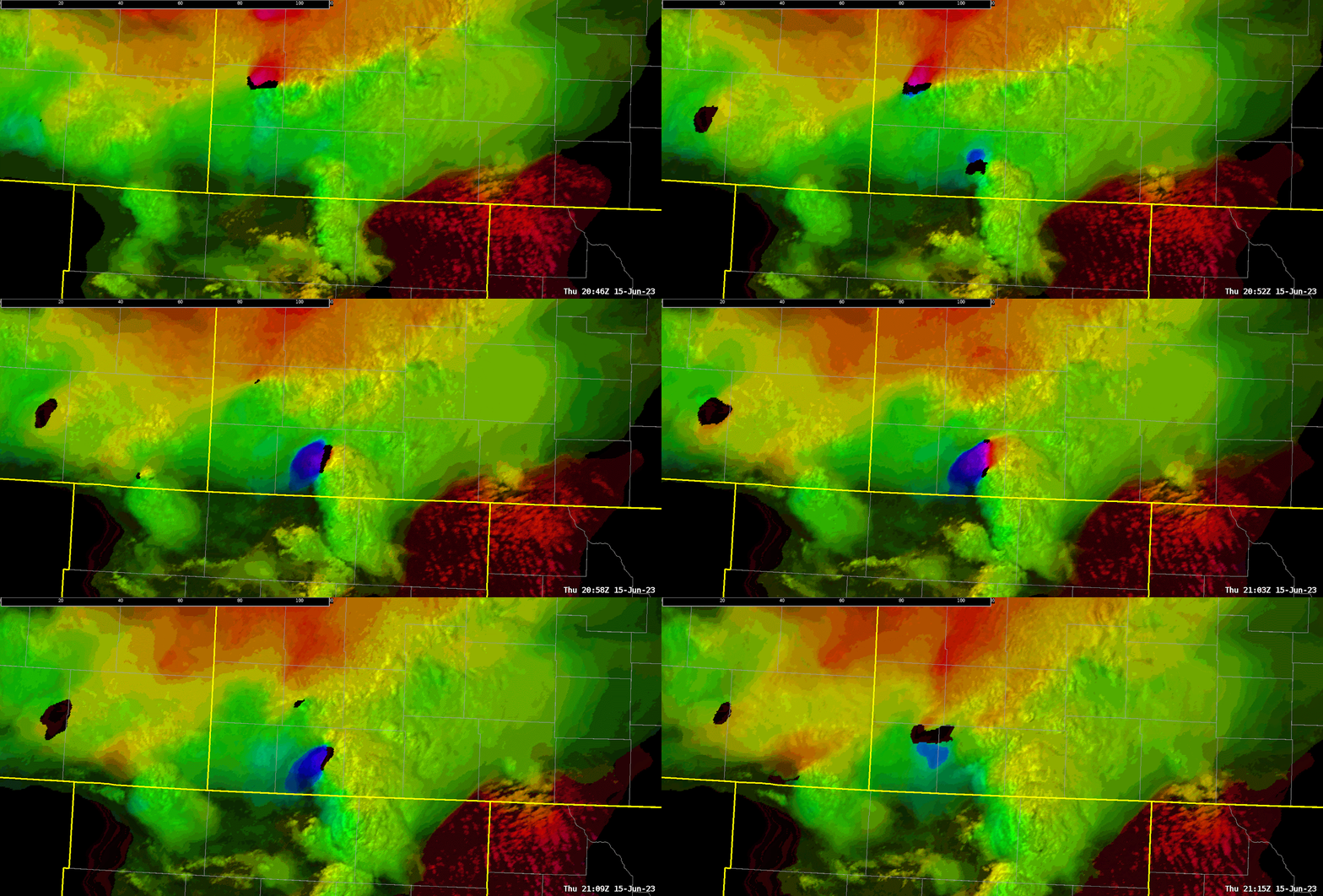
LightningCast within the trailing anvil portion of the squall line steadily dropped off within the trailing stratiform region. However, these probabilities decreased when cloud to ground lightning was still being observed, with even some strikes occurring in probabilities less than 10%. This can be seen in Figure 1 in the far left hand portion of the animation with CG icons occurring within and outside of the lower contours of LightningCast.

This significantly lowered confidence in tracking the lower probability contours to give an estimated time of cessation.

Here was the DSS message sent at around 21:45 UTC:

As of 4:45 pm CDT, severe thunderstorms are 20 miles west of your site, and continue to approach your site. There is a very high chance these storms remain severe by the time they reach your site, currently expected between 5:15 pm and 5:45 pm CDT, bringing very strong winds over 70 mph out of a direction ranging between northerly to westerly, heavy rainfall, and frequent lightning. We still cannot rule out the potential for a brief tornado and large hail, although the chance for a tornado and hail is much lower than previous hazards mentioned.

Because of the approaching thunderstorms, the chance for lightning to occur within 10 miles of your site within the next hour (5:45 pm CDT) is over 99%.

It is worth noting that even after severe hazards associated with this line of thunderstorms have ended, there will remain over 75% chance of lightning over your site for an additional 1-2 hours, along with the potential for continued gusty winds over 20 mph ranging out of the southeast to northeast.

– 0SMBLSN
Tags: None

Using Satellite to Aid in Defining Areas of Concern for Graphical Messaging

June 15, 2023 – Role playing as DDC, a colleague and myself were tasked with creating a public graphic for a near term forecast regarding the location and timing of the potential for severe thunderstorms and associated hazards.

There was ongoing severe convection within the western half of the CWA by the start of our shift. After going through a quick forecast process and mesoanalysis, it was determined that a prime environment for either additional or sustained severe convection was spreading into the southern and eastern portions of the CWA.

Shortly thereafter, satellite gave indications of convective initiation in the vicinity of a triple point of a surface low. Satellite imagery and products that gave indication of building, infant convection included Day Cloud Type RGB and LightningCast via GOES-West Mesosector 1.

Figure 1.

Day Cloud Type RGB was used to track the vertically growing Cu, while using the Time of Arrival Tool and knowledge of the environment to estimate the spatiotemporal extent ( orange dashed outline) of where severe convection would occur within the next two to three hours, as displayed in Figure 1. Additionally, LightningCast was used to build confidence in where convection was growing and tracking, aiding in defining this area of concern.

Figure 2.

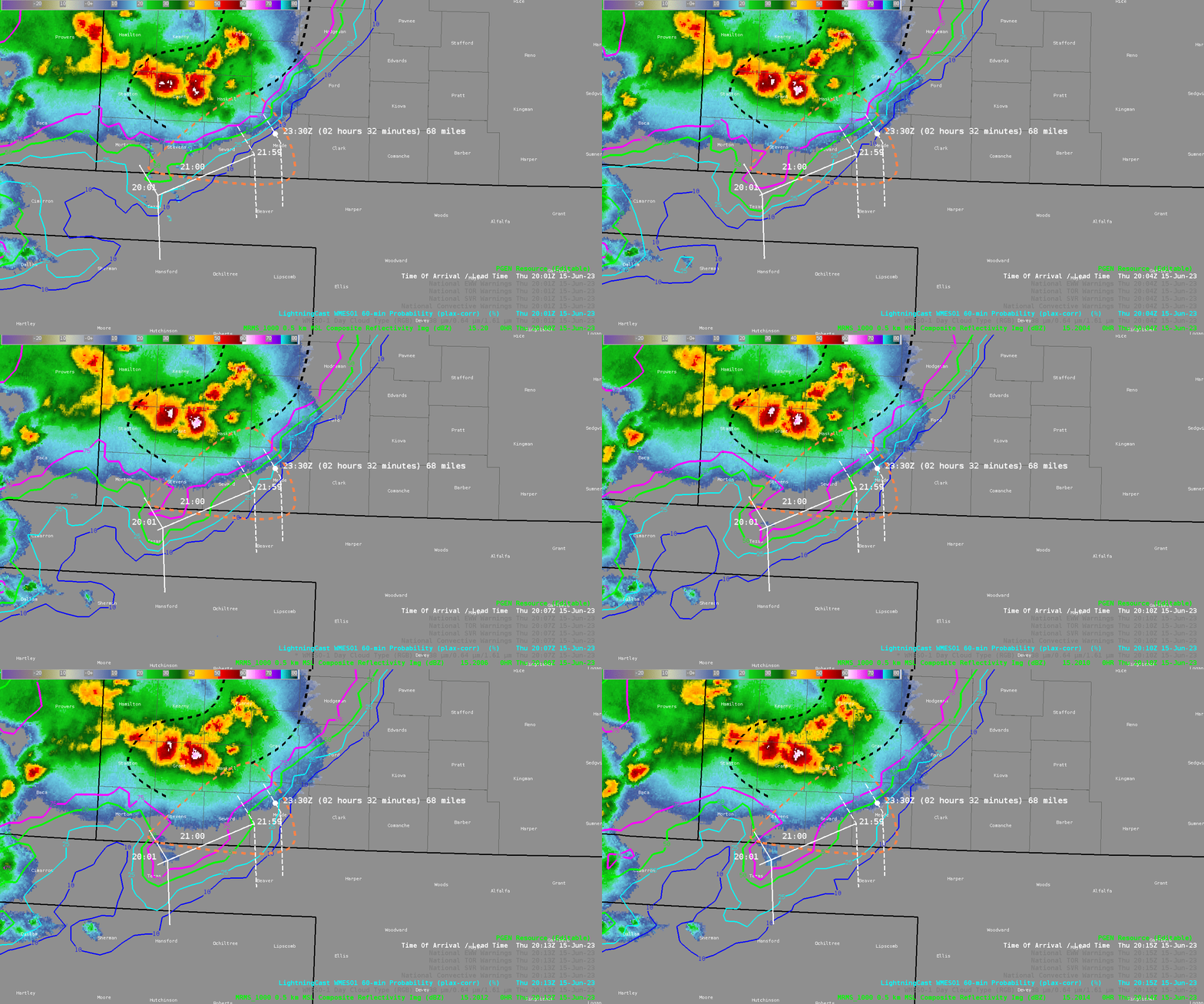
When comparing this to radar reflectivity (Figure 2.), radar was devoid of robust convection in the growing area of concern. Thus satellite proved useful in providing further lead time in defining the area of concern as well as when to start graphic creation. While we opted to not show satellite imagery for public consumption (satellite imagery can be distracting and/or misinterpreted when messaging severe hazards and impacts), it was crucial in the development stage of graphic creation, particularly defining areas of growing concern.

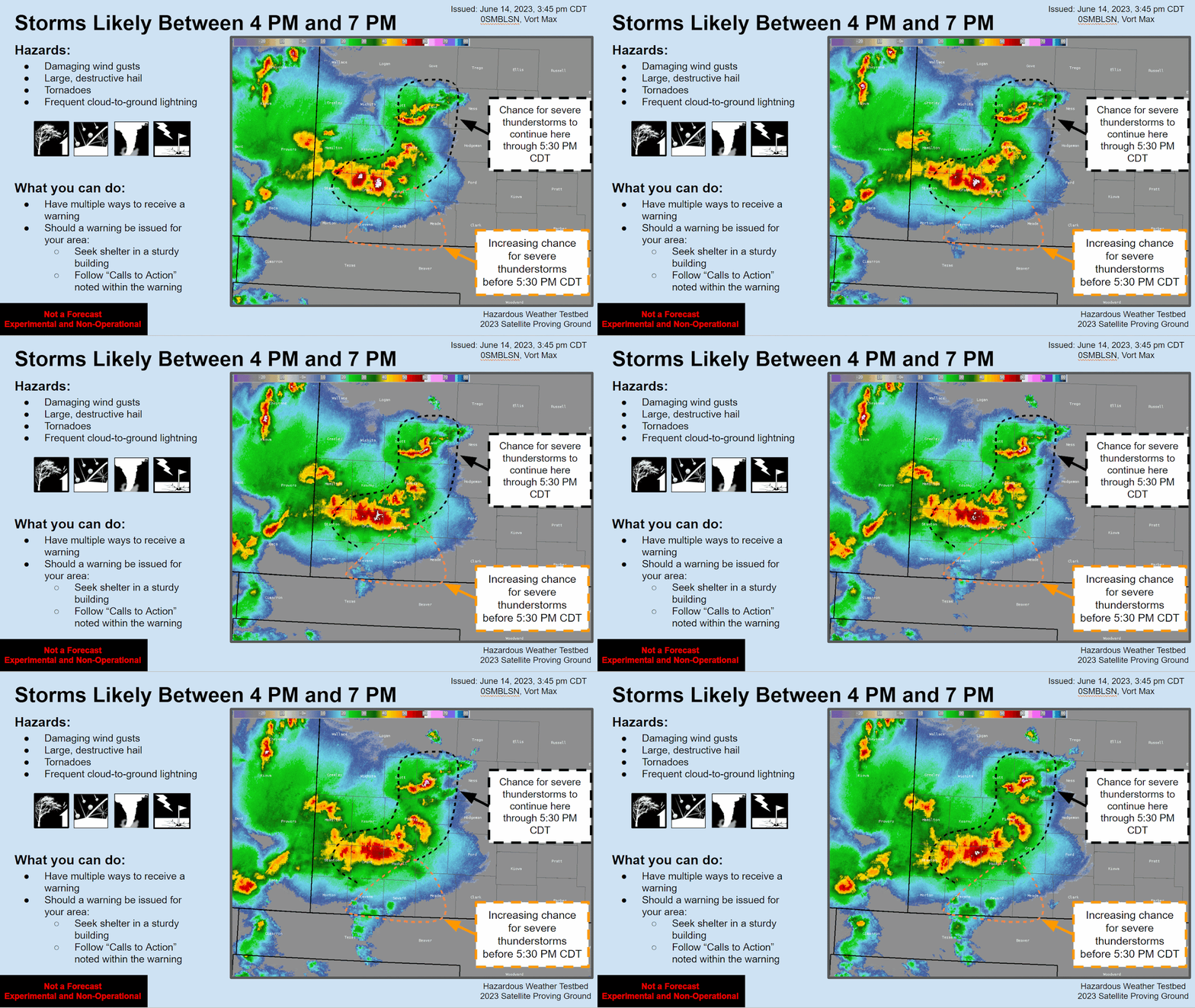
Here was the graphic we created:


How did it pan out? Pretty well, actually:

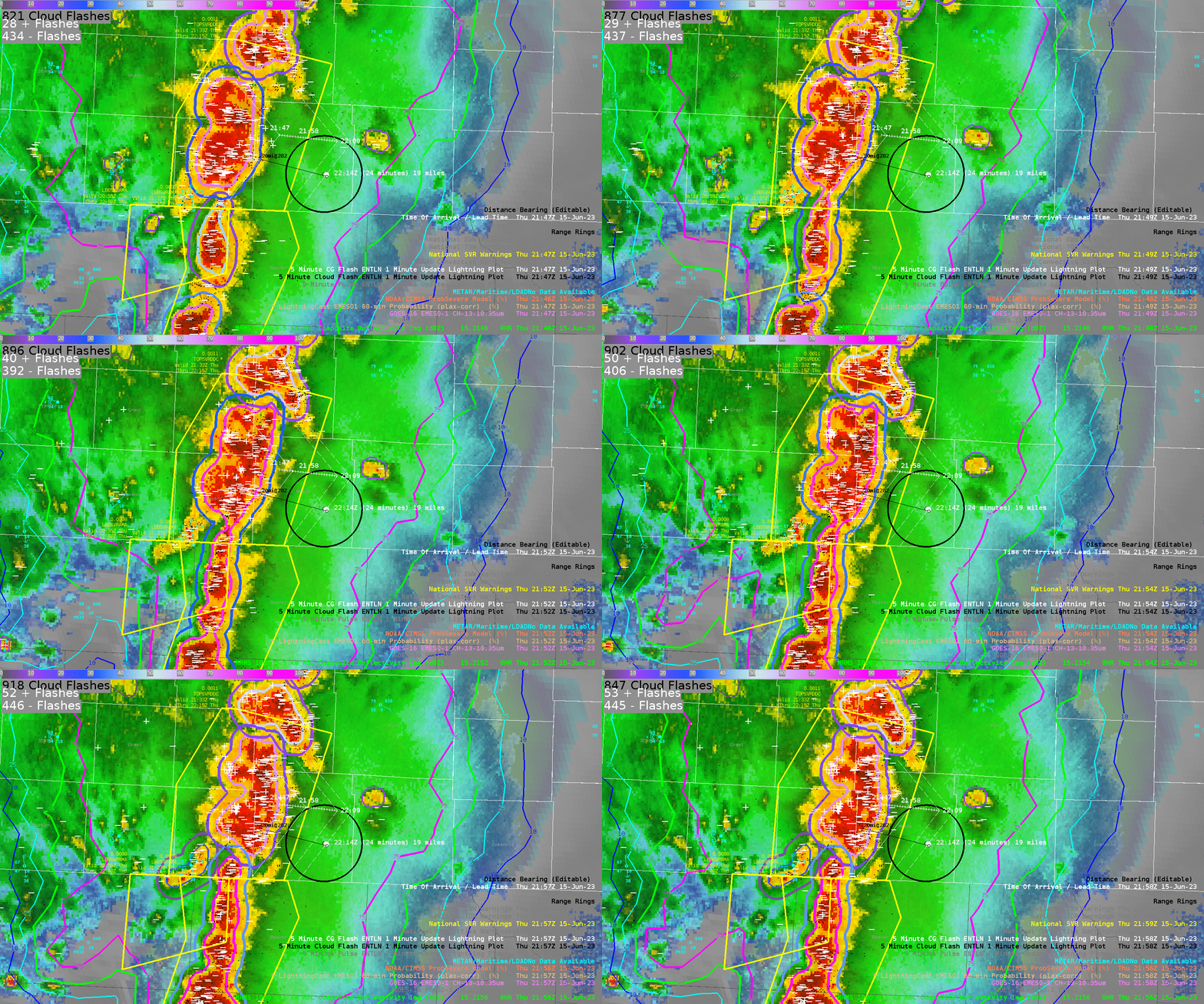
Figure 3 shows an animation of MRMS Composite Reflectivity and ProbSevere through the window of forecast hazards to help illustrate how severe convection developed between 20:00 UTC through 22:15 UTC within DDC during the period of concern.

Additionally, here are the SPC reports between 20:00 UTC to 22:15 UTC within DDC during the period of concern, including a measured 88 mph wind gust at 21:30 UTC within Seward County:

– 0SMBLSN
Tags: None

PHS and SPC Mesoanalysis, 0-6km Shear

I noticed that there was a big difference in 0-6km bulk shear values between the PHS MesoA and SPC Meso page. The gradient was similar but not the values. Highest values from the PHS MesoA was in the mid 30s. Highest values on SPC’s page was in the 60s at around 20z.

– SATGLM_84

Tags: None

SHV Feedback for 6/14 and some feedback from LZK CWA

NUCAPS

Noticed the SHV special sounding was very similar to the NUCAPS sounding done an hour later.  NUCAPS on the left and SHV on the right.  The surface and near surface environment did not match as well.

OCTANE

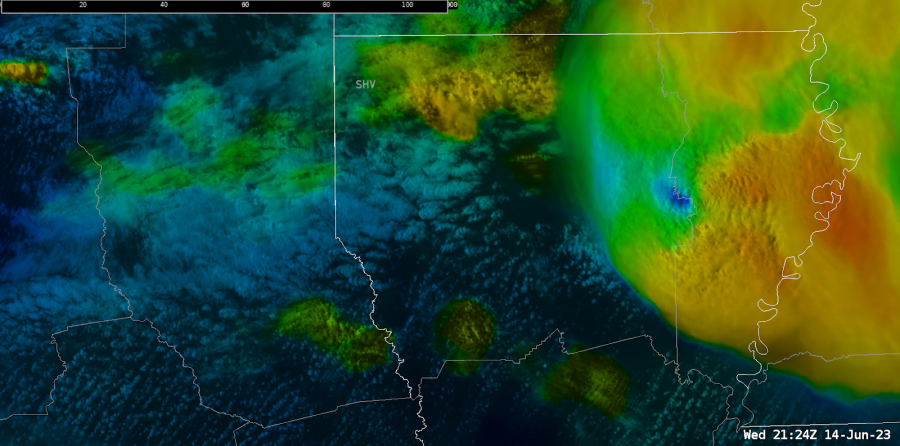
Neat to see OCTANE highlight the taller clouds that are developing behind the main storm activity over the western CWA.  Lightning Cast started highlighting this area too for a lightning threat.

Very nice divergent signature on the updraft.  However, the 80 kts of divergence seems underdone given the MESH of 1.51”.  I know the speeds are dependent on the environmental winds, but just seemed odd given the hail potential.  Calibration would be helpful to help determine the hail size potential based on updraft divergence.

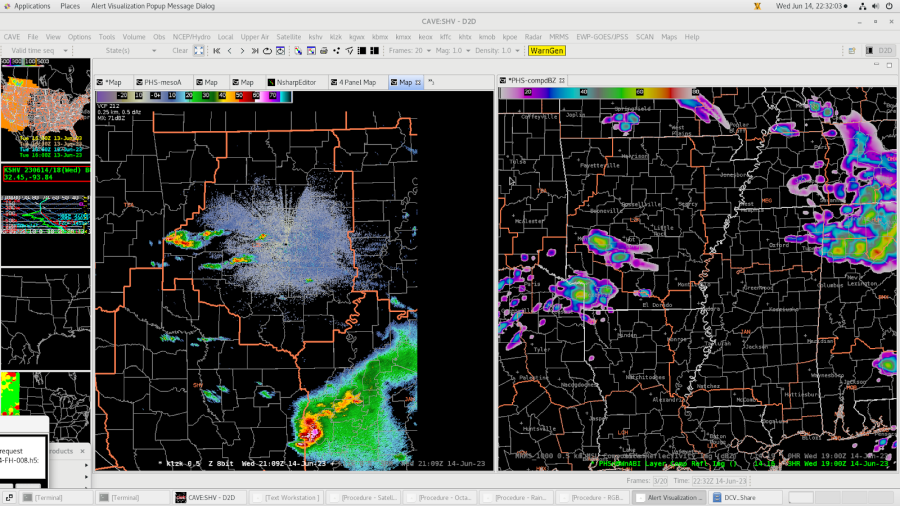
OCTANE captured two updrafts from a splitting storm over LZK’s CWA.  This helped to see the potential split earlier than when viewable on Radar.

Here is when OCTANE first denoted the split vs. what radar had at the same time.

PHS

Handled the storm location and timing rather well at the start of the exercise for SHV.

Noticed for the LZK CWA PHS was about 2-3 hours early with the storm activity, but had the location correct.  Radar image at 21z, PHS image at 19z

– Rainman

Tags: None

BMX Severe Thunderstorms

Overall, I used OCTANE, PHS, ProbSevere 3 and LtgCast today. NUCAPS wasn’t really accessible. Worked the DSS event, an Air Show, which was canceled due to severe thunderstorms all afternoon producing tornadoes, large hail and damaging winds. DSS for this event would have been done days ago.

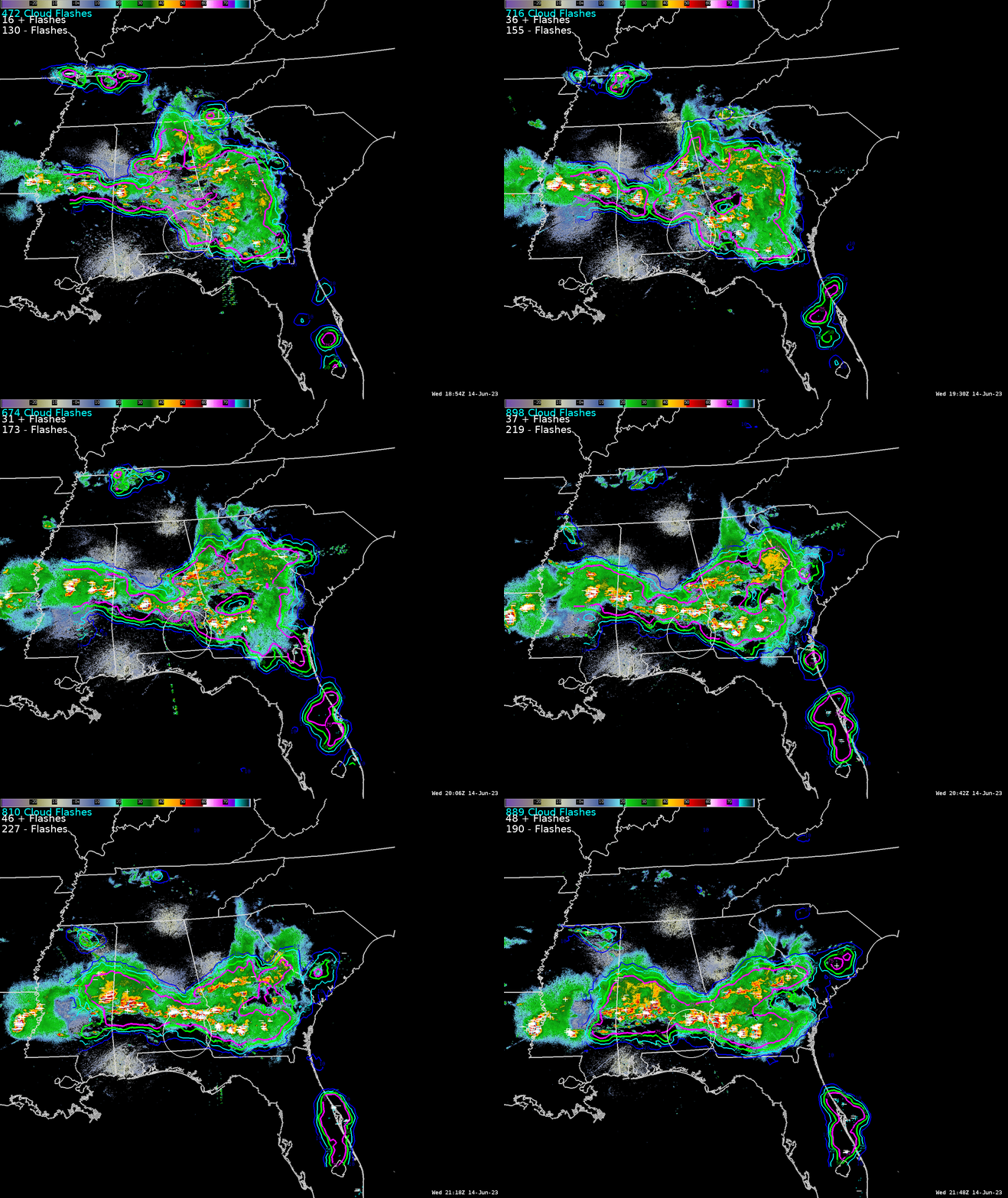
Below is a shot of LtgCast on a radar background and ELN measured lightning, the +/- are positive and negative ground strokes, and the cyan dots are in-cloud. It is interesting how the 75% probs lead out into southwestern Georgia though the showers there are more stratified and lightning isn’t expected, yet it gave about 45 minute notice of lightning strikes; that’s a good thing. But how useful is this? It predicted a few single lightning strikes tens of miles apart scattered across 100 miles which isn’t really useful; would you stop all outdoor activities across ¼ of Georgia for a few stray strikes? Would you clear the baseball field because a lightning strike will hit in the next hour somewhere within 50 miles? Not likely, but knowing there is some chance is valuable information for an event coordinator for risk analysis. If they can make minor changes to activities with little or no impacts, it helps, especially if it’s an area where lightning isn’t expected. What would be a big plus would be an estimate of flash density/frequency expected to go with the probs. That gets back to tracking the convective cells to predict areas of dense lightning. We have radar and ELN’s for that.
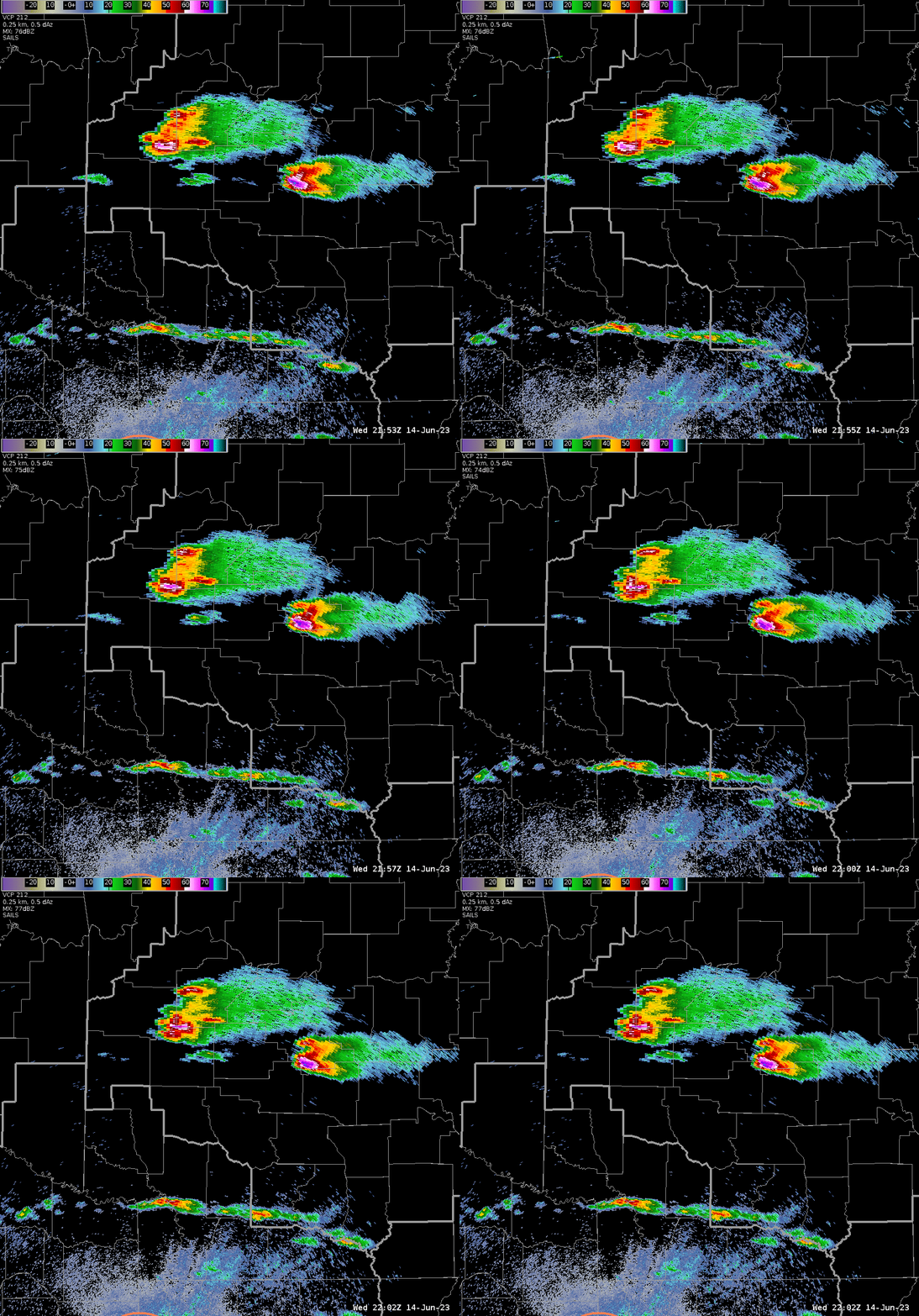
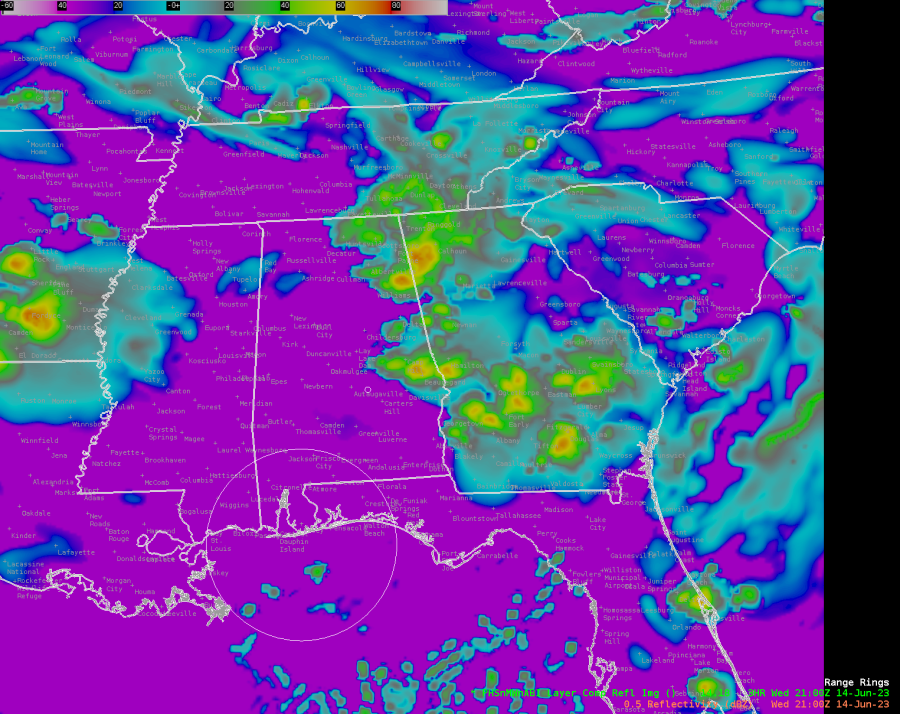
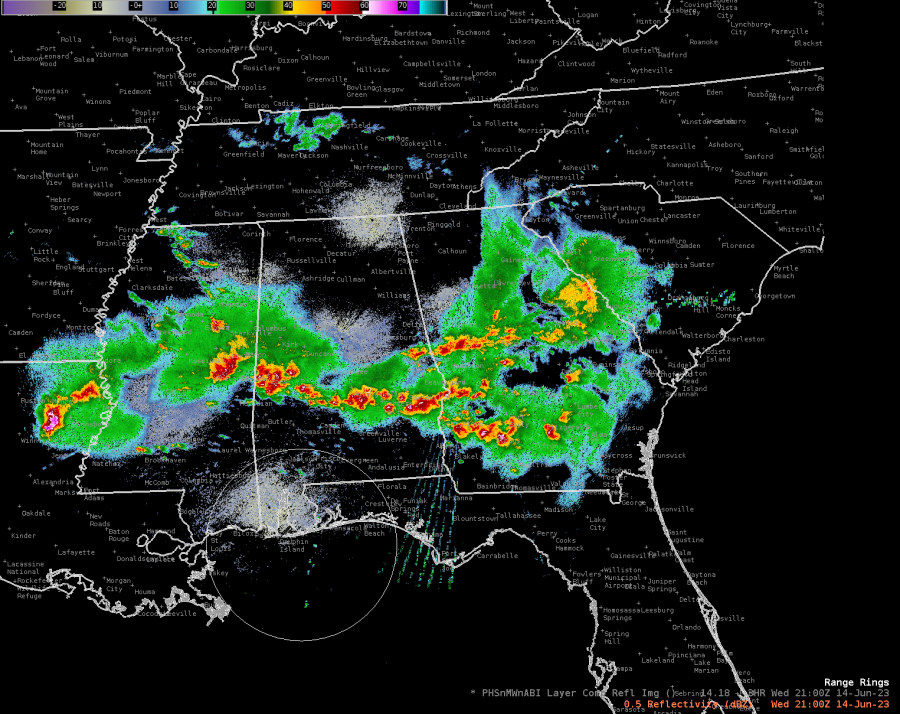
PHS composite reflectivity vs radar at 21Z… I find little value in the PHS composite reflectivity product. Below you see PHS composite reflectivity compared to the radar returns at 21Z. It’s not doing too well and I haven’t seen a time when it has done well predicting where the storms will be. The HRRR, NSSL WARF, HRef, NAM Nest and other high res models do much better.

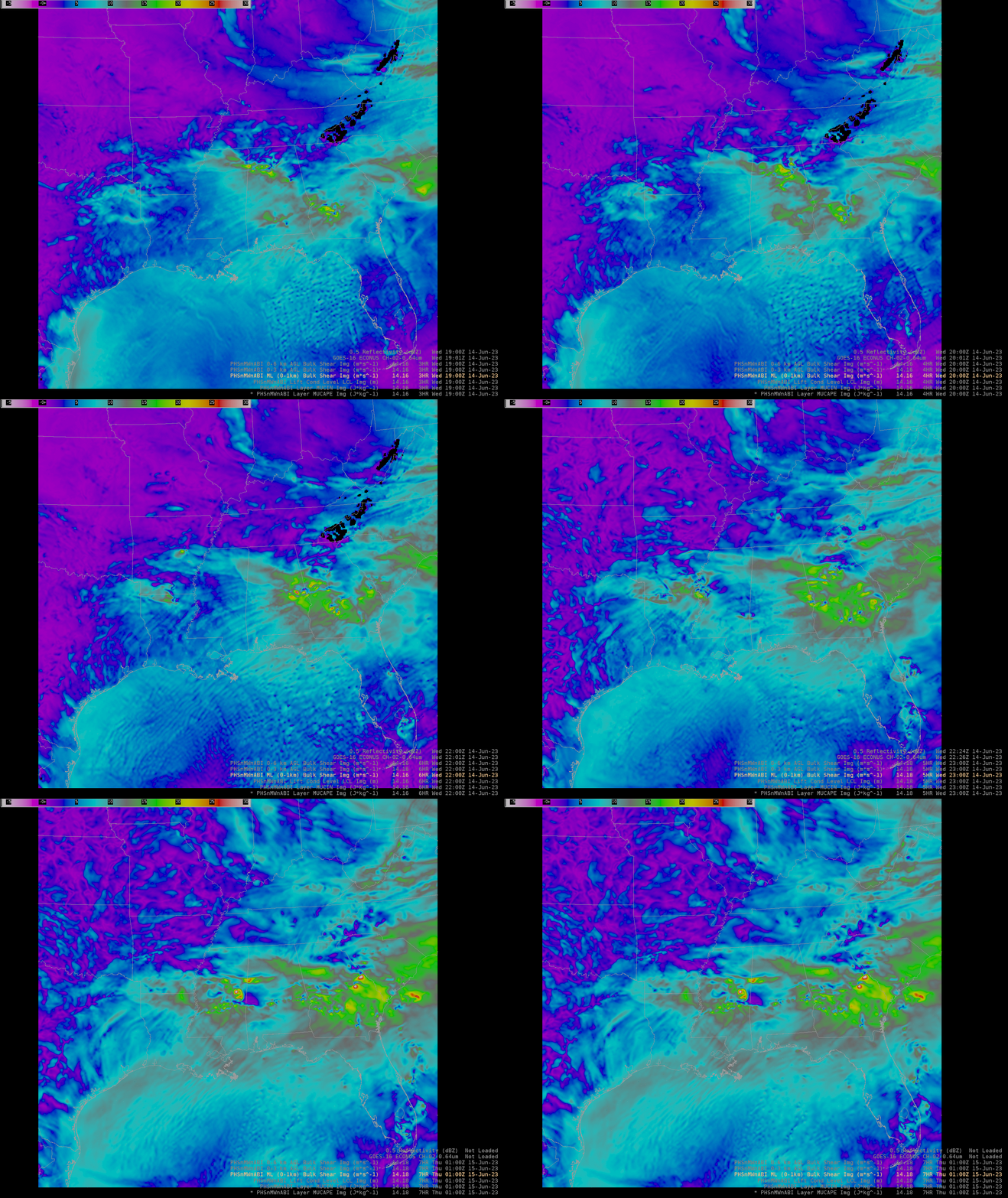
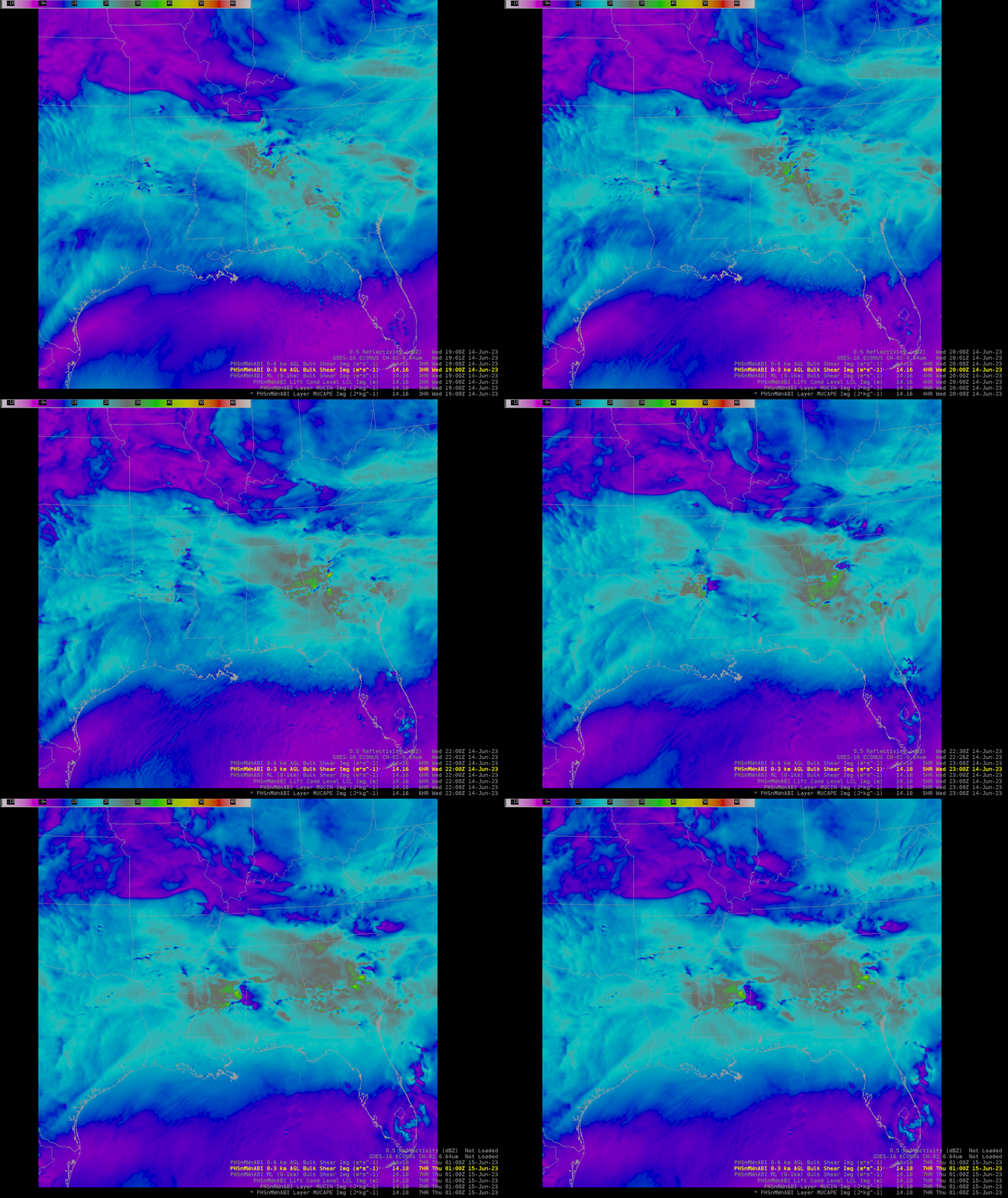
PHS Bulk Shear 0-1 km below on the left and 0-3 km below on the right both show a line between areas of lower and higher shear along the boundary where the severe storms were tracking, but this occurred after the convection started. I don’t see a pre convection signal pointing to where the training storms formed.

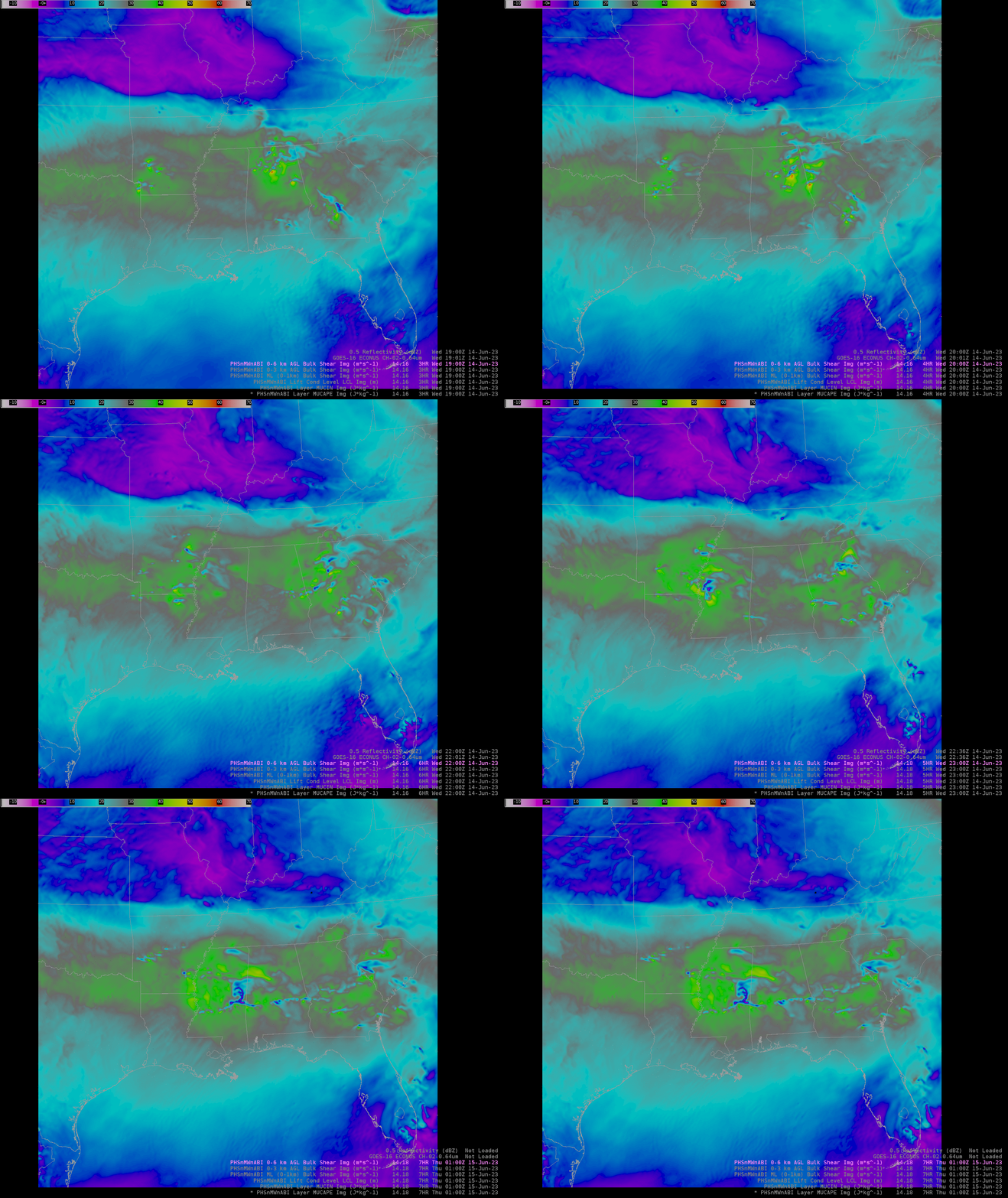
The Bulk Shear 0-6 km below shows more promise with the 19Z  frame showing a boundary where the training severe storms formed/tracked (what did it look like at 16Z or 17Z?). I would need to see more of this pre convection to really make a judgment, and would need to see positive validation/verification to have any confidence in it as a tool.

– Super Bolt

Tags: None

PHS Reflectivity Forecast Helping Out with DSS

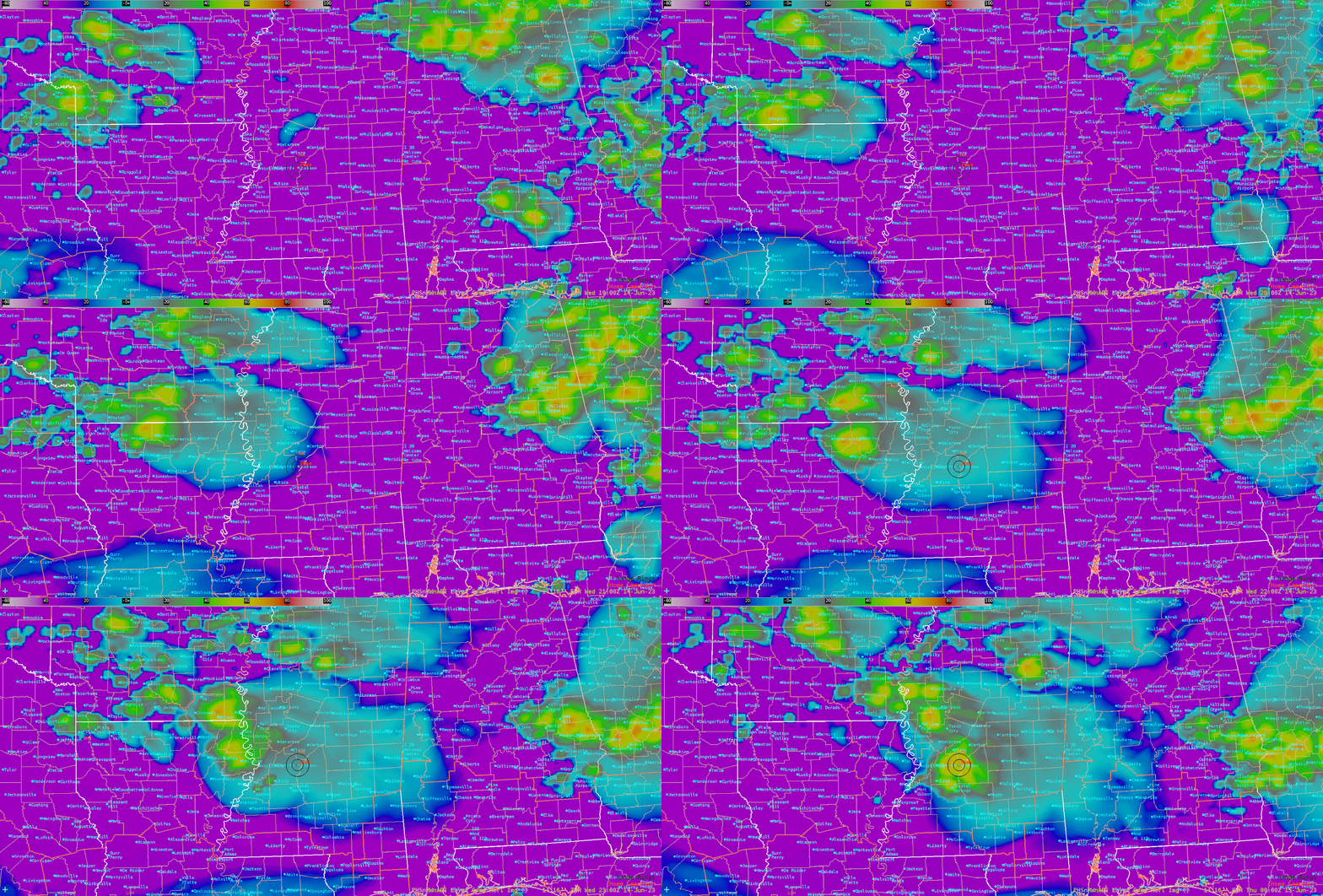
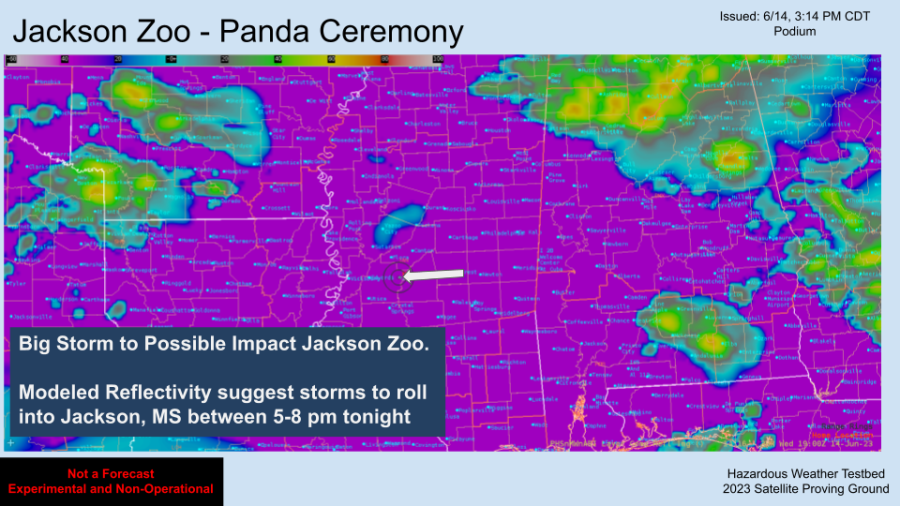
The Panda Ceremony was held at the Jackson, MS Zoo on the evening of Wednesday, Jun 14, 2023.  Strong to severe storms were forecast throughout the afternoon and evening hours and the event coordinator requested DSS for lightning and any severe weather with as much lead time as possible.  Using the 14.16z initialization of the PHS reflectivity was useful in providing some timing details to the event coordinator (See Figure 1). It suggested a fairly robust storm to roll through the Jackson area by around 00z with the forecast reflectivity ranging from 50-65 dBz directly over the event site.  

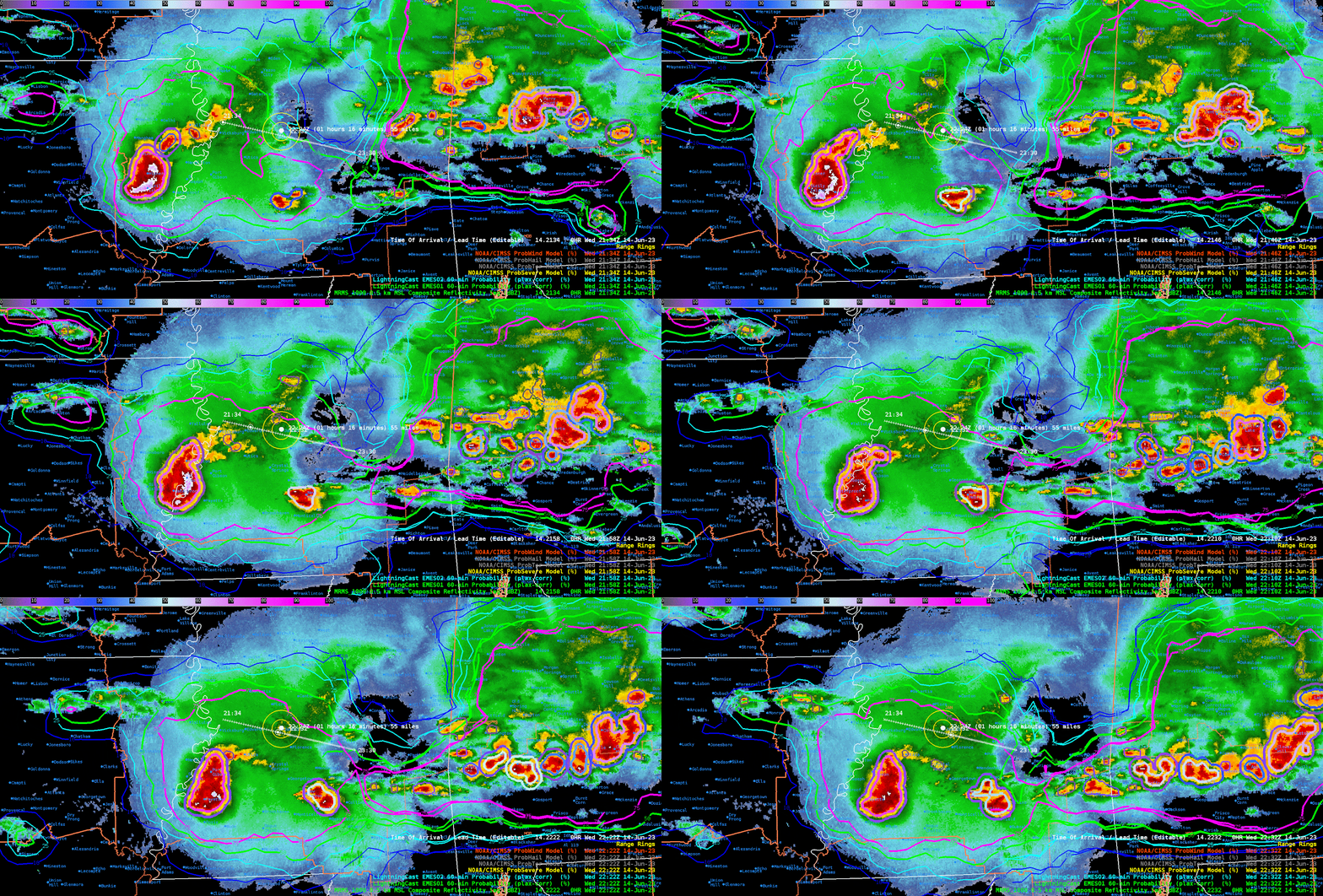
The reflectivity forecast did well with depicting a fairly large storm to move across southern Mississippi but was a bit too north on the location.  Overall, the product was very useful in boosting the forecaster’s confidence in the convection timing to impact the event. See Figure 4 for a look a the verification.

Figure 1: Loop of the 14.16z PHS layer reflectivity had a large storm over Jackson, MS, and impact the event (black range ring) by 00z.

Figure 2: A DSS Graphic was issued shortly after 3 p.m. to highlight the timing and potential impacts of the Panda Ceremony.  The original image had the animated GIF above with the PHS reflectivity forecast.

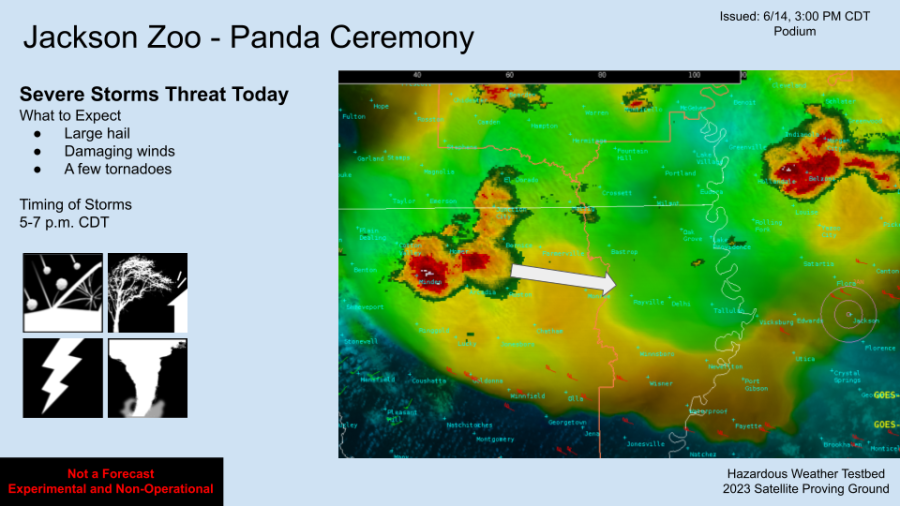
Figure 3: This was the first of 3 graphics created for the event and this graphic highlighted the severe weather threat and timing.  Overlaid is the MRMS reflectivity greater than 35 dBz and OCTANE Winds.

Figure 4:  A loop of MRMS with ProbSevere and LightningCast shows some verification of the PHS reflectivity forecast shown above. This loop ends at 2232z.   

– Podium

Tags: None