Tuesday 19Z – NSSL WRF Simulated Imagery

The simulated imagery is on the left-hand column, with the observed 19Z imagery on the right.

Just a quick blog update to show how the NSSL simulated satellite imagery is behaving.  It is not doing all that well, unfortunately.  It seems well overdone across central Indiana, where outflow from earlier storms has undercut convection and largely caused it to die out.  In our area of the day (Detroit CWA), the convection is well underdone.  We have ongoing strong to  locally severe storms, that the model does not have a handle on at all.

-Deitsch

Tags: None

vLAPS/HRRR/Radar Comparison

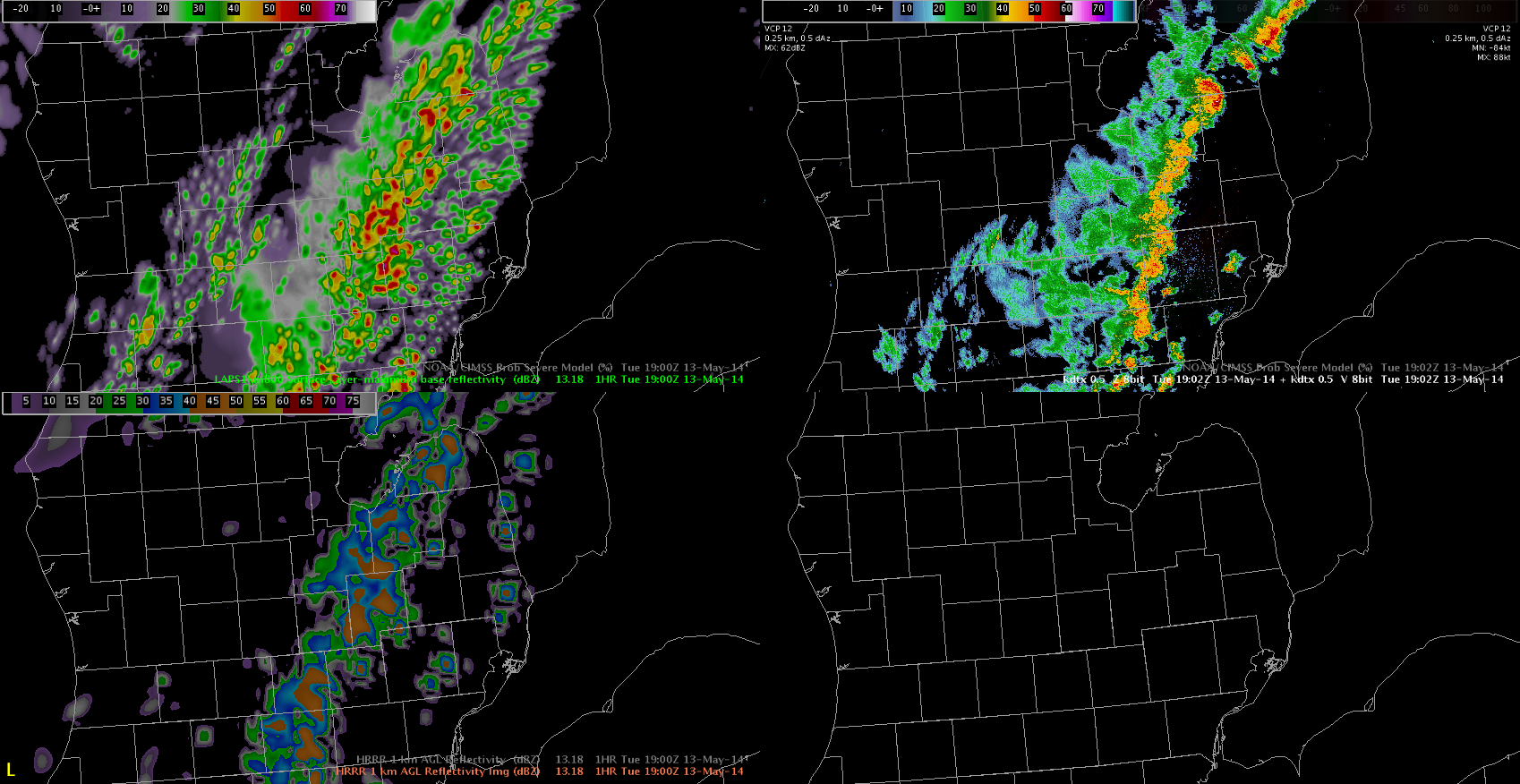
Vlaps_vs_HRRR_vsRadarHere is a screen shot from 19z focused on the DTX CWA. In this four-panel the upper left image is the 1 hour forecast from the 18z run of the vLAPS 1km Surface Layer Max Base Reflectivity, lower left is the 1 hour forecast for the 18z HRRR 1km AGL reflectivity and the upper right is 19z observed reflectivity from DTX. Overall the vLAPS is comparable with the HRRR in the placement of the stronger convection along a line extending south across eastern lower Michigan but the vLAPS is quite noisy with developing convection ahead of the main line that was not been observed by DTX Radar.

Shawn Smith

Tags: None

NOAA/CIMSS Prob Severe Model – Idea for Improvement for Linear Storm Modes

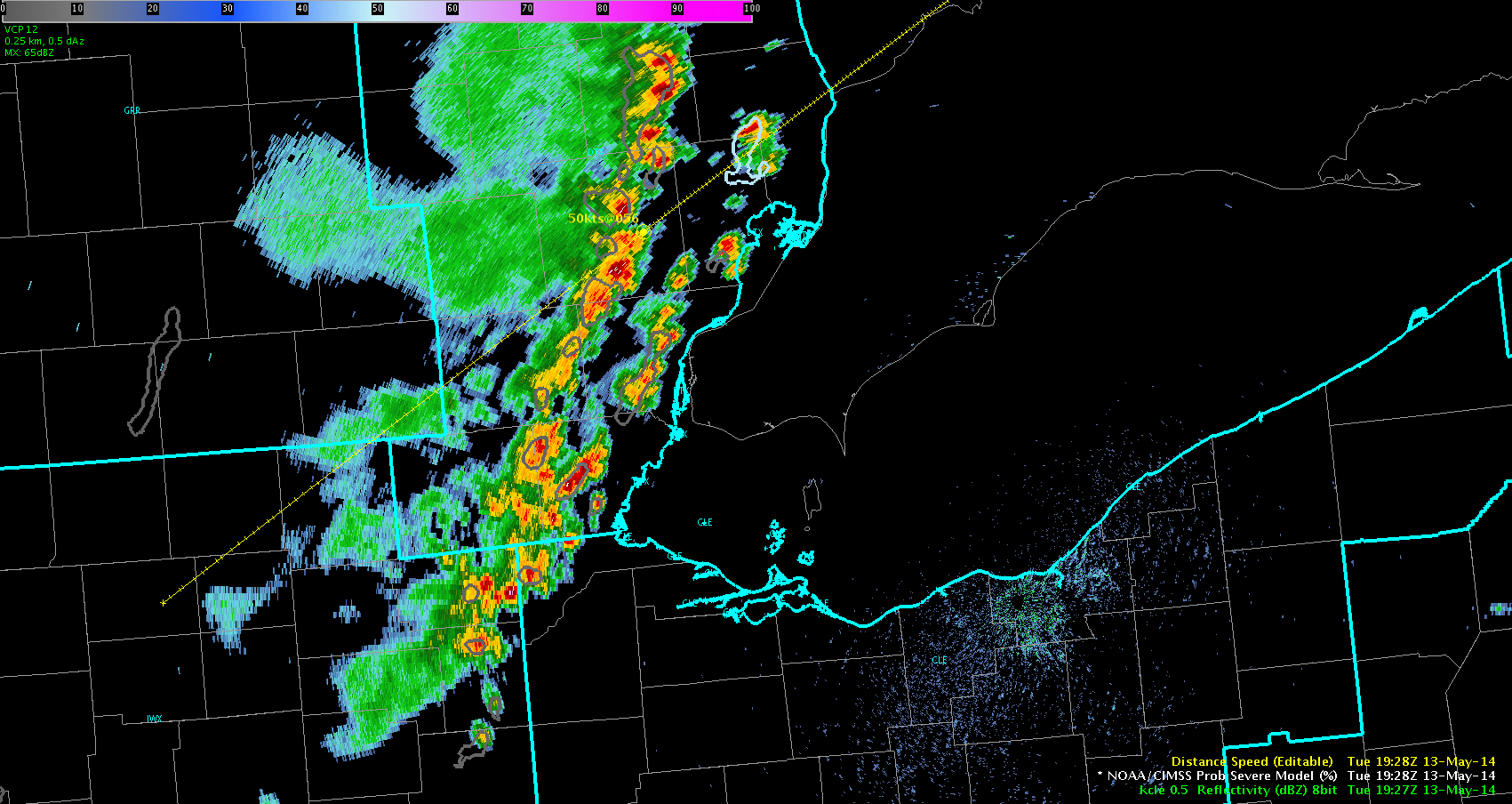
The CIMSS Probability Severe Model indicated low probability for severe storms 5-10% for a fast moving line of storms over eastern Michigan (northern part of line moving 50-60 mph) at 1928 UTC on May 13.  It seems to be a good idea to include DCAPE as a displayable variable in addition to MUCAPE, EBShear, MESH, Vertical Growth Rate, and Glaciation Rate and use this variable for calculating SVR PROBs.  The low probabilities are likely due to MESH values well below 1 inch (closer to 0.25 to 0.50 inch) as well as EB Shear generally 20-25 kt.

ProbSevereModel1928UTC051314

Michael Scotten


Tags: None

EWP Status for 13 May 2014: 12:30-8:30 pm Shift

Today, the threat for severe weather appears to be quite marginal, the bulk of which will be forced by the eastward propagating cold front. We have two forecasters operating in the Detroit CWA, and two in the Cleveland CWA. Similar to yesterday, convection was already ongoing this morning when participants began operations. However, there has been some new development out ahead of the front.

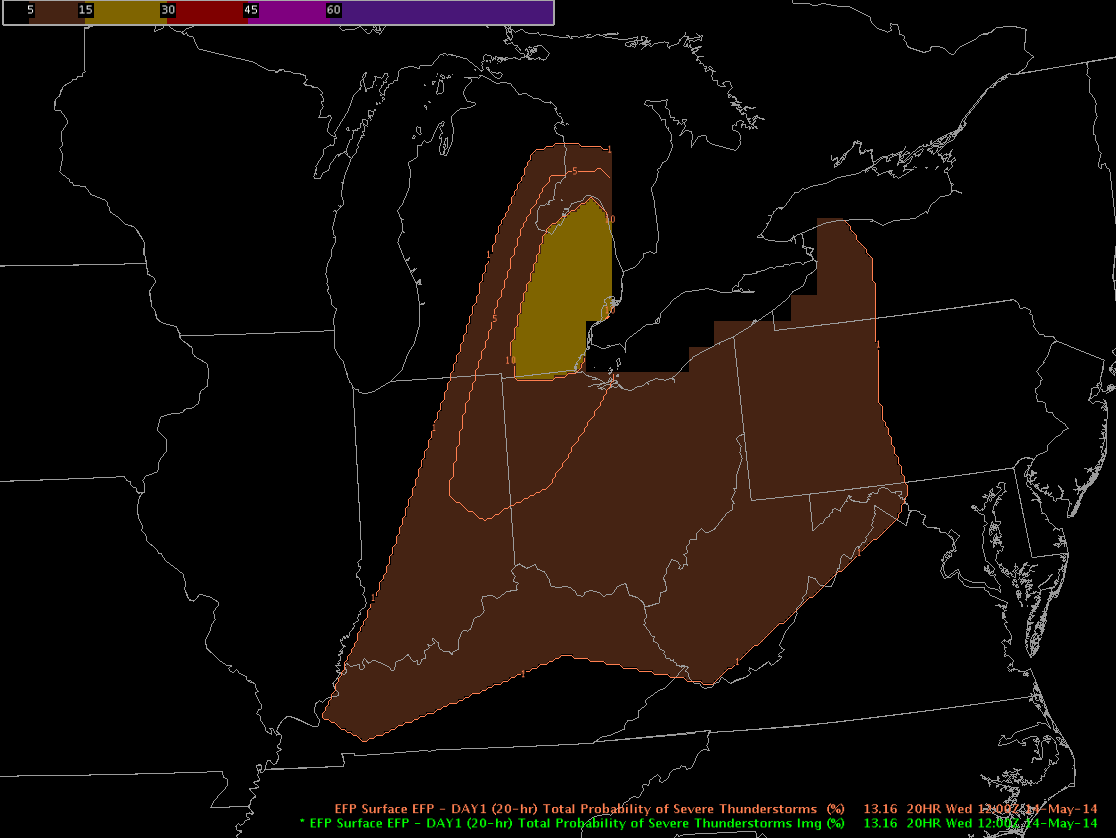
Today’s domains were chosen in part based off of input from the EFP. You can see from the image below, the EFP expects the greatest likelihood for severe weather to be in eastern Michigan south into western Ohio.

efp_day2

– Bill Line, SPC/HWT Satellite Liaison and Week 2 EWP coordinator

Tags: None

Daily Summary: Week 2, Day 1

Much of the focus for day one was hands-on training for each of the evaluation products. After some initial familiarization with AWIPS-II, the various PI’s worked with forecasters on how to interpret the products, and what to look for during the week. Forecasters also became familiar with saving images, and posting to the blog. By the end of the day, participants had already made several informative blog posts.

Today we operated in the Davenport and St. Louis CWA’s. Since many of the products being demonstrated have their greatest benefit in the pre-storm environment, forecasters were unable to experience their full potential given the ongoing convection at the beginning of operations. The Prob Severe and Overshooting Top Detection products seemed to have the most utility in this situation. Additionally, forecasters appreciated the availability of the GOES-14 1-minute imagery.

Tomorrow, we will start activities at 12:30 in the Dev Lab for the daily debrief before moving to the HWT for the EFP briefing. Operations will likely take place somewhere in the Ohio Valley region.

– Bill Line, GOES-R SPC/HWT Satellite Liaison and Week 2 EWP Coordinator

Tags: None

Tracking storm development in MO with Theta-e differentials

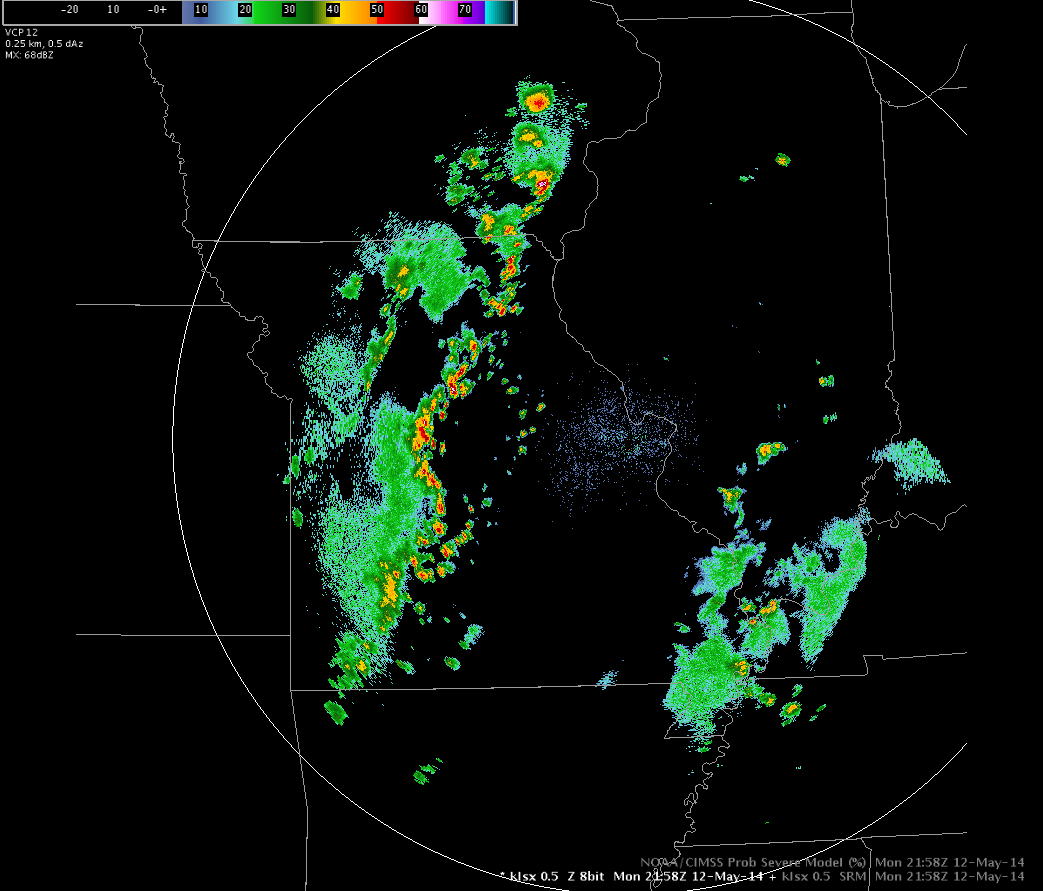
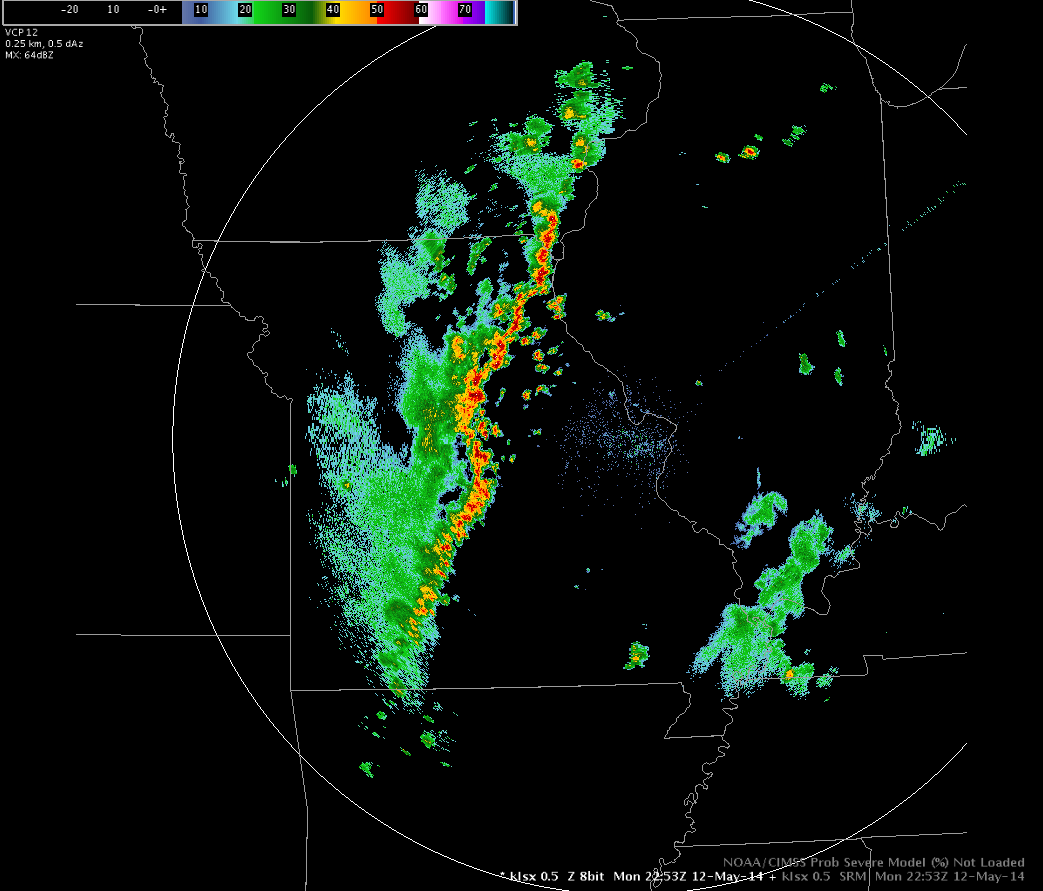
On Monday afternoon, a line of storms developed and propagated eastward, essentially bisecting Missouri by late afternoon. Here’s a look at the base reflectivity for the radar at KLSX (St. Louis) at 22Z (about 4pm):

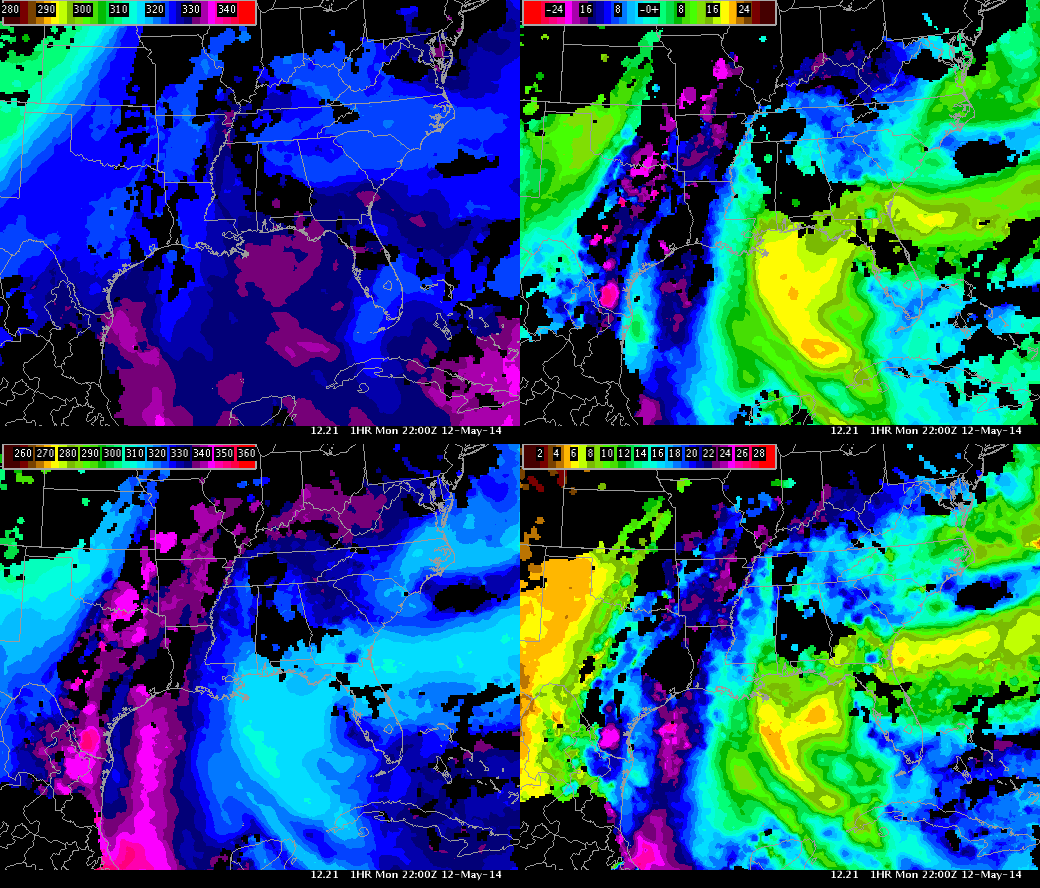
Baseref22ZMay12In the same timeframe, the CIMSS NearCast model was projecting a fairly high Theta-e lapse rate.

Theta_eDifference22ZMay12The box in the top right corner shows this GOES- derived Theta-e difference of around 20-21K in an area west of St. Louis. Interestingly enough, this ΔTheta-e maximum is aligned with the area of convection, seen in the radar imagery above. Will the storm cells continue to propagate eastward and will they actually strengthen as they enter this area of higher instability?

By 23Z, We’re starting to see some individual storm cells develop out ahead of the bow echo.

Baseref23ZMay12This would indicate that the area of high instability on the NearCast model is starting to produce some convectively-driven storms. The highest value I found in this image in the newly-formed cells was 56dBZ. So in the near term, it appears the NearCast is correctly predicting convective initiation through the ΔTheta-e product. How about at 0Z itself?

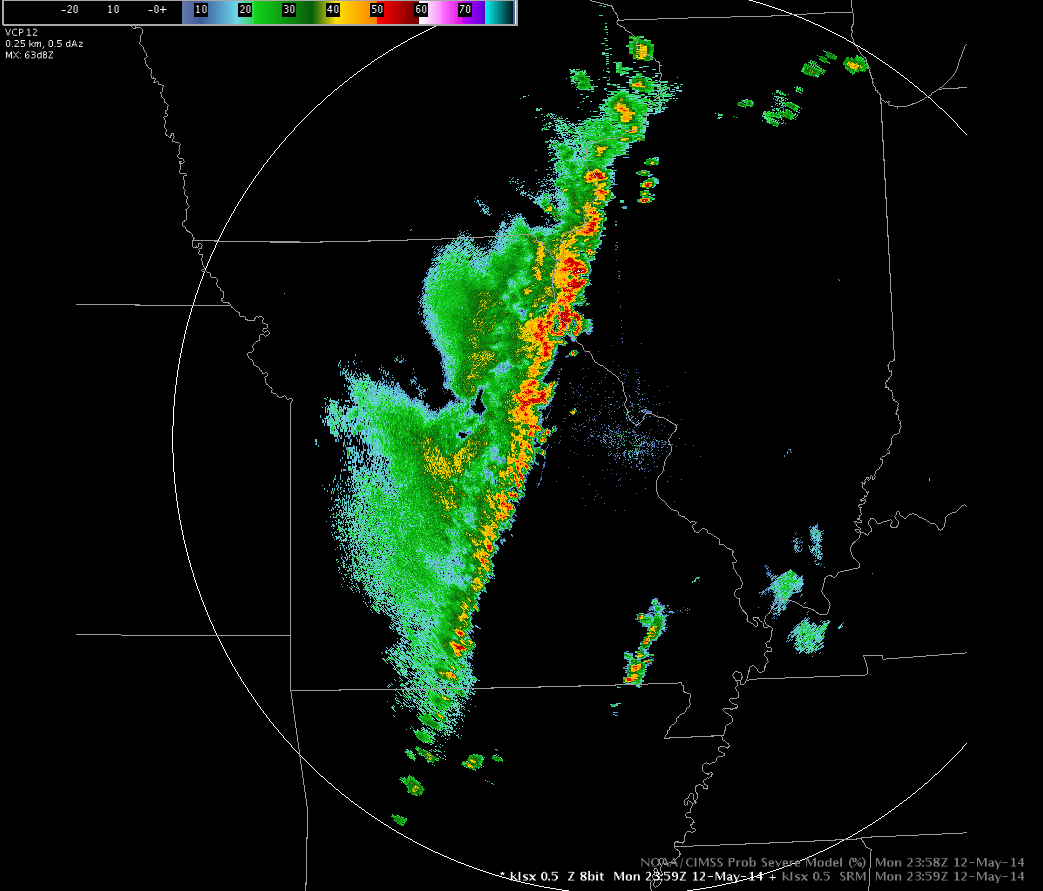
BaseReflectivity00ZMay13The stronger line behind the pop-up cells has accelerated and swallowed up the smaller individual cells! That is a straight line of storms if I’ve ever seen one. I suppose the ΔTheta-e could be used in this situation to predict that this storm line would evolve in this way. More cases will have to be examined in order to see if this parameter is consistently usable for this purpose!

Tags: None

GOES-R Convection Initiation Product Handles Convection Developing in Northern Illinois 5/12

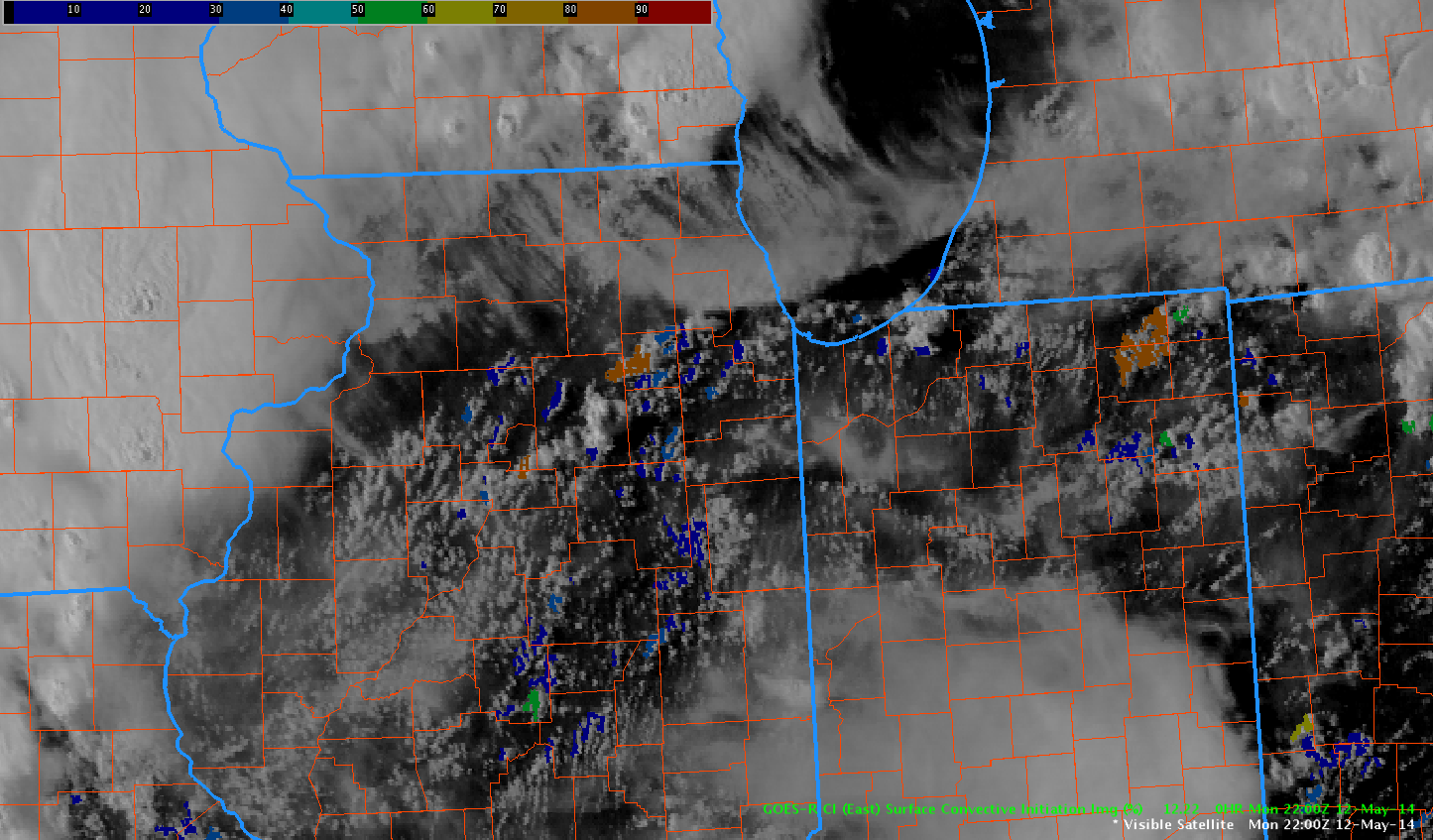
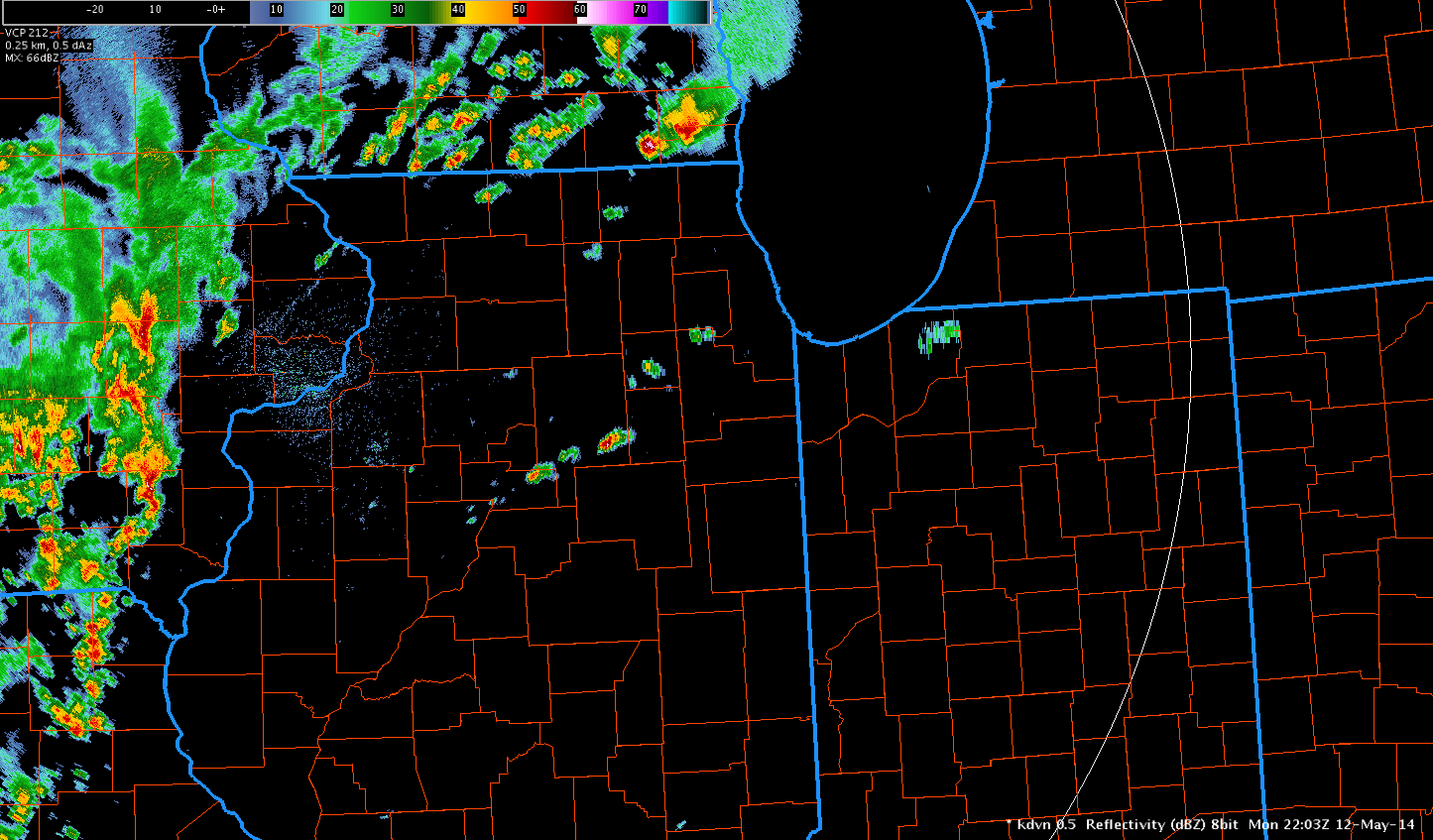
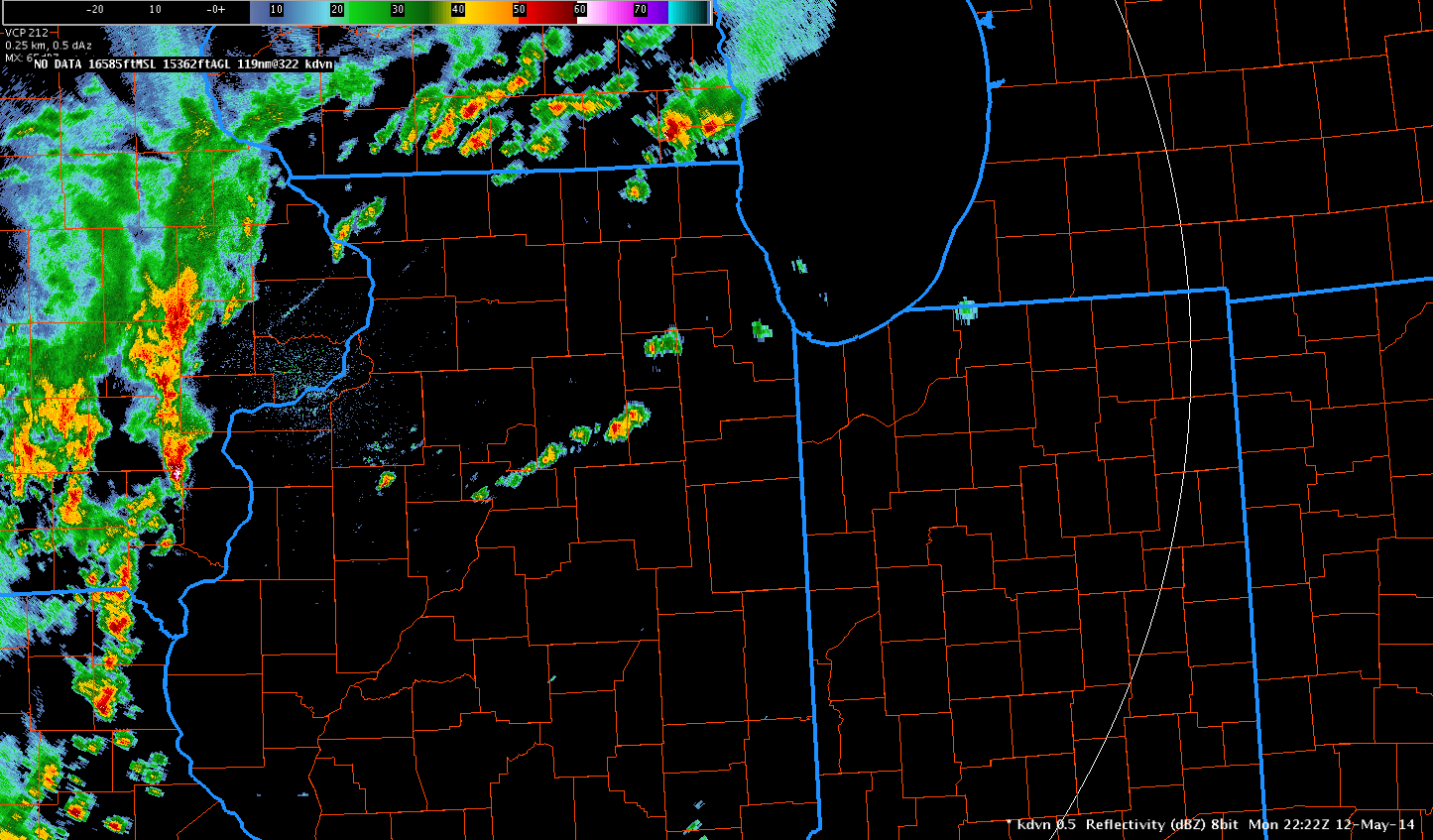
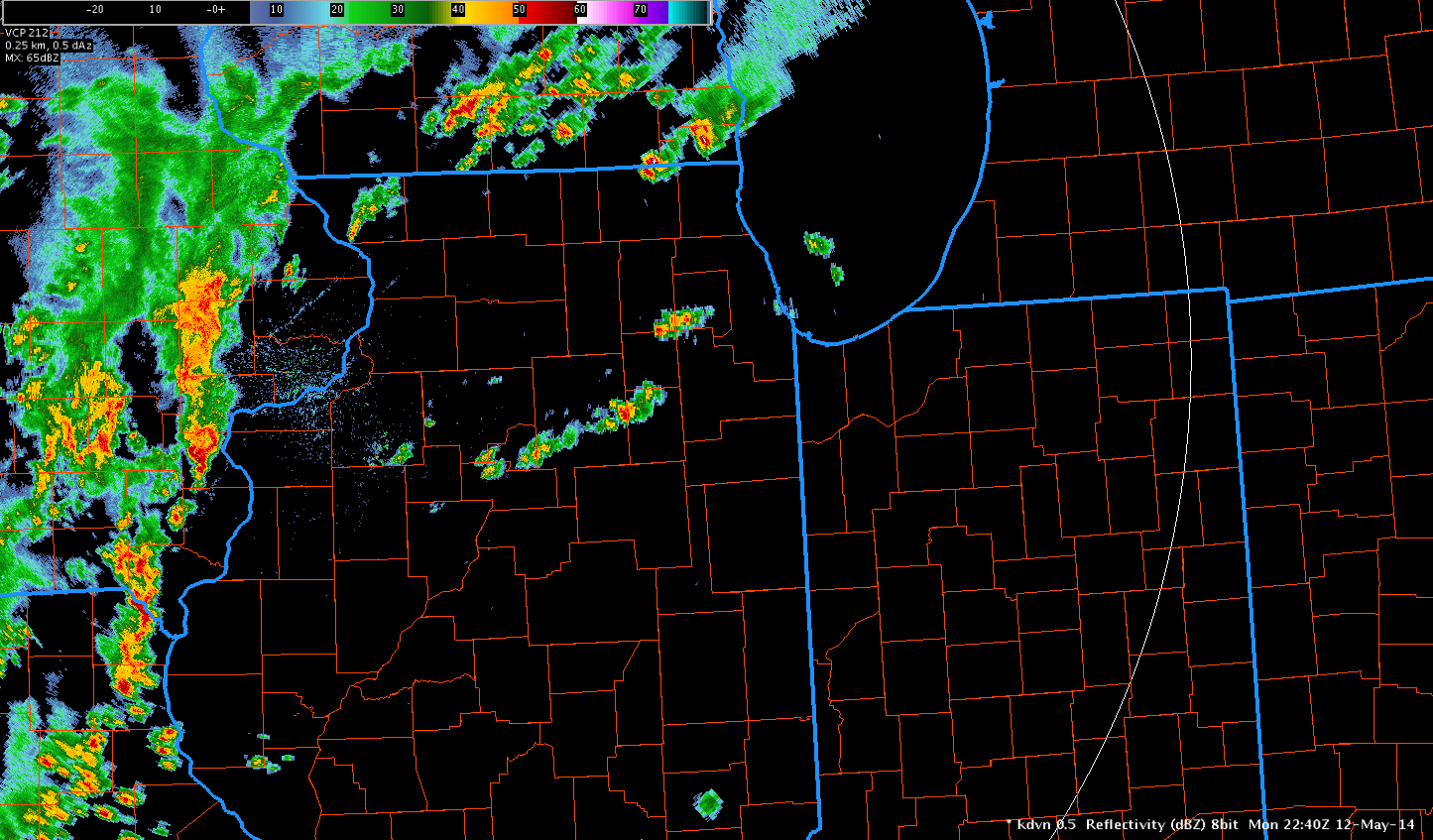
The GOES-R CI product did a fine job depicting convection growing in northern Illinois. The top image at 2145 UTC depicting values around 74% and the second image at 2200 UTC depicting 89%.  The radar images below at 2203, 2222, and 2240 UTC depicted a few developing showers and storms near the CI values below.   The product gave 15-45 minutes of storm lead time.  These storms did not become severe.VisibleCI2145UTC051214VisibleCI22UTC051214

KDVN2203UTC051214 KDVN2222UTC051214 KDVN2240UTC051214Michael Scotten

Tags: None

Value of 1-Minute Satellite Imagery

Monday, May 12, 2014 Mike Smith

Two situations worthy of note:

I “issued” a special weather statement for Winnebago Co. At 2:47pm for 3/4 inch hail and gusts to 40 kts. Using ONLY surface obs and 1-minute satellite data.

At 2:59pm, I issued a severe thunderstorm storm warning for the same county, based on a Fujita U with overshooting then collapsing top in 1-minute data.

NWS issued severe at 2:56pm (unknown to me). Both warnings verified with 1.75” and 2.0” hail reports.

I observed a downburst south of Sullivan, WI and based on the right moving cell, I thought the RFD would intensify at 4:12pm for Walworth Co. Predicted 55 kt and 2” hail. Unknown if it verified.

The right mover got more pronounced and at 4:22pm, I issued a tornado warning for the southeast third of Walworth Co. This was due to the wrapping pattern of the outflow air (into RFD), the 1-minute satellite U and collapsing top, the persistent right movement and high spectrum width in the inflow. NWS issued a tornado warning for the same area at 4:45pm. While a pronounced hook formed, it never quite formed a tight couplet.

satellitePromptedWarning


Tags: None

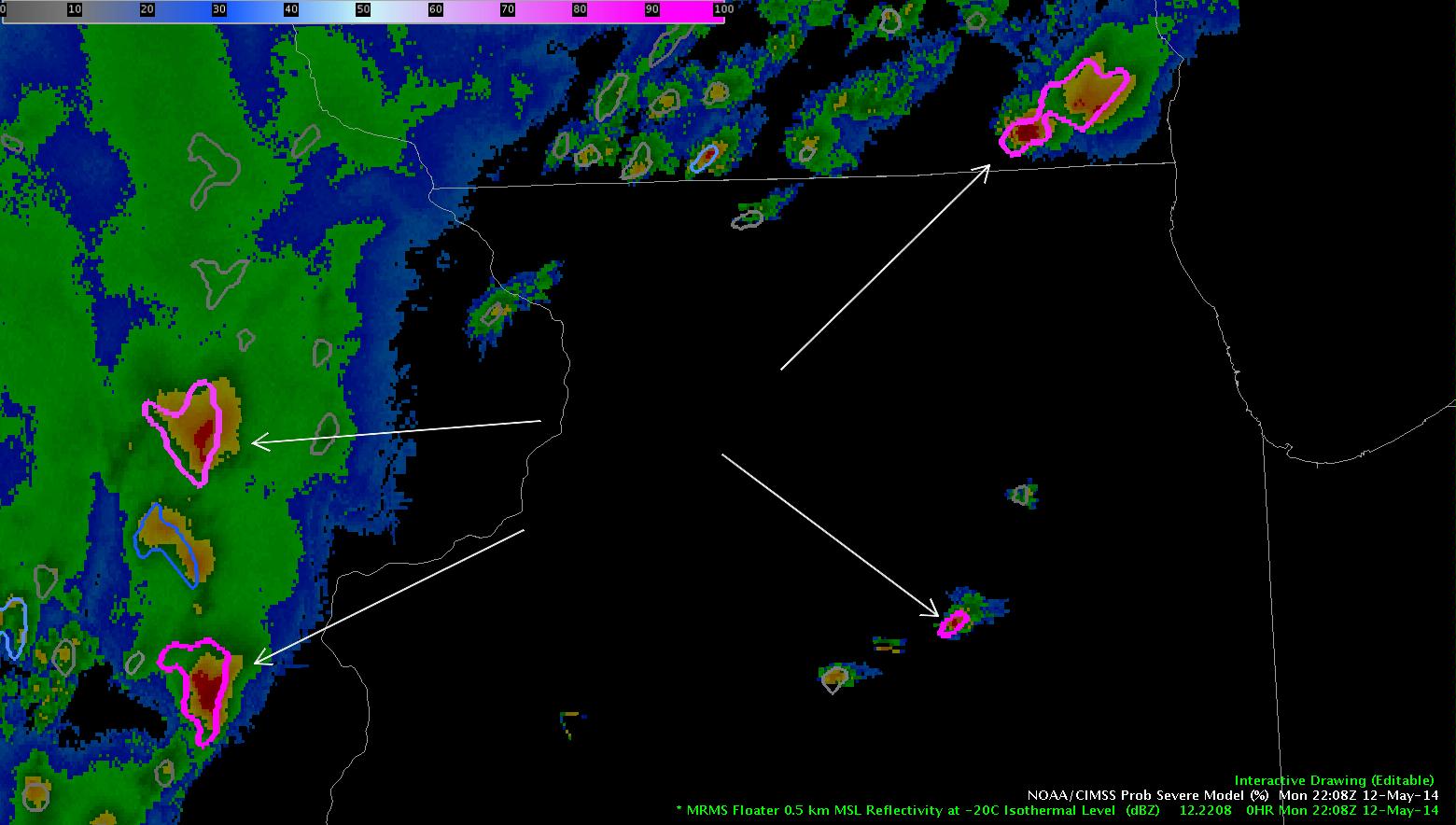
ProbSevere highlights strong cored storms. MRMS MESH seems overdone.

ProbSeverewithMRMSRefat-20cThe ProbSevere Model is doing a great job highlighting the strongest cells. In this image from 2208z the ProbSevere Model is overlaid on top of the MRMS reflectivity above the -20C isothermal level. The cells annotated with an arrow across eastern IA, southern WI, and north-central IL have 50dBz echoes above the -20C isotherm and the model indicates an 80+% prob of severe.

There were hail reports from three of the four cores highlighted. The lower left produced Quarter sized hail in Henry county IA with the MESH indicating 2.5in, The upper left storm produced reported penny sized hail in Johnson county IA with MESH of 0.89in and the upper right storm produced nickel sized hail in Racine county WI with a MESH of 1.13in. The MESH product is overdone in this example.

Shawn Smith


Tags: None

GOES14-SuperHiResVisible Shows Convective Trends 5/12

The Super Hi-Resolution Visible Satellite Imagery below depicted a differential heating boundary over northern Illinois, denoted by the green line.  Very little cumulus was observed north of the green line where cirrus cloud cover was thicker, while enhanced cumulus congestus was occurring south of the green line.  With low level south to southwest flow, cumulus that developed south of this boundary had a tendency to dissipate when moving north of the green line/boundary. A severe storm denoted by the orange circle in southeast Iowa was moving east northeast and seems to be moving along this boundary.  It will be interesting to see if this storm will continue to be severe over the next few hours.

GOES14SRSORVisible2155UTCMichael Scotten


Tags: None