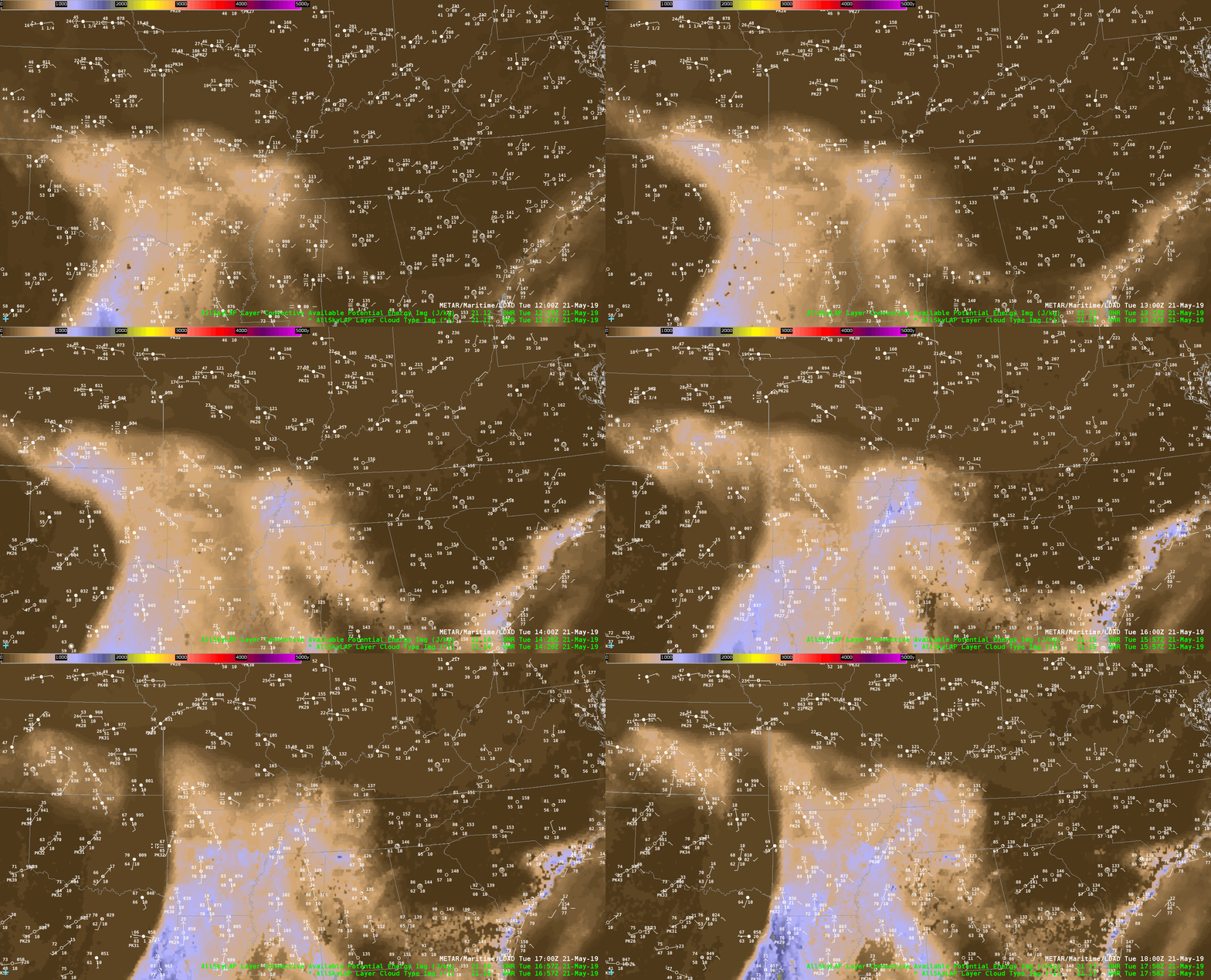
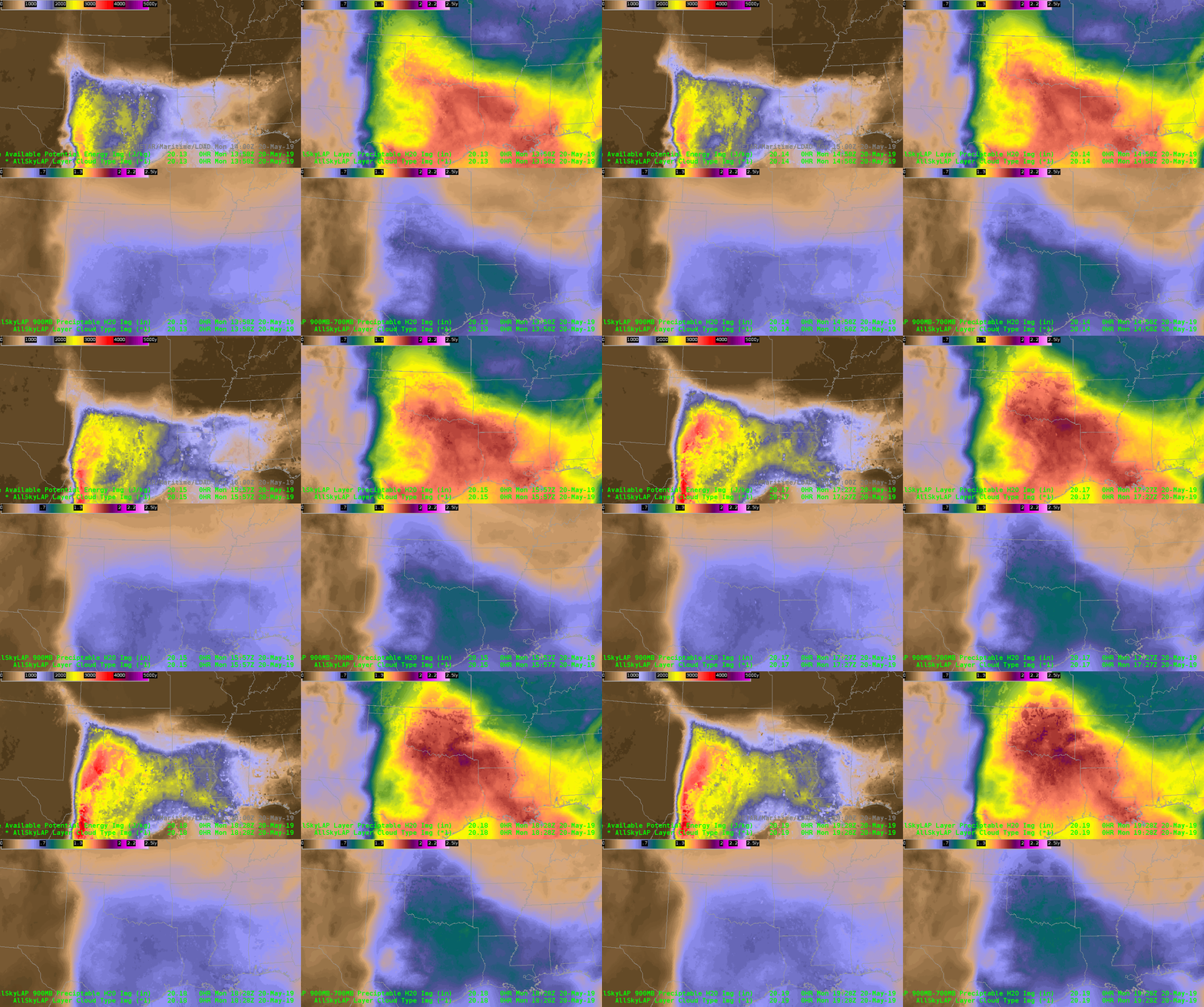
All Sky LAP CAPE

Looping the AllSky LAP CAPE product, moisture and instability is noted spreading northward toward the LSX CWA, which remains to the north of a warm front. One thing I noted is the western edge of the instability plume across eastern Texas jumps back and forth when looped. Not sure if this associated with the product itself or some other issue, but it was noteworthy. Otherwise the product seems to do a nice job depicting the instability plume spreading northward.


-64BoggsLites


Let’s do the wave

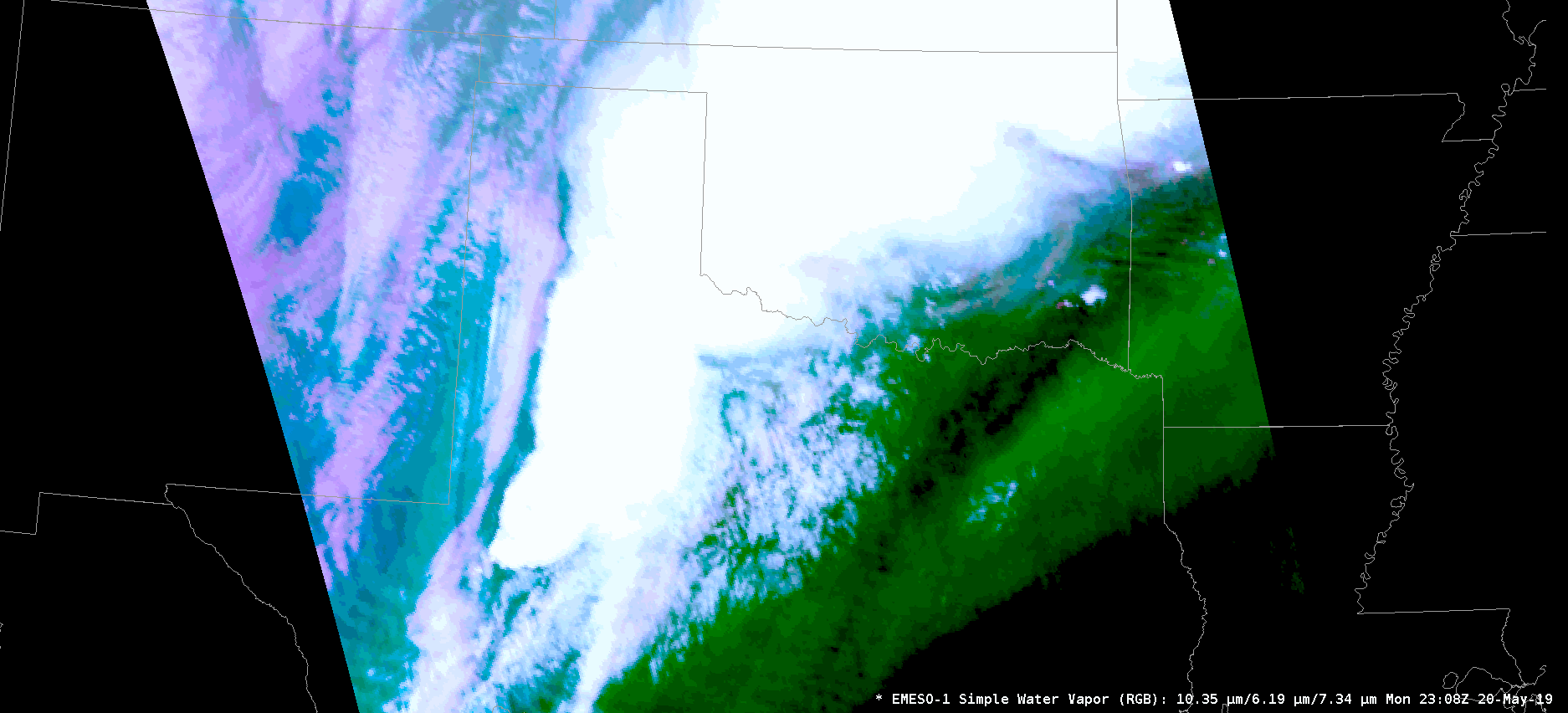
Seeing some interesting waves at different layers on the Simple Water Vapor RGB this evening. As a reminder, the simple water vapor RGB is made up of the low level water vapor image (band  10), the upper level water vapor image (band 8) and the clean window IR image (band 13).

There is one area of east/west waves along the Oklahoma/Arkansas border. The main contribution to those waves is the green channel, so we are “seeing” those waves based on the upper level water vapor.

The other is to the west of the severe convection in west Texas.  These waves have contributions from all the channels.

Thorcaster

Azimuthal Shear and Lightning Trends Prior to Tornado

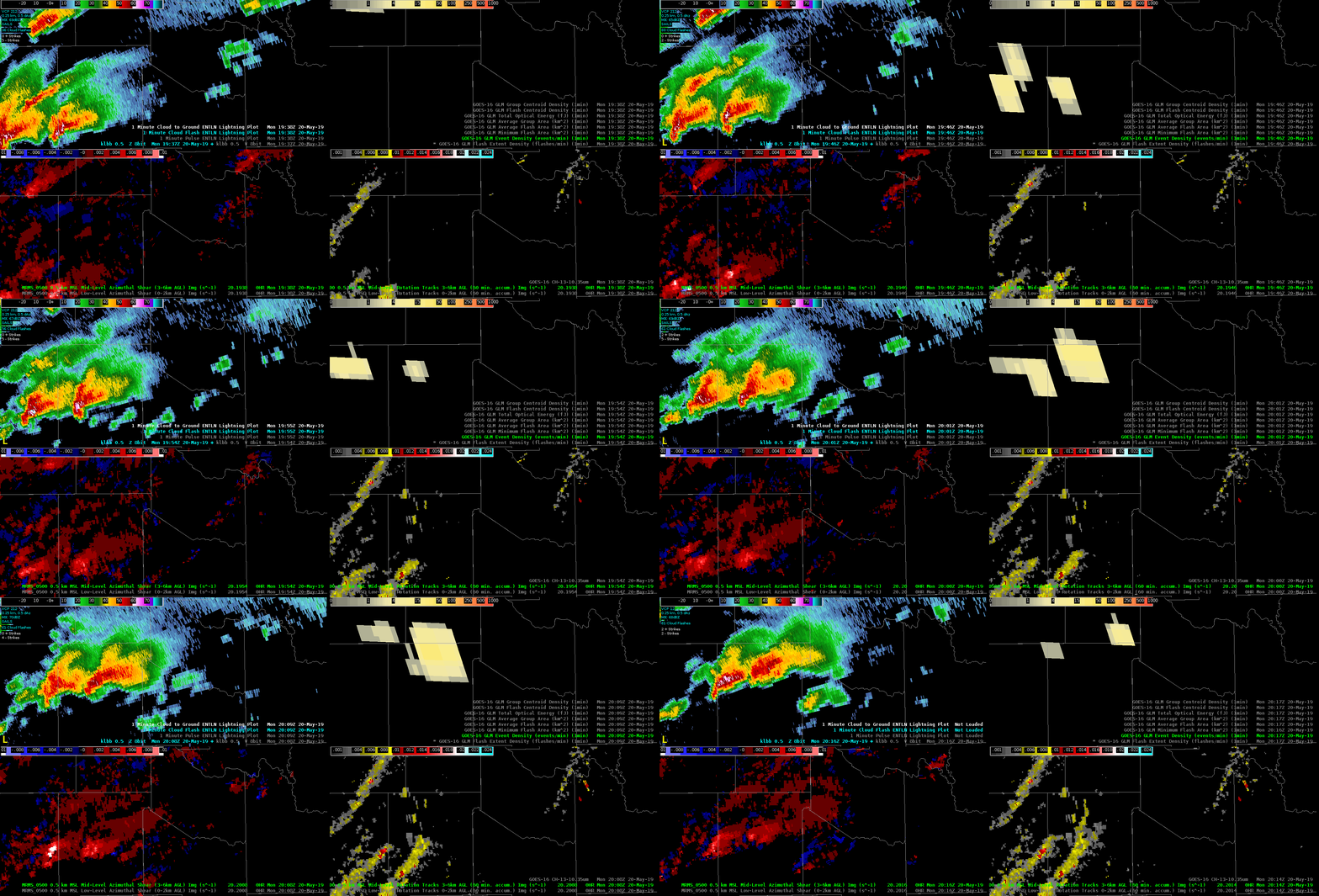
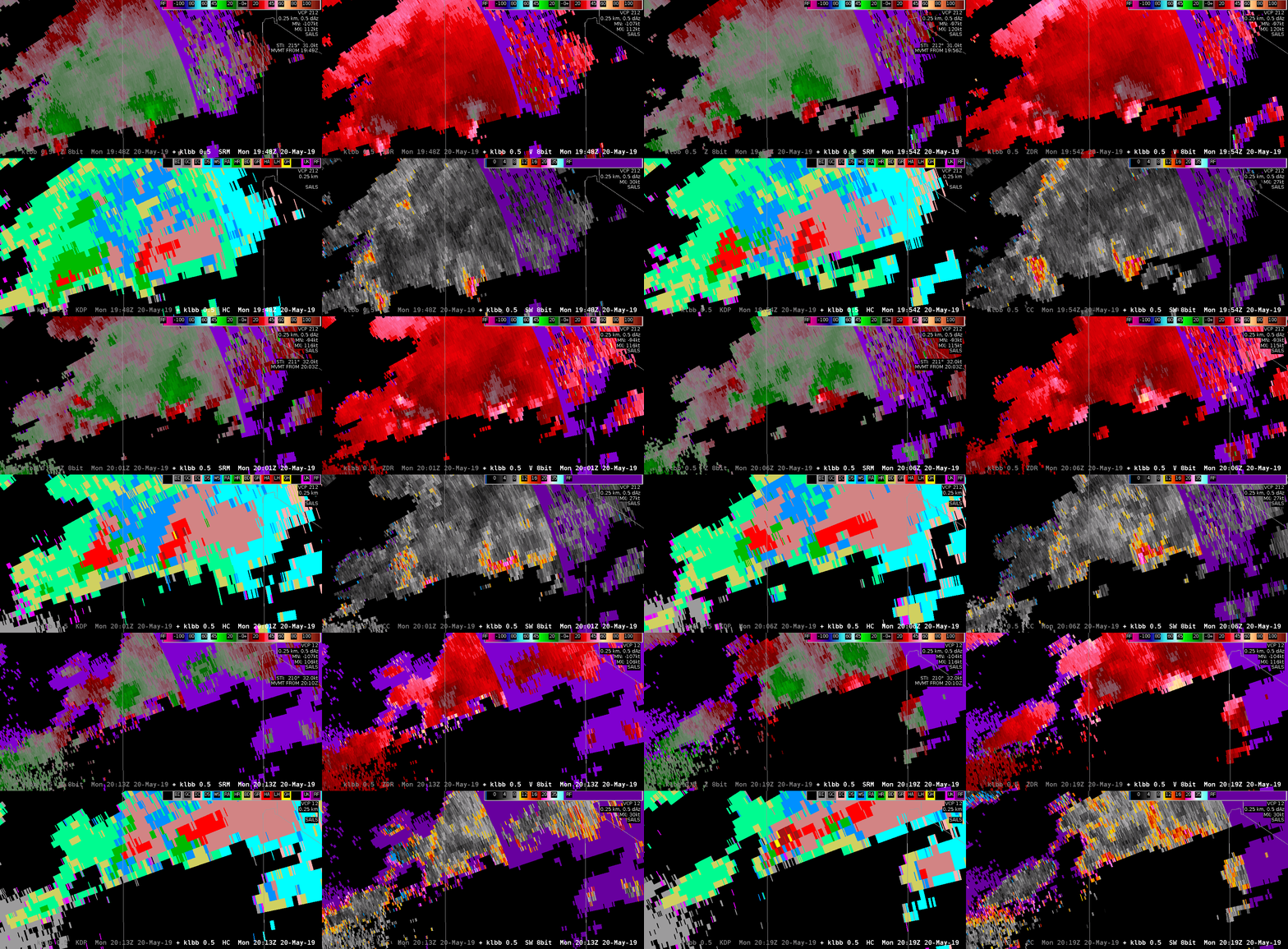
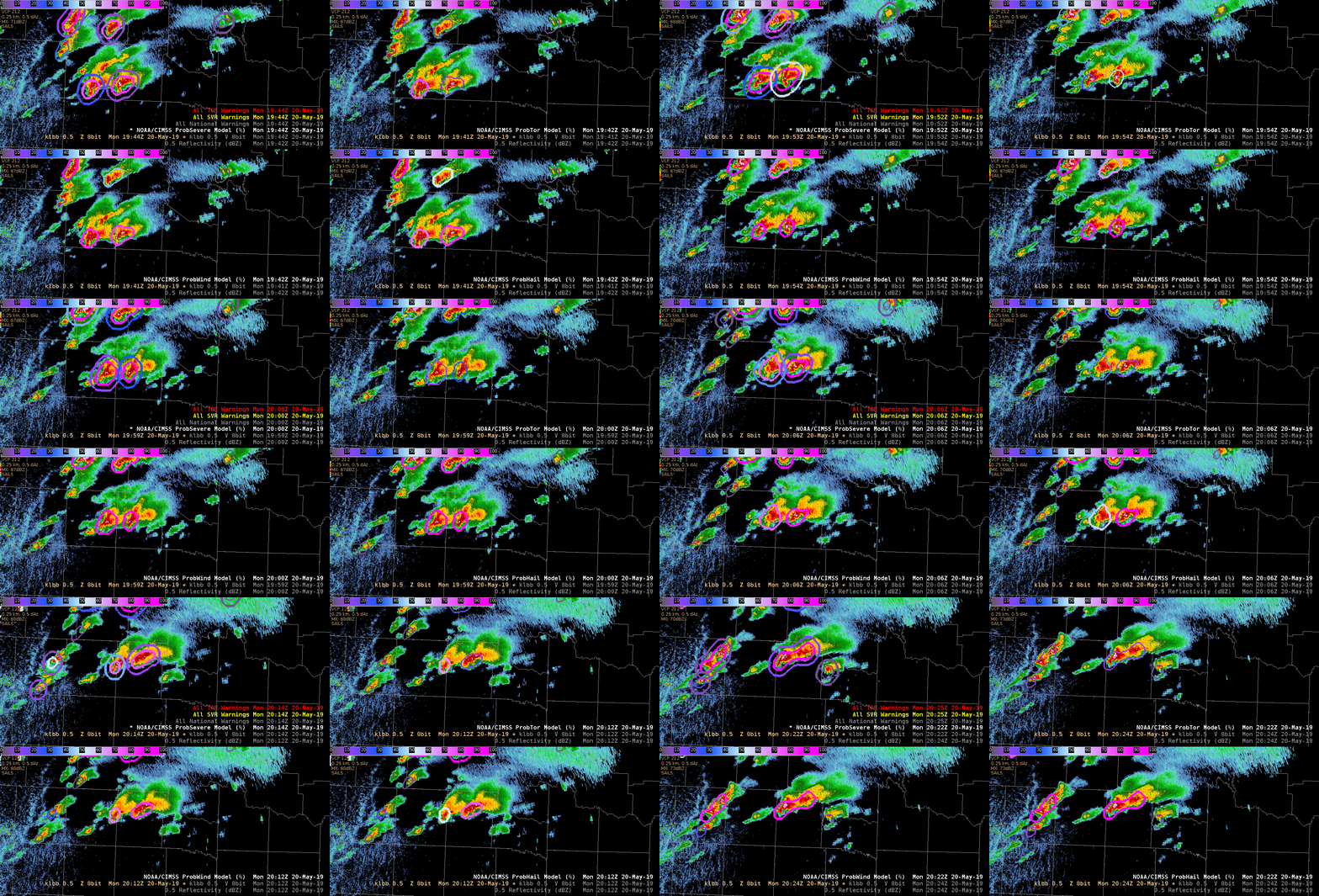
Pair of supercells exhibited intensification as they tracked northeast through the eastern Panhandle of Texas. MRMS azimuthal shear ramps up to slightly over 0.010 S-1 near time of a reported tornado from the more eastern of the two supercells. The GLM event density data also increases prior to or near the time of  the tornado between 1950z – 2000z (upper right panel). Comparing to the ENTLN lighting flash frequency (1min data), an jump was noted peaking 1947Z before it dropped off and remained lower through 2000Z (36 count to 15 count). To summarize this data, there was a jump 10-15 min before the tornado, then a drop off, and then another jump 10-15 min after the tornado.

0.5 storm-relative velocity couplet was strongest with the eastern of the two primary mesocyclones. Spectrum width (low right panel) displays a consistently strong signal of wind speed variance with the eastern tornado producing mesocyclone.

The tornado component of Probsevere jumped significantly before the tornado touchdown. At 1944Z the probability was at 7%, then quickly increased to 46% by 1948Z and peaked at 54% at 1952Z.

-Roy

First simulated TOR warning

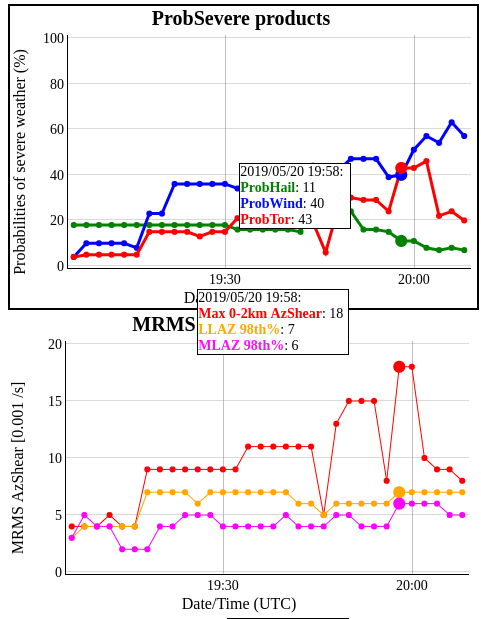
Trying to get set up in a hurry with all the experimental products. First simulated TOR of the day for OUN based on a combination of base radar, jump in TOR probability, and a noticeable increase in the AzShear. Below is shown the trend of the prob tor and MRMS AzShear products.

Notice the jump in both just prior to 20Z. Not show is the base reflectivity with the expected pendant on the inflow side of the cell.

Thorcaster


AllSkyLAP Instability and Moisture Analysis

A 4 panel showing CAPE (top left), along with 3 different PW images shows the moisture and instability profile across the panhandle region eastward into the southern Plains. The CAPE images show the warm frontal boundary lifting north through the morning, with instability eventually spreading into the far southeastern corner of the AMA CWA. The dryline shows up well in the surface-900mb PW imagery (bottom left) as well.

-64BoggsLites

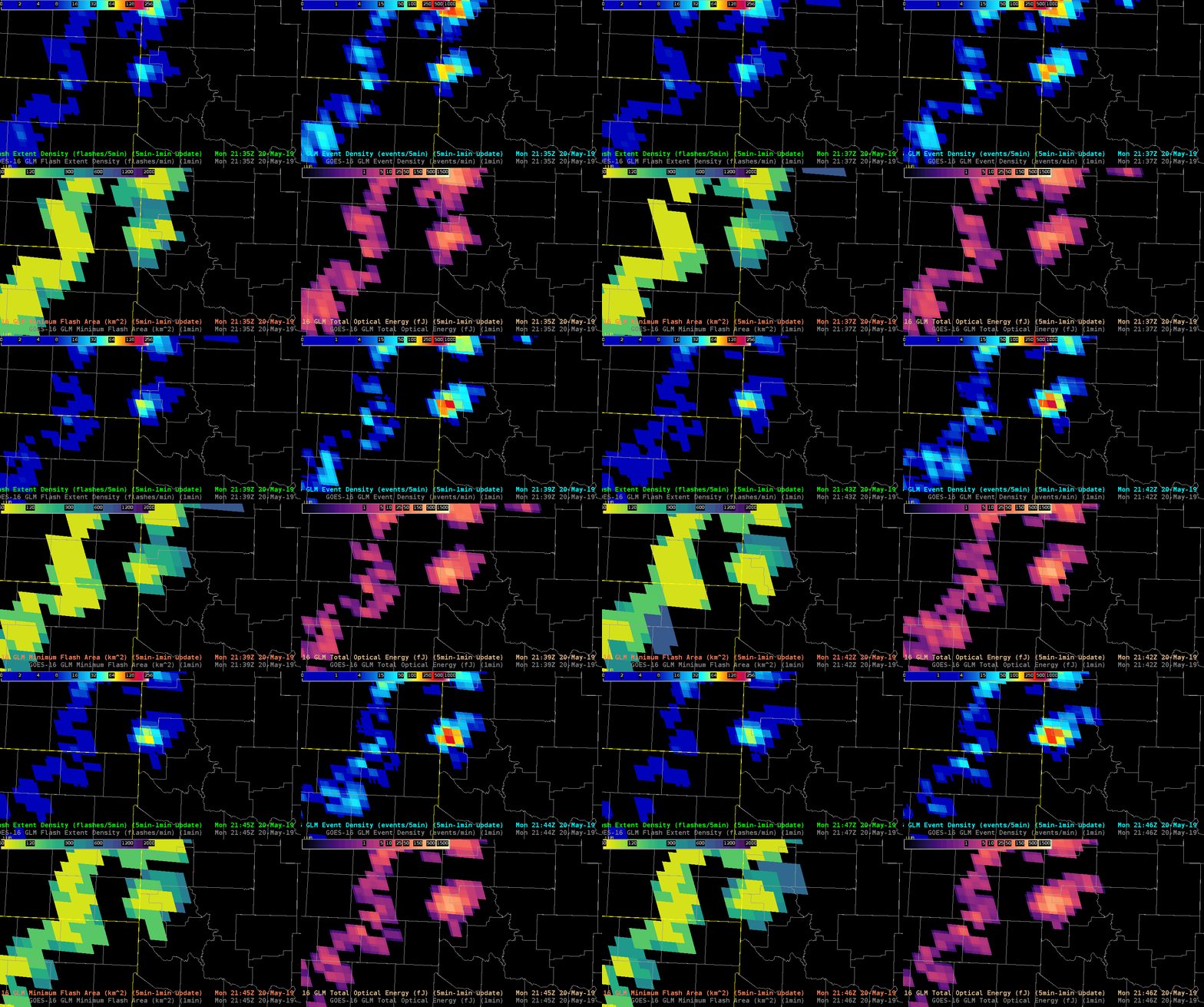
IDSS Usage from GLM/Minimum Flash Area

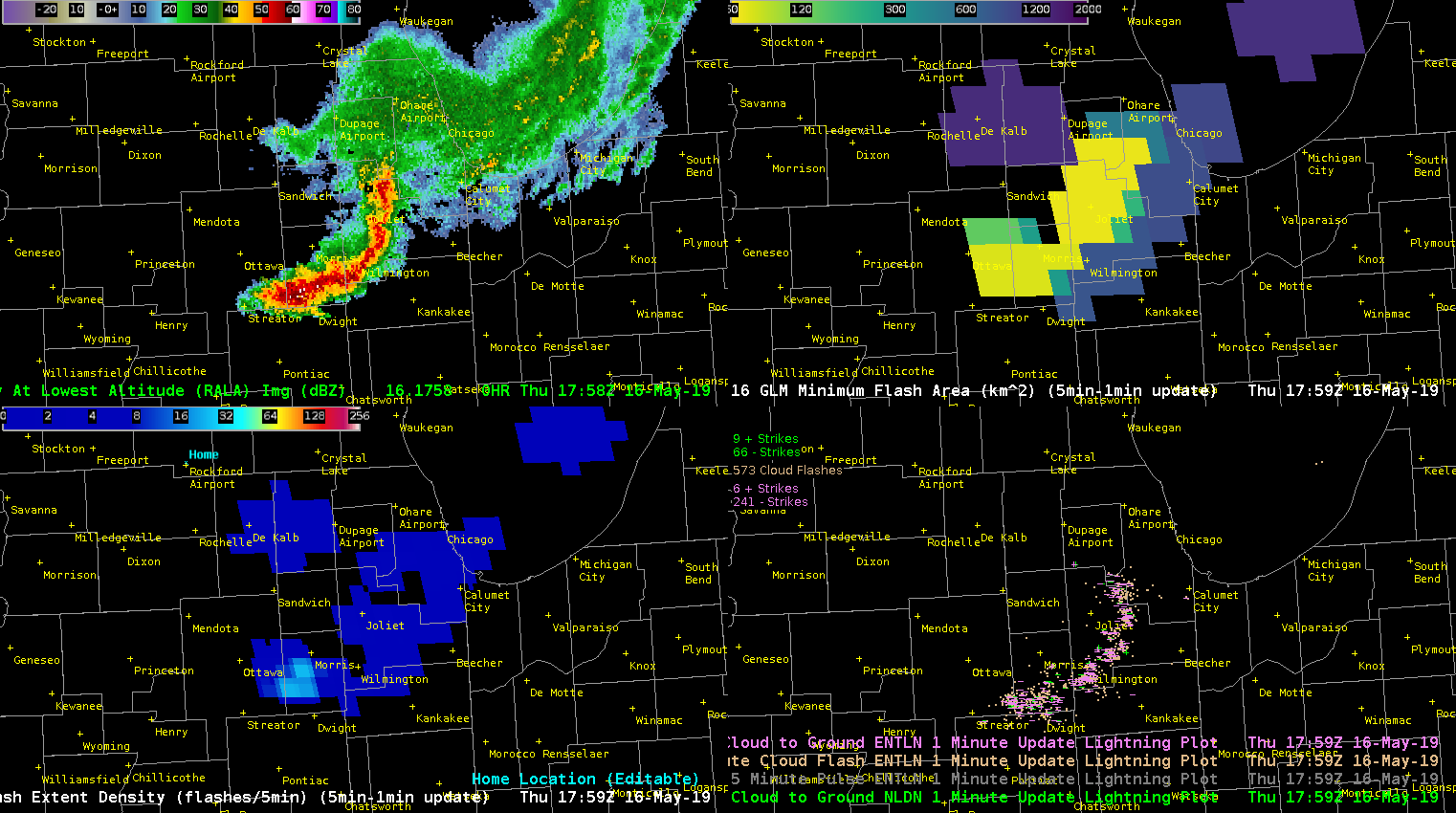
An MCS shifting southeastward across northern IL was producing quite a bit of lightning, and much of it was moving through the southwest portion of the line per Flash Extent Density. From a IDSS standpoint, the Minimum Flash Area and FED proved that it’s necessary to look at both GLM products and ground based lightning products to see the “total” picture. The GLM products captured a larger flash that extended out into the stratiform area behind the main line that is not seen in the ENTLN and NLDN products. This information can be especially important for Airport Weather Warnings and/or outdoor venues. You can easily see that the flash extends almost back to the Rockford Airport, while the main line and most of the flashes are ~80 miles away. In other words, areas near Rockford Airport are not out of the woods yet for lightning.

Clockwise from top left: RALA, Minimum Flash Area, NLDN and ENTLN Lightning Plot, Flash Extent Density

-Tempest Sooner

Comparing SWD with All Sky LAP PWAT

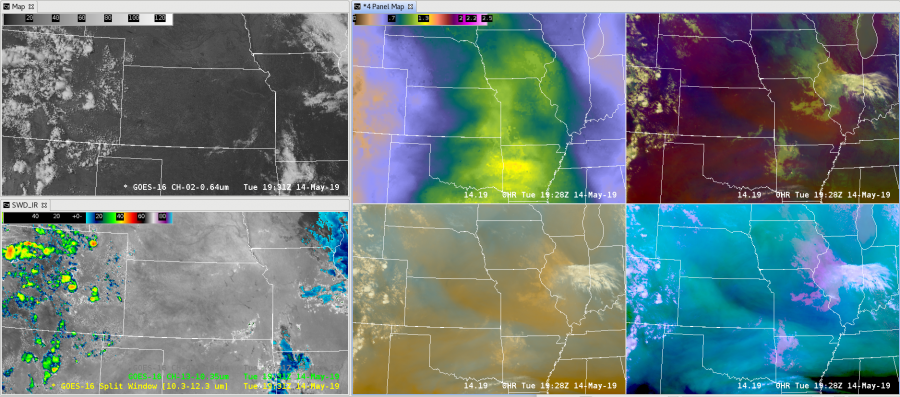
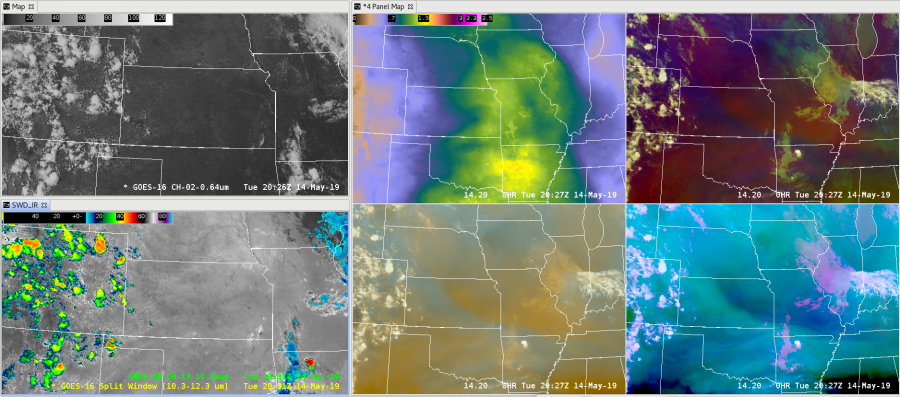
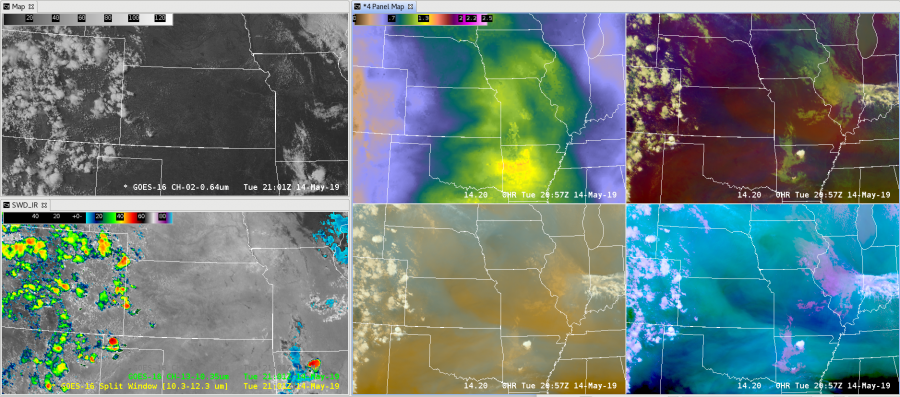
Trying to see how well AllSkyLAP Precipitable Water (upper middle pane) responds to subtle changes in low level moisture. The lower left is Split Window Difference (SWD) and upper left is visible imagery as a sanity check for no cloud cover. Also have airmass RGB (upper right) and differential WV RGB (bottom center) for comparison.

Note some slight darkening over KS possibly associated with some deeper subsidence seen on the diff W/V RGB.


Pinwheel Fronts In The Dakotas

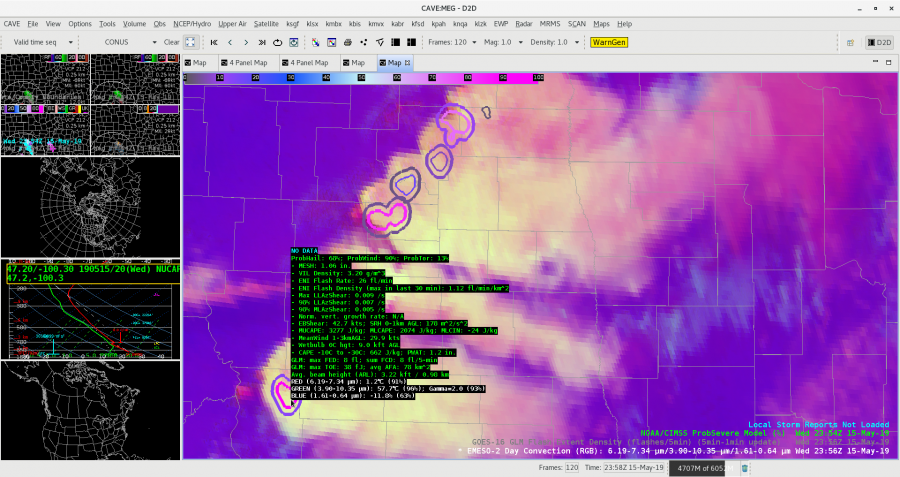
Mid afternoon into early evening saw a bretty good bloom of supercells along a SSW-NNE Cold Fronf in North Dakota…

Thru the period the SVRProb and SVRtor seemed to regularly over warn during this outbreak, BUT SVRHail was spot on, a little False Alarm-y, but it sure didn’t miss the Large Hail reports, with %s >90 both instances.  The RGB Day Convection GOES product seemed to respond pretty well with the hail instances as well.

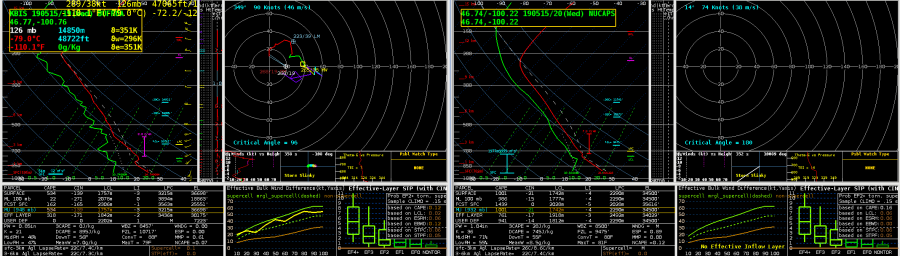
Afternoon NUCAPS over forecast the CAPEs by ~ 500, PW by 0.2″, did well with the Downrush temp and DCAPE tho.

Above Anvil Cirrus Plumes and GLM

This post will ask more questions than make assertions 🙂 We currently see evidence of a weak above anvil cirrus plume (AACP) based on the GOES-16 Sandwich RGB (upper left) and CH02 visible (upper right). Total Optical Energy from GOES-16 (GOES-17) is plotted on the lower left (right).  For reference, three of the four frames have 5 minute ENTLN data.
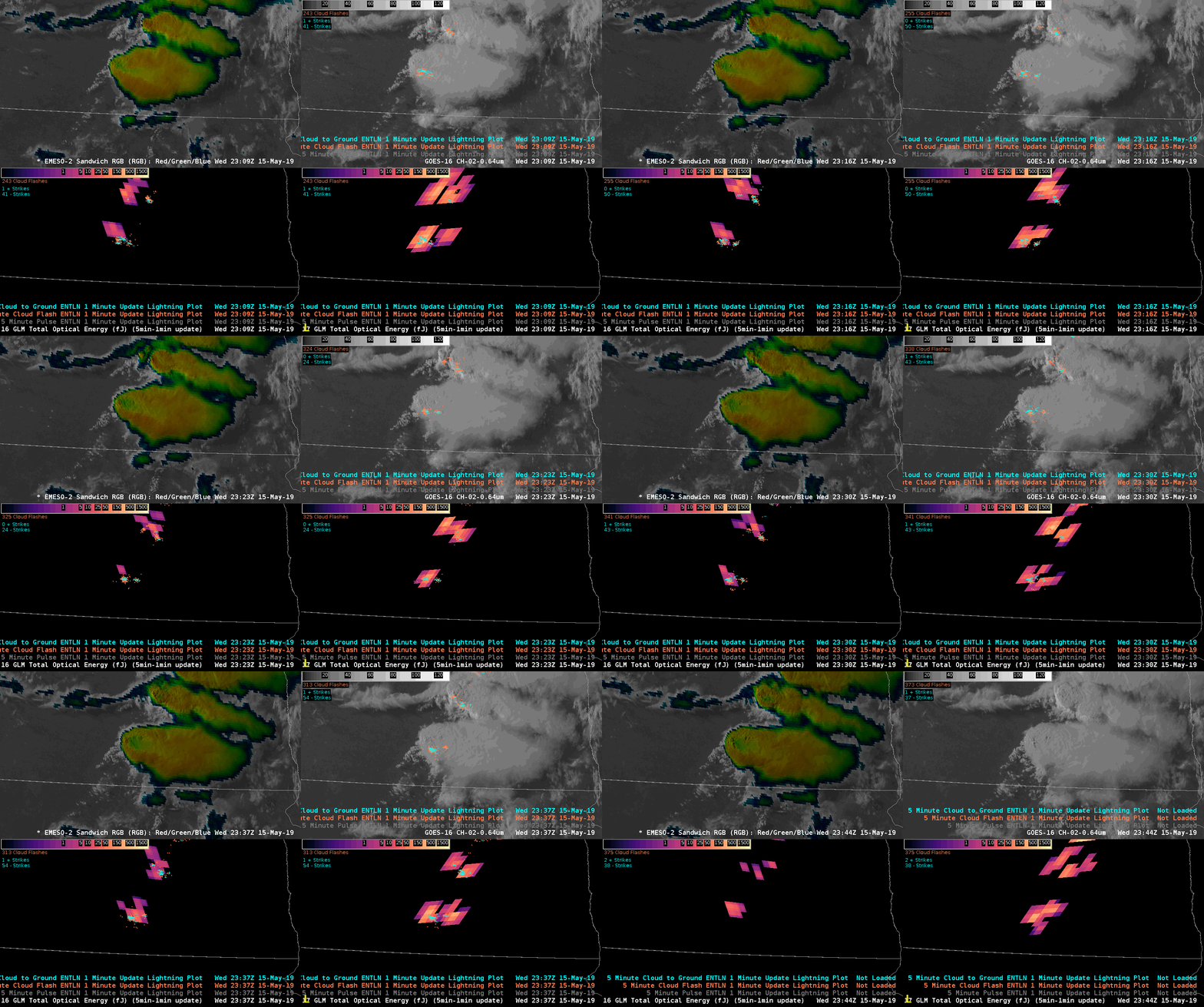
I’ve wondered if an AACP could extinguish a significant amount of Total Optical Energy (TOE) if lightning was occurring underneath. There are too many caveats here to draw any conclusions, such as:

  1. Extreme viewing angle for both GOES satellites resulting in significant parallax.
  2. A large viewing component of the sides (instead of just the tops) of the storms, resulting in possibly large and highly variable reflectances that might be harder to calibrate TOE against.
  3. Uncertainty regarding ENTLN efficiency and accuracy this far at the fringe of the ground network.

So, with all of that being said, what we see here is interesting. ENTLN does show two areas of lightning. GOES-16 picks up on the western area but not the area under the plume (at least not at first). GOES-17, on the other hand, has a better grasp  on there being two areas throughout.

I hypothesize that GOES-16 is struggling more in this particular scene because of the large reflectance and possible forward scattering issues that GOES-17 is not as susceptible to at this particular time of day.

Again, this is not a great setting to test any hypothesis about how much an AACP is able to throw a blanket over GLM detections. However, I’m confident that next week will provide many opportunities to test this with extremely stout AACPs at far more optimal latitudes.

#MarfaFront