An official website of the United States government
Here’s how you know
Official websites use .gov A
.gov website belongs to an official government
organization in the United States.
Secure .gov websites use HTTPS A
lock (
) or https:// means you’ve safely connected to
the .gov website. Share sensitive information only on official,
secure websites.
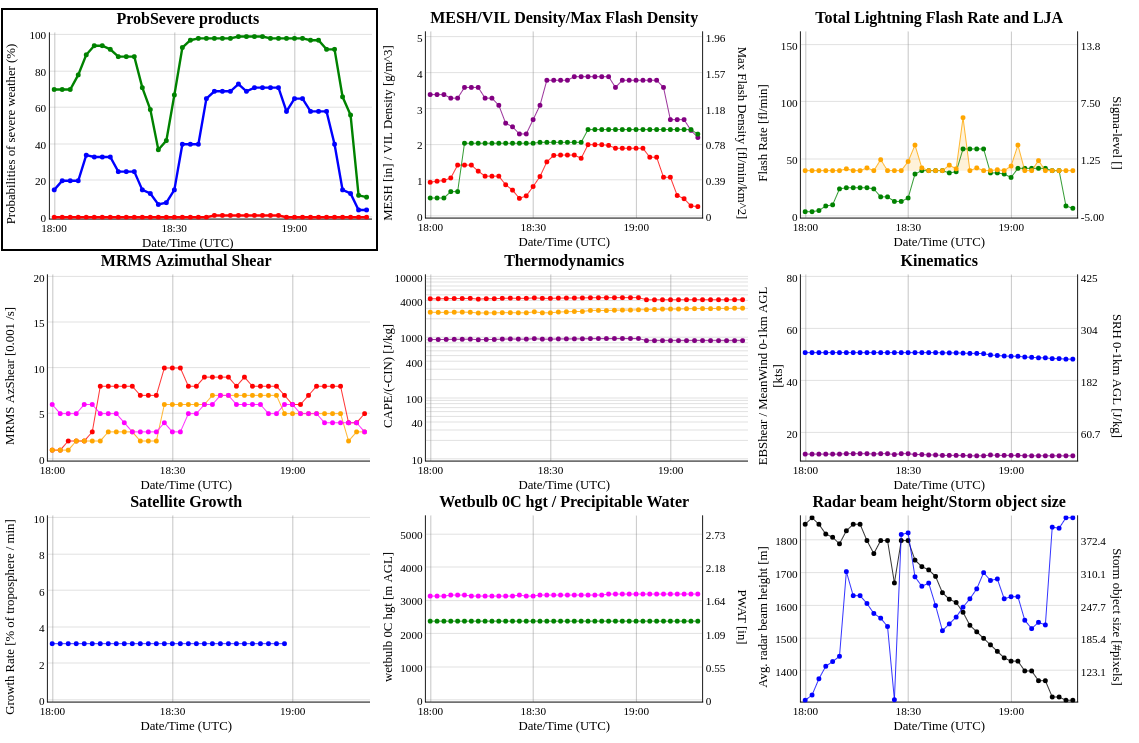
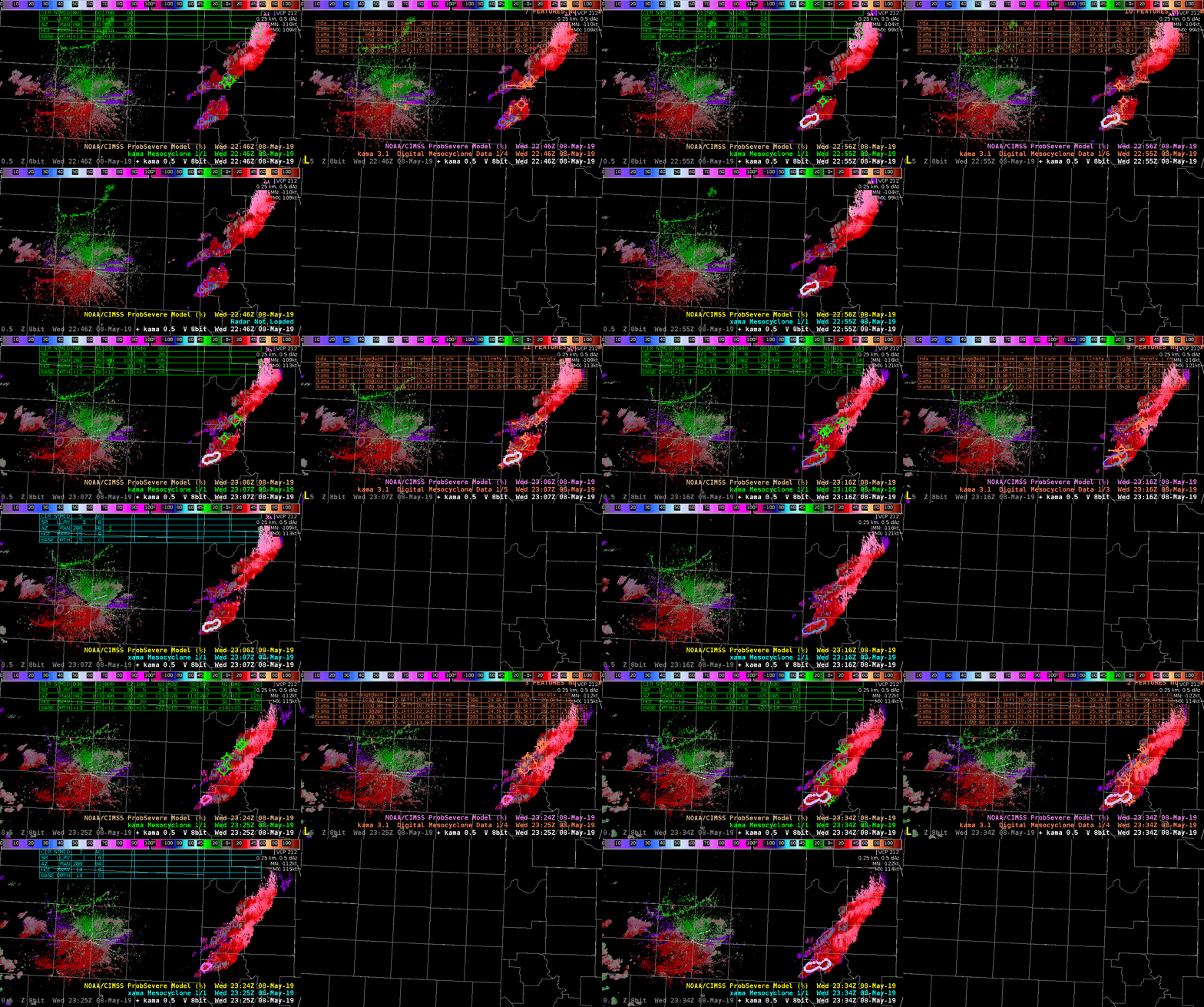
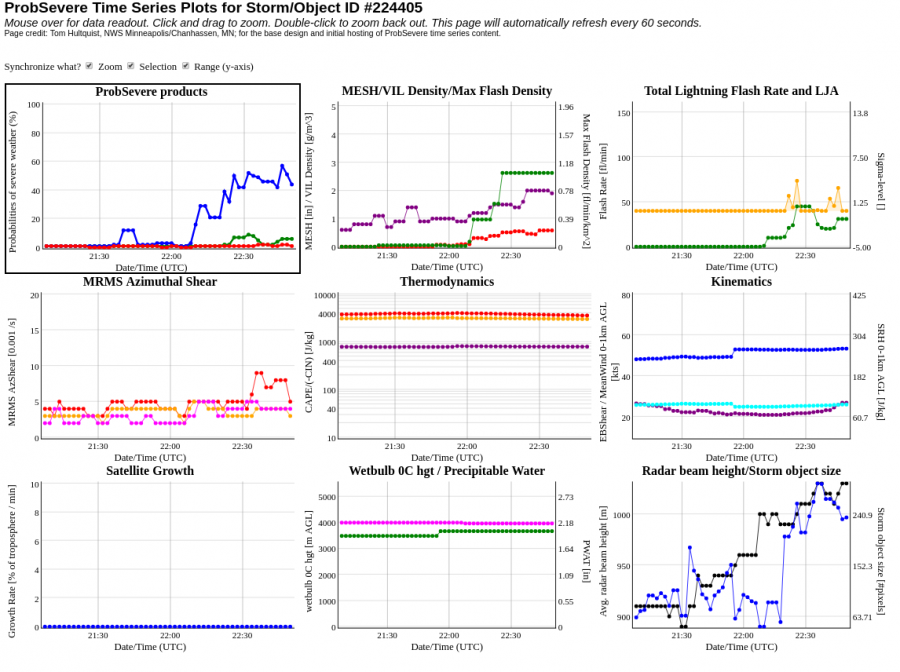
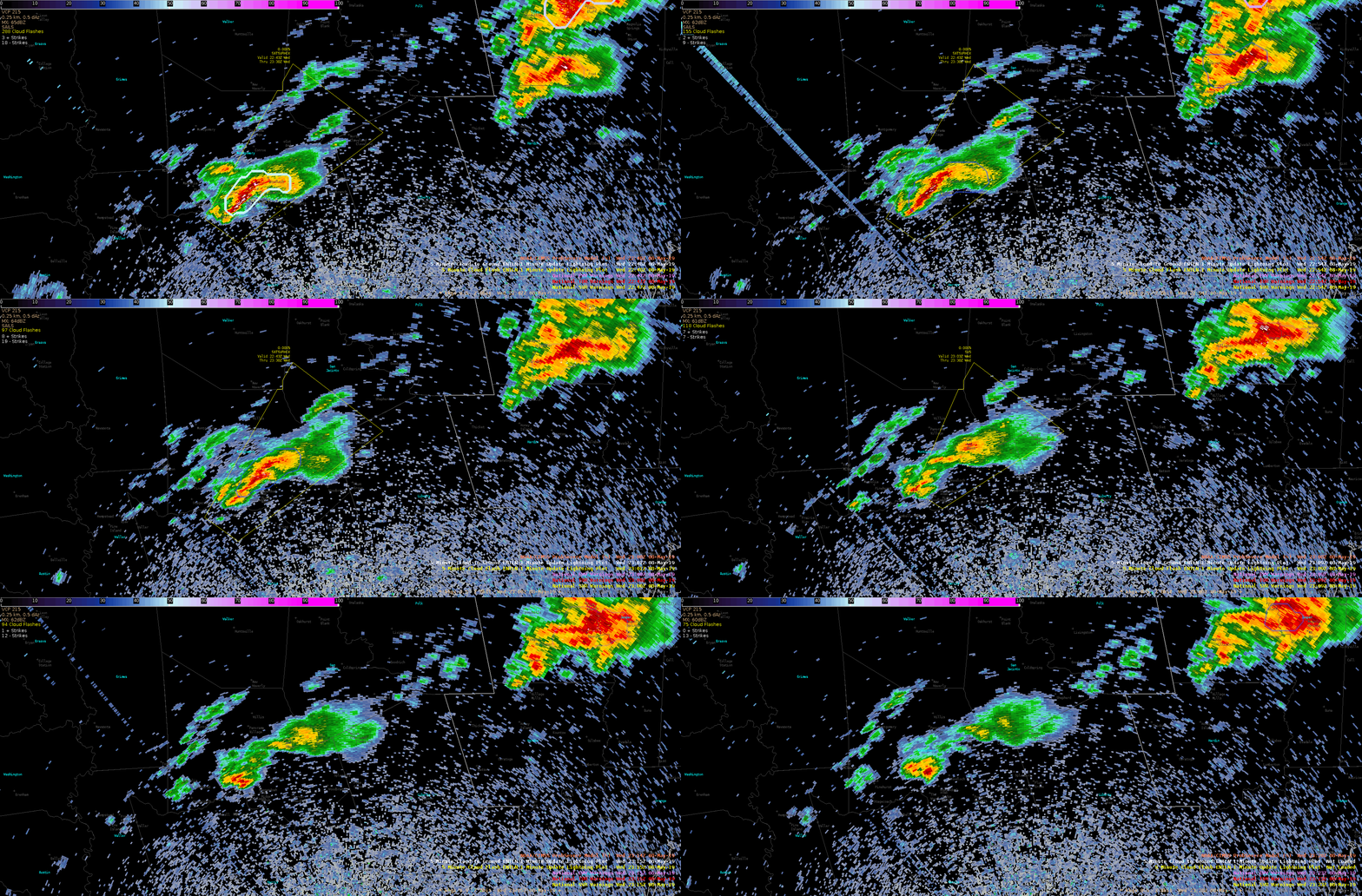
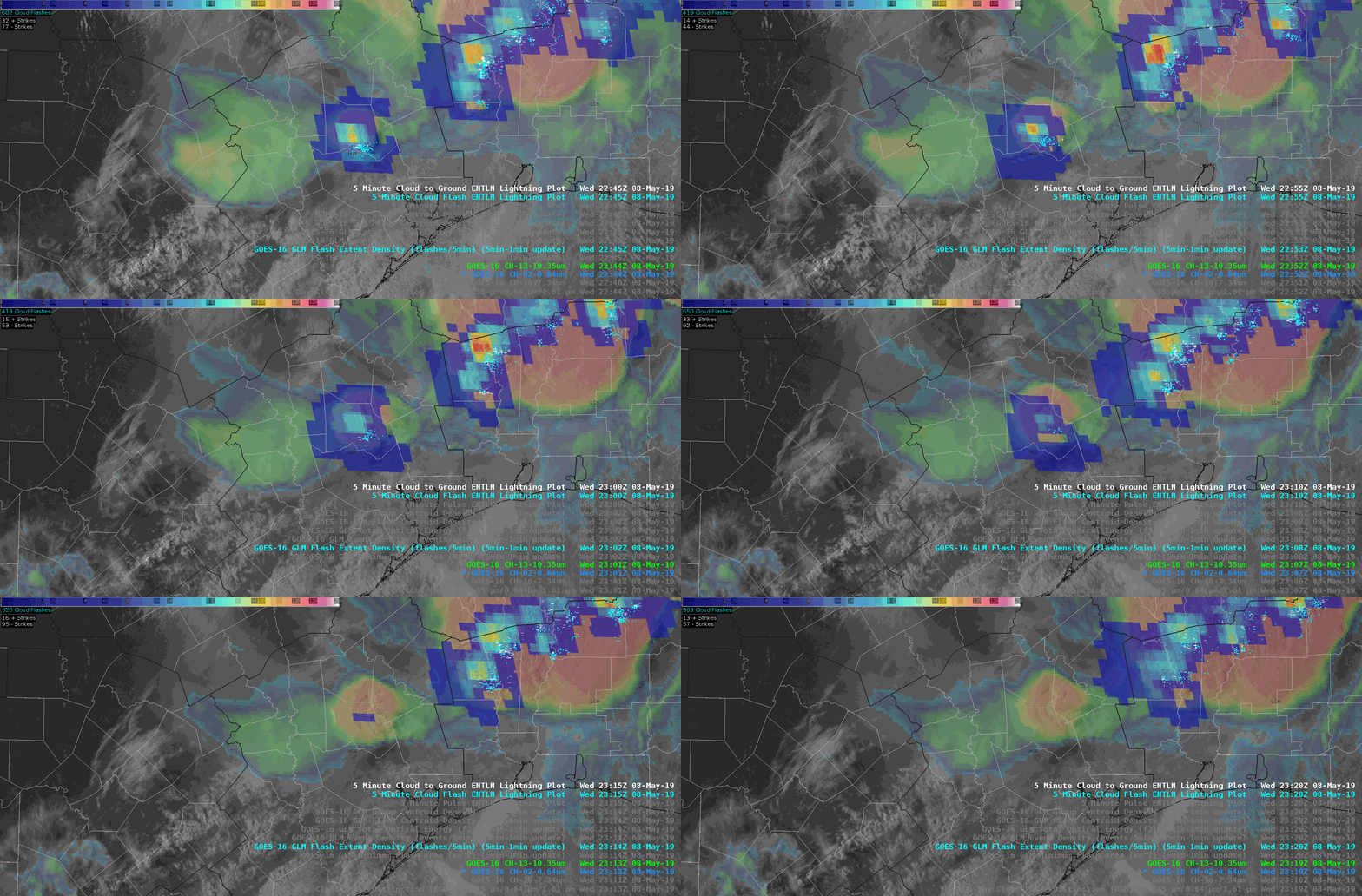
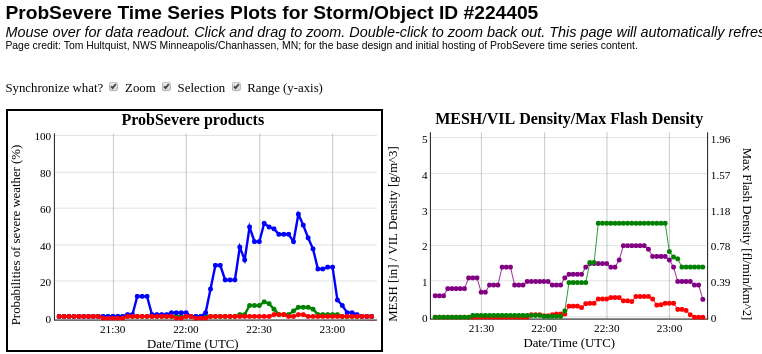
A noted downward trend in the ProbSevere Time series along with a downward trend in the GLM products (not pictured) resulted in this warning forecaster to cancel a SVR for Kerr County early. This early cancellation may not have occurred had these products not been available, potentially leading to areas being unnecessarily warned for a longer amount of time.
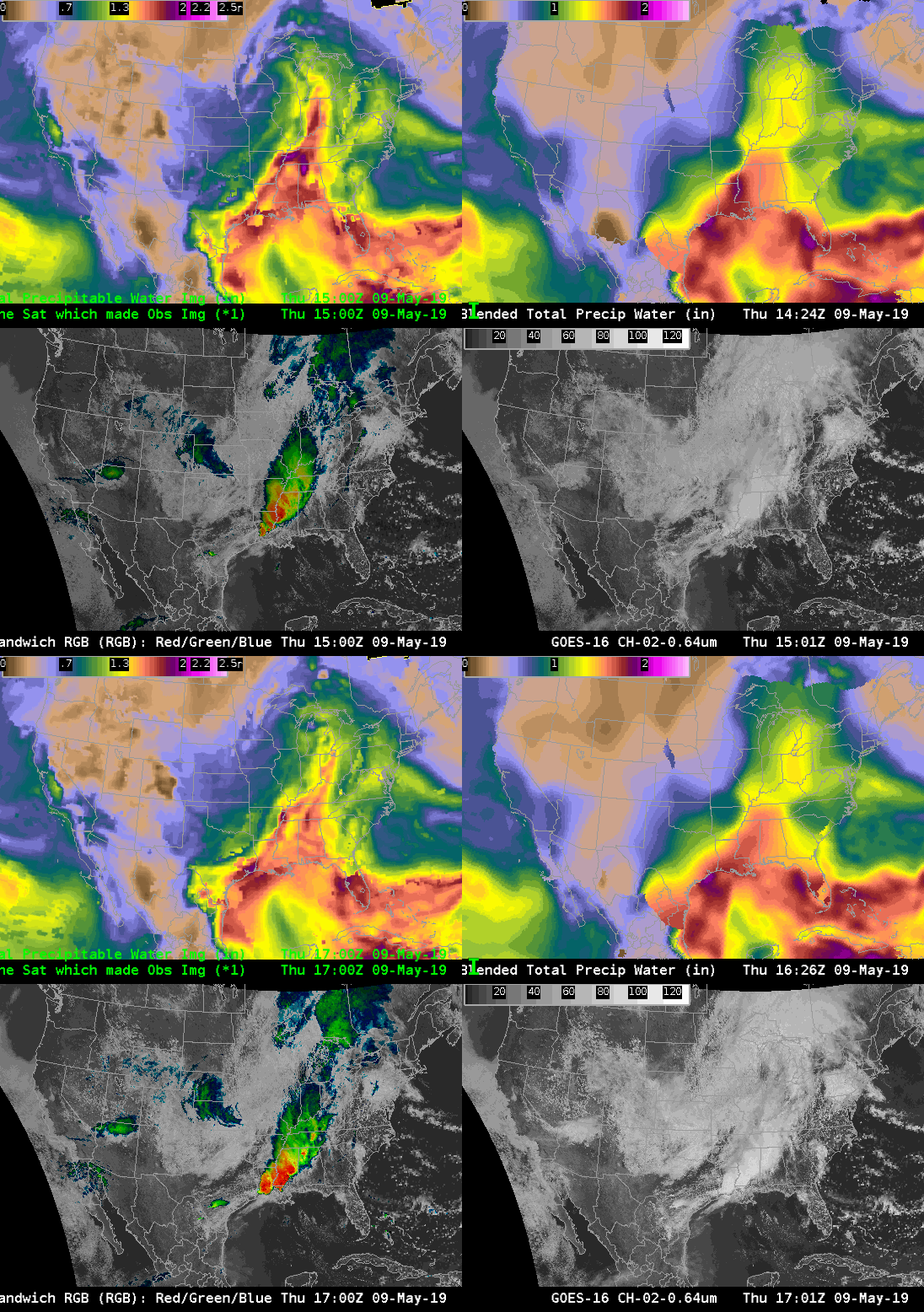
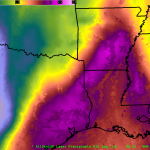
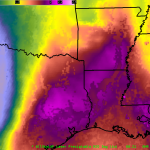
I was finally able to take a look the ATPW (top left) and compare it with the operational blended TPW (top right). My first impression was that both products show similar large scale patterns with a large plume of moisture extending from the Gulf of Mexico into the Ohio River Valley. The ATPW also tends to show a little more detail in the moisture field compared to the blended TPW.
At 15Z ATPW shows an area of lower moisture over the Texas Gulf coast which is sort of fills in by 17Z, likely due to upstream moisture being advected into the area. In contrast, this moisture is continuously present in the blended TPW. ATPW generally had PWATs around 1.5 in, while the blended TPW had PWATs around 1.7-1.8 in. In contrast, 12Z RAOBs along the coast had PWATs that ranged from 1.6 inches at KBRO to around 1.8 at KLCH. These values seems to match better with the blended TPW product. I suspect that the upstream convection over Louisiana and lingering clouds over the coast impacted the ATPW that was corrected in the blended TPW.
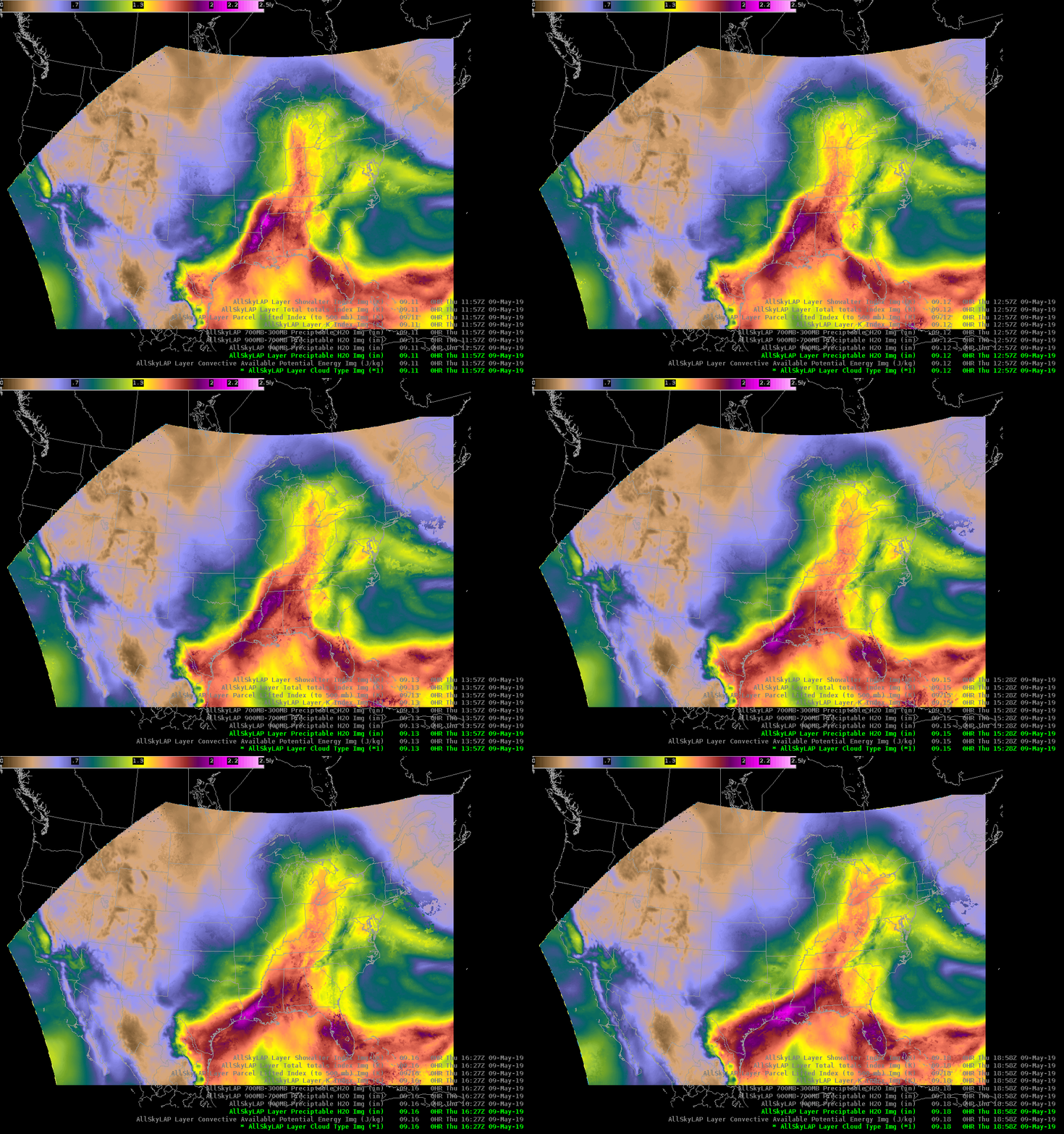
Update…Below is a loop of the LAP All Sky T PW. This loop shows a similar pattern to the ATPW and Blended TPW with a large are of gulf moisture moving into the Ohio River Valley. It is interesting/good to see that the LAP All Sky TPW is picked up on the sea breeze kicking in along the Gulf Coast. Despite the subtle differences among the three products the fact that they show similar patterns gives increase confidences that we will likely see a large area of flash flooding across portions of the south if storms are able to develop.
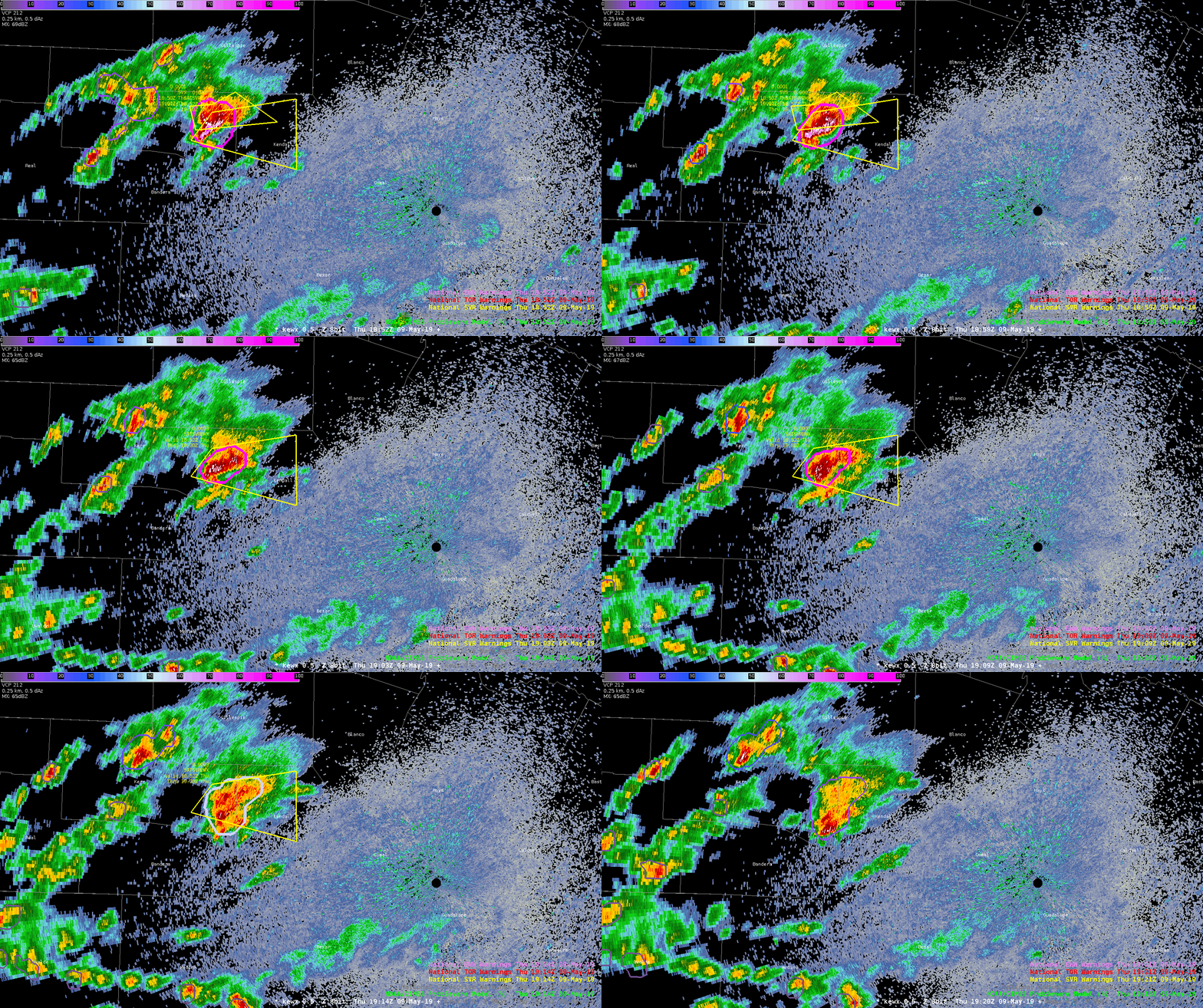
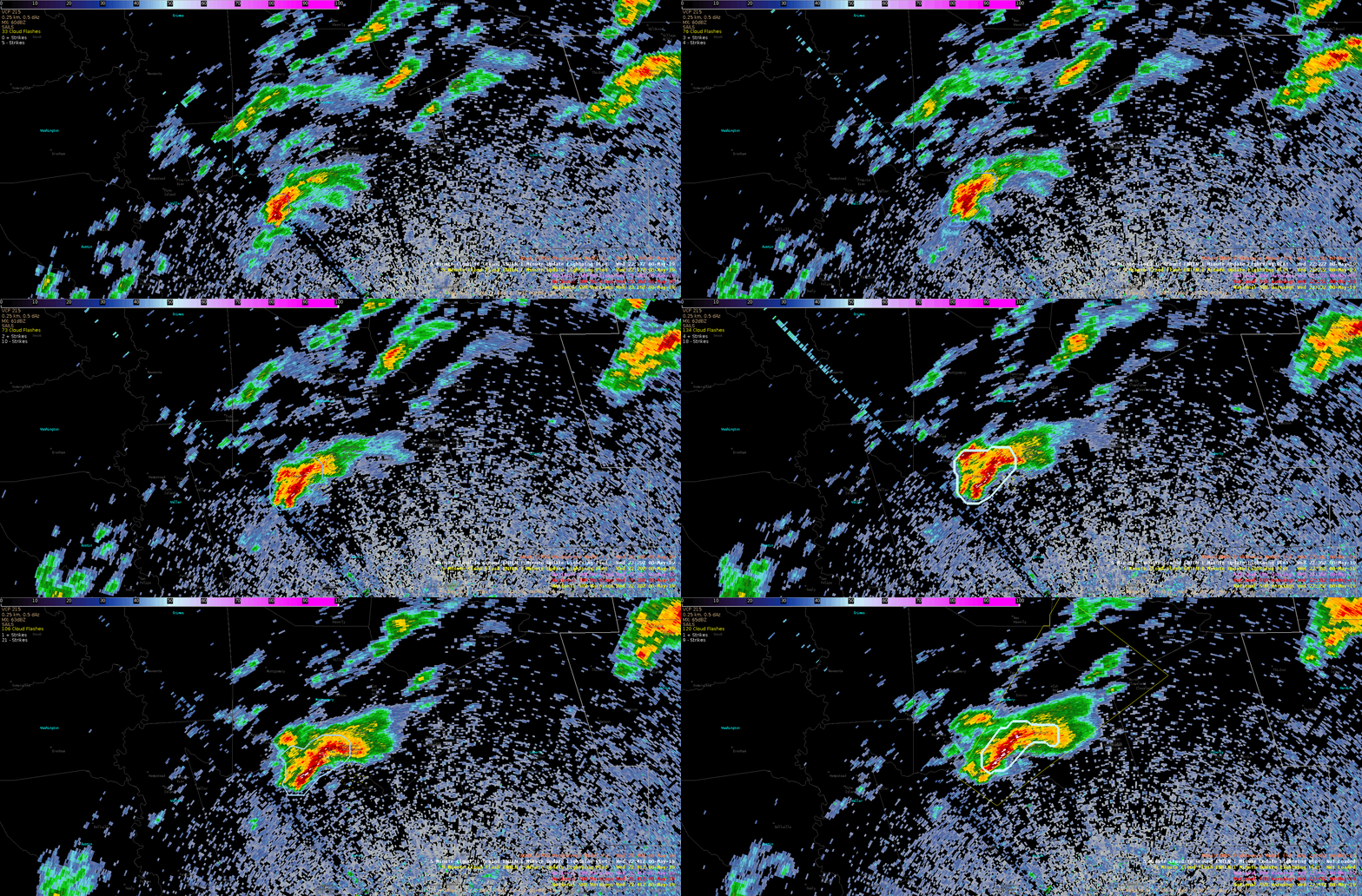
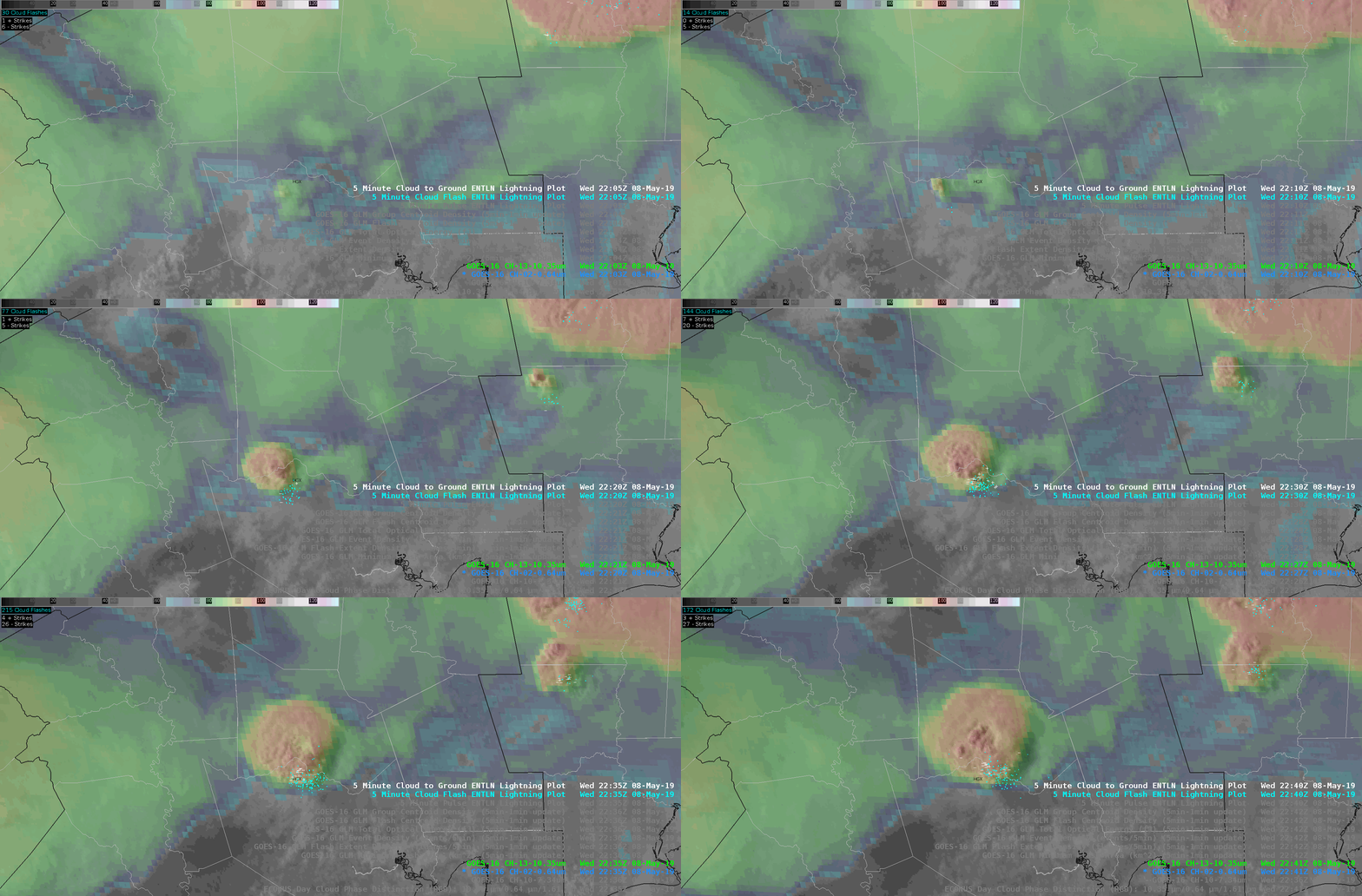
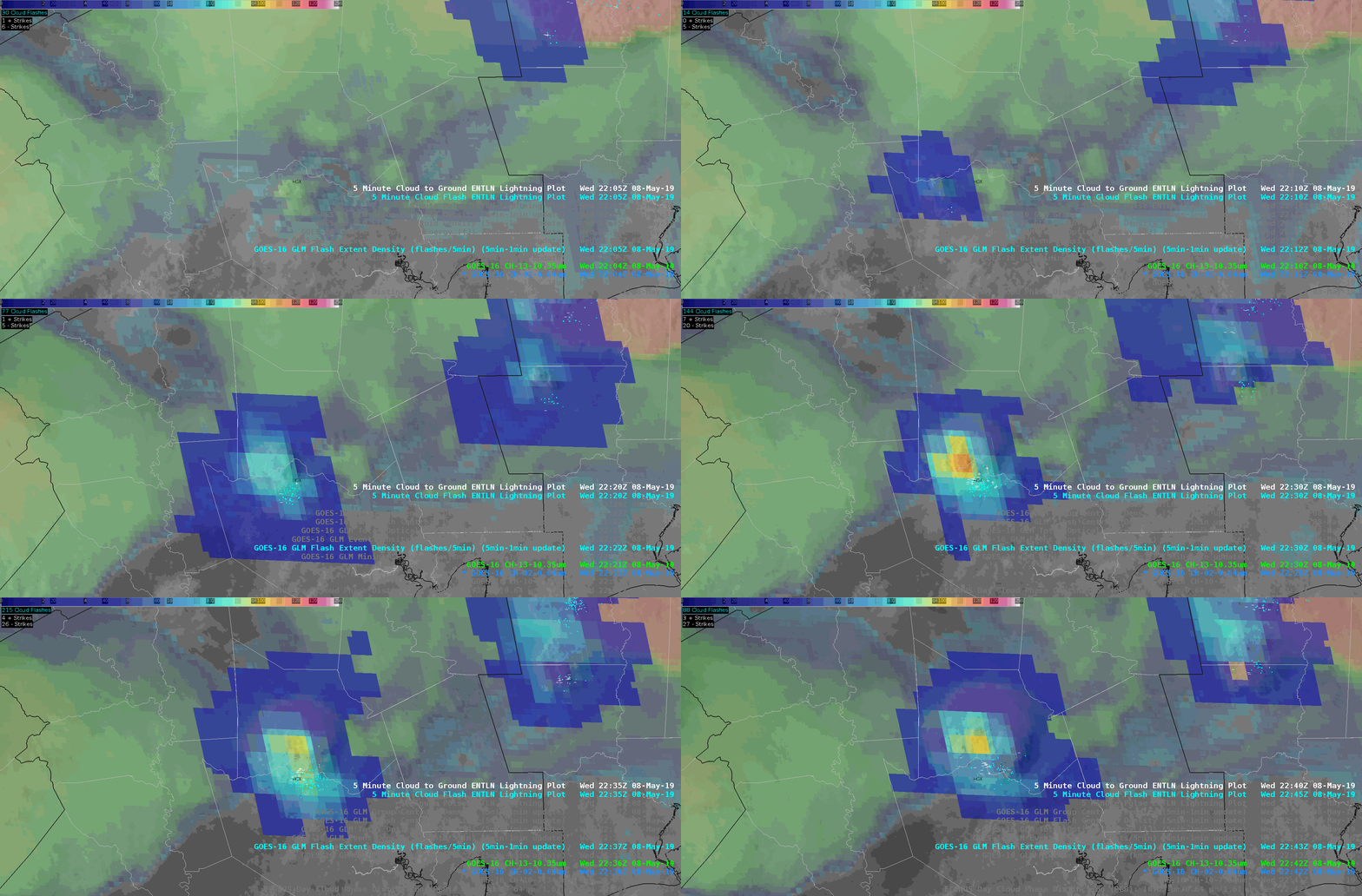
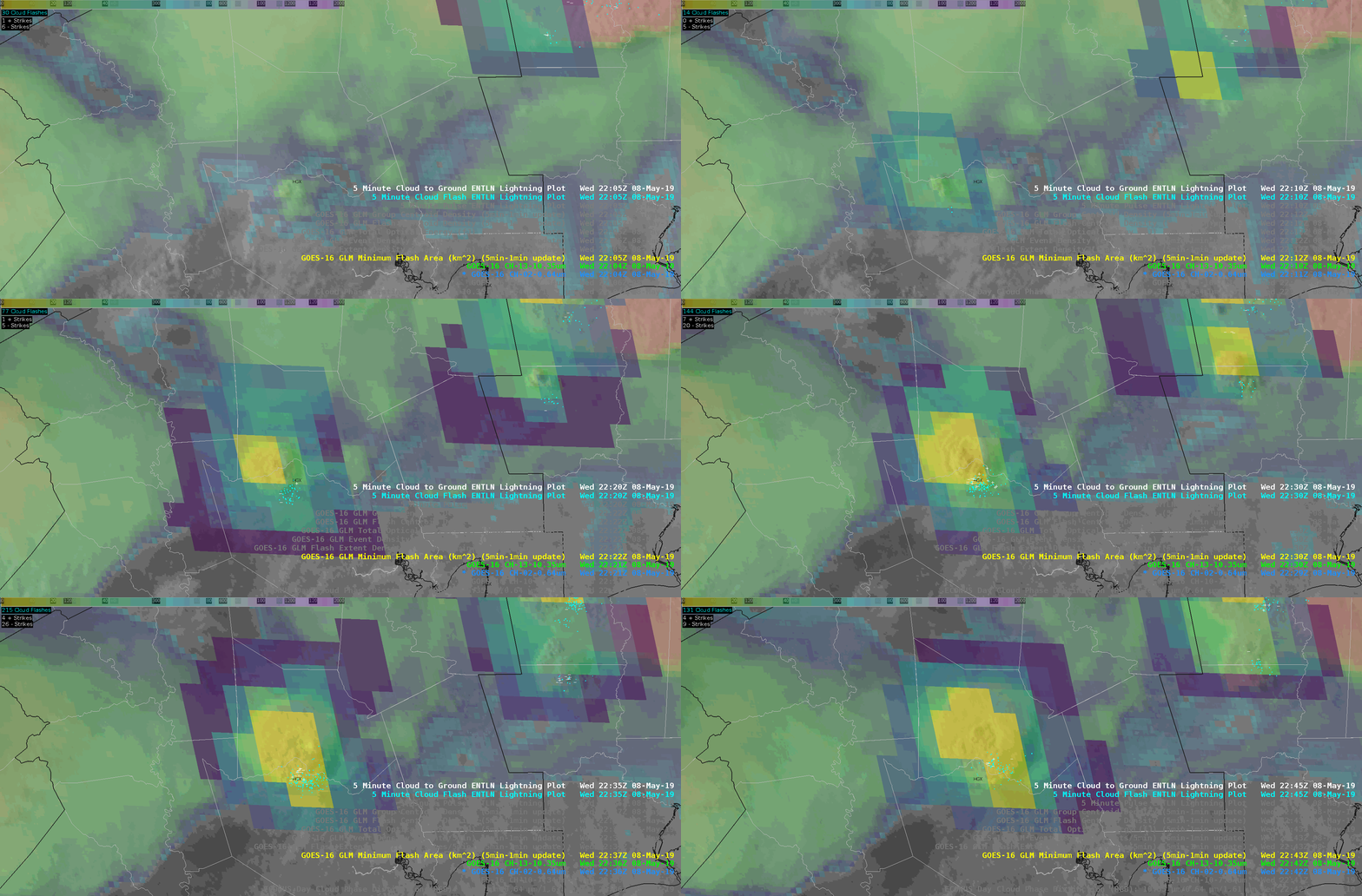
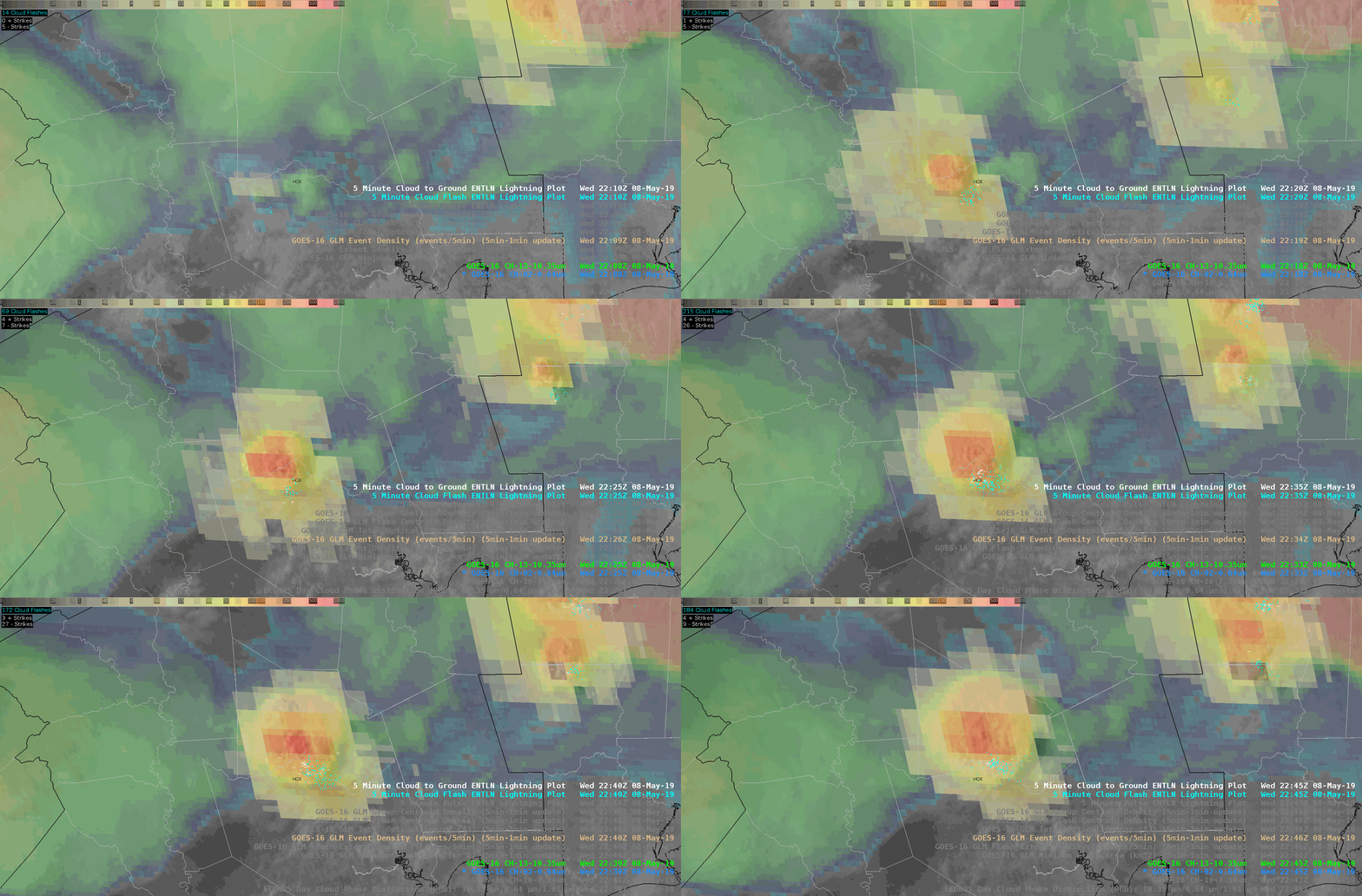
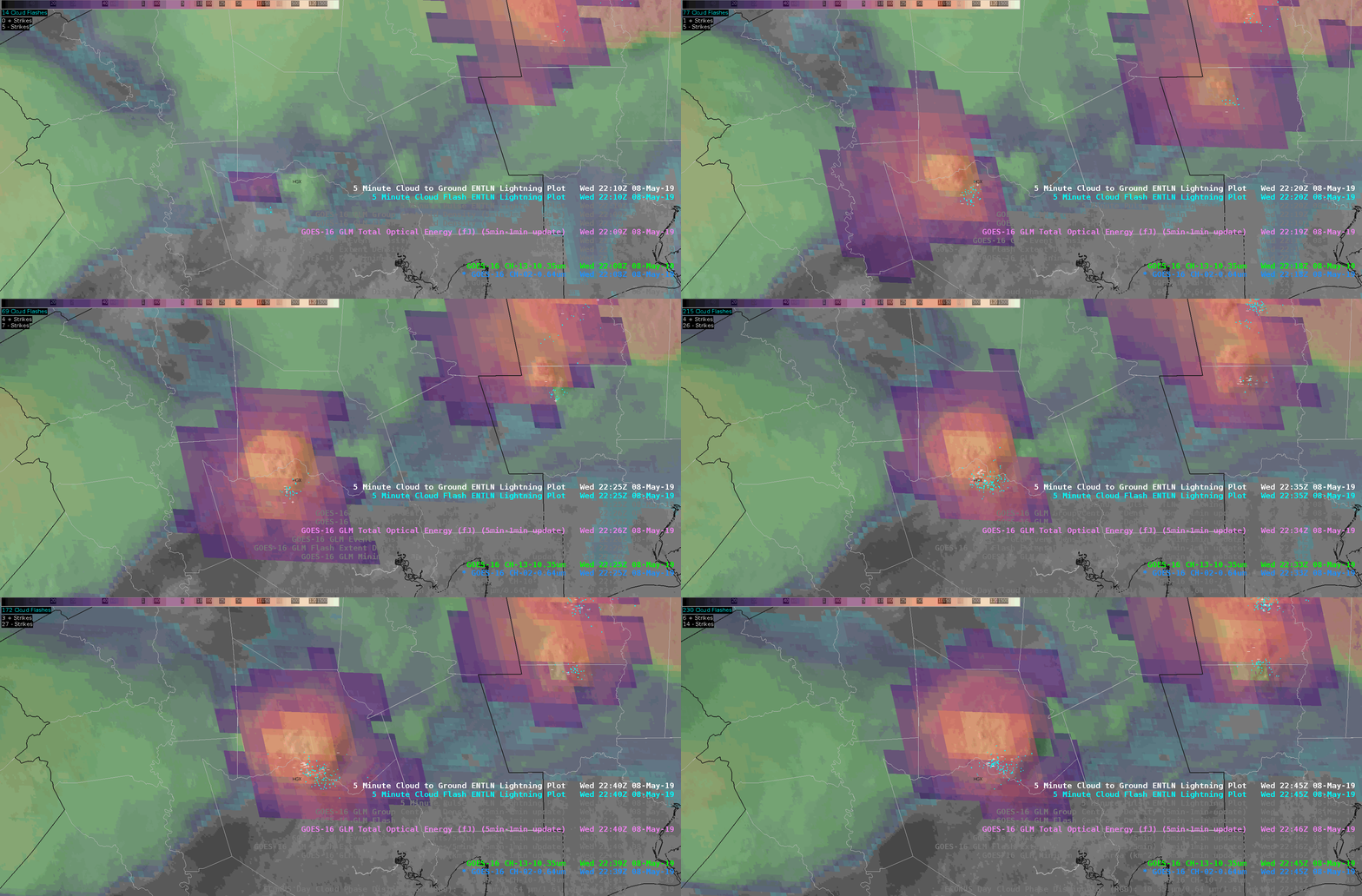
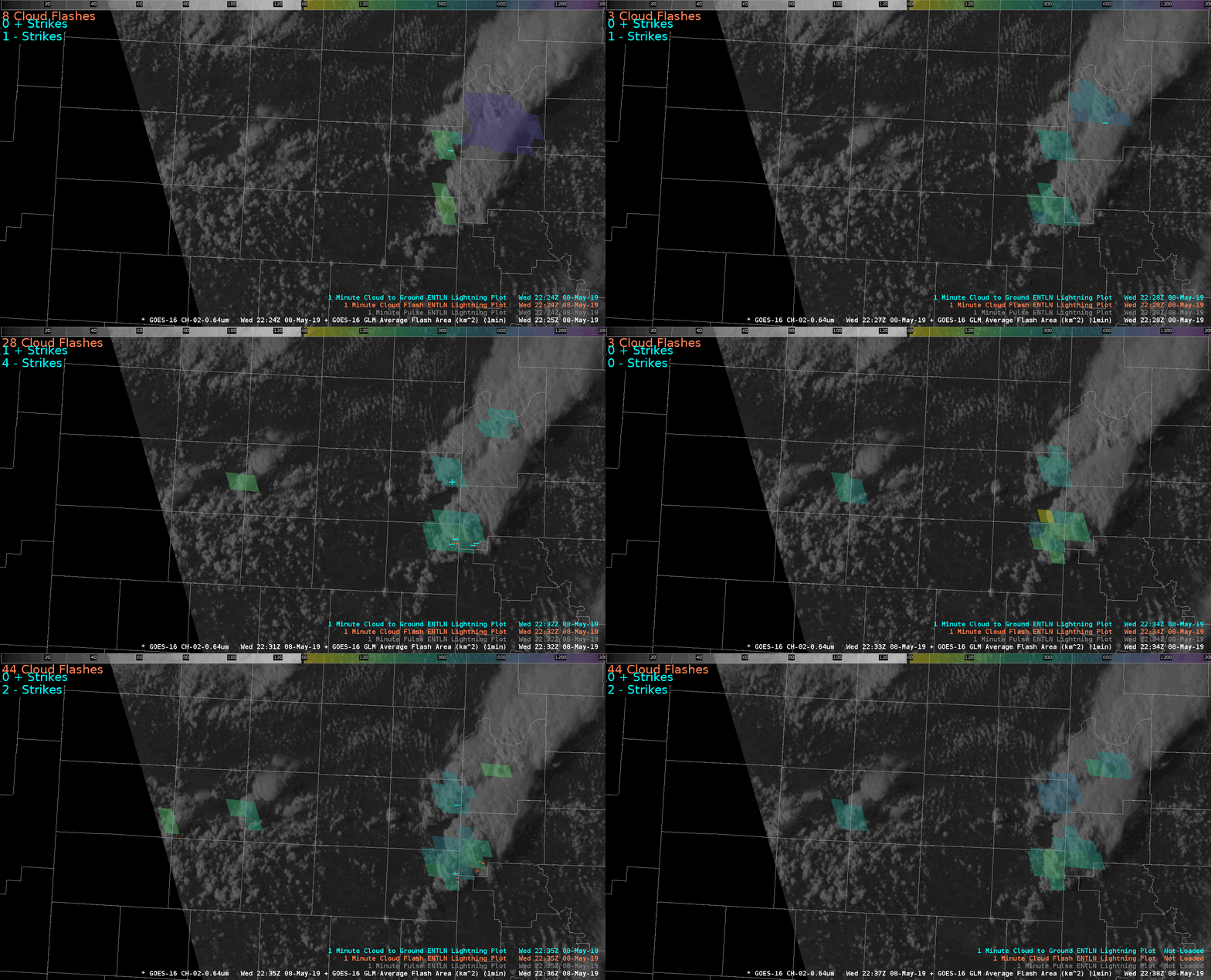
A strengthening thunderstorm in Val Verde County was noted by Prob Severe and GLM data. The Average Flash Area and Minimum Flash Area values quickly increased in the area of a strengthening updraft across Val Verde County. The combination of these factors, along with a noted uptick in ProbSevere data, prompted the HWT warning forecaster to issue a SVR for Val Verde County at 1:25pm CDT with WFO EWX issuing a SVR for Val Verde at 1:28pm CDT.
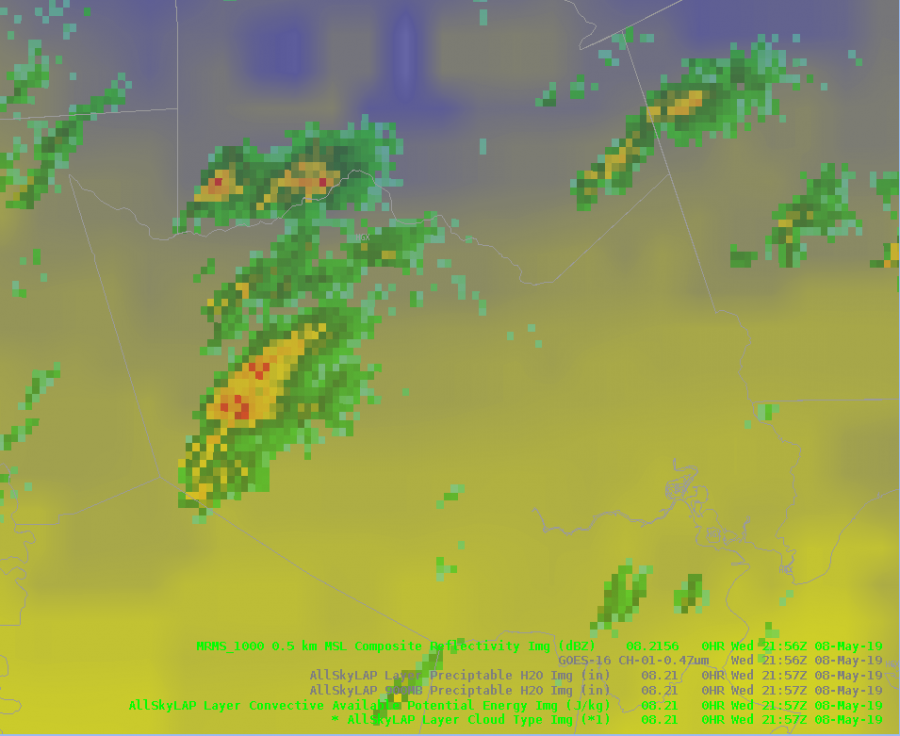
In this case of a rapidly developing storm, GLM data was leaned on to issue a SVR Warning on what otherwise may have been a marginal storm. AllSkyLAP showed the storm was developing in an area of MLCAPE values over 2000 J/kg, and ProbWind model had rapidly increased to ~50%. GOES-16 1-minute imagery showed rapidly cooling cloud tops, with a sharp increase in lightning activity. Given GLM values comparable to other severe storms on the day a SVR warning was placed on the storm. The warning was sent out relatively early to try to capitalize on lead time.
Radar w/ ProbSevere:
IR-Sandwich:
Flash Event Density:
Minimum Flash Area:
Event Density:
Total Optical Energy (too fast, whoops!):
AllSkyLAP CAPE:
ProbWind Model Increase:
UPDATE: Shortly after warning on the storm, it completely fell apart after failing to become rooted in the boundary layer and all indicators (i.e., ProbSevere, GLM imagry) dropped to null. Initial warning was shamefully cancelled.
At 2127 and 2157 UTC on 8 May (exactly six hours after it was previously noted), a surge in TPW in a cloudy region (Northeast TX region). This might be a predictable behavior in All-Sky LAP and points to improvement needed in how it handles new model cycles. Similar jump behavior was noted in All-Sky LAP CAPE.
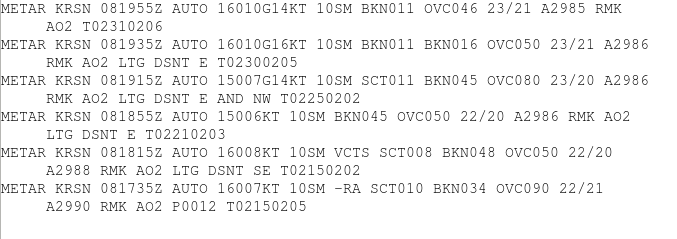
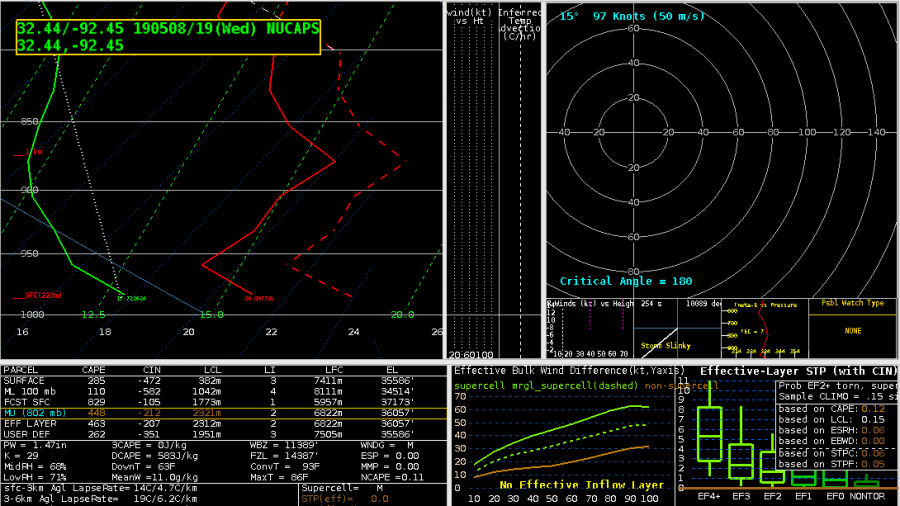
In trying to give due diligence to all of the products I decided to look at the NUCAPS soundings a little deeper today. The location of the sounding point was around 9 mi SE of Ruston Regional Airport in an area that was impacted by a weak line of convection moving across central Louisiana, as shown in the METARS from KRSN.
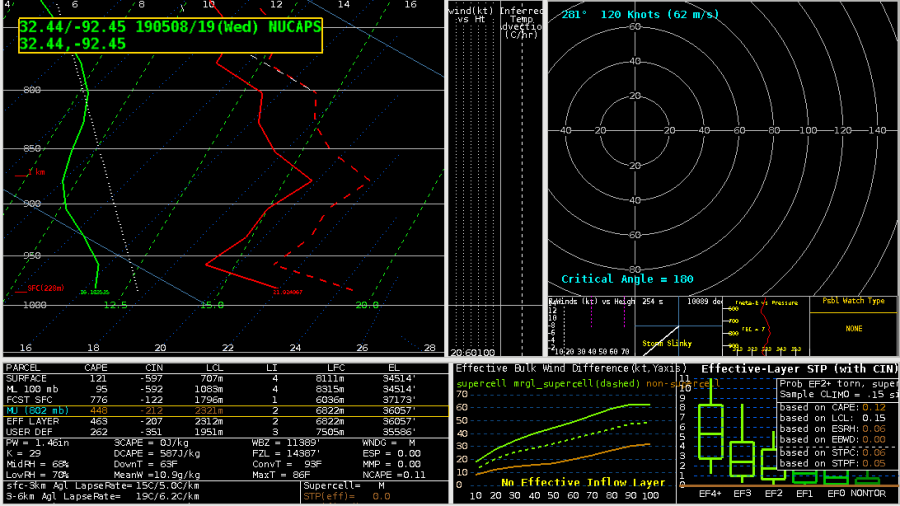
Both soundings passed the QC checks and were towards the center of the swath. So what did NUCAPS show? Here are the lowest levels of both the NUCAPS and Modified NUCAPS soundings at 19Z…
NUCAPS Sounding at 19ZModified NUCAPS Sounding at 19Z
The NUCAPS sounding had a temp of 21.92C (71.47F) and a dew point of 16.18C (61.12F). The modified NUCAPS sounding had a temp of 20.81C (69.46F) and a dew point 17.72 C(63.87F).
For comparison here are the RTMA temp and dew point between 17-19Z at the sounding point and at KRSN…
It makes sense that the RTMA dew point depression is small given the recent rains, and if the RTMA is suppose to be the ground truth, it looks like the NUCAPS soundings did a bad job in this case. Temps for the NUCAPS soundings were 2-4 degrees cooler which is okay, but the modified sounding was cooler. It would have probably been better to keep the temp from the unmodified sounding. With regards to dew points, both the modified and unmodified soundings had lower dew points than RTMA, on the order of 6-7 degrees. These definitely affected the thermodynamic calculations, though I’m pretty positive that it was the mid-level inversion that did the most damage. I’m not sure how to fix this since only the surface points get modified.
Anyways, hindsight being 20/20, I probably should have looked at an area that wasn’t recently impacted by rain, but by the time I realized it it was too late and I already gathered all the data. Anyways, both NUCAPS soundings in this case did not accurately represent the environment in the lower levels, likely a result of evaportaive cooling and outflow behind the line of convection. This is a word of caution that despite the soundings passing the QC checks (the points were both green) and being in the center of the swath the data may not be the most useful.
Isolated convection trying to develop across TX Panhandle. GLM Average Flash Area product picking up on initial lightning activity within the developing convection.
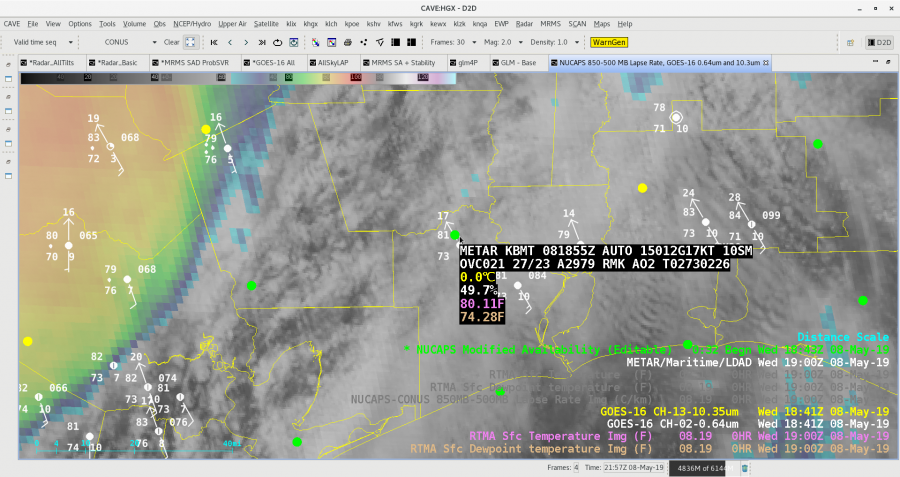
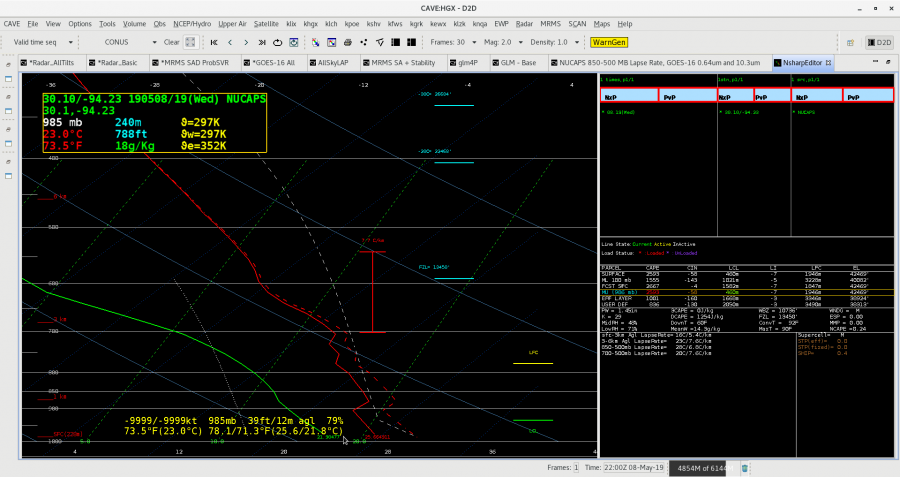
Another attempt at looking at the NUCAPs sounding and comparing to a local METAR and RTMA. This time the modified soundings seemed to do much better. The NUCAPs sounding point was roughly 2 miles away from the BMT METAR which was measuring a temp/dew of 81/73. RTMA was measuring 80/74 at the NUCAPs sounding location. NUCAPs unmodified sounding came in at 74/69 (not shown), however, the modified sounding was adjusted to 78/71.
So the modified sounding was adjusted well from the original, but looks like it may have not been adjusted far enough for this case. Although if there’s a bias throughout the sounding perhaps correcting too far would make the sounding unrealistic. Not sure w/o in situ observations throughout the troposphere.
Here’s a case where the ProbTor model significantly increased in an area where tornado potential was extremely limited. Below are animations of the radar velocity at the closest radar (KGRK), the low-level Merged AzShear, and the time series of the ProbSevere product. The cell in question was small and behind the main line of storms in the more stable airmass, yet the ProbTor model jumped to 79% for several minutes. The time series seemed to indicated this was due to an increase in AzShear yet the Merged Low-Level AzShear product showed no distinct signature (same for Mid-Level AzShear not shown).
UPDATE:
After consulting with the fantastic Mr. Cintineo, he found that the false flags were likely from a jump in the Low-Level Rotation tracks in MRMS (shown below). These false signatures, however, were not making it into the aforementioned AzShear product.