ProbTor not showing much “Love” for Tornadic Supercell in Love Co OK


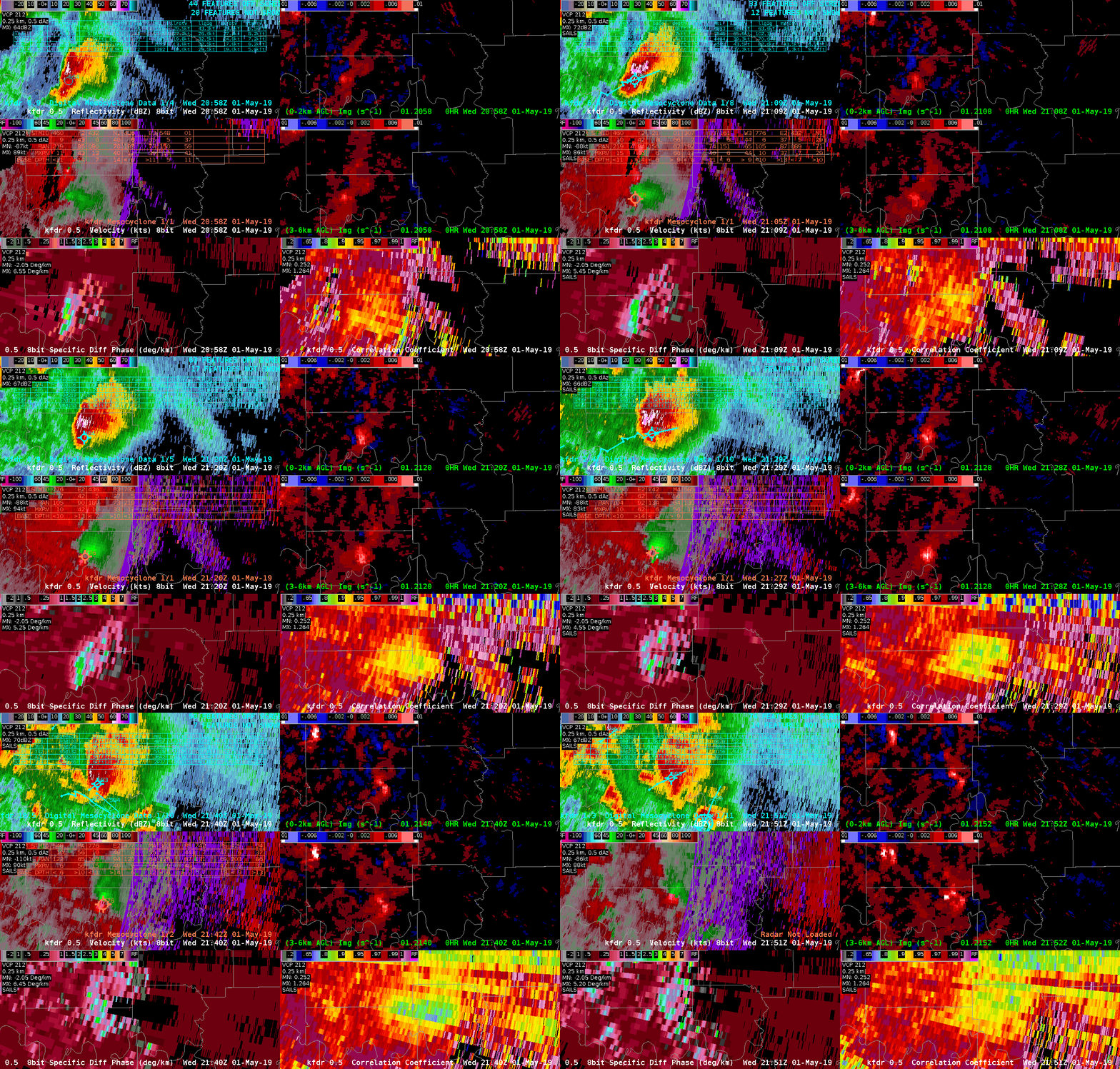
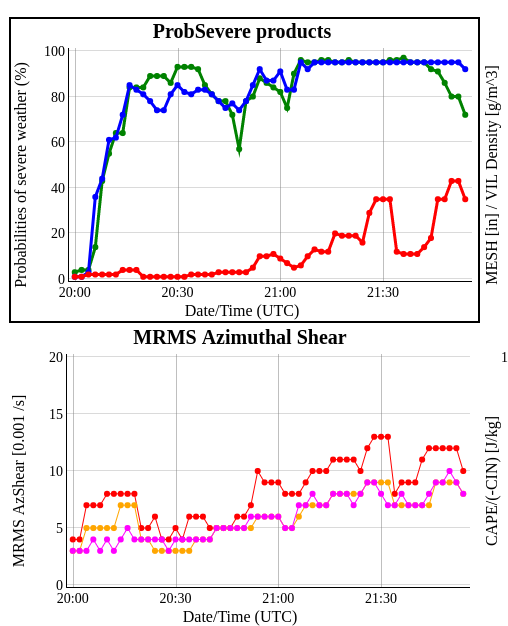
ProbTor showed a noticeable increase in values as the circulation on the Love County storm improved from 21:24-21:28 however there was a significant drop off at 21:34 even though the circulation from KFDR maintained its intensity and actually improved gate-to-gate. Looking at the MRMS AzShear graph you can see the same trends pinpointing the main driver in the ProbTor behavior. By 21:44 the AzShear recovered and ProbTor also returned to its previous value and continued to climb. There was some apparent “funky data” that got into AzShear to cause the unexpected drop. This emphasizes the need to have the proper products paired in AWIPS displays in order to diagnose why some algorithms may “fail” at times.
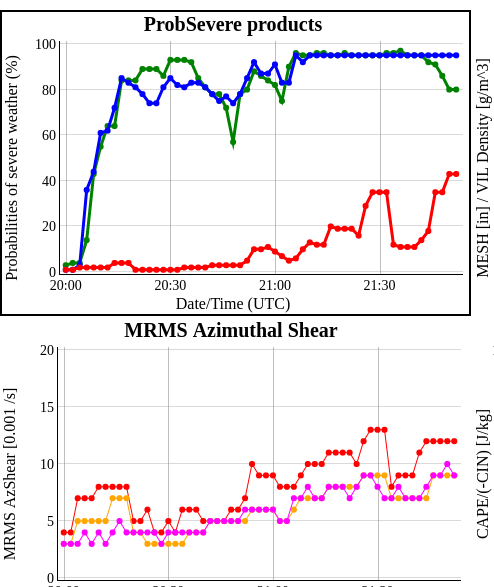
ProbSevere Time series. (http://cimss.ssec.wisc.edu/severe_conv/plots/PSplots.php?ID=166605)
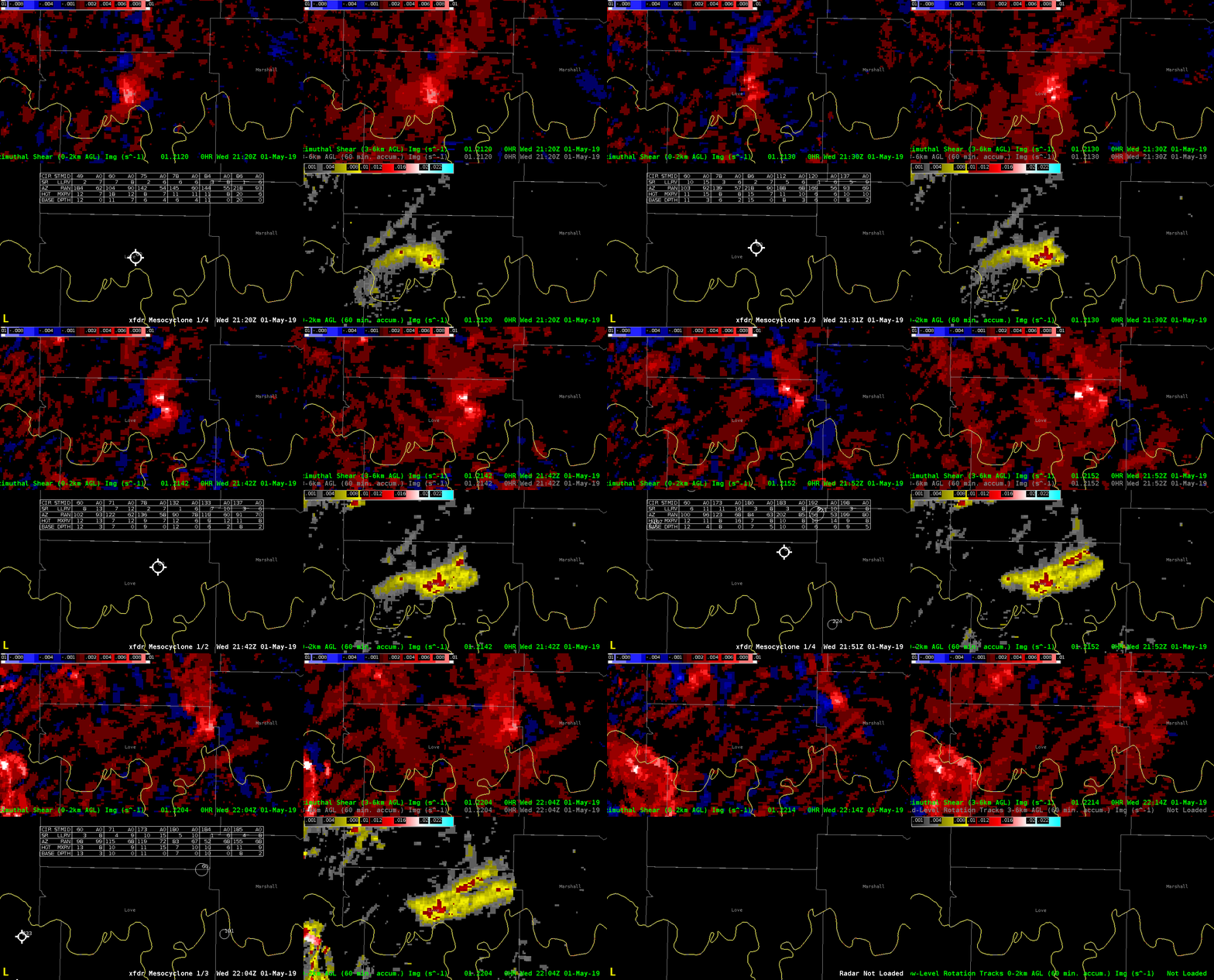
Low Level AzShear (UL), Mid Level AzShear (UR), New Mesocyclone Detection Algorithm (KFDR) (LL), Low Level Rotation Tracks (LR) 21:20-22:14
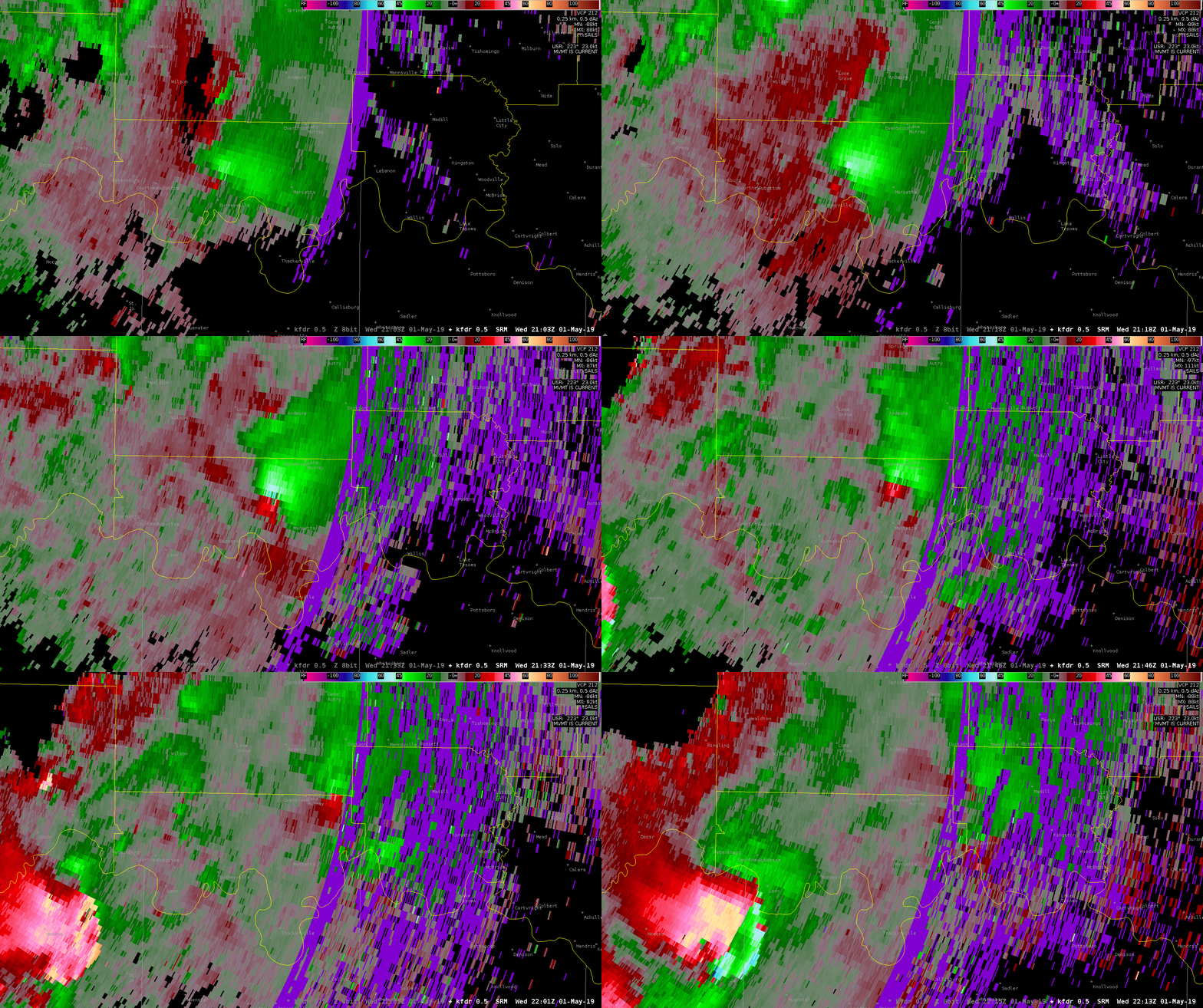
KFDR 0.5 deg SRM 21:03-22:13.
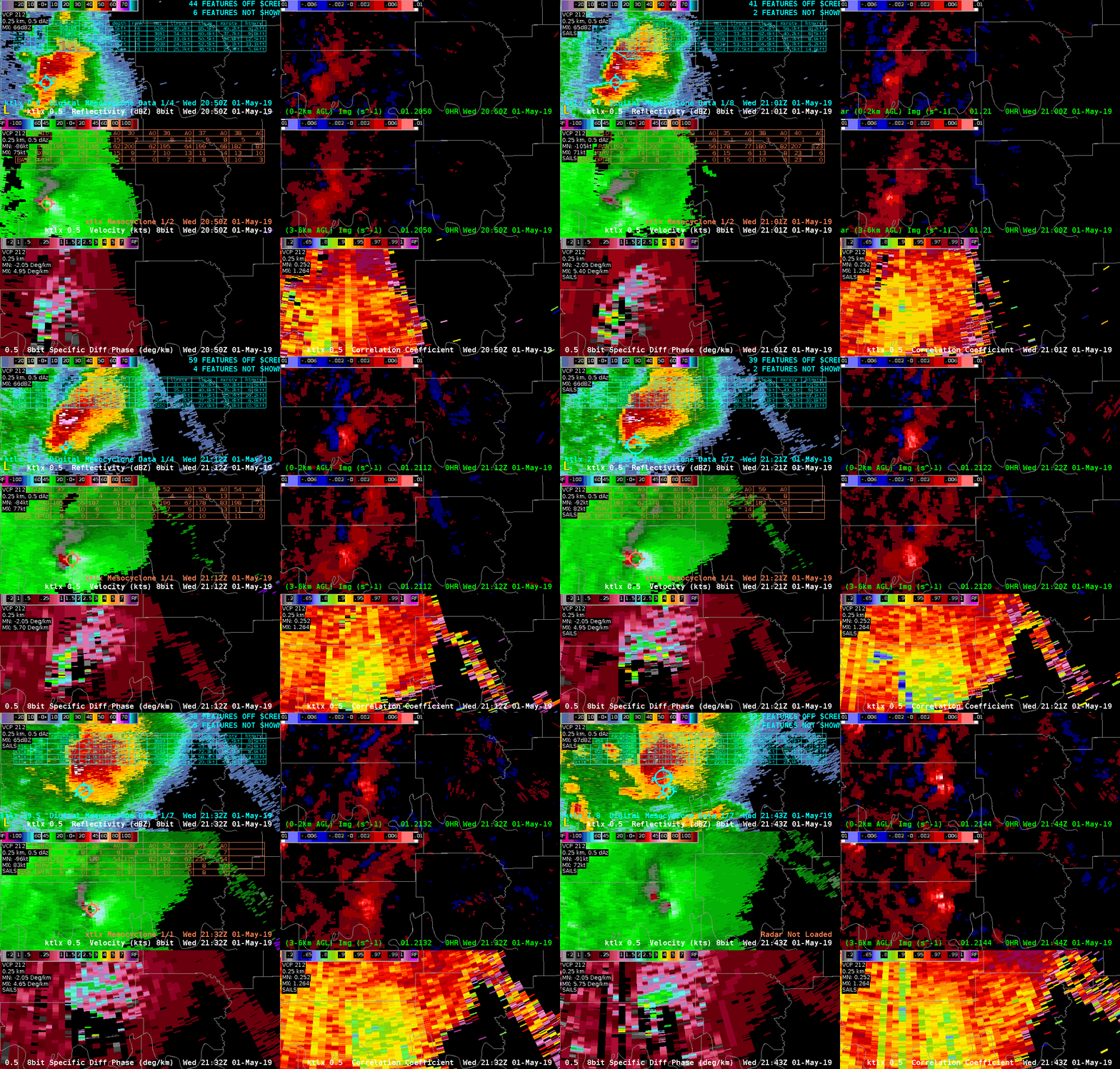
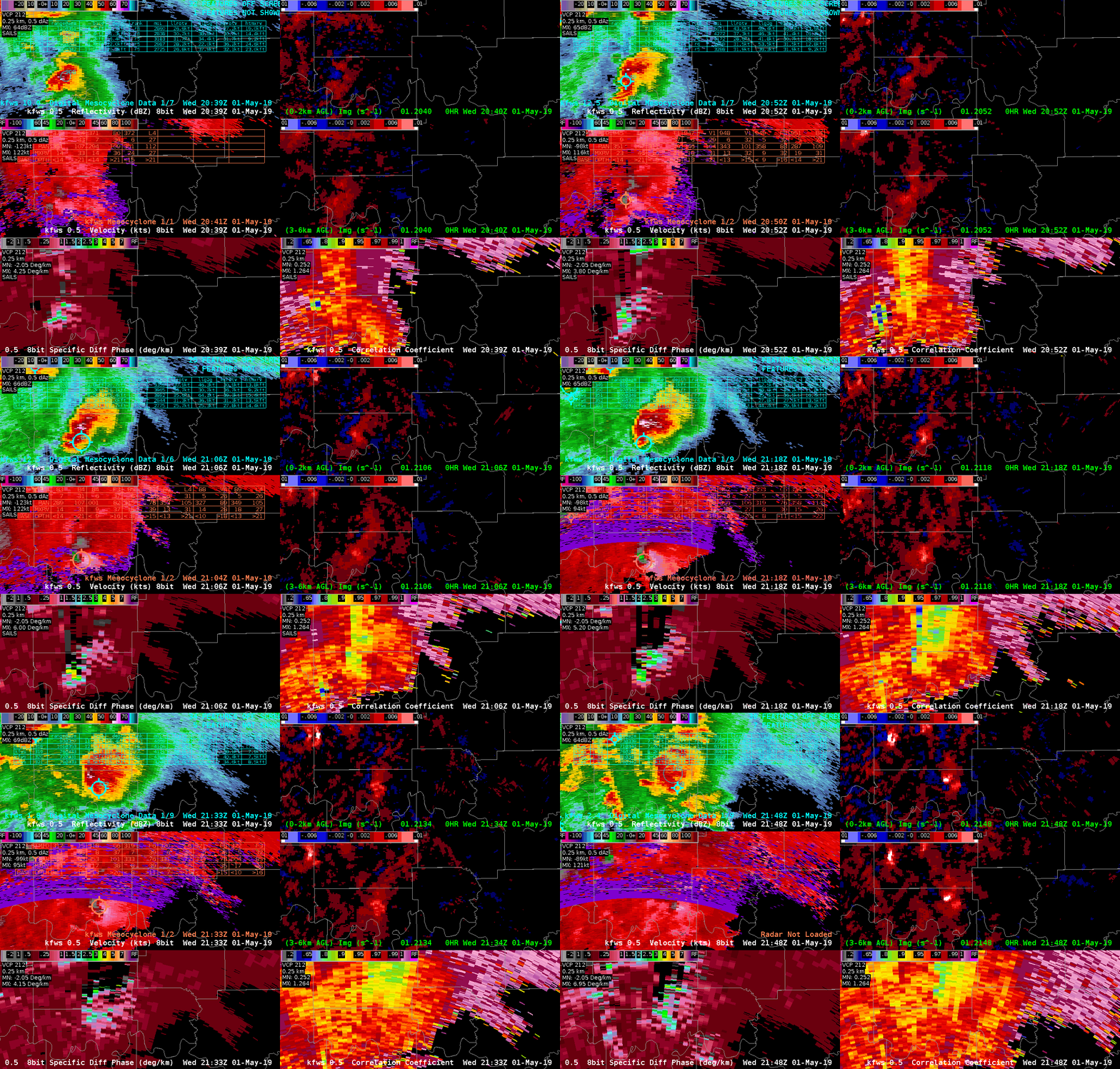
Multi-radar comparison of Tornadic Storm near Red River

KTLX, KFWS and KFDR perspectives of tornadic supercell near the Red River.  Spotters indicated occasional brief touchdowns with this storm.  Animation is from 2050 to 2143 UTC around the time of the reported brief touchdowns.  Last image is the time trend of ProbTor  (red trace) and MRMS AzShshear (red trace).  KFDR seemed to sample the mesocyclone the best and subsequent gate-gate-shear (90 nm from RDA).  ProbTor indicated a gradual increase then took a sudden drop shortly after 2130 UTC, then continued to increase.  This may have been the result of a similar drop in the MRMS AzSHear.  Not clear why AzShear dropped off briefly (perhaps a sampling issue with one of the radars). However, radar SRM data did not show any indication of weakening circulation in any of the, in fact the velocity couplet was even stronger around 2130 UTC especially KFDR radar.  A caution to forecasters to be careful when examining trends in the ProbTor and be sure to examine the various inputs into ProbTor in conjunction with the radar (velocity trends). – Quik Twip

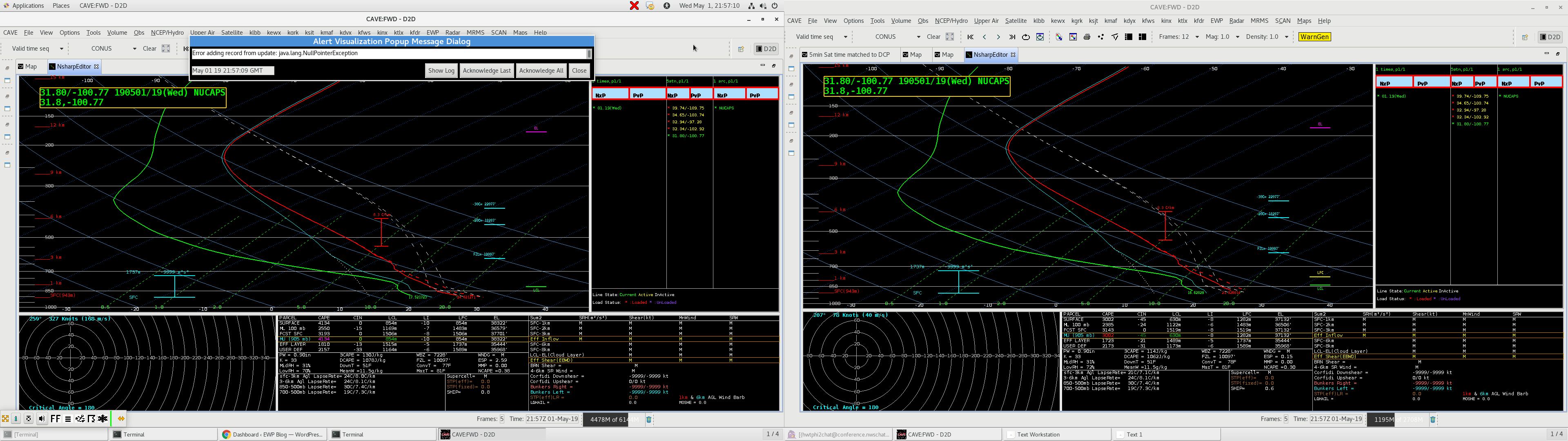
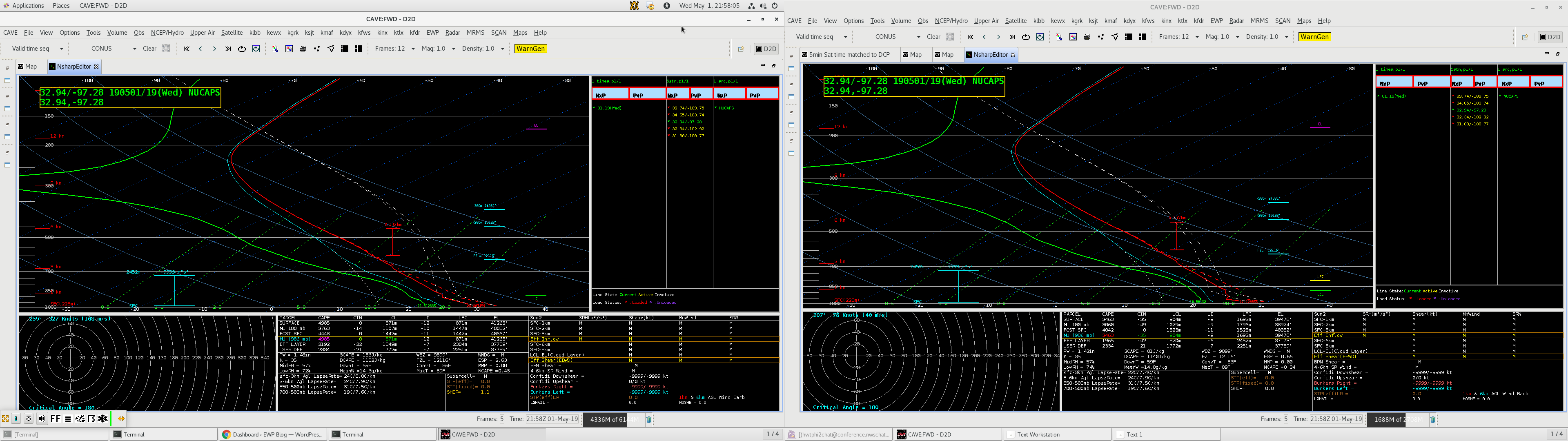
NUCAPS comparisons – modified versus unmodified

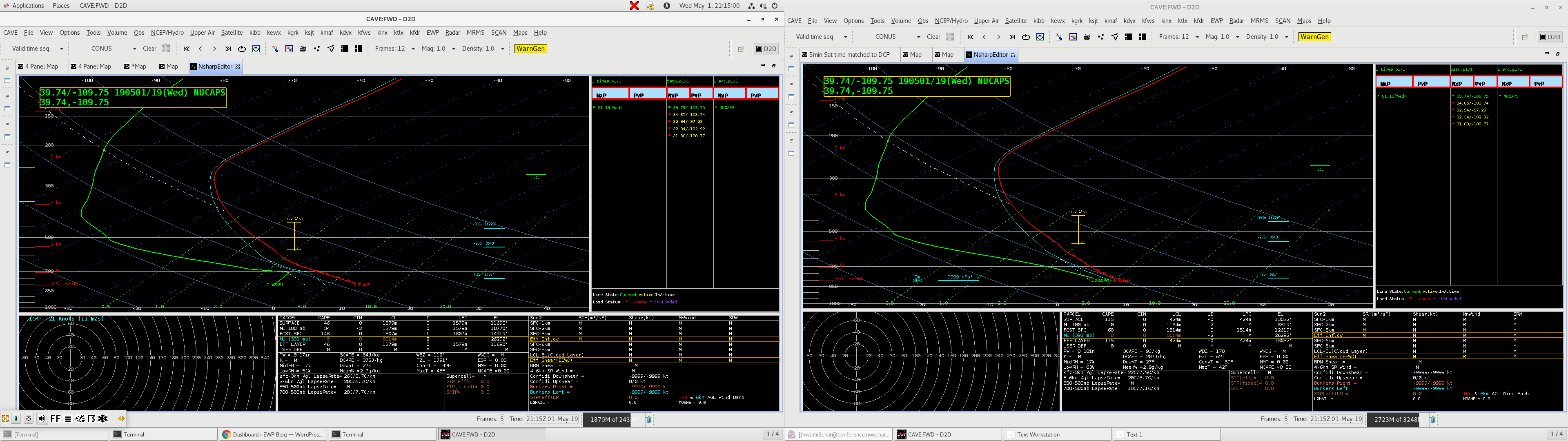
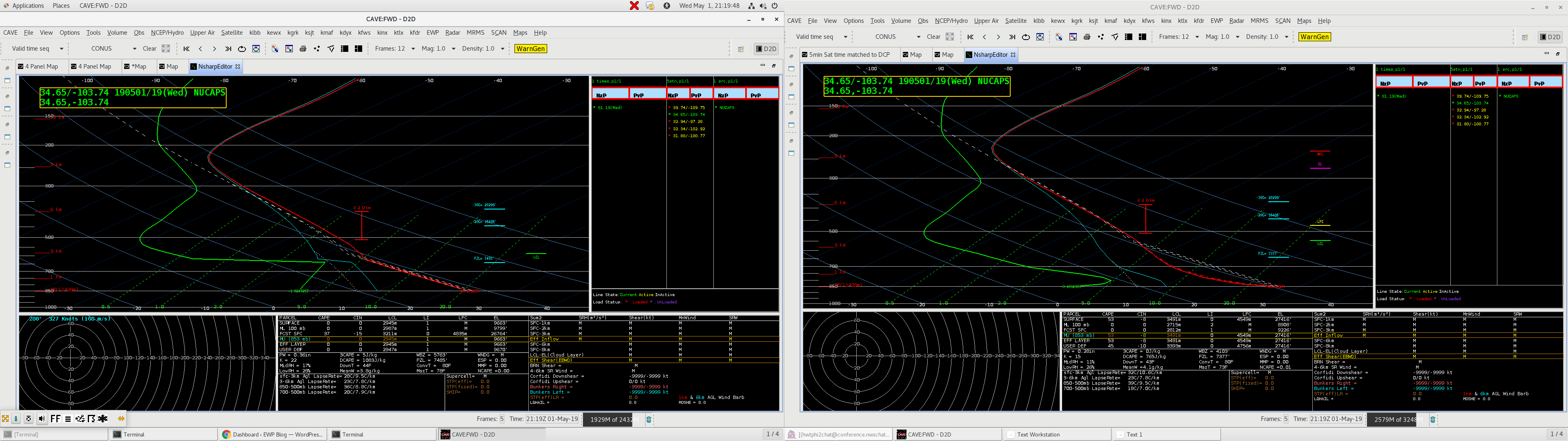
Compared several NUCAPS soundings across the pass to determine usefulness of the modified versus unmodified data. In each example, the modified is on the left and unmodified is on the right. The example above was quite dramatic. This was an example over my home CWA. The modified sounding on the left captures the true mixing likely taking place over the point to the north of GJT airport, the right has a vastly different temp/td profile. This would have dramatic impacts for fire weather and smoke dispersal forecasting in remote areas, which is a critical task provided by our office. 
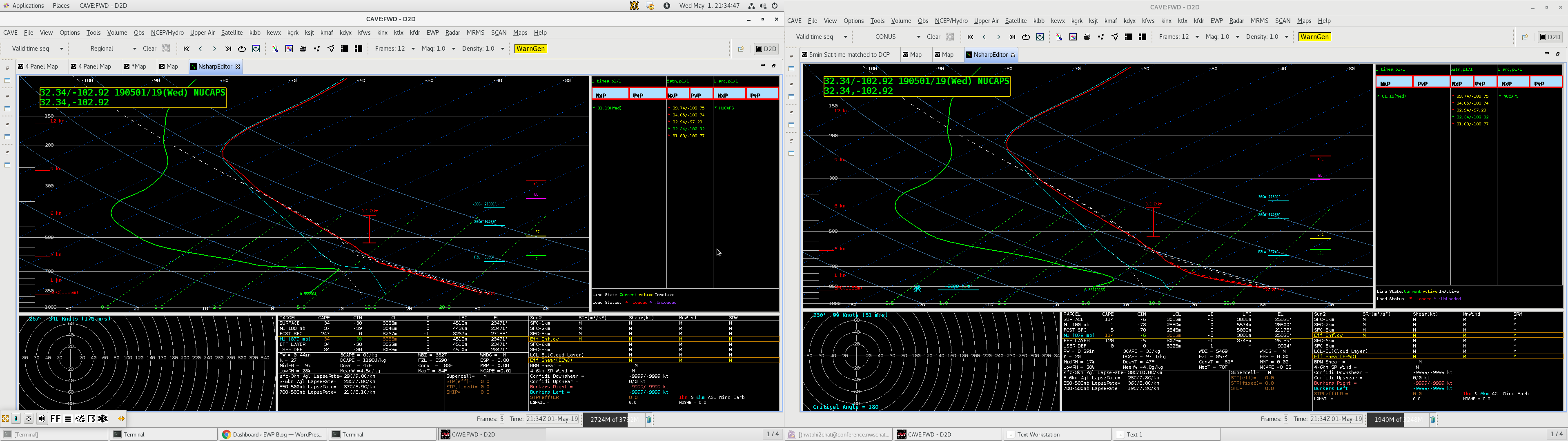
Moving south, the above example is well west of the dry line in New Mexico. Unmodified does capture a well mixed BL, but the modified shows this feature more pronounced. Clear skies were present throughout the entire day leading up to this point. 

This sounding above was from just slightly west of the dryline

This sounding was a bit farther east, in the vicinity of increasing moisture east of the dry line. Finally this sounding was from well east of the dry line in the vicinity of intense thunderstorm development. Note the odd structure in the lower levels in the unmodified sounding on the left, these strange temp readings are eliminated in the modified sounding which greatly changes the CAPE values and other parameters. 


-Dusty Davis

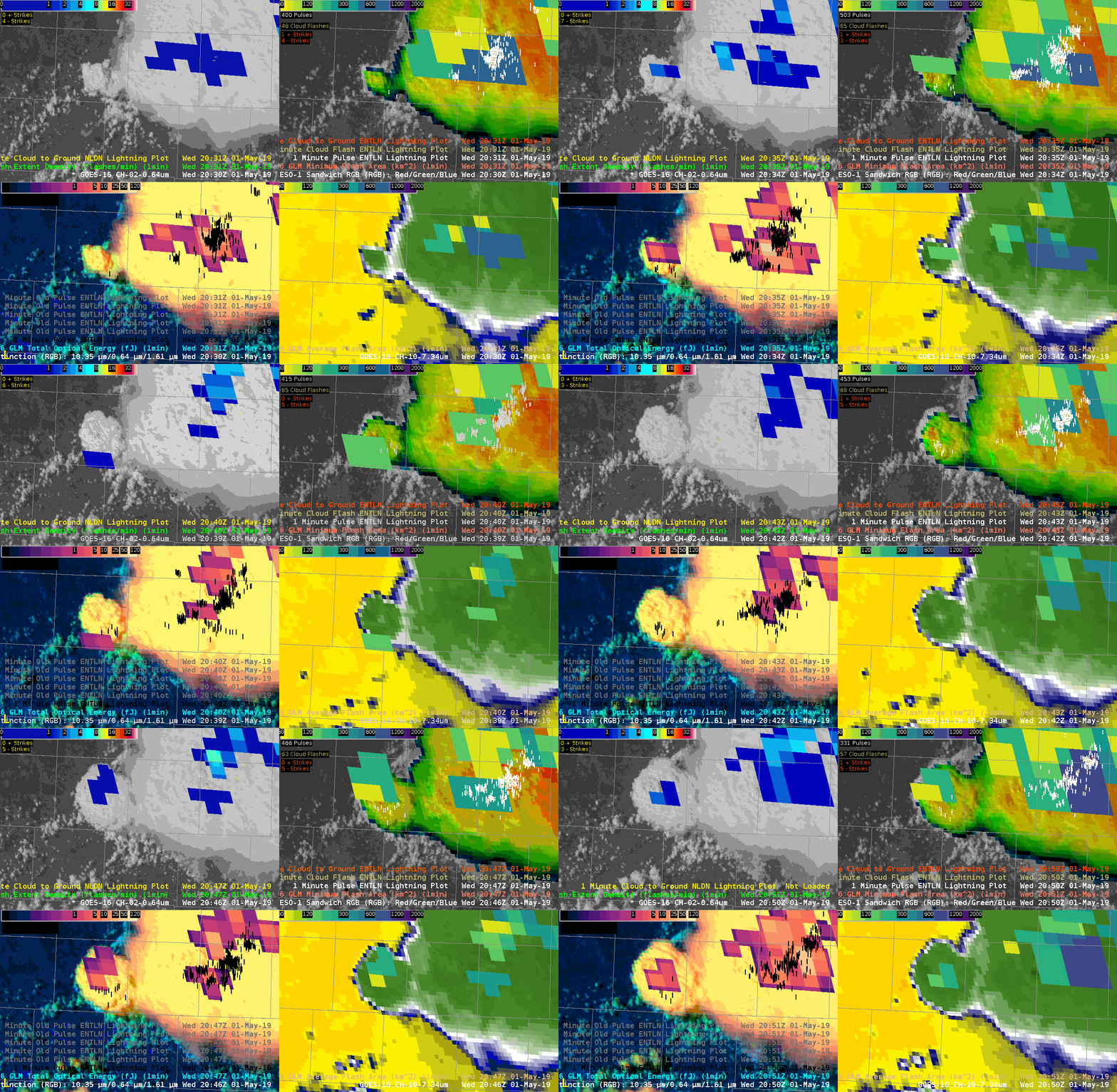
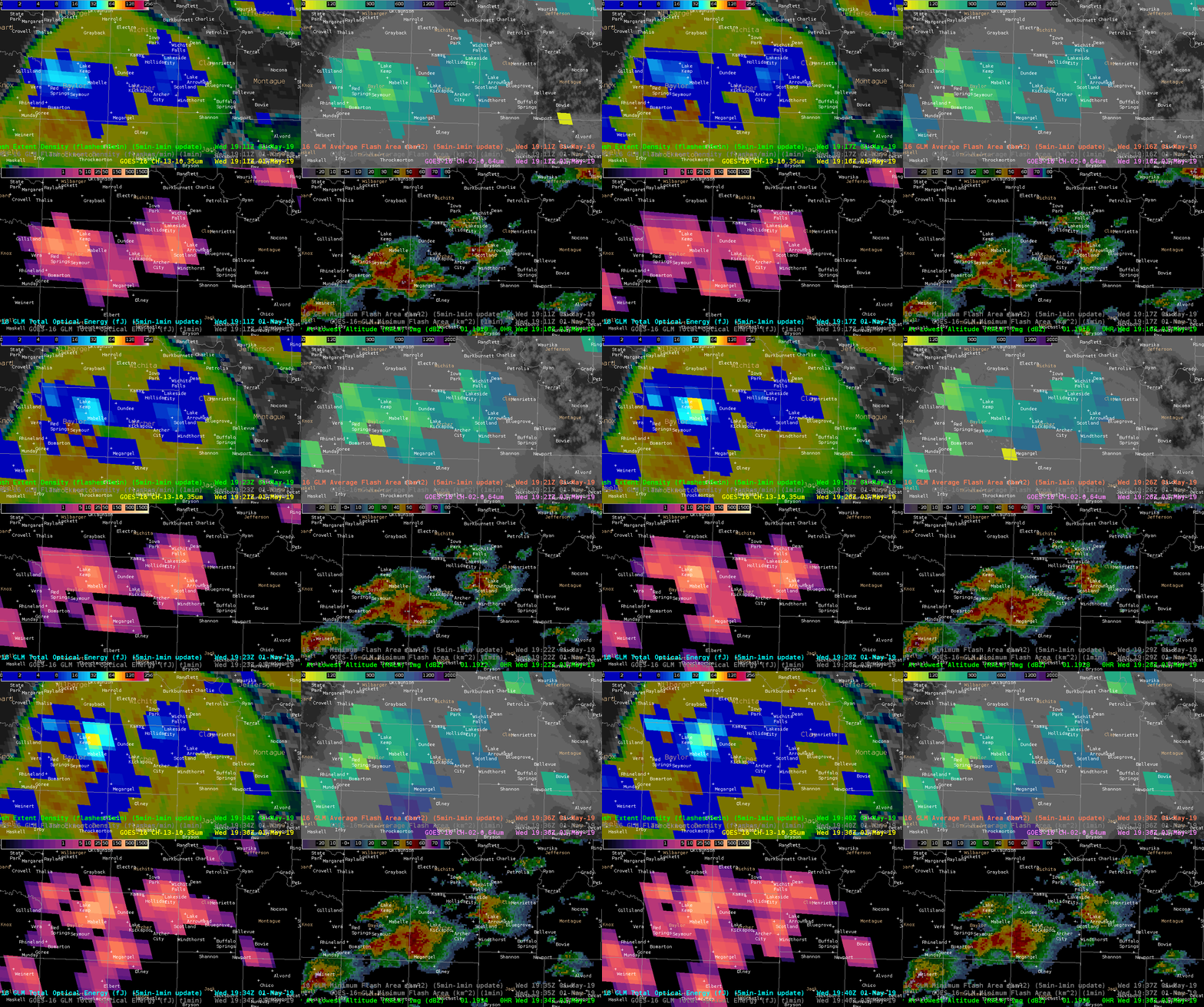
Initial lightning detection in new storm UD

Comparison of 1 min update GLM .vs. ground-based detection for new updraft tower.

Upper-Left is FED, Upper-Right is 1 min pulse ENTLN and Minimum Flash area, Lower-Left is 1min pulse ENTLN and TOE;  and Lower-Right Average Flash area.  First detected “pulse” is evident about 5 minutes prior to first GLM detections.  Note that the initial pulses in a new updraft may not be associated with a “flash”.    Also note the parallax error in the satellite-based detection.  – Quik Twip

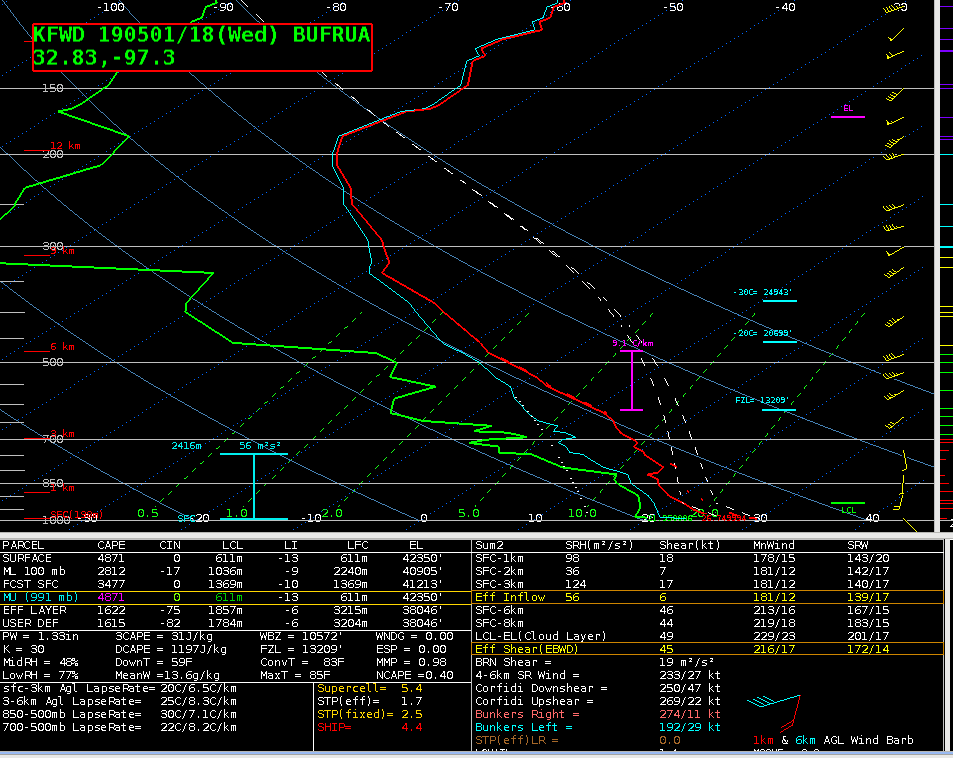
NUCAPS vs. Obs

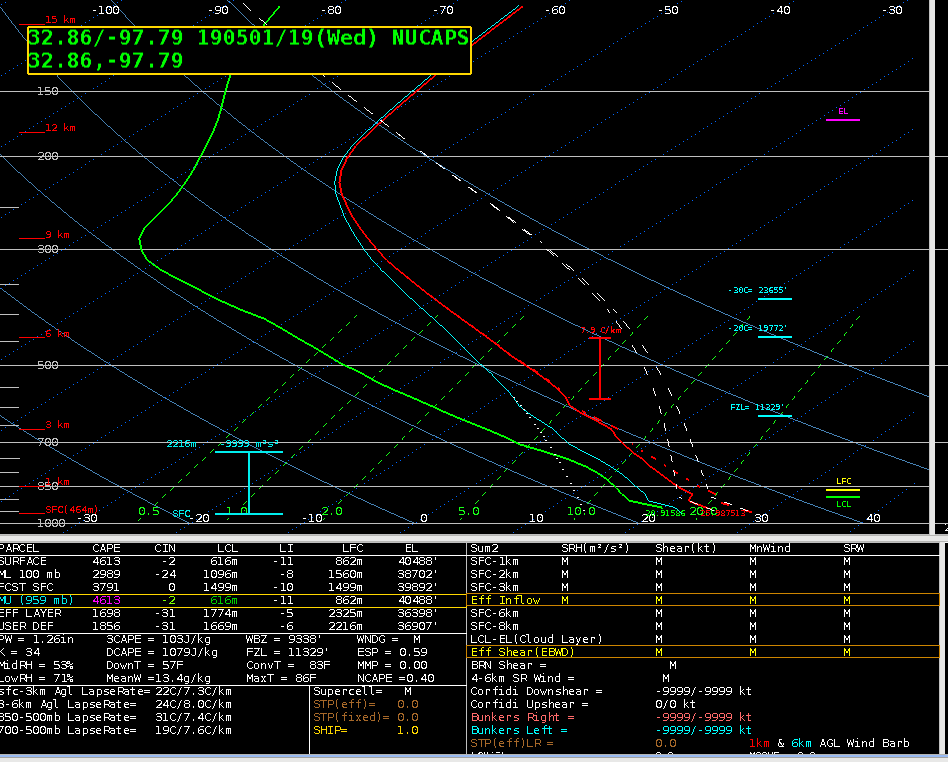
Perfect conditions to utilize NUCAPS soundings today in the FWD CWA. FWD did a special release at 18z and I was able to compare that to a 19z NUCAPS sounding immediately west of FWD, ahead of the ongoing convection north and west of the CWA. They are remarkably similar from the boundary layer upward with very similar MUCAPE/SBCAPE values around 4600-4800 J/kg.

This highlights how important these NUCAPS soundings can be in the absence of any 18-20z special balloon releases. I’m very impressed with how well it lines up with the observed 18z launch and have more confidence in using these in pre-convective environments.

–Stanley Cupp

18z FWD sounding:

19z modified-NUCAPS sounding ~25 miles west of FWD

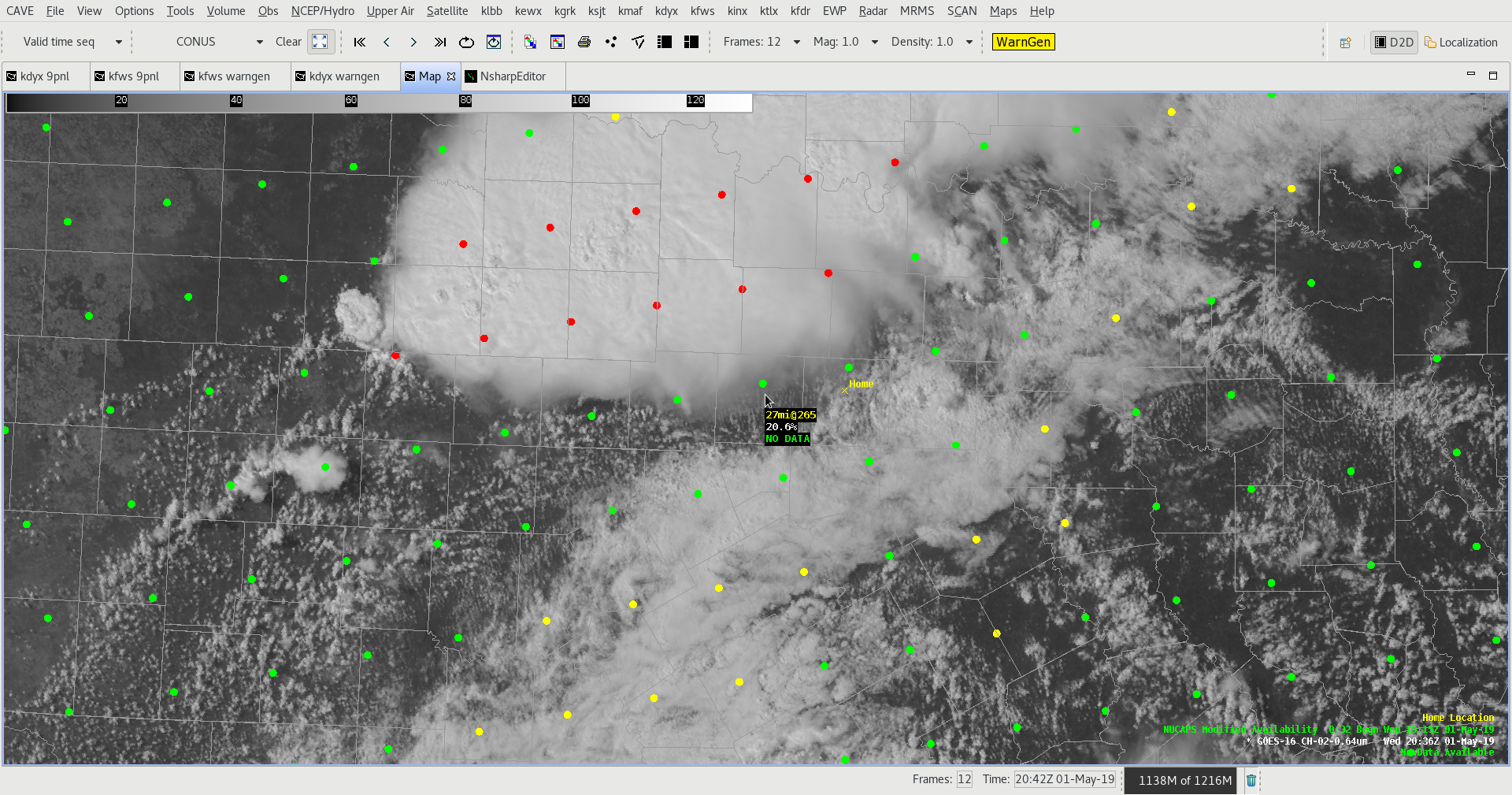
NUCAPS location (green dot above mouse cursor) vs. FWD location (yellow home cursor) and 1 minute vis imagery

Baylor Co TX Split

The storm split over Baylor county was seen in GLM. Higher flash rates remained with the right mover. The average flash area remained small through the transition but eventually some larger flashes were observed in the right mover.

There was also a significant lightning increase with the right mover, from 20 fl/5-min to over 80 fl/5-min in 10 minute period.

— SCoulomb

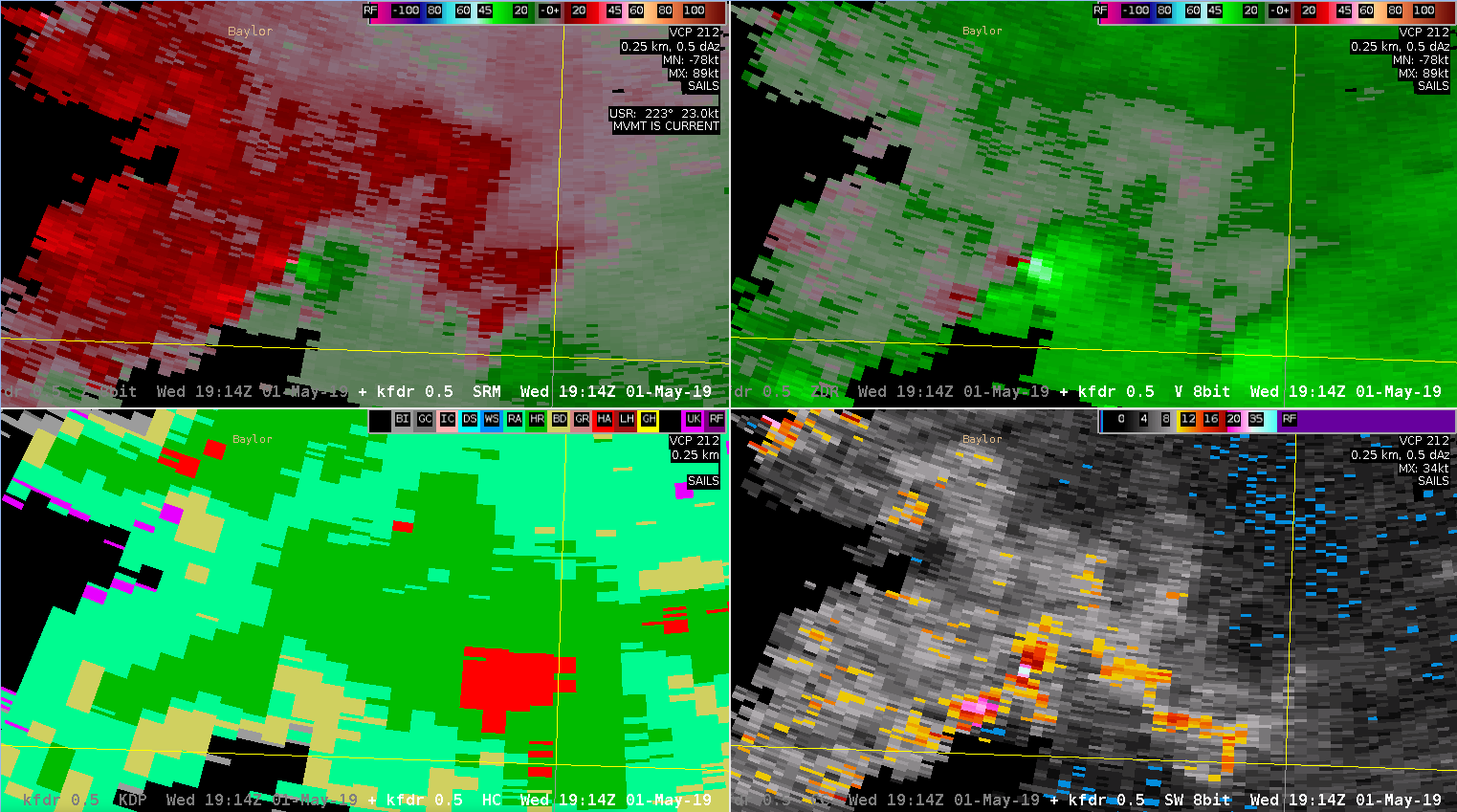
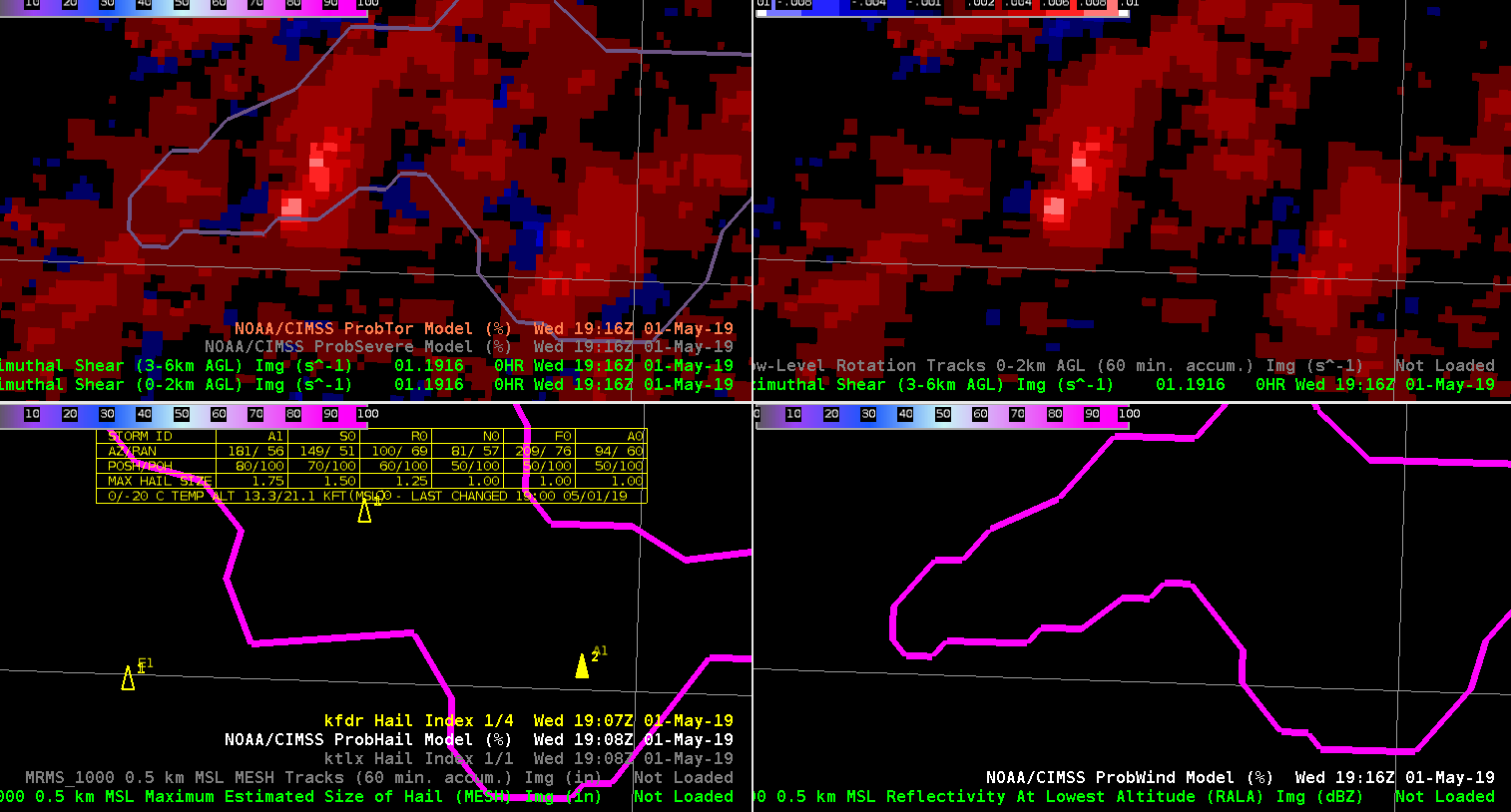
Baylor Co TX – cycling meso

The supercell over NW TX developed a new meso. AzShear also picked up on both circulations. ProbTor values remained relatively low (~3%) throughout this transition. AzShear was weak with SRH only 107 m2/s2, mean wind was also low at 22 kt – all enviro. parameters were near the climatological averages not increasing the ProbTor above average values.

Today’s Experimental Operations – May 1, 2019

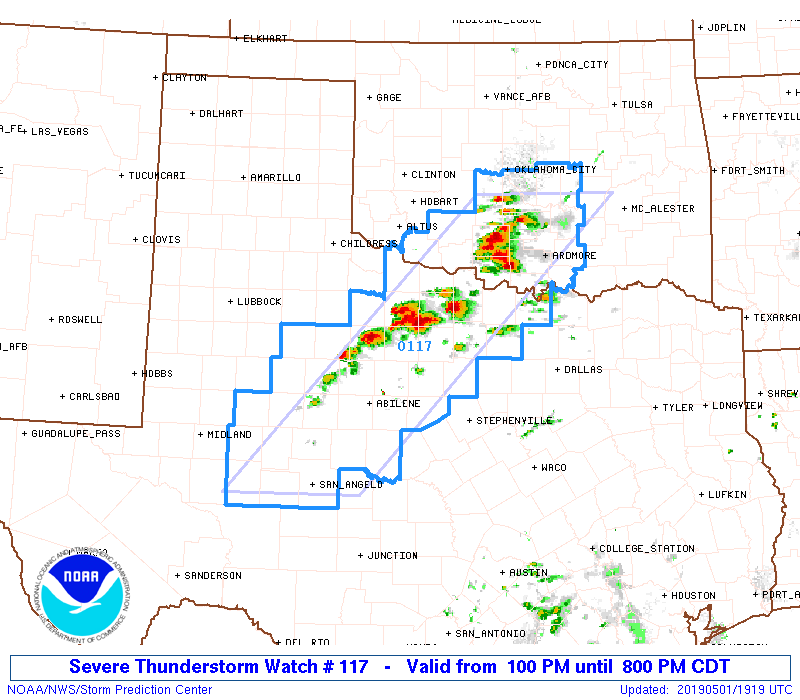
Today’s operations will be focused over the OUN (Norman), SJT (San Angelo), and FWD (Dallas/Fort Worth) county warning areas.  We are highlighting operations south of a remnant outflow boundary that has been left from storms that occurred overnight/early this morning roughly in the area of the Red River Valley.  Storms are currently on-going at the start of operations, with a severe thunderstorm watch over the operations areas that stretches from central OK all the way down to SW Texas.  Supercells will be the primary storm mode to start but might transition to a linear system later in the operations period.  The main threats today are large hail and high winds but tornadoes are still possible (lower probabilities than yesterday though).

Tags: None

Mesoanalysis of Storm Development

Figure A

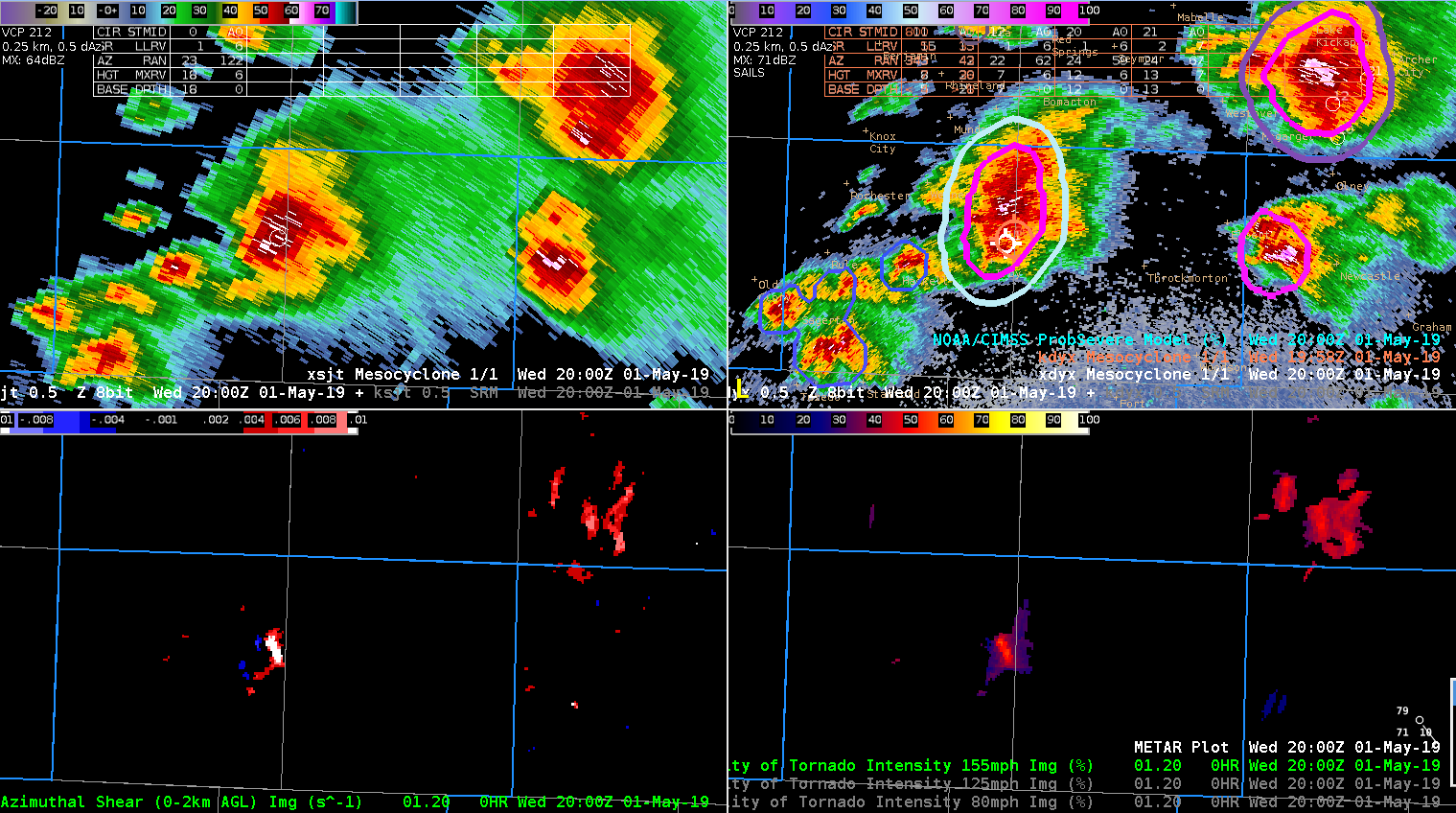
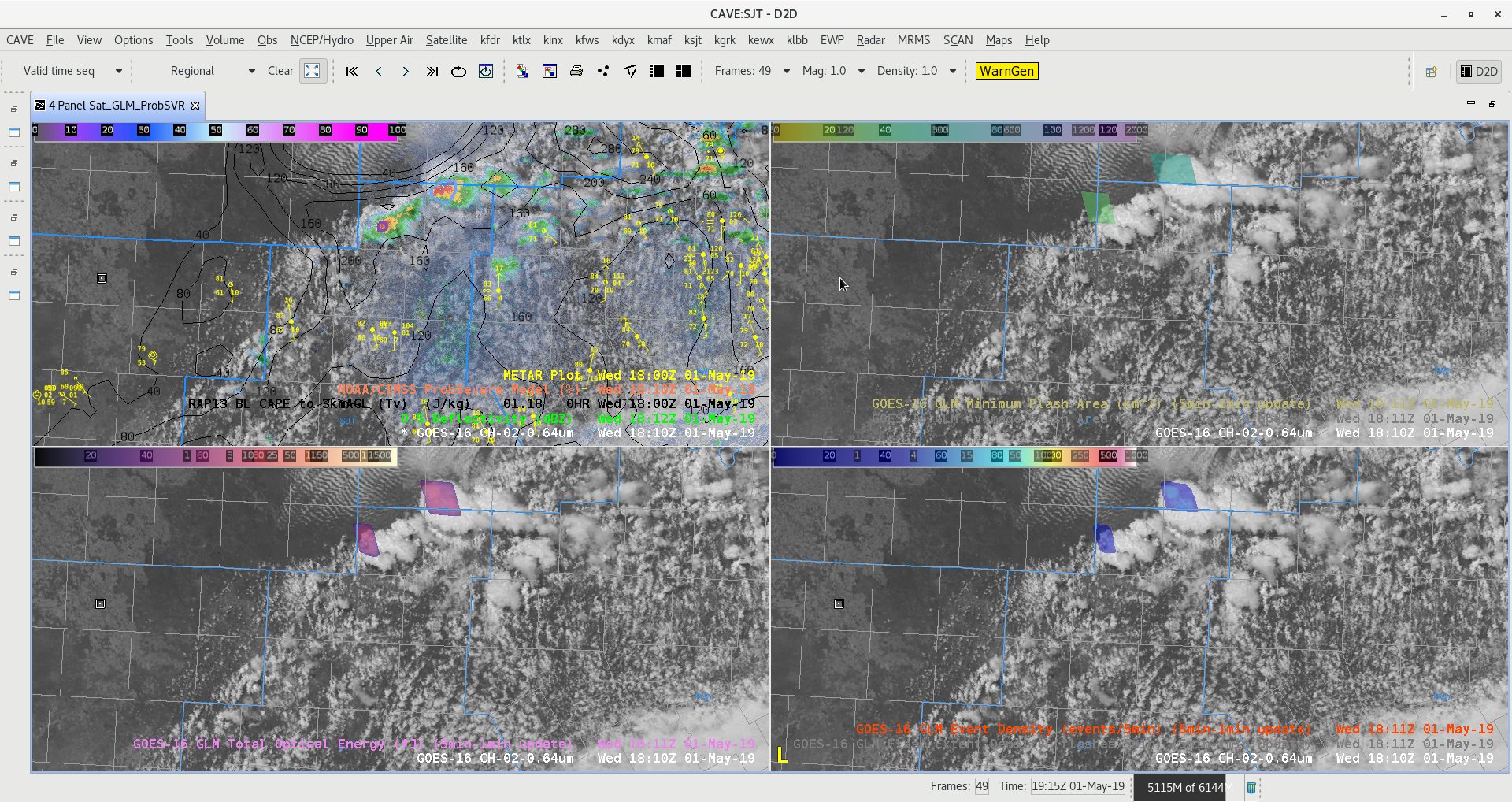
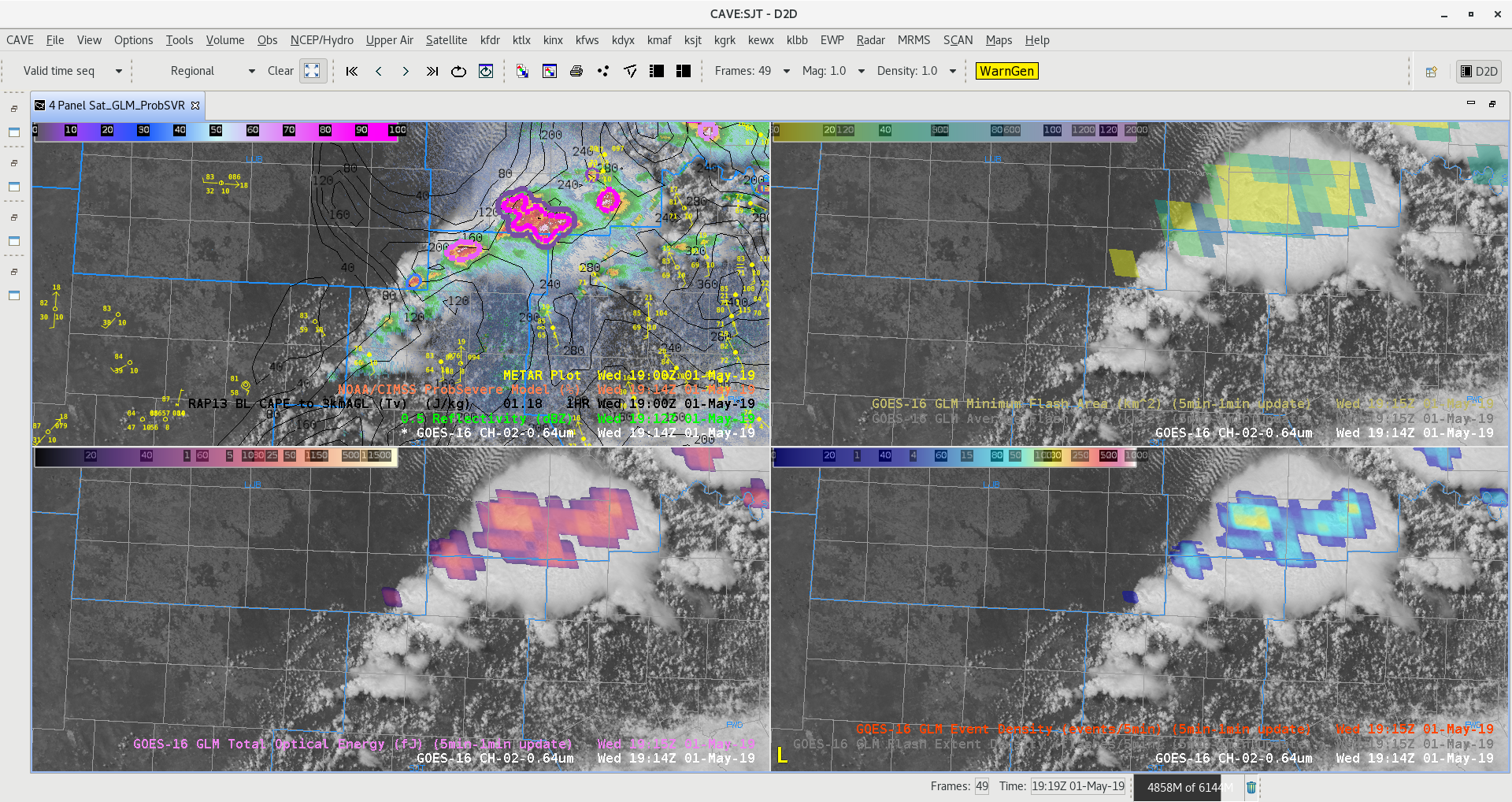
Lightning and ProbSVR detection of first storm develop in west Texas.  GLM products high-lighting two updrafts at 1810Z in Figure A.

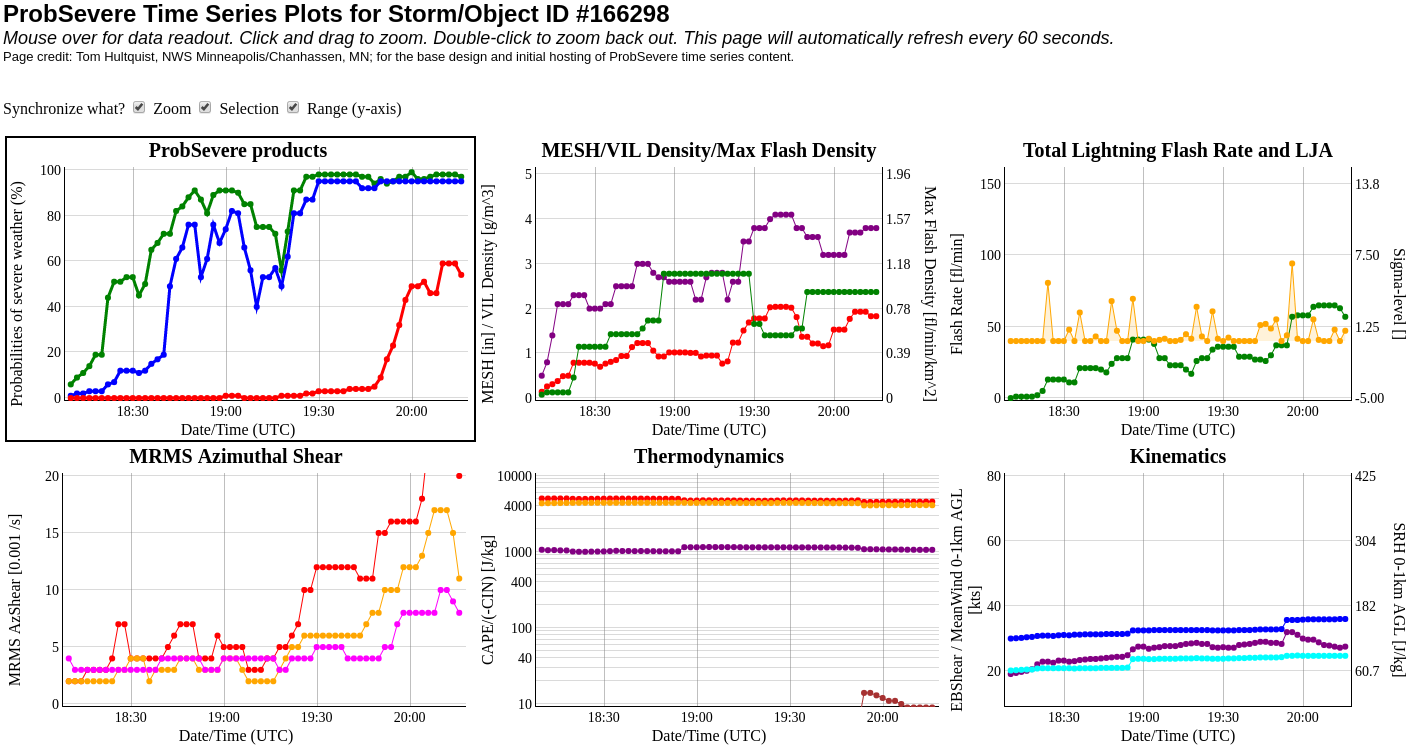
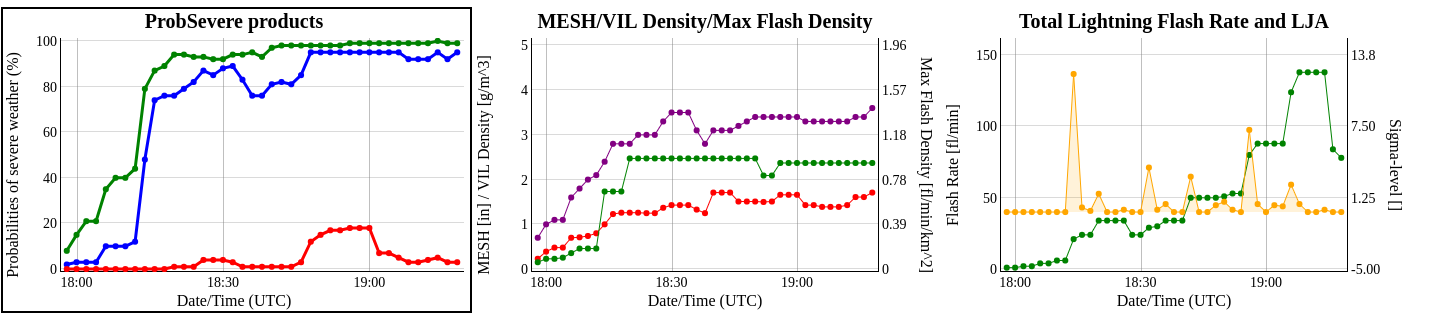
Lightning really increased showing lightning jumps and ProSVR Hail/Wind greater than 90% in time series trends.  Notice Tornado trend increased slightly with lowering wall cloud report, however environment is not as favorable for tornadoes today with 0-1km shear on the low end.