Initial Setup for LBB

Today we are set up as WFO LBB in north central TX.  Water vapor imagery (upper left in image below) shows large upper low centered over the four corners region with broad cyclonic flow across NM/TX with plenty of dry air moving into the forecast area.  Visible imagery shows some general clearing across the area as thicker clouds moved out of the area from this morning.  Expect convection to develop later this afternoon as atmosphere destabilizes across the region with hail and damaging winds as the main threat. An initial look at the CI product (lower left in image below) is showing mainly low probabilities of initiation across the LBB CWA but there have been some higher probabilities to the west over NM closer to the core of the upper low where lapse rates are steeper and associated with the colder air aloft.

4pnl_WV_VIS_CI_PWLooking at the GOES-R LAP precipitable water data the significant dry air is located in the 700-300mb level (lower left in the below image) which matches up well with RAP analysis soundings.    Not much on the radar this point to look at but will be monitor for developing convection.

4pnl_GOES-R_PWJack Bauer

Tags: None

Setting Up in ABQ

Currently in the process of setting up in ABQ CWA for the afternoon and will provide a little bit of an overview.  Water Vapor imagery is showing a disutrbance shifting east across eastern New Mexico, as seen in the image below.

050515_1745Z_WV

Already seeing convection over the area, both coming off the mountains and associated with the upper disturbance and also over the far eastern part of the cwa along the surface trough stretching south-southeast from the low in southeast Colorado.  While the convection coming off the higher terrain was already mature, the convective initiation product did pick up on the development of newer convection farther to the south and east of KROW.

050515_1745_VisSat_CI

As the storms continue to the east and into the higher instability shown on the GOES Sounder LAP CAPE, would expect the intensity of the storms to increase.

050515_1700_VisSat

Finally, here is a look at the radar from 1842Z showing both of the areas of convection. Before developing this post, was planning on issuing a warning on a cell to the southwest of Mesa, NM, but technical issues with the Text Workstation inhibited the issuance. In the decision process, used the ProbSevere data to add confidence (increasing from 5% to 77% in about 15min) to the higher cores seen on the radar data.

050515_1842Z_Radar_Lightning

SRF


Tags: None

Initial thoughts on convection for AMA

GOES-R/CIMSS CAPE values continue to increase across southeastern portions of the Albuquerque, NM, area towards the southwestern portions of the AMA CWA. Values are not markedly high, on the order of 400-500 J/KG, but skies continue to clear in the wake of convection earlier this morning allowing for greater destabilization later this afternoon.

050515_GOES_CIMMS_Cape_CI_18ZThe UAH GOES-R convective initiation probabilities continue to also increase for southeastern portions of the ABQ CWA and southern portions of the AMA CWA. Reflectivities remain weak moving northeast in the southern AMA CWA, but expect coverage to increase as the storms move into the more favorable environment.

1850Z_radar_ProbSevere_IR_CIMSS_CIBrick Tamland

Tags: None

Starting the day in ABQ

I’ll be starting out the day in ABQ. There is a short wave rotating through the region and convection has already fired off the higher terrain and is moving towards the NE. The GOES-R LAP CAPE and LI are enhanced in this area.

ABQ WV

ABQ GOES CAPE

ABQ topo radar

Interestingly, there has been very few CG lightning strikes with the stronger cells.

ABQ IC LTG

Time to go load up more data.

-V. Darkbloom


Tags: None

Pre Storm Environment

Briefing and water vapor loop showed short wave crossing north central New Mexico. Drying on Water vapor loop lines up with the clearing on the leading edge of the short wave. Better indications of CI in far sw CWA. CAPES have increased to near 1100 J/KG just south of the forecast area. Have DTA  set up and awaiting the next pass for NUCAPS availability. CAPES and LI 18z May 5 CAPES and LI 18z May 5


Lynford

Tags: None

Lubbock CWA Conditions

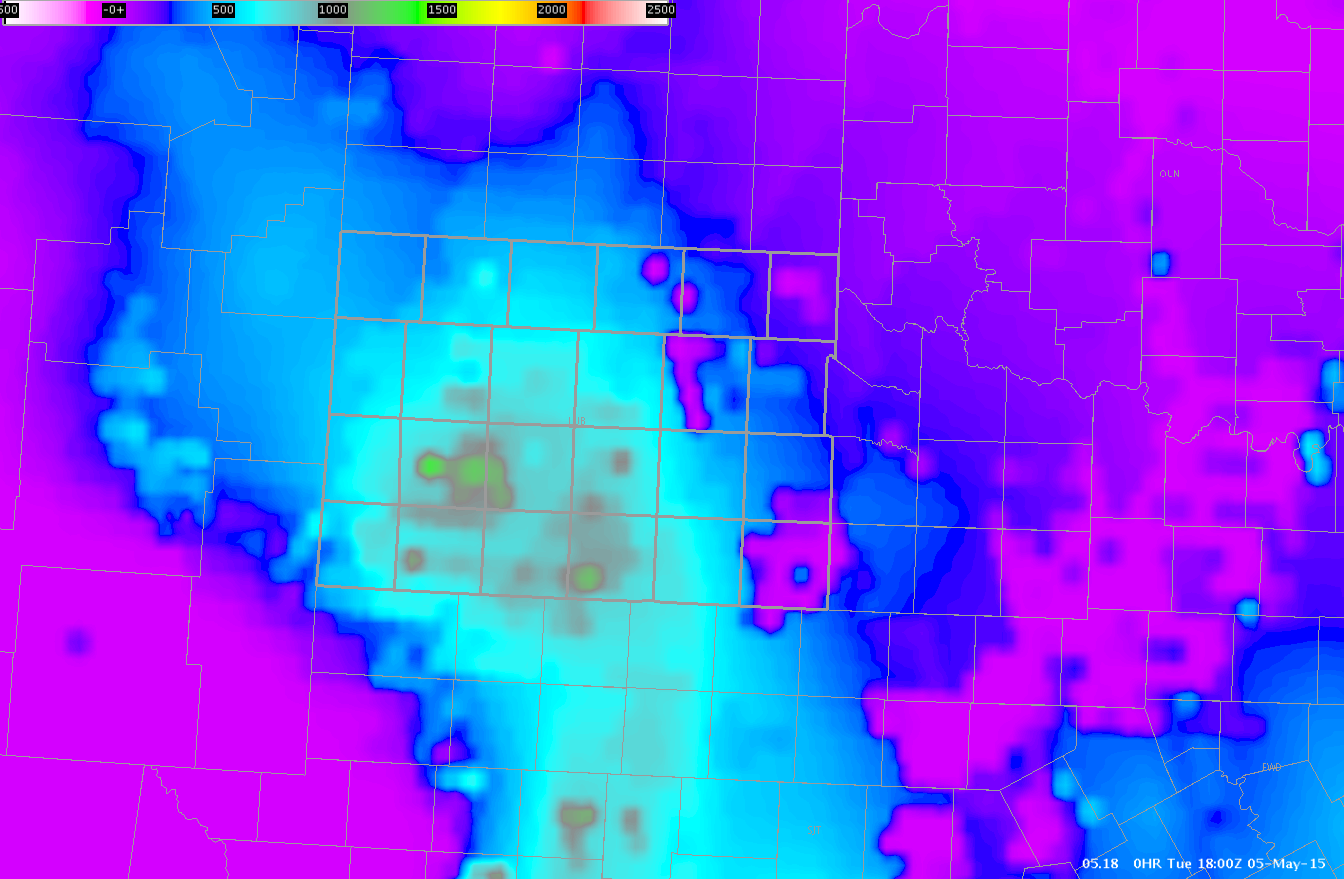
My warning operations will focus over the Lubbock CWA this afternoon.  Clearing of this morning’s cloud cover began to occur around 1830 UTC.  A cumulus field has quickly developed in the areas which cleared.  I will be watching the GOES CI Probability in this region as instability continues to increase.  GOES LAP CAPE values through the CWA range from 500 to 8000 J/kg, with some spotty areas of up to 1100 J/kg.GOESCAPE

Tags: None

Daily Summary: Week 1, Day 1

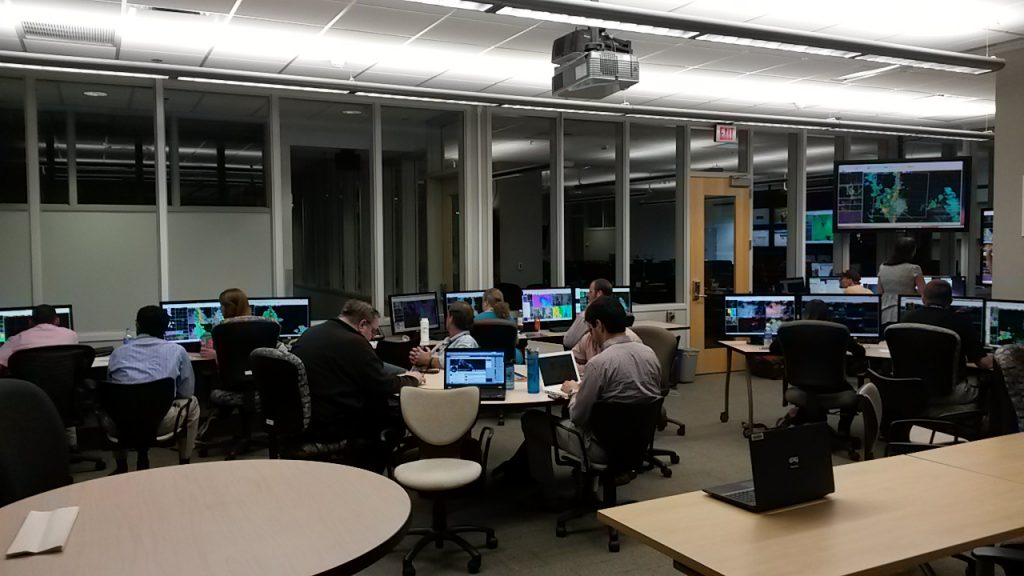
Today marked the first day of the EWP Spring Experiment in the Hazardous Weather Testbed in Norman, OK. This year, 5 NWS forecasters and 1 broadcast meteorologist will evaluate various GOES-R and JPSS algorithms, as well as Earth Networks total lightning products. Participants, working in pairs, will use the experimental products to issue area forecast discussions and severe thunderstorm/tornado warnings for their designated CWA. All of the products being demonstrated are available in AWIPS-II.

20150505_184843

Much of the focus for the first day of the week was hands-on training for each of the products under evaluation. After some initial familiarization with AWIPS-II and procedure building, the various PI’s worked with forecasters on how to interpret the products, and what to look for during the week. Forecasters also became familiar with saving images, and posting to the blog. By the end of the day, participants had already made several informative blog posts.

We began today’s operations in the Topeka, Omaha, and Midland CWA’s. As activity subsided in the Omaha CWA, that pair moved operations to the Wichita CWA. Participants were able to utilize all of the products today, including the PGLM total lightning from the West Texas LMA.

Tomorrow, we will start activities at 12:00 pm in the Dev Lab for the daily debrief before moving to the HWT for the 12:45 EFP briefing. Operations will likely take place in West Texas.

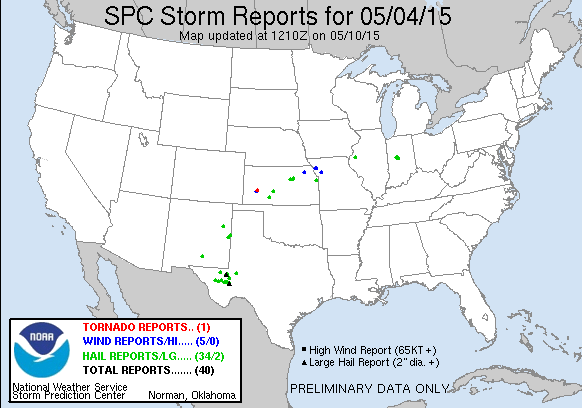
150504_rpts

– Bill Line, SPC/HWT Satellite Liaison and Week 1 EWP Coordinator

Tags: None

Convective Initiation in Southwest Kansas

Looking at the Convective initiation product over southwest Kansas in an area where the earlier cirrus had cleared out showed some enhanced probabilities in the 60-70% range at 2000 UTC over Hodegman county, KS.

SW_KS_CI_2000utc

At that time there was not any radar returns showing up in that part of the county where the CI was identified.  When looking at the radar imagery at 2045 UTC there was new convection that had developed across northeastern Hodgeman county.  I think this is a great example of the benefit of the CI product and how it does especially well in environments where only cumulus cloud development is occurring.

SW_KS_CI_2045utc

I think this can be a very useful product in the WFO, especially in offices where pulse convection can be a problem, such as the eastern United States.

Jack Bauer

Tags: None

Another CI Case

Just another brief example of using the GOES-R Convective Initiation Algorithm.

CZ (left) and GOES Vis and CI (right)
CZ (left) and GOES Vis and CI (right) at 1830Z. The orange areas show 81% probability of CI.
Click to animate.
Click to animate.

Convection did indeed initiate soon after, becoming severe by 20Z. There were several reports of golf ball sized hail associated with this storm between 20Z and 22Z.

LSR2

As of  2312Z this cell is still going strong. A pair of weak cells has popped up just to the south and the CI algorithm is showing two more 80% areas with these cells.

MAF CI 2

We’re about to start wrapping up for the day, but it’ll be interesting to see how these cells evolve over the next 30 minutes or so.

-V. Darkbloom

Tags: None

Earth Networks Lightning Time Series for 3rd SVR in Topeka

The time series lightning plot for the 3rd SVR in Topekas area is below. Note the peak close to 125 flashes/min around 2245Z which coincided with another hail core development aloft, 60 dBZ to around 22k ft/-25 C. This area is also tricky because it at the western tail end of a line of thunderstorms, so the centroid designation may be off since it is close to several other centroids, thus skewing the point values.

ETN_pointAnalysis_OttawaKS

Brick Tamland

Tags: None