ENI Alerts Used in Warning Decision

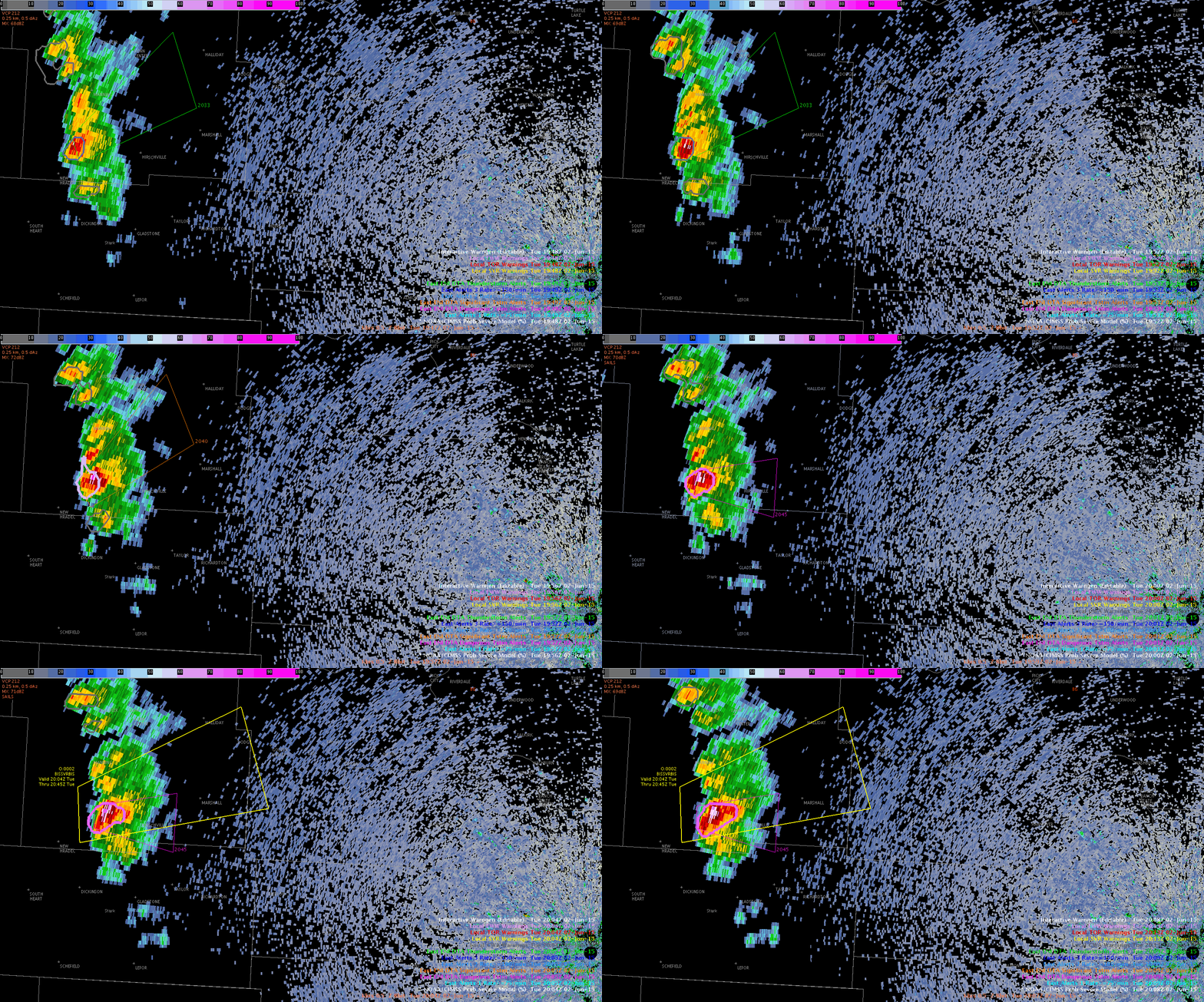
The ENI thunderstorm alerts drew my attention to a storm in the western part of the Bismarck CWA. I first got the ENI DTA Thunderstorm alert, then about 15 minutes later it had increased to the Significant Thunderstorm Alert and about 6 minutes after that, the Dangerous Thunderstorm alert. I also had the prob severe overlaid with the alerts and noticed that it was gradually increasing. This increased my confidence that the storm was strengthening and that a severe thunderstorm warning was needed. I issued the severe just after I got the dangerous thunderstorm alert. At that time, the severe prob was at 74%, but knowing the strengthening trend, I felt that I could get more lead time if I went ahead and issued the warning even though severe prob hadn’t yet reached the 80% threshold. The storm has not verified yet.

(Please click on the image below to see the animation)
svr

-Helen Hunt

Tags: None

Bismarck, ND: 1955Z TOR Issued

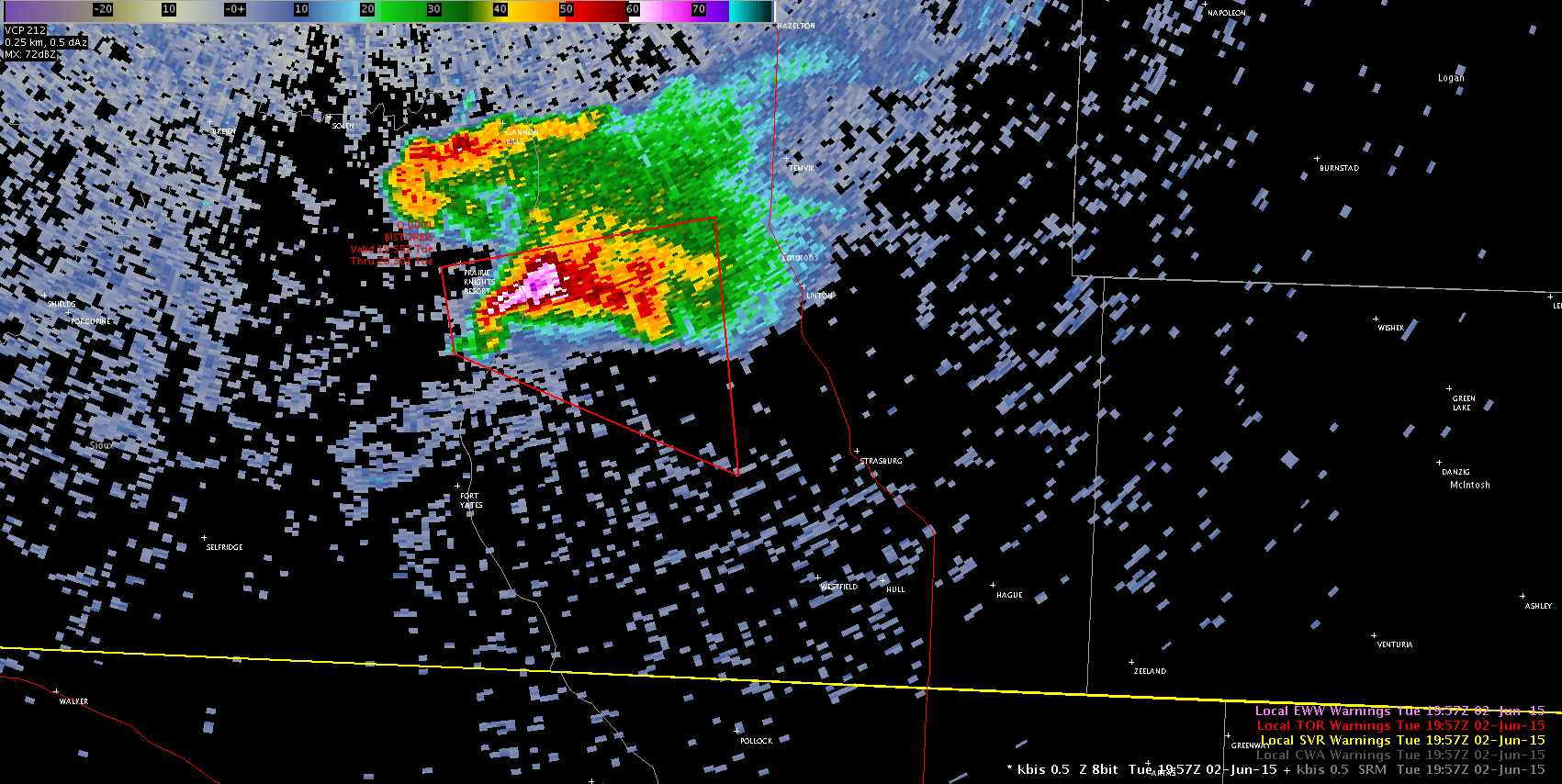
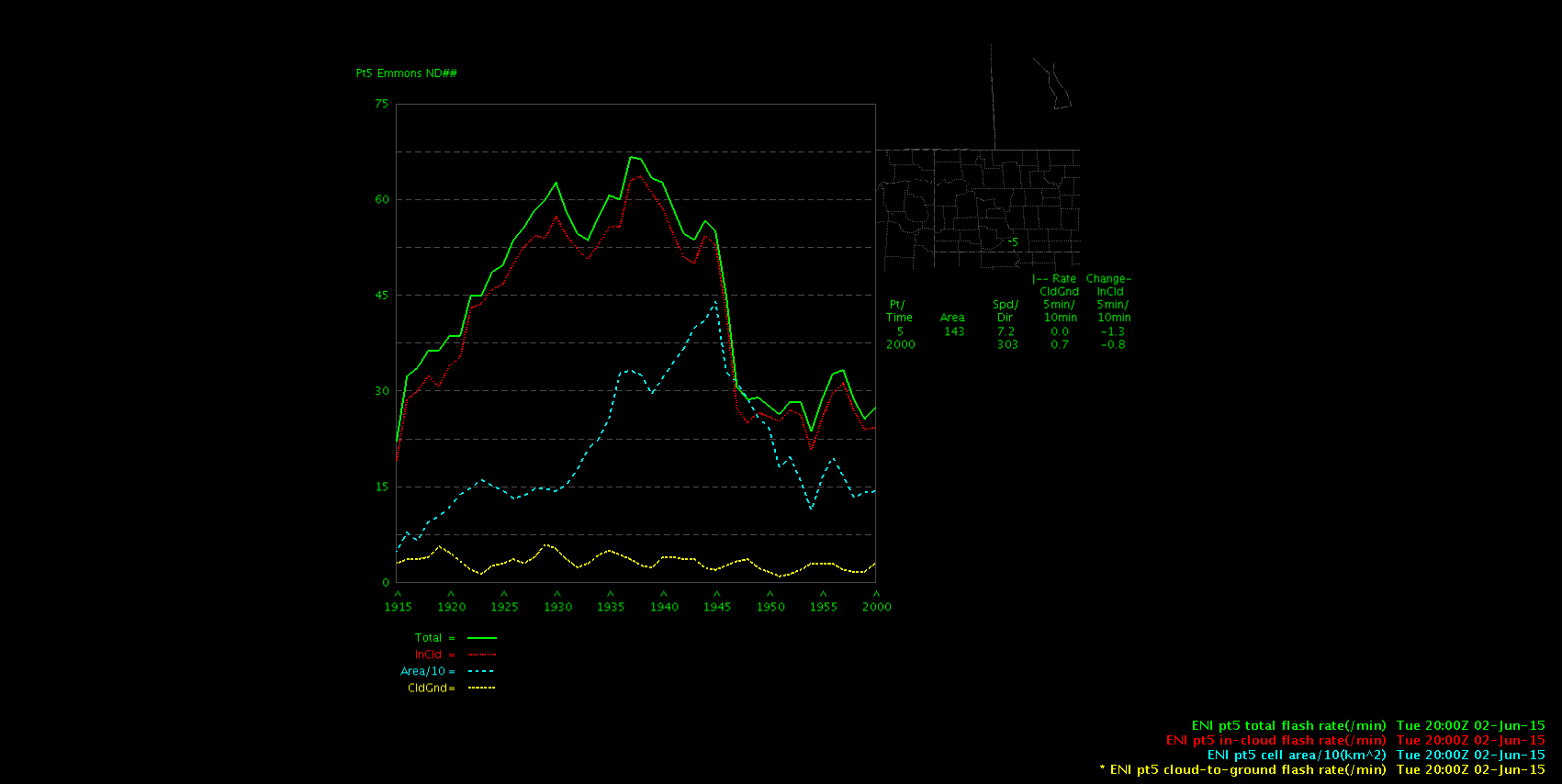
A cell over far eastern Sioux County demonstrated rapid growth and a split in which the southern cell developed into a super cell (fig 1).  The split occurred around 1940Z which marked roughly the end in the increasing trend of flash-rate which showed a marked increase around 1915Z (fig 2). The flash rate served as SA for cell strengthening, the TOR was issued based on the development of a mid-level mesocyclone and a trend in increasing low-level velocity couplet at 0.5 degrees.

TOR_radar

Fig 1: Spit with subsequent supercell formation at 1957Z.

TOR_total_flashRate

Fig 2: Increasing flash rate between 1915-1940Z. Splitting cell occurred around 1940Z.

Tags: None

SSRO and boundaries

The one minute data, by far, has been extremely useful.  The data has lead me to find small boundaries, like in this GIF.  It also has lead me to think outside of the box and find fine mesoscale features like small jets that will help strengthen and initiate convection. screenCapture


MacGyver

Tags: None

June 2 — Timing from Flash Density to CG Ltng (CYS CWA)

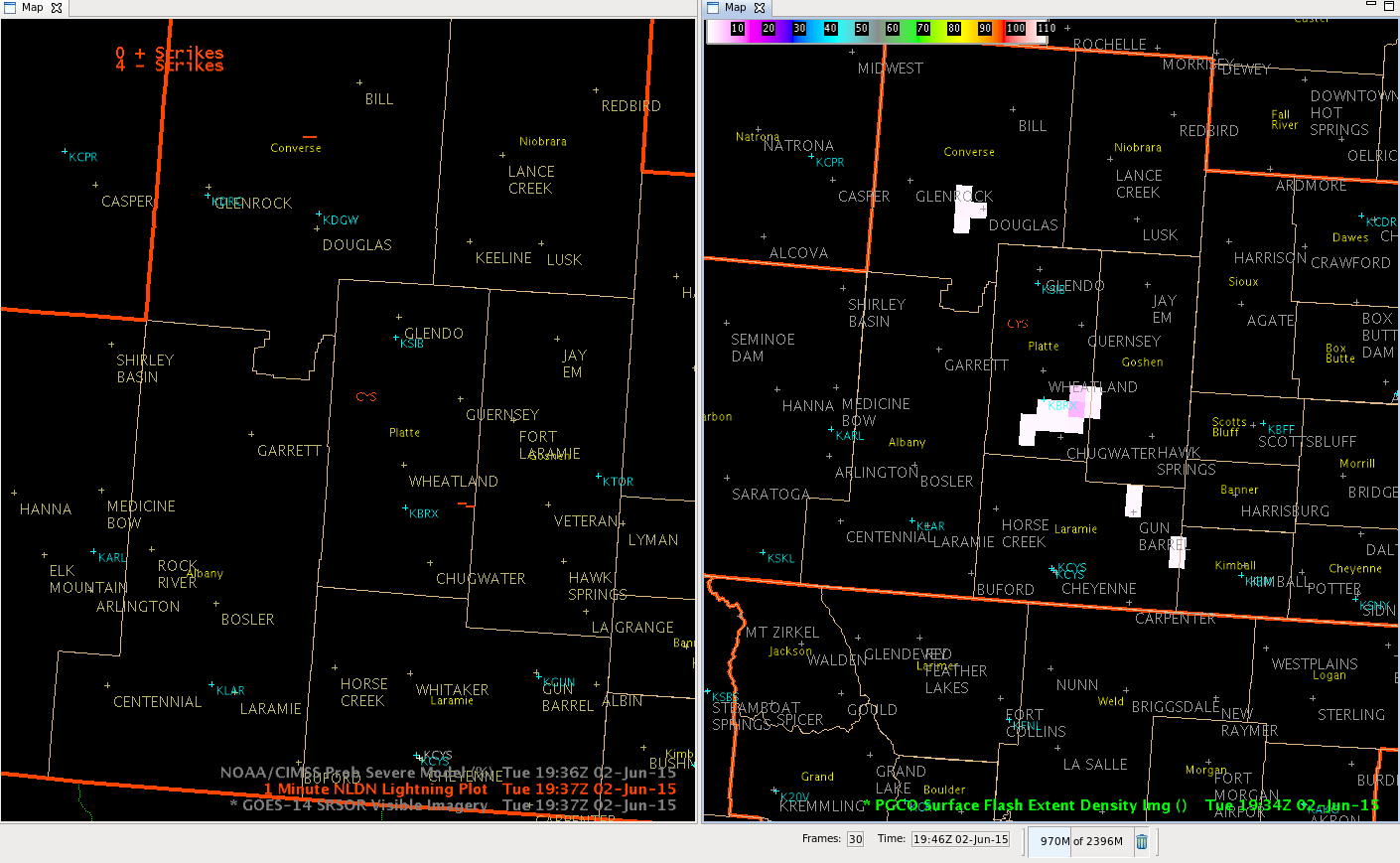
While monitoring the 1-minute satellite and NLDN data, noted that the Surface Flash Density product begins to show in increase in in-cloud density about 2-3 minutes before noting CG lightning strikes.  Check out the comparison on Figure 1.

LtngStrike_FlashDensity_Compare_2Jun15_1937ZFig 1.  NLDN Lightning Plot at 1937 UTC (L) and Surface Flash Density at 1934 UTC (R)

This appears to give a short fused indicator of CG strikes close to the flash density areas, especially as they increase. Expect to see increasing flash densities and CG lightning as the boundary moves NE through this afternoon.

CoonieCatEye

“Surface Flash Density” here refers to the Pseudo Geostationary Lightning Mapper (PGLM) Flash Extend Density product, which is showing Total Lightning (IC and CG) information from Lightning Mapping Arrays processed to an 8 km grid, similar to what we will see from the GOES-R GLM. – BL

Tags: None

individual cells merge into linear system near Billings

byz2_Capture

Discrete cells which showed modest growth west of Billings merged into a linear complex very close to Billings.  CIMSS prob severe model shows high degree of confidence of embedded severe potential within the line as it sweeps over the radar site. Dime size hail was reported near Billings as of 1945Z.

John Pendergrast

Tags: None

Bismarck, ND Discussion

Synoptic Discussion

Little synoptic change over 24 hours.  Main upper level trough remains over the PacNW with broad SW flow aloft over the BIS CWA.  Fig 1 in the top right panel shows an associated surface low slowly progressing east. This is producing  south low-level flow ahead of the low that is producing moisture advection primarily over the eastern CWA. Currently surface dewpoints are in the mid 60 east of Bismarck so cloud breaks are allowing for instability to develop. Moisture and instability are in place and trigger mechanism looks to be associated with diabatic surface heating and eroding the low-level CAP.  Surface convergence will also come in play in the surface trough areas associated with the sfc low. These are located through the central Dakotas and extending into Montana and Wyoming. By 00z Wed a secondary forcing provide by a weak vorticity center may allow for already developed convection to rapidly develop. The HRRR (fig 2)also seems to initiate convection with the small perturbation around 20Z.  Overall will focus on eastern CWA for most potent and organized convection. –Cattywampus

screenCapture

Fig 1:

screenCapture

Fig 2:


Mesoscale Discussion

The CIMSS Layer CAPE and LI products show that instability has increased over the last few hours. CAPE and LIs are highest in the south central portion of the FA with values up to 1900 J/kg and -7 respectively. The CIMSS Layer PWAT is most favorable across the eastern half of the FA with values up to 1.35 inches. The SPC mesoscale analysis shows wind shear values up to 35kts in the south central portion of the FA, so believe convection will be organized. Large hail and locally damaging winds appear to be the main threats. CIMSS

-Helen Hunt

Tags: None

SRSO data vs. RAP


Convection was ongoing across the area today in CYS.  This lead to a quick assessment of the weather.  Wanting to use the new data, I asked to use the 1 min srso wind data as well.  This shows that there is a weak 50kt + jetlet moving across the cwa.  This suggests that deep layer shear is larger than previous suggested by the RAP.  As storms move to the east across the cwa, I’m expecting the storms to become more organized.  With dewpoints in the 60s across this area, would not be surprised if we start getting some severe weather soon.

Screenshot-CAVE:CYS - D2D

Screenshot-My Animation - Mozilla Firefox

MacGyver

Tags: None

Environmental setup for eastern Montana this afternoon

A review of the Sounding from GGW shows an elevated unstable layer with sufficient moisture for ongoing storms through the afternoon.  It looks like the primary threat from convection will be the possibility of some coin size hail and high convective wind gusts in the strong or severe cells which develop.  Current radar shows scattered multi-cellular storms west of Billings will be moving through the region with a general increase in coverage expected through mid-afternoon.

Pendergrast/Jason Williams

Tags: None

Daily Summary: Week 4, Day 1

After a week off, the EWP Spring Warning Project resumed in the Hazardous Weather Testbed. With much of the first 3 weeks of activities taking place in Texas, it is refreshing to have a change in the weather pattern, taking us north this week. Today, we had our 3 pairs of forecasters operate in the Bismarck, Pocatello, and Pendleton CWA’s. It is beneficial to have the algorithms evaluated in a variety geographic regions, so today’s northwest convection was welcomed. With a slow start to convection, participants had ample opportunity to become familiar with all of the GOES-R and ENTL products under evaluation. By the end of the day, as convective activity amped up, participants were comfortable using the products to issue short-term forecasts and warnings.

Tomorrow’s activities will begin at 1 pm, and will likely make a slight shift eastward with the most active convective weather.

– Bill Line, SPC/HWT Satellite Liaison and Week 4 EWP Coordinator

Tags: None

6/1/15: First Cell, Bismarck CWA.

First meaningful cell developed in the area that showed the most promising CAPE values shown on the CIMSS satellite CAPE analysis.  The cell did develop but was of the pulse variety. ProbSevere only showed about a 35% SVR Prob (fig 1) which seemed reasonable with only a narrow 50dBz core only reaching a little above 27kft MSL.  The core quickly collapsed and only showed a ProbSevere of ~11% (Fig 2).

2110Z

Fig 1: 2010z, ProbSevere ~35%.

With our modified NUCAPS souding showing ~2300 J/kg, expecting to see some stronger development but it didn’t happen. The morning 12z sounding did show a pretty substatinal stable layer/cap so could be it hasn’t completely mixed out yet or our modified sounding using the KISN site may have been too aggressive. Additonal cells continue to form, will see if they can develop deep if the cap is continuing to erode.

2122Z

Fig 2: 2021Z, ProbSevere, ~11%.

Forecasters: Cattywampus/CoonieCatEye

Tags: None