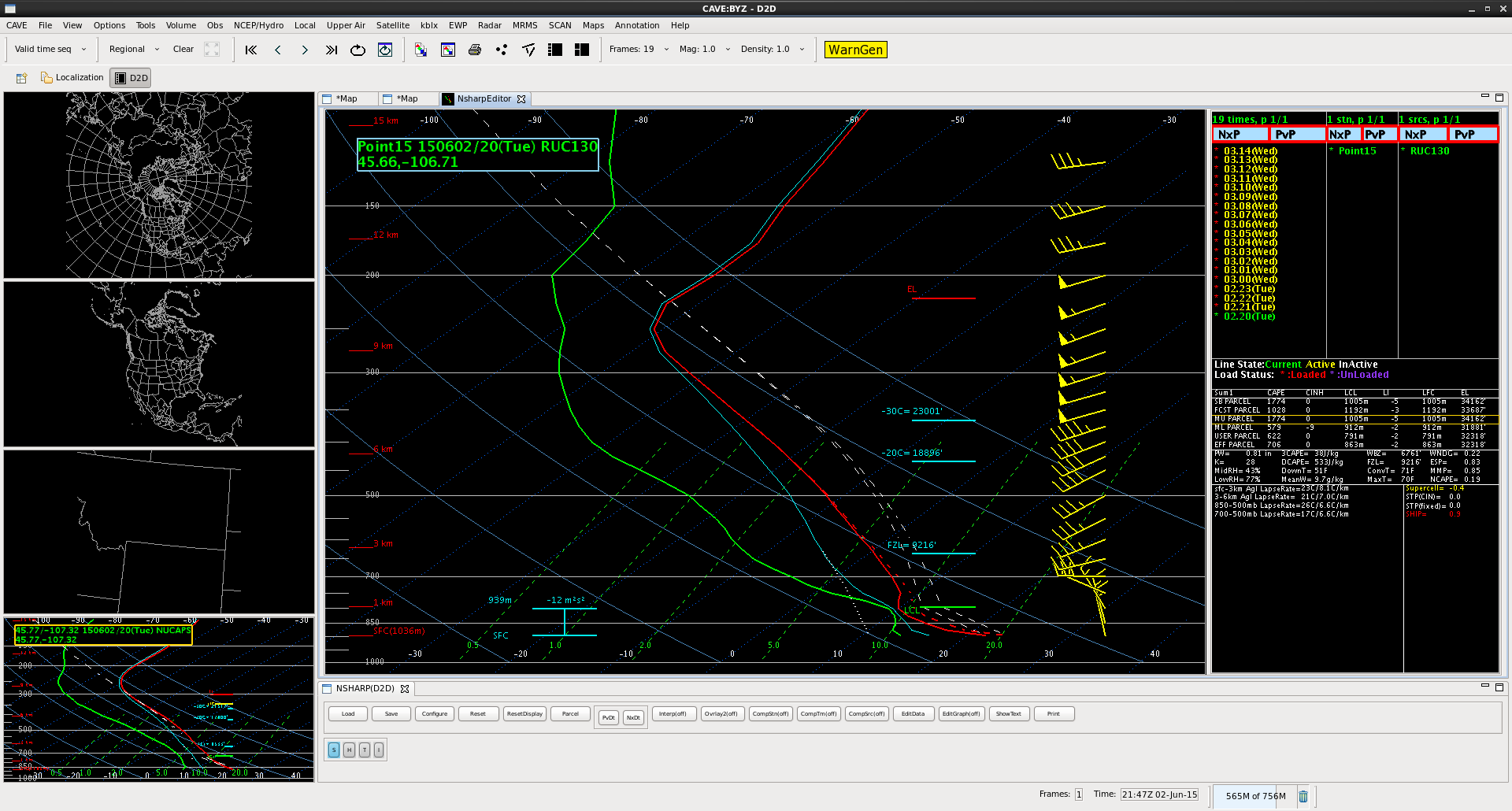
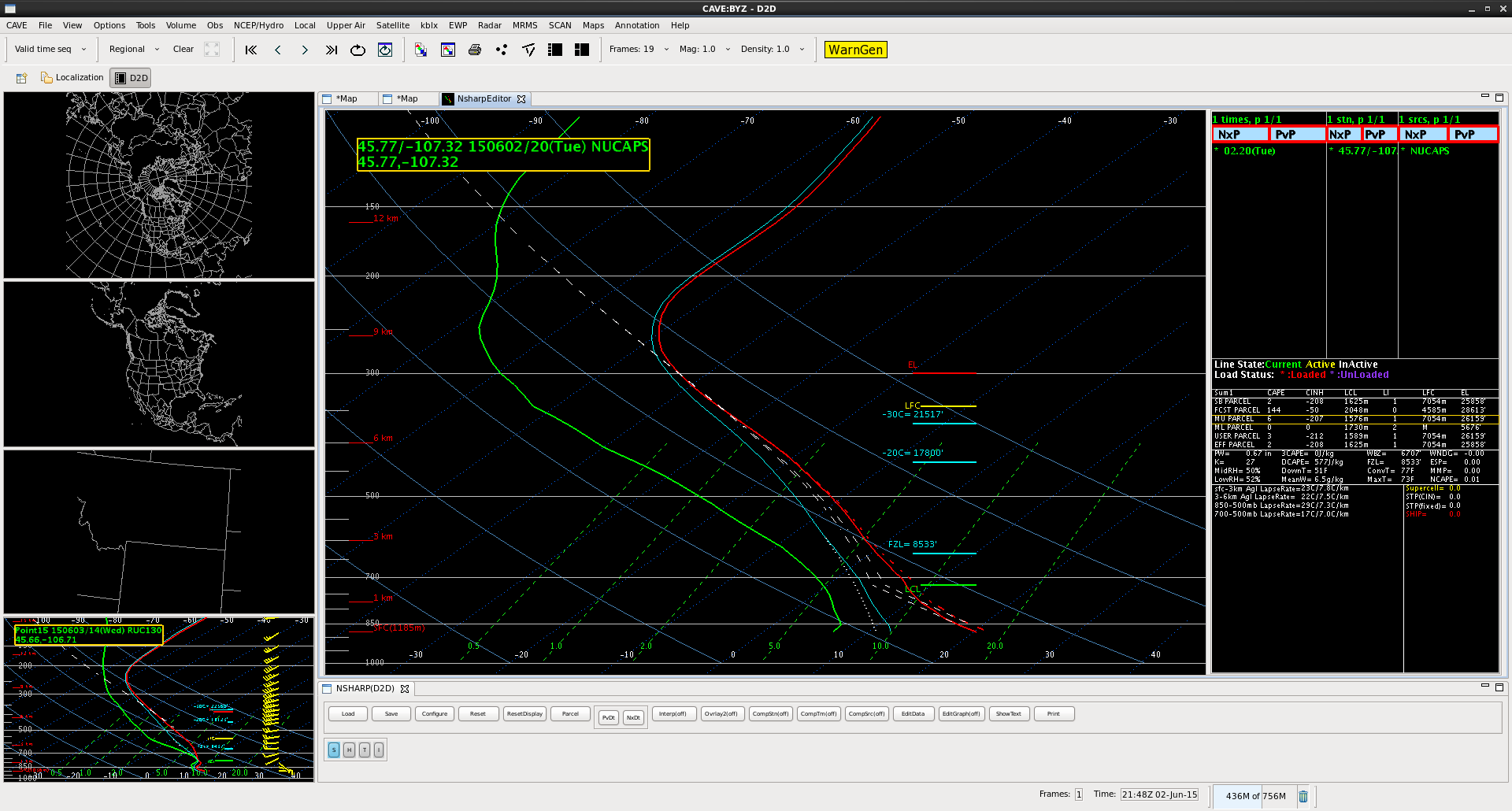
RUC – vs – NUCAPS soundings over SE Montana

Screenshot-ruc0602nucaps0602

Comparison of relatively uncontaminated areas from RUC and recently available NUCAPS ahead of encroaching cloud cover show temperature and moisture profiles similar with slightly higher PWAT on the RUC due to low level moisture contribution. NUCAPS indicated 500 MB temperatures around 2C warmer than the RUC likely leading to more convective inhibition than the RUC was showing.

John Pendergrast
Tags: None

June 2 — Rapid growth of 2 supercells across northern CYS CWA

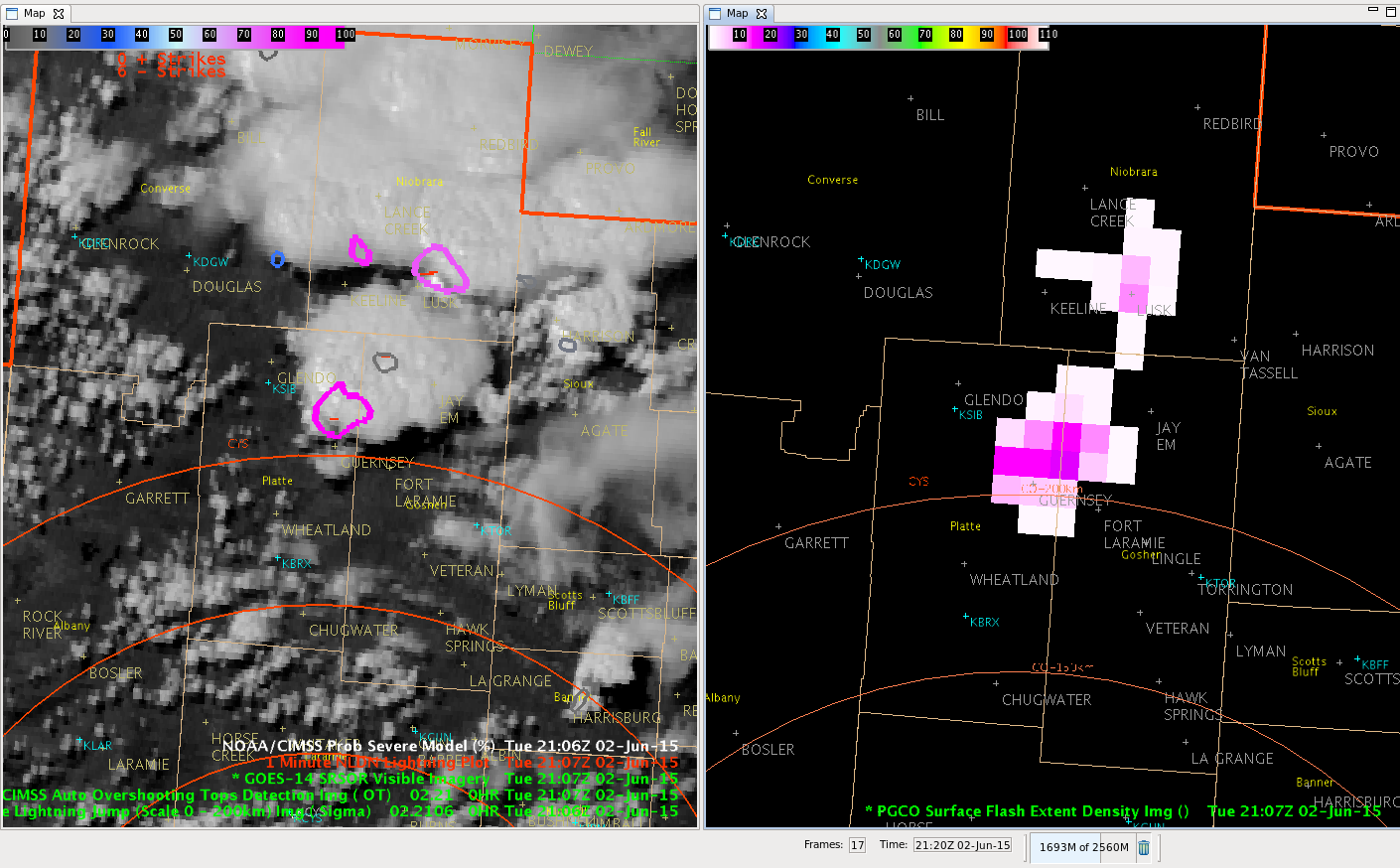
We have been seeing amazingly rapid supercell growth of two cells, one just north of Guernsey and a second near Lusk since 2045Z.  Both cells have also shown rapidly increasing severe probabilities.  The Overshooting Tops algorithm was also indicated with the Lusk cell.

Supercells_2107Z_2June15


The 1-minute GOES-14 visible satellite is showing both supercells very well (L).  The two pink overlays indicate the increasing severe probabilities.  The southern cell north of Guernsey was up to 90 percent, while the cell near Lusk was at 76 percent.  Since 2107Z, the Lusk cell severe probabilities increased to 89 percent at 2110Z. along with several CG lightning strokes.  The 2107Z Flash Density (R) was up to 17/minute with the Gurensey cell, and 10/minute with the Lusk cell.

CoonieCatEye/MacGyver


Tags: None

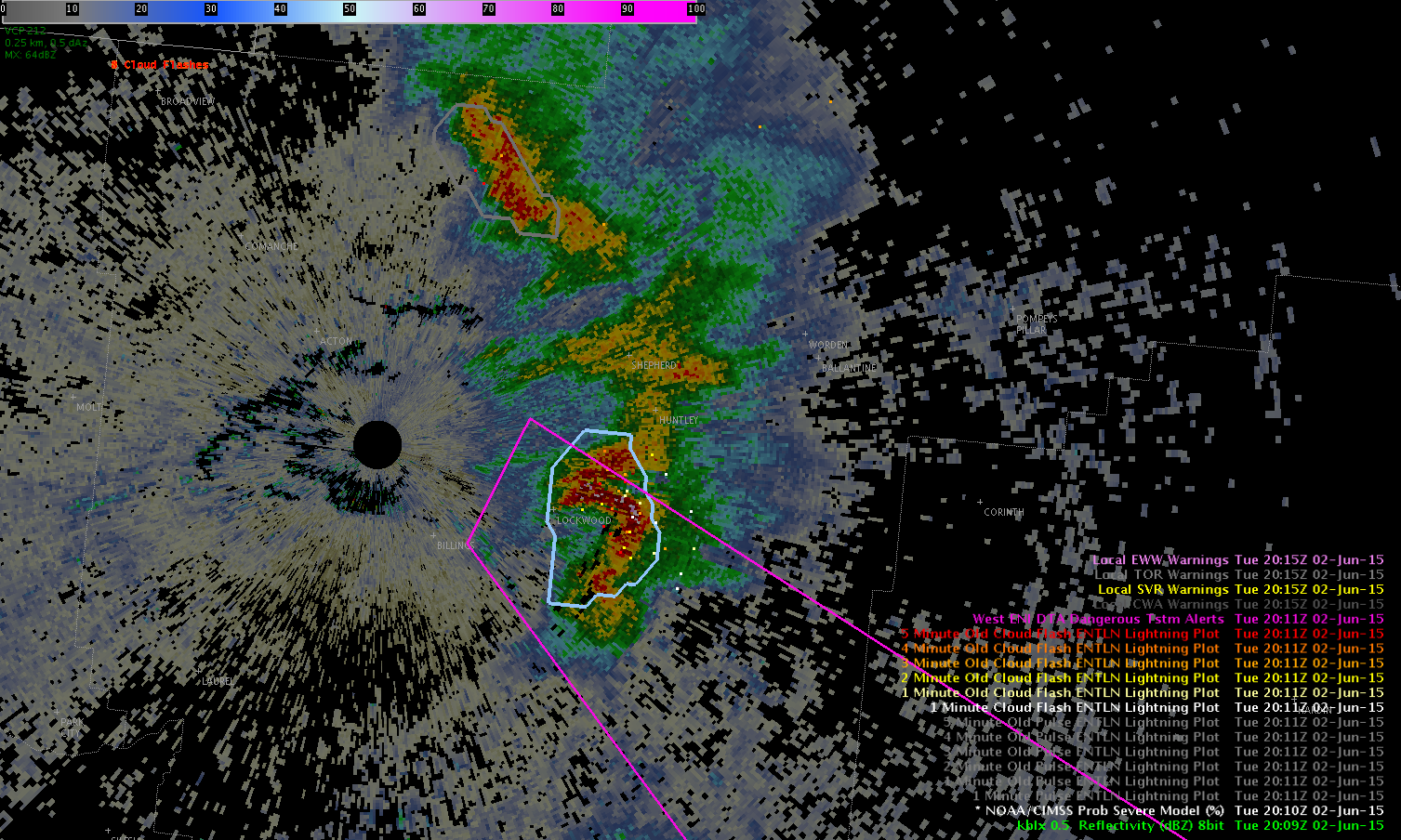
Lone cell southeast of Billings garners a pseudo warning

severe_rural0602

A lone cell over rural areas southeast of Billings developed into a persistent severe cell on the CIMSS Model (above 90 percent) for several consecutive radar scans along with significant to dangerous category total lightning values.  The cell centroid moved to the right of environmental flow on both radar and projected ENI motions.

John Pendergrast/Jason Williams


Tags: None

June 2 — Lightning Jump coincides with Large Flash Density (CYS)

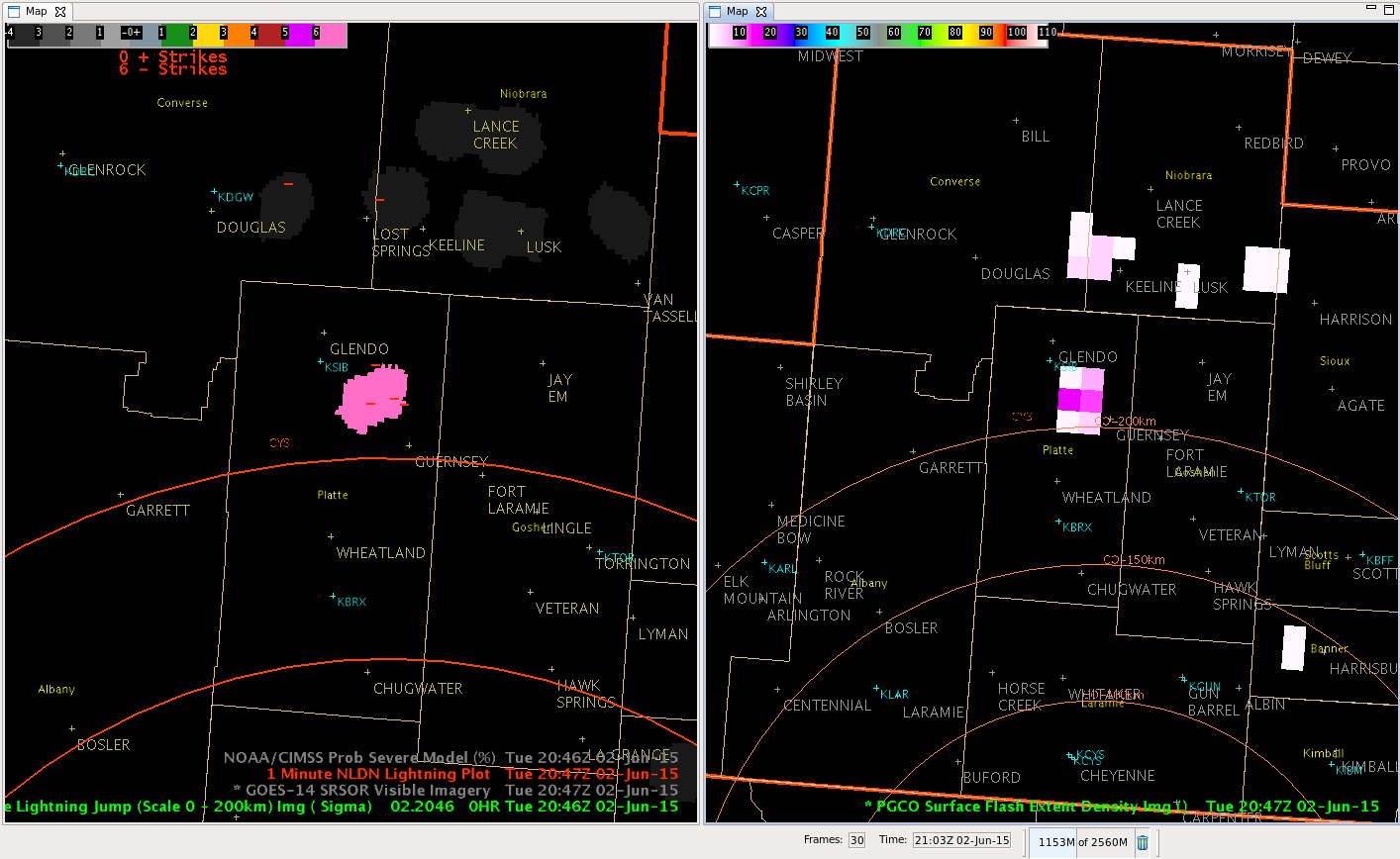
Just a few minutes after my previous post on distant flash density, we got a lightning jump along with several CG lightning strokes AND a large flash density.  The lightning jump was up to 6 sigma!

CGLrng_FlashDensity_2June15_2047Z

Note the 6 sigma lightning jump on the left screen along with 4 CG lightning strokes, while the flash density was up to 16 per minute!

This cell persisted with its density rate as the severe probability quickly increased to 90 percent by 256 PM.  The overshootimg top algorithm also turned on with another supercell that developed near Lusk, WY.

CoonieCatEye

Tags: None

BIS CWA: Using NUCAPS and CIMSS to anticipate new convective development

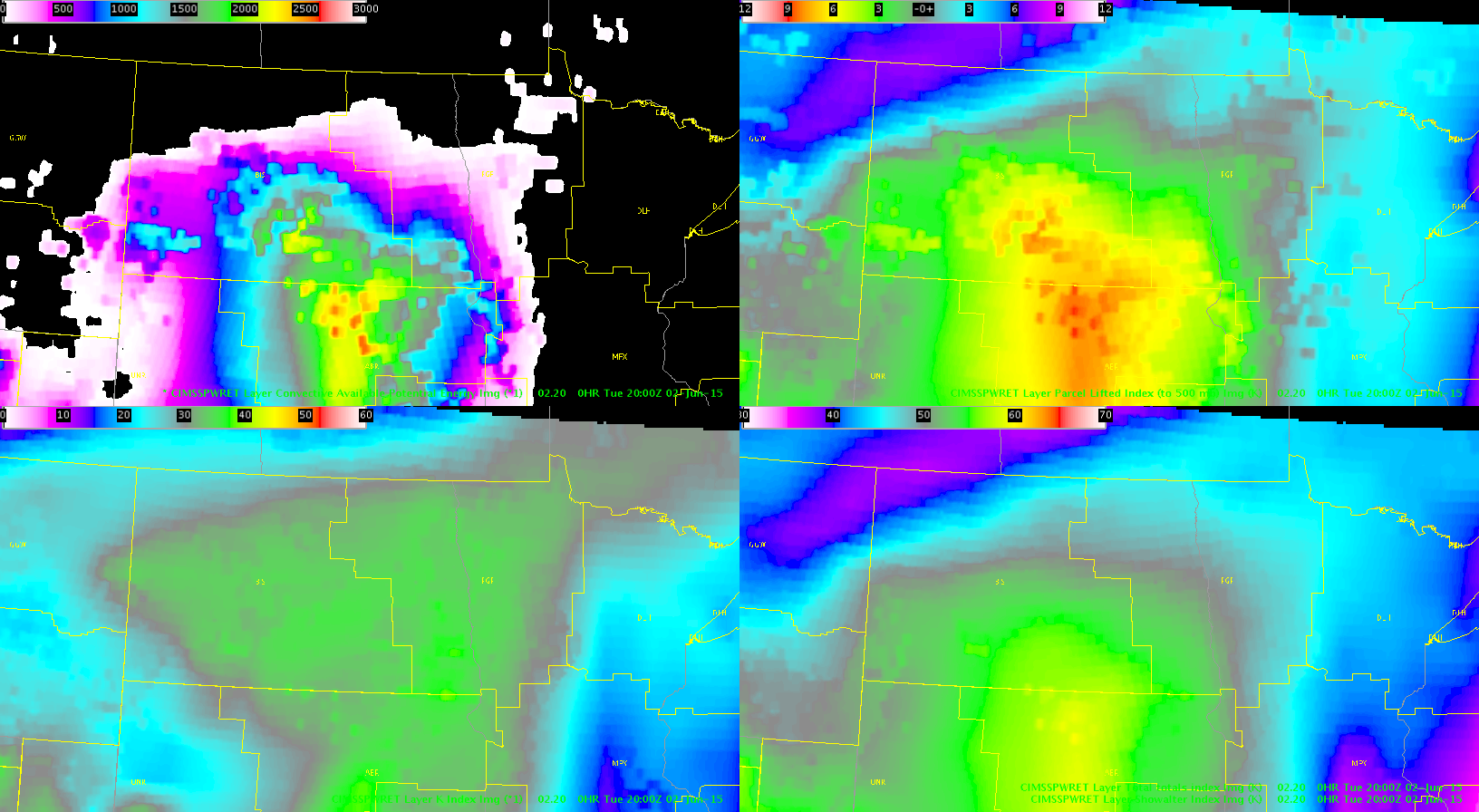
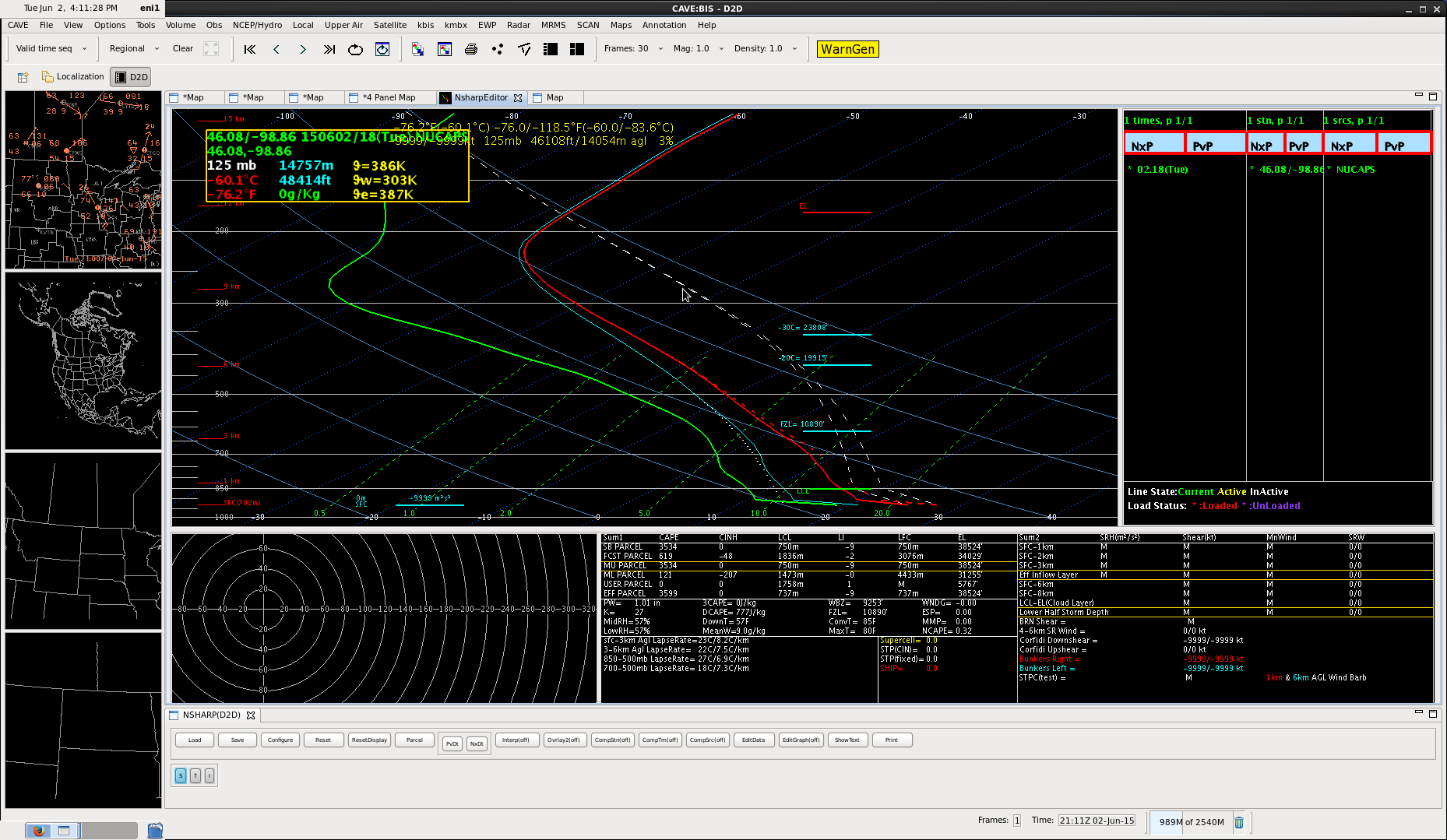
Trying to anticipate future convective development. Looked at a CIMSS CAPE (fig 1) plot and seeing that the best CAPE is shifting into the eastern CWA. Took the available NUCAPS sounding and modified  it with a nearby metar with a 77/66 surface reading.  See plenty of CAPE (3,500 J/kg). May be too much just simply modifying the surface points along, but nonetheless it shows it is plenty unstable.  This was also in a mostly clear region.  Plan on testing CI-East to see if this clues in on potential development in this area. –Cattywampus.

CIMSS_CAPE

Fig 1: CAPE shifting east along with surface low and southerly flow.

nucaps

fig 2. Modified NUCAPS sounding over cloud free SE portion of the CWA. Still quite unstable.

–Cattywampus

Tags: None

June 2 — Flash Rates vs. CG Ltng outside LMA Range of Efficiency (CYS)

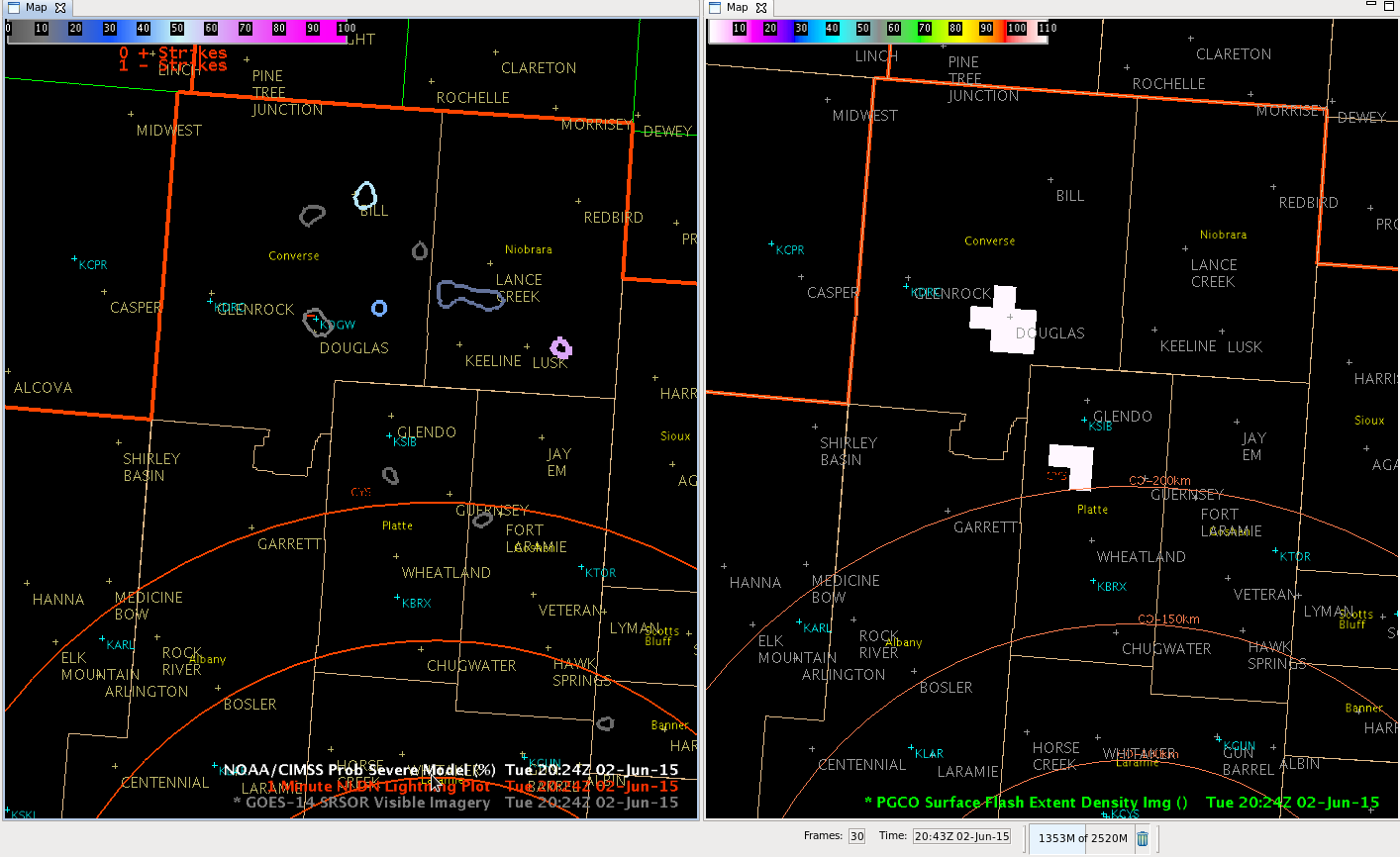
I had been noticing that the LMA Flash Density has been occasionally reporting outside the maximum range of efficiency well north of the sensor array in north central Colorado, over 200 km away.  Even though the flash rate is low (only around 1 flash/minute), it did pick up on one CG lightning stroke in the Douglas area this afternoon, which occurred coincident to the flash report.  See Figure 1 below.

DistantFlash_CGLtng_2Jun15_2024Z


Fig.1  One CG lightning strike near Douglas (KDGW) (L) and the Flash Density (R)

Appears this may be due to increasing cloud heights and possible glaciation rate aloft.

CoonieCatEye

Tags: None

CI Prob Success

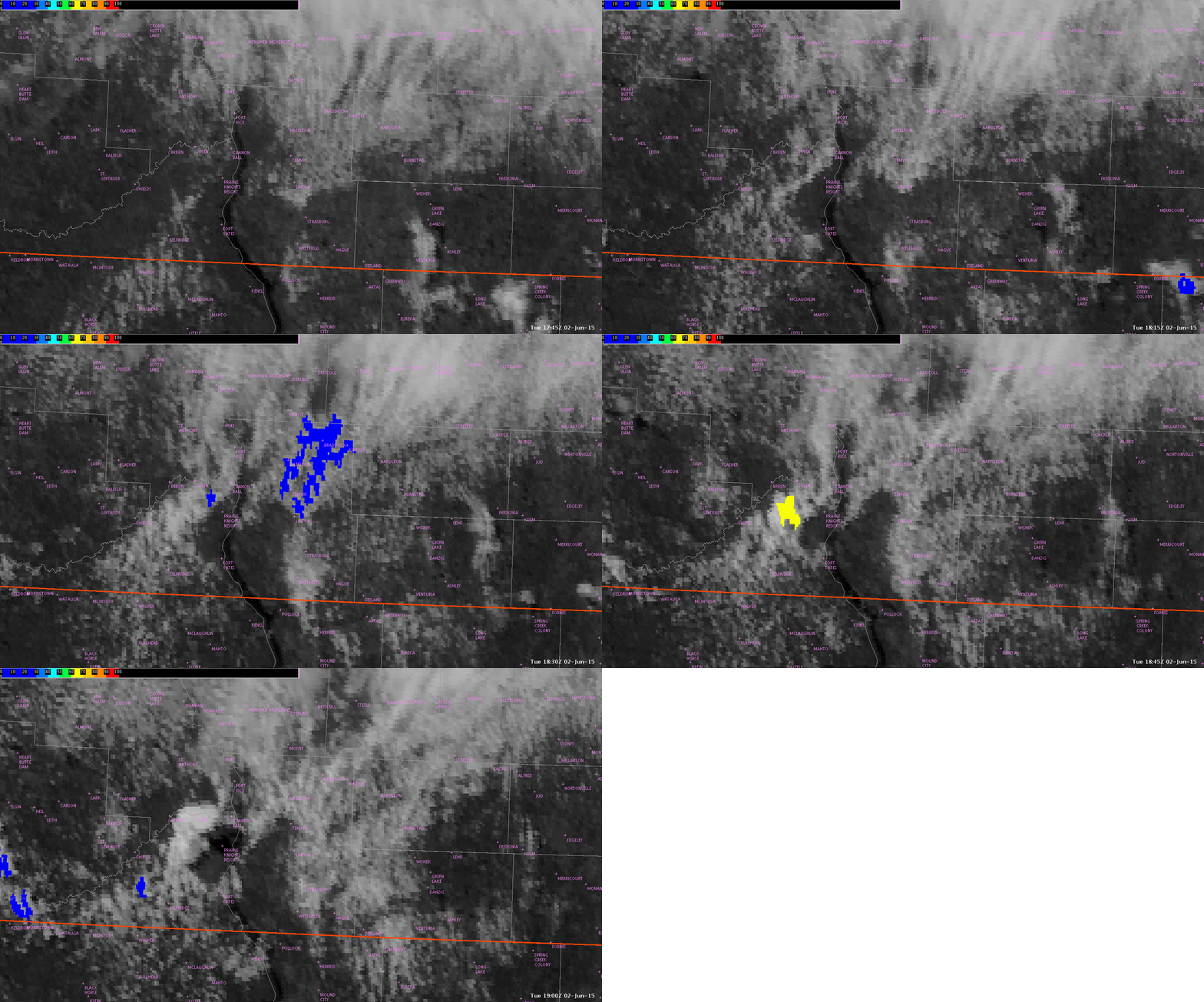
The image below (please click to animate) shows an example of when the CI probability product successfully predicted the onset of convection. At 1845Z, a yellow CI polygon appeared southwest of Solen indicating a 60% probability of convective initiation. In the next frame (1900Z), the visible satellite imagery shows intense cumulus growth in the vicinity. I also compared this to radar, and a cell popped up at 1858Z.

CIprob

-Helen Hunt

Tags: None

ENI Display

My 2 cents on the ENI AWIPS display. I found the data available via ENI was too overwhelming along with a cluttered display. The list on the right shows all the options available to look at and it becomes too much to ingest. I suppose with training and experience it may be a little more intuitive but not initially. Polygons shift direction rapidly with different storm directions, there is a listing for each DTA rate, a polygon for each cell along with flash rates for the cells. Add in the different obs plots for pulse, flash, cloud to ground. It gets very confusing. Granted this is new, but many off our staff also found this confusing when we recently had it installed with our AWIPS2 build. When information becomes too cluttered and confused it tends to get disregarded and not used in Ops.  Consolidation of the DTA Rates into one item with changing colors would be beneficial, same as with the alerts.  I think the cloud flashes are better represented as circles and not dots as it is shown on this workstation.

–Cattywampus. ENI_Plot

Tags: None

CI and outflow boundaries

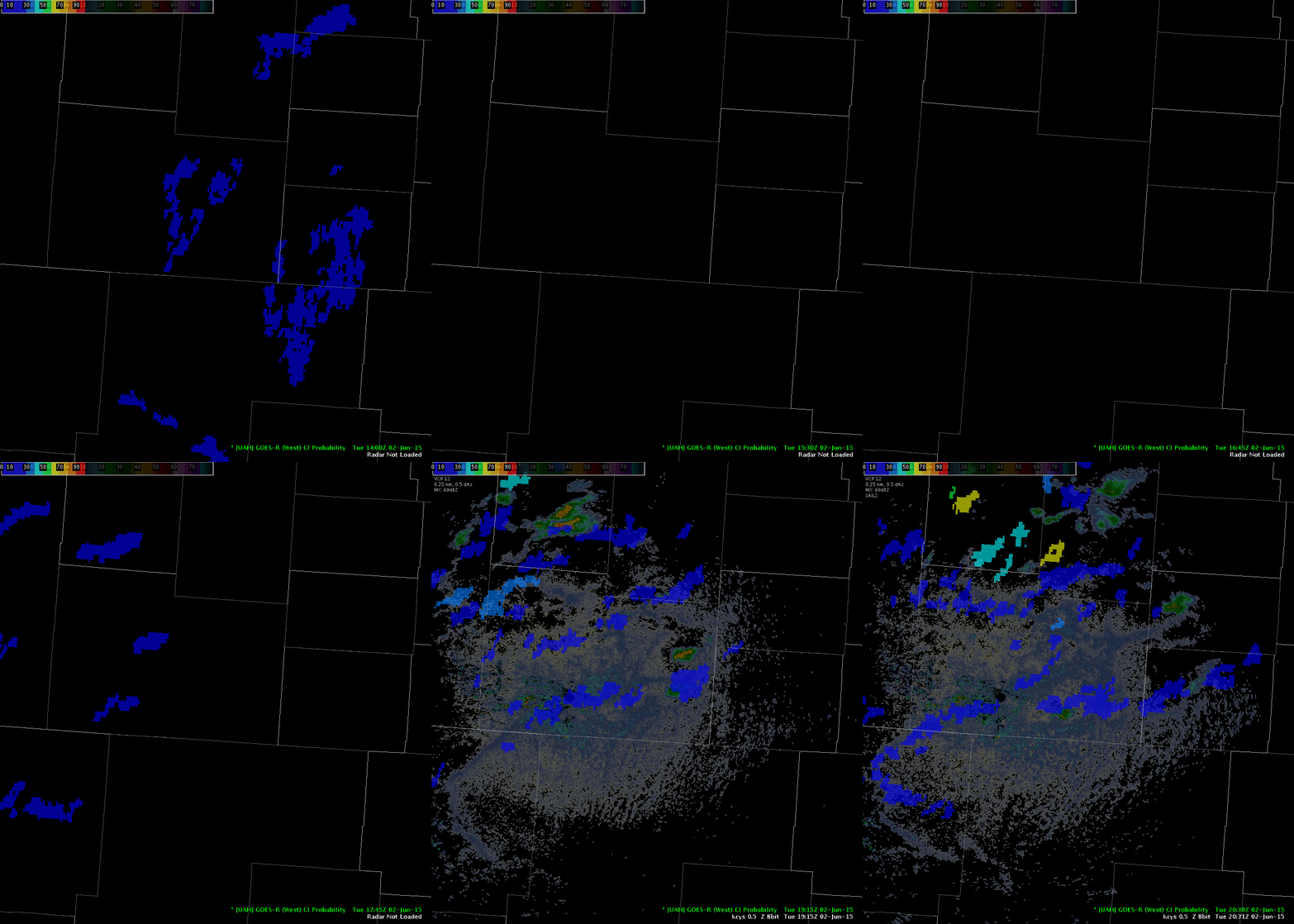
Noticed how the CI was pegging on the outflow boundaries.  Decided to overlay the radar and CI.  This image shows how the CI and outflow boundaries are marked out well.  Noticed that it did a good job picking up these boundaries, but did not do well with actual CI from boundaries interactions.  This was GOES-West…in SE WY.

screenCapture4

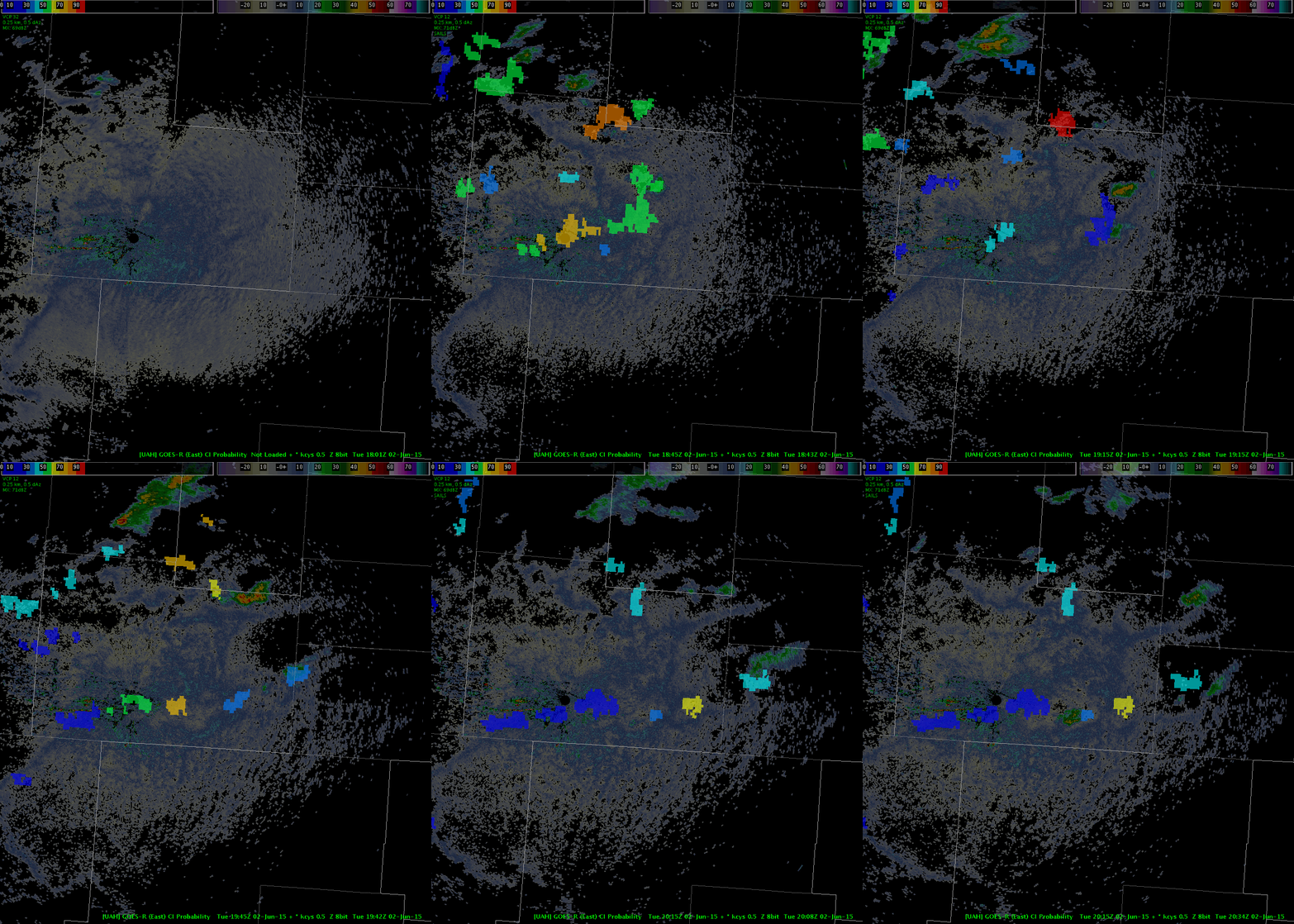
Now using GOES-East, it did an excellent job.

screenCapture3

MacGyver

Tags: None

ENI DTA tracks right mover emerging from linear complex

dta_box


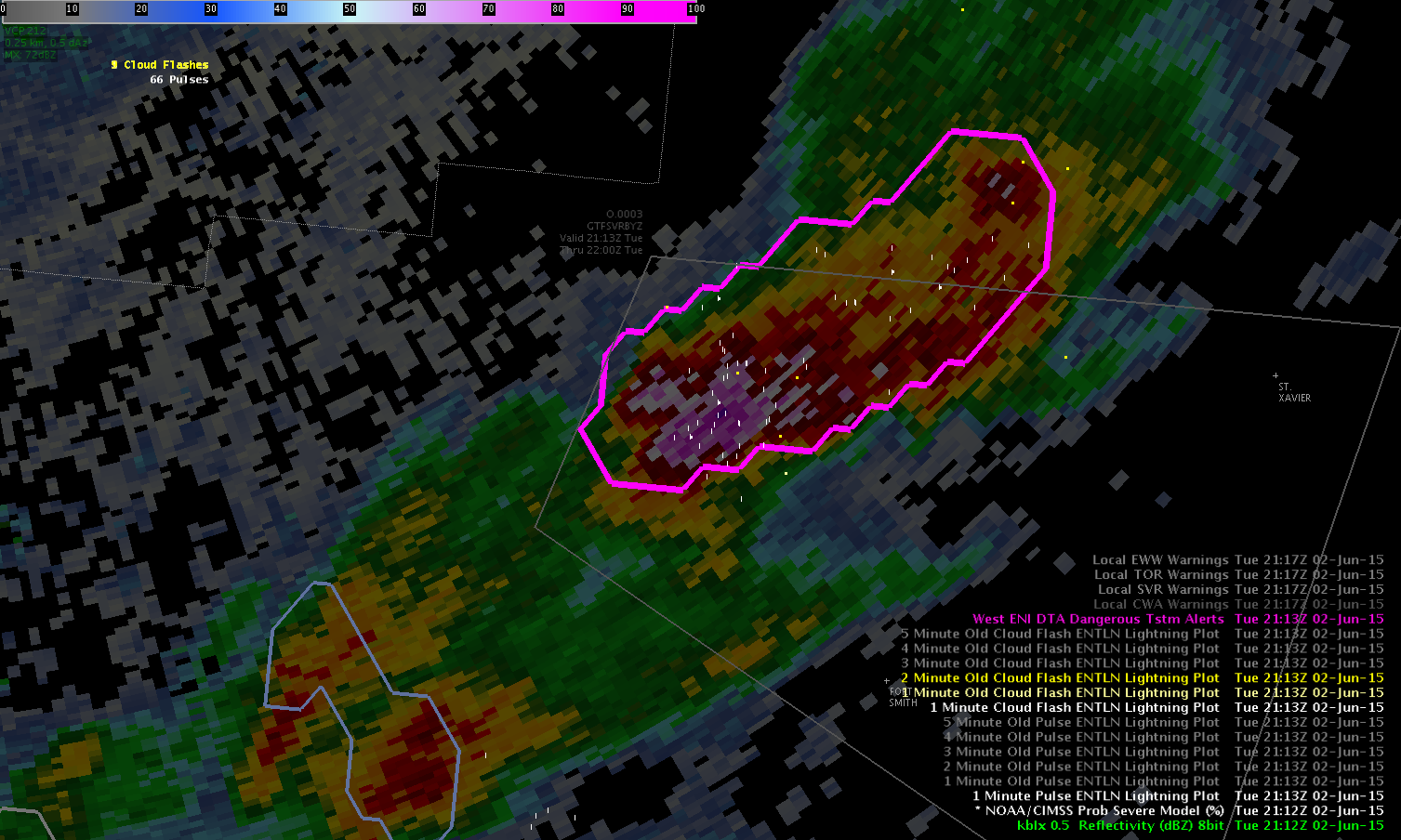
A dominant cell along the southern edge of a line of storms emerged from the complex.  ENI DTA projected further southeast movement with the developing cell as the cell centroid moved right of the environmental flow. DTA level 3 (Dangerous) was shown due to the total lightning threshold being sustained.

John Pendergrast

Tags: None