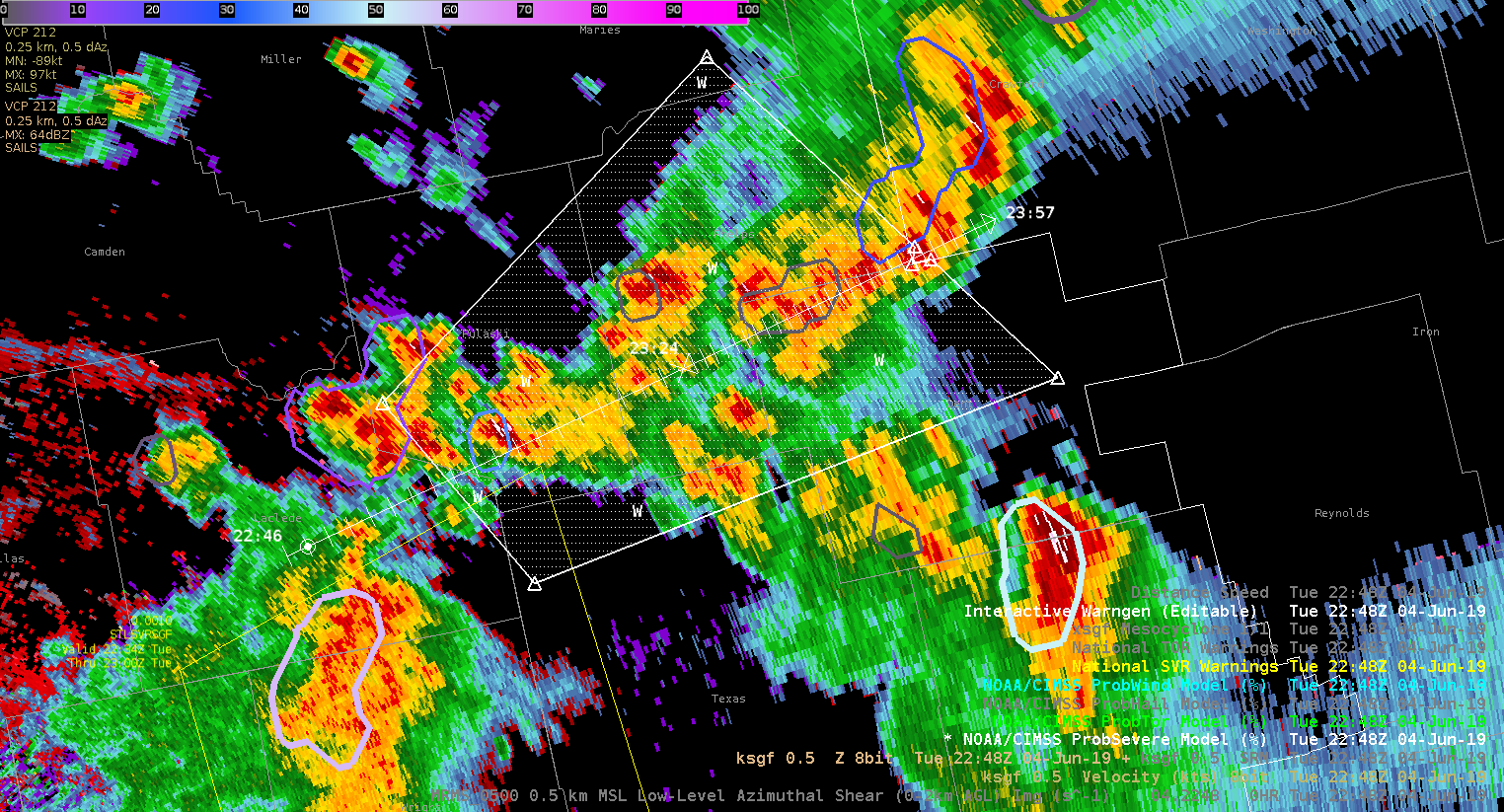
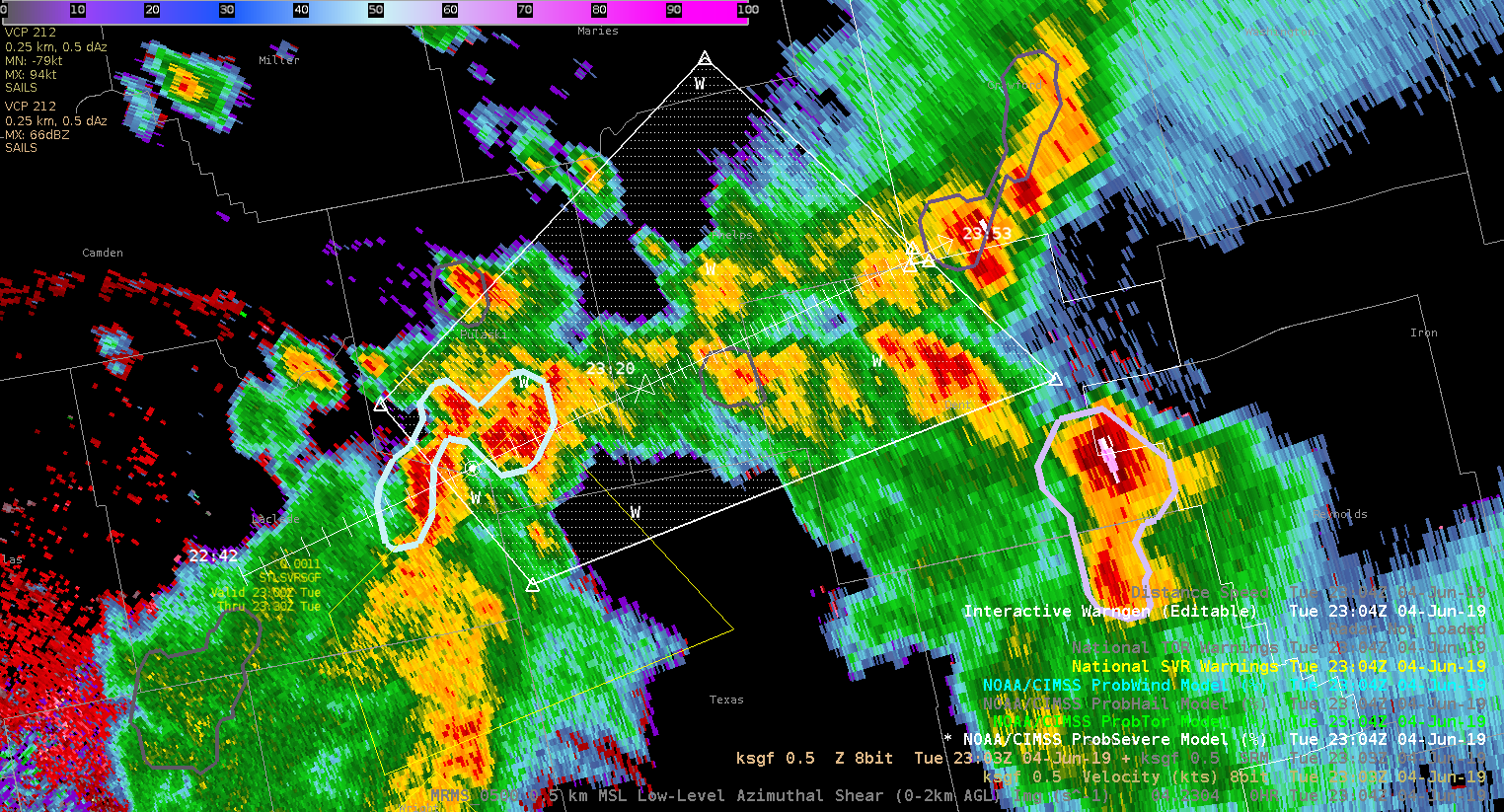
NTDA possibly relying on poor data

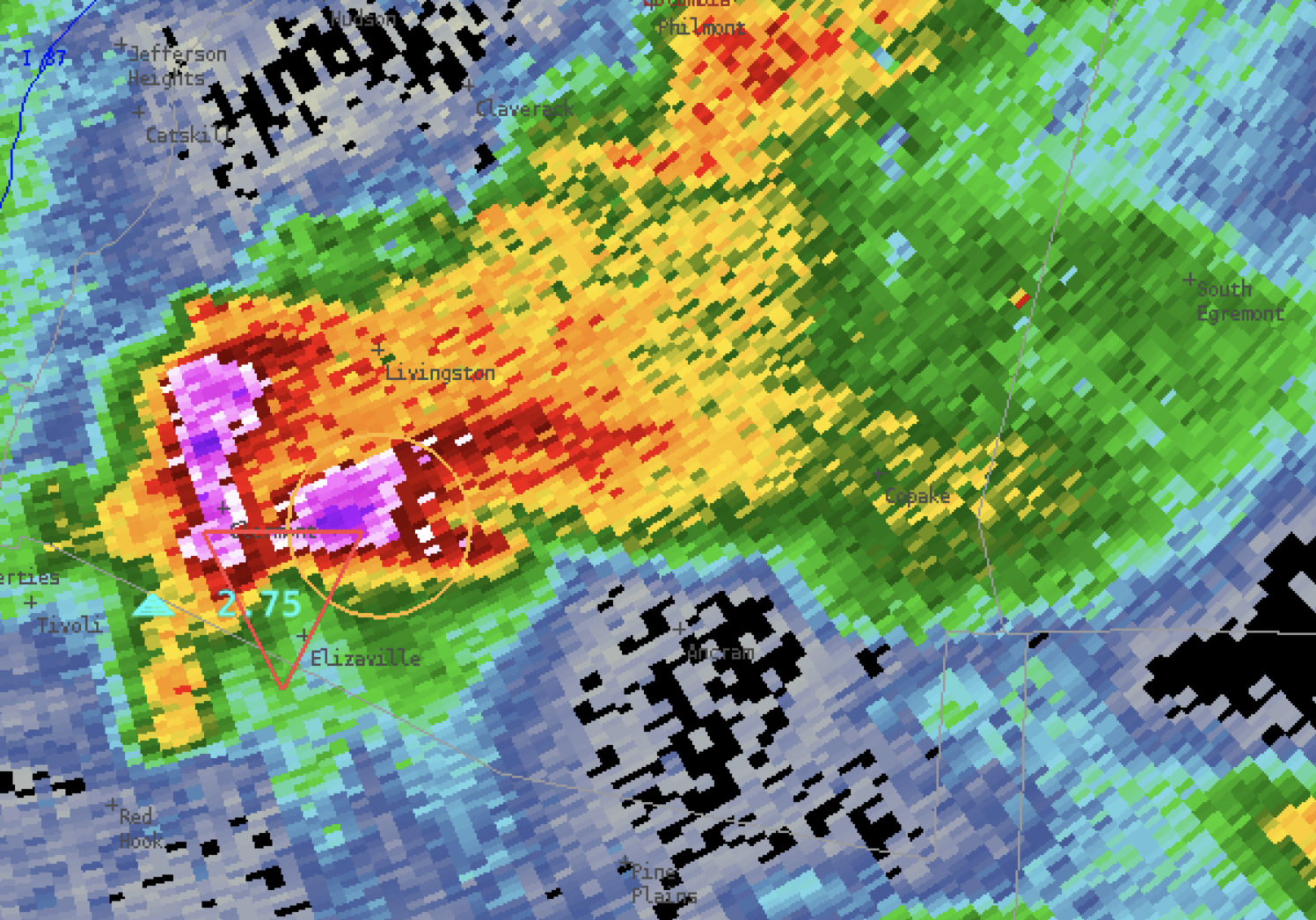
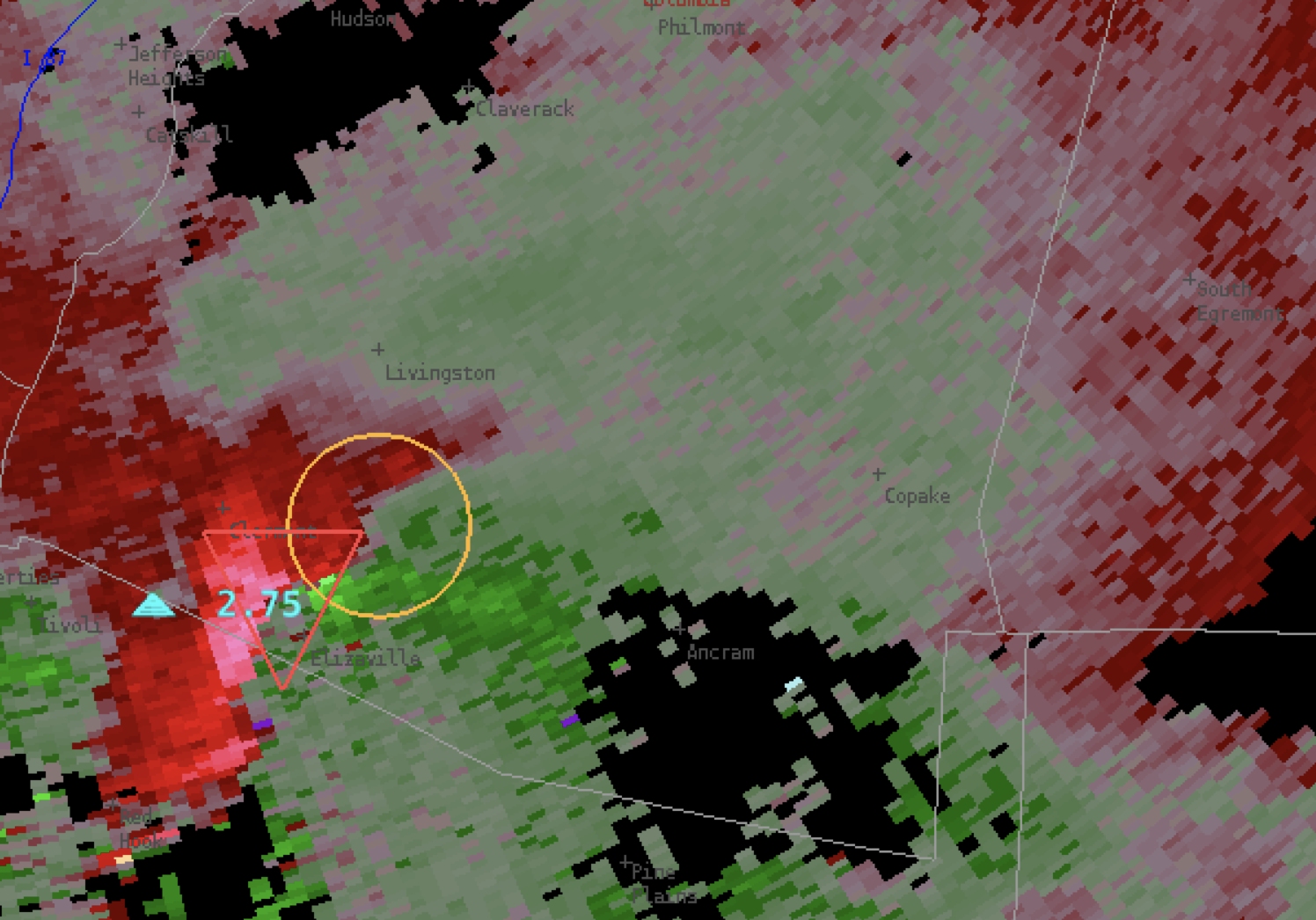
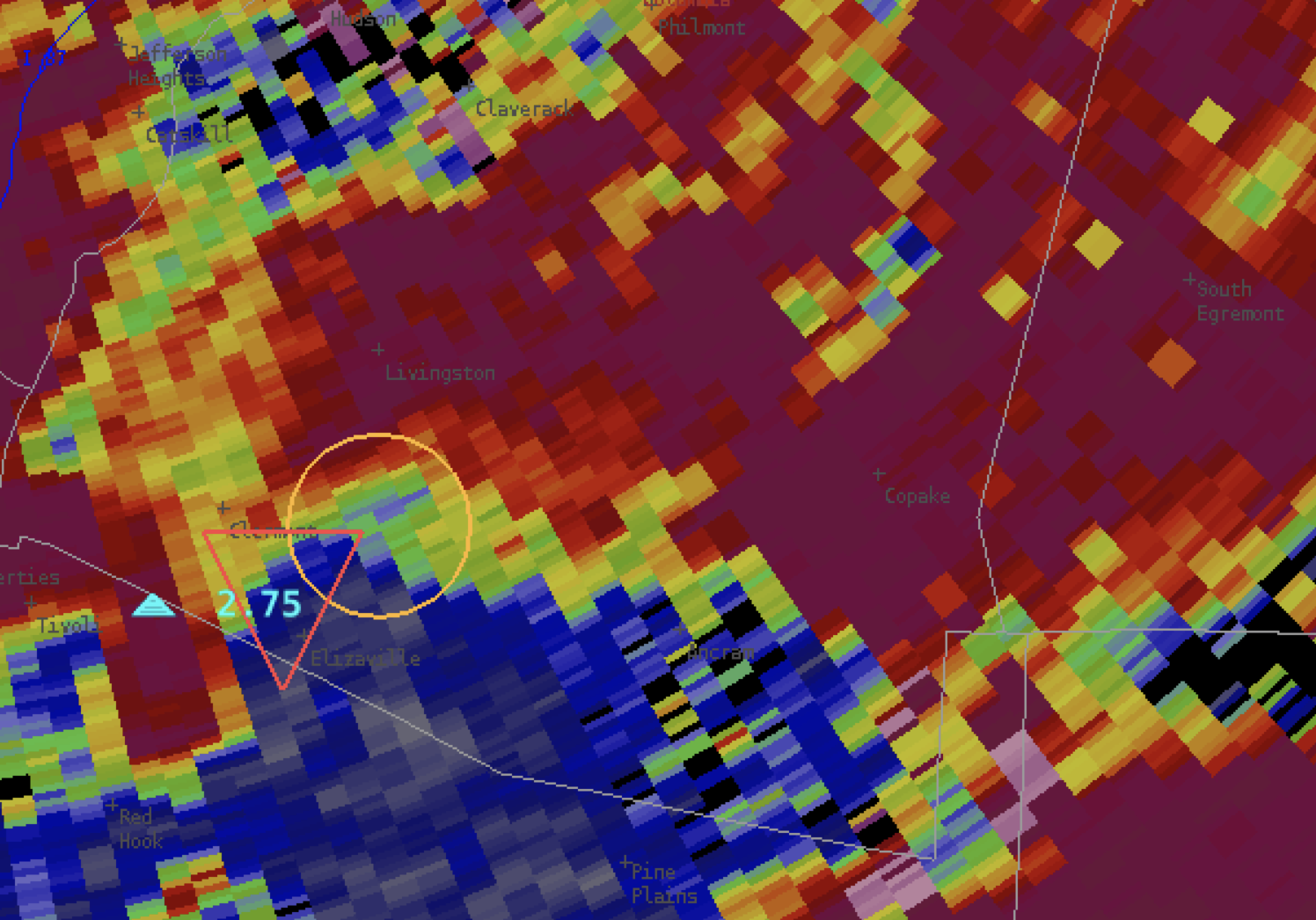
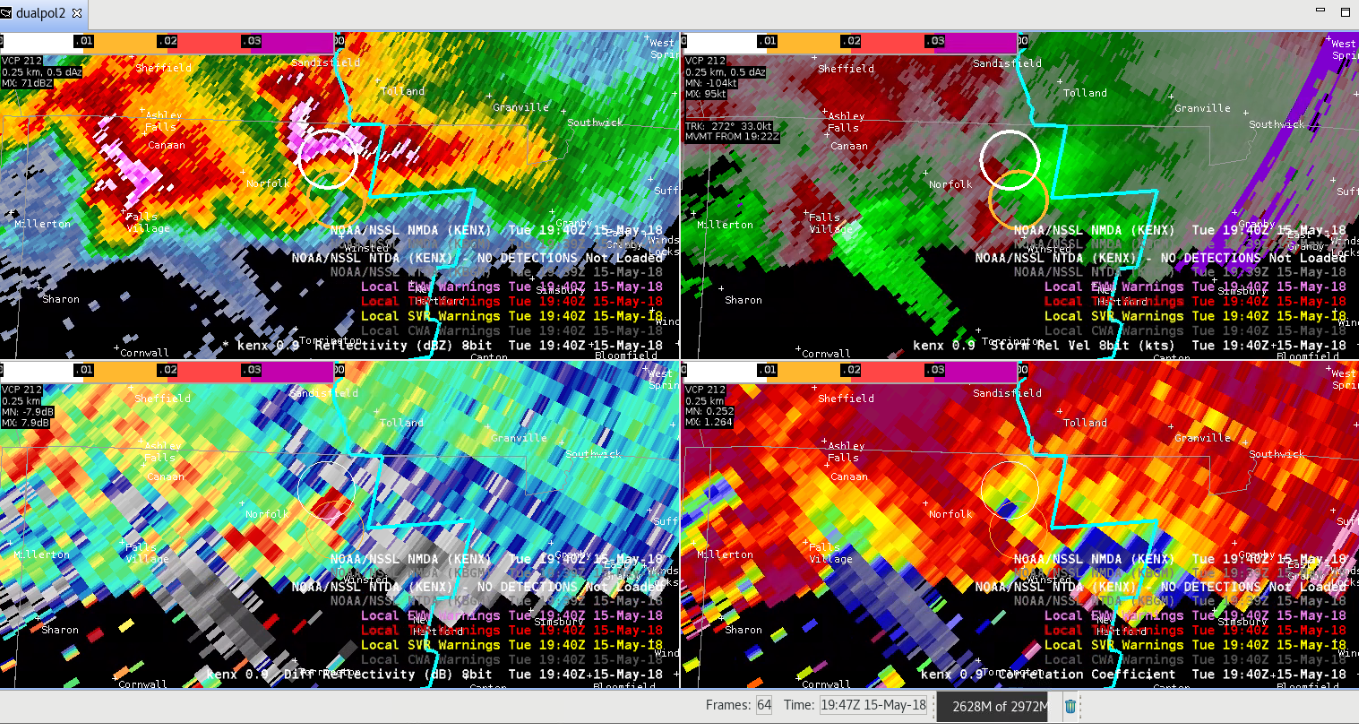
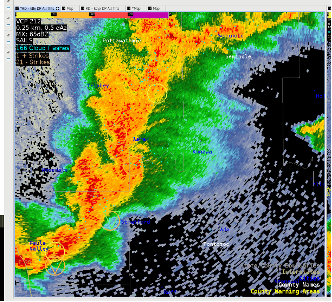
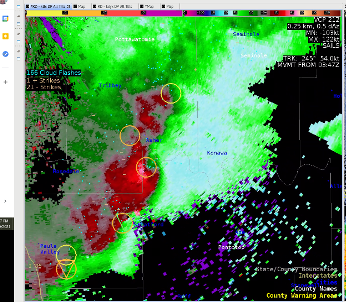
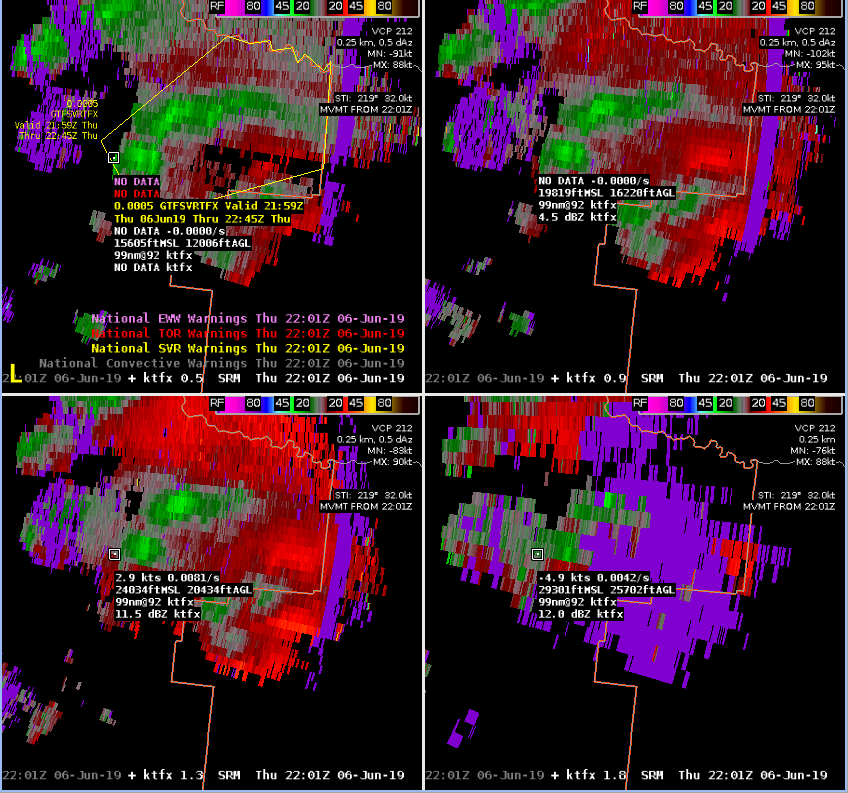
Looking at the area where the NTDA & the NMDA overlap in the images below, seems to indicate a large hail core where reflectivity is approximately 40 dBZ and higher, and a three-body scatter spike where reflectivity drops to less than 40 dBZ. The NTDA is indicating a probability of around 58% but the storm looks rather messy at this point with several of the highest inbound velocities occurring in areas where velocity is suspect due to the hail spike.

KENX @ 18:43Z
KENX @ 18:43Z
KENX @ 18:43Z

-#ProtectAndDissipate

NTDA/NMDA Possibly Struggling With Storms Featuring TBSS

The NTDA and NMDA for KENX had significant shortcomings for the 15 May 2018 event in the ALY CWA. The algorithms struggled to detect clear mesocyclones in cases where a significant hail spike was present. Could this hail spike be interrupting velocity data and causing unnecessary filtering of the algorithm? Also note that the velocity data appears to be more convergent, possibly due in part to the hail spike.

– Wario

NTDA Jumping from Circulation to Shear Max

During the OUN case today we noticed that both the NMDA and NTDA would occasionally jump in location relative to where we thought that the actual tornadic circulation would be.

Beginning at roughly 300z there was a northeasterly surge in reflectivity along the deep sheare 0-6km axis.  In turn we noticed that a couplet had formed along the northern extent of that reflectivity surge.  The NMDA captured this couplet however the NTDA did not. However, this is the same area that the NTDA had been scanning with the id of 51 which was described by a different blog post highlighting the length of time in which the NTDA and NMDA were able to track features.  Interestingly enough, while the NTDA did not display at 300z, it did the scan before and the scan after with the same ID value.


         .

Example Z at 300z (left) and Storm Relative Velocity (right)

What was particularly interesting about this case is that we started to notice that the NMDA and NTDA would jump from what appeared to be the tornadic circulation to the leading edge of the reflectivity where the azimuthal shear was perhaps maximized.  The following video is a feature following zoom where the feature zoomed in on is the tornadic circulation in question.

spiff_jump_042021_1140_low

– Spaceman Spiff


Algorithm Performance in QLCS transition

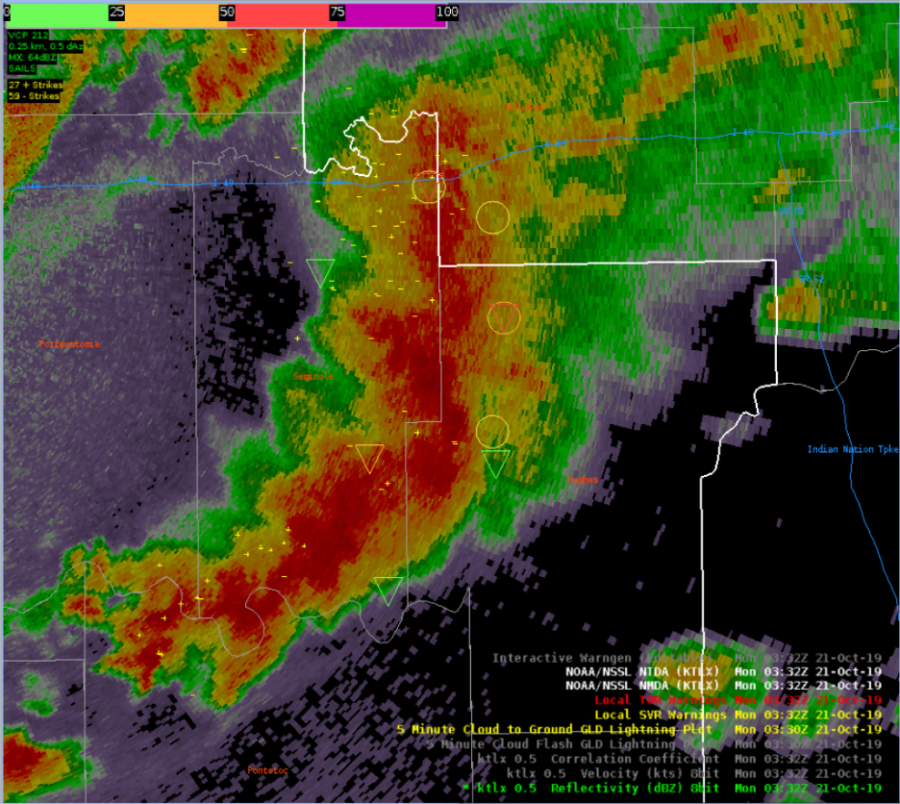
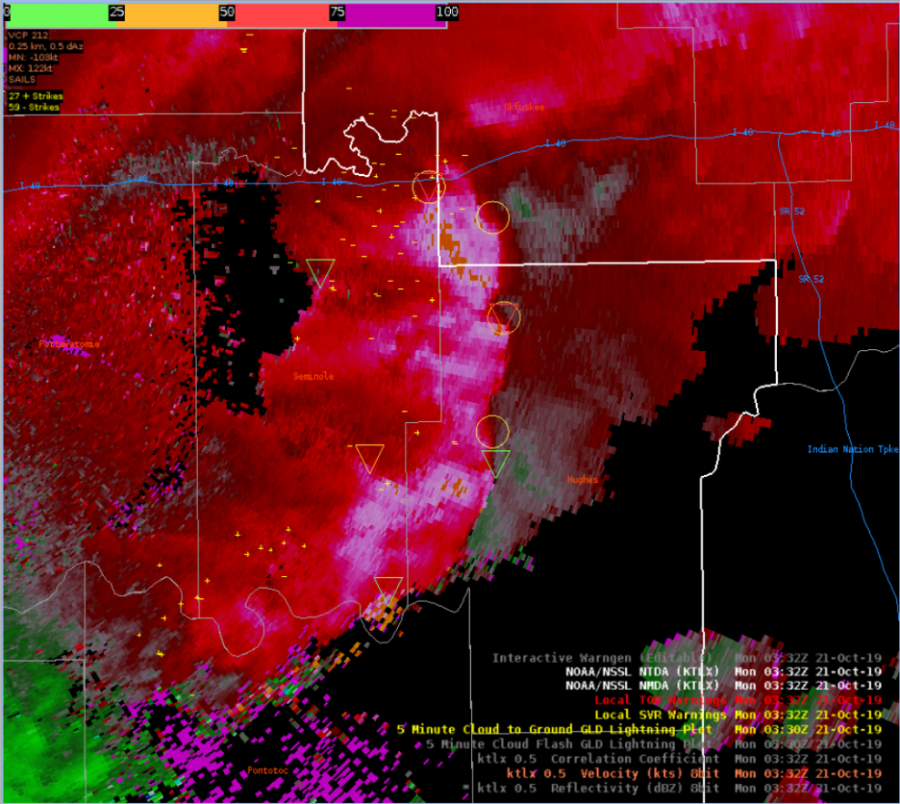
Both algorithms tagged onto the minor circulations within a developing QLCS pretty well with one or the other, or in several instances both, showing locations with increased vertical vorticity in areas that didn’t exhibit obvious bows or kinks in reflectivity. There was some noise and residual circulations in other parts of the storm, so there is room for detection improvement, but overall performance along the leading edge was okay.

Reflectivity at 03:32 KTLX


Velocity at 03:32 KTLX


– #ProtectAndDissipate

Time Durations for TDA & MDA

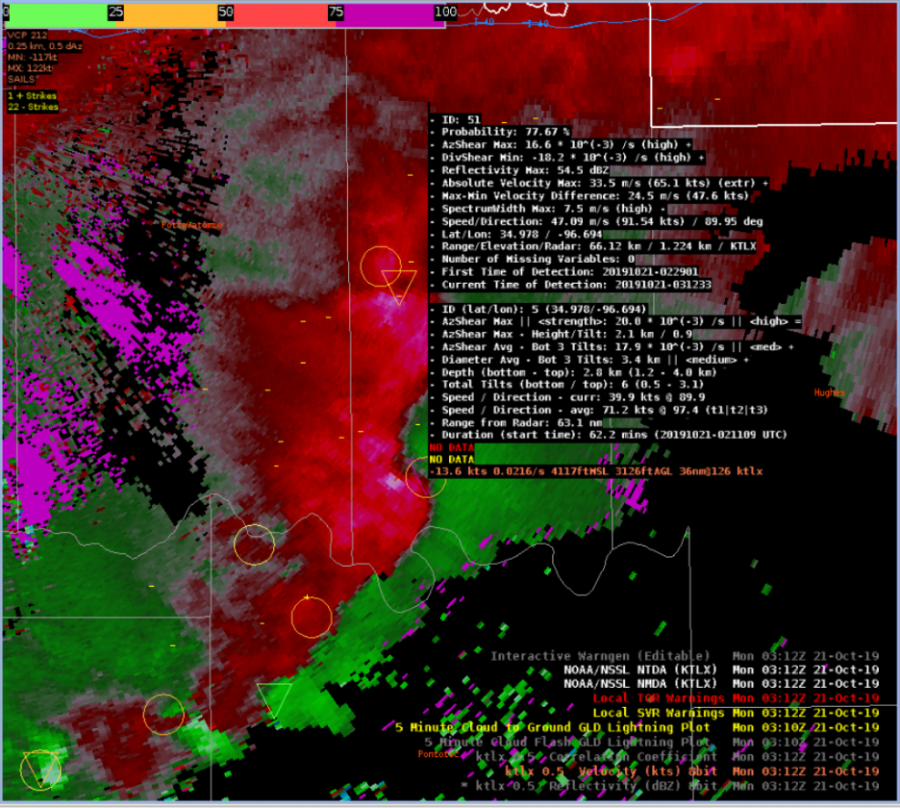
For a strong circulation that eventually became a tornadic in an occluding mesocyclone, the TDA and NDA did very well tracking the circulation in time. By 03:33Z (a time shown after the image below), the MDA had tracked the same circulation for ID 5 for over 82 minutes, and the TDA was able to track the storm for over 65 minutes. At times though the location of the MDA and TDA were a bit suspect


On a strong tornadic circulation, taken at 03:12Z


– #ProtectAndDissipate

Stronger Core

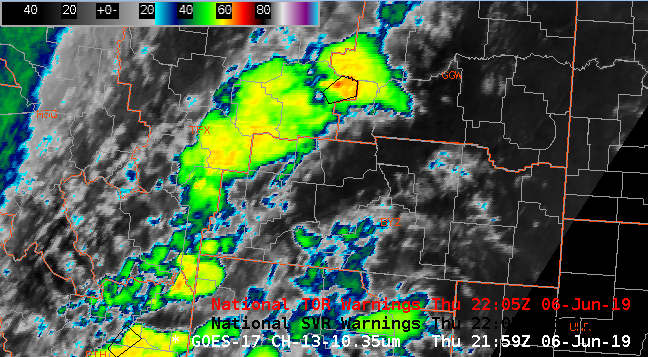
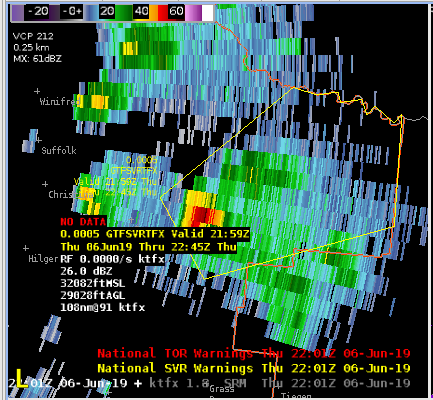
Continuing the SVR downstream, as yet another strong core pops up.  Colder cloud on IR and now prob severe is starting to jump up.  Blue color showing ProbHail and ProbWind in the 30s.

Cell also showing more signs of organization in the SRM…better chances for hail.

Also getting a pickup from the DMD (latency issue still for NMDA).

Charley

Springfield Illinois Storms

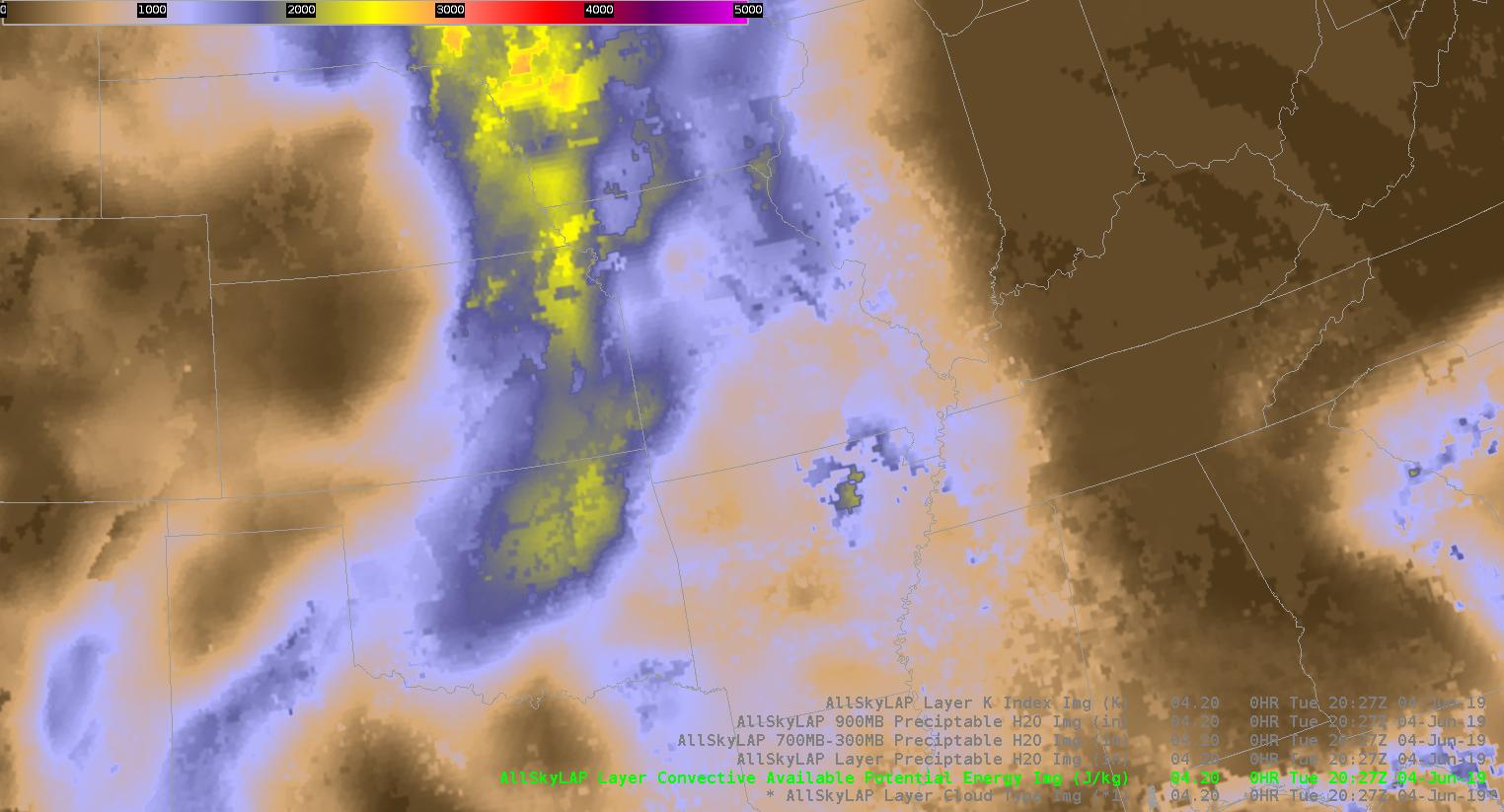
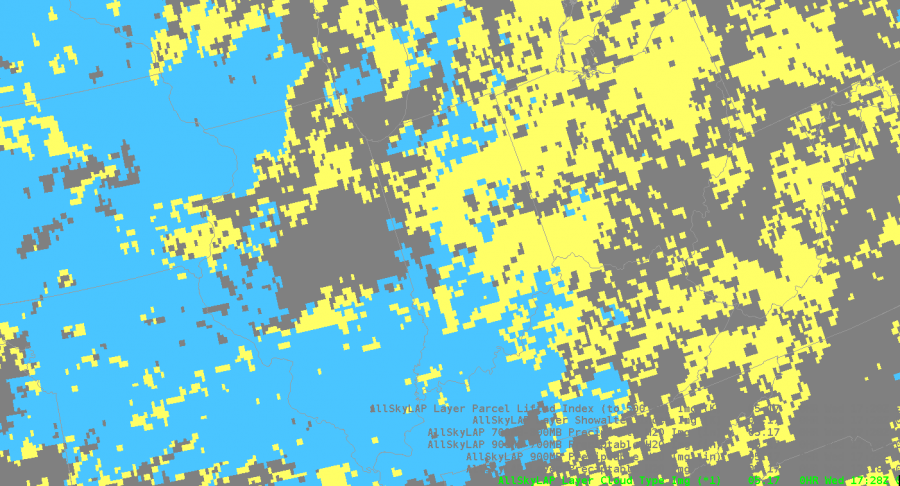
Right now I’m analyzing the various new products to nowcast where and when storms will intensify. Currently I’m comparing ALLsky cape to the mesoanalysis from the spc. Right now the mesoanalysis is higher with cape compared to allsky. Over our area the it’s cloudy so the it’s taking data from the GFS.

A cell in our western counties ramped up very quickly while our computers were down. Prob severe immediately directed our eye to the cell. The probsevere lined  up with an uptick in vil values and velocity.
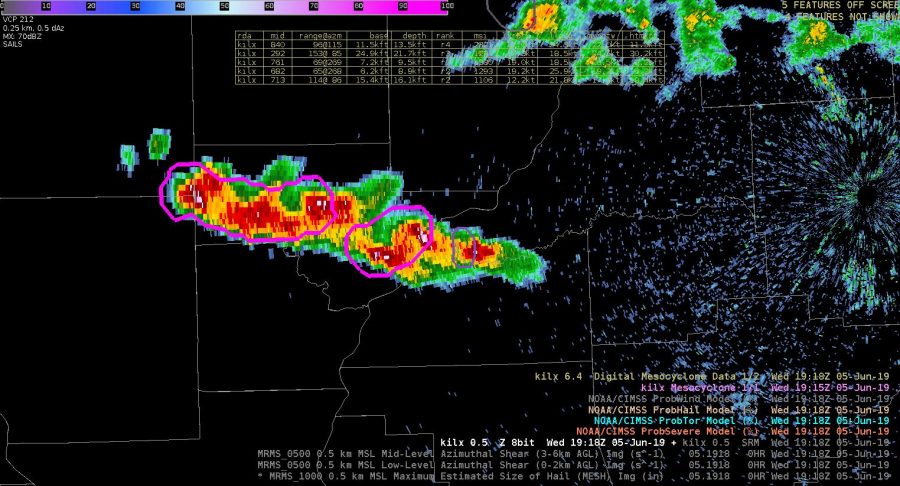
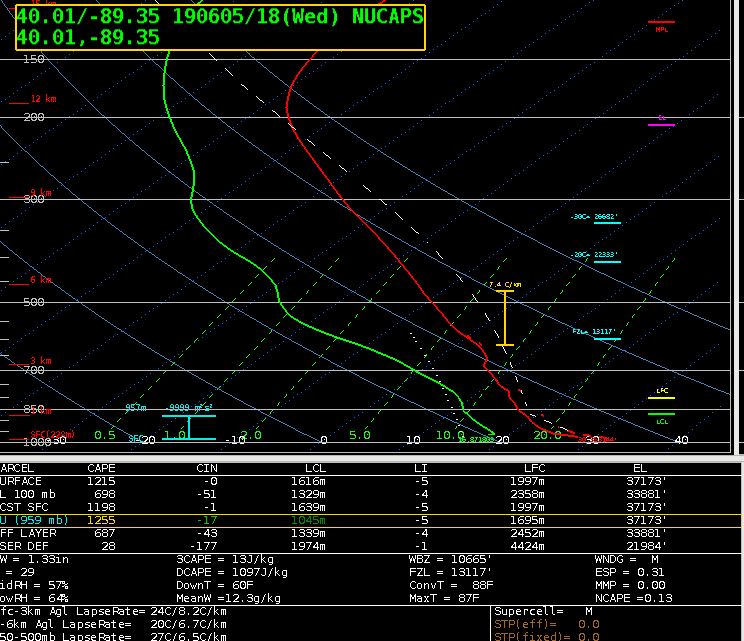
I’m comparing the actual sounding to what’s shown on nucaps, and allsky to see what’s initializing the best. The actual sounding shows 3025kj of surface lavyer cape and 1453 of mixed layer.
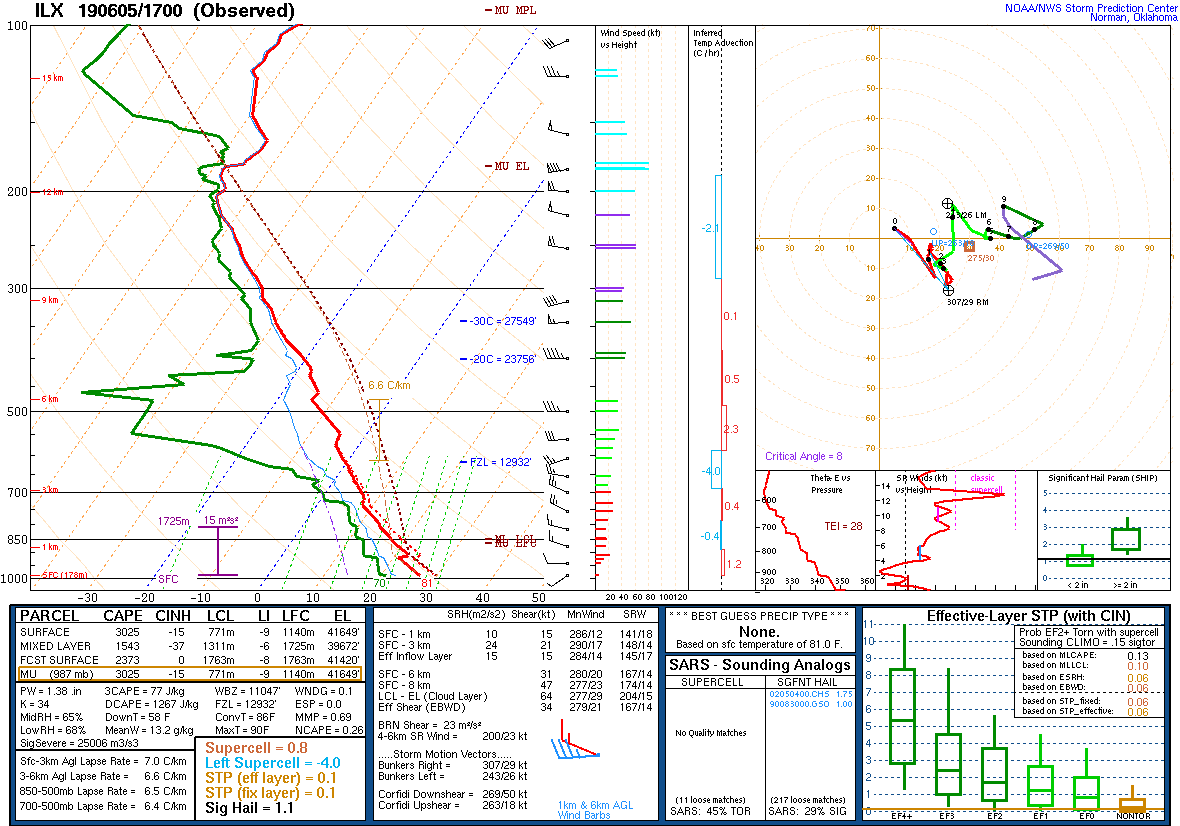
Around the same time allsky shows a similar value of cape.

The modified sounding was closest to the actual sounding with 1515kj of mixed layer cape
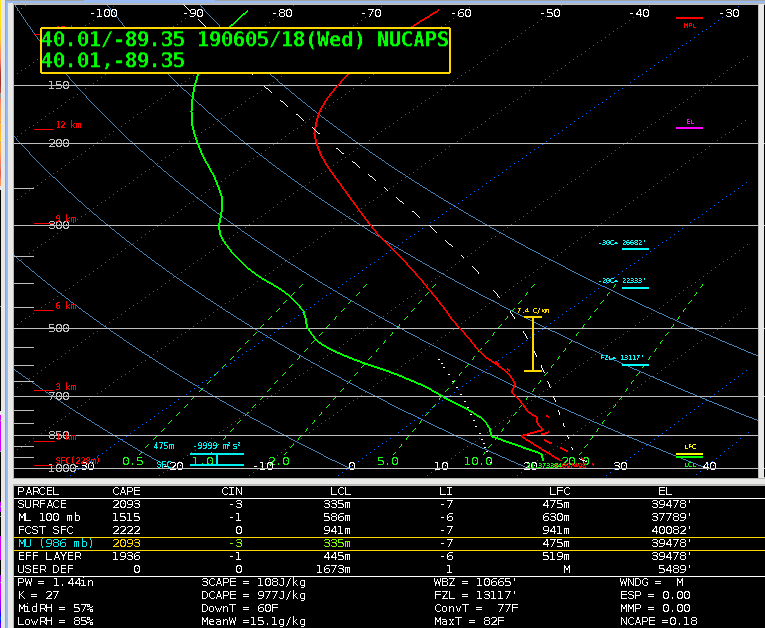
The nonmodified sounding is much lower when it comes to mixed layer and surface cape. In the case the modified sounding was more reliable and gave a more accurate picture of the current state of the atmosphere.
The all sky cape was much higher, around 2300kj.
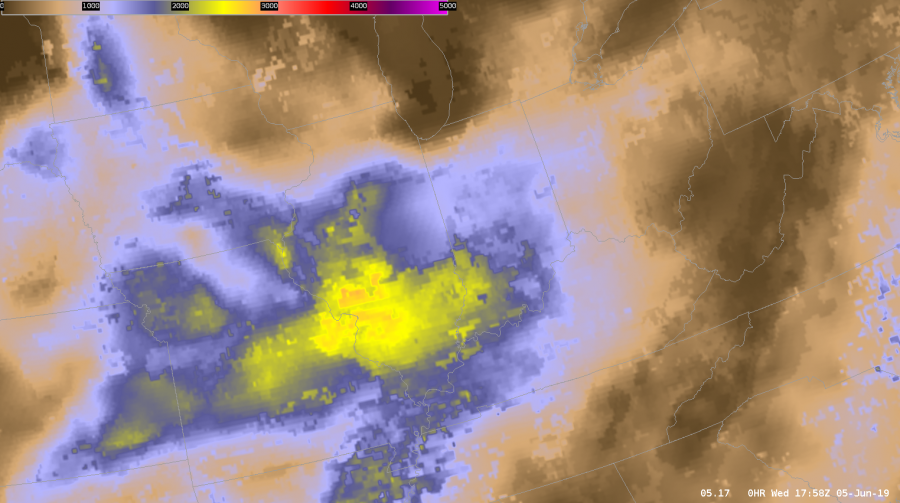
That increase might be due to the fact that the sampled area of interest was filled in by the GFS. Whatever input the GFS was taking into might have lead to it overestimating the amount of CAPE.
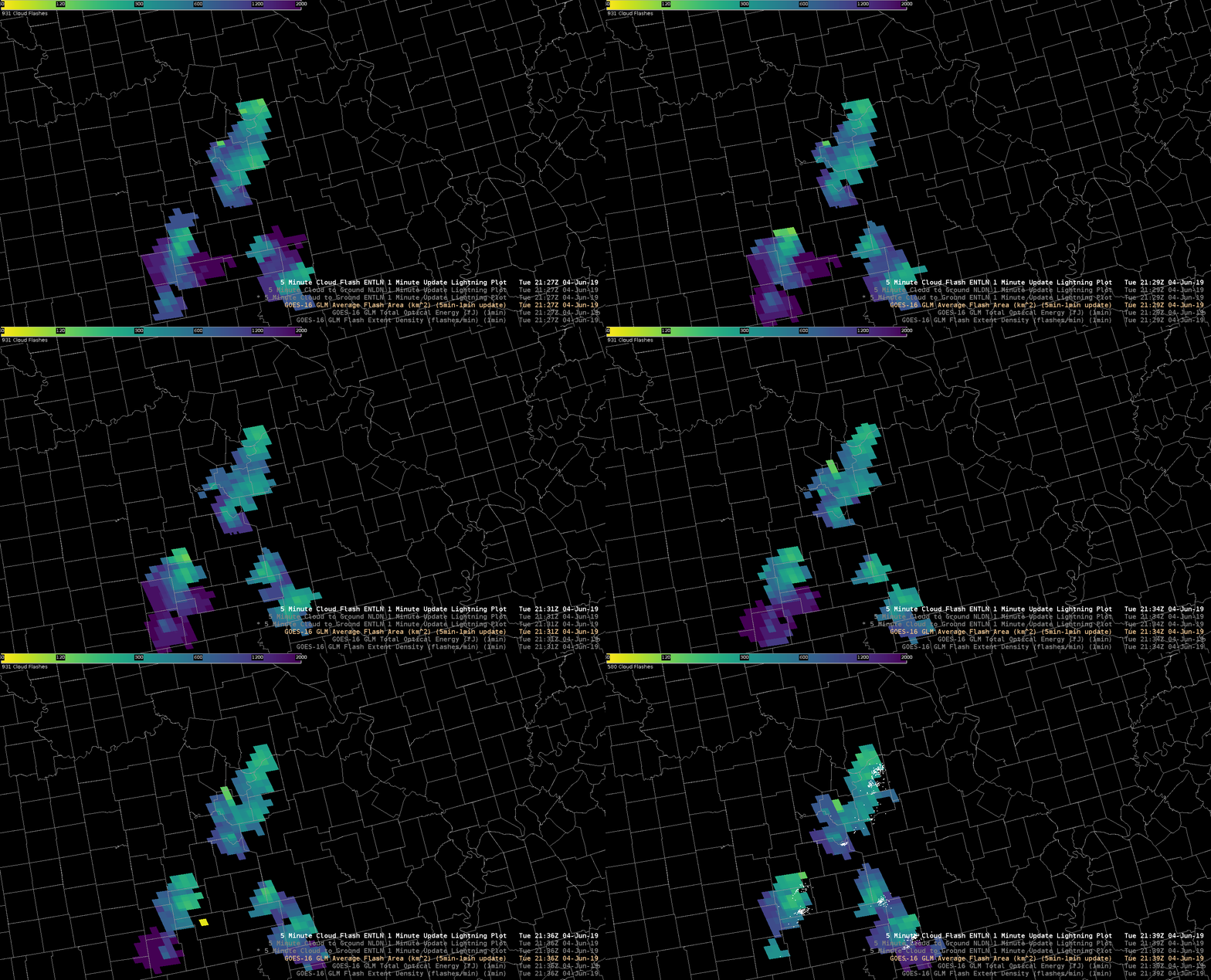
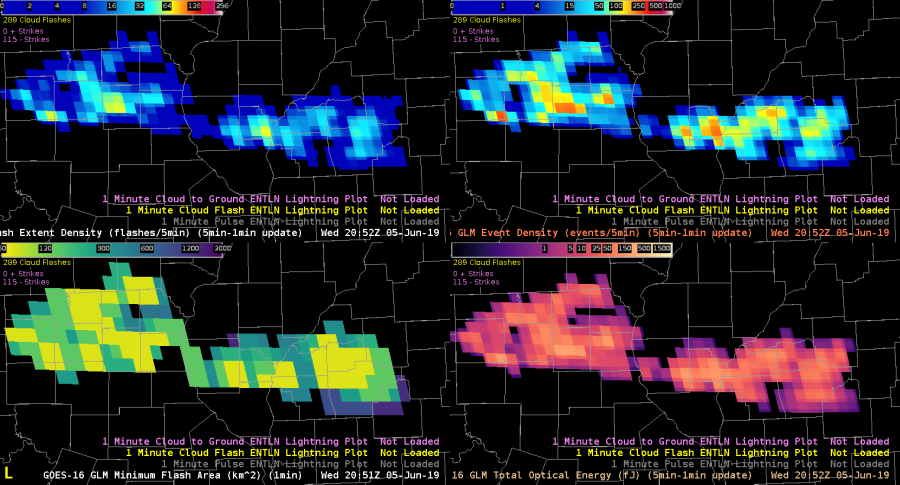
I’m also looking at GLM products to see trends with convection. The combination of event density and GLM minimum flash area help me to see the rapidly growing updrafts as well as cell that are producing hail. That’s the case right now. My warned cell is producing penny size hail.
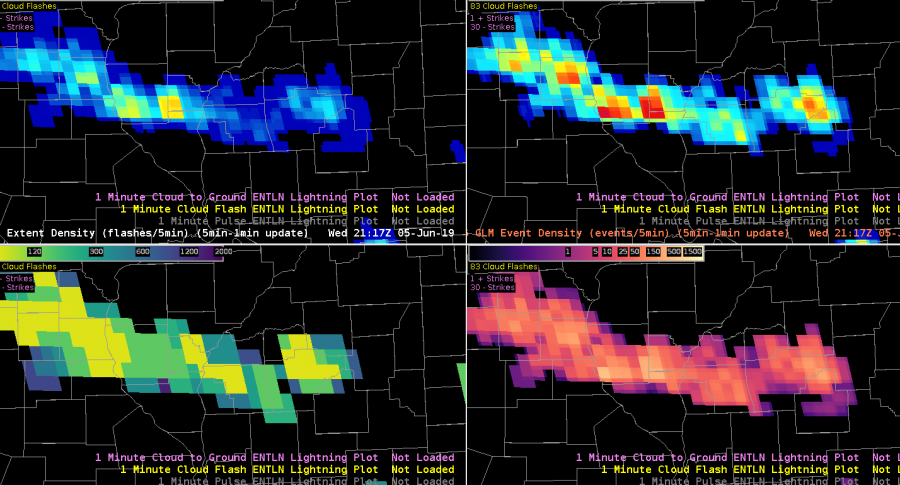
About an hour later the FED Is starting to pick up on longer flashes, but the event density is still showing higher values. The lines up with satellite which shows overshooting tops, but storms are overall keeping their intensity. The overall trend combined with looking at stability indices aids me in nowcasting that storms will at least maintain their strength over the next hour or so.
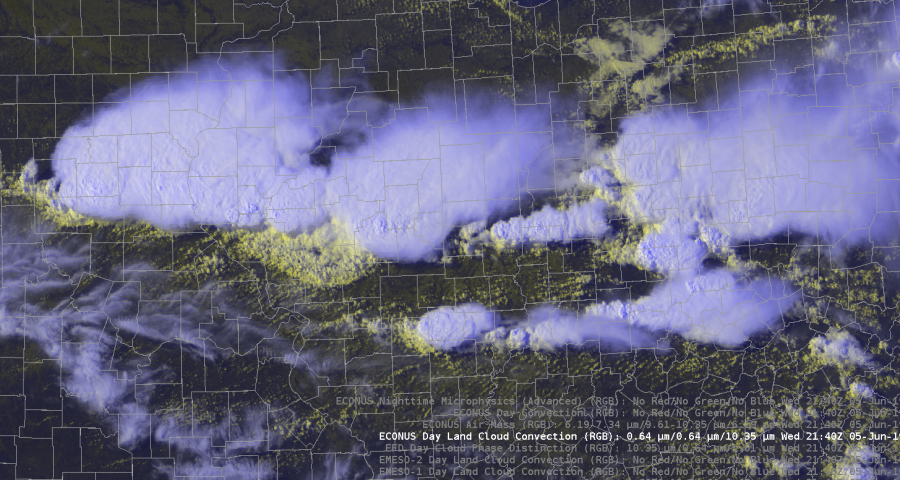
The Day Land Cloud convection RGB was helpful in analyzing different cloud tops. The color scale highlighted the thin cirrus compared to the lower thick clouds. It also dipicted the outflow boundary from our southern storms very well. It gives much more detail to the cloud types compared to the visible satellite.
Today I also got the chance to analyze and compare the merged TPW precipital water with the allsky.

During the afternoon the PW values stayed fairly steady across the northern half of the state while moisture increased in southern Illinois.
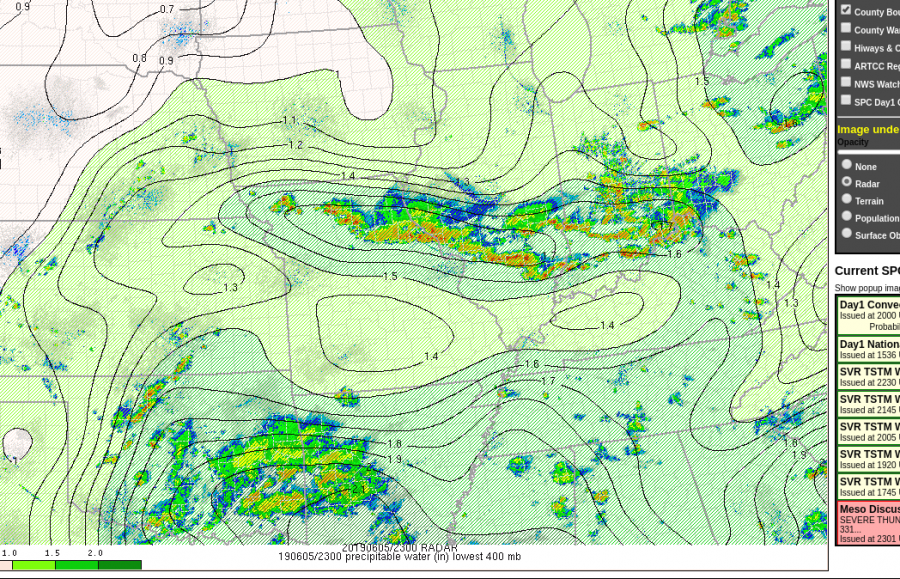
The TPW decreased PWATS to close to 1 inch as storms moved through. T
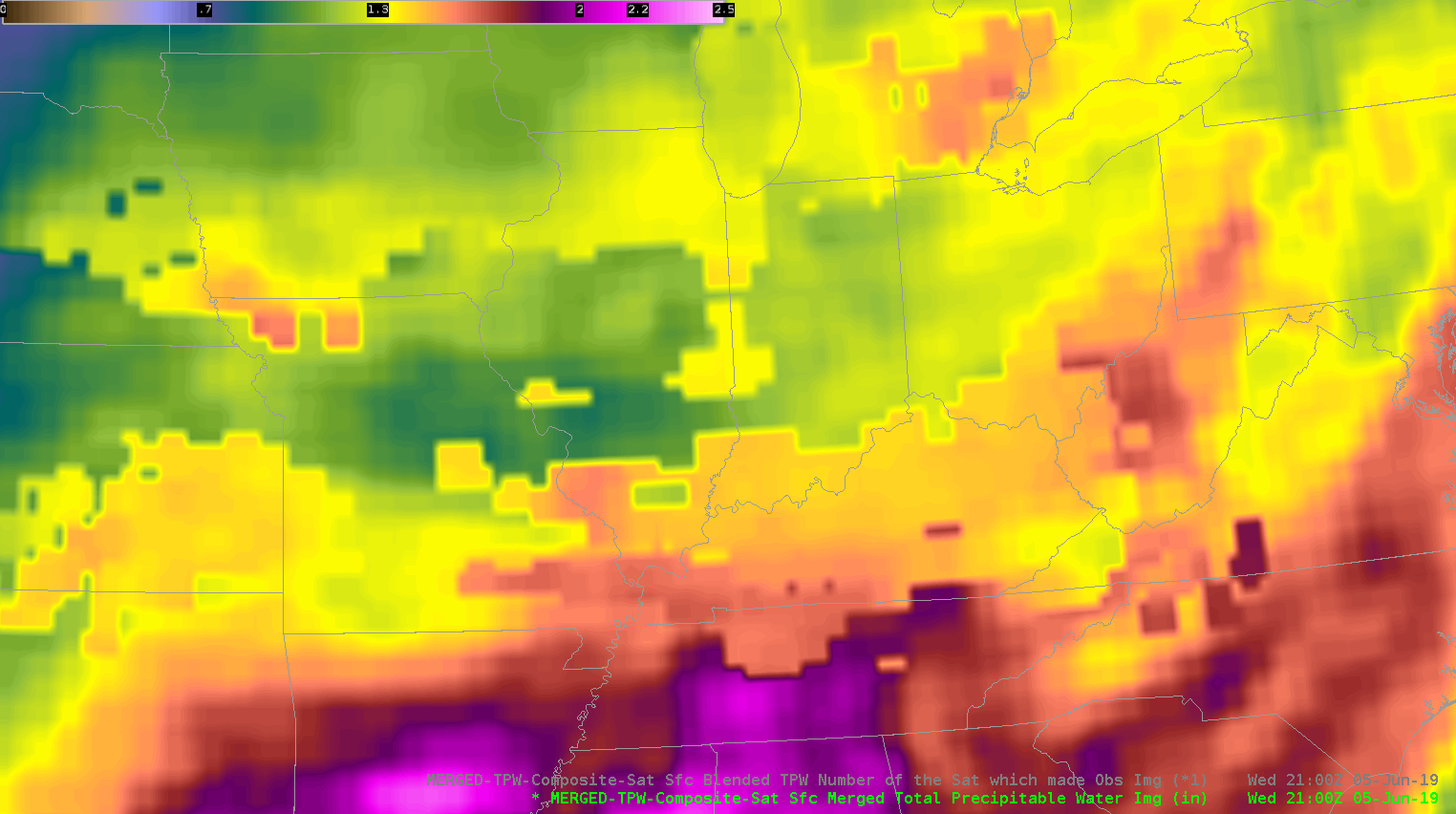
That data was sampled in a cloudy environment.
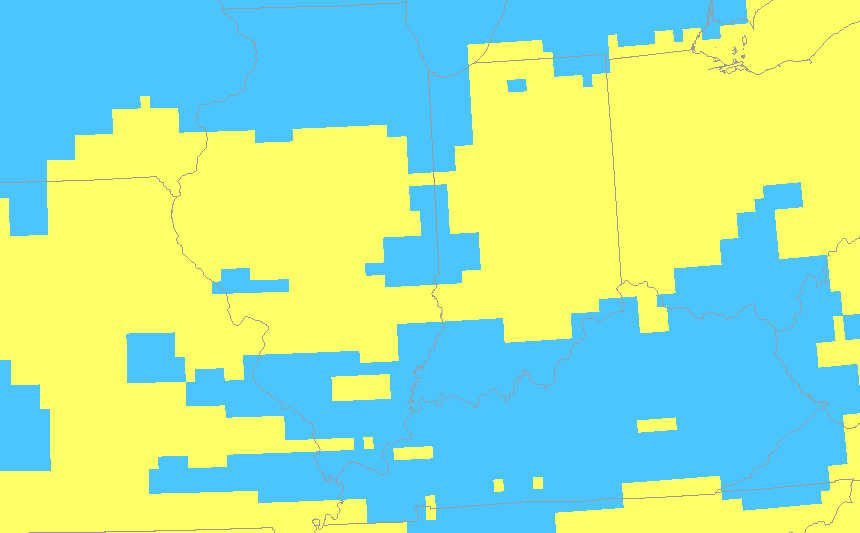
Meanwhile, the AllSky does show a decrease in PWATS but’s farther north compared to what actually happened. That data was pulled from the GFS since it was in a cloudy location. It was helpful to see how each product performed in this environment. It’s nice to have access to both in order to see which one has the best handle of the current atmosphere. That initialization helps me monitor trends and nowcast.
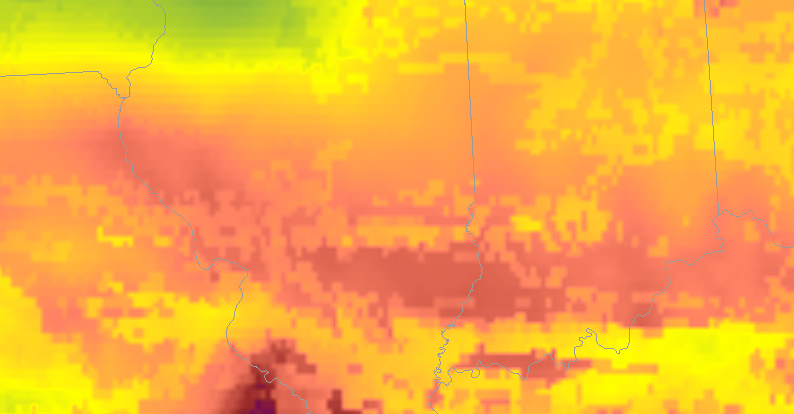
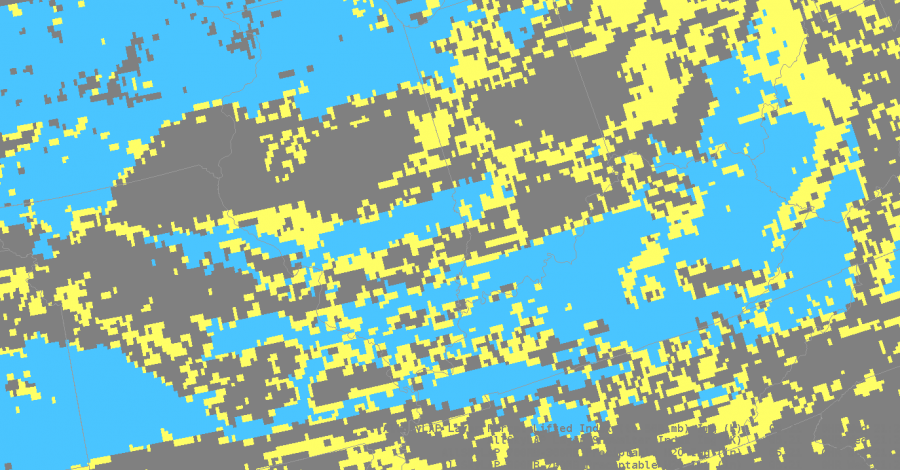
As storms moved south out of my DMA I used Day convection RGB just to monitor growing cells. It was clear to see the strongest storms because they had the bright yellow maxes.
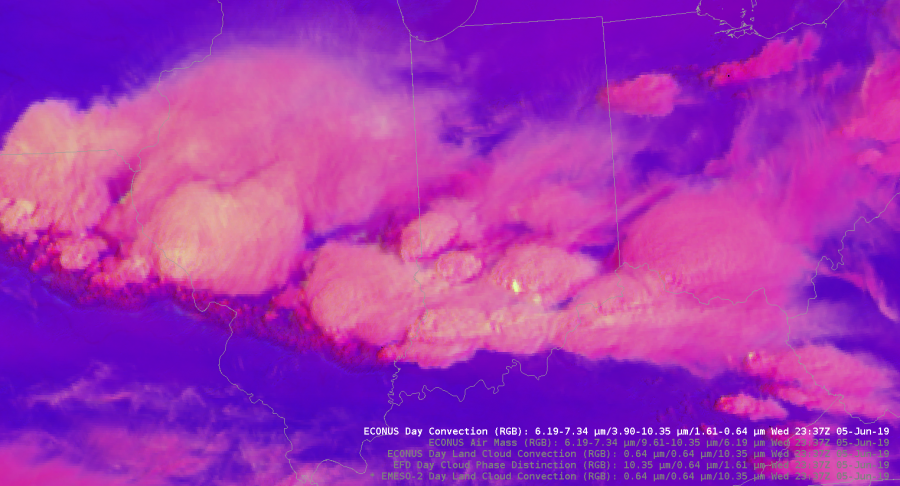
Earlier in the day was able to compare NMDA with the low level azshear. Tornadoes were’t a major threat, but the NMDA did line up with peak areas of Azshear. That storm did produce wind damage, and strong wind gusts.
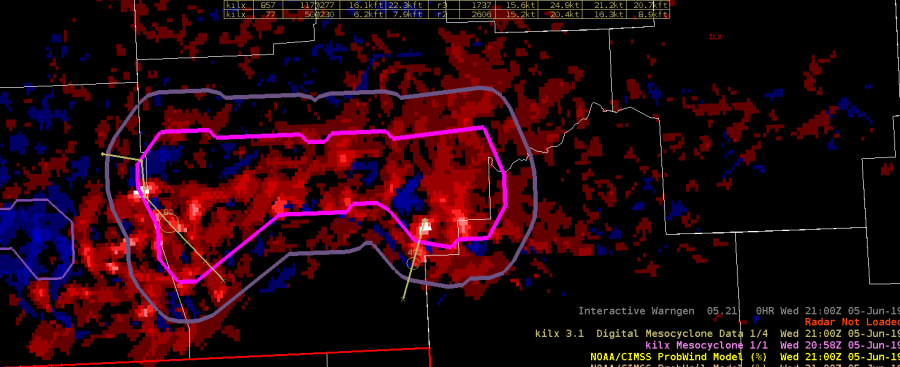
Taylor Johnson.

Springfield Storms

We’re currently analyzing storms developing in the Springfield Missouri WFO.  Right now I’m using various tools to monitor if these storms will become severe.

Right now I’m using a combination of radar, GLM, nucaps, and the All sky products. Currently the most helpful tools on top of what I normally use are allsky and the lightning products.

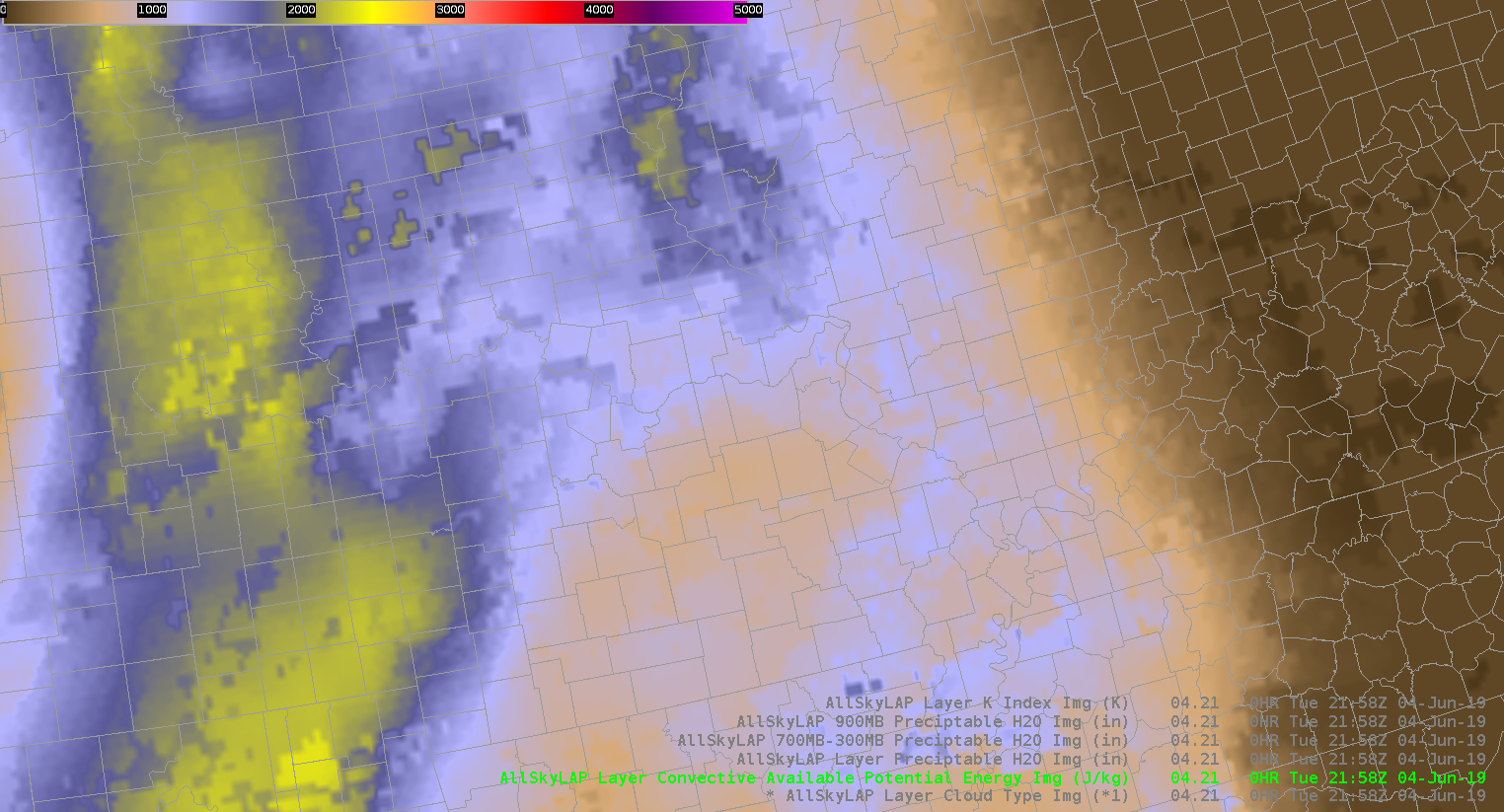
The allsky cape helped to find CAPE gradients and an increase in CAPE. The northern batch of storms were pushing into an area of increasing CAPE and in return they did intensify.

While deciding whether or not to issue a warning I also looked at AFA GLM data to see if there were new flashes developing which can be indicative of growing convection. That flashes aligned with radar and increased my confidence that storms would intensify.

That lead to me issuing a severe thunderstorm warning. The prob severe data also ramped up. So I felt confident about my warning.

I also used NUCAPS sounding predictor to look at the cape during the rest of the afternoon.


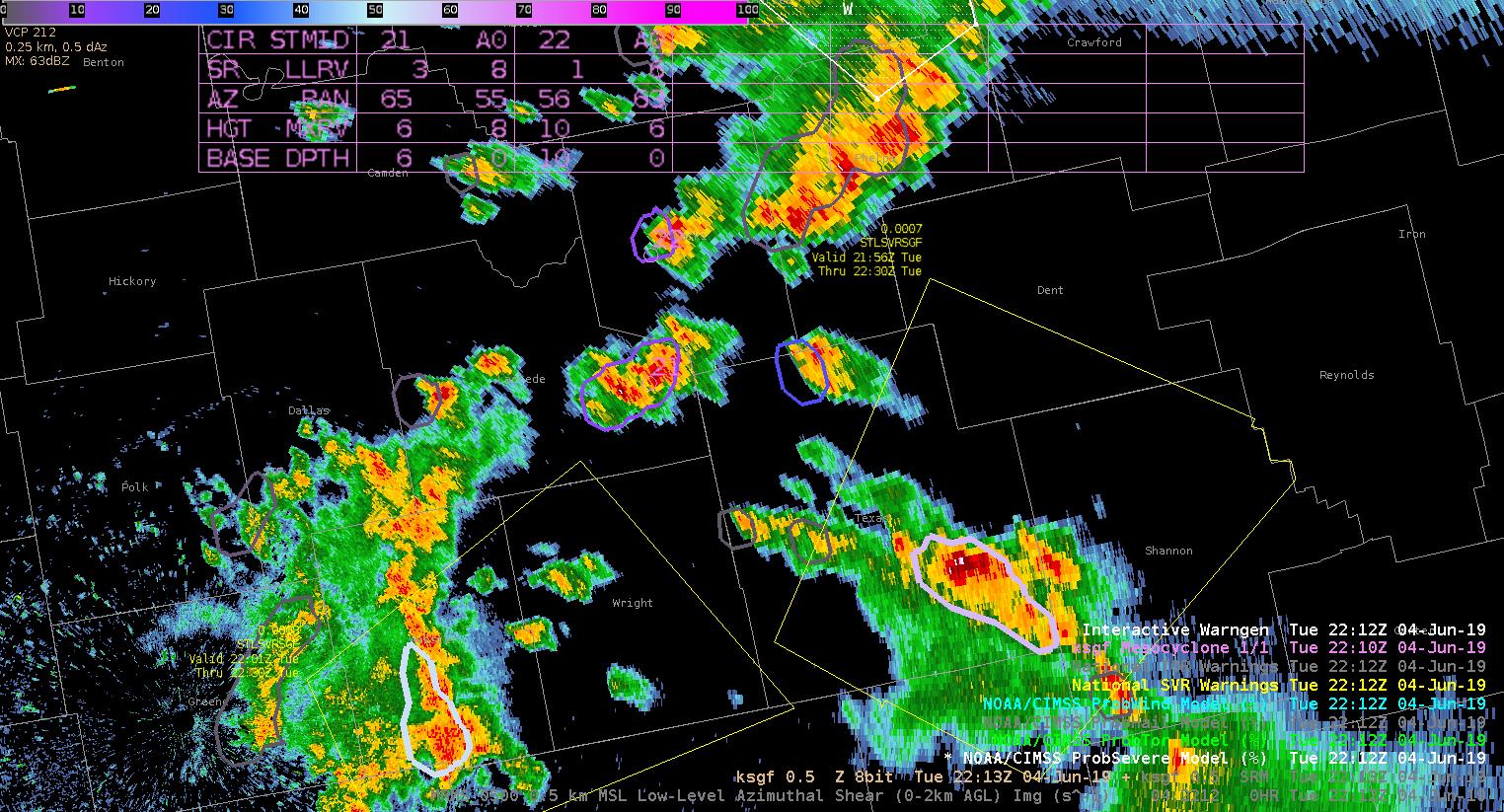
While watching storms in the Springfield area I tried using  NMDA. Even after magnifying the product it was still a bit hard to see. I’m note sure if there’s a way to make the circle bigger or more pronounced. It can get busy on an active day.

As I continue to track storms I’m using Allsky CAPE to see what type of environment they are moving into. The CAPE does increase farther east so that makes me anticipate convection wane over the next few hours. I will though pay close attention to the storm farther north since they will move along the cape gradient.

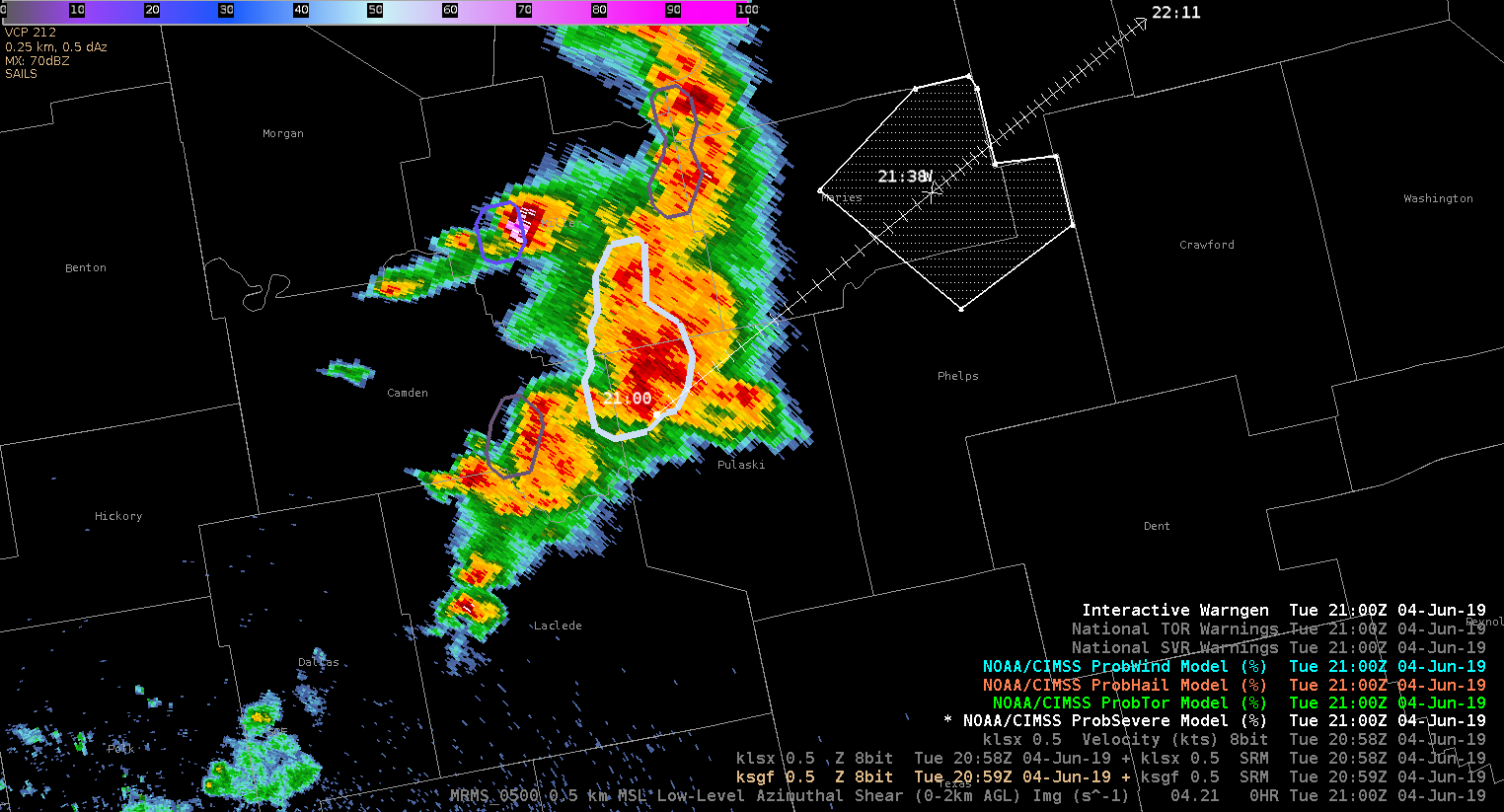
I also used probsevere to increase my confidence in warning for a cell in pulaski county. The velocity ramped up as well as vil values.


The increase in probsevere over a few scans prompted me to issue a severe thunderstorm warning.

Taylor Johnson

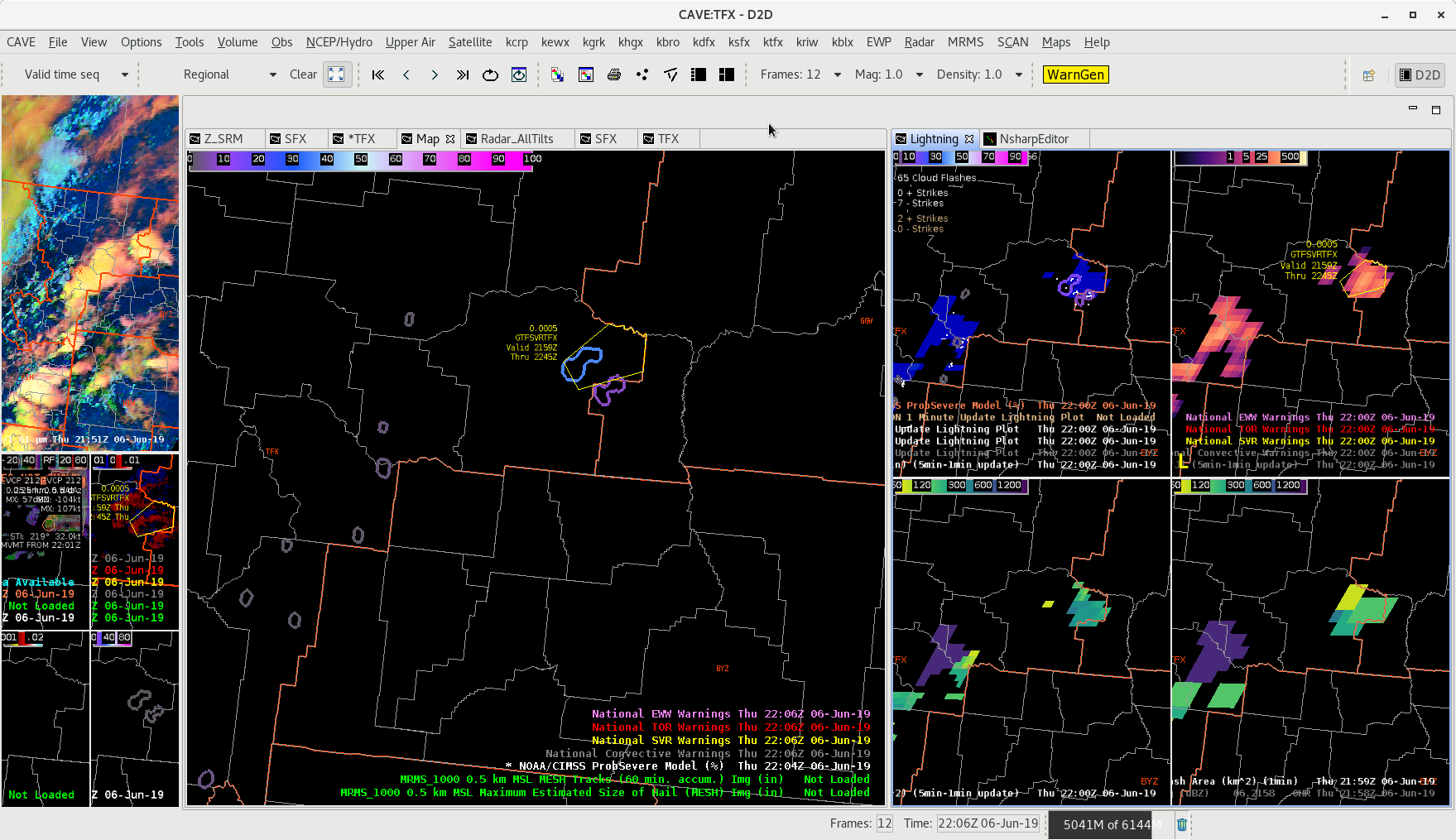
All Three Meso Detection Algorithms Struggle to ID Lone Supercell

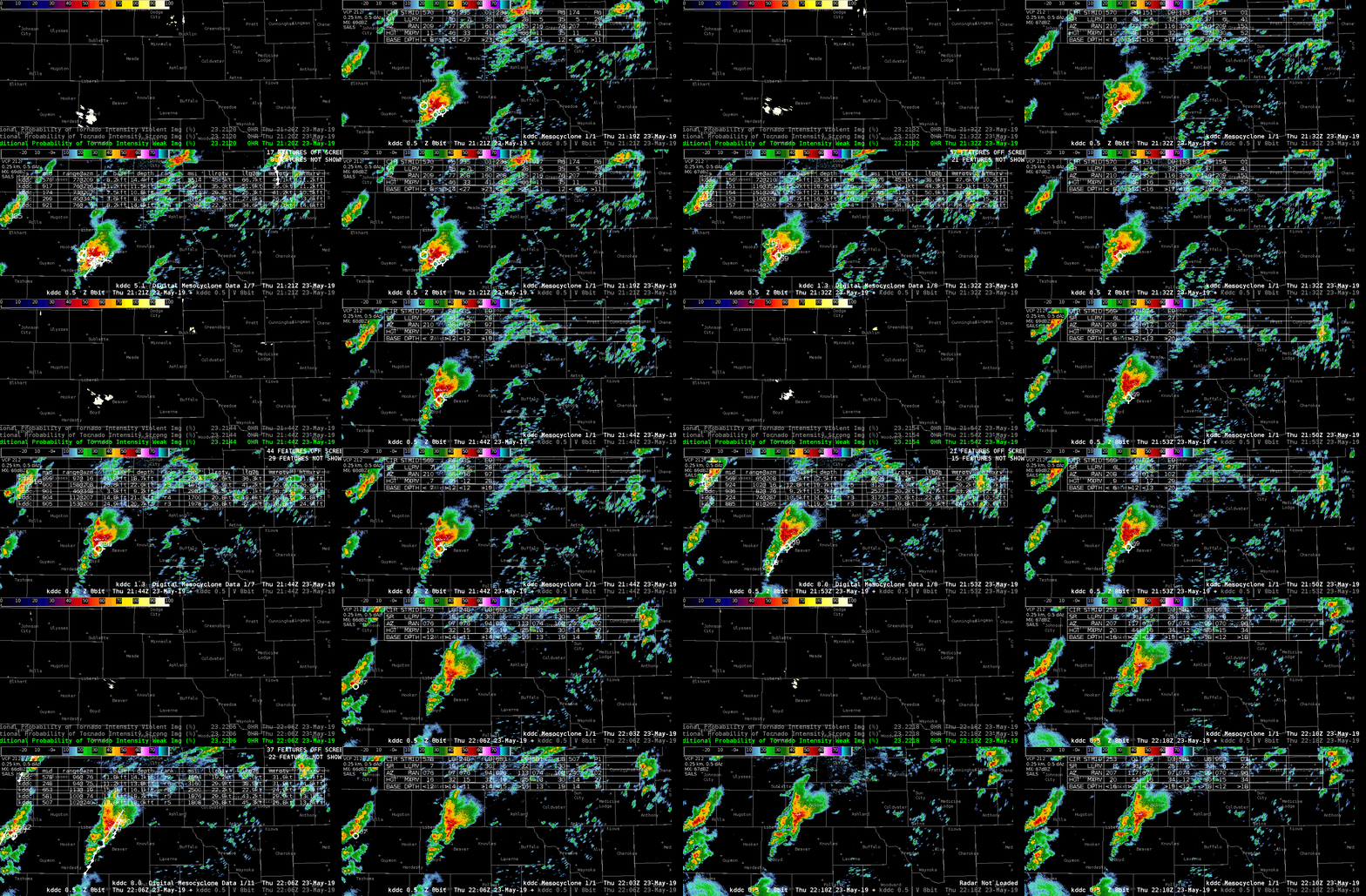
CPTI upper left, New MDA upper right, legacy MDA lower right, digital MD lower left.
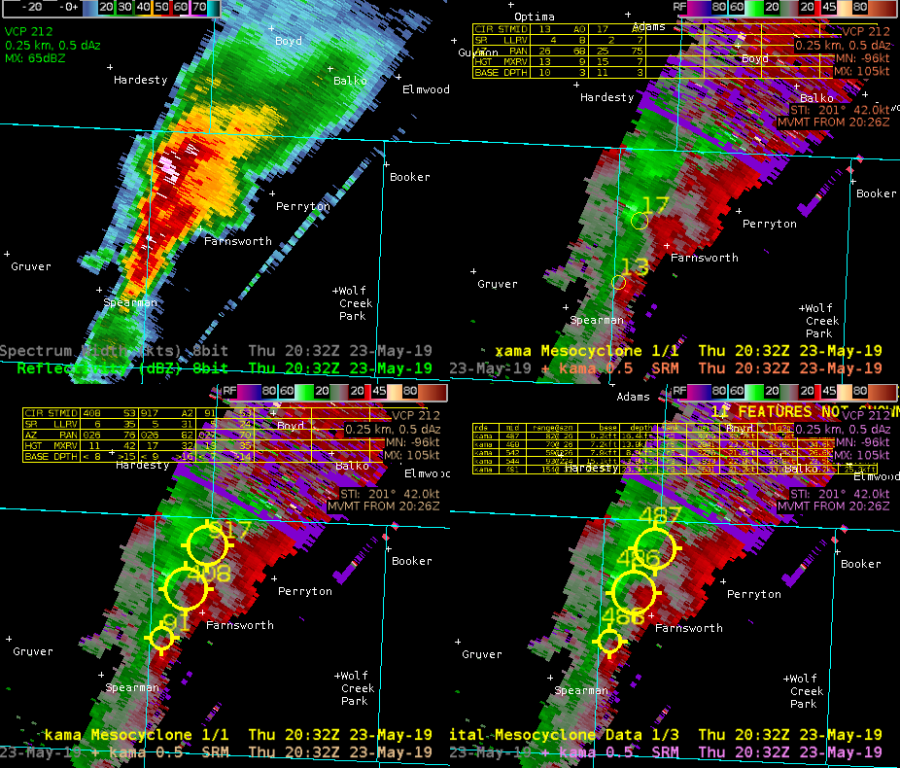
A discrete supercell tracked out of the Oklahoma Panhandle into southwest Kansas from 2120Z to 2220Z on 5/23/19.  During the first portion of this loop, the mesocyclone detection algorithms had a very difficult time latching on to one dominant meso, plotting up to four separate IDs for the same storm.  Eventually, both the legacy and new meso algorithms resolved one primary circulation, while the digital version continued to jump around a bit with the ID number and location.  For the last 15 min. of this animation, the MDA data completely dropped out.  The main point here is it was nearly impossible to utilize this product operationally because of the meso identification and data dropout issues.  It’s worth a mention that the legacy and new MDAs had about a 15-20 min. window of good meso tracking after the consolidation to one ID and before the data was lost. -Roy

Significant Difference Between Operational and New MDA

Thursday afternoon convection continues to cook in the northern Texas panhandle. Several mesocyclones were detected by the different algorithms along a broad, down radial shear zone. The values from the operational MDA (bottom left) and digital (bottom right) were very high, topping out at 24+ LLRV for all three mesos detected at the lowest scan. That is much higher than values seen for some tornadic supercells earlier in the week, and does not match the velocity data with no strong, tight couplets evident. The new MDA is much more restrained and actually has the strongest RV values above the lowest scan, which matches up with the velocity data much better as the values should be lower with broad, weaker areas of rotation.

Dave Grohl