


First blog post. Rotational velocity tightening considerably with corresponding CC drop. -Sidney Crosby
Official websites use .gov
A
.gov website belongs to an official government
organization in the United States.
Secure .gov websites use HTTPS
A
lock (
) or https:// means you’ve safely connected to
the .gov website. Share sensitive information only on official,
secure websites.

First blog post. Rotational velocity tightening considerably with corresponding CC drop. -Sidney Crosby
This is a test post. Fingers crossed it works! Now I am editing to see if it works lol.

Kilometers
Example of a 6 panel map with Az and Div Shear plotted


-Nimbus
This is a test blog post to test the software and process.
In my pursuit to find strange cases with TORP, AzShear, and DivShear, I stumbled across a large number of single digit TORP probability values along a line of meager convection. As I cycled through the different TORP objects, most looked to have short life spans with low values (as expected) but one looked to extend out over an hour back with sharp spikes in probability up to 74%.
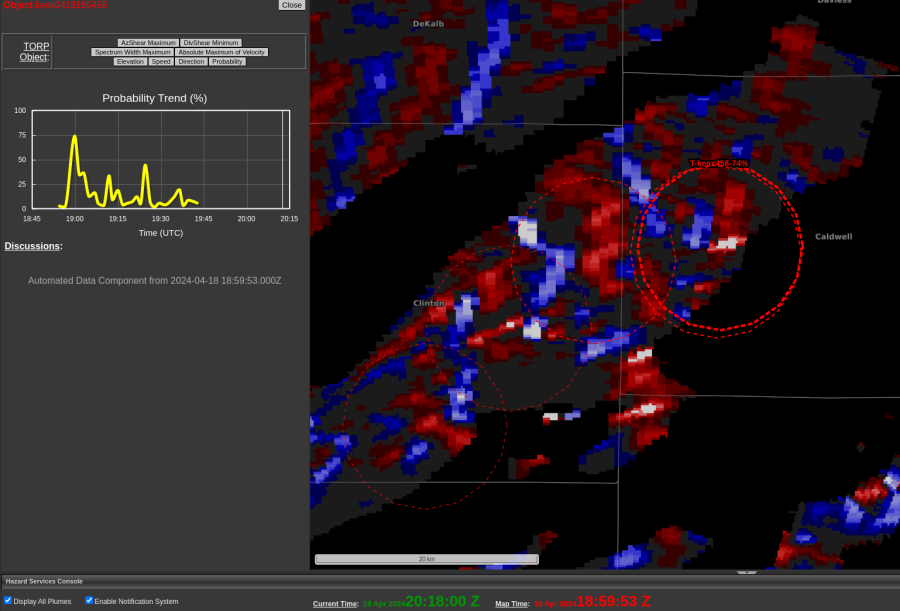
Intrigued, I stepped back to interrogate the storm data, expecting to see a possible tornado in its wake. In reality, it seemingly caused by erroneous velocity data (displayed with reflectivity below).
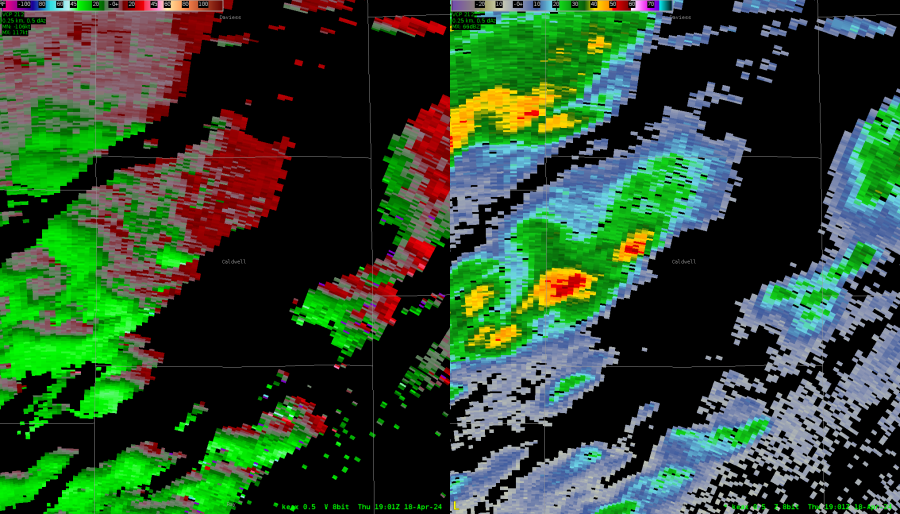
This was a little disappointing both because TORP seemed to have done alright with the line otherwise and this feels like something QC could catch and delete (not that I would necessarily know how). The overdone AzShear looks to explain this outlying detection, but I figured it would be worth also checking DivShear now that we had access to it. What I found was not what I was expecting.
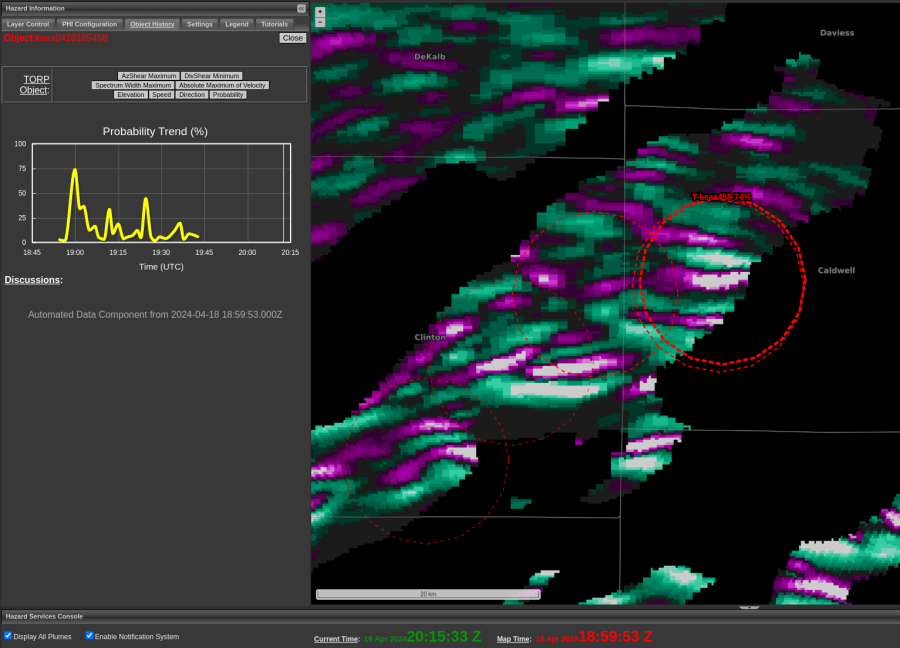
When we have good data for a robust supercell, we would expect a sort of clover formation centered about the max AzShear couplet. Instead we have these long ribbons and convergent and divergent signatures. Pleasing to the eyes, but again not what we want to see if we expect a tornado touching down.
-Wx Warlock
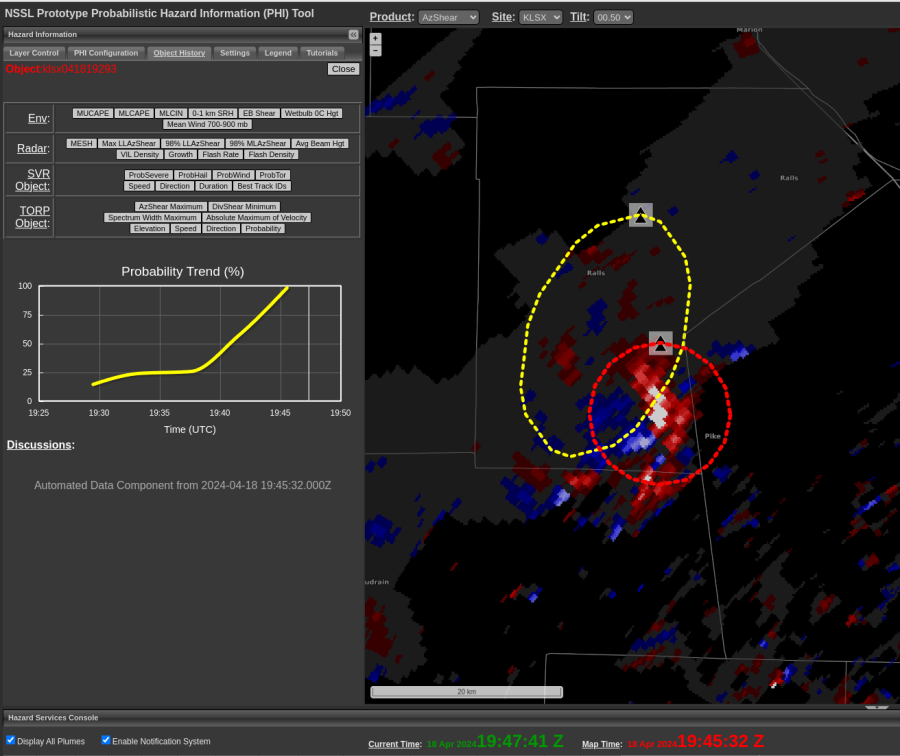
A case of sidelobe contaminated velocity fields occurred around 1945 UTC (Thursday) in Ralls County, Missouri. TORP/AzShear algorithms were quick to initiate an object and jump towards near certain (>90%) values. The object remained for multiple volume scans until sidelobes disappeared. When “real” velocities emerged, TORP magnitudes dropped/went below threshold quickly. -QLCS
A short observation. Looking at an incoming QLCS line from KDOX creates two different regimes of AzShear patterns depending upon how parallel to the radial it’s aligned. We see groups of couplets on the more perpendicular side and a long stretch of convergence/divergence paired on the parallel side.
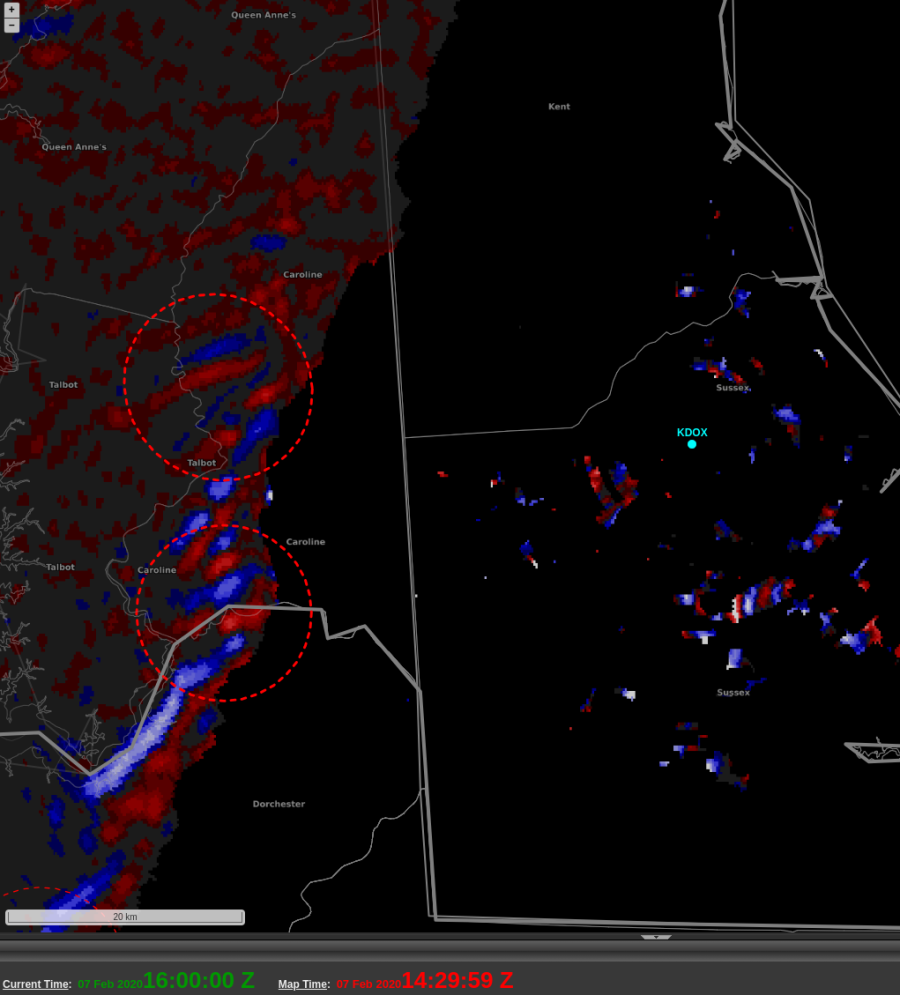 Meanwhile, TORP still isn’t really sure how to handle this…
-Wx Warlock
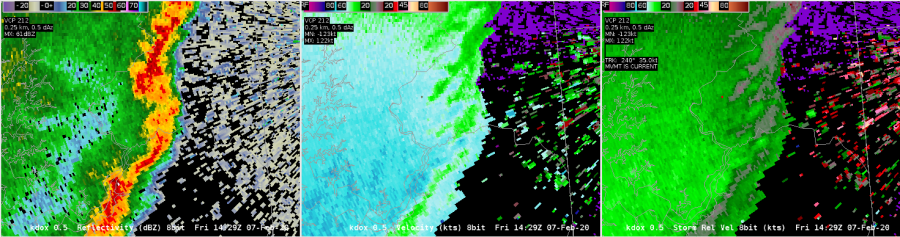
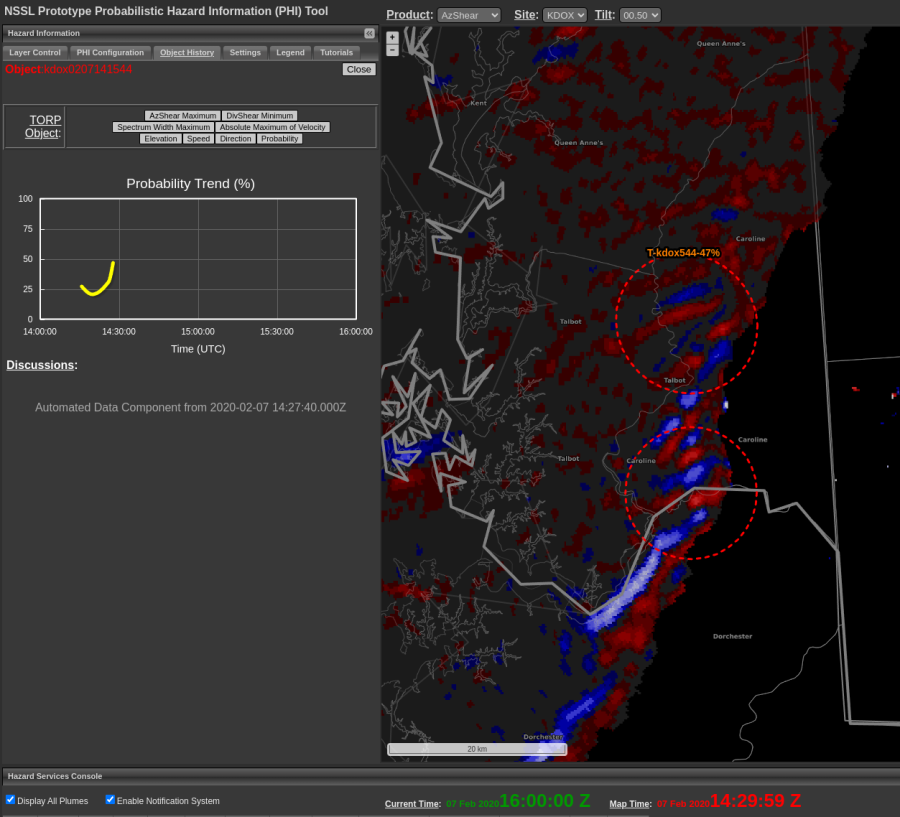
Interesting output from AzShear/TORP along leading edge of advancing QLCS. Environmental analysis (and velocity pattern) would indicate some stability of the boundary layer. Yet, TORP initiated two objects (>40%) near this feature with very little concern in viewing base data analysis. -QLCS
KDOX radar plotted nine TORP detections along a line of low-topped convection at 1451Z on 7 Feb 2020. Eight of the nine detections had probabilities over 30 percent, but almost all of them were less than half an hour in duration. 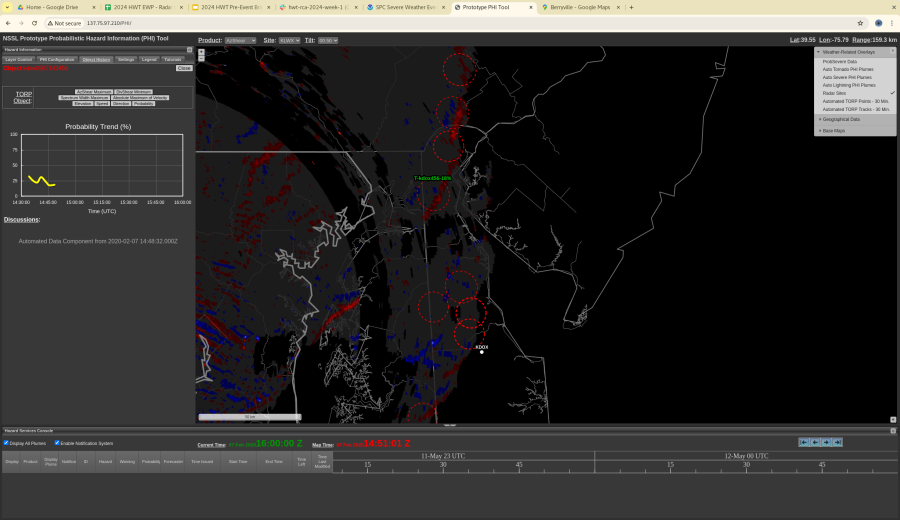
Posted by Rigel
Found a questionable TORP object while skimming through a case this afternoon. A few broken lines of convection are approaching the KAKQ radar on an early February morning. I had yet to see many TORP objects as the case is a bit of a slow start, but suddenly noticed this pop up centering on the west side of an oncoming line.
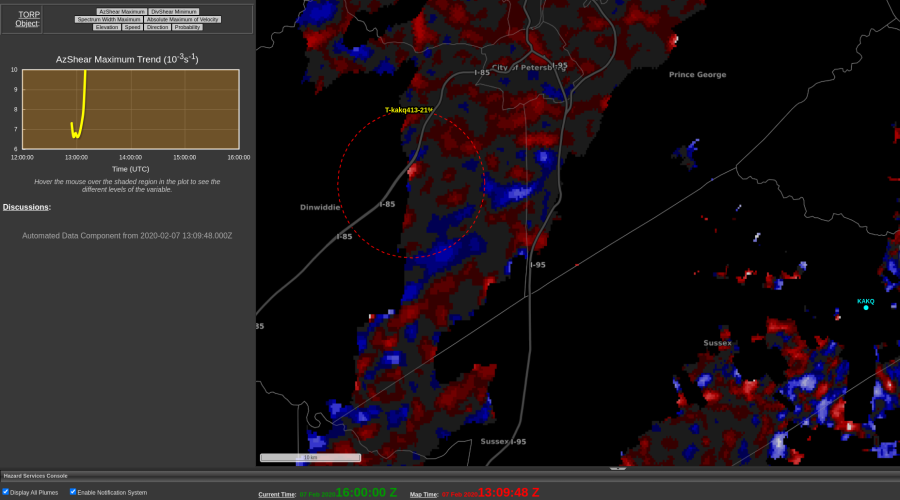
I found this strange, as I not would expect AzShear values to hug that close to the west side of a line. So I went to investigate with reflectivity and velocity data and didn’t find anything I was impressed with.
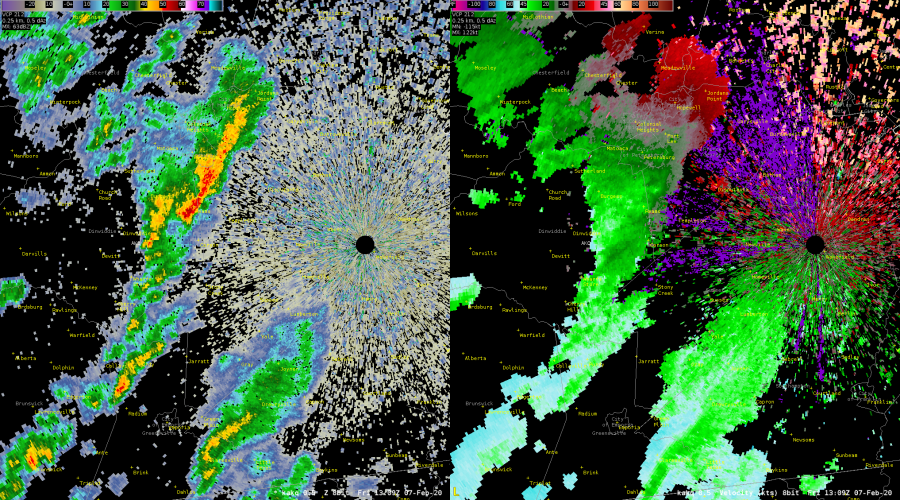
What I did see, is that the TORP object is centered about a section of I-85 in a section of fairly low reflectivity. In my home office, we’ve seen cars and boats via radar and this could be a similar event, but with a convective line in the way there’s no real way to be sure.
-Wx Warlock