Outlook 23 May 2012: Week 3, Day 3

Forecasters are beginning the day in NC/SC region, specifically starting in the Raleigh and Wilmington CWA’s. Storms were already going as we initialized in the area, but are expected to grow in strength and coverage over the next couple of hours.   All the products and algorithms seem to working well over the region (only lacking total lightning coverage by an LMA, though this region may have coverage in future years!).  Multiple storms have already been flagged by the UW-CIMSS Cloud-top-cooling product with min values as low as -26 to -27C and warnings may be issued shortly by the forecasters as they get settled in the new operations/CWAs.
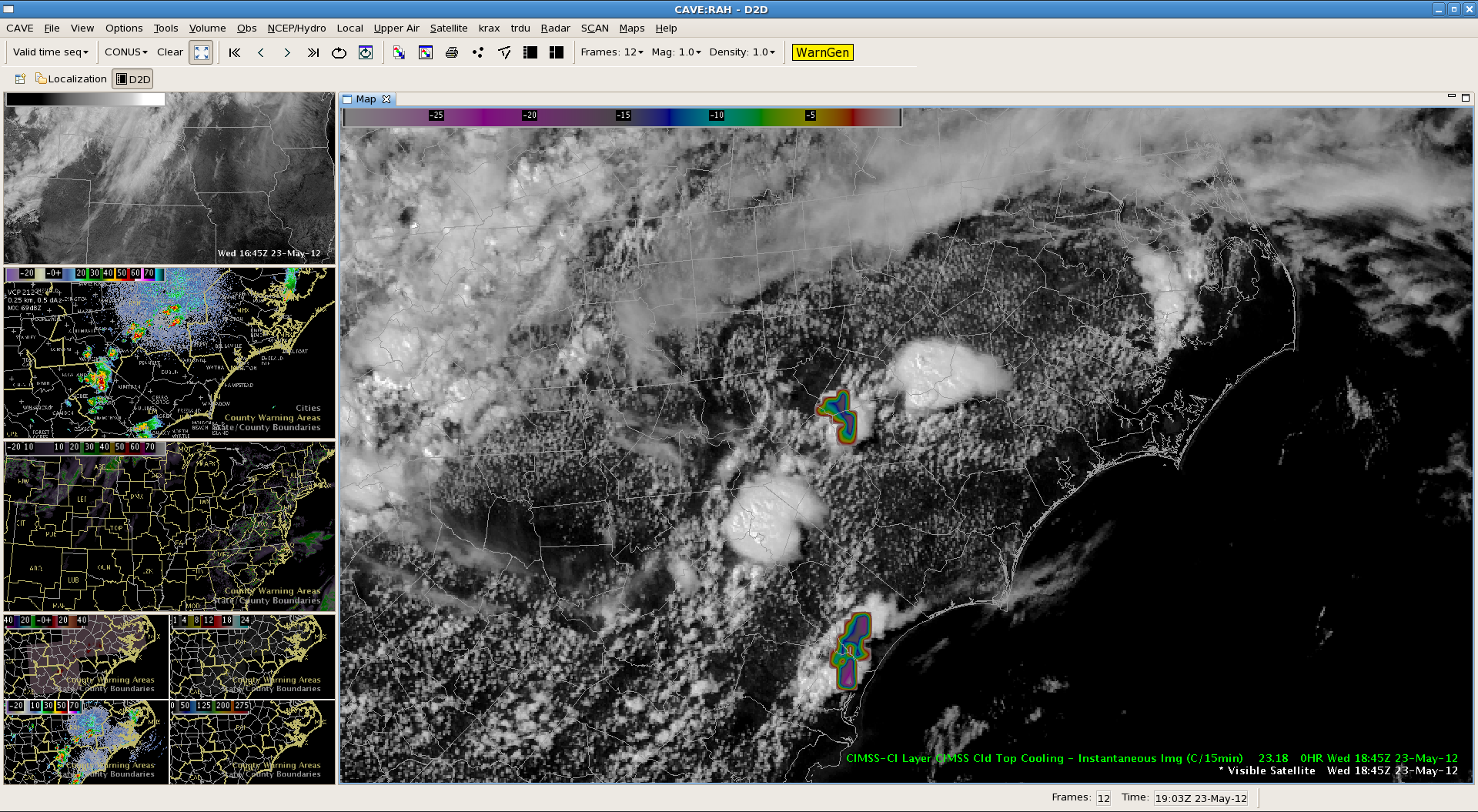
VIS SAT and UW-CIMSS CTC at 1845 UTC on 23 May 2012.

We’re still watching the other SPC slight risk area for later this afternoon and early evening.  It is likely we will make a switch (for at least one of the teams) to the central plains (likely Hastings/Omaha CWAs) if we start to see a CI signal.  Like yesterday the high-res models seem to want to initiate convection along the front by 2100 UTC, though moisture continues to be an issue over the region with dewpoints in NE CO in the upper 30s to mid 40’s increasing to only the mid 50’s over central KS/NE.   Unlike yesterday over the Dakotas where a thick cirrus shield covered the region, skies are pretty clear over KS with a bit more cloud coverage behind the front in central NE.  If and when storms develop, steep lapse rates and deep layer shear point to the likelihood of supercells with large hail and damaging wind (especially with the large dewpt depressions).
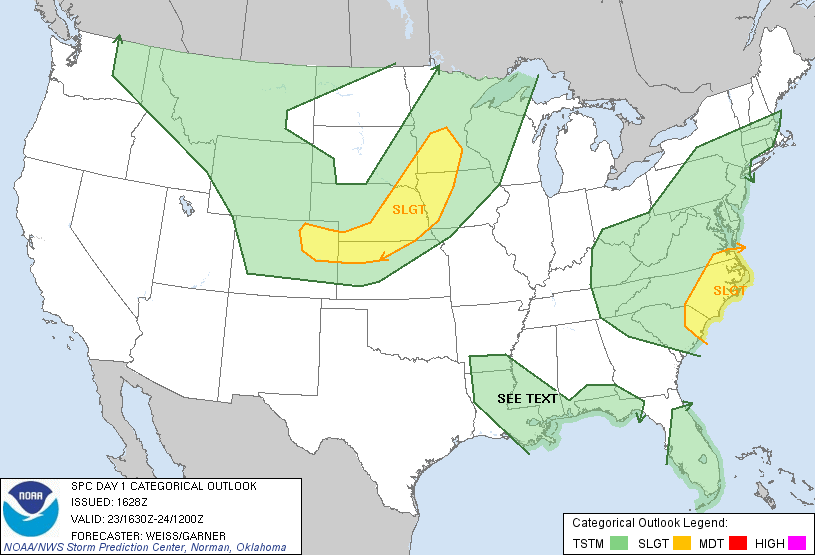
SPC day 1 outlook at 1630 UTC for 23 May 2012.

-Kristin Calhoun, Week 3 Coordinator
Tags: None

EWP STATUS FOR 23 MAY 2012: 1-9pm SHIFT

EWP STATUS FOR 23 MAY 2012:  1-9pm SHIFT

We will be operating a 1-9 pm shift tomorrow.  Although the cap will probably be an issue earlier in the afternoon, we expect supercell thunderstorms to form by early evening across the south-central Neb  & northern KS.

Another consideration are the data limitations after 9pm.  Since we share supercomputer time with the NSSL-WRF, 3DVAR calculations end at 9 pm.

-Kristin Calhoun, Week 3 Coordinator
Tags: None

BIS: 3D-VAR Max Updraft & Max Divergence…Good “Heads Up”

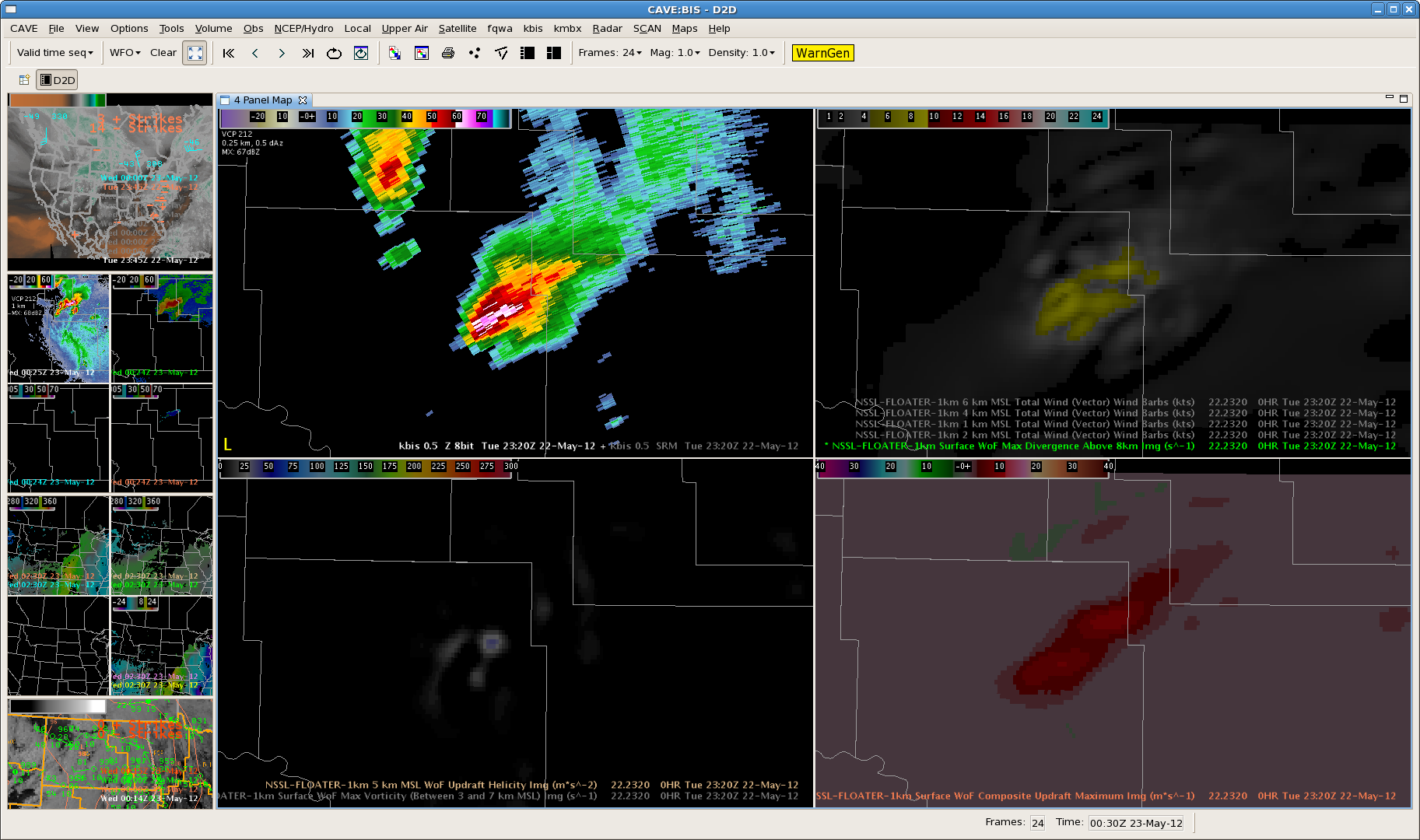
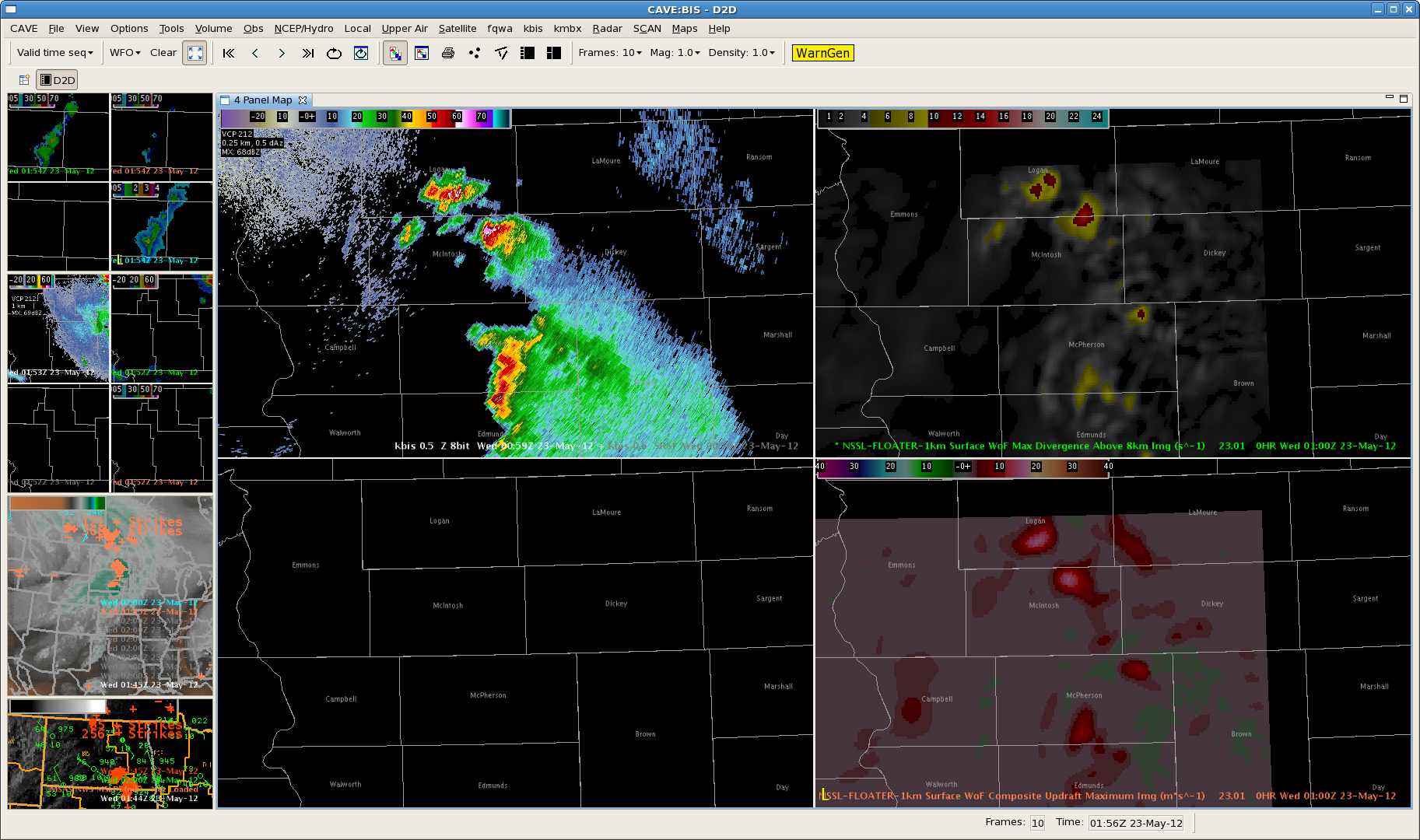
It’s becoming increasingly evident that 3D-VAR’s maximum composite updraft and max divergence above 8km can be utilized as a good “head’s up” display of the largest storms on the scope.  This can be seen in the image below.

Cluster of storms ESE of BIS on the evening of 5/22. Upper left (base reflectivity), upper right (max divergence above 8km), lower right (max composite updraft speed).

MCS over far SW Texas: synthetic vs real IR

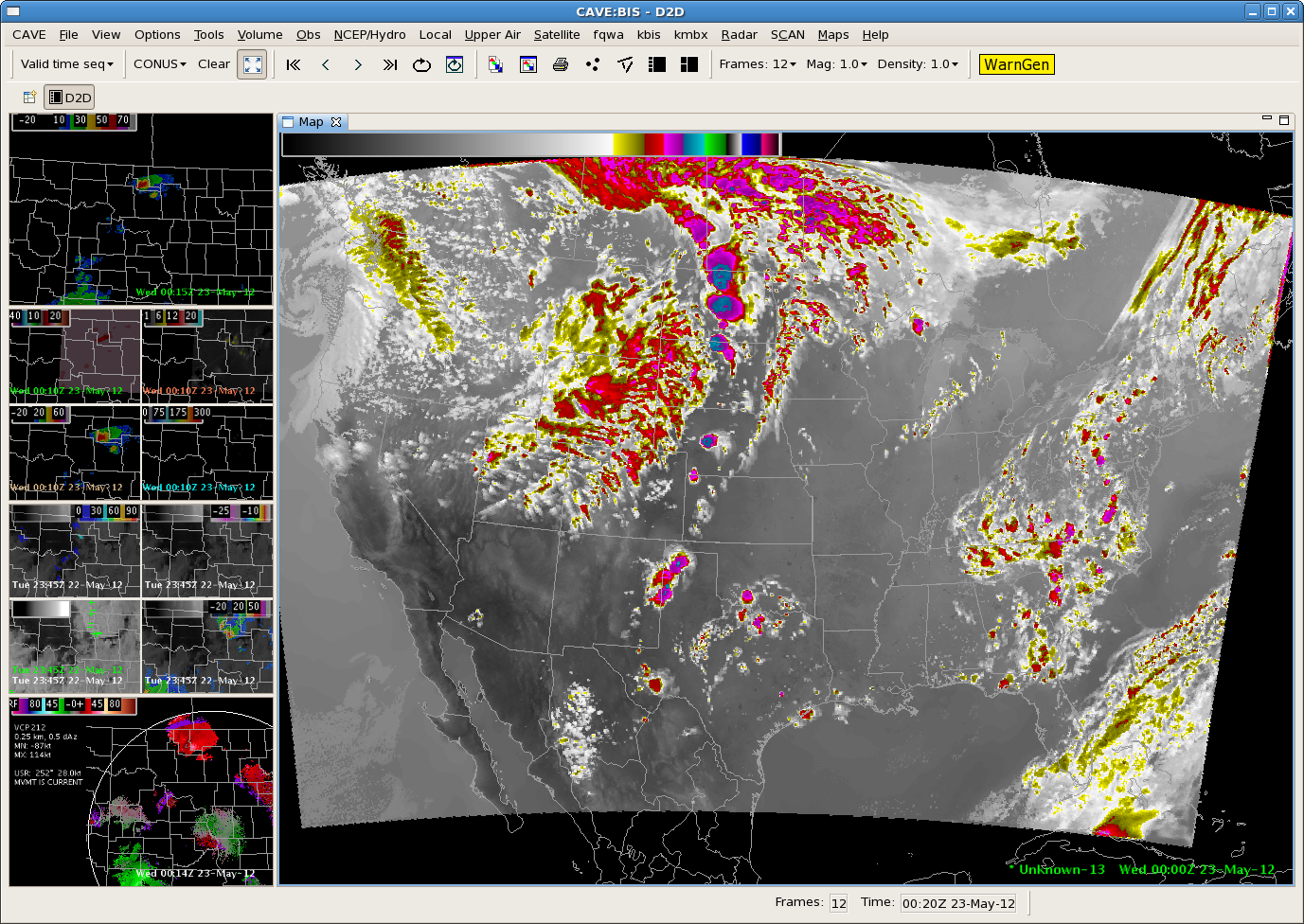
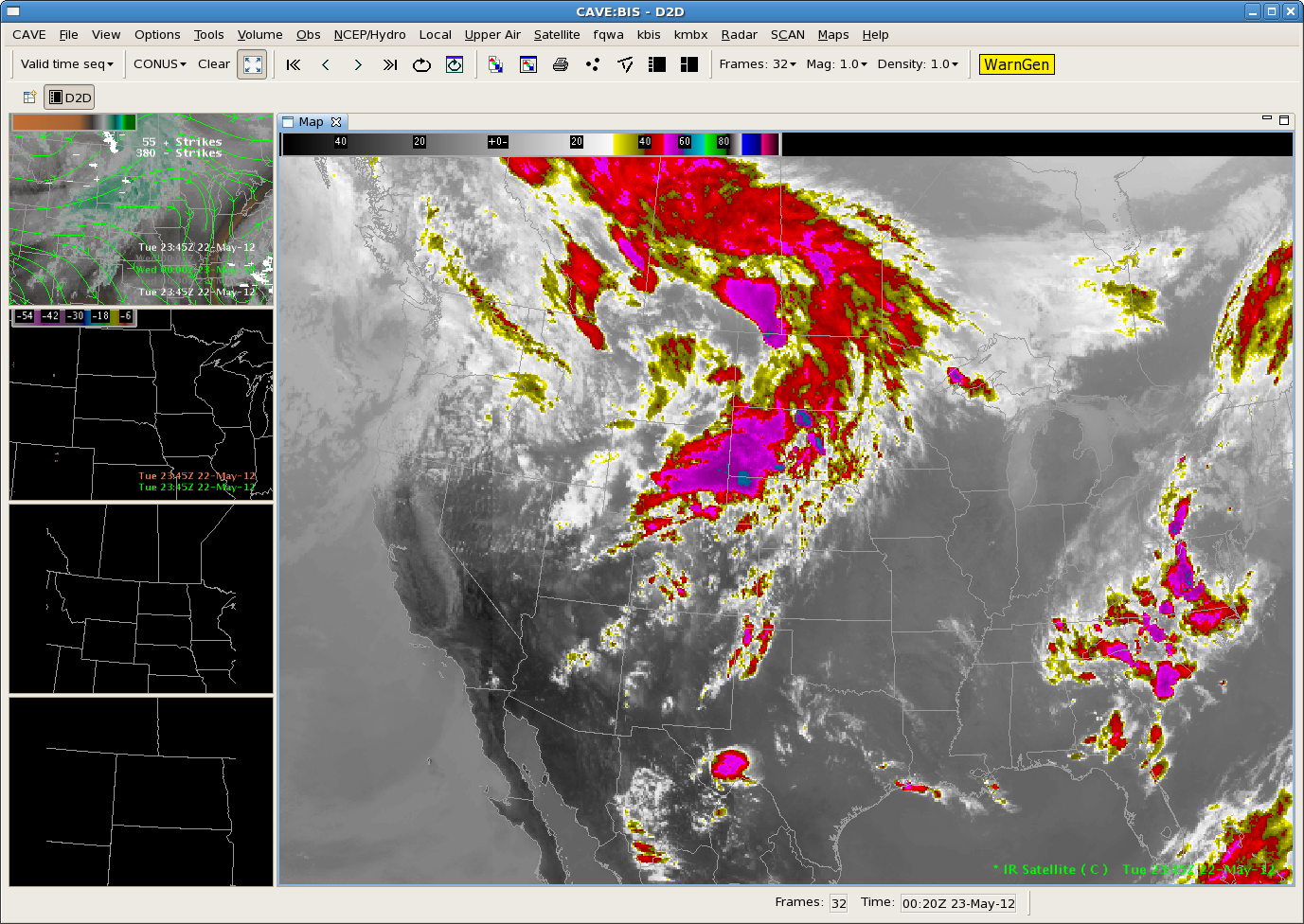
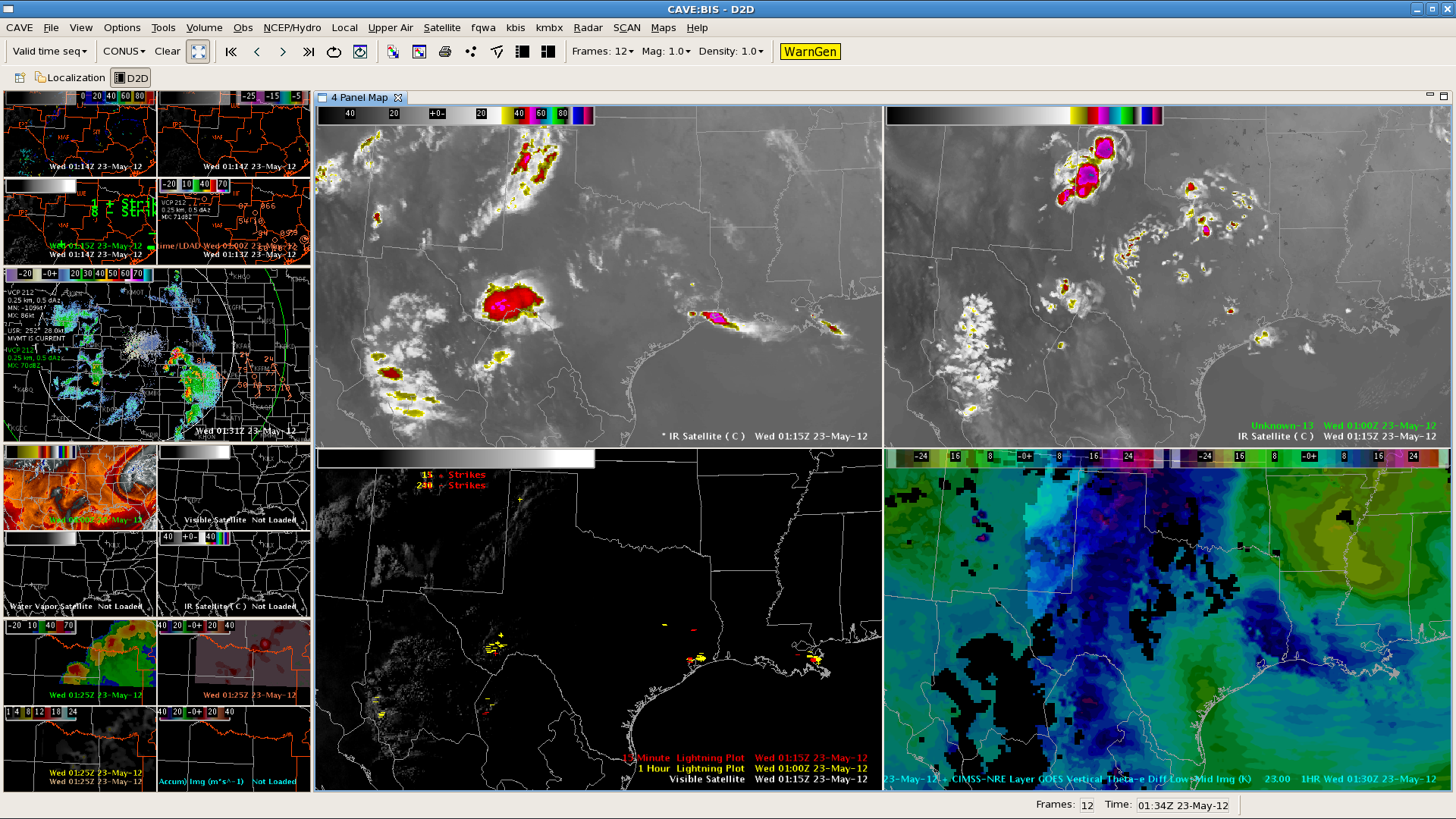
As described in this blog a few hours ago, storms developed S of Pecos due to ongoing diabatic heating in an environment modestly supportive for strong/isolated severe pulsating storms. Thunderstorms rapidly grouped in a loosley organized convective cluster, which gradually approached the NM boarder during the following hours. At 2300 Z, both IR showed the peak of activity/organization of that cluster with a constant weakening trend thereafter. However, the synthetic one caused a rapid decay of that cluster until 0100Z, whereas real time IR data still indicated a large cluster with cloud top temperatures of below -50 degree celsius at that time. Also, lightning activity was still present at 0100Z with that cluster although a rapid decline was also noticed until 0130 Z. So peak strength was captured well with a too fast decline of the cluster’s strength thereafter.

The synthetic IR did also an outstanding job in highlighting the area of initiation (both timing and the region…not shown).

Helge

BIS: 3D-VAR & Rapid Storm Growth

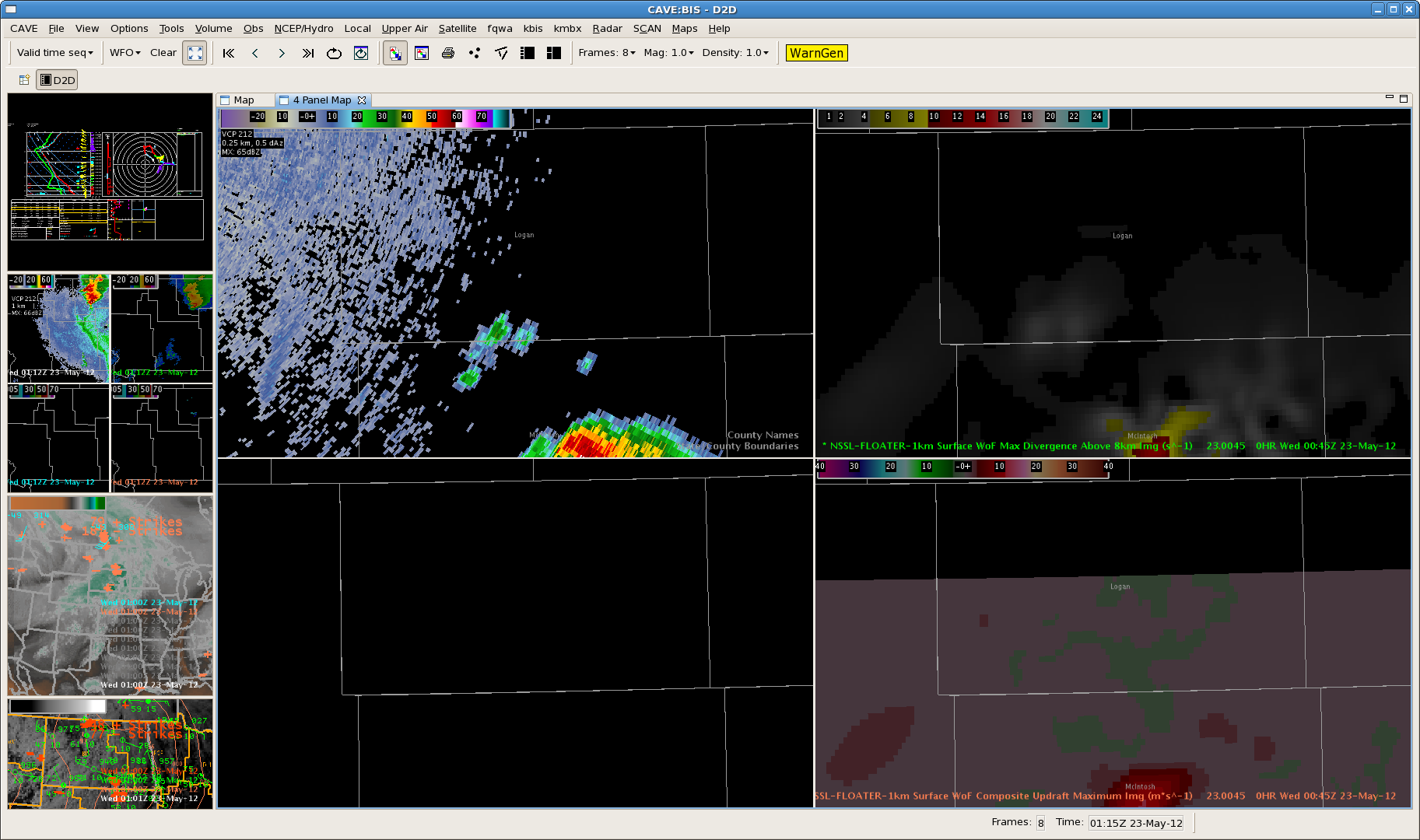
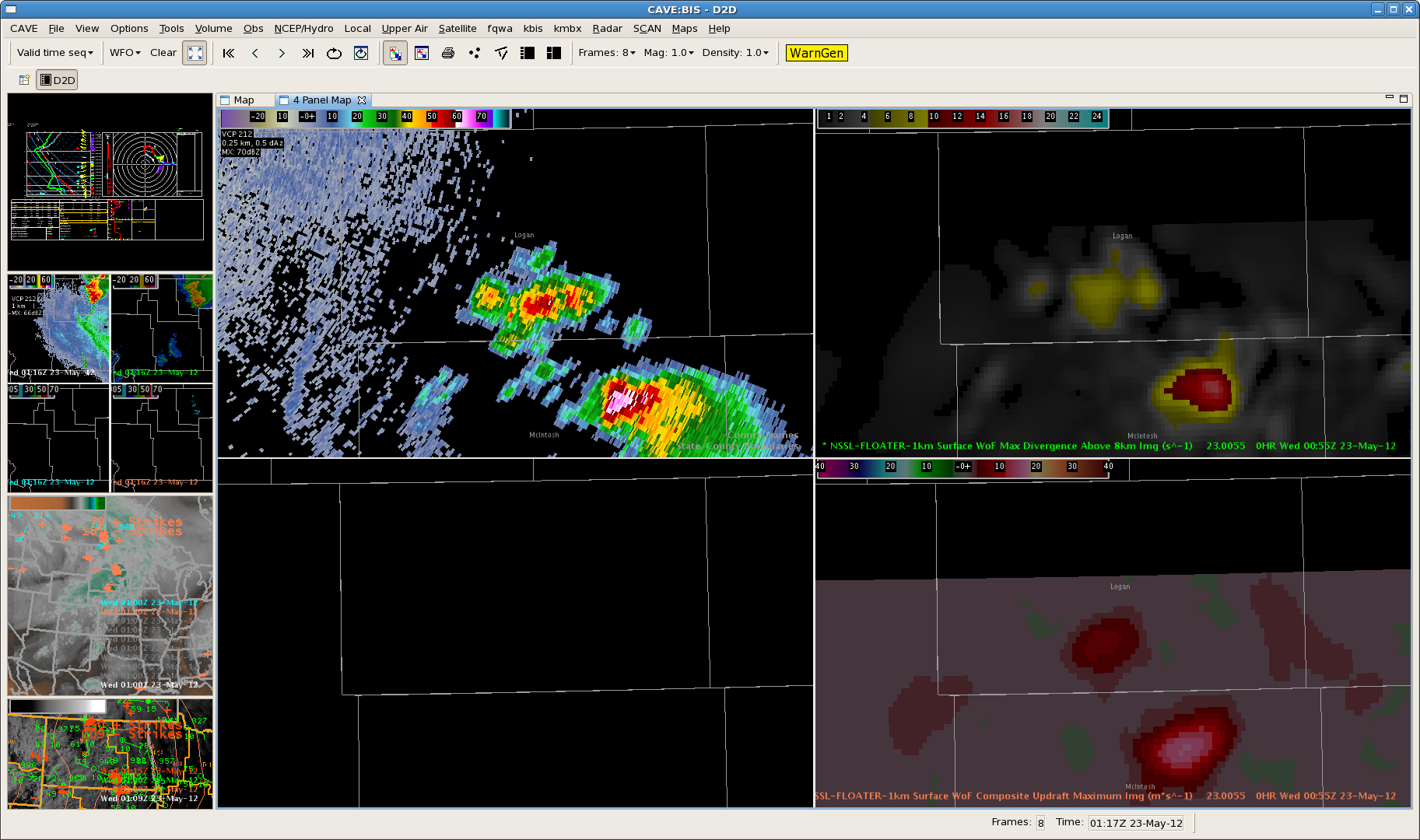
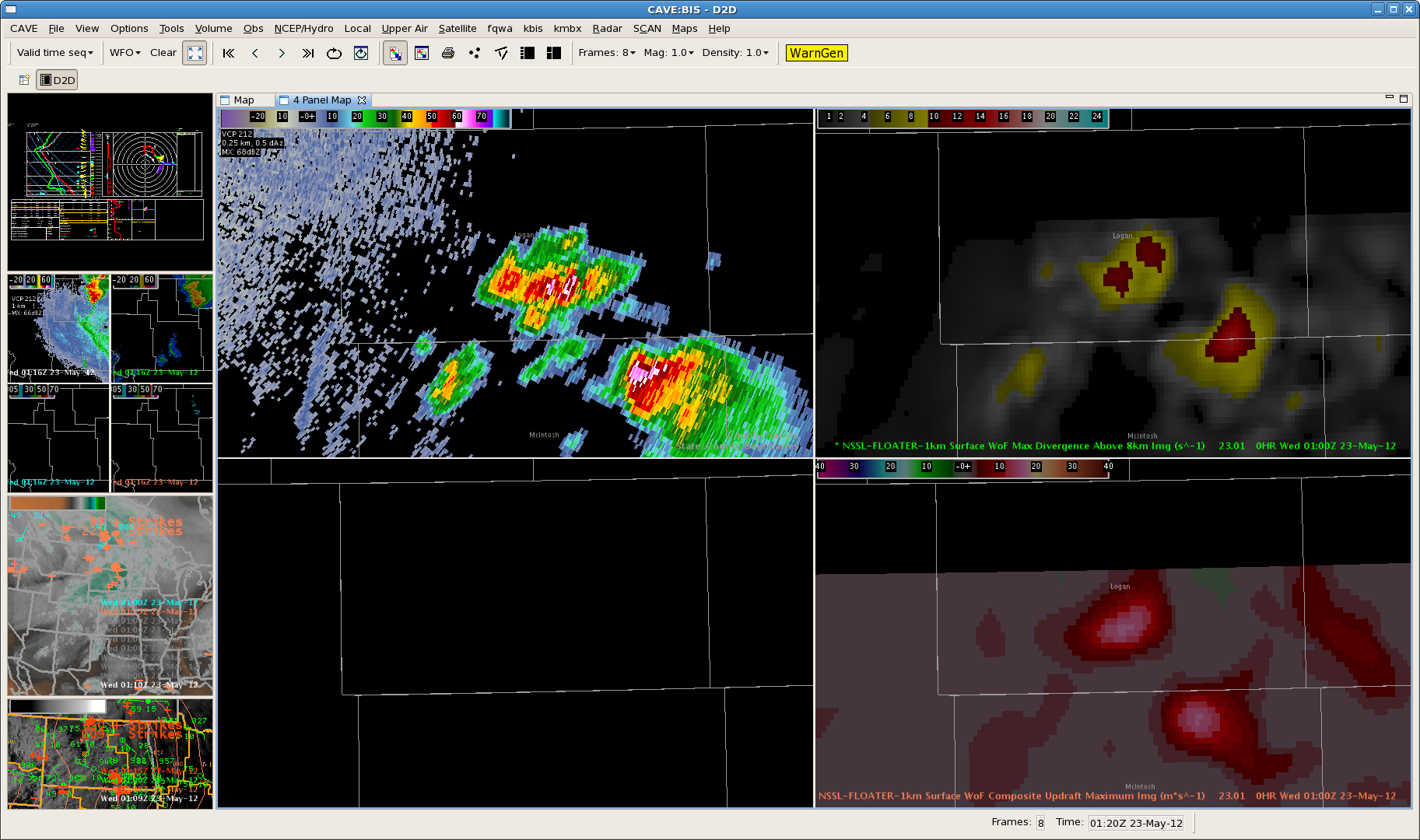
Refer to the northern-most storm in the below images.  Between 0045 and 0100 UTC, explosive thunderstorm growth occurred southwest of BIS, rapidly becoming severe as evidenced by 50-60+ dbz well above the -20 and -30C heights and mid-level rotation per BIS SRM.  3D-VAR products such as maximum composite updraft speed and max divergence above 8km picked up on this explosive thunderstorm growth, as shown in the 4 images below.

0045 UTC. Base reflectivity (upper left), max divergence above 8km (upper right), max composite updraft speed (lower right).
0050 UTC. Base reflectivity (upper left), max divergence above 8km (upper right), max composite updraft speed (lower right).
0055 UTC. Base reflectivity (upper left), max divergence above 8km (upper right), max composite updraft speed (lower right).
0100 UTC. Base reflectivity (upper left), max divergence above 8km (upper right), max composite updraft speed (lower right).

MR/MS MESH showed up to 2.76 inches with the stronger of these two cells.  The cell to the southeast produced golf-ball sized hail, per spotter reports.  This would lead me to believe that the stronger cell is no doubt producing large hail and I would feel confident issuing a strongly-worded SVR.

HIRSCH

Airmass composite used over N-Dakota

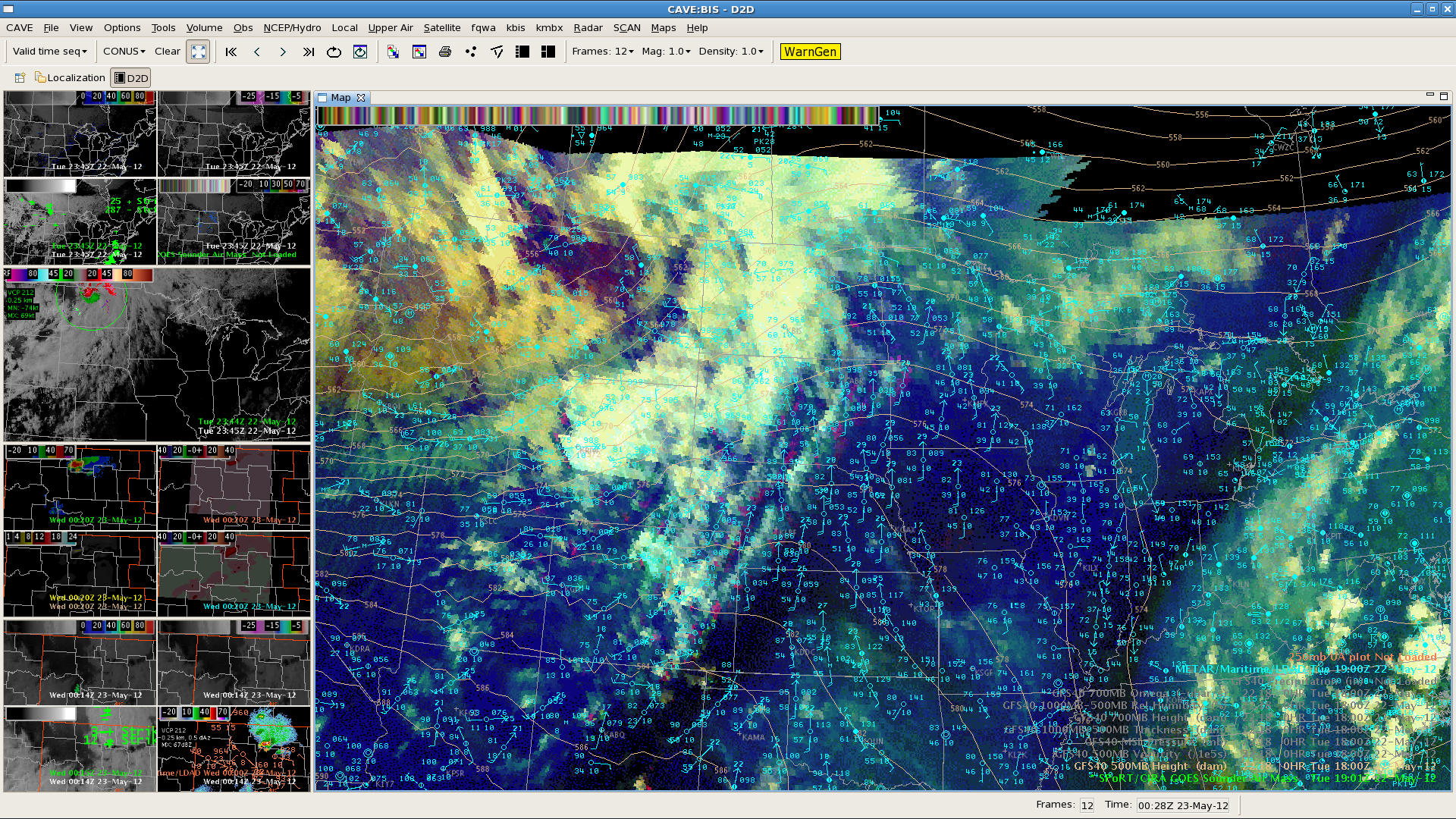
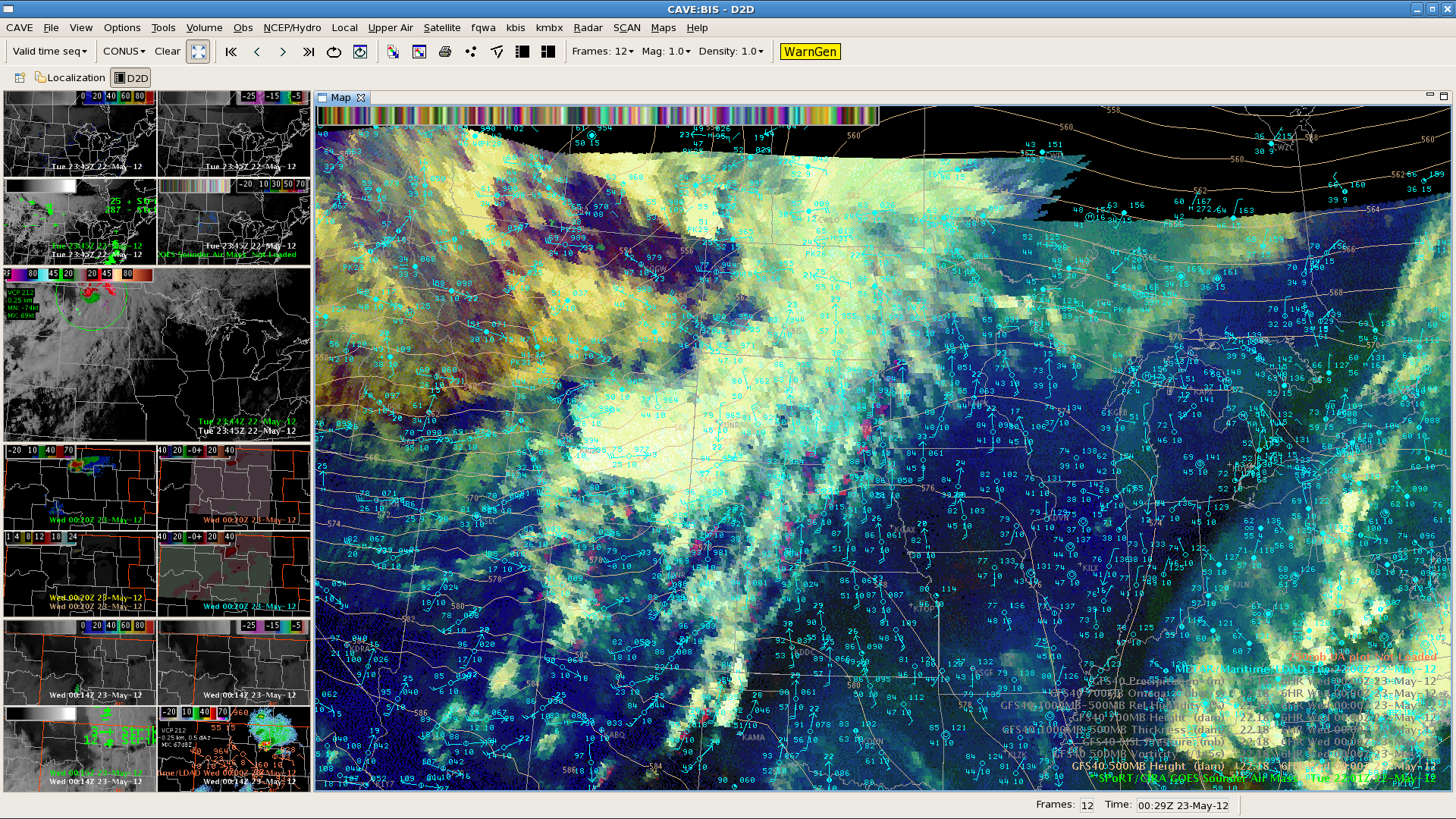
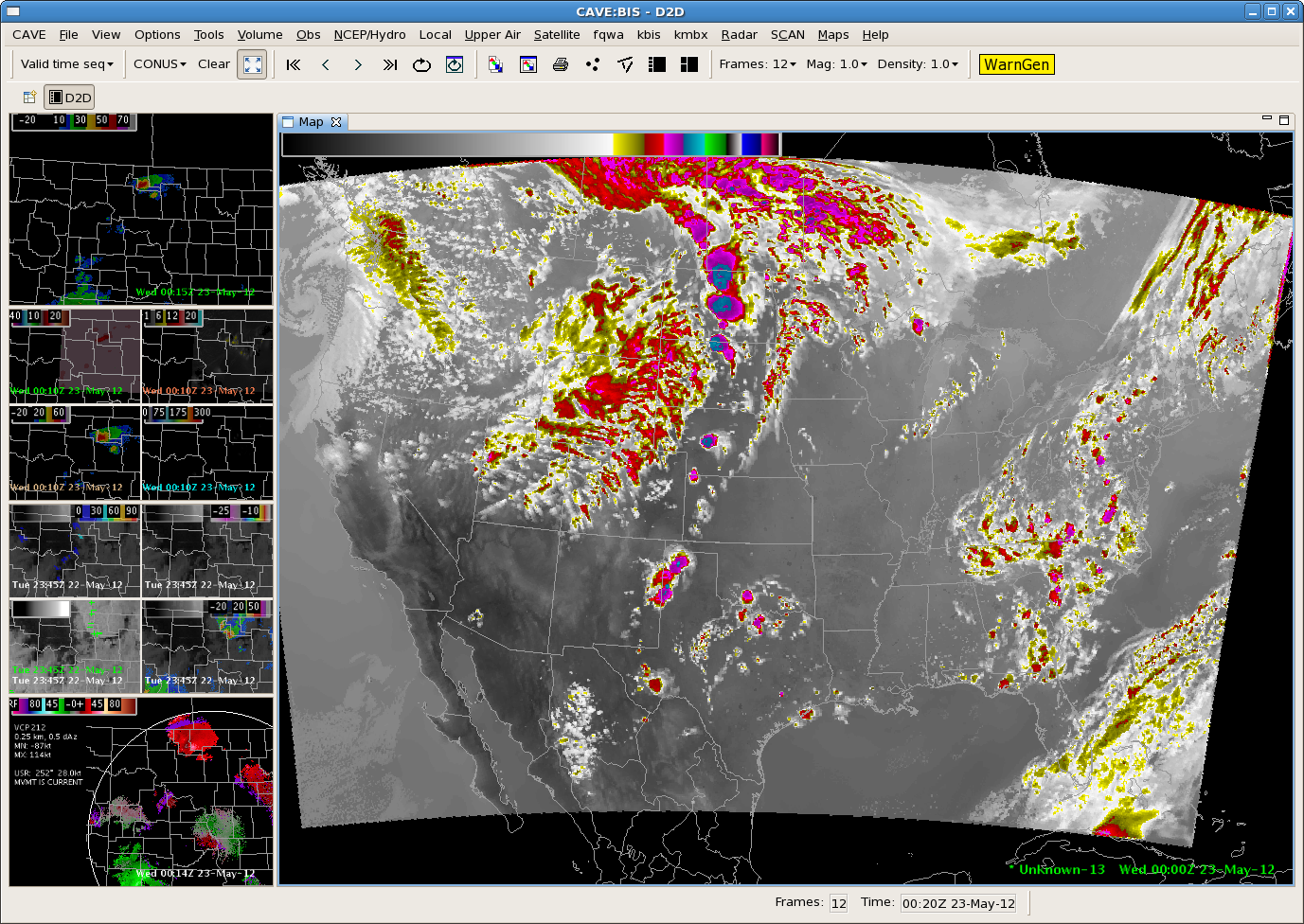
Broad upper low, situated over the far NW US, pushed eastwards during the afternoon hours and onwards. A sharp 100-120 kt high-level jet also translated to the east over the N-C Rockies with the favorable left exit region approaching our area of interest over NW Dakota at 19Z onwards. The airmass composite image was helpful in pinpointing the position of the jet max as a sharp moisture gradient evolved (roughly extending from Oregon to Wyoming). Initiation over far NW Dakota also awaited the approach of the “ozone-rich” airmass (purple) as it overtook the eastward progressing dryline between 19-22Z, fostered by reports of surface dewpoints in the mid 50s beneath rapidly drying mid/upper levels.

The first image captured at 1900Z:

and the second one at 2200 Z with initiation already underway/building SE-wards:

Helge

Tags: None

BIS: 3D-VAR Struggling at Long-Range from Radars

As would be expected, 3D-VAR struggles at greater distances from the radar.  A fairly large supercell thunderstorm that had a history of producing brief tornadoes was at 12-15kft AGL on BIS 88-D’s lowest slice.  It could be implied from base radar products that this storm had a powerful updraft, modest to strong mid-level rotation and strong storm-top divergence.  However, since the storm was too far from the radar, 3D-VAR products such as max updraft composite, updraft helicity, updraft vorticity and max convergence above 8km appeared much weaker than what was likely reality.

KBIS 5/22 2320 UTC 0.5 deg base reflectivity (upper left), max divergence above 8km (upper right), max updraft composite (lower right), 5km updraft helicity (lower left)

WFO-ABR Max Updraft and Vorticity Composites

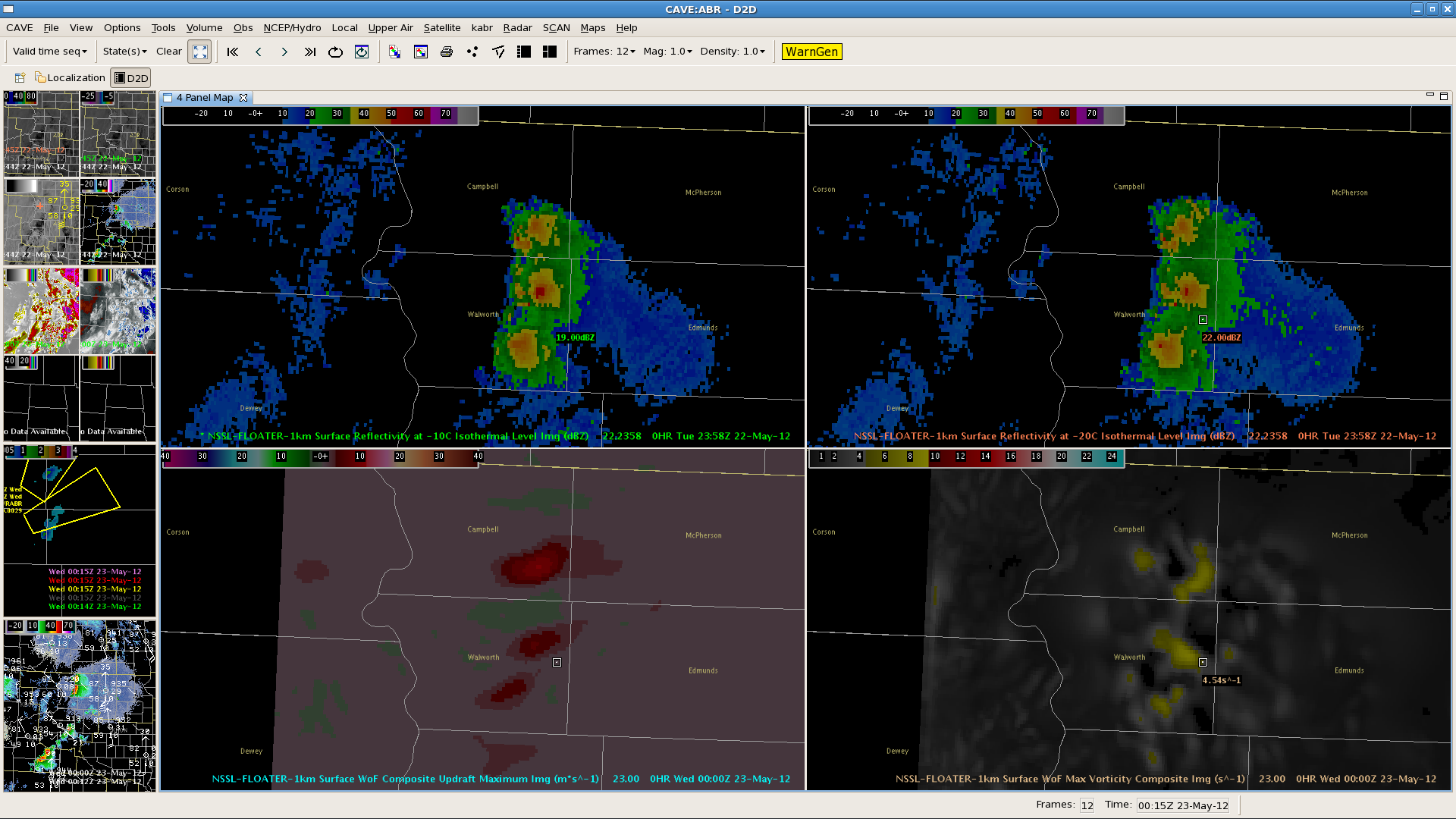
Several severe hail-producing supercells formed early this evening across northern South Dakota.  Reports of up to golfball size hail were received.  Here, we will focus on some 3DVAR products.

-10C Isothermal Reflectivity (top left), -20C (top right), Composite Updraft Maximum (lower left) and Composite Maximum Vorticity (lower right).

We want to draw your attention to the lower panels (the image was at 00Z).  The panel on the left clearly shows three distinct updrafts associated with each of the supercells.  The panel on the right shows the magnitude of the vorticity associated with each updraft very distinctly.  Let’s look at the next image, 0015Z:

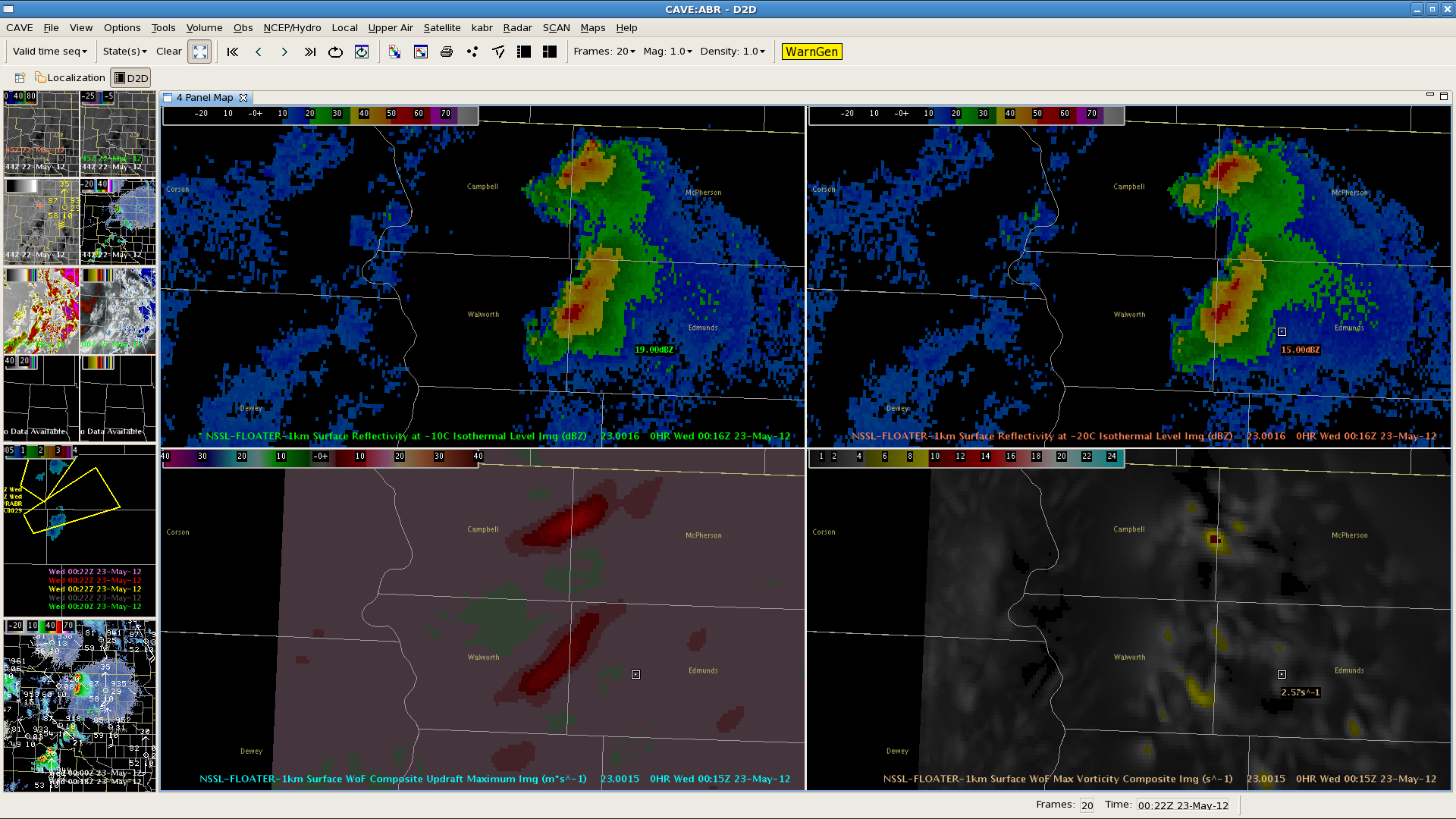
Same as above image, for 0015Z.

Look at the bottom panels again.  You can clearly see the middle and southern storms have merged into one homogenous cell, especially in the updraft image on the left.–Gordon Strassberg for WFO ABR.