An official website of the United States government
Here’s how you know
Official websites use .gov A
.gov website belongs to an official government
organization in the United States.
Secure .gov websites use HTTPS A
lock (
) or https:// means you’ve safely connected to
the .gov website. Share sensitive information only on official,
secure websites.
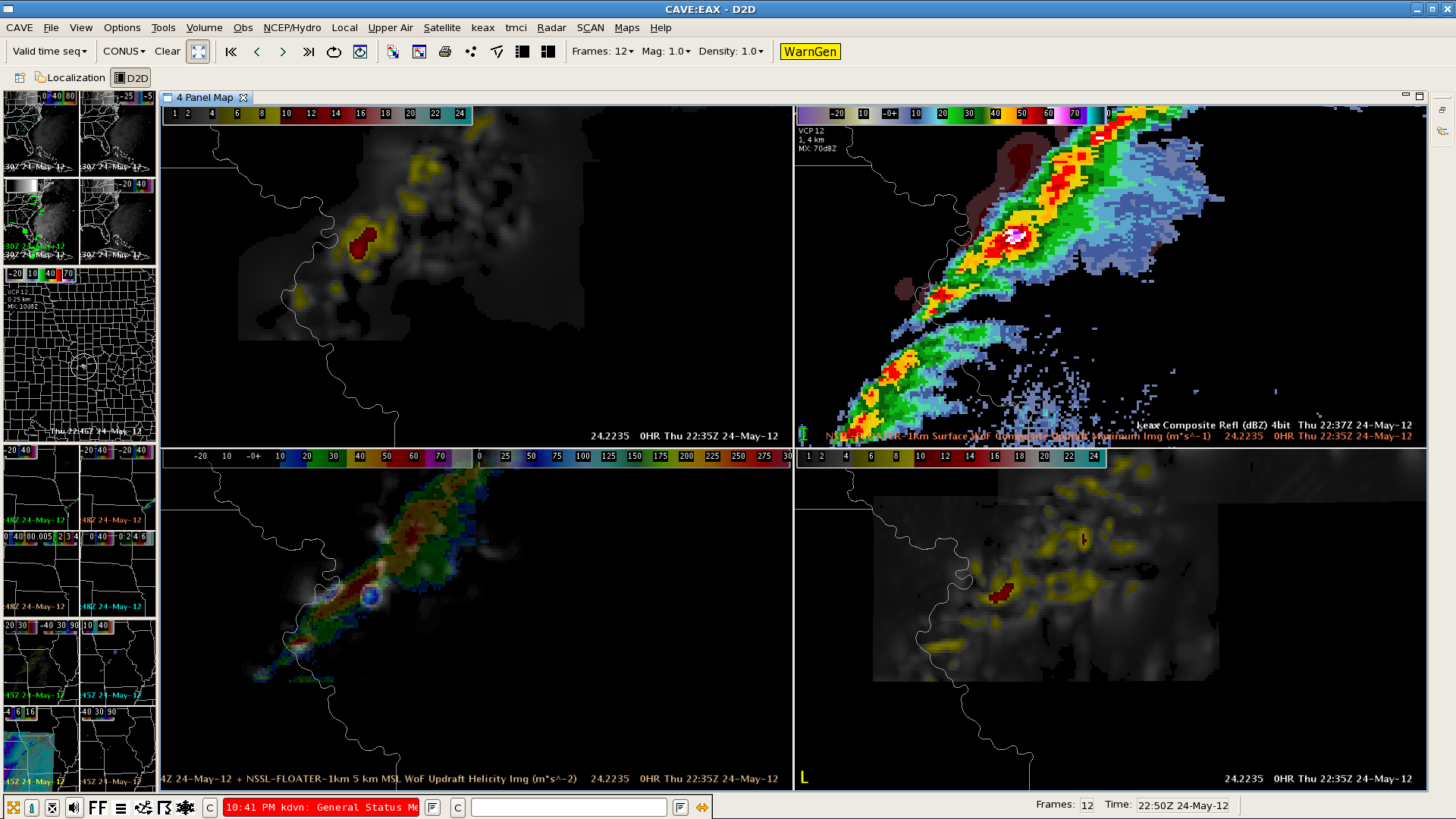
A line with strong to severe storms continues to push rapidly to the east. The environment is favorable for rapid storm organization, given 60 kt deep layer shear and tongue of 2000 plus J/kg SBCAPE sneaking in from the SW.
2230Z: Max divergence (upper left), composite updraft max (upper right), updraft helicity (lower left) and max vorticity composite (lower right)2237Z: Max divergence (upper left), composite updraft max (upper right), updraft helicity (lower left) and max vorticity composite (lower right)
At 2237Z, the composite reflectivity image was added (upper right) with core refl. aoa 70 dBz just where 3DVAR indeed had the most severe cell development along that line over NW Missouri.
The following CTC image led to the issuance of a warning at 2028Z. Severe hail signatures were noted with storm at 2112Z and severe hail was reported at 2130Z.
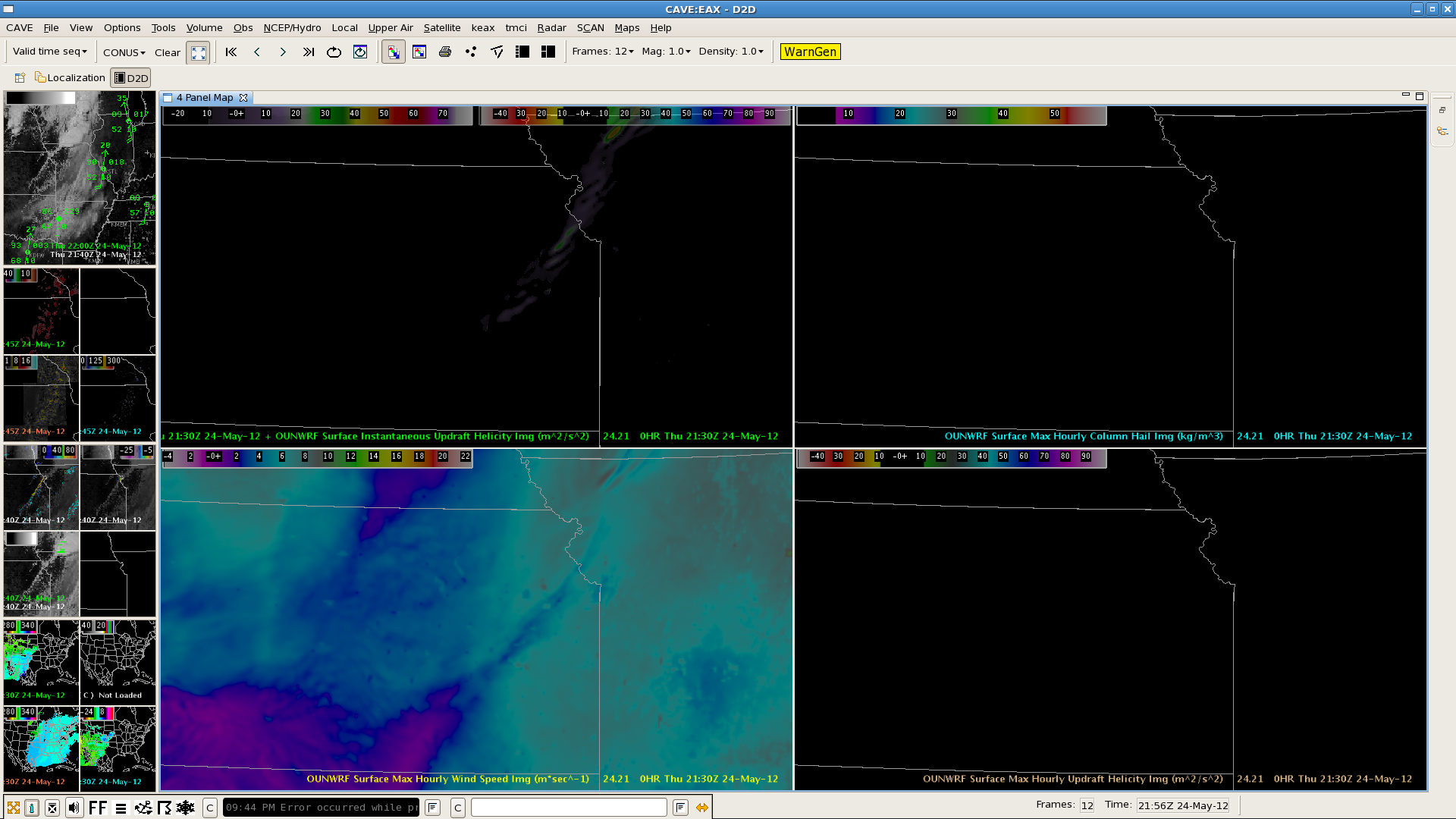
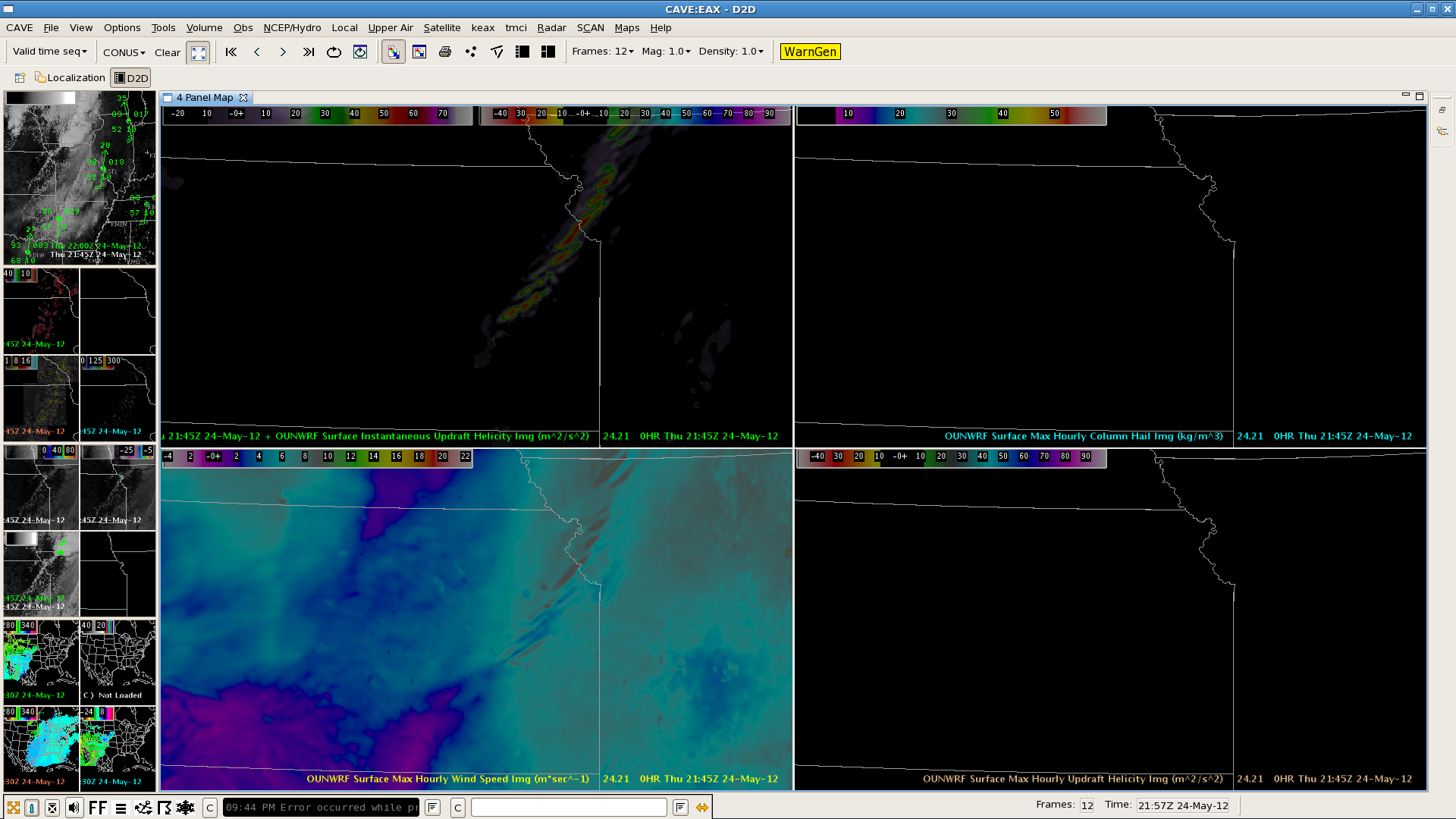
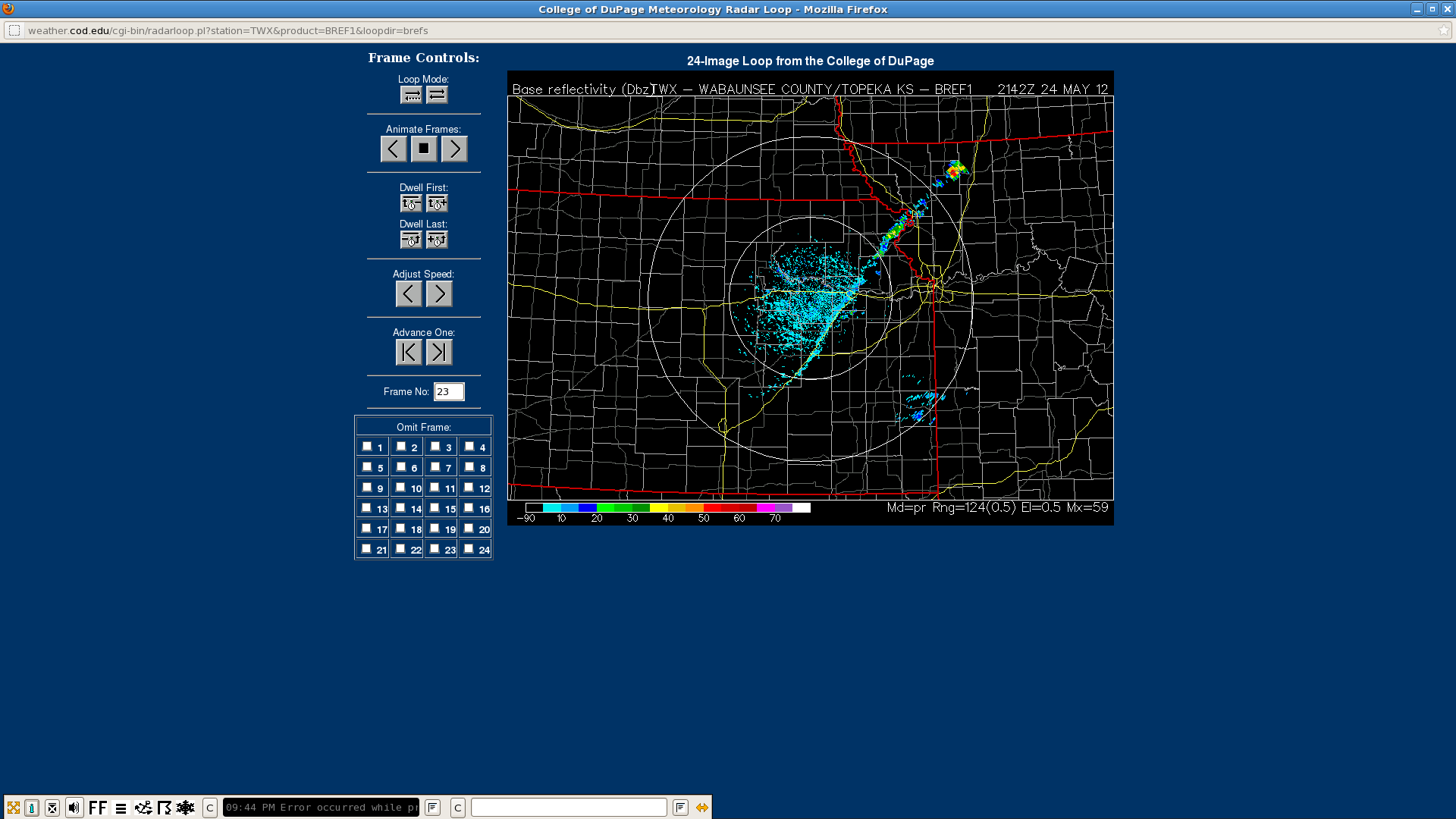
Thunderstorms continue to build rapidly to the SW along the cold front with initiation underway around 2145 Z over NE Kansas. It is amazing how well the OUN WRF captured the initiation:
2130Z OUNWRF precipitation and updraft helicity (upper left)2145Z OUNWRF precipitation and updraft helicity (upper left)Radar Topeka at 2142Z @College of DuPage
Timing was excellent with placement just slightly off to the south. This model forecast would have helped forecasters a lot to pinpoint area of initiation well ahead.
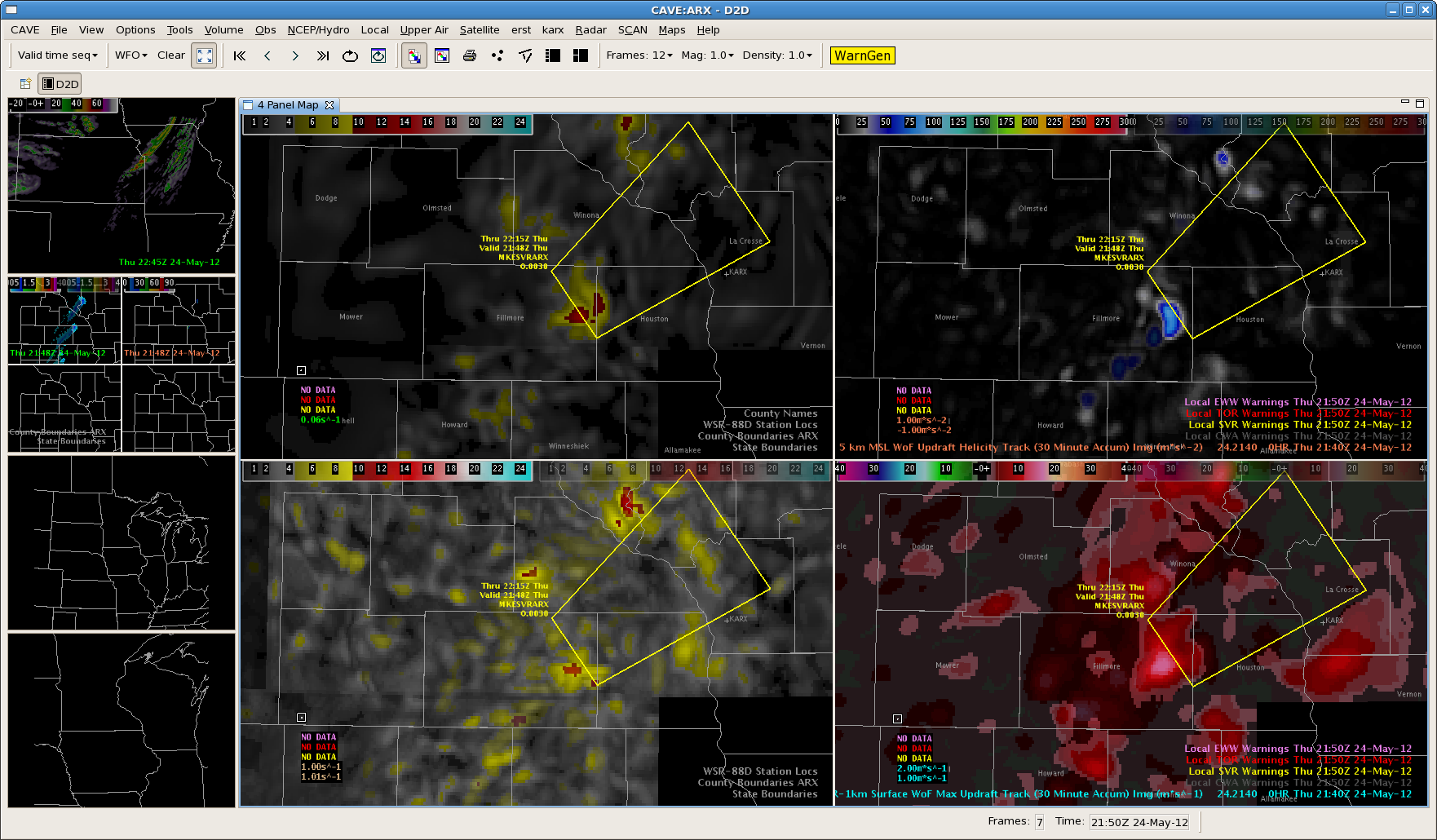
The 3DVAR products indicated strengthening of this thunderstorm with both the updraft helicity and maximum updraft values spiking on the 2140z image. This thunderstorm had previously caused wind damage (downed power poles) across southern FIllmore county. The values at 2140z were higher than those previously (as shown by underlaid history tracks) so a severe thunderstorm warning was issued for the potential for strong damaging winds.
UPDATE: Emergency managers reported widespread tree damage within the community of Winona, in the northern portion of the warned area, a lead time of 17 minutes. Dime sized hail was also reported within the warned area in southeastern Winona County.
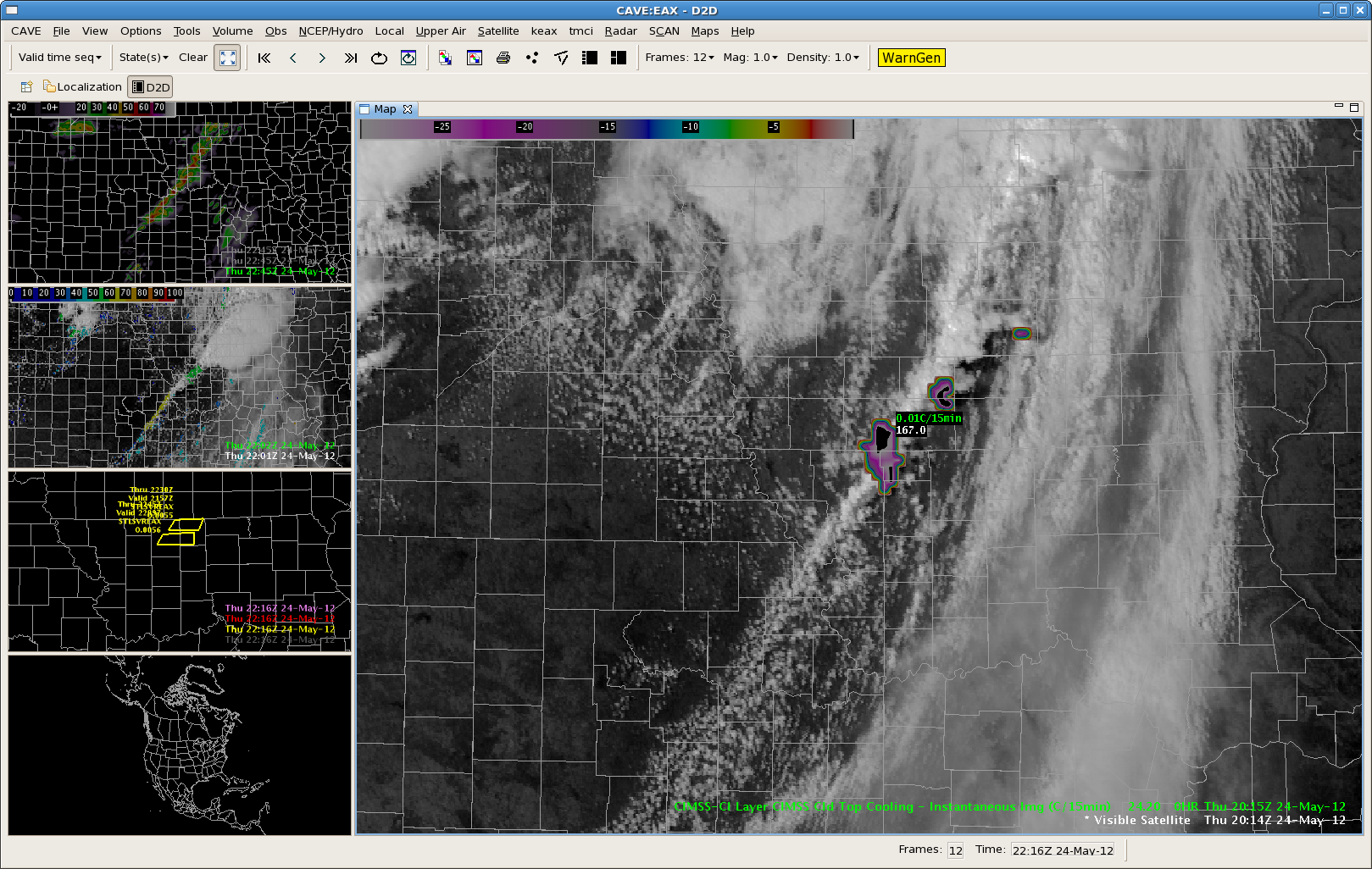
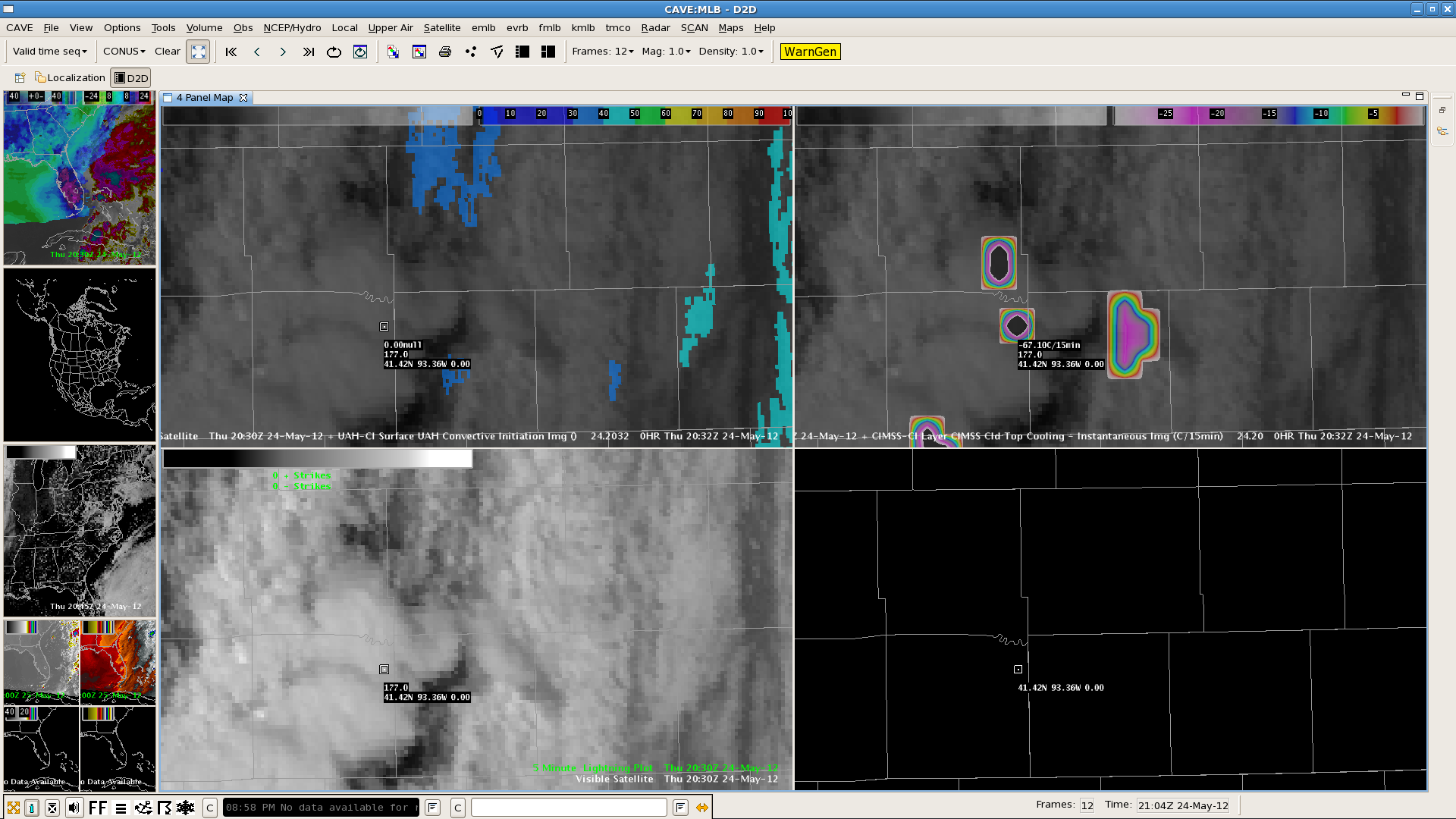
Severe convection currently evolves along the cold front over C Iowa with Cld top cooling product showing impressive cooling rates below -65 K/15 min e.g. over Warren and Polk counties.
About 2100 UTC we gave up on lightning in the east coast domains (saw a max of 2 flashes / min during our time there) and re-localized to Des Moines, IA (McKinney & Kleinsasser) & La Crosse, WI (Strassberg & Hirsch) with our observers working Pleasant Hill, MO.
Storms are already ongoing with CTC rates as low as -50 C for multiple storms and we expect some SVR warnings shortly.
A weak tropical low moved from Cuba to the NE during the daytime hours and was forecast to affect far SE Florida. Comparing SimSat and real IR/WV data, significant differences can be seen especially regarding the cirrus canopy. The main reason for the differences may be the much stronger development of this depression than expected 21 h ago. NHC also increased probs to 40 %, indicating a consolidating system. This evolution may have resulted in a better defined depression’s center with stronger convective development. Therefore those products may have to be used carefully for tropical lows, which reveal stronger intensification rates compared to what models forecast.
The cloud top cooling product in central Iowa indicated nearly 40 C/15 km of cloud top cooling for a storm in Boone and Story counties. This product preceded intense radar reflectivity in the area by nearly an hour.
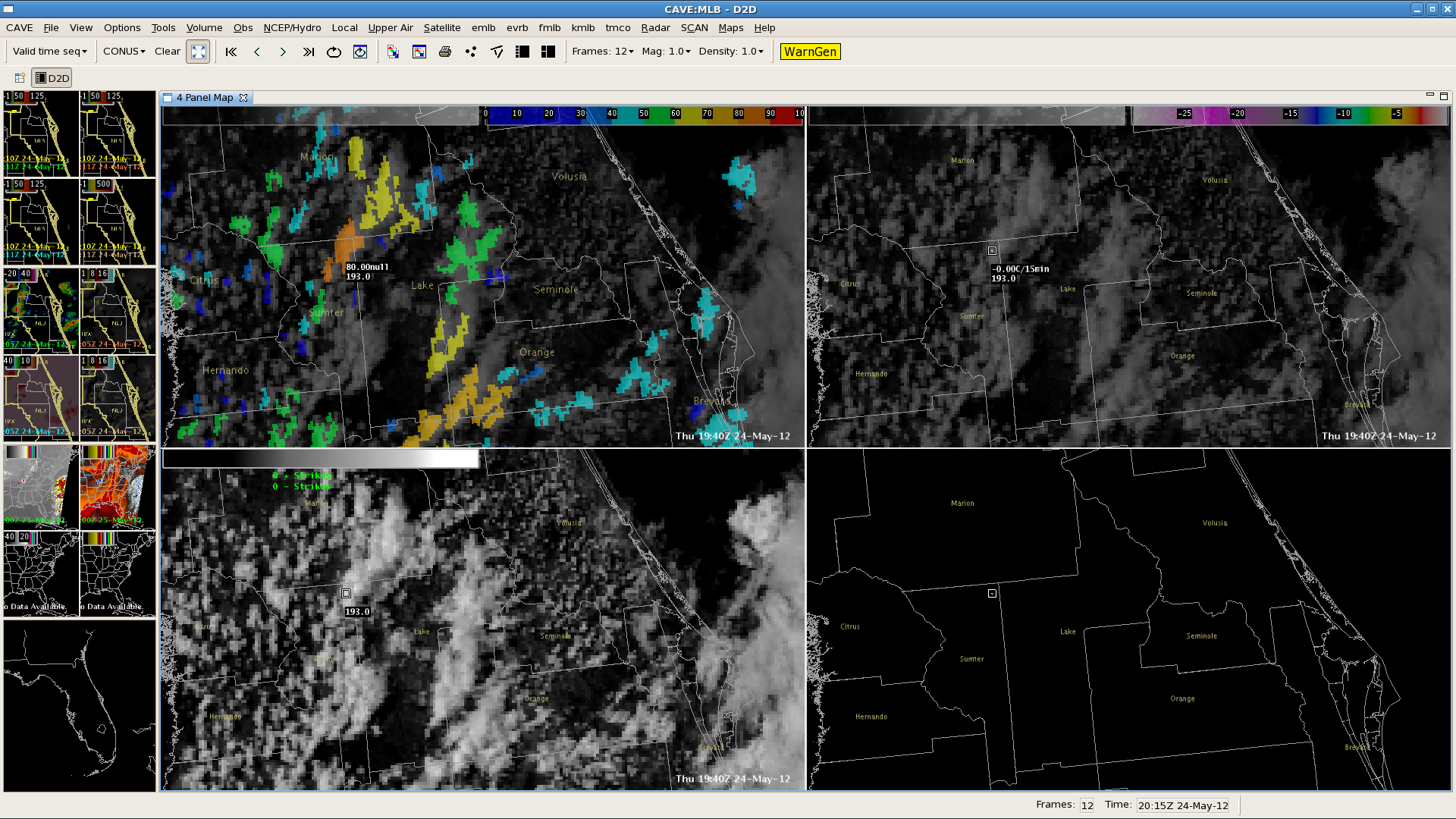
Here is an example of how UAH Convective Initiation (CI) and CIMSS Cloud Top Cooling (CTC) can be used to anticipate convective development. Here in the first image at 1940Z, let’s look at the CI product in the top left panel:
CI (top left panel) at 1940Z.
Focus on the Lake/Marion/Sumter County line. There is a maximum in CI there of 80, indicating likely convective development. If we look at the CTC in the same area on the next image (top right panel), we see a developing max CTC over -20C/15min, which is a strong indicator of a developing severe thunderstorm.
1945Z CTC (top right panel).
Although this did not ultimately become a severe thunderstorm, we did observe a few lightning strikes shortly after this time. This progression from strong CI signal to strong CTC can be a good indicator of a developing thunderstorm.–Gordon Strassberg for WFO MLB