



Occurred at 4:45 pm cdt.
Author: Greg Stumpf
Tornado On The Ground 4 mi E of Payson(Lincoln Co, OK).
If you live between and Sparks and Prague, OK, take cover now as a strong stovepipe tornado has been reported ON THE GROUND.
Tornado Moving Toward Talala in Northeast OK
Take proper shelter and precautions now if you live in Talala, OK. Spotter report a tornado is ON THE GROUND!
Dangerous Tornado NW of Vera, OK
If you live between Ramona and Vera, OK, you need to be in a place of shelter in an interior room on the lowest floor, or in a basement right now! This tornado will likely be moving into northern Rogers county and towardd Talala within the next half hour to 45 minutes. Prepare now ahead of this very dangerous storm.
Another Tornado 4 miles ESE of Bray, OK
Tornado Bray, OK is now headed toward Foster And Antioch in the next hour. Tornado is rain-wrapped and very dangerous. Do not come out to view the tornado. Find shelter now! If in automobiles, try to find a sturdy building with a safe area to take cover in immediately!
Funnel cloud reported 3 miles SW of Moore, OK
If you live in the Newcastle and Moore OK areas, you need to be taking shelter now and preferrably in an interior room on the lowest floor, or if able to get underground, one should do so now across these areas! This is a life-threatening situation!
Forecaster Thoughts – Rebecca Mazur (2013 Week 2)
The Experimental Warning Program provides an invaluable opportunity to test the utility of new products and methods in an environment that mimics standard severe weather operations. In no other way can newly developed products be assessed properly to identify strengths and weaknesses in such a fast paced and high stress environment. From my experience and hearing from other forecasters and researchers involved in the EWP, it was a truly invaluable experience not only to help research meteorologists transition their products to warning operations, but for forecasters to see the future of warning operations.
The products we tested include high resolution mesoscale and storm scale models to analyze the near storm environment, and new storm interrogation products to diagnose storm severity. Many of the products proved extremely useful to understand and forecast storm behavior from the ambient conditions. In particular, utilizing OUN WRF and LAPS high resolution fields of instability gave good indications of why some storms intensified, while others weakened or remained unchanged. Also, these products helped the forecaster to quickly adjust their mindset from thinking it would be a fairly marginal severe weather day, to being on high alert for potential dangerous storms. In regards to certain storm interrogation products, MRMS rotation tracks were very useful in making warning decisions during the supercell cycling process and when analyzing cyclone strength, moreso than just utilizing base radar products alone. In addition, MRMS echo top heights increased situational awareness for rapidly developing thunderstorms likely to produce large hail. Based on personal experience working in a WFO with not-so-ideal radar coverage, the echo top heights product will be extremely useful as it is imperative to utilize multiple radars for proper storm interrogation. This product will be a sort of “one stop shop” for large hail diagnosis in a storm, rather than constantly trying to keep up with all-tilts and mid/upper max reflectivity products from multiple radars. Of particular use will be the identification of potential large hail producers within storm clusters in a low shear, high instability environment common in the high plains mid to late summer.
One final suite of products to mention is the GOES-R products. We looked at convective initiation and growth potential, in addition to GOES-R airmass product. Incorporating these products into the EWP gave the forecasters hands-on involvement with the future of satellite data. Some forecasters had not had much experience with the GOES-R products, compared to folks like myself whom are heavily involved in the Proving Ground. Therefore, the EWP provided them the ability to see what the future of satellite meteorology will entail, which falls in line with the GOES-R Proving Ground objectives.
Not only was the opportunity to test new products and methods a gratifying experience, interacting with other forecasters from various parts of the country, in addition to the EWP facilitators, proved invaluable as well. In our agency, it’s a rare occasion to actually spend time with or work with other meteorologists within NOAA/NWS to share forecast tools and methodologies, and to discuss agency-related topics and the current/future state of the science. There is much to be gained by sharing ideas and tools across WFO boundaries, in addition to developing new relationships within the agency. For me personally, I was able to gauge where myself and my office stood against other WFOs in performance and involvement with emerging technology. I learned a lot during my week at EWP, and was able to bring back some new ideas and concepts to my office to better serve the people of southeast Wyoming and the western Nebraska panhandle.
Thank you for giving me the chance to participate in the 2013 EWP!
Rebecca Mazur
General Forecaster
NWS Cheyenne WY
2013 Week 2 Evaluator
Forecaster Thoughts – Michael Scotten (2013 Week 2)
The EWP2013 was a great experience to test experimental products and procedures as well as share ideas with operational and research meteorologists. Thank you for giving me this opportunity!
The derived satellite imagery products were very useful in warning operations and near term forecasting. In one exceptional case, the UAH CI product provided 20-30 minutes of lead time to storm development, 75-90 minutes of lead time for the onset of severe weather, and 120 minutes of lead time for tornado occurrence in Montague county, Texas during a historic tornado outbreak across north Texas on Wednesday, May 15. Also on this date, the UW NearCast Vertical Theta-e Difference maxima east of a dryline depicted the location of initial storm development in north Texas, which was a little unexpected as convection was forecast to develop farther west closer to the dryline. It was shown that storms struggled to develop and intensify in a minima area of UW NearCast Satellite Derived Precipitable Water 700-300 mb across southeast Colorado and southwest Kansas on Thursday, May 16. Having consistent UW-CTC depictions of -100C/15 min or less for two or more scans can give 30-90 minutes of lead time for thunderstorm development, even in weakly forced environments. Furthermore, GOES-R CIRA simulated IR images can be valuable for the depiction of short waves and mid/upper level moisture, which can enhance near term situational awareness. These simulated images would be handy to import into GFE/IFPS via a smartTool or procedure for making near term forecast updates.
For issuing warnings, MRMS data can be especially valuable. In particular, I liked using the MRMS derived reflectivity at the -20°C level for the detection of large hail, especially at long ranges from radar sites or where radar coverage was diminished. MESH confirms the presence of large hail and complements reflectivity products to increase forecast confidence when making critical warning decisions.
High resolution model data will only improve and become increasingly important for near term forecasting in the years to come. The 1 km LAPS data are tremendous at depicting storm scale subtleties in weather elements such as CAPE, LI, and surface wind. In one example, storms intensified as they moved in an area with higher LAPS derived CAPE. Also, the OUNWRF model outputs were beneficial, especially in determining storm mode, timing, and location several hours prior to convection development.
These products are fantastic to have for warning and near term forecasters to improve situational awareness and ultimately make better decisions. I would like to see these products implemented at a national level. Increasing POD and lead time as well as decreasing FAR of storm based warnings will likely result from using these innovative products. Incorporating research and new products into operations will be vital in the next several years to help ensure the NWS provides the best service possible.
Michael Scotten
Senior Forecaster
NWS Norman/Oklahoma City
2013 Week 2 Evaluator
Forecaster Thoughts – Joey Picca (2013 Week 2)
During the week of May 13-17, I was able to participate in the 2013 NOAA Hazardous Weather Testbed Experimental Warning Program (EWP). The week is characterized by a significant collaborative effort amongst NWS forecasters, NSSL scientists, and principal investigators from other research institutes, and it aims to evaluate and improve experimental mesoscale and stormscale products. Among those evaluated were LAPS and OUN-WRF hi-res model output, GOES simulated imagery and sounder data, convective initiation probabilities, cloud-top cooling rates, multi-radar multi-sensor (MRMS) rotational and hail tracks, and dual-polarization hail size and tornadic debris algorithms.
Each day, following a pre-operations briefing, the six forecasters were split into three teams of two – generally one on a mesoscale forecast desk and the two others on warning desks for two different CWAs. Indeed, one of the great features of the EWP is the way in which it replicates warning operations at an actual forecast office. As storms begin to develop, forecasters are tasked with issuing real-time (but experimental) warnings by utilizing the experimental products, in addition to more conventional products and real-time spotter reports via NWSChat, etc. Therefore, the NWS forecasters are in an environment in which they can provide very valuable feedback to the principal investigators, who can then further improve the products.
Without question, operations on the Wednesday of my week, when a tornado outbreak occurred across the Fort Worth CWA, provided our best opportunity to evaluate the products thoroughly. We entered the day with expectations of severe weather, but primarily large hail and high winds, not an outbreak of tornadoes. However, as the afternoon progressed, the experimental mesoscale and hi-res model data started to alert us to a higher threat than we originally thought. For example, the OUN-WRF clearly displayed tracks of higher updraft helicity values progressing across North Central Texas during the evening. As storms developed and the event began to unfold, multiple tornadic storms provided a significant challenge for warning operations, especially considering only two of us were FWD warning forecasters. However, the rotational/azimuthal shear and estimated hail size MRMS tools greatly improved the efficiency and ease of our analysis by giving us a method to check the storm trends relatively quickly.
During the “Tales from the Testbed” webinar at the end of the week, I made sure to emphasize how the new tools provide an improved ability to synthesize the enormous amount of data involved with severe weather operations. Therefore, even in a case where the event is more significant than originally anticipated, a forecaster can stay ahead of the situation. Additionally, the principal investigators were quite receptive to our suggestions for further improvements so I fully expect these tools to be further developed over the coming months and years. I was quite honored to be chosen for this program, and I believe it is a wonderful opportunity for collaboration and betterment of future warning operations.
Joey Picca
Meteorologist Intern
NWS Upton NY (New York City)
2013 Week 2 Evaluator
EWP2013 Week 2 Summary: 13 – 17 May 2013
EWP2013 PROJECT OVERVIEW:
The National Oceanic and Atmospheric Administration (NOAA) Hazardous Weather Testbed (HWT) in Norman, Oklahoma, is a joint project of the National Weather Service (NWS) and the National Severe Storms Laboratory (NSSL). The HWT provides a conceptual framework and a physical space to foster collaboration between research and operations to test and evaluate emerging technologies and science for NWS operations. The Experimental Warning Program (EWP) at the HWT is hosting the 2013 Spring Program (EWP2013). This is the sixth year for EWP activities in the testbed. EWP2013 takes place across three weeks (Monday – Friday), from 6 May through 24 May.
EWP2013 is designed to test and evaluate new applications, techniques, and products to support Weather Forecast Office (WFO) severe convective weather warning operations. There will be three primary projects geared toward WFO applications this spring, 1) evaluation of multiple CONUS GOES-R convective applications, including pseudo-geostationary lightning mapper products when operations are expected within the Lightning Mapping Array domains (OK/west-TX, AL, DC, FL), 2) evaluation of model performance and forecast utility of the OUN WRF when operations are expected in the Southern Plains, and 3) evaluation of model performance and forecast utility of the 1-km and 3-km WRF initialized with LAPS.
PARTICIPANTS:
Our participants included Michael Scotten (WFO, Norman, OK), Joey Picca (WFO, New York, NY), Ernie Ostuno (WFO, Grand Rapids, MI), Becca Mazur (WFO, Cheyenne, WY), and Chris Leonardi (WFO, Charleston, WV). The GOES-R program office, the NOAA Global Systems Divisions (GSD), and NWS WFO Huntsville’s Applications Integration Meteorologist (AIM) Program have generously provided travel stipends for our participants from NWS forecast offices nationwide.
Other visitors included Jordan Gerth (Univ. Wisconsin), Wayne Feltz (Univ. Wisconsin), Hongli Jiang (NOAA/GSD), Amanda Terberg (NWS Air Weather Center GOES-R Liaison), and Helge Tuschy (Deutscher Wetterdienst (DWD; Leipzig, Germany).
Kristin Calhoun was the weekly coordinator. Clark Payne (WDTB) was the “Tales from the Testbed” Webinar facilitator. Our support team also included Darrel Kingfield, Gabe Garfield, Travis Smith, Chris Karstens, Greg Stumpf, Kiel Ortega, Karen Cooper, Lans Rothfusz, Aaron Anderson, and David Andra.
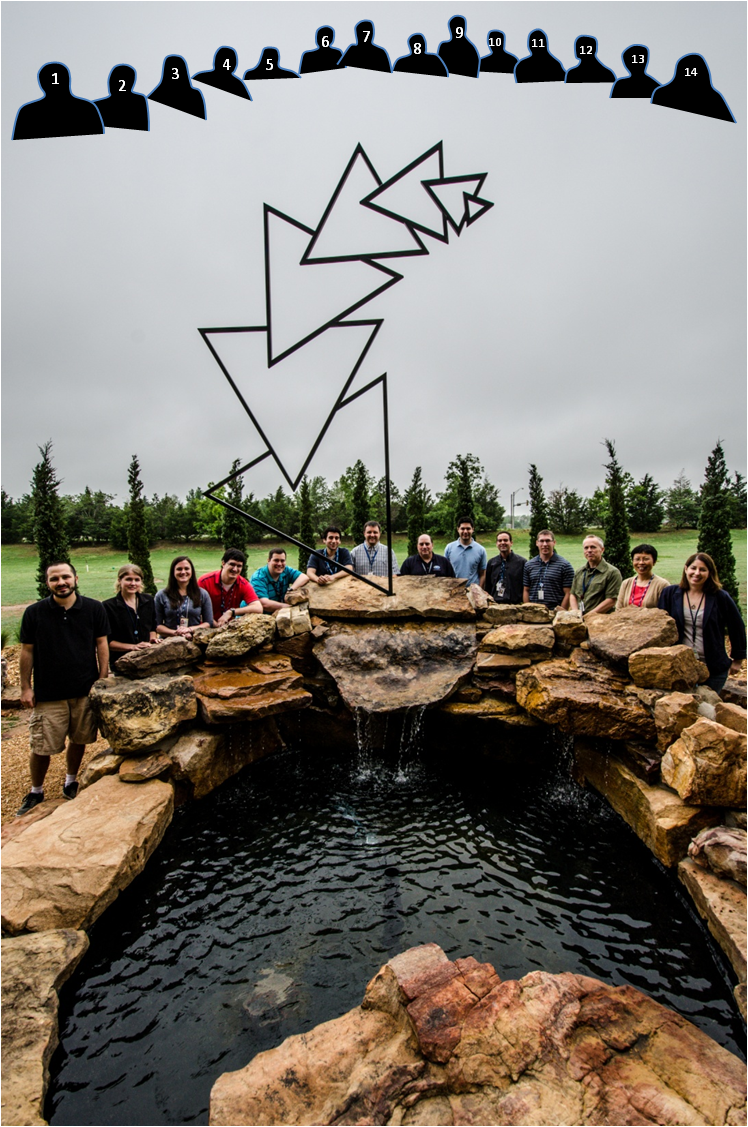
The Experimental Warning Program week #2 group photo: 1) Kiel Ortega (CIMMS/NSSL), 2) Amanda Terborg (UW/CIMSS), 3) Becca Mazur (NWS Cheyenne, WY), 4) Jordan Gerth (UW/CIMSS), 5) Chris Leonardi (NWS Charleston, WV), 6) Joey Picca (NWS New York, NY), 7) Helge Tuschy (DWD, Leipzig, Germany), 8 ) Ernie Ostuno (NWS Cheyenne, WY), 9) Gabe Garfield (CIMMS/NWS Norman, OK), 10) Michael Scotten (NWS Norman, OK), 11) Chris Karstens (CIMMS/NSSL), 12) Jim LaDue (NWS/WDTB), 13) Hongli Jiang (NOAA/GSD), and 14) Kristin Calhoun (CIMMS/NSSL).
REAL-TIME EVENT OVERVIEW:
13 May: Missoula, MT (MSD) and Great Falls, MT (TFX): marginally severe storms w/downbursts and hail as primary risk.
14 May: San Angelo, TX (SJT) and Midland, TX (MAF): Pulse and multi-cellular strong to severe storms in area of dry line circulation. // Des Moines, IA (DMX) mesoscale evaluation surrounding frontal boundary across western Great Lakes – primary threat of high winds.
15 May: Norman, OK (OUN) and Dallas-Ft. Worth (FWD): This was the primary severe weather event of the week. Embedded severe convection in OUN, isolated tornadic supercells in FWD.
16 May: Boulder, CO (BOU), Goodland, KS (GLD) and North Platte, NE (LBF): Marginally severe short-lived storms.
FEEDBACK ON EXPERIMENTAL PRODUCTS:
HSDA:
- Algorithm performed the best during the supercell event in the FWD domain where there were large swaths of giant hail associated with storms in TX.
- More confidence and better verification when region of hail is greater than 1-2 pixels. Forecasters suggest using an area or volume approach to algorithm evaluation.
- HSDA tended to over-predict Giant Hail throughout the week.
- Trend products would be useful.
- HSDA is not level II resolution. It’s also “cleaned up” in AWIPS2.
MRMS:
- Rotation tracks were commonly utilized by the warning forecasters. Particularly useful in determining polygon orientation (size / shape) — this reduced FAR area.
- Rotation tracks and AzShear products were time savers, particularly for situational awareness (calling attention to storms /locations).
- Tornado debris algorithm did not have region of low CC/ZDR co-located with SRM couplet and tornado on 15 May (possible error in algorithm).
- MESH and HSDA provided a useful combination in hail size estimation and confidence.
- A product that shows how many radars are being used to estimate the data in each grid point would be useful.
- MRMS hail indicators would be variable in the mountains – terrain may affect calculations (AGL versus MSL?) or beam blockage causing some radars to not go into the estimates all the time.
- The MRMS “thickness” products saved much time versus trying to estimate these using all-tilts and sampling.
- Normally get height from sounding, and apply to entire domain. MRMS takes a lot of the guessing and legwork out, instant answer. NSE updates hourly versus 12-hourly
- Still good at very little radar coverage at edges of network (e.g., Big Bend) since reflectivity it aloft anyway.
- Really useful when you get rapid developments and descent of elevated cores for pulse storms
- MRMS MESH better on low end days, HSDA better on high end days.
OUN WRF:
- Model reflectivity time ensemble (“d prog dt”) would be helpful.
- Improved from last year, especially with convection timing.
- Note that this year, the OUN WRF was changed from an hourly run to two hourly runs. Cycling radar data, and changed microphysics scheme and PBL scheme.
Variational LAPS:
- The instability field was quite useful when combined with a radar mosaic. Particularly early on in the FWD domain, this field provided clues to when storms would decrease or increase in intensity with time.
- The 22 UTC 1-km forecast was incredibly accurate 2 hrs out (on 15 May). The updraft helicity product was useful in visualizing the location/strength of the activity.
- A 0-6 km shear product is recommended.
- Would be nice to produce similar fields as OUN WRF to compare side by side
- Recommend adding a CIN product.
- Recommend adding more 1km floaters outside the OUN WRF domain.
- Useful for return moisture flow for subsequent convection episodes.
- The stormscale and temporal scale of variational laps is far superior to what’s available at the WFOs right now.
GOES-R Simulated Satellite:
- Comparisons of simulated IR with actual IR provided a quick understanding of where and how model (NSSL-WRF) may be handling convection: e.g., low-cloud cover in simulated IR > enhanced heating > convection initiated too early / too widespread.
- The models were still slightly faster than the synthetic imagery.
- Doesn’t handle anvils very well, but that could be a good thing. Can see where storms are developing without the anvils covering it up.
- There are plans to add a sky cover grid, to apply to other models.
GOES-R UAH SatCast/UW Cloud-Top Cooling:
- Both products need to be combined with environmental knowledge. Storms / regions cycled through multiple signals in CTC.
- CI had poor verification in mountainous terrain (60-70% + FAR) due to snow contamination.
- Cirrus contamination continues to be a problem.
- False CI detections on leading edges of anvils for fast moving storms are a problem at times.
- A threshold cutoff of display filter for the UAH CI is recommended. Anything above 70-80% seems to work best.
GOES-R NEARCAST:
- Interesting to compare CAPE field with LAPS and OUN-WRF modeled field for examining different scenarios and likely outcomes. Overlap on 15 May with LAPS was good and helped inspire confidence.
- Low precipitable water values were useful in determining that storms were unlikely to grow in strength or coverage.
- ThetaE difference helped pull focus onto anticipated area of initiation.
- The Nearcast will be running at the European Severe Storms Laboratory convective weather testbed as well.
- Prefer that the color table is “flipped” to use warm colors for high moisture
- The GOES-E and –W images were not seamless.
GOES-R PLGM and Lightning Trend Tool:
- Peak flash extent densities were useful in picking out which storms deserved more attention and providing additional lead time for severe weather at the ground.
- MESH and lightning flash rates had comparable trends in the OK region, with the flash rates typically preceding MESH by ~1-2 min and reports on the ground by ~15 min.
- Prefer a “less-harsh” color table (grays for lower flash rates better than bright colors). The choice of color (dark green) for the key threshold 30 flash per minute rate doesn’t stand out well. In addition, the yellow-to-green transition is not easy for threshold determination.
- Data dropouts from LMA station failures were difficult to recognize and separate from actual decreases in storm flash rate. Recommend adding a “number of sources” product to identify data dropouts.
- Lightning trend tool (“moving trace”) is useful for pinpointing developing cores quickly using lightning rate increases.
- All forecasters found that manually adjusting each frame in the trend tool tended to be tedious and needed an “apply to all” frames type option for size and spacing.
- Forecasters found trend tool to be too difficult and time-consuming to use in realtime difficult to use, but a good tool for post event evaluation.
- Would like to see similar graphical display from other data or algorithms (e.g., MESH, VIL) on same trend graph.
- Recommend that the default output format for the trend tool to be uninterpolated.
- Need an “Apply to all” feature in the trend tool.
OVERALL COMMENTS:
- Forecasters suggested that researchers may want to limit experimental product evaluation to one or two products for each team at a time.
- Perhaps assign different teams to different products.
- Comparisons between model (LAPS and OUN-WRF) reflectivity fields and observed reflectivity were often used to quickly gather which solution is trending in a better direction.
CONTRIBUTORS:
Kristin Calhoun, EWP2013 Week #2 Weekly Coordinator
Greg Stumpf, EWP2013 Operations Coordinator