Forecaster Thoughts – Mike Vescio (Week 4)

This is an excerpt from the July 2009 issue of the National Weather Association’s (NWA) Newsletter’s “President’s Message”

I would like to use this edition of the President’s Message to cover a few topics. In mid-May I had the opportunity to spend a week in Norman, OK, participating in the Experimental Warning Program (EWP) as part of the NOAA Hazardous Weather Testbed (HWT). When I was a forecaster at the Storm Prediction Center I earned the nickname “the dry slot” because of my tendency to suppress convection, and it proved true again this year as Oklahoma experienced a week of beautiful cloud free weather (much to my dismay!).  Fortunately, in the EWP you can focus on any part of the country, and there was one good severe weather day in Nebraska where we could issue test warnings.  Also, we went through a number of case studies from earlier in the year that were truly fascinating. The purpose of the EWP is to learn how emerging technologies can improve the warning process. I can only describe what was available to the visiting scientists and forecasters as being like a kid in a candy store.  There was access to Phased Array Radar data with 60 second update times, the highly sensitive Collaborative Adaptive Sensing of the Atmosphere (CASA) radars, the Oklahoma Lightning Mapping Array and The Warning Decision Support System – Integrated Information (WDSS-Il) algorithms and display interface.  The job of the participants was to determine how these tools improved the convective warning process, and let me assure you that they did! We will be having a series of invited talks about this technology at the NWA Annual Meeting in Norfolk so that these exciting datasets be shared with everyone.

Mike Vescio (NWS Pendleton OR – 2009 Week 4 Evaluator; and NWA President)

Tags: None

Forecaster Thoughts – Kevin Brown (2009 Week 3)

Luckily, we were able see real-time data with the LMA, CASA, and PAR systems, along with the WDSS-II multi-radar algorithms. When compared to the archived cases, real-time operations provided a much better picture of the challenges operational forecasters will have in base data interpretation, primarily due to the more realistic warning environment. Below are some of the main points that I would like to make about each system:

LMA:  With its quick updates, the 1km data aided in locating areas of updraft intensification and deviant motion trends. The ability to see the trend data was also a good indicator of storm strength/trend, especially in radar-sparse areas.  Future research will hopefully lead to additional tools for storm/warning forecasting and warnings.

CASA:  Although rapid updates from multiple radars can be overwhelming at times, the increased temporal and spatial resolution are well worth it.  To alleviate the rapid-fire of new radar scans from 4 separate radars, the multi-radar composite was utilized with success.  Especially in areas with sparse/distant radar coverage, this system should easily increase probabilities of detection and lead-times of severe weather events.  However, due to the detection of features not previously seen on the 88D, an increase in false alarm rate is also expected.  I also found that the sector scanning strategies took away from base data interpretation. Perhaps being able to manually control what sector is scanned would help in these situations.

PAR
:  The rapid scans, along with higher resolutions above the traditional “spit-cuts”, were outstanding.  This helped increase the confidence of meso-cyclone and core strengths.  The ADAPTS strategy appeared to work quite well without compromising the base data moments.  Hopefully in the not-so-distant future, additional panels will be added to alleviate the beam broadening on the edges of our current panel, and allow a greater radar coverage area.

Multi-radar/Multi-sensor algorithms:  In my experience, the use of MESH and reflectivities at 0C and -20C increase warning confidence tremendously.  Other diagnostic products, such as MESH Swath, Rotation Tracks, etc… are also great tools to help with warning confidence and warning polygon construction.  Especially in areas where radar coverage is sparse/distant with respect to your targets, these algorithms are needed.  After using the multi-radar data in this workshop, and also in real-time operations at my office, I feel the products greatly enhance warning and non-warning decisions.

Kevin Brown (NWS Norman OK – 2009 Week 3 Evaluator)

Tags: None

Forecaster Thoughts – Chris Wielki (2009 Week 3)

The EWP was a great experience and I couldn’t really ask for much more. As a meteorologist from outside of the United States I was somewhat uncertain what to expect but what I found impressed me. Technologies that we used throughout the week were useful and the exchange of ideas between researchers and meteorologists is something we too should strive for. The highlight was Wednesday when several tornadic supercells developed over Oklahoma with one passing through the CASA domain. The 3Dvar set the stage for the supercell entering the CASA domain and had us thinking about a tornado potential before appearing on the casa radars.  When the cell moved into the CASA domain the rotation was apparent and we were able to send the warning quickly. The strong winds that followed the tornado were easy to identify in the CASA dataset and warnings could likely be narrowed down as confidence increases with the use of these x-band radars. The WSR-88D data also showed the TVS however it was after the CASA data showing an obvious potential to improve lead times. PAR data and scanning strategies didn’t have any apparent faults and with the improved resolution and frequency I feel features would be singled out earlier in an event and once again lead times would increase. The LMA data has potential but I felt that I would have to get more comfortable with it and develop a conceptual model of what to expect with larger supercells. Picking out a peak in the LMA data would prove to be difficult but the graphical tool on Google earth was useful and could increase confidence in warnings already issued. There may be potential to use the LMA data for storm splitting since it would show the two updrafts however cases showing a split were limited. Last of all were the multi-radar/sensor algorithms. Returning to my office without products such as the MEHS, Reflectivity at -20, MEHS and rotation tracks will prove to be a difficult experience.

Chris Wielki (Prairie and Arctic Storm Prediction Center, Edmonton, AB – 2009 Week 3 Evaluator)

Tags: None

Forecaster Thoughts – John Billet (2009 Week 3)

Being part of the EWP was very worthwhile with the four separate test beds each offering unique opportunities. The phased array radar was extremely useful. The highlight of the week for the phased array was Wednesday night’s live event. I was working with Kevin Brown from the Norman office using the phased array to simulate test warnings for the storms. There are a number of very good features with the phased array, the fast temporal updates of 1 minute per volume scan and the higher resolution brings much better identification to features. The radar has the ability to quickly change where the range folding was occurring from one volume scan to the next which meant at most just one minute of bad data. We were able to view animated cross sections through WDSSII and actually watch the reflectivity cores rise and then come back down to the ground causing downburst signatures. The current phased array radar only has one panel so it had limited viewing as the number of storms increased. We only looked briefly at a tornadic storm in the CASA area but focused on the storm coming south from Oklahoma City to Norman which also had tornadic potential. This storm we could see the original outflow move out ahead of the storm then slow down as the storm caught up and reintensified. This is when the tornado developed which we could clearly track in the velocity and as it got close to the radar we even saw the debris swirl on the radar.

The CASA network with 4 low power Doppler radars each about 40 km apart was surprisingly useful. The fact that a 3DVAR wind analysis is done with the radar scans was very helpful. This analysis clearly showed gust fronts and rear flank downdrafts. It also picked up very well on the tornado. I had some hesitation about the system because it completes a volume scan in 1 minute and if there are numerous echoes in range it only does 1 to 2 elevation scans. I think in hail situations this could be a problem. The software is programmed to look for individual cells then scan up several cuts but we had too many cells in the area so that only 1 or 2 elevations were possible. There is also a numerical forecast of various fields which utilizes the radar data and goes out 1 hour in the future. This helps significantly improve situational awareness.

While the previous two systems are only available at Norman there are two other systems which we at Wakefield hope to access locally. The enhanced lightning detection network which includes in cloud and cloud to ground strokes has one domain centered over Washington DC. The VILMA or lightning density product helped with updraft detection and provides another reality check on storm structure. Being a coastal office and talking with the scientist about the fact that in cloud lightning almost always precedes any ground strokes, we could use this product to give some lead time at the beaches during the summer time about when lightning might occur. The lightning tied to individual cells producing trends helped in predicting intensification or weakening of cells. If the cell numbers could be color coded to indicate increasing or decreasing lightning trends this would help with quick identification of which cells might be increasing.

The final data set was multi sensor multi radar data. For now one domain is centered over Washington DC and covers all of our CWA. Some of the most useful products included real time MESH or hail forecast tracks and instantaneous size estimates. In the cases and two real time events it appeared a good estimator of hail size something always needed. These tracks could also be very useful in the proper shaping for a polygon warning. The circulation tracks are so dense it was hard to use it much but would like to look at it in more detail. There are numerous other products as well which will need to be examined but we ran out of time in Norman. We are working to set this up here for real-time use.

John Billet (NWS Wakefield VA – 2009 Week 3 Evaluator)

Tags: None

Forecaster Thoughts – Scott Rudlosky (2009 Week 2)

My participation in the EWP spring experiment was from a somewhat different perspective than most of the other evaluators, observers, and participants. Currently, I am a doctoral student at Florida State University studying CG and IC lightning. We make extensive use of the WDSS software, and I certainly advocate the multi-sensor, multi-radar approach that has been transferred to operations within WDSS. My current research seeks to quantify IC and CG patterns for comparison with these multi-sensor parameters in order to better diagnose storm severity. Therefore, I was extremely eager to observe the operational application of these products, and also how they may be improved.

The HWT-EWP is an ideal forum for forecasters and researchers to share insights. It provides forecasters with the opportunity to share insights into the development of the next generation of operational tools and allows researchers to more clearly define the forecaster’s needs. The following paragraphs detail some general comments and impressions.

The forecasters seemed reluctant to move away from their more familiar base products during severe weather analysis. This leads to one of the more significant points mentioned during our Day 5 debrief. The products that we create must be nearly bug free before the forecasters use them, because first impressions are very important and the tools may not receive a second look if they are not perceived as user friendly or helpful. This highlights the importance of residence training for these newly developed products.

I found the storm trends displayed in Google earth very helpful in diagnosing the state of a given storm; however, the comment arose several times that these trends seemed to originate from a “black box”. I suggest that the forecasters be introduced to the storm clustering techniques and/or that the clusters themselves are visually depicted alongside the trends during future experiments.

The CASA and PAR arrays had the advantage of extremely fine temporal resolution. The rapid updates increased the confidence of our warnings by allowing a more complete understanding of storm morphology. Although the ~ 1-min resolution was helpful, it also introduced a problem. Specifically, it was difficult to fully exploit the rapid updates when multiple storms were likely to require warnings. This is alleviated somewhat with two forecasters, but it raises the question of the frequency at which radar updates become less advantageous.

The only total lightning product that we evaluated during week 2 was a column density of LMA sources (i.e., vertically integrated LMA). The main question that I heard was how this product differed from composite reflectivity. My knowledge of total lightning and its relation to storm severity allowed me to make some use of this product, but the forecasters did not seem to find it very helpful. I suggest that additional products be created that allow forecasters to evaluate total lightning trends in both space and time. In addition to the trends that were displayed in Google earth (i.e., during the weeks with real-time cases in the LMA domains), this also could be achieved by including spatial plots displaying VILMA changes in time (i.e., 5 or 10 min differences/trends).

This opportunity was invaluable to my current and future research. I cannot say that I fully grasp the difficulty in “Crossing the Valley of Death”, but I now have a much clearer understanding of the difficulty involved in the transfer of academic research to operational applications. I appreciated the opportunity greatly and will do my best to incorporate all that I learned into my ongoing research. Please feel free to contact me directly (srudlosky@fsu.edu) if you have any questions in regards to my HWT-EWP experience or my current research.

Scott Rudlosky (Florida State University – 2009 Week 2 Evaluator)

Tags: None

Forecaster Thoughts – Tom Ainsworth (2009 Week 2)

Overview:

During the week of May 4-8, I had the privilege of visiting for the first time the National Weather Center (NWC) in Norman, OK. The purpose of my trip was to participate as an evaluator in NWC’s Hazardous Weather Test Bed 2009 spring “Experimental Warning Program” (EWP). EWP is designed to “test and evaluate new applications, techniques, and products to support WFO severe convective weather warning operations.” While Alaska, and especially Juneau, may not be known for severe convective weather, the opportunity to participate in EWP was valuable in several ways. First, I was able to evaluate emerging weather forecasting techniques and technologies that may have potential application in our data-sparse region. Second, I was able to network with a variety of people from around the nation working in both academia and government. Ensuing discussions covered ongoing field activities in different NWS regions and led to thoughtful brainstorming about future NWS services. And third, I accepted the offer to deliver a brown bag seminar on the last day of class. My brief talk was designed to raise awareness about science-service issues in Alaska. I concluded the talk by offering a friendly challenge to EWP to develop “new applications, techniques, and products” for Alaska Region WFOs which rely less on radar and more on other types of remote sensing.

1. Evaluating Emerging Technologies:

This year’s EWP focused on evaluating four potential WFO applications: 1) multi-radar/multi-sensor gridded severe weather algorithm products; 2) three-dimensional Lightning Mapping Arrays; 3) CASA (Center for Collaborative Adaptive Sensing of the Atmosphere) low power/short range radars; and 4) the Phased-Array Radar (PAR) operating in Norman.

The multi-radar/multi-sensor gridded algorithm products were made available via the Warning Decision Support System – Integrated Information (WDSS-II) developed at the National Severe Storms Laboratory (NSSL). Data from multiple radars and three-dimensional numerical model (RUC) temperature analysis grids produce more vertical volume samples than a single 88D can alone. Refresh rates are as quick as one to two minutes. Overlapping coverage fills gaps from terrain blocking. There are three WDSS-II domains across the south and mid-Atlantic states and a fourth “floater” domain that can be moved to an area expecting severe weather. Among the grids produced are echo tops above selected dBZ reflectivity cores or certain temperatures, lightning density, azimuthal shear, rotation tracks of the highest observed cyclonic shear, Maximum Expected Size of Hail, and vertically integrated Lightning Mapping Arrays (LMA) detecting source points of total lightning in 3D.

LMAs detect VHF radiation emitted as lightning propagates. Unlike the existing National Lightning Detection Network (and Canadian Network utilized in SE Alaska), LMAs detect both in-cloud and cloud-to-ground lightning. Emerging research is identifying a link between increased lighting activity, intensifying storms, and severe microbursts. Each of these parameters is plotted over a Google Earth background and trends of each parameter can be tracked for individual thunderstorm clusters using a multi-scale graph display.

CASA radar output can reveal storm structure, especially in the lower atmosphere, with much higher spatial and temporal resolution than the 88D, especially if the CASA radar is situated at a distance from the 88D. In fact, the rapid update cycle (~60 seconds) and short CASA radar range (~40 km) was difficult at first to get used to. PAR data sets have the range of the 88D and the higher resolution of CASA technologies. PAR is “electronically steered” S-Band radar that provides “targeted” scanning within a 90-degree azimuth sector. Its storm scanning strategy is significantly faster than the 88D which greatly enhances the operator’s situational awareness of storm trends. The PAR may one day replace the aging 88D network.

In summary, participating in the EWP was easily the most intensive, hands-on exposure to new radar technologies I have had since I attended the 88D Operations Training in Norman 15 years ago. All of the tools and applications I tested have significant potential for improving very short term forecast decision making. Assessing each application is literally the stuff of PhD dissertations. Unfortunately for Alaska WFOs, applicability of most of these technologies in the foreseeable future will be negated by the lack of requisite archive Level 2 data, no over-lapping radar coverage areas, the sparsity of conventional surface based data sets and the resultant impact on RUC-II model analysis. EWP facilitators requested field offices submit case studies and Level 2 archive data to which the tools can be applied. Unfortunately, the FAA does not maintain Level 2 data from any of the Alaska 88Ds. PAR and CASA radars, in my opinion, have the highest potential for use in Alaska Region.

2. Professional Networking:

It was quickly apparent to me the NWC is an important and very active facility for NOAA. It symbolizes the advantageous partnerships between university training, applied research, and NWS operations. The EWP work space was literally surrounded by the Norman Forecast Office, NSSL, and the Storm Prediction Center (SPC). During the week I was at NWC, a major tornado field research project covering the Great Plains over five weeks (VORTEX-2) was kicking off with international media attention. Precise orchestration of people and events in NWC this week – including several public tours per day – was managed by University and NOAA public affairs personnel. I was able to meet up with two OU graduate students with connections to WFO Juneau: one was hired in 2007 as a STEP; the other was hired as a SCEP this year.

My co-evaluators in EWP this week represented an equally diverse group: a Lead Forecaster from Chicago; a General Forecaster from Seattle; and a PhD candidate from Florida State University. Each person brought a different set of skills and experience to the program. Discussions during breaks and after hours generally drifted to future weather forecasting operations and trends of university research activities. I learned from conversations during the week that there are a number of different interpretations of the concept “decision support services”. DSS is a term becoming commonly associated with NWS Strategic Planning, and is a major agenda item in the National MIC/HIC Meeting later this year. My sense is field offices would benefit from having a clear and consistent definition of what NWS upper management means by DSS.

3. Brown Bag Seminar:

NWC routinely offers brown bag seminars by OU faculty and NOAA/NWS staff. Visiting scientists are also offered the opportunity to present short seminars. In the case of EWP, visiting evaluators are able to give a short presentation during the weekly de-briefing session on Friday. I agreed to speak about science and service issues in Southeast Alaska and demonstrate what makes warning decision making in our region particularly challenging. The presentation highlighted our large AOR, complex terrain, sparsity of in-situ data (including radar), and the value of high resolution satellite data to warning decision making. In closing, I requested the Hazardous Weather Test Bed (HWT) audience to consider ways they could apply their mission to develop “new applications, techniques, and products” for WFOs in Alaska Region and elsewhere that may rely less on radar and more on other types of remote sensing. In response, I learned the HWT intends to hire a student next fiscal year to begin investigating and developing warning decision applications related to satellite imagery. My presentation slides are available on the regional network (R:/) in the “Juneau” folder (HWT-NWC SEAK ScienceService 2009-05.ppt).

Summary:

I am very grateful to have had the opportunity to travel to the NWC May 4-8 and participate as an evaluator in this year’s Experimental Warning Program. The EWP cadre knew their material thoroughly, was well prepared, and interacted well with visiting evaluators. The amount of new material presented was considerable but, over time, was manageable. The NWC is a very busy place with OU faculty and students, NOAA researchers, and NWS NCEP and WFO operational staff. The interaction with these groups and fellow evaluators during the week was professionally stimulating. And even though there are serious road blocks to using the new technologies anytime soon in Alaska Region, the staff there was open to hearing objective, constructive feedback. I recommend supporting any future opportunities for Alaska Region field office personnel to visit and experience NWC.

Tom Ainsworth (NWS Juneau AK – 2009 Week 2 Evaluator)

Tags: None

Forecaster Thoughts – Steve Cobb (2009 Week 1)

The Hazardous Weather Testbed (HWT) Experimental Warning Program (EWP) operates from the National Weather Center (NWC) in Norman, Oklahoma. I was selected to participate in the EWP during the first of the six week project for spring 2009 during the 27 April through 1 May period. Activities during the week were structured but flexible enough to encompass the given weather scenario. Working shifts started at 1300 LT and ended at 2100 LT. Work was conducted in the HWT Operations Room which is a large glass-enclosed room centered between the operations of WFO OUN and SPC. Daily briefings and an end of the week debriefing was conducted in the NSSL Development Lab.

My forecast partner during this week was Suzanne Fortin (EAX SOO) from Pleasant Hill, MO. The coordinator for the week was NSSL scientist Greg Stumpf. Following is a timeline of activity and general observations regarding our evaluation of several new applications, techniques and products during the experiment. There were four primary projects of focus each geared toward WFO applications: 1) an evaluation of experimental Warning Decision Support System II (WDSSII) 2) an evaluation of 3D Lightning Mapping Array (LMA) 3) an evaluation of the phased array radar (PAR) in Norman and 4) an evaluation of networked 3-cm radar (CASA) in central Oklahoma. Since the WDSSII display was less dependent on weather in Oklahoma, we operated during two live episodes in the neighboring CWAs of ABQ, LUB and MAF.   Outside of active weather regimes or prior to convective initiation, our time was spent working with archived cases for each project. A longer intensive operations period (IOP) occurred late in the week as convection developed late in the evening over western Oklahoma, otherwise IOP and archived cases were contained in the normal eight hour shift.

Monday – Sue and I met Greg at the NWC entrance and began an abbreviated tour and orientation session due to anticipated convection within the immediate central Oklahoma area. The orientation included training on each of the projects and was conducted by the cognitive scientists associated with each. Project evaluation began with an IOP focusing on developing convection in central Oklahoma.  Storms quickly died so we switched to an archive case from 2007 of TS Erin as it intensified over central OK. We were able to follow several small circulations in the PAR data. Overall the first day was largely a matter of learning knobology with the new display tools such as WDSSII and adjusting our warning decision paradigm given the rapid update times provided by the datasets.

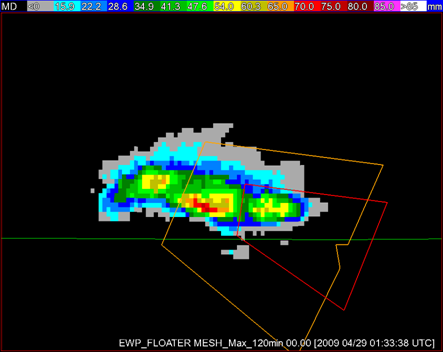
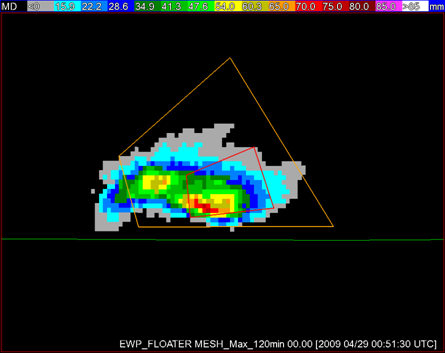
Tuesday – We began the day working through two CASA cases, one tornadic storm near my home town of Minco and another mini-supercell case. I became more comfortable with WDSSII GUI for interrogating the radar data but became overwhelmed at times having to consider five different radar views. The rapid updates were nice but each one seemed to present a new interesting feature that required investigation. We learned not to dwell too long on features but quickly evaluate their merit and move on to more recent data. This approach allowed us to stay ahead of developing storms as compared with the 88D. There were some gaps in the data due to the scan strategy employed with CASA so the 88D was still needed to evaluate higher tilts at close range. We ended the evening with an IOP concentrating on isolated storms In New Mexico and West Texas. The team utilized the multi-sensor/multi-radar output via AWIPS localized to WFOs ABQ and MAF. It was nice to operate within AWIPS and have the comfort of developing procedures and using warnGen to draw polygons. Some of the most useful products were the height of the 50db core above -20C and the MESH products. We particularly found the MESH tracks helpful in orienting polygons to capture storm motion. This can best be seen in the comparison images below between our polygons and those issued by WFO MAF.

Figure 1. Comparison of EWP warnings (top or left) and WFO warning (bottom or right). Note the difference in polygon orientation. The NSSL MESH track (image) was used by the EWP team to predict future supercell motion.

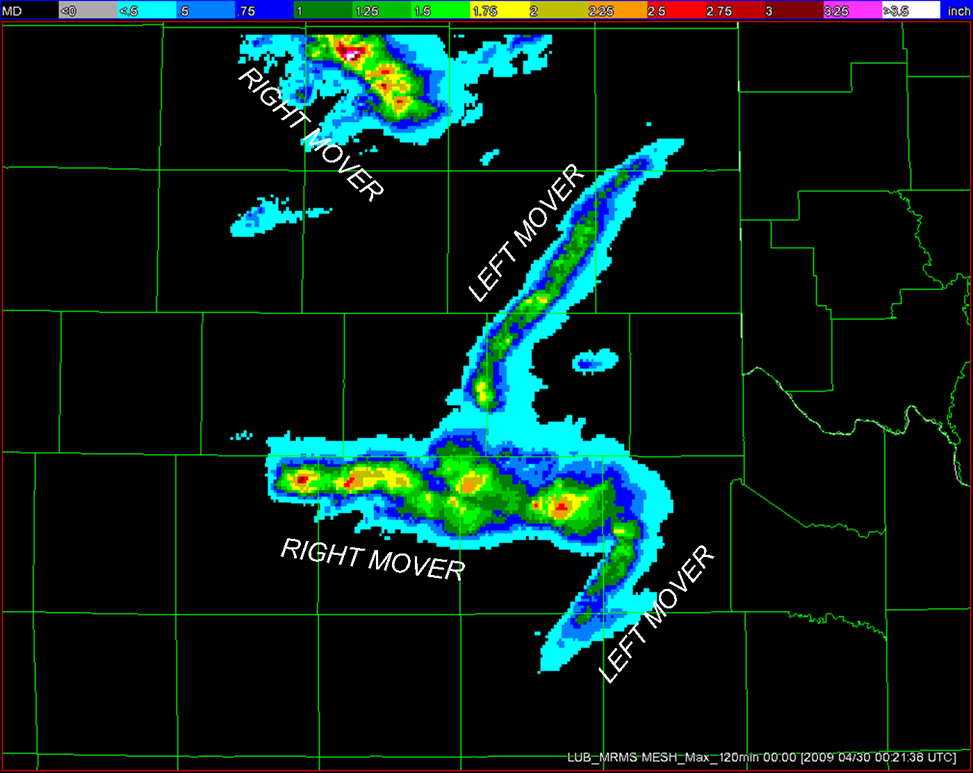
Wednesday – This was by far our most active IOP shadowing the forecasters at my home office in Lubbock. Both the familiarity of the CWA and working within the AWIPS framework attributed to high SA for this event despite it being busy. By this time most all bugs were worked out of the AWIPS system and we had procedures in place to evaluate the WDSSII decision support products. We quickly found our favorite few WDSSII products and cycled through them using the panel-combo-rotate feature deployed with AWIPS OB9 comparing them to base data from the 88D. In a couple of instances I felt we had better warning lead times due to enhanced SA provided by the diagnostic parameters. Once again our polygon orientation was highly influenced by the MESH tracks and appeared more cell based versus the WFO. It did become apparent that left movers present issues with rotational tracks and greatly underestimated hail sizes. Also values from the azmuthal shear products were a bit difficult to correlate to spotter reports. After the event I spent time in the hotel downloading archived images of MESH and meso tracks to send back to the WFO to assist in damage surveys the following day. There were a couple of significant tornadoes during this event over rural areas but they were well photographed by chasers. We also benefited from having live views of the storms via storm chasers available through http://www.spotternetwork.org.

Figure 2. MESH tracks, with left and right moving storms annotated (courtesy of Greg Stumpf). Warning polygons by the EWP team were again more storm-based than official NWS warnings based on the use of the MESh products. This image and corresponding meso track was sent to WFO Lubbock to aid in follow-up damage surveys.

We started the day Wednesday looking at an LMA case over central Oklahoma from earlier this year. The LMA data provided some usefulness for warning operations given the rapid update time (2 min) however this dataset is likely most valuable for longer fused products such as NOWs and SPSs. Product units were obscure to us in kg2/sec and we found that their interpretation increased as we combined them with other products such as the NLDN and reflectivity in the ice producing layers. There was good correlation with increasing updraft strength and tightening mesos but once convection became well organized and widespread it was more difficult to discern important features based solely on LMA data. Vertical cross sections or trend plots would also be helpful for display of the data but this was not possible during our portion of the experiment. It would be interesting to see LMA applications during winter or heavy rainfall events to evaluate other uses.

Thursday – A couple of non-tornadic events were the focus of our archived cases on this day. We interrogated PAR data at close range to observe a well-defined MARC signature and used FSI-like cross-sections on WDSSII to see the cores descend. I also found some application to the divergence fields but they appeared fairly noisy. A smoothed field or one at a lower resolution may prove more meaningful. The CASA case was a classic high wind event across the southern part of the domain but there was lots of convection throughout which caused issues with attempting to monitor multiple radars and keep good SA. The 3DVar analysis was nice in that it helped keep the focus on the proper location within the domain where the severe wind swath was occurring. It was difficult to manage five radars within the domain to keep pertinent storms visible on the main screen for complete interrogation. The composite image in this case was a life-saver and we frequently took wider views provided by the 88D to keep tabs on developing convection on the edges of the domain. We ended the day in IOP with a single supercell event in western Oklahoma, working with both the PAR and multi-sensor data. The PAR provided sufficient scans for detecting developing and decaying cells. At one point the azmuthal shear algorithm in the PAR showed an increasing trend while the multi-sensor data showed it decreasing with time. This discrepancy was possibly due to color curve differences between the systems but more likely a result of the way in which the multi-sensor data uses lower tilts and stronger mid-level shear was not going into the algorithm at longer ranges. There was considerable range folding in the 88D data and some in the PAR data but the PAR data by far was more consistent and provided a clearer picture of the mesocyclone evolution. Our warnings were consistent with OUN’s however we ended the tornado threat sooner than the WFO did.

Final Thoughts- Overall this was an enjoyable experience and highly educational. I truly appreciate being selected to participate. It is exciting to see improvements that can be made in the warning environment with new technology and the new application of existing technology. Although there was some spin-up time required, working almost entirely with base radar data from the new platforms made the transition easier. The PAR and CASA platforms bring a new dimension to storm interrogation with rapid updates on the order of 30 to 50 seconds. While there is some need for algorithms in this environment to provide integrated values of reflectivity or time and height tracks for rotation, a minimum of new tools is likely the best approach to introducing faster updates to the field. As a forecaster it was easier to adapt to the new scan strategies worrying just about the base moments versus also trying to get my hands around dozens of volumetric or new-scan products at the same time. As such, when working with the existing 88D network, the new algorithms provided by the NSSL multi-sensor applications integrated nicely with the base data and enhanced the already familiar process of storm interrogation.

Unlike this new technology which is likely decades from deployment, the multi-sensor/multi-radar applications have a role in today’s forecast environment and should become part of the AWIPS data stream. Southern Region should work with NSSL to provide at a minimum the MESH, rotational tracks and reflectivity heights above 0C and -20C as these were found to be beneficial during the warning experiment. Meso tracks and azmuthal shear products were also helpful to the EWP warning team and have value not only during the event but in post-storm analysis as well. The greatest value of the multi-sensor data is overcoming sampling issues at very close ranges to the RDA and to provide input from radars at an improved viewing angle especially for developing circulations. As a result, the SR strategy to improve warning effectiveness could be impacted directly and positively with the inclusion of these products into the field office decision making process. This is possible to some degree already through Google Earth but integration into AWIPS is necessary if true value is to be gained and to improve the timeliness of delivery of the products.

Steve Cobb (NWS Lubbock TX – 2009 Week 1 Evaluator)

Tags: None

Forecaster Thoughts – Suzanne Fortin (2009 Week 1)

During the week of April 27th I participated in the Experimental Warning Program (EWP) component of the Hazardous Weather Testbed (HWT) at the National Weather Center (NWC) located in Norman, Oklahoma.  The HWT is located on the 2nd floor of the NWC nestled in between WFO OUN and SPC, and was established in 2006 to foster collaboration between NSSL scientists and operational meteorologists.   There are two components of the HWT, the EWP which I participated, and the Experimental Forecast Program (EFP), which focuses upon the evaluating forecast tools that could improve severe weather operations in the 1-12 hour forecast period.   Typically, the two programs are run in tandem; however, this year the EFP was delayed, thus only EWP was run during the week I was at the HWT.

From my experiences, I cannot deny how valuable PAR and CASA will be to warning operations.  The temporal resolution of the data alone, will allow forecasters to make warning decision 5-10 minutes sooner than they could with the 88D.   The adaptive scan strategies of these radar systems will allow us to interrogate more critical storms more effectively, also enhancing our warning decision process.   My greatest concern about these data is our ability to process the volumes of data that will accompany these new technologies, and hopefully human factors engineering and/or fuzzy logic systems will help in that regard.   Similar to the integration of WSR-88D, we will have to modify our operations to fully exploit these data – but I can tell you at this time what the optimal set-up would be.

The derived MRMS products also show value, but until they can be fully integrated into AWIPS in real-time, they will not be as effective in the warning decision process.  In addition, the products need to be in a format that compliments base data analysis, but doesn’t detract from its interrogation.  Yes, they are available via Google Maps in real-time, but to make these products more viable to NWS warning forecasters, they should look into making these products viewable in GR2 Analyst, which outside of AWIPS is the software of choice to interrogate base radar data.  The CIMMS/NSSL researchers seemed open to exploring this possibility in the near term, until then, we’ll have to rely on viewing the data in Google Maps.

As I was driving home, and in the week that followed my trip to Norman, I had time to ponder my experiences at EWP, plus review input from some of the other evaluators.  I was struck by the number of SOOs and warning experts that had been tapped to evaluated the various systems at EWP, and that raised some concern in me.   When you have higher performing, multi-tasking and more analytical evaluators – are you really designing a system that will benefit everyone?  Of course warning “experts” are going to be able to process and interrogate data more quickly, they have high skill in this area, but what about the people who struggle in this arena.   I think it would behoove the folks at EWP to have a more varied population evaluate their products and system, as I feel it would build a more robust system that could be used effectively by all and exploited by the experts.

Finally, I should add that the NWC is quite a place to behold, and I was impressed how eager the researchers from NSSL and OU’s School of Meteorology were to work with and listen to operational meteorologist’s concerns.    I enjoyed my week at EWP, not only because I was able to get a glimpse of things to come, but because I was able to experience the synergy of the NWC.   I hope others get a chance to experience the energy that surrounds the place in a future opportunity.

Suzanne Fortin (NWS Pleasant Hill MO – 2009 Week 1 Evaluator)

Tags: None

Week 1 Summary: 27 April – 1 May 2009

Overview:

We just wrapped up the first week of the 2009 EWP Spring Program. It was a very productive week, and our visiting forecasters were able to get some experience with all four experiments either through archive cases or real-time events.  We had real-time events each of the 4 operations days as broad southwesterly flow, coupled with ample low-level moisture, was present all week.

Participants:

Steve Cobb – NWS WFO Lubbock TX (LUB)

Suzanne Fortin – NWS WFO Pleasant Hill MO (EAX)

IOP Summary:

Monday – Expected to work the PAR and CASA data on a developing line of severe storms in Central Oklahoma, but they died early, and we were left with little significant live data to utilize. Thus, the evening was spent mostly with archive case analysis.

Tuesday – A Multi-Radar/Multi-Sensor (MRMS) algorithm IOP in the latter half of the shift, centered on two isolated supercells in Southeast New Mexico.

Wednesday – A MRMS algorithm IOP in the latter half of the shift centered on severe and tornadic storms between Lubbock and Childress TX.

Thursday – A late IOP for a single isolated supercell in Western Oklahoma, as viewed by the PAR. MRMS algorithm products were also used in conjunction with the PAR data to issue warnings.

LMA Discussion:

The forecaster felt it was useful to compare the LMA products to the other multi-radar/sensor products. In fact, the same was said when using the PAR data to issue warnings. The forecasters were more comfortable with an integrated approach – to include all the experimental data.

A comment imitated a short discussion on whether we should be trying to issue experimental lightning warnings.

Multi-radar/Sensor Algorithms Discussion:

The MRMS products increased their ability to diagnose the storms versus using just the base data alone. The forecasters were quite pleased with the hands-on demo of each of the MRMS products that Greg gave on Monday. This greatly helped them understand what each of the products meant, how to use them for warning decision making, and how to properly combine various products. With the latter point being made, the forecasters commented that NSSL should develop a few default AWIPS procedures with multi-parameter and multi-panel image loads available to new forecasters each week. One forecaster felt that it would good if some of the future forecasters got to practice with an event that moved over one radar, with the other radars “filling in” the 3D MRMS grids. Each forecaster concentrated on their “favorite products” and thus did not evaluate each and ever product individually. This is not a bad thing and is good to know!

Finally, one forecaster commented that the introduction of these new products to operations should be done very carefully. If not, forecasters might find that the products put themselves too external to their comfort zones, and will push the new products aside. These first impressions can sometimes last a while.

PAR and CASA Discussion:

There wasn’t much additional discussion on PAR and CASA since they were adequately covered in the Thursday debriefing earlier during our Friday morning session. The underlying theme with both the PAR and CASA data was that the data refresh rate was occasionally too fast to manage, yet that having the more-frequent updates allowed the forecasters to better diagnose the evolution of the severe weather and tornadic signatures.

Project logistics Discussion:

The forecasters noted that having the WDSSII MRMS data in AWIPS helped with the analysis immensely, and they were grateful that we facilitated this in the testbed this year.

They noted that it was nice to be able to use the WDSSIII GUI (‘wg’), which is like peering “under the hood” of the more-familiar (to WFO mets) Four-dimensional Stormcell Investigator (FSI). They commented that some of the ‘wg’ features might be incorporated into a future build of the FSI. There was one suggestion provide linked cursors between the FSI and AWIPS D2D.

One forecaster noted that any forecaster might have a slightly difficult time adjusting to issuing storms in a County Warning Area (CWA) for which they are unfamiliar since there is a wide range of “comfort zones” with each forecaster and/or each WFO. They also suggested asking the forecaster to email their AWIPS procedures ahead of time to load them up on the HWT machines.

The value of Google Earth to illustrate multi-parameter trends was mentioned.

The forecasters felt the schedule was not too demanding, although hoped that the NWSEO could allow for some flexibility in the shift schedule to accommodate the “storm’s schedules”.

Having the cognizant scientist “mentors” provide another overview of the products during the 30 minute pre-IOP spin-up was found to be very useful. One forecaster also suggested that we provide an “Area Weather Update” during the 30-minute spin-up, to orient the “new forecast shift” with the situation. Also, the forecaster wanted to ability to issue polygon-based Special Weather Statements (SPS) which could be used for Significant Weather Updates.

The forecasters like the discussions, as learning comes best from discussion.

Friday Brown-bag lunch seminar abstracts/titles:

Our visiting forecasters each opted to not provide a seminar this week, and thus the brown-bag lunch was canceled.

Final thoughts from the weekly coordinator:

I’ve discovered that being the overall experiment operations coordinator, plus being the weekly coordinator for week 1, was a little too much – there were many experiment logistics loose ends that need to be tied up and fires to put out. Next year, I will do the weekly coordinator stint a little later in the experiment period. Otherwise, I think we have been much better prepared this spring as compared to 2008, even given our big transition to AWIPS, and we’re ready to roll on for the next 5 weeks of the experiment.

Greg Stumpf (EWP Weekly Coordinator, 27 Apr – 1 May 2009)

Tags: None

Summary – 30 April 2009

The forecasters began the afternoon by evaluating the 5/7/08 tornado archived CASA event.  Comments included: the rapid update andd closely spaced radars caused the forecasters to stay more focused on the evolution; it was sometime difficult to choose the best of the single radars to concentrate on; the wind analysis should be available in the WDSSII GUI, it was quite challenging to manage the wealth of information.

After this, the forecasters evaluated the 10 July 2006 wet microburst archived PAR event.  The forecasters commented that their situation awareness helped thme to be better prepared for the nature of the event.  They loooked a lot at the LLSD Divergence prodcut to analyze the Mid-Altitude Radial Convergence (MARC) signatures.

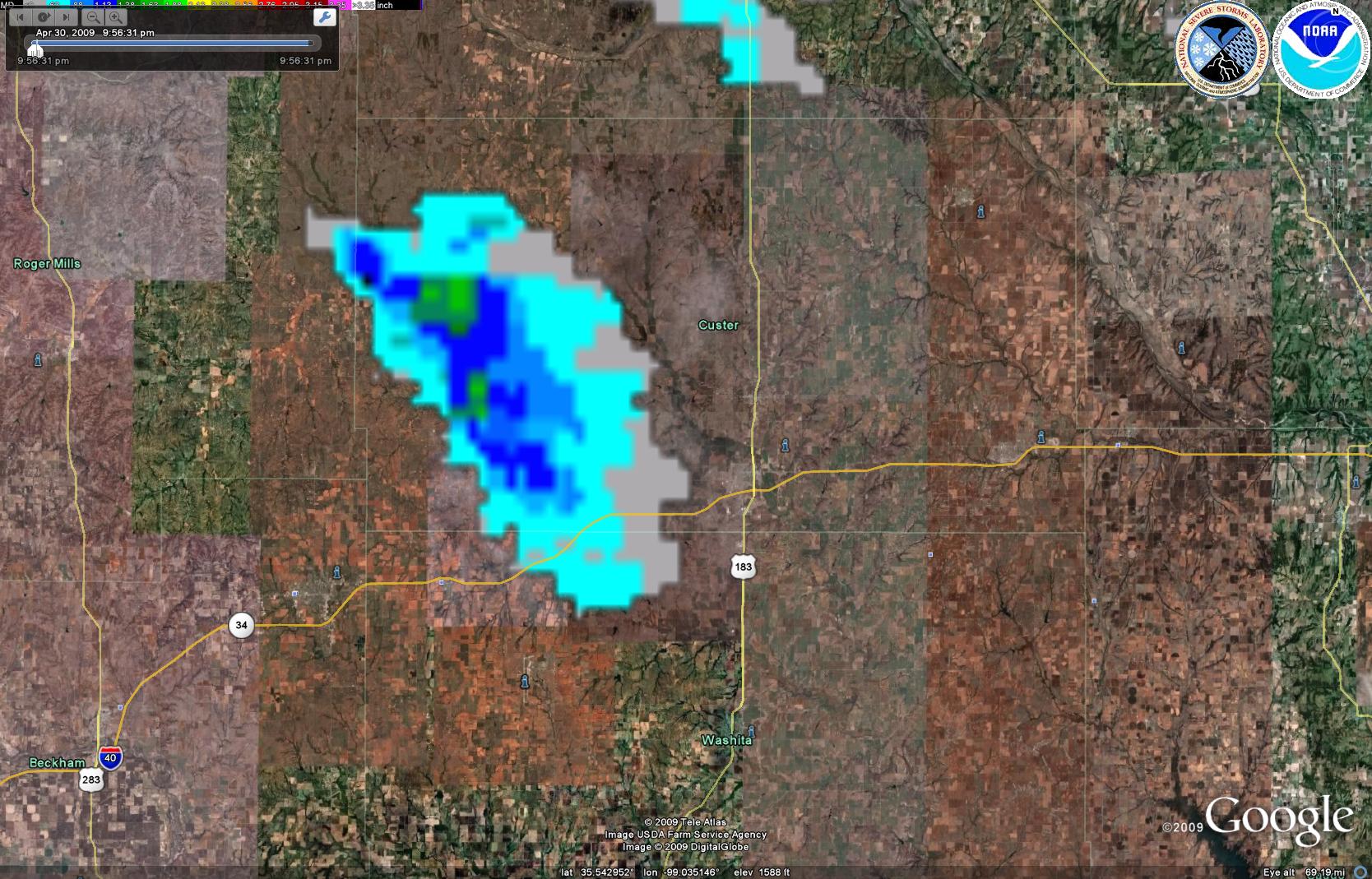
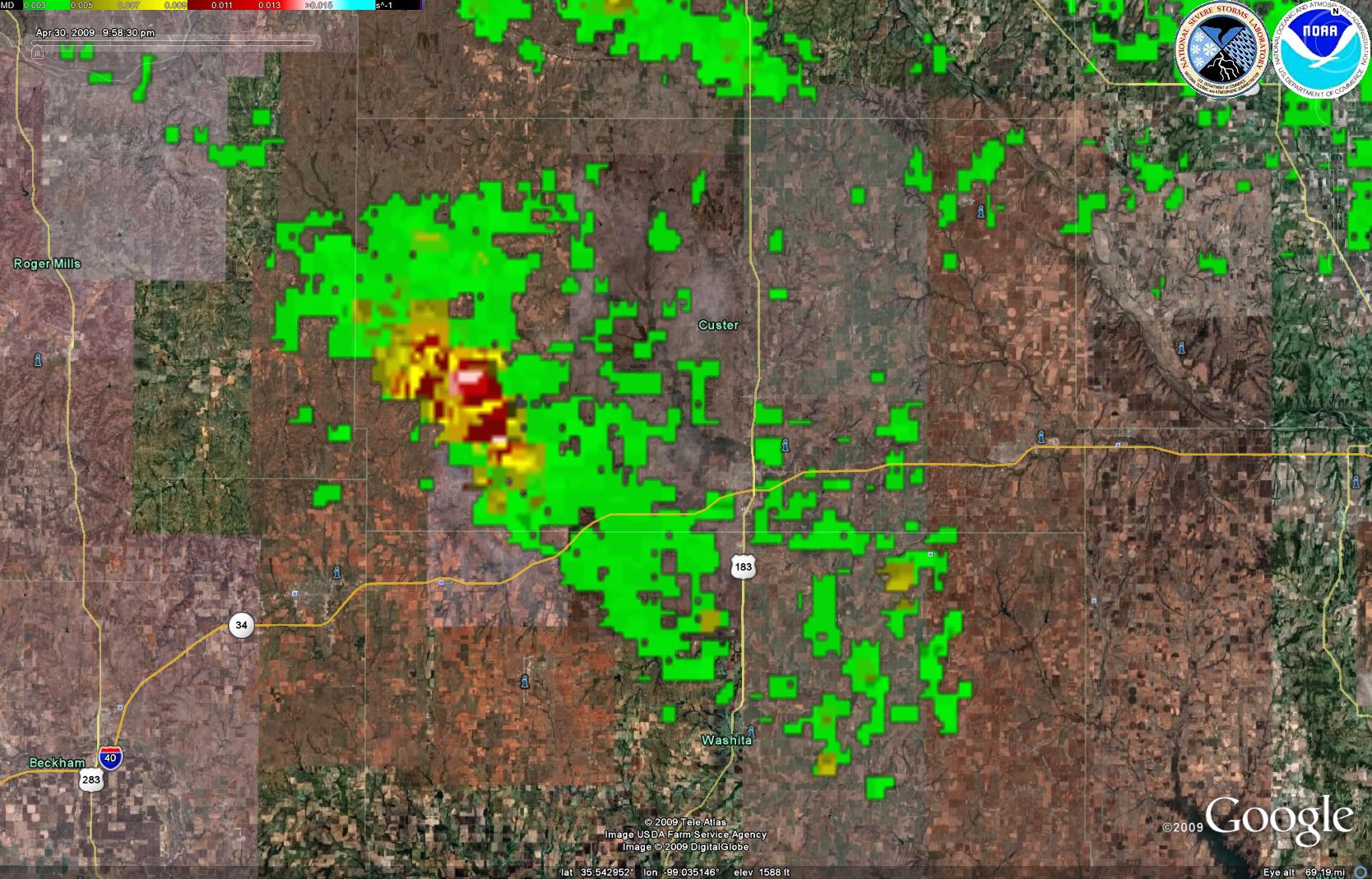
The IOP was centered on Oklahoma and was planned to involve mainly the PAR data, and perhaps the CASA data if storms formed in that smaller domain (the LMA network was unavailable today).  We began the IOP at 530pm, but the cap held and held and held, until storms broke through around 7:30pm in western Oklahoma.  The forecasters evaluated real-time PAR data, in conjunction with the WDSSI MRMS data, on an isolated supercell storm, mainly a large hail producer, as it moved southward through Dewey and Custer Counties.  Using AWIPS, the forecasters issued severe thunderstorm and several tornado warnings on the storm.  They noted that the MRMS rotation tracks indicated weaker shear than indicated on the PAR.  This was primarily because the PAR was looking above the 0-2 km AGL layer used to compute the MRMS azimuthal shear products.  The MESH swaths helped with the polygon cone orientation once again.

Figure 1.  MESH Tracks.

Figure 2.  Rotation Tracks.

Greg Stumpf (EWP Weekly Coordinator, 27 Apr – 1 May 2009)

Tags: None