vLAPS Surface CAPE

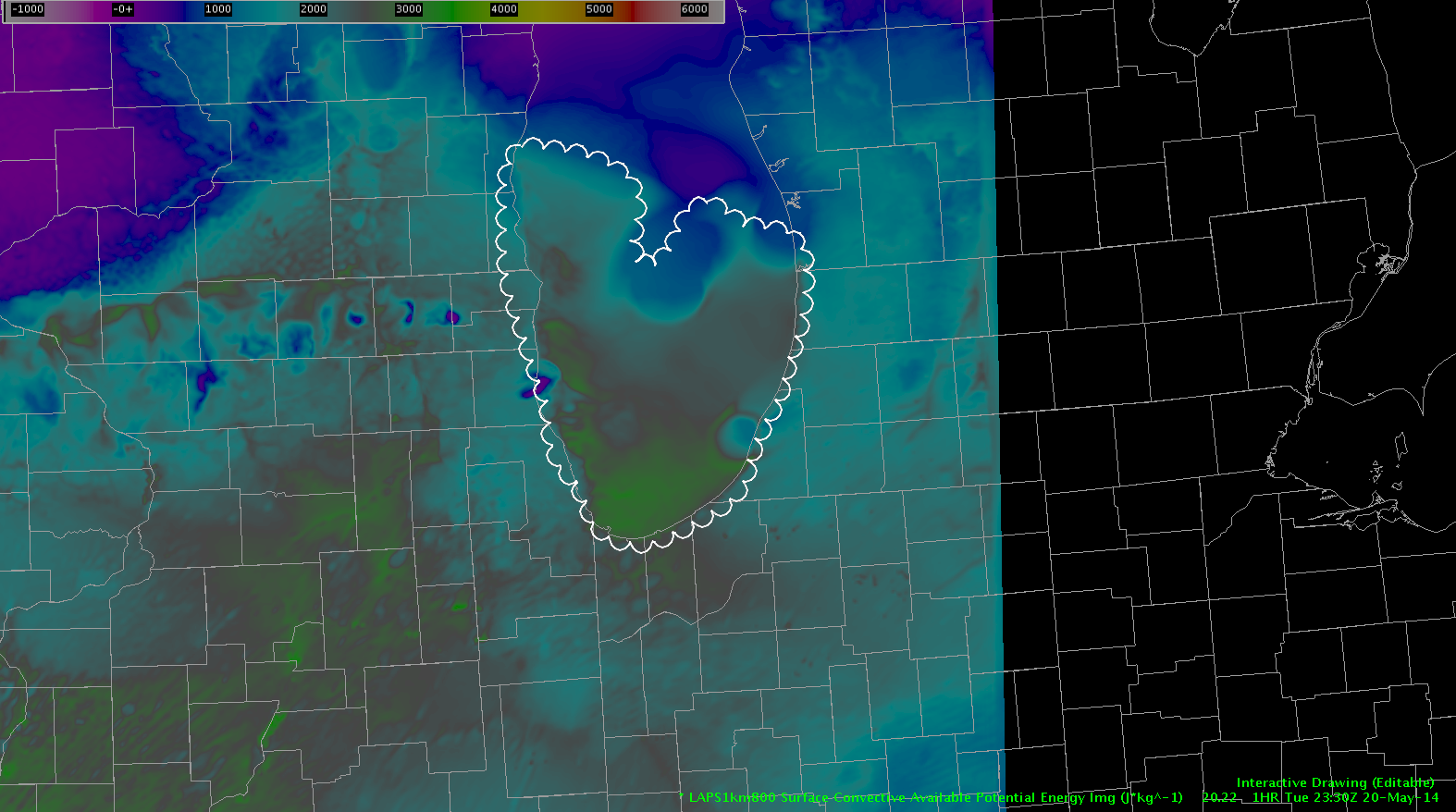
I loaded the surfaced based CAPE product from the vLAPS and below is the 1-hr forecast. The interesting area is over lake MI where the water temperature is still very cold, generally in the 40s F, and the model is indicating SBCAPE values of 1500-2500 j/kg over the central and southern area of the lake. This seems to be overdone given the very cold surface temperatures.

-JB

strange_cape_20_2330

Tags: None

Simulated Satellite Imagery Very Useful Today

Simulated Satellite verse Current MRMS and IR Satellite

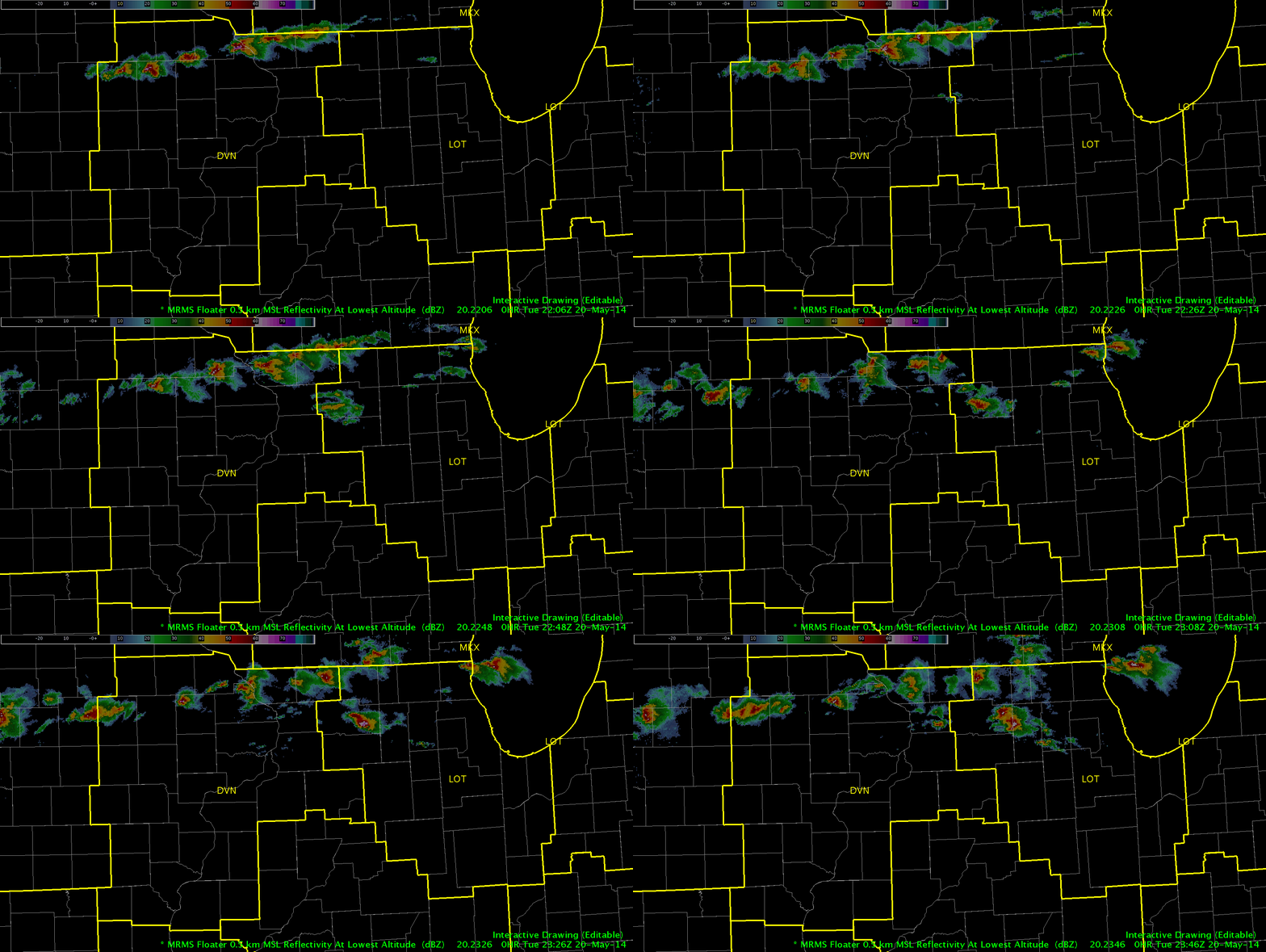
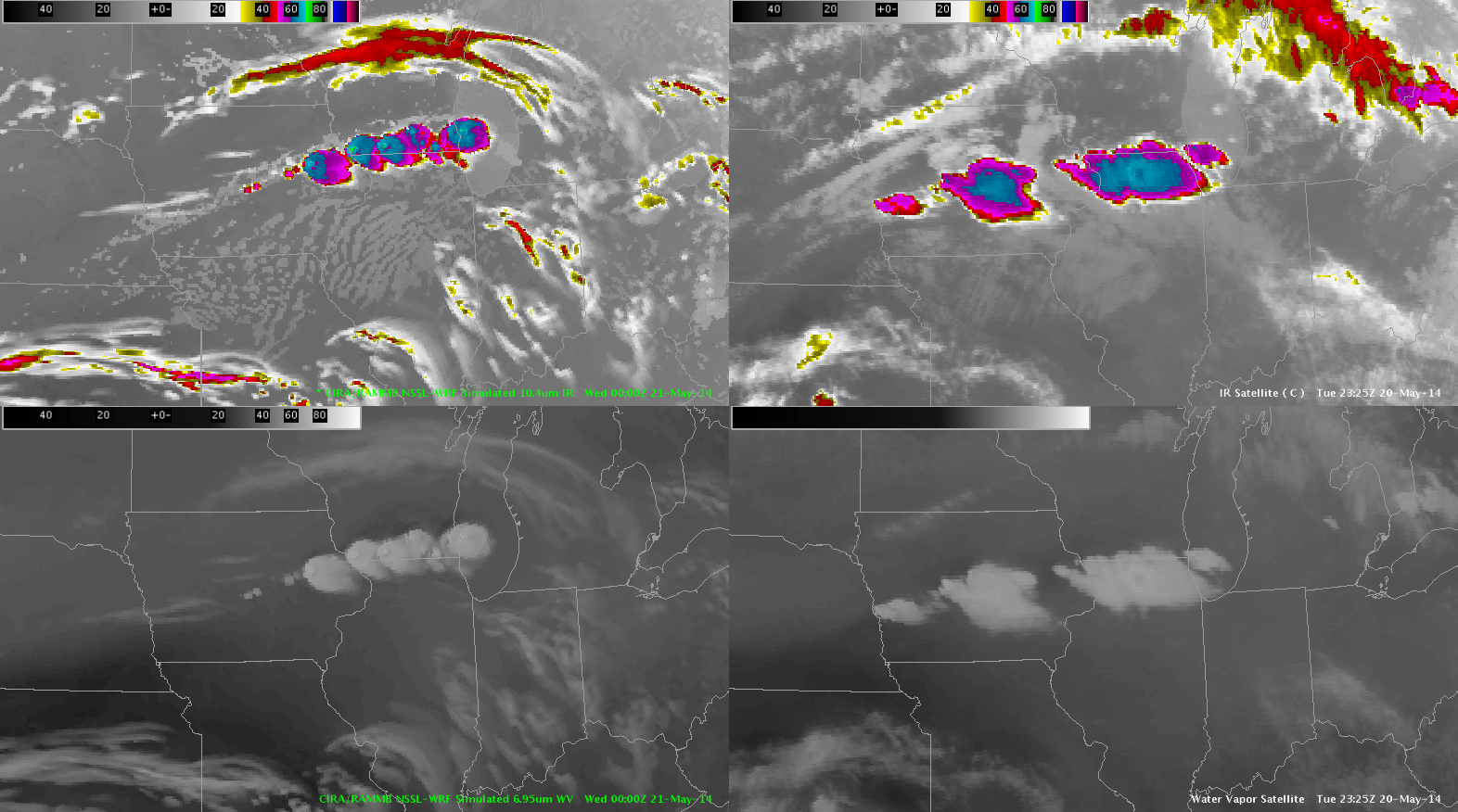
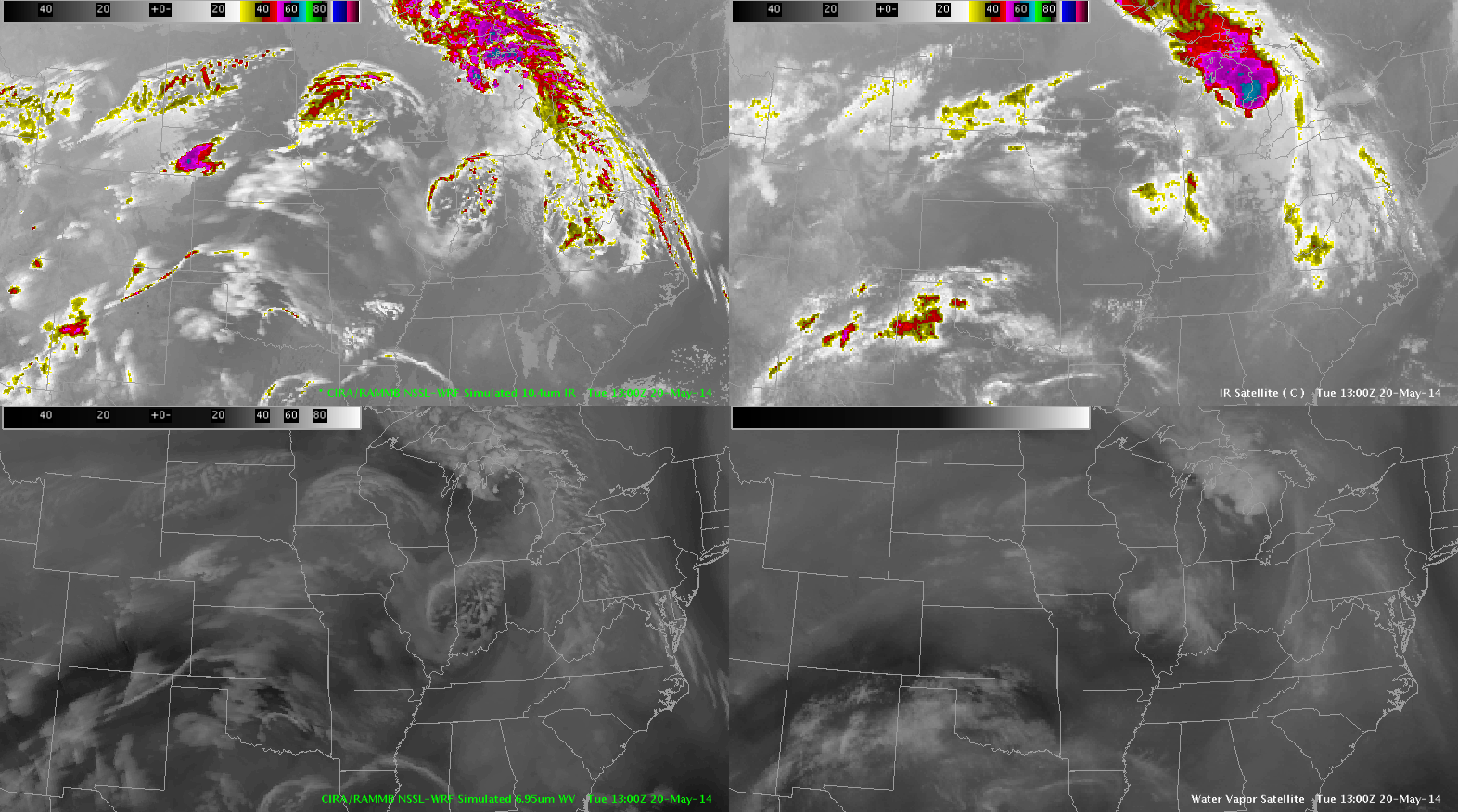
I decided to look back at the NSSL-WRF Simulated Satellite Imagery (top left) and it is pretty close to the actual IR satellite (top right).  You can also see the MRMS radar (bottom left) that it had the idea of a cluster of storms breaking out in central Iowa to N. Illinois.  The only issue I would say is it may have been slightly slower (30 min-1hr) with initializing the convection.  Other than that it has it timed pretty well after. I like it! ~Vollmar

Tags: None

Overshoot-Top Product

over_shooting_top_20_2337

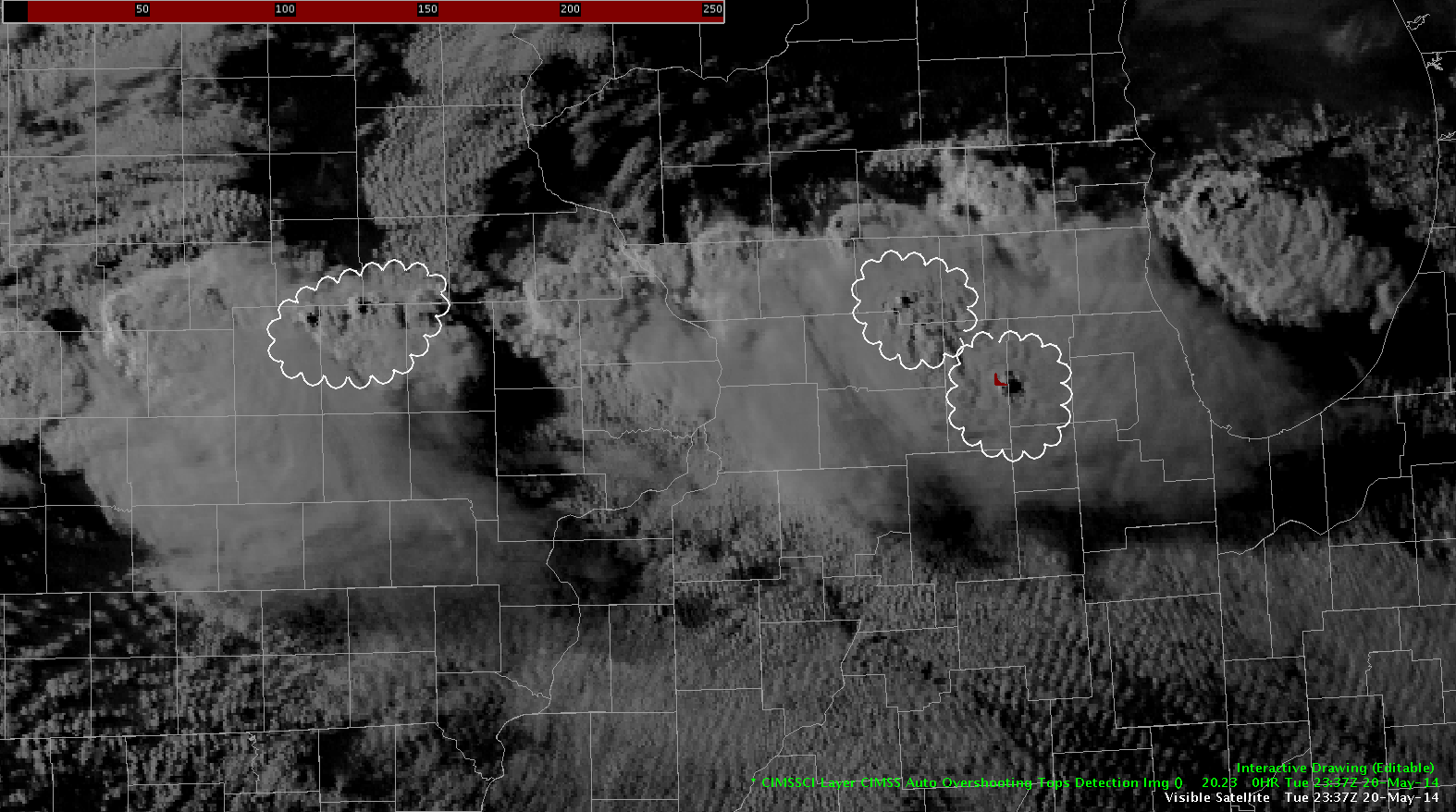
Visible satellite imagery indicates a few overshooting tops associated with the convection from central IL back west into central IA. The over-shooting top product did highlight the region over northern IL (where currently a golf ball size hail report was just received) but the ones to the west were not highlighted. The ones to the west must not have been large enough of an over-shooting top to trip the algorithm. Since the one indicated did product the big hail it tends to add confidence to use of the product.

-JB

Tags: None

EWP Operations Update – Tuesday 5/20 – 6:20pm

We moved our CYS team to the Chicago, IL (LOT) CWA as the convection in the CYS region wasn’t providing many severe reports. Our forecasters are deep into warning operations now, using GOES-R CI, ProbSevere, NearCast, MR/MS, and base data to interrogate and gauge storm severity. I feel like we may be going through Super-Rapid scan withdrawals though. 🙁

MR/MS Reflectivity at Lowest Altitude product - 2206z - 2346z.
MR/MS Reflectivity at Lowest Altitude product – 2206z – 2346z.

-Darrel Kingfield
EWP Week 3 Coordinator

Tags: None

Another vLAPs.

May20th 2346Z

Just another view of LAPs CAPE field here. Lake County appears to have its cell simulated by LAPs during the actual storm time. While the storm over Ogle county did not show up in the CAPE field. HOWEVER… I would like to note that LAPs did initiate with a very high CAPE maxima of almost 3000 J/kg in this area. Perhaps there was slightly stronger cap aloft in this simulation than what occurred in reality.

Grant H.

Tags: None

Simulated IR/WV Verifying Well

Building on the previous post the simulated IR/WV imagery did very well capturing the orientation/timing of the convection later in the day across eastern IA and into northern IL. In reality it did under-forecast the degree of convection over western IA.

-JB

simulated_wv_ir_20_00

Tags: None

Simulated Water Vapor Speed Max

Analysis of the simulated water vapor imagery compared to the actual water vapor imagery at 13Z indicated the simulated model had a good handle on the speed max that was located over western KS at 12Z. Although the simulated water vapor/IR was to agressive on TSRAs over western NEb at 13Z this leads to confidence in the position of the speed max later in the day on the simulated water vapor.

-JB

simulated_wv_20_13

Tags: None

PGLM, Lightning Jump, and Quarter size hail

lightning_jump_storm_4sigma_5sigma

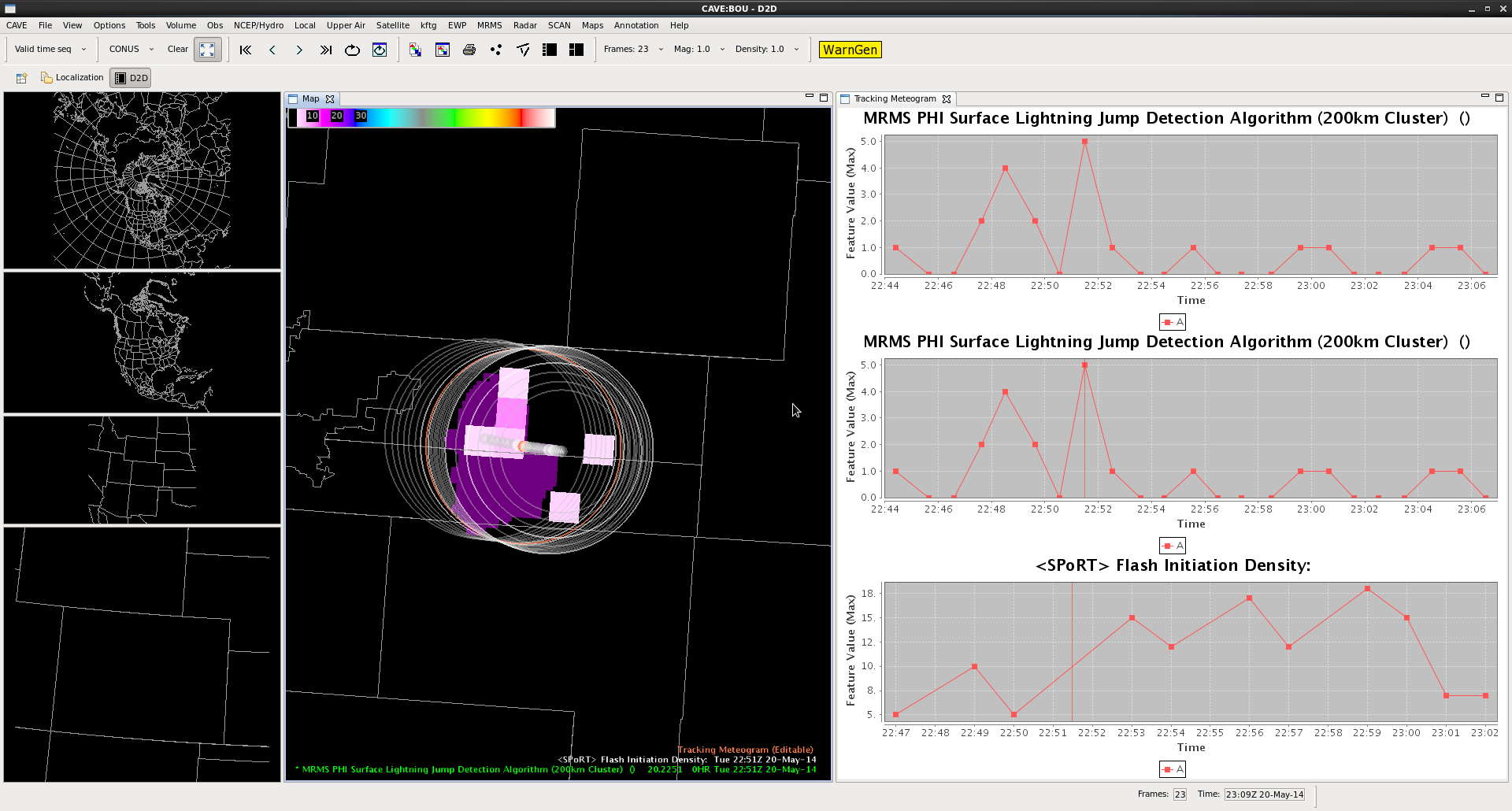
Example lightning jumps from just east of Denver CO at 2251 UTC. The image above shows the lightning jump feature (shaded purple), flash initiation density (FID; pink boxes) and the meteogram output information.  The top two panels are the sigma levels at which lightning jump occurs, and the bottom panel is the total flash rate from the PGLM.   The Tracking meteogram outline is the white circles encompassing the storm.  Two lightning jumps occur at 2249 and 2251 UTC.  The first jump occurs as the total flash rate from the PGLM reaches 10 flashes per minute (4 sigma level; anything above 2 sigma indicates a lightning jump according to Schultz et al. 2011), and the second jump occurs with the larger increase in total lightning from 5 flashes a minute to 15 flashes per minute (6 sigma).  The jumps are indicating increases in updraft strength and volume,and can be used as a metric in storm intensification.  Quarter size hail was reported approximately 20 minutes later at 2310 UTC.

*note the flash rates are likely higher with this storm because the LMA used in this case only had 5-8 sensors active at any given time.*

Jump in Prob Severe

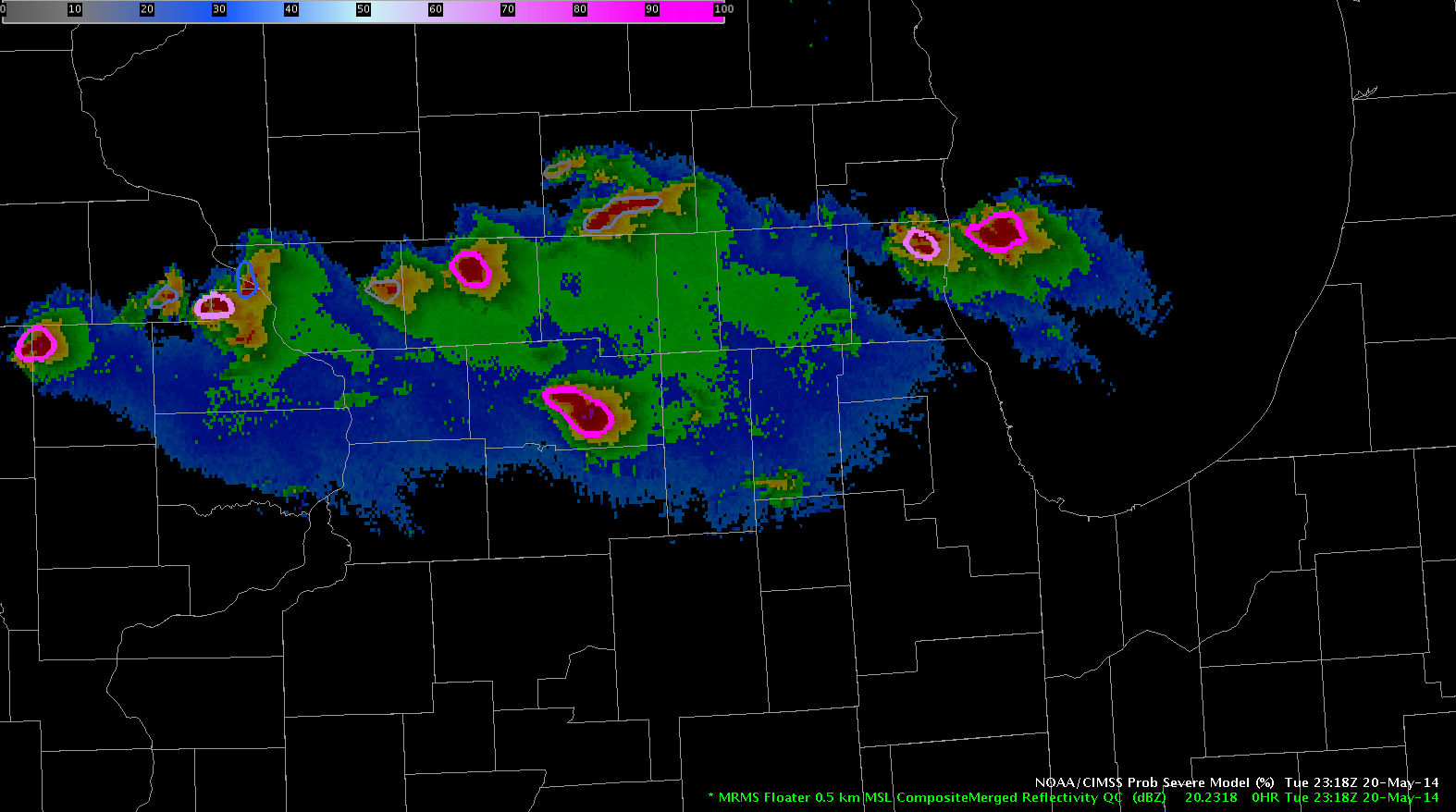
We have now switched CWA to LOT and have loaded in the MRMS composite reflectivity overlaid with ProbSVR. It is interesting to compare this area to what we were seeing to the west. In eastern WY the probabilities were lower despite rotation on velocity products and supportive 3-dementional reflectivity of a BWER. For the LOT CWA there is very high probabilities.

-JB

prob_svr_diff

Tags: None

Prob. Severe Model and Dual-Pol

The prob. severe model has been a great way to grab attention to storms that need to be monitored for the developing convection over the northern DVN CWA. Taking a look at how well it verified with dual-pol products and spotter reports, this screen capture (below) shows the prob. severe model overlaid on ZDR (upper right) and then 0.5 base reflectivity in the upper left, KDP on the lower left, and CC on the lower right. Based on the severe prob (shows 94% at 2138Z), my partner issued a Severe Thunderstorm Warning ten minutes prior to this screen capture as the probability trend was increasing over time. Having the ability to look at the parameters detailing more specifics about what the model is analyzing is very helpful in maintaining awareness with a particular storm. The MUCAPE (2325 J/kg, shown) and effective bulk shear (50.3 kts., also shown) being consolidated into one quick click of a mouse is much faster and easier than going to pull up the RAP elsewhere and analyzing the local storm environment. One other parameter that might be helpful is effective SRH. As for the other current, existing parameters, the same could be said as the other two above: the MRMS MESH, while overdone, provides an opportunity to monitor trends; and the satellite progs with annotations indicating whether or not the vertical growth rate and glaciation rate is moderate, strong, etc. is helpful and allows for increased confidence when utilizing this tool with other, more traditional methods. Without knowing how the exact values with respect to the satellite-tracking rates translate to growth/decay, the annotations deciphering what the values mean is critical to understanding the storm’s trend.

2138Z_ProbSvrwithDualPol_cropped

Comparing the prob. severe outline with the storm in question, dual-pol showed KDP values that were blacked out (with surrounding pixels well above 1), CC values below 1 (~.8 to .9), and a small but still evident three-body scatter spike. DVN received a report on this storm just two minutes later that was close to severe criteria:

LSRDVN

PRELIMINARY LOCAL STORM REPORT
NATIONAL WEATHER SERVICE QUAD CITIES IA IL
445 PM CDT TUE MAY 20 2014

..TIME...   ...EVENT...      ...CITY LOCATION...     ...LAT.LON...
..DATE...   ....MAG....      ..COUNTY LOCATION..ST.. ...SOURCE....
            ..REMARKS..

0440 PM     HAIL             2 W DUBUQUE REGIONAL AI 42.40N 90.75W
05/20/2014  M0.88 INCH       DUBUQUE            IA   EMERGENCY MNGR

            PEA TO NICKEL SIZE HAIL REPORTED ON HIGHWAY 151.

&&

Ten minutes later, another report of hail over severe criteria was issued from DVN, verifying my partner’s warning, the prob. severe model, and what was seen in radar trends:

LSRDVN

PRELIMINARY LOCAL STORM REPORT
NATIONAL WEATHER SERVICE QUAD CITIES IA IL
457 PM CDT TUE MAY 20 2014

..TIME...   ...EVENT...      ...CITY LOCATION...     ...LAT.LON...
..DATE...   ....MAG....      ..COUNTY LOCATION..ST.. ...SOURCE....
            ..REMARKS..

0450 PM     HAIL             1 E DUBUQUE REGIONAL AI 42.40N 90.70W
05/20/2014  M1.50 INCH       DUBUQUE            IA   EMERGENCY MNGR

&&

Overall and so far, this tool is a great resource and would be good to have in the toolbox.

~Linda

Tags: None