TPW in a convective environment

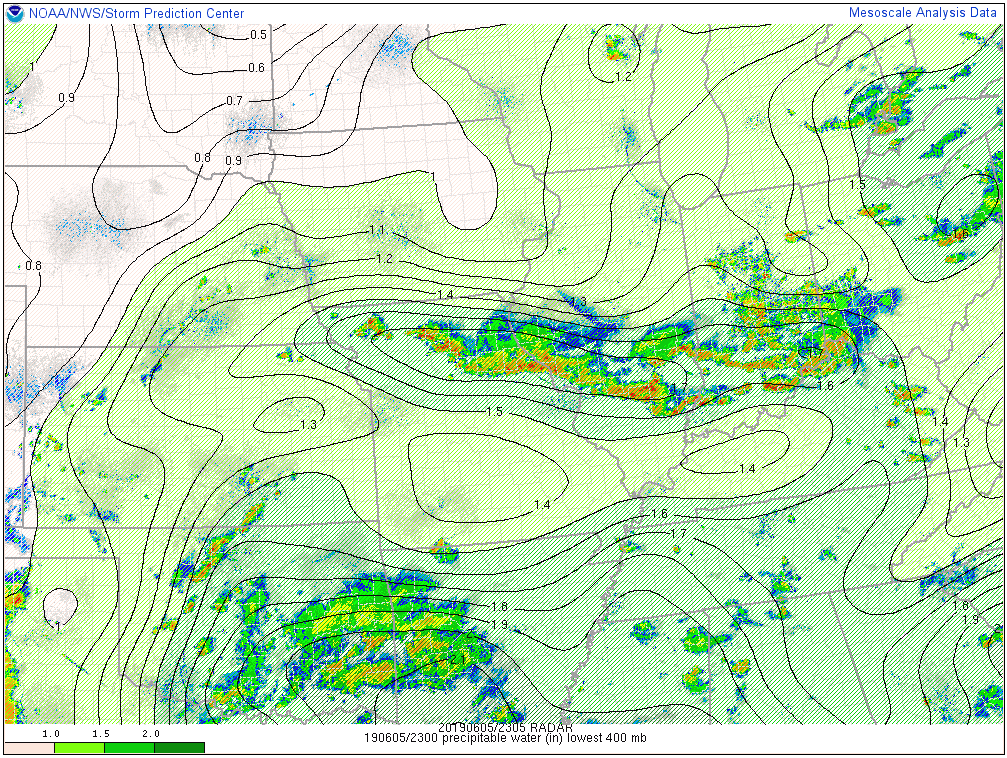
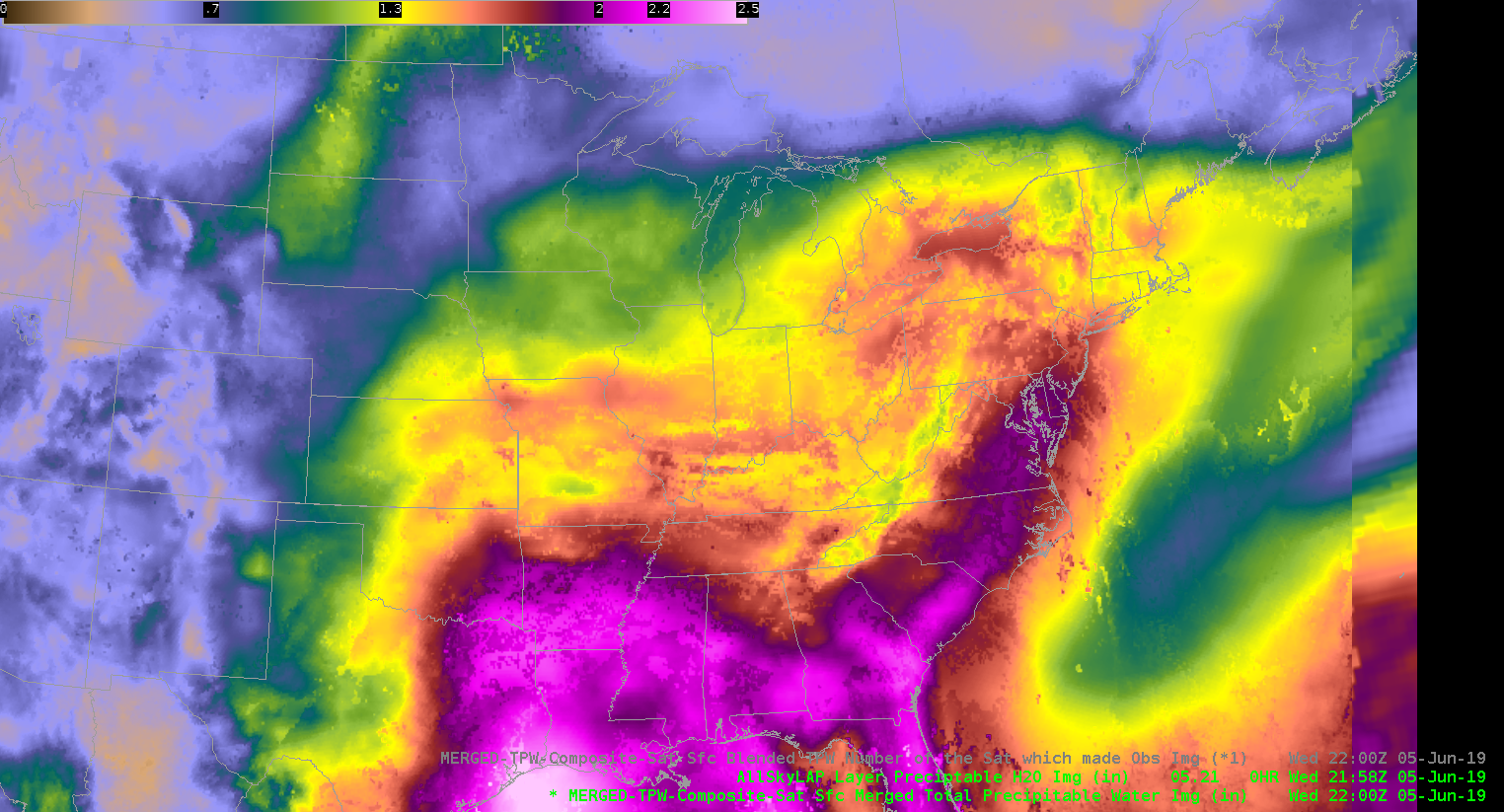
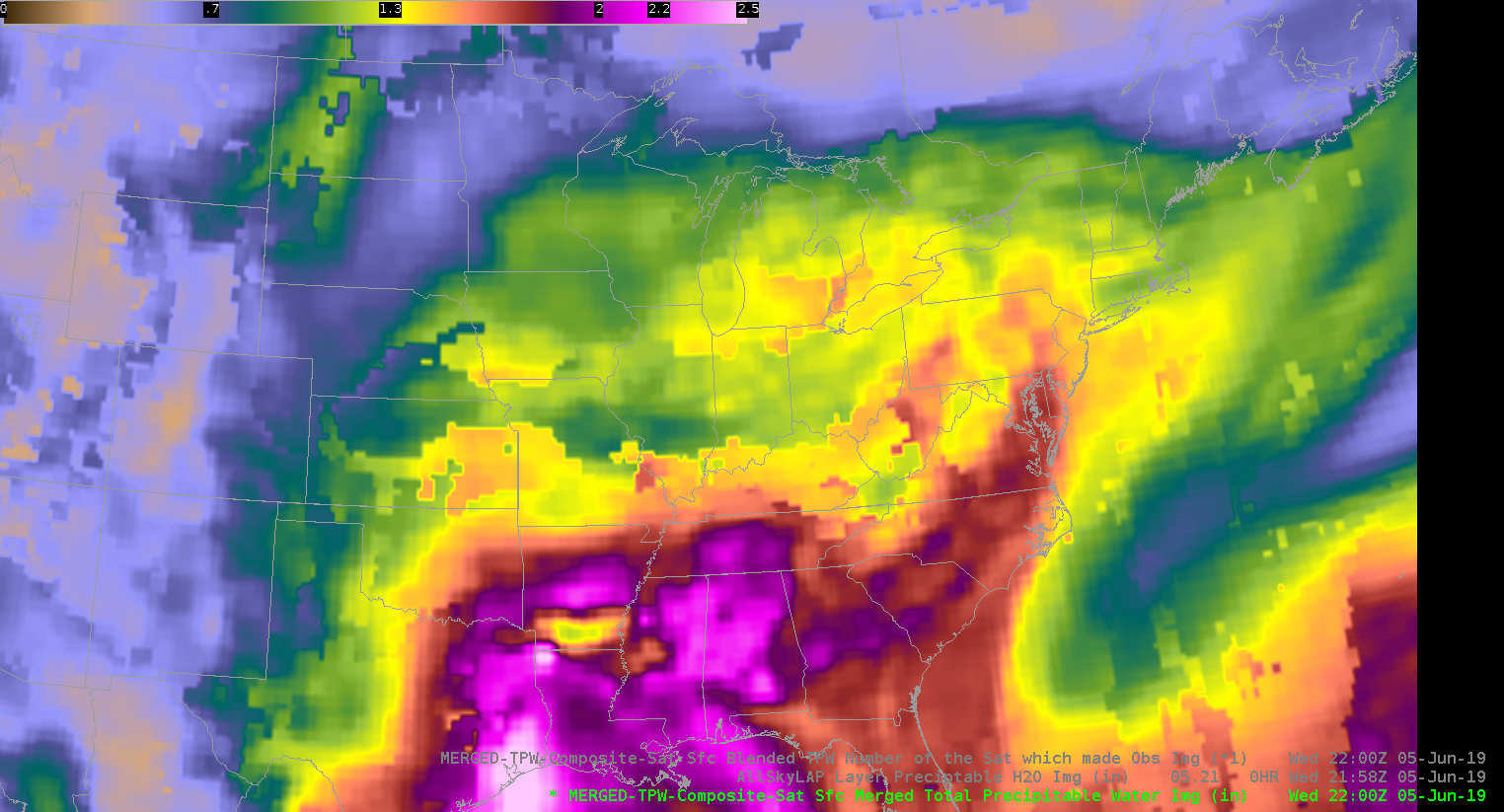
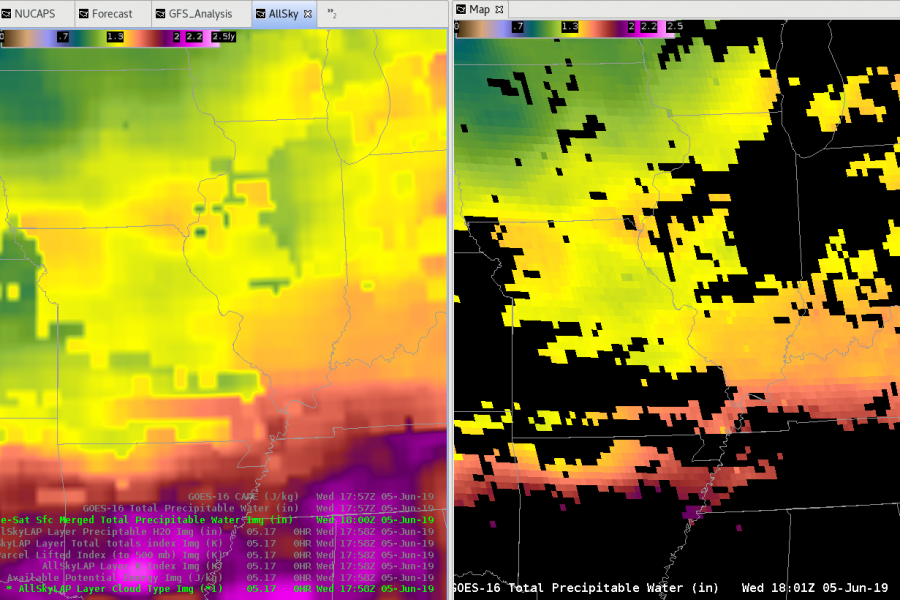
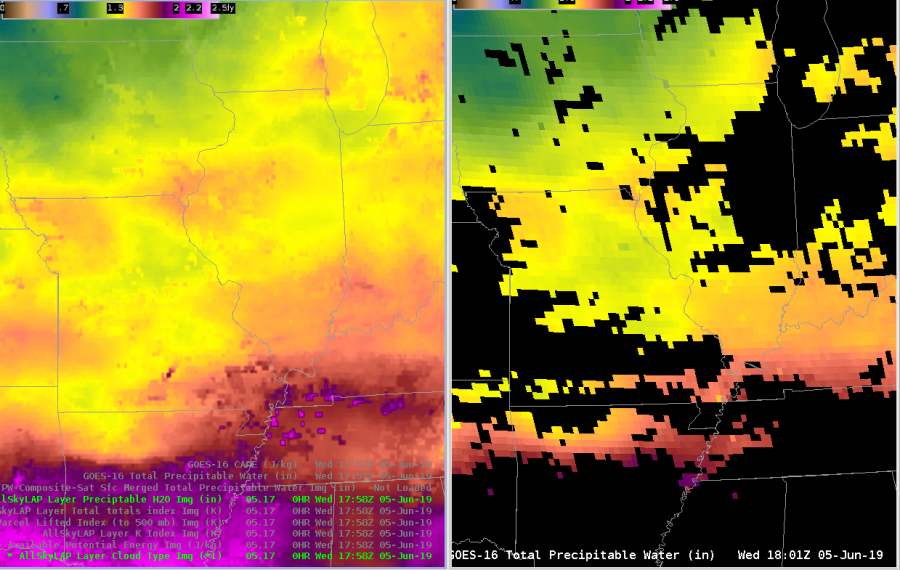
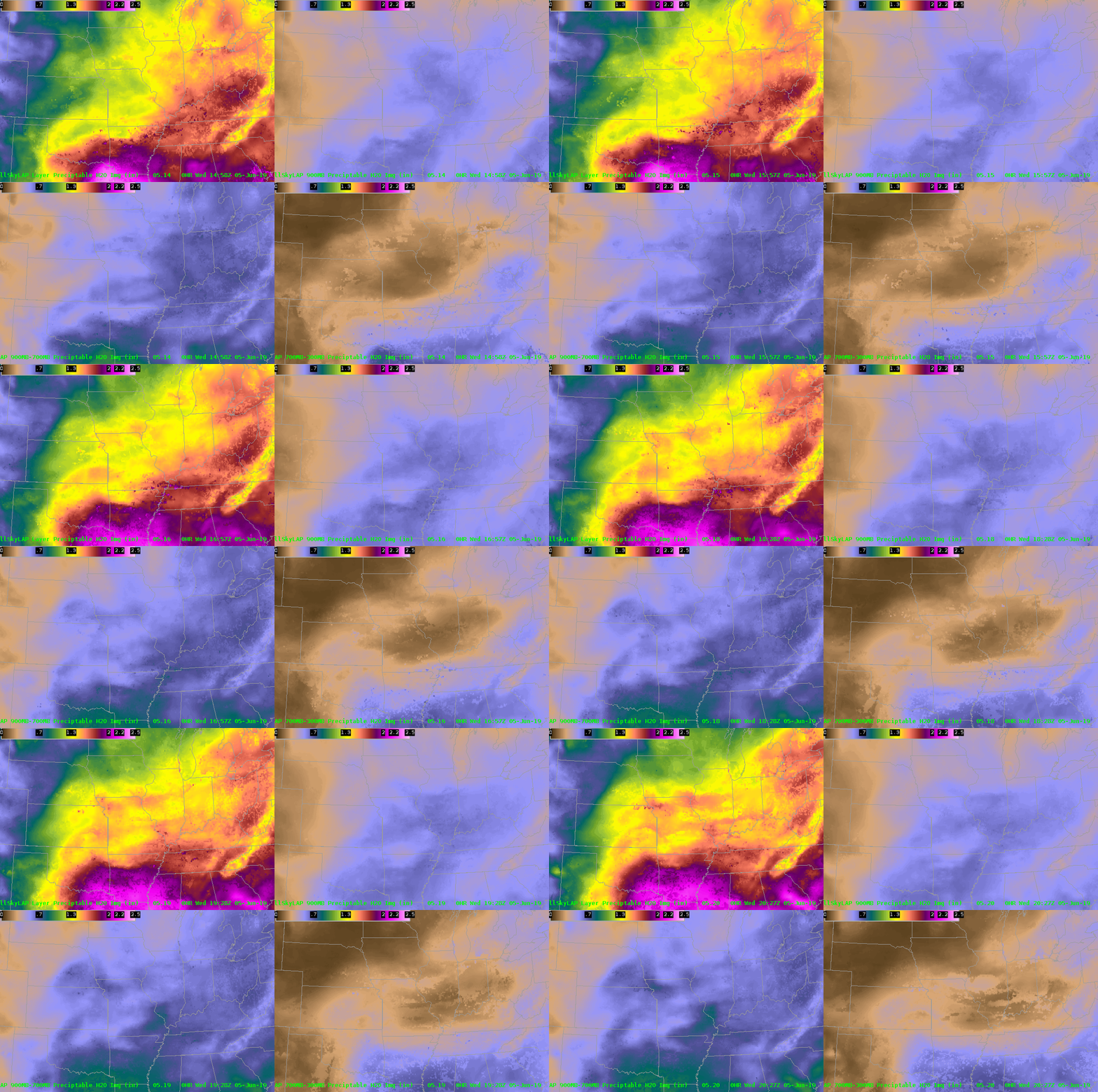
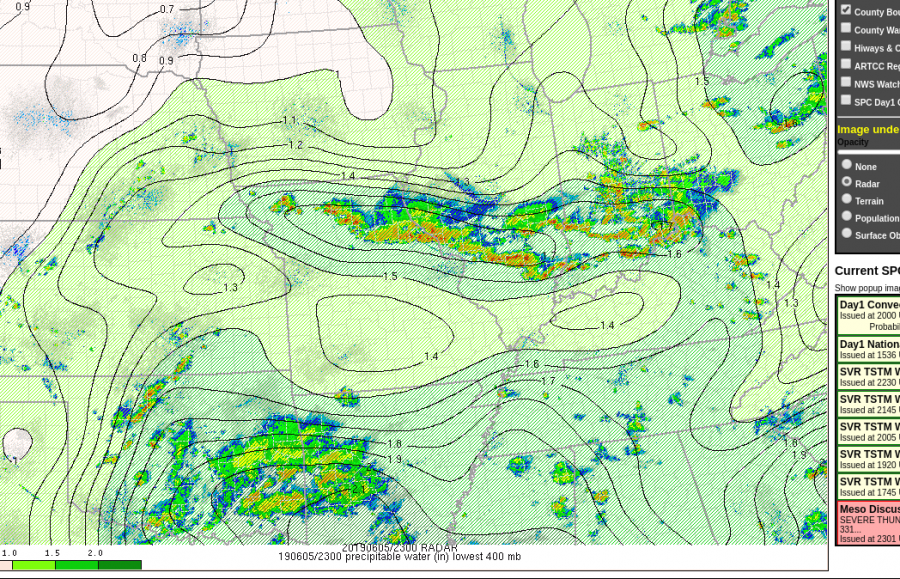
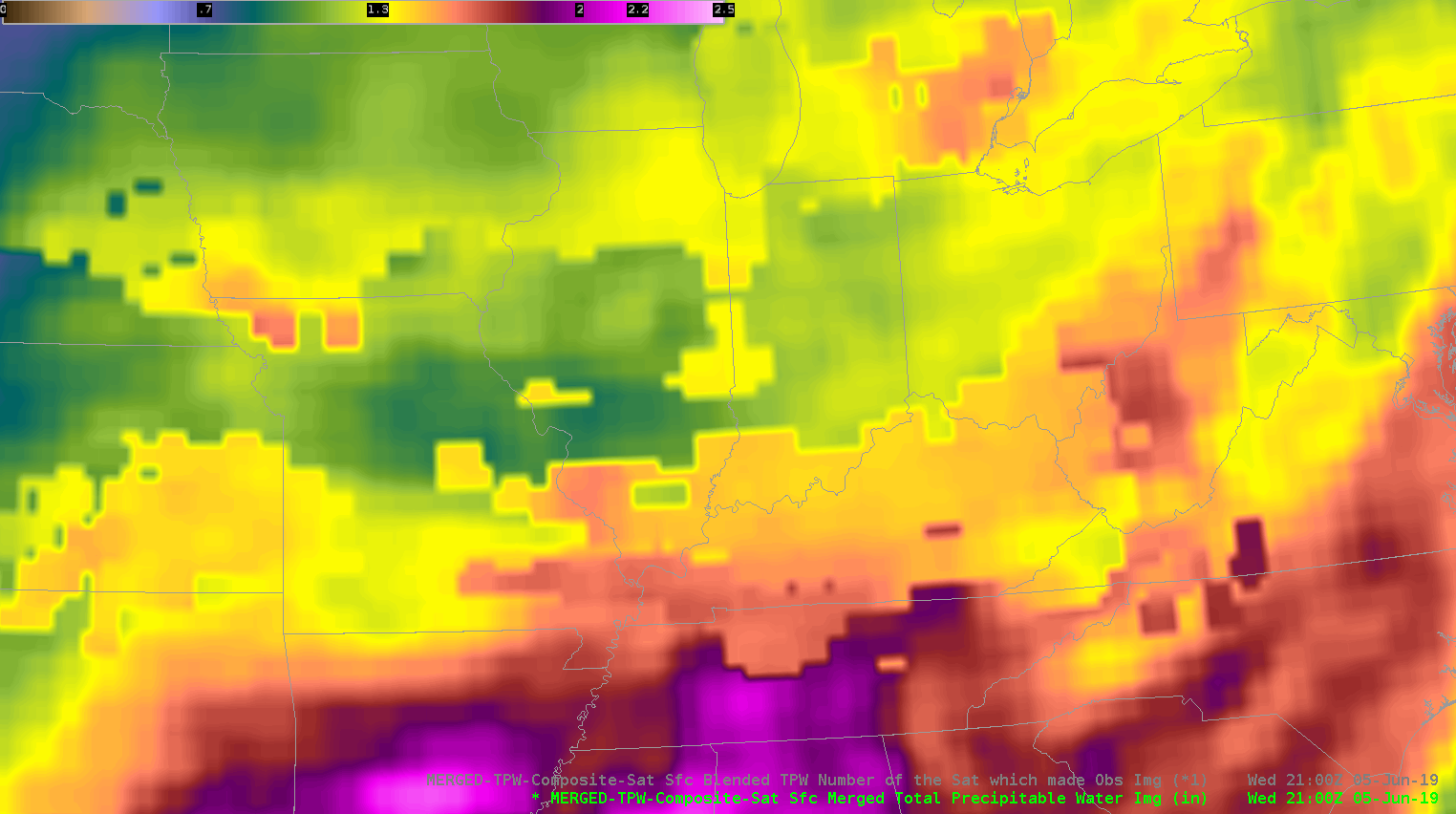
Below is a comparison of two different TPW products (AllSkyLAP layer Precipitable water and Merged TPW Composite Sat Sfc Merged Total Precipitation Water) compared to RAP Analysis from the SPC Mesoanalyst page.

Control group: SPC Mesoanalysis Precipitable Water

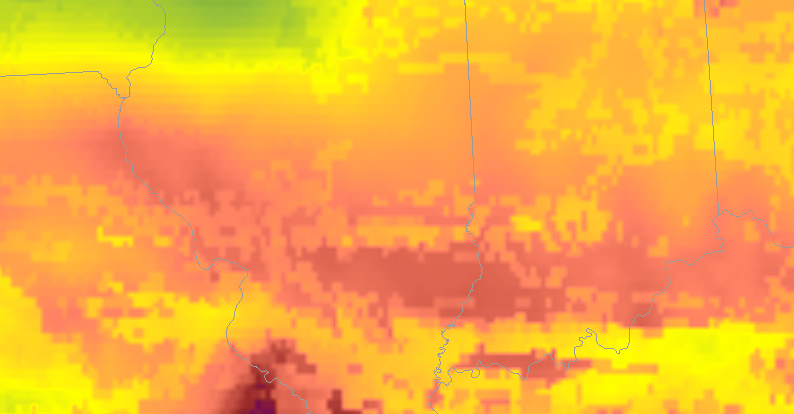
The AllSkyLAP product (below) seems to do a better job at “painting the picture,” however, it’s reliance on the GFS model often leads to a delay in PWAT drops in areas of convection. This is highlighted the best across central IL, where RAP Analysis shows PWATs in the 1 – 1.25 inch range while the AllSkyLAP product shows values closer to the 1.5 inch range straight from GFS output.

AllSkyLAP

TPW (below) does a better job at accounting for this, at least across the central IL study area, resulting in more realistic 1.1 to 1.3 inch values.

TPW
Tags: None

ILX Mesoscale Discussion

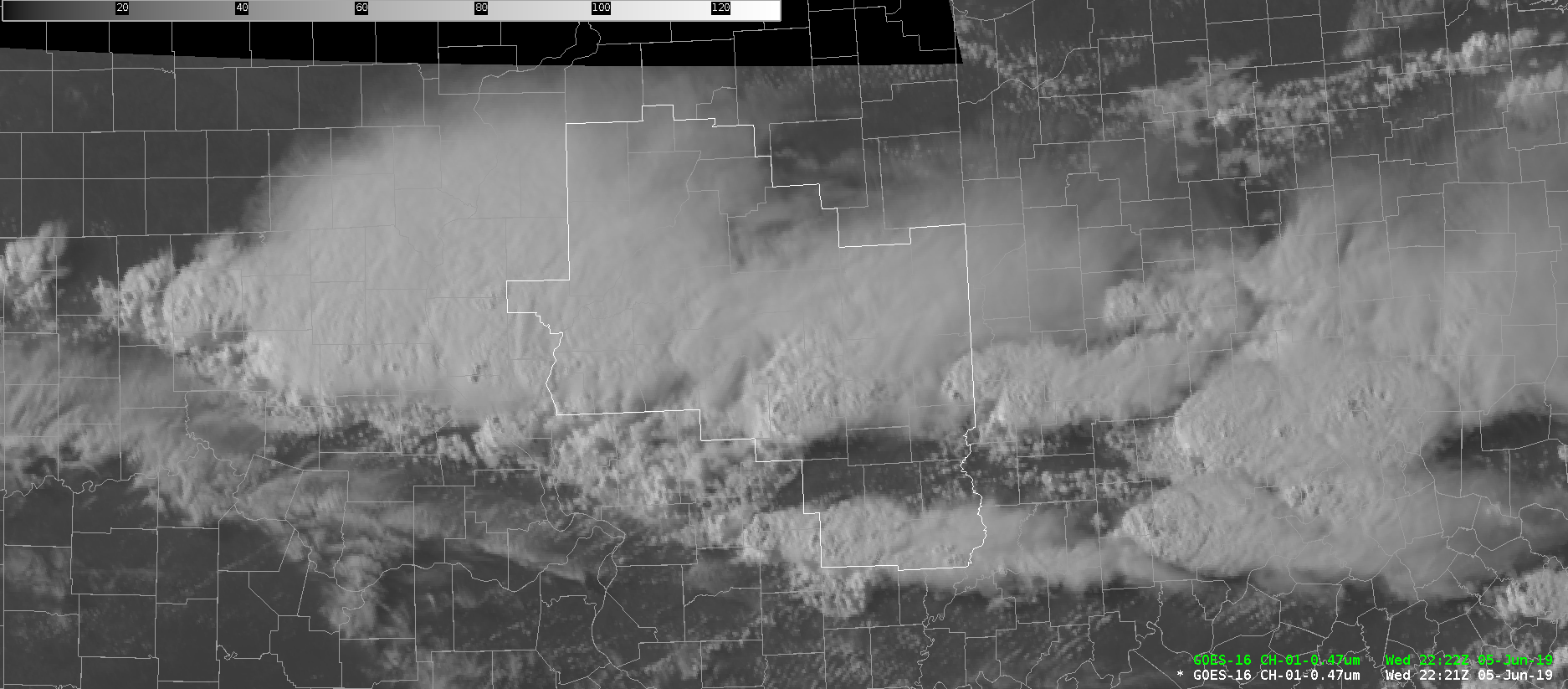
GOES_East Mesosector 2 Imagery (Band 2)

The effective surface cold front remains well north of Illinois, draped west to east across central Wisconsin as of the 22z surface analysis. Further south across the state, two main forcing mechanisms continue to play host to strong to severe convection. The first (southernmost boundary) is nearly stationary acting as the area of primary convergence, while also service as the dividing line between 70 degree dewpoints (south) and mid to upper 60s (north). The second is an outflow boundary loosely associated with earlier day convection, which continues to race southward driven largely by cold pool propagation. This boundary is anticipated to overtake the primary boundary over the next few hours, ushering the majority of shower and storm activity south of the Lincoln IL CWA later this evening (Showcased well by NUCAPS forecasts). With ample CAPE (1500 – 2500 J/KG per the 22z AllSkyLAP product) remaining along and south of said boundaries, storms are expected to retain their intensities through the early evening hours. Primary threats will remain damaging wind gusts, large hail, and flash flooding primarily in areas that see repeat thunderstorm convection this afternoon and evening.

—————————————————————————————————–Mountain Bone

Tags: None

Line Running Into Drier Air?

IR and RGB imagery showing outflow coming out of the storms in the eastern LSX area not firing up additional storms.  NUCAPS 400-200 mb RH product shows quite a bit of drier air that the line is pushing into.  More moisture is west of the MO/IL line, so that part of the line may have a better chance to maintain themselves/develop new cores ahead of the line along that outflow.

Charley

Tags: None

Mesoscale Update

Band of storms dropping in from the north is moving into an environment favorable to at least maintain severe wind gusts as well as some hail potential.  AllSky CAPE parameter shows the line moving into airmass with 2500 J/kg, similar to values given by earlier ILX special sounding and recent modified NUCAPS sounding.  Latest RAP shows DCAPEs up to 1400 J/kg, indicating good potential for severe wind gusts. Had a couple of reports of blackout conditions from blowing field dirt along I-55 near Litchfield.


Charley

Tags: None

Comparing Operational Derived Products

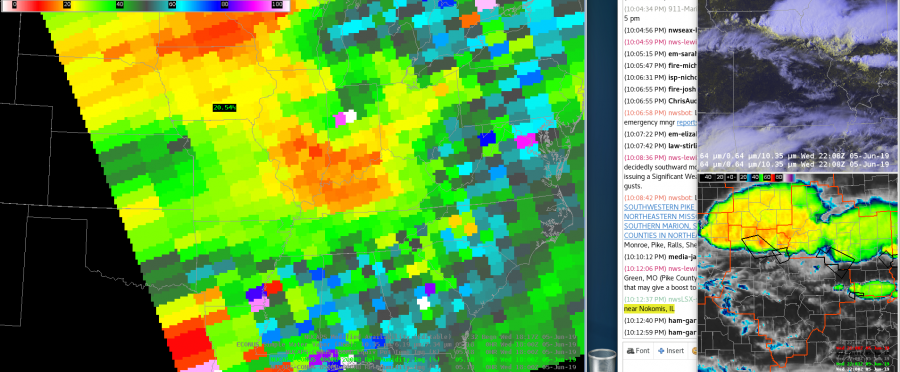
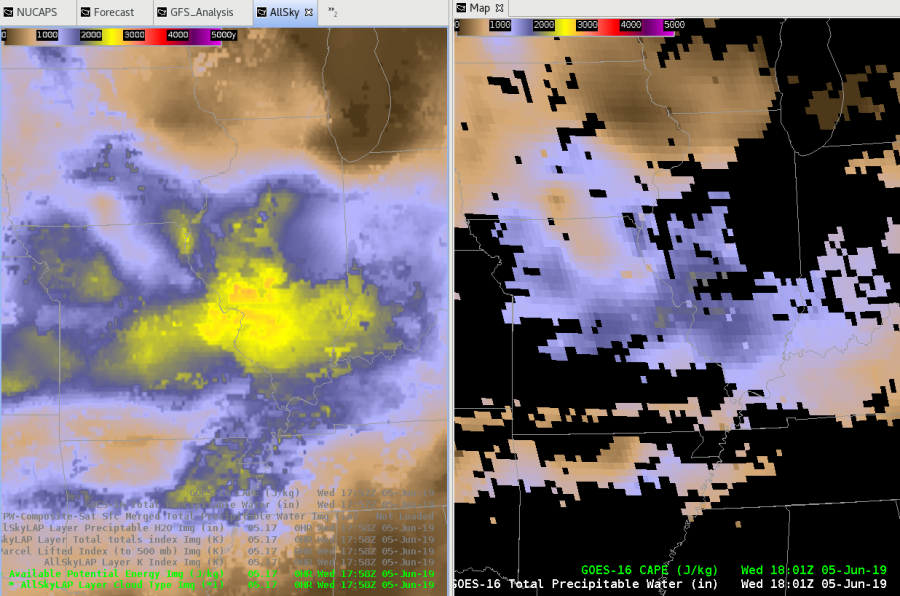
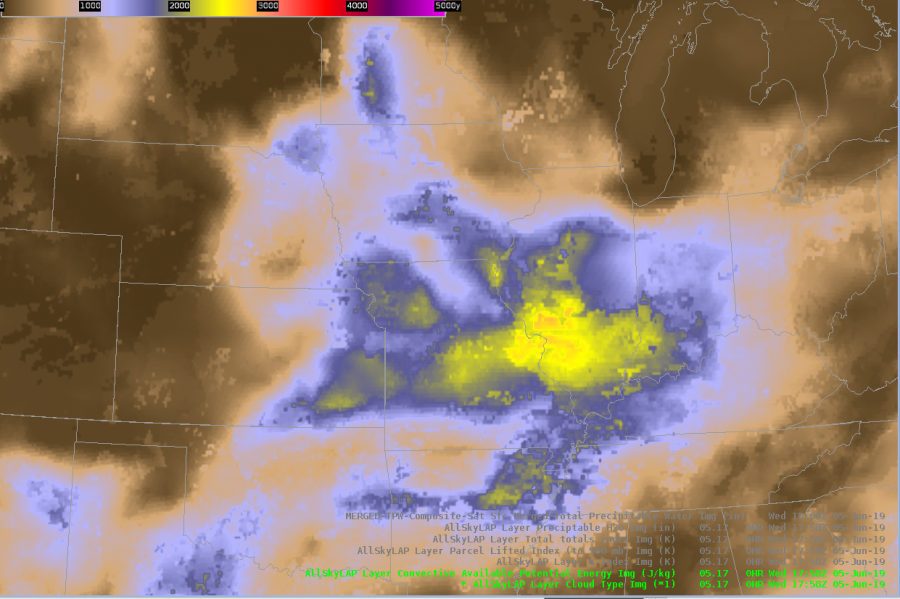
Total PW looks good from the operational version (minus the blacked out data, of course).  It is a little blotchy on the merged TPW (left).  A similar comparison below of the AllSky TPW and Operational product.

CAPE is a different story.

AllSky calculations are mostly in a clear airmass, as you can tell by the operational product not being blacked out.  Peak values on the right are in the 1700-1800 J/kg range, whereas points on the left peak at 2600-2800.

Charley

Tags: None

Similar Soundings

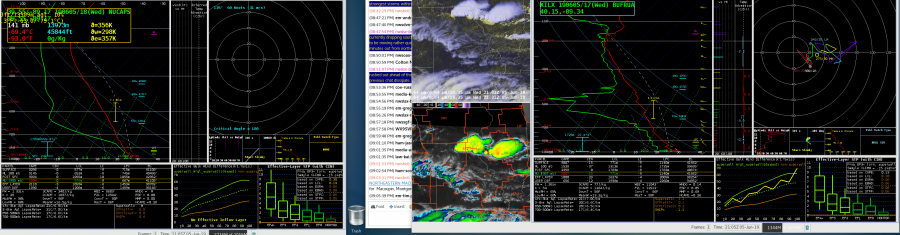
Modified NUCAPS sounding near ILX is pretty similar to KILX special sounding taken at 17Z!  MUCAPES both around 3000 and LI -9.

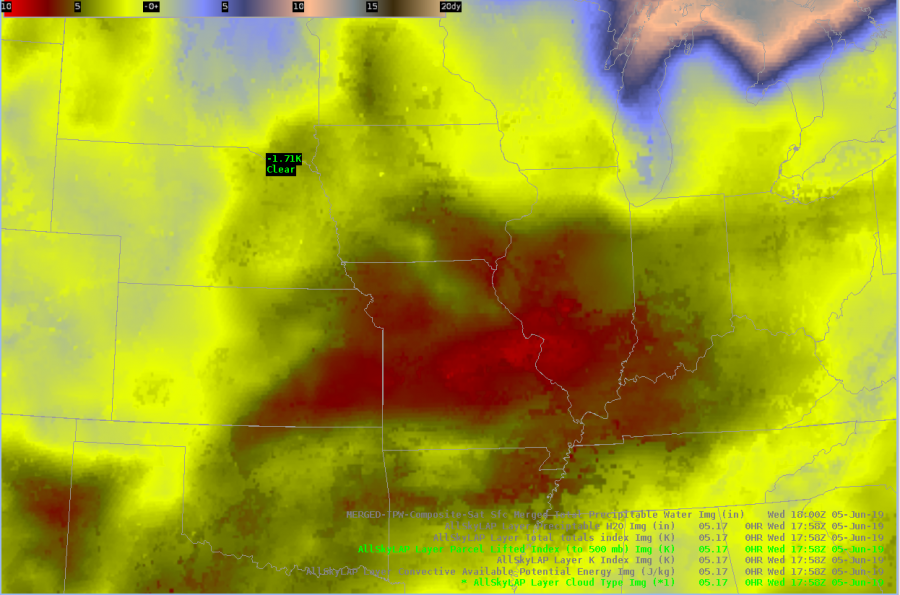
Values similar to AllSky at 18Z.

Those CAPE values near 2500 J/kg…also similar.

This similarity gives us some confidence in new forecasts, especially in clear sky regions out ahead in the AllSky data.

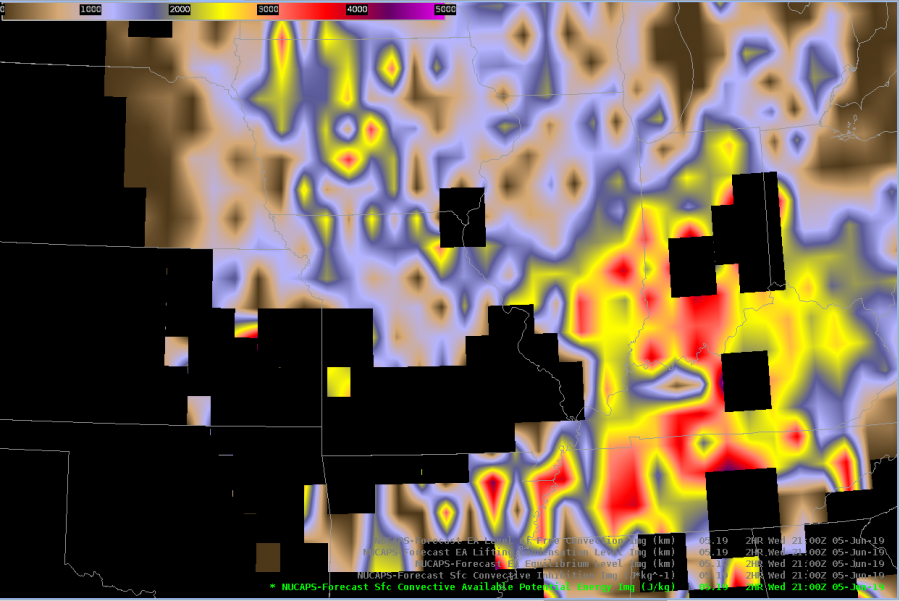
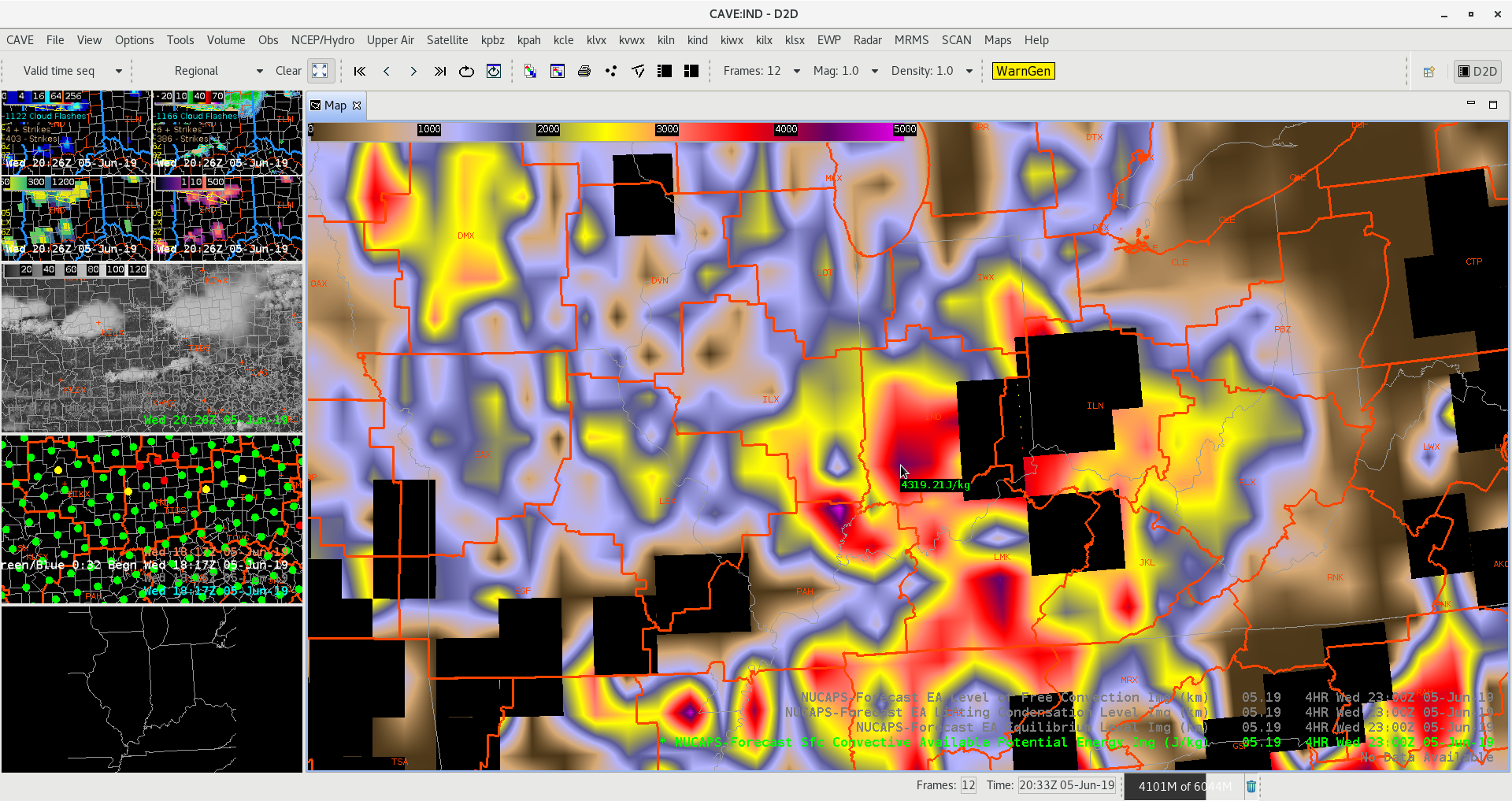
The forecast NUCAPS CAPE does not show much to the south of our line…and based on clear skies and warm conditions to the south would tend to lean away from this forecast.


Charley

Tags: None

Springfield Illinois Storms

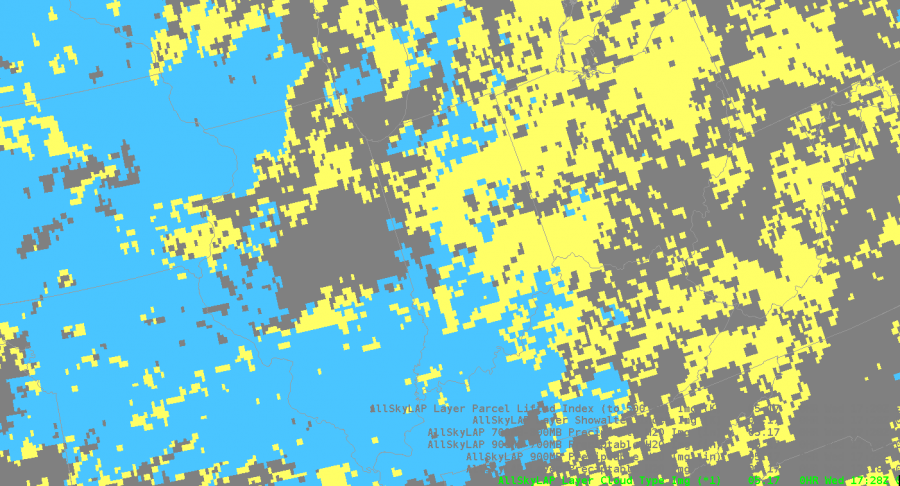
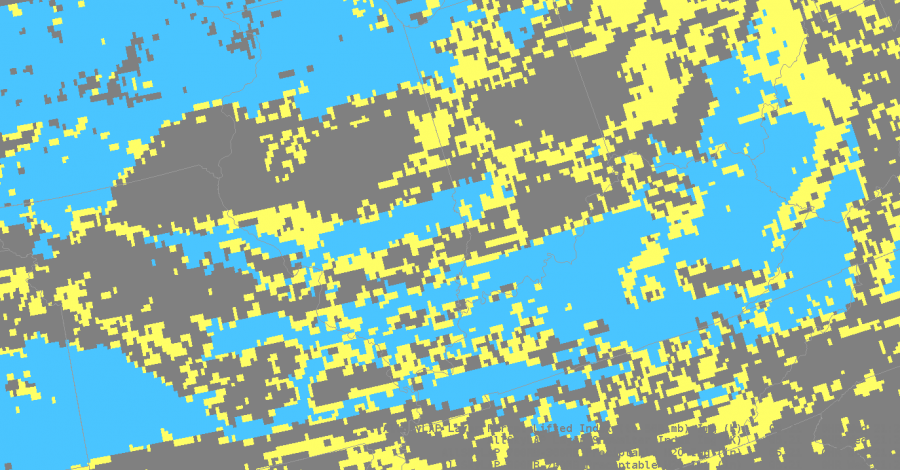
Right now I’m analyzing the various new products to nowcast where and when storms will intensify. Currently I’m comparing ALLsky cape to the mesoanalysis from the spc. Right now the mesoanalysis is higher with cape compared to allsky. Over our area the it’s cloudy so the it’s taking data from the GFS.

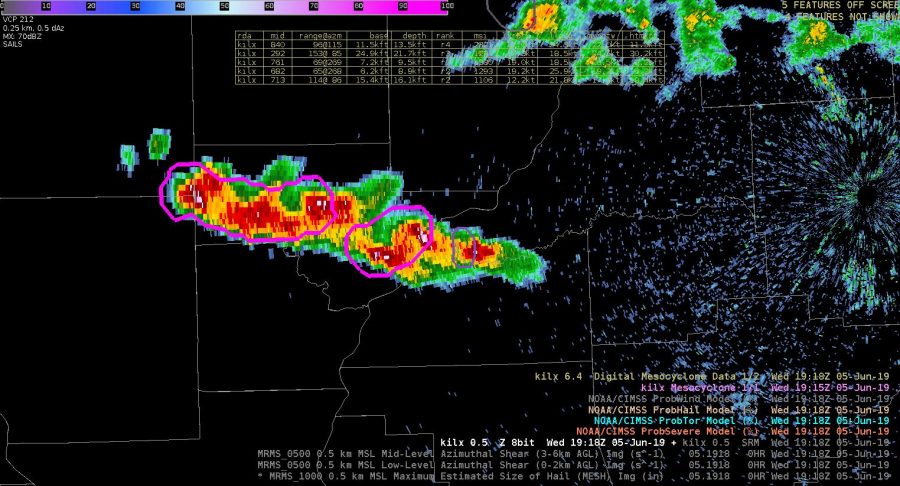
A cell in our western counties ramped up very quickly while our computers were down. Prob severe immediately directed our eye to the cell. The probsevere lined  up with an uptick in vil values and velocity.
I’m comparing the actual sounding to what’s shown on nucaps, and allsky to see what’s initializing the best. The actual sounding shows 3025kj of surface lavyer cape and 1453 of mixed layer.
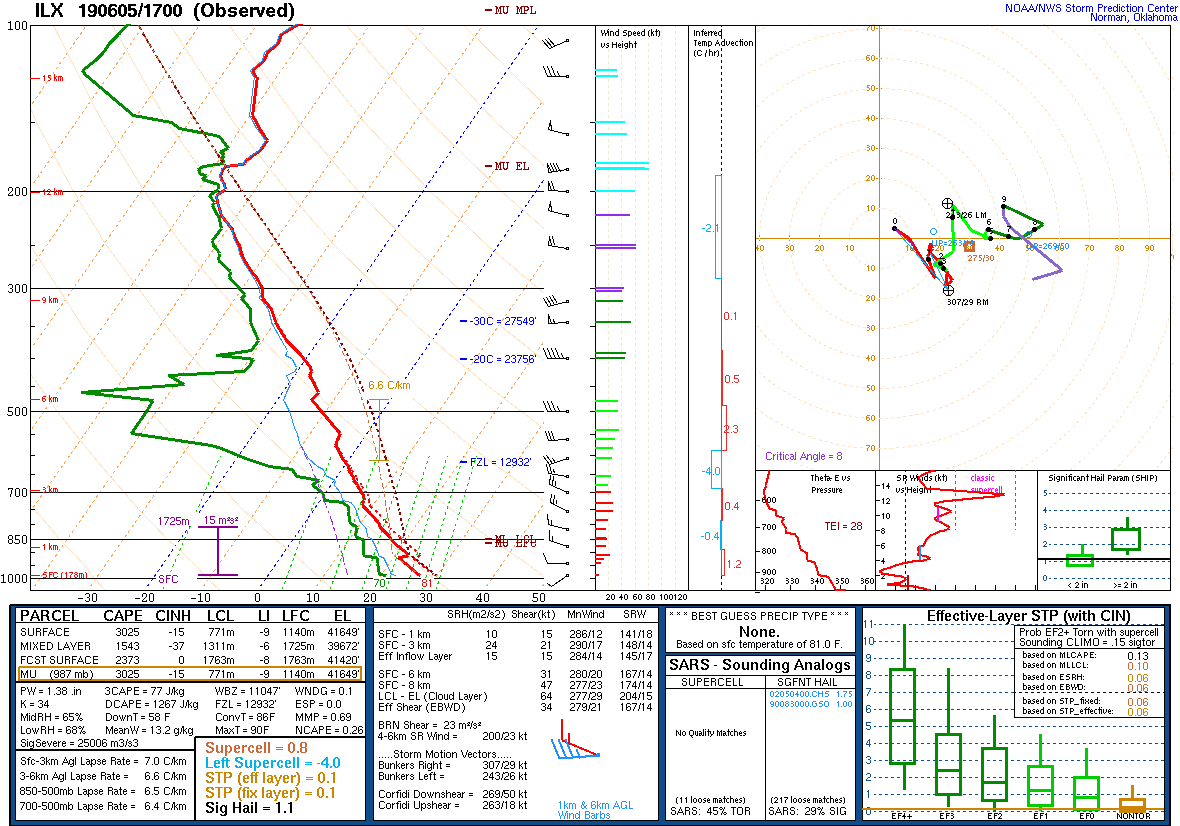
Around the same time allsky shows a similar value of cape.

The modified sounding was closest to the actual sounding with 1515kj of mixed layer cape
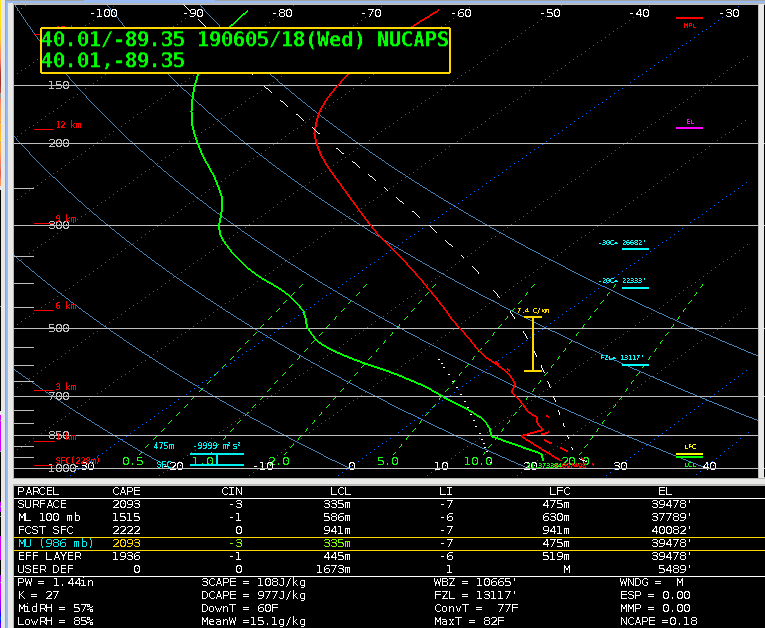
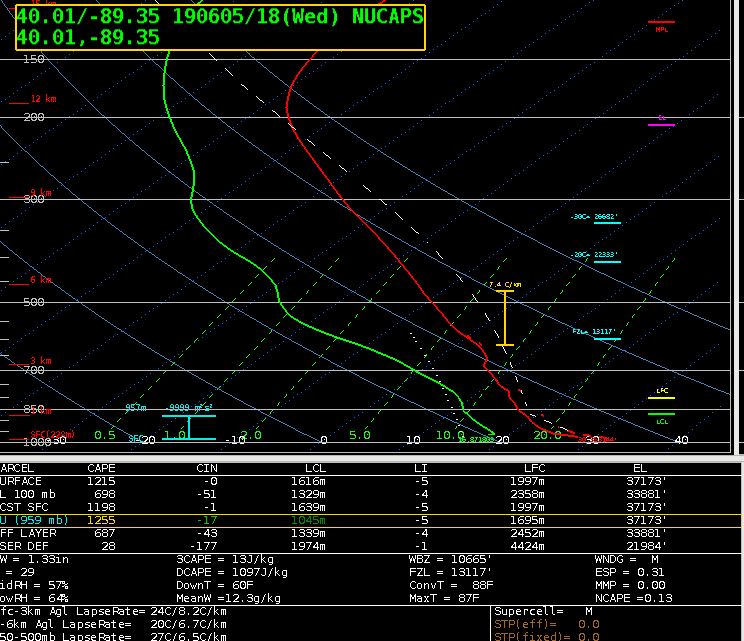
The nonmodified sounding is much lower when it comes to mixed layer and surface cape. In the case the modified sounding was more reliable and gave a more accurate picture of the current state of the atmosphere.
The all sky cape was much higher, around 2300kj.
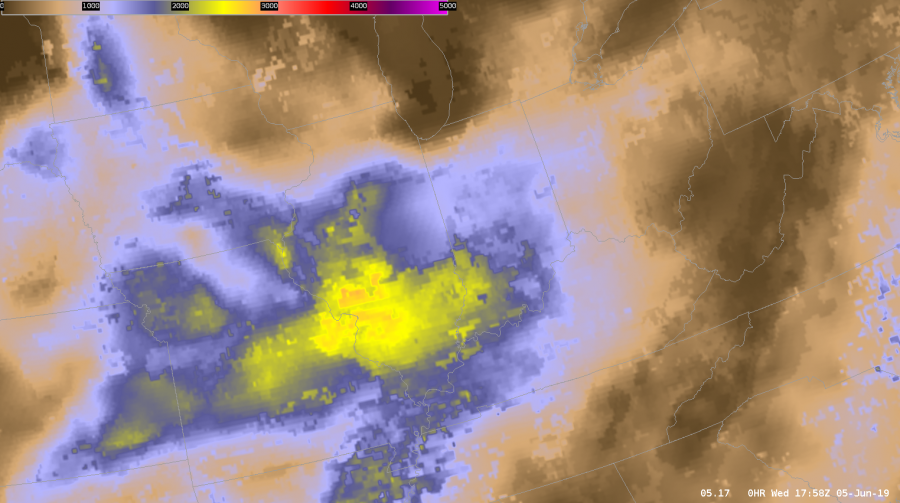
That increase might be due to the fact that the sampled area of interest was filled in by the GFS. Whatever input the GFS was taking into might have lead to it overestimating the amount of CAPE.
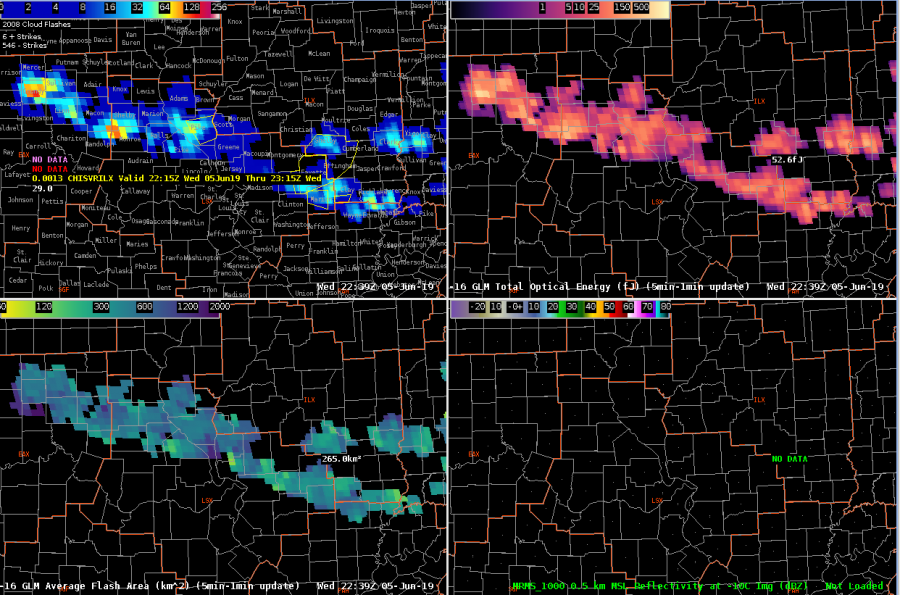
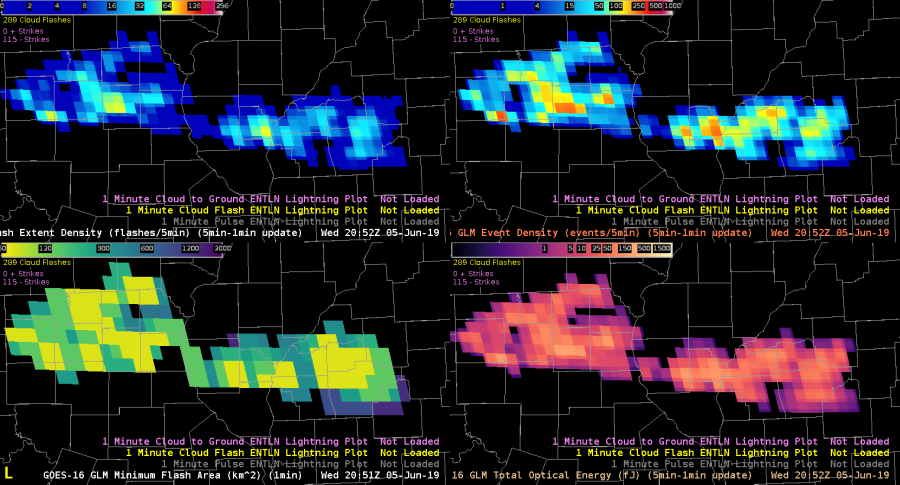
I’m also looking at GLM products to see trends with convection. The combination of event density and GLM minimum flash area help me to see the rapidly growing updrafts as well as cell that are producing hail. That’s the case right now. My warned cell is producing penny size hail.
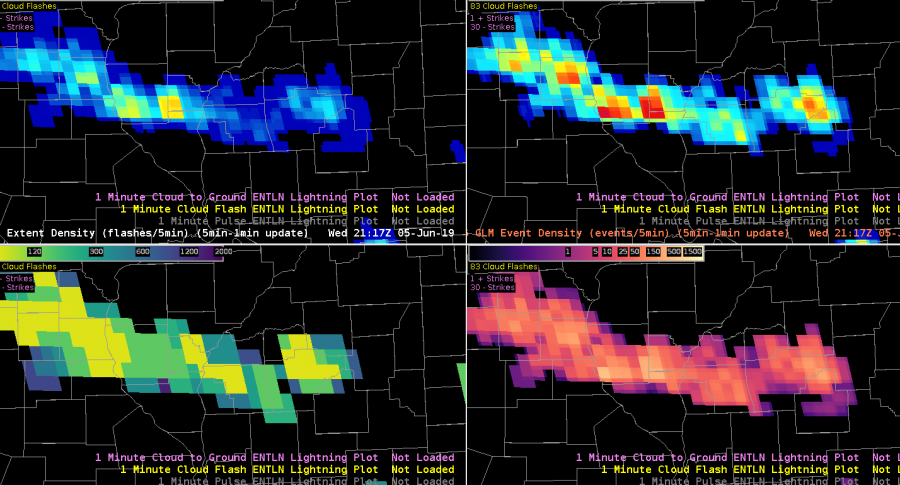
About an hour later the FED Is starting to pick up on longer flashes, but the event density is still showing higher values. The lines up with satellite which shows overshooting tops, but storms are overall keeping their intensity. The overall trend combined with looking at stability indices aids me in nowcasting that storms will at least maintain their strength over the next hour or so.
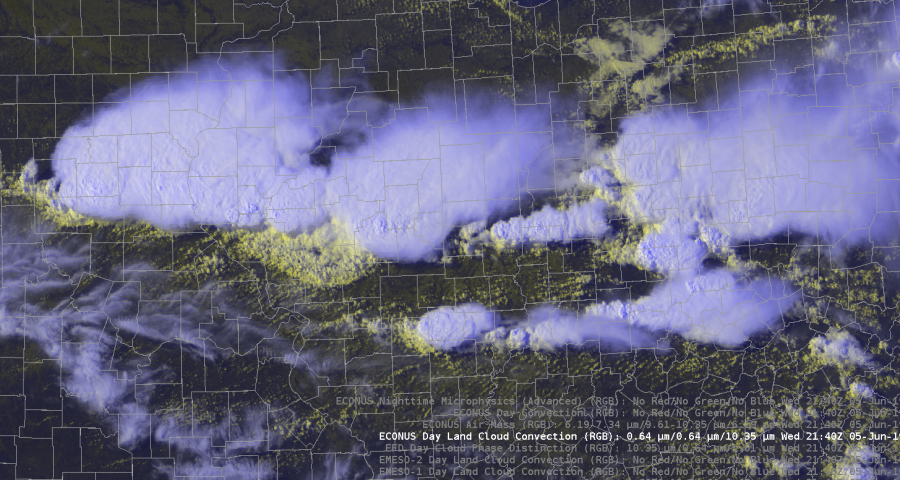
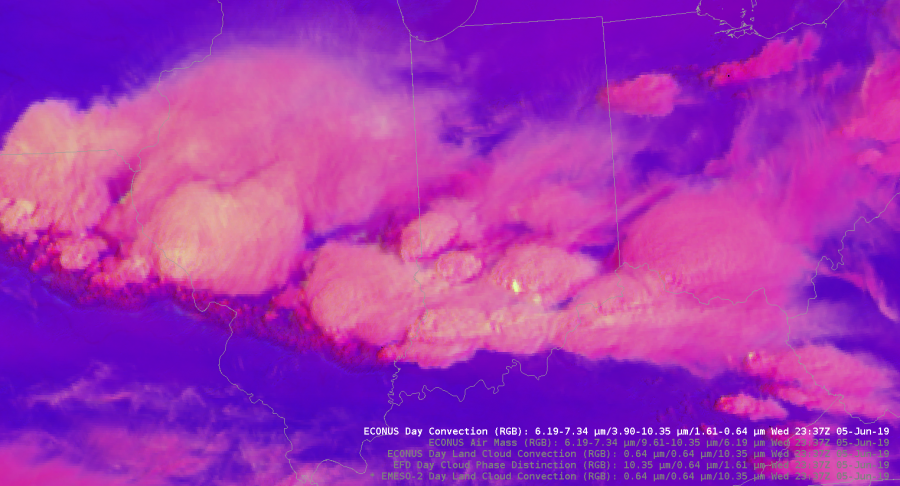
The Day Land Cloud convection RGB was helpful in analyzing different cloud tops. The color scale highlighted the thin cirrus compared to the lower thick clouds. It also dipicted the outflow boundary from our southern storms very well. It gives much more detail to the cloud types compared to the visible satellite.
Today I also got the chance to analyze and compare the merged TPW precipital water with the allsky.

During the afternoon the PW values stayed fairly steady across the northern half of the state while moisture increased in southern Illinois.
The TPW decreased PWATS to close to 1 inch as storms moved through. T
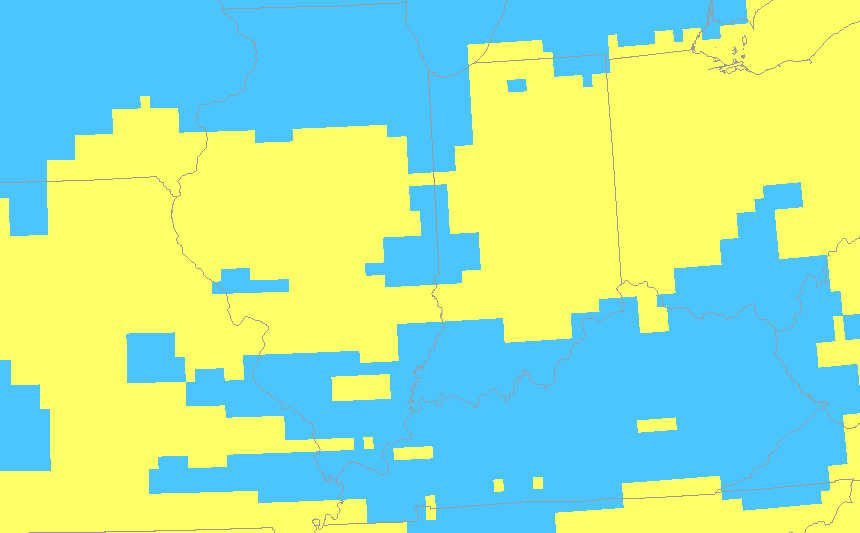
That data was sampled in a cloudy environment.
Meanwhile, the AllSky does show a decrease in PWATS but’s farther north compared to what actually happened. That data was pulled from the GFS since it was in a cloudy location. It was helpful to see how each product performed in this environment. It’s nice to have access to both in order to see which one has the best handle of the current atmosphere. That initialization helps me monitor trends and nowcast.
As storms moved south out of my DMA I used Day convection RGB just to monitor growing cells. It was clear to see the strongest storms because they had the bright yellow maxes.
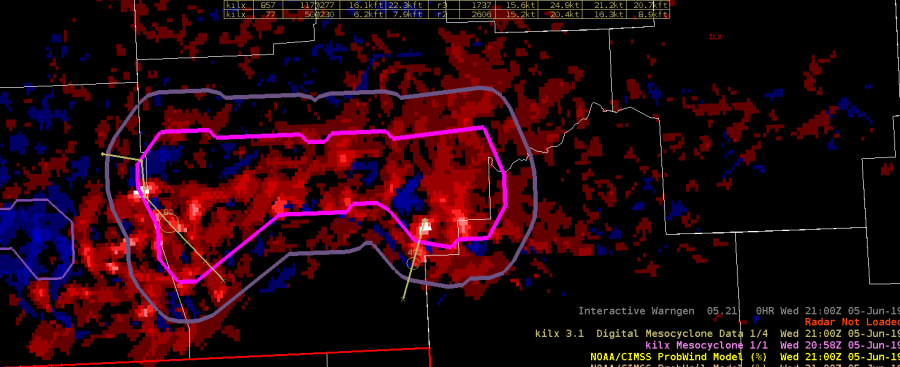
Earlier in the day was able to compare NMDA with the low level azshear. Tornadoes were’t a major threat, but the NMDA did line up with peak areas of Azshear. That storm did produce wind damage, and strong wind gusts.
Taylor Johnson.