ProbSevere vs ENTLN Time Series

Here is a good example showing the similarities in trends of ProbSevere, ENTLN total lightning data, and radar data. At 1908 UTC, lightning flash rates neared a peak and ProbSevere was ~50%. At  1919 UTC, the lightning flash rates had dropped significantly as did ProbSevere. By 1925 UTC ProbSevere quickly increased to ~75% at the same time that lightning flash rates were rapidly increasing. Finally, by 1945 UTC, ProbSevere decreased to 9% and lightning flash rates plummeted. Soon after this the storm dissipated. These types of products could help forecasters “hold onto” or “let go” of a warning sooner.

ENTLN Time Series
ENTLN Time Series
1908 UTC
1908 UTC
1920 UTC
1919 UTC
1925 UTC
1925 UTC
probsevere-18
1946 UTC

Ertel

Tags: None

ENTLN last frame can be misleading…

Depending on when you look at the last frame of the gridded lightning data you might not get the whole picture. The two screen captures below show this. One of the screen captures was taken at 1924 UTC, but if you look at the legend, the gridded lightning data says 1925 UTC. However, there are only 4 minutes of lightning data going into the 5 minute lightning product.  The next image was taken at 1925 UTC and includes the whole 5 minutes of lightning data. As you might expect, there is more lightning when it includes the whole time frame. If a forecaster was not aware of this, it might appear as though the storm is weakening when in reality it is just an artifact of how the product is generated. I would suggest waiting until the full time period is over before displaying the product…which would make analyzing trends much easier!

ENInotComplete
5 min gridded data with only 4 minutes of data
ENIComplete
5 min gridded lightning data that has a whole 5 minute period worth of data

Ertel

Tags: None

Day 1-Svr Prob Example

Hello everyone! This is day one of Week 2 of the Experimental Warning Program and we are getting situated and learning the products and making procedures. I personally was excited to try out the ProbSvr model as I think it could help with storms that pulse and that become severe or near severe within a scan or two- this is extremely useful in the northeast and even in squall line situations. While looking at it today in LMK’s area, we got a report of power lines down and I captured some of the ProbSvr data and I found it very interesting. I’ll step through the times.

1818z- This is as the northern storm was strengthening and the ProbSvr is hinting about 24%.

1818z

Next, at 1823Z, the ProbSvr bumped up to 61%

1823p

At 1825Z, the next scan, the 61% is still there (probably the same run).

1825_61percent

At 1829, the ProbSvr has decreased once again.

1829Z


Although I didn’t put velocity here, it isn’t overly impressive. Important to note is the rear inflow notch that looks like it is trying to develop.

At 1830z, the office received a report of power lines down with this northern storm.

In the training on ProbSvr, the examples were giving huge lead times when the model went above 50% but this isn’t always the case. I found this case interesting because it only gave about a 7 minute “lead time” before the first event. It looks like the storm surged/pulsed right at that time but noticed how the model surged back down before the event. How does a forecaster handle this? When it surges up and goes right back down? Would it change my warning process if it decreased next scan? It is still too early to say what the implication is but I will definitely be keeping an eye on these probabilities as I go forward!


Lauren13

Tags: None

Best Practices for the use of the NOAA/CIMSS ProbSevere Model

The NOAA/CIMSS ProbSevere Model is an excellent tool for situational awareness–especially in situations with widespread convection. The tool essentially allows for a quick all-tilts view without looking at all the radar tilts because it integrates data from the entire radar volume (and assimilates other non-radar data as well). For example, overlaying the tool on the lowest radar elevation (e.g., 0.5 degrees), you can monitor trends and areas of interest by the rate of change of the probability of severe. Rapidly increasing probability of severe gives the warning forecaster insight that the storm is rapidly intensifying aloft. At this point, a forecaster can do further interrogation on the storm of interest.

Here’s an example where there is widespread convection in southeast Texas:

Probsevere-1 Probsevere-2 Probsevere-3Probsevere-4Note the probability of severe rapidly increases (10% to 86% in 8 minutes on one storm) across the western storms. This immediately signals to the warning forecaster that these storms need further interrogation and are the storms of interest.

Polarimetric Researcher

Tags: None

Default color scale of gridded lightning data

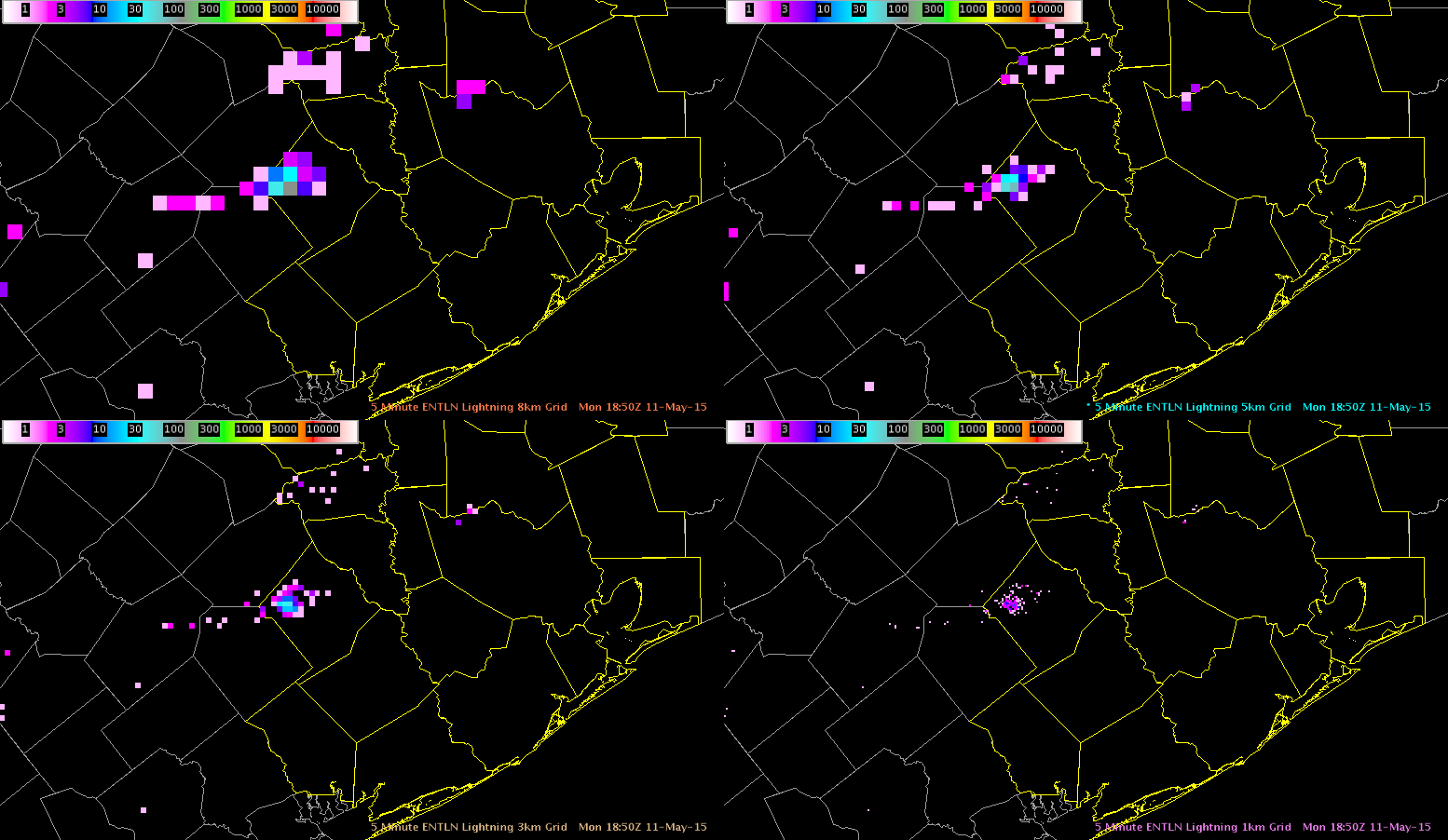
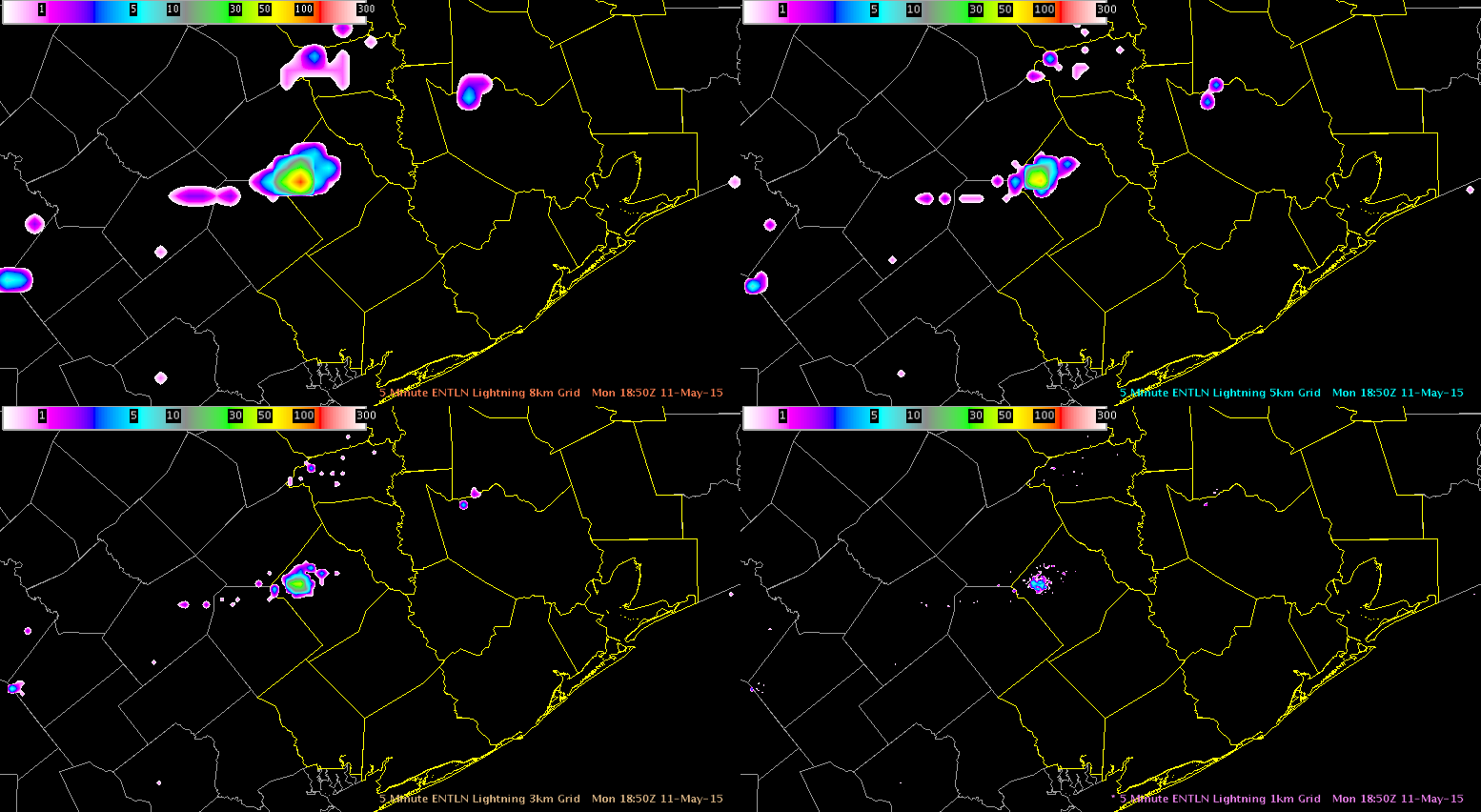
The default color scale for gridded lightning data is not very useful…as it goes all the way to 30,000 flashes. This is pretty unreasonable even for the most electrically active storm. Shown here is the 5 min total lightning data for the ENTLN gridded data at 8 km, 5 km, 3 km, and 1 km using the default color scale (with 30000 as the upper limit) and another image showing a more reasonable color scale (with 300 as the upper limit). Clearly, analysis is far easier using the adjusted color scale as the finer scale details are much easier to see. I also find that interpolating the gridded data makes visualization far easier.

ENI-Gridded-default-colorTable
Default color scale (max at 30000)
ENI-Gridded-adjusted-colorTable
Adjusted Color Scale (max at 300)

Ertel

Tags: None

EWP Week 1 Summary (May 4-7, 2015)

During the first week of the 2015 EWP Spring Experiment, we had forecasters from the Newport, Columbia, Roanoke, Marquette, and San Diego WFO’s, as well as a broadcast meteorologist from KETV Omaha, NE participate in the Spring Warning Project. With most of the active weather confined to the Southern Plains throughout the week, our CWA’s of operations included: Topeka, Omaha, Wichita, Midland, Lubbock, Amarillo, Albuquerque, San Angelo, Norman and Hastings. We had a good mix of marginal and very busy severe weather days, with Wednesday being the most active weather day as severe weather broke out across central Oklahoma.

Participants were able to use all of the demonstration products this week, which included GOES-R and ENI total lightning products. There were many good blog posts written throughout the week highlighting the use of all of these products in various forecast/nowcast/warning situations. Below is some end-of-the-week feedback on each product from this weeks participants:

PGLM

– It was useful yesterday in the Lubbock CWA.
– I have a marine responsibility in my CWA, so the lightning data would be useful for issuing sub-severe forecast products for storms moving towards the coast.
– This lightning information would be useful in my CWA on days when the fire danger is heightened.

Lightning Jump

– I was not so sure if a 1 or 2 sigma jump was significant, or if I should wait for a 5 or 6 jump.
– At one point when things were active, I was ignoring the 1 sigma jumps. The 4 and 5 sigma jumps really drew my attention.
– 3-sigma was when I really started paying attention to the storm.
– 1-sigma is probably not even worth a color, I made it transparent.

ProbSevere

– It did a good job with discrete cells, but when the mode became more linear, it suffered
– It really drew my attentions to the storms that I should interrogate further
– For me, MESH in the readout does not need to read to hundredths of an inch.
– Color/highlight values in the text display as they become more significant. Make the actual probability stand out more too.
– For the color contour, I made it neon on the higher end, and got rid of the lower end. The low end looked almost the same as the higher end.

CI

– Overall it did a pretty good job throughout the week of highlighting where CI would occur
– It really works best in a clear environment (no cirrus contamination)
– When you had a cu field developing, it did a nice job of depicting where stuff would go
– I liked using it when we had a lot of boundaries, it did a good job of depicting where along the boundaries stuff would go. Especially today when there were a lot of different boundaries in play, it gave me confidence where convection would develop and where I should look.
– Having a higher threshold for CI would be more relevant in WFO operations, and less messy
– With the colortable, the lowest probs (deep blues) stood out the most, which is not what you want to see. The higher end colors against the light background were more difficult to see. Reduce the appearance of the lower probs make the higher probs stand out more.
– Perhaps you could start out with white to light gray at the low end, and transition to colors at the higher end.

GOES-R LAP
– I use the GOES PW field the most
– I would like to know what data are from the retrievals and what are from the GFS.
– The pixelation in certain areas was an issue, with sharp, unnatural transitions present between adjacent values.

NUCAPS

– It might be a good idea to merge this product with something like LAPS to improve the lower levels.
– I want to set this up as soon as I return to my office.
– I can see myself using this a lot in the winter.
– I esepcially like the observation-based nature of it
– I would like to look at this over Lake Superiror
– Anything that gives us a temperature profile will be helpful, especially in the winter.
– In San Diego, it will benefit us during the summer monsoon. Also, the San Diego RAOB is not representative of the mountains in our CWA
– QC flags would give me more confidence in the soundings, as it is difficult to judge with just the cloud data.
– The RAOBS in my area are not representative of most of my counties, so I often use forecast soundings.

– Bill Line, Week 1 EWP Coordinator and SPC/HWT Satellite Liaison


Tags: None

Daily Summary: Week 1, Day 4

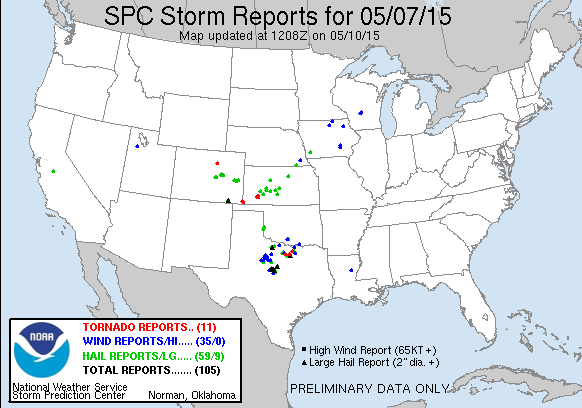
Today’s operations were in the Norman, Amarillo and Lubbock CWA’s. Compared to yesterday, it was a much quieter day, and convection took a little longer to get going. This allowed forecasters more opportunity to evaluate environmental analysis tools such as the GOES-R LAP algorithm and JPSS NUCAPS soundings. The GOES-R CI algorithm was also utilized by participants in the pre-convective environment. The Lubbock pair had the opportunity to evaluate the PGLM total lightning, especially late in the day when convective activity amped up in intensity and coverage. With the Frederick, OK radar down for most of the day, the Norman group had increased reliance on the Earth Networks lightning tools.

Tomorrow we will have our weekly debrief, and participants will complete their end of the week surveys and present the Tales from the Testbed webinar.

150507_rpts

– Bill Line, SPC/HWT Satellite Liaison and Week 1 EWP Coordinator

Tags: None

Convective Initiation and Radar

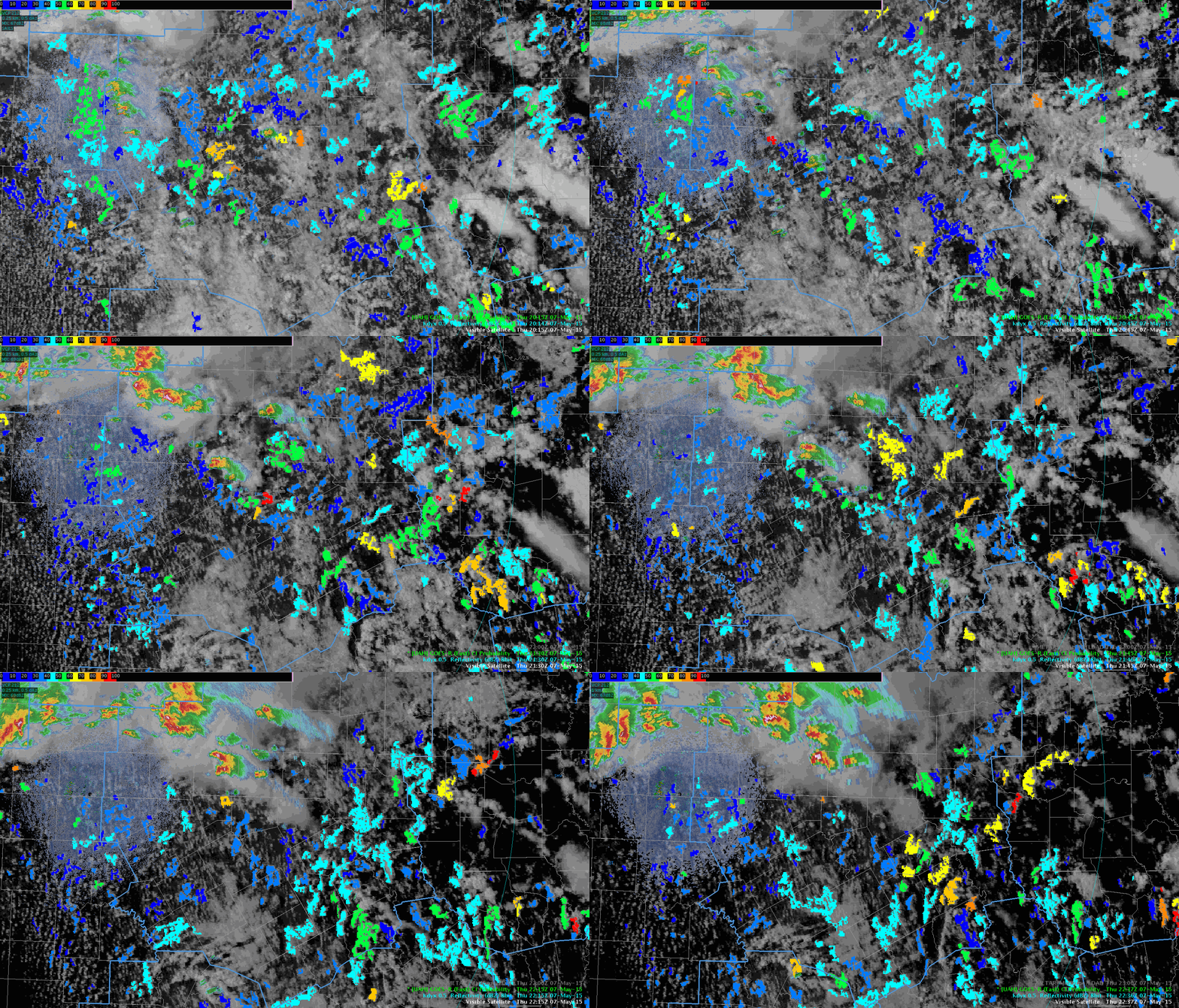
With the OUN cwa quieting down, decided to take a look at how the convective initiation product was working this afternoon. The animated image below (click to view), highlights a couple areas (both in the center and upper left of the image) where the CI algorithm picked up on the development of showers and thunderstorm. Meanwhile, in the upper right hand part of the image, there were several instances where the CI algorithm showed probabilities over 60% and nothing developed as of 2245Z.

20150507_2237Z_CI_Animation_Radar-SRF

Tags: None

Lightning Data Prompts SVS

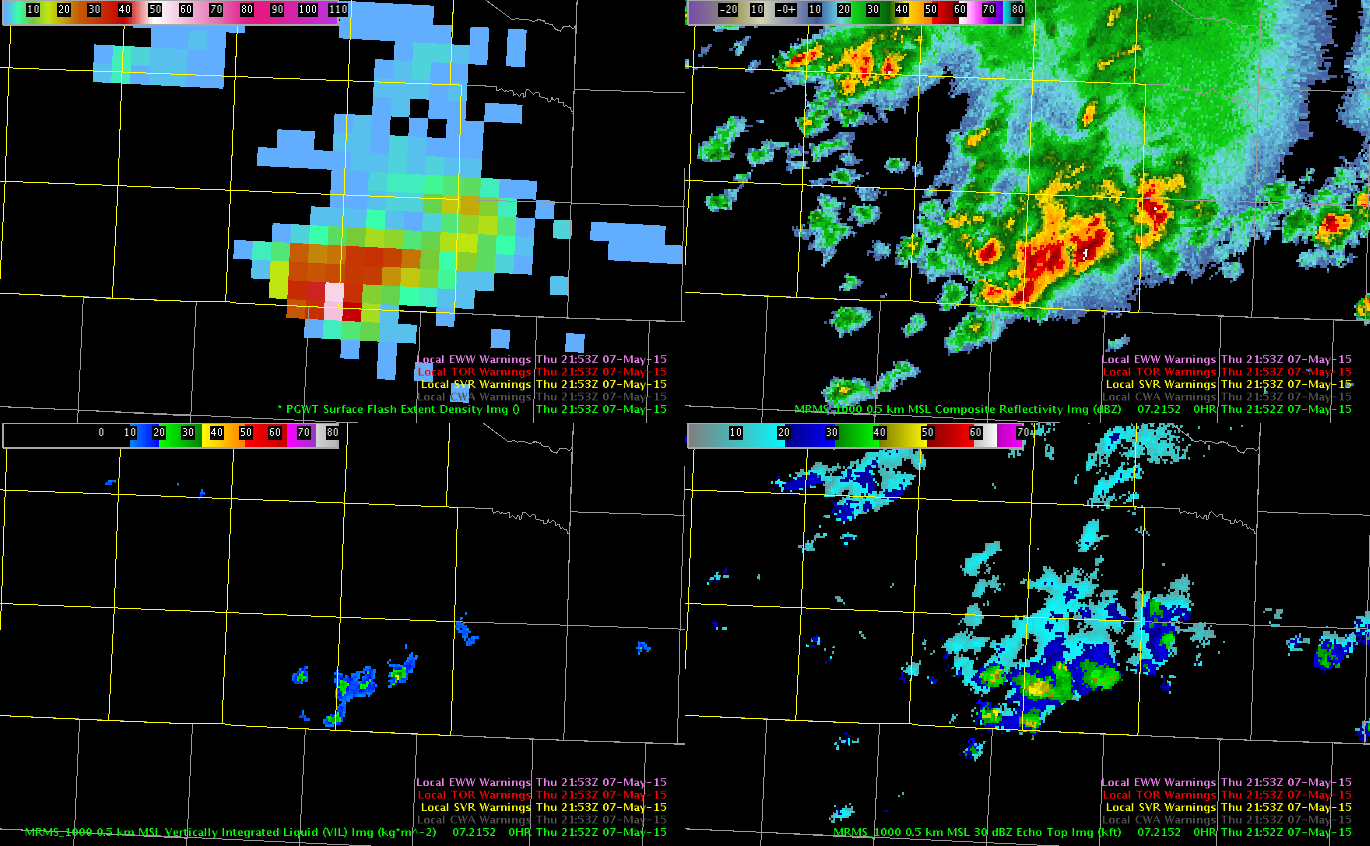
LBB remains a convective mess. Overall storms have been sub-severe. The flash extent density for a cluster of storms in the extreme SE portion of the CWA caught  my eye.

KLBB pGLM 2153ZThe two light pink pixels were around 56-57 (50 being the general minimum for severe storms) at 2153Z.

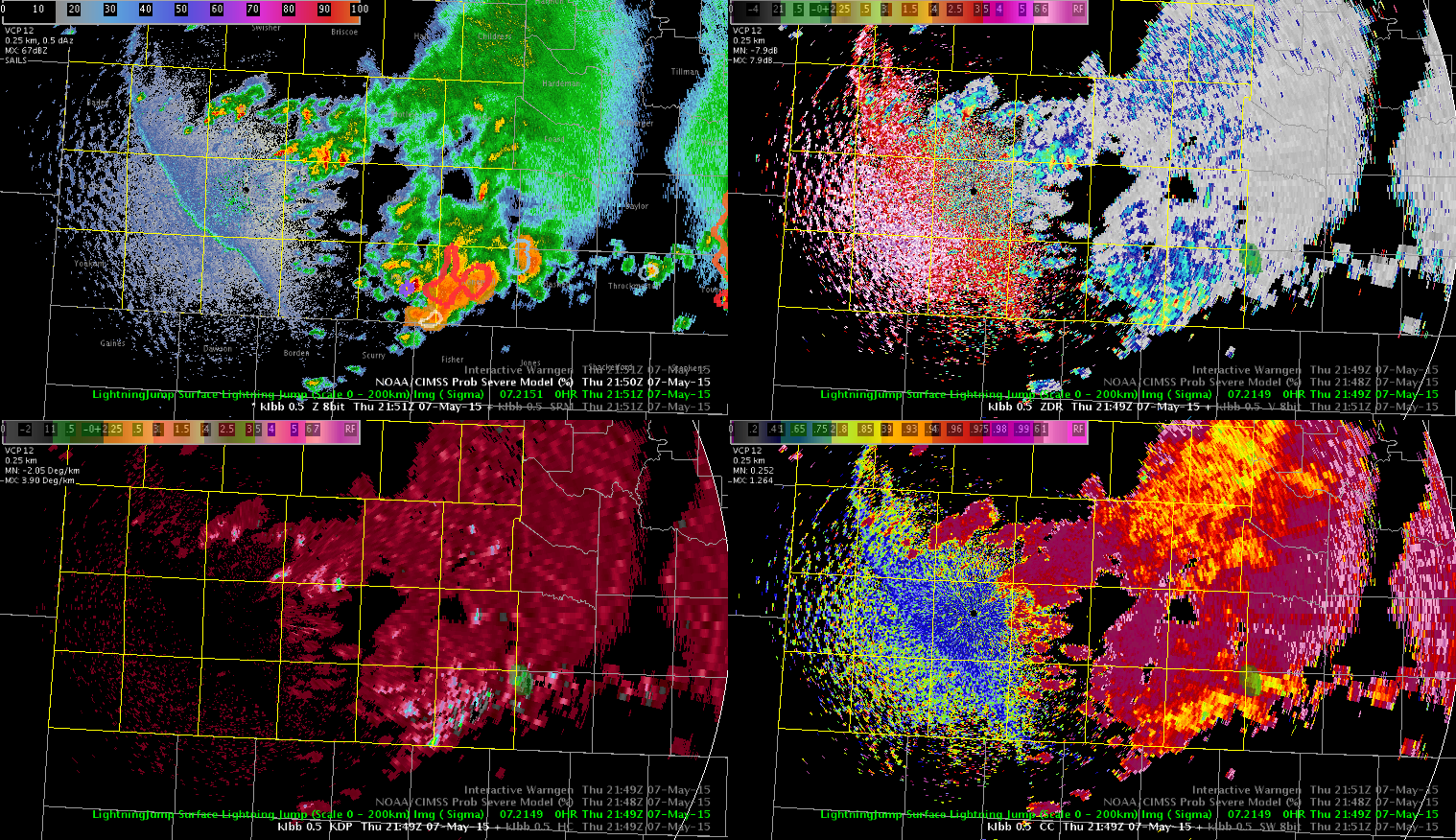
Looking at the other guidance we could use today, there was a 3 sigma lightning jump and a prob severe of 90% at 2149Z.

KLBB prob severe 2149ZI went ahead and issued the warning based on the lightning and prob severe guidance, despite the storms not looking overly impressive on radar. As has been the case the rest of the day across our area, there have been no storm reports.

-V. Darkbloom

Tags: None

ENI Cell Track Information

I haven’t really used the ENI cell track information much today but over the last hour I have started to pay more attention to it and I believe that it may be useful for larger and/or longer lived storms such as supercells.  However, I think it could be more of a problem or less effective in a typical weakly sheared pulse thunderstorm environment which is common in the southeastern US during much of the warm season.  It would be interesting to see how this performs in that type of environment.

CellTrackinfo

Jack Bauer

Tags: None