An official website of the United States government
Here’s how you know
Official websites use .gov A
.gov website belongs to an official government
organization in the United States.
Secure .gov websites use HTTPS A
lock (
) or https:// means you’ve safely connected to
the .gov website. Share sensitive information only on official,
secure websites.
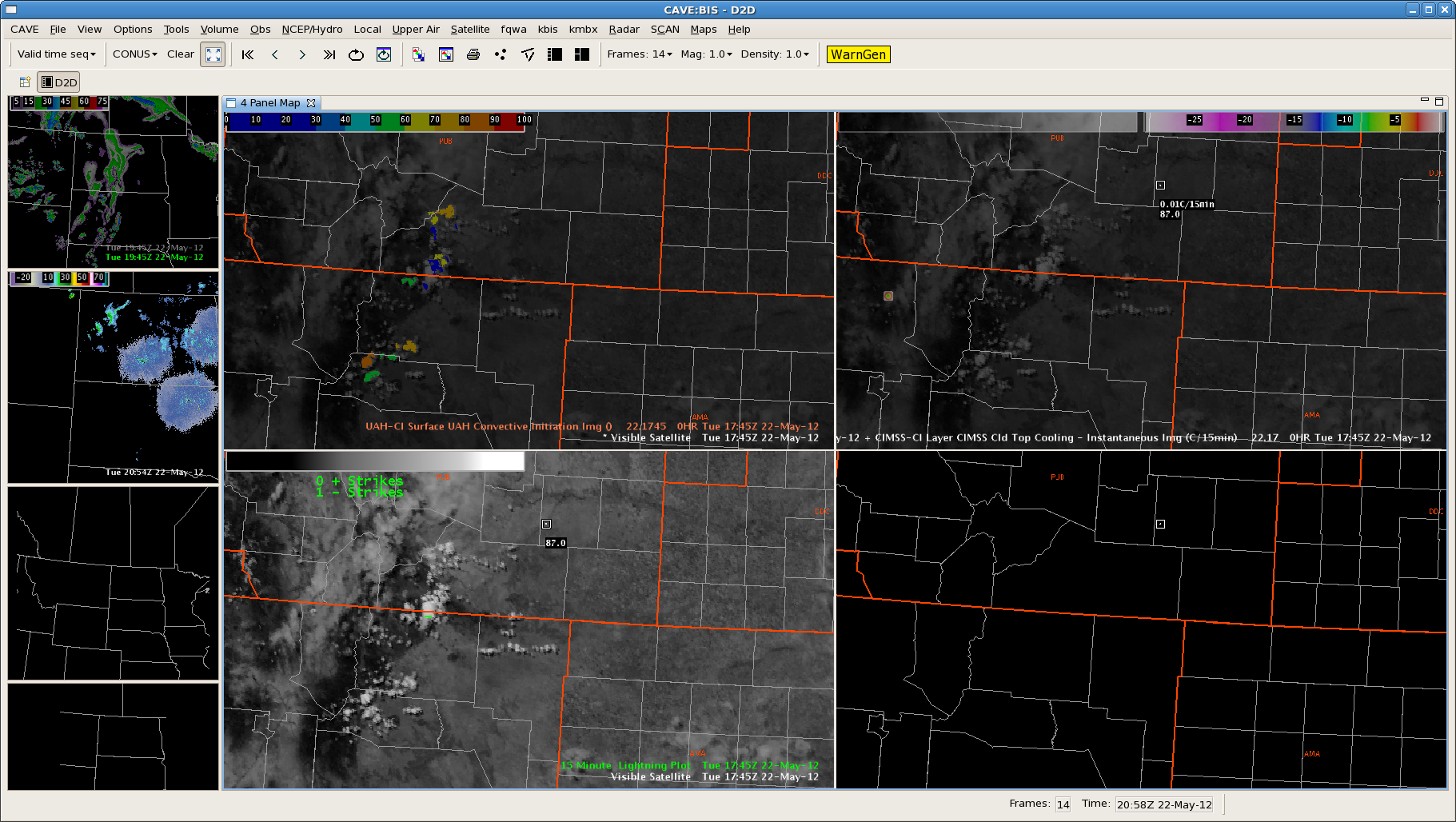
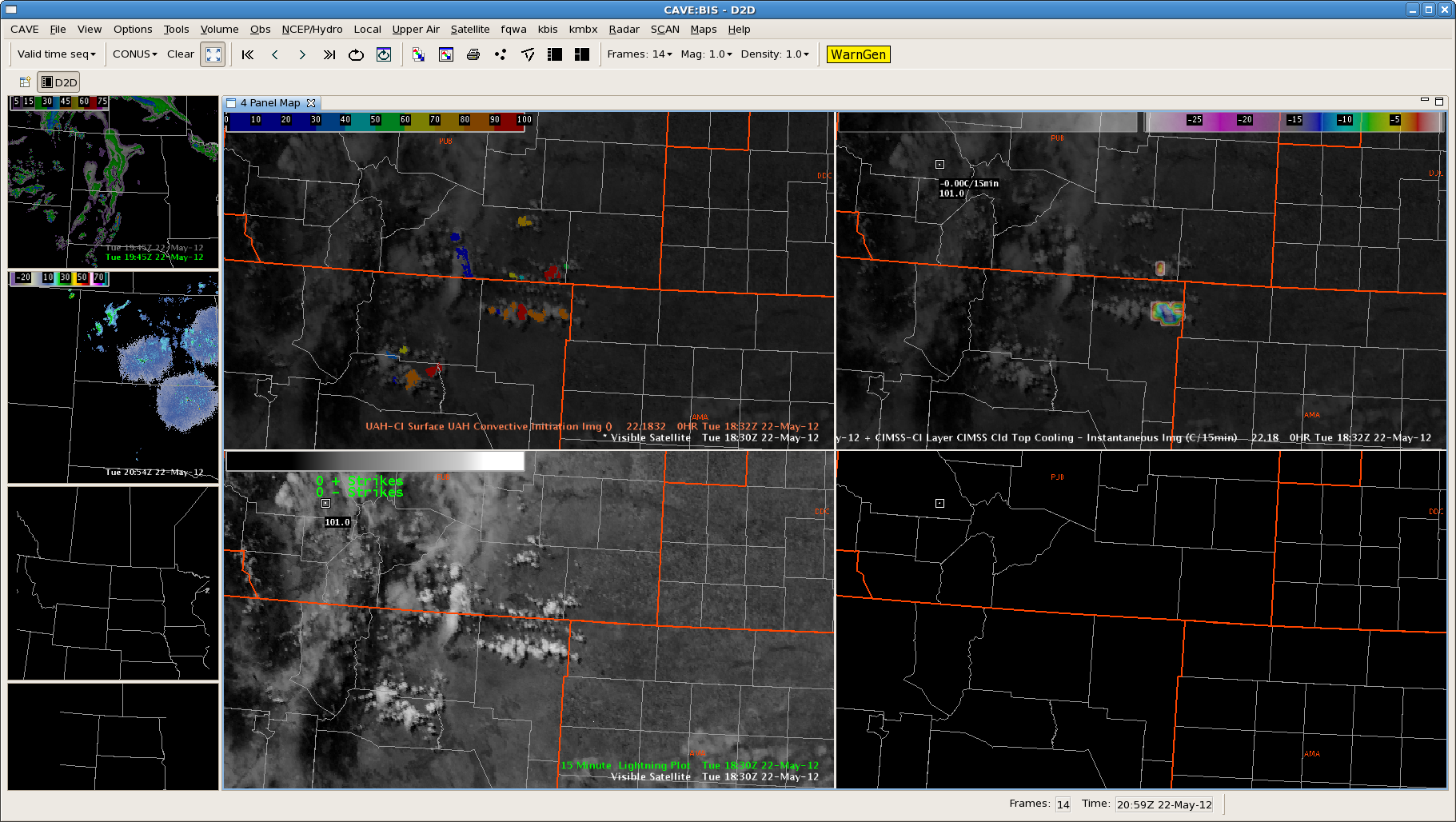
1745z image indicates developing cumulus over extreme northeast NM. In the 1830z image, UAH-CI product indicates a cluster of cumulus with a high confidence of convectively initiating. UW-CTC product also indicates rapid cloud-top cooling with the eastern-most convective element. Given the deeply mixed airmass with minimal cap, this would lend confidence to convective initiation soon. Sure enough, by 1915z the 15-minute lightning plot indicates some CG strikes with the eastern-most convective element, with a lead time to convective initiation of over one hour.
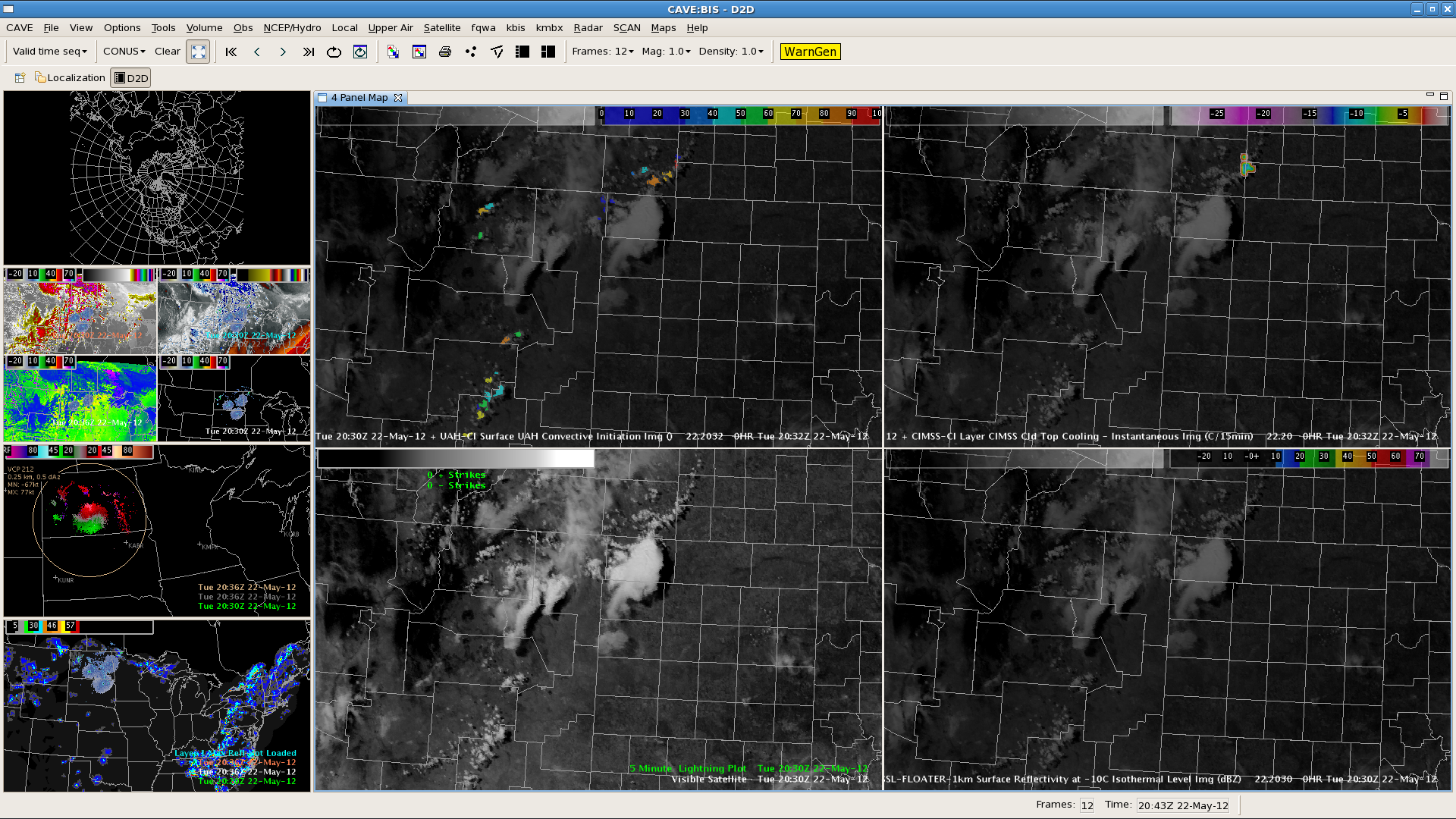
We watched a slowly SE-ward progressing outflow boundary with initiation already underway over far W-OK Panhandle. Northward building of deep convection is closely monitored as CI product indicates high potential with cloud top cooling around -11K/15 min present. Deep and well mixed profiles east of that boundary hint at enhanced downburst / isolated large hail potential as storms also enter a favorable air mass with MLCAPE AOA 2000 J/kg. Shear remains too weak but modest veering present, so a few better organized multicells are possible. Capture was done at 2032Z.
First signals seen in reflectivity fields in the area of interest about 20 min later (2052 Z), which gave a good lead time.
5/22 00z NSSL WRF simulated IR & WV imagery (upper two panels) indicate deep moist convection initiating by 22z over west-central ND, along a strong cold front and ahead of shortwave energy approaching from the west/southwest. This may be a tad optimistic given dense cirrus over the region, although the moderate/strong forcing may be able to compensate for this. Additionally, despite some subtle differences, 20z simulated satellite (20 hour forecast) is very representative of realtime GOES IR/WV (bottom two panels), with regard to shortwave placement and magnitude, and overall spirit of dense high level clouds over the region.
Focus for operations is over the Dakotas for today. Initially, forecast teams were separated into the Bismark and Grand Forks CWA’s, but with delay of any CI, we quickly decided to re-localize the FGF team to Aberdeen, SD.
The HRRR remains quite aggressive at initiating convection across both ND & SD as well as Montana by 2030-2100 UTC, though lessening in strength and coverage with each run (earlier runs developed a strong line of storms and it has moved to smaller, more isolated, cells in recent runs). Almost all the high-res models had similar solutions thought, and initially working off of the NSSL-WRF from last night convection was first expected by 2100 UTC.
The low pressure in ND with corresponding warm front extending across the ND / Canada border still holds promise. Steep lapse rates, combined with low-level curvature in the hodograph point to supercells with large hail (and isolated tornadoes) if and when storms finally develop…
In the meantime, thick cirrus coverage is preventing the UW-CIMSS Cloud-top-cooling and UAH-Convective Initiation algorithms from flagging any development across the majority of ND. But the CTC does seem to be flagging development in Montana…
Cloud-top-cooling ove Montana at 2025 UTC.SPC day 1 outlook for 22 May 2012. 2-5% tor, 15-30% wind, 15-30% hail (hatched) for the ND/SD region under the slight risk.
Currently, it appears that we will be operating in the North Dakota region tomorrow…
Early on, the cap combined with a narrow area of boundary layer moisture (50-60F dewpoints) seem to be a bit of a concern, but forcing associated with a cold front later in the evening should assure convection. If initiation can occur earlier in the day ahead of the front and along the dryline, shear profiles indicate supercells with large hail will be the most likely mode of convection before transitioning to a line/MCS by the overnight hours.
With the concerns limiting convection earlier in the day, we’ve elected to go with 2-10 pm shift Tues.
SVR issued for Oldham county. 3- body scatter spike evident. MRMS MESH showed 2.20 inches. Areas of strong SRMs have been disorganized so far. Updraft helicity near 200 m/s^2. Quarter sized hail reported.
Thunderstorm cold pools over far eastern NM appear to be consolidating into a forward propagating MCS between 00-01z on 5/22. This was advertised fairly well by the OUNWRF earlier this afternoon.
Per regional radar loop, MCS over far eastern NM appears to be developing on MCV. Latest 5/22 00z OUNWRF is picking up on this, and continues the MCS/MCV well into the evening southeast through LUB CWA.
A rotating wall cloud/small funnel cloud was reported at 22:22z with the storm over southern Colfax county. Fifteen-minutes prior to report the following parameters increased somewhat dramatically: max divergence above 8 km (upper right), composite max updraft speed (lower right), and mid-level vorticity (lower left). Attached is the 2215z image, about 7 minutes prior to the report.
Recall WFO Amarillo’s prior post referring to the OUNWRF’s convective initiation in the SW parts of the CWA by around 2130Z? Let’s take a look at what actually happened.
4-panel Reflectivity from KAMA at 2205Z. A few weak showers have developed in the SW, but overall convective development has been slow and weak.
Looks like the OUNWRF was a bit too quick to develop convection over WFO AMA. We did see some very weak Cloud Top Cooling (CTC) on the order of nearly ~4C/15min near the Oldham/Deaf Smith county line for a brief period but this diminished quickly. Notice that the UAH Convective Initiation (CI) in the top left panel showed that the potential for development was elsewhere. Note…these initial showers which triggered the weak CTC rates weakened pretty rapidly.
UAH CI (top left panel) and CIMSS CTC (top right panel) at 2145Z. The CTC indicated was very weak and the showers weakened quickly.
It appears the OUNWRF may have been a bit too bullish on convective development ahead of the activity moving out of New Mexico in the NW flow aloft this evening, but stay tuned.–Gordon Strassberg/Matt Hirsch–WFO Amarillo Team.