Starting This Monday – ENTLN Experiment (Week 3)

Monday 4 August 2014 begins the third week of our Earth Networks Total Lightning Network (ENTLN) Experiment.  This experiment is a part of the 2014 NSSL-NWS Experimental Warning Program (EWP2014).

NOAA National Weather Service (NWS) forecasters will test how lightning data impacts the warning process during convective events in the NOAA Hazardous Weather Testbed.  In particular, they will utilize Earth Networks’ “Dangerous Thunderstorm Alerts” – which may increase forecaster situational awareness and lead times – during a series of warning scenarios in displaced real time.  These events cover the gamut of atmospheric possibilities, ranging from marginally severe to significantly tornadic, and occur over a variety of locations.   The final outcome of this project is to make recommendations on possible product improvements, and determine whether Earth Networks products should become part of the operational product suites available to NWS offices nationally.  The ENTLN Experiment will be conducted in conjunction with Earth Networks and runs from 21 July to 29 August.

For the week of 4 – 8 August, our distinguished NWS guests will be Tom Lonka (Newport, NC),Sam Shamburger (WFO Nashville, TN), and Stephen Keighton (WFO Blacksburg, VA),  If you see these folks walking around the building, please welcome them!   The National Severe Storms Laboratory (via the Sandy Supplemental) has generously provided travel stipends for our participants.

Kristin Calhoun and Darrel Kingfield are the project coordinators.  Our support team also includes Matt ElliottTiffany MeyerDaphne LaDueLans RothfuszChris Karstens, Aaron Anderson, and Gabe Garfield.

You can learn more about the EWP here:

https://hwt.nssl.noaa.gov/

Gabe Garfield
CIMMS/NWS OUN

Tags: None

Starting This Monday – ENTLN Experiment (Week 2) and Hydro Experiment (Week 4)

Monday 25 July 2014 begins the second week of our Earth Networks Total Lightning Network (ENTLN) Experiment and the final week of our Multi-Radar / Multi-Sensor (MRMS) Hydrology Experiment (hereafter, “Hydro”).  Both experiments are a part of the 2014 NSSL-NWS Experimental Warning Program (EWP2014).

ENTLN Experiment:

 NOAA National Weather Service (NWS) forecasters will test how lightning data impacts the warning process during convective events in the NOAA Hazardous Weather Testbed.  In particular, they will utilize Earth Networks’ “Dangerous Thunderstorm Alerts” – which may increase forecaster situational awareness and lead times – during a series of warning scenarios in displaced real time.  These events cover the gamut of atmospheric possibilities, ranging from marginally severe to significantly tornadic, and occur over a variety of locations.   The final outcome of this project is to make recommendations on possible product improvements, and determine whether Earth Networks products should become part of the operational product suites available to NWS offices nationally.  The ENTLN Experiment will be conducted in conjunction with Earth Networks and runs from 21 July to 29 August.

Hydro Experiment:

National Weather Service and River Forecast Center forecasters will work with research scientists to assess emerging hydrometeorological concepts and products to improve the accuracy, timing, and specificity of flash flood watches and warnings.  In particular, forecasters will evaluate short-term predictive tools derived from MRMS quantitative precipitation estimates (QPE) and Flooded Locations and Simulated Hydrographs (FLASH) hydrologic modeling framework. The Hydro experiment will also explore the utility of experimental watch and warning products that convey uncertainty and magnitude while investigating human factors to determine operationally relevant best practices for the warning decision making process. Operational activities will take place during the week Monday through Friday.  The Hydro experiment will be conducted in conjunction with the Flash Flood and Intense Rainfall Experiment (FFaIR) at the Weather Prediction Center (WPC) and runs from 7 July to 1 August.

Guests:

For the week of 28 July – 1 August, our distinguished NWS guests will be Ray Christensen (Elko, NV), Tom Clemmons (WFO Flagstaff, AZ), Brandon Dunstan (WFO Raleigh, NC),  Chris Horne (WFO Greenville, SC), Jennifer Palucki (WFO Albuquerque, NM), Ryan Sharp (WFO Louisville, KY),  and Cathy Zapotocyny (WFO Omaha, NE).  If you see these folks walking around the building, please welcome them!   The U.S. Weather Research Program (Hydro) and the National Severe Storms Laboratory (ENTLN, via the Sandy Supplemental) have generously provided travel stipends for our participants.
ENTLN Team:

Kristin Calhoun and Darrel Kingfield are the project coordinators.  Our support team also includes Matt ElliottTiffany MeyerDaphne LaDueLans RothfuszChris Karstens, Aaron Anderson, and Gabe Garfield.

Hydro Team:

Jess Erlingis and Elizabeth Mintmire will be the weekly coordinators.  Our support team also includes J.J. Gourley, Lans Rothfusz, Zac Flamig, Race Clark, Steve Martainatis, Jim LaDue, Ami Arthur, Jess Erlingis, Maria Moreno, and Brandon Smith.

You can learn more about the EWP here:

https://hwt.nssl.noaa.gov/

and the Hydro Experiment here:

https://inside.nssl.noaa.gov/flash/hwt-hydro/
Gabe Garfield
CIMMS/NWS OUN

Tags: None

Starting This Monday – ENTLN Experiment (Week 1) and Hydro Experiment (Week 3)

Monday 21 July 2014 begins the first week of our Earth Networks Total Lightning Network (ENTLN) Experiment and the third week of our Multi-Radar / Multi-Sensor (MRMS) Hydrology Experiment (hereafter, “Hydro”).  Both experiments are a part of the 2014 NSSL-NWS Experimental Warning Program (EWP2014).

ENTLN Experiment:

 NOAA National Weather Service (NWS) forecasters will test how lightning data impacts the warning process during convective events in the NOAA Hazardous Weather Testbed.  In particular, they will utilize Earth Networks’ “Dangerous Thunderstorm Alerts” – which may increase forecaster situational awareness and lead times – during a series of warning scenarios in displaced real time.  These events cover the gamut of atmospheric possibilities, ranging from marginally severe to significantly tornadic, and occur over a variety of locations.   The final outcome of this project is to make recommendations on possible product improvements, and determine whether Earth Networks products should become part of the operational product suites available to NWS offices nationally.  The ENTLN Experiment will be conducted in conjunction with Earth Networks and runs from 21 July to 29 August.

Hydro Experiment:

National Weather Service and River Forecast Center forecasters will work with research scientists to assess emerging hydrometeorological concepts and products to improve the accuracy, timing, and specificity of flash flood watches and warnings.  In particular, forecasters will evaluate short-term predictive tools derived from MRMS quantitative precipitation estimates (QPE) and Flooded Locations and Simulated Hydrographs (FLASH) hydrologic modeling framework. The Hydro experiment will also explore the utility of experimental watch and warning products that convey uncertainty and magnitude while investigating human factors to determine operationally relevant best practices for the warning decision making process. Operational activities will take place during the week Monday through Friday.  The Hydro experiment will be conducted in conjunction with the Flash Flood and Intense Rainfall Experiment (FFaIR) at the Weather Prediction Center (WPC) and runs from 7 July to 1 August.

Guests:

For the week of 21-25 July, our distinguished NWS guests will be Marc Austin (WFO Norman, OK), Patrick Gilchrist (WFO Glasgow, MT), Greg Hanson (WFO Burlington, VT), Stephen Hrebenach (Wilmington, OH), and Jeff Zogg (WFO Des Moines, IA).  If you see these folks walking around the building, please welcome them!   The U.S. Weather Research Program (Hydro) and the National Severe Storms Laboratory (ENTLN, via the Sandy Supplemental) have generously provided travel stipends for our participants.
ENTLN Team:

Kristin Calhoun and Darrel Kingfield are the project coordinators.  Our support team also includes Matt ElliottTiffany MeyerDaphne LaDueLans RothfuszChris Karstens, Aaron Anderson, and Gabe Garfield.

Hydro Team:

Brandon Smith and Ami Arthur will be the weekly coordinators.  Our support team also includes J.J. Gourley, Lans Rothfusz, Zac Flamig, Race Clark, Steve Martainatis, Jim LaDue, Elizabeth Mintmire, Jess Erlingis,and Maria Moreno.

You can learn more about the EWP here:

https://hwt.nssl.noaa.gov/

and the Hydro Experiment here:

https://inside.nssl.noaa.gov/flash/hwt-hydro/
Gabe Garfield
CIMMS/NWS OUN
2014 EWP Operations Coordinator

Tags: None

Starting This Monday – The Hydro Experiment (Week 2)

Monday 14 July 2014 begins the second week of our Multi-Radar / Multi-Sensor (MRMS) Hydro Experiment (hereafter, “Hydro”), which is a part of the 2014 NSSL-NWS Experimental Warning Program (EWP2014).  The Hydro experiment will be conducted in conjunction with the Flash Flood and Intense Rainfall Experiment (FFaIR) at the Weather Prediction Center (WPC) from 7 July to 1 August.

During the experiment, National Weather Service and River Forecast Center forecasters will work with research scientists to assess emerging hydrometeorological concepts and products to improve the accuracy, timing, and specificity of flash flood watches and warnings.  In particular, forecasters will evaluate short-term predictive tools derived from MRMS quantitative precipitation estimates (QPE) and Flooded Locations and Simulated Hydrographs (FLASH) hydrologic modeling framework. The Hydro experiment will also explore the utility of experimental watch and warning products that convey uncertainty and magnitude while investigating human factors to determine operationally relevant best practices for the warning decision making process. Operational activities will take place during the week Monday through Friday.

For the week of 14-18 July, our distinguished NWS guests will be Laura Belanger (WFO Peachtree City, GA) and Britt Westergard (WFO Albany, NY).   The U.S. Weather Research Program has generously provided travel stipends for our participants.
Brandon Smith and Maria Moreno will be the weekly coordinators.  Our support team also includes J.J. Gourley, Lans Rothfusz, Zac Flamig, Race Clark, Steve Martainatis, Jim LaDue, Elizabeth Mintmire, Jess Erlingis,and Ami Arthur.

Here are several links of interest:

You can learn more about the EWP here:

https://hwt.nssl.noaa.gov/

and the Hydro experiment here:

https://inside.nssl.noaa.gov/flash/hwt-hydro/
Gabe Garfield
CIMMS/NWS OUN
2014 EWP Operations Coordinator

Tags: None

Starting This Monday – The Hydro Experiment (Week 1)

Monday 7 July 2014 begins the first week of our Multi-Radar / Multi-Sensor (MRMS) Hydro Experiment (hereafter, “Hydro”), which is a part of the 2014 NSSL-NWS Experimental Warning Program (EWP2014).  The Hydro experiment will be conducted in conjunction with the Flash Flood and Intense Rainfall Experiment (FFaIR) at the Weather Prediction Center (WPC) from 7 July to 1 August.  During the experiment, National Weather Service and River Forecast Center forecasters will work with research scientists to assess emerging hydrometeorological concepts and products to improve the accuracy, timing, and specificity of flash flood watches and warnings.  In particular, forecasters will evaluate short-term predictive tools derived from MRMS quantitative precipitation estimates (QPE) and Flooded Locations and Simulated Hydrographs (FLASH) hydrologic modeling framework. The Hydro experiment will also explore the utility of experimental watch and warning products that convey uncertainty and magnitude while investigating human factors to determine operationally relevant best practices for the warning decision making process. Operational activities will take place during the week Monday through Friday.

For the week of 7-11 July, our distinguished NWS guests will be Michael Moneypenny (WFO Raleigh, NC) and David Ondrejik (RFC State College, PA).  If you see these folks walking around the building, please welcome them!   The U.S. Weather Research Program has generously provided travel stipends for our participants.
Elizabeth Mintmire and Jess Erlingis will be the weekly coordinators.  Our support team also includes J.J. Gourley, Lans Rothfusz, Zac Flamig, Race Clark, Steve Martainatis, Jim LaDue, Brandon Smith, Maria Moreno,and Ami Arthur.

Here are several links of interest:

You can learn more about the EWP here:

https://hwt.nssl.noaa.gov/

and the Hydro experiment here:

https://inside.nssl.noaa.gov/flash/hwt-hydro/
Gabe Garfield
CIMMS/NWS OUN
2014 EWP Operations Coordinator

Tags: None

Group Photos – 2014 “Big” Experiment

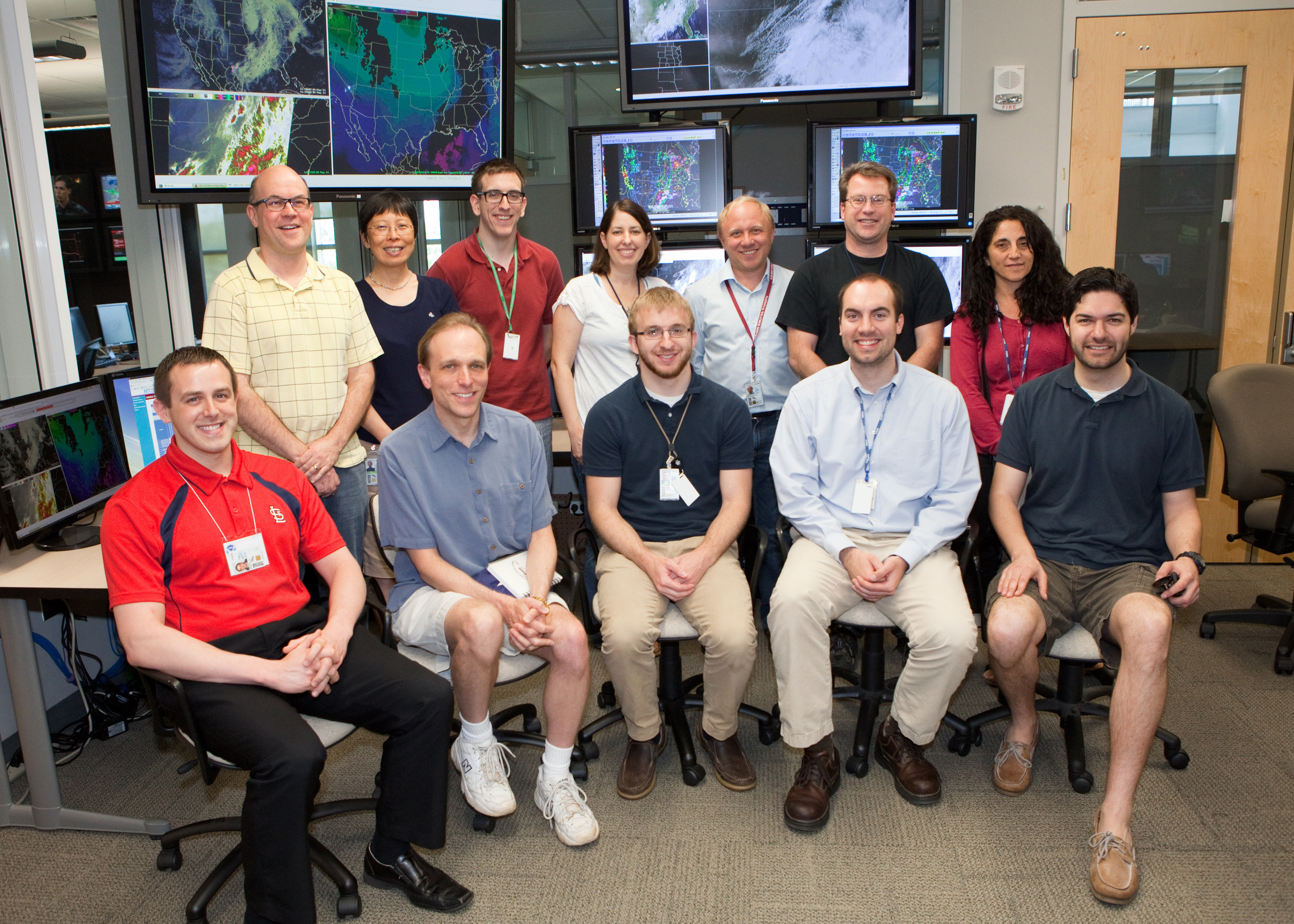
The 2014 “Big” Experiment has concluded.  Here are the group photos we took each week.

Week 1 Participants:

Bottom Row (l-r): Jared Maples, Dan Bickford, Bill Line, Lance VandenBoogart, Gabe Garfield

Top Row (l-r): Bruce Thoren, Hongli Jiang, Darrel Kingfield, Kristin Calhoun, Kris White, Scott Rudge, Paola Salio

week_1

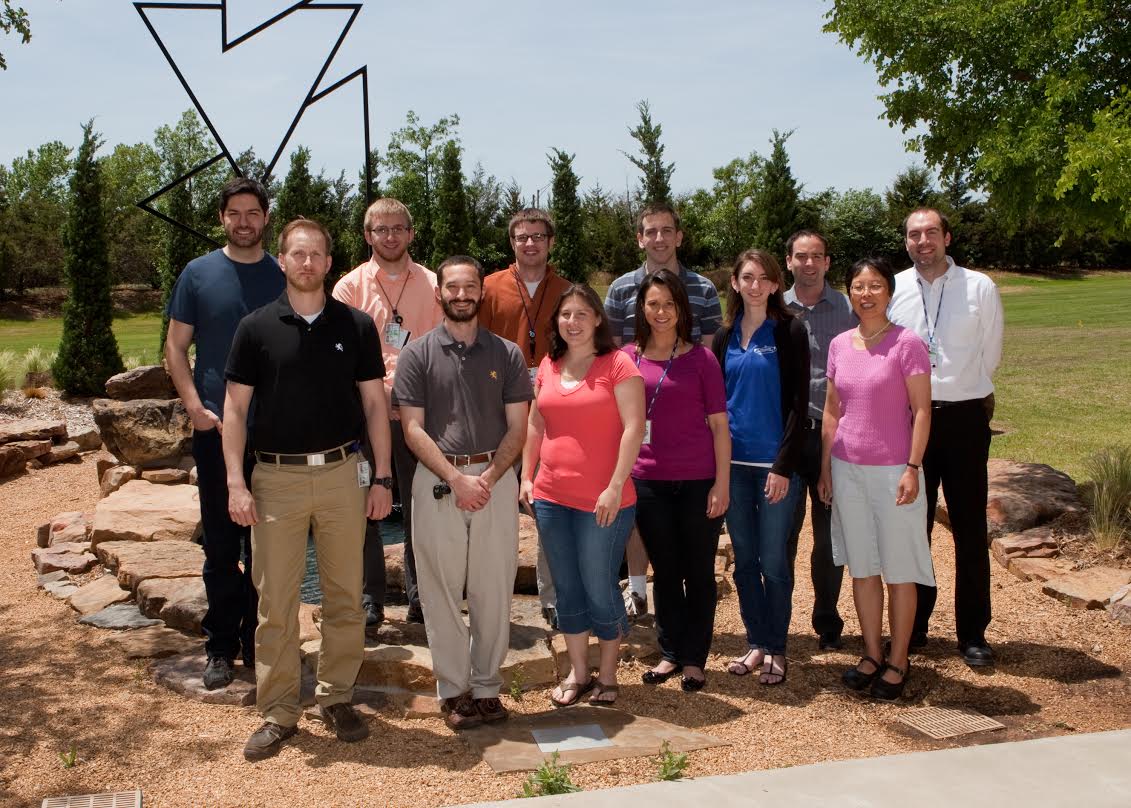
Week 2 Participants

Bottom Row (l-r):  Shawn Smith, John Cintineo, Elise Schultz, Erica Grow, Sarah Stough, Hongli Jiang

Top Row (l-r): Gabe Garfield, Bill Line, Kevin Deitsch, Darrel Kingfield, Michael Scotten, Lance VandenBoogart:

week_2

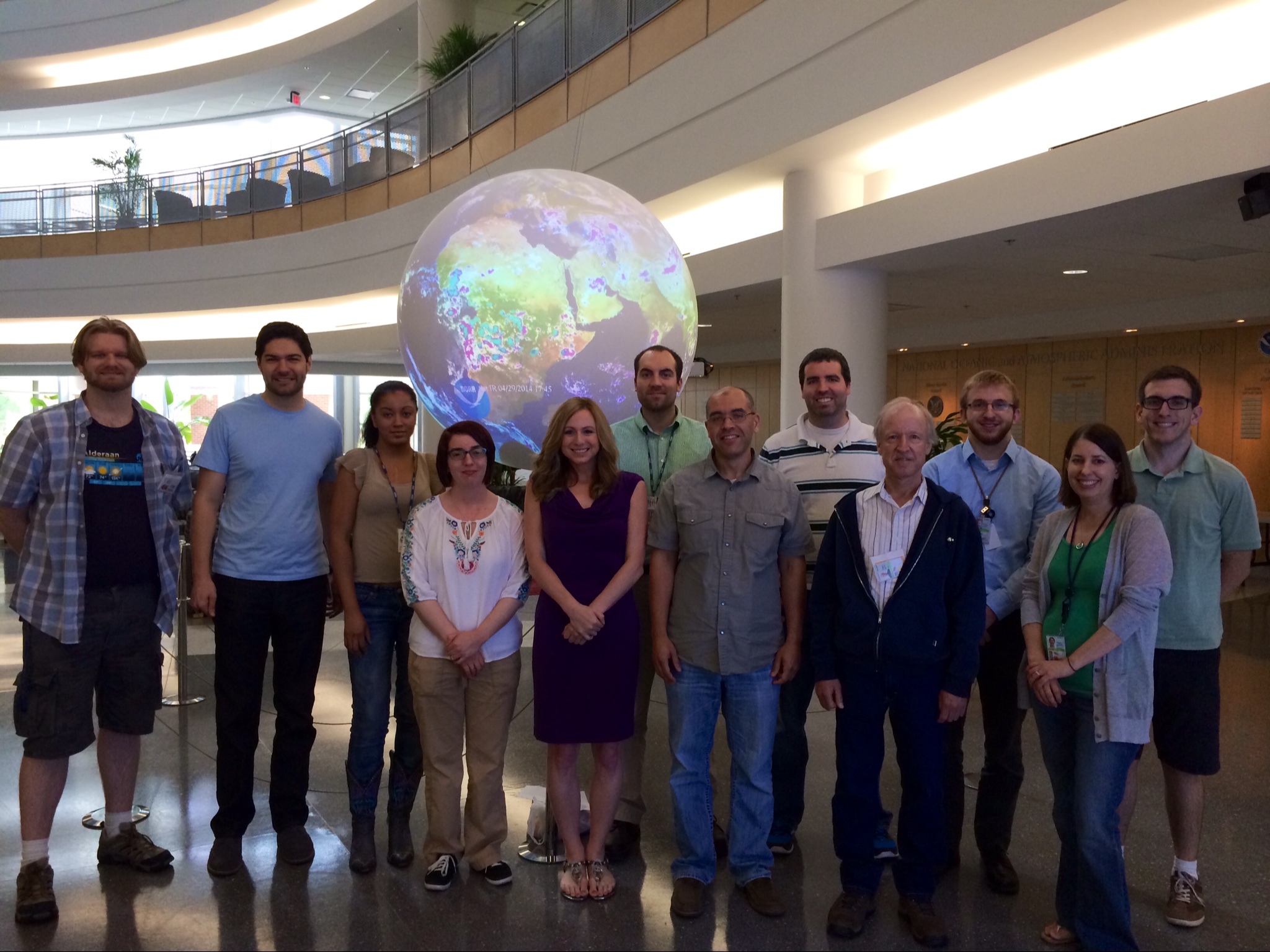
Week 3 Participants:

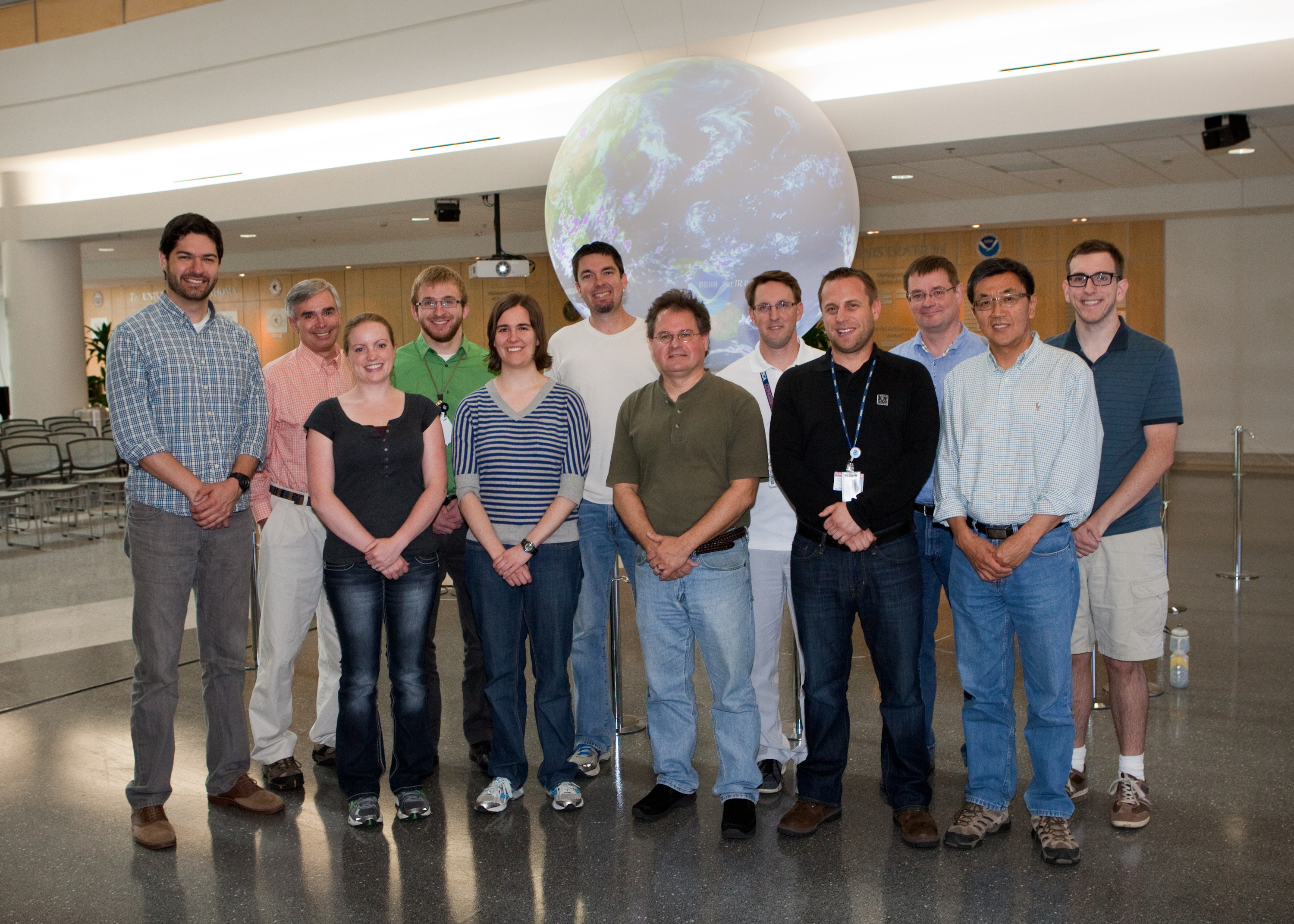
Left to Right: Grant Hicks, Gabe Garfield, Ashley Griffin, Linda Gilbert, Danielle Vollmar, Lance VandenBoogart, Josh Boustead, Chris Jewett, Steve Albers, Bill Line, Kristin Calhoun, Darrel Kingfield

week_3 Week 4 Participants:

Left to Right: Gabe Garfield, Dan Satterfield, Kathleen Pelczynski, Bill Line, Alex Anderson-Frey, Michael Fowle, John Mecikalksi, Jason Anderson, Matt Elliott, Vesa Nietsovaara, Yuanfu Xie, Darrel Kingfield
week_4
-G. Garfield

2014 EWP Operations Coordinator

Tags: None

ProbSevere and S. Colorado Severe

The ProbSevere model captured the development of severe weather in southern Colorado nicely during the evening of June 5. With one cell in particular, the first probability over 50% provided 20 min lead time to the first reported severe weather (1″ hail).

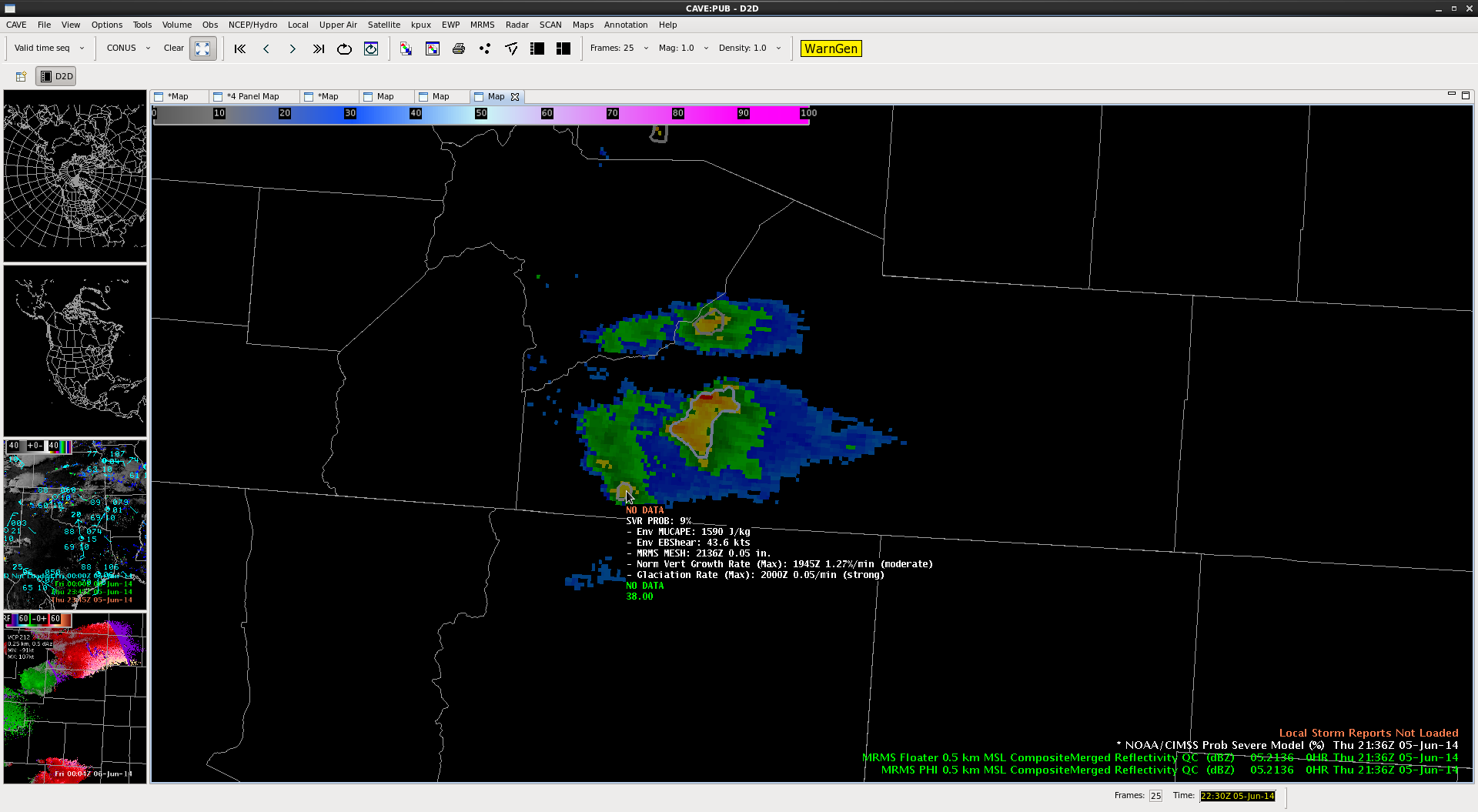
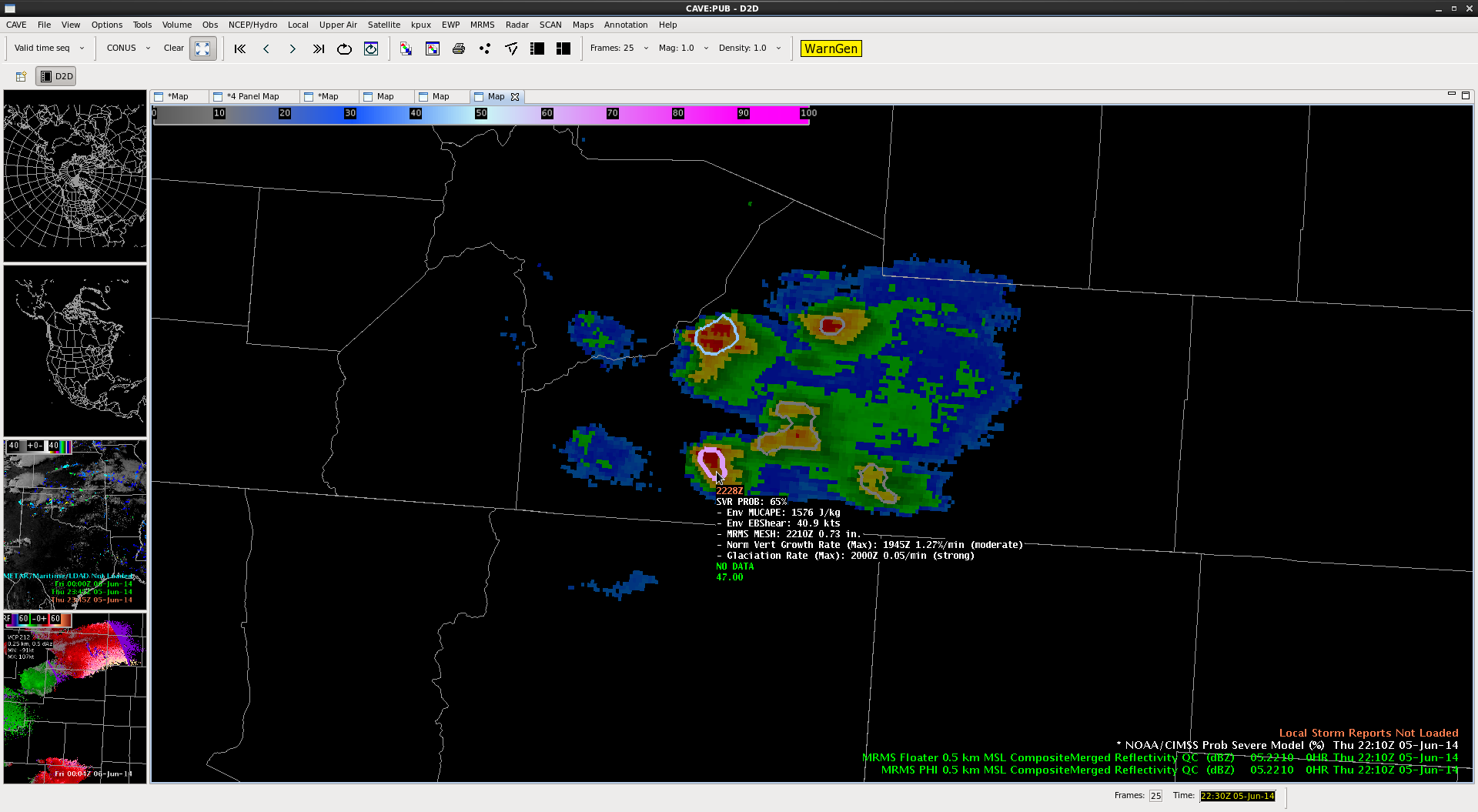
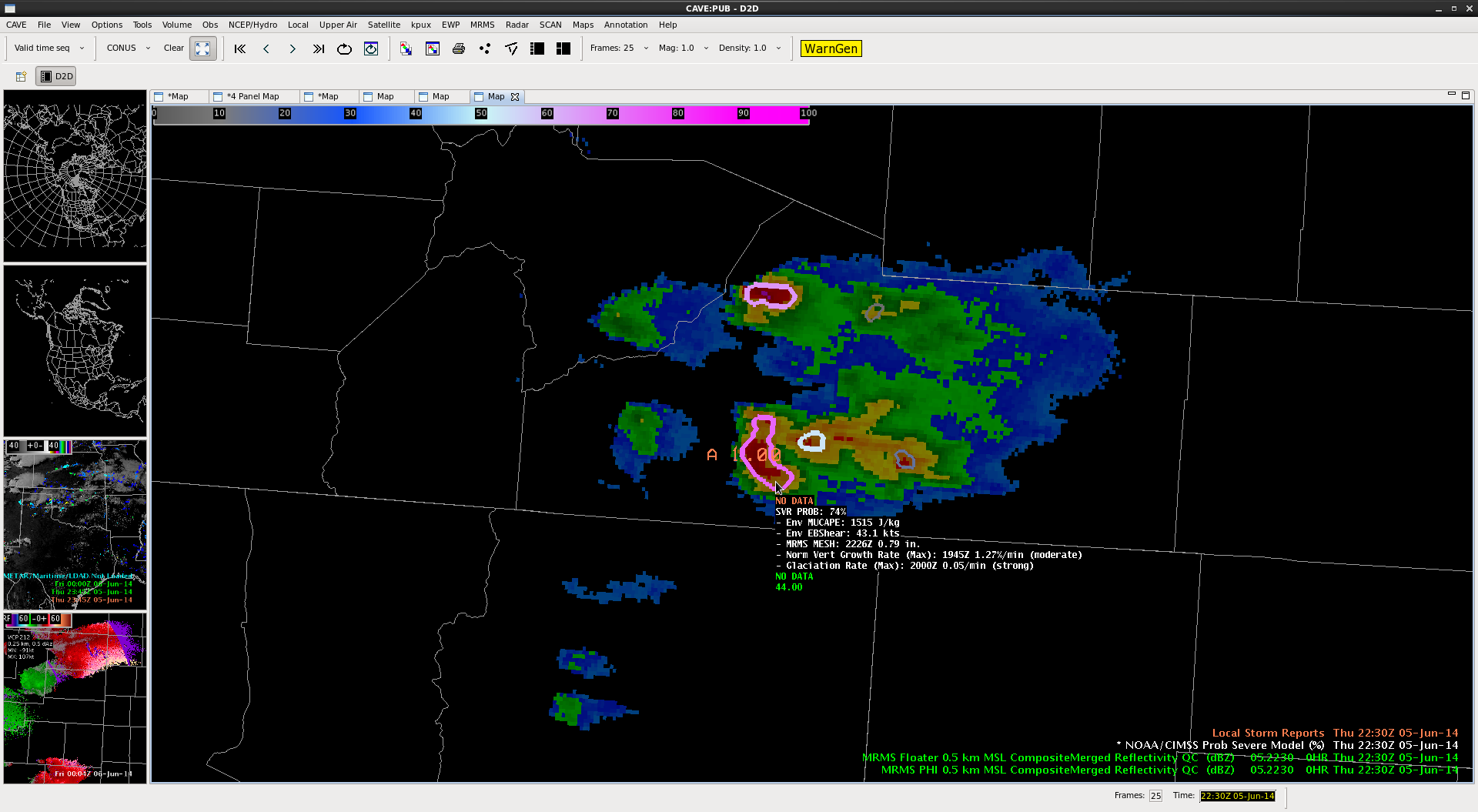
The algorithm started tracking the cell at 2136 UTC giving it an initial probability of 9% (to the first severe, Fig 1). At 2210 UTC, the algorithm had its first probability over 50% with a prob of 65%, indicating the cell was more likely than not to produce severe weather (Fig 2). The first severe weather of 1″ hail was reported with this storm 20 minutes later at 2230 UTC (Fig 3). The probability had maxed out at 85% at 2216 UTC.

ps_co_1

ps_co_2

ps_co_3

– Bill Line, SPC/HWT Satellite Liaison


Tags: None

Blog 12 June 5 HSV Area Cherokee County AL

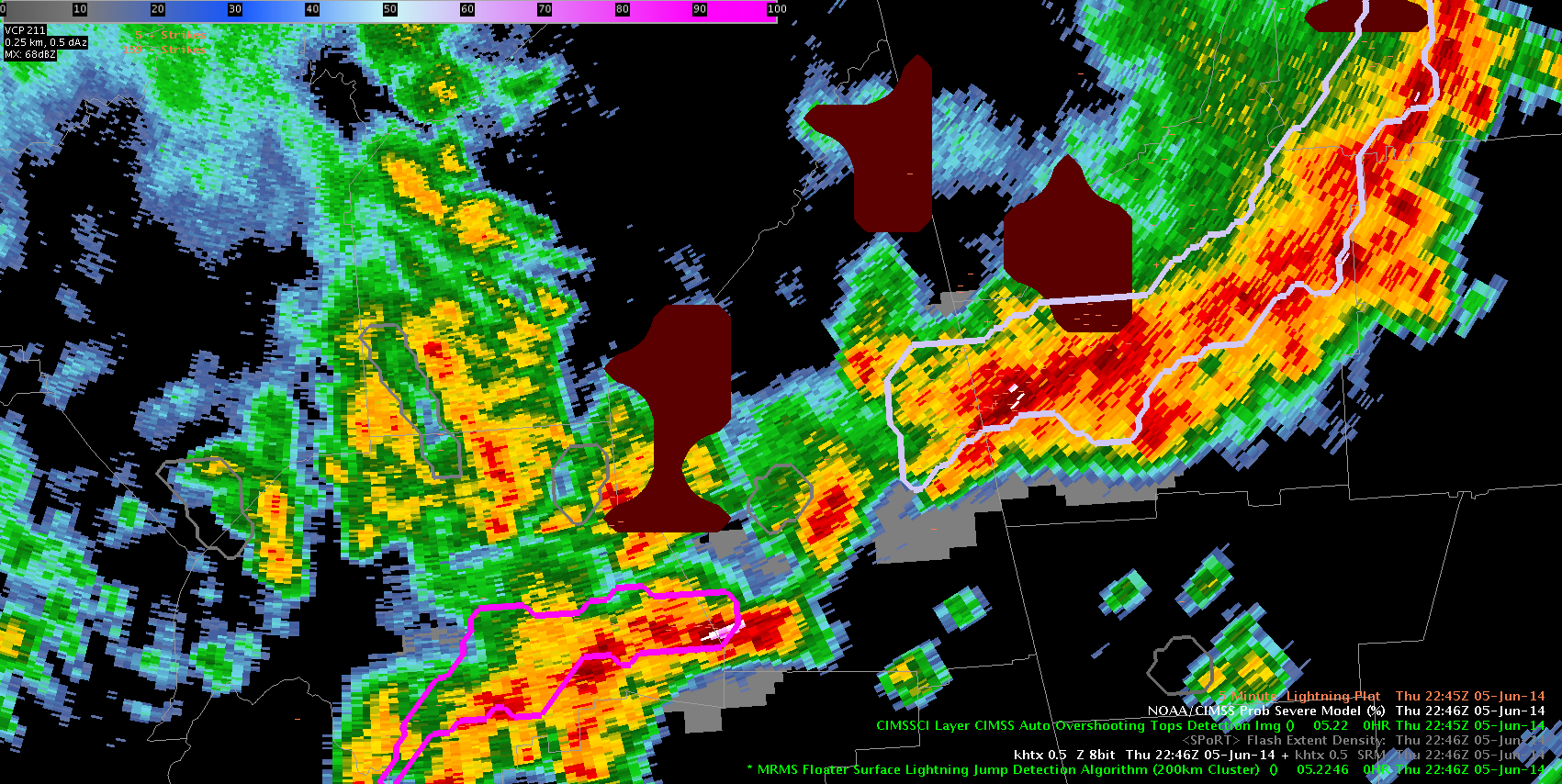
In the last post I mentioned the prob severe as not as helpful today. We now have a cell in Cherokee county ahead of the MCS that has an OT Top detect and a 4 sigma jump in lightning. Prob Severe now at 80% with strong flash density. HUN has warned and with all of these present expect severe reports. In this case it was warned because of history of these storms but all of this increases confidence in the warning and that this storm is still likely getting stronger.. was not as impressive 30 mins ago.

DSatterfield 2255Z

Cherokee AL Cell2250

Tags: None

ProbSevere Improvements

Couple quick thoughts on ProbSevere improvement – based on threats:

Wind:

T/TD depressions

Subcloud/Low Level RH

0-3KM Shear

DCAPE

Vertically integrated “core dump” e.g. track descending Z core

Hail:

Areal extent of negative ZDR cores on 0.5 degrees (difficult)

H7-H5 Lapse Rates

CAPE in Hail Growth Zone

500MB Temps

Tornadoes:

0-1km Bulk Shear

0-1 SRH

MLLCL


Fowle

Tags: None