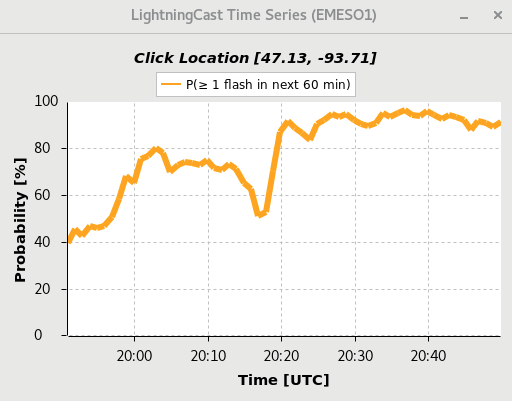
LightningCast Dashboard

Being this was my first time using the Dashboard, It took me a minute to figure out what I was looking at and which was V1 vs V2. But I believe the green line was V2, and it performed comparatively to yesterday in that it was quicker to react to the threat.

– Lightning McQueen

Tags: None

Web based LightningCast for a DSS event

My office’s internet went down hard for the entire day, so I had to utilize a mobile hot spot. AWIPS in the cloud was very sluggish and unusable on the mobile hotspot so I opted to only utilize the web based tools for today.

With a focus on the Brisket Appreciation Society Annual Bash in Beaumont, TX, storms started to emerge to the west and southwest of the event around 2 PM. I found the DSS dashboard useful when monitoring the specific location, but I wanted to use the LightningCast map as well for overall situational awareness. It was a little difficult for me to find exactly where the location was, so it would be useful for the map to have a dynamic layer for the DSS events.

I created a public graphic around the time lightning started near the to move closer to the DSS event. I generally utilized radar and LightningCast dashboard for the DSS event for the messaging. I did not include an image of the LightningCast for the graphic because it was already above 80% when I created the image. Because of this, there was very high confidence that lightning would occur, with the goal of the graphic to inform people of the approaching storms and the associated hazards.

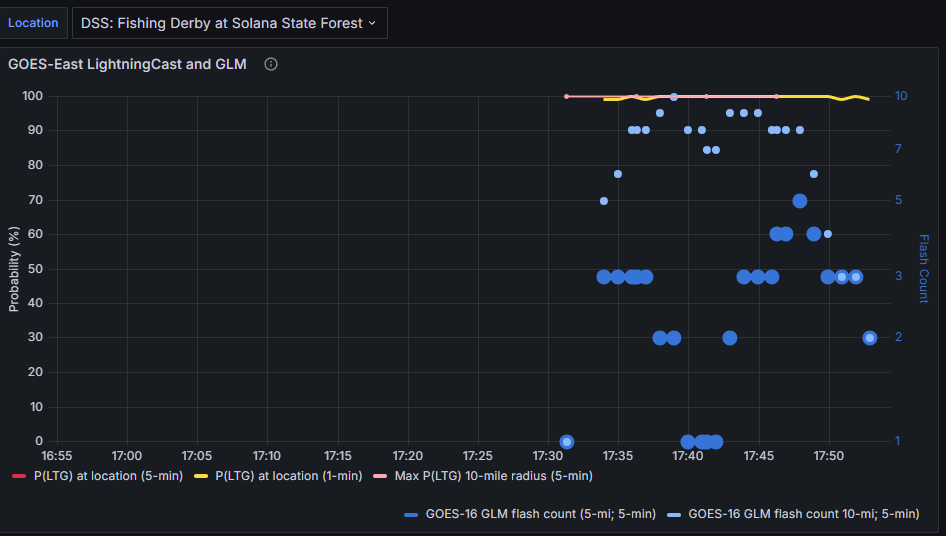
LightningCast (both v1 and v2) stayed very high during the entirety of the event. When looking at the DSS dashboard, the probabilities within for the event increased to >80% 30 minutes before lightning was within a 10 mile radius of the event. There was an issue with the 1 minute data that caused that dip to 0. However, the 1 minute data is very noisy, and in this case, is not an improvement when compared to the 5 minute data.

– Golden Retriever Lover

Tags: None

LightningCast Comparison for Cabbage, Potato, and Bacon Festival near Hastings, FL (JAX CWA) on Wednesday May 7th

LC V2 did better with lightning cessation showing lightning probabilities dropping quicker as convection moved east of the DSS event which it title “HOME”. This allowed for more timely DSS updates to partners mentioning the lightning threat was diminishing, at least over the next hour or so. LC V2 also did better with storms to the south which we will talk about more below.

LC V2 showed higher probabilities for lightning quicker for developing storms near southern portions of the county warning area. V2 also lowered probabilities quicker once the storms temporarily pulsed down. I do believe one or both of these storms eventually pulsed up again after this though so it is possible V1 performed slightly better in this scenario by keeping slightly higher lightning probabilities.

LC V2 had tighter areal extent of lightning probabilities overall which was more helpful and accurate. May just need to be a little more weary of sensitivity to decreasing lightning probs too quickly for pulse thunderstorms in the summer.

– Ricky Bobby

Tags: None

Day 3 observations

LightningCast/MesoAnywhere for DSS Event

We were operating as NWS JAX on 5/7/25. There was not a huge severe threat, but there were cells that produced a lot of lightning. Our DSS event was the Cabbage, Potato, and Bacon Festival in Hastings, FL (labeled as “home” in AWIPS). As soon as the   day started, there were cells within the range of the festival, with our primary focus on lightning cessation. One of the first things I noticed was that for the cells to the north of the cells, LightningCast v1 had a wider spatial extent of the probabilities than v2 for areas of decaying convection. I assumed this was because of the MRMS data as there were lower MRMS -10C reflectivities in the northern edges of the convection where the lower v2 probabilities were.  I was curious how that would impact the probabilities for the event as the convection began to decay there and how it related to notifying the event of an “all clear”.

Image 1: LightningCast data v1 vs v2 from 19:50Z to 20:11Z.

With respect to the event itself, using the lightning dashboard (image 2) was helpful. Probabilities both in v1 and v2 were high for the beginning of the day in the middle of all the convection. Probabilities started to decline around 20:15Z. Initially, v1 was declining faster, but by 20:30Z, v2 was declining at a faster rate than v1. There was still lightning within the 10 mile radius during these declines, but v2 it seems that v2 caught on to the decay a bit faster. This is also shown in the LightningCast loop from AWIPS (image 3) where v1 had a larger spatial extent to the higher probabilities for longer. I used LightningCast probabilities in my DSS messaging. When the probabilities were going down, I used a number in between each version for the probability I used in the message. I also utilized MesoAnywhere 1 minute Channel 13 data once it became available for us to monitor the potential for new convection behind the main cluster of cells. There was not much being shown, which made me more comfortable noting the event of an all clear.  Probabilities eventually did start to go back up after 21:15Z because there was a lot of convection to the north and south of the event.

Image 2: LightningCast Dashboard for the Cabbage, Potato, and Bacon Festival in Hastings, FL.

Image 3: Lightning Cast comparison loop from 20:43Z to 21:32Z.

Octane and Gremlin

Today was the first day that I used Octane. After getting some training on it from Jason, my first impression of it is that it would be a valuable resource for situational awareness for developing convection and alerting you to where stronger thunderstorms are. This could alert a forecaster to a cell that they may need to interrogate a little more. During warning operations, if radar data is available, I do not think that a warning operator would have enough time to use this in their data analysis, but the warning coordinator or mesoanalysis person would probably find this tool helpful. We went through a thought exercise about how we would use this tool when radar data is unavailable. During times like that, the radar operator would probably find this tool helpful because the storm top divergence and the speed sandwich offers information that radar operators look in radar when assessing thunderstorm strength. With respect to the individual options, I found myself using the speed sandwich more initially because I was able to infer the storm top divergence in a unit that I am used to. However, the more I get comfortable with the actual CTD units and colors, having it paired with the storm top cooling would provide me more information overall than the speed sandwich during warning operations. If I only had satellite data, I would probably be pretty liberal with my warning issuance. There was a cell near Juniper Springs around 22Z, where the speed sandwich and CTD tools were showing relatively “stronger” signals (stronger is relative since there were not many strong signals today). Looking at radar data (MRMS MESH, VII, dual-pol data) and knowing the environment, I did not think the cell was producing severe weather. I am not very comfortable just yet with the thresholds in these Octane products, but given the environment was supportive of marginal severe weather, I may have issued a warning in this instance. Both the SpeedSandwich and the CTD displays were indicating the storm was weakening though, so I also might not have either. As others have noted the last couple of days, the MedSmooth CTD was the one I preferred.
Image 4: Octane Speed Sandwich and Cloud Top Divergence and Cooling from 21:54-22:21Z=
Looking at GREMLIN for the same storm, it seemed to have picked up on the stronger signals of the specific cell and would be useful for pinpointing the storm with the highest “potential” in this instance since it was the one with the higher reflectivity values. I don’t know if I would make a warning decision specifically off of this product, but if I had it available in addition to other satellite data, I may be more inclined to issue a warning or an SPS if the environment is supportive of it.
Image 4: GREMLIN 20:31Z to 22:21Z
Unrelated to the previous storm, this was another snapshot I took of GREMLIN. There was an outflow boundary (not visible in this image) that was traveling southward and sparking new convection as it interacted with the sea breeze. A small cell that was relatively strong quickly developed to the southeast of the Jacksonville Airport. While reflectivities were picking up on MRMS, satellite didn’t pick up on it as quickly. GREMLIN did not catch this initiation.
Image 5: GREMLIN at 20:01Z.
There was a cell that developed along a outflow boundary very close to the radar. Satellite data was not really picking up on it with little cooling cloud tops so GERMLIN completely missed it.
-goldenretreiverlover
Tags: None

RADAR DOWN IN DULUTH CWA

Without the use of radar out of Duluth more reliance was given to Satellite derived observations and satellite derived output.

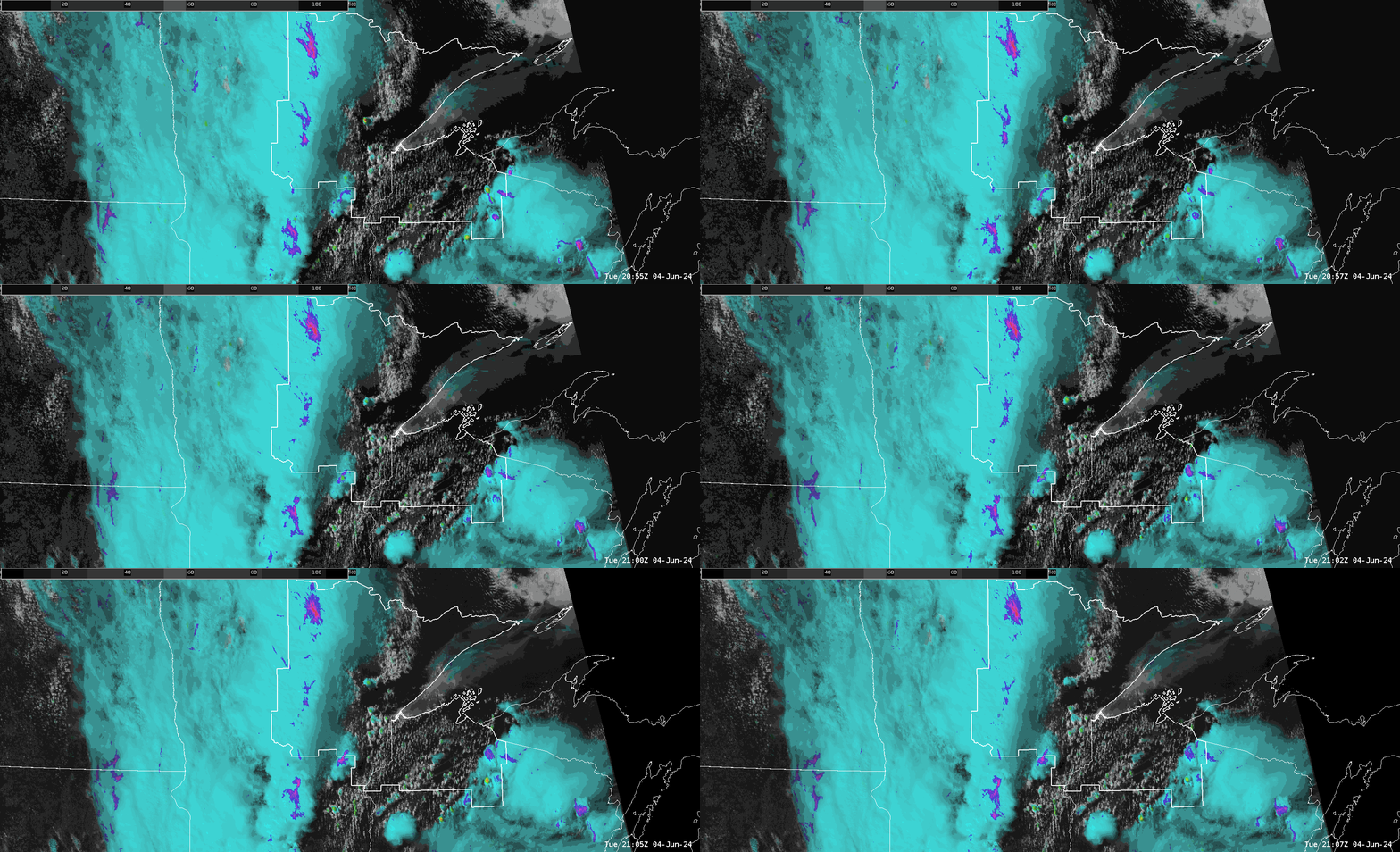
Below is the OCTANE cloud top cooling and cloud top divergence product.  You may notice in an area of moderate but increasing instability there is convective initiation ahead of the main line of convection.  However, you can notice early in the loop that there is convective cooling indicated in the south-central portion of the CWA and the far SE portion of the CWA.  Notice how in the far SE portion of the CWA there is the purple shading indicating cloud top divergence.  And in south central portions there are “hotter” yellow and tiny red(s) (may be hard to notice due to scale) pixels indicating cooling cloud tops, but with no purple shading and thus no meaningful divergence at the cloud top.  This is indicative of orphan anvils. The moral of the story here is that without radar the OCTANE product heightens your attention to the cells in the far SE portion of the CWA, and this would be where to consider SVR or SPS product release, with the activity across South Central portions of the CWA failing to produce significant convection at this point in time despite moderate to strong instability.

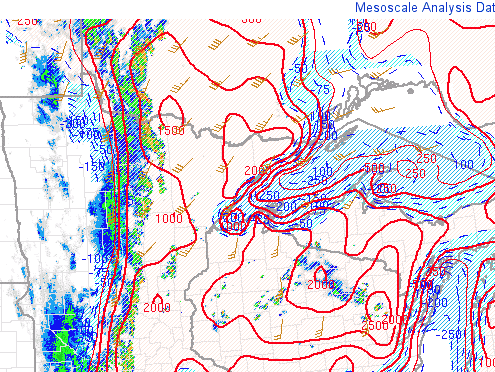
Further southeast however notice that there is stronger instability over SE portions of the CWA, thus the OCTANE product is giving you a result which coincides with where there is higher instability (higher MLCAPE – see SPC mesoanalysis).

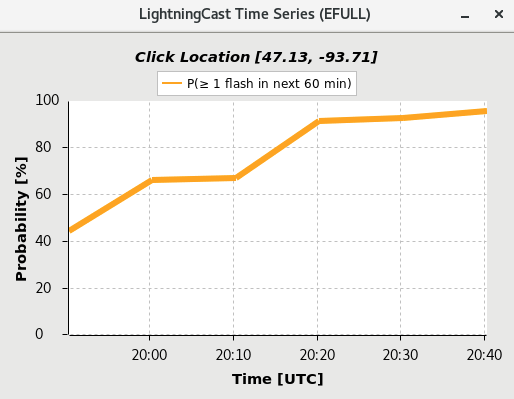
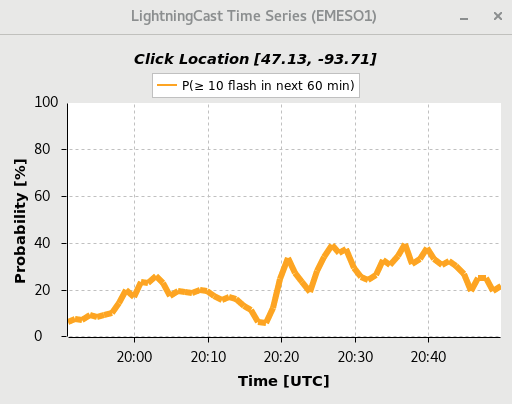
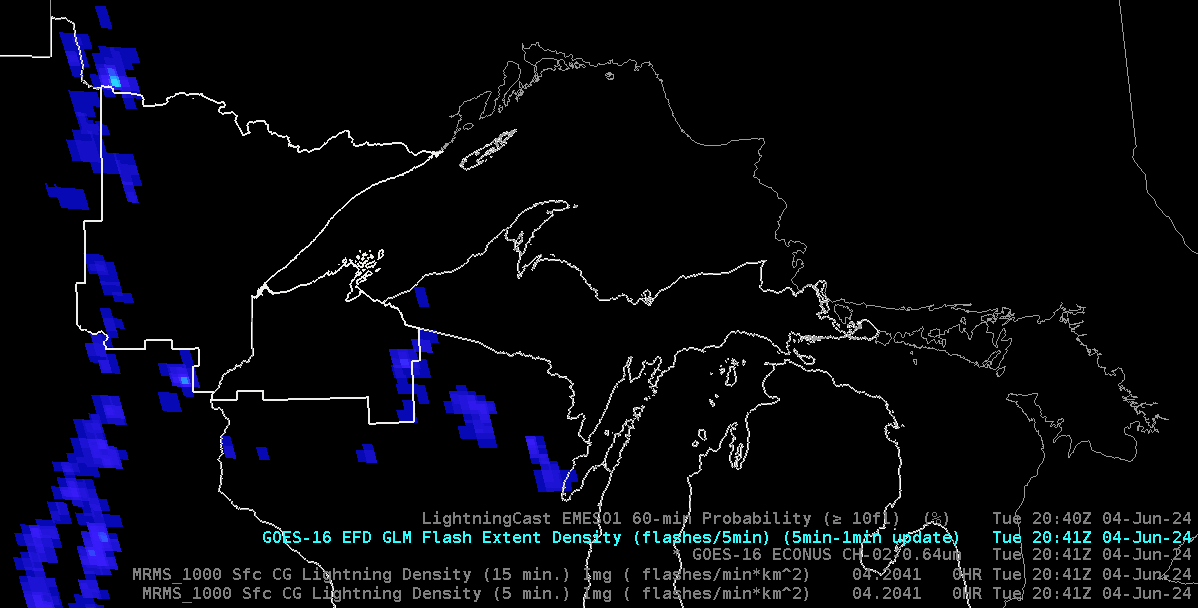
Lightning Cast continued to show high confidence of lightning over the next 60 min with the linear MCS moving into western portions of the CWA.  This lead to high confidence in forecasting lightning for a DSS location (Solana State Forest) during this event.

Steady behavior with the greater than or equal to 10 flashes in the next hour.

High probability of 1 flash of lightning in the next hour, increasing then holding steady

Here (below) is the Lightning Cast and GLM dashboard output comparing the forecast to the GLM flash count.  Note: the dashboard was down initially but came back online

Thus we were able to give a high confidence lightning forecast for DSS.

Here is the GLM Flash Extent Density at the time of the Lightning Cast 1 hour forecast.

– 5454wx

Tags: None

Examining LightningCast Values Near Pierre SD

We have a Fishing Derby ongoing near Pierre, South Dakota. We observed some differences in the LightningCast probabilities within a 10 mile radius between the AWIPS contour plot and the dashboard.

Here’s an image from AWIPS at 2004Z (1504 local time), with the DSS point marked by a 10-mile radius near Pierre SD (white circle), and the LightningCast probabilities (60-min for 1 flash) contoured in blue and green.


Next, here is a look at the dashboard for the same DSS event. Of interest is the pink line, which shows the maximum probability for a flash within 10 miles of the DSS point within the last 5 minutes.

At the 1506 (local time) time slot on the dashboard, it shows the maximum probability of 47 percent. However, the AWIPS image above shows the greatest contour values within the DSS point radius for that same time minute span (at 1504 local time) and the value only barely exceeds 30 percent. It appears that the value on the dashboard is reading about 15% higher than the value that would be implied by the contour display in AWIPS.

Functionally, as long as the trends are consistent, this may not make much of an impact on messaging or forecasting for this DSS point. However, having the values more closely matching between the two sources is something that would likely increase forecaster confidence.

–Insolation

Tags: None

LightningCast and DSS

Monitoring convective development over the southwestern portion of the ABR CWA, where we are providing DSS support to a Fishing Derby (yellow range ring – 10 miles). From this data, I would be able to let an EM know that we’re noticing an uptick in lightning probabilities due to storm cells developing to the south/southeast of the Derby and moving northeast. These are not severe at this time and no lightning has been observed as of yet. However, currently, probabilities of lightning within 10 miles are between 40-50%. If I were to use LC while at an on-site deployment, I would have both the map view (first image/loop below) and the graph (second image below) up to show what I am looking at, but especially the map view to give context to the graph.

LightningCast in “map view” showing probabilities of one or more flashes (as an image, not contoured)
LightningCast Dashboard showing lightning probabilities at DSS point (Fishing Derby, Aberdeen, DS)

UPDATE # 1 – Lightning has been observed! From when the 10% contour (10% chance of 10 or more flashes) first popped up (red contour north of Lyman) at 2010Z, it was 10 minutes until GLM and the ground networks observed flashes. It was 5 minutes later when ground networks observed CGs.

LightningCast – time of first 10% contour (red) 2010Z


LightningCast – GLM and ground networks observe flashes 2020Z


LightningCast – Ground networks observe CGs 2025Z

In terms of lead time, I crafted a DSS message between 310-315pm (seen in the first paragraph above this update) and the first flashes were observed at 320p and CGs at 325p. Therefore, this gave a 10-15 minute lead time.

UPDATE #2 – Below is a snapshot of the LightningCast Dashboard showing the above mentioned GLM flashes within 10 miles.
Forecaster Cumulus
Tags: None

Analyzing Clusters, Anvils Carrying Charge North, Final Checkup on LightningCast

Working on the DSS for the PGA tournament, one of the more frustrating features was how thunderstorms well outside the range of the event produced lightning. About the time one DSS image was sent, there was a lightning flash that occurred well north of the primary cluster and near a very weak area of reflectivity.

However, this has been the story for much of the day, where intense convection has been to the south and weaker cells to the north are still managing to produce lightning. Below is the probability of exceeding 10 flashes on GLM, with GLM and MRMS at -10 C to highlight how weak the convection was to the north. The fact that reflectivity was barely at 25-35 dBZ would suggest little potential for lightning.


Analyzing the RGB channels for lightning, one can see this evolution well. With more intense updrafts producing several flashes on GLM, they appear yellow. To the north, where it appears the anvil is carrying charge north, the flashes are very long. From a DSS perspective, this can be frustrating when communicating the potential for high impact weather when all that one gets are sprinkles and rumbles of thunder. Still, the RGB channel can be very helpful in delineating these features, but would also be a helpful means to suggest that the northern convection may not develop quite as much. The 50dBZ echo tops are intended to help highlight the stronger storms. Note how a few pixels of 50dBZ echo tops at best appear in the blue, while the larger cluster of taller storms have the younger convection. This also helped me consider parallax as well. Overall, I really like the potential for lightning characteristics divided into this RGB would be helpful in pulse convection.
And then later, the LightningCast began to behave a bit more oddly. Perhaps these situations cause it to become bouncy. Although, you can almost see these dips in the flashes on the chart as well. At this stage, I feel like I could tell the poor folks playing above par at the PGA tournament and taking forever that they can pack up their clubs and head home, because at this stage, the lightning is here to stay.
Outside of the one flash of lightning that took place over the event about when values crept upwards towards 50 percent, there was a flash. However, values had been hovering around 30-40 percent for much of the day. Values crept even higher, and yet there were no flashes nearby. It seems whatever convective debris left the region, and then the forecast became better overall.
Kadic
Tags: None

Adding Latitude/Longitude on Dashboard May Help Locate Mistaken Entry

While doing DSS for the PGA tournament, there was an instance where we were uncertain whether the dashboard was matching the values on the map. Below, the probability of 1 flash and 10 flashes are shown. Using the sampling tool within the 10 mile range ring, the values never exceeded 50 percent. However, on the dashboard for the PGA Attempt 3, there were values above 70 for a single flash.

Trying to find the reason why, the most likely situation is that the forecaster may have mistyped, either mixing up decimal points in the lat/lon, or swapping two digits around. It may be helpful to be able to go back and edit the entry if that occurs or be able to view the lat/lon point to be certain whether a typo occurred putting in the entry.

In this case it wasn’t a typo – It was parallax!

Kadic

Tags: None

Using GREMLIN for Time of Arrival

LightningCast has been running high near the PGA Tournament today near Fort Worth as a result of several thunderstorms around the region, but not over the region. As a result, decided to swap over towards trying to use GREMLIN to find the time of arrival of the boundary noted earlier.

So an attempt was made to highlight this in the DSS image to provide an estimate of when these hazards would arrive. Perhaps another proofread would’ve caught the initial typo from copying it over. However, a value of about 40 percent was noted. Partners still had information that storms would become increasingly likely over a narrower time frame in addition to the probabilistic information from LightningCast.

But nature had other plans with a strike and a few pulses of lightning over the event at the time this was “sent out”. An area of weak convection was in the area, and so I would’ve thought that this would not produce lightning.
Sneaking in information on the RGB evaluation, you can see how this was not a young storm and likely something in decay, and that may track with a bit of the surprise element.

Kadic

Tags: None