



Lightning data in the Texas panhandle late this afternoon showed low correlation between GLM output and data from ground based lightning networks. The output from the GLM flash extent density product appears underdone when compared to data from ENTLN, which has numerous areas of clustering in the vicinity of stronger thunderstorm updrafts. Meanwhile, the GLM flash extent density data shows low values and not much variance within the same general vicinity. The problem does not appear as significant in western Oklahoma where the GLM flash extent density product shows much higher values in concert with clustering in the ENTLN data. It is difficult to pinpoint what might be causing this issue just by looking at the data alone. 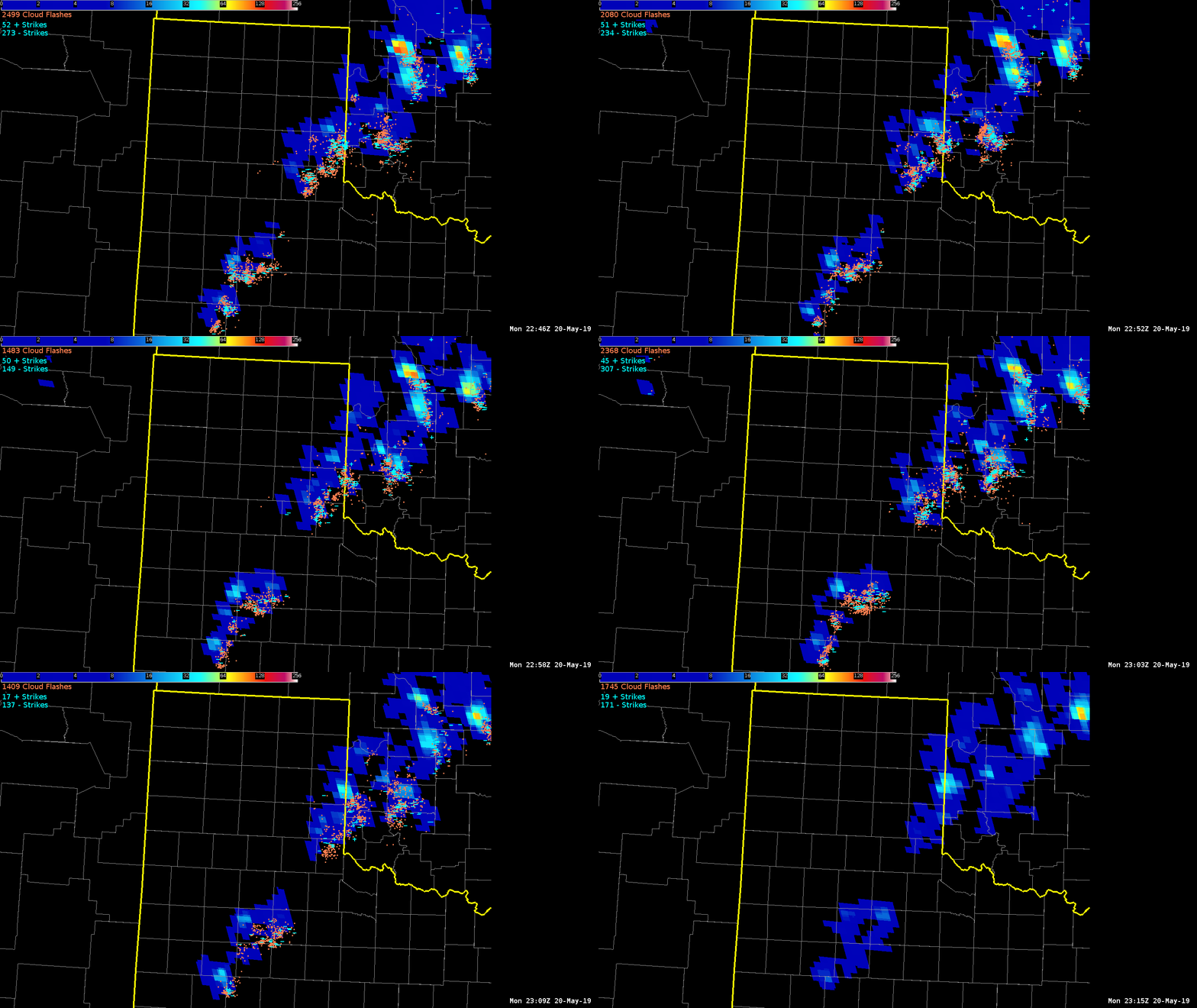 Dave Grohl
Tag: GLM
Comparison of ENTLN and GLM Lightning Data
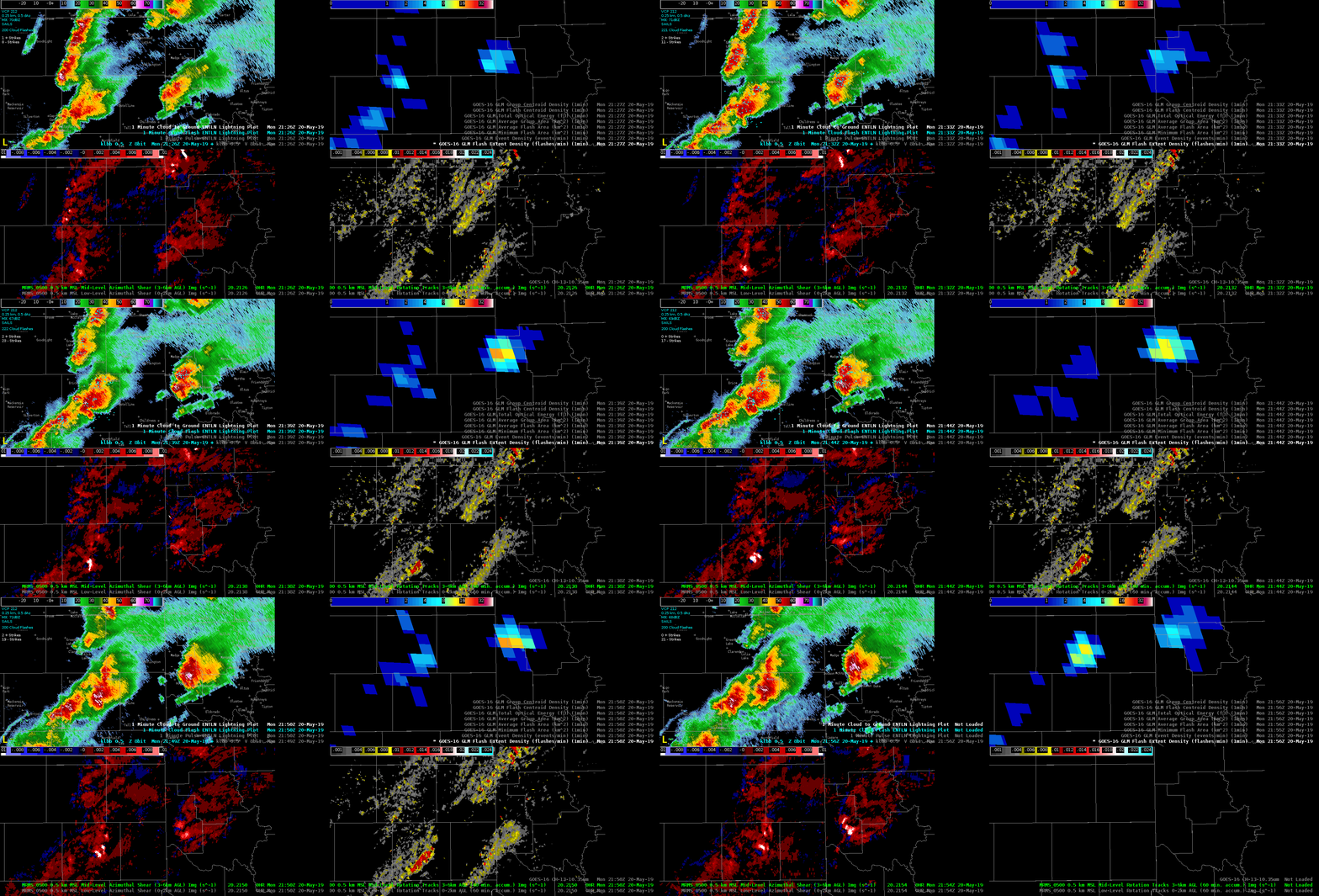
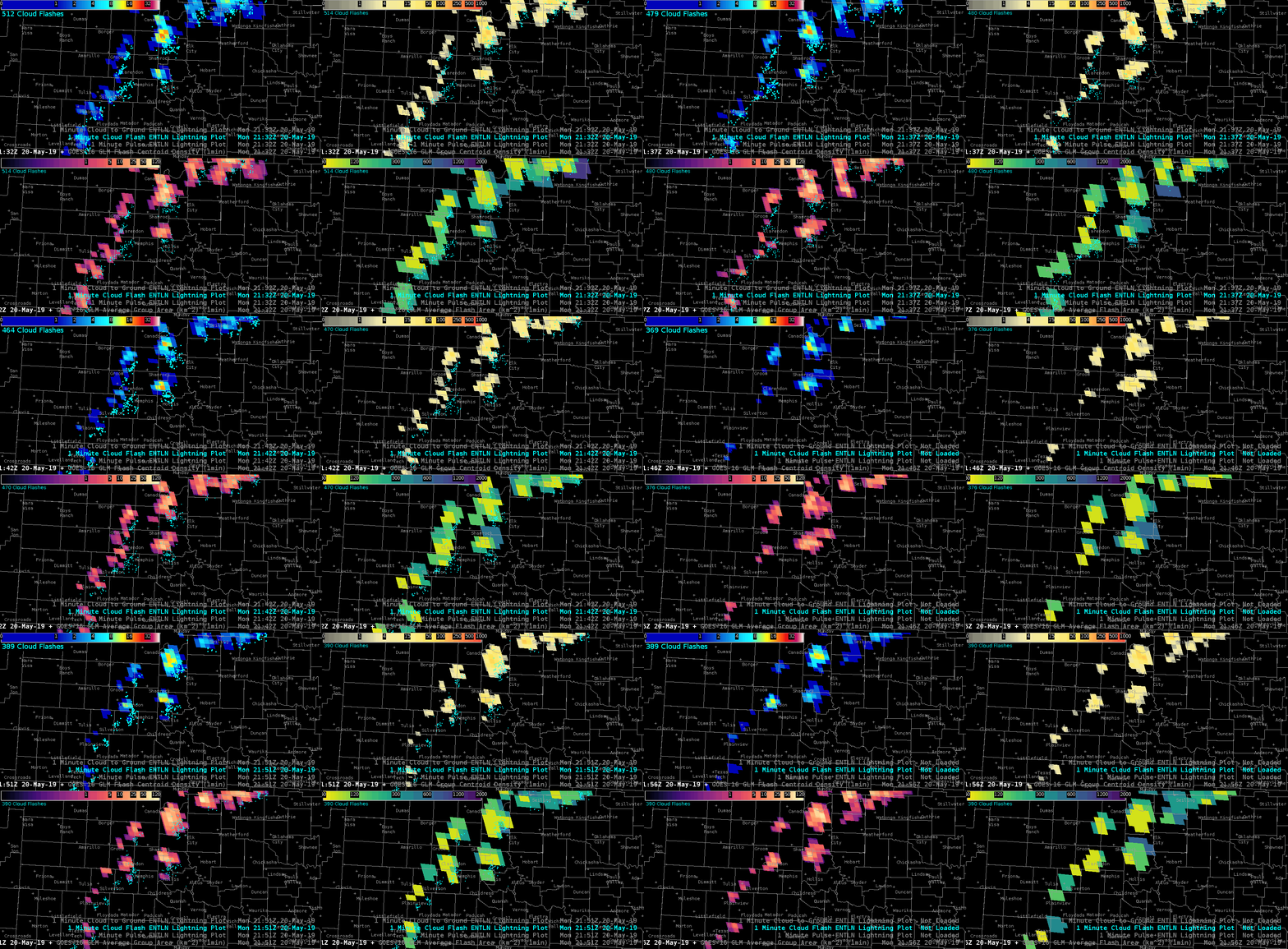 Storm of interest is the supercell NW of Childress, TX. Increase in ENTLN lightning occurred before a substantial increase in the 0-2 km and 3-6 km MRMS azimuthal shear. The signal in the GLM flash extent density product was muted in comparison to ENTLN data. ProbTor went from 12% at 2124Z to 52% at 2130Z. At 2140Z, ProbTor peaked at 91%, which corresponded with the maximum 0-2 km MRMS azimuthal shear (0.20 S-1) associated with this rotation track. I frequently use the ENTLN data in operations and am trying to incorporate GLM products.
So far, the most useful GLM components, largely because of their visual representation and relationship to updraft growth rate or intensity, are the flash extent density and total optical energy. These two products helped me maintain situational awareness on individual storm intensity trends. Plotting the flash extent density and total optical energy in a four panel with GOES IR imagery and base radar data, I can quickly decipher which storms pose the greatest risk for severe weather. Roy
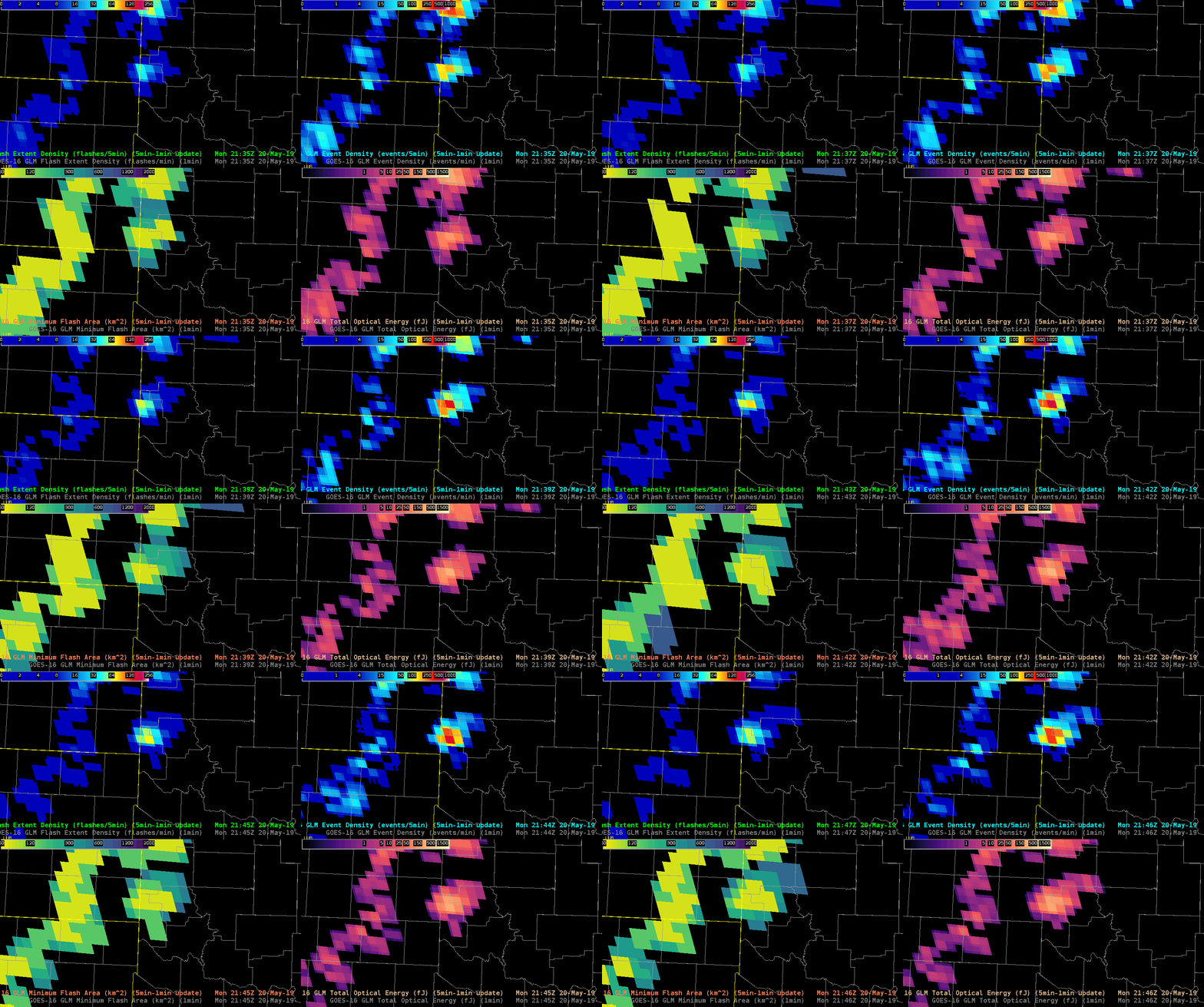
Increase in lightning with storm just east of the TX/OK border area
An isolated cell within the warm sector had been showing a weakening trend even though it seemed to be in a very favorable environment. However, over the past 15 minutes or so a notable increase in GLM Flash Extent Density and GLM Event Density, which has coincided with the cell exhibiting a better presentation on radar.
-64BoggsLites
Azimuthal Shear and Lightning Trends Prior to Tornado
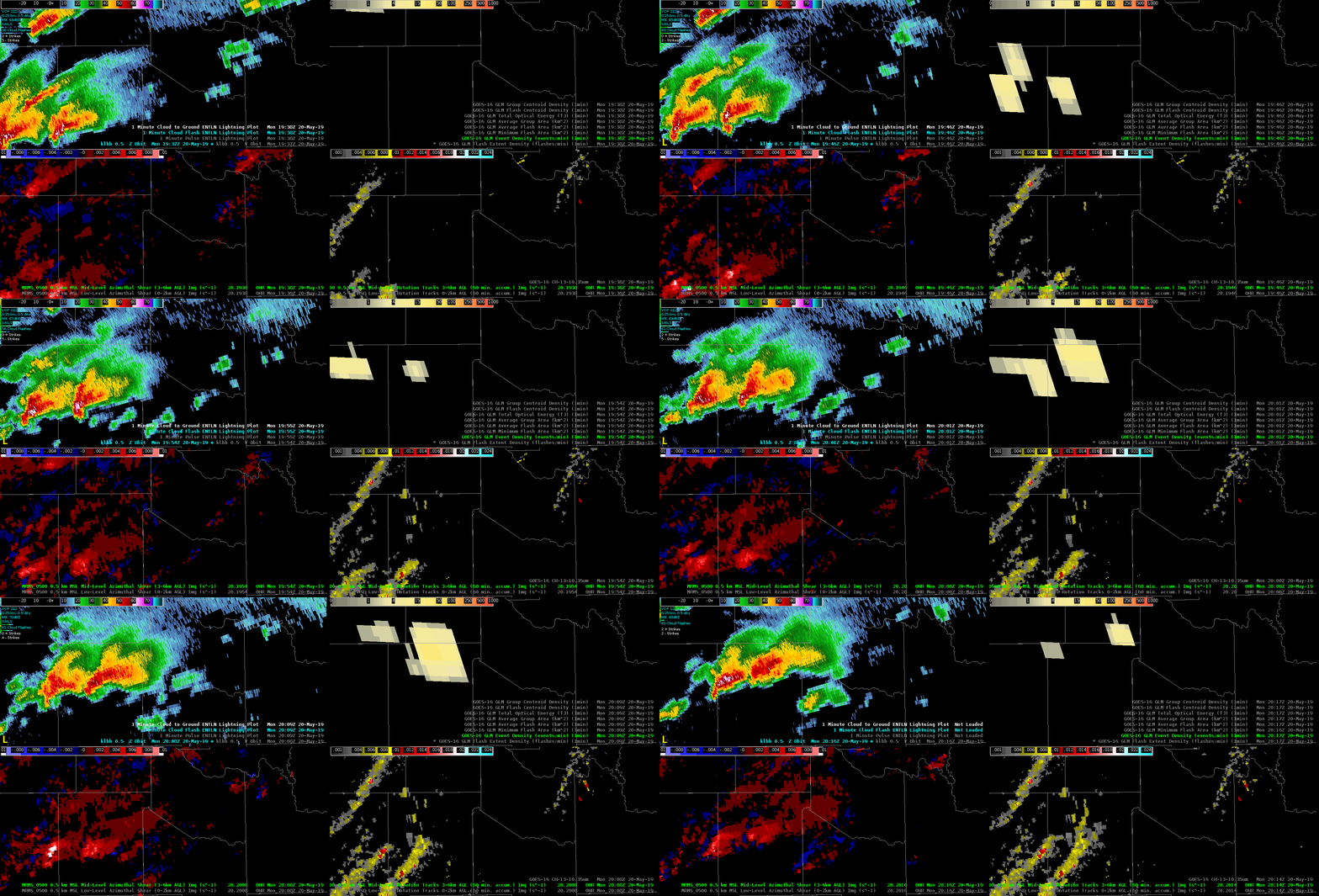
Pair of supercells exhibited intensification as they tracked northeast through the eastern Panhandle of Texas. MRMS azimuthal shear ramps up to slightly over 0.010 S-1 near time of a reported tornado from the more eastern of the two supercells. The GLM event density data also increases prior to or near the time of the tornado between 1950z – 2000z (upper right panel). Comparing to the ENTLN lighting flash frequency (1min data), an jump was noted peaking 1947Z before it dropped off and remained lower through 2000Z (36 count to 15 count). To summarize this data, there was a jump 10-15 min before the tornado, then a drop off, and then another jump 10-15 min after the tornado.
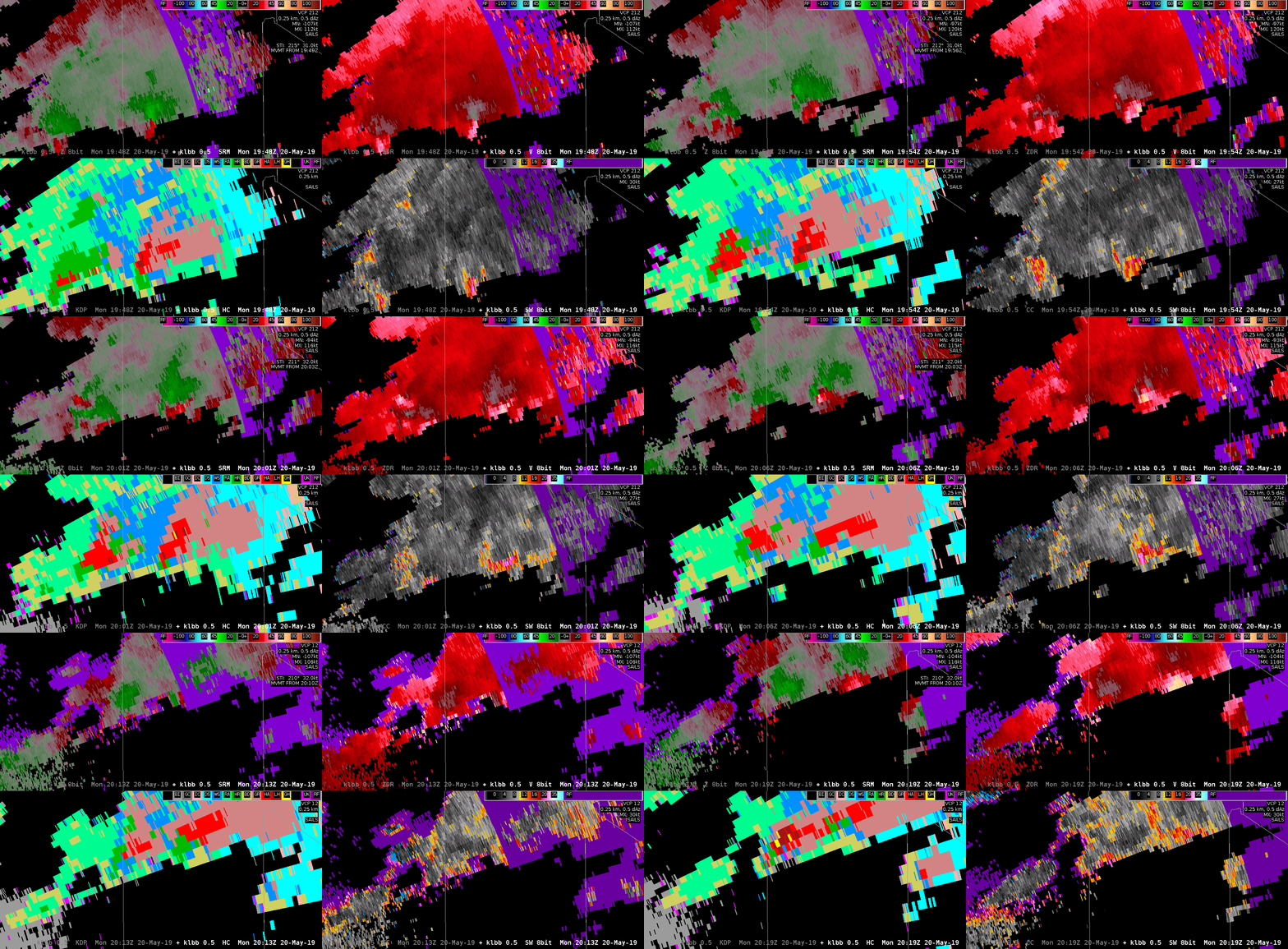 0.5 storm-relative velocity couplet was strongest with the eastern of the two primary mesocyclones. Spectrum width (low right panel) displays a consistently strong signal of wind speed variance with the eastern tornado producing mesocyclone.
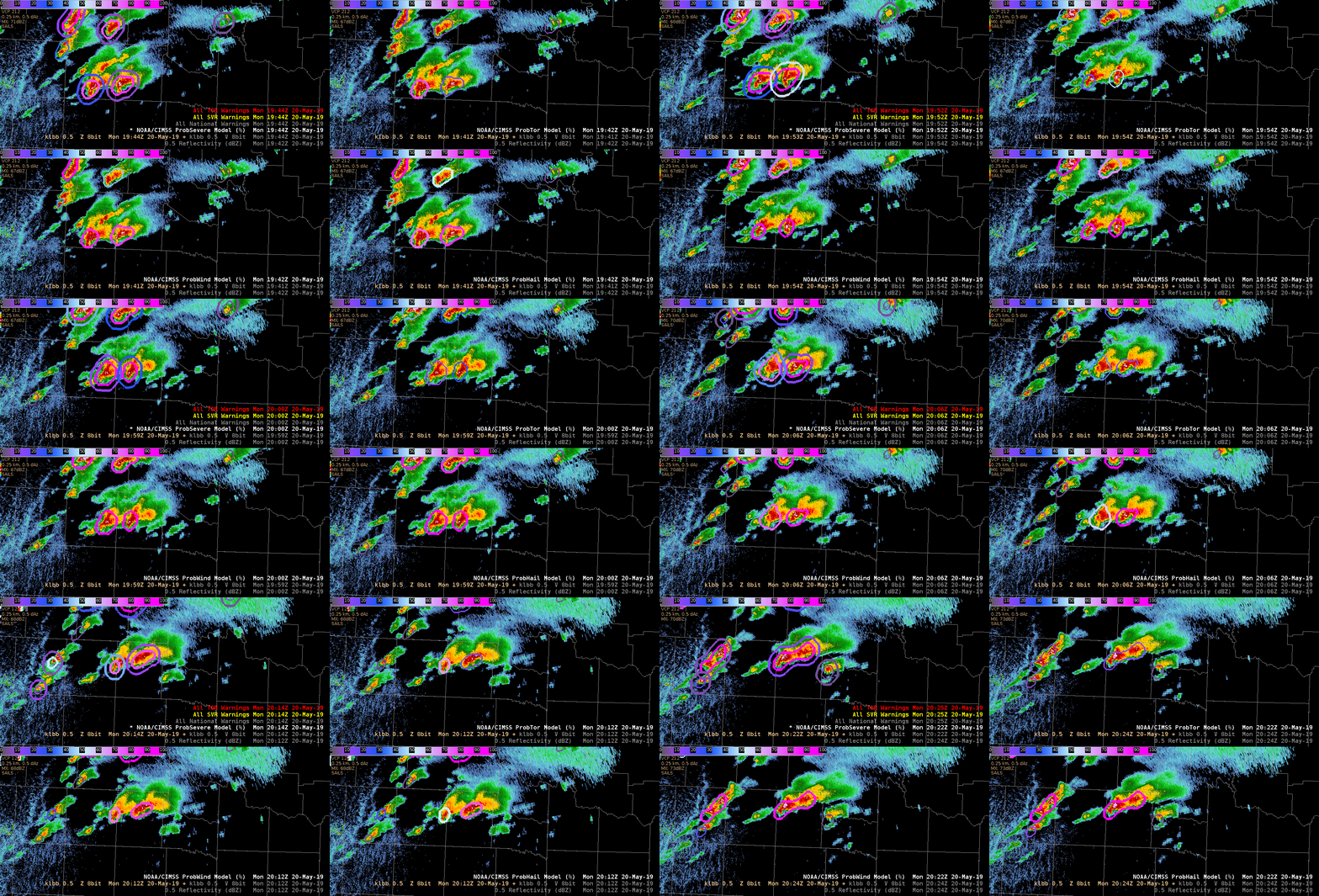 The tornado component of Probsevere jumped significantly before the tornado touchdown. At 1944Z the probability was at 7%, then quickly increased to 46% by 1948Z and peaked at 54% at 1952Z.
-Roy
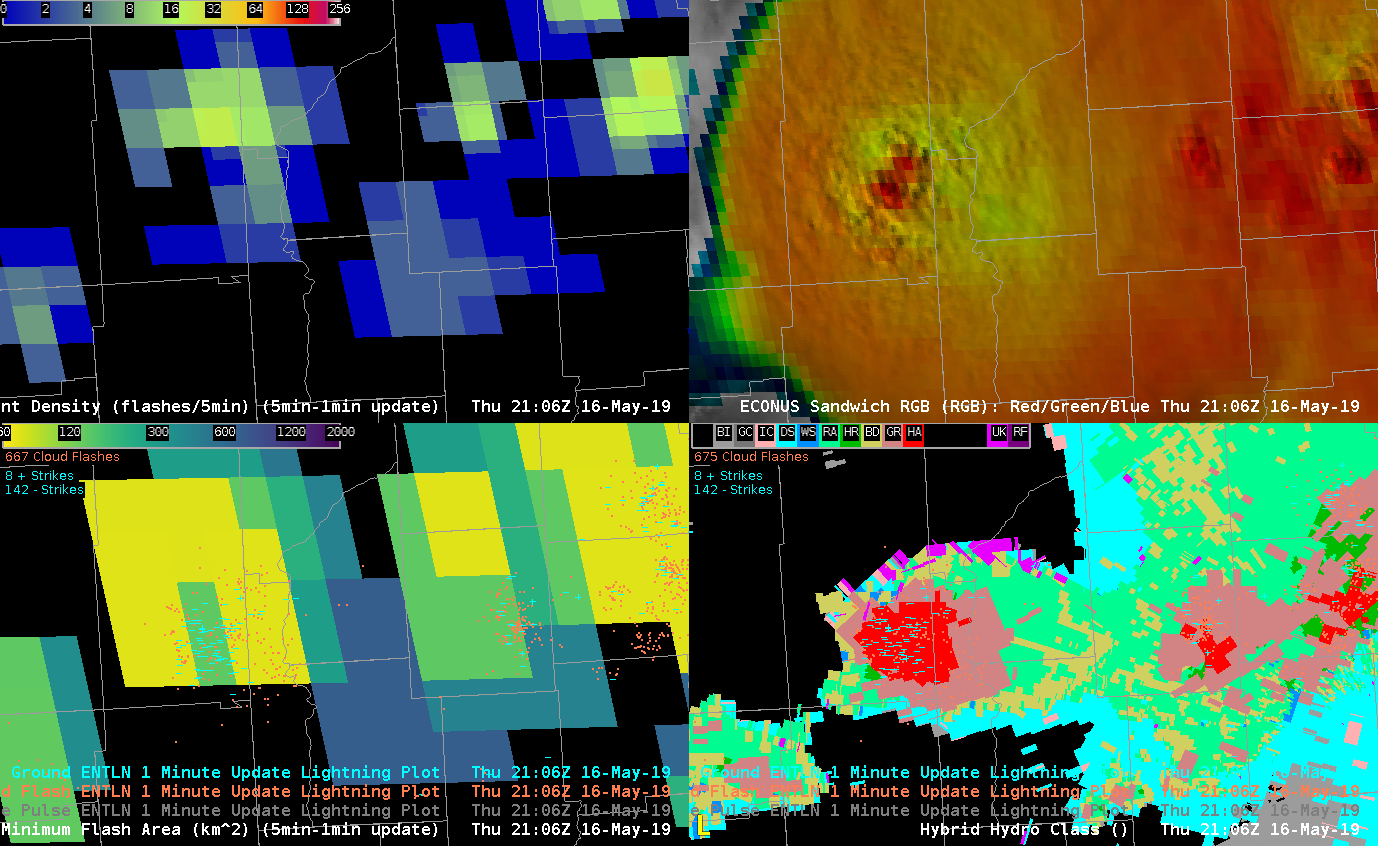
Earth Networks detects negative flashes in hail core
Over Indiana, there is a concentration of negative flashes where Minimum Flash Area is slightly larger. This is colocated with a hail core shown in the Radar Hybrid Hydro Class.
-Jonathan Wynn Smith (ESSIC/UMD)
GLM Flash Event Density vs Centroids
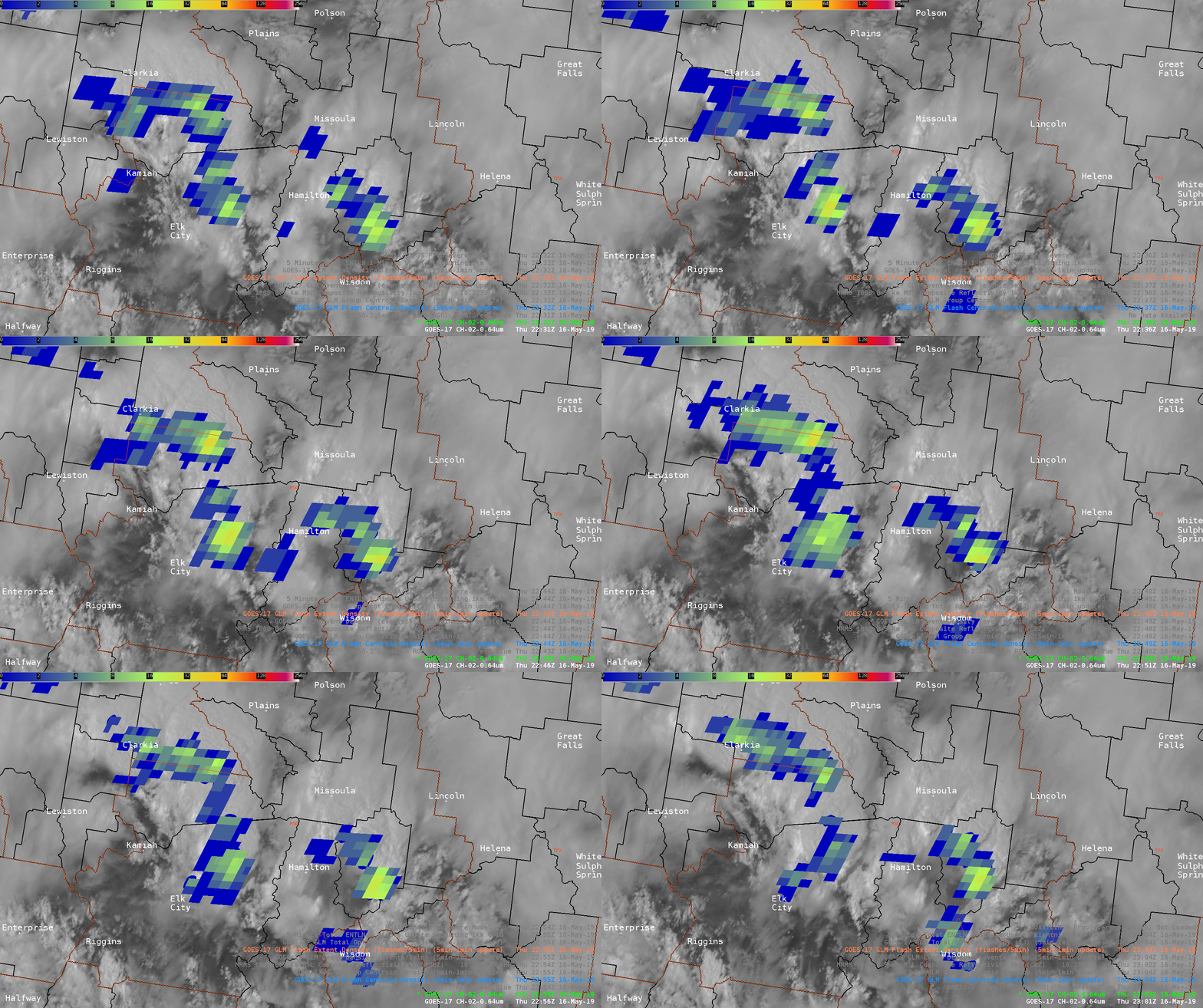
Viewing some marginal severe storms in northern Idaho from GOES 17 in this example. In the first image is the traditional Flash Extent Density product. However, have modified the color curve (User -> Awips -> GLM_FED_DC) to provide some enhancement to the lower values as detection efficiency seems to remain lower over ID/MT as we have found in MT/WY in previous days. While this is overall helpful in picking out some stronger storms, the large 8km grid boxes take up a lot of screen real estate when viewing over background satellite imagery. Also the strongest storms are somewhat lost in the lightning data of the surrounding storms.
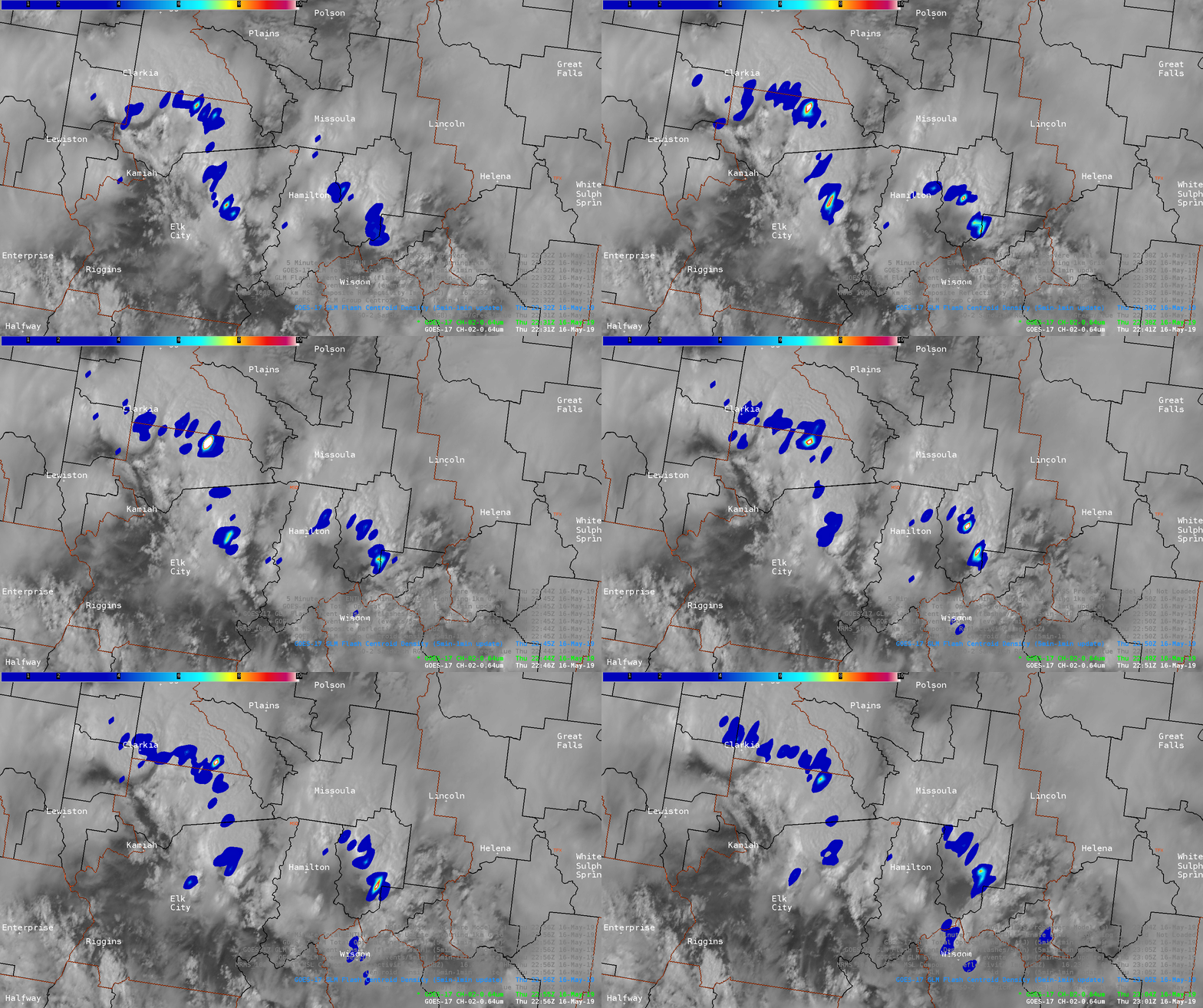
As an experiment, tried loading up the Flash Centroid Density Product. By turning on the interpolation and setting the max value to 10, this really helped to isolate and highlight the strongest cells. Of note is the cell moving toward the north, west of Missoula. Picking out the lightning jump in this storm was easier viewed on this Flash Centroid Density product, and comparing its strength to surrounding storms was also easier. It is also helpful that the product has overall small footprint.
— warmbias —
Eye Candy – Nothing More, Nothing Less
#CaptionThis
#MarfaFront
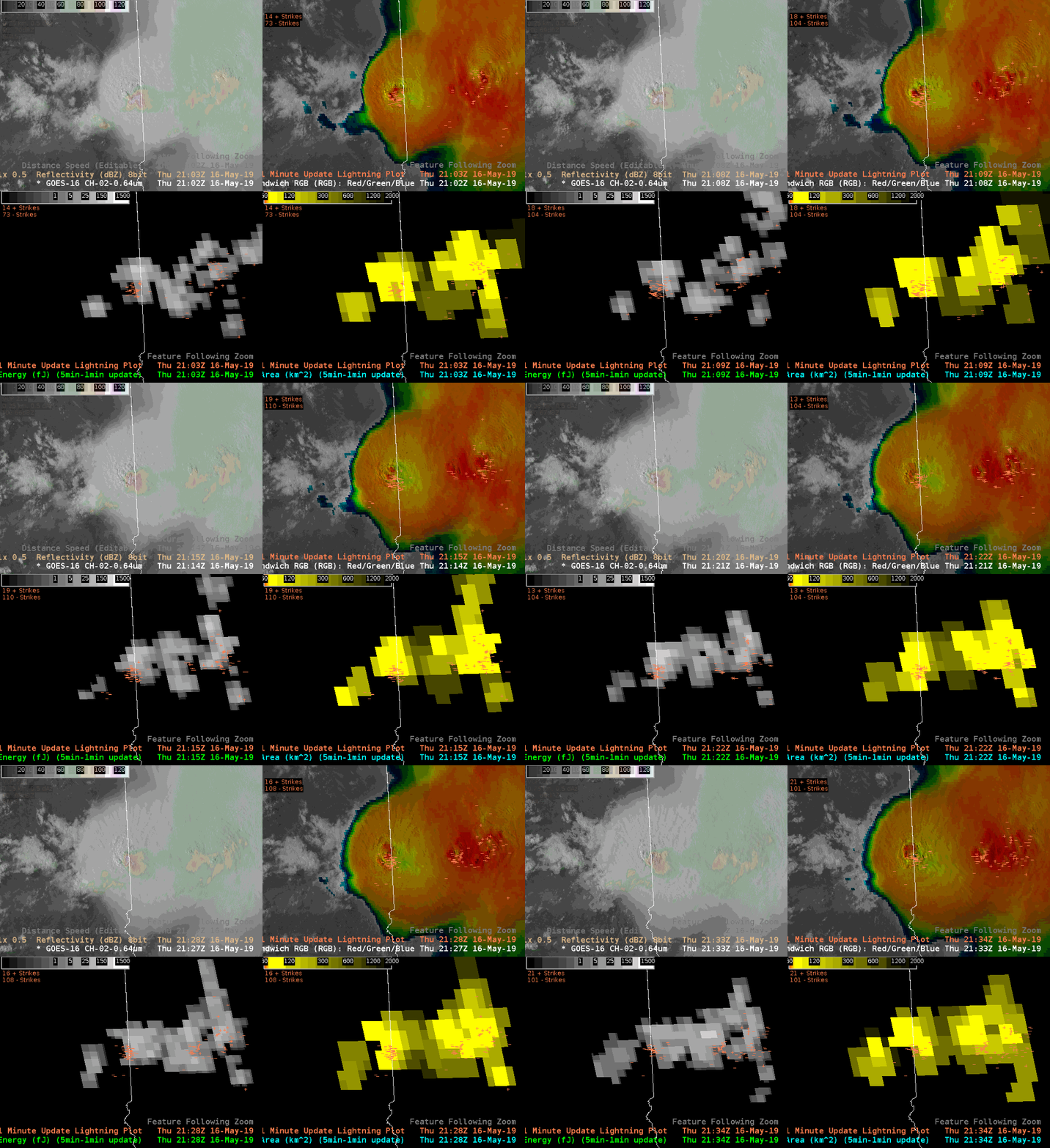
FED Gives Precursor to Strenthening Supercell, but…
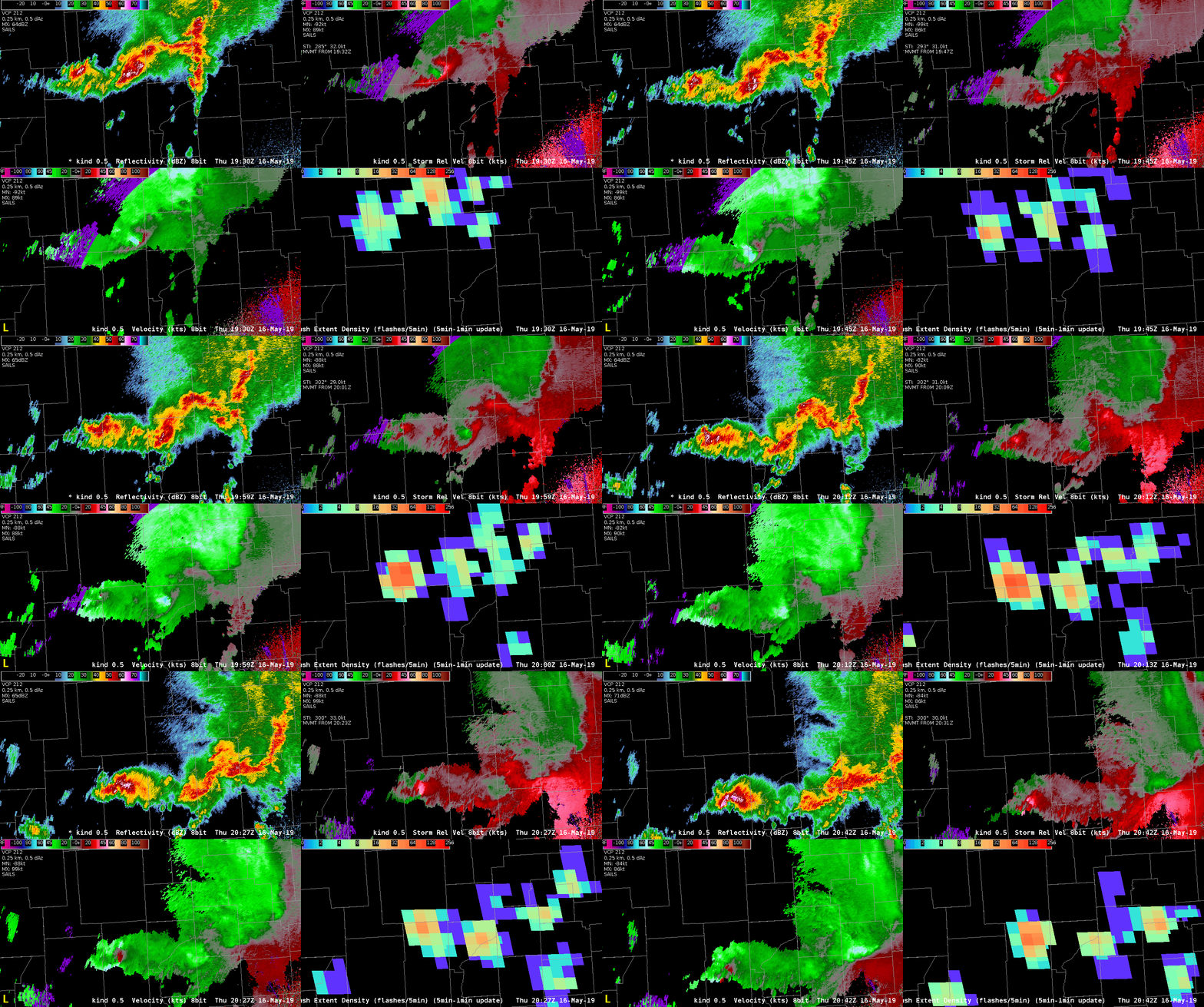
Watching the last storm in the line that is still in Illinois, the Flash Extent Density values started climbing rapidly (between 1947Z and 2020Z), which suggested to me that I should start paying attention to it. Upon interrogation, the velocity started to change from being more convergent to rotational, and eventually it appeared that a tornado was likely per the KIND radar. Interestingly, that was when the FED fell rapidly (2022Z).
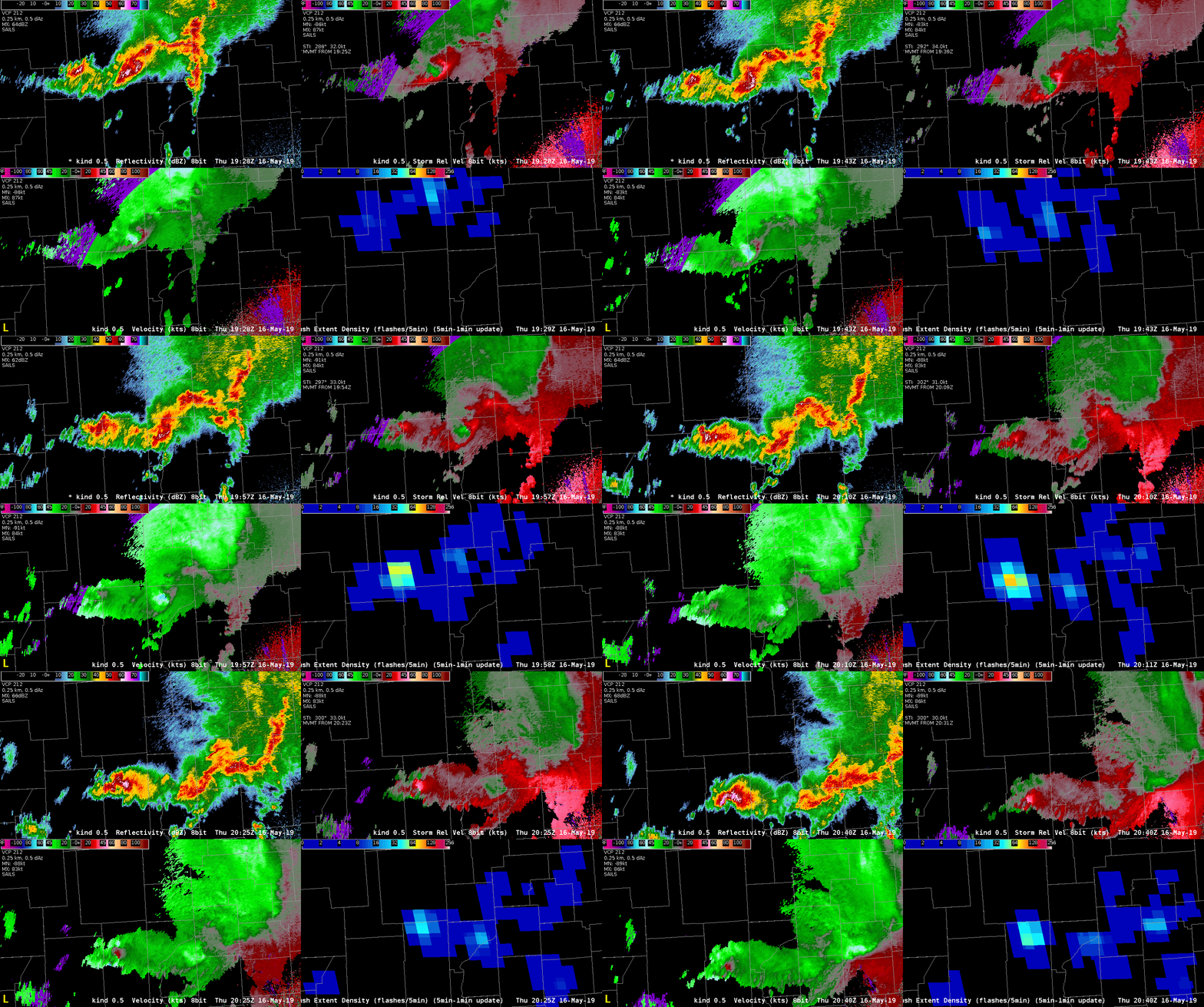
There was also an increase in FED after the tornado signature became less intense, but when it wrapped up again, the FED decreased again (not shown).
Interestingly, I also looked at these same data with the new color curve that Jonathan and Kristin worked on today, and the increase and decreases in FED were not as clear, and I don’t think it would have drawn my attention as quickly. Perhaps the lower values need to be more muted or less bright, but still within the same the rainbow color curve.
-Tempest Sooner
5-min FED Colormaps
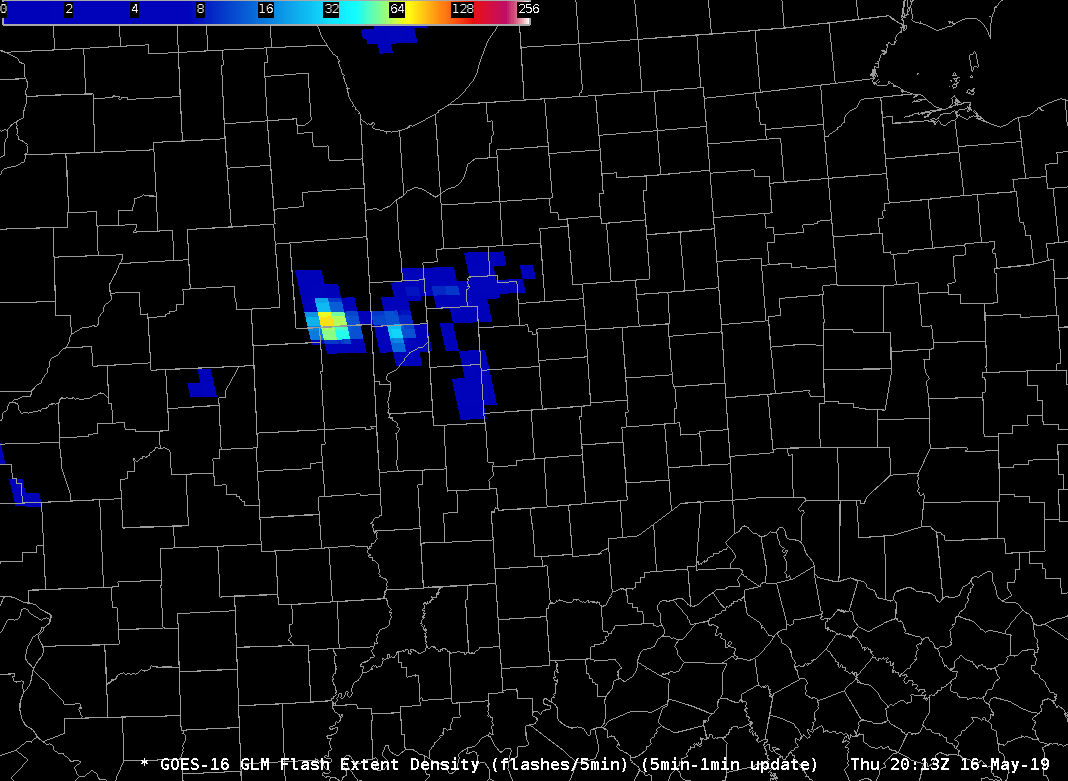
Testing a new colormap for FED using the Rainbow colormap in Python. The first image depicts the modified 5-min FED with the modified colormap. There is more variation on the lower end of the 5-min FED. Will this colormap depict the variation in the more intense convection. The second image is the original 5-min FED colormap. – Jonathan Wynn Smith (ESSIC/UMD)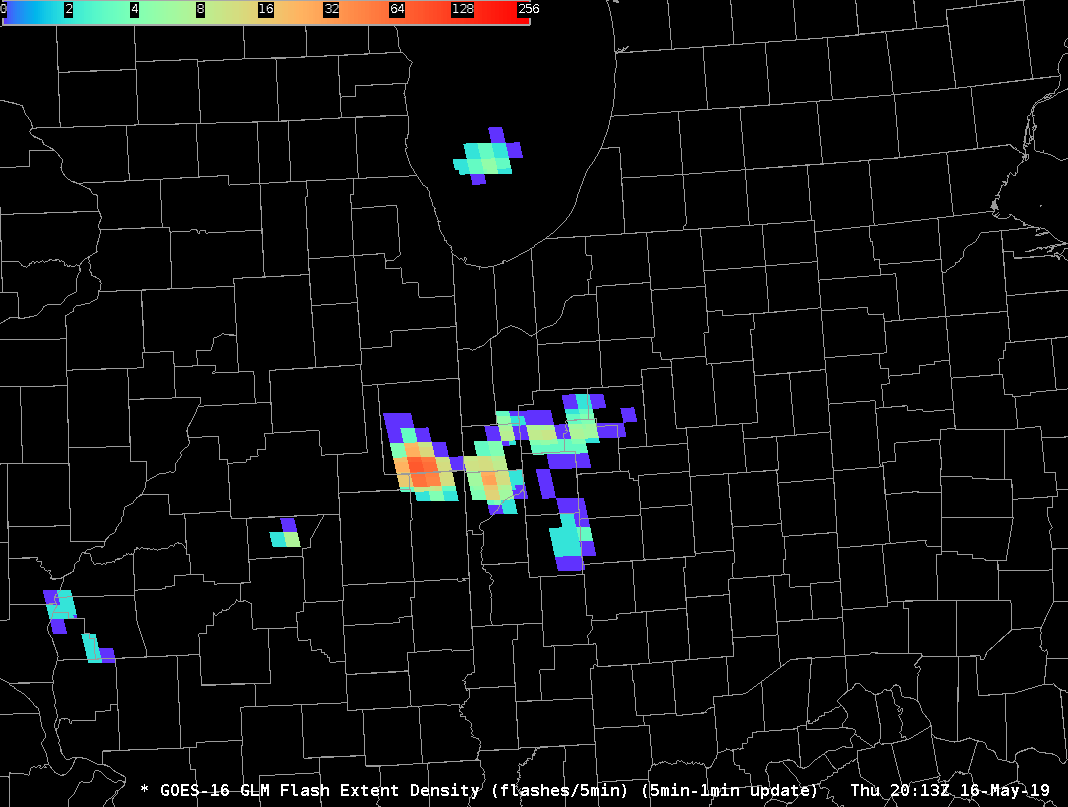
IDSS Usage from GLM/Minimum Flash Area
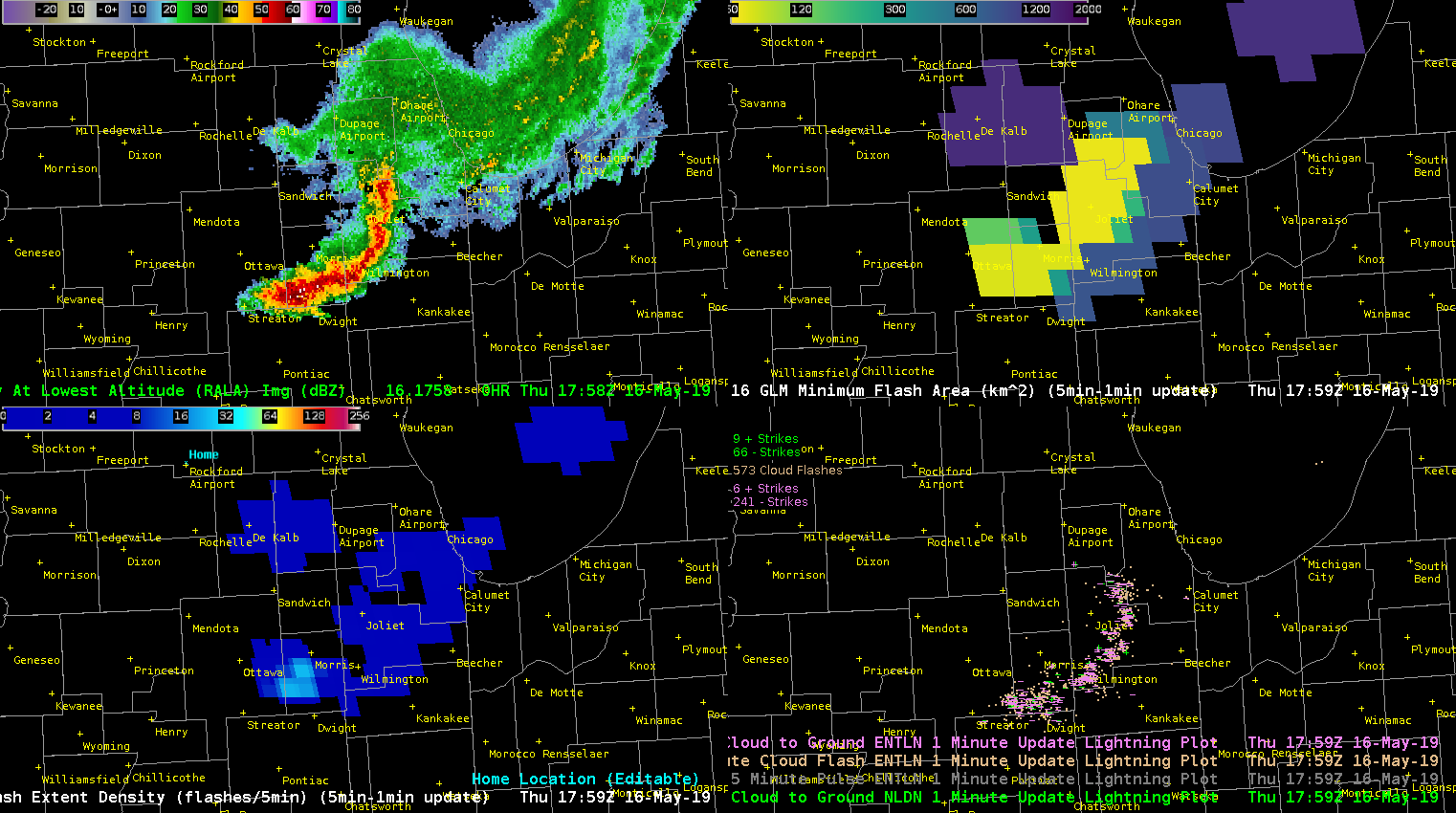
An MCS shifting southeastward across northern IL was producing quite a bit of lightning, and much of it was moving through the southwest portion of the line per Flash Extent Density. From a IDSS standpoint, the Minimum Flash Area and FED proved that it’s necessary to look at both GLM products and ground based lightning products to see the “total” picture. The GLM products captured a larger flash that extended out into the stratiform area behind the main line that is not seen in the ENTLN and NLDN products. This information can be especially important for Airport Weather Warnings and/or outdoor venues. You can easily see that the flash extends almost back to the Rockford Airport, while the main line and most of the flashes are ~80 miles away. In other words, areas near Rockford Airport are not out of the woods yet for lightning.
-Tempest Sooner