


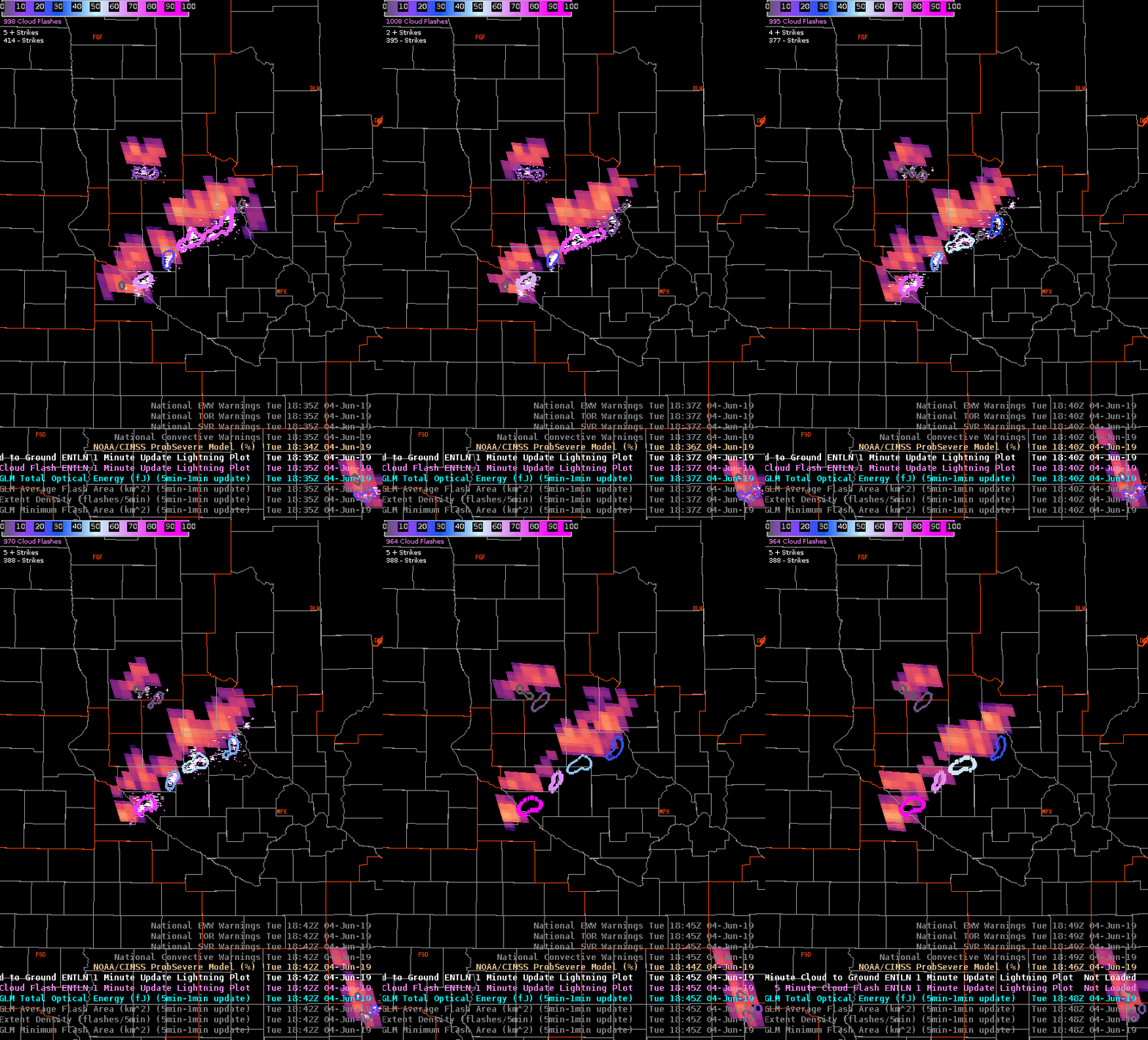
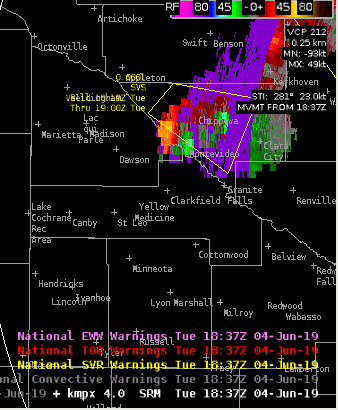
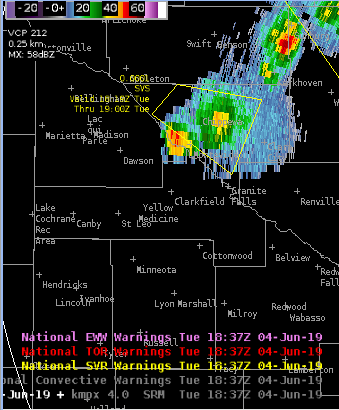
Flash extent density focused on that storm as well. Prob severe coming up. Had 50 dBZ to 48 kft and ~115 knot Delta V at storm top.
Official websites use .gov
A
.gov website belongs to an official government
organization in the United States.
Secure .gov websites use HTTPS
A
lock (
) or https:// means you’ve safely connected to
the .gov website. Share sensitive information only on official,
secure websites.

Flash extent density focused on that storm as well. Prob severe coming up. Had 50 dBZ to 48 kft and ~115 knot Delta V at storm top.
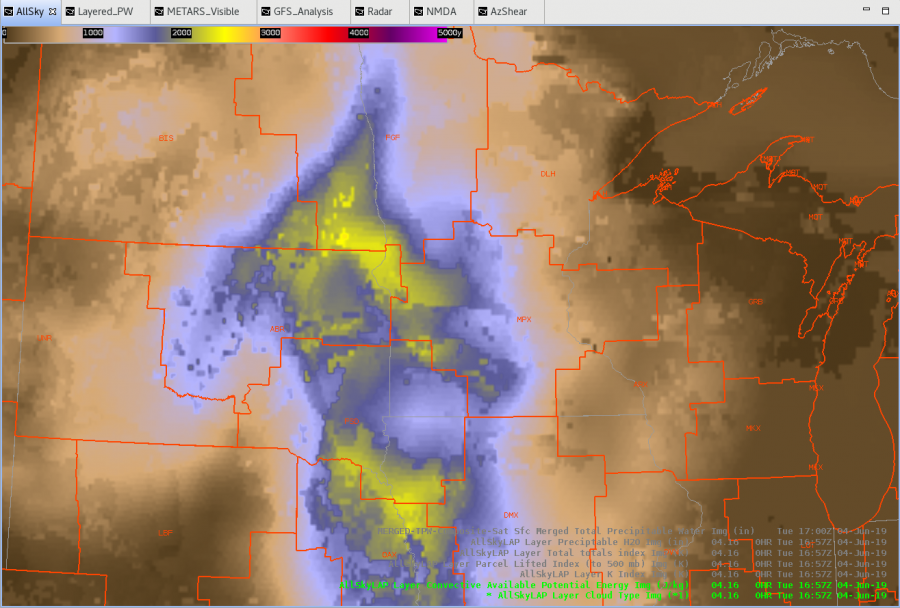
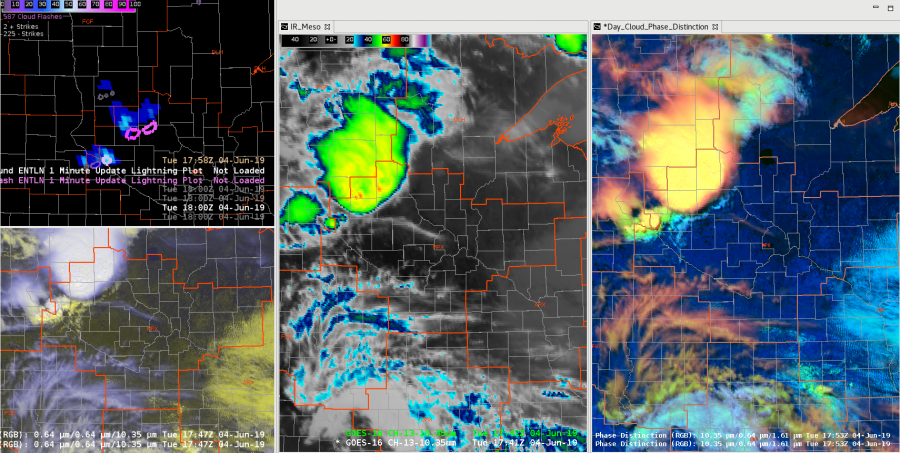
Ongoing complex of thunderstorms pushing into south central MN this hour. Have a new set of thunderstorms forming in what AllSky is showing as a higher CAPE environment along the outflow pushing out from this complex. ProbSevere has picked up on this cell as well (near Milan)…showing a Hail chance of 55% now and growing quickly. Will monitor the downstream growth of both systems.
A storm just northeast of Amarillo developed quickly along a frontal boundary, and quickly showed supercellular characteristics with mid level rotation and a 65+ dbz core reaching about 35 kft MSL. 2 inch hail was reported with this storm during this time. GLM data again shows a decrease in both Flash Extent Density (top right) and Event Density (top left) show a notable decrease in GLM lightning activity while ground based radar remains fairly unchanged, and both the IR satellite presentation (bottom right overlaid on visible imagery) and radar data (not shown) indicate the storm maintained intensity and if anything, had strengthened a bit.
-64BoggsLites
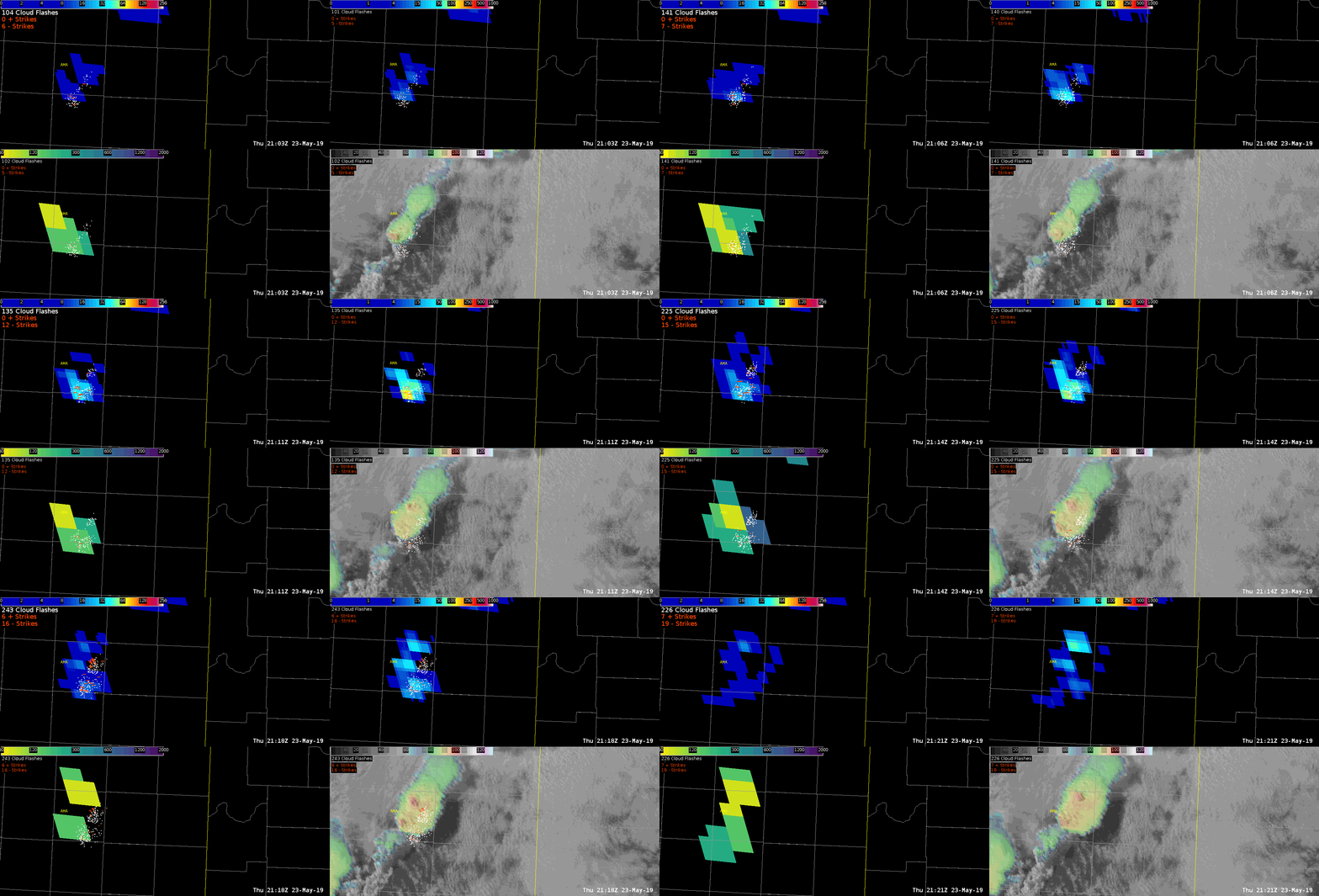
A supercell moving northward along the dryline over the Texas Panhandle region underwent a split over the last 20 minutes or so. Preceding the split, there was a notable decrease in 5 minute GLM Flash Extend Density and Event Density. After the split, there were to notable maxes in both of these products. However, in the GLM Minimum Flash Area, this trend was not observed due to the more coarse resolution of the product. Better resolution may have helped identify both updraft regions within the 2 storms after the split. Additionally, a downward trend was noted in 5 Event Density and Flash Extent Density despite no real change in the ENTLN lightning activity. A loop of GLM data and IR/Vis depicting this storm split is below. 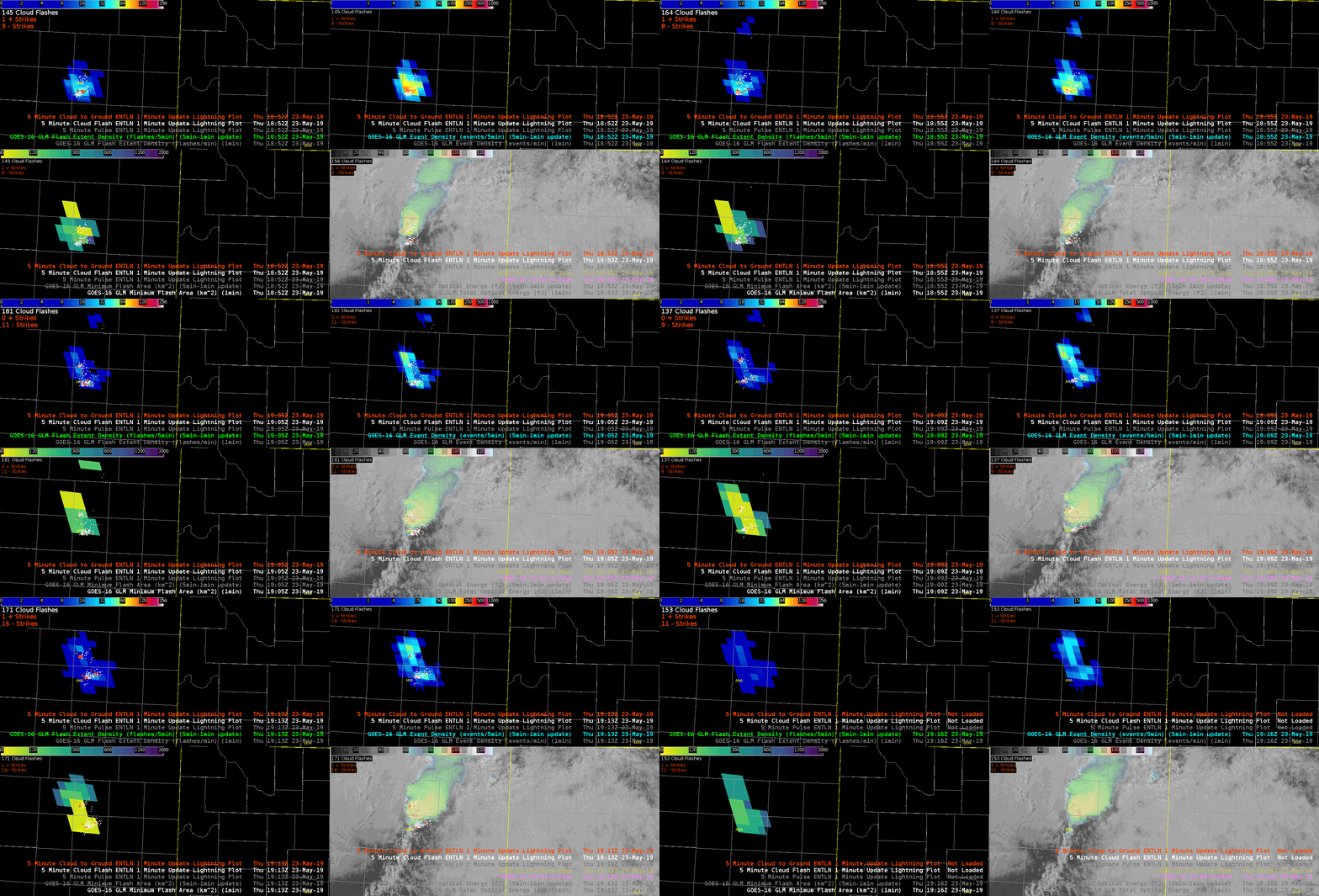
-64BoggsLites
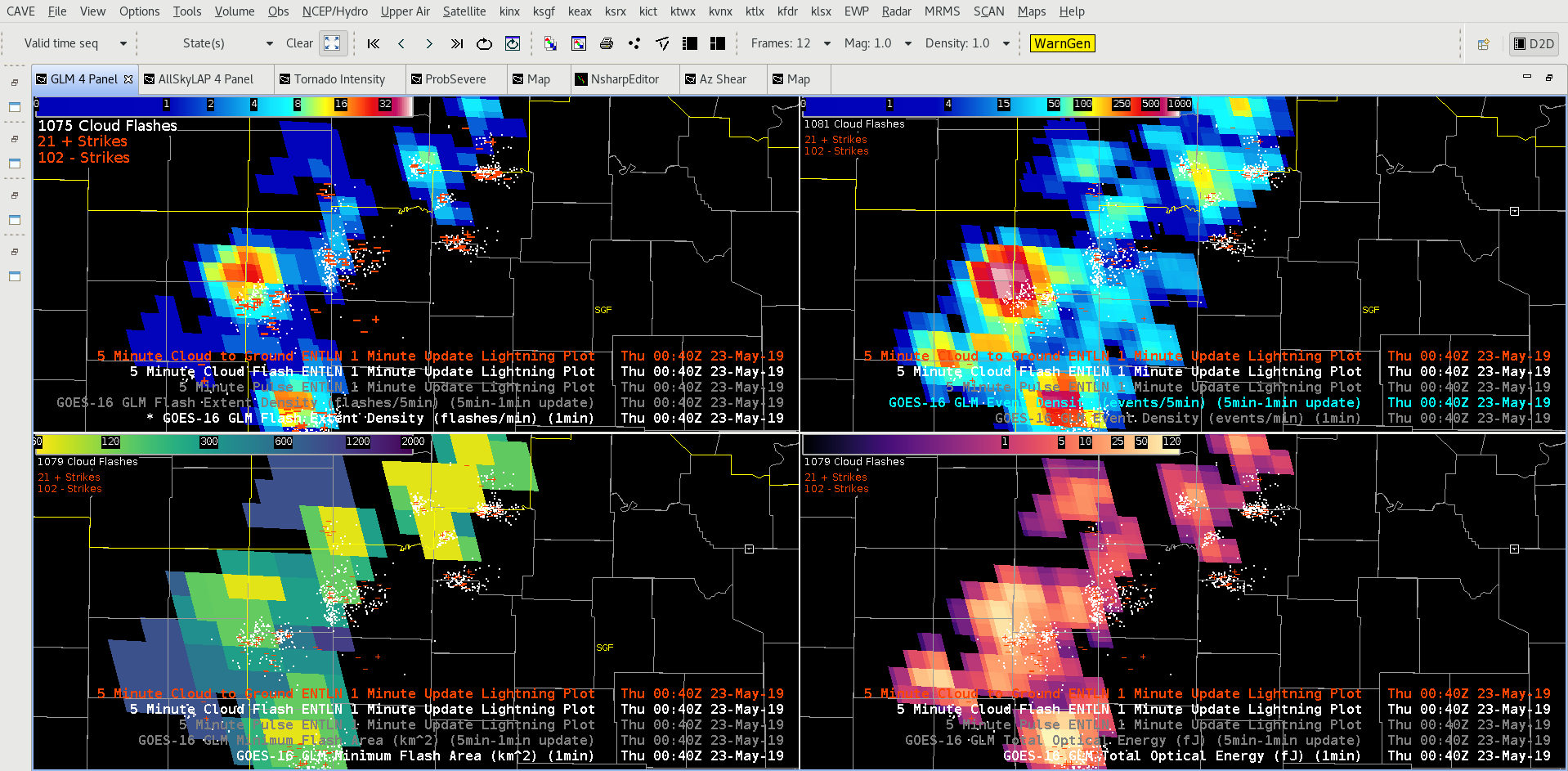
Comparing GLM flash extent density and GLM event density to ground based ENTLN data along the Kansas/Missouri border region, there is a notable minimum in GLM data with a couple of the large clusters of ground based lightning clusters, while the other ground based lightning clusters seem to correlate relatively well with GLM data. Very strange indeed
-64BoggsLites
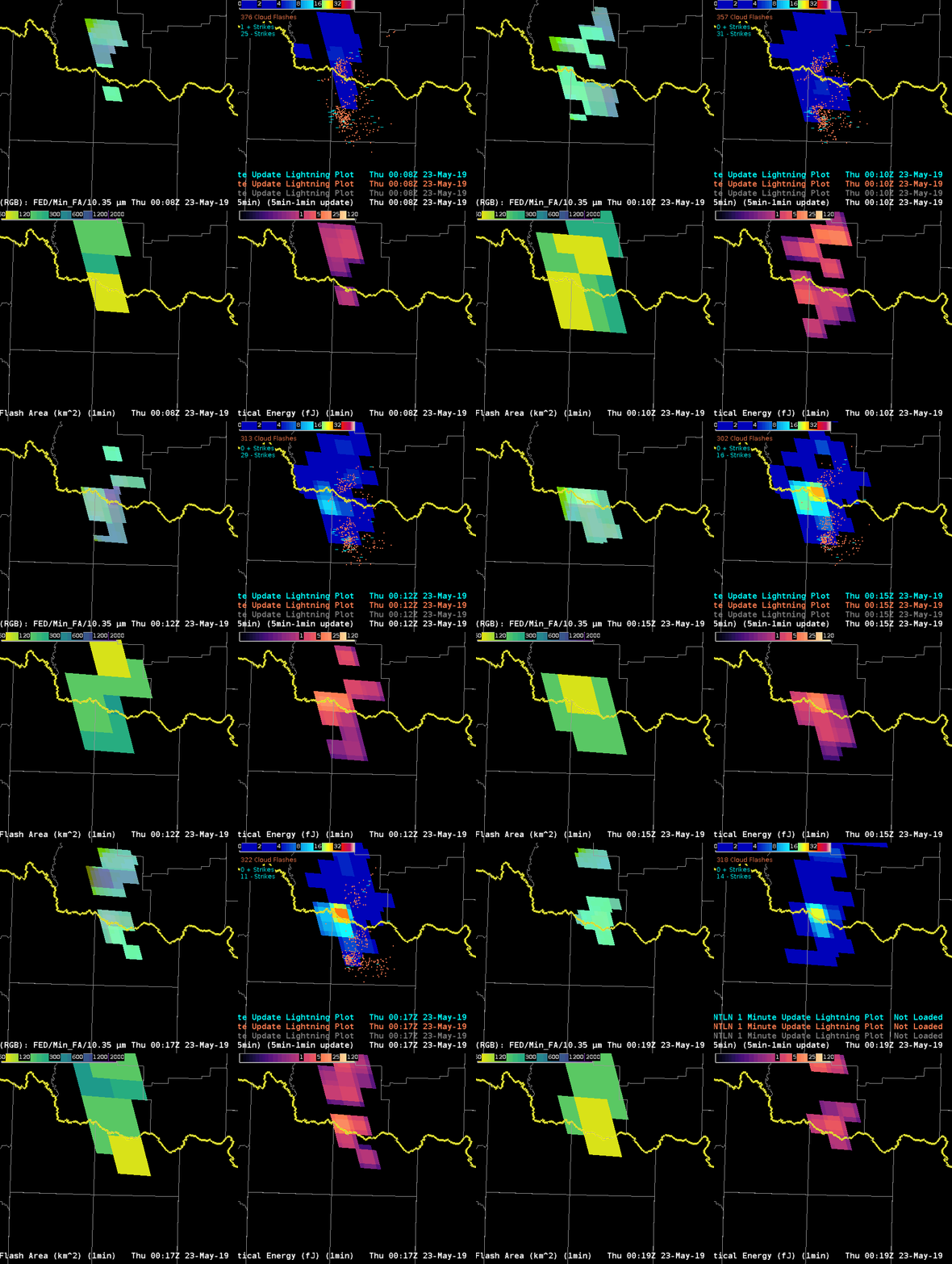
Storms continue just after 7pm near the Oklahoma/Texas border. A currently severe-warned storm saw a substantial and rapid increase in lightning activity observed by the GLM Flash Extent Density product. However, the ground based lightning network did not follow the same trend and remained fairly steady. The ground based data is more reasonable considering the storm did not experience any sort of significant strengthening during this time period. Earlier discussions with lightning detection experts suggested the low GLM FED count may be due to the location of lightning within the storm updraft region, which could impact how well GLM can sense it. That is difficult for the typical operational meteorologist to consider in real-time since it goes well beyond current training, and leads to decreased forecast confidence in the lightning data.
Dave Grohl
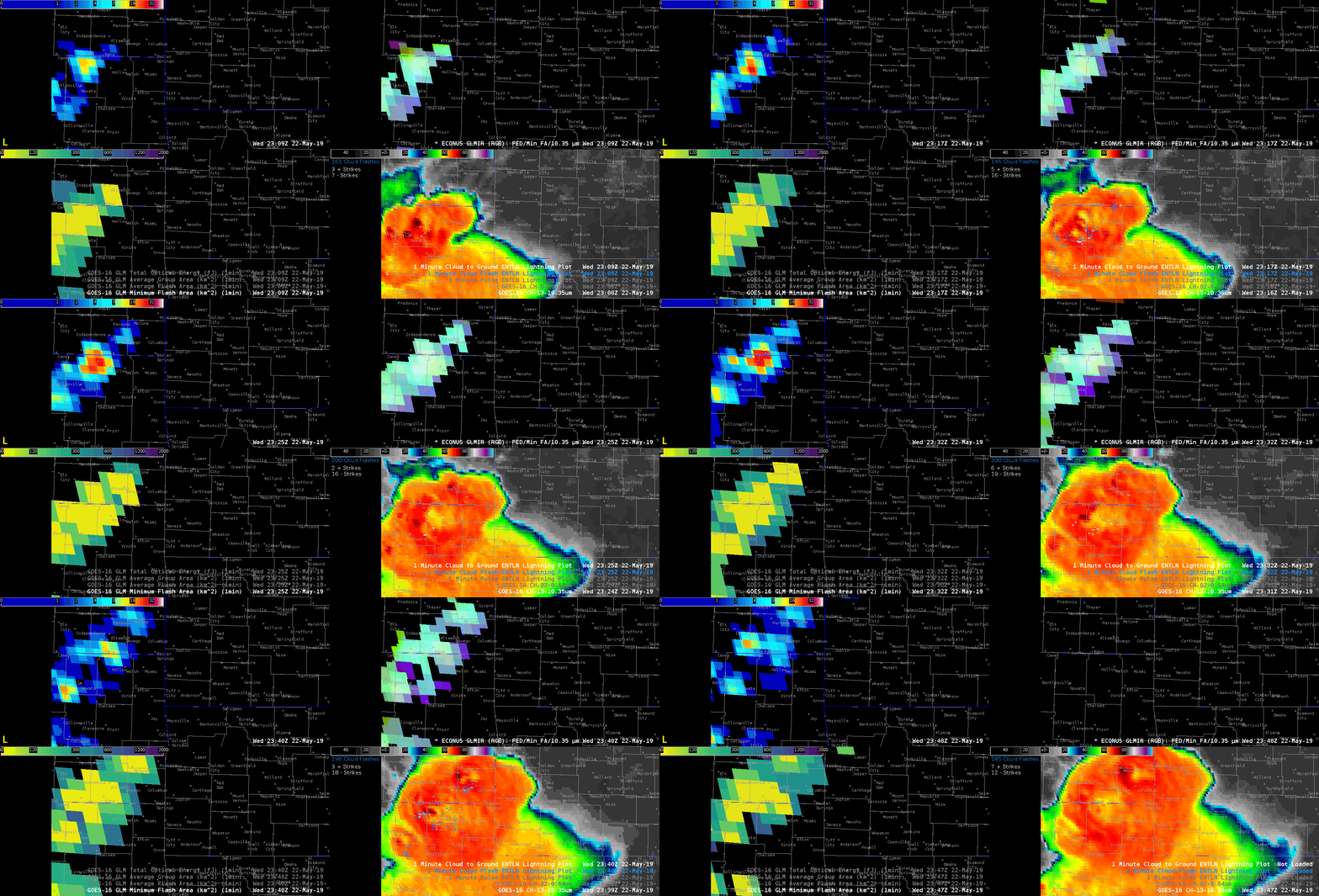
GOES-16 10.3 um IR channel in the lower right panel captured an exceptionally cold overshooting top at -82 C. This occurred toward the beginning of the animation at 2311Z in far northern Oklahoma (south of Coffeyville, KS) and preceded a large jump in the flash extend density (upper left). The minimum flash area did not change much during this loop, so it may be advantageous for this component of GLM to have a higher spatial resolution than what is currently used. The GLM RGB product (upper right) merges the flash extent density, minimum flash area, and 10.3 um cloud top temperatures. A group of bright cyan and white pixels helped highlight where all three of the aforementioned components were maximized. In addition to a substantial increase in the flash extent density 5-10 min following the -82 C cloud top temp., ENTLN ground based lightning flash counts doubled during the same time.
Although the environmental conditions already supported warning on this storm prior to the overshooting top (OT), seeing the FED and ground based lightning double, likely in response to the intense OT, may push a forecaster to upgrade the severity of the warning (larger hail, higher winds etc.) -Roy
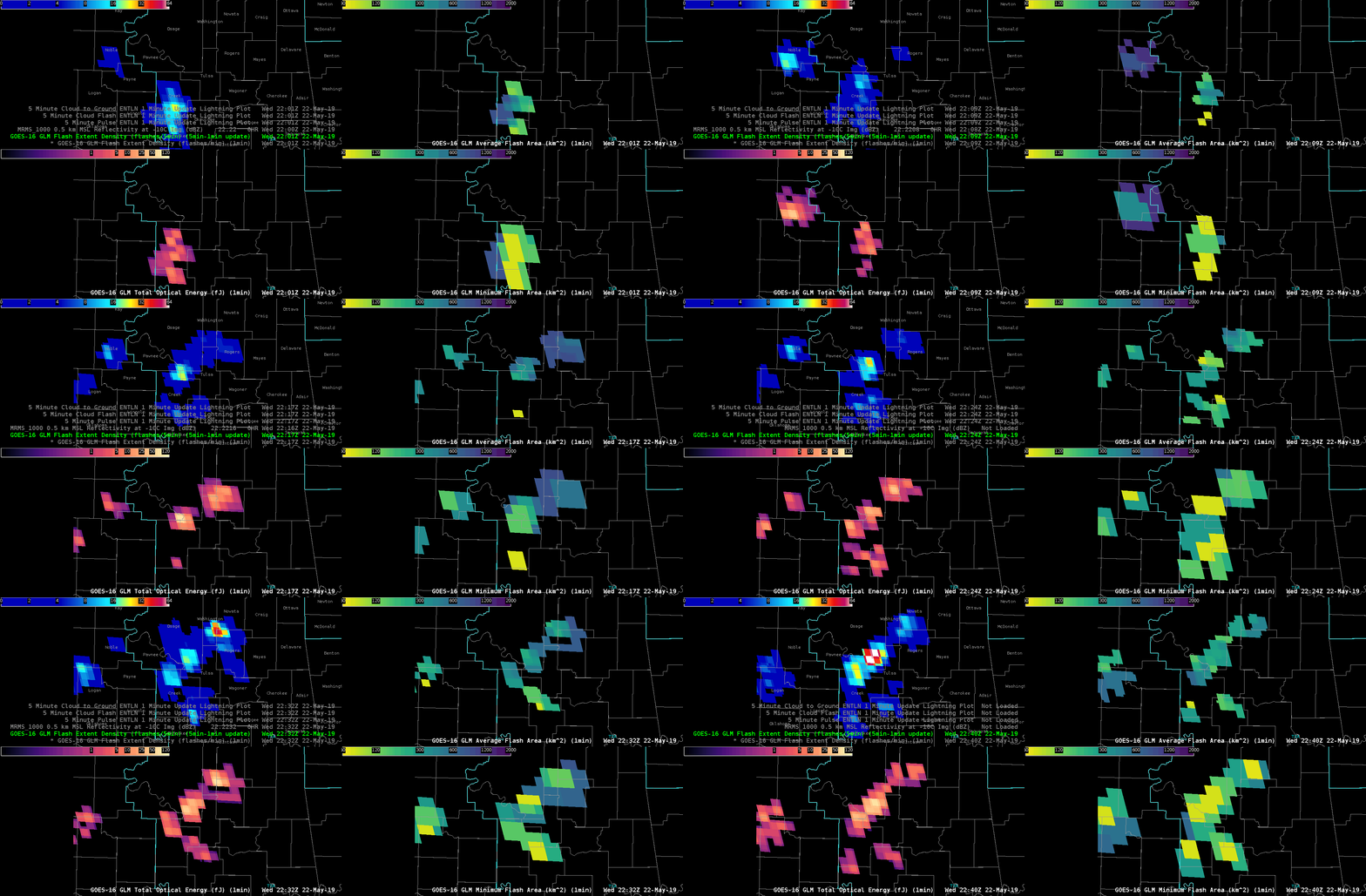
A loop of GLM products, particularly the Flash Extent Density and the Minimum Flash (top left and bottom right, respectively), appear to have depicted strengthening updrafts in the Tulsa area. In particular, notice the uptick in Flash Extent Density going from Creek to Osage Counties, as well as the area over northwestern Rogers County. The increases in FED coincided with low areas of Minimum Flash Area.
The MRMS -20C Reflectivity product shows the strengthening updrafts over the same time frame:
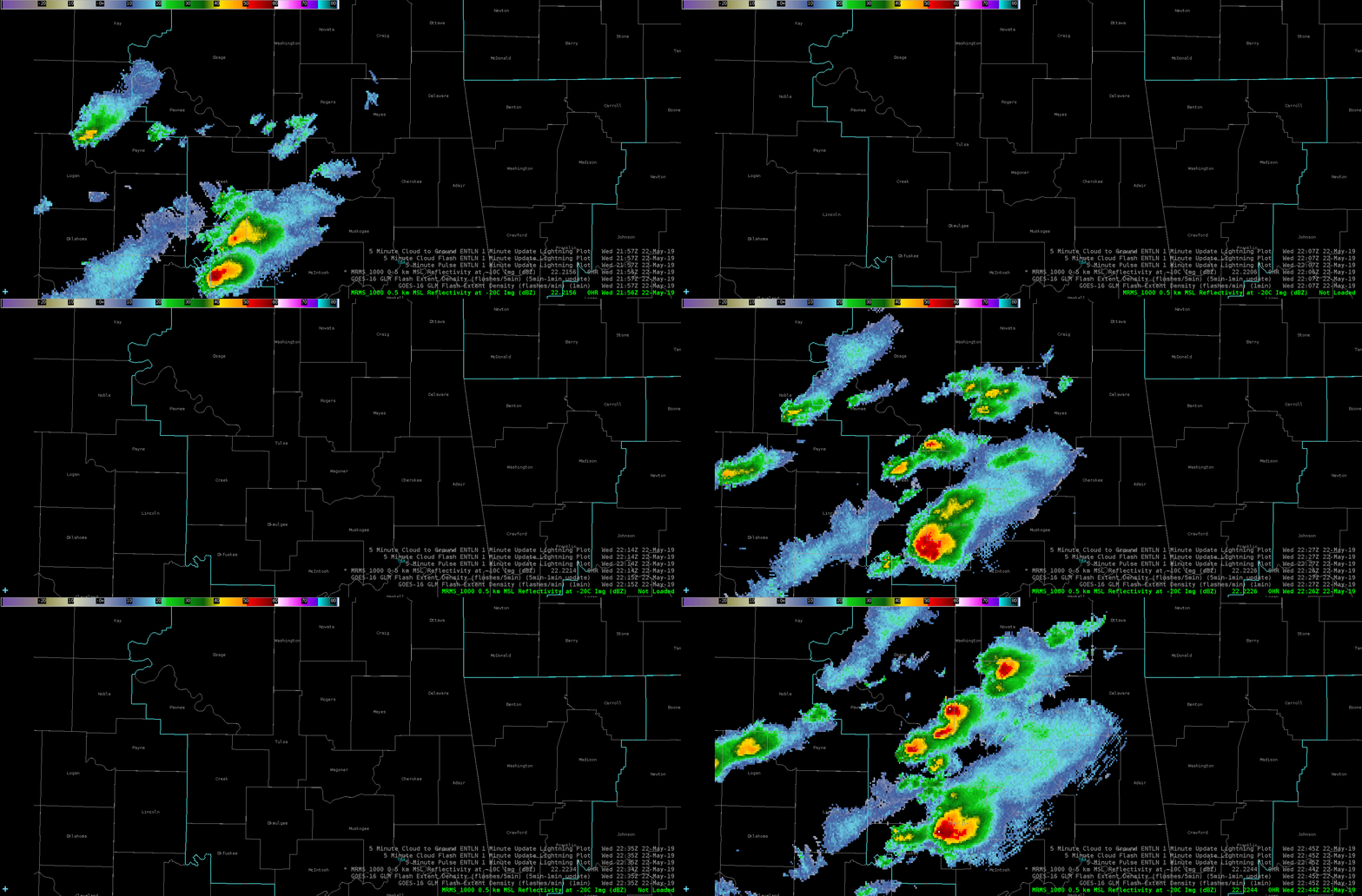
The GLM products increased confidence in a decision to issue two SVRs.
Ron Dayne
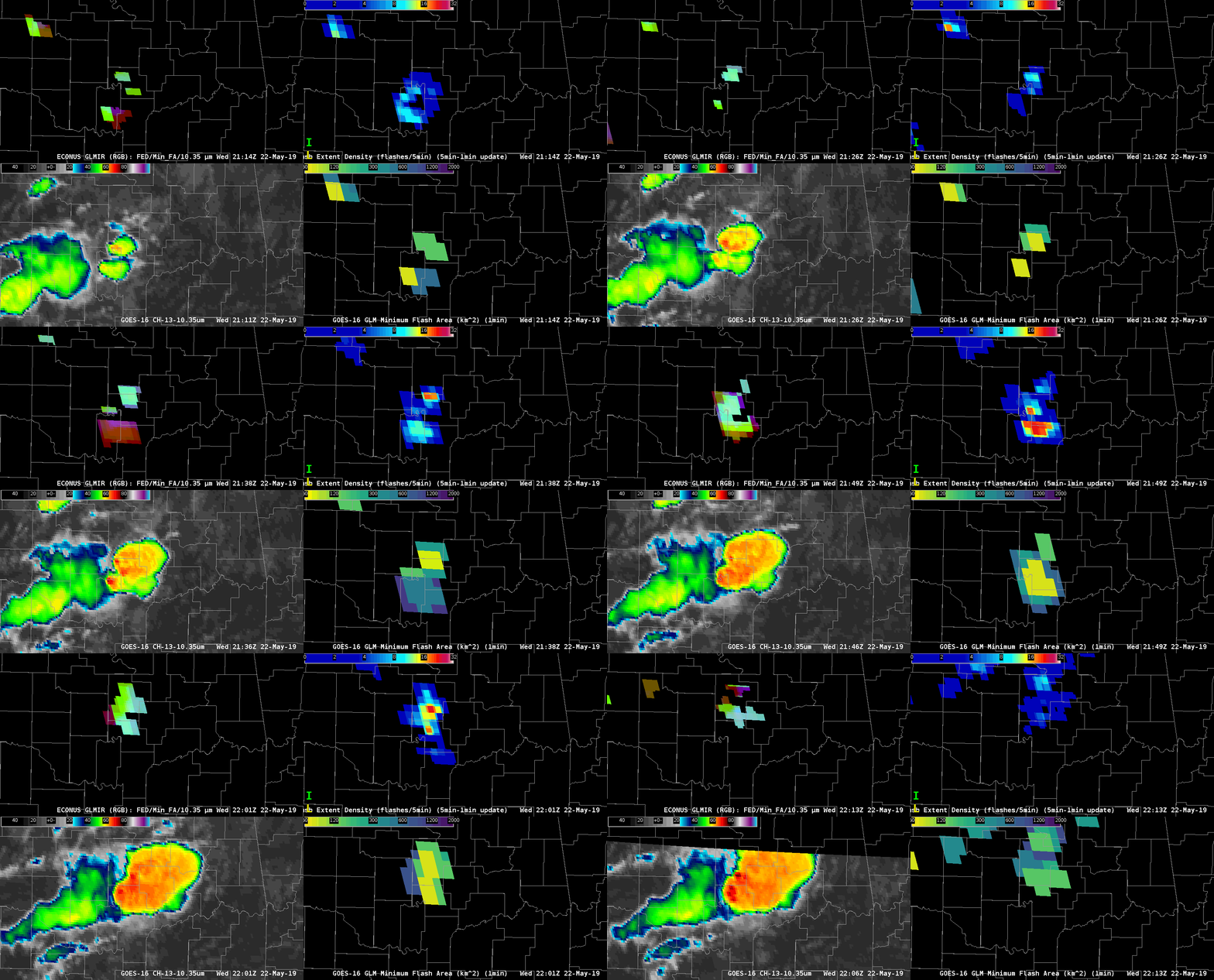
This pair of supercells near Tulsa, OK illustrates how flash rate and flash area information can complement one another. High flash rates and small flashes usually go together in a small updraft. However, at 2145 UTC the flash rate is much higher in the southern storm at the same time its minimum flash size is larger, with the opposite pattern in the northern storm. The northern storm was tornadic at this time. Shortly thereafter, the large flash rates decreased in the southern cell, and the average flash size became smaller, while cloud top brightness temperatures rapidly cooled and the extent of the anvil spread. The southern cell would soon go on to produce its own tornado.
The RGB panel in the top left combines the flash information together with the ABI 10.3 thermal infrared data: the coldest cloud tops and small flashes lead to a bright cyan color, and high flash rates push the colors further toward white. Early on the northern cell exhibits cyan colors while the southern cell is green and burgundy. Later, the southern cell becomes more cyan, while the northern cell takes on a more green hue.
Apparently, the jump in flash rate in the southern cell was an indicator of a strengthening updraft and the development of a mesocyclone. The drop in flash rate and minimum flash size might have been due to (1) a shift to small flashes that didn’t make as much light, (2) extinction of light by an increasingly ice-rich, optically thick cloud, or (3) other instrument artifacts. While the explanation is less than clear-cut, synthesis of multiple sources of information improves the ability to understand the observations.
-deeplycloudy
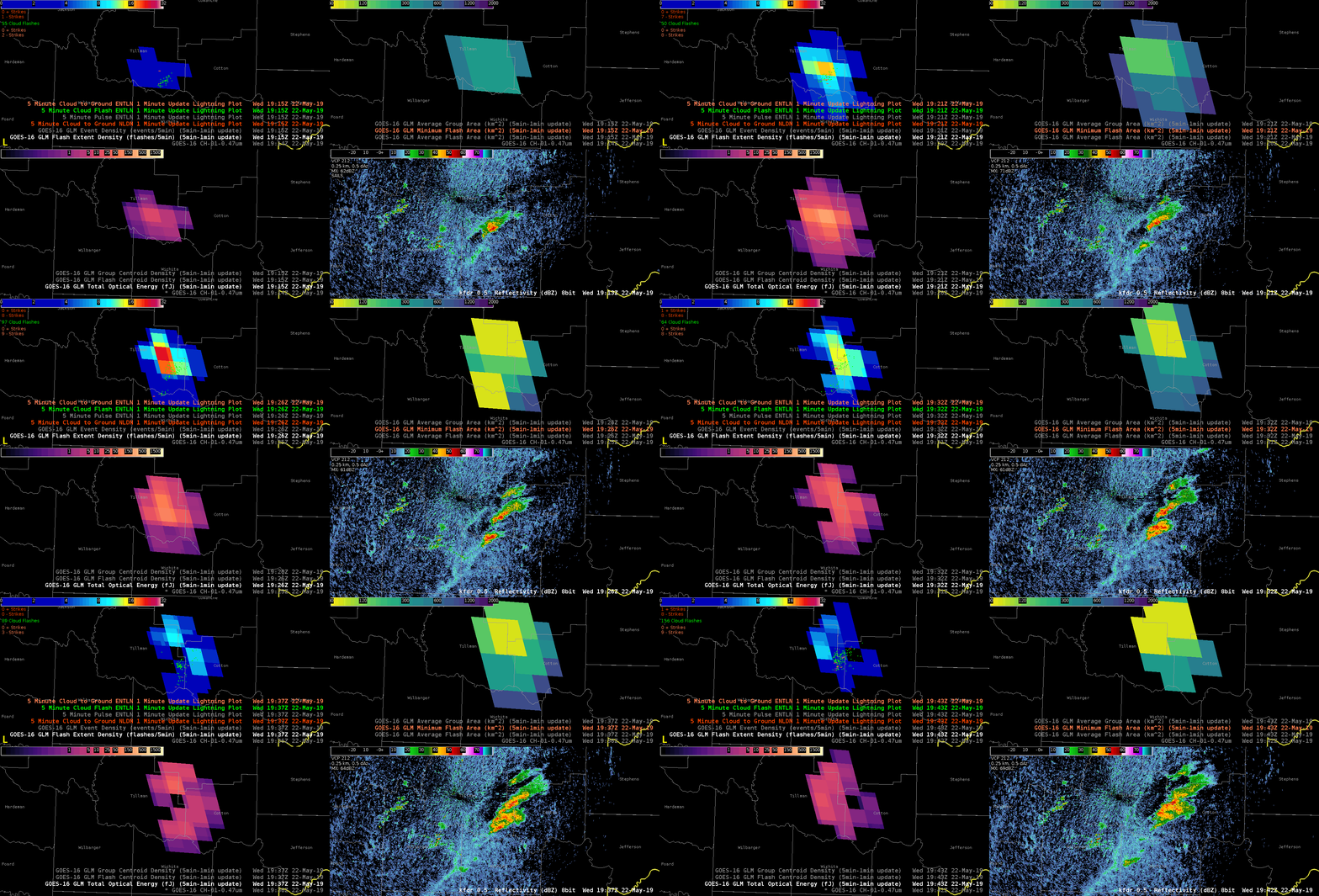
The first CI of the day occurred just after 19Z. The radar appearance of the storm remains healthy and the ground-based lightning networks are as strong as they’ve been, but the GLM strength has (erroneously) dropped off dramatically.
-Atlanta Braves