Fun 30 minutes of storms in Florida

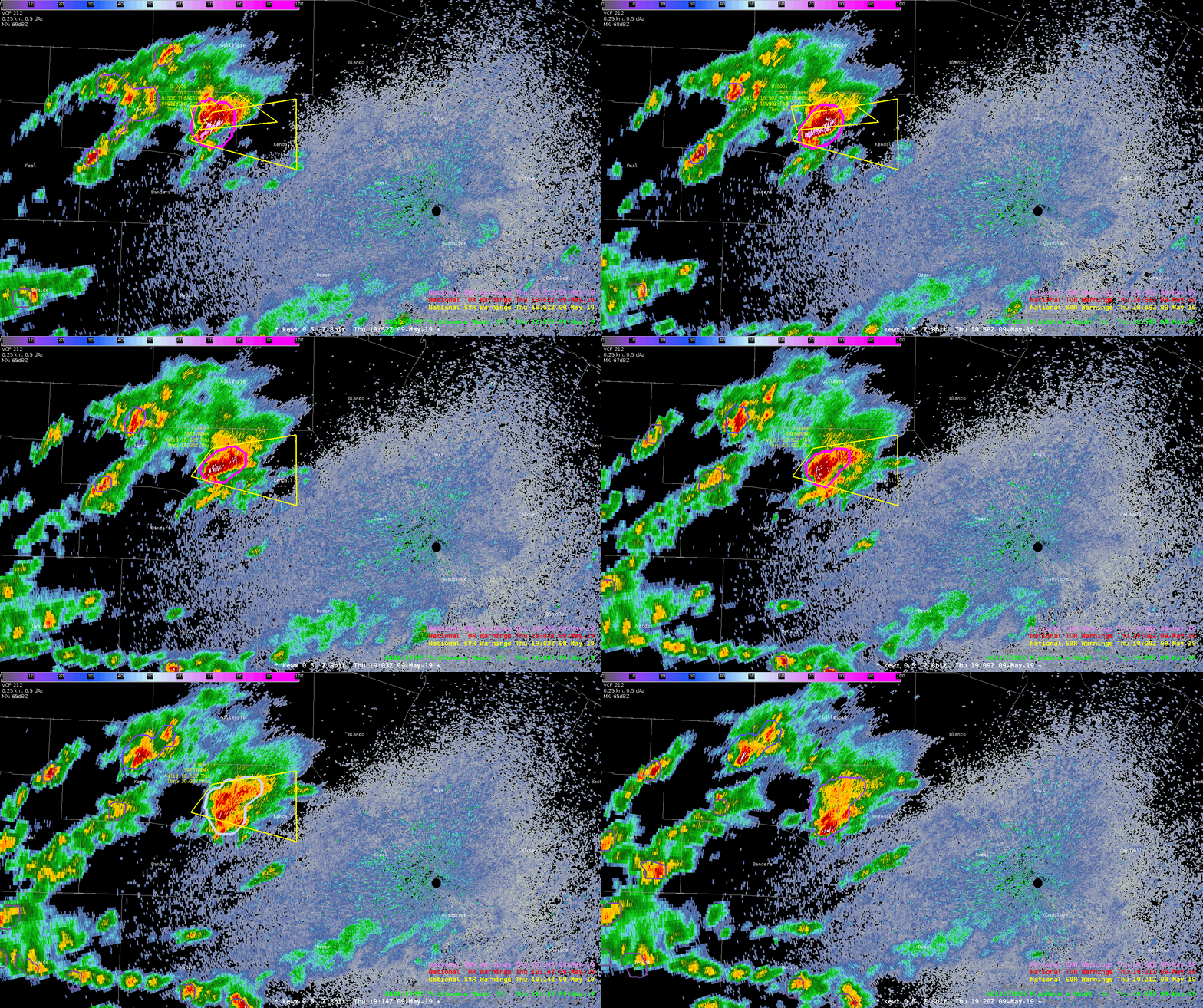
There was a nice area of convection moving off the east coast of Florida with storms forming off an apparent outflow boundary moving to the south. As the storms moved off the coast they increased intensity exponentially. Focusing on these storms as they moved over water reflectivity showed max dBzs in the low to mid 60s with tops 45-50k ft high. GOES-16 Event density (5min-1min update) showed a value of 247 suggesting a nice updraft, which AzShear seems to further support with a bright white color and value of .007s^-1 exactly where the max dBzs/echo tops/GLM data is. In addition,prob severe did a good job of tracking the storms…but with the storms moving off the coast it is impossible to get any storm reports to verify its accuracy.

Utilizing all of this data I would most definitely want to issue a localized small craft or some sort of marine advisory or warning…if there was one for this are. -Desmond
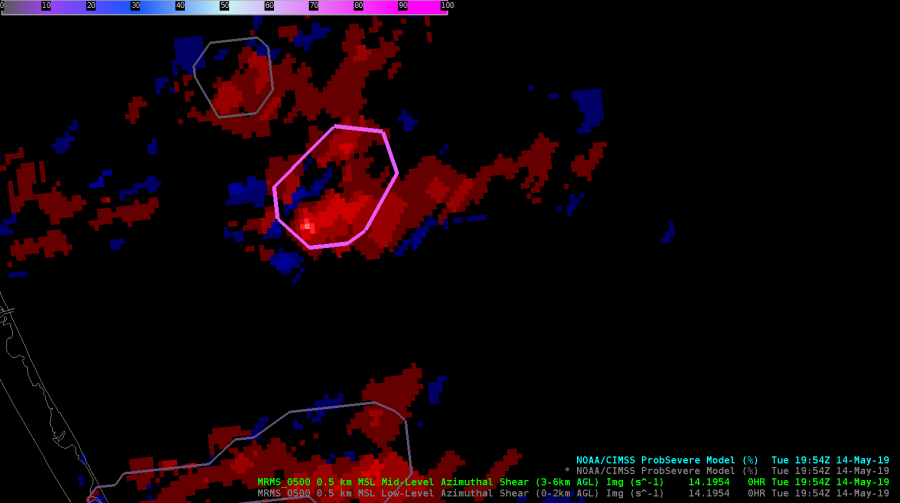
AzShear .007s^-1
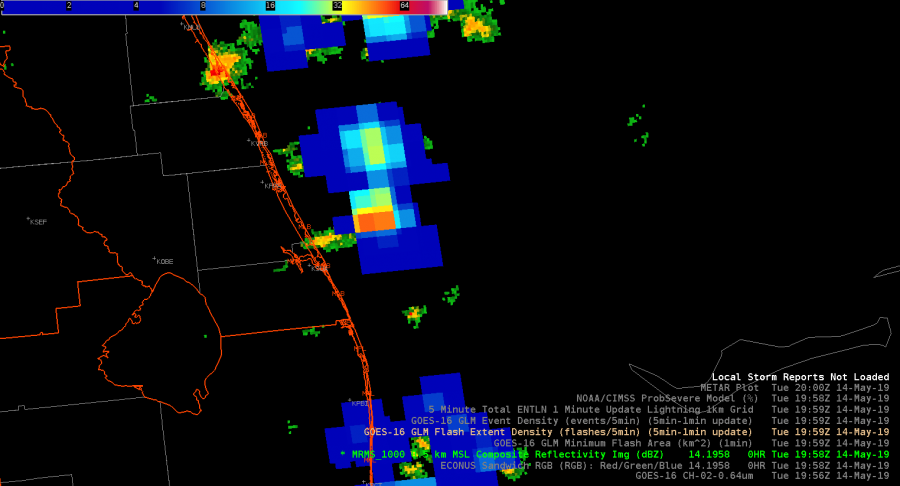
GOES-16 Event density (5min-1min update)
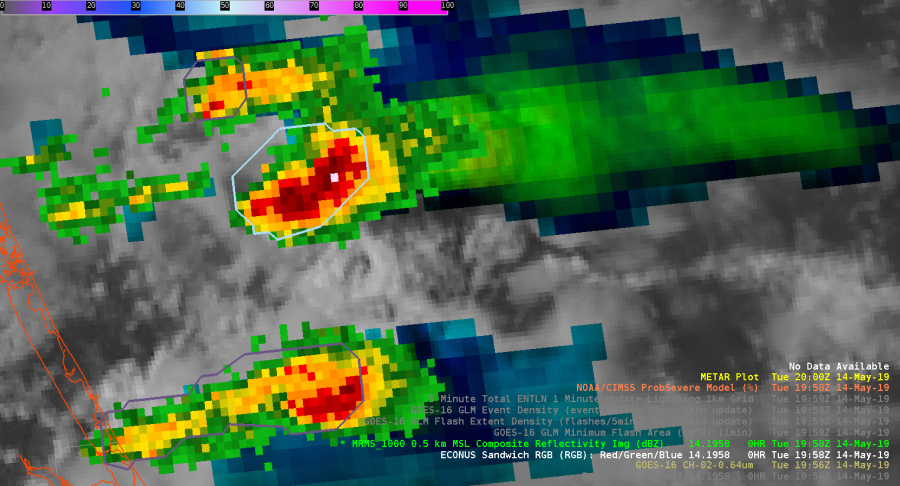
Max dBzs in the low to mid 60s
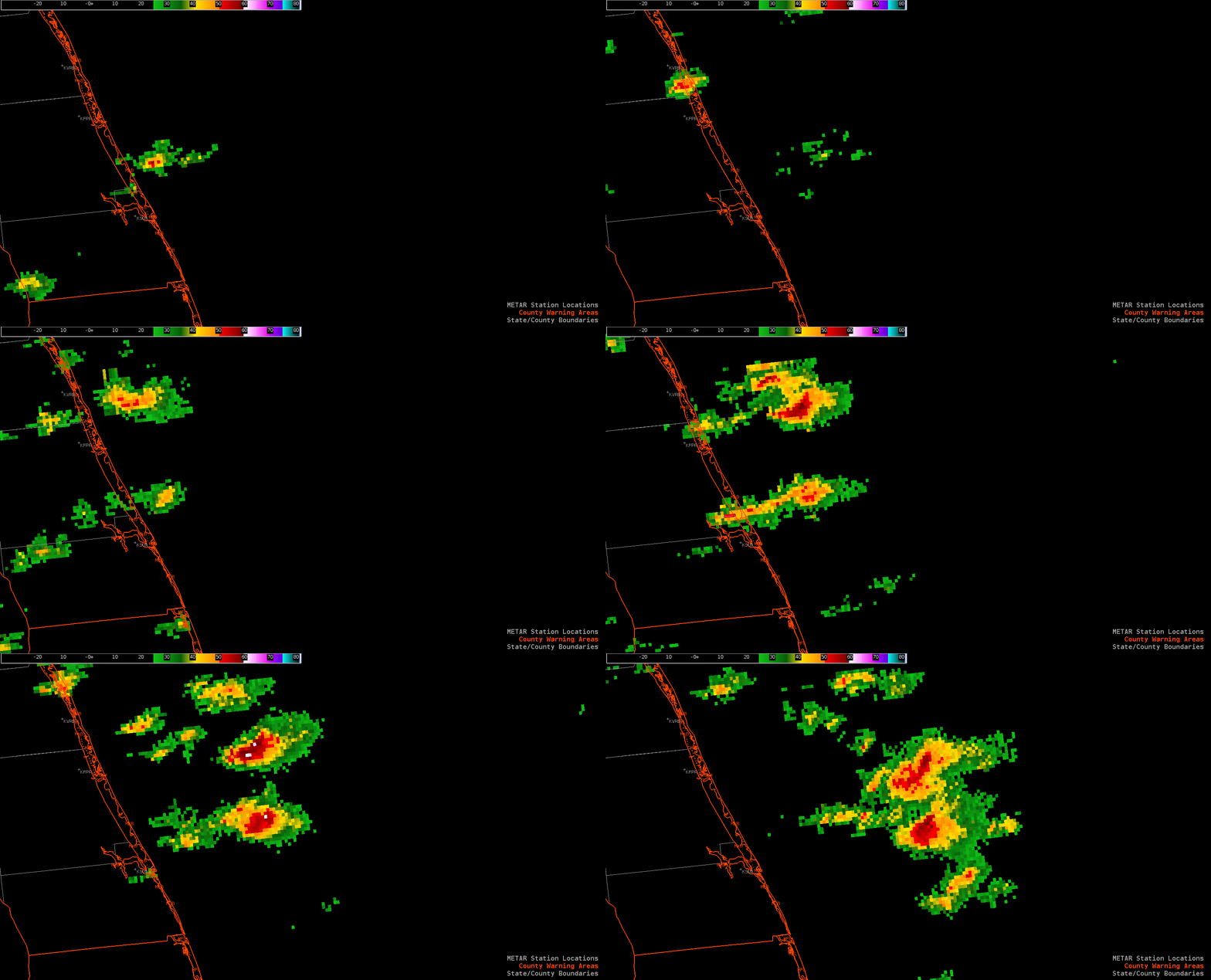
 

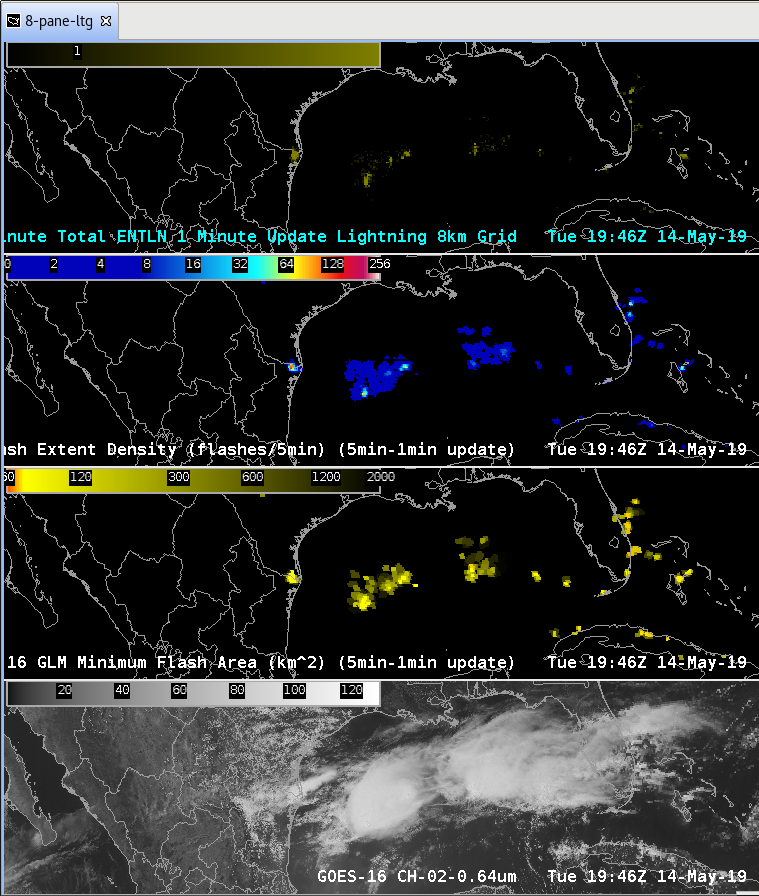
GLM detection efficiency over the Gulf of Mexico

When life hands you lemons (or for that matter, a bleak, moisture-starved convective environment draped over the entire CONUS) we can still  make lemonade on this particular day by focusing on the Gulf of Mexico.

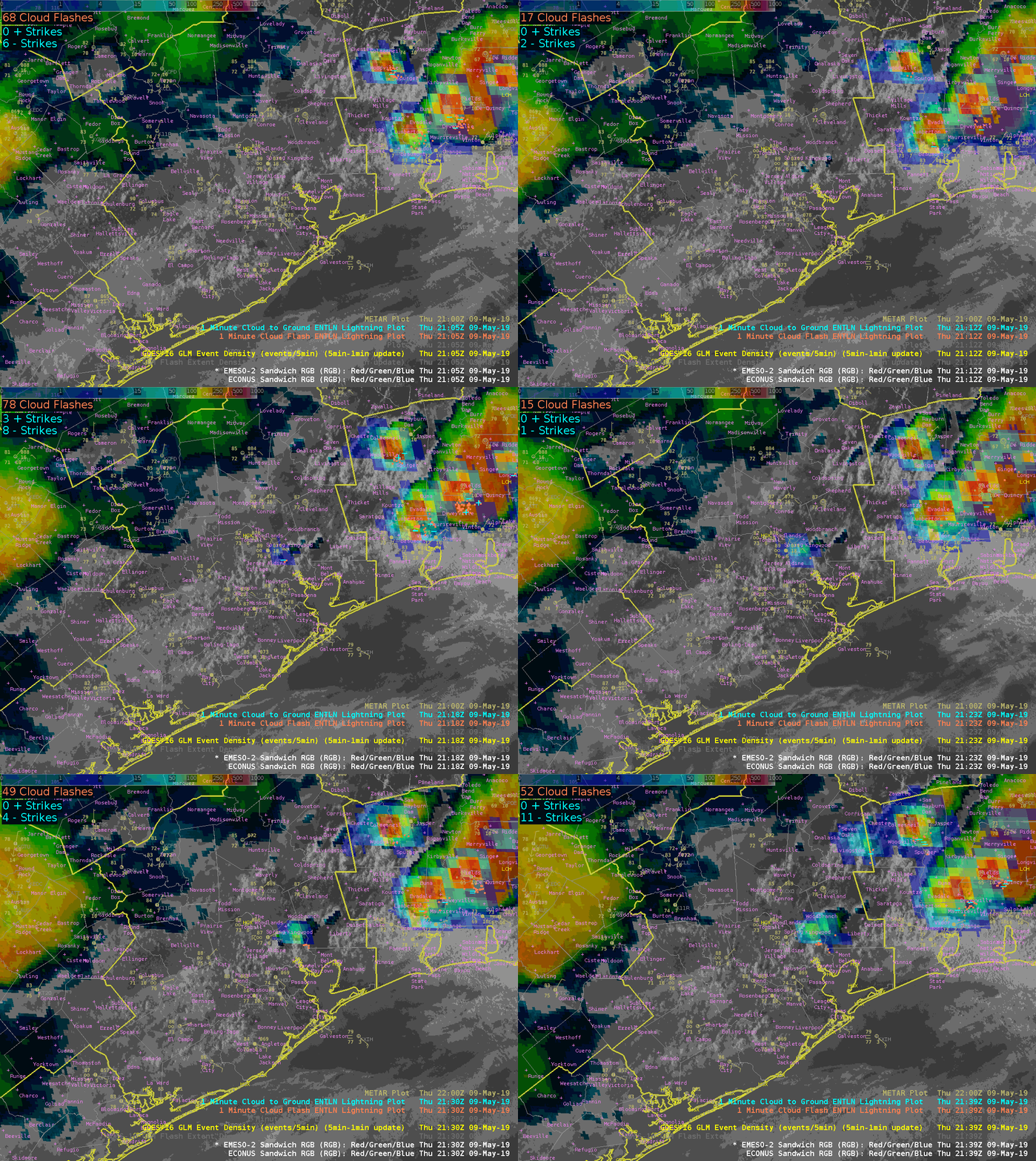
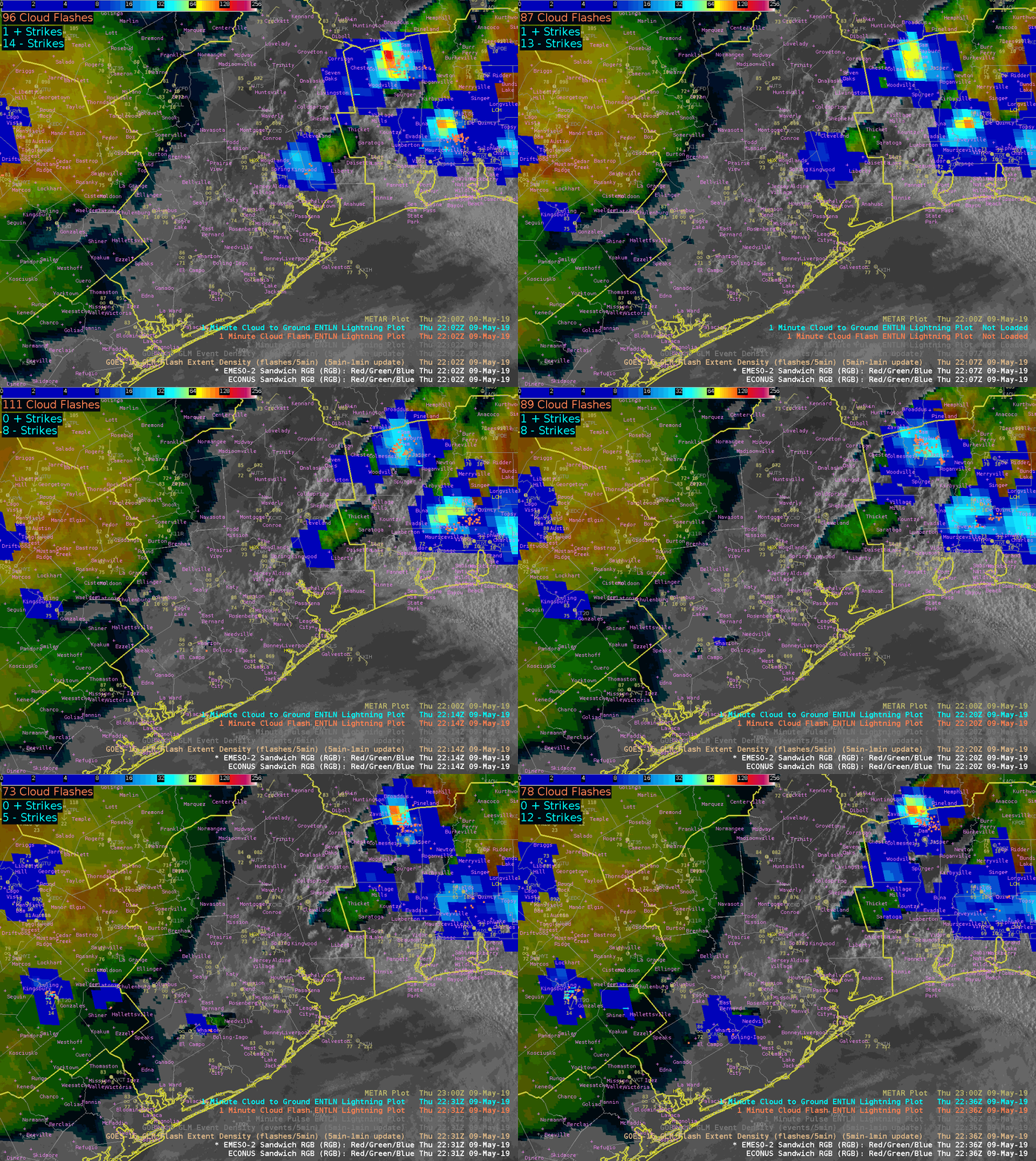
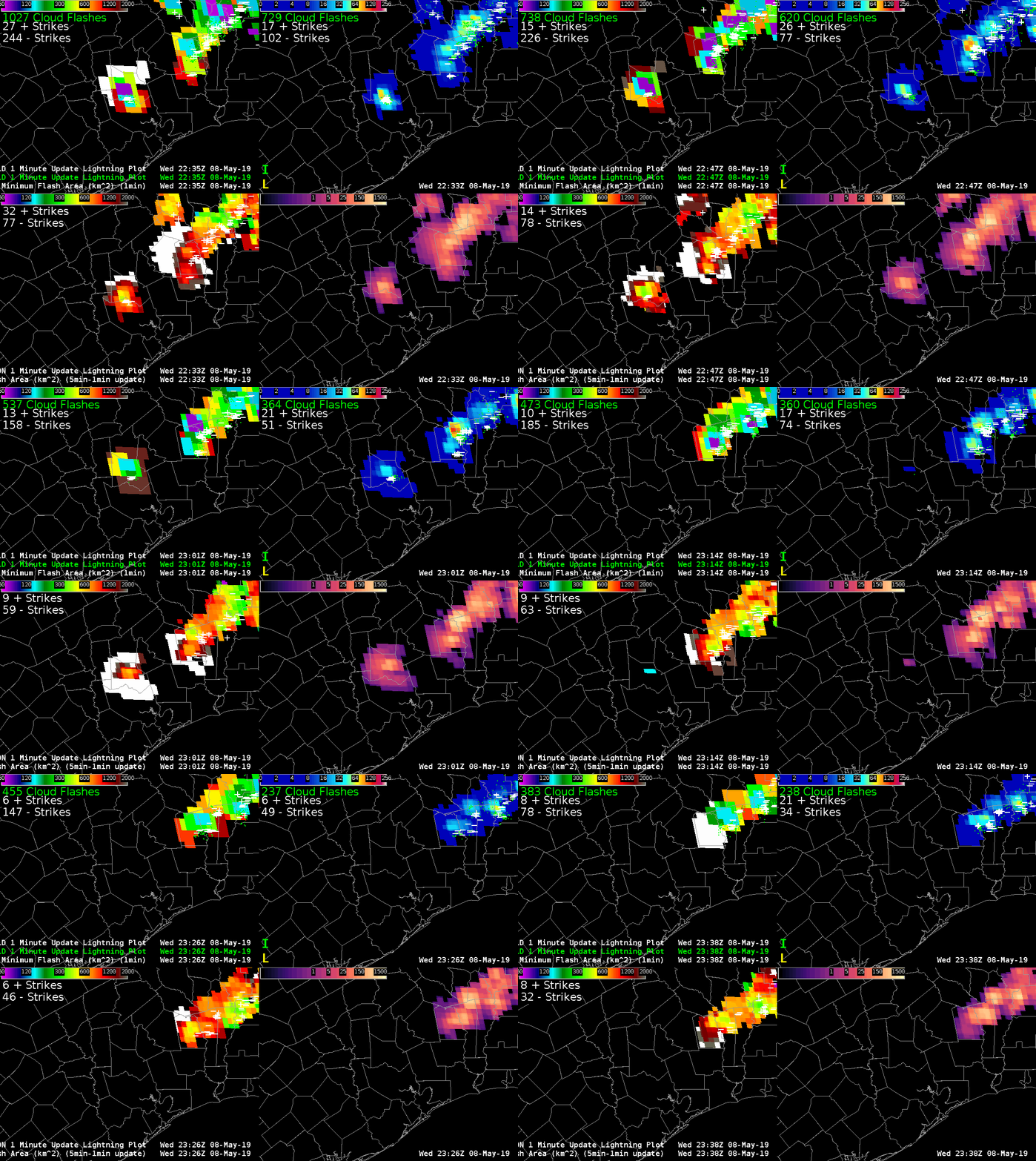
A question I’m asking all week when evaluating experimental products is: “How does this meaningfully improve upon what’s already operationally available?”  My initial impression of GLM was that it’s merely duplicating efforts of ENTLN (except of course over the ocean where it’s unquestionably important given the lack of ground sensors exist). One of the better examples of this I’ve seen is below. In the panels below, looking south of Mobile, we see a much weaker signal in ENTLN total lightning grids compared to off the TX coast, whereas Flash Extent Density shows much more similarity between the two areas.

Another thing that was pointed up during discussion this morning: ENTLN pulse detection efficiency is *highly* variable across even the interior CONUS. This is because sensors are more clustered around metropolitan areas  and therefore the number of pulse detections (and to a lesser extent, flash detections) can fluctuate quite significantly for completely non-meteorological reasons. So, I’m becoming increasingly convinced that GLM data might be a more useful sanity check than I previously thought.

Part of this experiment is to evaluate minimum flash area (botttom pane). To be continued…

#MarfaFront

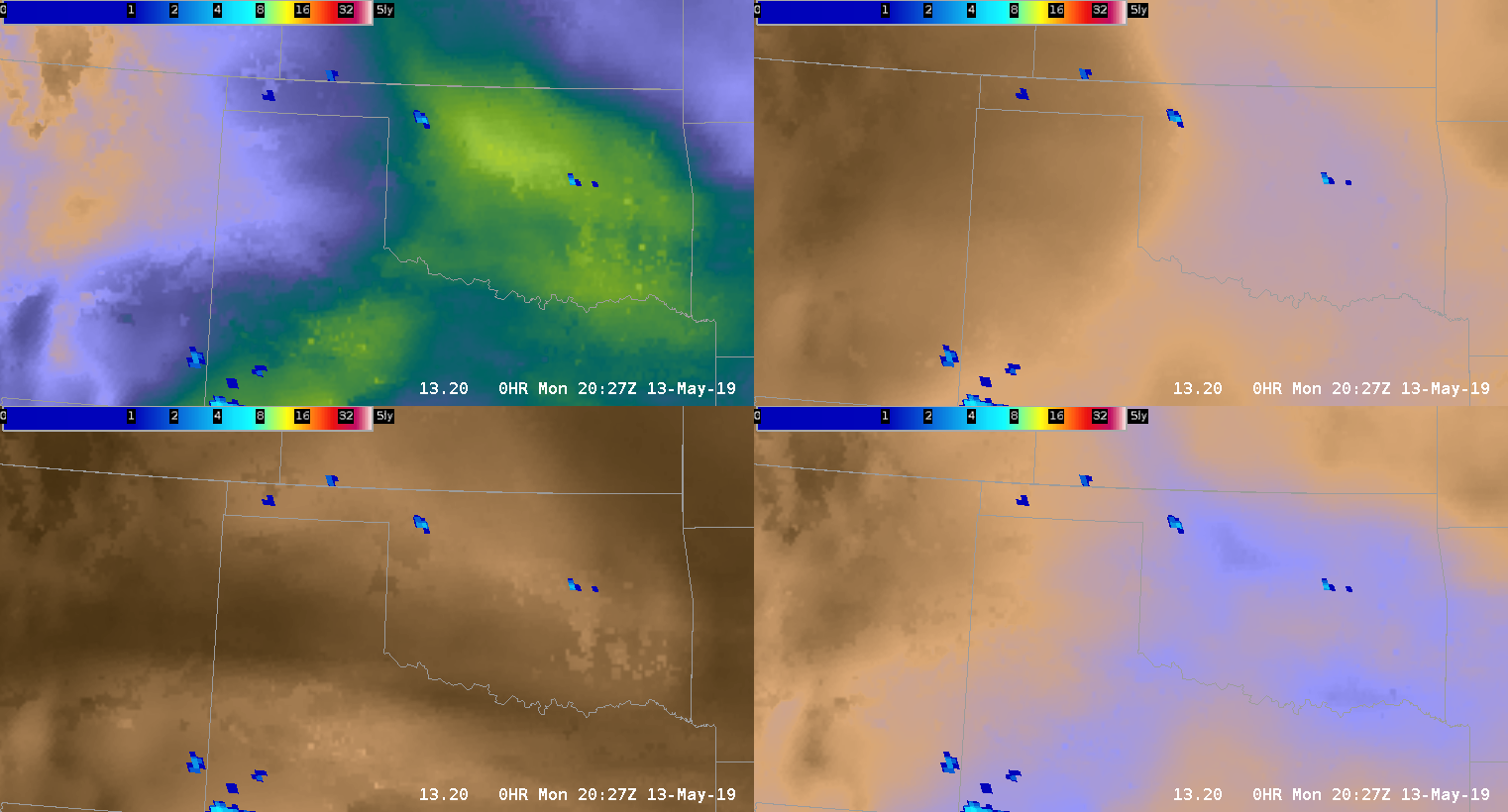
Convection on LL PW Gradient

Convection began along a low level PW gradient across NW OK per GLM Flash Extent Density. Expected forecast: Based on steering flow, the storms should move into a more moisture rich environment and expand in coverage.

2027Z Upper Left: TPW, Upper Right: Sfc to 0.9 sigma PW, Bottom Right: 0.9 to 0.7 sigma, Bottom Left: 0.7 to 0.3 sigma PW

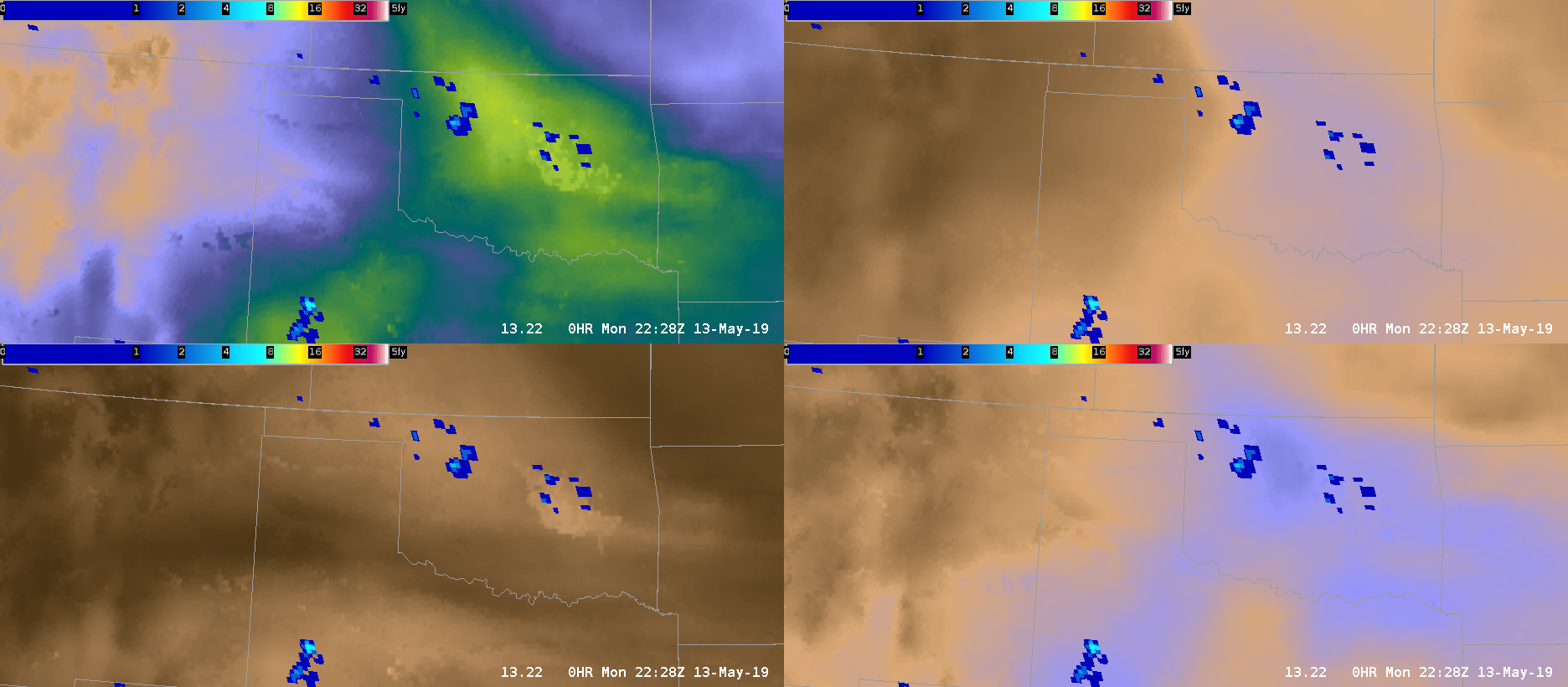
A little while later…Storms continued to expand eastward along the gradient into the more moisture rich environment.

2228Z Upper Left: TPW, Upper Right: Sfc to 0.9 sigma PW, Bottom Right: 0.9 to 0.7 sigma, Bottom Left: 0.7 to 0.3 sigma PW

-Tempest Sooner

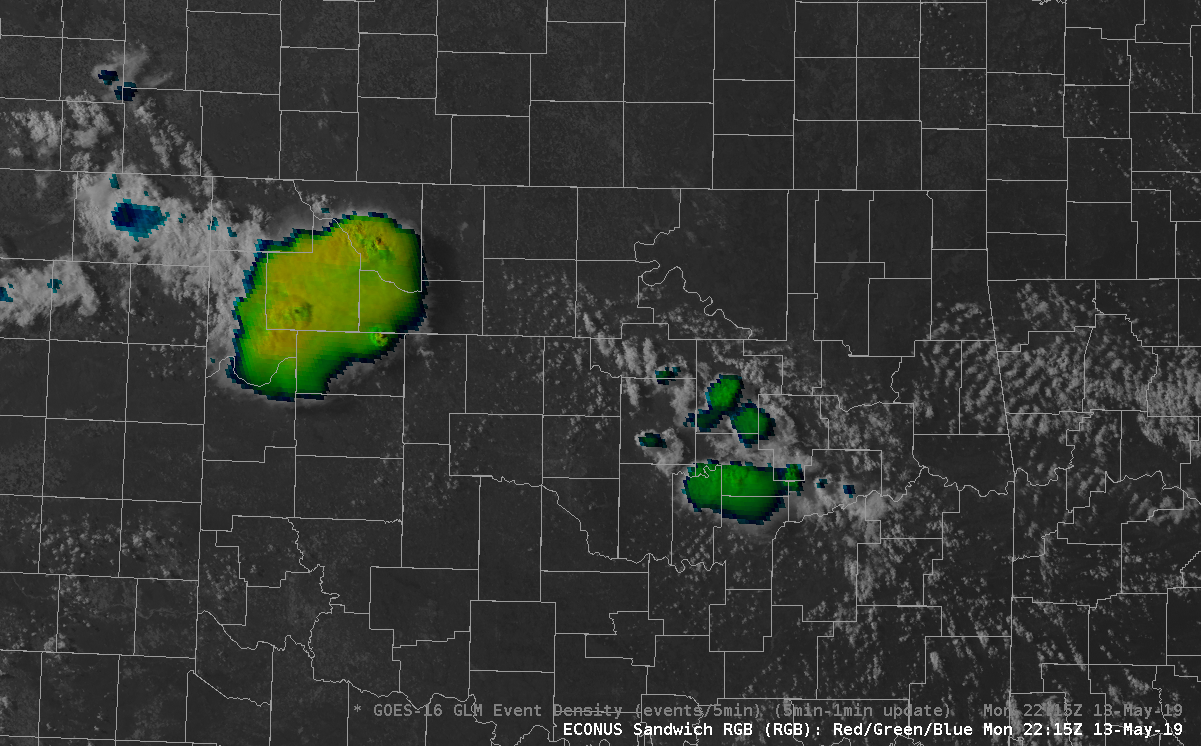
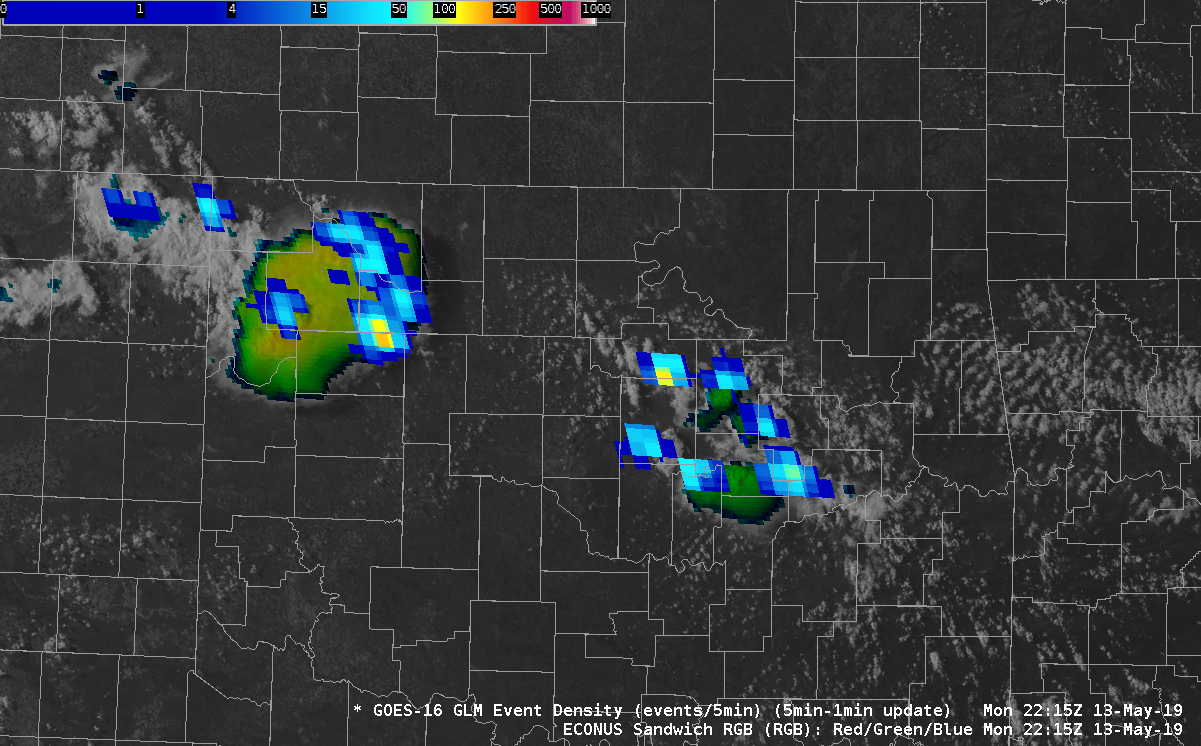
Event Density with RGB Composite VIS/IR Sandwich

Image 1 shows the  GOES16 RGB Composite VIS/IR Sandwich.  This product displays the texture of the convective cloud tops and the temperature of those cloud tops.  The texture and temperature of the clouds provides information about the updraft.  The 2nd image shows the most intense GOESR GLM event densities and how they correspond with the taller clouds and strong updrafts. – Jonathan W. Smith (ESSIC/UMD) .

This was interesting

Since things were kinda boring over HGX today I had to look for things to blog about. Here is something interesting that I noticed with the Vis/IR Sandwich RGB. At the beginning of the loop the RGB didn’t show any IR brightness temperatures. As the TCU continued to develop we saw pixels of IR brightness temperatures starting to show up indicating cold cloud tops and the potential for glaciation to start. Low and behold, if we continue to watch the loop, more pixels start showing up…and a few minutes later both GLM and ground based networks picked up on a couple of CGs. As the thunderstorm developed, cloud tops cooled and more pixels started getting displayed we began to see more lightning.  This was something that I didn’t expect the RGB to pick up on and potentially helpful for situational awareness and IDSS in the west where most lightning tends to come from single cell thunderstorms. If you are able to pick up on these ahead of time you may be able to some lead time before lightning occurs.

Update…it happened again, pixels starting being displayed and then lightning occurred within a couple of minutes. If this generally hold true for single cell thunderstorms this would be awesome for outdoor IDSS.

Life and Death in One Loop

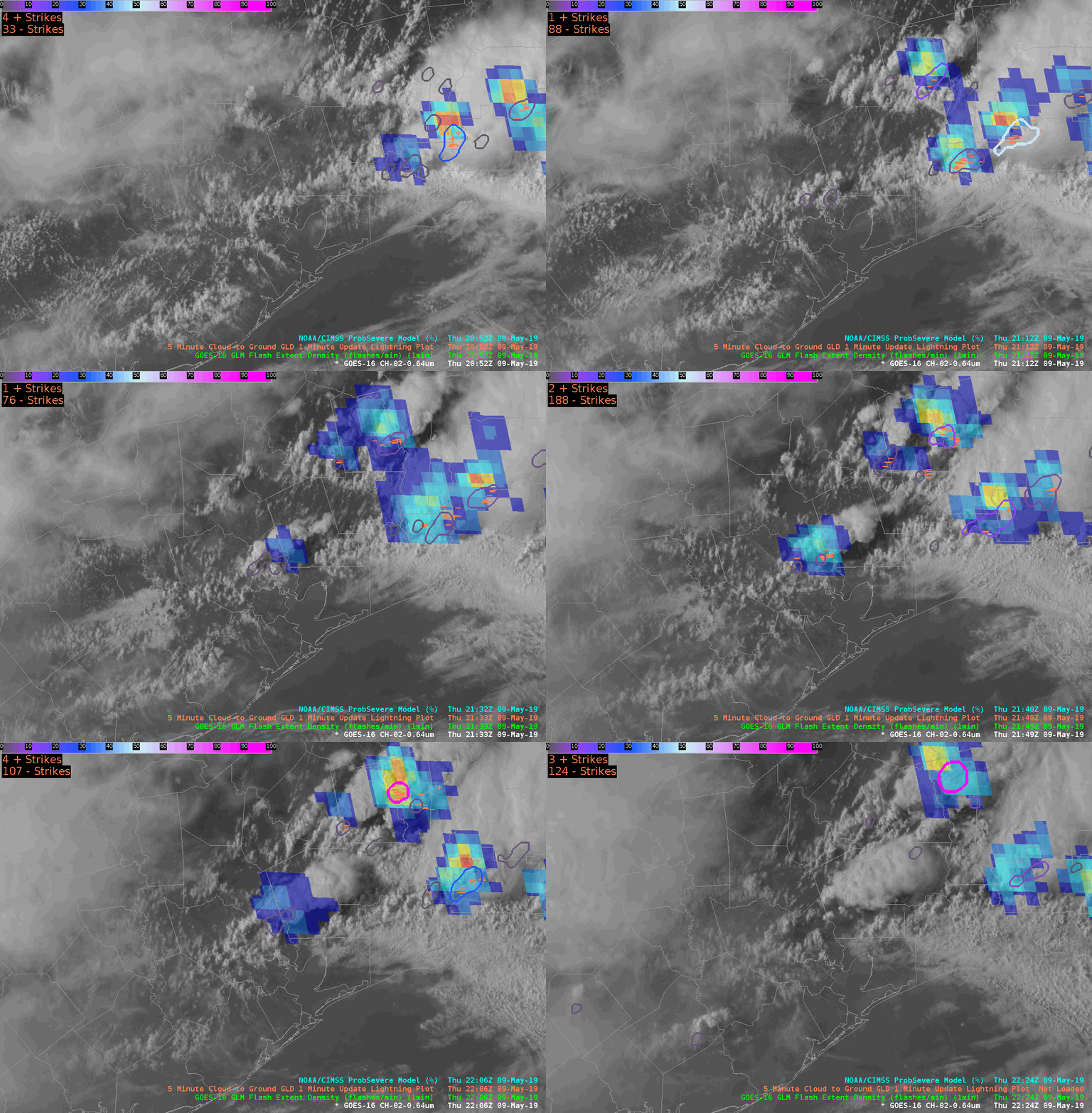
Well, the convection is trying. And dying.  Case in point, the full life cycle of a pair of storms across the  northern suburubs of Houston.  Thoughts below:

You are looking at the 1-minute Mesoscale Sector scan with GLM Flash Extent Density, the Vaisala GLD dataset, and ProbSevere overlays.  Some things to look at:

ProbSevere struggled when the storms were most intense by merging two individual storm objects, splitting them apart, then re-merging back into one object.  Trends were a mess because of this.

GLM lightning activity ceased a full 10 minutes before ProbSevere dissipated the tracking associated with the cells.  However, it continued to show flashes taking place for 7-minutes after the last CG was detected in the GLD data.  Good use for IDSS to let people know that cloud-to-ground strikes are still possible.

The storms initially were moving northwest along a boundary then deviated to the northeast as they strengthened.  As soon as the moved off the boundary…bye bye!

-Dusty

Downward Trend in ProbSevere Time Series & GLM Results in Warning Cancellation

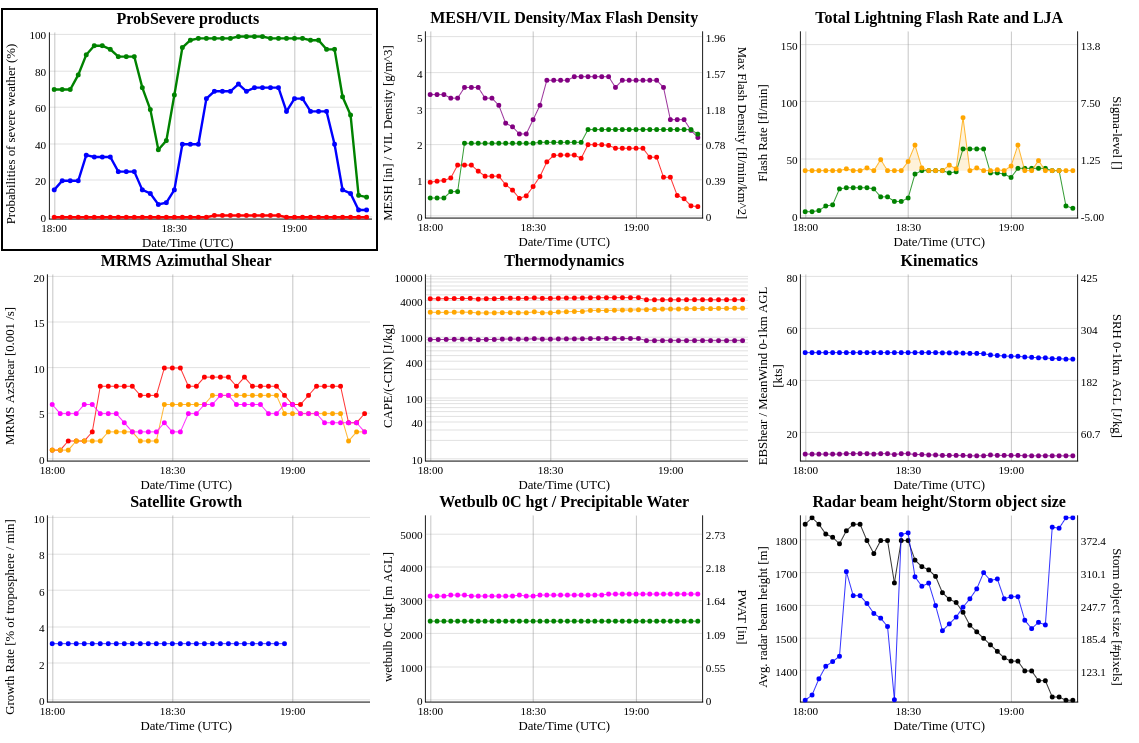
A noted downward trend in the ProbSevere Time series along with a downward trend in the GLM products (not pictured) resulted in this warning forecaster to cancel a SVR for Kerr County early. This early cancellation may not have occurred had these products not been available, potentially leading to areas being unnecessarily warned for a longer amount of time.


HWT Issues SVR 3-Min Before Field Office Does Due to GLM & ProbSevere Data

A strengthening thunderstorm in Val Verde County was noted by Prob Severe and GLM data. The Average Flash Area and Minimum Flash Area values quickly increased in the area of a strengthening updraft across Val Verde County. The combination of these factors, along with a noted uptick in ProbSevere  data, prompted the HWT warning forecaster to issue a SVR for Val Verde County at 1:25pm CDT with WFO EWX issuing a SVR for Val Verde at 1:28pm CDT.

Minimum Flash Area Shows all the Features

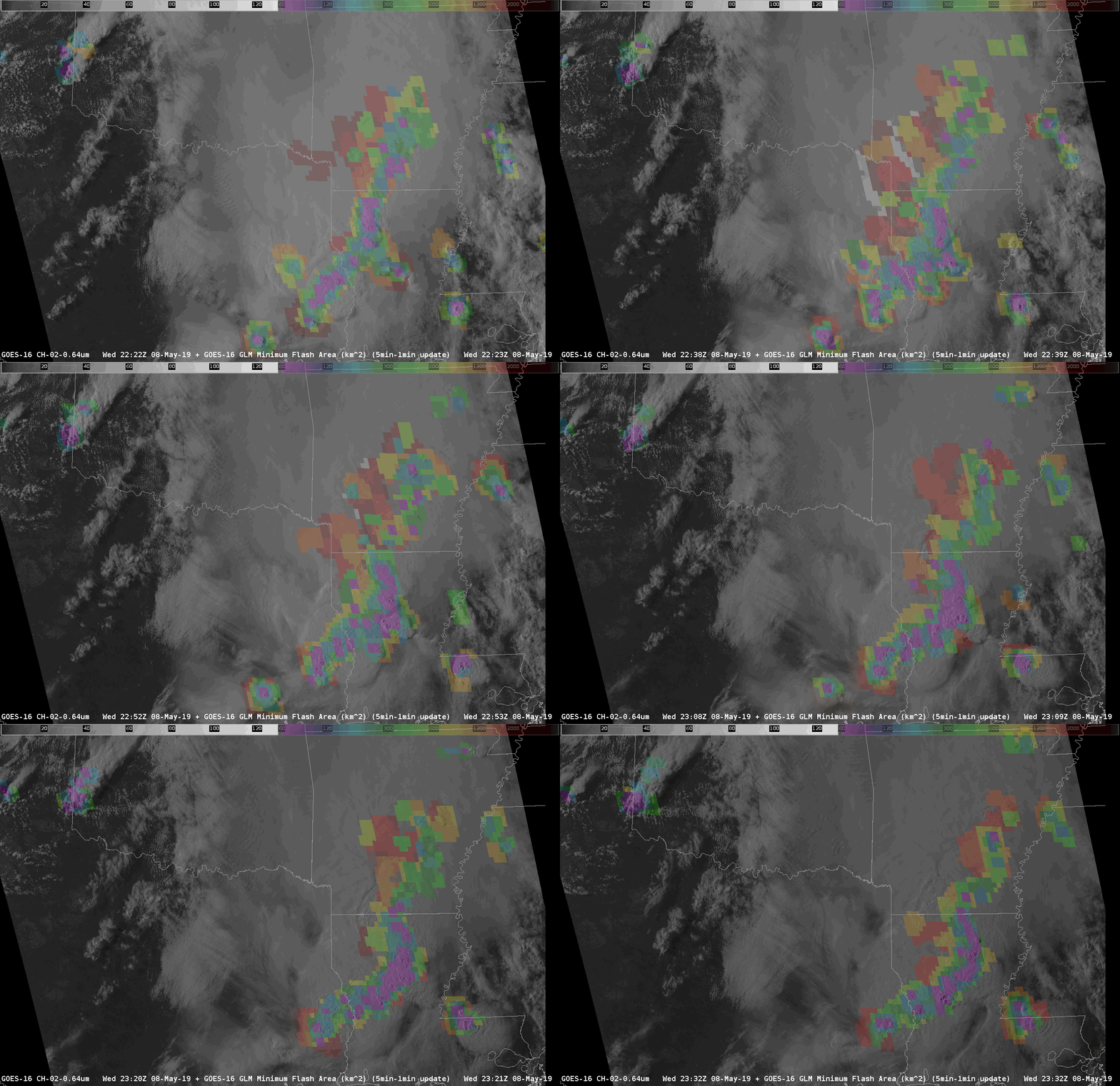
As we move towards sunset, the MCS continues to munch across the southeast Tejas, Louisiana, and portions of Arkansas.  There is alos a strong storm developing ahead of the MCS in SE Louisiana.  Add in some storms across Northwest OK and there is whole spectrum of flash sizes is showing up now:

What is neat about this image is that the small flashes (purple) are concentrated near the overshooting tops of the storms.  The  large area flashes (red to white) are in the trailing stratiform area.

One other cool tidbit I just saw in this loop; watch the southwestern part of the line where a storm weakens and dissipates; flash area basically shows that all electrical activity ceases along with the storm.  Looking closer:

-Dusty