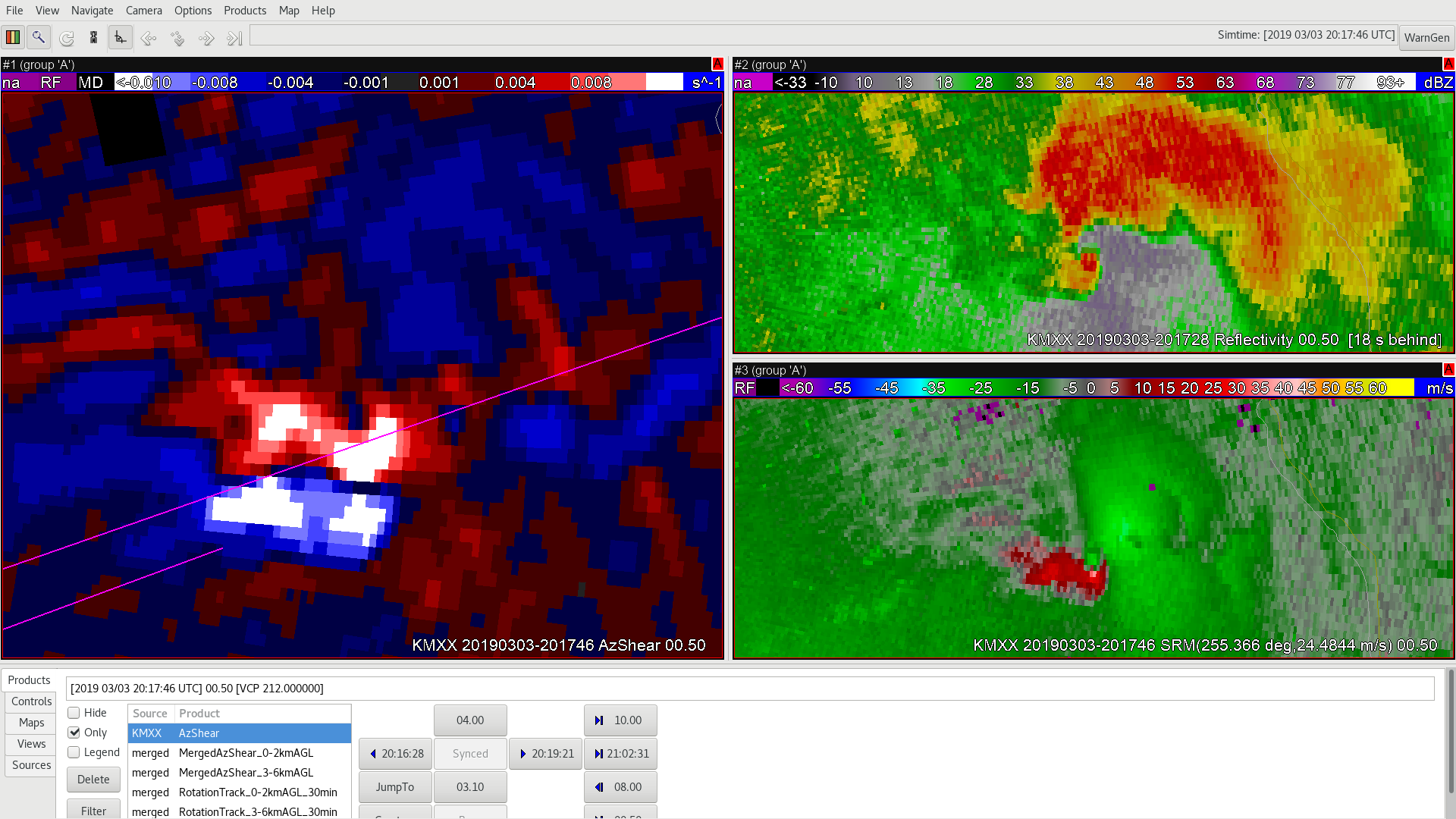
Low-level AZ Shear continues to do well

The Low-level AzShear Product continues to do well, increasing significantly in areas where tornadoes were reported, and showing value in areas where looking at Doppler Velocity alone may not show the best picture of the vorticity within the storm (which was pretty messy at this time). However, some limitations I was seeing was 1) latency issues with short-lived circulations which I would hope the single-radar product would mitigate and 2) possibly due to SAILS cuts, the same features are often captured multiple times in the same image (i.e. vorticity along gust fronts and low-level rotations).

#ProtectAndDissipate

Lightning Jumps in Action

The storm near Tulia is…impressive.  Aside from being a long-tracked supercell, the storm has been extremely active electrically.  There have been several lightning jumps with this storm that appears to coincide with an increase in the strength of the mid-level mesocyclone.  First we will take a look at an hour long loop (TL – Flash Extent Density overlay with Vaisala GLD, TR – Minimum Flash Area, BL –  Optical Energy, BR –  Mid-level Azimuthal Shear (3-6 km AGL) with New Mesocyclone Detection Algorithm Overlay) :
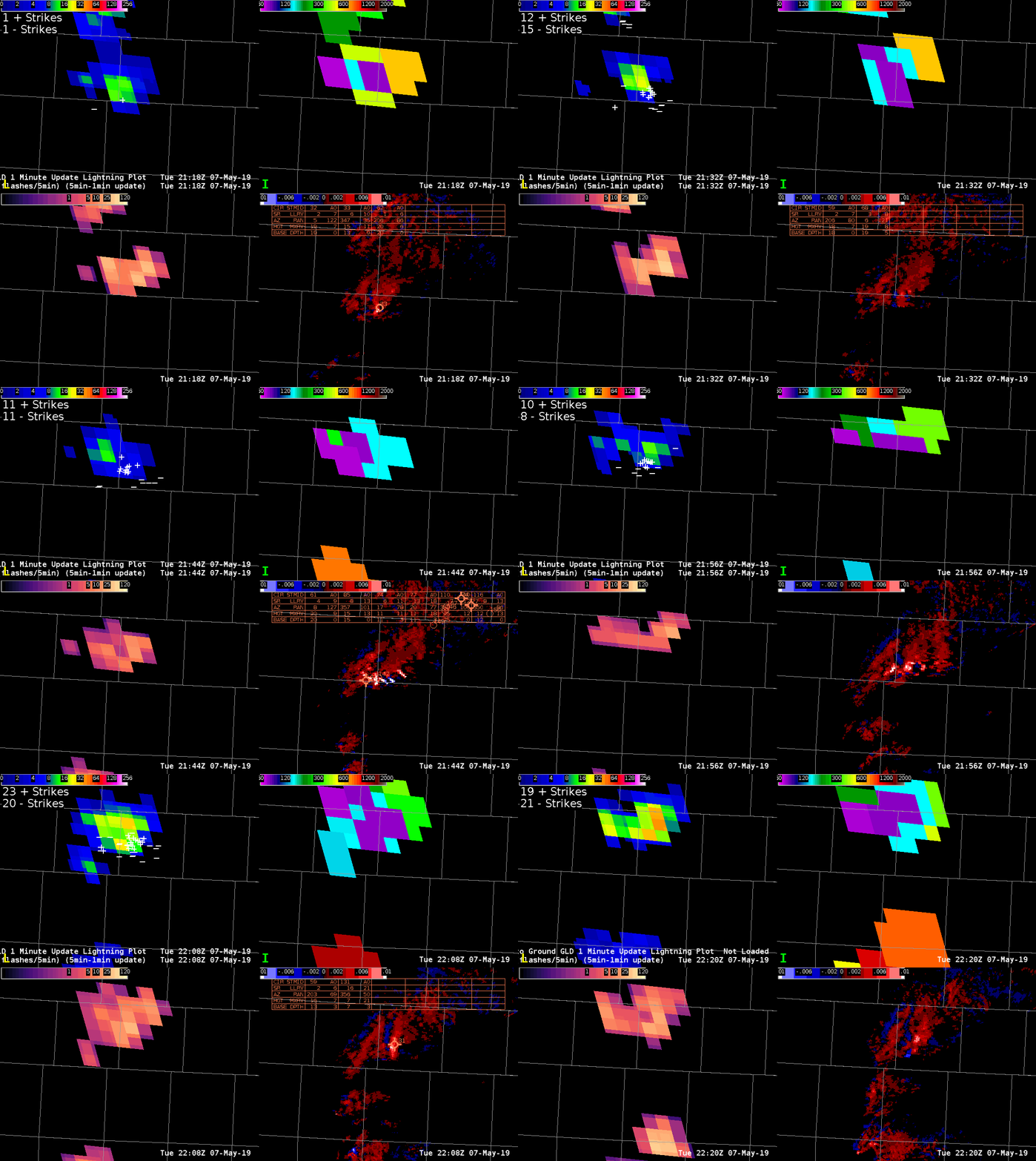
There are two jumps to take a look at, 1) between 21:29 and 21:40, 2) 21:55 – 21:20.  Although the AzShear product doesn’t show a strong mid-level meso developing, the number of positive CG flashes in the GLD data increases and we see continued small area flashes in the core.  The more impressive jump is the second one;  AzShear shows a much more pronounced area of positive shear, a long-lived NMDA indication (the circle with 4 pips on it), and overall smaller flashes in the area of that storm.

Shortly after the last jump (and not shown here), live stormchaser feeds showed a rapid strengthening of low-level features; well defined wall cloud, organized rotation, and frequent CG activity sending a flurry of stormchasers heading east to get out from under the storm…

-Dusty

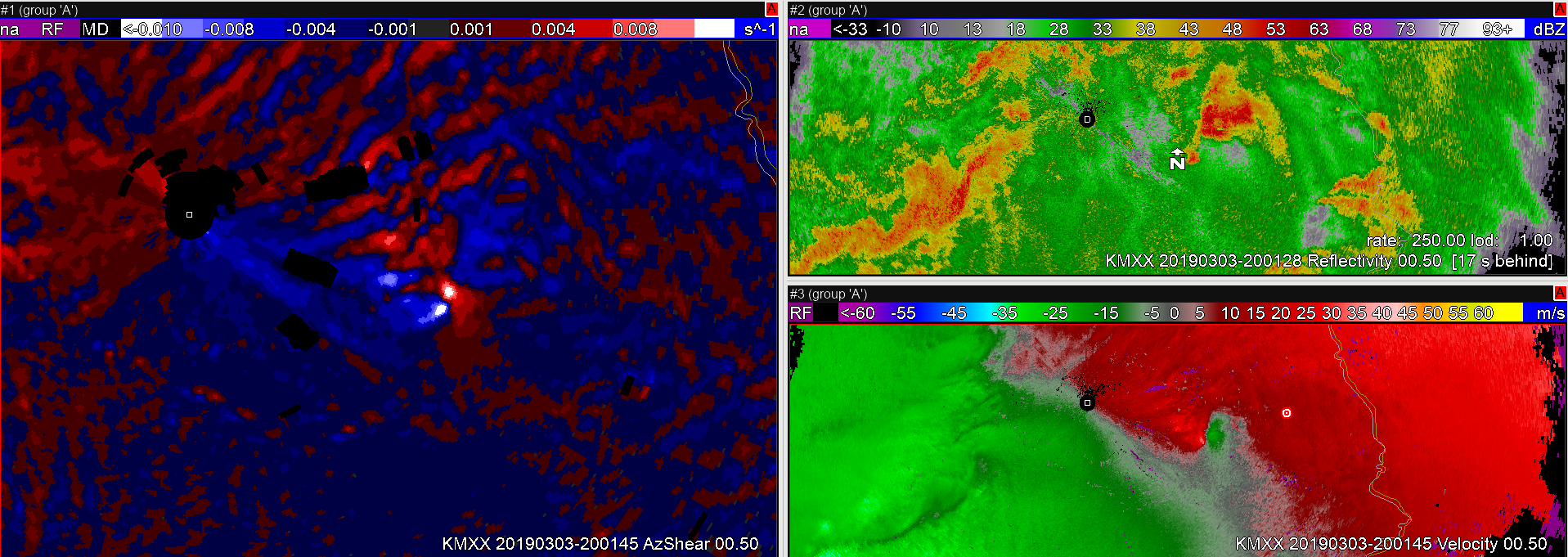
High AzShear Values Near Areas of Range Folding

When using AzShear forecasters need to watch out for high values near areas of range folding. You can’t just assume that the high values mean something. This is an example to show that you still need to do basic storm interrogation and can’t purely rely on AzShear to issue warnings.

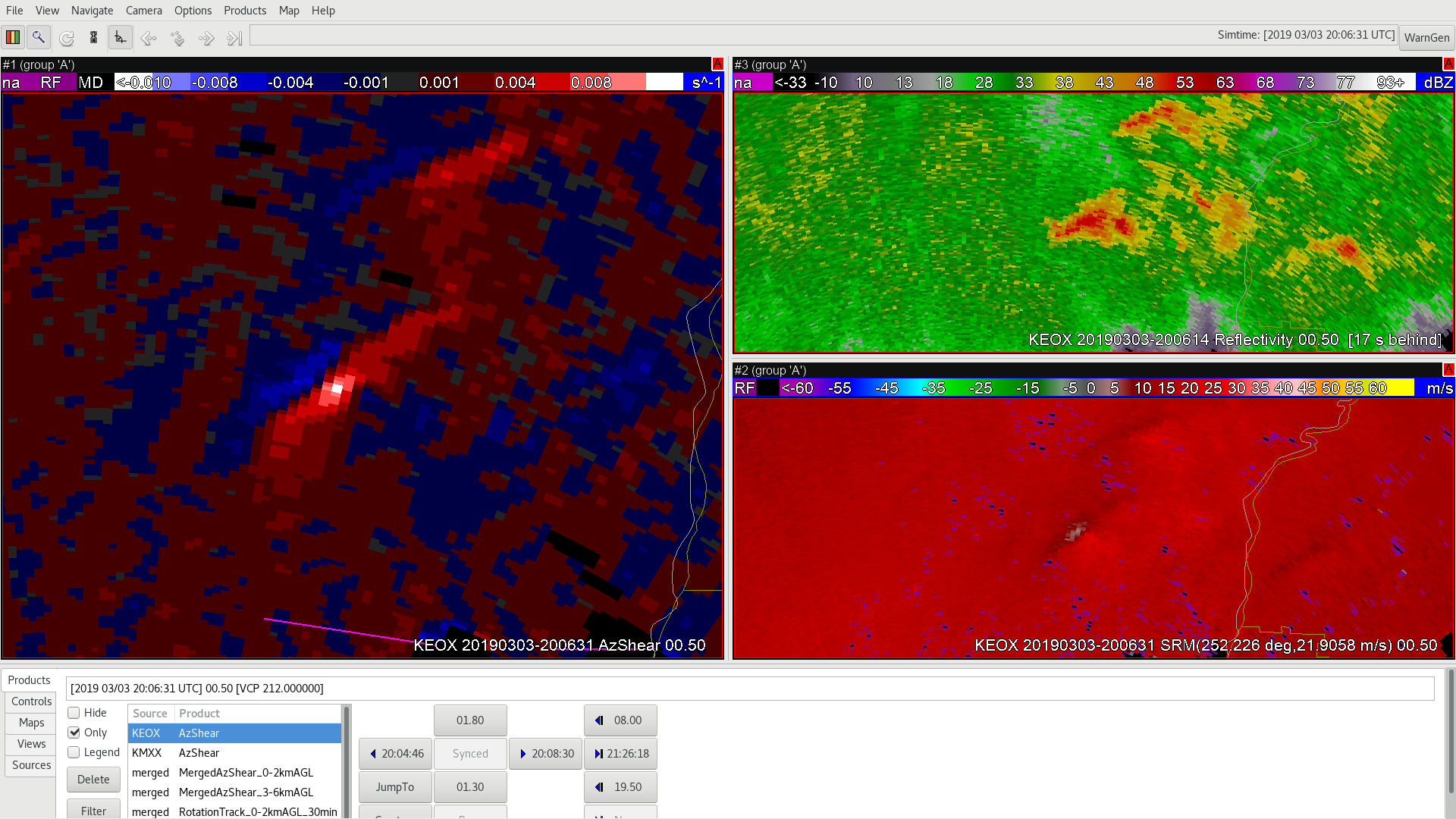
Displacement from damage path

KEOX AzShear shows displacement to the north from the given damage path. This shows up with KMXX AzShear as well. This displacement is also occurring with SRM data, but even more so with AzShear. Circulation is so small that AzShear is quite helpul here, as this could almost be missed with SRM data, and reflectivity looks completely innocuous. Detection of this short-lived tornado would be picked up much better with the use of AzShear.

ZDR_Arcophile

Single-Radar vs Merged AzShear

The 0-2km merged Azshear product showed multiple “hot spots” at the beginning of this particular storm. But which one is more important? Below is what the  merged AzShear looked like at 2023Z…

Without looking at velocity data you can’t really tell where the center of the storm is using the merged product. However, here is what the single-radar AzShear looked like around 2023Z…

The single-radar AzShear clearly indicates that the southern couplet in the merged product was where center of the rotation was located. This clearly shows how single-radar can provide additional information in a warning situation.

AzShear False Alarm

Here’s a case of a false alarm situation where a tornado was not produced. KEOX AzShear radar draws attention to this circulation that eventually fizzled. Still, it is nice to be able to see the trends later on with AzShear that clearly shows that it would be safe to take my eyes off of this storm as far as tornadic activity is concerned.

ZDR_Arcophile

Early Detection from different radar

Here’s a case for loading data from a different radar, if possible. Over an hour before this seemingly innocuous cell produced a tornado, KEOX AzShear picked up on this, whereas there was not much to look at with KMXX shear. Also not that SRM was not as helpful in early detection as AzShear as well from KEOX.

ZDR_Arcophile


Usefulness of AzShear at the Beginning of a Shift

As a forecaster in the Pacific Northwest, where severe weather tends to be limited, I have had to adjust my perspective of what is/isn’t a strong storm. Most of our tornadic storms tend to be cold core funnels that dissipate as quickly as they develop. I can see AzShear being used as a powerful situational tool for forecasters, especially when storms that have weak rotational signatures.

The image below is relatively close in time to when the simulation started and my eyes immediately went to the “hot spots” in the single-radar AzShear product. It took me all of a couple of seconds to realize that I needed to pay attention to this storm and as soon as I looked at the Z/R products I immediately started thinking that we need to issue a TOR if one wasn’t already issued. This storm is probably a “No Duh!” TOR for almost all forecasters, but being able to see the AzShear product and quickly orient yourself is extremely useful and  when used with other base products can save time in spinning up at the start of a shift.