LightningCast v1 vs LightningCast v2 5/5/25 21:26Z-22:21Z

 The cell I was observing was producing infrequent lightning for much of the period in the loop with probabilities in v2 staying consistently higher than v1 before and after the lightning strikes. v1 decreased to near 0% at 21:41Z right before a strike occurred at 21:56Z although the probability in v1 increased to 10% at 21:46Z. v2 probabilities remained relatively consistent during that time frame. It seemed that with the MRMS data, it had enough reason to continue the probabilities even though the lightning was infrequent. From a forecaster’s perspective, this would give me more confidence that the storm was persisting and was continuously capable of producing lightning whereas v1, I might think that (if only relying on the LightningCast), the threat was diminishing.

4 panel comparing LightningCast v1 and Lightning Cast v2

-Golden Retriever Lover

Tags: None

Comparison of GREMLIN, OCTANE, and Radar Products For Two Storms near KMAF

Something interesting was noted when looking at two nearby storms on 05/06 between 2146Z through about 2205Z. When looking at two thunderstorms which quickly fired up near the MAF radar, OCTANE STD data suggested the storm to the left had stronger divergence aloft. The OCTANE Speed Sandwich also showed these storms were relatively similar in strength with the right storm having slightly stronger shear, but decided to look at GREMLIN and dual-pol radar data for further analysis. It is worth noting that OCTANE data stopped coming in around 2146Z due to a power outage at CIRA. GREMLIN data clearly showed the left storm was weaker depicting much lower reflectivity. This overall aligned with MRMS data, but the GREMLIN data did smooth out higher Z values as expected. 88D radar data was then used to help investigate the two storms after seeing both OCTANE STD and GREMLIN data differ on which storm was more intense. When looking at radar data it became clear that the storm on the right was more intense with a BWER, higher cloud tops, more intense reflectivity core aloft, and stronger STD (wasn’t able to sample true STD because the storm was too close to the radar).

It was very odd to see the left storm had stronger divergence aloft in the OCTANE STD procedure yet all other data suggested the storm on the right was much more organized. There are no loops in this blog, but the weaker left storm was a left mover while the stronger thunderstorm was more of a right mover. Could this have played a role in the OCTANE STD data suggesting the left storm was more organized?

A severe thunderstorm warning was issued on the right storm before these comparisons were made as it was evident a supercell was developing. OCTANE/GREMLIN aided in quickly seeing where CI was occurring and which storms were intensifying quickly. However, using the satellite products alone to issue warnings would have been difficult. This could be due to not being familiar with what thresholds forecasters need to be looking for in OCTANE or GREMLIN in order to issue a warning. If I were in a forecast office with radar holes or beam blockage, these new satellite products would still be very helpful to interrogate storms. OCTANE/GREMLIN provided better confidence on what storms to focus on and paired well with 88D radar data for warning operations. It would be fascinating to see how this works in a location where there is beam blockage or radar holes.  

When looking at this 4 panel OCTANE STD suggests the cell on the left has stronger divergence aloft. The speed sandwich (top left) suggests the storms are relatively similar in intensity though slightly stronger shear was evident for the right storm.

The two storms on the right are the ones of interest. Ignore the far left storm. GREMLIN data clearly shows that of the storms in question, the one on the right is more intense as reflectivity values are much higher. OCTANE data went out at 2146Z so timing between products is off slightly. GREMLIN data compare to MRMS data as both showed the storm on left being less organized. MRMS was a lot easier to read though due to less smoothing.

88D Radar data clearly shows the storm on the right is more organized with a BWER, higher cloud tops, much stronger reflectivity core aloft, and stronger STD (true STD could not be sampled as the storm was very close to the radar).

– Ricky Bobby

Tags: None

First Use of GREMLIN in Warning Scenario

My first time experimenting with GREMLIN, I was able to utilize it briefly during a warning scenario.  Using the 4-panel (Figure 1) below in conjunction with radar data (KFDX), I issued a Severe Thunderstorm Warning for 60 mph winds (Figure 2).  Other than the fact this storm previously had warnings, the velocity/SRM signature was decent (certainly no slam dunk) for straight-line winds, but the uptick in GREMLIN Meso-1 combined with the increase in cloud top cooling south of Fort Sumner. Figure 3 shows a 3 minute difference showing the rapid uptick in the GREMLIN radar emulation. The CONUS radar emulation did show it, but in a warning scenario was a bit too delayed to use with any confidence to issue a warning based on its data.  It certainly helped solidify the decision after issuing the warning.

Figure 1: East Meso Sector GREMLIN and Channel 13 (left side), MRMS composite reflectivity and East CONUS GREMLIN (right side).

Figure 2: Severe Thunderstorm Warning in southeast portion of ABQ CWA.

Figure 3: The radar emulation from East Meso-sector 1 (top left) shows a nice uptick within 3 minutes with the storm south of Fort Sumner and from the previous loop from Figure 1, it continues for several more minutes. Thus, added confidence to issue a warning by 21:21z.

– Podium

Tags: None

Subtle LightningCast Differences

After the first day of using the new LightningCast, I was able to notice some subtle differences between the old version (LC1) and new version (LC2).  However, I don’t have enough information to say it will impact my operations one way or the other with the new version.  It does seem the new version is a bit more detailed and possibly slightly faster with convective initiation. For instance in Figure 1,  there was an isolated storm in west-central NM where the new LC has the 75% outlining the storm by the end of the loop and the older version does not. Also, the cluster across the northern portions of NM (or ABQ CWA), the older version seems to be too quick to end the lightning as it just has a small 75% line near the border of Colorado. The new version keeps that higher probability going much further south.  In this case, LC2 might provide slightly more lead time in IDSS as well as a bit more detail in the cessation of convection.

For the last figure, I wanted to provide a snapshot of the convection and compare the two LC versions. Northern NM again was a noticeable difference between the probabilities. For the farthest northern cell, LC2 has a much larger 75% prob area while the 25/50 probs are fairly similar to LC1. LC2 suggests there might be lightning between the two areas of storms in northern NM as it has the 10% prob contour completely connected while the LC1 does not.  

LC1 suggests there might be a storm developing further east with a small 25% area near the CO border, while LC2 does not have anything and verifying with radar, appears there were only a few showers in that location. It is interesting to note the two 50% areas on the two separate storms in the southeast suggested by LC1 while LC2 keeps the contours together. And judging by the FED data, LC1 is probably more correct in this snapshot.   There are a couple other differences within that snapshot, but not entirely sure these differences would make much of an impact on a warning/IDSS scenario.

Figure 1: LightningCast and Flash Extent Density at the beginning of convection on May 5, 2025.

Figure 2: Captured a few hours in the southeast section of ABQ county warning area. A few subtle differences, but nothing notable that would change operational thinking.

Figure 3: At 20:26z, the most notable difference between the two versions is with the storm across northern NM and a minor difference with the storms in the southeast portion of ABQ county warning area.

– Podium

Tags: None

USING THE GLM BACKGROUND & DATA QUALITY PRODUCT (DQP)

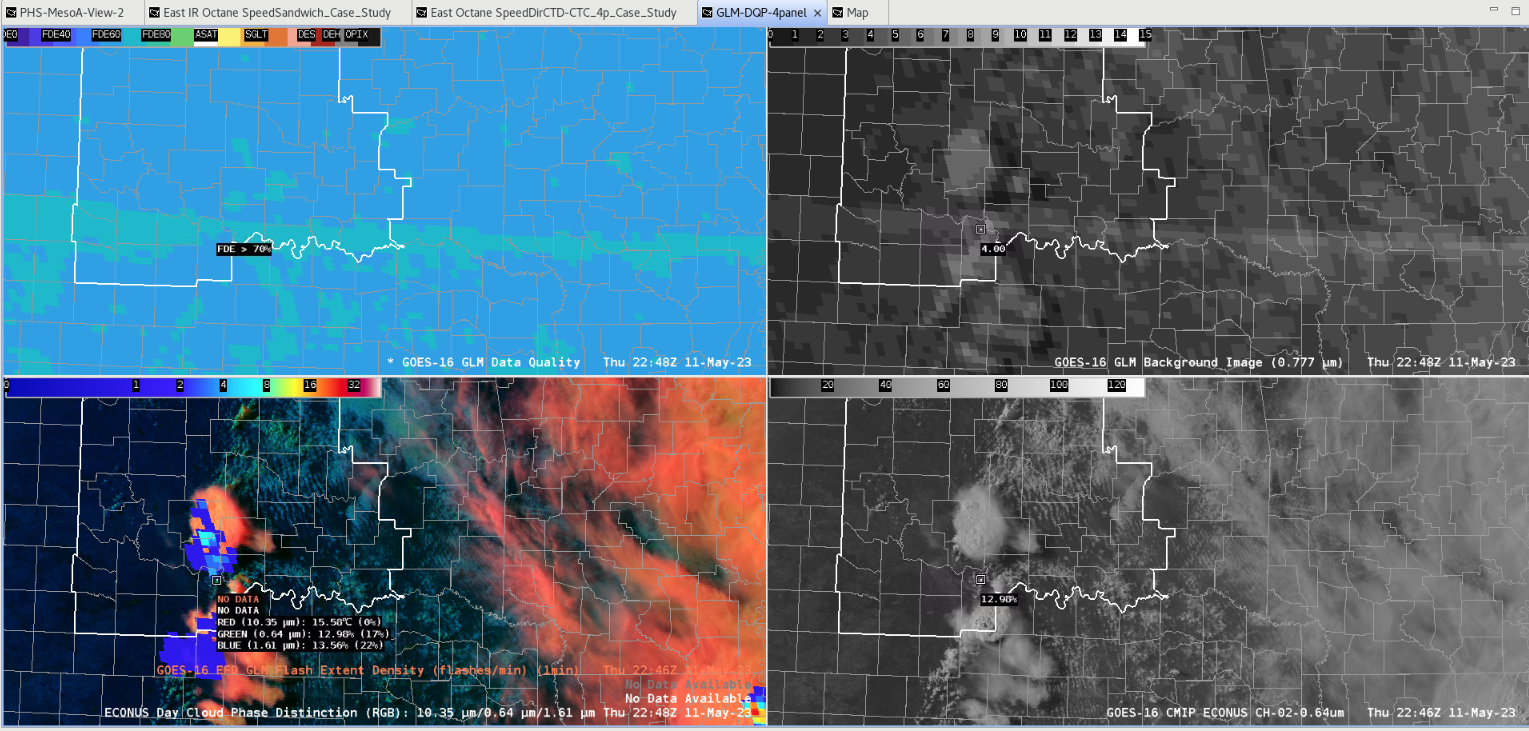
Here is an inspection of the GLM Background and DQP to get a feel for the reliability of the GLM flash extent density (FED) data.  Below you will notice a four panel display with GLM quality on the upper left, the GLM background image on the upper right, the GLM flash extent density on the bottom left, and the 0.64 visible satellite imagery on the bottom right.

You should be able to make out a sub-array boundary going horizontally (upper left panel) AND also in the GLM background image (upper right panel). In the top right and both bottom panels you can make out strong convection taking place with two cells (one in the southern portion of the CWA, and one just to the south and along the CWA border). I did my best to put my AWIPS cursor along the sub array boundary.  You will notice in the bottom right corner that the cursor is actually between the two convective cells.  However, you can make out some weaker GLM FED signals along the sub array boundary where you are in-between the two cells.  This demonstrates uncertainty around the validity of the GLM data just to the south of the northern convective cell.  They are weaker GLM FED returns with only a minute or so of lag among the various elements being shown. And with these returns being upshear of the northern cell it is likely that this is not related to anvil lightning activity.  In this example with the relatively close proximity of the two cells one cannot be sure that the GLM data is incorrect, but with the GLM returns showing up on the sub array boundary this does increase uncertainty around this portion of the GLM flash extent density data.

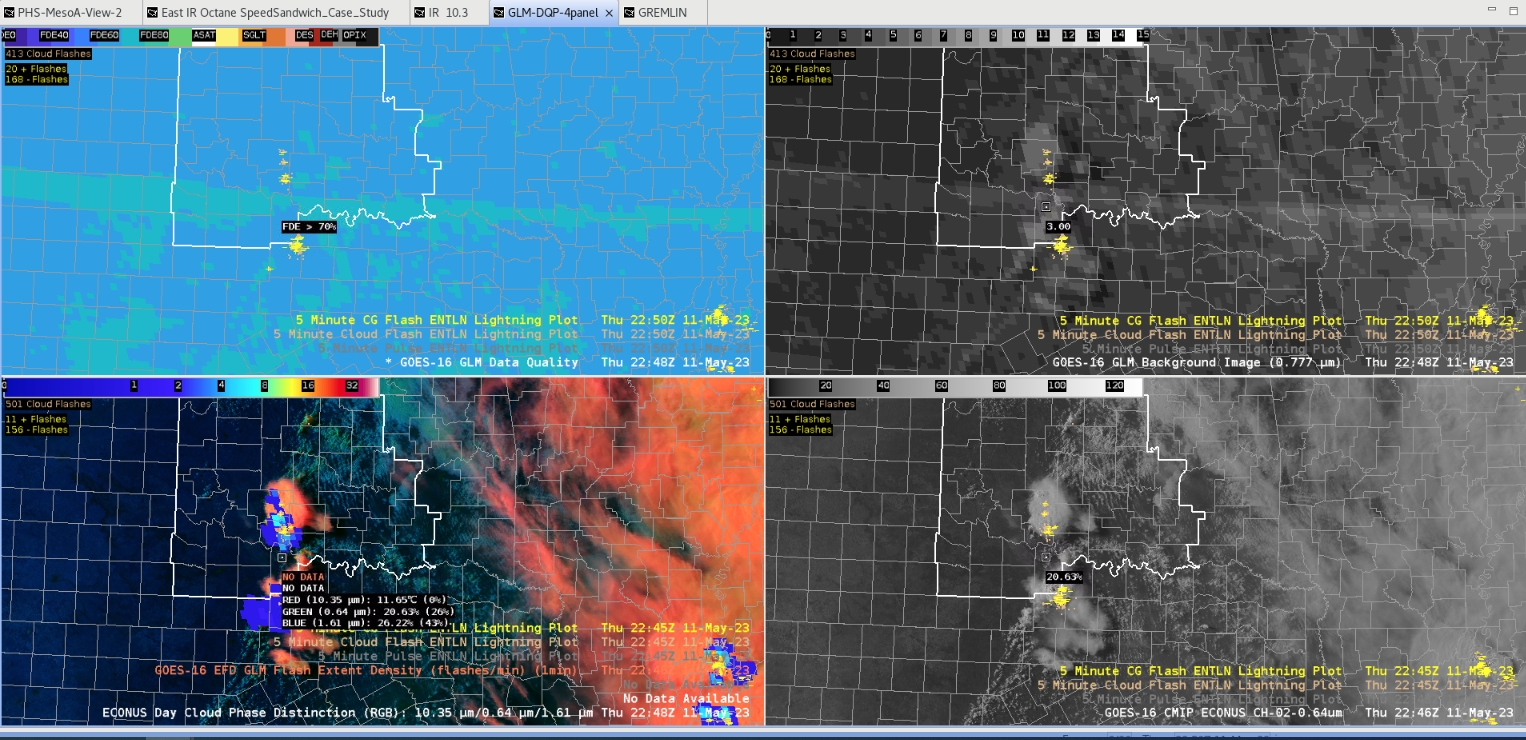
Below is the same four panel, but with the ground based earth lightning detection network showing as verification for lightning.

Notice how there is a weaker return with the GLM flash extent density on the southern portion of the northern cell, but the detection (lower right panel displays best) shows the lightning verification within the convective cloud shield and not past the southern portion of the northern cell like in the GLM FED (bottom left panel).  This demonstrates that one should question a portion of the GLM flash extent density output. By using the GLM data quality and background products one can get a better feel for where the GLM FED data may not be reliable.  If something doesn’t make sense with regard to GLM output then this product can verify that suspicion.

– 5454wx

Tags: None

Storm-Scale Environmental Analysis of Early Convective Development

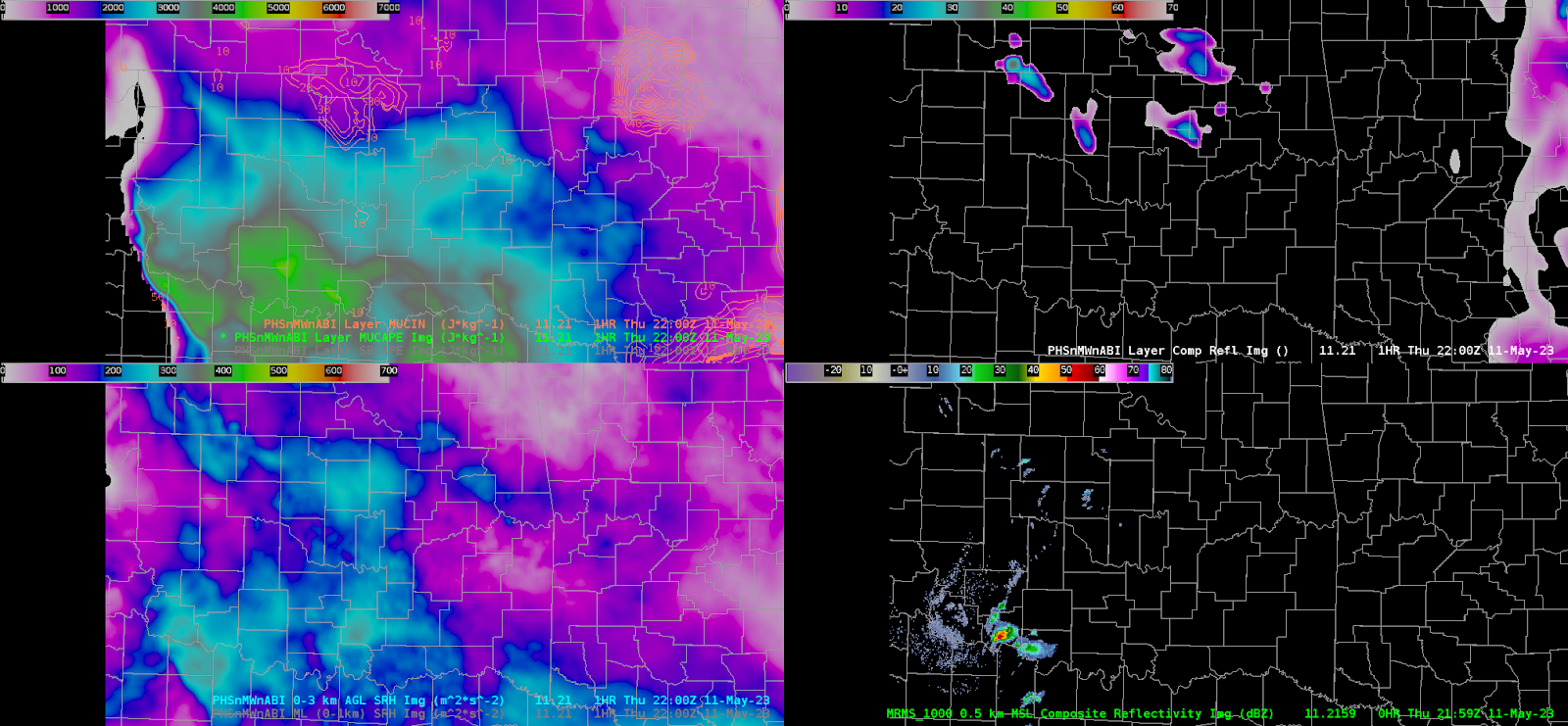
This case at WFO OUN brought forth a challenging situation monitoring developing severe weather with no available radar data, and only relying on satellite products for storm interrogation and convective warning decisions. This analysis will primarily focus on the evolution of early convective development and how satellite products/PSH data helped gain a better understanding of the environment.

My role in the team monitoring/analyzing the environment was focused on issuing warnings and having the Mesoanalyst(s) relay satellite, PSH and GREMLIN information to support warning decisions. To prepare and gather a greater situational awareness of the environment and what satellite was observing, I loaded in RAP13 Right/Left Bunkers vectors which would aid me in effective polygon design. Given the orientation of the hodograph per observed soundings earlier, storms would support the potential for left/right splitters meaning proper storm motion/polygon flare is very important.

Convective initiation began around 21-22Z with noticeable towering Cu across Cotton County, OK, prompting the first issuance of a SVR at 21:56Z given cooling cloud tops/increasing storm top divergence.

Towards the end of the loop above, observation was made that the overshooting tops were turning more ENE biasing closer to the bunkers right, implying the likelihood of the storm developing a mesocyclone. Not shown here, but a useful trick of enhancing the contrast of the Day Cloud Phase RGB became extremely useful in tracking overshooting top motion and intensity, along with other satellite products diagnosing an intense updraft in progress.

The pre-storm environment was analyzed using PHS data, highlight ample MUCAPE on the order of 3500-4500J/kg around the area of CI,  and large-scale 0-3km SRH ranging around 250-350m2/s2, bringing support for stronger/severe storms to attain rotation in a volatile, highly unstable/moderately sheared environment.

WIth the storm obtaining a developing/intensifying left splitting  updraft (later in the first loop), confidence of a strengthening mid-level mesocyclone increased leading to a transition to a base TOR warning, with polygon design mainly following the bunkers right motion vector to imply near-term motion to continue ENE.

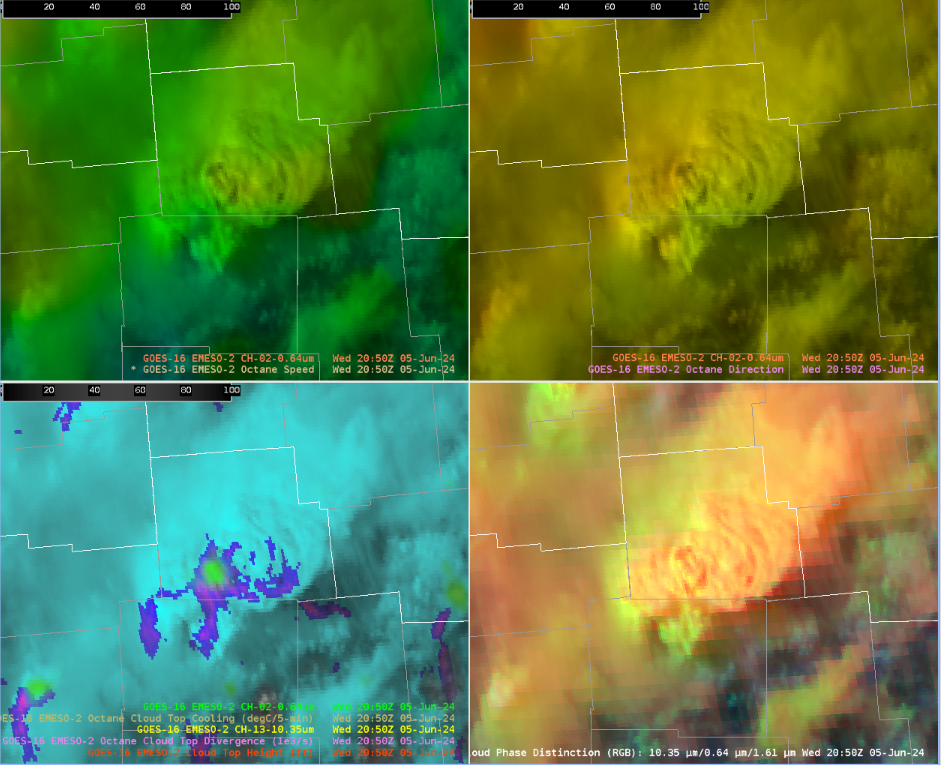
Modifying the OCTANE speed product by decreasing the max observed values downward and min values upwards helped diagnose a more eye turning signature to storm top divergence. Additionally, modifying the direction scale, albeit took some work, came out with a product that illustrates (in red) backed sfc winds <`180 degrees which existed well ahead of it, inferring the likelihood of larger curved hodographs and greater attendant estimated low-level SRH.

However, one item that was not noticed until after the TOR warning was the winds being ingested into the storm (shown in green) averaged around 210-230. This appeared very accurate looking at feeder cumulus ingesting into the inflow region of the cell just to the SSW. Less backing of the surface winds yields much less available streamwise vorticity (in fact is mainly crosswise) leading to the likely reason the storms rotation did not strengthen, and ultimately collapsed 30 minutes after the image above and the left-turning supercell became the dominant storm.

Overall, OCTANE exhibited great, practical uses to understanding not just the storm intensity/trends but the environment explaining why the storm was behaving the way it did.

– RED11248

Tags: None

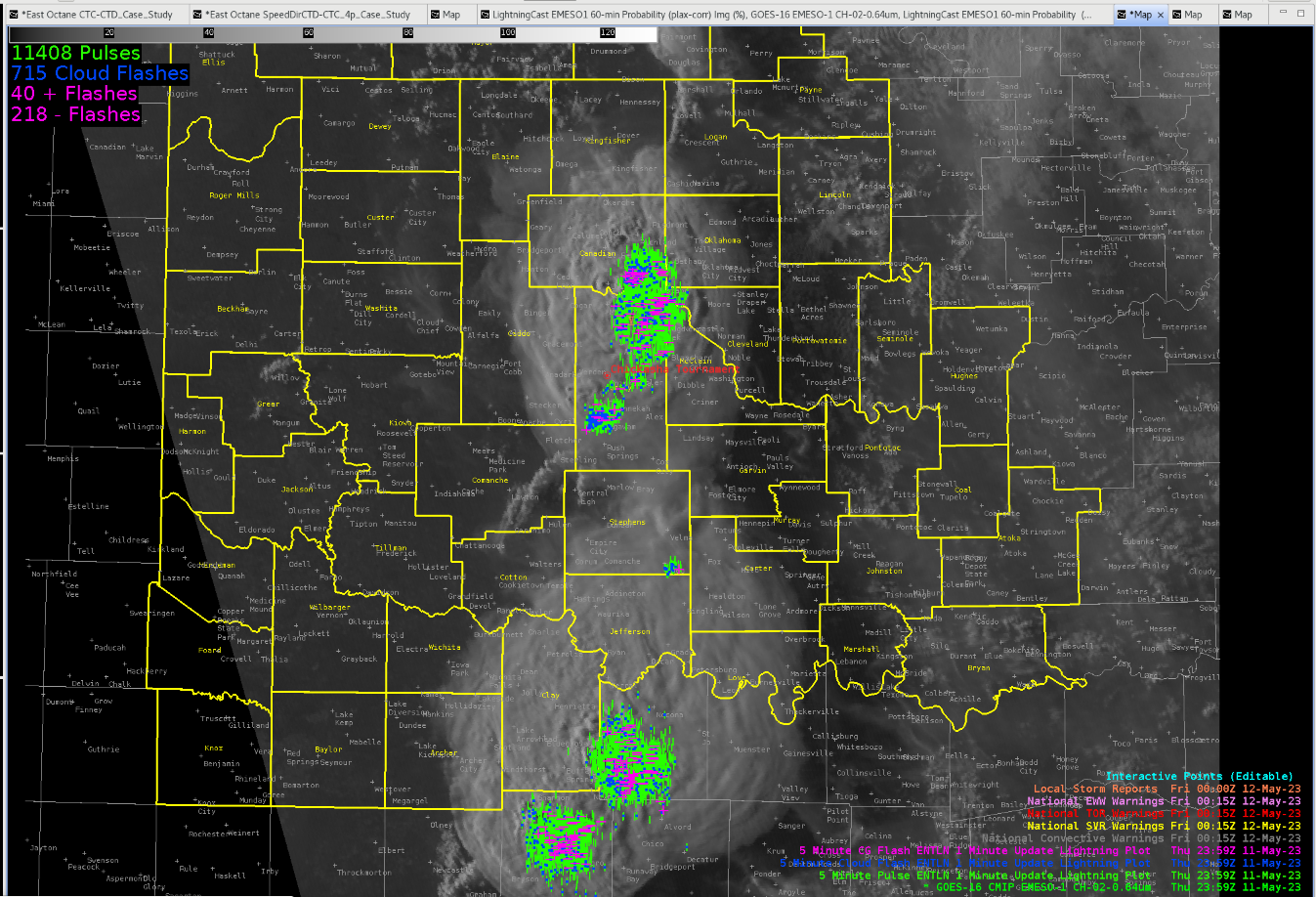
Comparing GREMLIN and LightningCast to actual Reflectivity and ENTLN Lightning Plots

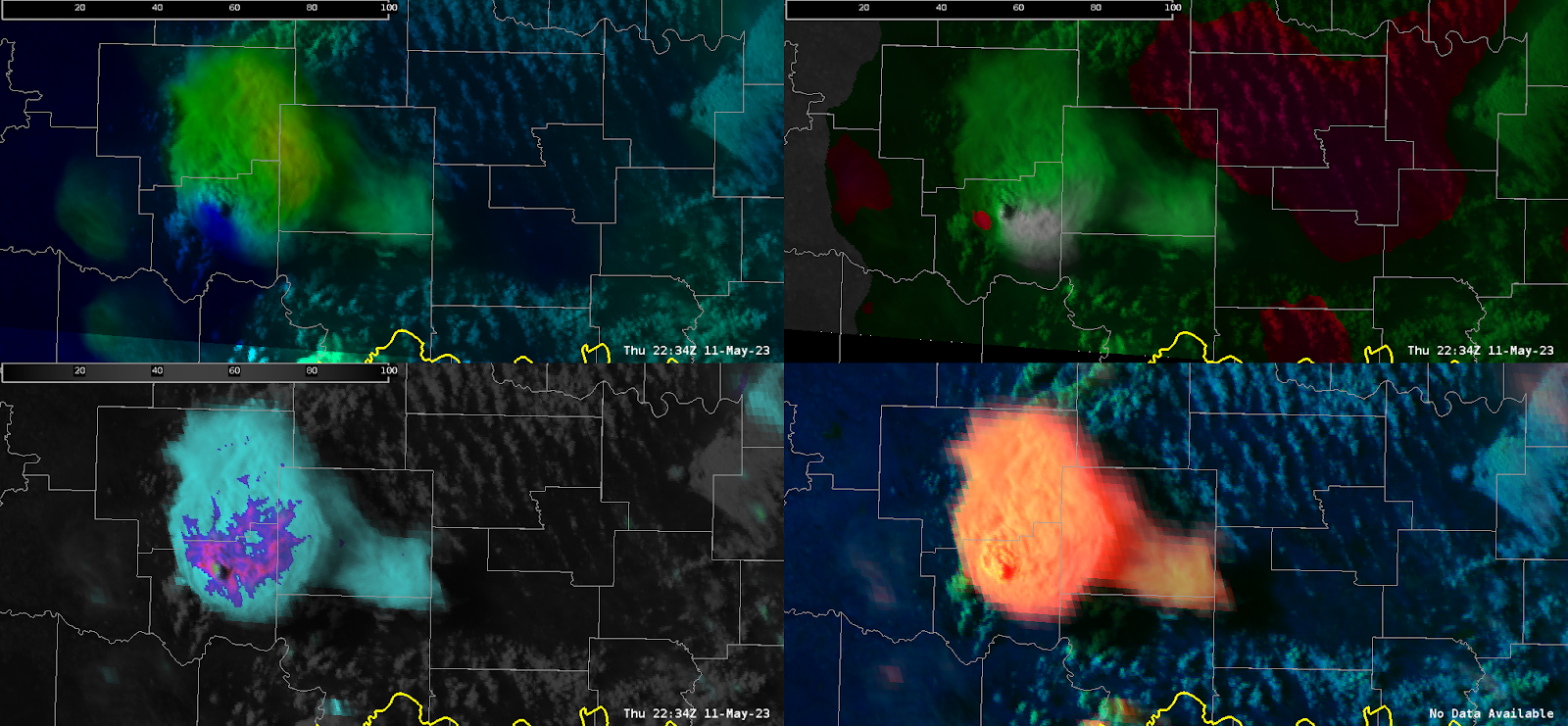
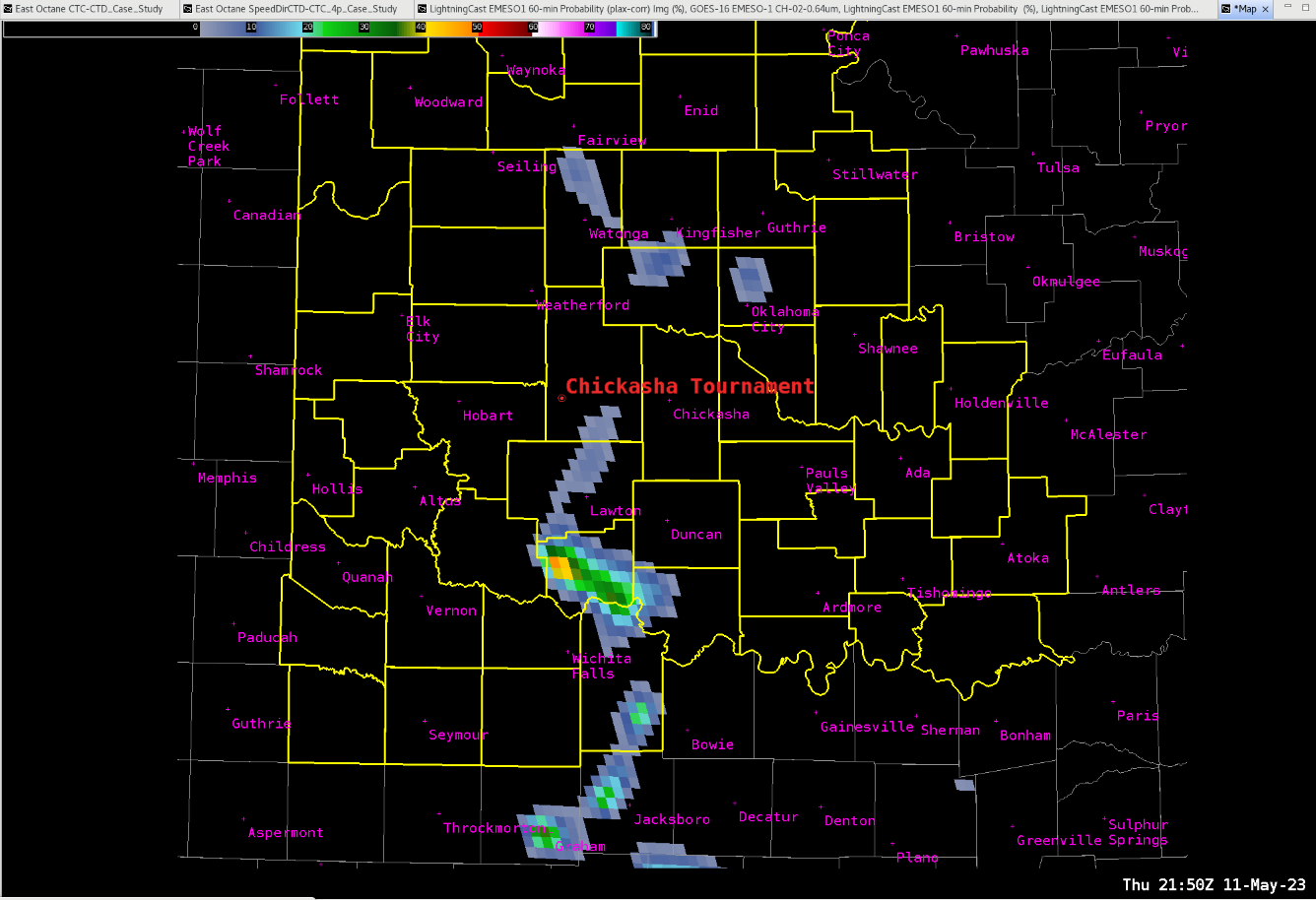
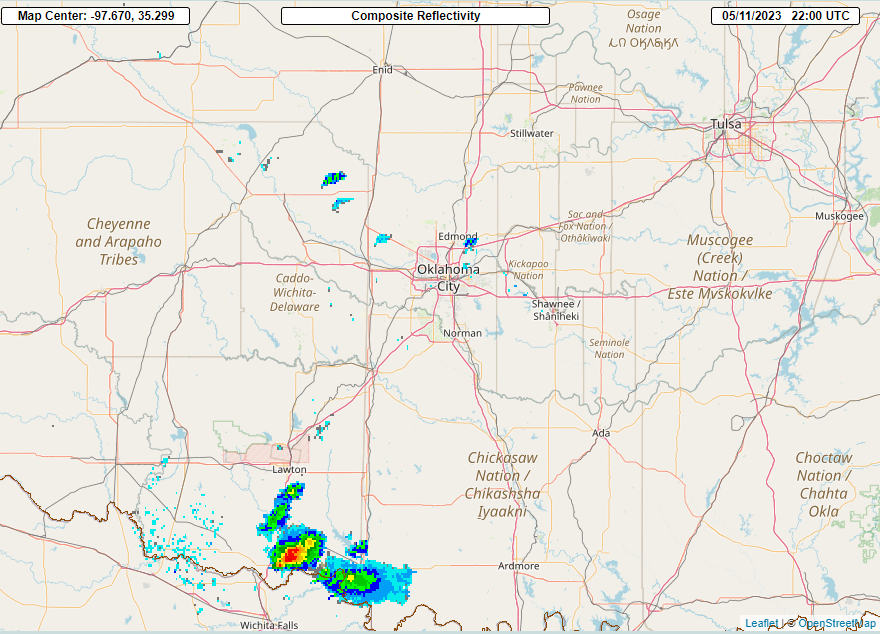
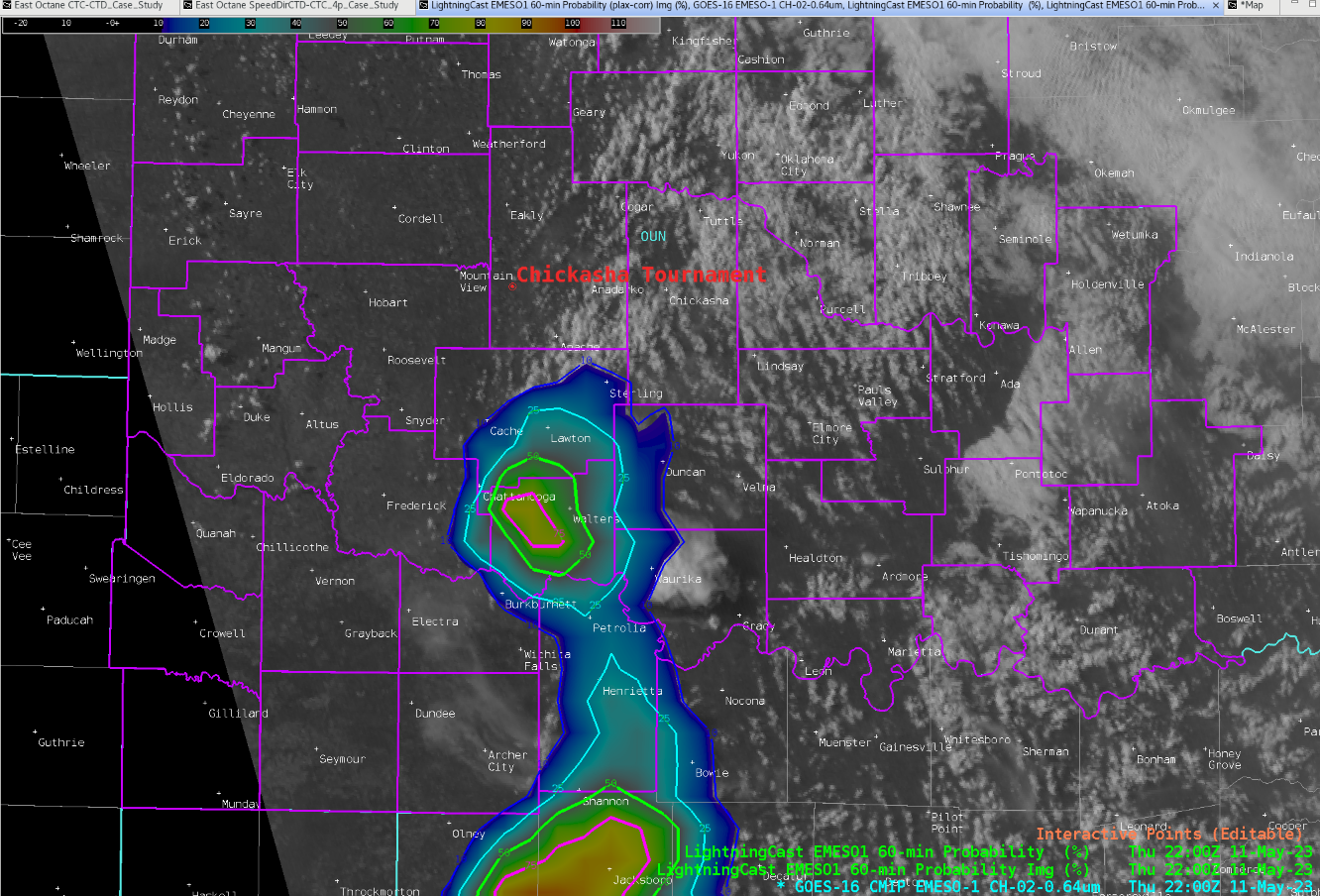
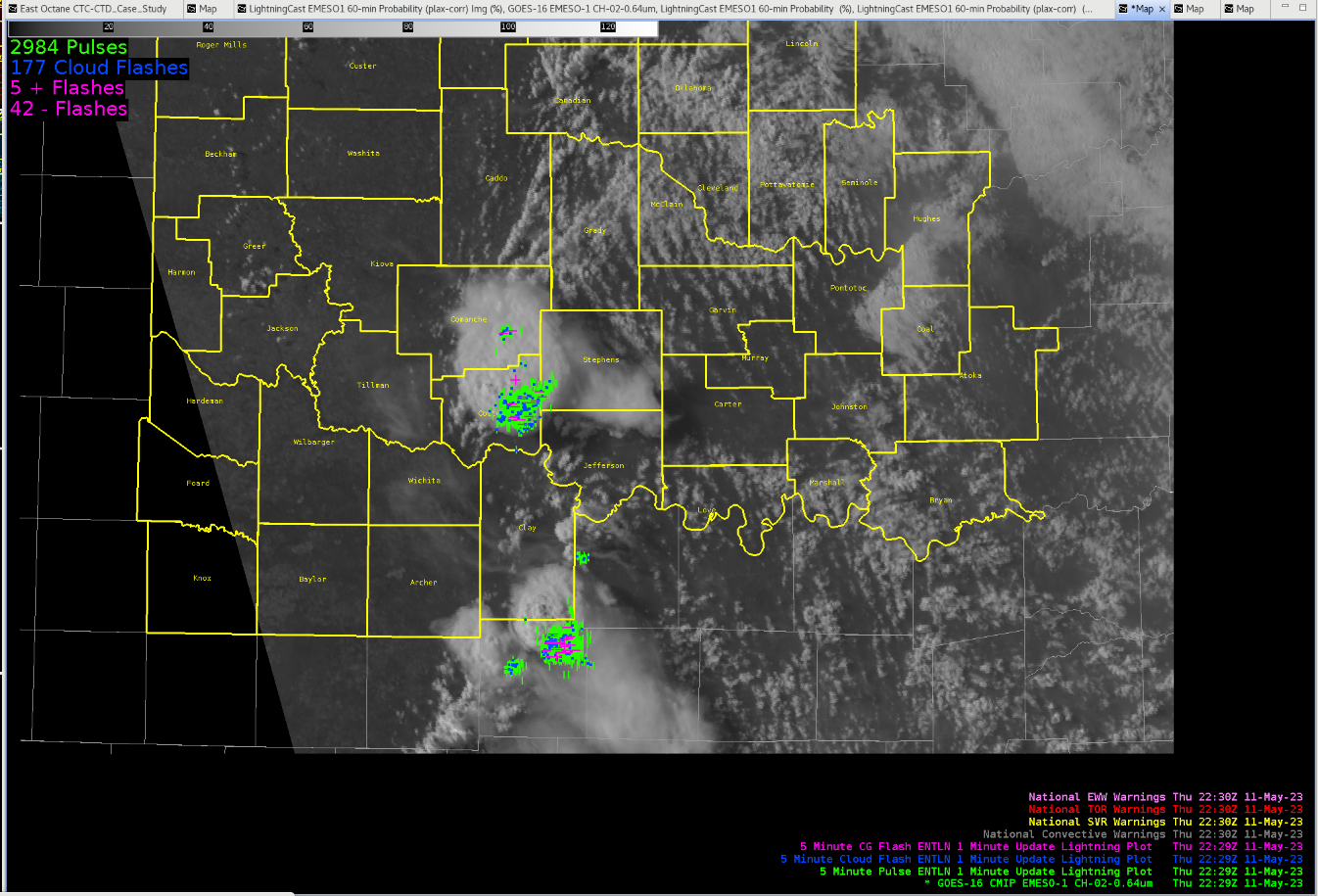
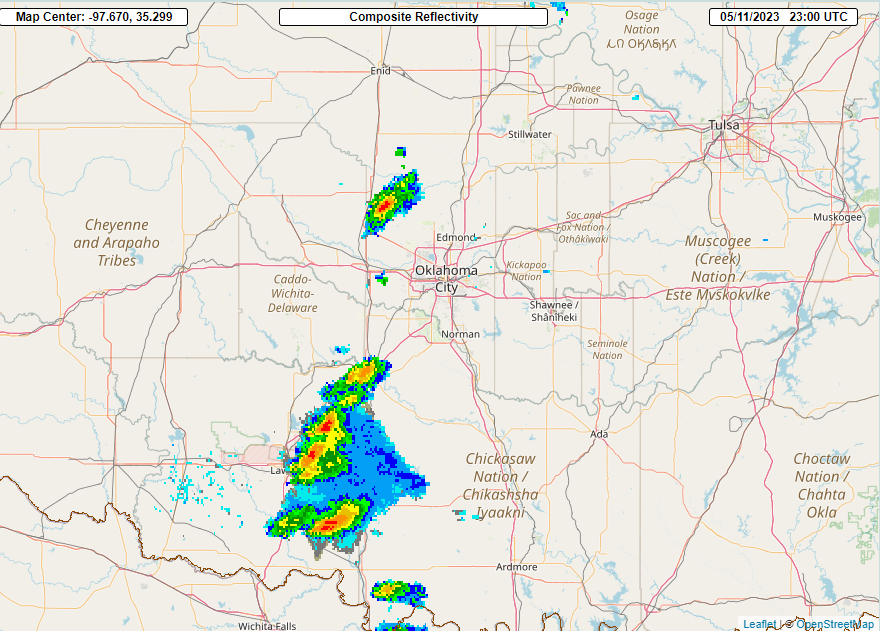
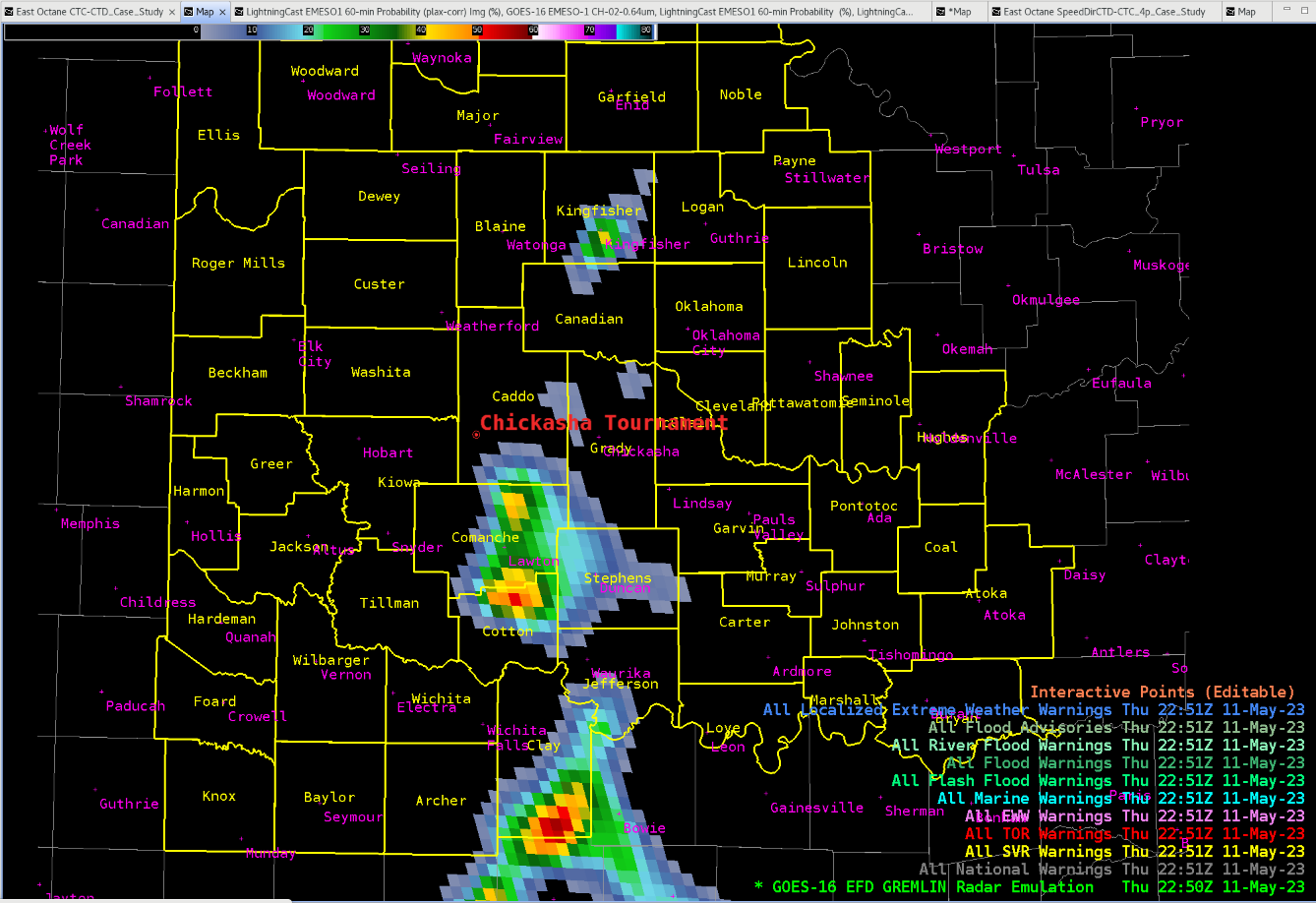
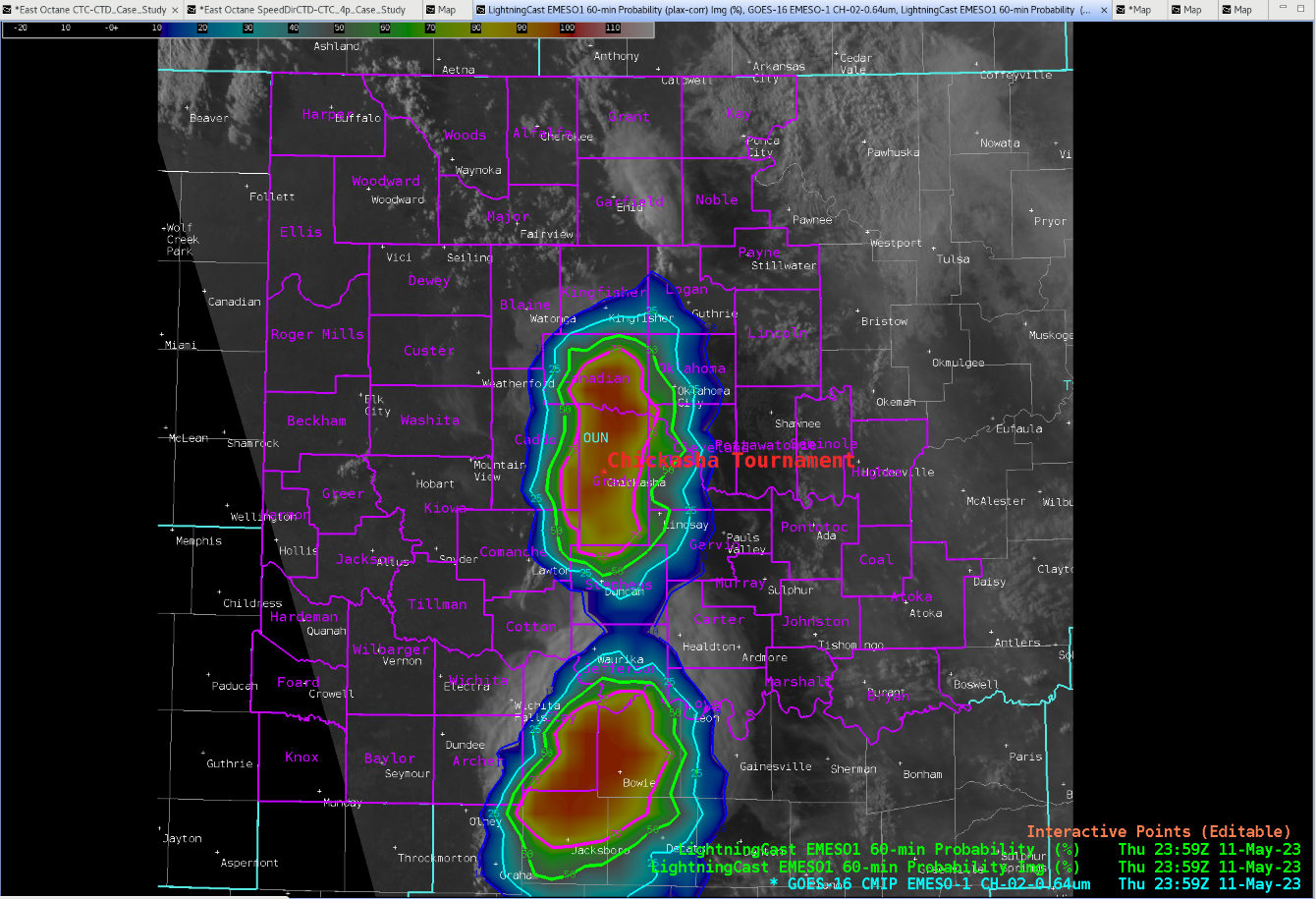
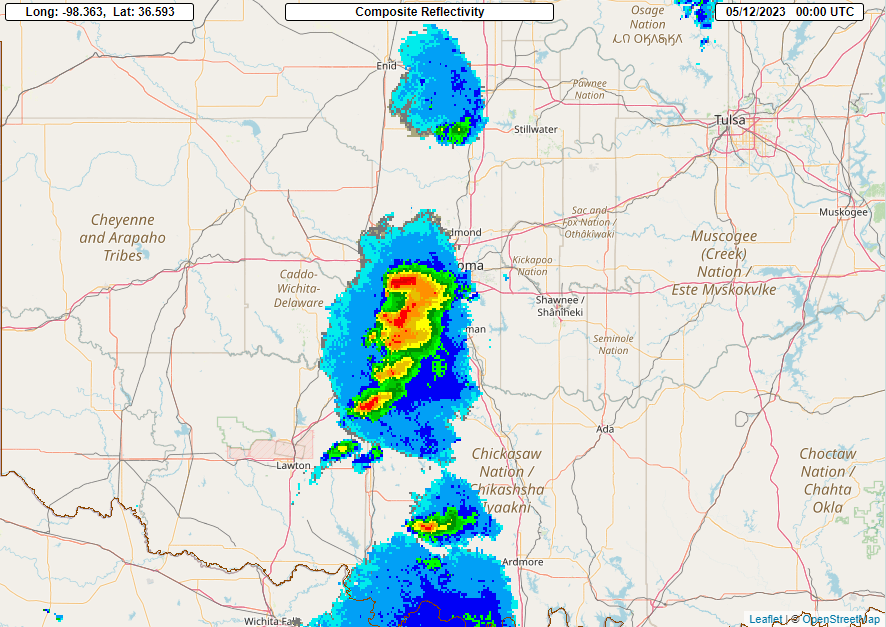
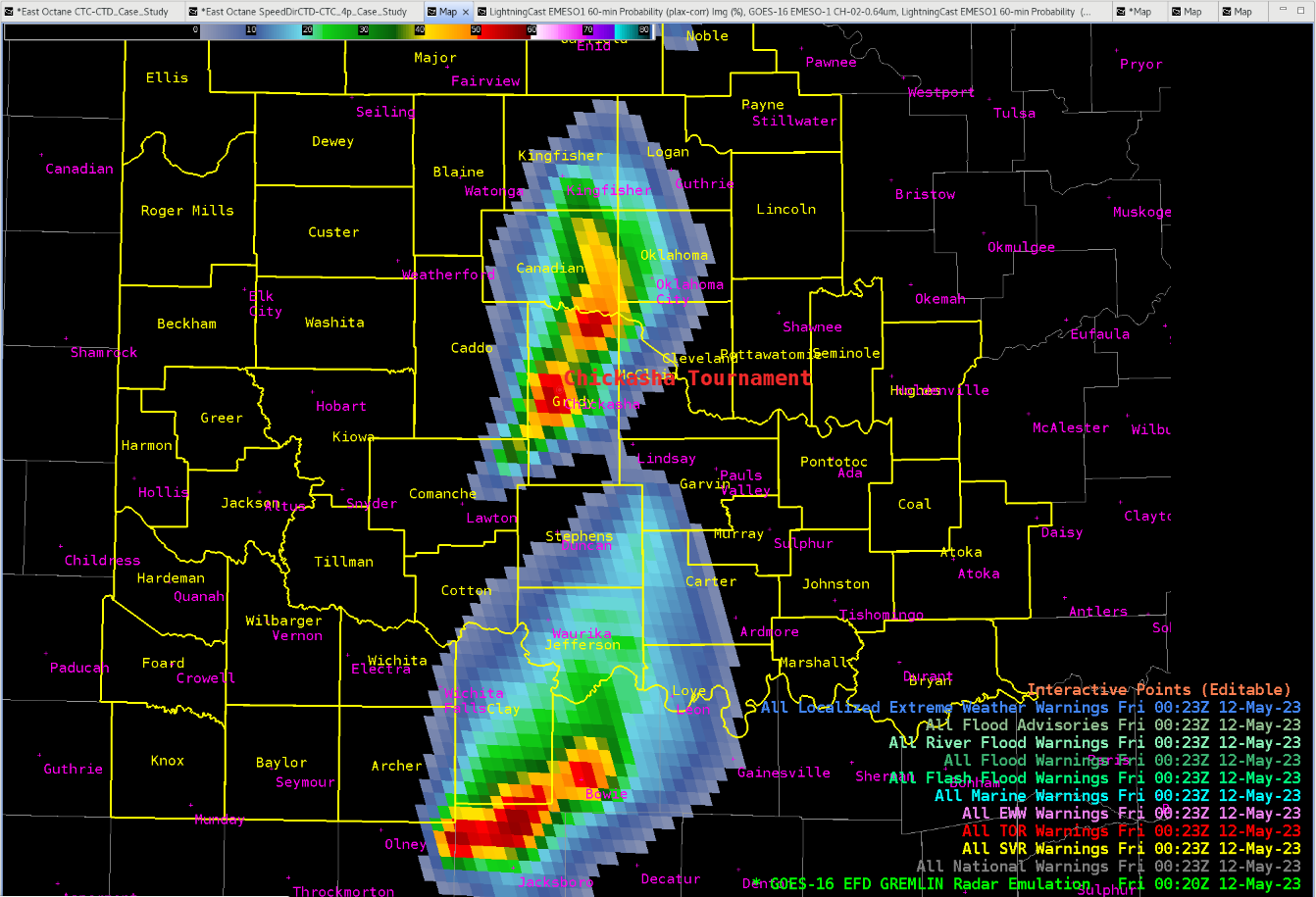
Radar is an essential tool used across all CWA’s daily. What would you do if your CWA had the potential for severe weather but you did not have radar or MRMS? Well that is something I was able to experience today across KOUN’s CWA. Satellite convective products such as GREMLIN and LightningCast were crucial in being able to determine storm location and intensity. GREMLIN was helpful in being able to get an idea of the location of storms along with their intensity even though the range of reflectivity with GREMLIN is limited. The general idea was to see if there were any areas with high end reflectivity near 50 dbz as that usually indicated an area of stronger storms. If there were any areas with lesser values this may mean developing storms that could be checked with LightningCast data to see if it believes storm development is likely to occur there. Speaking of LightningCast it was very useful in determining locations of possible future storm development. Using the >1 strikes within the next 60 mins really helps highlight areas of potential storm development and motion. When comparing these products to actual reflectivity there are a few things that stand out. The first being a good ability to get a general idea of potential strong storms and future storm development. Both products highlighted about the same area where the actual reflectivity was located and where lightning clusters developed.

\

These products were then able to do a good job in picking up the intensifying storms and their likely future location. This was shown from data taken at around 23Z.

Overall, both of these products were extremely useful and successful when it came to forecasting severe thunderstorms in a scenario where radar was not available. I can most definitely see these products being applied to everyday convective ops at CWA’s across the CONUS. The last two images show the 00Z comparison between GREMLIN and actual radar reflectivity.

– Sven The Puffin

Tags: None

OCTANE in a Pulse Environment

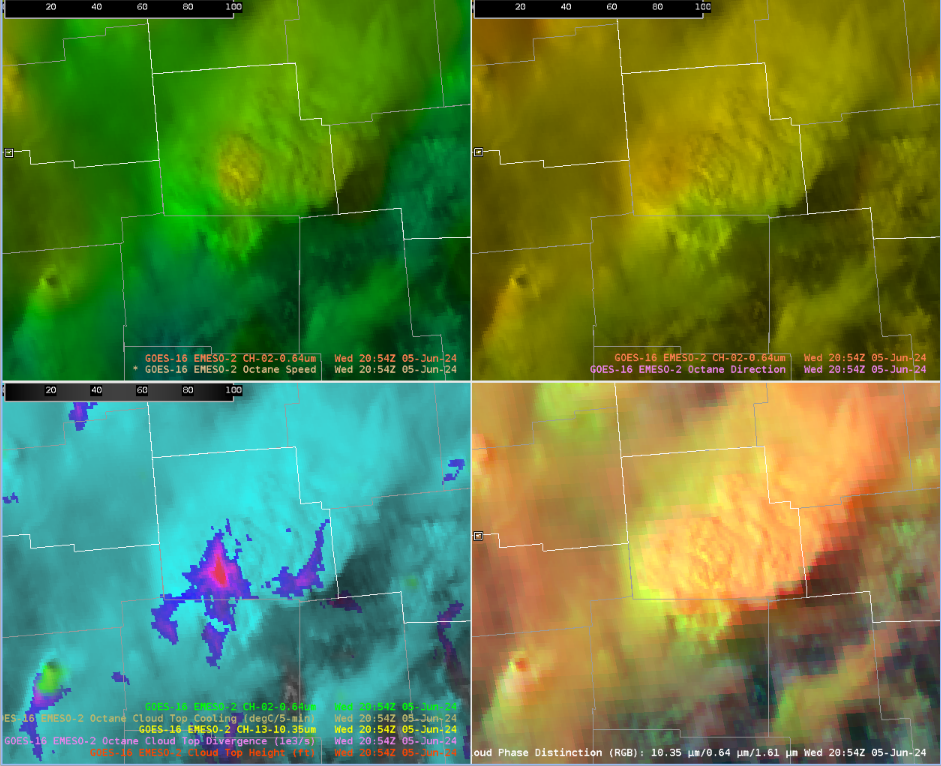
The environment across the ILN CWA this afternoon was one which favored pulse convection as deep layer shear was fairly weak. At around 4:45, we began watching a storm in the northern portion of the CWA that seemed to be strengthening quickly. Unfortunately, the OCTANE data was coming in around 30 minutes late at this point, so we had to rely on traditional methods to assess storm strength. We decided to put out a Severe Thunderstorm Warning on the storm as radar indicated that it was capable of producing 1” hail. Luckily, the OCTANE data caught up not long after and I was able to analyze it as well.

This first image is from around the time that the warning was issued. Looking at the speed and direction products, we see that the gradients are rather diffuse. This is indicative of the weak deep layer shear. However, looking at the cloud top cooling, we see cooling of around 3°C which implies that the updraft was strengthening at the time the warning was issued.

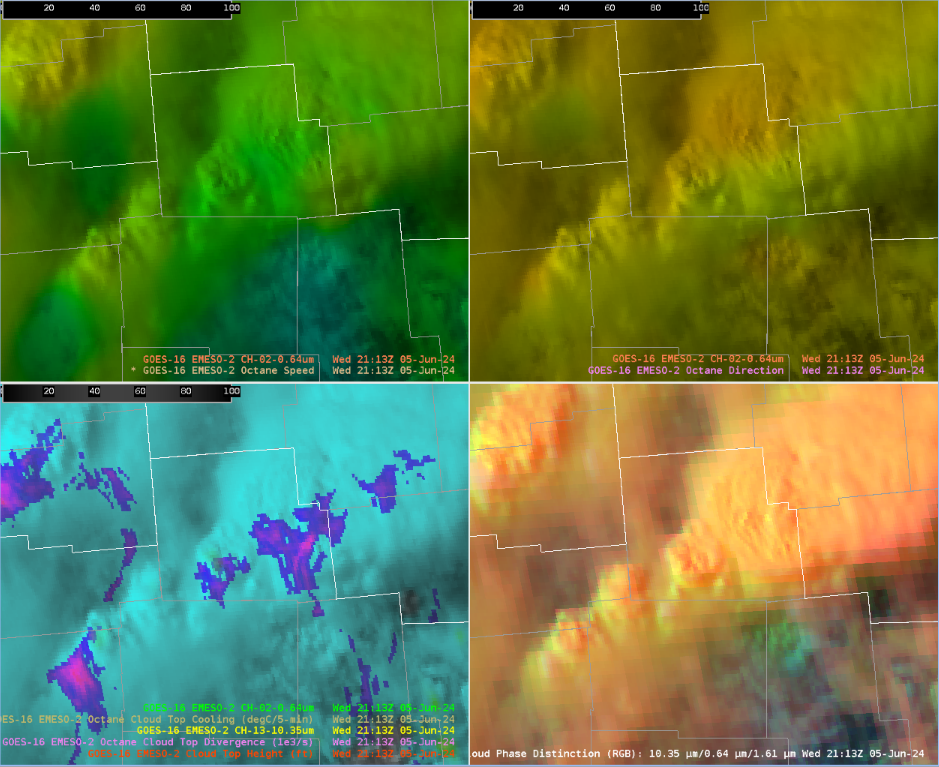
This next image is from 4 minutes later. The speed and direction products still show a diffuse gradient, but the cloud top divergence product really stands out. This lines up with when the storm appeared strongest on radar.

This final image is from around the time that the warning expired. The cloud top divergence is considerably weaker than it had been and radar also indicated that the storm was weaker. We were comfortable with letting the warning expire.

This storm made me think about the utility of OCTANE products in a pulse severe environment. It seems that the cloud top cooling and cloud top divergence products would be significantly more useful than the speed and direction products as you can use them to quickly infer changes in the severity of the storm based on updraft strength.

-EI2018

Tags: None

LightningCast Miscellany over Ohio

The scenario for the Ohio/Indiana area today is pop-up convection ahead of a cold front, with a gap, followed by the front itself. The pop-up convection was already getting going when we began ops for the day, but a few cells were able to be observed in the developing stages. The main convection with the front was just starting to enter our CWA when HWT ops ended for the day.

Troy Strawberry Festival

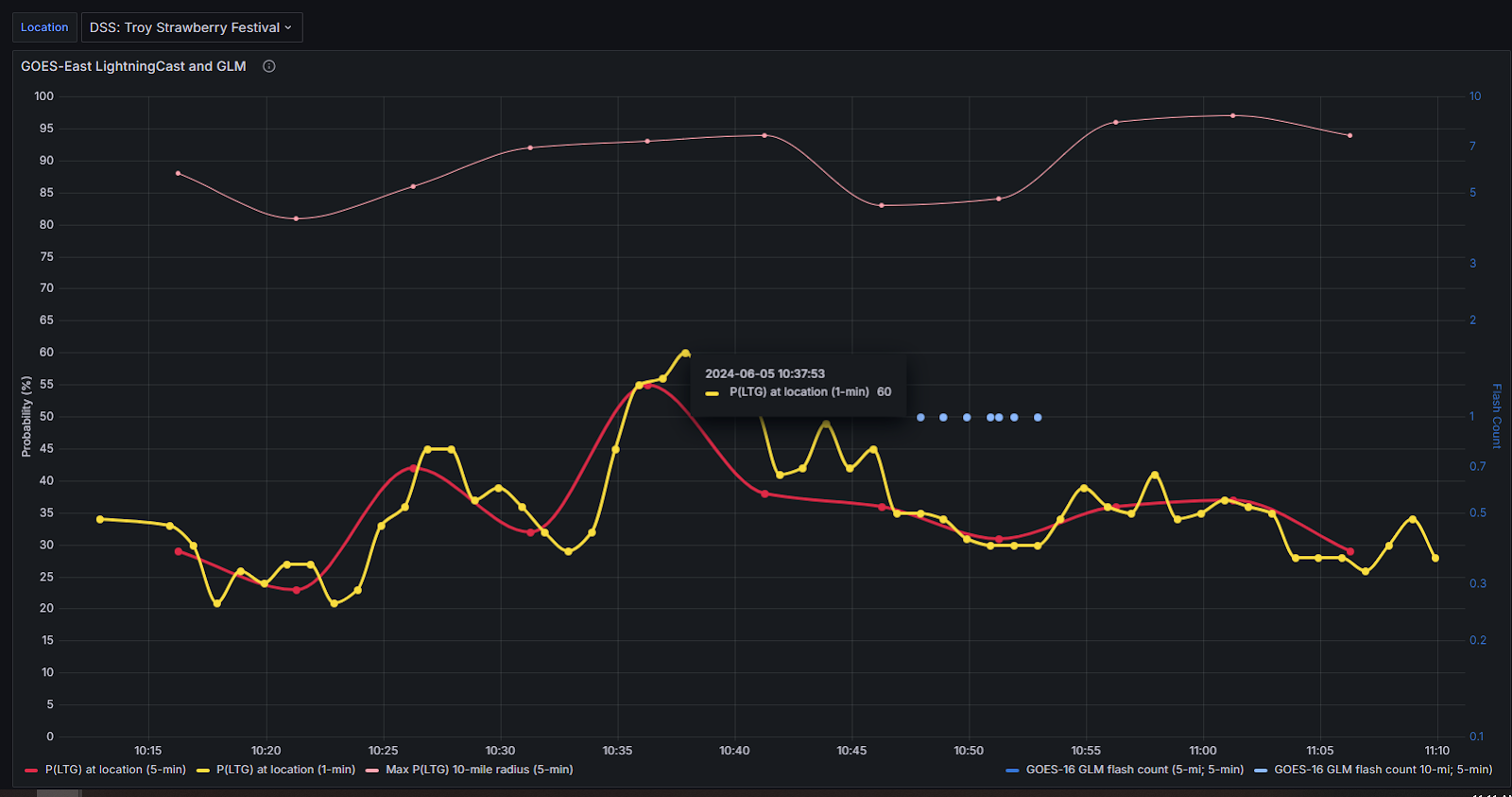
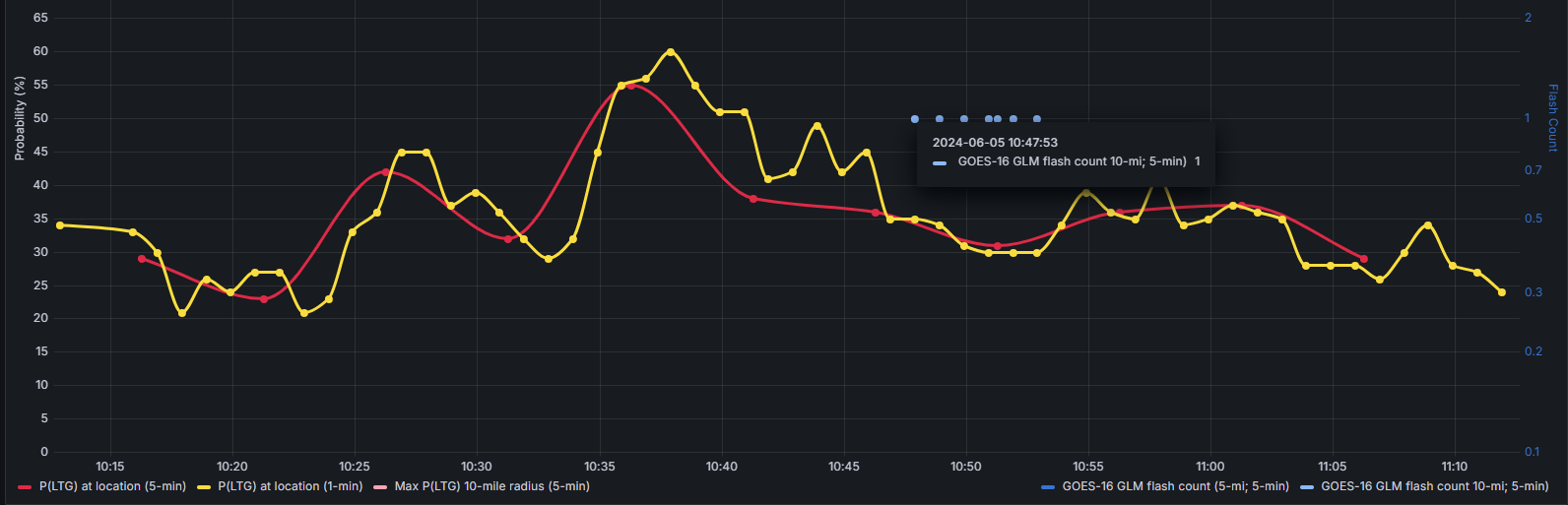
The festival was in the lull environment between the pre-frontal convection and the convection associated with the front itself for the majority of ops today, though a couple cells did approach the festival area early on in our shift. We were still getting spun up for the day when those cells developed. It was technically a missed DSS event, but I utilized the on-demand LightningCast dashboard to retroactively look at the situation and see how the LC performed and the utility of the dashboard itself. With this event, LightningCast performed fairly well, giving an approximately 10 minute lead time between the peak lightning probability within the following hour and the first GLM flash. A few minutes of additional lead time could be tacked on if you go back to when the probabilities began to spike. I believe this rapid rise in probabilities to be enough time to quickly give the festival a call, alerting them to the likelihood of lightning within the next hour. However, not sure if we’d be able to tell them it would occur in the next 10-15 minutes.

Darke County LightningCast Progression

LightningCast dashboard plot showing the time and probability value of the peak.
LightningCast dashboard plot showing the time of the first GLM lightning flash observation.
– Loki
Tags: None

PHS/HRRR/SPC Meso Comparative Analysis

Overview:

For this event over the ILN CWA, we will focus on 3hr forecast verification from hourly runs of the PHS and HRRR starting at 17Z, ending at 20Z. Each models 3hr forecast will be compared with SPC mesoanalysis data for verification/comparative analysis.

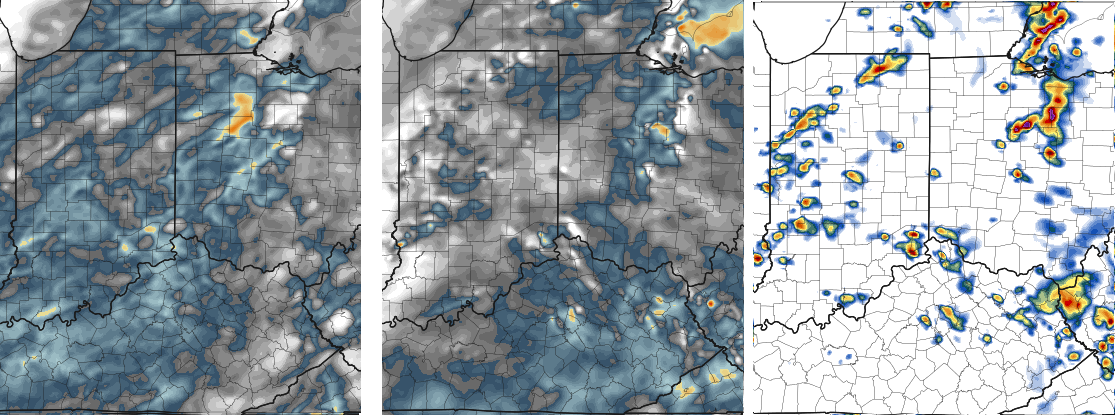
PHS & HRRR 3hr Forecast Comparison & SPC Meso Verification [20-23Z]

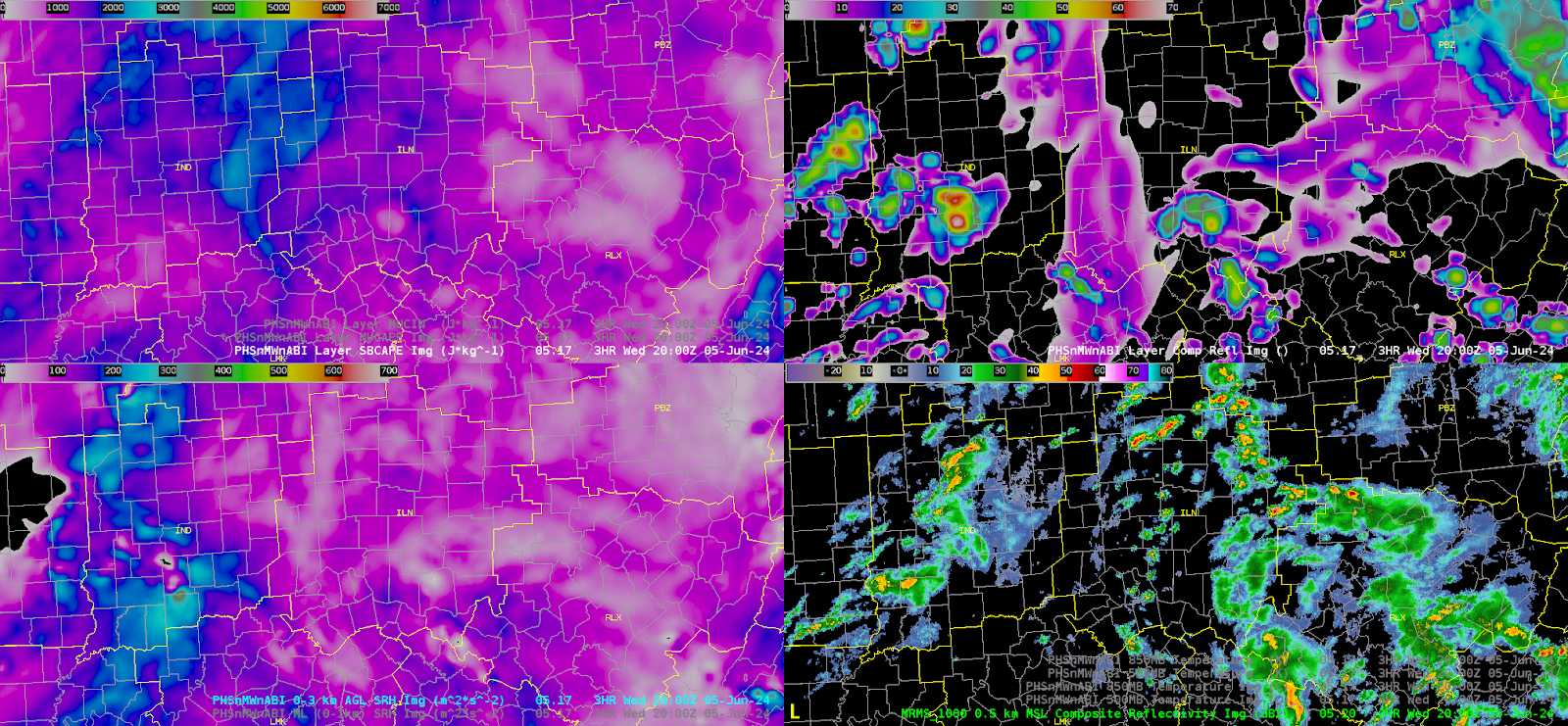
PHS 17:00Z valid for 20:00Z

SBCAPE [J/kg, top left], Layer Comp Ref [top right], 0-3km SRH [m2/s2, bottom left], MRMS Comp Ref [dBZ, bottom right]

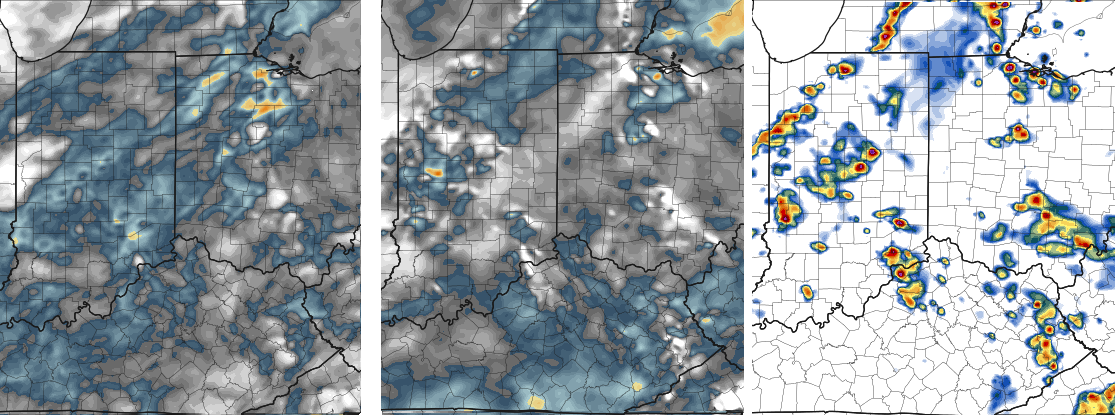
1700Z HRRR valid for 20:00Z

SB CAPE [J/kg, left], 0-3km SRH [m2/s2, middle], Sim Comp Ref [dBZ, right]

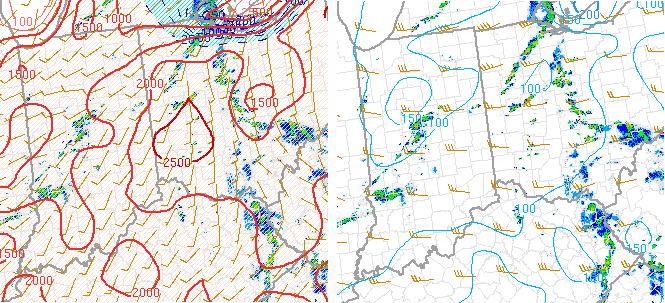
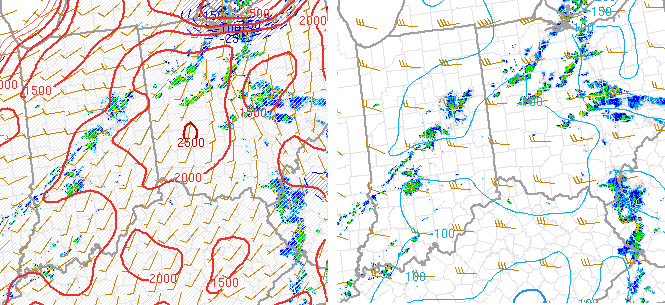
20:00Z SPC Mesoanalysis

SB CAPE/CIN [J/kg, left] & 0-3km SRH [m2/s2 + Storm Motion, right]

20:00Z Summary:

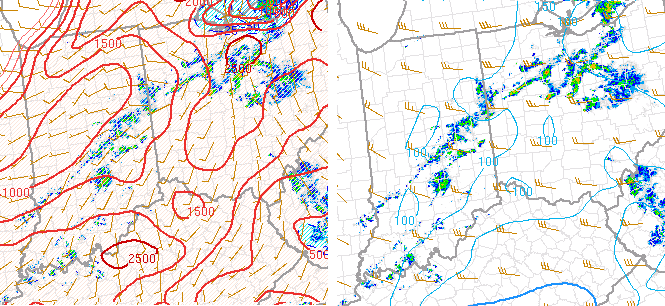
Lingering convection was observed around the area, but diminishing in intensity/coverage. PHS identifies a bullseye of higher 0-3km SRH to the south/west around the order of 150-250 m2/s2, while the HRRR has much lower values around 50-100m2/s2 which verified closer to SPC Mesoanalysis.
Instability was much greater per SPC mesoanalysis upwards of 2000-2500 J/kg, where both the PHS and HRRR were forecasting much lower values.
Convection would be slightly overdone in intensity/coverage from both the HRRR and PHS.

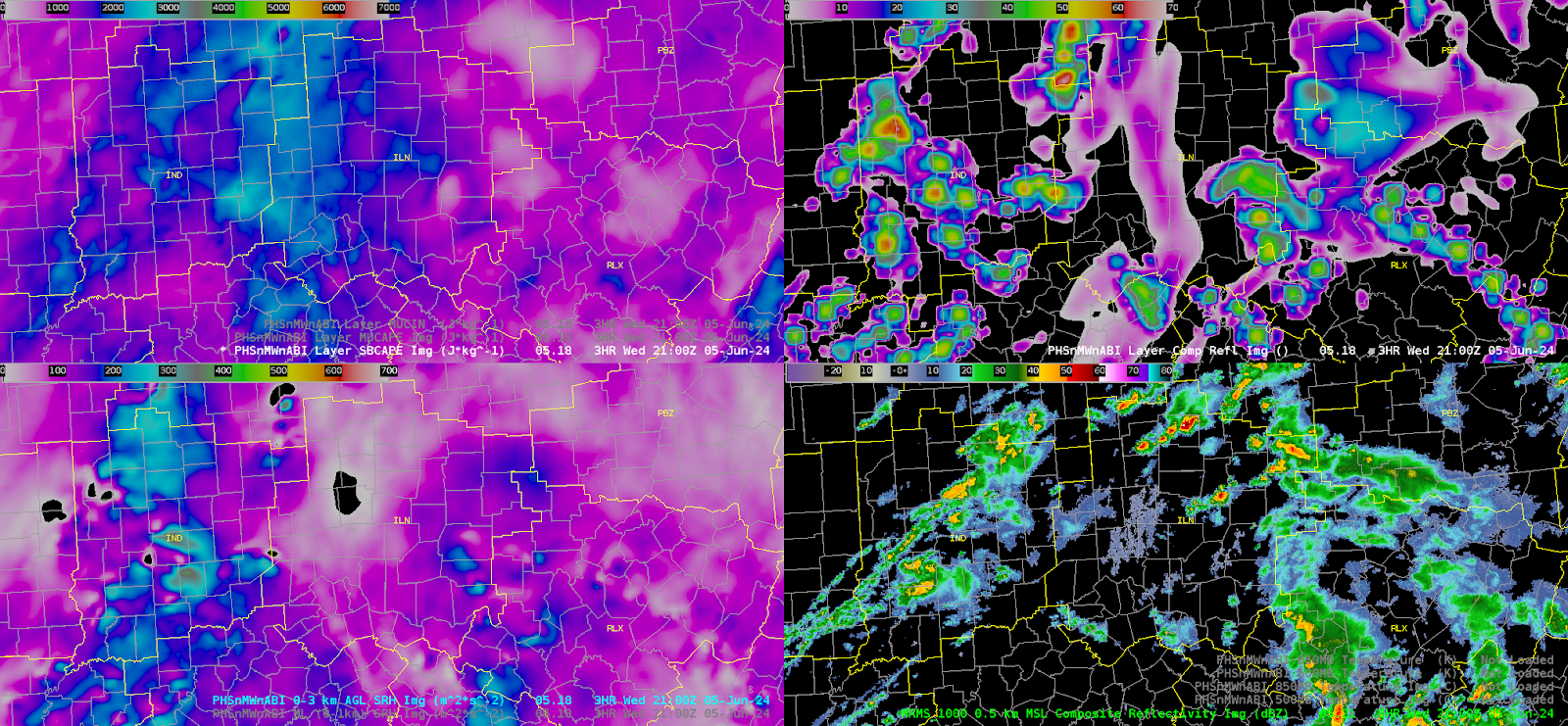
PHS 18:00Z valid for 21:00Z

SBCAPE [J/kg, top left], Layer Comp Ref [top right], 0-3km SRH [m2/s2, bottom left], MRMS Comp Ref [dBZ, bottom right]

1800Z HRRR Valid for 21:00Z

SB CAPE [J/kg, left], 0-3km SRH [m2/s2, middle], Sim Comp Ref [dBZ, right]

21:00Z SPC Mesoanalysis.

SB CAPE/CIN [J/kg, left] & 0-3km SRH [m2/s2 + Storm Motion, right]

21:00Z Summary:

By this time frame, we entered a lull in the activity as convection pushed off to the northeast. PHS and HRRR kept some lingering activity across the area. Instability varied between the PHS showing a continued higher corridor to the west, with the HRRR that had overall lower values on the order of 1000-1500 J/kg while SPC Mesoanalysis kept higher values above 2000 J/kg.
Convection was slightly overdone by both models by this point.

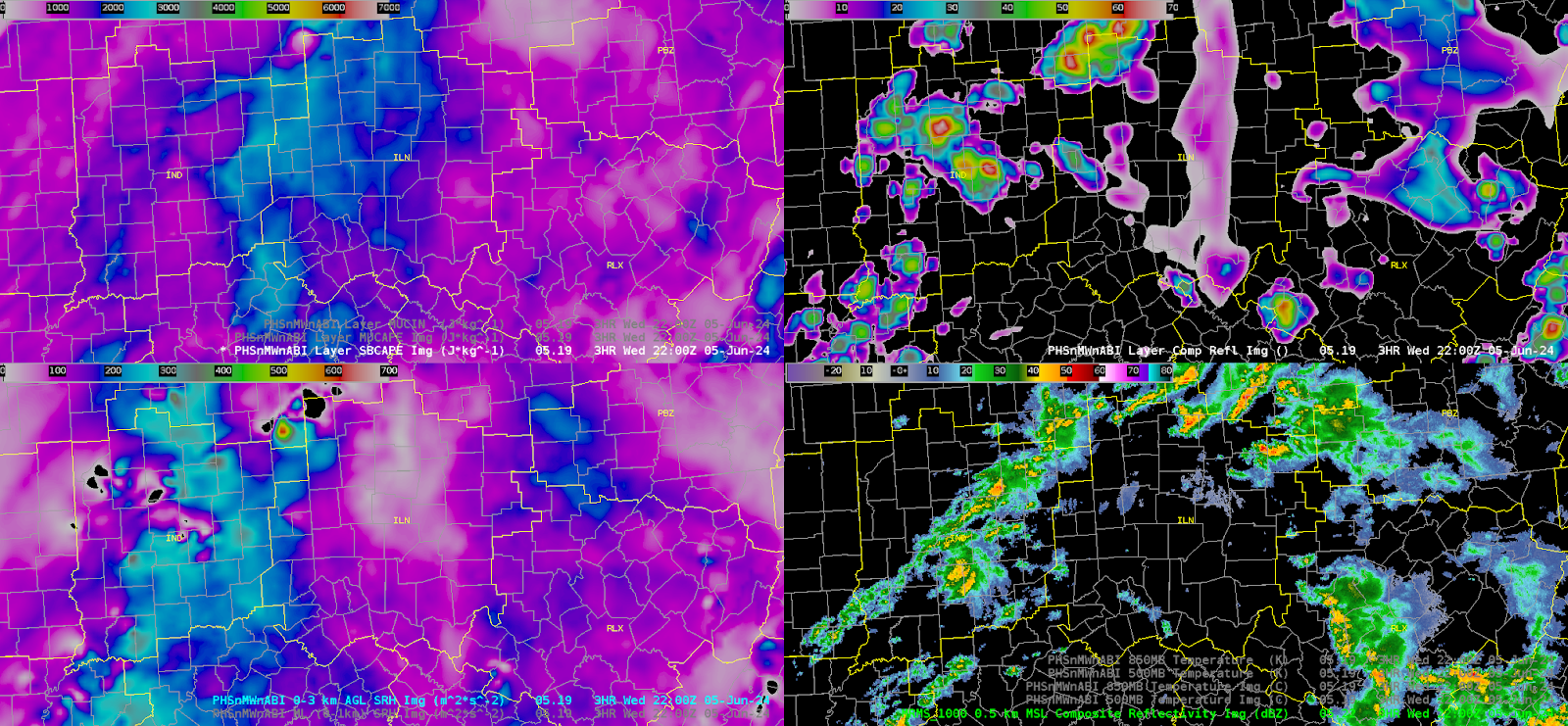
PHS 19:00Z valid for 22:00Z

SBCAPE [J/kg, top left], Layer Comp Ref [top right], 0-3km SRH [m2/s2, bottom left], MRMS Comp Ref [dBZ, bottom right]

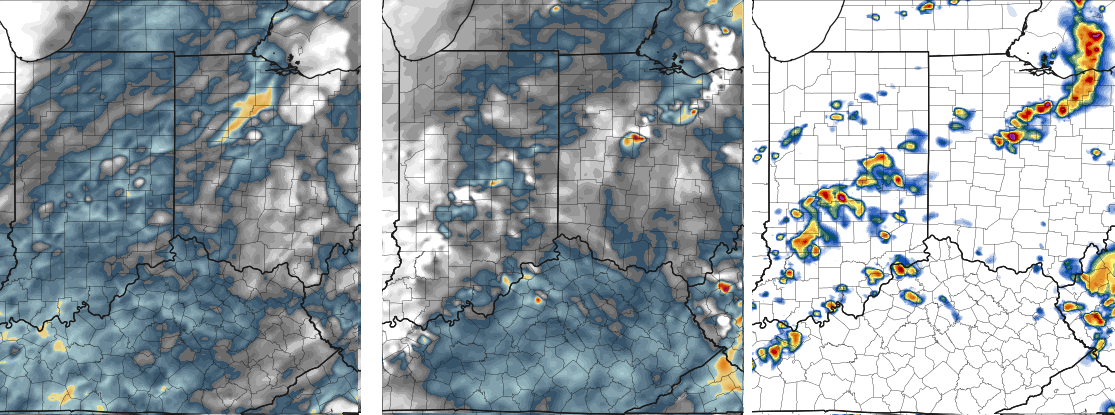
1900Z HRRR Valid for 22:00Z

SB CAPE [J/kg, left], 0-3km SRH [m2/s2, middle], Sim Comp Ref [dBZ, right]

22:00Z SPC Mesoanalysis.

SB CAPE/CIN [J/kg, left] & 0-3km SRH [m2/s2 + Storm Motion, right]

22:00Z Summary:

Started seeing both the PHS and HRRR catch up with diminishing trends in convection. SB CAPE lowered per SPC Meso, closer to HRRR/PHS suggested forecast values but the PHS remained consistently high at estimated 0-3km SRH to the SW of the CWA that did not match SPC mesoanalysis values.

PHS 20:00Z valid for 23:00Z

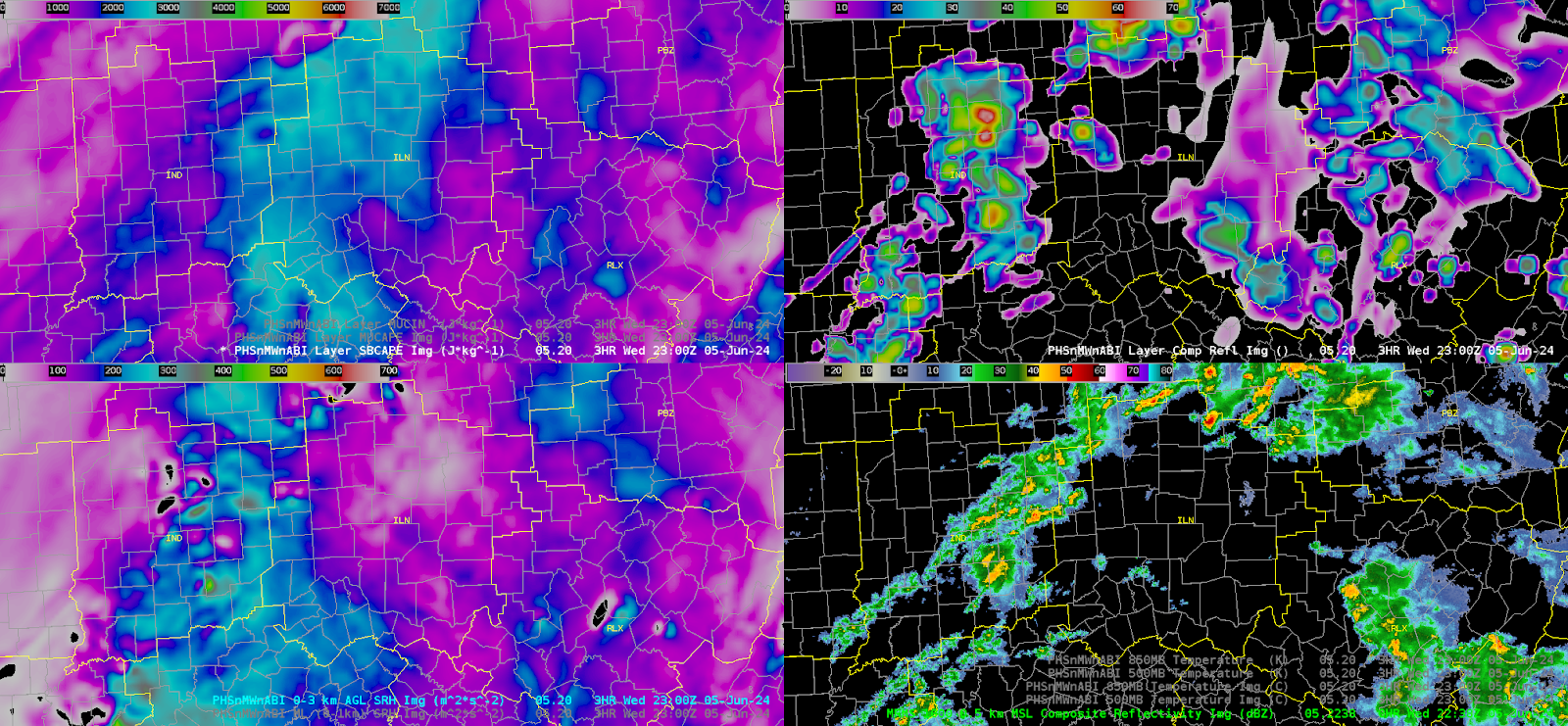
SBCAPE [J/kg, top left], Layer Comp Ref [top right], 0-3km SRH [m2/s2, bottom left], MRMS Comp Ref [dBZ, bottom right]

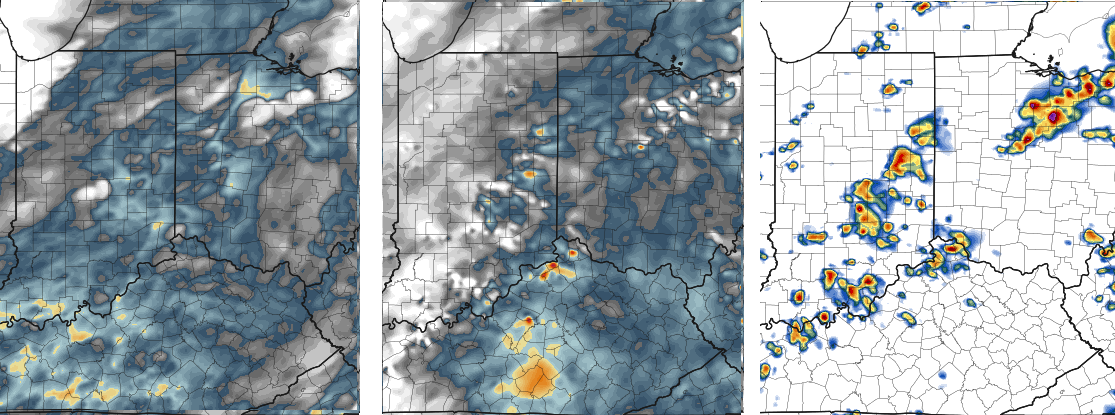
2000Z HRRR Valid for 23:00Z

SB CAPE [J/kg, left], 0-3km SRH [m2/s2, middle], Sim Comp Ref [dBZ, right]

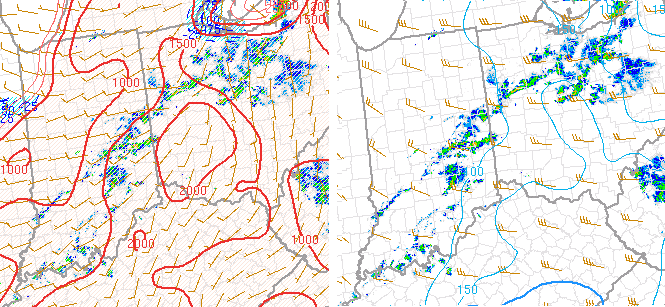
22:00Z SPC Mesoanalysis.

SB CAPE/CIN [J/kg, left] & 0-3km SRH [m2/s2 + Storm Motion, right]

23:00Z Summary:

Activity started to perk ip along the front to the west, associated with greater forcing while both models hinted at this temporary lull persisting (HRRR being slightly more aggressive with convective coverage). The HRRR started to pinpoint a steady increase in 0-3km SRH to the south reaching around 200-250 m2/s2 but still was shy of PHS forecast values around 250-350 m2/s2. SPC Mesoanalysis continued to show much lower 0-3km SRH.

Total Event Summary

  • Both the HRRR and PHS forecasted lower SBCAPE values than SPC Mesoanalysis data depicted. The HRRR being the lowest on the order of 1000-1500 J/kg. The PHS constantly pinpointed a greater axis of instability to the west reaching 1500-2000 J/Kg while SPC Meso illustrated much more widespread areas of 2000-2500J/kg of SBCAPE.
  • The PHS was much more aggressive with predicting an increase of 0-3km SRH from the southwest with values reaching 250-350m2/s2. The HRRR illustrated this increase, but position was displaced more east and magnitude was much lower in the 100-200m2/s2 range. Both models were considered aggressive compared to SPC mesoanalysis trends showing values ranging mainly around the 100 m2/s2 range.
  • In reality, per SPC Mesoanalysis hourly trends, the lull of activity between 21-23Z could be due to lack of large-scale forcing regardless of the widespread areal coverage of available instability coincided with low values of shear. Greatest forcing was along the approaching front, which increased going into the later hours.
  • Both the PHS and HRRR trends depicted overall slightly greater convective coverage throughout compared to observed, with noticeable differences between the two compared to SPC meso data.
– RED11248
Tags: None