
GREMLIN Goes Over 60dBZ?!

A very interesting thing happened with the GREMLIN tool with today’s supercell southwest of Wichita Falls, TX. After a very strong upward burst in the updraft and surge in lightning activity, the CONUS GREMLIN actually showed simulated returns over 60dBZ, despite the product supposedly having a hard cap at that level. Simulated returns as high as around 64dBZ were noted.

Fig. 1. Clockwise from top left:GREMLIN GOES-East Meso1; MRMS Composite Reflectivity; GREMLIN GOES-East CONUS; GOES-East Meso1 Channel 13 10.35µm IR imagery.

Looking at the loop before and leading up to this time (Fig. 2), we see persistent high overshooting tops in the IR imagery, and even evidence of gravity waves surrounding propagating away from the core of the overshooting top. The Mesosector GREMLIN was a bit less and jumpy, but did eventually show consistently stronger simulated returns. Meanwhile, the CONUS GREMLIN would continue to consistently show strong returns at least approaching 60dBZ even after this loop. The GLM Flash Extent Density (Fig. 2 overlay) does show higher values in the frames leading up to GREMLIN going over 60dBZ.

Fig 2. Same as Fig 1, for a loop from 2024z to 2035z.

Fig 3. Same as Fig 2, with GOES-EAST GLM flash extent density overlaid.

– Marko Ramius
Tags: None

LightningCast Dashboard

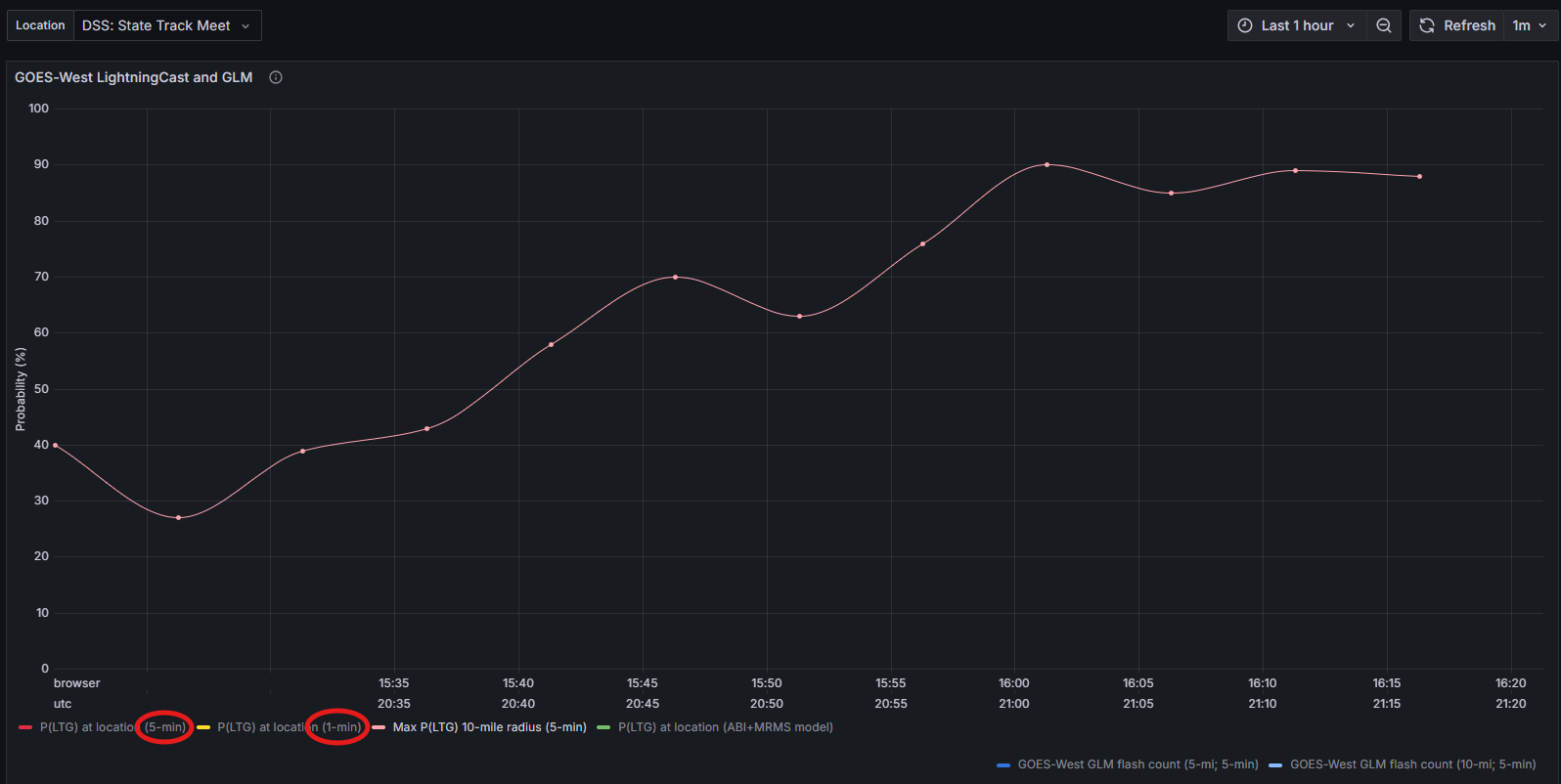
One of the more useful features for DSS messaging today was the Dashboard Request Form for values at our State Track Meet. Since we were operating under the assumption that the go or no-go threshold for this event was lightning within 10 miles, I liked using the dashboard but isolating the Max P 10-mile radius line in pink.

One note of feedback I had was to add some context for what we’re looking in each line at by noting where the data comes from in the legend. I was able to verbally ask a visiting scientist exactly what each line meant and where the data comes from, but this may not always be an option. The suggestion we came up with was adding (5-min, CONUS) and (1-min, MESO) to the legends circled in red so that it’s clear that the 5 minute data came from the CONUS satellite and the 1 minute data comes from one of the mesosectors.

– millibar

Tags: None

Lightning Cast Differences With Pulsing Convection

A weak line of thunderstorms developed and moved into the southern portion of Great Falls, Montana CWA (WFO TFX). Based on MRMS, the storms appeared to be weakening with MRMS and lightningcast V2 began to lower probabilities of lightning quicker than V1. However, slightly after the lightning decreased in V2, both versions increased probabilities of lightning within the next hour to above 90%. Maybe V1 does better with pulsing storms or maybe it was just a single case scenario where V2 dropped in probabilities during what it believed was decaying convection, when in reality it was pulse-like convection.

– Aurora Borealis

Tags: None

OCTANE and a supercell

Day 4 OCTANE

I had a severe storm in the southern part of the CWA that was a little pulse-y, and I found that I was able to look at OCTANE to see when it was on the way back up. Below, I have the OCTANE and radar at the same time stamp- OCTANE shows cooling cloud tops, and the ProbSevere MESH was 1.12”.

OCTANE product and base reflectivity at 21:25z, MESH of 1.12”

A short time later, the MESH jumped up to 2.17” and OCTANE depicted it as a mature cell.

OCTANE product at 21:33z, base reflectivity at 21:38z, MESH 2.17”

I don’t know if anyone reported how big the hail ended up being, but I wouldn’t doubt it was over 1.5”.

– Lightning McQueen

Tags: None

Lightning Cast: Real-Time Monitoring for DSS

The LightningCast Dashboard is an excellent tool to monitor and predict the probability of lightning at a point, which allows us to easily provide decision support services (DSS) for outdoor events.

Here’s an example from today for the Clown Rodeo on the south side of Lubbock, TX:

Notice the LightningCast probabilities for both the ABI and ABI + MRMS generally remained between 0 to 20% during the duration of the event.

These probabilities were associated with developing cumulus clouds in the area, which can be seen in the Day Cloud Phase Distinction RGB:

Typically, if a meteorologist sees developing cumulus similar to shown above in the Day Cloud Phase Distinction RGB, this would result in an increasing concern for lightning at that location. However, it is challenging to quantify this concern and message it probabilistically to our partners. LightningCast gave us confidence to message our partners there is a low probability (10 to 20%) of any lightning strikes within the next hour.

-Vrot

Tags: None

MesoAnywhere Appearance with Sharply Defined Convective Clouds

More of a ‘gee whiz’ post than anything of true operational importance. I thought it interesting that while in many instances you don’t see a big change in the MesoAnywhere images from the ‘real’ GOES images at x1 and x6 minutes, vs the interpolated MesoAnywhere imagery, you can tell if you look closely at sharply defined convective clouds with ‘active’ cloud tops full of bubbling and roiling features. The real imagery (example in Fig. 1) will show features that appear somewhat sharper than the interpolated MesoAnywhere imagery (example in Fig. 2).

Fig. 1. 2126Z ‘Real’ GOES-East Day Cloud Phase Distinction imagery (Right).

Fig. 2. 2128Z Interpolated MesoAnywhere’ GOES-East Day Cloud Phase Distinction imagery. (Left)

– Marko Ramius

Tags: None

CONUS GREMLIN Handling Convection Worse than MESO for a Change Over Western Montana

Figure 1: CONUS GREMLIN. There is a lot of stratiform in TFX and MSO’s area, though it is not being reflected nearly as much as MRMS indicates in Figure 2.

Figure 2: WMESO GREMLIN. Although the Meso Sector doesn’t extend all the way north, it does a better job representing the arcing line of showers. Perhaps it has a tendency to do this on the edge of the domain?

Not a whole lot is happening across MT right now so I will shift my eyes to TX for a bit. OCTANE seems to be doing great with initiation across a puffy CU field across west TX in Figure 3.

Figure 3: Note the cooling tops across all the CU in the unstable environment. A few have already developed into robust storms.

Back to MT…

Cloud tops have cooled somewhat on the storm entering the southwest corner of the CWA with LightningCast increasing accordingly, Figure 4.

Figure 4: LightningCast V2 seems to be handling this better according to lightning obs.

Figure 5: Associated Radar

ECONUS GREMLIN also appears to have picked up on this well (Figure 6).

Figure 6: ECONUS GREMLIN

Figure 7: ECONUS GREMLIN continues to intensify accordingly with what radar and MRMS have.

Additionally, the parallaxing appears to be quite evident once again as shown in Figure 8 and 9. I’d imagine that it’s due to the ECONUS sector, but I am not totally sure. This would be a major issue in my CWA with flooding ops as the warnings tend to be very specific over slot canyon locations, and this could lead to a false alarm or a missed event entirely if we are solely relying on GREMLIN.

Figure 8: Notable parallax issues compared to where my SPS was issued.

Figure 9: Location of the storm according to the KTFX radar.

Tags: None

Getting Supercellular with Octane

After about an hour or so of monitoring the storm to the north and west of the Dallas Fort Worth CWA we finally begin to see signs of a rather mature and intense supercell across portions of northern Texas. Taking a look at the Octane Speed Sandwich we can see clear signs of a much tighter shear gradient, which from my perspective shows a clearly intense supercell.

Figure 1: Octane SPEED Sandwich valid between 2000-2030Z.

Taking a look across some of the more typical radar 4 panels I use, Mesh has become maxed out around 2-2.5 inches, the vertically integrated Ice has become maxed out on the color bar, and finally the MRMS 30 min rotation tracks have begun to perk up with this storm. So while it was outside of our area of responsibility for warning operations, I would not have been shocked if the storm was either severe thunderstorm warned with a considerable tag or even tornado warned.

Figure 2: Four Panel with RALA in the Upper Left, MESH in the upper right corner, 30min MRMS Rotation tracks in the bottom right corner, and VII in the bottom left corner.  Valid times 2000Z-2052Z.

On the mesoanywhere Day Cloud phase distinction, we can also see the overshooting tops with this supercell producing some gravity wave like features, indicating a very intense storm. You can also note that the initial supercell had split with the left moving supercell now pushing across the Red River and into Oklahoma. This left moving supercell went on to produce several large hail reports.

Figure 3: Mesoanywhere Day Cloud Phase Distinction Valid 2030-2056Z.

Finally as the storm began to push southeastwards this evening we did begin to see a weakening trend in the Octance SpeedSandwich product between the upshear and downshear strength which looks to have been a precursor to a weakening trend with the cell between 2130Z and 2230Z. Radar returns began to diminish shortly after this signature with the core of the storm beginning to collapse just as we ended the day.

Figure 4: Octane Speed Sandwich Valid between 2100-2130Z.

Figure 5: KFDR 0.5 Base Refelectivity, Valid between 2118Z-2217Z.

– Sting Jet

Tags: None

MesoAnywhere

Without the help of a meso sector satellite in JAX, the MesoAnywhere overlaid with IR as a sandwich was very helpful in simulating a finer resolution of detail in the supersaturated IR satellite data. Having this sandwich of MesoAnywhere really helped contextualize the behavior of the top of the convection, especially individually growing storms exhibiting overshooting tops. These features are more difficult to see in the plain IR and even in practice on a regular IR/Visible Sandwich on AWIPS. I was easily able to identify that the two cells coming out of TAE’s area were pulsing up at the time of this loop, while storm tops of the JAX convection all bubbled out shortly after the start of the loop and continued on a weakening trend. After the MesoAnywhere was turned off, all the green/yellow colors kind of blended together and nothing was easily discernable.

Loop of convection decaying in JAX’s area and growing in TAE’s area. The first half of the loop has the MesoAnywhere sandwich turned ON, the second has it turned OFF.

– millibar

Tags: None

LightningCast: Version 1 vs Version 2

Throughout the day, there were a few instances of latency issues between version 1 and version 2. It was usually no more than a 30 second delay, but the right panel with version 2 of LightningCast often failed to load in AWIPS for a few moments despite there being no differences in the temporal resolution of each field. Example below of version 1 coming in faster than version 2. This delay was about 20 seconds.

Though versions 1 and 2 of LightningCast perform generally similarly, I did notice a few times where version 2 captured the initiation of new convection better than version 1, such as the offshore cells popping up in these screenshots from 19:21 and 19:31Z.

19:21Z

19:31Z

– millibar

Tags: None